An EVIL Taxi That Requires Your Baby for Payment! “Black Cab” reviewed! (Acorn Media International / Blu-ray)

Anne has lingering reservations about getting back together with cheating boyfriend Patrick but half-heartedly agrees to take him back and even merry him.  The announcement comes as a surprise to dinner friends, including Anne’s best friend Jessica, but before talking out the situation that clearly has the two women upset, Anne is eager to leave and return to her home.  The embattled couple jump into a cab driven by Ian, a gabby cabby prying into the couple’s heated discussions.  When Ian drives down a dark alley and stops to retrieve a map from the trunk, Anne and Patrick realize they’re locked inside the cab.  A returning Ian reveals his true intentions with a purpose still ambiguous why the couple has been abducted but a desperate Ian will do anything, even kill, to get what he loves back from a wistful countryside spirit, and he needs disordered Anne for a trade. 

Should have taken an Uber.  “Black Cab” is the 2024 British abduction and supernatural horror-thriller from serial television and made for TV movie director Bruce Goodison, with a career credits that specializes mostly in tales of international military conflict and British murder mystery, and a screenplay by “Reawakening” writer-director Virginia Gilbert, incorporating into the relationship couple’s discordant flame a sliver of kidnapping, electrical prodding torture, and a desperate act inside the context of an old ghost tale as well as inside the English’s famous hackney carriage of black taxis, using the popular public mode of transportation as a device to market the film’s story for the sordid cab driver.  Filmed in the city of Manchester and the surrounding greater area, the Shudder exclusive presented film is produced by Jan Roldanus of Stolen Pictures and executively produced by Sony International Pictures’s former strategic producer Lucy Robison and current producer Michaela Fereday.

When a moviegoer familiar with actor Nick Frost runs through a mental checklist of the actor’s filmography, comedies like “Hot Fuzz,” “Shaun of the Dead,” “Monster Family,” and “Paul” come to mind with the often lighthearted, sometimes heart wrenching or darkly humorous, storylines in the presence of physicality and fun, done nearly most of the time alongside Frost’s usually entourage and friends, actor Simon Pegg (“Star Trek,” “Run Fatboy Run”) and director Edgar Wright (“Shaun of the Dead,” “Last Night in Soho”), but Frost has been frequently rooted at the base in horror, science fiction, and, well frankly, genre films in general, with the perfect examples being the aforementioned with shoot’em up polizias, zombies, classic monsters, and an Earthbound alien features.  Frost’s comedic genius is all about timing and the way he carries himself jovially and nonchalantly through tough situations, but Frost can also use those same qualities and twist them to enact a man of deeply troubled anguish behind a masked funny face and viperous wit.  That’s his role in Ian, a cab driver with the gift of gab but turns on a dime with forced aggressive intent to take what he needs from Anne, emoting her character’s already internalized troubles with now a threatening abduction conflict from actress Synnove Karlsen (“Last Night in Soho”).  While Anne is poised as can be in the situation, her disagreeing fiancé Patrick has little-to-no merit as a character being a bit of a bully, cheat, and coward.  Luke Norris (Poldark) gives his best unpleasant rendition of a dirtbag white male with misogynistic issues, but the poorly written aspects of Patrick never fully amount to anything but a weighted towline and an extra body to do what what Ian thinks best with.  Tessa Parr and Tilly Woodward make up the rest of the cast. 

“Black Taxi” subsidizes good suspense over the supernatural calling cards that slowly, yet continuously, shows Anne through an emotional struggling, involving a rather vocally rambunctious boyfriend in Patrick, as well as building the tension inside the cab by hinting at its unusual state of tinted windows, child locked doors, and a more than nosy driver, mostly gone unnoticed by Anne and Patrick due to their bickering and heated love life, or lack thereof.  The first two acts slowly feel out where this story is aiming to drive the audience as Ian’s true intentions are well covered and contained and not fully delineated by the baby clues Ian hints at along the way.  There’s an elemental theme of family and protection, loss and heartache, and how that torment is divergently depicted by both the lead principals Ian and Anne, with the latter being more at a crossroads of choices whereas Ian has already made his choice and it’s one he won’t or can’t come back from.  The third act is mostly where the supernatural factors come into play with the infamous haunting of Mabel Hill, a fiction road supposedly paranormal charged with the ghost of a woman who lost her baby fleeing an abusive relationship and continues to search for the child through bypassing passenger vehicles.  The third act is also where things get murky under the black and white essence of Ian’s motivations as the Ian, Anne, and the ghost are nebulously intertwining on Mabel Hill in some sort of supernatural netherworld dimension that plays mind tricks and is foggy with phantom, falling apart at the seams to support a porous ending.

“Black Cab’s” fare is prenatally pricy in this new release from Acorn Media International and presented as a Shudder exclusive. The UK release is AVC encoded, 1080p high-definition, BD25 that renders a softer image quality that, in all fairness, was already foggy and murky being set in the darkness of the English countryside, presented in a widescreen 2.35:1 aspect ratio. Lots of shadows and silhouetted surroundings drowns out the delineated city structures that blend to the spooky forest as the focus is significantly on the interiors, the cab and the abandoned hotel, and not even those highlighted inmost sets solidified specifics. There’s quite a bit of banding from compression and that’s not to be surprising given the format size and the profound amount of tenebrous tone. Textures along Frost’s dressed-in-black casuals or in contrast to Karlsen’s cocktail outfit that’s more nightgown than ritzy, they’re just not there to extensively define Ian and Anne other than being the epitome of differing the dark and light of loss. “Black Cab” has more of a cityscape than a landscape though the story heavily hits upon Mabel Hill as ghost central and yet lacks the elucidation as well as the finer points to flesh out the haunted area. The ghost too is more a cheap visual effects trick than the implementation of palpable practical patience with an overlaid layer of overexposed blues and whites over top the actress to be then augmented into the scene for ethereal effect. The English language DTS-HD 5.1 surround mix is a better outfit, more so in the clean and clear dialogue exchanges between the trio of Nick Frost, Synnove Karlsen, and Luck Norris but does whittle down to the Nick Frost exposition hour when his vague maligned venture is made with more understanding through his broken man diatribes and Anne just sitting and listening as any good abductee would do to avoid saying or doing the wrong thing. Light atmosphere hubbub caters to just that with the night, likely late, shoots inside the city and rural settings but the localized car actions, taser zaps, and character efforts are effective enough to entice a palpable action. English subtitles are optionally available. Acorn’s releases are not chockfull of special features, and “Black Cab” harbors the same slimmed down supplements with a behind-the-scenes gallery. The UK release has a slightly thicker than normal Blu-ray Amaray with an encompassing composition of a rearview mirror peering Frost and a shadowed Karlsen in the fear of the mirrored frame while a ghost hovers above the presumed Mabel Hill Road. UK certified 15 for strong threat, horror violence, domestic abuse, and very strong language, “Black Cab” is hard encoded for region B playback only and has a runtime of 87-minute runtime.

Last Rites: “Black Cab” starts off as an unpredictable ride of mystery and suspense that quickly loses gas to keep up with the swerving supernatural vehicle.

Not a Plague of Rats Could Stop EVIL’s Obsession. “Nosferatu” reviewed! (Universal Films / Extended Cut Blu-ray)

Experience “Nosferatu” in 4K UHD or Blu-ray. Purchase Here!

Wisborg, Germany, 1838 – Thomas Hutter is a promising real estate apprentice appointed travel six weeks to the Carpathian Alps to settle on Wisborg real estate for the reclusive and mysterious Count Orlok.  Thomas Hutter is also a newlywed, married to the lovely Ellen Hutter whom together Thomas plans to solidify their proper social status with the wealth of this trip away from his wife despite her pleas for him to stay.  Upon meeting Count Orlok in his dark castle, Thomas is overcome by his host’s undying evil presence that confines him to the grounds while Orlok psychically holds spellbound Ellen’s mind to a fretful state.  When Thomas escapes, he makes it back home at the same time Orlok arrives by ship that brings a plague of rats to the city of Wiseborg as well as a nasty blood-loss disease affecting population.  As Thomas warns of Orlok’s intentions, discredited Prof. Albin Eberhart von Franz knowledge of the occult sees through the rat-plague and into the dark heart that has cast its shadow over the city and into Ellen Hutter’s soul.   

The acclaimed folkloric horror director of “The Witch” and “The Lighthouse” sinks his teeth into one of the most renowned classical villains of our time, a vampire known to most as Dracula and revised, at times, up to the Robert Eggers take on the timeless “Nosferatu” tale.  Eggers’s 2024 adaptation of Bram Stoker’s novel and the 1922 F.W. Murnau silent picture, “Nosferatu:  A Symphony of Horror,” written by Henrik Galeen, is also penned by the director, revamped to tell both classic narratives in a way that is his own and that’s reflective of his slow burn gothic dread style.  “Nosferatu” is a Focus Features presentation from the productions of Birch Hill Road Entertainment and Studio 8 as well as produced by Eggers alongside the industry esteemed Chris Columbus (“Home Alone,” “Harry Potter”) and daughter Eleanor Columbus under their Maiden Voyage Pictures co-founded company.

Stepping into the tall, slender, blood slurping role of the titular character, under a full-body prosthetic suit of what is essentially a rotting corpse with a wicked mustache, is Bill Skarsgård, the actor who is quickly rising to the top of heavy makeup and effects characters while making the star-studded Skarsgård name synonymous with horror in his breakout film playing the maniacal demon-clown Pennywise in the film remake adaptation of Stephen King’s “It.”  Skarsgård’s baby face is completely enveloped in the ancient Transylvania nobleman Count Orlok with a high-bridge nose, protruding and high cheekbones, a vertically elongated face, and a sparse hair straggling through presumably a latex mock of decaying skin.  Skarsgård also modulates his vocal chords to reach deep, resonating levels that gives Count Orlok an additional tier of terror.  Undoubtedly, Count Orlok is an omnipotent, powerfully entrenched presence brought to existence by Skarsgård and accentuated and elevated even further by Lily-Rose Depp in Orlok’s obsessive muse of Ellen Hutter.  Through choreographed body manipulation and control, the daughter of Johnny Depp has since put the gum-chewing, wise-cracking, convenient story clerk “Yoga Hosers” role behind to redefine herself as an austere period and physical role actress willing to go the extra mile for the story.  Nicholas Hoult (“Warm Bodies,” “Mad Max:  Fury Road”) updates his Dracula film resume with another after having just come off the heels of playing the titular character in “Renfield” to Nicholas Cage’s grotesquely campy version of the Prince of Darkness, but there’s nothing intentionally campy about this Stoker story nor his role as Thomas Hutter with first-hand experience of Count Orlok’s monstrous dysphoric plague in what would be, too, another physical, yet less so, role for Hoult as a concerned husband fighting for his wife.  Speaking of roles, or films, that come around again for certain actors, Willem Dafoe passes the torch of Count Orlok from his Max Schreck performance in “Shadow of a Vampire” and takes on the elder Professor von Franz, a once esteemed learned man of science and knowledge now a discredited scientific explorer of the occult brought in to see to Ellen Hutter’s feverish nightmares and hallucinations.  Dafoe’s just as spasmodic and expressive as ever to be a part of those knowledgeable opposition of the vampyr realm, giving prominence to the character Dafoe has bordering as a mad genius of sorts with eccentric behavior that never allows to be compassionate or otherwise emotionally driven, like a true scientist.  Principal cast rounds out with Aaron Taylor-Johnson (“Kickass”), Ralph Ineson (“The Witch”), Emma Corrin (“Deadpool & Wolverine”), and Simon McBurney (“The Conjuring 2”).

As much as Eggers wanted to make “Nosferatu” a scary film while staying to the themes of obsession and Stoker and Munrau’s core elements, the film only manages to scare up a couple of true moments of hold-your-breath terror with panning shots and swelling scores that composition a seat jumping jolt.  Like most of Egger’s previous work, a continuous course of dread, which the filmmaker produces well in droves, meanderingly streams through the narrative that slowly builds with each closing in step Count Orlok takes toward obtaining Ellen Hutter’s willing submission to him.  Between the 1922 and 2024, both films play the love-triangle card of a married couple’s happiness being compromised by a tall and dark outsider entrancing, enthralling the wife, diverting her loyalty by any means possible.  In this case, those means are to blackmail her by holding the city hostage to plague of rats and draining her of the loved ones surrounding her.  However, the genesis of Orlok’s obsession is built upon brittle sticks with a prologue that hamstrings a powerful, psychic ability unwittingly used by Ellen Hutter to awaken the ancient evil.  The whole origin of events feels threadlike and happenstance, perhaps to instill more mysterioso of the antediluvian universe on a smaller scale obsession story.   Aesthetically, “Nosferatu” follows the Robert Eggers’ cinematography trend of blacks, grays, and a reduction to dull of primary colors for a gloomy period piece of cold weathered melancholy and bleakness under the continuous collaboration camerawork eye of Jarin Blaschke, marking their fourth feature together that implements inventive, complicated shots to sell practicality as fantasy in an early 19th century European context.  Blaschke’s aesthetic style would not have worked without the makeup and prosthetics for Count Orlok as a decrepit evil nobleman juxtaposed against the period costuming and elevated higher by the massive set designs of creating the Wisborg city as well as all of the other sets built to scale on acres of movie lot land. 

Robert Eggers and “Nosferatu” is the match made in dark heaven to give that classical rebirth the kick in the Dracula cape it desperately needed for Universal.  The at-home, Blu-ray release brings the darkness into living room television sets and other media players with an AVC encoded, 1080p high-definition, BD50.  Eggers is also so fine and particular on detail, such as with all the production value listed above and the retro design company opening credits, “Nosferatu” is also presented in a European widescreen 1.66:1 aspect ratio used in antiquated times of the 60s to early 90s in Europe, to which this story is fictionally set.  The Universal Films release houses both the theatrical version and extended cut at their respective runtimes of 132 minutes and 136 minutes, which is pretty incredible being both versions compressed onto one disc and, in the same breadth, had me concerned for artefacts in what’s surely a beautifully dark and tenebrous veneered Egger feature.  However, low and behold, no signs of posterization or banding to speak of with a saturated void to keep the shadows menacing rather than murky or milky.  The overall grading is quite dark with a deep bluish hue that enriches the time piece as well as the gothic tones.  The unnatural density of color saturation leaves natural skin tones to sake of reality, but the details do emerge here and there when shadow play, mostly around the presence of Count Orlok, is abridged for quotidian life without the encroaching dread of supernatural omnipotence.  Both formats are encoded with lossy audio mixes, a quite of a bit of them actually, with an English Dolby Atmos, Spanish Dolby Digital Plus 7.1, a French Dolby Digital Plus 7.1, and, lastly, an English Dolby Virtual Speaker (DVS) 2.0.  The Dolby Atmos is tuned for a 7.1 configuration, emitting immersive and resonating sound to which “Nosferatu” laps up in luxury.  The most notable aspect of the entire design goes, without question, to Skarsgård voice modulation for Count Orlock, a deep, guttural, European-accented assertion of all-encompassing faculty highlighted in every scene when, even more so when Orlock is not physically in frame.  I like to think Robert Eggers is the Wes Anderson of horror when it comes to dialogue and entourage of ensemble casts and with dialogue range and depth that’s dynamic to flow with the ever-presence of physical change or to swell or diminish a moment.  Dialogue is also stable, clear, and without dodgy interference, the spatial environment diffuses and disperses nicely through side, back, and even upper channels in Atmos and, the illusion provided, in DVS, and LFE finds a proper level without overwhelming cataclysmic plagues, fever dreams, or Orlok’s dreadful lust.  Opted subtitles are available in English SDH, Spanish, and French.  Bonus content includes a feature length parallel commentary with writer-director Robert Eggers, a lengthy behind-the-scenes featurette with interviews from cast and crew, and deleted scenes that can be seen in the extended cut.  The Blu-ray, plus digital code, release comes with white-black and grayscale in between cardboard O-slip with the same Lily-Depp Rose’s face being caressed by Orlok’s sharp-nailed and decrepit hand image also as the cover art on the Amaray case.  Inside, you’ll find the digital code stage right while the disc is pressed like most of all of Universal’s home video Blu’s with a near translucent quality to them.  Theatrical cut is rated R for bloody/violent content, graphic nudity and some sexual content and the extended cut comes not rated.  Though not listed anywhere on the cover or disc, the Blu-ray is encoded with region A playback only.

Last Rites: Robert Eggers shoots his shot working his dream story under a major Hollywood studio providing him with a major Hollywood sized budget. “Nosferatu” is every bit of Eggers, carved out and etched to the gothic and folkloric perfection that has quickly skyrocketed his brief career and the eclectic cast stuns in their own right with otherworldly and creepy performances that revives ole’ Count Orlok back to from the celluloid dead.

Experience “Nosferatu” in 4K UHD or Blu-ray. Purchase Here!

There’s No EVIL Magic Cure for the Inevitable. “Bag of Lies” reviewed! (Dread / Blu-ray)

See What’s in the Bag! “Bag of Lies” on Blu-ray!

When everything seems to be going Matt and Claire’s way with a strong marital bond, a beautiful house, and rising careers, life throws them a nasty curveball – Claire is hit with inoperable, terminal cancer. Laid up in bed, her weak immune system and fleeting strength are spent on retching up the remains of the chemotherapy treatments she suddenly quits. Matt, under a considerable amount of pressure in losing his wife, has tried everything from conventional medical treatment to the snake oil practices of holistic cults. Desperate for a cure, Matt turns to a man and his bag. Not just any bag, but a bag given the right ritual and stated purpose will produce all that Mark desires and, in this case, the return of his wife’s good health. The man warns that rules must be followed and when Matt can’t uphold his end of the agreement, what he wishes for will still come true in a way most unpleasant.

“Bag of Lies” is the 2024 released supernatural thriller to boldly state that no matter whatever miracle cure is trialed or desperate attempted, one can’t stop the juggernaut of grim inevitability, and if somehow, someway one beats the momentous odds, nothing will ever be the same again or, perhaps, it will be worse.  Debuting his first feature, David Andrew James is the mastermind behind the screen treatment of the story, directing and writing the shooting script based off a story by Nick Laughlin, known for his art and props on “Wrong Turn” remake and “Bones and All,” and “Clever Girl” creator Joe Zappa that tackles one of the more painfully enduring occurrences of impending loss, the slow and excruciating rot of cancer that selfishly takes everything and all anyone, especially loved ones, can do is sit and watch the wasting away from internal consumption of being.  “Bag of Lies” is another Dread Presents and Traverse Terror collaboration, produced by Dread and Epic Picture’s Patrick Ewald and Matt Cleckner alongside Spencer Frazen, Joe Hui, Victoria McDevitt, Jake Heineke, and director David Andrew James.

One of the problems “Bag of Lies” has lies with the married couple Matt and Claire Quimby, played respectively by Patrick Taft and Brandi Botkin (“Bystanders,” “Wicked Ones”).  The problem is not chemistry as the affectionate teasing and relationship frustrations are the hallmarks done right to reflect any kind of amorous partnership on screen and the fact that Taft and Botkin have previously collaborated also makes establishing an already established couple a lot easier but the latter has been under different roles and conditions with Taft producing projects, such as “Wicked Ones,” and both also having roles in the same television series entitled “Wildfire” but overlapping only once in their own three episodes span.  The problem falls upon how their characters got to be where they are now and that creates an injustice to that particular unpleasant side of the story because the audience never experiences the good times the Quimby’s once had before cancer strikes at Claire, not even in a remote sense, and that ultimately fails them because its hard to fall long and hard if not privy to the height of their good fortune.  The lack of backstory extends to the supporting cast with Matt’s awfully empathetic cousin Harold (John Wells, “The Possessed”) who hangs around, brings over a 6-pack, and occasion reworks their basement to surprise Claire with an in-house music studio, more so the former two, and the mysterious man Al (Terry Tacontins) who offers or is sought out or is just happened upon, it’s unclear, the even more mysterious bag option to Matt with a vague understanding of instructions or the cost of what he’s about to unleash or sacrifice or both.  These supporting characters lack of reason for being a cog in the bigger machine seems happenstance rather than necessary to the progression or the problem in what evolves into more of a three-way triangle between Matt, Claire, and an unusual young woman sneaking into their house and property and has a quirky laugh and a dark circle on her palm, played by Madison Pullins (“Baby Oopsie: The Series”).  Aja Nicole and a Kayla Theis round out the cast as Matt’s doctor friend Gwen and local bartender Lilly who has loved one ailment issues that parallel to Matt.

The title “Bag of Lies” is a spin on the idiom a pack of lies, defined as a grouping of false statements or information led to deceit.  “Bag of Lies” plays and preys upon that deception of an all-in-one, quick-and-easy remedy aimed to be a cure-all when, in reality, the thing to solve all your problems is nothing but snake oil that builds hope out of desperation, that sees confidence stemmed from false promise, and instills blindness to the consequences it delivers.  David Andrew James favors suspending in disbelief more than what’s comfortable as Matt experiences haunting visions of ominous means to an end yet doesn’t seem too bothered to really dig into the background and so the story flounders in the second act with Matt just experience weird and frightening sights and sounds without even an attempt to explain, until near the end.  Frankly, if I kept seeing a quirky, quizzical madwoman constantly around and inside my house, the cops would be on speed dial.  Instead, Matt lets himself be silage for the taking, cut off from the rest of reality for the most part without ever going to the authorities, without ever confiding in his friends, nor without ever digesting his experiences and talking about it with his wife, who is usually part of the strange visional equation.  That isolation plays into the burdening effect of trying to beat the odds by doing it yourself and not asking for help, which is definitely being depicted here in Matt’s own surreal nightmare, but the lackadaisical effort and having one peculiar instance roll over him after another breaks down the story’s credibility.  Much like the cancerous rot that’s eating his wife from in the inside out, Matt’s own rot origins from being stagnant and it’s that do-nothing that bears the consequences of terrifying transfigurations in not only his sweet Claire but also in himself. 

“Invasion of the Body Snatchers” interlocked with desperation and a melancholic longing is how the “Bag of Lies” shapes fictional hope around a wrenched inevitability, similar to what the French author Guy de Maupassant once said,, “ the only certainty is death.”  Dread and Epic Pictures brings home an unrated, AVC encoded, 1080p high definition, BD25. Presented in a widescreen 2.40:1 aspect ratio.  Brandt Hackney’s shadowy cinematographer has a fairly nature presence in natural daylight sequences but utilizes a quite a bit of low-level, low-frequency lighting to create a soft incandescence and low-contrast shadows spreads.  Much of the same textures and colors are shown over and over and without that breadth of diversity, comparing scene-by-scene details are more than slim but what’s apparent is subordinate to the atmospheric lighting, or lack thereof, to create moody, broody dark house settings with little light to expose detail and color.  Even in bar sequences, the dimness doesn’t allow detail.  The English audio offerings are a Dolby Digital 5.1 and a Dolby Digital 2.0 Stereo. What’s uniquely about the “Bag of Lies” audio facet is the distinct distortional soundtrack by James Paul Bailey who, in his own words, could never recreate or repeat the score again because of the randomized tones and feedback produces by temperamental distortion boxes, overlayed and modulated to produce a one-of-a-kind soundtrack to parallel the rotting horror “Bag of Lies” corkscrews into. Dialogue does the job with a clean and clear rendering by an indifferently satisfying sort of humdrum performances unfazed by the surrounding sideshow of black bag magic and the curious curiosity that’s emerging vocally from within its capacity. There’s decent localized range within Quimby house with conversating interactions with a door or a vent in between, using post-production to fill in hurling diatribes from the basement below toward Matt in Claire’s voice. English and Spanish subtitles are optionally available. Special features include a brief behind-the-scenes featurette with cast interviews voicing their deconstructing opinions about the story. Though not listed on the back cover, there is a longer, more in-depth featurette around James Paul Bailey’s distortion oeuvre for the film that’s quite comprehensive, plus the film’s trailer and other Dread Presents film trailers. Physical features are just like all the other bare minimum Dread-Epic Pictures release with a standard Blu-ray Amaray and no inserts. The cover illustration has clunky written all over it with a photoshop job of what looks like a giant dirty taco, but it’s the titular bag, with a dirty disfigured hand reaching up and out. The release has a region A playback and has a runtime of 96 minutes.

Last Rites: Neither great nor is it terrible, “Bag of Lies” skips a few key steps toward being a promising indie horror and though the theme is poignant, fantastical, and infused with a jarring soundtrack, the ironic inevitability is there is no cure for what can’t be fixed.

See What’s in the Bag! “Bag of Lies” on Blu-ray!

An Invisible, EVILociraptor is No Walk in Jurassic Park! “The Invisible Raptor” reviewed! (Well Go USA Entertainment / Blu-ray)

“Insivible Raptor” Tearing Onto Bluray! Buy it Here!

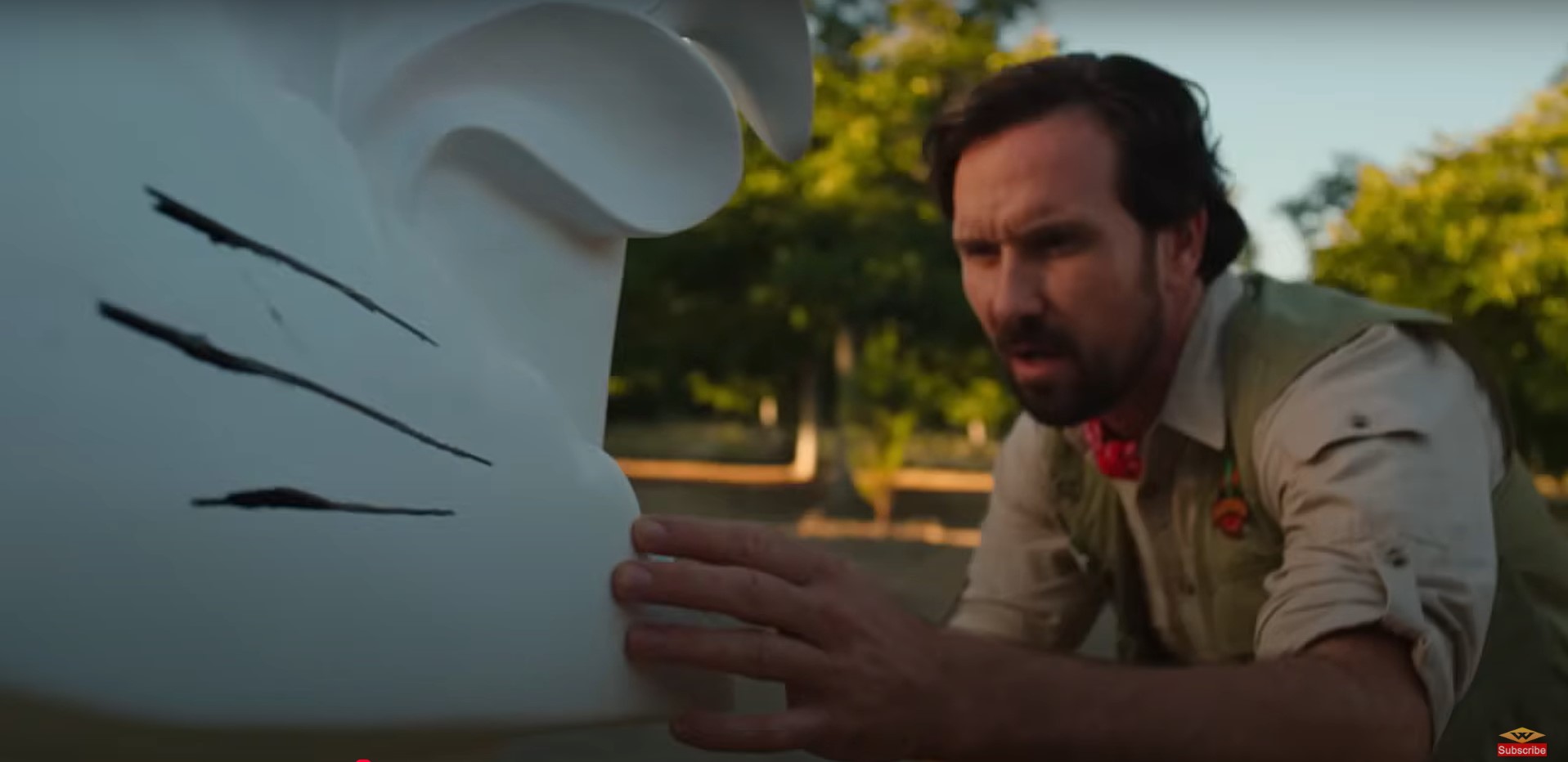
 once promising paleontologist is reduced to being a dinosaur theme park sideshow act after being swindled and sued for a discovery of a lifetime aboard.  When a deadly and intelligent lab created raptor escapes from its maximum-security confines, the paleontologist, an attractive ex-girlfriend returning into his life, and an eager townie security guard with no friends must put a stop to the first living, breathing carnivorous dinosaur in 65 million years, but tracking down an invisible creature with razor sharp talons and teeth is no easy task, and they must follow the carnage and bloodshed of its wake in order to stop it.  With little resources, relying mostly on the paleontologist’s expertise and the chummy security guard’s willingness to take life-or-death risks for his new friends, the trio rope in a local, rough-around-the-edges chicken farmer to persuade the foul ancestor into a madcap trap before the whole town becomes raptor food. 

Audiences shouldn’t care about another “Jurassic Park” sequel.  Instead, any cretaceous period anticipation should all be channeled and focused toward Mikey Hermosa’s “The Invisible Raptor.”  The 2023 comedy-horror is not land of the lost as it lands right in our homes on a new physical media release.  Written between first feature film writers Mike Capes and Johnny Wickham, the “Dutch Hollow” director Hermosa is not one bit phased by the prospect that his main villain is every bit nasty and furious as antagonists come but is entirely out of sight!   With the challenge accepted, Hermosa aims to pull of the next big comedy-horror dinosaur film since “Tammy and the T-Rex” while ribbing in fun it’s bigger, more successful, campy-somber, franchised brethren mercilessly.  Hermosa coproduces the Showbiz Baby and Valecroft production with writers Capes and Wickham as well as William Ramsey and Nic Neary with Well Go USA owning the theatrical and at-home presentation rights. 

Capes writes for himself as the hard-up paleontologist Dr. Grant Walker, a play on Sam Neill’s Dr. Allen Grant, who has succumb to being of caricature of his profession and while the Dr. Walker is downcast despite his credentials, educations, and reputation, opposite him is the town goof Deniel “Denny” Denielson (David Shackelford, “Beneath”), a friendless, family-less, theme park security guard who’s repute amongst his peer is lower than fossilized dinosaur crap, but his attitude remains cheerful and positive.  The two characters complement each other with budding growth in their arcs of Dr. Walker not pushing people away like he did with ex-girlfriend Amber (Caitlin McHugh) and Denny, with every ounce of his hillbilly being, trying to a fault to make a friend.  There’s a slew of eccentric side characters but one not more as colorful as chicken farmer Henrietta McClusky.  Played by the early 70-year-old Sandy Martin, the “Scalpel” role debuting actress who had a profound supporting character career having had a role in “Napolean Dynamite” and “Three Billboards Outside Ebbing, Missouri” in recent years continues her dry humor, dark comedy run with the Henrietta role a crude, rude, and with ton of attitude poultry farmer with a no nonsense way about her and while Henrietta is a deeply sexual creature in her own right, the amorous tension lies in between Walker and Amber that have instantly become two magnets in rekindling their lost flame.  The ease of which the two characters are written to be instantly smitten is greatly construction to be an almost an unattainable relationship by introducing a child with no relationship to either one of them, a decade long gap without a ton of hurt feelings for the other’s sudden decision of career over love, and, the obvious, a large, man-eating, invisible predator repelling the two magnets apart.  Sprinkled with familiar faces, “The Invisible Raptor” rounds out with notable cult film actors, such as Richard Riehle (“Office Space,” “Hatchet”), Larry Hankin (“Armed and Dangerous,” “Home Alone”), and Sean Astin (“Encino Man,” “Lord of the Rings”) as well as a cameo appearance from Vanessa Chester who played Dr. Ian Malcolm’s daughter in “The Lost World” in another potshot at the “Jurassic Park” series.

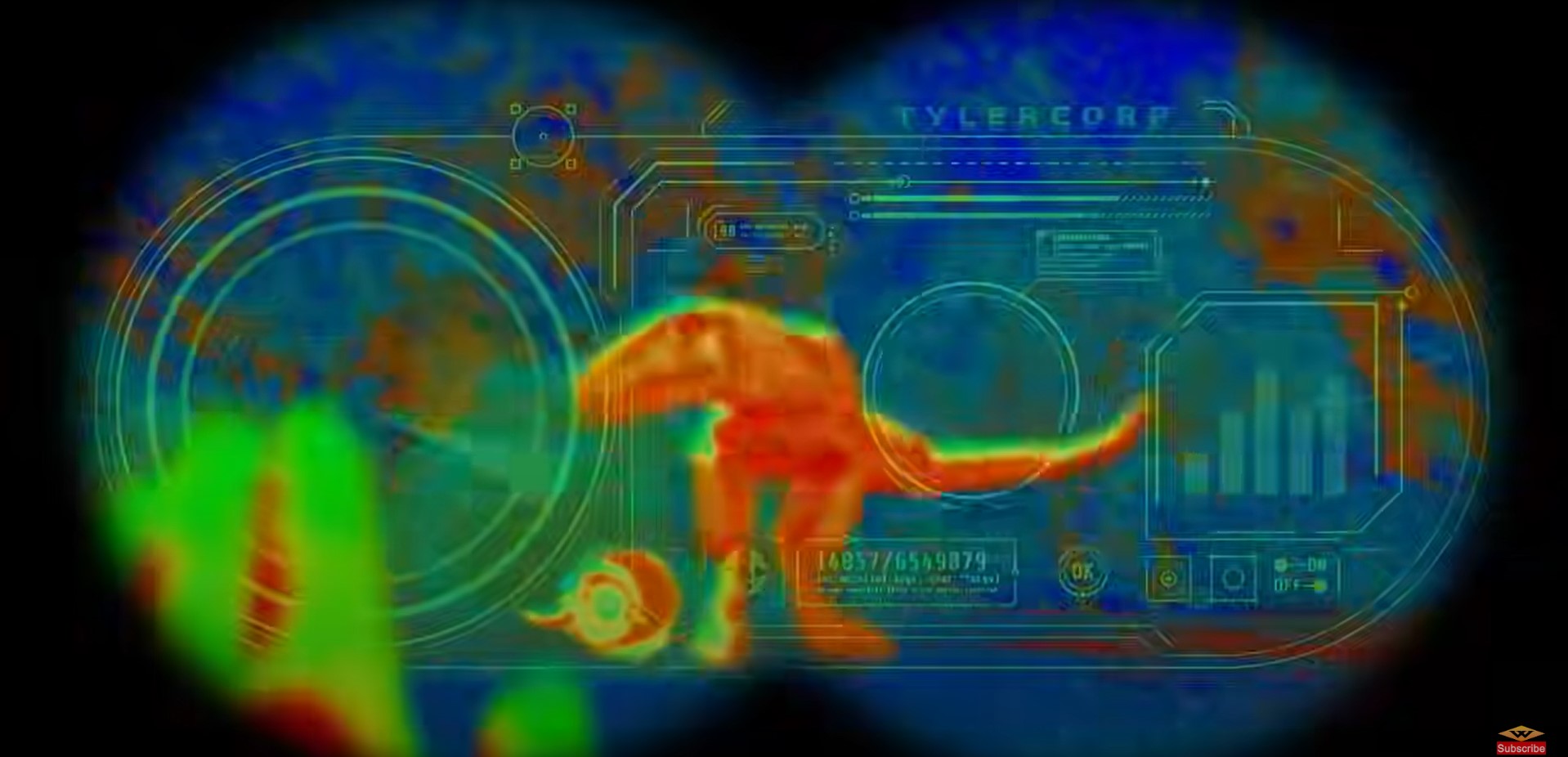
Between the hilariously staged “Jurassic Park” callback moments and an unnerving number of gags around the butt region (raptor feces, fossilized raptor buttholes, butt jokes in general), “The Invisible Raptor” has a lot of humor that’s either smart or misses the mark, but not by much in the cogently confined venture packed full of heart, heroism, and havoc on a prehistoric, science-fiction level.  “The Invisible Raptor” may be a modern-day gory comedy-horror but that gory-horror element combined with a bit of underground covert weaponization of dinosaur has a real throwback sense to the early 90’s to early 2000’s dino-horror, such as the “Carnosaur” films, “Tammy and the T-Rex,” and, of course, “Jurassic Park.”  Dino-horror is a niche subgenre that’s rare explored unless it’s totally satirical (“The Velocipastor,” “The Jurassic Dead”) or rooted more in a lost world aspect, sporadically released throughout the decades with “Raptor Island” or the more perilous journey of “Land of the Lost,” original series and it’s more comedic feature remake.  Hermosa quickly moves out from the testing bunker lab that has been the Raptor’s home and where the scientist treat it like an adored, harmless child, a theme of attachment to harmful things we shouldn’t be attached to and gets right into the mayhem by letting it loose in only a way one could perceive a raptor would – in indiscriminating bloodshed.   Hermosa also doesn’t flinch with an invisible titular foe, one the actors have to mentally conjure up to play against in a combative or cat-and-mouse scene, with neatly composited special and visual effects of floating objects, quickly consumed severed heads, and silhouette work through blood spray, heat vision, and a shower curtain by the talented Steve Johnson (“Lord of Illusions,” “Species II”) and Dorian Cleavenger, both of who bring years of experience and both of whom have worked together for the effects of Robert Englund’s “Fear Clinic.” 

Audiences won’t see this one coming!  “The Invisible Raptor” debuts onto an AVC encoded, high-def 1080p, Blu-ray courtesy of Well Go USA Entertainment.  The single-layer BD initiates some cause for concern on the image presentation prior to viewing but the picture produced is solid and stable with no banding in the darker voids, especially in those areas since there is no Raptor to be seen mostly during the night exteriors, poorly lit underground laboratory, or in the lowly key-lit interiors, there’s more shaded and hallow space exposed in the 1.78:1 widescreen aspect ratio.  Textured details are generally adequate with a softer, smoother touch from capacity compression, coupled with a hazy warm yellow-green lighting scheme.  The more standard, non-stylistic shots have better definition to where the details on Dr. Walker’s paleontologist outfit stand out amongst the eye glazing brown-and-tan colors and in the gooey grooves of the Velociraptor fecal matter complete with yellow kernels of corn.  Visual effects are handled with not too revealed explicitly to limit noticeable computer imagery and keep all that is practical the focus.  Audio options come in two English formats – a DTS-HD 5.1 and Stereo 2.0.  The range on this mix is explosive as it is subtle right down the clicks and grunts of the assumed noises one would be led to believe a prehistorical, carnivorous raptor would make.  Dialogue renders clearly and definitively prominent amongst ensuring bedlam cacophony whenever there’s a dino-crises in a more than one people grouping; the audio compilation has been carefully layered to denote exactly what’s intended to be discerned at that moment. English and French subtitles are available. There are no encoded special features on fluid menu of this feature only release but there is a quick bonus scene at the end credits. The physical copy has only a little bit more in the way of extra content with a cardboard, tactile-titled O-slipcover sporting the current state of arranged character pyramid composite. The snap lock Blu-ray Amaray is standard with the same cover art and no tangible extras inside. Rated R for bloody violence and gore, crude sexual material, drug use, and brief graphic nudity, Well Go USA’s release is region A encoded for playback and has a runtime of nearly 2 hours at 114 minutes.

Last Rites: Though the raptor may be invisible, this release should be seen by all! “The Invisible Raptor” is a hilarious “Jurassic Park” parody with plenty of bite, plenty of fun, and plenty of non-visible computer-generated dinosaurs, especially for those who are feeling the dinosaur fatigue.

“Insivible Raptor” Tearing Onto Bluray! Buy it Here!

You’re Not Going Crazy. EVIL Has Snuck in Its Egg! “Cuckoo” reviewed! (Neon / Blu-ray)

Fresh Horror for the Taking! “Cuckoo” Available on Amazon!

Moving to the Bavarian Mountains can be breathtaking, relaxingly scenic, and peacefully remote.  For Gretchen, however, the involuntary move comes shortly after the death of her mother, and she’s forced to leave the U.S. with her father, stepmother, and half-sister to now live at the base of the German Bavarians where an isolated vacation resort is overseen by Herr König who has hired Gretchen’s father to architecturally design an extension to the resort’s vast campus.  Reluctant to make the best of an undesirable situation, Gretchen attempts to run away with another woman and go back to America but on the way, an accident lands Gretchen in the nearby hospital and the odd, omnipresent and oppressive sensation that has surrounded her upon her arrival begins to unravel around Herr König and the resort grounds.  Disorientating visions and sounds, entranced female guests vomiting in the hotel, and an aggressively cloaked women pursing her in the shadows, a battered and bruised Gretchen can’t convince her family of the oddities around her or the ones that have plagued her mute half-sister without warning like a flash flood but with the help of a police detective, the only other person who believes her, the two investigate the strange threat that’s closing in on Gretchen’s family.

For fans of the 2018 under-the-radar, mighty mite demonic possession film “Luz,” director Tilman Singer helms another inimitable horror that’s literally for the birds.  “Cuckoo” is Singer’s this year’s released production in which he penned the script.  His sophomore feature-length film, a plotted preservation of a quickly diminishing deadly, infiltrating species, keeps in line with his Germanic heritage by filming on site at the base of the Bavarian Mountains around the North Rhine-Westphalia region of Germany.  “Cuckoo” is a production of Neon, Fiction Park, and Waypoint Entertainment, spearheaded by producers Thor Bradwell (“Saint Clare”), Emily Cheung, Maria Tsigka, Josh Rosenbaum, Ken Kao (“Rampart”), Markus Halberschmidt, and Ben Rimmer (“Midsommar”).

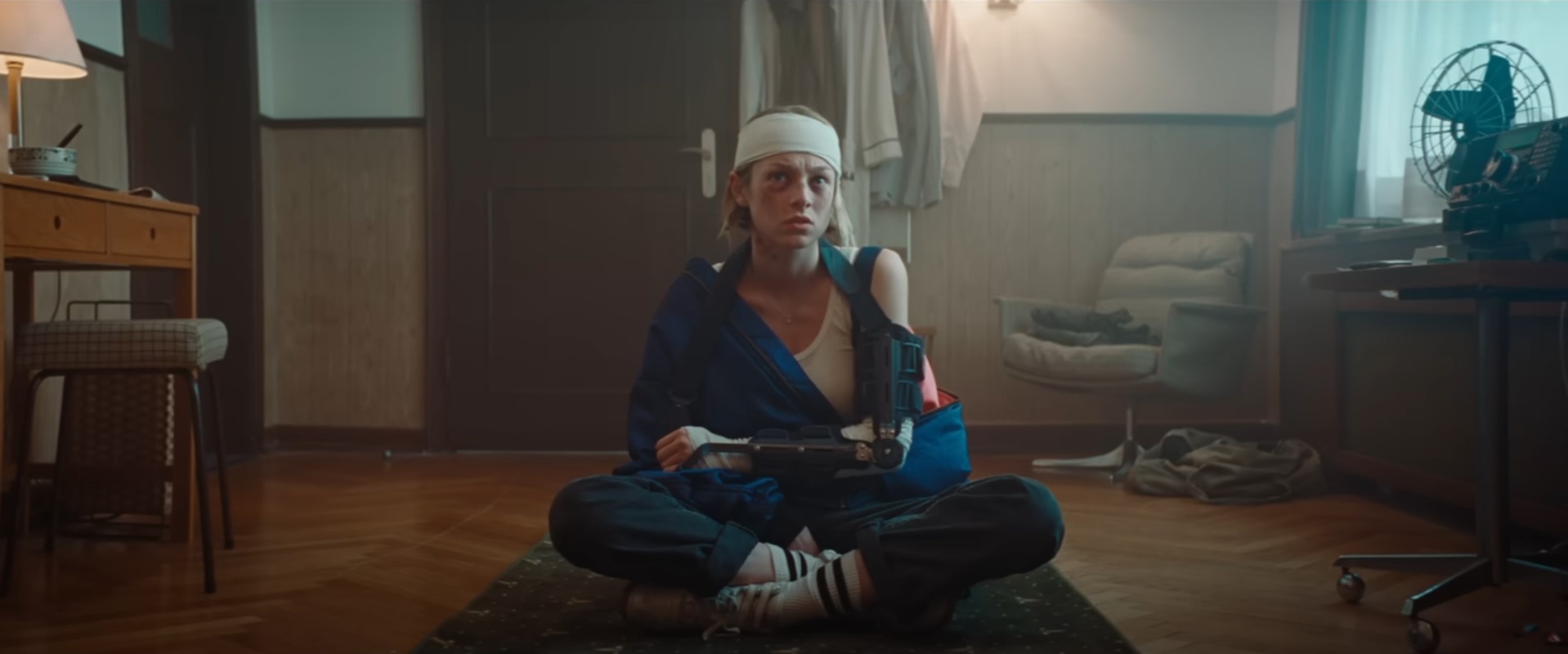
Having established himself as a refined and charming British actor in the widely popular BBC series “Downton Abbey,” Dan Stevens has slowly but surely infiltrated himself in what Lydia Deetz might describe as strange and unusual films.  Shortly after the untimely demise of the Matthew Crawley character, the principal love interest to Lady Mary (for those who know, know), Stevens jumped right into the Adam Wingard thriller “The Guest” where the then slightly over 30-year-old actor proves himself capable of portraying so much more than a stiff socialite.  As resort owner, nature preservationist, and the overall prototype of Zen in Herr König, Stevens displays another side of his deranged splits while showcasing his perfection of the German language.  Opposite Herr König in the teen heroine role is the rising star from “The Hunger Games:  The Ballad of Songbirds & Snakes” and the provocative HBO series “Euphoria,” Hunter Schafer.  As Gretchen, Schafer instills a grappling of grief for a mother she was not ready to let go, institutes steadfast judgements about her father’s new family, and impresses a level of loneliness when having to move away from familiar America to the foreign and alienating grounds of Eastern Europe which all evoke the epitome of teenage angst who can’t see beyond her music, her longing for home, and her new family aversion to see that all those negative, destructive traits innately push her away from what’s important, her family.  Herr König embodies Gretchen’s impediment to move forward while another, Henry the detective (Jan Bluthardt, “Luz”), is stitched to ground Gretchen as the past representation of events you can’t change and the anger it has over you.  Jessica Henwick (“Love and Monsters”), Marton Csokas (“Evilenko”), Greta Fernández (“Embers”), Proschat Madani, Kalin Morrow, Astrid Bergès-Frisbey (“Pirates of the Caribbean:  On Stranger Tides”), and the introduction of Mila Lieu as the mute Alma rounds out the cast.

There are no Coco Puffs to go for here in what will be Tilman Singer’s signature breakthrough hit in the cult genre.  “Cuckoo’s” unique spin on the certain genus of the titular bird is next to none as it radicalizes extreme measures to save a mimicking, infiltrating, surrogate-forcing species from extinction.  The story, which takes on the play God and find out narrative, is a perfect prefect of cutting your nose off despite your face in both the sensationalized horror element and in the rite of passage of teenager squabbles that oxymoronically favors a contrasting parallel.  “Cuckoo” falls into area of weirdness that could be an episode of the “Twilight Zone” in its earthbound peculiarity hidden from public view for decades, if not centuries, blending the once unforeseen man and animal into one and trying to keep that unity intact no matter what the natural process of survival decrees; the story goes between the shadows into its lockbox of nature’s little dirty secrets left in the dark recesses of the forgotten closet and what’s found there is unnatural, wrong, and perhaps even prehistoric.  “Cuckoo” might be too weird.  Understandably, audiences may find “Cuckoo’s” birdy thriller too intractable and maybe too, too far-fetched for a horror film that tiptoes around political hot topics, such as with the violation of women’s bodies and the pregnancy genetics that ensues.  Yet, that controversial conversation starter inside a soupy mixture of on-your-toes tension and the solid acting from Schafer, Stevens, Bluthardt, Bergès-Frisbey, Lieu, Henwick, Csokas, and Morrow develop a much needed off-the-wall and cacophonous-stirring horror that offers a new breed of horror.

The unbelievably scary ordeal arrives onto Neon’s standard Blu-ray set with an AVC encoded, 1080p high-definition resolution, BD50, presented in the anamorphic widescreen aspect ratio 2.39:1 CinemaScope.  Graded with a lower contrast, “Cuckoo’s” antiquated, perhaps wall-to-wall 70’s or 80’s veneer, elevates the finish with bolder conventional colors, enriching wood paneling, gaudy wallpaper, and the like to pop out rather than blend in.  Textures are retained in finer fabrics but appear to be lost on much of the skin surfaces with the revolving door of lighting.  Cinematographer Paul Faltz’s play on light, shadow, and depth creates tension, mood, and a lasting impression.  The lossless English (and some German, which isn’t listed) language DTS-HD Master Audio 5.1 mix provides favorable fidelity, especially when a partial of the film’s story revolves around immersive sound – Gretchen’s music, vibrating vocal sirens, Herr König’s recorder tune, etc.  Depth and range hit on the exact spatial amalgam, diffusing nicely and dynamically into the back and rear channels when scenes play out to a chase or civilly devolve into gunfire.  The second, accompanying audio option is an English Descriptive Audio 2.0 mix that provides same quantity without much of the immersive quality.  English and Spanish subtitles are optionally available.  Bonus features include the making-of “Cuckoo” with snippet interviews and behind-the-scenes look, a video diary series, on-set interviews with actor Hunter Schafer, costume designer Frauke Firl, and production designer Dario Mendez Acosta, a handful of deleted scenes, and a teaser and theatrical trailer.  Neon’s hard-encoded region A, standard Blu-ray comes in the traditional blue Amaray case with the poster art as primary cover design.  Disc is pressed with a black background and “Cuckoo” in red font.  There are no inserts or other tangible features.  The R-rated film, for violence, bloody images, language, and brief teen drug use, has a runtime of 102 minutes.

Last Rites: “Cuckoo’s” a devouringly devilish and deranged nightmare discording from the pattern to breach onto a new form of terror.

Fresh Horror for the Taking! “Cuckoo” Available on Amazon!