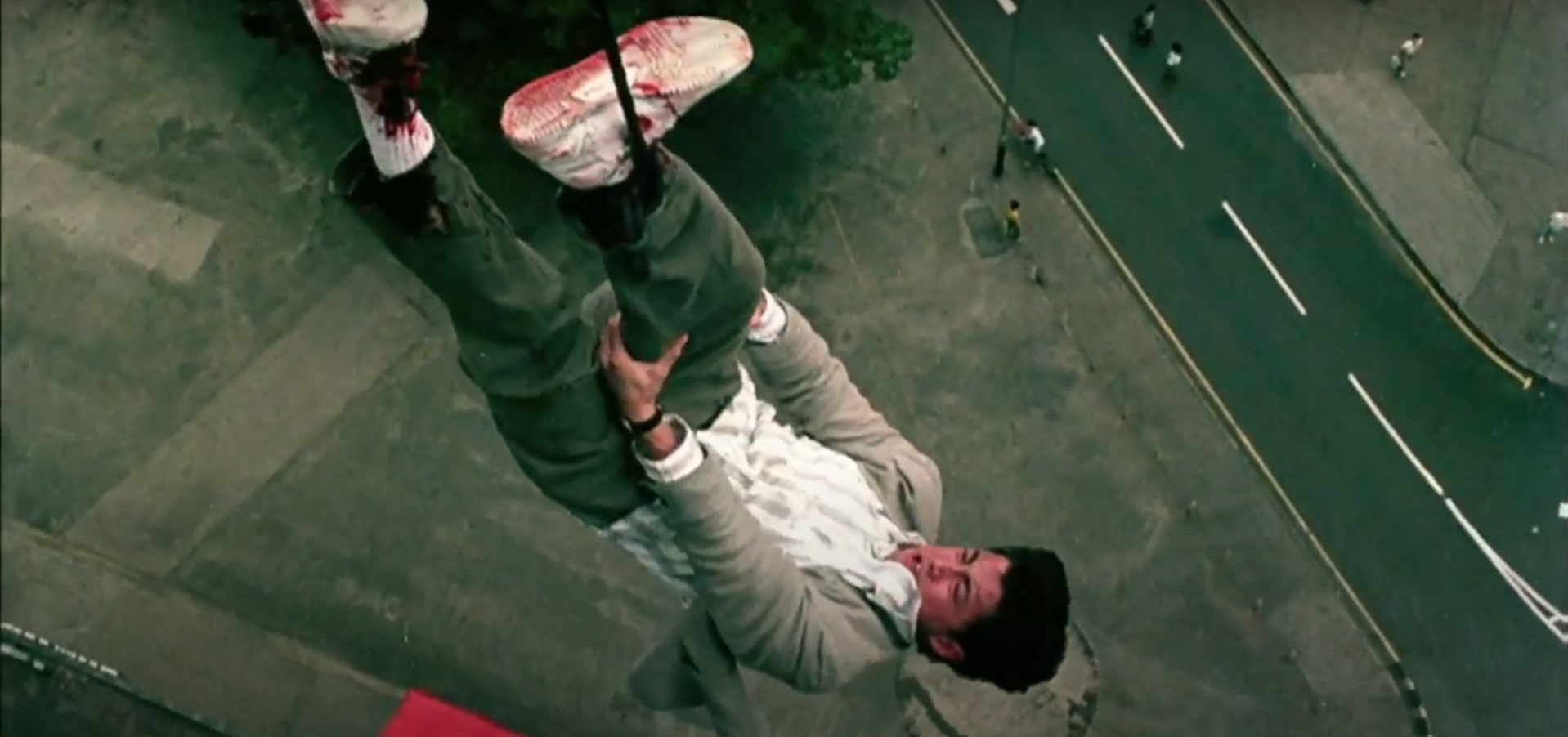
You, Me, and EVIL Makes Three on “The Island” reviewed! (Eureka Entertainment / Special Edition Blu-ray)

“The Island” from Eureka Entertainment and MVD Visual! Order Here!

Geography teacher Mr. Cheung faith in his student’s studies lacks encourage and their grades likely won’t improve.  He decides to take his class on a field trip to an isolated island he once visited more than a decade ago as a young man.  With the intended purpose of relaxation, Mr. Cheung refuses his students of mentioning any schoolwork and studies to try and enjoy the coasting waters and the native nature the island has to offer.  However, there’s more than just animals and plants inhabiting the island as a family of three eccentric brothers welcome them with strange behavior and creepy vibes.  When the younger brother selects one of the student girls as his bride to carrier on their lineage, the once ideal getaway traps Mr. Cheung and his students without a way of escaping the irrational whims and delusions of the three brothers.  With a retrieval boat still a day out, the cornered teacher must keep his party alive at all costs. 

Considered Hong Kong’s answer or version of the backwoods pursuers of cutoff society people, 1985’s “The Island” secludes normal kids and their acquiescent teacher on an island where inbreeding has corrupted the copies of three brothers who’ve recently interred their adamant mother to rest and who’ve been searching for mainland women suitable to be the unsterile youngest’s wife.  Leung Po-Chi, or Po-Chih Leong, director behind “He Lives By Night” and “Hong Kong 1941,” produces a Jekyll-and-Hyde contrasting tale that’s sad and bleak to the core with a script not pinpointed to one particular writer but rather to a creative team within the production company D & B Films, aimed to capitalize on the western grim nature of the deranged and callous upon the unsuspecting and innocent seen in such exploitation and other B-pictures as Hong Kong shifts from the longstanding yet now waning Kung-Fu pictures.  Dickson Poon, Sammo Hung Kam-Bo, and John Sham, the founders of D & B Films, produce the film. 

John Sham may not be the ideal looking or sounding hero with a receiving hairline close to Three Stooges’ Larry Fine, thick, round spectacles, and about as average build of a middle-aged man as they come, but for “The Island” the ‘Yes! Madam” actor and D & B Films’s cofounder is suitable and ideal to be the pliantly, run-of-the-mill geography instructor looking to leave the woes of education behind him for a chance to revisit a place from his youth.  Unfortunately, Sham’s inadvertently the head of the snake as everyone remembers the exposed poisonous fangs threateningly elongated from with out the jowls underneath the reptilian beady and glowing eyes.  No one really remembers the slithering body unless there’s a warning rattle connected at the end.  That’s how the rest of the student body reproduces in trying to portray characters to care about but not really achieving the level of sympathy needed to rise about that film of understanding.  One of the more prominent kids is Phyllis, labeled the chunkier one by youngest aggressive, the snotty-simpleton Sam Fat (Billy Sau Yat Ching, “Scared Stiff”) and she’s targeted for Sam Fat’s procreation affections.  Played by Hoi-Lun Au, Phyllis has a working but tiffed relationship with Ronald (Ronald Young, “Sex and Zen III”) and see the untimely death of Ronald sends Phyllis into seeing red, being a formidable survival combatant against the remaining Fat brothers Tai (Lung Chan, “Encounter of the Spooky Kind”) and Yee (Jing Chen, “Riki-Oh:  The Story of Ricky”).  Billy Sau Yat Ching, Lung Chan, and Jing Chen are distinctly diverse to the best possible way, and each deliver their own dish of crazy that gives “The Island” an inescapable locked inside a padded cell substructure all too familiar on its base componentry but alien enough to master a new diverging kind of terror.  Che Ching-Yuen, Chan Lap-Ban (“Hex After Hex”), Kitty Ngan Bo-Yan, Lisa Yeun Lai-Seung, and Timothy Zao (“Diary of the Serial Killer”) costar in the relatively fresh faced and unknown at the time casted film. 

Leung Po-Chi wets our whistle with an opening of an intense forced marriage ceremony involving shuddering sexual exploitation and personal space invasive mistreatment of a mainland young woman, a swimmer who swam her way into trouble with the island’s inhabitants – an elderly mother and her three disturbed sons with the goal of using her for breeding a new bloodline.  This ultimately sets up the tone for a bleaker story that tells of nihilist cruelty with a thematic division between the urban educated and the unsophisticated rural folk, in this case the rural Bumpkins are isolated island inhabitants, but then Leung switches gears with a lighthearted introduction of frolic scurrying teacher and his students as they spread amongst the island’s sandy beaches wearing brilliantly colored skin tight swimsuits and bask in the island’s natural beauty with a couple of them going tangent into their own personal secondary storylines.   Those subplots never vine out and upward to flower fully but there’s enough stem and leafing groundwork between the good old gay times and a few individual internal affairs to setup sympathy for at least a select few as the relationship between visitors and residents quickly sours with Sam-Fat’s eyes growing bigger and bigger and his drool becoming slobbery and slobbery for Phyllis.  There’s not a ton of autonomy for the brothers who do their mother’s bidding long after she expires, committing themselves to the original plan of marrying off Sam-Fat in a show of take and force that robs Mr. Chueng’s dual purpose plan of a good time of fun and nostalgia.  Leung acutely abrupt faces again, back to the cruel inklings from the beginning, that displays unsettling camera shots, dark and low-warmth lighting, and a ferocity that’s always been with the brothers now more evident and growing inside the remaining survives who must fight for each other as well as themselves.  Leung’s style feels very much like a blend between the quick editing and fast action of a martial arts production but has the lighting and chaos-laden horror of an Italian video nasty that does see and lingers onto blood spilled. 

“The Island’s” a terror-riddled getaway that has arrived onto a new Blu-ray from UK label Eureka Entertainment routed through North American distributor MVD Visual.  For the first time on the format outside of Asia and as part of the company’s Masters of Cinema series (#324), Eureka’s Special Edition release is AVC encoded, 1080p high-definition resolution, BD50 and presented in the original widescreen aspect ratio 1.85:1.  With a brand new 2K restoration scan, “The Island” has impeccable quality measure that emerges the most minute details in every frame.  Skin tones have inarguable organic quality and a true-to-form reactionary sweat-gleam look induced when the chase is on.  The textures pop through in garb, foliage, and in dilapidated structure that gives certain discernibility and depth of object.  The original print has virtually no wear or tear as well as any aging problems, appearing to be a fresh off the reel transfer with natural appeasing grain.  The original Cantonese mono track is the only track available and is really the only mix we could expect and receive without a remastering, but, in all fairness, the mono works well enough to satisfy dialogue, ambient, and soundtrack integrity in its limited fidelity box  Dialogue is clean and clear on the encoding with no damage or other verbal obstructions but the modulation favors the antiquate characteristics of the era and the paralleling ADR offers little synchronous value, both to not fault of Eureka.  The optional, newly translated English subtitles by Ken Zhang pace well and are in flawless transcription.  The special edition is encoded with a new commentary with East Asian film expert Frank Djeng, a second new commentary by genre connoisseurs Mike Leeder and Arne Venema, a 2023 interview with the director Po-Chih Leong Surviving the Shoot, East Asian film expert Tony Rayns provides an appreciation video essay Tony Rayns on “The Island,” and the film’s trailer.  The limited-edition set comes with a red and yellow pastel colored O-card slipcover with new beaitfully illustrated artwork by horror graphic artist Ilan Sheady, whose supplied extreme and gory “Terrifier” franchise artwork to European media books, and delivers “The Island” a warm glaze of trouble-in-paradise, capturing the essence of what to expect from the story.  Original poster art graces the clear Amaray façade with a sepia image of John Sham from the opening scenes on the reverse side.  The limited set also includes a 19-page color booklet containing photos of “The Island” as well as other Leong productions, cast and crew credits, To Genre and Back:  The Cinema of Po-Chih Leong program notes by Roger Garcia for a strand celebrating Po-Chih Leong at the 2023 Far East Film Festival, an interview with the director conducted by Roger Garcia All Within the Same Film:  An Interview with Po-Chih Leong, and bring up the booklet’s rear are viewing notes and release credits.  The not rated feature has a runtime of 93 minutes and is region A/B locked for playback.

Last Rites: Director Po-Chih Leong’s trip to “The Island” is beyond bleak in social commentary and in of dire situation of nothing but pure innocence being destroyed by those left forgotten on the outskirts of mainlanders and of sanity. Eureka Entertainment’s Blu-ray honors “The Island” with praise upon praise for its slick high-definition picture, solid extras, and beautifully designed O-slipcase and design.

“The Island” from Eureka Entertainment and MVD Visual! Order Here!

A Prince’s EVIL Plan to Gain the Throne Meets High-Flying, Kung Fu Rebel Resistance. “The Lady Assassin” reviewed! (88 Films / Blu-ray)

“The Lady Assassin” LE Blu-ray Now Available!

Emperor Ching’s health is rapidly declining and before his death, he challenges his 14 princes to find the best candidate to rule of his kingdom.  Ultimately, the 4th and 14th princes are vying for the throne but embark on different moral paths that set them starkly apart.  Fourth Prince Yung Cheng will lower himself to any ignoble scheme worth gaining him the throne while the 14th Prince, who might be weaker in strength, would be a better, more compassionate, ruler for the people.  When Yung Cheng plots an assassination against the 14th Prince, his plans are foiled by the prince’s skilled bodyguard Tsang Jing, the greedy Prince takes an alternate route to the throne by conning Han loyalists, who feel the Manchu clans have treated them unfairly by abusively restricting their power and fortune, into a plot to steal the Emperor’s royal decree of announcing the new Emperor and forging his name into the document.  By this very deception, Yung Cheng is announced Emperor and turns his back on the Han loyalists who joined forces with Tsang Jing and Han rebel Si Nang to end his dishonest rule over both the Hans and the Manchus.

The eclectic Shaw Brothers produced fantastical fights, high-flying stunts, and a story interweaved with deception, death, and melodramatics in the immersive period of dynastical China with the film “The Lady Assassin.”   Filmed in Hong Kong, the film is written-and-directed by acclaimed action filmmaker Chin-Ku Lu at the height of his career.  “The Black Dragon” and “Holy Virgin vs. The Evil Dead” director delivers a deluging epic of sensationalized kung fu interspersed with a usurping back-and-forth story of cutthroat politics and deceit and the minority that attempts to dethrone villainy with punitive justice, the only kind of justice ancient China knew to dish.  Mong Fong (“Killer Constable,” “The Mad Monk”) produced the feature with Run Run Shaw serving as executive producer.

One would think the title being “The Lady Assassin” would focus on a solo female kung-fu killer aimed to strike ruthlessly in a clandestine caper, but most of the story’s principal shoulders have an equal share burden amongst a deep protagonist cast of characters.  Leanne Liu plays the titular assassin Si Niang, a Han rebel whose father (Ku Feng, “Erotic Ghost Story,” “Vengeance of a Snowgirl”) is head dissident number one against the Manchu leaders, and the “Bastard Swordsman” and “Hong Kong Playboys” actress doesn’t become introduced into the story until about midway through as much of the Prince-on-Prince, good-vs-evil, tale is spearheaded by those vying throne-seekers with much emphasis on their guards, assassins, and the skilled in Kung Fu company they keep.  Tony Liu (“Fists of Fury”) and Mok Siu-Chung (“Nightmare Zone”) are respectively the evil scheming 4th Prince and the good-natured but weaker 14th Prince seeking the throne of their dying Emporor father (Ching Miao, “The Devil’s Mirror”) and the two give into their roles very efficiently, delineating a clear line where they stand in the grand scheme of the plot with the 4th Prince proactively trying to destroy any chance others may have at the throne with the 4th keeps in the shadows and avoids conflict; the latter heavily emphasized by a lot of do-nothing from the 4th Prince’s character.  A great deal of the first two acts relies heavily on Tsang Jing’s honorable service to the people who showed him kindness.  “Zu Warriors from the Magic Mountain” actor Norman Chui imposes impeccable fighting ability and timing but is strangely engrossed by his character’s life to serve those who he owes and we’re not talking a purse debt or for saving his life but rather a loyalty aspect for kindness, morality, and justice that contrasts against Min Geng Yiu, played by Jason Pai Piao, who initially is introduced as an upstanding citizen fighting against unethical behavior until his hypocrisy lands him greedily in the arms of a deceiving 4th Prince, twisting You to accomplish his bidding while he always subverts his lord with his own deceptive plans of power.  Backstabbings and desperate mesasures, along with stellar, high-flying, hand-to-hand and sword fighting, zip “The Lady Assassin” into another level of martial arts mania with a rounded out cast of Cheung King-Yu, Yeung Jing-Jing, Yuen Tak, Kwan Fung, Sun Chien, and Johnny Wang Lung-wei. 

Kung Fu films, especially in the 1970s through well into the 1990s, are a dime a dozen so what makes Chin-Ku Lu ‘s “The Lady Assassin” different from the rest?  One area to note is fight and stunt choreography that smooths the edges around the other contemporaries slower, less theatrical, routines with vigorous and diverse long sequences containing large quantities of combatants.  Usually, most fight sequences are limited to 1-on-1, 2-on-2, and maybe 3-on-3 or 3 or 4-on1 at most, but hordes of swords, staffs, and topographical anomalous landscapes, constructed on a stage of course, are seamlessly dynamic and meritoriously fast paced and thrilling, produced by the stunt work team of Yak Yuen, Kin-Kwan Poon, and Yung Chung.  The other area to note, and one that goes hand-in-hand with the stunt choreography in order for it to work, is Shao Kuang Liu’s editing, taking footage and just going to town with a series of cut and tapes and still coherently fashioning a continuous fight and flight, complete with pulley wires, despite its rapid strikes that might have some accelerated motion of the film.  What’s inherently captivating for “The Lady Assassin” can also be a tiring visual as the fights flare up brief plot points in between, the fights can feel a bit long in the tooth come the third act; however, the final showdown, a last ditch effort between the last of the Han rebels versus the 14th Print and his crazy-faced, hired gun Japanese martial artist levels up the violence that halves fighters horizontal and vertical.  The story’s an effort to keep up with as the continuous double crossing and changes of heart nearly blend together and too many assumed interpretations toward the fate of characters off screen can work the thinker double time, compounding the ambiguous clarifications profoundly. 

88 Films continues to restore-to-rejuvenize the Shaw Brothers extensive catalogue of Hong Kong produced eclectic films with the UK company’s latest high-definition scan of “The Lady Assassin” from the original negative and release the 45th title on a part of their 88 Asia line  Cleanly saturated and rich in beautiful coloring, the AVC encoded, 1080p, BD50, presented in the original widescreen aspect ratio 2.35:1, is a marvel to watch. The original print has been kept well-preserved with barely a flaw to note albeit a less than a handful rough tape cut or damage framed moments that are so insignificant that if you blink, you’ll miss them.  The vivid and vibrant mise-en-scene is a convergence of stark contrasts and itemized delineation that creates space and depth while also visually stunning, even with what I like to call peacock fighting, or showing off fighting.  Of course, there’s also tiger fighting, praying mantis fighting, etc.  The gain is naturally pleasing without being too thick or smoothed over.  Skin tones and gleams are natural and absolute with a sense of popping right off the screen.  The Cantonese 2.0 mono is post-production ADR but syncs well with not an egregious division between mouth movements and dialogue.  Dialogue is overall clean and clean with faint hissing here and there.  Chopsocky audio layers have clean hand and foot, leg and arm whacks and full-bodied swish and swing of sword and glaive swipes.  There’s not lucrative range with much else, specifically the ambient environment as all the audio design is done in post, with a few only a handful of moments, such as Tsang and Si Nang fishing or a few interiors fights implementing room objects require foley.  The soundscape is epically charged but not terribly memorable and there are quite a few fights that go without a score to provide the action effects more prominence.  The newly translated English subtitles are errorfree, do sync well, and keeps with the pace.  Special features include an interview with Kin-Kwan Poon conducted by Fred Ambroisine From Child Actor to Fight Coordinator as well as the film’s trailer and gallery stills. 88 Films’ houses the Blu-ray in a limited-edition glint of golden cardboard slipcover of new art featuring the titular assassin. The same image is primary Amaray cover art with the original poster art on the reverse side. In the insert, a thick, dual-sided folded poster of both cover illustrations rounds out the tangible elements. The Blu-ray is encoded with A and B region playback, is unrated, and has a runtime of 86 minutes.

Last Rites: A spectacle of soaring Kung Fu with a spruced-up restoration that makes “The Lady Assassin” that much deadlier in all its dynasty melodrama and game of thrones strife. One of the best Shaw Brothers offerings from the early 1980s!

“The Lady Assassin” LE Blu-ray Now Available!

A Pact Plans EVIL Revenge on Crime Fighting Heroes! “Royal Warriors” reviewed! (88 Films / Blu-ray)

“Royal Warriors,” a Revenge Tale, Now on Blu-ray from 88 Films!

Hong Kong police inspector boards a Hong Kong bound plane on return from her vacationing in Japan.  She meets Michael Wong, the plane’s air marshal, as well as her across the aisle seat mate, Japanese native, Yamamoto, a retired cop returning to Hong Kong to retrieve his wife and daughter and retreat back to Japan to start their new life.  Also on the plane, an escorted criminal being extradited to Japan for prosecution.  When a criminal accomplice takes the plane at gunpoint, Michele, Michael, and Yamamoto spring into action and thwart an aero catastrophe with the two terrorists dead.  After celebrating their success of saving many lives, the heroic trio begin to depart their separate ways when suddenly Yamamoto’s car explodes with his wife and daughter inside.  The assassination attempt puts a target on the backs of all three of them as two war veterans swear vengeance for their slain combat brothers from the airplane hijacking.

“Royal Warriors,” also known in other parts of the world as “In the Line of Duty,” “Ultra Force,” and “Police Assassin,” is the 1986 Hong Kong police action-thriller from “Web of Deception” director and “Once Upon a Time in China” director of photography, David Chung.  Stephen Chow’s regular screenwriter Kan-Cheung Tsang, who penned Chow’s “Kung Fu Hustle” and “Shaolin Soccer,” as well as “Magic Cop” and “Intruder,” reteams with Chung on their sophomore collaboration following the comedic-crime film “It’s a Drink!  It’s a Bomb!” starring the Hong Kong humorist John Sham, and a denotes a shared three-way perspective of protagonist principals while simultaneously providing sympathetic seedlings for the principal antagonists who though are coming wrongdoings and murdering up a storm of people, a wartime conflict bond between them holds them a higher level of honor between close brothers in arms.  Dickson Poon and D&B Films produce the explosive and hard hitting with prejudice venture with John Sham (Remember him from earlier?) and Yiu-Ying Chan, serving as associate producer.

Michelle Yeoh plays Michelle Yip, the level-headed chopsocky cop returning from some rest and relaxation only to wind up on a dish best served cold “Royral Warriors” for Yeoh, who then under the less recognizable moniker Michelle Khan, is the risk-it-all action film for the actress still in the earlier days of her what would be a prolific international career.  Her breakout hit “Yes, Madam,” saw both Yeoh and also then newcomer Cynthia Rothrock punch and kick into silverscreen success as unlikely onscreen partners to take down a crime syndicate.  In the Yeoh’s next film, she rides solo but only in the actress category, being a third of the good guys, yet holding her own as a strong female, lead between another prolific Asian cinema actor Michael Wong (“Tiger Cage III,” “Dream Killer”) playing essentially himself as Michael Wong (not a typo), the plane air marshal turned love sick puppy for Hong Kong’s tough cop Michelle Yip, and yet another prolific Asian actor whose career in Japanese films started well before Yeoh and Wong and has been rising internationally amongst the ranks of American cinema in Hiroyuki Sanada (“Sunshine,” “Mortal Kombat”) playing retired officer Yamamoto, a revenge-seeking justifier on those responsible for killing his family.  The level of how these three come together in a post-incident instantaneous bond borders an idealistic way of an extreme shared experience.  Yeoh and Sanada offer a cool, collective approach with degrees of vindictive separation with a layer of compassion thinly in between with Wong providing calculated lighthearted measures of chasing Yip with infatuated eyes to break any kind of monotonous, stagnant composure between the other two, yet they’re seemingly different lives, connected ever so vaguely by being around law enforcement one way or another, doesn’t seem to thwart an instant relationship immediately after the plan incident.  What’s also odd, especially with Yamaoto, is there is more background to the villains of the story than there is with him, providing rewarding elements for reason why the two men are hunting down Yeoh, Wong, and Yamamoto and seeking deadly revenge.  Ying Bai, Wait Lam, Hing-Yin Kam, and Michael Chan Wait-Man are the pact-making, behind-enemy-lines soldiers of some unknown war from long ago who neither one of them will turn their back on a combat brother in need.  Through a series of none linear flashbacks, a union of honor between them is made and while respectable and moral during war, that pact turns rotten overtime outside the context of global conflict, suggesting ever-so-lightly toward a combat shock issue between the four men that builds a bit of sympathy for them even though blowing up a mother and child and shooting to shreds a whole lot of nightclub patrons in their misguided revenge runs ice through their veins.  Peter Yamamoto wears his sleeve on his shoulder and there is this uncertainty with his character, and his wife too, that something is amiss, creating a tension that goes unfounded and sticks out.  “Royal Warriors” rounds out the cast with Kenneth Tsang, Siu-Ming Lau, Jing Chen, Reiko Niwa and Eddie Maher.

As part of the In the Line of Duy series, a strict criterion needs to be met:  Police Action, check.  Martial Arts, check.  A Level of High Intensity, check.  And a Female Heroine, check.  “Royal Warriors” meets and exceeds the bar with another bar, a no holds bar, of spectacular stunt work done by the Hong Kong standard way of action now, think later which looks phenomenal on camera and the resulting footage.  Hoi Mang’s martial arts choreography showcases a fast-striking combinations that cut traditional sparring with melee improvisation dependent on the surroundings, moving the action left-to-right, top-to-bottom by never staying in the same place and expanding the field of play with collateral damage of bystanders and family.  A couple of components are missed between that focused innocence and whiplash of violence.  For example, the playfully amorous affections between two of the characters are not poignantly shattered like precious stained glass when one is suddenly offed.  There are other examples of once a downspin cataclysm occurs, the aftershock of loss and change does not rear its ugly head.  “Royal Warriors” just pushes forth, continuing pursuit, in a rage of retribution and righteousness. 

88 Films releases “Royal Warriors” onto an AVC encoded, 1080p high definition, BD50, presented in the film’s original widescreen aspect ratio of 1.85:1.  If you own the “In the Line of Duty” four film boxset, the version in the boxset contains the same transfer as this standalone, standard version that stuns with a new 2K restoration from the original 35mm print.  When I say this restoration stuns, I mean it.  A clean-cut natural gain, color balanced saturation, and with all the detail trimmings laud 88 Films’ work, as such as with the rest of their higher definition catalogue in the older Asian film market.  Range of atmospherics challenge with a different lighting scheme and mise-en-scene cinematography, such as the pink and purple warmth of a nightclub glow or the brilliantly lit restaurant ferry boat.  Skin and texture tones cater to a slight darker pastel but is consistent through-and-through without appearing to unnatural.  The restoration does have a positive to a fault, revealing stunt equipment during the fast-paced fighting, such as the exterior stone ground turning bouncy with creases when Yeoh vault kicks one of the Japanese yakuza members to the ground.  The release comes with four, count’em four, audio tracks:  a Cantonese DTS-HD 2.0 mono theatrical mix, a Cantonese DTS-HD 2.0 alternate mix, an English dub DTS-HD 2.0, and an English dub DTS-HD 5.1.  Of course, I go with the theatrical mix to comply with the original fidelity as much as possible with any films using ADR for an immersive experience within the original, intended language.  the 2.0 mix keeps a midlevel management of the voluminous aspects to bombastic range but never muddles or mutes the tracks.  Dialogue comes out clear with a microscopic static lingering way deep in the sublayer but, again, has negligible effect on the mix.  Special features content includes an audio commentary by Hong Kong film expert Frank Djeng, missing airplane inserts which are spliced out shots of an inflight plane exterior, and the Cantonese and English trailers.  The standard edition comes pretty standard but does feature the new character compilation artwork of Sean Longmore on the front cover with the reversible sleeve featuring the original Hong Kong poster.  The disc is individually pressed with Michelle Yeoh doing what she does best in most of her films, kick butt.  There are no inserts or other tangible bonus content.  88 Films’ North American release comes with a region A encoded playback, not rated, and has a runtime of 96 minutes.

Last Rites: 88 Films’ “Royal Warriors” Blu-ray release captures Hong Kong cinema impeccably with monumental stunts, hard-boiled police work, and permeates with color, detail, and a cleanly, discernible audio mix. In the Line of Duty, “Royal Warriors” is the first, and foremost, cop crusading caper that began it all.

“Royal Warriors,” a Revenge Tale, Now on Blu-ray from 88 Films!

EVIL Strikes with Thousands of Disastrous, Deadly Fangs! “Calamity of Snakes” reviewed! (Unearthed Films / Blu-ray)

Save the Date!  “Calamity of Snakes” Slithers onto Blu-ray and DVD!  Available at Amazon!

A greedy, time-is-money land developer pushes his project manager and structural architect to complete his condo building earlier than scheduled, even if that means to cut corners.  While digging to lay the structure’s foundation, a massive pit of deadly snakes is unearthed.  With no times to waste, the land developer orders the mass killing of the snakes by the crew and even takes matters into his own hand using a backhoe as a weapon against the wishes of more sensible architect.  Those who are karma-included and God-fearing believe the mass murder of the snakes will result in retribution with fears being validated when workers fall victim to random snake attacks.  Shrugging it off as superstition mumbo-jumbo, the land developer finishes marvelous residential condo and fills the units in record numbers.  His success becomes the tenant’s death trap who can’t escape the swarming thousands of deadly slithery serpents infesting every nook and cranny and climbing toward his penthouse, seeking revenge against the snakebit developer’s cruelty and greed. 

Warning.  If you have a severely crippling phobia of snakes, then do not press play on “Calamity of Snakes” or you’ll be crying in the fetal position for hours afterwards with imaginational visions of venomous serpents dangling around your neck and arms, clinging to your punctured flesh with their sharp, tapered fangs. Trust me.  I know from experience after having watched the William Chang Kee (Chi Chang) creature feature and going into the viperous vengeance film with my own form of sweat-inducing ophidiophobia, an extreme fear of snakes.  Kee’s 1982 production comes with a bit of notoriety that may put the film in hot water with Peta or other animal rights organization, it also may be a silver lining for those petrified by the carnivorous reptilians that lurk underfoot, but don’t worry, from Unearthed Films news board, the home entertainment distribution company pledges to donate a percentage of the “Calamity of Snakes’” sale profits to the Save the Snakes, an organization that aims to converse and repopulate all species of snake around the world.  Penned by Kee with cowriters Kang-Nien Li (“The Lady Avenger”) and Kuo Jung Tsai (“Crouching Tiger, Hidden Drago”), The Chinese film made in Taiwan, “Calamity of Snakes” wriggles to-and-fro between different genre elements with pieces of horror, martial arts, and comedy packed so tightly together that making diamond shaped heads and rattling tails difficult to define the kind of film Kee intended to convey, but what came to fruition fabulously depicts the can-do attitudes of developing a preposterous idea into something insane, terrifying, and effectuated with countless real snakes.  Chi He Film Company and the Hong-Kong based Kee Woo Film Co. serve as the production companies with Tsai-Ching Wang producing and Golden Sun Films (“Dr. Lamb”) distributing.

Despite the animal cruelty, which undoubtedly can’t be ignored, you have to give credit to the Chinese for their willingness to do just about anything in order to get the shot.  If that means two of the actors’ role violently around on a floor covered with live snakes, screaming their heads off, then they certainly have more cojones than I ever will.  From a recent interview I watched with Michelle Yeoh, the “Everything Everywhere All At Once” Academy Award winning actress describe the Chinese film industry of the 1980s to be stunt demanding and really did lack the strict safety standards when compared to the U.S.  “Calamity of Snakes” appears to be no different with the easily handling of cobras and an overall serpent magnitude that can’t be denied. Yun-Peng Hsiang stars as the young, U.S.-studied architect with a sensible and rational head on top of his shoulders, overcome with the feeling that his dealings with the unscrupulous land developer (Yuen Kao) and the two passive aggressively buttheads throughout the narrative that eventually lends to the developer getting what he wants by way of money, power, and backdoor dealings that denotes an allegory of affluence being blind to the perceptible cause-and-effect dangers ahead while the studiously educated are left ignored, exploited for their talents. “Calamity of Snakes” cast rounds out with Lui Cheung, Ying Lee, Tung-Min Huang, Ying Lee, Pei-Ying Lo, and Ping-Ou Wei as the land developer’s chucklehead assistant.

“Calamity of Snakes'” hardest part to digest is the disgusting display of snake homicide. In what becomes a grouping of three scenarios that are just scene after scene of killing snakes by the hacks of machetes, the release of mongoose going right for the head of the snake, and in a blaze of flame throwing fire, cruelty is terribly too integrated into the pericardium encased heart of Kee’s ecohorror and makes the snake outdoor market delicatessen scene that dispatches a cobra for use of consumption that much more palatable despite the graphic skinning, organ removal, and blood draining for a special drink cocktail that can supposedly cure what ails you. Down the hatch! After the ginormous scenes of genocide, rooting for the snakes to bite back against the unbridled cruelty of humans to come crashing down in a heap of revenge-seeking serpents is a sight of satisfactory glory. Kee, also known for his cheap but fast-paced martial arts films, creates a loose hierarchy amongst the ophidians by fabricating a boa constrictor that can kung-fu with the best human snake whisperer. The showdown scene takes flight with the constrictor whipping through the air using its large, serpentine tail as a formidable blunt object and its body to innately crush the life out of foes. In contrasts, the chop-socky, though wonderfully fast-paced and choreographed, is a bit out of place with a flying, unrealistic boa against the real slithering slitherers creeping along the floors and walls, decorating the rooms with slick, shiny scales that encircle terror around frantic condominium residents and the boss-level land developer who unsheathes a katana in another scene of snake cleaving in slow motion.

The day of the snake is here and now, on a high definition 1080p, AVC encoded, Special Edition Blu-ray from Unearthed Films as part of the boutique distributor’s Unearthed Classics sublabel and slotted at number 12 on the spine. The primary feature is presented in a widescreen 2.35:1 aspect ratio with a genuine digitized effort toward the best possible 2K scan rendition of the photograph film source print. There’s not a ton of wear, tear, or much of anything regarding damage aside from a few vertical scratches. Delineation is consistent with delivering characters and snakes transposed clearly, but often you might see the boa constrictor scenes share a softer exposure because of that accelerated camera work with the martial arts. Color reproduction does maintain a certain image fidelity, but the grading comes off placid, never giving the snake, or snakes, a chance to gleam a venomous glare with those eyelid-less and verticalized wide-angle seeing eyes. The original elements offer little to work with, but the Unearthed Films’ release is still top-notch work in delivering the best possible picture. The Mandarin, Cantonese, and English dub PCM mono 1.0 provide the typical options available when released in Taiwan decades ago; In fact, they’re all scratch tracks but I went with the Mandarin track that synchs not too adversely to viewing pleasure. With the mono, dub track, depth is done before it can even get started but “Calamity of Snakes” has immense range that conveys the whooshing actions of living things flying through the air during fight sequences, flamethrowers singe the very audible air, and the Foley keeps up to any and all actions with a more than satisfactory overlay track. Dialogue being the important aspect of anything film is fine here being in the forefront and clean albeit some moderate background crackling-static throughout. English subtitles are available and discern no issues with pacing or with spelling slips but there is a sense of something lost in translation as the dynamic discourse seesaws in an irregular way that feels forced and unnatural. Unearthed Films doesn’t just deliver one version of the film, the company offers two more edits for equality. If you’re not one for animal cruelty, a cruelty free version is available that omits the snake snuff. Also, the theatrical edit is a censored version, but Unearthed Films does include the 4:3 uncut, unrestored versions that adds back in prolonged sex acts and one very brief nudity scene. A From Shaw to Snake: The Venom And Violence of Early Chinese Language Horror Cinema brings back some key far East scholars, such as Calum Waddel, and new academic faces with Dr. Lin Feng, to discuss the background limbotic tug-a-war of Taiwan between the democratic island and mainland China that also morphs into the rising of Shaw Brothers’ films in the mid-20 century to eventually Golden Sun’s competitive rise, and subsequently the Shaw Brothers’ as well, into the kitschy crowd favorites of the horror genre. Reptilian Recollections: Lin Kuang-Yung In Conversation With Chui-Yi Chung converses in an interview with Lin Kuang-Yung recalling moments from production involving the countless number of snakes and the safety assurances with the cast and crew, despite some being bit a few times. The special features round out with a commentary track with Nathan Hamilton and Brad Slaton, alternate opening and ending credits, and a still gallery. The physical portions of the release come with a traditional Blu-ray snapper case inside a cardboard o-slip with the original Thai poster art by illustrator Kham, provided by the M. Wright Collection. The same poster art is used for the disc art as well. Inside the snapper case lies no insert or reverse cover art. The region A locked Blu-ray clocks the feature presentation in at 96 minutes and is not rated. “Calamity of Snakes’ is the original “Snakes on a Plane” of the 1980’s, a coiling revenge plotted by nature with potent venom and disturbing imagery that deserves to be a classic in its own right soon to once again see the light of day on DVD and Blu-ray come April 25 from Unearthed Films.

Save the Date!  “Calamity of Snakes” Slithers onto Blu-ray and DVD!  Available at Amazon!

Prepare Yourself for the Side-Splitting EVILS of Adultery. “Sex and Zen” reviewed! (Umbrella Entertainment / Blu-ray)

A Must-See, “Sex and Zen” is highly erotic and highly funny.

A wealthy educated man is arranged to marry the beautiful and sexually naïve daughter of a high scholar.  After persuading her sex being a cornerstone to a healthy marriage, she quickly concedes to his insatiable desires.  Yet, the man wants more and decides to venture out into world seeking passionate sexual escapades and when he happens upon a distinguished scoundrel, who’s good at swordplay, martial arts, and as a carnal adviser, the man is schooled about his insignificant manhood needing to be the size of a horse’s.  The obvious thing to do, transplant his penis with a horse’s.  The comical insanity pursues from then on out with the man falling for not only the brutish fabric maker’s wife, but also a bisexual noblewoman with a jealous lady lover.  When the scholar’s secret is found out, the jealous lover imprisons the man’s stay-at-home wife into prostitution, spearheaded by the seduction of the vengeful fabric maker posing as the house’s new gardener.  

Attuned to the same idea as war and peace, “Sex and Zen” is a delicate balance of control between the two and the dire consequences suffered if the sanctity of matrimonial fidelity is not respected.  Hailing from Hong Kong under the infamy of the Category III rating and with surprising staggering budget of approx. 4 million USD, director Michael Mak’s artfully erotic 1991 sex-comedy is by far one of the most entertaining of its genre ever to be produced into the world.  Michael Mak, the director of the three sequels following the “Long Arm of the Law” after taking over the franchise from his brother Johnny Mak, helms a script penned by “To Be Number One” writers Alexander Lee and Ying-Chiet Lee, based loosely off the drama-tragedy novel “The Carnal Prayer Mat” by Yu Li.  While definitely not a mirror dramatization of Li’s novel, “Sex and Zen’s” melodrama is in full-frontal effect with outlandish sex organ transferring and fiendish-flings and betrayals that make this slapstick an absolute riot.  Raymond Chow’s Golden Harvest (“Game of Death,” “The Man from Hong Kong”) and Michael Mak’s brother’s company, Johnny Mak Productions,” build “Sex and Zen’s” luxurious sets and wardrobe, bright with colors and backed by phenomenal talent. 

“Sex and Zen” is only as good in its absurdity as it’s actors and actresses and, fortunately, Lawrence Ng and Amy Yip, and amongst the others, infuse and imprint themselves to the carnally comically characters with pleasure.  Ng (“The Underground Banker,” “Madame Q”) plays the travelling sex alcoholic husband Mei Yeung-Sheng to “Erotic Ghost Story’s” Amy Yip character, Huk-Yeung.  Huk-Yeung is an in the closet nympho taught to be disgusted by sex from her father’s puritanical stance.  Though Ng. and Yip’s scenes are few, they sizzle as explorers of each other’s bodies with Ng portraying shameless lust for the flesh against Yip’s innocent purity.  When Mei Yeung-Sheng ventures out into the world seeking erotic flings, that’s when Kungfu superstar Lieh Lo (“Fiver Fingers of Death”) enters the fold as the famous masterful thief Choi Kun-Lun who not only steals from the rich and gives to the poor as a Robin Hood-esque martial arts bandit but also becomes the sexual advisor to a hapless Yeung-Sheng and his itsy-bitsy trouser snake problem.  Lo’s hilariously cavalier and unpredictable in his performance that offers a divergent against the constant yearnings to follow the graphic depictions of pornographic picture art.  The scholar becomes entangled with an abused fabric seller (Japanese-born actress Mari Ayukawa, “Groper Train Hurry Up and Come”) and, in consequence, the fabric seller’s husband Wong Chut, a ultra-physical ruffian played vigorously intensive by Elvis Tsui (“The Boxer’s Omen”), who has a vendetta against the scholar and has an affair with the scholar’s wife that leads to prostitution, frail health, and immense guilt in an parable about the misconduct of unchecked sexual liberties.  “Sex and Zen” rounds out with a solid cast in Hong Kong comedian Kent Cheng (“Dr. Lamb”), Isabella Chow (“The Nocturnal Demon”), Carrie Ng (“Angel Terminators”), and Feng Tien (“Fist of Fury”) as the Sack Monk who warns about lust-induced karma that pulls the story into a full arc.

“Sex and Zen’s” mighty price tag is beyond being obvious with elaborately detailed set designs and structures, equally elegant and era appropriate wardrobe and makeup, elevated stunt work that blends highflying Kungfu with softcore eroticism, a physical and omnipresent choreography, and a few complicated shots, especially the one involving the back-and-forth editing of above and below the surface of a steamy hot tub sexual assault-to-fantasy fornication.  The inexplicit story can be difficult to follow at times without much being conveyed to what the characters are doing, especially in the first act that jumps from a licentious Mei Yeung-Sheng debating with a temple-residing Sack Monk on the principles of polyamorous relationships, to the scholar fulfilling his engagement to and the slow deshelling into wanton exercises of the aristocracy daughter, to finally his sudden departure from her as he ventures out into the world for untamed carnal delights with strange women.  From that point, “Sex and Zen” becomes a little more cohesive and coherent, building upon the scholars need for a bigger penis at the suggestion of his newfound friend Choi Kun-Lun and bedding the wife of a loutish fabric maker while paralleling a forbidden lesbian love affair of two stepsisters without the meddlesome of man in the mix.  As Mei Yeung-Sheng and the lesbians’ paths collide, stiff and unforgiving karma catches up to each and every one of them with the welting sting of tit-for-tat cuckolding.  Yet, Mak’s depiction of the story is wilder than the slapstick and melee humor with a stark contrast of, or maybe a complete overshadowing all together of, the perversion of foreign sex toys.  From the hilt of a scroll brush to both ends of a golden flute (I’ll let that visual sink in)the women of “Sex and Zen” have a knack for insertion talents in this Hong Kong Cat III sideshow of debauchery and comedy. 

Coming in at #2 on Umbrella Entertainment’s Sensual Sinema label, “Sex and Zen” lands on a sleek Blu-ray home video from the Australian distributor. Presented in a widescreen 1.85:1 aspect ratio, the “Sex and Zen” Umbrella Blu-ray has impeccable full high definition, 1080p quality that pops right off the screen. The original 35mm transfer has a healthy amount of good grain and the colors lavishly seize control over every scene with a full-bodied range of hues. Blacks are inky and unaffected by any major artefact issues and the skin shades are poor-riddles and hair-laden in every since of the detail spectrum. Umbrella’s Blu-ray offers two audio options with a Cantonese 5.1 DTS-HD master audio with optional English dub or a Cantonese 2.0 Dolby Digital stereo with optional English dub. The dubbed-dialogue overlay is slightly asynchronous with the image, but there’s robust dialogue amplification centralized out of the five channels coinciding with isolating individual ambient sounds, such the swooshing of the swordplay or the chains clinking during acrobatic coitus. Special features are a little slim and of yore for a second title on a new sublabel, but the release offers an achieved, English-subtitled interview with director Michael Mak diving into the budget, working with the actors, and creating certain scenes. The theatrical trailer is also available on special features. The hot pink Sensual Sinema cardboard slipcover has a retro impression with various posters of the film on the slip and the snapper case surrounded by also a hot pink border. The film is listed as region B coded but played on my region free player without issue, runs at 95 minutes and is rated R+ for high level sex scenes. “Sex and Zen” is, by far, one of the best and most fetishized sex comedies ever produced and though a notorious Hong Kong CAT III production, the film is absolutely riotous and one-of-a-kind, deserving of praise from hedonistic crowds around the globe.

A Must-See, “Sex and Zen” is highly erotic and highly funny.