Set in Rome of 1912, a newly constructed wax museum, under a mysterious alchemy artist known as Boris Volkoff, stirs controversy with the showcasing of the world’s most grisly and notorious murder scenes. Two brothel customers’ debate result in the one challenging the other to spend the night at the curated museum of horror without having an ounce of fleeting fear. The next morning, the man has been found, apparently keeling over in fright, and the police are baffled, but something more sinister is afoot when Sonia, a young costume designer with a horrific past as the sole witness in the gruesome death of her mother and father in Paris 1900, becomes employed at the museum to costume the wax figures and faints when the scene of her parents’ brutal death is recreated as the museum’s new showpiece. Sonia and a reporter closely examine the museum when more people begin disappearing off the street, people who have ties with the beautiful costume designer, and learn the waxed creations are much more underneath their plastic-lifelike skin.

Before his untimely death, the Godfather of (Italian) Gore, Lucio Fulci, had been cooperating on a semi-quasi remake of Vincent Price’s 1953 thriller “House of Wax,” based on the Gaston Leroux’s novel, alongside fellow iconic Italian horror director Dario Argento (“Suspiria”) in a comeback collaboration for Fulci, but the entitled “The Wax Mask” film was evidently delayed partly in because of Fulci’s death. “The Wax Mask” was handed over by Argento, who was producing, to special effects guru Sergio Stivaletti (“Cemetery Man,” “The Church”) and months after Fulci’s death, a finished product shared very similar traits to the Godfather of Gore’s style craftily blended with more modern approaches to filmmaking was released to the public. Though tailored more toward the interests of gory special effects, Stivaletti’s 1997 film is dedicated to Fulci with the implementation of many of the director’s popular trademarks, including closeups on various eye expressions and zoom-ins on gore and the weapons before their fateful strikes, while also basking in strong bright colors in the midst of shadowy cinematography that’s typical of the giallo genre.

In such a crimson world, an elegant performance by Romina Mondello, who stars as the orphaned Sonia, has the Rome born actress bring beauty, innocence, and charm to the macabre that harbors contrasting arguments against undermining marred antagonists and she provides a breath of aesthetic liveliness amongst a narrative that surrounds itself in capturing beauty in inanimate wax figures. “Cemetery Without Crosses'” Robert Hossein embraces the enigmatic museum curator, Boris Volkoff, with struggling internal black aspirations that involve his recently acquired employee, Sonia, and Houssein is able to turn off and on that switch of longing and menacing, playing the hand of the character superbly to keep audiences guessing his true intent. Volkoff’s faithful assistant and exhibit creator, Alex, embodies creepy and morbid attributes wonderfully contributed by a relatively unknown Umberto Balli. The trifecta cast sells the ghastly science fiction that slowly builds toward the transformation of “The Wax Mask” from classic giallo to sensational mad science Gothicism with a boost of euro trashiness that’s more relative to the work of Jesús Franco or Joe D’Amato. Riccardo Serventi Longhi (“Symphony in Blood Red”), Valery Valmond, Gabriella Giorgelli (“The Grim Reaper”), and Gianni Franco (Dario Argento’s “The Phantom of the Opera”) round out the cast.

Stivaletti’s toolbox of special effects celebrate in the practicality that escalates when the cloaked killer’s metal claw literally rips terror through the hearts and souls of characters, but the glossy composite imagery thwarts realism and cheapens the already cheesy Euro horror with a laughable fire set ablaze and a slew of lampoon electricity while half naked women are strapped to a barbaric mechanized chair. The cut-rate composite won’t ruin a guilty pleasure viewing and won’t blast apart an arguably respectable adaptation of Gaston Leroux’s novel, but the script, co-written between Argento, Fulci, and “The House of Clocks'” penning collaborator Daniele Stroppa, does pull from other, interestingly enough, inspirations that one wouldn’t think would be genre compatible. The action-packed finale of James Cameron’s 1984 pre-apocalyptic, time-traveling cyborg blockbuster, “The Terminator,” makes an unexpected appearance with an endoskeleton villain donning some familiar and memorable moments from one of the greatest sci-fi films of all time.

“The Wax Mask” greatly resembles Italian horror cinema from the 1970s and 1980s spawned in the late 90s, a superb feat for a director more aligned in vocational special effects, but the jaded historical background accompanying the film places a stain on whether Lucio Fulci had much to do with the project at all. Much is speculated that Argento and Stroppa re-wrote Fulci’s original script after his death, removing much of Fulci’s atmospheric flair and adding more gore, but in the end, “The Wax Mask” instabilities are overshadowed by great practical effects, an engaging storyline, and a roster of flavorful characters. The One 7 Movies and CAV Distributing Blu-ray release is presented in 1080p. The widescreen 1.78:1 aspect ratio is the not the original 1.85:1 aspect ratio, but doesn’t constrain the image. The MPEG-4 AVC codec emits a bit of shakiness under the compression, suggesting a lower bitrate, but the One 7 Movies’ release is the best, sharpest looking transfer of the original source material with natural coloring on skin tones, vibrant shades of various colors, and shadows being exquisitely black. Four audio options are available from the English and Italian Surround 5.1 tracks to the English and Italian Stereo tracks with no accessible English or Italian subtitles in the static setup menu. Extras are slim with a handheld camera behind-the-scenes that’s solely in Italian. “The Wax MasK” is an ambitious Gothic hybrid horror that cements the memory of Lucio Fulci, pleases the gore of Dario Argento, and showcases the talents of debut director Sergio Stivaletti.
Tag Archives: gore
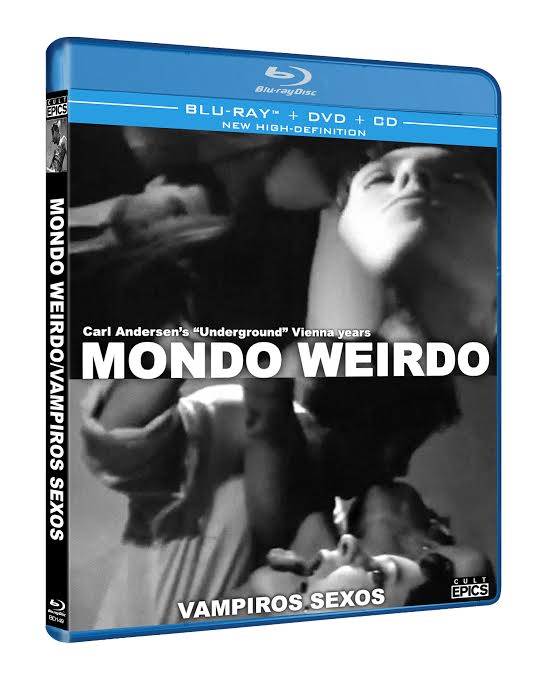
March 2017 Cult Epics Gets “Mondo Weirdo” and “Vampiros Sexos” on Blu-ray/DVD!
MONDO WEIRDO / VAMPIROS SEXOS Premieres on BLU-RAY/DVD March 14, 2017
Los Angeles, CA (March 6, 2017.) Cult Epics presents Carl Andersen’s films, the European answer to the Cinema of Transgression of Richard Kern and Nick Zedd, except more extreme, eccentric, surreal and erotic.
“The Hard-core version of Eraserhead” –Jan Doense (Weekend of Terror)
MONDO WEIRDO: A TRIP TO PARANOIA PARADISE aka JUNGFRAU IM ABGRUND wallows in smut, sleaze, gore, splatter, and dark comedy and is set in an underground world where both vampires and punk rockers engage in hardcore sex to the highly addictive and hypnotic electro music of Model D’oo. Dedicated to Jean Luc-Godard and Jess Franco featuring his daughter Jessica Franco-Manera. Shot on 16mm stock, presented in a new High-definition transfer on Blu-ray.“Vampire Porno”
VAMPIROS SEXOS aka I WAS A TEENAGE ZABBADOING… is Carl Andersen’s debut film and is one of the weirdest movies ever, and it will certainly shock your mind. VAMPIROS SEXOS is the ultimate European underground punk rock sex vampire film. Stylish and trashy at the same time in the best sort of way, the film also features an endlessly entrancing no-wave score by Model D’oo. Cult Epics presents the rare only existing Uncut SD version on DVD together with: WHAT’S SO DIRTY ABOUT IT? Bonus short film. Cut-up trance noise nihilistic short film, reminiscent of the work of Throbbing Gristle and Kenneth Anger. SD3 Disc Limited (numbered) Edition of 2000 copies includes Exclusive CD soundtrack by Model D’oo.
MONDO WEIRDO/VAMPIROS SEXOS Blu-ray/DVD/CD Combo
Price: $39.95
Street Date: March, 2016
Production Year: 1988/1990/1990
Film run time: Approx. 68/57/9
Language: English & German language with English subtitles
Aspect Ratio: 1.33:1
Audio: Dolby Digital 2.0 Stereo
Label: Cult Epics
Distributor: CAV
Blu-ray/DVD/CD Cat.no. CE-149
BD UPC: 881190014998
Rating: Not RatedSPECIAL FEATURES
New High-definition Transfer (from original 16mm print)
Introduction by Erwin Leder (star of Angst)
The Making of Mondo Weirdo (2016)
The Making of I was a Teenage Zabbadoing aka Vampiros Sexos (2016)
Bonus film: What’s So Dirty About It? (1990)
Evil Scores Big by Burning Rubber! “Death Race 2050” review!

In the dystopian America of 2050, commercialism presides over the middle and lower classes in the constructed wasteland that is United Corporation of States led by an impeccable and blood thirsty Chairman. A popular, carnage-laden sport known as the high octane Death Race has become beloved by all Americans, giving them an escape from their mundane and pitiful existence. The Death Race is simple: war-modified cars trek across the United Corporation of States in a 3-day race to score points by running down citizens of an overpopulated nation as an encouraged way of resetting the out of control producing rate and racers can also seek glory to reach the finish line with best time. Four-time champion, Frankenstein, is the returning crowd favorite and seeks to win a fifth crown, unless the powerful and conniving Chairman decides otherwise.

Under Universal Studio’s filmic sequel and reboot sublabel, Universal 1440 Entertainment’s “Death Race 2050” is a rip-roaring start toward 2017’s best intense action cinema and despite being pre-labeled as just another diluted and benign remake of the Roger Corman produced, Paul Bartel directed “Death Race 2000” from 1975, the modern day G.J. Echternkamp directed and co-directed film with Matt Tamashita honorably doesn’t lose the rich, yet full of cheap thrills, heritage that makes the original “Death Race” so fun, so entertaining, and so campy keeping the pandemonium on four high-performance, face-shearing tires. Even though Death Race has been quiet for over thirty years since 1975, the last decade has been riddled with Death Race films produced by the legendary low-budget filmmaker Roger Corman and all have been complimentary exclusive in their charm, mayhem, and versions of the lead character Frankenstein to thrill audiences, but it’s “Death Race 2050” that revs in true remake fashion of similar plot structure that changes all but one character.

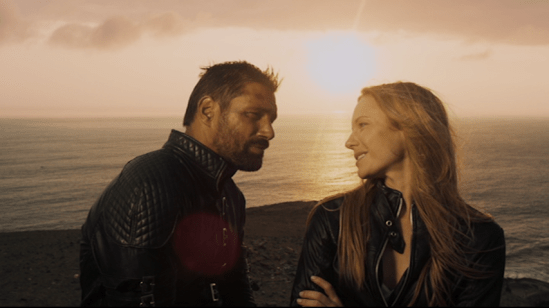
New Zealander Manu Bennet carries the torch in portraying the original character Frankenstein, a four time champion with a leather covered body that’s been ravaged and cybernetically repaired from previous race crashes. Manu’s charisma and rugged image will win over audiences as he perfectly embodies a conflicted champion on the brink of doing what’s right; a tone very similar in all “Death Race” films. Manu is paired with actress Marci Miller, as Frankenstein’s passenger proxy, who dishes out the good girl sex appeal with a self-reliant rind. Beyond these two characters, even with a moniker like Frankenstein, the remaining characters make Mike Judge’s “Idiocracy” a college course of rocket science! Deliveries were timely, actions were precise, and performances couldn’t have been more meticulous in scenes with Jed Perfectus, the genetically engineered and ambiguous pretty boy played by Burt Grinstead, Minerva Jefferson, the wealthy ghetto rapper forged to life by Folake Olowofoyeku, and with Tammy the Terrorist, a cult leader with a celebrity high power portrayed by 2007’s “The Signal’s” Anessa Ramsey. The relatively unknown cast is whole-heartedly glued together by the flamboyant performance of “Clockwork Orange’s” and “31’s” Malcolm McDowell as the Chairman.

One could take a good stab in the dark on what the quality of the effects would be like for any Roger Corman produced film. In this instance, “Death Race 2050” channels much of Corman’s style with Echternkamp and his visual effects supervisor Anthony J. Rickert-Epstein (“Sharktopus vs. Whalewolf”) supplying rotoscope blood and dismemberments that pin-pricks a visual stimulate into the vein of the snobbiest of film aficionados and can be on an everlasting high. The simple, but effect, gasoline based pyrotechnics attest to the dedication of the crew and to the stunt work to know that if they miss their spot, they’re literally toast. However, the sometimes choppy, rapid editing drains some of the juice from the kills that attempt to piece coherent death sequences with humor and action. In fact, “Death Race 2050” redlines just like the modified, manslaughter vehicles used to rundown babies and the elderly to score points by quickly jumping to the next segment in order to sustain all the gory story’s girth.

“Death Race 2050” is adrenaline flowing wildly adjacent with gasoline, exploding with gore, and is terrifically enjoyable. Echternkamp’s script bares no sense with the sensitivities, secreting American wealth, greed, and stupidity in an environmentally degraded America filled with large high fructose corn syrup soda, an addictive cheese whiz byproduct, and borders that are named after corporate conglomerate of brands such as Walmart or Texaco. Universal’s R rated Blu-ray, DVD, and Digital HD release of the New Horizon film is an 1080p of the 1.78:1 widescreen presentation that makes the film look cheap due it’s hi-def attributes. The image quality is sleek and vibrant with a wide range of rainbow hues and the definition doesn’t ever thrown in the towel. The three option audio selection that consists of an English DTS-HD Master Audio has a lossless appetite that delectable distinguishes the channels where explosions are bombastically LFE and the gory parts are viscerally squishy. The dialogue is surprisingly clear through the amount of chaos. Bonus features include “The Making of Roger Corman’s Death Race 2050,” “The Look of 2050″ featurette,” a closer look at the cars in a segment entitled “Cars! Cars! Cars!,” a cast car tour, and deleted scenes. Even if the story’s timing is a spastic, “Death Race 2050’s” a guilty pleasure from start to finish line under the caustic cinematic eye of Roger Corman!

Dead Parents Create Good and Evil Children. “The Orphan Killer” review!

Audrey Miller is your borderline, but overall good, Catholic woman, but the Saint Michael’s Orphanage dance teacher withholds a dark secret from her past. Audrey, herself, is an orphan along with her estranged brother, Marcus. At the age of 6-years old, Marcus took the brutal death of their parents the hardest, transforming a young innocent boy into an emotionless and destructive shell of his former self and while they attended the orphanage where Audrey currently teaches, Marcus suffered at the hands of wrathful Nuns hellbent on forcing Marcus to repent for the sins he’s committed. Years have gone by and Marcus, donning the Nuns’ gifted mask to frighten other children away from him, has been confined to a neglected psych ward, but, now, Marcus has found an escape and seeks to hunt down his beloved sister, trapping her inside Saint Michael’s, to relay a message that blood never abandons blood unless it’s fatally punctured with a blade.

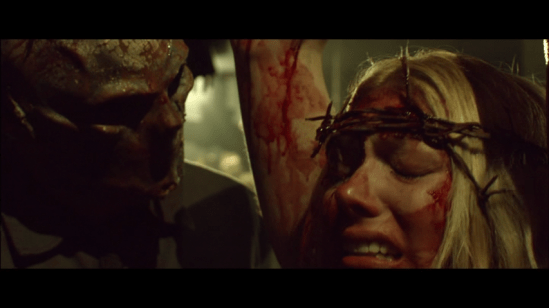
Matt Farnsworth’s 2011 “The Orphan Killer” is a cold-hearted, slaugtherfest, aiming to reap the Catholic church of sinners by committing the ultimate sin. Serial killer, Marcus Miller, becomes this generation’s misunderstood maniac, being the right hand of God and smiting blasphemous individuals in a one-night stint of blood drenched dirty work. Being the sophomore feature from writer-director Farnsworth, there’s plenty to be impressed with here from the setting up victim characters and the killing-ground stage to quickly canonizing Marcus after learning the atrocities his victims; Marcus blurs into the realm of anti-hero in a twisted sense of the slasher genre with religious undertones – such as Audrey wearing a barbed wire crown of thorns. He’s very familiar to that of iconic genre staples such as Jason Voorhees or Michael Myers, yet Marcus Miller’s unique origins background and murderous methodology doesn’t share with the already established grisliness. If Farnsworth is willing, this serial killer could be expanded upon with such a rich backstory.

Story wise, there are familiarities toward that of Michael Myers’ background with the bloodlines. Instead of Laurie Strobe being related to her coupled murderer, Audrey, played by stunning beauty Diane Foster, has, unbeknownst to her good fortune, to her still breathing psychopathic brother, Marcus, portrayed by David Backus. Both Foster and Backus have previously worked together on another Matt Farnsworth written-directed feature, his breakout indie film, “Iowa” in 2005 that also starred Rosanna Arquette {David Cronenberg’s “Crash”) and Muse Watson (“From Dusk till Dawn 2: Texas Blood Money”) and have great cat-and-mouse chemistry through love-and-hate sibling rivalry. Farnsworth also co-stars his own flick as Audrey’s cop boyfriend who becomes mixed up in the mess when Audrey doesn’t come home next morning. Unlike Audrey and Marcus, Officer Mike Hunt – yes, Mike Hunt – lacks substance and is portrayed a bit of a wild card when Audrey goes into dire stress. The cast rounds out with Karen Young, James McCaffrey, Charlotte Maier, Spencer List, Dana DeVestern, and John Savage.

The realistic, sometimes over the top, practical effects make the scene in a welcoming glorified shower of gore splatter. Marcus Miller’s killer tactics vary from victim-to-victim, whereas some slashers maintain one particular kill setting, making “The Orphan Killer” eye-catching and extremely engaging. The unbelievable production value for an offbeat slasher that’s so profane to religion temples and other holy aspect shouldn’t go unnoticed and I’m not just speaking highly solely of the special effects. The structural bones of a cathedral church setting and the amount of extras used in well choreographed dance recital and Miller kids’ flashback scenes show the committed financial backing put to work in Farnsworth’s film. Farnsworth edits his own work that’s slightly erratic at times, but overall successful with the action that’s involved and the displaying the severity of splicing together great practical kill scenes. I’d say his style is certainly earthy and sometimes there are glimpses of channelling iconic directors.

Produced mainly by Farnsworth’s company, entitled simply enough Matt Farnsworth Films, in association with Full Fathom 5, “The Orphan Killer” has rightfully found a friend at the Reel Gore Releasing home distribution label with a Hi-Def 1080p Blu-ray and DVD combo release. The 2.35:1 aspect ratio presentation sharply defines details, especially in the blacks, and does well with desaturating the hues to give it a gritty, dirty appearance that compliments the abandoned sections of Saint Michael’s. Two audio options are available, an English DTS-HD Master Audio 5.1 and Dolby Digital 2 channel; the 5.1 delivers a heart pounding score, but the soundtrack by Bullet Tooth releasing, featuring a slew of hardcore metal bands, oversteps into some dialogue sequences. However, Ventana’s cover of “Cry Little Sister” kicks off right after the opening credits; an early sure sign of good things to ahead. Bonus features include a “behind the Murder:” an exclusive video diary, teaser trailer, theatrical trailer, music clip, and a slideshow. “The Orphan Killer” has religious metaphors under a sacrilege of brutality and unleashes a retroesque Renaissance slasher for modern day terror.
Want to be the Evil Doctor’s Guinea Pig? “American Guinea Pig: Bloodshock” review!

One man becomes the unfortunate subject of ghastly experimentations performed by a sadistic and blood thirsty doctor. Wheeled by abiding orderlies back and forth from his sterile white and padded cell to the mad doctor’s dark and dingy operating room office, the man’s will to live quickly begins to fade, yearning for death before suffering anymore in an alternative Hell. That is, until the handwritten notes start appearing on his padded room floor. The notes seep through between the pads from another tortured soul, a female, in the adjacent room. Withstanding new atrocities done to her before the man receives them, she pleads with the man to not leave her and to make a pact to outlive the inhumanities together.

Welcome to the new American Guinea Pig series! “Bloodshock” is the 2015 follow up film, on the coattails of 2014’s “American Guinea Pig: Bouquet of Guts and Gore,” from writer-producer and Unearthed Films president Stephen Biro and directed by special effects guru Marcus Koch. Koch, whose effects credentials include the Barbara Crampton starring thriller “We Are Still Here” and Koch’s prior directorial work “Rot” and “100 Tears,” strays away from the straight forward concept with an ultra gore art house expressionistic horror film that aims to break your mind as well as your body. Open for interpretation, “Bloodshock” fits perfectly into the ever provocative Unearthed Films’ wide open cache of underground cinema and will alleviate Koch to the next level of filmmaking. My interpretation of what this poor man and woman are experiencing is simply a penancing purgatory that’s intended to cleanse their souls in the warmth of their own wretched blood; the two victims understand their pain, as if not feeling the invasive effects of being dissected while still yielding breath, and are willing to subdue themselves to a maniacal physician until they’re able to briefly thwart his tireless work to share pain and open wounds in blood-soaked passion of hopeless ecstasy.

Dan Ellis puts in a powerful performance as the mistreated male patient with Lillian McKinnay, as the female patient, co-starring in an equally bold performance, especially being McKinnay’s first major role. Andy Winton’s diabolical medical maltreatment compares to the similar magnitude of “The Human Centipede’s” Dieter Laser by conducting exploratory, invasive, and unnecessary surgeries for sport while being candor about his blood lusting necessity. Amongst the three main actors, Biro’s script contains little dialogue, banking laboriously on physical renditions since both tortured patients’ tongues have been severed and jarred. Every movement is precisely executed and surged with attention, tuned to tell the story without much verbiage. Ultra gore isn’t everybody’s cup of cinematic tea and with an extremely thin film of dialogue as an outer coating, Ultra gore becomes that much difficult to be entertained by, but, recently, I’ve been lucky enough to come across another gore and shock film, coincidentally enough another Unearthed Films’ release entitled “Flowers” by director Phil Stevens, that had proved to me, as well as Koch has just done, that unspoken gore can be ingeniously crafted and thought provoking.

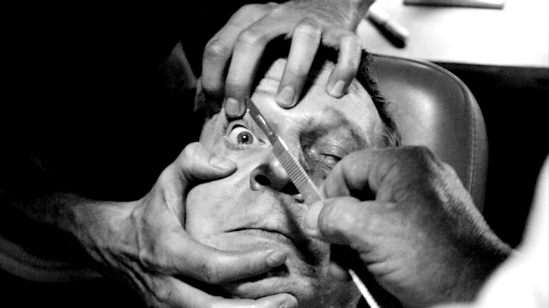
“Bloodshock’s” gore holds nothing back and leaves nothing to the imagination. The meticulous bone-sawing, head-splitting effects from a talented special effects team, consisting of Marcus Koch’s Oddtopsy FX crew, paint a sordid picture with a blood brush. Koch’s decision to go with Donald Donnerson’s cinematography under the two-tone of black and white doesn’t stiffen the poignant sight of blood, inner layers of flesh, or the splintering bone fragments. The Japanese would be pleased with their American counterparts realistically depicting gore and death captured amongst an underlying meaning. Unearthed Films has already taken the steps to continue the series with their next installment, “American Guinea Pig: The Song of Solomon,” which will pertain to a graphic exorcism and, currently, there are preview images and video scenes available.

The 3-Disc Collector’s Set from Unearthed Films and MVD Visual has priceless collector’s value. Not only does the set have a Blu-ray transfer of the 1.85:1 widescreen presentation, but also contains a DVD presentation and a third disc containing a CD of the Kristian Day industrial-jarring soundtrack. The black and white image quality is sharp and solid for a majority of 91 minute runtime. Some scenes go soft, losing shape to blotchy interference, but the qualities only supplement to “Bloodshock’s” charming grit. Only during the course of the patients unifying do colorful hues gradually seep in, almost unnoticeably, during an ostentatious sex scene involving blood and intestine that’s effectively edited to slowly build the passionate boiling point. Despite two of the main characters have their tongues removed, the Dolby Digital 2.0 audio has the dialogue so sorely crushed under the weight of the Kristian Day soundtrack that at some scenes I can’t even understand what the good mad doctor is saying. Also, on the DVD, I noticed that all audio tracks delay a second behind the action and dialogue. The bonus features are immense with interviews with director Marcus Koch, writer-producer, Stephen Biro, actor Dan Ellis, actress Lillian Mckinney, and two commentary tracks with Marucs Koch and Stephen Biro on one and actor Andy Winton, Gene Palubicki, and Alberto Giovannelli on the other. There’s also a behind the scenes featurette, production videos, and a booklet with a review from Ultra Violent Magazine! Unearthed Films certainly has a definitive release in their collection with “American Guinea Pig: Bloodshock” that’s packed with bonus material and full of venomous content abiding by the guidelines set forth by the Japanese. I don’t foresee the underground cinema juggernaut or the explicitly snuff-like Guinea Pig series ever slowing the flow of blood. “Bloodshock” fulfills the qualifications of the series by having the guts to show the guts and being just as demented and sick for fans who can stomach and endure grisly content.