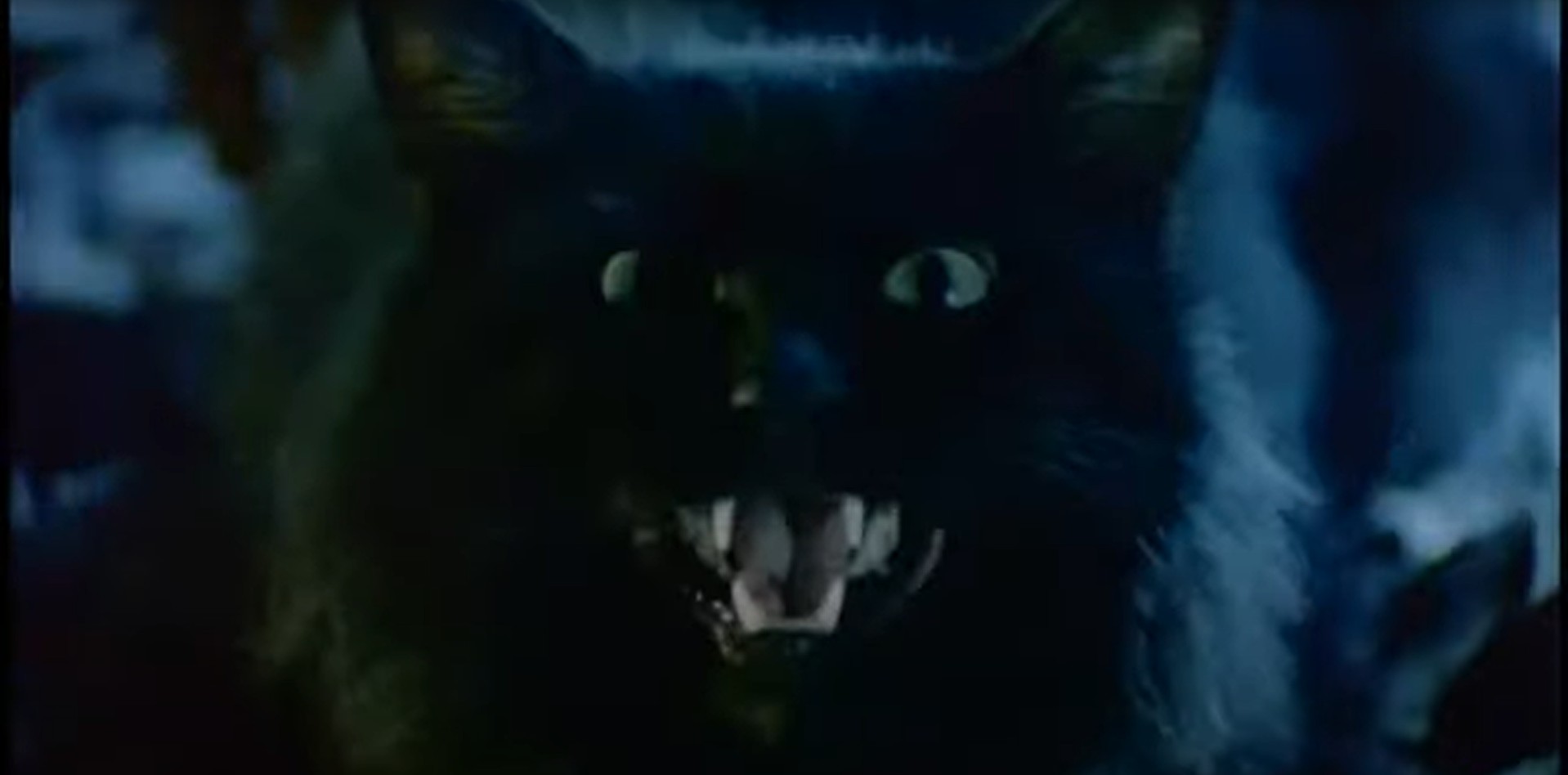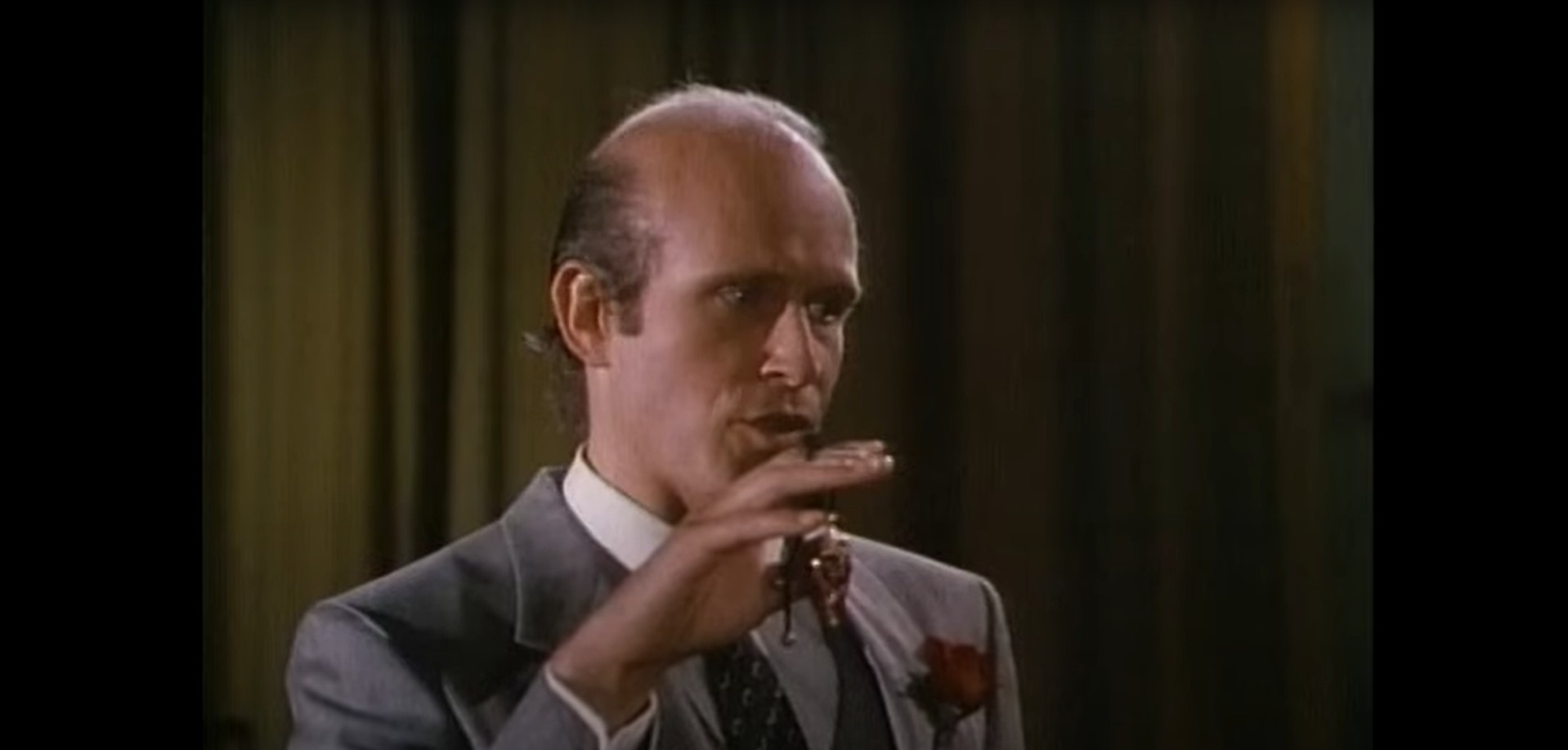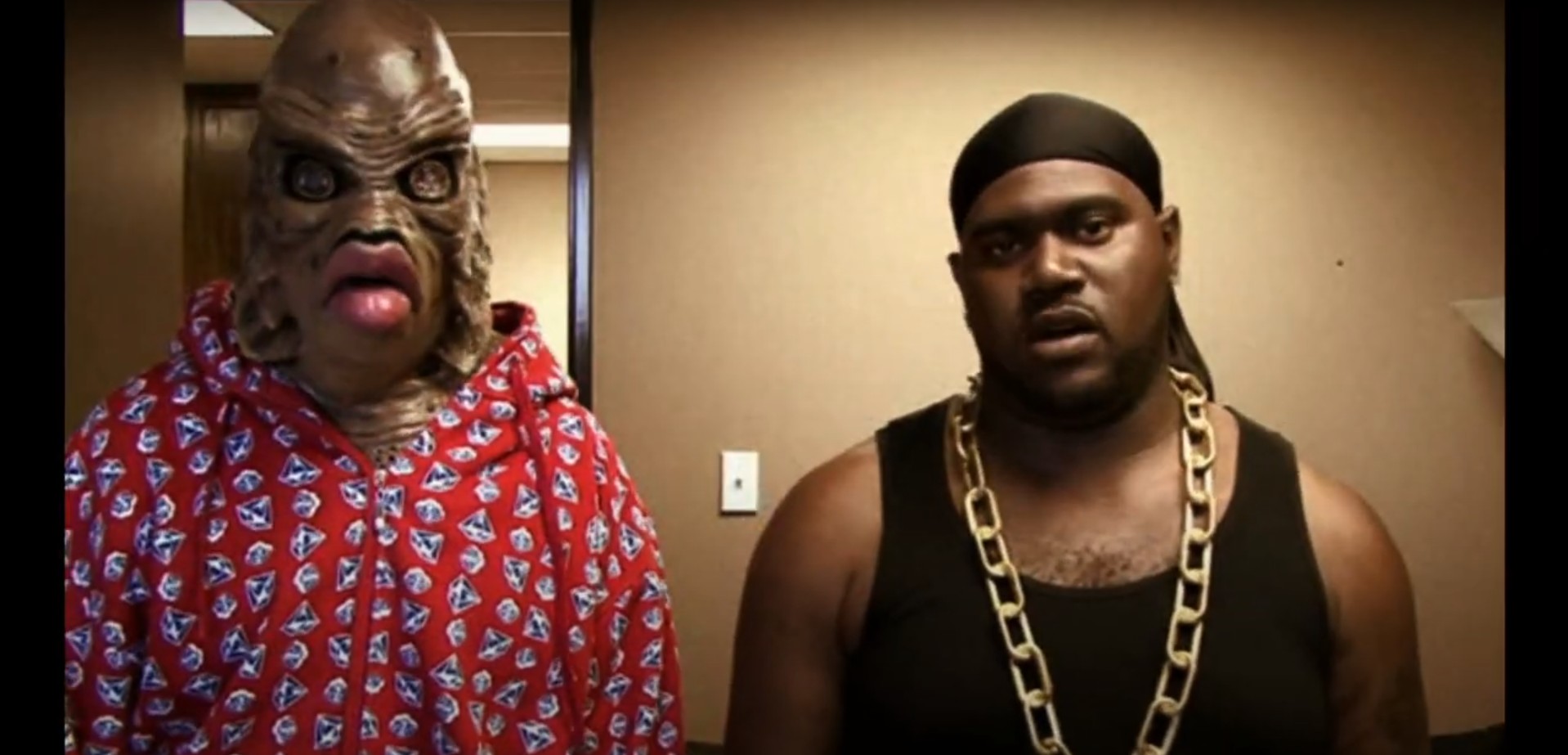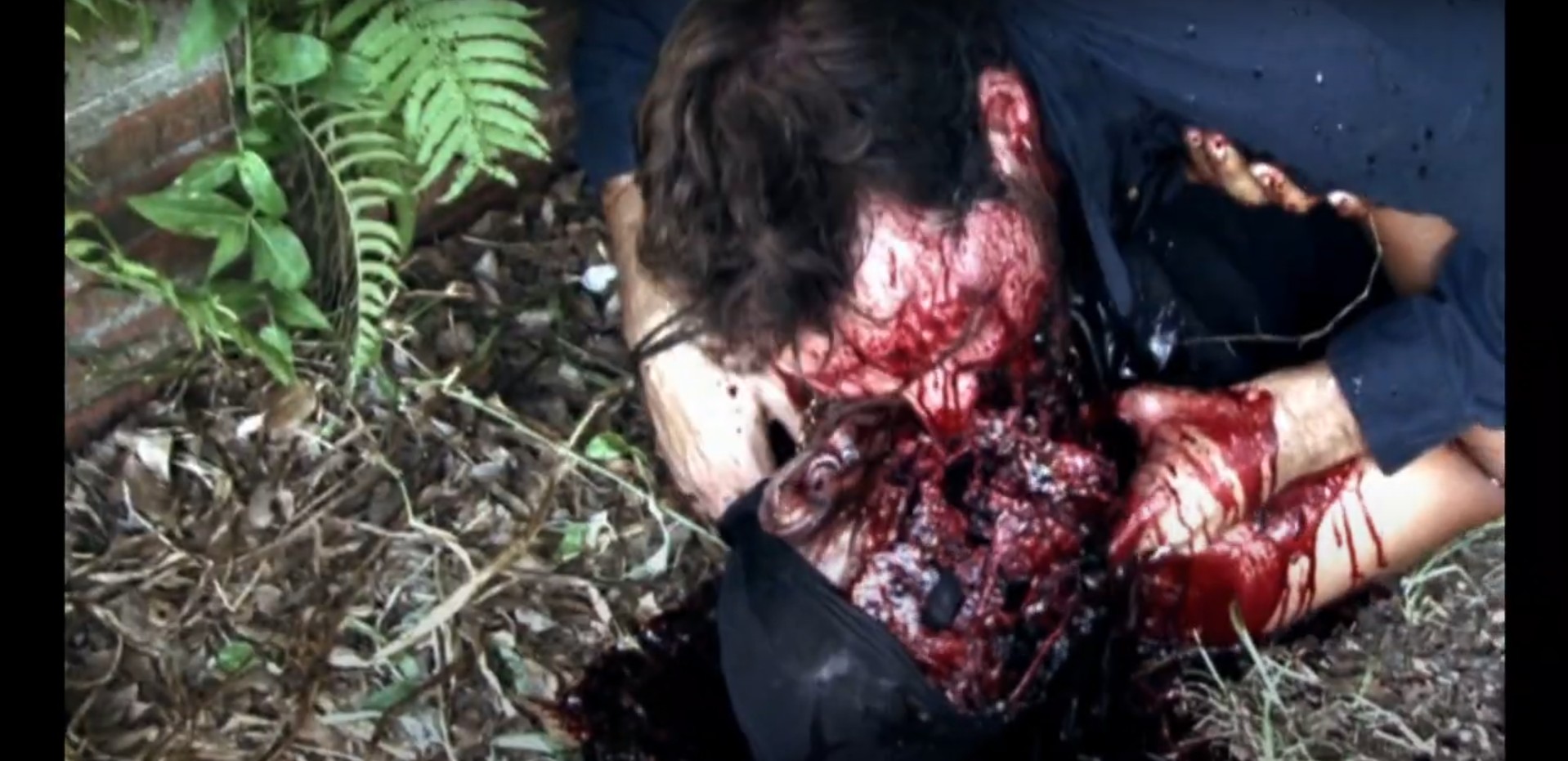
EVIL Just Wants Their Heads Back! “The House of Lost Souls” reviewed! (Cauldron Films / Standard Edition Blu-ray)

Don’t Lose Your Head in “The House of Lost Souls” on Blu-ray!

A group of geological fossil hunters spend their time researching in what is supposed to be the ideal climate of the Italian mountains but inclement, rainy weather has produced all kinds of inconvenient havoc and challenges that have slowed down their darting research.  Mudslides caused by the constant rain makes mountain roads impassable.  They encounter such a mudslide impasse on the way to their next research grounds and do an emergency detour to a remote, vacant hotel to spend the night out of the cold damp night.  Greeted without a single word from their unusual host, they’re given room keys get some rest before the next day’s hike up the cleared mountain road, resuming course toward the fossil hunt, but the geologists quickly discover something isn’t right with the hotel that has a dark history.  Trapped inside the abandoned hotel, murderous spirits appear and aggressively seek more souls to fill the hotel’s vacancy.

The fourth and final entry in The Houses of Doom series produced from Italian television in 1989, “The House of Lost Souls” is the second Umberto Lenzi (“Nightmare City,” “Ghosthouse”) film of the Lucio Fucli and Lenzi stint from the coproduction of Dania Film and Reteitalia with producers Massimo Manasee and Marco Grillo Spina, behind Lenzi’s “The House of Witchcraft” and Fucli’s “The House of Clocks” and “The Sweet House of Horrors.”  Lenzi also created the story concept and wrote the script that feels like a blend of the American-produced, supernatural thrillers “House on Haunted Hill” and “13 Ghosts” but with more bloodshed, color encoded and has that Italian violence flair too graphic for public television.  Italian-titled “La casa delle anime errant,” the film is also a production of the National Cinematografica that produced other Italian Umberto Lenzi cult classics “Seven Bloodstained Orchids,” “Eaten Alive,” and “Cannibal Ferox.” 

Trapped inside the gruesome lore of the hotel’s deadly history and as the focus of the overall dilemma is the group of geology students and friends, plus one adolescent boy tagging along with his older brother.  Further more concentrated on inside the group is Carla who’s been diagnosed, yes – medically identified, as having clairvoyancy with her psychic nightmare visions, sporadic and jumbled frightening images that yet don’t make sense, but guess what?  To no surprise, they will soon! Stefania Orsola Garello, who went on to have a role in the Antoine Fuqua’s period epic “King Arthur,” played the third eye sensorial Carla investigating the hotel’s sordid past along with quasi-boyfriend Kevin, donned by “The Slumber Party Massacre” American actor Joseph Alan Johnson.  Johnson is the extent of international casting, unless you count the hotel host, or rather head ghost who we’ll touch upon later, and the distinct facial features and the significant height of Japan-born Hal Yamanouchi (“2019:  After the Fall of New York,” “The Wolverine”) as a zombified Hare Krishna ghost, one of his many Italian roles while residing within the country since mid-1970s.  The remaining fill out with Garello countrymen counterparts with Matteo Gazzolo (“Specters”) as the group leader, Constantino Melon (“Who Killed Pasolin?”i as the leader’s little brother Giancarlo, and young lovers Guido and Mary, played by Gianluigi Fogacci and Laurentina Guidotti (“Dark Glasses”), as the victimized geologists being hunted down and tricked into slaughter by, too, victims of a hotel proprietor madman, the key perpetrator to all this madness but reduced to only a reflected role through Carla’s flashbacks.  Aside from Yamanochi, there are a handful of former guests and voiceless ghosts, some stuck in a bloodied stasis at the time of their death, some pristine as if nothing happened at all, haunting and hunting down the warm bodies, including Scottish actor Charles Borromel (“Absurd”), Marina Reiner, Dino Jaksic (“Little Flames”), and Beni Cardoso (“Barbed Wire Dolls”).

A different ghost house picture than Lucio Fulci’s “The Sweet House of Horrors’ but still contributes the same inhuman intensity of one person (or one ghost person) can against another person.  Yet, for Umberto Lenzi, his story thrives through the house’s, or rather hotel’s, ability to dispatch the innocent with household items.  Decapitating dumbbell waiters, a cabinet with a ripping chainsaw blade, a head-eating washing machine, and almost even a walk-in freezer become the tools of fatal terror.  Lenzi depicts little in the way of person-on-person violence with only implied deaths at the hands of another person; instead, the personification of ghost house miscellany is definitely more exciting, very unexpected, and a lot of fun to watch the hapless have their heads fall prey to household items that are supposed to be helpful, not hurtful.  Perhaps, Lenzi’s intentions were to explore the negative dependency of gadgets or appliances and how easily we’re allured by their safe nature marketing and profound assistance to our daily lives that it makes us easy targets with our guard down.  Lenzi also doesn’t believe in nepotism when casting young actors as the two child characters become fair game for the house’s thirst for slaughtered souls, dooming them with an equal risk to a brutal death.  The storied hotel’s notoriety serves as the vessel that drives ghosts to go berserk but the story’s miss is bringing back to the killer hotel owner who chopped the heads off of his guests to rob them, stowing them away to hide his transgressions, only for them to be the root of the ghosts’ reason for revenge against any and all who trespass through the lobby.  As the origin of the ordeal, the omitted owner serves as just flashback fodder that fuels the floor-by-floor fiends. 

Spiders, skeletons, and severed heads make up, but are not limited to, Umbero Lenzi’s “The House of Lost Souls” now on Blu-ray as the last The Houses of Doom release from Cauldron Films.  Presented in the European widescreen aspect ratio 1.66:1, the new 2K scan was restored and released uncut from the original film negative, inviting a clean and beautifully vibrant pictures for a dark, haunted hotel feature.  However, like with many Lenzi pictures of the time, the final product has softer image detail that’s brilliant for producing color but relaxes the stringent textures to a still better than mild palpability that’s more than enough beyond the bar of image quality.  There are no compression anomalies to speak of as Cauldron Films, again, produces an excellent high-definition encoding, much like with the other three Houses of Doom installments.  Audio setup includes an encoded English and Italian 2.0 mono with optional English subtitles for the English track and forced English subtitles on the Italian.  The ADR hits and misses the mark with vocal ranges seemingly too mismatch with the actors, such as with Massimo who looks like a tenor but has a bass voice, or the boy Giancarlo with an unsettling falsetto and you can lipread those who are actually speaking English compared to those who are not native English speakers.  The overall track has no compression issues with a powerful dialogue projection and an adequate ambience that hits every keynote to bring the composition together.  “Demons” and “Tenebrae” composer Claudio Simonetti produces a charming little synch rock trap-threat and of a score that becomes essential to “The House of Lost Souls” snare and stalk of the geologists caught in the wrong place at the wrong time.  Special features include Cauldron Films’ exclusive interviews with FX artist Elio Terribili Working with Umberto and composer Claudio Simonetti The House of Rock along with two audio commentaries, one with Samm Deighan and the second with Rod Barnett and Adrian Smith, and bringing up the rear is a 2001 interview with Lenzi going through points in his lustrous independent career of exploitation, poliziotteschi, and giallo contributions to Italian cinema in The Criminal Cinema of Umberto Lenzi.  The not rated, region free Cauldron Films standard Blu-ray release, encased in a clear Scanova Blu-ray case with original Matthew Therrien and Eric Lee illustration cover art and logo design, has a runtime of 87 minutes.

Last Rites: That’s a wrap on the fourth and last film on The Houses of Doom collection from Cauldron Films and it’s a beauty scanned onto a new high-definition transfer that brings doomed television features back to life, to live again, to breathe its hot breath of death all over a new generation of viewer unfamiliar to Lucio Fulci, Umberto Lenzi, and even Italian horror!

Don’t Lose Your Head in “The House of Lost Souls” on Blu-ray!

This Toyish EVIL is Definitely Not a Toy! “The Monkey” reviewed! (Neon / Blu-ray)

Own “The Monkey” on Blu-ray from Neon!

When twin brothers Hal and Bill, who personably couldn’t be more different, come across their deadbeat father’s windup toy grinding monkey amongst his left behind things, every time they wind up the monkey’s rat-tat-tat tune, at the last stroke someone close them dies a gruesome, horrible, seemingly accidental death.  As the deaths hit closer to home, such as the violent aneurism that takes their loving mother, the boys decide to toss the sinister toy into a deep well to stop it’s dooming of another soul.  The boys diverging personalities drive them apart and for many years they don’t speak until Bill calls Hal about the accidental death of their aunt.  A new string of death begins as the toy resurfaces to play its portentous tuneful rattling once again.  Hal, who’s now trying to connect with a son he’s kept at arm’s length in fear of the monkey’s return, must reunite with Bill to stop the carnage before it’s too late for them all.

Stephen King is so hot right now.  Hell, Stephen King has been hot for decades as one of the still living novelists to have numerous film and television series adaptations.  This year alone proves how influential and craved King’s work is amongst filmmakers and fans with “The Long Walk” and “The Running Man” feature films being released in the months to come.  There’s even the upcoming film rendition of “The Stand,” a novel that’s been adapted twice already set to receive a third account.   Since 1976 with his first adapted novel “Carrie,” King has been the king of having his work reimagined for visual scares and entertainment.  Earlier this year’s “The Monkey” is another example of the prolific author’s short story of the same title from his “Skeleton Crew” collection, coming to life on the big screen being helmed by one of the hottest new directors in modern horror, Osgood Perkins (“Longlegs”).  The horror-comedy is written and directed by Perkins in British Columbia, Canada and produced by “Saw’s” James Wan as well as Chris Ferguson, Dave Caplan, Brian Kavanaugh-Jones, and Marlaina Mah.  “The Monkey” is a company collaboration between Atomic Monster, The Safran Company, Oddfellows, Stars Collective, and C2 Motion Picture Corp. with Neon presenting theatrical distribution.

English actor Theo James is also no stranger to films adapted from literary works as The Divergent Series film star steps into “The Monkey’s” killing sphere by playing not one but two roles as the Hal and Bill Shelburn, twins with a tragic history that runs integrated with the windup, grinder monkey.  James caters to both personalities with mild-mannered energy that does transition exactly from the children counterparts (Christian Convery, “Cocaine Bear”) in the first half of the 30-year time span. Older Hal is joined by his son, lightheartedly named Petey, played by “Wonka’s” Colin O’Brien with the same deadpan deliveries as Theo James that greatly adds to their combined relationship and antagonism.  There’s plenty of self-deprecating and bullying upon Hal who, amongst the monkey’s supernatural selection-for-death drumming, is fashioned to be a loser but the narrator of the story in his slow burn rise to overcome the blood splattering challenges ahead, turning one-half of the twin duo into a lead principal and the feeble hero of the tale mostly setup by the character’s voiceover of the past and his action of the present.  In a rare showing amongst conventional character work, there is no love interest to note to either Hal or Bill other than possibly the Shelburn mother Lois in a doing in the best with what I got single mothering act by Tatiana Maslany (“Diary of the Dead” ).  Lois’s rough around the edges attitude is more shaved down by her airline pilot husband who left her and the boys and comes across as a guiding light for her twins on the rough, diverging path.  Once she’s removed from the picture, whatever threadbare connection between the twin boys had was severed that day, creating underlining turmoil and bloodshed decades later.  The cast fills in with Rohan Campbell (“Halloween Ends”) a teen obsessed with the monkey since his first encounter, Osgood Perkins as the blunt uncle, Sarah Levy as the unfortunate aunt, and a couple of powerhouse names with cameo appearances in Elijah Wood (“The Toxic Avenger”)  as Petey’s soon-to-be stepfather and Adam Scott (“Krampus”) as the Shelburn deadbeat dad.

Through the mysterious monkey business of randomized, accidental deaths is this dark theme of everybody dies and everybody dies at different times in various ways.  Through Theo James’s Hal narration and a few character jawing harps upon a zero set expiration date for people and really nails the head on the lack of preconceived set of parameters and time span of how long a person should be alive before they die, setting a concentrated focus on the way a person dies, as mentioned in Lois’s post funeral service monologue while holding her two boys that some die screaming in blood curdling agony and some parish peacefully without a blip of hoopla.  The grinding monkey toy (never call it a toy!) represents the sardonically absurd aspects and happenstances of death with its selective process and imminency; in essence, the grinder monkey is a materialized grim reaper.  Stephen King wrote “The Monkey” 45-years ago in 1980 but the film shares similarities to the modern-day horror of the “Final Destination” franchise that provides ominous premonitions precipitating subsequent deaths of those who weren’t supposed to survive a major mass causality event.  Yet, what the two entities possess is their love for the absurd, Mouse Trap ways those in the crosshairs come to end with “The Monkey” rivaling the exploding of gore, gruesomeness, and ferocity that’s made the “Final Destination” franchise rocket with cult fandom. 

Beyond bananas, “The Monkey” shines as an adept and agreeable anarchial Stephen King adaptation.  Neon brings the blood with a standard Blu-ray with an AVC encoded, 1080p high definition, BD25, presented in a widescreen 2:00:1 aspect ratio.  Technically, “The Monkey’s” a sound example of competent compression on a lower capacity format with no evident artefacts of any size.  “Witch Hunt’s” Nico Aguilar’s semi-dark gloss adds a sheen to the elements inside a middle-of-the-road contrast.  Coloring is diffused distinctively into the well-lit scene, providing separation and delineation amongst objects, while the lower lit, more obscure moments, are sprawled by a mellower shadow that is inky or just a void but a stylistic choice to create atmosphere rather than be a menacing presence or a gape of mystery.  The English DTS-HD 5.1 Master Audio equates much of the same caliber with a clean, clear, and robust dialogue layer with a step down for the ambience, accentuated by range and depth where necessary, and a soundtrack that’s not engrossingly ear-catching but is still full-bodied and present from Edo Van Breeman (“Afflicted”).  Also listed is a Descriptive Audio 2.0 Stereo and there are English and Spanish subtitles optionally available.  Encoded bonus features are a condensed cut of behind-the-scenes featurettes, including Becoming Hal and Billi with Theo James conversing about getting into the mindsets of two completely personalities of twin brothers, Funeral Gallery provides insight on the funeral programs for the multiple services of accident deaths, Outrageously Gory and Thoroughly Gratuitous takes a dive into the cartoon-like graphic violence full of blood – lots of blood and body parts, and The Cast of The Monkey rounds out with in-depth look at the cast playing the cast of eclectic characters.  An assortment of trailers is also in the mix with an included announcement teaser, teaser, and the full theatrical trailer.  Neon’s Blu-ray is standard fare with a conventional Blu-ray case from Viva Elite housed inside a delicate slipcover with a hard detailed look at the grinder toy monkey (again, don’t call it a toy!) in full smile and ready to rap his drum, the same image of stark red and black contrast that’s also on the front cover of the Blu-ray cover art.  The insert section does not contain any physical supplements nor are there any other physical supplements included.  Locked in a region A playback, Neon’s release has a runtime of 98 minutes and is rated R for strong bloody violent content, gore, language throughout, and some sexual references. 

Last Rites: Banging away as a harbinger of death, ‘The Monkey” drums up an honest day’s work as a solid Stephen King adaptation twisted by Oz Perkins’s black comedy and high-level gore only the filmmaker could devise.

Own “The Monkey” on Blu-ray from Neon!

Is Your Disturbing Library This EVIL? “Reality Killer” review! (Treasured Films / Blu-ray)

“Reality Killers” Entering the U.S. Torture Porn Market! Buy it Here!

Serial killer known as “The Sculptor” narrates his obsession and love with documenting the stalking, capturing, torturing, raping, and killing of his victims.  As he watches and video tapes his next target, Mary, from afar, a woman he’s chatted with online extensively about recording home snuff movies, The Sculptor opens up his personal library of snuff movies, labeled and numbered dark web bought tape cassettes exhibiting the videoed brutal deaths of strangers by strangers for their pure sordid joy of taking another life.  An adventurous couple lure a promiscuous young girl on the promise of a threesome, a group of three masked teens take pleasure in the torture of a young woman, a couple enticement a child to their backyard pool, father and son roam the streets for call girl action and a little home invasion, and an underground, all-female rock band’s music video takes male fans to new extremes.

A title and a film unabashed and fully accepting the phrase torture porn, as if it’s a pithy elucidative to be proud of, “Reality Killers” is a shot-on-video, found footage anthology and snuff horror from 2005 helmed by “Witch Story” director and “Body Count” writer Alessandro Capone.  The Italian production contains shorts and a wraparound story that connects them together in an ugly tale of sadism, written by four aspiring, young filmmakers in Pablo Dammicco (“A Deadly Compromise”), Francesco Maria Dominedò (“Dedalus”), Volfango de Biasi (“Help!  My In-Laws Are Vampires”), and a writer simply known as Zedd with Alessandro Capone also contributing with his own screenplay while project managing filmic newcomers as they shoot mostly in Los Angeles using American actors.  Alternatively known under the title of “Project K,” the 2005 film of nihilistic sadism is produced by Eagles Pictures’ Ciro Dammicco and Pablo Dammicco and executively produced by Luca Dammicco and Fabrizio Manzollino.

“Reality Killers” is one of those rare breed films that shares a connection with pictures 70+ years it’s senior with having no after credits.  With no before or after cast credits, acknowledging the cast and their ignoble roles is a challenge to say the least.  If fact, it’s impossible.  The wraparound segment with The Sculptor has some clarifying character elucidation online connected to one of the more well-known Italian extreme violence and horror filmmakers in modern times with Domiziano Cristopharo, director of the surrealistic yet broad-stroked with intense visceral “Confessions of a Necrophile Girl” and “House of Flesh Mannequins,” in a role credited as The Monk.  However, there seems to be some melding overlap between The Monk and the large, oiled-up, and masked concentrated sadist on screen in the wraparound story, played by Valter D’Errico, in a disturbing show of vain and perverse expression.  Alongside D’Errico, in a handful of scenes of being stalked around a metropolitan city and in a naked position of vulnerability on D’Errico’s slab of slaughter, is Cristina Puccinelli (“Phantasmagoria”) playing as the aspiring snuffer enthusiast and killer as well as the online conversationalist Mary who turns prey to her own betrayal going against and essentially humiliating a masterclass maniac like the oily and masked maniac.  After that and within the shorts, none of the other actors are repeated or credited for their work that waver between being exaggeratedly overacted and staged to the point of disingenuous means and the thought of the inflicted violence that spur a subtle creepiness.

The trouble with “Reality Killers” is the inherent topsy-turvy post-production that revamped the anthological storyline with a linear outer story with an anthological storyline connected with a threadbare connected wraparound.  Initially story structured with a sheriff unearthing a library of snuff films and going through selected VHS examples of the killer’s cache with a journalist to explicate the rare breed of butcher.  The videos were also lengthier, more narratively in depth of character and plotline, and have digestible connective tissue with the main shell story that’s redesigned for a body round and glistening, conventionally narcissistic, masked chatterbox, “The Sculptor,” who’s just a physical and commanding orb of a presence in a dark and grimy setting, spouting a deluge of devilish details about his devotion to snuff filmmaking and his own contribution to the perversion.  The told tales vary in degree of both explicit violence as well as story structure as some become more glimpses than a perusal of a three act analog anecdotes to which, in all fairness, found footage, especially pulled from VHS, are only short-lived windows into the lives of others, literally short-lived.  The vignettes are mostly hyper concentrated on the gore, leaving little room for a yard to build, lengthen, and become deeper to invest audiences when the decisive moment comes to take a life with sociopathic heartlessness.  However, “Reality Killers” pales in comparison to the likes of others, such as Fred Vogel’s “August Underground” features that really hammer down on violence and gore with sickening special effects and concentrated shock.  Capone’s entry into the niche subgenre feels reversed at times, never really going for gold in the gutting of precious human life, but the film still evokes a visceral response to the extreme content. 

“Reality Killers” arrives into the U.S. market hailing from the UK label Treasured Films, squeezing itself into the ever tightening commerce of boutique distributors.  Treasured Films’ debut special edition Blu-ray is MPEG-2 AVC encoded, 1080p high-definition resolution, BD50 is presented in a 1.33:1 aspect ratio and either scanned through a VHS record or implements a VHS or commercial handheld camera filer to achieve that passé effect that’s slowly making an aesthetic comeback.  There’s not a ton of other stylistic options used in the vignettes to instill a realism effect and result while the wraparound ups the contrast and grades darkly into its grim substance, leaving attenuated tones of yellows, greens, and reds to be coloring that seep through the oily voids.  The featured presentation carries more of the filtered aspects but in the special features’ Original Production Scenes, the alternate telling of “Reality Killers” embarks on a cleaner, conventional approach in the different outer story with the vignettes either slightly less boxed in by a matte or are outright more defined.  The audio track is an English DTS-HD stereo.  Though an Italian production, the vignette actors are primarily American and the wraparound story is voiced over.  Dialogue coincides with an onboard camera mic that picks up every little detail but also captures varying degrees of volume.  Discerning clarity is, must I say, pretty excellent for the differing sub-productions without an overbearing lopsidedness that usually stems with some who don’t have the technical knowhow to engineer audio precision; each episode achieves what’s strived for without interference, or even with the physical release, compression issues.  English subtitles are available.  Special features include a new interview with director-producer Alessandro Capone From Witch Lore to Snuff Gore in Italian only with English subtitles, a new interview with coproducer Gabriele Pacitto A Killing Reality in Italian only with English subtitles, a new English language essay by Giacomo Calzoni Cutting Deep :  Mapping the Origin of Torture Porn which takes a look at films like “Saw” and “Hostel” that generated the coining of descriptor torture porn and how it influenced horror pop culture, a teaser trailer, storyboards, and an image gallery.  The Original Production Scenes I’ve mentioned previously tells a completely different story and, in my opinion, is more interesting with longer story sequences, more nudity and gore, and the first vignette is scored with music from Nine Inch Nails, specifically “Dead Souls” from The Crow soundtrack, which adds another element to the coarse-riddled subject matter.  Treasured Films standard special edition set comes in a rigid slip box with a hazed face of the masked Sculptor.  The clear Amaray case houses new Ilan Sheady illustrative, compilation cover art in all its explicit detail with the same art pressed onto the disc.  Inserted is a 31-page color booklet with film stills, Blu-ray acknowledgments, and a David Flint essay “The Forbidden Films of the 21st Century” that discusses the films banned in Britian, which includes “Reality Killers’ rejected by the BBFC.  The all-region release has a runtime of 75-minuts and is, obviously, not rated.

Last Rites: Torture porn snuff films are, for a lack of a better world, repetitive in their controversial narrative and “Reality Killers” is no exception but it’s the style choices that and effects that entertain us or makes the sweat run down our brow. Alessandro Capone’s entry to torture porn has a visceral bite but isn’t the repulsive best-of-the-worst. Yet, Treasured Films’ entry into U.S. market is remarkably unforgettable.

“Reality Killers” Entering the U.S. Torture Porn Market! Buy it Here!

A Parents’ Love Never Dies. It Just Becomes EVIL Against Threats! “The Sweet House of Horrors” reviewed! (Cauldron Films / Blu-ray)

“The Sweet House of Horrors” on Blu-ray by Cauldron Films!

A house robbery gone wrong results in the brutal murder of twin siblings’, Marco and Sarah’s, parents Roberto and Mary Valdi when they stumble upon the masked thief, catching him in the act in their beautiful villa home.  The twins bawling at the funeral gives way to impish innocence as the children cope in jokes amongst each other and to their now legal guardians, Uncle Carlo and Aunt Marcia.  Looking to sell the now sullied house, Carlo and Marcia invite a pompous realtor to examine and price the home only to have strange occurrences begin a series of unexplained phenomena the children are certain to be their parent’s lingering and love presence to keep the house within the family.  The parental entities also seek revenge on their attacker whose has been close to the family for years.  As the spirits continue their course of playful and perturbed poltergeist toward their children and unwanted visitors, an unaware Carlo and Marcia hire an exorcist to rid the house of what they suspect to be an evil spirit. 

The third made-for-TV film in the Massimo Manasse and Marco Grillo Spina doomed The Houses of Doom series, in which none of the films aired due to their too gruesome violence, “The Sweet House of Horrors” is the second Lucio Fulci production under the defunct 1989 series, coinciding with “The House of Clocks.”  Just like that film, Fulci also invented the concept of murdered parents being guardian angels over their children while thwarting murderers, realtors, and exorcists from taking what they hold most precious, their children and their home.  The shooting script comes from “Devil Fish” and “Phantom of Death” duo Vincenzo Mannino and Gigliola Battaglini.  The fantasy-ghost house horror is another production of Reteitalia and Dania Film and filmed in peaceful Italian municipal of Ponte Pattoli.

“The Sweet House of Horrors” has an alternating appointed cast of main characters that turns focus between the children, Marco (Giuliano Gensini, “The Fishmen and Their Queen”) and Sarah (Ilary Blasi), the inheriting guardians of Carlo (Jean-Christophe Brétignière, “Rats:  Night of Terror”) and Marcia (Cinzia Monreale, “The Beyond”), and the dead parents turned ambivalent malicious poltergeists with Mary (Lubka Lenzi, “Massacre”) and Roberto (Pascal Persiano “Demons 2”) Valdi.  Giuliano Gensini and Ilary Blasi are well matched bratty children with mischievous dispositions who let their parents setoff hurricane force winds in the house and unleash topsy-turvy fog to combat the selling of the house and the unwanted removal of the children by the new guardians.   The children are also the only ones who know what’s actually going on while Carlo and Marcia chalk it up to either Marcia overactive imagination or, eventually, boiling the explanation down to malevolent ghosts unaware that it’s actually the deceased Mary and Roberto being impish apparitions.  This allows to comical characters to enter the fold in an overweight and pompous realtor lovingly nicknamed Sausage (Franco Diogene, “A Policewoman on a Porno Squad”) and gravely natured exorcist (Vernon Dobtcheff, “Horsehead”) to give levity and breeziness for a television market to a point where it feels almost a like a kids movie, but then we get to Guido (Lino Salemme, “Demons”) whose a guilt-ridden soul is splashed with past transgressions and the blood of his victims that haunt him from beyond the grave, literally, and in these flashes of Lucio Fulci’s ferocity for a visceral showing of range that definitely turns what could very well be a family friendly film into a smaller scale fright and violent feature.  Dante Fioretti (“The Wild Team”) rounds out the cast as the graveside servicing Father O’Toole who is the butt of the joke from not only the children but also the audience as a priest overbooked in his ceremonial duties. 

Finally – we’ve always suspected in The Houses of Doom installments a good old fashion haunting would make an inevitable appearance, but this particular Godfather of Gore entry is no ordinary ghost house narrative.  As read above, “The Sweet House of Horrors” has plenty of light-hearted comedy and fantastical elements to make a great televised production with dancing and floating candle flames, slapstick punching bags with the Sausage character, and two children who laugh and belittle at those in the path of the spirit-induced misfortune, spirits who are just loving parents taken too soon from their children and want to protect them at all cost.  As these scenes playout, feeling breezy, light, and full of supernatural fantasy, one hardcore horror fan could potentially forget their tuned into a Lucio Fulci film if it wasn’t for the opening double murder of the parents, the subsequent revenge killing of the murderer, and the shocking last frames of a hand melting away to the bone.  Granulized bits of body injury and stark severity and gruesomeness slingshot audiences out of the kiddie dreamland into the grisly nightmare of Fulci’s eye for details.  Hair and blood matted together, run over and eviscerated by a large truck, and, of course, “The Sweet House of Horrors” wouldn’t be a Fulci film without a gruesome dislodged eyeball from the socket.  There’s nothing quite like this House of Doom picture, or even in the generalization of haunted house tropes, as “The Sweet House of Horrors” splinters a fractured tale of holding onto dear life a happy nuclear family with the external forces that try to violently rip them apart.  

Cauldron Films proudly presents an uncut and restored Blu-ray release, scanned in 2K from the film negative and encoded onto AVC BD50 with 1080p, high-definition resolution.  The 1989 Fulci film now looks remarkably crisp in its European widescreen 1.66:1 aspect ratio.  A counterargument against the defined image could be the color timing that does have a bit of a wash layer overtop, reducing hues down to a pause in the image pop.  The reserved grading primarily hits the internal scenes, perhaps a result of the transparent animation layer for dancing candle flames, the ethereally delineated parents, or the blue orb/blob that circles the kids, but there are live shot instances that too are stifled to radiate better.  Textures are definitely not washed away as we receive an in-depth look at the wardrobe design that distinctly set characters apart, such as Sausage’s prim-and-proper suit, Guido’s paint-speckled denim overalls, and the Exorcist’s dark cloak getup, courtesy competent compression.  The ADR English and Italian 2.0 mono tracks offer a more than adequate A-to-Z dialogue with instances of crackling, more so the beginning.  The hit tracks and other targeted ambient sounds land with depth and range incorporated into the action with the character.  As with a mono track, distinction can be lost but with many Cauldron releases, there’s a pseudo-tier balancing of separating sounds through the 2.0 channels.  English subtitles are available on both releases and are well transcribed with excellent pacing.  Special features includes new Cauldron Films’ produced content, such as interviews with actress Cinzia Monreale Sweet Muse of Horrors in Italian with Englis subtitles, production designer Massimo Antonello Fulci House of Horrors in Italian with English subtitles, editor Alberto Moriani Editing for the Masters in Italian with English subtitles, and an audio commentary track with film historian regulars Eugenio Ercolani and Troy Howarth.  The release also includes archival interviews previously seen on Mediablasters DVD release with interviews from actors Cinzia Monreale, Jean-Christophe Brétigniere, Pascal Persiano, Lino Salemme, and screenplay writer Gigliola Battaglini, all of which are either in Italian or English with English subtitles on the Italian interviews.  Matthew Therrien and Eric Lee provide, yet again, another compositional illustration of the more harrowing sides of “The Sweet House of Horrors” and its logo design inside a clear Scanova Blu-ray case.  The reverse cover also pulls a fiery still from the story.  There are no additional supplements inside or out with a cropped pressed image of the front cover on the disc that has a runtime 83-minutes and has region free playback.

Last Rites: “The Sweet House of Horrors” is a paradoxical made-for-TV special that never saw the light of public broadcast day but lands safely in the distributive hands of Cauldron Films with a new Blu-ray, Hi-Def release too good to pass up.

“The Sweet House of Horrors” on Blu-ray by Cauldron Films!

Business and Pleasured are Ruined by EVIL’s Obsession! “Tulpa: Demon of Desire” reviewed! (MVDVisual / DVD)

“Tulpa: Demon of Desire” Now on DVD!

Lisa Boeri is a career-driven businesswoman successful in locking down deals and achieving financial gains in a fast-paced, no-holds barred global market as she slaves away from dawn to dusk at the office, but when the sun goes down, Lisa releases the stresses of occupational hazards and her thirst for carnal desires at an exclusive, hidden-away nightclub where sexual fantasies range from BDSM to orgies while esoteric mystic and club owner Kiran trains her to release her Tulpa, an inner being of sensual self-exploration and freedom, through ecstasy elevating drugs.  When Lisa comes across printed news reports of her club sexual partners being brutally murdered by a serial killer, she must warn Kiran and her last partner before another body makes the press but Kiran isn’t too keen on making public private identifying information that goes against club rules and Lisa must do whatever it takes to investigate who and why would want to murder her intimate encounters. 

“Tulpa:  Demon of Desire” is a contemporary giallo from “Shadow” and “The Well” director Federico Zampaglione attempting his hand at the sordid Italian genre that has come to cult infamy over the past few decades with a regained revival and following on physical media.  Zampaglione co-wrote the script with father, Domenico Zampaglione, and Giacomo Gensini, the writing collective’s second collaboration behind the 2009 thriller “Shadow.”  Also known in Italian as “Tulpa:  perdizioni mortali,” the 2012 erotic giallo is a glow up of the everyday modern giallo that doesn’t try as hard as other productions that lean strictly toward being an homage to notable films and directors, “Nightmare Symphony” comes to mind as a compliment to Lucio Fulci’s “Cat in the Brain,” aka “Nightmare Concern” with a fairly identical storyline, rather than be self-serving toward its own identity within the subgenre context.  The producer behind Tinto Brass’s “Cheeky” and Zampaglione’s “Shadow,” Massimo Ferrero, returns to produce “Tulpa:  Demon of Desure” under his studio company Blu Cinematografica and IDF, Italian Dreams Factory.

At the center of a murder’s relentless focus is conservative promiscuous lead character, Lisa Boeri, played by Claudia Gerini who has had roles in Mel Gibson’s “Passion of the Christ” and Chad Stanhelski’s “John Wick:  Chapter 2” as well as reteaming with Zampaglione for his last film “The Well.”  Gerini’s versatility proves its worth in “Tulpa” as Boeri’s required to be business professional and quick witted and then is contrasted against her carnal rendezvous that’s no longer has in control of herself.  There’s a freedom from the business shackles that takes place but when her night world comes crashing down in a heap of bodies, Boeri finds herself unable to focus on anything else other than the lives of her anonymous sleeping partners.  Club owner Kiran (Nuot Arquint, “Shadow”) is a bit of an odd bohemian duck with his psychosomatic holistic spirituality and the biochemical, psychedelic drugs he pours into his clients’ drinks.  The rest of the Italian cast are a series of rotating characters that, unfortunately, don’t flesh out enough to warrant when becoming intertwined into a killer’s web with to note Ivan Franek (“T.M.A.”) as the last sex-partner to be a killer’s crosshairs and Boeri has to save, Frederica Vincenti as Beori’s envious coworker out for her colleague’s scandal, and Michela Cescon (“I Am the Abyss”) as Boeri’s best friend outside of work and play as well as Pierpaolo Lovino, Michele Placido (“The Pyjama Girl Case”), Giorgia Sinicorni (“Canepazzo”), and Piero Maggio (“The Vatican Exorcisms”) rounding out the rest of supporting company.

Zampaglione’s giallo attempt is coursed with suspense with a masked, gloved killer targeting a beautifully flawed woman complicated by her own sexual exploration and reach inside a world that’s viewed as taboo as it is tantalizing with sexual delight.  The director fashions Boeri’s alternative and secretive lifestyle as a self-harming vice, much the same way as illegal drugs or excessive alcohol, done in the shadows and hidden from friends and family.  There’s a moment in the midst of Boeri’s desperation search for her last partner’s name where an adversarial colleague learns of her sex club nightlife and aims to expose her, turning her private venture public through means of blackmail.  Eventually, more than one type of obsession over Boeri comes into play and the bodies pile up because of the unhealthy nature of the meddlesome and malevolent.  Though taut when tension bred from a killer whose maniacal plan involves and extends to a torturous and gruesome end against those hovering in Beori personal bubble, a couple of key catalysts are not cleared very well.  One of the individual obsessions over Boeri falters right at the end with a quick cut that doesn’t allow breathing room for comprehension of what went down and, perhaps one of the more complexing and important outliers that strays off the narrative from off the straight and narrow, a supernatural sign of power, perhaps the Tulpa force in practice, that gives the story a taste of Lucio Fulci giallo, such as “The Psychic.”  Yet this revelation of an ability receives lukewarm reception that cases the story’s drive into a wait-a-minute of mystical puzzlement. 

“Tulpa:  Demon of Desire” arrives onto DVD from MVDVisual in association with Danse Macabre and Jinja Films.  The upscaled from 720 to 1080p MPEG-2 encoded DVD9 is presented in a widescreen 1.78:1 aspect ratio.  Bathed in warmer tones of yellow, green, and red that often blend into a confluence of orange, Guiseep Maio’s noir dark veneer engages a sordid world of sophisticated sleaze and maniacal murder, creating a side-by-side dualism of Boeri’s day-and-night lifestyles.  Details are soft for this upscaled DVD as if the format slightly shimmers to keep focus on textures and delineations, the vibrant gel coloring for eliciting illicit behaviors doesn’t help either, but the release manages to produce a discernible image without the strain of compression issues and still convey Zampaglione’s visual aesthetic of a darker, viscus blood, heated shades of fervor, and a higher contrast to intensify shadows.  The English and Italian PCM 5.1 Surround Sound mix caters to the score and dialogue layers rather than creating worlds with ambience audio.  Though the dialogue is not listed as Italian on the DVD backside, there is a sizeable chunk of the dialogue in Italian with English subtitles, but the feature is mostly in a heavily accented English language.  The overall dialogue is clean without interference other than the accents and is prominently positioned, but still integrated in, amongst the other layers with a timed Francesco Zampaglione (last name incorrectly misspelled on the DVD back cover with missing the I in Zampaglione) and Andrea Moscianese exotically haunting score that works to not overpower the dialogue and plays into the sex-club and giallo themes  English subtitles appear to have no flaws and are paced well.  For a side note, I would suggest using the English subtitles to get through the Italian accents that can be challenging at times with certain actors.  Special features include a “Tulpa” behind-the-scenes featurette that interviews cast and crew, the official trailer, and two trailers for two other Federico Zampaglione productions – “Shadow” and “The Wall.”   The MVDVisual DVD release is a perfect example of less is more with a black background with a contrasting silver and intrinsically cracking Venetian mask and white logo with a blood-tipped spear.  The standard, region free, rated R release comes with no other physical or encoded attributes in its 84-minute runtime.

Last Rites: Honestly, a kill-focus blood overtakes the slim waist of sex in what’s supposed to be a blend of both motifs as the title suggests in”Tulpa: Demon of Desire,” but this modern-day giallo from those who did the niche subgenre the best, the Italians, is still worth viewing calories.

“Tulpa: Demon of Desire” Now on DVD!