EVIL Manga to EVIL Movie! “Liverleaf” reviewed! (SRS Cinema / DVD)

“LIverleaf” Pushes Through the Bleak to Shine. On DVD Now!

The move from Tokyo to a dwindling rural town hasn’t been easy for middle schooler Haruka.  Most of her classmates have grown up with each other and formed vicious cliques that bully her relentless during and after school.  Mitsuru Abu, a photography enthusiast and Haruka’s classmate is also an outsider but has family ties to the area, is about her only friend and whom she finds attractive.  Upon returning home after spending the day together, Haruka finds her family home engulfed in flames, her mother and father dead, and her little sister severely burned over her entire body.  The loss of her family, her only emotional support, mentally compromises Haruka’s self-control and sends her spiraling into a revenge fueled murdering spree, targeting her bullying classmates who had a hand in the inferno of her family home.  The root of malevolence is not as it appears on the surface, and it will be up to Haruka to kill her way in finding the truth and reveal the secrets.

Adapted from the popular manga series, “Misu Misō,” written by Oshikiri Rensuke, the film version incorporates the indelicate dramas of being a school age teen in while reproducing faithfully the graphic gore, violence, and disturbing nature of character of the series in great detail.  Titled “Liverleaf,” as in the resilient, mountainous found three-lobe leafed flower that resembles the human liver and can withstand harsh winter conditions, is helmed by “Let’s Make the Teacher Have a Miscarriage Club” director Eisuke Naitô and penned by Miako Tadano of “The World of Kanako,” another manga-based film adaptation.  The 2018 film, which can be described as a revenge-drama with particle elements of horror, is shot in one of the snow-covered foothills of Japan’s mountain regions and is produced by Shigeto Arai (“We Are Little Zombies”) under the production banners of the Nikkatsu Corp. and the L’espace Film Co.

Anna Yamada is in the lead role that’s very familiar and culturally significant to Japanese cinema.  A scorn-born femme fatale that’s merciless and personnel, the kind of role that Quentin Tarantino exacted in his tribute to Asian revenge narrative with “Kill Bill,” starring Uma Thurman, hunting down the offending party and dispatching the scum from the Earth in a one-by-one fashion.  The “Suicide Forest Village” actress Yamada headlined “Liverleaf” as mid-to-late teen portraying the manga series’ preteen or early teenage girl Haruka Nozaki.  She isn’t the only nearly adult woman to play a teen in the throes of hormones, peer pressures, and angsty conditions sideswiped by wickedness and a taste for dominance as the whole student body pretends to be a youthful waste in a snowy, mountainside village on the verge of collapse.  Howling Village’s Rinka Ôtani, as Taeko Oguro, stands out with her bright orange hair and a sense of indifferent authority being the supposed head of the gaggle of bullying girls.  “Liverleaf” is Ôtani debut picture and Ôtani would eventually reteam with Yamada on “Suicide Forest Village,” but their first dichotomized performance as protagonist and antagonists brings a palpable tension to the screen.  Throw a boy both girls stoically can’t admit with a lot of expression and that pressure pot grows into an ugly shape of jealousy spurred love triangle.  Mitsuru Aibe is tall, handsome, kind, and a photography buff always looking for the raw and beautiful moment to capture on film.  Played by Hiroya Shimizu, “The World of Kanako” and “Sadako” actor instills that hope for the future and a glance of stability amongst the opposing craziness that has ensued between the rebirthed revenger Nozaki and the horrible highschoolers now fearing for their lives because of their responsible part for the monster they’ve created but does he really provide a safer, greener pasture Nozaki needs to return to once her retribution is complete?  Kenshin Endô, Masato Endô, Reiko Kataoka, Seina Nakata, Arisa Sakura, Aki Moita, Minoir Terada, Kazuki Ôtomo, and ReRena Ôtsuka are cast in one messed up and depressive high school student body that ends in a blizzard of bloodshed.

One thing about “Liverleaf,” if looking at and considering all the components of the feature as a whole, to take away from the adaptation is how Eisuke Naitô facsimiles the plot points of a manga series or, in more general terms, Naitô” has plucked the rudimentary concepts straight from any regular extreme manga series, not just from Oshikiri Rensuke’s Misu Misō.  Yet, “Misu Misō” is very faithfully extracted from the illustrated pages for live action execution down to many of the details with very few changes to the story’s original design. Gore has an extreme graphic nature juxtaposed against the snow, contrasting in homage to those historical revenge genre films set in the same harsh, white blanket, and like all the heroines, or anti-heroines, Haruka Nozaki speaks her soul in her outfit, dressed in a continuously deepening red after each gruesome dispatch of her classmates.  This saturation into crimson extends into this belief that Nozaki is bordering being supernatural, like most condemned women done wrong, who somehow find the superhuman strength, endurance, know-how, and resilience in their own disdain for blood and violence to slay beyond their normal means without batting an eyelash.  “Liverleaf” is not the chippiest of narratives with a coursing core of grim doom and gloom through a quickly dilapidating little town with an austere school, junk pits, and modest structures that inhabit indifferent teachers, brooding teens, and a mental illness that ranges from inherent sociopathy to social sociopathy of peer pressures and bullying. 

SRS Cinema brings manga pen and paper to the big screen with their unrated DVD release of the film adaptation titled “Liverleaf.”  The MPEG2 encoded, upscaled 1080p, DVD9 release is presented in a 1.78:1 aspect ratio.  “Liverleaf” stands out unusual from the other SRS releases, a company that prides itself on standard definition 480 and 720 resolutions and compressing features and their special features onto a packed DVD5 that creates eye artefacts on already low budget, commercial grade, inexperienced film.  Instead, “Liverleaf” has punchier colors and distinction on that segregates the austere from the vibrancy and the extra space helps allow for this decoding to be as smooth as possible on what some may now consider an antiquated format.  Decoding at a higher range of 7-9Mbps, compression imprudence doesn’t show itself here with a clean picture that retians inky voids, charted snow mounds and footprints in a white sheet of snow, and the colors and details on objects that natural enlarge themselves when in contrast, such as Nozaki’s red jacket or the red, orange, and yellow glow of house flames against the night sky.  The Japanese LPCM 2.0 stereo renders a clean mix of dialogue, ambience, and soundtrack.  Dialogue’s clean, crisp, and clearly upfront of a subdued diegetic sound mixed from the boom mic or from post and a Hisashi Arita soundtrack that scores Japanese revenge in non-traditional Japanese notes.  Post mix and action does create some separation that uncouples the visual onomatopoeia of the activity but remains negligible throughout.  The burned-in English subtitles synch well and are error-free.  Extras include a featurette from Manga to Movie that goes into the history of manga and the adaptation concept which most thought the film couldn’t be adapted, Elijah Thomas supplements with his own thoughts and opinions on “Liverleaf” as well as another featurette titled Liverleaf’s Obsession that looks at the character’s dangerous obsessive qualities, the trailer, a Oshikiri Rensuke, biography The Comically Twisted Mind of Oshikiri Rensuke with narrator voiceover going into the writer’s family history and “Misu Misō” genesis, the trailer, and talent files on Anna Yamada, Eisuke Naito, Hiroya Shimizu, Miako Tadano, and Rinka Otani.  These features house behind a static menu, that only has a play option alongside the extras, with a neat art illustration of a murderously ominous Naruka Nozaki.  The cover art hints at the film’s stark contrast aesthetics with a Naruka Nozaki wrapped her red coat and jetblack hair sprawled out on the white snow.  The Amaray does not come with a reversible cover nor any tangible extras inside.  DVD has region A only playback and has a runtime of 114 minutes. 

Last Rites: “Liverleaf” is a surprising, better-than-no budget teen revenge thriller that deals with obsession, depression, and a consternation that Haruka’s tragic journey through the pits of a lowly high school hierarchy will only get worse before it gets better.

“LIverleaf” Pushes Through the Bleak to Shine. On DVD Now!

Disguise as the Dead to Defeat EVIL! “The Shadow Boxing” reviewed! (88 Films / Blu-ray)

Corpse Herding Isn’t Easy in “The Shadow Boxing.” Purchase Your Copy Here!

Corpse herder Fan Chun-Yuen has studied Master Chen for years, learning the ritual incantations and mastering the nuances of getting the dead home to their loved ones for proper burial.  What should have been a routine corpse herding goes astray when the last arrival of a corpse, a bald man, seemingly has issues following the simple incantations and master Chen’s leg is broken during a misunderstanding over gambling winnings at one of their resting pitstops.  Being left with no choice, Fan Chun-Yuen must herd the rest of the hopping corpses, publicly feared as hopping vampires, to their terminus with the aid of aspiring corpse herder and an undeterred woman Ah-Fei.  At the same time, criminal overlord Zhou, a casino owner, and a corrupt military leader are in search of a moral sub-lieutenant who can foil their plans and who has seemingly evaded all military checkpoints in route to Zhou, leaving the corpse herding understudies in the middle of a danger. 

The jiāngshī, or hopping vampire, is the Chinese version of the living dead, whether be a vampire, zombie, or a ghost in the country’s folklore.  In Chia-Liang Liu’s 1979 comedy-actioner “The Shadow Boxing,” the horror element of the jiāngshī is reduced to no more than a few false scares on the Chinese cultural collectiveness of superstitious fears.  Originally known as “Mao shan jiang shi quan” and also known as “The Spiritual Boxer II,” the film is considered a quasi-sequel to also Liu’s 1975 “The Spiritual Boxer” but only in association to the director and one of the principal actors and not a direct, character-connecting sequel by any other means.  The late “Human Lanterns” and “Demon of the Lute” writer Kuang Ni pens the script with Kung-fu comedy in mind amongst seedy corruption aimed to thwart tradition and principles, shot in Hong Kong by Celestial Entertainment on the Shaw Brothers studio lot, and produced by younger Shaw brother, Run Run or Shao Renleng. 

The actor who carries over from “The Spiritual Boxer” is “Dirty Ho” star Yue Wong in the role of corpse herding apprentice with a bad memory, Fan Chun-Yuen.  Wong’s character is a likeable learner who has the skills to be great at his vocation but lacks the confidence without being tethered to his master, played as drunkard and obsessive gambler by Chia-Liang’s brother, Chia-Young Liu, a longtime stunt man (“Once Upon A Time in China,” “The Savage Killers”) and actor (“The Return of the One Armed Swordsman,” “Five Fingers of Death”).  Fan Chun-Yuen tries to keep his sifu on a straighten arrow and focus on the task on hand and Wong and Chia-Liang invest that dynamic wholeheartedly while maintaining their sense of strength outside military force and criminal brutality to be masters under the flags of good and just.  Between them, a level of trust and reliance is displayed through their fighting casino goons and military soldiers where Wong needs his master to shout commands of the vampire style due to his bad memory.  There’s almost zero context on why that is but adds a melted layer of slip-in, slip-out comedy to make it unusually entertaining.  An understudy of the understudy and borderline love interest comes from Cecilia Wong (“The Hunter, the Butterfly and the Crocodile”) as Ah-Fei, a friend of Fan Chun Yuen who doesn’t want an arranged marriage but has an underscoring coyness with Fan Chun but their misadventures delivering the beloved bodies to grieving relatives proves to be difficult and much of their shenanigans to try and make their “mastery” believable in order to deliver the goods gets in the way of that amorous connection.  Also in the way are the corruptive forces hellbent to track down Chang Chieh (another Liu brother in Gordon Liu, “Kill Bill”) before he foils their transgressions, coinciding with performances from Lung Chan, Han Chiang, Wu-liang Chang, and Norman Chu.

“The Shadow Boxing” finely blends the chop-socky action with mystical folklore and comedy that’s not overly slapstick or buffoonery.  A serious layer runs through the middle of story and while the line chart fluctuates between peaks of let-loose Wing Chun and then violent sway the other direction with fleeting spikes of death and ghoulish shades, there’s never a tiresome tone of stagnating acts as Kuang Ni’s script develops and progresses upon the micro and macro dynamics of good versus evil characters, especially how Ni slyly introduces audiences to the last and bald corpse and it’s diverging acts of not exactly following incantational direction, in a mistakenly, humorous way.  The off feeling is there of baldie being of some importance but not until more third-party clues come to light halfway through the runtime and it’s by then the lightbulb begins to flutter and anticipatory wait for exposure begins.  If looking at “The Shadow Boxing” on a more comprehensive scale in the martial arts genre, the pace of fighting emulates too much on the lines of choreography counting.  Slow and herky-jerky, there’s not a smooth transition of moves in either of the individualized faceoffs or in the group skirmishes that doesn’t reflect well upon the stunt department as martial arts is the centerpiece of the action.  Every other aspect of creating tension and levity with the action works perfectly only to be lopsided by the sudden starts, stops, starts of checklist kick and punches. 

88 Films’ North American label lands the new high-definition release of “The Shadow Boxing” with an AVC encoded, 1080p, BD50.  The transfer is processed from the original negative and presented in the original Cinemascope aspect ratio of a 2.35:1.  The anamorphic lens used compresses the image, creating a spherical or rounded out sides on tighter shots, a known issue for the lenses of those times.  The 35mm negative has won the test of time with a near spotless print that 88 Films sharpens the color palette and defines the broader details with texture lacing, decoding the image at an average of 33Mbps.  There are times the details appear too texturally chiseled with the Shaw Brothers’ set backgrounds exposed as obviously painted backdrops, see the final showdown fight.  A single audio, uncompressed output of a LPCM Mandarin 2.0 mono is offered on the release.  The track comprises enough overlapping range of effects to sturdy the sound design almost as if it was an innate recording.  The instilled post effects have the traditional Chinese martial arts flare of whacks and thunks but added with greatly synchronous care whereas the dialogue, though clean and present at the front, has the expected timing issues with an intensity level that doesn’t quite match at times.  English subtitles are optionally available.  Surprisingly, this is one of the few 88 Films releases without special features other than the original trailer.  Instead, the label elevates the physical release with a limited-edition stunning monochromatic and illustrated cover art by Mark Bell with subtle tactile elements on the cardboard O-slipcover.  The same image is showcased as the primary clear Amaray cover art but with slightly more color added to it while the reverse sleeve features the original Hong Kong poster art.  The LE also comes with 4 collectable artcards, though they’re more still image cards than art.  The not rated, 101-minute runtime 88 Films release is encoded for only two of the three regions with an A and B playback.

Last Rites: Hong Kong cinema has been fast, loose, and either furiously funny or folklorically fist over hard-hitting fist and Chia-Liang Liu’s “The Shadow Boxing” takes into account both now on a format pedestal with a new Blu-ray release from 88 Films!

Corpse Herding Isn’t Easy in “The Shadow Boxing.” Purchase Your Copy Here!

The EVIL Gutierrez Family Accommodations are to Die For! “Fucking Bastards” reviewed! (Wild Eye Releasing / DVD)

Those “F**king Bastards” on DVD at Amazon.com

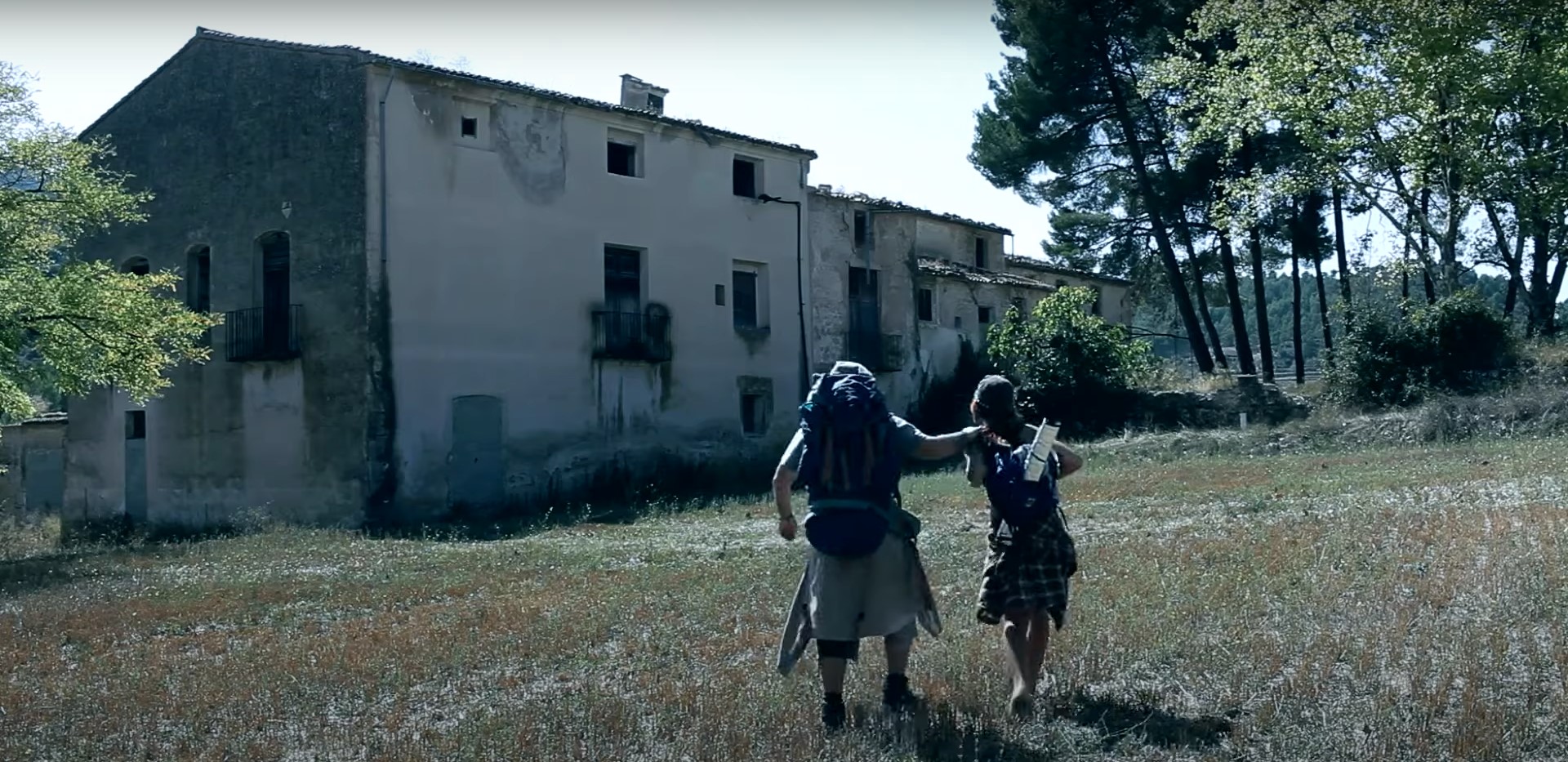
On the walk path to Santiago, on an isolated stretch of the trail, hikers Richie and Lucia run into a bit of bad luck when Richie’s foot is severely injured by a speeding car driving recklessly on what’s typically a walking path.  Needing immediate aid, they’re forced down a offshoot path to the isolated Hotel Gutierrez, a local hostel ran by the eccentric manager, Arturo Gutierrez, and his family.  Unsure about the odd hostel manager and even more unsure about the temperamental cook serving questionable, gloopy slop but continue to entertain their hosts’ hospitality to not offend or make upset, Richie and Lucia quickly realize they’ve made a grave mistake in staying when the Gutierrezes are actually a deranged family of cannibals exploiting their guests for the one thing, to be the main course on the Gutierrez menu.  The path trekkers find themselves on the receiving end of a butcher’s block that might not have been an accident after all.

“Jordidos Kabrones” aka “Fucking Bastards” is the 2012 precursor film to Manolito Motosierra’s “Spanish Chainsaw Massacre” from 2017, introducing viewers to the morbid-madcap antics of the Gutierrez family. The comedy-horror uses the Camino de Santiago, or the walk to St. James, as the backdrop that ultimately leads to an unprovoked massacre of the pilgrims traversing to the shrine of the first martyred apostle St. James at the cathedral of Santiago de Compostela in Spain. Some believe that walking the trail is a part of a sinner’s expiation toward God. In Motosierra’s case, as seen in “Fucking Bastards,” the seemingly normal hiking trail is a gateway to Hell for all when a local family exploits the pilgrimage as a source of unconventional comestibles that has been a tradition passed down from generation to generation. Over-the-top with nauseating ordure and gore, Motosierra refuses to hold back in the mire situation that leaves Richie and Lucia being the unfortunate guests of the Gutierrez hostel. The feature is produced by Motosierra and Kiko Navarro, who’ve went on to collaborate on “The Corpse Grinders 3” and “Spanish Chainsaw Massacre,” assistant producers Santi Banjo and Fernando Montano Galvañ, and is a Spanish conglomerate production of AGP Productions in association with Olga Underground, Yosoyfande Reanaimator Association, Dark Times Visual, Esquizoide Productions, San Jorge School of Film and Audio, and the Alcoi Film Office.

If you’re like me and ended up watching the follow up film, “Spanish Chainsaw Massacre,” first, then you may recognize a couple of familiar faces in “Fucking Bastards” of the atrocity paving duo of Arturo and Guti Gutierrez, played by José Luís Tolosa and Manuel Rodriguez. Tolosa tall stature, wide, sinister grin, and antsy movements perfects Arturo’s wildly tormenting behavior as the collected, but not also cool and calm, head of the family. Then, there’s Guty, the clearly deranged imbecile delighted to follow Arturo’s direction and take verbal abuse times infinite as long as he gets to tenderize, fillet, and serve up guests for breakfast, lunch, dinner, and dessert. Rodriguez plays a derived goof that’s nothing really to note and write home about in his goon and goof performance that does support Arturo’s more sophisticated role as a deviant duo. While “Spanish Chainsaw Massacre” inundated viewers with extended family member of maniacs, “Fucking Bastards” starts out with slow with select immediate relations, such as their veiled and grunting grandmother played by Motosierra himself. The Gutierrez family’s pilgrim victims come in pairs. The main hapless marks are Richie and Lucia, played by Ricardo Pastor and Miriam Larragay and who both went on to have a new role in Motosierra’s “Spanish Chainsaw Massacre,” are suitable enough saps to be slaughtered by their own dimwittedness by ignoring that little voice inside their heads screaming at them to run for the hills upon meeting Arturo and Guti. Pastor and Larragay, compared to Tolosa and Rodriguez, are satisfying normal pilgrims without life infractions, without ulterior motives, and with nothing other than the backpacks on their back on what should have been a simple hike to pay respects to St. James and God, making their detour-to-death that much more nihilistic and grotesque. Sonia Ayala, Pedro García Oliva, Xima Perpinyá Mira, Marino, Yolanda Berenguer, Raúl Darío Gandoy, Jaime Martínez Moltó, and Jaime Martínez Moltó round out the cast.

By all means, “Fucking Bastards” is no great cinematic masterpiece. With an offensive title, not one person should expect it to be a great Spanish cine, but what should be expected from the Manolito Motosierra picture is a ton of gore and a load more of offensive and garbage slopped material to flaunt to shock the casual cinema consumer or speak the niche lurid language of gore film fiends around the world. Motosierra accomplishes both as “Fucking Bastards” will disgust the weakest of stomachs and will galvanize others to glue themselves to the story to see what happens next. Those viewers excited for the kills will find the gore effects to be inconstant at best from special effects artist Ruben Vallés Guerrero who has worked the movie grade gamut from the micro-indies, such as “Fresh Flesh,” to moderately budgeted films like “Down a Dark Path,” starring Uma Thurman (“Kill Bill”), and “A Monster Calls” with Sigourney Weaver (“Alien”) and Liam Neeson (“Darkman”). The Motosierra picture became a jumping point for Guerrero to show off his effects skills and delivers on some Tom Savini-inspired hand chopping and leg slicing but in the same breath also approves the use of an augmented plastic baby, with non-lifelike stiff arms and legs, in the bashing of a pregnant woman to force deliver. Whether due to limited funds, or the content was too shocking overall, or out of respect for depicting infant children in hugely Catholic culture, the scene sorely cheapens the already shoddy, low-budget production with artificial appearances. Refreshing is not a term I would say defines Manolito Motosierra’s “Fucking Bastards” but there’s a sense of unassuming relief from the lack of pretense because from front cover to end credits, you know exactly what type of vulgarity to expect.

Coming right in as spine number 69 on Wild Eye Releasing’s Wild & Extreme label, “Fucking Bastards” offers its sadistic viewing pleasure onto DVD home video. Presented in an open matte widescreen 1.78:1 aspect ratio, the feature is housed on a lower storage format, likely a DVD 5, that suffers tremendous compression pockmarks, such as smoothed out textures, blotchy-pixelated patches, banding, and contrast issues. Video presentation is watchable and not a terrible eyesore but definitely not the pretty picture around with a good portion of the issues stemming from commercial grade equipment. The Spanish language Stereo 2.0 audio tracks varies in dialogue levels, leaving depth unaccounted for and very little in range value as there’s not much of an ambient arrangement. Though varied, dialogue is clean and clear with English subtitles that have some synch/timing issues. There were a few occurrences where the subtitles on flashed and vanished in an instant. The English subs are also severely consolidated with characters’ throwing out much more than what is being translated…trust me, I know enough Spanish to tell. Bonus features only included the theatrical trailer plus other Wild Eye previews which, in my opinion, are worth checking out. No dialogue, just impressively edited, impressively scored, make-you-want-to-check-it-out handful of trailers that include “Death to the Ten Commandments,” “Gore Grind,” and “The Thrill of a Kill.” Stay tuned for an after credits bonus scene that displays the horrors of the Gutierrez children. The exterior features include a clear DVD snapper with a photoshop filtered act of asphyxiation on the front cover while the inside reveals a reverse cover of a screen grab of one of torturous moments of the story. The Wild Eye release of the film is unrated, has a runtime of just over an hour at 63 minutes, and is region free. Get your gonzo gore on with Manolito Motosierra’s humble beginnings in “Fucking Bastards” that could be considered the Rob Zombie’s Firefly family of Spain.

Those “F**king Bastards” on DVD at Amazon.com

EVIL Expressionism in “The House That Jack Built” reviewed!


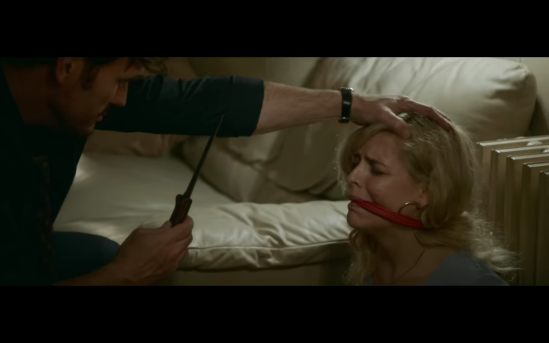
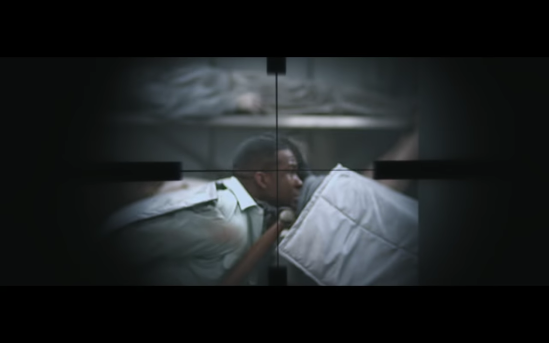
Over the span of 12 years from the 1970’s to the 1980’s, wannabe architect Jack is an accomplished engineer living in serene of the Pacific Northwest and with a lack of empathy and an internal repository of compulsive and narcissistic traits, Jack is able to be a highly successful and intelligent serial killer who seeks mastering his craft as highly artistic and divine. Over the same period of time while butchering nearly countless people, including his own family, Jack obsessive compulsive disorder not only assists his longevity of his creative expression, but also dwindles down another social expected goal of designing and engineering his own home isolated at the edge of a lake. As the body count rises, Jack compulsive restrictions loosen and he begins taking greater and greater risks of being caught. Jack narrates his voyage of viscera and macabre to a literary listener in a back-and-forth to explain and justify his murderous methods and craft.

Unlike anything you’ve ever seen before, auteur writer-director Lars Von Trier (“Antichrist” and Nymphomaniac Vol. 1 and 2″) crafts his very own artistic expression delineation with the 2018 “The House That Jack Built,” a two and half hour venture into the deconstruction of a serial killer’s personality traits as well as the flourishing experience of murder through years of repetitive brush stroke practice and self-preservation knowledge done in a self-portrait form. Graphically violent and supercharged with coarse and visually stimulating visual effects and editing, all the hallmarks of a Von Trier film, “The House That Jack Built” blends an abundance of fine arts with religion and mythology that develops into a soaring renaissance piece of art in the modern times and would inspire the most closeted psychopath to revel themselves in a heap of aesthetic and picturesque horror.

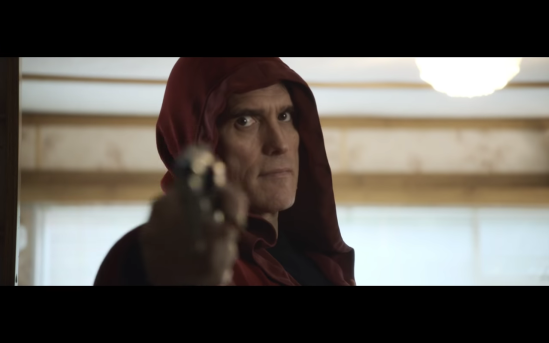
As if Matt Dillion isn’t already an entertaining and diverse actor, the “Wild Things” and “Crash” star excavates a vile and dumb luck Jack from deep within, crafting the character as so smart, he’s sometimes stupid, but with each murder subsequently gone scot-free, the confidence builds, the trade becomes tangible, and the narcism washes over ever so slightly. Dillion arcs Jack so well that the character no longer becomes the villain but an anti-hero of sorts as rooting for the slaughtering of innocents becomes a painful necessity rather than an empty desire. The titular character converses with a mysterious companion named Vergel in a way as if Jack was anecdotally telling his own biopic. Vergel symbols multiple conceptual and tangible beings, from Jack’s moral conscious to Vergil, the Augustan period Roman poet, Vergel, or Verge as Jack simple calls him, crudely interviews and thoroughly analyzes Jack’s so-called art. Verge’s off-screen presence is heartily brought to life by Bruno Ganz, an actor who once portrayed Adolf Hitler in 2004’s Academy Award nominated film, “Downfall.” Ganz takes an expected backseat to the title carrying Jack, but doesn’t succumb to being underneath’s Jack’s critical and narcissistic viewpoints, making Verge a level playing field character alongside Jack. Ganz, who passed earlier this year, is equally masterful under a relatively underwhelming role paired with pure evil and while the contrast’s magnitude should be starkly poignant, Jack and Verge are equals in the eye of the viewers and that’s how powerful Lars Von Trier’s filmmaking can really be. Jack’s chaptering stories include co-stars such as “Kill Bill’s” Uma Thurman, Siobhan Fallon Hogan (“Men in Black”), Sofie Gråbøl (“Nightwatch”), Riley Keough (“It Comes At Night”), Jeremy Davies (“Ravenous”), and David Bailie of “Pirates of the Caribbean” franchise.

In my experience with film from Lars Von Trier is that those who patron his films have polarizing affections; you either love his work or you absolutely loath his style of film. My experience consists of only one, yes one, of projects and that being “Antichrist,” and while I was not entirely enthralled with the film’s sexual themes, “The House That Jack Built” provided a plethora of philosophies to pick apart and to continue to digest even way after viewing. For those who might forego themes, philosophies, and theologies, many will bore themselves through the filmmaker’s American serial killer thriller for over two hours long, clocking in a 153 minutes, and finding themselves disoriented in a segmented tale that’s chaptered by five incidents and an epilogue over a 12 year span. Others will bang their hands over Trier’s use of repeat scenes, purposefully rolling them slow and in a calm disposition, allowing Jack to deliberate how and why he does what he does in his discussions with Verge, but these soft touches are nice pillow talk touches to the main, punchy action of Jack’s self imposed duresses under his murdering moniker, Mr. Sophistication, that palpably places the narcissistic cherry on top of misanthropic persona. The devil in the details are punchy themselves and a keystone to Trier’s overall narrative to explore the impulses of a killer’s mind. “The House That Jack Built” is a great accompaniment to shows like “Mindhunter” on Netflix or other films like “Silence of the Lambs” where serial killers vocalizes intricacies of their niche trade is very fascinating for morbid loving sympathizers.

Umbrella Entertainment releases “The House That Jack Built” onto Blu-ray home video. The full HD, 1080p, region B, uncut disc is presented in a widescreen, 2.35:1 aspect ratio, and is fully operational in all sense of the phrase with a generous color palate lacing through more natural lighting than assumed there would be in comparison to “Antichrist,” but the raw tone by Manuel Alberto Claro debases the stylized techniques of “Antichrist’s” Anthony Dod Mantle to virtually a hardline and graphic depiction of reality in the 1970’s. The English language 5.1 DTS-HD Master Audio is respectfully verbose and robust. Trier’s loquacious exposition is actually great exposition of the crystal clear kind and the director shows off his depth and range, splicing edits together like a madman that still convey the overall theme without disregarding audio accounts. While technically sound, the Umbrella release comes regretfully with no bonus features. Brilliant, musing, and intense, “The House That Jack Built” is a Lars Von Trier legacy film breathed with unadulterated violence and sharp with superb writing potent that’s potent on every level. Trier just gets better and better with every film and look forward to his next project!

The House That Jack Built on Blu-ray!

Triangular Space EVIL is the Sign of the Beast! “The Dark Side of the Moon” reviewed!


In the year 2022, orbital satellites carry nuclear missiles and maintain flight patterns around the moon. When a satellite repair ship, known as a “refab” ship called Spaecore 1, attempts to intercept a satellite for maintenance, the system wide computer goes into an unexplained power failure that jeopardizes communications, life support, and navigation. Drifting helpless toward sector Centrus B-40, the dark side of the moon, all hope will be lost within 24 hours unless operations can be restored, but a mysterious spacecraft, NASA’s Discovery shuttle, heads toward them and docks onto their outer hull without so much of a hail from the shuttle. Captain Flynn and Lt. Giles investigate a seemingly abandoned ship until coming across a dead body of a presumed missing NASA astronaut, eviscerated with an opening left in a perfect triangle as the cause of death, and that opens the door to more questions than answer as a sinister presence boards their ship, pursuing damnation for their souls.

Just think, in two more years, weapons of mass destruction satellites will loom just above fluffy white clouds, ready to mushroom clouds out of targets with a 10-ton yield; at least that’s what director D.J. Webster and the screenwriters, identical twins Carey W. Hayes and Chad Hayes, modeled the future when conjuring up this delectable Sci-Fi horror film approx. 20 years ago. With special effects models and techniques that withstand against powerhouse space films, such as from the immaculate effects of Alien franchise, “The Dark Side of the Moon” becomes more than just a 1973 Pink Floyd album title Fabricated out of warped creativity of old and new concepts with a Biblical horror base that only the 1990’s could loosely spin into an hour and 27 minute feature, for many of the filmmakers involved, “The Dark Side of the Moon” credits as their first taste of a feature length, large scale production, especially with the mainly music video director D.J. Webster, who loves his closeups, and director of photography Russ T. Alsobrook, as they auto clicks into a team that seemingly have experience of seasoned veterans or, perhaps, spent some secretive, unlogged time in space. Who knows, but the outcome ruminates about the dark side of religion and how each of us deal with it internally.

When mullets and giant framed glasses are afoot, the late 80’s, early 90’s filming era is beyond evident with interestingly gritty characters lined up for an evil figure eager to knock them down and, of course, the story’s lead character is the mullet sporting pilot named Lt. Giles Stewart who is unwittingly thrust into the fast track of a hero’s lane. Giles’s atheism framework has a pleasant sardonicism about it when face-to-face with the immortal conqueror of his ship and crew. Will Bledsoe paints Giles as such as faithless space pilot, bound to duty, and willing to do anything to just not save himself, but others. One of the only recognizable faces, at least for myself, in the cast is John Diehl. The “Stargate” and “The Shield” television actor is best at being a wild card in turmoil situations and as shipmate Phillip Jennings, the same can be expected without being utterly conventional or warrant any kind of typecast label. Another actor to note is Alan Blumenfeld as the ship’s panicky Dr. Dreyfuss Steiner. Blumenfeld, who had a role in the best Jason Voorhees film, in my humble opinion, “Friday the 13th Part VI: Jason Lives, is once again stalked by a larger-than-life villain while maintaining a profusely sweaty persona that’s symbolically intended to be true, unadulterated fear. As a whole, the cast is amazing regardless of some first time filmmakers at the helm, rounding out with “Re-Animator’s” Robert Sampson as the ship’s Capt. Flynn, Joe Turkel from the first “Blade Runner,” “Blood Frenzy’s,” and overall erotic thriller goddess, Wendy MacDonald, stunt man (“Kill Bill Vol. 1 & 2, “Army of Darkness”) Ken Lesco, and another “Friday the 13th” actor, Camilla More, or Tina from “The Final Chapter,” as the stationary sexy, ship’s onboard computer-robot named Lesli – think on the same lines as Mother from “Alien,” but in the flesh.

What makes “The Dark Side of the Moon” very interesting is the film being an unofficial precursor to other science fiction horror films like “Event Horizon” that was released roughly seven years later. Space as this gateway to Hell concept is sorely under-appreciated and underutilized. Space is already vastly frightening to begin with and by adding a devilish abyss aspect to it makes the idea an absorbingly scary thought. What’s also fascinating is the Hayes brother. “The Dark Side of the Moon” is the brothers’ roots film; the proverbial patient zero that spread successful movie writing careers for the twins, spawning turn of the century horror with the remake of “House of Wax” that saw the on-screen death of Paris Hilton, had “Underworld” star Kate Beckinsale track down a killer in Antarctica in “Whiteout,” and they penned “The Conjuring” that constructed its very own universe.

“The Dark Side of the Moon” comes in at #2 on the Unearthed Films’ Classics label distributed MVDVisual. The newly restored 4K transfer of the Wild Street Pictures production is presented in a widescreen, 1.85:1 aspect ratio, region A Blu-ray release. Surprisingly sharp despite consistent low-lit scenes and not as washed like previous VHS versions, this restoration fine tunes the nitty-gritty specifics needed for proper presentation that doesn’t falter from heavy digital noise or blotch artifacts and shows no signs of enhancing The English language LPCM 2.0 audio track is strapping for a dual channel format. Dialogue pronounced clearly, ambient spaceship clinks and clunks create atmospheric range and depth, and the relentless brooding score by “Society’s” Mark Ryder and Phil Davies delivers shuddering spinal-tingles without being monotonously dull. Bonus features include a commentary with executive producer Paul and Unearthed Films’ Stephen Biro, interviews with Alan Blumenfeld, FX artist R. Christopher Biggs, and stuntman Chuck Borden, plus vintage audio track, trailers, photo gallery, and a insert booklet that dives into about the production and the cast. All packed into a nice little slipcover package. “The Dark Side of the Moon” pioneers into the future of space horror as a good ole dread-inducing fear-monger of the great expanse, deserving this Unearthed Films’ release, hands down.