Chris Cannon and Mark Austin are back to save the world from a devious organization once again as the two bureau agents are assigned to protect the last world-renowned scientist that developed an International World Arms Removal (I/War) satellite project that could detect terrorists’ weaponry no matter how concealed, but when the other three scientists from around the globe are brutally assassinated, the odds are stacked up against them and the bad guys are always one step ahead of them. Given four computer chips to guard at all times, I/War assigns their best agents to the task of securing hope for the project, called The Dallas Connection, for three days until a specifically timed launch to coordinator with a passing asteroid field that’ll power the satellite for years decades to come, but the well-armed and well-organized crime uses all assets and their power of seduction to gain control over the satellite at all cost.
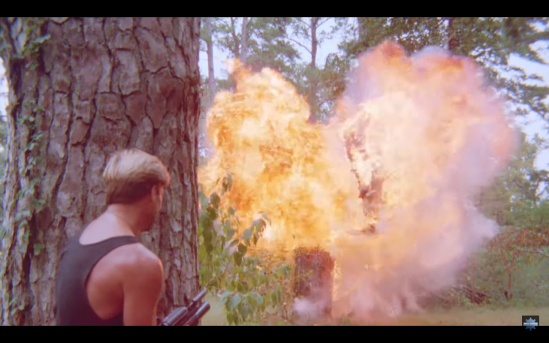
The L.E.T.H.A.L. ladies series continues with the second buddy-cop picture, “The Dallas Connection,” helmed by Christian Drew Sidaris, son of the erotically charged-action producer and filmmaker, Andy Sidaris that follows up on the first Drew Sidaris prospecting fracas, Enemy Gold. “The Dallas Connection” is the tenth installment of the series, known also as the Triple B series (that’s Boobs, Bombs, and Bullets) that has little-to-nothing linking the entire series cache together aside from being exclusively explosive wrapped with a sensual rouleau of Playmate and Penthouse centerfolds, tightly coiled around the tight and firm half-naked bodies of it’s leading stars. The Sidaris team, under the Malibu Bay Films and Skyhawks Films banners, one again economically ignite a successful B movie that promises 90’s attired, flamboyant action on set at a few familiarly recycled locations in Shreveport, Louisiana and Los Angeles, California, redressed for a not-so different genre or distant premise.

As aforementioned, centerfolds are a staple in any Sidaris, father or son, girls and guns feature and “The Dallas Connection” is no exception, starting off with their main squeeze, good friend, and cult movie icon, Julie Strain, as one of the chief co-antagonist under the nom de guerre, “Black Widow.” Strain is tall, sexy, and a wild villain capable of restraining the violent kick of an AK-47 in thigh high boots and a low-cut open jacket that embodies gun nuts most delectable dreams. The once Penthouse Pet of the Year stays quite reserved compared to her tantamount villainous role in “Enemy Gold” by going topless only in a couple of instances in a death grip roll that involves a lap dance before her prey’s demise, a specified attribute to the beautiful and deadly small spider she spins her call sign from. Black Widow is joined the just as deadly Cobra, fellow Penthouse Pet of the Month February 1993, Julie K. Smith, and Scorpion, the equally as Julie Strain tall, Playboy Playmate of the Month December 1991, Wendy Hamilton. Smith and Hamilton offer up polar features that doesn’t make “The Dallas Connection” a one-type of woman show, but both are voluptuous in their own rite, adding sizzling hot tub sex scenes and long-legged strip shows to accentuate “The Dallas Connection” amongst the B movie fray. “Phantasm II’s” Samantha Phillips becomes the whip cream on top, rounding out Sidaris’ centerfold assembly, as another the third Penthouse Pet of the Month, June 1993. There’s also Bruce Penhall and Mark Barriere, but who cares about these shirtless studs who drag race old Plymouths and jet ski when you four gorgeous women to ogle over? Penhall and Barriere mark their return as Chris Cannon and Mark Austin from Enemy Gold in a buddy-cop adventure loaded with a Dirty Harry Magnum .357 and a M1 Grenade launcher assault rifle. Kaboom! Rounding out the cast is Gerald Okamura (“Big Trouble in Little China”), Roland Marcus, Cassidy Phillips, Ron Browning, Tom Abbott, and Rodrigo Obregon as a satellite scientist.

After finishing “The Dallas Connection,” I wanted to say that I’ve seen this movie before and not because of some misplaced form of déjà vu, but, rather, that I, in fact, HAVE seen this movie before in the precursor film of the L.E.T.H.A.L. ladies series, “Enemy Gold.” The story’s been tweaked slightly to a story with the same framework. Hell, like also mentioned, when you throw in some of the same locations as in “Enemy Gold,” Sidaris’s home with the hot tub and the cabin the woods, and redress the same actors, Julie Strain, Bruce Penhall, Mark Barrier, Rodrigo Obregon, Tom Abbott, and Ron Browning all in the essentially the same roles, “The Dallas Connection” just feels like an extension or a mirror image of that former film, making the story a weary one with nothing really new to spectacle except for three pairs of new, large-and-in charge, breasts in Smith, Hamilton, and Phillips. One difference noticed is that the bureau agents this time around are a lot dafter with skulls thick as a brick and unable to use common logic in the most practical situations. There have been many a time when producer Andy Sidaris commented his films to James Bond, but at least Bond had the smarts to always be on guard; Chris Cannon and Mark Austin do indeed think with their other head that do, in benefit, leave the door open for some saucy hot tub sex that’s perhaps the best simulation from Sidaris reel I’ve seen to date.

Available for the first time on Blu-ray, “The Dallas Connection” will get your rocket launchers off with ton of gunplay and is loaded with beautiful women. The region A, 1080p high definition presentation from a 4K scan restoration has an aspect ratio of 1.78:1 widescreen. The image’s simply gorgeous from the 35mm negative baring a few minor faint scratches that linger only for seconds at a time. There’s quite a bit of noise during the night scenes that almost make the scene look daylit, but skin tones, especially gleaming with water, are remarkably velvety and the textures on clothes and skin looks great for a low budget action. The English language DTS-HD Master Audio dual channel mix medleys appropriately, dialogue is clear and upfront and ambience has proper depth and range. Explosions are powerful coming through the dual channels with a hefty LFE and gunfire can rip just as good as Dutch blasting away at a trophy hunting alien in Predator. Even the sexy lounge soundtrack from Ron Di Iulio is on point despite being a rehash of “Enemy Gold” once again. Hardly any blemishes or distortions coming from the audio track. English SDH subtitles are optional. The bonus features mirror that of “Enemy Gold” as well with Andy Sidaris and Julie Strain doing this awkwardly coy and sugar daddy bit showing off “The Dallas Connection” merchandise and international posters that lead into Andy’s film school where him and his wife, Arlene, go onto commentary on how to shoot scenes and edit them together, using an action and a sexy scene from “Return to Savage Beach” as reference. In the same behind the scenes, there’s an equally bizarre Joe Bob Briggs interview where the legendary MonsterVision and The Last Drive-in Host seems uncomfortable with Andy and star Julie K. Smith about how he persuades to get these beautiful centerfolds to be in his films. Other bonus material includes a commentary on the film itself and theatrical trailer. “The Dallas Connection” is a Texas-size IED with a busty ornate façade, but acts more like a duplication of something we’ve already experienced, making the sophomore feature from Christian Drew Sidaris just a more of the same.
Tag Archives: Los Angeles
Subscribe to EVIL’s Vlog! “Followed” reviewed! (Global View Entertainment / Digital Screener)

Unable to entertain that ghosts actually exist and to be one of the best social media influencers he can be on the world wide web, influencer “DropTheMike” vlogs locations’ ghastly back stories that are now presumably haunted by the very souls the locations consumed. When offered a once in a lifetime opportunity, worth a small fortune in the sum of a quarter of a million dollars and set start up his family with his recently pregnant fiancé, “DropTheMike” quickly challenges his followers to scout out the next paranormal investigation on the cusp of Halloween in 2016. With the results in, an overwhelming number of responses held one of the most notoriously haunted hotels in America, The Lennox, as his and his video crew’s next targeted exploration from the tops of the roof to the dank, dark basement. Ecstatic and eager in a pool of mixed emotions amongst his crew, “DropTheMike” pushes forward despite the forewarning counsel from a hotel historian and his friends, booking rooms for a three day stay that turns horribly frightening when the social media influencer’s greed for followers and fortune provokes the damned souls and the spirit of an infamous serial killer who once hacked up his victims in the very same room “DropTheMike” is staying in.

Us bloggers always try to use our social media platform powers to not only gain internet popularity amongst the ever growing, or continuously exploding, tsunami of 24/7 news, reviews, and inspirational muses for instant, impactful transmission to billions of users, but also to express the things we, the bloggers/vloggers, express what we’re passionate about. Sometimes, what we’re blindly passionate about undertaking can haunt and consume our very being, and also destroy our souls and that’s the epitomic baseline for Antoine Le’s 2020 supernatural cyber-horror “Followed” that’ll feed into select drive-in theaters Friday the 19th. “Followed” is Le’s debut full-length feature film penned by the self-help screenwriting guru, Todd Klick. Shot on location in Los Angeles, Le and his crew use a number of different hotels give the illusion of being inside the fictitious Hotel Lennox, including Hayward Manor Hotel for the lobby scenes and Hotel Normandie for the interior rooms, re-working the rest digitally to effectively pull off the faux location without issue. Branded Pictures Entertainment and Le’s own co-founded Viscape Arts, along with co-producers Greg Berlant and Matthew Ryan Brewbaker, server as the production studios that pushes cyber-horror virtually toward to the forefront of found footage and dark web terror.

In front of the camera, the main attraction, the host with the most is “DropTheMike,” played enthusiastically by Matthew Solomon in his sophomore feature film and handling the pressures of a demanding social influencer position with pizazz to generate subscriptions with the utmost vigor. Personally, I’m familiar with too many influencers that cast a pendulum energy to the akin of a zany children’s educator personality known as Blippie. Google Blippie and have you’ll be able to paint a picture of a less morbid version of “DropTheMike” but with the same kind of body and facial expressions. Solomon’s counterpart is Tim Drier as Mike’s director of photography, Chris. Reversed within the confines of his Christian faith, Chris has serious reservations about The Lennox stunt, opposing Mike at every plea for him to shoot what could be the influencer’s biggest achievement and turning point of his mediocre career. If it wasn’t for being sweet on Danni, a fellow DP, Chris would snuff out any venture into the what Mike thinks is the one big publicity stunt. Played by “The Incantation’s” Sam Valentine, Danni’s a bit of an instigator or, perhaps, shares Mike’s agnostic views on the spirt world, but communes with the film crew in order to reach out to her former fling in Chris and see what materializes from the questions that have been plaguing her. The story primarily focuses on the trio and their friendship dynamics, but there are interesting key support roles that provide a well timed and deserving boost to keep “Followed” grippingly tense and violently rough-hewn toward the path of the malevolent specter plane, including performances by Caitlin Grace, Kelsey Griswold, Christopher Ross Martin (“American Horror Story: 1984), and veteran actor of “Deer Hunter” and “Carnisaur 2,” John Savage.

What makes “Followed” different from other cyber-horror genre films, such as “Unfriended,” “iLived,” or “Like.Share.Follow?” Cyber-horror looks a lot different now than 20 years ago when the genre viewed the mechanics of machine was bedeviling autonomy and people were slave to the machine in one way or another. “Death Machine,” “Lawnmower Man,” and “Evil Speak” are the quintessential ghost in the machine with each plot platters different variations of to subordinate mankind. Now, these films might seem low-tech and more tangible instead of the trying to grasp the idea of cyberspace. Aside from the dark web snuff premises, cyber-horror nowadays, such as “Followed,” is bound by the original influencer, the devil, who has strewn his watermark through the many conduits of streaming services, infecting at will the dark powers to beguile and besiege the barrier of rationality, and deconstruct human morality to the most primitive and primary sin. “Followed” doesn’t break the mold of cyber-horror, but exploits the mold to the max to deliver a terrifying hotel with a ghastly black past. Based perhaps on a number of personal grim accounts and then chained together like an all-in-one anthology, “Followed” jazzes up with the second act with myths, visions, and theories between the rather ordinary bookend beginning and end, always stepping up evil’s game to the point where you never know what to expect and that’s what’s enjoyable about the found footage aspect because nothing is certain, especially when each floor has a history of violence.

Book your reservation to hell and subscribe to the nerve-racking black magic of Antoine Le’s “Followed” hitting the drive-in theaters on June 19th, insidiously expanding into more drive-in theaters on June 26, and eventually landing onto VOD later summer 2020 courtesy of the new kid on the film distributor block, Global View Entertainment. Since “Followed” was viewed as a digital screener, the video and audio aspects will not be critiqued, but the official specs include a presentation in a widescreen format, aspect ratio 1.85:1 with an English language 5.1 surround sound audio mix inside a 96 minute runtime. “Followed” is a visual feast that apply a number of different kind of filming techniques from handheld, spy cams, and security footage and brush the hue spectrum from the ominously vibrant reds to the forlorn splay of sterile metal and steel. With tactics that include a pluralistic phantom ecosystem all living together at the Lennox Hotel, the varied soundscapes and ambient bytes spookily outfit the multi-headed apparition commune existing just on the threshold of the reality plane and seeping in when poked, like a sleeping bear with a stick. There were no bonus material included or any additional scenes during or after the credits. “Followed” is a cherub of the cyber-horror junkets before it’s time that indulges itself into the destructive and careless path of a social influencer, ignoring the sinister forces amongst the other things, like personal property, public safety, or personal safety, real influences tend to disregard when climbing the social media latter to the 15 minutes of fame of internet stardom.
Find a Drive-In near you by clicking on “Followed” official website : https://followedhorrormovie.com/
[youutube=https://www.youtube.com/watch?v=VduFOTzm8DI]
The EVILs of Drugs, Addiction, and Art in “Bliss” reviewed!

Dezzy Donahue, a struggling Los Angeles artist, lives life ferociously with hard drugs and heavy drinking despite the cautionary advice of her quasi-boyfriend, Clive. Her current masterpiece falls behind on schedule and she hits a formidable creative block that results in being fired by her managing agent and with cash quickly dwindling, Dezzy’s losing the battle for inspiration that turns to an increasing narcotic intake surging through her system where any and all substances are fair game to explore. When she snorts a line of Diablo, a blissful, out of body experience drug, she finds herself in a rapturous three way with friend Courtney and her on-off side piece Ronnie that leave her with a post-high, post-sex altering inner body inexperience of opening the flood gates on her creativity to draw again as well as pang her with an insatiable need for a fix when no longer riding the high. Soon, Dezzy discovers the Diablo might not have been the drug that lit the fire inside her when a strong craving for blood becomes an inescapable addiction and a means to finally finish her greatest triumph work of art.

An audio/visual besieging rabbit hole shiplapped with braided beleaguering addiction and vampiric pathology in the stimulating aggressive, Joe Begos written and directed visceral horror, “Bliss,” set in the sordid Los Angeles metal scene. The “Almost Human” and “The Mind’s Eye” filmmaker hypnotizes on a stroboscope wave with his latest take on the vampire mythos with a drug-fueled, warmongering hell on a canvas tale of sex, drugs, and diabolical fiend cravings. Produced by Channel 83 Film, as are all of Bego’s works, “Bliss” is the director’s next notch up on the crazy, unrestrained belt that’s already garnished and weaponized with razor wire and three-inch cone spikes and while the story itself isn’t fashioned for originality, the way Joe Bego’s exfoliates the overripe garbage of rehashed formulaic filmmaking from the excessively strained eyeballs, sheepish with mawkish and dull stories, will be a new design to treasure as cult status.

Where’s “Bliss’s” 2019 nomination for best actress in a lead role!? Dora Madison seizes the performance of Dezzy Donahue by storm inside a role of careless abandonment that coils into viperous mode and lashes out with a deadly strike of unconventional fangs. Madison embraces the exotic Joe Begos route covered in blood, paranoia, and a sleazy shade of florescent neon and runs a willingness to express his mesmerizing vision with body cam harnesses. “Bliss” quickly establishes a hard-hitting tenor and Madison, whose credits include “The Loft,” “Night of the Babysitter,” and in the next upcoming Begos release, “VFW,” exacts a fortified layer of extreme sovereign, a do-what-I-want policy with a zero complaint department attitude, while stowing away what little hope and compassion Dezzy has in the forgotten corners of her plainspoken mind until the moment is too late to turn back. The story solely follows Dezzy’s perception of events as she encounters and reencounters characters before and after needing a junkie’s fix, an exaggerated play on an abusers volatile relationships. The cast affixed to roles of Dezzy’s vexing fix are Tru Collins, Rhys Wakefield (“The Purge”), Jeremy Gardner (“The Mind’s Eye”), Graham Skipper (“Carnage Park”), Chris McKenna (“King of the Ants”), Rachel Avery, Abraham Benrubi (“Wristcutters: A Love Story”), and that lovable “Cheers” regular, George Wendt.

At this point in the review, an overabundance of praise for Joe Begos’ “Bliss” has been logged by this reviewer, who is obviously a fan of the film, but more can be unquestionably explored. From previous reviews and comments I’ve come across regarding “Bliss,” a minority have displayed a disdain for the indistinct theme of drug withdraws and vampirism that resembles Abel Ferrera’s 1995 film “The Addiction,” but instead of being set in shadowy alleys of New York’s urban jungle, Bego’s relocates to the wayward esse of L.A. life. Perhaps Begos was inspired by Ferrera’s undiluted struggle and violence that makes “Bliss” a clone to “The Addiction’s” chief thread, but the film’s are artistically polar opposites. “The Addiction’s” black and white photography and slow-burn air tunes more into the story of the Shakespearian tragedy variety, especially when Christopher Walken provides lengthy life stance and coping monologues to establish his eternal dominance over Lili Taylor. “Bliss” proclaims a stimulus trip from the very beginning with a favorable thrashing metal soundtrack and an psychedelic filmic presence that comes with an opening epileptic warning. Both films compliment the figurative comparison for a fix in their own poetic ways and would make a fantastic double feature release or double bill midnight movie.

If this writeup has a jonesing affect, “Bliss” is cut and lined ready for blipping on an Umbrella Entertainment DVD home video presented by Dark Sky Films. The Channel 83 Films production is presented in a widescreen, 2.35:1 aspect ratio, being shot with a ARRI/ZEISS Super Speed Lenses, as credited on IMDB, that would explain the sharp image and stark contrasts on the colors. The visual perception of the seemingly humming-on-your-eyeballs neon lighting barely lets you experience the film in natural lightening during night scenes and only in the daytime that resembles the little normalcy left of Dezzy’s life, fade away with natural light the more she succumbs to blood cravings. “Bliss” feels and acts out like a 90’s film, slightly grainy for grindhouse seduction by way of shooting of actual film stock (35mm!), and forgoes the bubbly shine of perfection, coinciding damningly with Dezzy’s inner circle of sleaze, grime, and gore. The English language Dolby Digital 5.1 surround sound has a lot of kick and energy with a prevailing metal and punk/post-punk soundtrack feature Doomriders, Deth Crux, and Electric Wizard just to name drop a few. Dialogue is clean with an appropriate depth in the midsts of hard partying and live bands. Range is a little harder to discern since the soundtrack really is overpowering and dialogue sops up the remaining amount of audio track space, but when opted, the ripping of flesh and breaking of bones doesn’t disappoint. No subtitles are offered. Like many of Umbrella Entertainment’s standard releases, the single sided, singer layer DVD has no static menu or special features to offer other than the 80 minute runtime feature. “Bliss” is one coked-out, blood hungry hell of a vampire tangent from the norm that rectifies the optic and audible sanctuary for shock brilliancy to flesh out the Machiavellian in all of us.
[https://www.youtube.com/watch?v=5KdXU-n7qSg]
The Evils After World War III! “The Aftermath” review!

On the space shuttle Nautilus, three astronauts are returning home after one year in deep space. Their outbound transmissions to Earth are not being returned nor are they being received and as their ship draws closer to Earth, the only option for reentry is to take a risky crash landing into the Pacific Ocean, just off the coast of California, hoping someone, anyone, would see their shuttle coursing downward from the sky. Only two survive the crash and swim to shore where no boats, no planes, nor onlookers were around to receive them. They soon find out why. World War III had engulfed much of the Earth during their time in space, reaping the land of the urban jungles and making food and living conditions scare. Germ warfare had mutated much of the population to cannibalistic creatures and when torrentially raining, acid rain pours from the war torn atmosphere from ferociously brilliant and deadly clouds. Only a small band of good people remain and the two astronauts seek to keep them safe from the harsh elements, even against a merciless gang of thugs.

In the early 1980s, an ambitious and visionary filmmaker sought to produce, write, direct, and star in his very own modest budget feature film that would rival Hollywood’s glamourous and expensive effects while still maintaining a down-to-Earth independent production. That filmmaker was none other than Steve Barkett, creating his debut film, the 1982 science fiction post-war catastrophe, “The Aftermath.” “The Aftermath” is like if the “Planet of the Apes” met “The Walking Dead,” a sheer blunt for trauma of returning to your home to discover the world in shambles with different factions of hard nose killers ready to plunder all that you own and all that you will ever have. Barkett, with assistance from the brothers Dennis and Robert Skotak, who’ve went on to work on major studio films such as “Aliens” and did the matte work for John Carpenter’s “Escape from New York,” create a destroyed Los Angeles landscape through the power of some serious movie magic considering the time period and the budget.

Steve Barkett is Newman, one of the three astronauts with no first name, and the tough hombre’s hard disposition comes from his background exposition where he lost his wife and child before going up into space. Newman’s cold, but not heartless, and Barkett taps into that fairly well despite some robotic and formulaic performances. However, Christopher Barkett, Steve’s son, was a complete first generation cyborg, a regular toaster oven with teeth and eyeballs that monotones through all the lines and actions. The most interesting casting here is Lynne Margulies, who at the time of this release, was or was not yet the late Andy Kaufman’s girlfriend. Margulies, who previous worked on an adult film entitled “Young, Hot ‘n Nasty Teenage Cruisers,” continued the racy trend with a shirt-pokey role in Sarah, Newman’s quick-to-sack love interest with a briefly, well-endowed nude scene. Yet, Sig Haig manages to steal the Barkett’s film from right under his nose. The young and ruggedly muscular “The Devil’s Rejects” star sports his trademark shaved head and thick, dark goatee, labeling him the perfect casting choice in gang leader Cutter. Alfie Martin, Forrest J. Ackerman (“Dead Alive”), Larry Latham, Linda Stiegler, and Steve’s young daughter, Laura Anne Barkett costar.

One aspect that’s really appreciated in Barkett’s enterprising venture through post-war commentary and morally righteous themes is the special effects matte work from the Skotak brothers. Detailed paintings, such as exampled in the war-ravaged metropolis that was formerly L.A. embodying the once towering buildings, are now destructively cut short in a mangled heap in a matte effect with live actors. Practical effects work wonders for Barkett’s large scale premise despite the small scale performances, except from Sid Haig. The detail in the violence dawns a newly restored faith in early 1980’s sci-fi films; violence that was more prevalent in the genre later in the decade, in such films as “Aliens” or “Robocop,” making Barkett’s film a trail blazer that paved the way to deliver more sensational savagery and lots of blood of a high body count to a already fantastic genre.

MVDVisual and VCI Entertainment release Steve Barkett’s “The Aftermath” onto a dual format, DVD and Blu-ray, combo pack. Presented in 1080p on a MPEG-4 AVC encoded BD-50, the post apocalypse never looked so good in a widescreen 1.78:1 aspect ratio from a 2K remastered transfer of the original 35mm negative. VCI has bested the rest with colorfully enriched scenes and untouched framing. Slight grain more so over the matte special effects that optically contrasts between the two different layers where a little touchup could have smoothed out the indifferences, but other than that, the details are quite stark. The clean and untarnished English LCPM 2.0 mono track is also vastly well constructed that contains minuscule hissing and the occasion pop, clearly making the dialogue a prevalent force. Composer John Morgan’s traumatically dramatic score is full-bodied and robust that coinciding renders well with the action sequences and tranquil moments. The extras offer the original laserdisc bonus material that provide snippets of interviews from cast and crew, Steve Barkett’s short film “Night Caller,” over an hours’ worth of John Morgan’s soundtrack complete with title information, VCI promo announcement for Barkett’s other director “Empire of the Dark, and the original theatrical trailer. A retrospective journey to the early 1980’s science fiction indie sector is also a visually stunning resurrection of “The Aftermath” courtesy of VCI Entertainment and with impressive effects and a bigger-than-life concept despite an underwhelming performance as an actor, director Steve Barkett’s legacy as a filmmaker remains stronger than ever with this prominent and well-deserved upgrade of the lazer-gun and mutant inhibiting world reckoning.
Evil Smells, Has Lice, and Wants Your Spare Change! “Parasites” review!

Los Angeles’ skid row is the desolated and forgotten residence to countless displaced people living in tents or sleeping bags on the cold streets, fighting ever which way they can to live just one more day. When three University of Southern California students take a wrong turn onto the streets of skid row, a dangerous world opens to them where being young and privileged doesn’t warrant an easy pass through LA’s notorious “The Nickel.” A homeless gang, ramrodded by a vicious vagrant named Wilco, catches them trespassing under the unused sixth street bridge and detains them until the situation turns deadly wrong. When one of the students, Marshall, escapes naked and on foot, a chase ensues through the empty concrete jungle, and as he attempts to retrieve help, he encounters wretched night owls who are just as dangerous, or if not more so, than Wilco and his gang.

The very first impression from the films of “Parasites’” director Chad Ferrin came in the form of Ferrin’s 2003 underground cannibal dweller film “The Ghouls” and, retrieving past critiques or comments from past yonder, I wasn’t too thrilled with his indie sophomore feature. However, after sitting through “Parasites” and being a fan of the 2009 pleasantly berserk “Someone’s Knocking at the Door,” a second viewing might be warranted. The 2016 film, shot on location, defines Ferrin’s immense penchant for independent filmmaking that basically tells a story of one man’s perilous and herring marathon journey through the meat grinder of Los Angeles while also reminding and resonating viewers that the homeless are just an unfortunate alternate version of ourselves.

“Parasites” will suck every once of hope and happiness one might have for humanity to the point of believing in misanthropic perspectives. Purely oozing with cynicism in a nightmare scenario, the story couldn’t have reached such depths without a few key performances such by Robert Miano (“Giallo”), a bold and enduring role for Sean Samuels, and an always pleasant cameo by “Day of the Dead’s” most villainous captain, Joseph Pilato. Though, some exaggerated moments of peculiar over performances and prolonged montage scenes of Sean Samuels running through the barren Skid Row maze run their course with seizing captivation, but Miano steals many scenes with his spiteful portrayal of an overprotective, mad dog violent bum being the venomous snakehead of a 1980’s style street gang whose keen on hunting down and burying a college quarterback.

What I also found interesting about the Ferrin’s scripted-narrative is the severe lack of tension with race and gender relations between the eclectic group of characters. Much of the action and dialogue flows freely without much opposition as if the racial slang or the running down of a young black man is normalcy. Gang leader Wilco only cares about one thing, his dilapidated corner of L.A., and berates everyone in a fit of racism peppered with nihilism. Ferrin purposefully implemented a Hispanic and an Asian in Wilco’s crew to run rampant with obscenities from their leader, along with a hefty woman to whom Wilco objectifies constantly with chauvinistic nicknames such as “Sugartits” and “Sweet Cheeks,” and an athletic black character being the subject of a bizarro-world reversal characteristic witch-hunt that relates awfully too familiar with recent race crimes. The social commentary leaves an everlasting trail of uncomfortable goosebumps, working their way toward the heart’s core of human morality and packing a powerful punch when not nearly one single character has any redeeming value.

Crappy World Films in association with Girls and Corpses Magazine produces “Parasites,” an exhibition a do-or-die survival horror framed to point out the loathsome portions of past, and most certainly, current events. Ferrin’s low-budget film goes the extra mile with the brief, yet effective, violent special effects. I’m unable to critique on the audio and video quality of the 108 Media distribution release, nor the bonus features, as a screener copy was provided. “Parasites'” raw approach through characters, story, and cinematography, breathes life into a desolate place like “The Nickel” and gives power to the powerless, remarking upon the monsters we create by ignoring their existence and shunning their potential worth. The fear from this film is all too real.