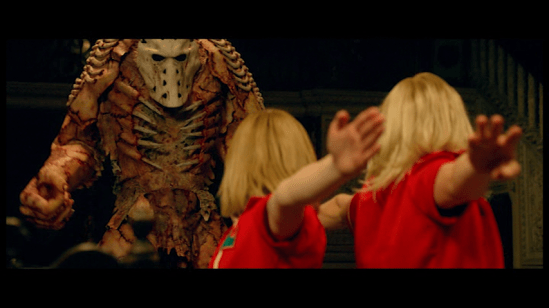
A small and sleepy town has a haunting and grisly past. Old man Robert Bowery, stricken with a degenerative eye disease, once believed his failing eyesight would return if he gouged and digested the eyes of young children. Younger the eyes, the better. Thought to be long dead, Robert Bowery’s legacy of sadistic evil has left a dreadful impact on the town, so much so that the young townie and Sheriff’s daughter, Helen Connolly, still feels the long lasting fright of the horrific stories of Bowery’s hide-and-seek hunt of his adolescent victims at his dilapidated campground compound which he knew every inch of it’s isolated wooded location. When Helen is persuaded by her father to babysit Lucas, a little boy whose family is new in town, she begrudgingly accepts to take care of the boy in Robert Bowery’s former home, but Lucas goes missing during the middle of the night. Helen tracks him down to Bowery’s rundown hunting ground where the child eater lies in wait to sink his razor sharp teeth into children’s eyes and burst their anatomical fluids!

Based upon the short film of the same title, “Child Eater” is director Erlingur Thoroddsen’s unholy birth of a slasher paragon. The subtle, patient approach Thoroddsen establishes stretches an unlimited amount of a brooding atmosphere that compliments the gangly stature and unpigmented color of the demon-looking Robert Bowery. With Bowery’s round, tinted spectacles, thin whipping cane, and bald top, the fragile elderly have a new heroic face when combating youthful brats. Thoroddsen, who also penned the script, purposefully leaves Bowery in an ambiguous light, never really obtaining a good solid shot of the villain’s icy and bleak veneer until near the very end, that mystifies a character with such a monolithic and infamous lore surrounding him. Every character in town knows one version or another the story of Robert Bowery and his sick obsession of regenerative eye method, but not one person can put truth to the plague of his affliction and that makes the town stain that more tough to remove.

Cait Bliss returns as Helen Connolly from the 2012 short as the conflicted heroine with change of heart toward her perspective on children, especially when feels obligated in her duty to serve and protect a snatched Lucas. Bliss feels a little too old for the role that involves her character living with her Sheriff father, but Helen might be part of the millennial group where you live with your folks until your thirty or older; yet Bliss teeters on the fine line of being a final girl, similar to Heather Lagenkamp’s Nancy in “A Nightmare on Elm Street,” turning her entitled life of aimless wandering into one possibly worth living and fighting for once the life changing ordeal is over. “You Can’t Kill Stephen King’s” Jason Martin provides the elephant ears, bald head, and lanky features that spectacularly builds Robert Bowery and Martin also provides a persona for a character whose always in the shadows, intoxicating the scene when visible with a nefariously bowie knife grin under a pair of Nazi-era mad scientist eyewear. Melinda Chilton, Brandon Smalls, Colin Critchley, Dave Klasko, James Wilcox, Andrew Kaempfer, and Kara Durrett make up the remaining cast in “Child Eater,” a unforgettable dooming blood junket.

Thoroddsen masterfully crafts “Child Eater’s” unsettling composure with unrivaled pacing, well edited jump scares, and an unchained animalistic killer crutched on sense other than his sight and who wouldn’t love a wretch plucking out peepers from eye sockets or ripping out jugulars with a single forceful bite? Robert Bowery could be a villainous idol and deservingly needs to be just that, but the vast weight of the Bowery mythos was attempted to be explained in too little of narrative run time, killing much of the hype that engulf’s his presence. The nearly unexplained death defiance follows into the trope trap similar to that of Jason Voorhees or Michael Myers, but the background provided on Bowery is unique, stemming from a vague portion of German and Polish folklore in which the latter may explain the child eater’s power, donned symbolically and, perhaps, even physically given his ability to be in the right place at the right time almost in simultaneous moments, that has been granted by the Devil.

Technically, I adore much of Thoroddsen’s slasheresque style blended with a calming patient that’s nearly unseen in the slasher genre. The only technical aspect I was not fond of was the fish eye lens used mainly in the beginning that spun a sickening wave of nausea through my corneas, the same sensation felt by viewers watching the jerky motions of a handheld found footage film. Still, Thoroddsen’s use of space, lighting, and special effects by Fiona Tyson states more than just another indie production and mesh those attributes with a superbly captivating and haunting string score by Einar Sv. Tryggvason and “Child Eater” strives further from being just another horrendously dubbed horror shunned aside for it’s nothing new attitude.

Black Stork Productions in association with Wheelhouse Creative and Blue Fox Entertainment deliver 82 minutes of toe curling fear in 2016’s “Child Eater.” MVDVisual distributes the Elingur Thoroddsen film onto a region free, not rated DVD that’s presented with an Anamoprhic Widescreen 1.85:1 presentation that’s definitely sharp even during the film’s mostly nighttime scenes. There are two audio options available: a Dolby Digital Surround 5.1 and a stereo 2.0. The 5.1 draws back the dialogue leaving more room for Tryggvason’s excellent score. Bonus features include a theatrical trailer, deleted scenes, and an audio commentary with director Erlingur Thoroddsen and stars Cait Bliss and Jason Martin. The deleted scenes leave good insight, explaining some scenes that might need more detailed clarification, and round out a rough edges. “Child Eater” eats into being an well played atmospheric horror on a budget with a rememberable child predator who can go eye-to-eye with foundational renaissance slashers!
Tag Archives: MVDVisual
Colleen and Colleen Versus the Evil Bratzis! “Yoga Hosers” review!

Colleen Collette and Colleen McKenzie are best friends. They’re also two superficial 15-year-old girls who are nose deep into their social media campaigning cell phones, jamming in their girl punk band Glamthrax, and living by the unorthodox, yet namaste driven, yoga practices while exasperatingly working at one of girl’s father’s convenient stores called “Eh-2-Zed.” Set in the Great White North of Canada, the Winnipeg, Manitoba sophomores are surprisingly invited to a senior party, a lure by a popular, good-looking senior boy who has a darker, Satanic side to him. The Colleen girls’ run in with a murderous devil worshipping senior inadvertently opens another hidden danger lurking 37 feet beneath their “Eh-2-Zed” soles. A slumbering Nazi mad scientists has been awoken and aims to finish his Third Reich master plan to take over Canada with a cloned army of Bratzis, living Bratwurst sausages who are pint-sizes Nazis, and seeks to unleash evil upon the Manitoba Earth.

Kevin Smith’s latest pop-cultural flick, a comedy-horror feature, entitled “Yoga Hosers” is the second installment, following 2014’s film “Tusk”, in Smith’s horror-inspired trilogy known as The True North Trilogy. Did you noticed I labeled “Yoga Hosers” as a comedy-horror instead of a horror-comedy? The “Mallrats” and “Clerks” director basks more in the familiarity of witty, profane humor in this second of three films, but Kevin Smith has known to dapple, gradually stepping over to the dark side into horror with his radical religious sect piece “Red State” and, like aforementioned, the body-horror “Tusk.” The Jersey native also has an occasional appearance on AMC’s “The Talking Dead,” a talk show about “The Walking Dead’s” post-premier of each episode, and has meddled in the realm of the fantastic. Not only is Smith a strong advocate and sincerely passionate comic book enthusiast, coinciding with his own AMC show “The Comic Book Men,” but “Dogma,” starring the late Alan Rickman, delivers divine revelations and, now, with “Yoga Hosers,” a villainous Nazi clones miniature Bratwurst soldiers. Smith holds, in my opinion, one of the most extremely diverse bodies of work in our lifetime.

Where as “Tusk” goes gritty and gory with R rated horror-comedy, Smith’s intentions for “Yoga Hosers” has always leaned toward that of PG-13 and, maybe, that’s due in part of the two films’ minoring connection. The connection, presumably set in the same whacked out alternate universe, stem from the two Colleens, one played by Smith’s hysterically funny daughter, Harley Quinn Smith, and the other being Harley’s longtime, kindergarden friend Lily-Rose Depp. Yes, the daughter of mega star Johnny Depp and French singer Vanessa Paradis brings her inherited talent and French dialect to one-half of a buddy comedy. The 15-year old girls, who are also 15-year old in character, transfer their natural offscreen relationship into being an entitled millennial pair with every intent on neglecting responsibility until faced with the moment of truth. Teamed up well with Lily-Rose’s father, Johnny Depp, under the heavy makeup of a fictional French manhunter named Guy Lapointe, also from “Tusk,” with scene-to-scene rotating facial mole, the crime fighting, buddy trio awkwardly moves across the plain in an enjoyable double entendre performance of simple wit. Accompanying Depp, Smith, and Depp are an eclectic roster of Kevin Smith’s usuals such as Justin Long (“Tusk,” “Jeepers Creepers”) as a reality-severed Yoga instructor named Yogi Bayer, Jason Mewes (“Jay and Silent Bob Strike Back”) in a bit part, and, of course, Kevin Smith himself as the devilish Bratzis. New faces also make the scene with an unrecognizable Haley Joel Osment (“Sixth Sense”) as a young Canadian Nazi and “Orange is the New Black” Natasha Lyonne portraying a slutty Eh-2-Zed manager who sleeps her way to the top with Colleen C’s father, “Veep’s” Tony Hale.

“Yoga Hosers” explodes with Canadian farce that’s laced heavily with jokes on ‘aboots,’ hockey jersey-wearing patrons, an alternate version of Lucky Charms called Pucky Charms, and many more stereotypical references that satirically poke a good humored finger at Canadian culture and pop-culture. To top this satire sundae, the smug Colleens define the very title of the film with their dimwitted sludge and white girl yoga written into every storyboard moment. “Yoga Hosers'” buddy film concept gives an opportunity to two young and clueless teen girls who genre pirate the story with a jalopy of unsystematic plot humor, sucking away and discarding like garbage the sole ounce of blended “Gremlins” and “Puppet Master” cavalier subgenre horror that’s comfortably pleasant and inarguable right for a fun film of this triviality. Though I think the Colleens’ have had their story told, I’m intrigued to see what the pair of aloof teens offer in Smith’s third film of the trilogy, “Moose Jaws.”

MVDVisual distributes a dual format Blu-ray, DVD, and Digital HD release of the various production companies’, including main investor, Invincible Pictures, and Kevin Smith’s founded SModcast Pictures, “Yoga Hosers.” The Blu-ray disc is a MPEG-2 encoded 1080p transfer with a 2.38:1 presentation and, rarely, flutters under a mediocre bitrate. Image brightens with a glossy coating that revels in brighter hues of blue, pink, orange, and yellow while starker bolds such as red and purple pop with vividness. Yet, sharp details are thin, less defined to bring high definition to present technological age. The English Dolby Digital 5.1 track slightly elevates the ambient noise, especially during the girls’ punk rock practice that muffles out portions of their vocals, yet still manages to vary and balance. The only bonus feature available is a behind-the-scenes featurette that includes some insightful interviews. “Yoga Hosers” oppresses a melancholy reminder that the old Kevin Smith is no more and dawns a Kevin Smith 2.0 who transforms his satirical trademarks and his witty banter into strange misadventures, involving, in this case, two teenage fools flighting from one sub-narrative to another in a mixed bag of comedy and inferior minion horror.

Enter Into Your Darkest, Evilest Fantasies. “We Are The Flesh” review!

Struggling to survive the conditions of the outside world, a brother and sister locate shelter inside a desolated complex and stumble upon it’s strange inhabitant, a solitary middle-aged man named Mariano with a penchant for welcoming his insanity. The alcohol distilling and isolating embracing Mariano has a twisted offer for harboring the young siblings as he also puts the two to work, constructing Mariano’s trash-ridden home into a cavernous structure from taped scraps of lumber and cardboard. Mariano desperately needs them to explore unorthodox depravities upon themselves to become one with their unhinged host that forms, in more than one way, one flesh-ravenous happy family.

“We Are the Flesh,” aka “Tenemos la carne” in the original title, is an experimental art house feature from controversial Mexican director Emiliano Rocha Minter. The 2016 film harbors more than just three hermit individuals dipping their toes into a forbidden pool of acts, but also provides numerous metaphors and symbolisms that might be hard to swallow and difficult to sit through during the 79 minute runtime. “Sin Nombre” actor Noé Hernández stars as Mariano and there isn’t enough praise in the art house world from his performance that consumes his mortal being, transforming him into a well oiled psychotic machine with a blazing stare, a certifiable grin, and a defined muscular physique. Hernández steals scenes left and right from his young and novice co-stars María Evoli and Diego Gamaliel, whom are equally as brave as the more experienced Hernández in their respective roles. “We Are the Flesh” emits racy undertones by just hearing the title alone and, absolutely, lives up to the title’s very core by displaying non-simulated sex acts. Think about it. Minter’s film only has three main characters for most of the narrative and two of them are siblings. Yup, Minter went the incest route for the sake of art.

In the opening scene, heavy breathing creeps upon a black screen until the image pops open to a Mariano’s face, laboring over something. Next cut is Mariano hunched over with a high stack of baled cardboard, walking in the color tone of a dark cool blue with a slight haze engulfing him. This opening scene is one instance where Mariano is portrayed the Messiah prophet Jesus. Other religious symbolistic events that connect Mariano, who would be condemned for his actions in the Christian scope, to Jesus that occur throughout, such as being dying and being reborn, the cave aspect, the motifs of faith from the mysterious eye dropper liquid, and being the sacrificial body as if transpiring to be some sort of demented wafer during a crazed cannibal communion orgy. Of course, opening anybody’s eyes or mind to this notion can be immensely difficult and profanely sacrilegious to even spell it out in text because seeing the streaming drug use, the attempted murder, the cannibalism, and the sibling incest rule the majority of the narrative makes a case that affiliates more with an unholy antichrist rather than Christ, but I believe director Emiliano Rocha Minter, being a Mexican national and growing up in a Catholic, like the majority of Hispanics, culture aimed to blur the lines between the heavens above and the fires below and embodying them as a singular whole.

Intrinsically irrational and insatiably grotesque, “We Are the Flesh” has momentum in a colorfully abrasive form, quickly evolving from act to act with characters reemerging anew every second onscreen. What might seem as a visionless quest for the sole purpose of producing shock value can be re-construed as a message more aesthetically beautiful in man’s most detested nature. Yollótl Alvarado’s cinematic vision is absolutely dripping with gripping, mature atmospherics that are well doused in vividness while, at the same time, being despairing in a post-apocalyptic haze. The experience charges at you, pulls you into this cavernous womb, and scratches at your tender barrier lining, trying to sneakily slip into your soul. The sensation is as much unreal as the film’s avant-garde structure.

Produced by production companies Piano, Detalle Films, Sedna Films, Estudios Splendor Omnia, and Simplemente, “We Are the Flesh” is a poetic approach experimental wonder, gratifyingly brought to home entertainment fruition from Arrow Films in the United Kingdom and Arrow Films, in conjunction with MVD Visual, in the United States on Blu-ray and DVD. Between Lex Ortega’s brutal social commentary gore-flick “Atroz” and Emiliano Rocha Minter’s art house metaphor “We Are the Flesh,” Mexican filmmaking stands high and bold, unafraid to tell unapologetic stories in conservative societies; a mere taste of what’s to come, I’m positive. While recommending this type of film isn’t the easiest for status quo movie lovers, “We Are the Flesh” hopefully will expand minds, open eyes, and encourage skin-on-skin contact for the cinematic adventurers.
“We Are the Flesh” available in USA! and in the United Kingdom!
Want to be the Evil Doctor’s Guinea Pig? “American Guinea Pig: Bloodshock” review!

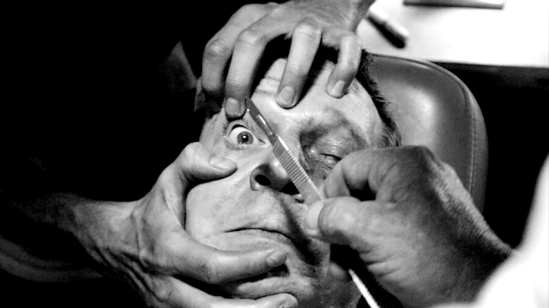
One man becomes the unfortunate subject of ghastly experimentations performed by a sadistic and blood thirsty doctor. Wheeled by abiding orderlies back and forth from his sterile white and padded cell to the mad doctor’s dark and dingy operating room office, the man’s will to live quickly begins to fade, yearning for death before suffering anymore in an alternative Hell. That is, until the handwritten notes start appearing on his padded room floor. The notes seep through between the pads from another tortured soul, a female, in the adjacent room. Withstanding new atrocities done to her before the man receives them, she pleads with the man to not leave her and to make a pact to outlive the inhumanities together.

Welcome to the new American Guinea Pig series! “Bloodshock” is the 2015 follow up film, on the coattails of 2014’s “American Guinea Pig: Bouquet of Guts and Gore,” from writer-producer and Unearthed Films president Stephen Biro and directed by special effects guru Marcus Koch. Koch, whose effects credentials include the Barbara Crampton starring thriller “We Are Still Here” and Koch’s prior directorial work “Rot” and “100 Tears,” strays away from the straight forward concept with an ultra gore art house expressionistic horror film that aims to break your mind as well as your body. Open for interpretation, “Bloodshock” fits perfectly into the ever provocative Unearthed Films’ wide open cache of underground cinema and will alleviate Koch to the next level of filmmaking. My interpretation of what this poor man and woman are experiencing is simply a penancing purgatory that’s intended to cleanse their souls in the warmth of their own wretched blood; the two victims understand their pain, as if not feeling the invasive effects of being dissected while still yielding breath, and are willing to subdue themselves to a maniacal physician until they’re able to briefly thwart his tireless work to share pain and open wounds in blood-soaked passion of hopeless ecstasy.

Dan Ellis puts in a powerful performance as the mistreated male patient with Lillian McKinnay, as the female patient, co-starring in an equally bold performance, especially being McKinnay’s first major role. Andy Winton’s diabolical medical maltreatment compares to the similar magnitude of “The Human Centipede’s” Dieter Laser by conducting exploratory, invasive, and unnecessary surgeries for sport while being candor about his blood lusting necessity. Amongst the three main actors, Biro’s script contains little dialogue, banking laboriously on physical renditions since both tortured patients’ tongues have been severed and jarred. Every movement is precisely executed and surged with attention, tuned to tell the story without much verbiage. Ultra gore isn’t everybody’s cup of cinematic tea and with an extremely thin film of dialogue as an outer coating, Ultra gore becomes that much difficult to be entertained by, but, recently, I’ve been lucky enough to come across another gore and shock film, coincidentally enough another Unearthed Films’ release entitled “Flowers” by director Phil Stevens, that had proved to me, as well as Koch has just done, that unspoken gore can be ingeniously crafted and thought provoking.

“Bloodshock’s” gore holds nothing back and leaves nothing to the imagination. The meticulous bone-sawing, head-splitting effects from a talented special effects team, consisting of Marcus Koch’s Oddtopsy FX crew, paint a sordid picture with a blood brush. Koch’s decision to go with Donald Donnerson’s cinematography under the two-tone of black and white doesn’t stiffen the poignant sight of blood, inner layers of flesh, or the splintering bone fragments. The Japanese would be pleased with their American counterparts realistically depicting gore and death captured amongst an underlying meaning. Unearthed Films has already taken the steps to continue the series with their next installment, “American Guinea Pig: The Song of Solomon,” which will pertain to a graphic exorcism and, currently, there are preview images and video scenes available.

The 3-Disc Collector’s Set from Unearthed Films and MVD Visual has priceless collector’s value. Not only does the set have a Blu-ray transfer of the 1.85:1 widescreen presentation, but also contains a DVD presentation and a third disc containing a CD of the Kristian Day industrial-jarring soundtrack. The black and white image quality is sharp and solid for a majority of 91 minute runtime. Some scenes go soft, losing shape to blotchy interference, but the qualities only supplement to “Bloodshock’s” charming grit. Only during the course of the patients unifying do colorful hues gradually seep in, almost unnoticeably, during an ostentatious sex scene involving blood and intestine that’s effectively edited to slowly build the passionate boiling point. Despite two of the main characters have their tongues removed, the Dolby Digital 2.0 audio has the dialogue so sorely crushed under the weight of the Kristian Day soundtrack that at some scenes I can’t even understand what the good mad doctor is saying. Also, on the DVD, I noticed that all audio tracks delay a second behind the action and dialogue. The bonus features are immense with interviews with director Marcus Koch, writer-producer, Stephen Biro, actor Dan Ellis, actress Lillian Mckinney, and two commentary tracks with Marucs Koch and Stephen Biro on one and actor Andy Winton, Gene Palubicki, and Alberto Giovannelli on the other. There’s also a behind the scenes featurette, production videos, and a booklet with a review from Ultra Violent Magazine! Unearthed Films certainly has a definitive release in their collection with “American Guinea Pig: Bloodshock” that’s packed with bonus material and full of venomous content abiding by the guidelines set forth by the Japanese. I don’t foresee the underground cinema juggernaut or the explicitly snuff-like Guinea Pig series ever slowing the flow of blood. “Bloodshock” fulfills the qualifications of the series by having the guts to show the guts and being just as demented and sick for fans who can stomach and endure grisly content.
Evil Git Er Done in “Bubba the Redneck Werewolf” review!

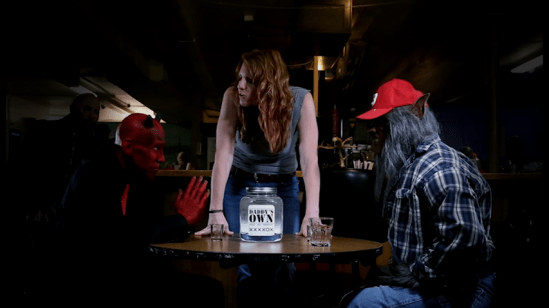
In the sleepy town of Broken Taint, dimwitted dog catcher Bubba Blanche is the town joke amongst the rest of the moronic residents even in the eyes of former girlfriend Bobbie Jo, wrapping her needs around the naked muscle-shirt arms of a triple wide trailer owning redneck. Bubba swears that he’ll do absolutely anything to win Bobbie Jo back and his pathetic cries stretch deep to the depths of hell, reaching the ears of the The Devil himself who suddenly appears in Broken Taint. The Devil strikes a dubious agreement with Bubba to make him stronger in order to win over Bobbie Jo, but when Bubba wakes up the next morning, the dog catcher has been transformed into a big, bad, and hairy werewolf. His curse becomes a gift straight from hell as he knocks the front teeth out of triple wide, wins the heart of Bobbie Jo back, and earns the respect of the local townsfolk. That is, until Bubba’s curse starts a chain reaction of unfortunate diabolical agreements between the conniving Devil and the town simpletons. As The Devil turns Broken Taint into his own tarnation playground, Bubba must use his newfound canine powers and some of his old hidden strengths to overpower and to outwit the clever Lord of the underworld.

Comic book movies. We either love them or hate them. We judge their fantastic value on the precision of who was casted as the hero or heroine and on the accurateness toward staying true to character origins. This may be common knowledge or it might not, but “Bubba The Redneck Werewolf,” a cigar-smoking, shot-gun carrying, jean-overall wearing werewolf, has been a successful comic franchise since 1995. Created by former CRACKED magazine writer Mitch Hyman, the true success of the provincial lycanthrope stems from the classic tale of a downtrodden individual being granted a huge amount of strength to overcome fear, to unleash ambitions, and to reestablish a brick wall of confidence all the while drinking a six-pack and drive a big truck. I’m sure Mitch Hyman would also note that the hilarity of a rootin tootin redneck werewolf with a patchwork heart of good intentions appeals to the masses as well.

When Two Rubbing Nickels, LLC partners with central Florida based and spoof-specializing video production company And You Films, that’s when Bubba truly comes to life from off the vivid comic book pages to ever critical independent big screen in 2014 where director Brendan Jackson Rogers’ colorful illustration of the hairiest super hero of all time and his barroom dingbats challenge a mischievous and dastardly Devil. What’s even more interesting about this under-the-radar adapted horror-comedy being released by MVDVisual onto DVD is the writer who penned the script. None other than writer, director, producer, and president of Unearthed Films, Mr. Stephen Biro. Yes, the man who delivers spectacular acquired gory avant garde and underground horror films to see a slither of public light puts forth his mighty pen to paper and etches out a perfect blend of comedy and horror that creates a sea monkey world where “Bubba The Redneck Werewolf” radiates with rib-tickling slapstick humor aimed to be darkly unapologetic and fused with embellished illustrations of spew and blood splattering mayhem.

The ensemble cast doesn’t have one single recognizable name credited and that makes this outrageous comedy that much alluring for nothing is taken overly serious. The very title of the film should be a clear expectation without explanation. Without that thespian pressure mounting on the casts’ shoulders, Rogers was able to build an alleviated atmosphere and let the actors be kids performing on the biggest stage of their careers. Even lead actor Fred Lass, who dons the Werewolf suit, had his very detailed and comprehensive werewolf facial mold conformed to show the expressions and the contours of his face. Bubba creator Mitch Hyman even has a starring roles as the Devil, his thin physique and defined face definably pops under a lush shade of hell branding red under a crown of dual horns; his satanic performance cultivates the very worst of humanity, using their greed against them, and reveling in their agony soaked suffering. Mitch Hyman wins the best ungodly trope since Al Pacino rendition of the Devil in 1997’s “The Devil’s Advocate.” Another unique element to harp upon are the strong female characters. Though the comic routinely objectifies female characters on the front covers with being petite and scantily cladded women of the countryside positioned around the massive werewolf with a baseball cap, only Malone Thomas’ role of Bobbie Jo resembles such a booty-jort, low-cut shirt clothed character, but, at the same time, Bobbie Jo remains a fierce constant show of strength for Bubba. She knows what she wants, how she wants it, and when to take it without shame and selfishness. Sara Humbert and Gail Fleming do the same for their respective roles of the blunt bartender Jamie Sue and the clairvoyant gypsy.

MVDVisual shotguns a beer and will deliver “Bubba The Redneck Werewolf” onto a region free DVD come 2017! The comic book image quality does well with the slight rotoscope composite with interlaced moments of raw and naturally colored scenes. The darker scenes in the widescreen 1.78:1 presentation comes off unsharp and blotchy, leaving details solely toward more well lit portions. The Dolby Digital audio track clearly puts forth dialogue amongst a balance ambient track. No issues are detected and sufficiently goes beyond being just good quality. A vast batch of bonus material outshines other indie releases, beginning with a 16 minute documentary “From Page to Screen. The Making of Bubba The Redneck Werewolf. Other extras include deleted scenes, blooper reel, Werewolf and Devil Make process videos, “The Ballad of Bubba” behind-the-scenes music video by The Blast-Offs, and the official trailer. Amongst the top contenders of modern horror-comedies and werewolf films, Brendan Jackson Rogers, Mitch Hyman, Stephen Biro, and Fred Lass have, literally, created a winning combination with their monstrous furry feature.