The 90’s Played Videotapes by a Different Set of EVIL Rules. “V/H/S/94” reviewed! (Acorn Media International / Blu-ray)

V/H/S/94 Blu-ray Can be Purchased Here!

A police S.W.A.T. team raid a large warehouse where suspected drug storage and trafficking is being conducted.  Tagging along a camera man for code of conduct review, what the team discovers inside is more alarming than a stash of street narcotics.  The nearly empty warehouse is filled with gruesomely recorded VHS tapes, snowy television sets in every room, and recently deceased bodies with their eyes plucked from their heads.  As the investigation frantically continues through the labyrinth corridors that turns the capture and arrest mission into a mission of escape, the pre-recorded tapes they come across show vivid, nightmare-fueling horrors, including footage of a sewer-dwelling rat man, a near empty funeral home on a dark-and-story night, inhuman surgeries joining man and machine, and a militia preparing themselves to unleash true evil onto the government establishment.  What the officers see can’t be unseen as analog madness ensues them spurred by the motivations of a deadly cult.

The fourth installment of the David Bruckner and Brad Miska created analog-influenced V/H/S horror anthology.  Known as V/H/S/94, as in 1994 to mark the period of social and cultural influence, six new directors take the short movie helm in a new line of videotape terror.  “Night’s End” director Jennifer Reeder tackles the wraparound story “Holy Hell” that fills in between and shepherds in four frightening tales with “Watcher’s” Chloe Okunols “Storm Drain,” “V/H/S/2’s Simon Barrett’s “The Empty Wake,” “May the Devil Take You’s” Timo Tjahjanto’s “The Subject,” and “Lowlife’s” Ryan Prows’ “Terror.”  “Psycho Gorman” and “Manborg” filmmaker Steven Kostanski also directs a mini-pseudo infomercial entitled “The Veggie Masher.”  Together, the filmmakers for a new lot of under-the-radar talent to showcase an eclectic blend of 90’s set scary stories with Josh Goldboom, Kurtis David harder, and Brad Miska producing, Studio 71, Cinepocalypse Productions, and Hangar 18 Media as the production credits, and Bloody Disgusting and Raven Banner Entertainment presenting the production.

With any type of anthology, a variety of roles are laid out for different scenarios.  From newscasters (Anna Hopkins, “Tin Can”) and cameramen (Anthony Christian Potenza, “Bad Dreams”) to body-transfiguring mad scientists (Budi Ross), to greenhorn funeral home attendants (Kyal Legend), “V/H/S/94 reaches into the far corners of world while also breeding home grown terror right into suburban America.  Each episode develops and nurtures layered characters with fast-setting concrete, quickly building who and what they are in a matter of minutes to which some full-length features have to build in a whole act or in all three acts.  The writing of and the colorful depiction of each character sets the tone for the rest of short and whether the short will be a success hit or not.  An example of this would be in Timo Tjahjanto’s “The Subject” with The Creator, played renationalized and crazy by Budi Ross.  An eccentric acute accent in Ross’s Creator apexes the overall expectation of a mad scientist and in that there is an understanding of what’s coming while there’s still a simultaneous shroud of mystery of how batshit crazy things can really become. The episode that didn’t quite flesh out enough, in character and in story, was the wraparound “Hell Hole” segment that sees a S.W.A.T. team (Kimmy Choi, Nicholette Pearse, Dru Viergever, Thomas Mitchell) and ride-a-long cameraman (Kevin P. Gabel) storm a suspected drug warehouse and find nothing but death and VHS.  Tremendous pandemonium as the team charging into the multi-layered complex is roughly cleaved to not smoothly segue in-and-out with the intercut VHS episodes that also hinder the characters from really being built upon to relate any interest in them.  “Holy Hell’s” climatic reveal has little weight to then stand on without that much needed seething of every detailed bubble that pops in between the short films.  However, the wraparound story doesn’t snuff out the rest of eye-gluing terror you’re witnessing with solid, edge-of-your-seat performances from Donny Alamsyah, Tim Campbell, Brian Paul, Conor Sweeney, Devin Chin-Cheong, Juan Blone Subiantoro, Christian Lloyd, Cameron Kneteman, Steven McCarthy, Brenand McMurtry-Howlett, Slavic Rogozine, and Daniel Willston.

Zombies, cults, body horror, vampires, subterranean creatures, and much more are the selected subgenres that invade insidiously into our visual receptors and straight down to shake and scare stiff our stable core, each one idiosyncratically crafted and tailored by the filmmakers tastes to deliver a unique tale under the guise of those beautiful VHS artefacts.  Whether ran through a VHS recorder or filters are applied, each era-idolized short has a distinct visual approach and feel how the 1990s tape decks presented the goods that can be saturated in horizontal noise strips, tracking lines, and image ghosting.  Granted, and likely subjectively by yours truly, some shorts are better than others with a narrative outline and in special effects.  “Holy Hell” doesn’t let time to breath and let the dust setting to effectively lay in fear and frights because of the constant cacophony of the S.W.A.T. team’s frantic ambling through the complex, seeing each disturbing scene as if breezing through a museum and glimpsing at the exhibits.  I’m fully aware of the short film time crunch Reeder was under but breakneck pacing didn’t have time to elicit any type of reaction or setup a story.  “The Empty Wake,” “The Subject,” and “Terror,” reel in and piece together all the components of their tales and find room to make them thriller and terrifying.  Barrett’s is one of the simplest yet most anxiety-riddled shorts to come out of the V/H/S anthology run, creating a couped up Funeral home atmosphere, the background threat of a tornado out of the story night, and a coffin that goes bump-bump with a sole wake service attendant on the edge of fright for fear of what’s inside trying to get out.  Ryan Prows puts a spin on the whole vampire trope by never mentioning the creature as the living dead bloodsucker held captive by a radical, ring-wing militia under the influence of its power to destroy.  Instead, the creature is just plain and pure evil that, as the militia men find out by the flaws in themselves, can’t be contained.

Acorn Media, the United Kingdom subsidiary label of RLJ Entertainment, releases the Shudder exclusive anthology on Blu-ray home video.  THE AVC encoded, 1080p high-definition, BD50 of “V/H/S/64” goes by the oxymoronic details in the videotape artefacts.  Through various VHS filters and VHS recording deck converter, the widescreen 1.78:1 aspect ratio image is purposefully distorted, worn, and in standard definition to meet the standards of the V/H/S series, providing an anomalous analog outer shell so if you’re expect fine delineation, natural skin tones, or any clear details of any sorts, then the V/H/S franchise is not for you.  For the rest of us, “’94” parades the paltry resolution like gold in a true celebratory style, embracing the chroma spectrum for a maximum retro throwback.  However, the color bands on a couple shorts appear too vibrant, creeping more into digital age with flusher hues rather than tape degraded coloring.  The English and Indian language tracks are ran through a lossless DTS-HD 5.1 surround sound mix that offers punchy kbps decoding filtering through the appropriate side and back channels and right into your ears. The sonic palette has great depth and range in the midst of the crackling and warp-pops of damaged tape. Dialogue is clean, clear, and concise and there’s synched-well, error-free English subtitles for “The Subject.” Bonus features include a behind-the-scenes featurette with the directors speaking about how they were approached and crafted each of their respective shorts, a panel interview at the San Diego Comic Con, deleted and extended scenes, the special effects discussed by Patrick Magee, a quick glimpse at “The Wake’s” visual effects piece to the pie, the full-length Steven Kostanski “Veggie Masher” commercial, behind-the-scenes images, and Hail Raatma!, a special look at the sewer-dwelling creature. There are also two commentaries: a feature-length commentary track with the filmmakers and producers hosted by The Boo Crew and a second commentary track on “The Empty Wake” with writer-director Simon Barrett. There is no mid-credit or after-credit stingers. Sheathed inside a thicker UK Blu-ray casing is the “V/H/S/94” blocky cover art of a face screaming while tape emerges from their mouth and eyes. Inside lies bare with no insert but the disc art is different with a snow-static tube televisions outlining a techno-skull. With PAL encoded playback, the Acorn Media Blu-ray comes region free (tested) despite not proclaiming so on the back cover. The UK certified 18 releases has a runtime of approx. 104 minutes.

Last Rites: If anthologies get your horror rocks off, the “V/H/S” franchise continues to disturb, disgust, and dread with new filmmakers, new stories, and new horrors, but with the same amount of thirst-quenching blood shot on video!

V/H/S/94 Blu-ray Can be Purchased Here!

Getting Revenge on EVIL is a 6-Year Plan! “Kill Butterfly Kill” reviewed! (Neon Eagle Video / Blu-ray)

“Kill Butterfly Kill” – Both Films Available on Blu-ray!

Caught on the wrong side of the tracks during  a torrential downpour one dark and stormy night, a soaked Mei-Ling seeks shelter in a haybarn where a group of drunk men are playing cards.  Through an intoxicated lens of brash confidence, the men rape Mei-Ling as if the whole ordeal was nothing more than a game, like them playing cards.  For Mei-Ling, the night that changed everything ate at her for six long years as she worked her way up into a nightclub business as she sought the names and faces of her attackers.  When one of the men, a crime boss, stiffs a hitman after taking out leaders of a rival gang, Mei-Ling and the assassin form a mutual business and romantic relationship, pledging to help one another’s revenge. Together, along with Mei-Ling’s most trusted female accomplices, they plot, seduce, and lure each man out of hiding and take them out one-by-one in different ways.   

“Hei shi fu ren,” aka “Underground Wife,” aka “Kill Butterfly Kill,” is the 1982 rape-revenge Taiwanese thriller from director Yu-Lung Hsu, a fast-paced crime-action filmmaker with credits “The Boy from Dark Street” and the more fantastical, kaiju picture “King of Snakes” under his belt later in his career.  The script is penned by a compeer of such genres in Ching-Kang Yao who wrote “One-Armed Swordsman vs Nine Killers” and “Superdragon vs. Superman,” starring Bruce Lee imitator, Bruce Li.  Yu-Lung and Ching-King would collaborate often, making the film one of those efforts right at the height of their joined forces; yet, the film has gone through various titles and edits, even recut and edited in new scenes into what would become “American Commando 6:  Kill Butterfly Kill” five years later from director Godfrey Ho (as Charles Lee), and trying to get a sense of the original intention has proved nothing but difficult.  “Official Exterminator 2:  Heaven’s Hell” executive producer Wu-Tung Yet produces the film what we’ll refer to as “Kill Butterfly Kill” for the sake of his review and Fortuna Film Company is the production firm and presented by International Film Distributors (IFD).

Li-Yun Chen stars as the nightclub madam Mei-Ling hellbent on lethal revenge.  Chen, who continued her career in a few other sexy femme fatale roles in “Commando Fury” and “The Vampire Dominator,” plays the damsel in distress, forced into romping in the hay with a few baboonish male drunkards.  The rape scene is nothing to be overly wrought about as the close-ripping pursuit through the barn is violently toned down and the rape is more implied than explicit.  There isn’t even any nudity of the private parts with just Chen in ripped attire and the men baring their sweaty chests.  Chen never really receives the sympathetic tone one is supposed to receive after going through harrowing humiliation and assault.  Not because of the less intense attack, perhaps more so with how jovial and goofy the intoxicated men are, but Mei-Ling is never lit in a low-point light.  Even after the rape, Mei-Ling is standing strong, glaring, and with a look of determination to get payback while still having straw hang from her disheveled hair, segueing seamlessly right into her powerful businesswoman persona six years later.  This is the point in time where, as an exclusive call girl for a powerful crime boss (Paul Chang Chung, “Vengeance of a Snowgirl”) in a variant subplot, she meets cheated assassin Shiu Ping (Sha Ma, “The Nude Body Case in Tokyo”) who becomes a kindred spirit in seeking revenge.  Their intertwining falls on a fated sword and too serendipitous to make a lot of sense but their run-in to each other makes for good buddy action, an assassin and a high-end prostitute going full tilt on some really bad men who have dispersed into their own idiosyncratic corruption paths that makes them all the more detestable when Mei-Ling and Shiu Ping come for them.  “Kill Butterfly Kill” rounds out the cast with Sing Chen, Hung-Lieh Chen, Fu-Cheng Chen, Yaun Chuan, Li Hsu, Shao Hua Chu, Ti-Men Kan, Chen-Peng Kao, Yun Lan, Fei Lung, Wen-Tseng Liu, Kuan-Wu Lung and Ta-Chuan Chang.

“Kill Butterfly Kill” is inarguably a cult film from Taiwan with sordid themes coursing through its cinematic circulatory system.  Conjoined with the rape-revenge aspect, one of the staple themes of the genre, society corruption, gang wars, assassination attempts, prostitution and martial art skirmishes and brawls run rampant and serve “Kill Butterfly Kill” as Eastern grindhouse ambrosia.  Yet, the seemingly positive film style paraphernalia can also be detrimental.  In the case of “Kill Butterfly Kill,” there’s not a clear cut profile from Yu-Lung Hsu with lot to ingest but not a ton targeted nourishment.  The rape-revenge aspect, which feels like the keynote, foundational plot, careens into awkward comedy and the swindled assassin territory a little too much or invests heavily into the sudden and unexplained relationship between the two protagonists without much background or backstory. There’s no phoenix moment of rising from the ashes with a quick cut from the rape to the revenge without delving into the nitty-gritty details needed to satisfy an important sympathetic and empathetic resurrection.  Sha Ma’s assassin feels like a threadbare connection serving mostly for patriarchal palaver because, surely, a woman couldn’t undermine five influential men by herself, right?  In any case, what’s filmed is filmed, and the fight coordination doesn’t displease with fast-paced action and quick-striking movements.  There’s also a lean cinematographer stylistic palette that fashions surreal moments to coincide with fast action, offering unique methods in tracking down, seducing, luring, and inevitably dispatching the scum.

The film having been through multiple remixes, edits, and being obscure to begin with, the Neon Eagle Video’s 2-Disc Blu-ray release restore what’s feasibly possible in effort to showcase the best possible elements.  In return, the quality on the AVC encoded, high-definition BD50 houses a variable image that never falls terribly below par. The best surviving print is a burned-in English audio export now scanned in 4K and restored to the best possible extent that still sees vertical scratches, frame damage, splicing, and possible print decay. Yet, that doesn’t halt the fast-acting, slow-motion, and tripping visual lenses from being savored. Coloring’s limited saturation offers a flat, little-to-no, pop but there’s quite a bit of exterior light coming through the lens, creating a vivid lens flare effect that makes print have designer appeal. Aforementioned, the burned-in English DTS-HD 2.0 mono dub is the only audio track available and is about as gum-flapping as the next dub track over the likely original Mandarin, the native language track that’s presented on the standard definition presentation of “Underground Wife” in the special features. Foley’s fine with timely inclusions in the fight sequences and other naturally prescribed milieu audio bytes important for the story. English SDH subtitle are optionally available. On the first disc, “Underground Wife,” the feature’s original title and as I already mentioned available in the special features in standard definition, is a bonus version of the film in the original language audio. Also included an audio commentary by Podcast on Fire Network’s Kenneth Brorsson and Paul Fox as well as the “Kill Butterfly Kill” trailer. The second disc contains the remix of the 1982 film with the release of a 1987 “American Commando 6: Kill Butterfly Kill” with more-or-less the same premise except with the newly shot and edited in scenes of International Film Distributor (IFD Films and Arts Ltd.) regulars Mike Abbott and Mark Miller intercut to fit into the narrative that’s expanded by bringing in a powerful crime boss syndicate and his endless Rolodex of assassins. Also scanned and restored in 4K, “American Command 6: Kill Butterfly Kill” has a little more color in the cheeks and is in much healthier celluloid shape. I actually like the bastardized, Frankenstein cut better because of not only the image quality but because the fights show more intensity, but this isn’t to say “Kill Butterfly Kill” scrapes are poorly orchestrated – just different. The second disc also comes with the trailer and an IFD trailer compilation. The non-slipcovered release is housed in a clear Blu-ray Amaray with reversible cover art – one for each of the features. Inside, there’s a disc on either side of the cast featuring composite and illustration art for the respective features. Both films are region free and are not rated with “Kill Butterfly Kill” clocking in at 87-minutes and “American Commando 6: Kill Butterfly Kill” done in 90-minutes.

Last Rites: IFD had procured the rights to “Underground Wife” and mercilessly re-edited and re-mixed the storyline through the meatgrinder, producing two English exports for quick cash, and while intelligible to extent, each version carries a volatile variation that leads to a problematic personality disorder that loses sight of the story’s initial purpose. In the end, the differences denote diversity within the same framework, like facelifting a building with its original good steel bones, and shows how fluid and flexible the editing room can be as long as possibilities and creativity can prevail.

“Kill Butterfly Kill” – Both Films Available on Blu-ray!

Conman Bites Off More EVIL Than He Can Chew. “Impulse” reviewed! (Grindhouse Releasing / Blu-ray)

Pre-Order “Impulse” Here at Amazon!

As a boy, Matt Stone had an altercation that resulted in the transfixing death of a man at his hands.  As an adult years later after a sanitarium stint, Stone seduces wealthy women as a sophisticated and well-off playboy, using the cultured guise as way to con women out of thousands of dollars, and then murders them when has milked them for all their worth or when their patience for his extravagant and philandering behavior has run it’s course.  When he meets widow Ann Moy, Stone begins his plan of deceit, eyeing not only the single mother for her riches but also Ann’s even more affluent and eccentric best friend Julia.   Stone’s scheme begins to unravel when a strong-arming ex-partner unexpected show up to force into his ploy, his mental instability flares into paranoia and near psychosis, and then there’s rambunctious Tina, Ann’s young daughter who even though doesn’t want Stone to replace her deceased father also witnesses firsthand Stone’s violent transgressions. 

Personally, when William Shatner comes into the conversation about anything, “Star Trek” inevitable pops into the mind first thing.  “Star Trek” and “Captain Kirk” have become not only a household name for Trekkies but also for the non-science fiction laymen who rather get lost in, dare I say, rom-coms.  Shudder.  Diehard horror fans know Shatner is more than just the charismatic space explorer seducing alien women, karate chopping the Gorn, and become inundated with the furry Tribble.  The now 92-year-old Canadian born Shatner has sporadically yet constantly been the star of thrillers for much of his career, such as 1966’s “Incubus,” 1975’s “The Devil’s Rain,” and even the more recent 2019’s “Devil’s Revenge” with fluctuating, polarizing success.  Yet, one of Shatner’s engrossingly more disturbing performances comes from director William Grefé’s (“Mako:  The Jaws of Death”) 1974 schizo-thriller “Impulse.”  Penned by “Blood Mania” and “The Killing Kind’s” Tony Crechales, “Impulse” was filmed in Tampa, Florida under Conquerer Films with Socrates Ballis in his first producing role.

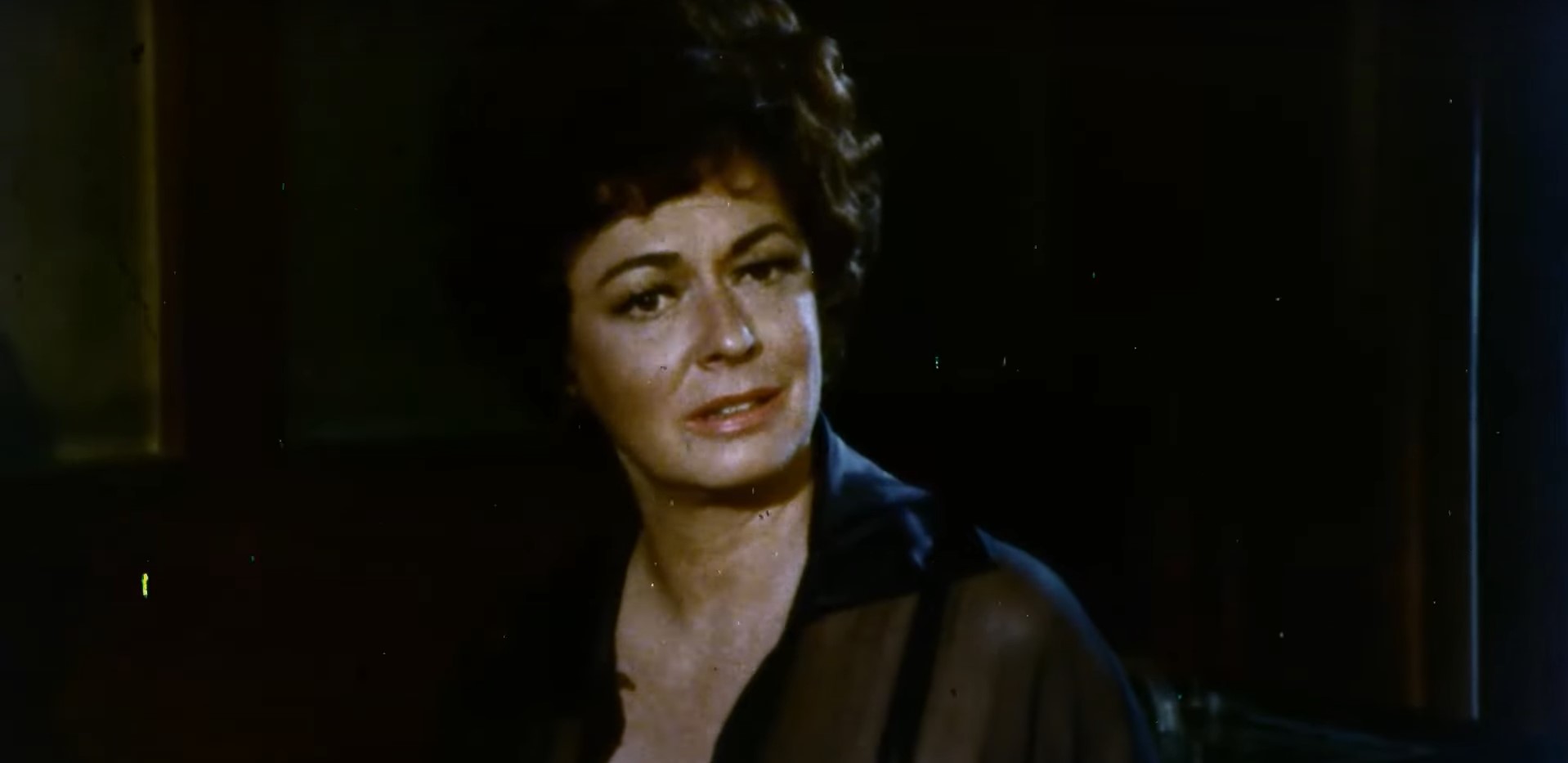
What most don’t realize about William Shatner, from their limited scope of him inside just “Star Trek,” is the man has range and can accomplish more complexity than just being confident space captain.  “Impulse” really drives Shatner to split hairs and be a polygonal persona, one that goes into deep anxiety at the sight of blood or extreme violence, one that can polished and suave in charm and romance, and one that can be ruthless and cunning.  All these traits fit into Shatner’s performance bubble of Matt Stone, chiseling each angle of the traumatized encoded individual into a wolf in sheep’s clothing in constant conflict with himself and those around him.  With the exception of Tina, those around Stone are targets as he swoons Anne Moy (Jennifer Bishop, “Horror of the Blood Monster”) and Julia Marstow (Ruth Roman, “The Baby”) of their money.  Anne and Julie feed into Stone’s false promises and hidden agendas and, as characters, Bishop and Marstow play their diverse friendship with traditional flare that can be easily duped by a stranger from off the street and barely know.  Tina is the only wildcard.  With the look like Heather O’Rourke and a prickly preteen attitude, Kim Nicholas falls in tune with the boy who cried wolf but, in this instance, as the girl who cried wolf as she becomes the aware adolescent privy to a fault to Stone’s dangerous side.  Agitated by the loss of her father and her mother’s effortless slip into a physical relationship, not to forget to mention her impish naughtiness, turns Tina into an incredible source, labeled spiteful, and angry at the world despite her true knowledge of her own world burning down around her with Matt Stone at the wheel.  “Impulse” rounds out the cast with James Dobson (“The Search for the Evil One”), Marcia Knight (“Stanley”), Shatner’s then wife Marcy Lafferty (“Kingdom of the Spiders”), and James Bond’s Odd-Job himself, the former heavy weight wrestler Harold Sakata as the ex-partner Karate Pete crashing Stone’s scam.

William Grefé steers childhood trauma to be the root cause that shapes Matt Stone into a cold and calculating killer.  While not driven to be a rabid dog seeking to kill on sight, the sweet and innocent child only protecting his mother from the potentially rapist hand of a drunken brute had not only been scarred by the incident but also incited his mother to institutionally commit him as if assigning him blameful wrongdoing, extenuating his reality into a woman hating deviant.  And the worst part of it is, and the part that Grefé is able to define and make Stone be sympathetic to audiences, is Stone knows he shouldn’t have been deinstitutionalized, as he more than once referred to his situation as a puppy left out in the middle of the street.  Then, does “Impulse” become more of a tragedy for our principal villain as an unfortunate byproduct of a catastrophic situation, an ill fit mother, and a system that have all let him spiral down to this point in the story?  The only individual to see through his ruse, in fact, is another child, Tina, with a child’s sixth sense in their melting pot of developing emotions.  The social niceties and grown-up cognitive reasoning shield Anne Moy, Julia Marstow, and others, and even to an extent the unscrupulous brute Karate Pete, from Stone’s devious nature and his will to survive at any cost, no matter who he has to kill whether be a lover, former partner, or a little girl. 

The new Grindhouse Releasing, the first through the distribution firm MVD, is a 2-disc Blu-ray release restored from a rare archived, 35mm film elements.  The original negative was unfortunately destroyed and the restored, 4K scanned print comes with a prologue disclaimer that some elements may not be up to quality standards.  However, the print, on the March 12th Blu-ray release now available for pre-order, looks stellar, stored on an AVC encoded, 1080p High-Definition, BD50, and presented in a widescreen 1.85:1 aspect ratio, with only a few noticeable scratches, faint to the eye, in a few brief frames within the natural grain.  Grading can appear monochromatic gray in some exterior scenes but the overall grading pops and are distinct in natural-looking shading. We can also look at Grefé’s direction and Edmund Gibson’s cinematography as just as striking as the picture quality with brazen, worth-while shots that include an interior car shot aimed toward the windshield heading toward a watery grave. The English language original mono track, for a single channel output, clears the bar with room to spare with intelligible, comprehensive dialogue, capturing every word and sentence distinct and syllabized to great detail without too much interference, technically and from layering. Slight popping and background electronic interference never engulfs or take the reins over the layers. Decent spacing and a good range, supported by the Lewis Perles lingering unhinged musical composition, adds value to Shatner and the casts’ performances. Grindhouse Releasing Blu-ray also comes with the original mono French soundtrack. English subtitles are optionally available. Loaded with special features with a William Grefé audio commentary, Shatner Between the Treks a Ballyhoo produced documentary regarding Shatner’s various projects before, after, and in-between, Kingdom of the Shatner is a William Shatner live interview in Santa Monica in Oct. ’22 after a Shatner triple feature, Shatner promo shorts, William Grefé shorts “Thumbs,” “Iceman,” “The Cask of Amontillado,” and “Underwood,” a making-of “Impulse,” the 40th anniversary screening at the Tampa Theater with William Grefé post-film discussion, the raw footage of Shatner saving Harold Sakata from accidental lynching with two commentaries from Grefé and Shatner, still gallery, two theatrical trailers, and other trailers from Grindhouse Releasing titles. Also included are bonus Grefé features, including “The Devil’s Sisters that has its own special features with an introduction, Grefé audio commentary, radio spot, still gallery, and a revisiting of the film from the director, plus “The Godmothers” with only an intro by Grefé. Grindhouse Releasing’s “Impulse” is truly a lovefest of the two Bills, Grefé and Shatner, and the label really goes the extra mile with a deluxe edition and restored release with a character and title embossed, fully colorized, and rigid cardboard sleeve with a clear, dual disc push lock Amaray Blu-ray case sporting the originally illustrated, composition cover art that’s also reversible with the same sleave cover design that’s utter madness on printed cardboard. Inside, the discs are locked in on the right, one on top of the other with the top disc snuggly in behind the feature disc in a vertical layout, and both disc arts are rendered with pulpy aesthetics and primary colored, yet darkened feature stills for full fear effect. Opposite in the insert section, a 4×6 illustrated liner portrait of Matt Stone painted by artist Dave Lebow, and a 6-page linear note booklet with color pictures, grindhouse posters, and an essay by Jacques Boyreau. The 87-minute Blu-ray comes region free and is not rated.

Last Rites: The tale of two Bills, Shatner and Grefé, is a match made in heaven, or, better yet, a match made in demented evil with “Impulse” and Grindhouse Releasing stuns with a fully loaded, supersized, and Shatner-stuffed 2-Disc release that puts the film rightfully up on a grandstand pedestal.

Pre-Order “Impulse” Here at Amazon!

Woman Vs Shark! “In The Deep” news!

Scene from "Jaws:  The Revenge"

Scene from “Jaws: The Revenge”

Any Shark related news is good news for me, being a shark enthusiast. Today, the news across that a new shark film, entitled “In The Deep,” spec script was bought by Sony Pictures. The script, described as “Jaws” meets “127 Hours,” revolves around a young female surfer, 60 feet from a remote beach shore, being stalked by a Great White shark from below.

Woman versus Nature and I’m lovin’ it (as McDonalds would say). “In The Deep” sounds intense and thrilling and with a shark being involved the film already has a soft spot in my heart!

Stay with us to learn more about this development.

More “31” Production Art!

From what I’m seeing from these production art release, I’m getting more and more interested in seeing what this new Rob Zombie film has in store. A new production art was released and it’s more clowns and more scantily clad women. I’m not complaining!

31-fanart

The synopsis of “31” involves five random people being kidnapped five days before Halloween and held hostage in a place called Murder World – a man-made hell of a structure where survival is the key as anything goes including, you guessed it, murder. The “contestants” have 12 hours to survive, from what I can tell by the concept art, clown masked clad killers and if the hostages survive, they’ll earn their freedom.