Demonic Nuns Want Virgins to Resurrect EVIL! “The Convent” reviewed! (Synapse Films / 4K UHD and Standard Blu-ray)

4K and Blu-ray “The Convent” Demonically Entering Your Soul! Buy It Here!

A woman strides into a convent carrier a can of gasoline and a shotgun during the sacrament of Eucharist between priest and nuns.  After setting the humble nave ablaze, she unloads shotgun shells into all the screaming bodies.  40 years later, a group of Greek life college students look to make their Greek letter mark on the same derelict convent now swarming with urban legends and ghost stories.  When a virginal student is kidnapped by wannabe Satan worshippers, they accidentally open the gate for dormant demons to arise through the corporeal vessels of the dead.  The possessed dead slaughter all in their way to seek another virgin, one that will embody their unholy master until this plane of existence.  The only chance for survival is to track that now woman from four decades ago to finish what she started after 30 years in an insane asylum, to blow away the demonic beasts of Hell!
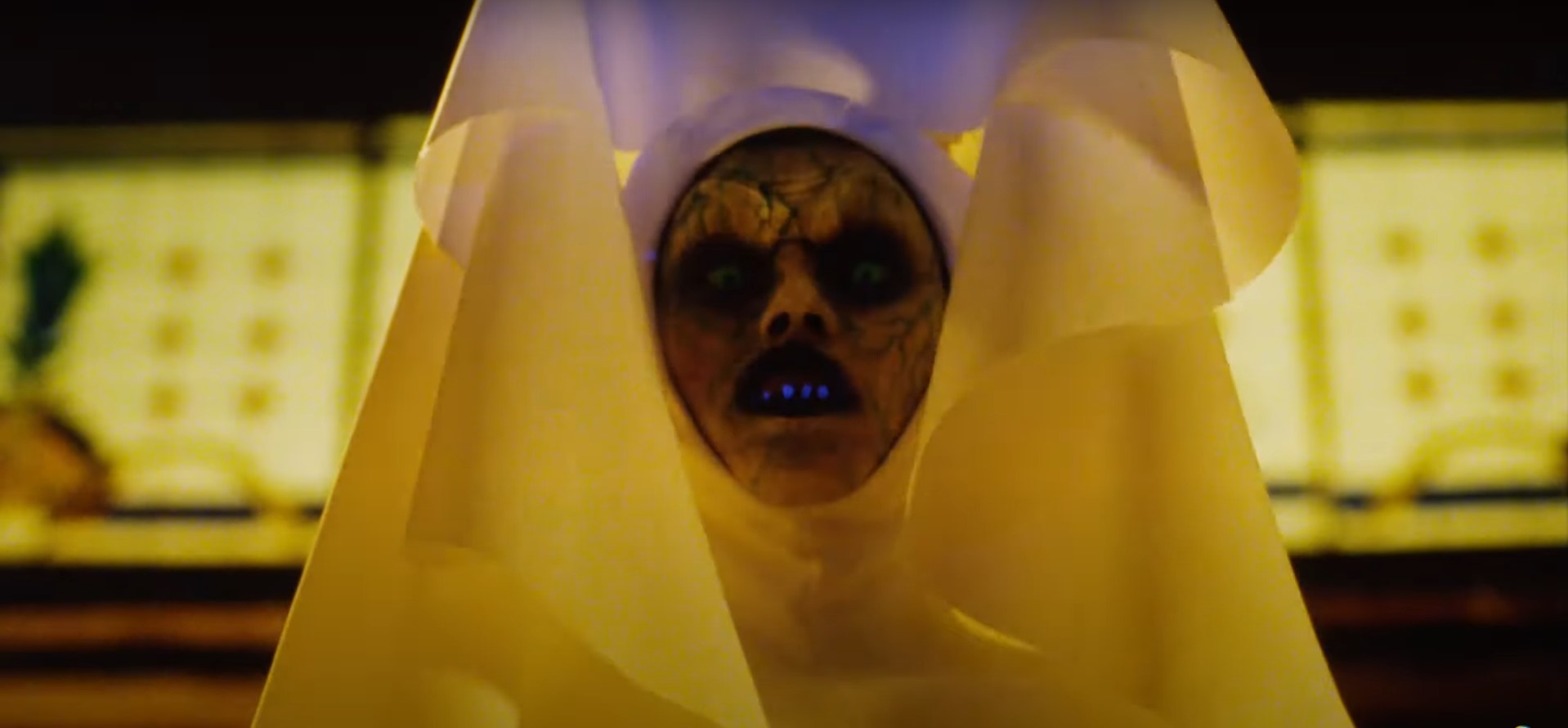
At the turn of the century in the year of Lord of 2000, a year some Christians believed marked the 2,000th anniversary of the incarnation of Jesus Christ, saw another reincarnation of Hell passing through Catholic sacred ground from the creative culinary of profanity director Mike Mendez.  The one of a handful of creative talents behind the “Satanic Hispanics” anthology film and the native Los Angeleno helmed “The Convent,” his third directorial in horror behind breakout pyscho-hit “Killers” and the male-chauvinist be damned horror-comedy “Bimbo Movie Bash,” from the Chaton Anderson’s debut script full of sacrilegious imagery, glow-in-the-dark veined demons, and the dark comedic charm of early 2000s.  Shot entirely in Los Angeles, the demon-comedy is produced by Anderson and Jed Nolan (“Jurassic Women”) on a microbudget from executive producers Ryan and Roland Carroll of Alpine Pictures (“Dark Honeymoon”), Elliot Metz, and Rene Torres, who served as associate producer on the cult favorite, “Night of the Demons.” 

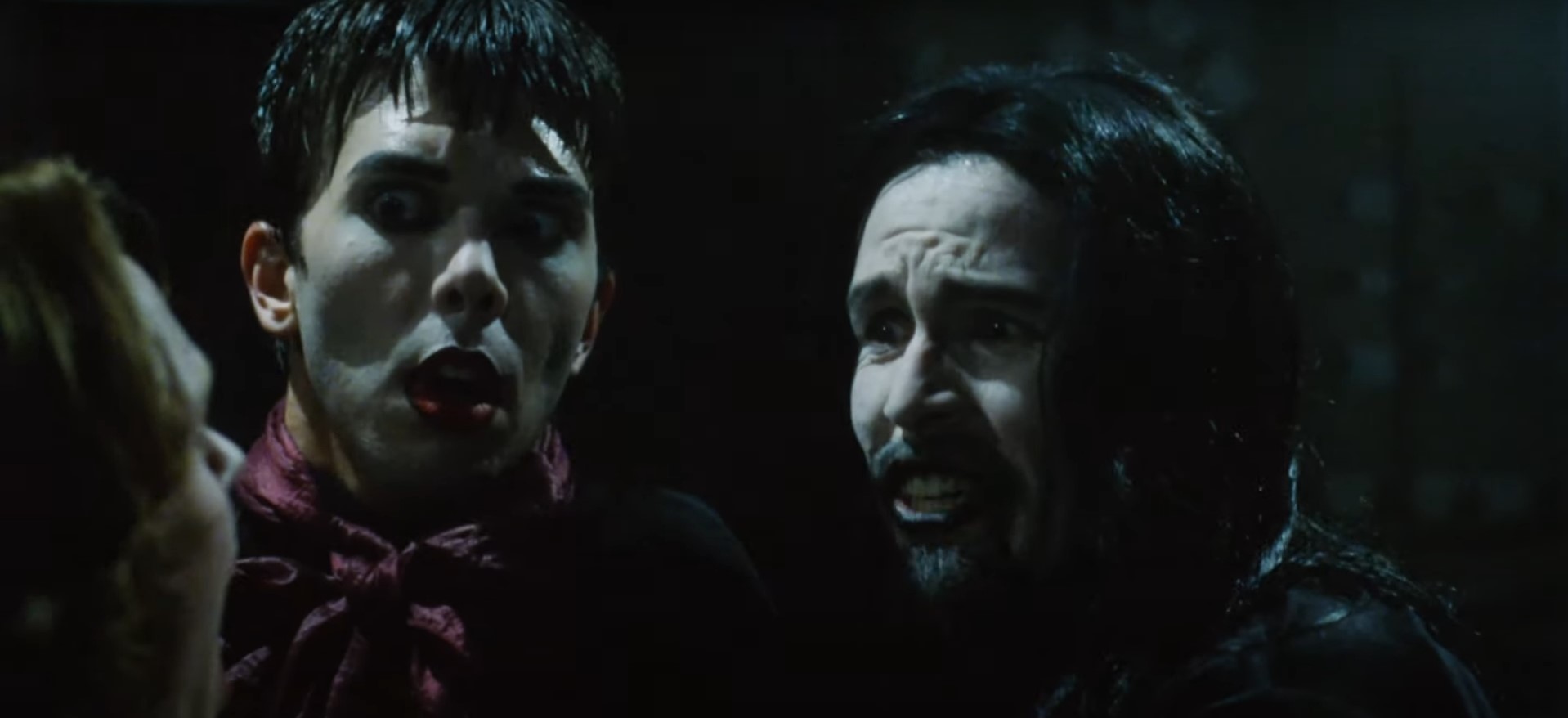
The collegiate characters are not only surrounded by twitching, carnage-dishing demons under the nuns’ habits but they’re also surrounded by headlining genre greats Adrienne Barbeau (“The Fog,” “Swamp Thing”) and, briefly, Bill Moseley (“The Devil’s Rejects,” “Texas Chainsaw Massacre II”) and gangster rapper, the late Coolio.  Barbeau doesn’t lose a step being the beautiful badass we all know and love from her reign as an 80s-90s scream queen, shotgun barreling down demons left and right as her character’s 40-years-senior self from the Nun-torching and blasting opener, the accused certifiable crazy lady called to action in Christine.  She’s called to once again stop a demonic Catholic kerfuffle she immobilized from spreading four decades back by a new set of naïve, older teenagers looking to get high, get lucky, and get the kicks.  Joanna Canton, who had three seasons in her on “That 70’s Show,” battles back-to-back with Adrienne Barbeau as Clorissa, the lead principal of the trespassing teens.  Canton is joined by story boyfriend Chad (Dax Miller, “Blood Surf”), story friends Biff (Jim Golden), Kaitlin (Renée Graham, “Shriek If You Know What I Did Last Friday the Thirteenth”) and Frijole (Richard Trapp, “Re-Cut”), story little brother and abuse-taking pledger Brant (Liam Kyle Sullivan, “Rideshare”), and story gothic bestie of another life time in Mo (Megahn Perry, “The Perfect Host”) whose been ostracized by mostly Clorissa’s friends and even a little by Clorissa trying to escape a gothic lifestyle for more fit in “normal.”  A dark and spooky night in a rundown convent transforms into a night of terror when Satan Worshippers Sapphira (writer Chaton Anderson, “Wither”), Davina (Allison Dunbar, “Browse”), and Dickie-Boy (“Kelly Mantle, “The Evil Within”) are led by so-called Satanist expert and a poorly 17th century speech replicator Saul (David Gunn, “Killers”).  “The Convent” does have dynamic trope characters, ranging from jock, to druggie, to cheerleader, to goth, and to the nerd, following formulaic footsteps to face forces of ferocious, fanged demons and doing it oh not so well and oh so gloriously bloody.  Casting rounds out with Oakley Stevenson, Larrs Jackson, and Elle Alexander.

Mendez’s “The Convent” has a real identity crisis issue walking in the familiar territory that closely resembles Kevin Tenney’s “Night of the Demons.”  Hell, I would go as far as stating Mendez’s Y2K-personified horror is a near step-by-step remake of Tenney’s 1988 demon possession carnage in an abandoned structure film.  However, minutia differences, a fall of Catholicism theme, and the addition of a motorcycling, demon-destroying Adriene Barbeau keep similarity nuances at bay and the acquainted plot lively and entertaining with a glow-party, nightclub maquillage on the demons to give them a fascia of techno-effervescence veins.  Mendez also adjusts the demons’ movements to a rapid twitch with increased frames per second and having the actors jerk their movements in a wild array.  Seems a little bizarre at first but the effect grows on you, and you can’t imagine “The Convent” demon without the spasmatic shots, as their glowing eyes set on seek-and-destroy roam from dilapidated hallway to dilapidated hallway, succumbing to the evil spirit’s will after the life force leaves the body.  Themes of an evil Catholic perspective will challenge those with a Christian value upbringing, especially with nuns and priests being gunned down and torched, and more character specific concepts of personal growth in deciding what’s right versus what’s popular run a paced course of dispersed too late to fix what’s already broken. 
As part of the Mike Mendez 4K UHD double bill release from Synapse that includes his individual inaugural film “Killers,” which we will review soon too, “The Convent” comes in a 2-disc, dual format set, making it’s uncensored, U.S. debut remastered in Dolby Vision 4K from the original 35mm internegative elements.  HEVC encoded, 2160p ultra-high definition, BD66 and the AVC encoded, 1080p, BD50 rockets the previously out of print film right past a standard Blu-ray release and into the land of 4K with 2k hitching a ride.  Both formats presented in a widescreen 1.78:1 aspect ratio, the definition and color saturation advancement are a huge leap from previous DVD releases with more delineate means inside a broadly shadowed interior.  Light and shadow have now divided fully and agreeably to shapes are now more obscured or in illumination.  With that being said, details are not knocked out of this part and that’s especially surprising since director Mike Mendez supervised the 4K remastering.  Facial features do appear smoothed out, more so on the standard Blu-ray release.  UHD has a slightly better rooting out skin details and customer texturing which Adrienne Barbeau leather jacket and tight denim jeans, with all the folds, zippers, buckles, and such, seeing the most promise.  The superimposed glow f/x has rich lamination with the emanating pulses creating reflection being done well on character faces and throughout an enclosed room.  The UHD and standard Blu-ray come with an English DTS-HD master audio 5.1 surround sound from the original 16-track master audio.  Uncompressed fidelity is a complete win here for “The Convent” that seizes side and back channels with monstrous grunts and growls, and not to forget to mention the often-neglected spooky house ambience of creaks, cracks, and killer hits to the body.  A broad range helps diffuse distinct layers to the individual channels.  Dialogue renders clean and clear with no pitchiness of hissing or crackling to note.  English subtitles are available on both formats. While the UHD only has eyes for the feature, the Blu-ray has the movie plus Hell-Raising bonus content, including two audio commentaries with a cast and crew commentary with director Mike Mendez, Megahn Perry, and Liam Kyle Sullivan and a Lords of Hell commentary featuring David Gunn and Kelly Mantle in full character of Saul and Dickie-Boy, a behind-the-scenes featurette, a location featurette, a single deleted scene, gore/kill scene outtakes, the original EPK (Electronic Press Kit), a pair of promotional trailers, and a still gallery. The new primary cover art and the reverse cover art inside the black Amaray case is illustrated by Ralf Krause and Samhain1992. A 6-page essay from Corey Danna has cropped color pictures along with release acknowledgements on the backside. The not rated film has a 80-minute runtime and is region free.

Last Rites: Never intended to take itself seriously, “The Convent” has wicked style, makeup, and effects under an early 2000’s feng shui and is balls-to-the-wall nonstop with demonically dark humor laughs and the barbaric blasphemy of a savagely railed faith!
4K and Blu-ray “The Convent” Demonically Entering Your Soul! Buy It Here!

EVIL Says Talk to the Hand. “Talk to Me” reviewed! (Lionsgate / Blu-ray)

“Talk to Me” on Blu-ray/DVD/Digital!

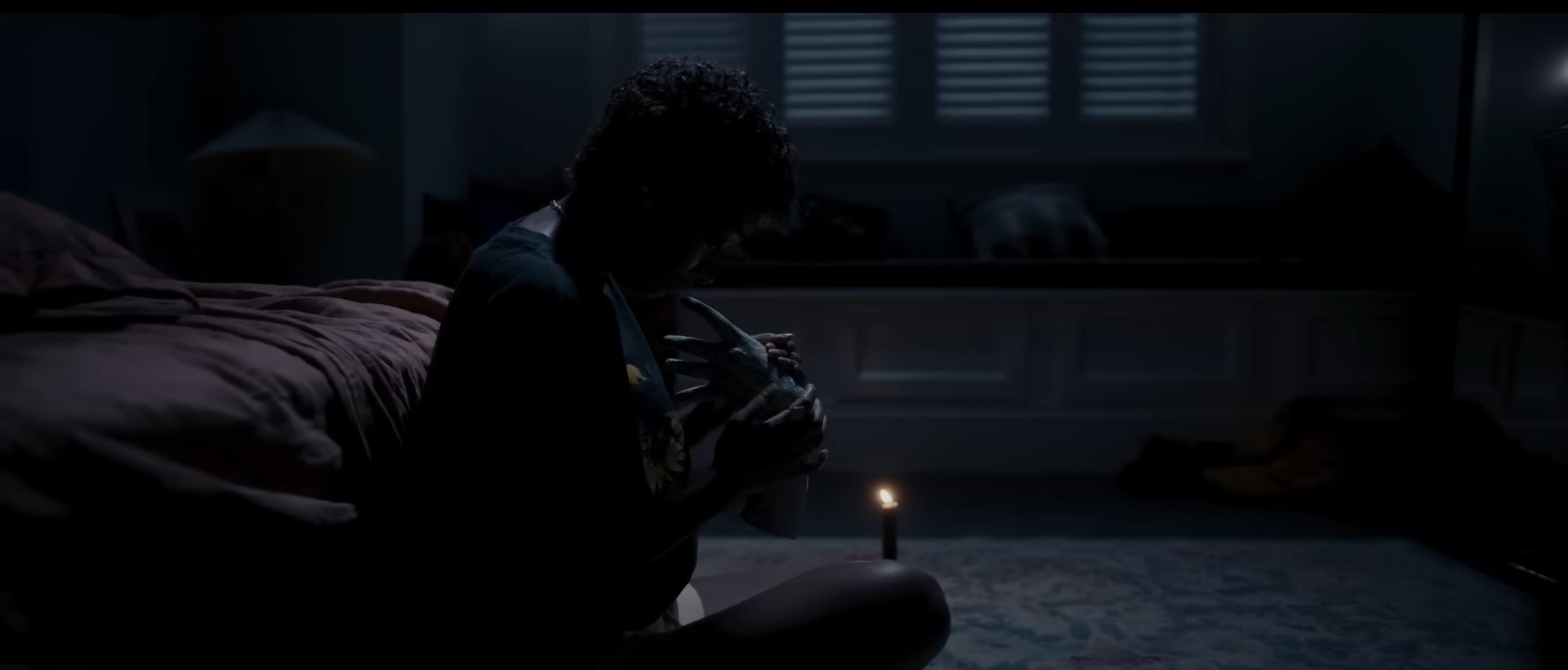
The two-year anniversary of the death is a solemn time for Mia to mourn the hard loss of her beloved mother who took her own life, or at least that is what her father tells her.  Feeling uneasy by her father’s account that circulates doubt uncontrollably, Mia pries her way into her best friend Jade’s family for comfort and becomes equally amiably with Jade’s younger brother, Riley, as like another sister.  When social acquaintances post viral videos of peers supposedly being possessed by an embalmed hand of a psychic for party games, Mia is eager to participate.  All is fun and games with the dead inhabiting and speaking through the hand holder for a limited time until Riley’s spirt takes a violent turn, leaving the boy severely injured and in a comatose state after exhibiting Mia’s mother possessing him.  Obsessed to speak again with late mother, Mia uses the hand to talk to the dead and learns Riley’s soul is stuck on the other side and being tortured by the countless, malign spirits. 

Grief can be so powerfully self-destructive that holding an embalmed hand, becoming connected with the grotesque spirit, and letting the shadow world possess you can be addictive and even as far as a parlor game to pursue answers or a desperate release from suffering.  The 2022, breakout Australian production “Talk to Me” explores that forced hand of grief, literally, with a socially pressuring aspect that can be contagiously engrossing and collaterally harmful if unchecked.  The Southern Australian-born brothers Danny and Michael Philippou come out swinging on their debut feature-length film penned by Danny alongside Bill Hinzman based on a concept by “Bluey” executive producer of all people, Daley Pearson.  “Talk to Me” is a coproduction between The South Australian Corporation, Screen Australia, Head Gear Films, and Causeway Films with Christopher Seeto (“The Flood”), Samantha Jennings (“Cargo”), and Kristina Ceyton (“The Babadook”) producing.  The film is released theatrically by A24.

“Talk to Me” opening with a young, shoulder length haired man desperately searching for his younger brother through a sea of people at a house party.  The scene sets the film’s take-no-prisoners tone with begins with compassion as the older brother comes to the rescue of his disturbed, shirtless kin, trying to display the flashlight gleaming phone camera sharks who smell viral video blood in the water, when in a surprising turn of events the younger brother stabs his sibling before ramming the chef knife into his own skull.  “Talk to Me” segues into the cast of teenage characters, spanning the age spectrum of 14 to 20, letting us know right off the bat that youths are on the chopping block and no one will be safe.  The mostly untried cast pulls through with a trypanosome performance that gets under your skin, festering in its linger.  Sophie Wilde helms being the principal lead Mia still shell shocked by the sudden death of her twinning mother two years after later.  Suspicious of her father’s role in the death, Mia escapes and integrates herself into best friend Jade’s family, a role resting in between two uncomfortable rocks of being the new girl beside Mia’s onetime ex.  Alexandra Jensen as Jade floats carefully portraying Mia’s friend and a pursuant tiptoe toward the relationship with Daniel (Otis Dhanji) that passively irks Mia in the form of playful jokes, side glares, and inner demons becoming fruition ones expressing desires.  Sophie Wilde, on the other hand, spans the gamut with a flip of a switch soul spectrum polarized by spirit madness, grief over loss, and a fallback friendship.  When Wilde turns on the darkest light of possession, when her character lets the spirit into her body, the disheveled whole of Mia lives up to the actress’s surname becoming an uninhibited periapt for the spirit within that lusts over the youngest in the room, Riley (Joe Bird), for his childlike purity and when the spirits have control of over his soul in what is an orgasmic suffering that neither is parlous fun or exciting.  “Talk to Me’s” cast rounds out with Zoe Terakes, Chris Alosio, Marcus Johnson, Alexandria Steffensen, Ari McCarthy, and “Homeland’s” Miranda Otto. 

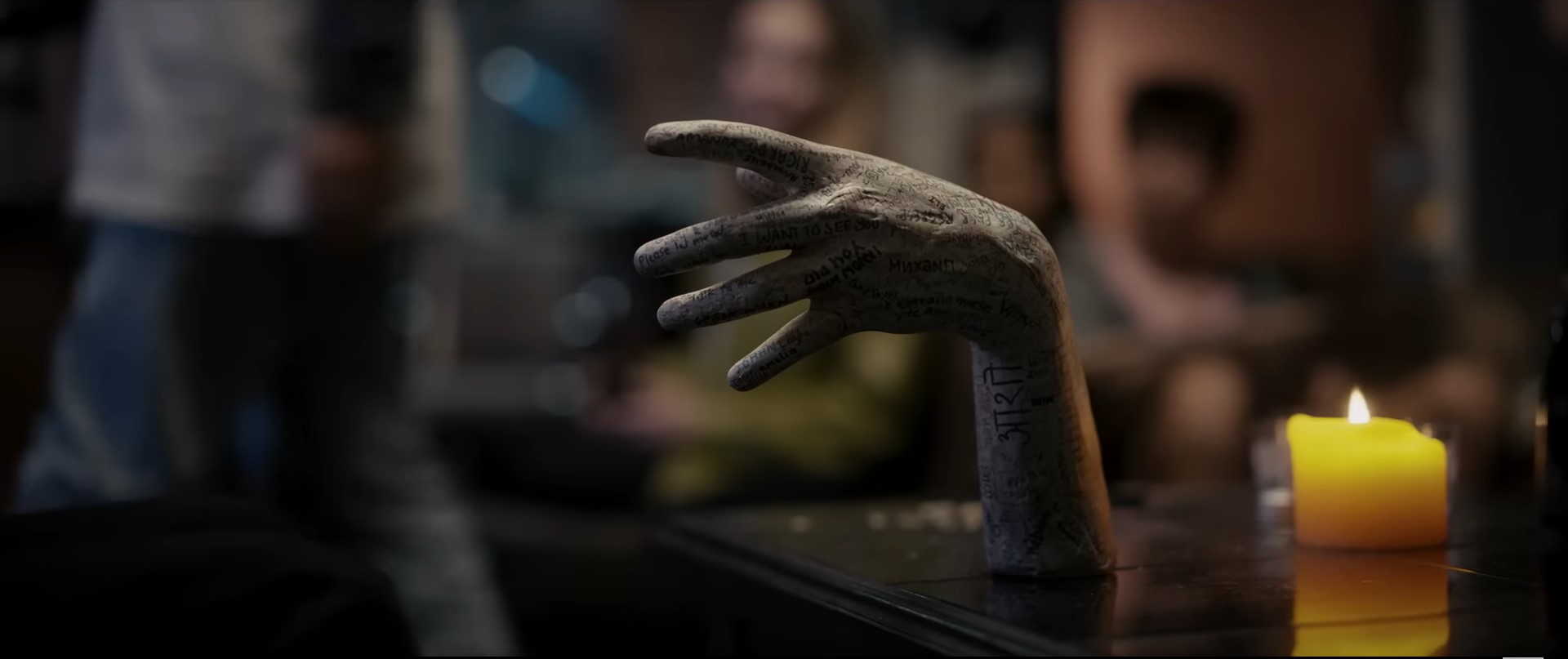
“Talk to Me” is an original byproduct stemmed from the cursed fetish genre.  The inexplicable mummified hand with unknown origins, thought to be once the hand of a medium, falls into the hands of a difference kind of representation.  Not to be bestowed conventional tropes like an inanimate object to be feared, the mirror in “Oculus” comes to mind or the cenobite unleashing puzzle box of “Hellraiser,” the persevered curled open hand doesn’t hold that sort of malevolent power, at first.  Despite its powerful connection to the purgatorial other side with frightening results of classic possession cases – levitation, catatonia, dissociative profanity and behavior, etc. –  these more-or-less new generational children treat something they don’t completely understand, such as ancient, mystical artifacts and in this case, human remains to be exact, without respect and humility, using the hand as if an additive drug, parlor game, or write to go viral amongst peers.  Directors Danny and Michael Philippou use the peer-pressuring viral video social commentary of their film as a sensationalized stern warning that has equal cause-and-effect results.  Ostentatiously showcasing more of the adolescent revelry spree rather than the mangled, decaying, and water-bloated entities in front of them or recklessly inhabiting their bodies once let corporeally inside.  For someone like the character Mia who continues to process close loss and has troubling thoughts, or maybe even delusions, regarding her father’s role in her mother’s untimely demise, she yearns for answers and when Mia receives a glimpse into what she believes is her kindred spirit mother through the vessel that is her friend Riely, aching impulses take over already crumbling judgements and she goes down the rabbit hole despite the consequences to herself, to her father, and to her adopted family.

Get a grip and take “Talk to Me’s” hand to experience the possessively powerful Philippou brothers’ debut film on a Lionsgate 2-disc Blu-ray/DVD/Digital release.  The AVC encoded, 1080p high-definition, BD50 and the MPEG-2 encoded, upscaled standard definition, DVD are presented in a 2.39:1 widescreen aspect ratio.  What’s achieved out of the Aaron McLisky’s through-the-looking-glass visual vignette is focus driven, claustrophobic, and engaging to be present of a reality teetering the line between two worlds.  Details inarguably shine, casting a great deal of deep shadows within the hard lighting to set the ominous tone.  Skin textures gleam within the light as well as coarse change with the vapid and pale makeup adjustments of the dead-entered body or even when we do brief see a condemned soul, the greatly applied contusions, decay, or bloating is reflected with great care from the infinite image detail.  The release has an English Dolby Atomos output reaching the difficult crevices of the inaudible dark holes and exposing them to immense carousal and haunting zeal that makes the experience more palpable. Dialogue renders nicely through albeit a heavy-handed score that relentlessly attempts to knock down the channel-leveled door and a strong Australian accent on most of the cast may sway those who don’t have a keen and distinct diverse ear away from the film or may find discerning a challenge to channel from beginning-to-end. While most of the camera’s frame stays in medium closeup to closeup, McLisky’s able to find depth where advantageous to bring a creep building dark cloud after Mia’s one minute over willing but felt forced possession participation. English SDH and Spanish subtitles are optionally available. Special features include an audio commentary with brothers Philippou, a featurette with the cast and crew in their experience and thoughts on the film, entitled In the Grip of Terror, deleted scenes, and theatrical trailer. Behind a rigid O-slipcover imaged with the centerpiece un-ensepulchered, plaster anoint, and sanskrit-esque-ladened hand upright and in the forefront with phone flashlights dully lit in the background. The typical Blu-ray snapper houses the same slipcover image slipped in between the plastic sheeting whilst the two discs are held on snapper locks on each side of the interior accompanied by an insert for the digital download. Both discs are pressed with the same font and coloring on in reverse with a baby blue stark against white. The 95-minute minute feature is region A locked and is rated R for strong bloody violence, some sexual material, and language. “Talk to Me” is utterly and terrifyingly fresh and freakish in more so with the naturality toward the touching and the facetious ways with an embalmed hand that’s a one-way personal radio to the dead as a means to be engaged in popular, peer-pressuring social activity and as something to prove with reckless naivety.

“Talk to Me” on Blu-ray/DVD/Digital!

This 600 Horsepower Outboard Propeller Runs on EVIL! “Motorboat” reviewed! (SRS Cinema / DVD)

As Chief Brody Always Said, This Isn’t a Boat Accident!  “Motorboat” on DVD today!

Messiah Ward and his cult of followers once plagued the surrounding Lake Jude for years, conjuring black magic and death in order to appease their netherworld lord.  Ward’s evil is only matched by the goodness of a man of the cloth, but the pious risktaker is no ordinary priest but Messiah Ward’s very own brother, Father Thomas.  Taking matters into his own had to save the souls of his community, Father Thomas mercilessly guns down Messiah Ward and his acolytes, ending his reign of terror…or so he thought.  Two years later, a black and powerful phantom speedboat appears on the lake, killing those who dare enter its waters.  With the help of the local lake patrol officer Barney Rayl investigating the homicides, Father Thomas must serve as the wrath of God once again to stop his brotherly possessed motorboat from hacking up any more innocent swimmers and fishers with its deadly outboard propeller. 

I’ve seen my share of possessed combustible engine films with cars, trucks, and even a killer bulldozer.  Hell, I’ve even seen a rubber tire on a rampage.  Yet, I’ve never seen a killer boat movie until today and the Polonias are responsible for the slaughter on the seas with their latest indie schlocker, “Motorboat.”  The “Splatter Farm” and “Hellspawn” director Mark Polonia and his son Anthony team up for their fifth rudimentary, lowbrow lunge at hyper-micro budget horror, crowdfunded on Indiegogo for around $5,000, and shot in the fall of October ‘22 in and around Tioga county, such as one location being Hills Creek State Park Lake to be one of three locations in creating a larger lake setting.  “Motorboat” is created by Polonia Brothers Entertainment, executively produced by SRS Cinema’s Ron Bonk, through Indiegogo, and John Dagostino with Mark Polonia producing, and Elliott Monroe (“Evil Bong 666”) and Previn Wong (“Yule Log”) set as associate producers. 

Like many of the Polonia Brothers Entertainment, a cast of regulars return to indulge in the tightknit production family and to give their all in providing their best performances to make micro budgets like “Motorboat” come to filmic fruition.  In the roles of Priest and Harbor Patrolman are Tim Hatch (“Shark Encounters of the Third Kind”) and Jeff Kirkendall (“Sharkula”) who have once again found themselves working side-by-side on a Mark Polonia production.  Cemented more into exposition than action, Hatch and Kirkendall essentially get the job done with their extensive rapport and long history working together but as developing their characters, a Priest and a Harbor Patrolman could have well been a Lake Fisherman and  Pizza Delivery Man as the professions are laid waste to the script’s lesser defining ideals that are more clearly evident, such as a demon possessed motor boat offing people on and off shore.  Also, Hatch and Kirkendall, as well as much of “Motorboat’s” cast, aren’t very expressive, use little gesturing, and corner themselves with monotone deliveries, taking what should be shocking scenes or jump into actions with little reactionary energy and intensity.  That fairly sums up “Motoboat’s” cast as Messiah Ward is more like the 1958 Plymouth Fury in “Christine,” a motorized machine on a killing spree, with Michael Korotitsch briefly playing the character under a black or rubber mask during his corporeal scenes.  The remaining cast are essentially the racked up body count boat fodder with Polonia regulars Jamie Morgan (“House Shark”), Ken Van Sant (“Sharkenstein”), Dave Fife (“Doll Shark”), and Noyes J. Lawton (“Virus Shark”).

As you can obviously see by the cast’s previous film credits, which all involved Mark Polonia, the director has a healthy fascination with the predators of the ocean, augmenting and exploiting sharksploitation from a limitless thought-bubble of narrative concepts.  Surprisingly, “Motorboat” does not contain one single dorsal fin or rows of razor-sharp visual effects teeth.  Polonia may have deviated from sharksploitation but never got out of the water by keeping the tide still infused with blood.  Post-production blood effects, rain, and layered energy spirals are not the most skillfully composited integration but what Polonia always strives for is to make an entertaining film, to keep the viewers engaged, and could only hope that the his microbudget efforted effects, such as using a 1/16 scale RC boat as the Messiah Ward’s ship of slaughter, afforded him enough production value to eke by but how Mark Polonia, and I’m sure son Anthony also, very masterfully retains engagement for his microbudget movies is to not linger on a shot that can make the scene stale or monotonous.  Granted, you may roll your eyes on lower shelf quality, but you’ll still find yourself connected to the screen as cuts are made for different camera angles, such as over-the-shoulder, behind-the-back, master shots, closeups, mediums, there’s never a single take for a long period of time to avoid idle eyes and unstimulated neuron firings.  The story itself cruises along as combination of films like “The Devil’s Rain” and “The Car” leaving a fair amount of demonic or possessed destruction in its wake but can be trying at times piecing together the whole story behind Messiah Ward’s purpose and transition into either a speedboat or a demon driving a speedboat, an unclear specific of the antagonistic character, and this undercuts Father Thomas and Harbor Patrol Rayl endgame goal because we’re not exactly sure who or what they’re up against.  An innuendo term like “Motorboat” suggests lighter, more in a foreplay of intentions, but SRS Cinema and Mark Polonia are abreast in another way to turn the tide toward something far more terrifying on the waters!

The one thing you can always count on Ron Bonk and SRS Cinema to pull off are immaculately enticing cover arts to catch one’s eye and that is what we have here with “Motorboat” on DVD home video.  The 16×9 widescreen presented film is a MPEG-2 encoded DVD5 shot digitally with an overall clean finish. However, compressions issues do appear with minor jittery picture noise and minor banding with skin tones ungraded and appearing sometimes orange in the shot. Thrifty visual effects are you get what you pay for but doesn’t necessarily affect the watch if going in, understanding, and if a fan of the Mark Polonia fast and dirty chugalug of filmmaking. An English stereo 2.0 is wangled by the built-in camera mic that more than most the time doesn’t have too many issues with playback aside the varying and inconsistent dialogue levels despite being in the same scene as well as unable to filter an overwhelming lakeside ambiance. Post ADR was used to overlay a couple of scene dialogue tracks due to the crashing, wind-driven waves of lakeside conversing. As a whole, dialogue sums up pretty clear without serious hurdles. The two-channel speaker relays a punchy boat-toot audio byte that sounds like a Mac truck blaring its horn whenever Messiah Ward the “Motorboat” is cruising the waters and killing the people. There were no English subtitles available. Extras include an audio commentary track with director Mark Polonia who half the time soapboxes his trials and tribulations as well as champions micro-indie filmmaking while also diving shallowly into “Motorboat’s” background waters. The official trailer and other SRS trailers are also present. I’m always impressed with SRS Cinema front cover artwork as it’s very appealing, alluring, and is sometimes not truly accurate and for “Motorboat,” we have a half-submerged woman in distressed and reaching out for help in the foreground as a minacious boat barrel toward her from behind. Not insert inside and the DVD art is the same front cover image but cropped to just show the woman’s frightened, eyeshadow-streaked face. Region free with a rum-runner runtime of 75 minutes, SRS Cinema’s DVD comes unrated. “Motorboat” is pure Mark Polonia and if you’re expecting high-caliber horror, you’re going to need more than a life preserver to survive these chopping waters.

As Chief Brody Always Said, This Isn’t a Boat Accident!  “Motorboat” on DVD today!

Night Terrors Are Not EVIL Enough. “While We Sleep” reviewed! (VMI Releasing/ DVD)

“While We Sleep” available on DVD home video at Amazon.com!

Neurologist Nina Evanko is perplexed by the unusual CAT scans of 13-year-old Cora whose been suffering from sudden onset sleepwalking after her birthday party.  Believing the CAT scan is going through calibration issue with imaging process, Nina orders another set of scans, but when the scans produce the same result and a death of another patient right in front of Cora sends her home early before Nina’s arrival to study the results, Nina convinces Cora’s parents to an at-home sleep observation to root Cora’s sleepwalking cause.  What Nina finds is far more sinister than night terrors or any other kind of parasomnia as a demon has inhabited Cora’s body with nefarious intentions.  Cora’s only hope to save her soul is her bewildered parents, a rattled neurologist, and a rogue priest but a family secret may consume everything. 

If you’re still looking to support Ukraine during the now 6 plus months Russia invasion of their sovereign neighbor, why not support the Ukrainian-U.S. collaborative cinema?  Why not start more precisely with Andrzej Sekula’s 2021 child-possession thriller “While We Sleep” set in the Ukrainian capital and flagship city of Kiev.  Sekula, known more for his work with Quentin Tarantino as a cinematographer on “Reservoir Dogs” and “Pulp Fiction” as well as “American Psycho” and “Hackers,” has quietly and seldomly helmed a handful of films over the two decades with “Cube 2:  Hyperspace” being one of them.  “While We Sleep” returns Sekula to the director’s chair for the first time since 2006 with a script by Rich Bonat and the film’s supporting costar Brian Gross, the first feature script penned by the “Jack Frost 2:  Revenge of the Mutant Killer Snowman” and remake of “2001 Maniacs” actor.  “While We Sleep” is coproduced by American Brian Gross and Kiev-Los Angeles based CinemAday productions, which include company bigwigs Rich Ronat, Yuriy Karnovsky, and Yuriy Prylypko. 

While much of the story begins with Cora and her parents (real life family of husband Brian Gross, wife Jacy King, and daughter Lyra Irene Gross) cursed by Cora’s acute and disconcerting sleepwalking disorder and moody behavior, the daily battle to understand their predicament is not left in the out of their league but most lovable hands of the parents as the film leads you to believe.  Roughly half hour into the film, the narrative switches from the convincing family perspective, despite building background on their low-band relationship troubles and move it nearly 100% to Nina’s problem-solving perspective with a hint of her own troubled past.  Kiev born and “Stranger” actress Darya Tregubova plays the neurologist too curious to shrug off the mysterious case of Cora’s abnormal scans.  Tregubova is fetching without saying but she doesn’t provide the necessary emotional weight of person who’s going through grief and loss issues from the past.  Tregubova also doesn’t convey the necessary weight toward her strong connection to Cora and Cora’s case with only a few expositional moments that hint at such.  These aspects leave Nina outside the bubble of plot events that make the character stick out as unnecessary even more with the character’s negligent professionalism surrounding the wellbeing of Cora and with the parent interactions.  Once the story butts in randomly the blacklisted priest, Father Andrey (Oliver Trevena, “The Reckoning”), with an intimate familiarity with the demon that possess Cora, we know that the story is lost as it tries to quickly and covertly wrap its grip around how to come to a head with this storyline.  You can’t have a possession film without a priest, right?  Father Andrey feels very much like a leftover thought, but Trevena tries his darnedest to sell a washed-up man of the cloth with desperation pouring from word out his mouth despite looking like an English hooligan in a pop collared leather jacket. 

“While We Sleep” has not-so-brittle bones of demonism and possession albeit lacking its own or established cultural mythos, yet there’s a disjointed nature about the story structure and plot points that just don’t make sense that crumble that coherency faster than Cora descending into the depths of demonic disorder. The opening scene is the most perplexing of all with an elaborate birthday cake that neither mom nor dad had made or bought for Cora’s 13th year. Without a care in the world, mom and dad don’t explore further who could have possibly made such a beautiful cake and little do they know, the cake, or rather the cake’s candles, are a conduit for demonic transmission into the soul. This part is never explained through the rest of the picture and, in fact, Gross or Bonat don’t touch back upon a possibility of explaining the odious presence. Much of everything is taken a face value, such as the fact Cora cuts her long hair to a pixie style without an eyelash being bat or in what’s more crtical to the plot is with Cora’s real and darkly unholy father backstory. Those facts are a shot to the brain and we’re still not understanding where Cora’s biological father fits into Cora’s space, into her mother’s space, or even into Father Andrey’s space, but you would think as important as this twist was suddenly deluged in a quick spit of point-blank honesty, the edges would be smoothed over and the picture would become clear as the holy water that was cross was spritzed with; yet, that the aggregation of aggravation of little-to-no details continues to carry out as if everything is perfectly peachy and comprehendible within the story context.

From the at-home release distributor that delivered John Travolta as “The Fanatic,” VMI Releasing, a subsidiary of VMI WorldWide, releases “While We Sleep” on DVD home video. The clear snapper cased DVD, a MPEG-2 formatted DVD5, is presented in a widescreen 2.39:1 aspect ratio with an average speed bitrate of 4-5 Mbps. You can see noticeable banding issues in the darker bedroom scenes sporadically throughout. Aside from that, the picture result is fair with more than enough detail for viewing. The English-Ukranian soundtrack is not listed on the back cover, but my SEIKI player reads two audio options: a Dolby Digital 5.1 and a Dolby Digital dual channel 2.0. Discerning the difference between two is not worth the effort as there’s only subtleties in the output. The 5.1 surround sound has obvious better capacity for multi-channeling. Optional English subtitles are available but neither one of the audio tracks available nor the subtitles offer English captioning for the Ukranian dialogue and often times, there are back and forth exchanges that are intended to carry worth behind the exchange. The subtitles just state foreign language speaking which doesn’t help at all so there’s a bit of lost in translation in the dialogue unless you happen to speak or understand East Slavic languages. The 92-minute film comes unrated but doesn’t come with any bonus material as a feature only release. “While We Sleep” only nips at attempting to be a better than average “Exorcist” akin contemporary but remains on the haphazard course of shaky character building and bumpy, unpaved developments that make only for a rocky portrait of possession.

“While We Sleep” available on DVD home video at Amazon.com!


When Marriage Sours, EVIL From Within Manifests. “Possession” reviewed (Umbrella Entertainment / Blu-ray)

After his return from a lengthy time abroad, Mark finds himself in a contentious and spiteful relationship with his skittish wife Anna unveils her infidelity.  Unable to pry any kind of information from her before her sudden disappearance, Mark results to all the stages of grief and heartache:  denial, isolation, anger, bargaining, depression and, finally, acceptance.   Anna comes-and-goes from Mark and their son’s life, but their spats continue, increasing in anger and violence which each encounter.  Mark hires private investigators to track down Anna’s whereabouts.  He evens confronts her flamboyant and Zen-mastering lover.  But when Mark comes face-to-face with Anna’s sinister secret, a sub rosa affair unlike anything Mark has ever seen, he will go to unimaginable lengths to protect the wife he obsessively loves. 

Polish filmmaker Andrzej Zulawski’s “Possession” spans over a number of parallels that, in abstract theory, reflect social political matters of a post-war, Berlin wall divided Germany and the personal matters of Zulawski as a mirror of his ugly and bitter divorce from actress Malgorzata Braunek.  The 1981, Berlin shot, inimitable horror is a speeding melodramatic bullet train racing down a tracklayer of surreal rails and planks, ripping toward destruction with two turbulent people who about to slam, engine first, into an unforeseen mountain façade of towering despondency. That unforeseen mountain takes form from the tug-a-war of within, materializing duplicity, in every sense of the word, unnaturally. Frederic Tuten cowrote the emotionally florid and easily post-grad thesis dissecting film with Zulawski that was French mounted by Gaumont Film Company under producer Marie-Laure Reyre. Two other French companies, Oliane Productions and Soma Films, co-produced.

Watching Mark (“Jurassic Park” and “Event Horizon’s” Sam Neill), and Anna (“The Tenant” and “Diabolique’s” Isabelle Adjani) go at each other’s throat in a vicious cycle of matrimony madness can be in itself, maddening. Neill and Adjani radiate such loathing and desperation that’s seeing the two interact could possibly ignite World War III right there in the heart of Germany. What makes the contentious and hyperventilating scenes more interesting and alluring are the actors’ stage-like, full of hyperbolic melodrama, performances that somehow don’t quite register as the feisty interactions playout in what can only be concluded being pinpoint precision. Even Heinrich (“A Young Emmanuelle’s” Heinz Bennent”) is blatantly over-the-top with erratically wild movements of his body during scenes of emotional and physical struggle. Zulawski and “Possession” embraces the international cast with individual methodology on acting from Britain, France, Germany, and with even Zulawski who’s Polish and though you know the film is set in a divided Berlin between East and West Germany, there’s never this sense that “Possession” is strictly locked down to be anything but German. Aside from the Berlin Wall and some signage, maybe even the architecture, the multinational cast thins out the inklings of thinking, “oh yeah, this is filed in Germany!” “Possession” cast concludes with Margit Carstensen, Shaun Lawton, Johanna Hofner, Michael Hogben and Carl Duering.

Being that this was my second sit down with Andrzej Zulaski’s “Possession,” the first being Second Sight Films’ DVD release over 10 years ago, you begin to fathom the pattern of surrealism Zulaski aims to bombard viewers with through incessant bickering and an unspoken love-and-hate undertone. The doppelganger theory that’s attached itself to “Possession” from over the years warrants merit because those in a relationship on the precipice of implosion always wish the other person to be a better version of themselves, of who they want them to be, or of who they fell in love with in the first place. One can’t go deep into the doppelganger theory without totally exposing all of “Possession’s” secrets, surreal or not, and that infestation of preference takes shape for Zulaski as, ironically enough, a shapeless creature. The desire is tremendously powerful for Anna she can’t avoid being away from it for long stretches of a time, popping in to her and Mark’s old apartment for just enough time to have Mark stir the pot with his own manifested infernal creature, himself. Anna, an extremely passive woman, rarely confronts Mark about her infidelity and is always Mark who has to extract that information with every tooth and nail. “Possession” will forever be hailed a film that can analyzed over and over again without ever finding a concrete interpretation and, you know what, we can live with that.

As I said, last time “Possession” was visited by these aging eyes was over a decade ago on a UK DVD. Now, I had the fortunate opportunity to sit down with a new Blu-ray release from Australia. Umbrella Entertainment, in conjunction with The Film Institute (TFI) Films Production, releases a single disc, full 1080p Blu-ray, registered as their volume #11 on the spine, as part of the banner’s Beyond Genres collection. Presented in European widescreen 1.66:1 aspect ratio, this “Possession” release has a giant leap of negative exposure in comparison to Second Sight’s DVD, retreating away from a more natural and textural palpable transfer, full of detail and good amount of grain, to a blue-tinged headscratcher with a higher contrast that renders details and shadows nearly wiped out. The transfer is also conveyed with slight damage seen in approx. minute 14 with a vertical scratch and some image destabilization that makes discernability dematerialize right before your eyes near minute 44 and 57. The English language DTS-HD 2.0 master audio renders better with cleaner tracks seeing little-to-none hissing or static. The dialogue’s apparent and unobstructed thought slightly isolating without much depth. Despite some limited capacity with the dual channels, “Possession’s” more adrenalized scenes/ranges – i.e., speeding car flip, shoot outs, apartment explosion – sound effective and robust. Special features include an archival audio commentary with director Andrzej Zulawski and co-writer Frederic Tuten, an archival interview with the late Zulawski The Other Side of the Wall: The Making of Possession from 2011, a U.S. Cut of the film with a following featurette Repossessed, a location featurette A Divided City, the musical compositions in an interview with composer Andrej Korzynski The Sounds of Possession, an interview with producer Christian Ferry Our Friend in the West, a poster analysis, and the international and U.S. theatrical trailer. What’s presented by Umbrella is the fully uncut 123-minute version in a region B-code format though, weirdly enough, rated 18. Another weird note about the release is the back cover credits are displayed in French on the cardboard slipcover housing the reversible DVD artwork featuring a new illustrated snapcase cover art by Simon Sherry. I’m a clear fan of “Possession’s” clear ambiguity despite being not sure positive about the new Blu-ray release. Zulawski’s tale of corrosive dissolving of wedlock definitely fits the Beyond Genres banner and is a fine edition to Umbrella’s celebratory bank of classic horror.


Possess Your Own Copy of Umbrella Entertainment’s Blu-ray Release of “Possession” Today!