Milan Has All the Best Short Film EVIL! “Drag Me To Fest” reviewed! (Rustblade / DVD)

Hurry! Grab the Limited Edition Copy of “Drag Me to Fest” Before Its Gone!

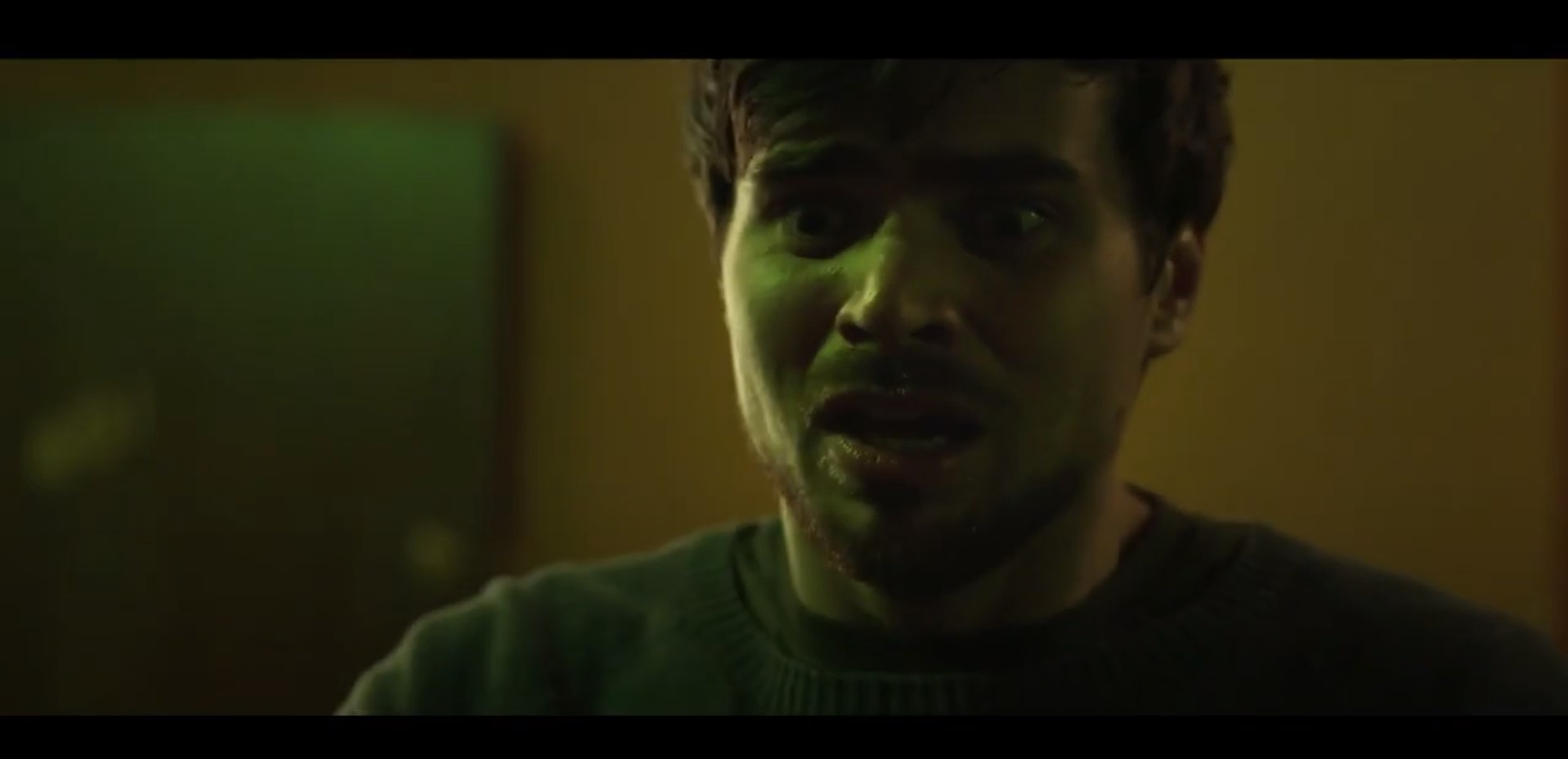
An outpatient nurse is requested by an old woman leaving by her lonesome.  Always forgetting and troubling eccentric, the humble nurse finds he’s in way over his head with a clearly unstable, possibly delusion woman, until the truth of her hidden secret unveils a web of horror.  A young couple looking to help a lonely farmer find themselves erecting a sheep fence as well as maintaining the upkeep of a strange rock formation known as a Tursemorkel that emits ooze out of black orifices and soon find the psychological and physiological energy from the Tursemorkel is more than they can withstand.  An elderly couple, tucked away inside their roadside camper trailer, whips up a finger-licking meaty stew made from all natural, locally sourced ingredients as they watch the nightly news’ top story of a missing person.  A man answers the doorbell and finds a package on his step, scratching and crawling out is a festering corpse eager to play with him.  A priest with an obsessive bug collection has him turnaround when a recently caught rare beetle toys with his mind.  Dafne, a young woman lost in another state of mind, is in the presence and in the arms of her own, personal demon. 

These bloodcurdling tales are the latest batch of horror shorts from the annual Milan, Italy hosted Drag Me to Fest.  The festival brings together Italy and international filmmakers to submit their unique brand of terror.  The 2024 lineup were submitted to the Milan collection in 2023, hit the festival the following year, and has now been compiled onto a home video release for North American audiences to enjoy and cower in teeth chattering fear under its namesake title, “Drag Me to Fest,” from Italian distributor Rustblade Records in association with MVD Visual, a subsidiary of MVD Entertainment Group.  Norway’s “Vevkjerring,” or “The Weaving” by Øyvind Willumsen and “Tistlebu” by Matthew Valentine kick off the anthology followed by Italian filmmaker’s Riccardo Suriano’s “Long Pig”, Julie Gun’s “Dafne is Gone,” and Jacopo Vismara’s “Il Coleottero” and finally rounding out with Japanese director Nori Uchida’s “For What the Doorbell Tolls,” all of which are self-produced.

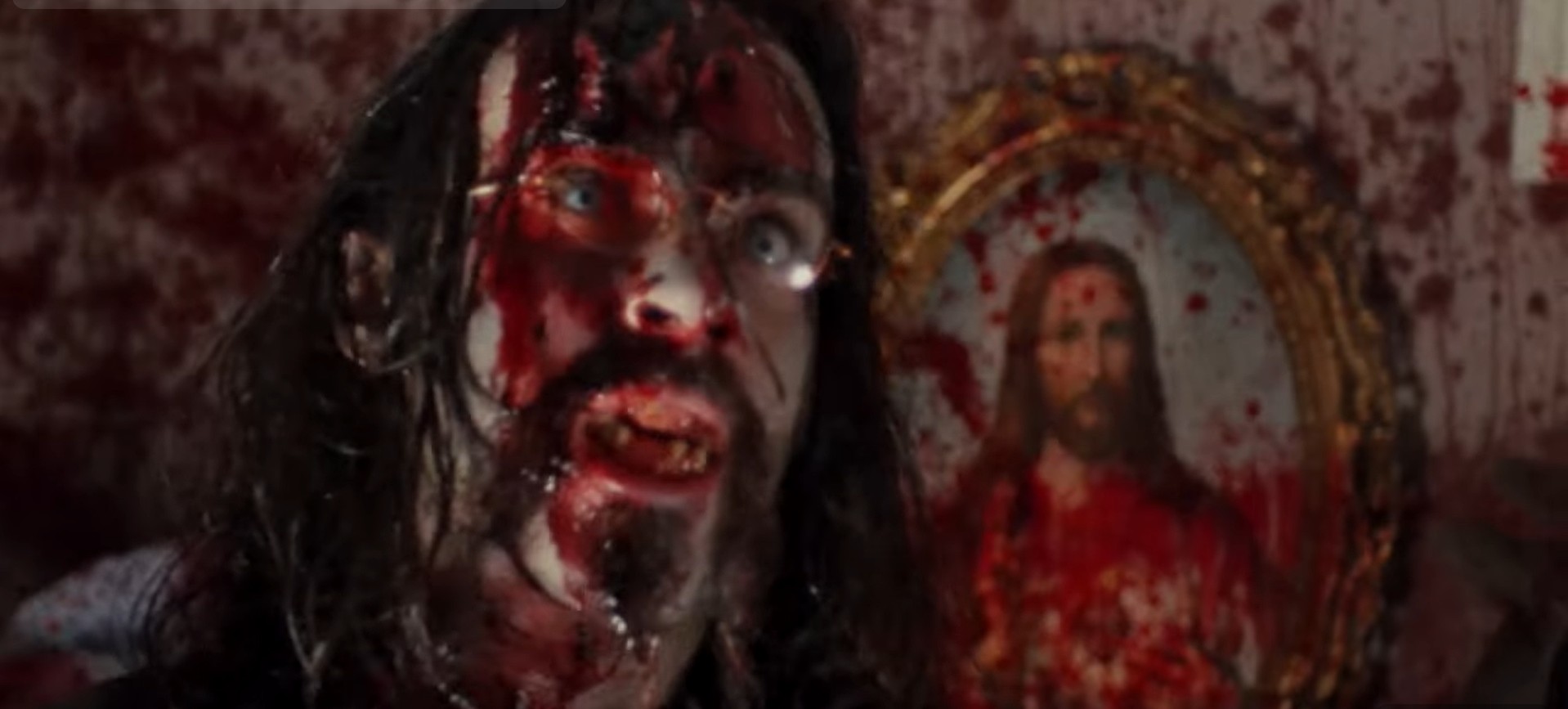
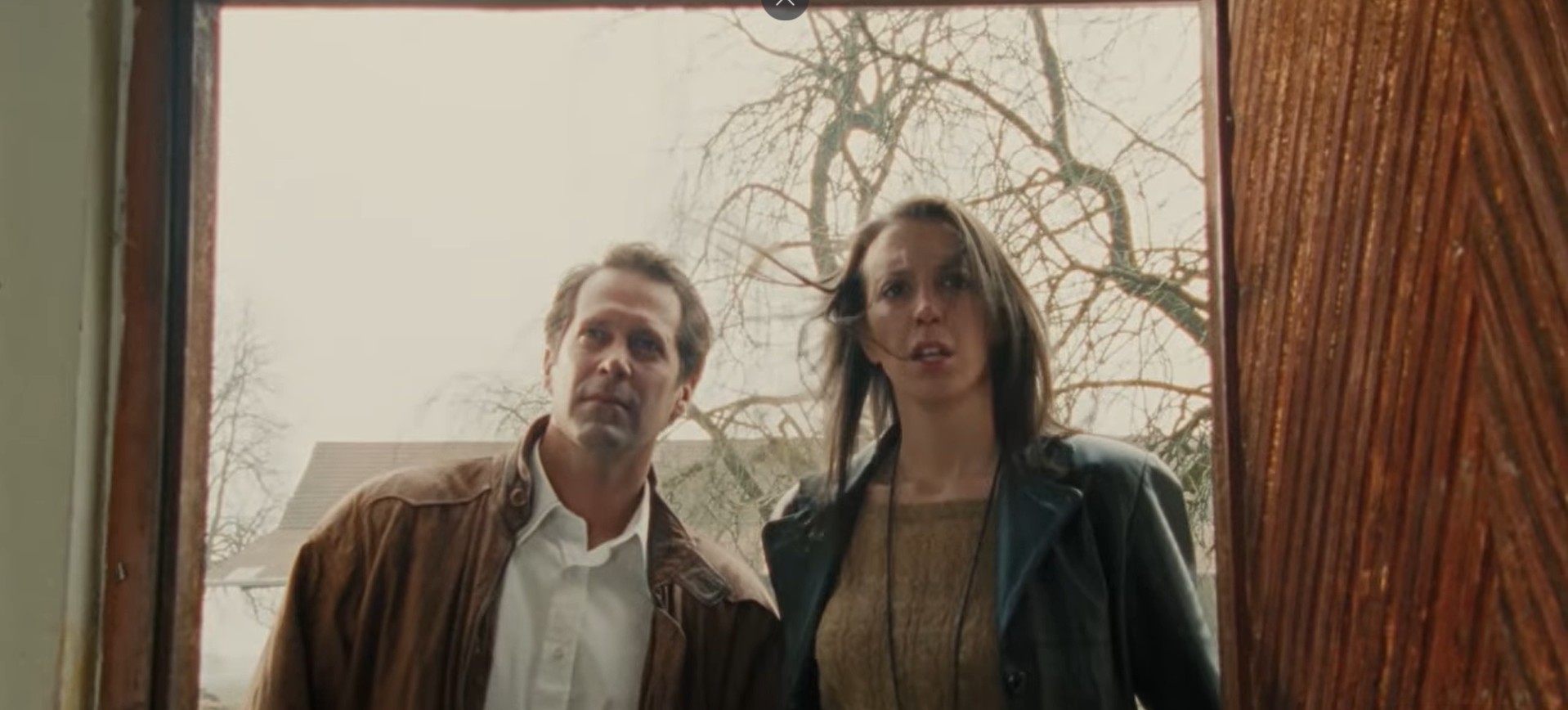
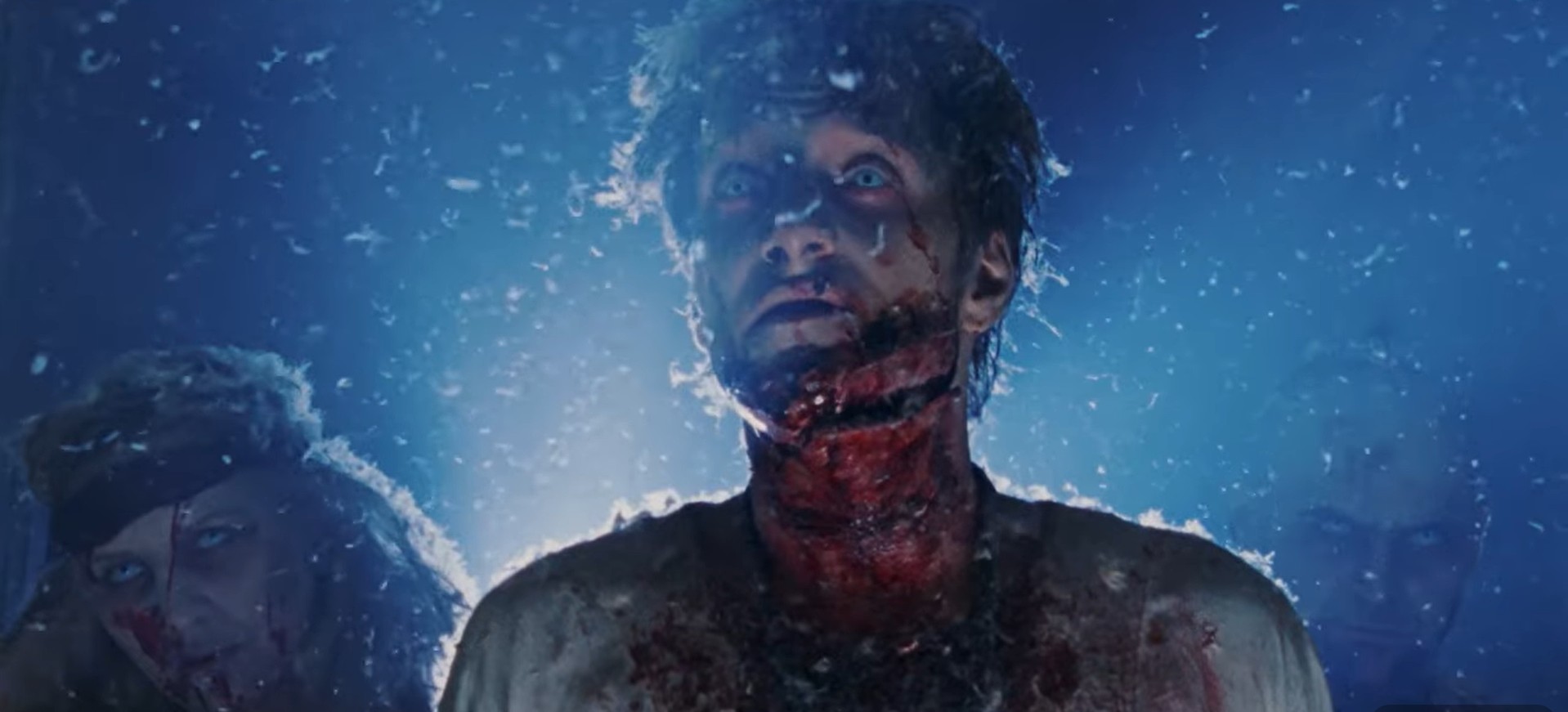
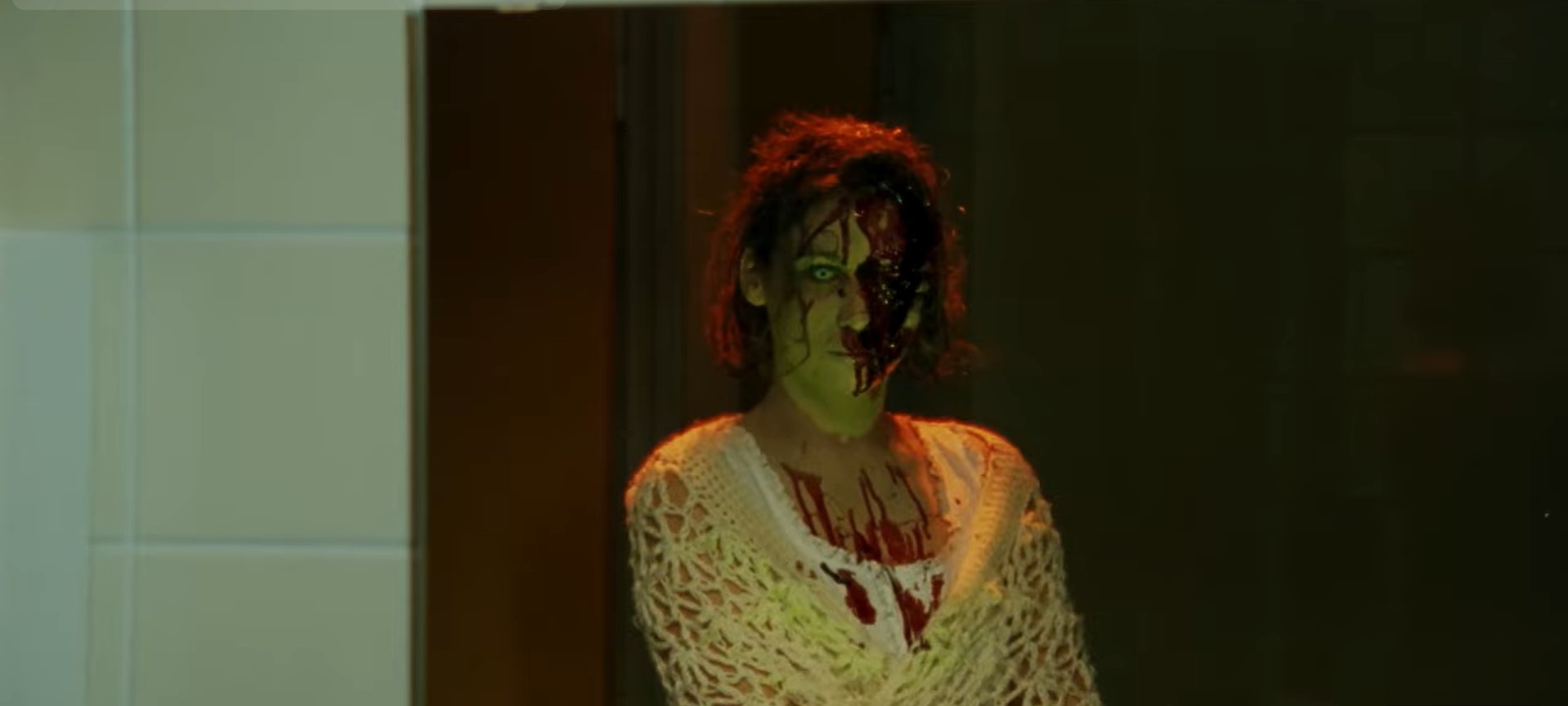
Three countries, six distinct films, and all packed into the unusual side of ambiguously horrifying elements contained inside six short films.  Each character is curated to fit inside the narrative design, no matter how outrageous or avant grade the message is.  Willumsen’s “The Weaver” is a more straight forward, common structured horror of building up tension in an already uncomfortable situation of a friendly, living assisted male nurse Henrik (Fredrik Hovdegård) knocking on the doorstep of a haggard and kooky old croon named Gudrun, played devilishly and disgustingly by Isa Belle.  The next four episodes become a bit vaguer in their intentions of madness, purgatory, survival, and obsession that intends to either harm or transfigure into something beyond the dimensional standard.  “Tistlebu” aims to transfigure as a young city couple (Sascha Slengesol Balgobin and Sjur Vatne Brean) look to connect with nature and their curiosity, coupled by intrusive misuse and sexuality, toward an earthy pillar of energy inside a widow’s (Oda Schjoll) barn enraptures them into something more primordial, literally connecting them to an omnipresent natural world that’s much bigger than their insignificant need.  Uchida provides his own one-of-a-kind performance based immensely off Sam Raimi’s “Evil Dead” by playing not only the hero but also the decaying plaything that arrives at the hero’s doorstep in one’s mirrored rotting of loneliness.  “Il Coleottero’s” Don Antonio (Mimmo Chianese) has a crisis of faith that become sidetracked by his diligent hobby of entomology when his prized find, a rare beetle, suddenly disappears from his collection.  Chianese finds the balance between being a disenchanted priest and an anxious man hunting for the beetle that got away and that will eventually destroy him.  Julie Gun’s “Dafne is Gone” is more operatically finessed with interpretive dance between Dafne (Giulia Gonella) and a demon (Jason Marek Isleib) that’s completely absent of dialogue, stagecraft visualized, and characteristically naked to showcase Dafne’s descent into the Demon’s spellbinding movements.

The collected and presented works are not the highest dollar productions but do encase a prosthetic practicality as seen in Willumsen’s “The Weaver” with a shedding of an exterior layer into a more grotesque freak of nature while Uchida takes the tribute route using filleted flesh and milky contacts, along with LFE tones and grading, modulated vocals, to accomplish his own version of “Evil Dead” without the presence of Ashley Williams.  The others are not as cut and dry with their infinite interpretational insights that likely will speak more on a personal level than a glossy buttered popcorn one that requires little effort to absorb.  “Tistlebu” and “Dafne is Gone” entrench themselves in their respective unknown and modern art by providing very little in the one thing they both have in common, a shared sense of unsettlement.  There’s also an undertone of sexualism as if it equates to the very beast that entrances, which in these shorts is the Tursemorkel, which is a large surface growth that emits an allurement of safety and gratification, and, in comparison, to the demon, perhaps her own visceral demon, that frolics to breach Dafne’s temptation, drawing her closer to his own colorfully neon netherworld in a production of warmly dark euphemism.  “Il Coleottero” is perhaps the best understated undercurrent between the skepticism that plagues man and his faith.  Shot mostly naturally, tension is built on Father Antonio continuous deviations from his religious duties, distracted in his homilies and divine surroundings, by the mere fact of a lost beetle, a beetle, similar to the appearance of a Stag Beetle, that toys with him.  One could assume the beetle represents a test from God to challenge the priest’s diversification balancing his faith between realism against spirituality, to quote biologist J.B.S. Haldane, and I paraphrase, if the creator had made life, it must have been inordinate fondness for beetles because of their profound species diversity.

“Drag Me to Fest” has now hit DVD home video for the first time in its 3rd annual run with a limited edition to 500 copies courtesy of Rustblade Records, routed through the North American distribution channels of MVD Entertainment Group under their MVDVisual label.  The region free release, presented in a widescreen 1.78:1 aspect ratio, is encoded onto a MPEG2, upscaled 1080p, DVD5 with palatable average of image quality in its varying degrees of filming equipment, lighting, and technical know-how to get the intended look without suffering cinematography faux pas.  Compression wise can be a different story but, generally, “Drag Me to Fest” has an adequate presentation albeit a less-than-desirable color saturation, especially Gun’s “Dafne is Gone” that implements warm neon primary coloring in a high contrast, hard light emulsion.  Skin and pattern textures vary from short-to-short, but the delineation is there to not blend depth nor create solid, smoothed out surfaces.  Valentine’s “Tislebu” relies heavily on the rolling hills and greenery farmscape to enact its character qualities for an Earthy or terrestrial mystery important to the sentient and engrossing formation.  The Italian, Japanese, and Norwegian language Dolby Digital 2.0 Stereo offers a passable mix that doesn’t elevate the atmospherics or construct tension to the max but neither does it flounder or lay waste to the support of the shorts.  There’s not a profound amount of leveled depth or creative sound design to fabricate space as much of the dialogue and environment resides in the foreground, and the dialogue does render over clean and clearly with forced errorfree English subtitles, but the focus is primarily on moving the story in a matter of minutes for some of the shorts, leaving narrative devices, such as characters and the effects, to drive the story and its tension.  The DVD is a barebones released that does not come with any encoded extra content, but the slim, trifold jewel case does depict a grouping of cherry-picked ideas from the shorts in a green bath illustration from graphic artist Gonz and has individual taglines and color stills for each short.  The 92-minute anthology is unrated. 

Last Rites: Abroad anthology with a goal to highlight and amplify short filmmaker voices, “Drag Me to Fest” finishes up from the main screen and extends to home video for the first time! Rustblade and MVDVisual illuminate the cinema obscure for the general public and we’re all the richer for it!

Hurry! Grab the Limited Edition Copy of “Drag Me to Fest” Before Its Gone!

When the Artist Becomes the Art, EVIL Takes Over Their Soul. “Stopmotion” reviewed! (Acorn Medial International / Blu-ray)

“Stopmotion” Available on Blu-ray!

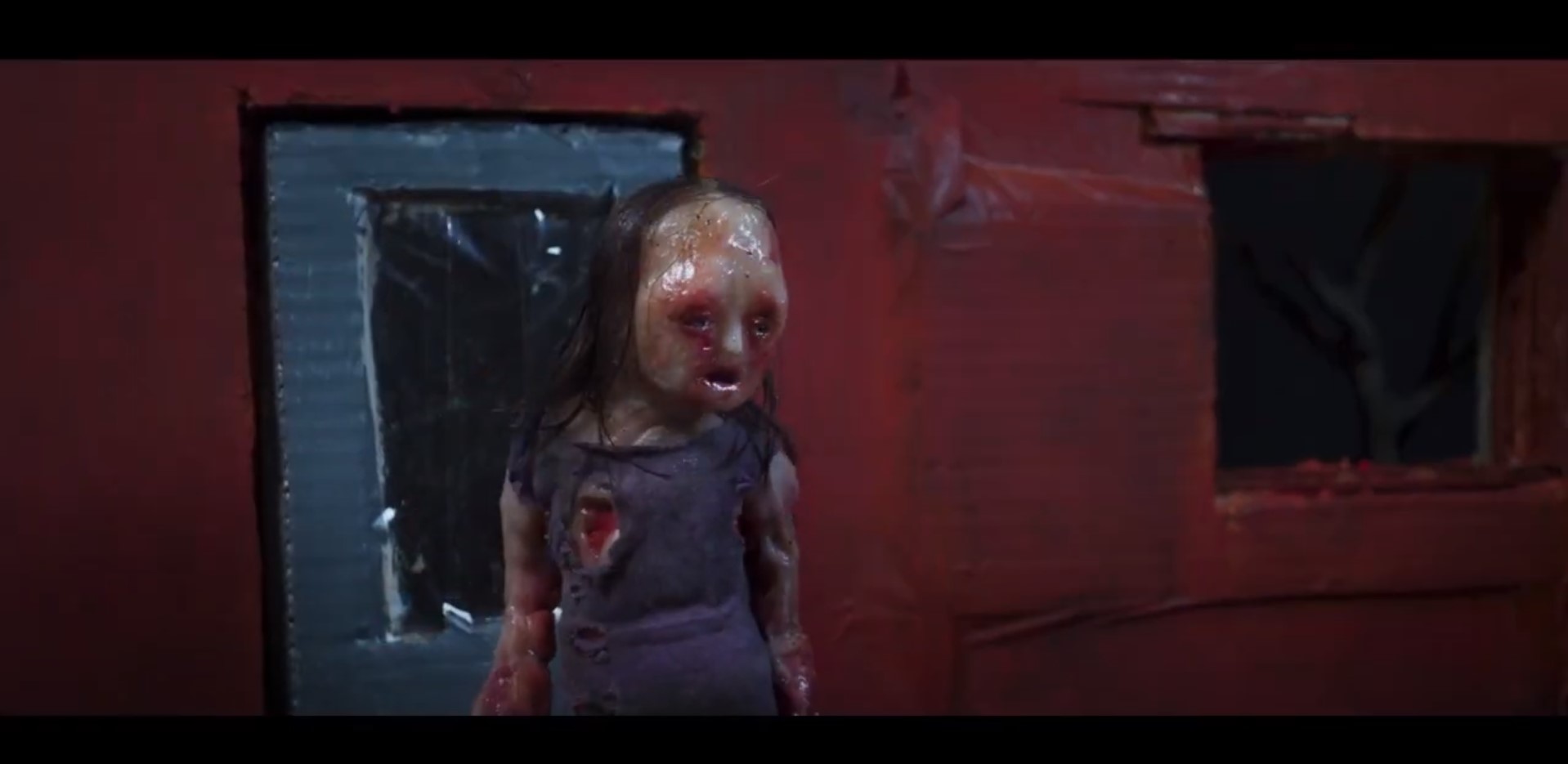
Living under her arthritis-enfeebled mother’s tremendous stop motion reputation and browbeaten into being the hands of completing her overbearing mother’s last film, Ella Blake can’t find her own voice in the animated art form.  During one already tension filled morning, Ella’s mother has a stroke and falls into a comatose state.  The unfortunate opportunity opens a door for Ella to complete her mother’s final masterpiece on her own as she moves out from the traumatic memories of her home and into a vacant high-rise apartment to be left in occupied solitude, but when a curious and brash little girl finds her mother’s story mundane and offers an alternative, more grotesque story, one which insidiously fascinates with disturbing themes and grisly creativity, Ella finds herself starting afresh, listening to the yarn of a young girl’s chilling vision, whole slowly cracking under the immense pressure of completing a film worth calling her own. 

With the timesaving, cost-efficient computer-generated imagery, many once popular animation techniques have nearly become a lost art in the recent feature film pool.  Stopmotion is one of those dangerously close to extinction animation styles, which has played a pivotal part in some of the most thrilling and magical films in history, such as, but not limited to, the live-action dominion of Desmond Davis’s “Clash of the Titans,” Sam Raimi’s “Evil Dead” films, and Tim Burton’s “Beetlejuice” to the fully animated features of Henry Celick’s “Caroline,” another Burton film in “A Nightmare Before Christmas,” and Phil Tippett’s “Mad God.”  Stopmotion animator and filmmaker Robert Morgan aims to add his entry to the dwindling, yet sustaining for now, artform with his 2023, debut full-length film “Stopmotion” co-written by Morgan and Robin King (“Mnemophrenia”).  The UK film is produced by Alain de la Mata and Christopher Granier-Deferrere under the French production company Blue Light and is presented by the UK’s British Film Institute, or BFI, with IFC Films and Shudder.

In the tragic lead role of spiraling down through pressurized suffering , trying to surface and take a breath from Ella Blake’s domineering mother’s shadow, is Aisling Franciosi, an Irish actress who also had a principal role in the segmented Dracula tale of “The Last Voyage of the Demeter” released the same year.  As Ella Blake, Franciosi plays into the young woman’s meek and submissive behavior as a subservient daughter to her conceited mother (Stella Gonet, “Spencer”).  All the while on the inside, Blake’s bottled voice contains lethal doses of self-destruction, barring her indefinitely inside the mental boundaries of her psyche, and never surfacing between the already emotional scarring and the grief for mother’s authoritarian parenting as Blake herself becomes very much like the armature puppet she manipulates into position for her film, needing that command structure to follow orders.  That need to be creative is so strong within Blake she fabricates another persona splitting soul into a dissociative disorder that takes the yoke and, ultimately, control over her and her project.  And, in some distressing and grim fairytale type of way, the voice recreates a story that parallels Ella’s life with the Ash Man (effects and prosthetic-cladded actor James Swanton, “Host”) chasing down and manipulating a wax puppet version of Ella in a grotesque mirror dynamic between Ella and her mother.  Tethering Ella ever so barely to reality is flexible boyfriend Tom (Tom York) and his flaunting animation corporate head Polly (Therica Wilson-Read, “Suicide Club”) to what’s in front of her rather to the voice inside of her but their truth is far too combative for Ella to stay fastened to a much strong influencing voice that’s far too close to her.   The upcoming “The Beast Within” actress, Caoilinn Springall, rounds out the cast as the little girl of the apartment building. 

As much as I wanted to seep and soak into “Stopmotion’s” one-frame-at-a-time madness, I couldn’t help but to think I’ve seen this story before.   A sort of déjà vu encircles me and hits me squarely in the gut as I lament over the possibility of feeling the same way I felt before with another film.  Then, it struck me like a bolt of lightning that this storyline shares similarities with the 2021, Prano Bailey-Bond film, “Censor.”  Now, I’m not saying “Stopmotion” is a direct carbon copy but follows a familiar pathway, a movie industry outlier forced by life and submersed under the weight to finishing what the heroines have started only to crack in deep obsession.  On a high level, character impetuses that lead to the same conclusion are in stark contrast and Ella Blake’s descent fathoms family trauma and fixation with trying to be an individual and not just a minor component of a bigger, more impressive, machine that overshadows the necessary cog that makes the whole operate.  Coupled with surreal imagery, otherworldly stopmotion animation, and physical effects that’ll make your skin crawl, or melt like wax, “Stopmotion” enlivens an animator filmmaker’s creativity outside the personifying vocation, blending genres and animations to exact a reality bending mania.  Morgan’s fragmented segues evoke an alternate reality that skips the portions where the audiences’ minds might fill in the gaps.  There is no gap filling, only essential, contextual moments, as if Morgan is the puppeteer to his story by arranging the movements one frame at a time reflect Ella’s poignant reminders and dour moments that mold her.

“Stopmotion” animates a living hell.  The Shudder exclusive lands onto a RLJ Entertainment subsidiary UK label, Acorn Media International, Blu-ray release.  The Blu-ray is presented in a widescreen 2.35:1 aspect ratio encoded with AVC, high definition 1080p, on a BD25.  Though in spartanly stark and gritty-glum set dressings, “Stopmotion’s” grading is on the lighter side of saturation diffusion, held mostly to a shade array of reds, greens, browns, and yellows.  There is numerous isolating, low key-lit scenes concentrated on the framed charactered and engulfing them in darkness but with that, there were no notifiable issues with posterization or banding.  Depth, especially in the stop-motion portion of reality, has spatial length and dimensional delineation, a testament to Morgan’s stop motion animator’s background and experience as some examples of the craft often look flat.  The English DTS-HD Master Audio 5.1 offers a lossless fidelity through the broodiness of Lola de la Mata’s compositional vocal and violin score, stringing through the surrealistic switch of cerebral crossfire.  Dialogue creates no challenges with a clear and clean presentation, range of effects heighten in animation’s Foley, and, again, depth creates that an enwreathed sound field through the back and side channels.  English subtitles are optionally available.  Special features include an interview with star Aisling Francosi, interview with writer-director Robert Morgan, and a behind-the-scenes featurette.  The Acorn Media release is rated 18 for Strong Bloody Violence and gore, has a runtime of 94 minutes, and, though not listed, played in region A playback so does seem to have at least dual-regional encoding between A and B.  The tangible Blu-ray comes in a standard Blu-ray case with a creepy, head-nesting puppet artwork.  The interior has standard appeal with just the disc inside, pressed with the same front cover art. 

Last Rites: “Stopmotion” depicts a tragic fall but not from grace in what is a more sad and sullen reality, and the escape is a freshly personified hell of one’s own making. 

“Stopmotion” Available on Blu-ray!

Channeling the EVIL from the EVIL DEAD! “Slaughter Day” reviewed! (Visual Vengeance / Blu-ray)

SOV “Slaughter Day” on Bluray for the First Time Ever!

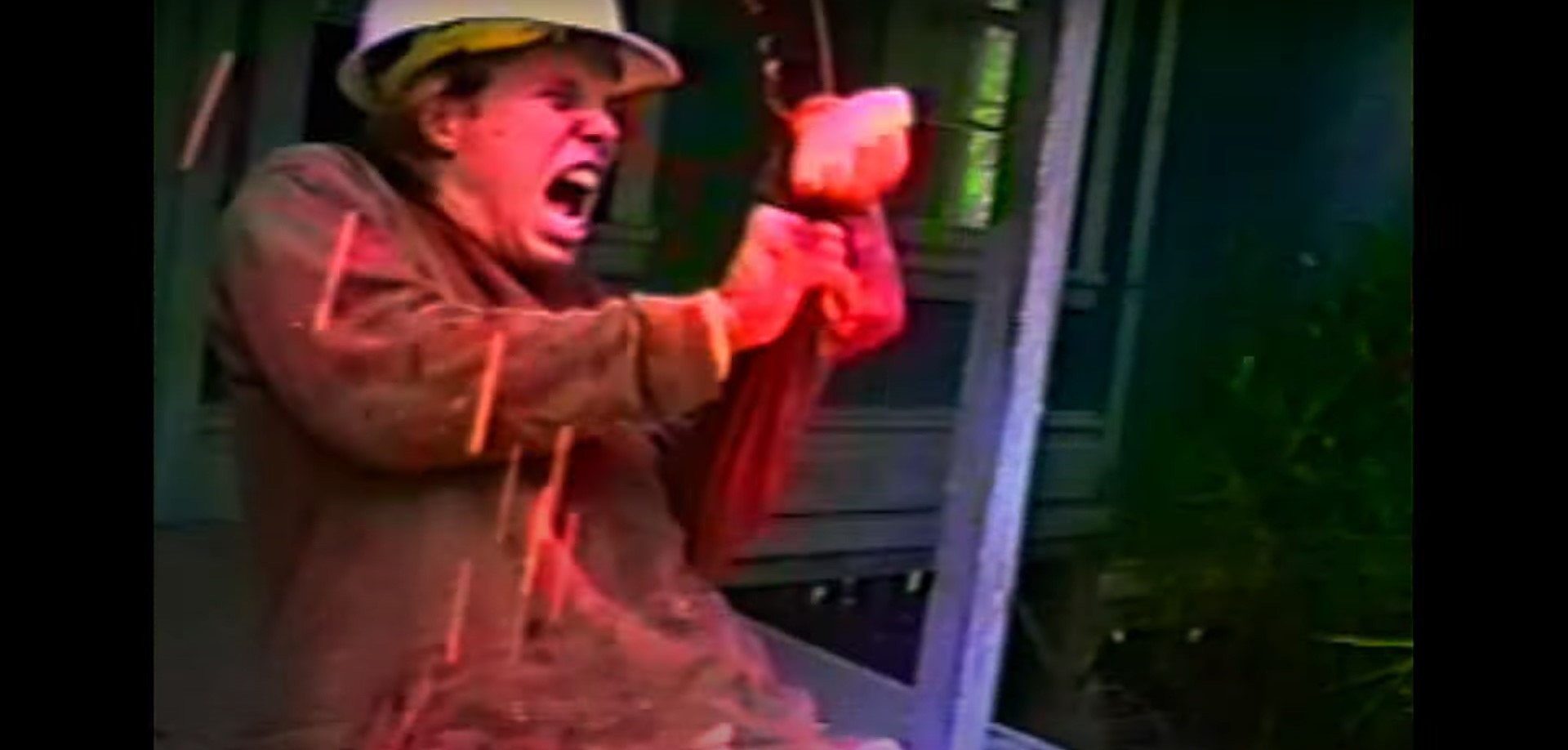
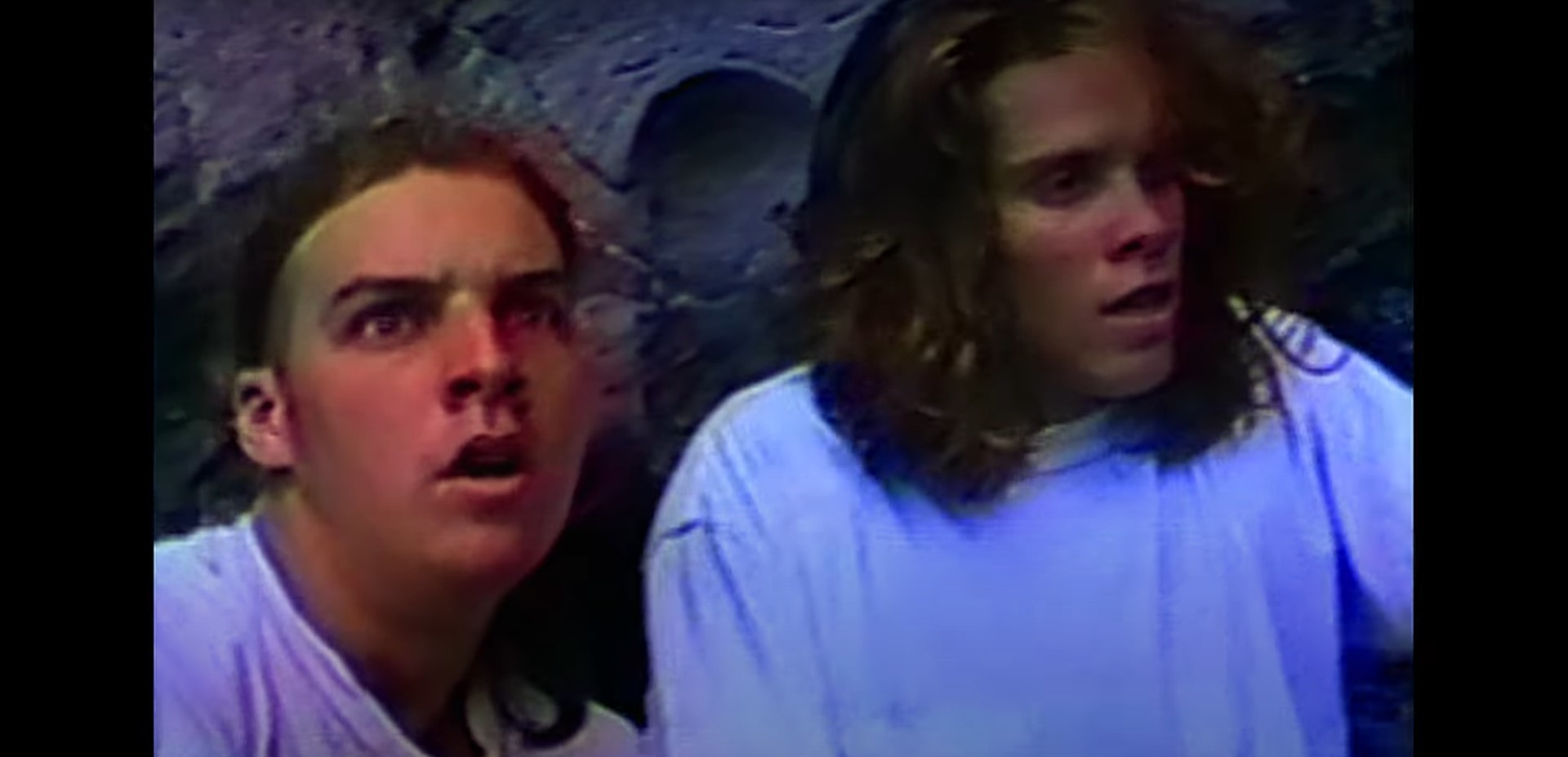
A pair of friends who run a small construction company drive up to an isolated cabin project in the outskirt nooks of Hawaii.  When they arrived, they encounter disgruntled employee John Jones who dabbles in the dark occult.  Having murdered already one of their construction crew members, Jones invokes the evil from the book of the dead, the Necronomicon, to bestow upon himself unnatural powers to seek revenge for years of abuse on the job.  Enslaving two other members of the construction Crew, Jones relentless goes after his former employers who must fight tooth and nail for every minute of their lives.  The fight stretches across the island and spills into the streets, abandoned factories, tropical brush, and even on the side of a mountain. 

“The Evil Dead” meets “Double Dragon!”  A fierce bareknuckle fight against a malevolently possessed construction crew is the not-stop action and gore premise of the Brent Cousins’ “Slaughter Day.”  The heavily influenced Sam Rain and “The Evil Dead” 1991 shot-on-video occult survival horror is co-written by Brent’s twin brother, Blake Cousins.  The twins’ filmic debut concept where a maniacal occult enthusiast goes on the offensive with his vindictive side by conducting dark, Necronomicon evil against the two construction supervisors is pieced together, scene-by-scene, from the various shorts created when they were adolescents.  The four short films from their inspired youth were revisited and remade into a full length feature film financed by a nearly a next-to-nothing zilch budget, but with more than a little can-do attitude, a group of close friends and family, and a willingness to drench the cast in splatter bags fill of fake blood, Brent and Blake’s balls-to-the-wall, commercial grade equipment schlocker never lets up and pays endearment to the legendary video nasties that have stimulated their need for tangible blood-shedding effects.  “Slaughter Day” is a self-funded labor of love under the Cousins Brothers Productions and is made in one of the more tropical places on Earth, the Big Island of Hawai’i, with a few scenes shot in the town of Honokaa.

Aside from being one of the two writers, Blake Cousins jumps in the front seat to become one of the hapless heroes in the suddenly twisted, Hellish ride of that classic story of good versus evil. Blake embodies one of the few aspects that makes the viewing of “Slaughter Day” so infectiously exciting with a high intensity level somewhere around near redline critical. The intensity spreads to each and every actor in front of the camera and with Blake’s breakneck pacing as the film’s post-production editor, there’s a side-scrolling, beat’em-up video game quality about the whole run through. The acting isn’t terribly good with haywire yelling and screaming from start-to finish with a lack of professional training that gives way to under developing a story, but story be damned, the brother Cousins ambitiously puts caution to the wind by balancing out the acidic acting with exceptional camera work that occasionally would involve hazardous to their own health amateur stunt work. The unharnessed and unpadded fight sequence in the back of the pickup truck gets mad props in succeeding instead of squashing someone’s head under the tire. If everyone lives and you get the shot, it’s a win, right? The fight sequences themselves are extensive, as I aforesaid, the breadth of the short feature is like experience a live action “Streets of Rage 2,” and they have the smack of decent choreography with near miss blows and head whips. Some of the bigger fake hits lack sterling results but are nonetheless entertaining and expected. “Slaughter Day’s” cast is made up of essentially a closeknit group of friends with performances from Sam Bluestone, Dave Anderson, John Lambert, Kulaka Branco, Jeremy Couchiardi, Joe Ross, and Lincoln Ross who all have never again seen the gaffer lights of another film production.

“Slaughter Day” has many flaws: bad acting, continuity mistakes, not much of a plot, etc. While honest attempst were made to rectify a handful of those sore points, those very same imperfections are what make “Slaughter Day” ironically perfect in the SOV canon. Some of the gags land relatively smooth, such as being John Jones being bent backwards in half and sucked into a copy of the pop media cultural influencing H.R. Giger’s Necronomicon book, and others kind of flounder in the lukewarm stew of unskilled technical know-hows. Yet, I do firmly believe the brothers achieved a memorable salute to Sam Raimi’s breakthrough 1981 video nasty, “The Evil Dead” in pulling more so the macabre-isms then comedic slapstick elements of the “3 Stooges.” Brent and Blake obviously understood what they wanted to see and how much familiar content they wanted to rework to open the recesses of our memory banks to access and recall “The Evil Dead” playbook, but then the flyby the seat of their pants filmmakers take their committed vision farther by adding certifiably crazy stunts and be big and bloody as all bloody hell! Severed limbs, decapitations, exploding shotgun bursts, and impalings are difficult for even the most seasoned effects artist, taking sometimes years to master a simple effect to perfection. With “Slaughter Day,” the brothers are unafraid to take risks, something the filmmakers proved with audacious stunts, by rendering a practical effect inclined storyboard or script thought to the screen tactic and owned it with a pinch of panache pizzazz!

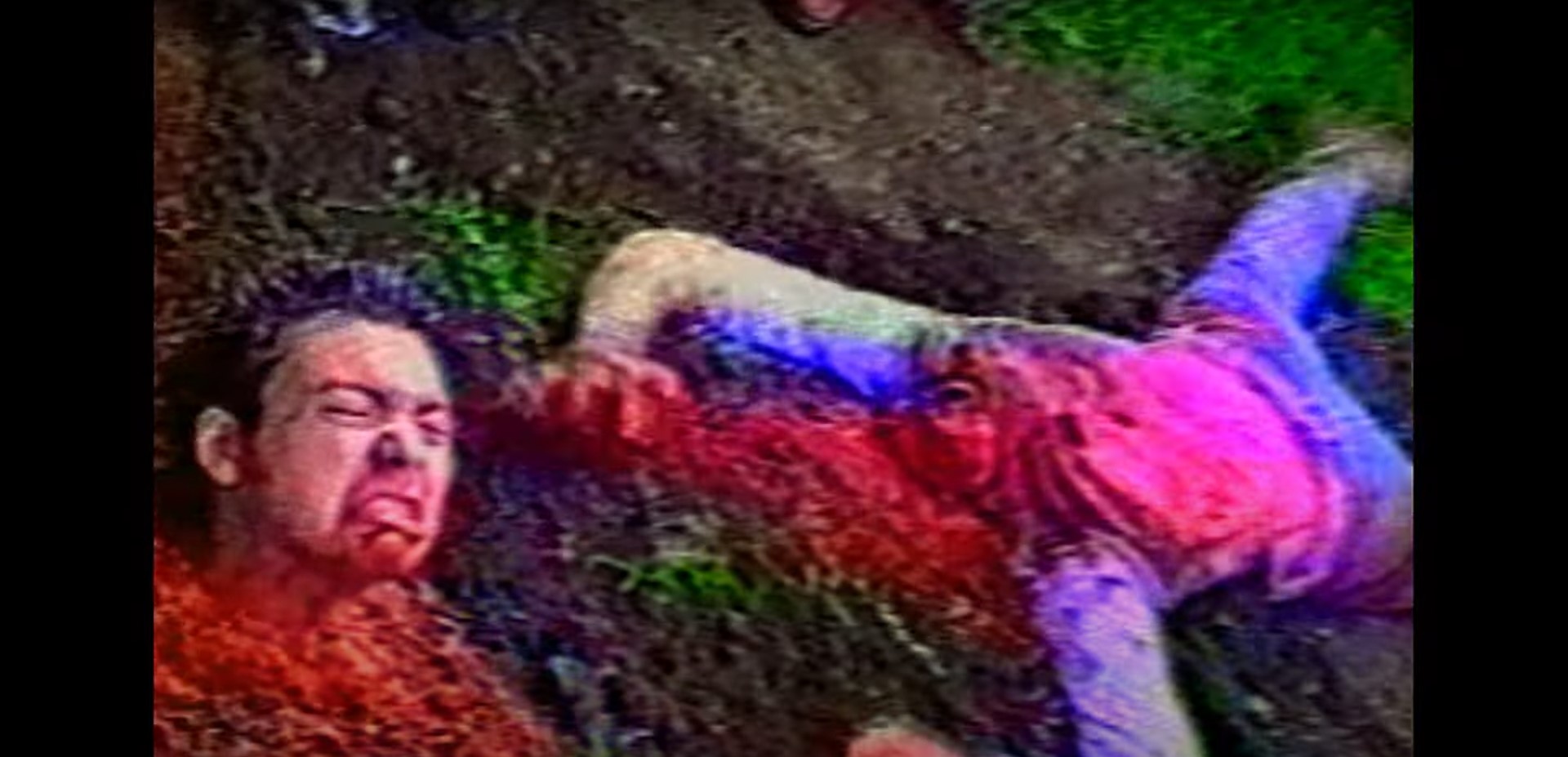
“Slaughter Day” might be release number five for Visual Vengeance but is clearly the Wild Eye Releasing cult-horror SOV sublabel’s second adulation of “The Evil Dead,” following “Bloody Muscle Body Builder in Hell.” The rough-and-ready S-VHS quality, presented in a full screen 1.33:1 from the original standard definition master tapes, can take on a grueling affect with a below par outcome. Tape lacks the proper color resolutions and that displays here immensely with full of deep and warm purples, reds, and yellows that you’d think the brothers were using gels to tint the picture. Tape wears, static interference, tracking lines… you name it, ‘Slaughter Day” visually had it. Delineation and details are deduced to a softer, overlapping ghost image that barely yokes together resolution pertinent pixels. Like always, Visual Vengeance’s disclaimer warns of the consumer grade equipment issues. These issues extend also into the English Stereo audio mix with a consciously underlay of static shushing, lo-fi dialogue recording, and zero depth and range to add more fuel to the “Slaughter Day’s” chaotic fire. Perhaps that’s why the dialogue is terribly rampant with the hope to invigorate and illicit engrossing captivation. The video game punch throw sound bites are a good touch and a innovative way to keep with the fighting game motif. The special features include a new audio commentary by directors Brent and Blake Cousins, a new audio commentary with Visual Vengeance’s own Matt Desiderio and Rob Hauschild, a quickly paced new interview with the Cousins Brothers regarding the genesis of “Slaughter Day” and they’re excitement about the new Blu-ray release, all four original “Slaughter Day” shorts, an earlier short entitled “Full Metal Platoon,” the “Slaughter Day” theme song, trailers from other Cousins films, such as “Rising Dead,” and the original trailer cut. Physical release features include a mini poster of the Visual Vengeance cover artwork, a three-page colorful essay from long time cinema contributing writer Tony Strauss, retro Visual Vengeance stickers that has graced all the company’s releases so far, a reversible cover art with new artwork as well as the original VHS art, and a cardboard slipcover with a heavily demonic and menacing Thomas “The Dude” Hodge design. The film comes unrated and has a runtime just shy of an hour at 58 minutes. I always get the warm and fuzzies when obscure works of art receive the red-carpet release treatment and “Slaughter Day” is an exemplar of SOV at its best while being innately its technically worst. Lots of ambition, lots of derived creativity, and lots of guts behind and in front of the camera to make a life-long dream of filmmaking come true.

SOV “Slaughter Day” on Bluray for the First Time Ever!

Let the Heavens Fall to Cleanse the EVIL Away! “Undead” reviewed! (Umbrella Entertainment / Bluray)

The small finishing town of Berkley, Australia comes under siege by blazing meteoroids that turn the quaint residents into mindless flesh-hungry zombies. A small band of survivors led by the town’s dismayed local beauty queen and a fisherman turned doomsday prepper fight the undead hordes in order to escape the carnage by reaching the city limits, but when faced with an otherworldly monolithic barrier surrounding the town and blocking the exits, a hopeful way out becomes quickly fleeting. To make matters worse, unusual rainstorms drench them with fear of what’s really in the rainwater of the apparent alien attack. In a last-ditch effort, the remaining survivors board a personal prop plane to scale the great extraterrestrial wall that’s imprisoning them with the undead. An onslaught of end of days catastrophes drives their instinct to battle on, to push forth toward living, despite all the evidence of a contrary methodology to the misunderstood, overwhelming alien actions.

A 9-year marriage, three children, the death of my dog, two states, a new home, four jobs, four presidents, and a global pandemic in more than almost two decades’ passing has transpired since the first and last time I saw the Spierig brothers’ 2003 zombie-comedy “Undead” and, still, the 2003 Australian film impresses with a large-scale gore show on a small-scale budget. Before terraforming new vampire words with Ethan Hawke in “Daybreakers” and taking a stab at an entry in the “Saw” franchise with “Jigsaw,” the brothers Michael and Peter Spierig’s first full feature-length venture was an ambitious love letter to their’ most endeared cult films of their youth, more heavily influenced by Sam Raimi’s “The Evil Dead.” Blowing through the meager budget halfway into filming and shooting an insane 40 to 50 shots per day for the better part of two months, the completion of “Undead” was a must for the self-funding brothers under their production banner of Spierigfilm and the success of “Undead” also jumpstarted the careers of cinematographer Andrew Strahorn (“Hostel III,” “Lethal Weapon” television series), production designer Matthew Putland (“San Andreas”), and special effects artist Julian Summers (“Bait,” “Mortal Kombat” ’21).

“Undead” was the first film for Felicity Mason and Mungo McKay in a lead role as that dismayed local beauty queen, Rene, and that fisherman turned doomsday prepper, Marion, mentioned in the above synopsis. Rene seeks to leave the town of Berkley in the wake of the tragic death of her parents before becoming the burdened beholder of their debt; instead, she thrusted into a crisis that won’t allow her to escape so easily from a destiny laid out for her in hometown. Mason’s humble portrayal of Rene is nearly invisible compared to her more boisterous and gun-fu counterparts but grounds us to an agreeable realism of reactions whereas Marion’s limitless gun-toting out of his fishing overalls and Matrix-like gunplay moves adds that layer of voguish fun of the Chow Yun-fat variety. The other four survivors fall into the run-of-the-mill of yowlers and cutting personality types who throw around their weight and cowardly sarcasms in immediate show of unfounded animosity. Supposedly, a longer cut of “Undead” provides more backstory for father-to-be charter pilot Wayne (Rob Jenkins, “Australiens”) and the law enforcement neophyte Molly (Emma Randall, “Bullets for the Dead”) but the release copy which this review is based off was not of that longer cut. Dirk Hunter supplies a purge of negative comic relief as Harrison, the chief constable without a clue, and Lisa Cunningham’s Sallyanne is Wayne’s antagonizing pregnant lover of bitterness as she comes in second place next to Rene at the local beauty pageant and seizes moments, during all Hell breaking loose, to confront Rene’s rope-wrangling talent that won her the cast prize.

Over the past year, I watched and reviewed another Australian sci-fi horror “Dustwalker” from director Sandra Sciberras where crash landed space objects turned the local dustbowl residents into the resemblance of zombies and connected to the chaos is a not from this world creature. I likened “Dustwalker” to be a lesser, weaker, total rip-off of the Spierigs’ ozploitation rager and I still stand 100% behind my claim as I reaffirm “Undead” to be the reigning supreme champion, and “did it first” as far as story goes, between the two nearly identical narrative plots. There’s an uncrushable affinity for “Undead’s” bold risk of looking at the bigger picture head on and absolutely landing each scene whether in prosthetics or in post with better than your average computer rendered imagery. Are the effects the sleekest, most realistic, graphics you’ve ever seen? Absolutely not but what they are are ultra-rich in creative detail rather than quality detail and can give most substantial budgeted films a run for the money, especially in the closeup shots that can be an obvious slapdash, might as well be silicone, fake. The Spierig brothers also don’t overcomplicate the plot with survivors trying to simply quickly decamp the overran town madness with plot points sensible to character designs and not relying on gratuitous happenstance scenarios for the sake of gore alone. However, do believe me when I say that “Undead” will delight gore geeks with a gut-spilling, face-lifting, head-decapitating mixture of zany zombie knockoffs that are steady throughout. If you’re deciding between the more recent “Dustwalker” and the now almost considered antique 15+ year-old “Undead,” the choice is clear with “Undead’s” superior campy, shoot’em, blood-splattering zombie mayhem.

For U.S. horror viewers looking for something that borders obscurity and might be out of their comfort zone, “Undead” has yet to make an appearance on Blu-ray, surprisingly enough. Only the Lionsgate DVD version is the known, and authorized, copy to be released in America. For those searching high and low, the all-region Blu-ray from the Australian distributor, Umbrella Entertainment, offers a 2-disc alternative with a new 1080p, Full High-Definition, release as volume # 12 on the company’s World on Film: Beyond Genres banner. The Aussie cult modern classic is presented in a widescreen 1.77:1 aspect ratio and with a runtime of 97 minutes, mirroring the U.S. DVD length which is a bit disappointing as longer cuts of the film do exist on other European releases. Day scenes play into an agreeable enough flat, more natural, color scheme with some serious grain in the 16mm film stock use, moving the photography toward a retro de-aged semblance courtesy of Spierigs’ cult film homage, but the darker scenes, mostly through a moderately intense blue filter, sees the unstable pixelation flareups, especially in black blank spaces and I’m taken aback by the lack of touchup to clear up any stylized misgivings. Umbrella offers two audio options – an English 5.1 DTS-HD Master Audio and an English 2.0 DTS-HD Stereo. Paired with an excellent soundtrack, the audio tracks do “Undead” complete justice without a smidgen of lossy fidelity. With plenty of action to go around – firearm discharges, explosions, zombie grunts/groans/sneers, and sundry of miscellaneous and oddball effects – each elemental output is distinct and clear. The dialogue renders nicely as well. Umbrella holds a few exclusive and rehashed special features that include an audio commentary from Peter and Michael Spierig and cinematographer Andy Strahorn, a raw video behind-the-scenes look on the set of “Undead,” the more production quality making of “Undead,” “Attack of the Undead” short films from the Spierig brothers that inspired the feature, home-made Dolly Video, the camera and makeup tests, still gallery, and theatrical trailer. Plus, an exclusive Simon Sherry illustrated art on the front covers of the snap case and the cardboard slipcover along with reversal DVD cover art and a second disc containing the complete 17-track soundtrack from Cliff Bradley. The rating is listed as an Australian certified MA 15+ for horror theme, medium level violence. which sounds severely tamer than it is for the more recent video nasty with all its zombies punching holes through hapless skulls, bloody brain munching, gooey face ripping, and severed torsos with spine exposures.

Don’t Mind the Glowing, Ominous Hole in the Wall. That’s Just a Gateway to Evil. “Beyond Darkness” reviewed! (Severin / Blu-ray)

A witch acolyte of Ameth, an underworld demon, is executed on multiple counts of child murder.  The priest who oversaw the witch’s last rites came in with a doubtful heart and upon researching Ameth through an unholy book, disavowed his own religion only to fall into a near drunken stupor of atheism.  Months later, a new priest and his family move into a home arranged by the archdiocese, but soon after settling into the old house, a series of disturbances point to a closed in wall behind a door that’s uncovered to be a gateway to another plane of existence; an existence where the child killing witch is granted access to seek the souls of the priest’s young children.  Fighting with his own struggles of faith, the ex-Jesuit assists the priest and his family in an attempt to cast out evil once and for all. 

Perhaps common knowledge amongst diehard horror fans, but not so much among the casual curiosities of an oblique coursed moviegoer is the fact that “Beyond Darkness” and Sam Raimi’s “The Evil Dead” share a cinematic series connection.  Well, not one in any official capacity one at least.  Drained from the same bloody vain that unofficially corrals Lucio Fulci’s “Zombi 2” as a sequel to George Romero’s “Day of the Dead,” retitled in Italy as “Zombi,” the American-made, Italian-orchestrated “Beyond Darkness” too fell upon the slew of Italian title changes sword with a rechristening into the “La Casa” series.  With the success of “The Evil Dead” in the U.S., Raimi’s video nasty was renamed to “La Case” and “Beyond Darkness” became the fifth “sequel” in the series as “La Casa 5.”  Since Italy has no copywrite laws, a light breeze can easily change any filmic title.  Even the director, Clyde Anderson, dons a false pretense as the Americanized alter ego of Italian director Claudio Fragasso.  The “Scalps” and “Troll 2” Fragasso pens “Beyond Darkness” with longtime script confederate Rossella Drudi, under the Sarah Asproon pseudonym.  “Beyond Darkness” is shot in the deep American South of Louisiana under the Joe D’Amato (aka Aristide Massaccesi) founded Filmirage (“Anthropophagus: The Grim Reaper,” “Deep Blood”), produced by D’Amato, as the Filmirage Production Group.

While behind the camera is mostly an Italian production team, in front of the camera is a cast of American and English actors with an opening Louisiana penitentiary pre-execution theology debate between Bette the witch, played by Mary Coulson, and Father George, a priest having a crisis of faith, played by one of D’Amato’s regulars in English actor David Brandon (“StageFright,” “The Emperor Caligula:  The Untold Story”).  Coulson’s role may be punitively small as the “Beyond Darkness’” lead witch and predominant face of the core evil, but the actress puts all into the Bette character comprised of a maniacal laugh and a lots of very European skin-tag makeup effects whereas the classically trained David Brandon has an array of lively emotions and facial expressions sized to fit Father George’s clerical shirt and white tab collar when he’s not sloshed with doubt.  Both characters interweave into the life of a new-to-the-area priest, his wife, and two kids who move into an old house, built on unholy ground, to start his new chapter in priesthood.  Days later, as the kids become instantly okay with a giant black swam rocking horse in the middle of their bedroom, the family is terrorized by flying kitchenware, flooded with a bayou mist, and frightened by figures in black, tattered shrouds seeking to steal their children’s souls.  Christopher Reeve’s lookalike Gene LeBrock (“Night of the Beast”) fails at double father duty in his poorly lit excuse of a worried father with his children being lured to the realm of the spirit side and as a grounded in faith Father combating the forces of evil without a solid sense of what to do.  Both parents are equally written off as incompetents who continue to stay in the house despite on the continuous threat of Baba Yaga wannabes knocking at every door in the house.  As the mother, Barbara Bingham felt as if she had a little more skin the game.  Perhaps having just come off the legacy success of a “Friday the 13th” sequel (“Jason Takes Manhatten”) she felt the responsibility of maintaining a more diligent approach toward being a mother coursing through occult’s dire straits.   Michael Paul Stephenson (“Trolls 2) and Theresa Walker excel much better in their roles as the two kids, Martin and Carole, who’ve become the centerpiece of Bette’s maliceful desires. 

“Beyond Darkness” will come across as very familiar amongst both horror fans and fans of movies in general with a story pulling inspiration from films like William Friedkin’s “The Exorcist” and Tobe Hooper’s “Poltergeist.”  Fragasso picks and chooses a blanket of trope elements to rework with great malleably in order to not be a total copy.  However, for those who know anything about low-budget Italian horror, Fragasso’s rousing similarities to major and independent hits should come as no surprise.  Notoriously renowned schlock horror directors Joe D’Amato and Bruno Mattei, amongst a sea of others, use to fabricate out of fame at every opportunity by gobbling up successful films, chewing them up, and spitting out their Italian produced counterparts without a second thought just to cash in on just a fraction of the original narrative’s success.  The way I see it, the method was (and still is) an honorable form of flattery. Yet, flattery doesn’t cure sloppiness and “Beyond Darkness” is about as sloppy as sloppy joes. Plot hole after plot hole stack up on Fragasso’s inability to amalgamate elements in an entirely coherent way. There are underwhelming revelations to anticipating character build ups that fizzle; such as a thick-tension mystery behind the local archdiocese and their involvement to place a good Christian family in a house built on evil land or what precisely convinced Father George of Ameth’s power to sink him into an alcoholic pit of despair? I already mentioned Martin and Carole’s inept parents on not fleeing the house at first sign of poltergeist activity or any activity since then so don’t get me started. The story needs some fine tuning but not after is amiss. The acting is not entirely a humdrum of monotony, Carlo M. Cordio’s eclectic synthesizer riff and haunting keynotes score is on another level akin to a composition pulled right out of a survival horror video game, and Larry J. Fraser, another one of Joe D’Amato’s pseudonyms, has an honesty about his scenes unlike we’ve ever seen before in a D’Amato production as the cinematographer captures the fog luminously and effervescently surrounding and chasing the family from out to in.

“Beyond Darkness” is no “The Evil Dead” but is a solid demon and ghost dog and pony show from 1990. Now, the Claudio Fragasso (or is it, Clyde Anderson?) classic is heading straight to your level room television set with a new 2-disc Blu-ray. The hardcoded Region A is presented in widescreen 1.66:1 aspect ratio in a full high definition and 1080p resolution. With only a possible color touch up here or there, I would venture to say the transfer used is the most pristine copy with hardly any damage or any age deterioration. The grain looks amply checked and no cropping or edge enhancing at work in an attempt to correct any issues, if any ever existed. Severin offers two audio options: an English language DTS-HD master audio 2.0 and an Italian dub of the same spec. With dual channels, there retains an always room for growth inkling and with the film’s broad range in sounds, a difficult to swallow lossy audio pill plays the aftertaste tune of, man, this could have been way better. Yet, the track is solid enough, if not more so, with virtually zilch damage. Dialogue comes across clean and clear, but there tails some minor hissing. Like with many Severin releases, new interviews are the star of the special feature show with one-side, talking head interviews with writer-director Claudio Fragrasso Beyond Possession, co-writer Rossella Drudi The Devil in Mrs. Drudi, and actor David Brandon Sign of the Cross. Though the theatrical trailer rounds out the first disc special features, Severin also includes Carlo M. Cordio’s superb soundtrack as disc number two along with a two-page booklet with an introduction to the ingredients of a horror score and to Cordio himself as well as a listing of all 17 tracks. “Beyond Darkness” is Claudio Fragrasso’s unbridled mutt, a motley of motion picture royalties rolled up into an adulating and piggybacking horror beyond comparison.

“Beyond Darkness” 2-disc Special Edition Blu-ray Available on Amazon