A Father Goes Looking for His Missing Daughter but All He Finds is EVIL! “The World of Kanako” reviewed! (Drafthouse Films and MVD Visual / Blu-ray)

Purchase “The World of Kanako” From Drafthouse Films and MVD Visual

A washed-up former lieutenant detective now working as a lowly security guard becomes the first person to stumble into the aftermath of a gruesome, convenient store triple homicide.  After being questioned by police who suspects him of being involved because of his manic-depressive disorder, stemmed by his historical violent behavior and ugly divorce that virtually left him with nothing but his medication, the indecorous alcoholic floating through life receives a frantic call from his ex-wife about their teenage daughter, who he hasn’t seen in years and has suddenly gone missing for nearly a week.  Eager to have his family back in his life, he takes on the responsibility of investigating his daughter’s disappearance but the deeper he digs into her whereabout the more of the ugly truth surfaces between his daughter and the criminal underworld where deception, prostitution, and murder tells a different story than the one in his muddled head. 

In 2004, novelist Akio Fukamachi wrote “Hateshinaki Kawaki,” the rummaging into a lurid and pulpy underbelly of crime network through the eyes of one charismatic high school girl and her former detective father pursuing answers to her disappearance.  Fast-forward a decade later to 2014, director Tetsuya Nakashima (“Kamikaze Girls,” “Confessions”) adapts the novel’s darkness into a visual descent into lunacy under the title “The World of Kanako” from a script by Nakashima cowritten with collaboration writers Miako Tadano and Nobuhiro Monma of “3 Year Pregnant.”  The adaptation retains fidelity to the original Fukamachi story filled to the brim with violence, yakuza, sordid themes, and coldness that translates effortlessly and is well received in the likes of Japanese cinema that has decades of trenchant crime films under its wing.  “The World of Kanako” is no different yet still stands alone as an engaging entry produced by Satomi Odake (“Himizu”) and Yutaka Suzuki (“Confessions”) under the production of Gaga Communications.

The film interweaves the past and present with a bi-story to help unearth cruel intentions from what starts off as a seemingly routine plotted mystery with a degenerate, deadbeat father looking to make recompences using his investigative skills to find his daughter to quickly spiraling recklessly into an abyss of bombshell revelations.  Yet, Akikazu Fujishima continues his crusade out of his own self-pity to a more deserving, rewarding, and if not, diverting objective that reveals just about as much of his cataleptic state of being than the exhuming of his daughter’s disappearance from out of the criminal underground.  Veteran, international actor whose had roles in such films as “Memoirs of a Geisha,” “Pulse,” and “Babel,” Koji Yakusho gives a conscious performance of a flawed man with flawed tactical awareness charging headfirst and sternly stubborn into a complex web where the giant carnivorous spider of seediness hides behind the veil.  At the opposite end of the casting table is then newcomer Nana Komatsu (“Destruction Babies”) making her filmic debut in a past timeline as the titular Kanako, paralleling her father’s story by accompanying fellow high school student and constantly bullied narrator of the historical account in Hiroya Shimizu (“The Outsider”).  Kanako’s story unfolds a yakuza narrative that’s nasty and perverse while shepherding in Kanako’s role that teeters upon the audience’s perception throughout.  What Akikazu fleshes out and discovers is the reason for all the mayhem that has, more-or-less, started with him, retorting whatever sliver of moral intentions he had begun with with the fact we can’t change who we are and the children we raise in a Darwin nature or nurture, or perhaps in this case both, environment.  Akikazu and Kanako meet a variety of unsavory characters along the way that ends shockingly and cynically, completely obliterating the happy family and happy ending conventionalities.  Satoshi Tsumabuki (“Tomie:  Re-Birth”), Asuka Kurosawa, Ai Hashimoto (“Another”), Fumi Nikaidô (“Lesson of the Evil”), Aoi Morikawa (“The Killing Hour”), Miki Nakatani (“Ringu”), Mahiro Takasugi (“12 Suicidal Teens”), Munetaka Aoki (“Godzilla:  Minus One”) and Jun Kunimura (“Ichi the Killer”) portray some of those uncharacteristic archetypes.
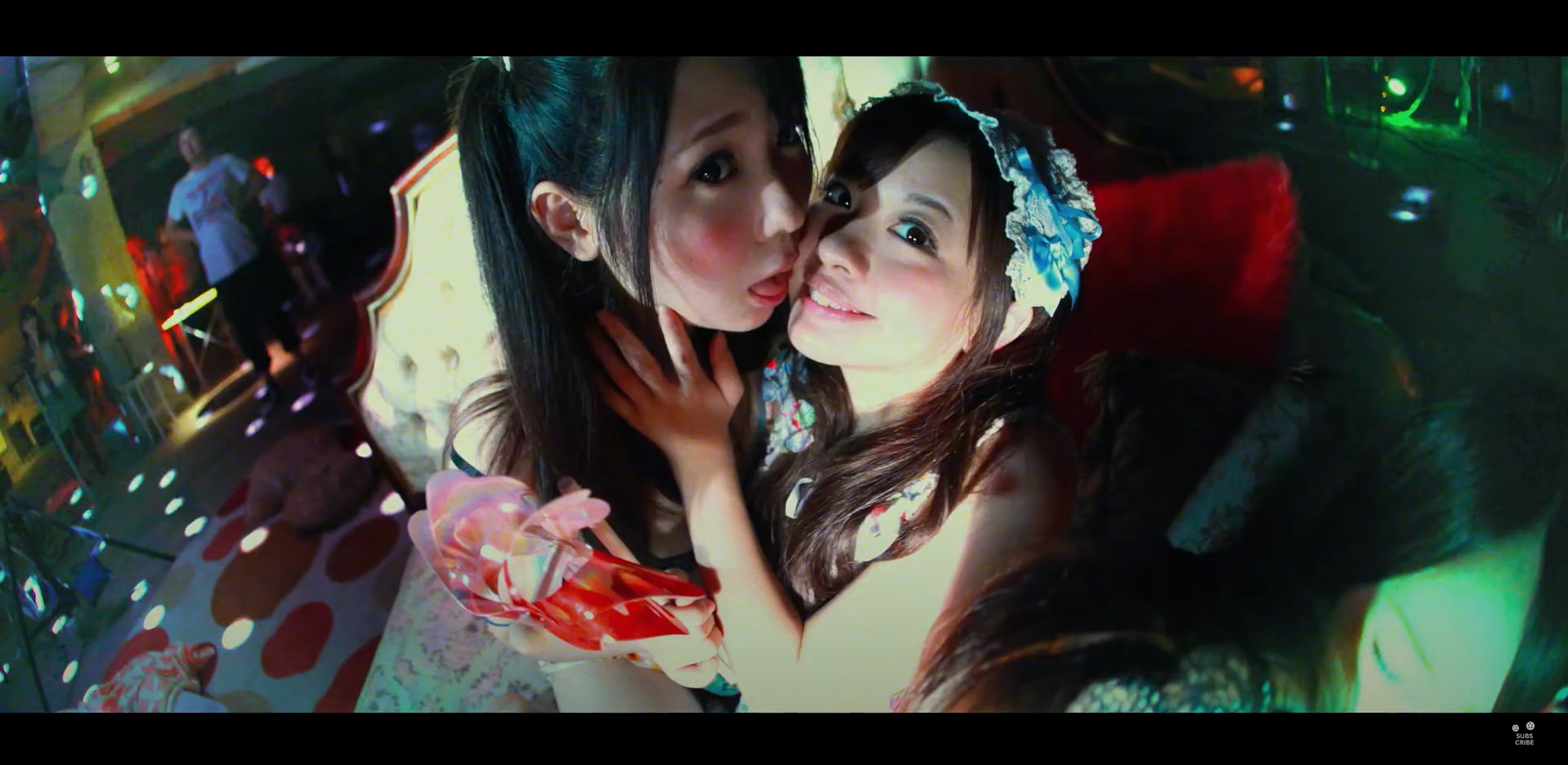
Stylish, pulpy, and darkly themed, “The World of Kanako” has a modern grindhouse pastiche of the hardboiled Japanese noir.  The story is a wrecking ball of all good ideals and hopes, a genuine cynical representation of an unpleasant situation.  An 80/20 mixture of live action and animation splice ins, Kanako’s world is certainly represented as a chaotic coup d’état over pedestrian storytelling and dissects the human condition to test family ties, reveal lost bonds, and really scrutinize hereditary genetics.  The film’s opening is a flurry of converging images, past and present, live and animation, and narration, soundtrack, and bits of dialogue that open with the gruesome convenient store murders of three people, seemingly strangers, setting the stage and tone for the rest of the Tetsuya Nakashima’s film that’s bleak to the dying core.  The rapid editing style doesn’t incur fluff or filler moments in a slimmed down for exactly what we’re supposed to experience.   While Akikazu Fujishima may not be the best example of a hero, a loafer with anger issues, physical abuse tendencies, glutton for food, alcohol, and manic-depressive pills, a rapist, and perhaps even engaging in incestual pedophile, the protagonist majority pushes forward with relentless determination and beyond the scope of being a good father to find his daughter, but for what purpose is about as ambiguous as the imbalanced human mind and Akikazu mind sizzles with insanity that affects his legacy to the point where he feels responsible for taking care of his own.  On the flipside of the protagonist narrative, Kanako begins as a savior of bullies, working to remove the threat from those too weak to defend themselves only for them to be exploited by that defenseless and vulnerability when the yakuza and more extremists take from their emotions and bodies.  

Tetsua Nakashima speaks an entirely new language in “The World of Kanako,” derived from a mix of the compellingly twisted story of “Old Boy” and the appalling violence of filmmaker Takashi Miike.  Drafthouse Films and MVD Visual re-release “The World of Kanako” on a high-definition Blu-ray.  The 2024 release comes with AVC codec on a dual-layer BD50 and presented in a widescreen 1.78:1 aspect ratio.  The various animation styles spliced into the live action coupled with some choice primary color grading in the opening gives “The World of Kanako” a very nostalgic touch of passé pink films of the 1980s and slight arthouse surrealism feel to the likes of Nobuhiko Obayashi (“House”).  The mixture doesn’t meld into one another with detrimental effect and leaves a stark impression between the formatted visuals that creates definitive delineation.  Details also don’t bleed in the sharp textures of character faces and clothing with objects being distinct and well defined.  Darker scenes are enshrouded in intentional shadow amongst grittier interiors to better understand the gritty context, losing some details but no issues with compression, such as blocking or banding. Two audio options are available, and both are in Japanese with a lossless DTS-HD Master Audio 5.1 and a DTS-HD Master Audio 2.0. Presented with fidelity, “The World of Kanako” produces no issues with either audio track with a clear and absolute. The ambience denotes a nicely spaced standard fare of common routine movements and actions around the environment setting. Outside of that, punches and kicks knock with an authenticity and same goes with gunshots and the hit-and-runs during more tense and thrilling heights. Yes, there was a lot of hit-and-runs with Akikazu behind the wheel for most of them. English subtitles synch well and appear to be error free. Bonus features a making of featurette in Japanese with English subtitles, an equally as long interview with principal leading actress Nana Kamatsu, an interview with Akio Fukamachi, and the theatrical trailer and teaser for the film. Physical features pale in comparison to Drafthouse’s first release that came with a 11″x17″ folded mini-poster and color booklet with essays and acknowledgements. This re-release favors the slimmer model with no tangible goodies inside. The standard Blu-ray Amaray has a stark front cover image of Kanako starring forward with a blood smear behind her; the disc is also pressed with this image. The Not Rated presentation has a runtime of 110 minutes and has region A playback.

Last Rites: Welcome to “The World of Kanako,” a savage acceptance of responsibility down the rabbit hole of malfeasance. Family ties be damned as one father takes it upon himself to ensure the deed is done right by his own destructive hands.

Enter “The World of Kanako” On Blu-ray Now Available at Amazon!

Two Movies, One EVIL. “House of Cruel Dolls” reviewed! (Full Moon / Blu-ray)

A perverse gang of sex traffickers kidnap beautiful women to be prostitutes for a hidden away bordello, known as the House of the Lost Dolls.  Gaston, a bordello regular, falls for sex slave Yvette and together they make a great escape to free Yvette from the gang’s clutches.  Yvette’s harrowing ordeal is given to the police.  What ensues next is the dispatching of secret agent Sigma to track down and eliminate the ruthless gang, but finding their hideout won’t be that easy as espionage tactics and killer assassins lie in wait around every corner, but agent Sigma will do everything in his power to see an end to their depravity. 

What a wild mashup of manipulation to work in a spy thriller around a sordid exploitation!  That’s the only way to describe French filmmaker Pierre Chevalier’s sleazy action-action thriller “House of Cruel Dolls.”  Also known as “The House of the Lost Dolls,” “The Panther Squad” director and A.L. Mariaux, one of “The Sexual Story of O” Jesús Franco’s pseudo names, penned 1974 released screenplay fills in the blanks with archival footage from the 1967 espionage flick “Agente Sigma 3 – Missione Goldwather,” starring “The Vampires Night Orgy’s” Jack Taylor.  Judging by the colorful, multi-national, grindhouse titles and the crew involved, you can bet on the “House of Cruel Dolls” to be a licentious and violence riddled romp, swanky in sexual severity and coarse with an untamed plot.  As a production of Eurociné, one shouldn’t be surprised of “House of Cruel Dolls’” shameless nature with the once legitimate Marius Lesqeur storytelling company that ventured into mass producing cheap, seedy classics, more around the uncomfortable context of Naziploitation or WIP (Women in Prison), with such films as “Angel of Death,” “Jailhouse Wardess,” “Hitler’s Last Train,” and “Helga, She Wolf of Stilberg,” as well as other European exploitations in “Diamonds of Kilimandjaro” and “Female Vampire” to capitalize on the rise of erotic in the 1970s through the 1980s. 

The Eurociné played the popular casting game of hiring American actors to star in their oversees produced films, but for “House of Cruel Dolls,” the hiring of an America actor doesn’t go as typical as you would have thought.  Instead of signing Oregon born Jack Taylor to be the leading man stopping a ring of evil sex traffickers, Chevalier, along with “Nude for Satan” editor, “Luigi Batzella,” spliced together Jack Taylor’s Italian-made spy thriller “Agente Sigma 3 – Missione Goldwather  fit into the extremely graphic and perverse scenes of rape, gang rape, and perversion narrative of the barely sticky adhesive “House of Cruel Dolls.  There’s actually one scene where Taylor’s character and partner run down a flight of stairs on a boat, but topside is definitely Taylor, but down the stairs inside the boat is a different actor with an extremely bad wig.  Co-starring, more or less, with Taylor are a blend of Italian and French actors from both stories that not necessarily share the same screen with their leading man.  The French actress Silvia Solar (“Cannibal Terror”) does share actual screen time with Taylor as the infiltrating villain in the cloak-and-dagger film whereas Sandra Julien (“The Shiver of the Vampires”) mingles deep undercover in the lion’s den of the sex trafficking master of ceremonies, Rasly, played by “Blue Rita’s” Olivier Mathot staged in actual “Cruel Dolls” territory.  Rounding out the patchwork cast is Magda Mundari, Raymond Schettino, Gillian Gill, and “Shining Sex’s” Claude Boisson (credited as Yul Sanders) who can’t seem to scratch his inch for lusting over helpless dames. 

I’ve seen worse cut and paste fuses of different 35mm reels and some not so terrible, yet oblivious a stretch at the seam, “Caligula” comes to mind with the inserted hardcore snippets, but “House of Cruel Dolls” flows and flows pretty well considering the rough segue cuts that blend the 1967 film with the 1974 film without much era style or stock degradation differences.  However, what Chevalier, and also most likely Franco, accomplished with their film had more attributes toward being a hardcore adult movie than being an action packed espionage thriller with prolonged and gratuitous sex scenes.  For example, Gaston rescues Yvette from sex slavery horror after a short-lived shoot out during the opening segment, the pair drive their way to the police station but stop along the way to cool down under the forest trees, lay out a blanket like they’re having a picknick, and have sex before going back to rushing to the authorities.  Plus, also experiencing Claude Boisson uncontrollably salivate over tied up and drugged women and easily make them look feeble as he ravages them is a trope norm of that character in the adult industry.  Plenty of skin makes “House of Cruel Dolls” a surefire sexploitation attraction, but much of the nudity is one-sided with the women baring everything while every man, except for one, keeping his clothes while committing the sleazy act and cinematographer, Gérard Brisseau, remains tight on focusing on two parts:  the clothed humping rear of the misogynistic rapist and the women’s bare nipples being forcibly suckled on. This makes the scenes not pungently powerful but more monotonously dull stuck on loop.  The latter is really laid on thick for the first act, saturating the skin-laden setup with Yvette’s escape and her flashback of how she become a lost doll in the lost doll brothel, but once Jack Taylor makes the scene, the action really starts with solid fight sequences that could rival the Sean Connery era James Bond.  However, you really receive a good chuckle when the big boss dies and story cuts-to Gaston and Yvette, hanging around Gaston’s pool, hugging and smiling that the gang has been wiped out in a drop off, that’s-a-wrap ending that table any coda gratification. 

For the first time released in North America and on Blu-ray home video, Pierre Chevalier’s “House of Cruel Dolls” comes uncut and remastered in Hi-Def, 1080p from the original 35mm transfer by our friends over at Full Moon Features as part of their Eurociné Collection.  Presented in a matted 1.85:1 aspect ratio, the pristine transfer really comes through without really a hint of damage or over the years degradation.  The color palette dices through the natural grain copiously vivid where needed to be character garments, hair, and vehicles.  Contrast has a whispery air about, heavenly almost, throughout without squashing too much of the textures.  The forced Dub English language audio tracks come in two formats – Dolby Digital stereo 2.0 and 5.1 surround sound.  Prepare to have side-splitting, cringe-worthy reactions to the incredible horrendous dubbing of baritone grumbling through the lossy audio tracks.  Even the Jack Taylor impersonator has a different dub than the actual Jack Taylor. Bonus features include trailers of other Euro cult titles. Considering being the only release in North America, “House of Cruel Dolls” is a rubbernecking sight to behold as the Eurotrash epitome of the Eurociné scene of the 1970’s, worth the price of admission just for that.

Own “House of Cruel Dolls” on Blu-ray or DVD!

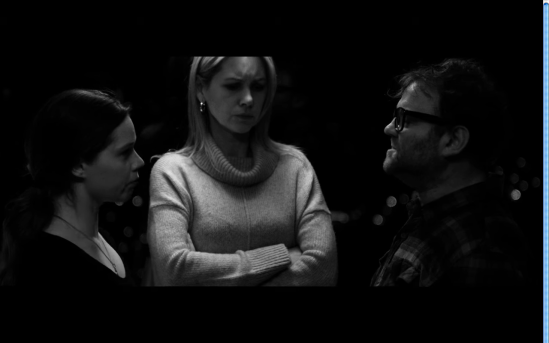
When EVIL Isn’t That Black & White. “Choir Girl” reviewed! (Nexus Production Group / Digital Screener)

Eugene lives a lonely, pitiable existence.  Residing with his ailing father in a slum neighborhood, his photography background captures the crime and the desolation that surrounds him, snapping pictures without ever interceding with his crime-riddled subjects, in an attempt to hold an exhibition or sell his work to a high profile magazine, Slipstream, as his ticket out of the despair that engulfs him.  When Eugene stumbles upon young teenage girls being drugged and held for prostitution, he becomes fixated on Josephine when a low-level editor, seeing her as a professional stepping stone, prods him for more pictures that evoke hope out of her situation, but when he finally intervenes, helping her escape, Eugene falls into a world of a massive prostitution ring with doctors, cops, and major organizations on the payroll and a kingpin named Daddy at the helm.  The deeper the debt placed upon him for showing compassion to Josephine, the more the lines blur on whether he’s become his muse’s lone savior or just his meal ticket out his current life.

How far will your moral principles take you to save a teenage girl when you’re locked into a no-win situation?  That’s the theme explored to a shocking sexual assault conclusion in John Fraser’s 2019 unscrupulous Australian thriller, “Choir Girl.”  Introducing Fraser’s first credited written and directed full length feature film, shot entirely in black and white, the Melbourne arthouse and a goose egg-fairytale version of “Pretty Woman” speaks volumes toward the perceived illegality of immigration, the horrors of sex-trade, and the touch-and-go balance act between doing what’s right and self-serving opportunities with a 15-year old girl’s fate dangling at the end of a line.  “Choir Girl” is produced by Ivan Malekin under his Melbourne based label, Nexus Production Group, along with Lucinda Bruce serving as co-producer.

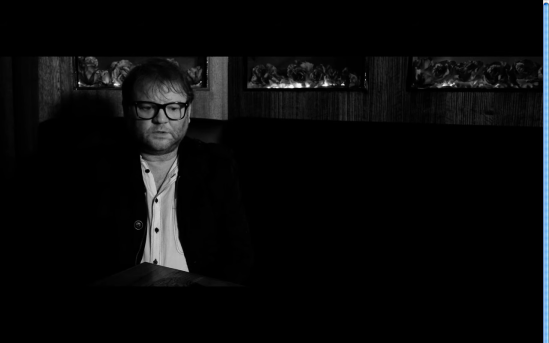
To carry “Choir Girl” through the muck of it all, a strong performance must arduously burden the gravity of the content and Peter Flaherty astounds with an ingloriously flawed and unlikely hero, Eugene.  “The Butcher Possessions” and “KIllervision” actor masts a greasily haggard with bordering neurodevelopment issues, disheveled in his attire, and walks with a noticeable limp, made intentionally noticeable when as he walks away from characters and situations.  Though Eugene seems meek, the shutterbug aches to improve himself by seemingly exploiting others as a freelance photographer and being persistent in that pursuit until becoming engrossed into a 15-year-old prostitute’s life struggle blossoming before our eyes a rather unsettling grown man and teenage girl relationship that assumes a pedophilia ideology of adoring the child to the extent of protection, but also falls in to grooming and sexual exploitation.  The film introduces audiences to Sarah Timm, playing Eugene’s muse, Josephine, an Eastern European illegal immigrant who literally has nothing left that is her own, this including her body, when forced into sex slavery so when Eugene and other characters call her diminutively by Jo, she immediately corrects them to call her Josephine in order to keep the one thing left that is still hers, her name.  In her first feature role, and a mightily demanding role it is with the amount of discomfiture of playing essentially an abused child, the German native will have audiences overlooking the fact that she’s portraying a teenager in the sordid sultriness of sex-trafficking with crafting Josephine’s war-torn history and pre-adolescent childhood stories as always the girl in the background, the unpretty forgotten girl that blended in and no one noticed, until she’s a part of a much larger, more ferocious, uncompromising system that Daddy (Jack Campbell) dictates with CCTV live feeds of every sleazy, scummy hotel bedroom in his syndicated footprint.  The cruelty that Jack Campbell reins savors every facet of Daddy’s being on screen with an intent to be a immovable roadblock in Eugene’s advanced for progress and for John Fraser’s “Choir Girl,” the character development and personalities find justification from the cast with the exception of one, the low on the totem pole and self-absorbed Slipstream magazine editor, Polly.  Krista Vendy imposes on Polly’s rabid  narcissism with an incredibility that becomes the underbelly amongst a bloc of solid performances.  Andy McPhee (“Wolf Creek”), Lee Mason (“The Caretaker”), Jillian Murray (“Body Melt”), and Kym Valentine fill out supporting roles. 

I love the juxtaposition opening of Eugene in his dark room in the middle of photographic processing his oblivious subjects, including a drug abusing child with a hypodermic heroine needle sticking out of his arm, a blowjob being serviced between a wall and bushes, or the aftermath of man being beaten with his assailants walking away from his leveled body, and then the title fades in from black and the next scene is of a framed magazine cover with the cover title “It’s All Back and White.”  The sequence sets up perfectly the entire premise driving “Choir Girl’s” gray area circumstances that nothing substantial, meaningful, or controversial can be black and white. Plus, the entire film is shot in black and white furthering the contrivance of the theme. The gray area challenging Eugene is a tightrope walk when squeezed for payment for snatching Josephine by the amoral organization claiming property theft, making him submit to the idiom of pulling his strings like a marionette or shooting at his feet to make him dance for insatiable perverse satisfaction. Eugene rarely displays remorse in his demeanor, face, or actions for the things he does and doesn’t do when faced with adversity in a slither of sociopathic idiosyncrasy, but when outright criticized for his inaction, he’s able to right wrongs with deplorable methods like a toddler trying to mop up a grape juice spill with mother’s expensive, white dress. There’s a bit of innocence or naivety in Eugene’s mind as you can almost see the gears slowly spinning when confronted but in the defense of the man who no really gave the time of day, those gyrating mice wheels of delicate thought snuck past every contingency against Eugene surviving Daddy’s deadly game, leading to an unsavory solution that puts the viewer in an awkward spot to either avert the eyes or remained captivated to see it through.


I, for one, remained seated, steadfast to the end, hypnotized by audacity of John Fraser in his feature film directorial, “Choir Girl,” that has arrived onto Apple’s iTunes. The unrated film is presented in it’s original aspect ratio of a widescreen format and will have an English language Dolby Digital 5.1 surround sound availability. Though derided as kitschy at times, the black and white veneer works here inside “Choir Girl’s” vascular system of catch-22s and director of photography, Mark Kenfield, rides a consistent straighten arrow style with steady cam shots, decent framing, and some tracking shots without pushing the envelope in regards to angles or oscillation. There were no bonus content or additional scenes during or after the credits. “Choir Girl” sings no praises of hallelujah. Offers no solace in time of hardship. If you’re looking for a movie that touches you, then you’re in for a rude awakening as “Choir Girl” obliterates the moral standards, leaving faith outside, with a severe penance in abetting the Devil’s work, selling their soul to do what’s right.

Undercover. Underwear. Whatever Defeats Evil Sex Trafficking in “Two Female Spies with Flowered Panties” review!

Cecile and Brigitte have served two of their twelve month sentence for inappropriate sexual acts involving prostitution and stripping. International authorities, including an American Senator, remove the two ladies of the night from their incarcerations and have them audition a private and provocative dance routine that will spring them from prison life and place them into a contract for hire that the pair of beauties find difficult to refuse. Cecile and Brigitte use their God-gifted talents to slip undercover as a pair of lesbian dancers in order to spy on Mr. Forbes, the Flamingo club owner on the Canary Islands who moonlights as a sadistic sex trafficker. Forbes kidnaps, rapes, and then, with the help of his wife Irina Forbes, hypnotizes well-known and famous women to be the ever faithful lovers of Mr. Forbes wealthily clients and to stop the egregious trafficker, any smoking gun evidence must be photographed for the international police to make a move on an arrest.

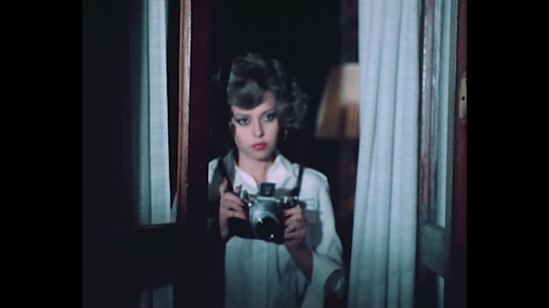
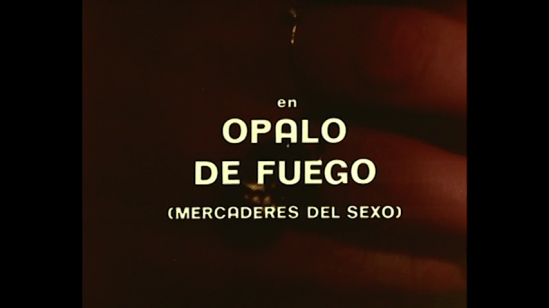
Jess Franco is the maestro of guilty pleasure shlock and the 1980 violently erotic, crime drama “Two Female Spies with Flowered Panties” is no different inventoried with ubersleaze spiced in folly comedy and tense sadism. The sort of mixed bag genre film only writer-director knew, and understood, how to achieve on a minuscule budget level in hastily conditions, but “Two Female Spies with Flowered Panties,” whether designed or by chance, stemmed from the combination of old and new footage, re-edited out of the original title, “Ópalo de fuego: Mercaderes del sexo,” and told a slightly different tale with slightly rearranged character backgrounds and graphic scenes, and featured two different locations that were later labeled Las Palmas of the Canary Islands to tie it all together. Severin has included both versions on a limited edition Blu-ray (“Two Female Spies with Flowered Panties”) and DVD (“Ópalo de fuego: Mercaderes del sexo”) release to experience both versions.

Franco’s long time common law, then legal in 2008, spouse Lina Romay, under pseudonym Candy Coster stars as Cecile in really a non-seductive, non-promiscuous, and only pinched with erotica role. Unlike Romay’s “Bare Breasted Countess” (aka “Female Vampire”) role, Cecile undercuts the erotic tone with more gratuitous comic and threatening nudity. Relishing into a staple of erotica are all of Romay’s supporting cohorts consisting of “Zombie Lake’s” Nadine Pascal, “Women Behind Bars'” Joëlle Le Quément, Susan Hemingway of “Love Letters from a Portuguese Nun.” Interesting enough, Hemingway isn’t credit in either version of the film. Pascal offers playful dilly-dally while practically be nude throughout whereas Quément slips into a deeper carnality with an unhinged relationship with her sex trafficking husband Mr. Forbes while Hemingway just provides a taken-advantaged vessel to plunder her dignity, soul, and body for easy money. Surrounding the gorgeous vixens are ruthless, dirtbag men played by Claude Boisson as the club owning sex trafficker and “Elsa Fräulein SS’s: Olivier Matthot as the sleazy American Senator Connelly. The role with the most opaqueness between the two versions of the film goes to Mel Rodrigo as Milton, the club’s gay artist organizer with an existential crisis and a quick to rebel attitude.

Though charming in its own delectable unchaste ways, Jess Franco deploys a haphazardly glued story inflamed with by chance moments shrouded with psychosexual tendencies. Sexually ostentatious and manic, “Two Female Spies with Flowered Panties” wildly pivots like an out of control sprinkler, spitting lustful filth, jovial comedy, and menacing suspense everywhere while still, by way of only Franco can accomplish, accurately hitting the intended mark of downright Eurotrash entertainment. A shocking, yet hardly noticeable, factor of the director’s is his film withholds any large amounts of blood or gore; in fact, gore is absent and the blood is sparse, especially during the girls-on-girl torture scenes involving bondage, a switchblade near the hind parts, and a cinder-weaponized cigarette, but the element that sparks gritty fortitude in those same said scenes, shot intently with fraught close-ups and well positioned shadows, could culminate a subversive tone that ultimate could convey a scene without words.

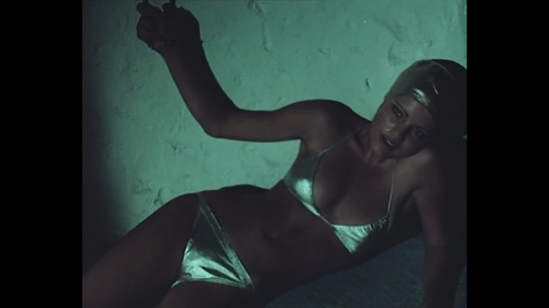
Severin’s limited edition 2-disc release of the Eurocine produced “Two Female Spies with Flowered Panties” has rightfully been graced with the Blu-ray treatment. The release also has the Spanish edit version of “Ópalo de fuego: Mercaderes del sexo.” The Blu-ray is a 1080p encoded AVC transfer presented in a near stand definition aspect ratio format from a restored into HD, uncut print. The overall color palette appears fairly washed with only some segments, especially peering out over the water or inside tight quarters, stand out with rich color. Darker scenes are heavily splayed with turquoise that, again, give the washed overlay, but the richness of the shadows with grindhouse print grain is stellar. Franco’s struggle with focusing, as part of technical self embattlement or as part of an against-the-grain auteur, are prominent throughout. The two LCPM 2.0 tracks are dubbed only in English or French and while not tracked in the native Spanish, either track will serve as a palpable substitute despite the English track being transcribed awfully cheesy and the French track with consistent hiss. Bonus material includes “Two Cats in the Canaries: An Interview with Jess Franco” is an undated interview with Franco recalling his love for the Canary Islands and being a genre maverick. There’s also a 1993 interview with long time Franco composer Daniel White conducted by “Cannibal Hookers'” Donald Farmer, a thorough analyst of Franco and “Two Female Spies with Flowered Panties” by Stephen Thrower, location outtakes, and a theatrical trailer. While “Two Female Spies with Flowered Panties” is not the best example of Jess Franco’s credits, the vicious erotic thriller is arguably ambitious and epitomizes the style of the legendary filmmaker with sultry, fringed performances and an unforgettable narrative lined up in a one-two punch package from Severin Films!

Stopping Evil Takes Relentless Determination. “Bound to Vengeance” review!

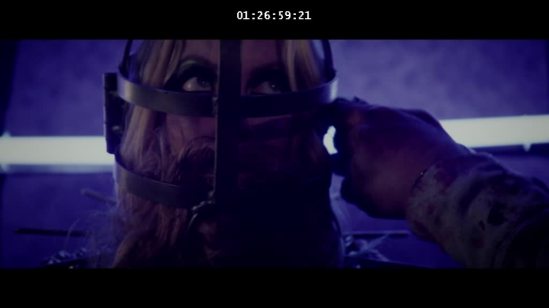
vlcsnap-2016-01-21-19h32m39s140

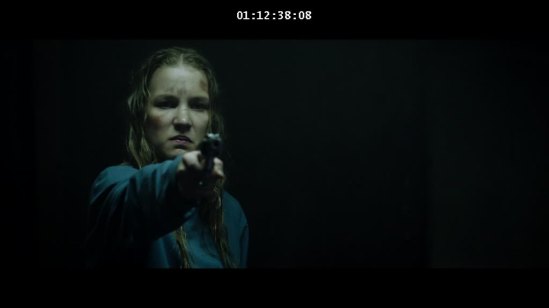
Twenty-one year old Eve has been chained to a basement structure of a desolate house in the desert.  She turns the tables on Phil, her sexual predator, by clocking him hard with a stone brick and escaping his hellish domain, until she realizes, through Phil’s pictorial archive, that he has more girls in similar captivity.  Driven by guilt over her sister’s own demise at the hands of their captor, Eve sets forth a nonstop mission to release girls no matter the cost even if that means bringing her injured rapist along for the ride.  As they stop from location to location, not all the victims are as calm and collected as Eve and her predator isn’t the only dangerous one in this particular sex trafficking ring.

vlcsnap-2016-01-21-19h21m23s31

“Bound to Vengeance,” also known under the working title “Reversal,” would naturally seem from first glance reading the title as a rape-revenge exploitation film by José Manuel Cravioto, except the story begins in the basement with Eve’s escape.  Cravioto’s film fast forwards past the pre-show character story development, the terrifying abduction, and the uncomfortable rape scenes or sequences.  Instead, the story bee lines straight toward the revenge act, raising Eve out of the ashes like a worn torn Phoenix and obtaining the upper hand on Phil.  From there, only sporadic interjections of her prior abduction are revealed through video tape footage of her and her boyfriend.  Even without displaying all the horrible things that have happened to Eve, a successfully conveyed cognizance of her strife goes without saying, or in this case, showcasing because the Rock Shaink Jr. and the late Keith Kjornes, whom I remember from his first penned wacky work in “Repligator,” cover Phil’s monstrous and unquenchable sexual rampage through the scared and scarred eyes of all the victims Eve intends on liberating and from Phil’s spew of lies from his own snake forked tongue.

vlcsnap-2016-01-21-19h57m41s50Dark Factory Entertainment, for a company as a whole, is as small as a guppy when compared to bigger, badder fish in the ocean; however, “Bound to Vengeance” is like a piranha, a flyspeck river fish with a vicious bite.  I’m also impressed to see “Kindergarten Cop” star Richard Tyson presenting a delightfully decadent performance in his character Phil, whose a mid-40’s man living a double life, living the American dream with a beautiful wife, innocent young child, and living in a grand house while a darker, hidden side revels in an oversight role in the world of sex slavery.  Phil represents the very definition of a very real evil inside our society and Tyson, through that slightly raspy and baritone voice of his, brings out the character’s warranted ugliness.  Tyson opposites Stephanie Charles, saddling into the empowering female role Eve, and Charles meets the veteran Tyson eye-for-eye on all their scenes together, never once sensing a performance recession.

vlcsnap-2016-01-21-19h41m18s205The rape-revenge flick, minus the rape, concentrates, just outside the surface, around the sex slavery ring.  In fact, the insightful story is quite educational and informative, sectoring separate pieces of the sex trafficking ring from a simple abduction, restraint, and rape to a criminal empire consisting of various locations and various hands in this particular ring.  Victims also go through stages of stockholm syndrome, such as with one of the girls Eve attempts to free, but she’s too far gone under the influence of Phil and his forceful philandering friends.  And for a film that’s about sex trafficking, sex has nearly been omitted from the entirety with only some disheveled and scanty covered women, some with BDS&M outfits.  Criavioto’s suspense thriller breaks the narrative barriers without being, story suggestively, sexually explicit and gratuitous.

vlcsnap-2016-01-21-19h26m56s37

The High Fliers distributed DVD and Dark Factory Entertainment production is a win-win for both companies where dynamic actors and sexually charged subject matter thoroughly straps you forcibly in the passenger seat and causes a five-finger death grip on the oh-shit handle bar.  Prepare to have your eye balls glued to screen and your jaw drop when each scene becomes more intense than the other, from girl-to-girl, to house-to-house.  Gravitate to this release as soon as possible as I swear disappointment will be far, far away from any reaction bestowed upon this Cravioto film.