Daddy’s EVIL Little Secret. “The Beast Within” reviewed! (Well Go USA Entertainment / Blu-ray)

“The Beast Within” is Calling! Own Your Copy Here!

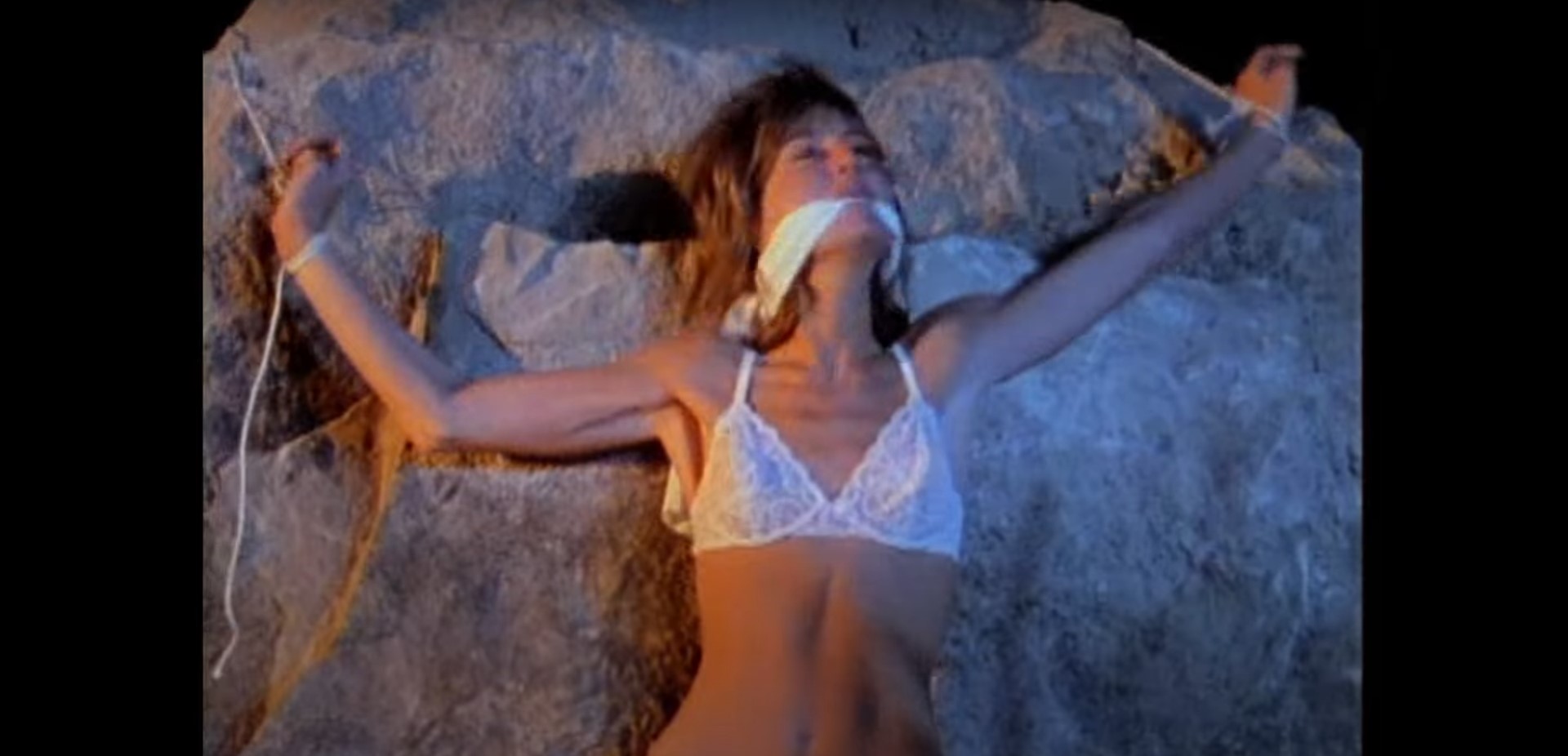
Infirmed 10-year-old girl Willow witnesses one night a month her mother whisking away her rather distant father into the dense woods deep within the English countryside.  When brought home the next day, her father must be helped carried in, appearing haggard and weak from his strange and mysteriously kept overnight departure far from home.  The secret festers between the parents, as well with her grandfather, to a point where tensions rise to the surface and the family is slowly falling and drifting apart.  One night, Willow decides to sneak onto one of those one-a-month egresses and discovers her father, left chained inside a dilapidated structure in the middle of the wooded nowhere, transforms into a horrible beast.  From that point on, the family secret was no more, and she must come to terms with her parents’ deception and their struggling family cohesion before the next full moon rises above their isolated home compound.

Lycanthrope films are on the rise with the anticipation of two new theatrical releases that have seen positive reactions just by their trailers alone with “The Invisible Man’s” Leigh Whannell staying in the Dark Universe with “Wolf Man,” slated for the silver screen January of 2025, and “Scream of the Banshee’s” Steven C. Miller going wild and hair near this Christmas season with his chaotic and carnage-ladened “Werewolves.”  Kicking it off in the werewolf category however is English director Alexander J. Farrell making his debut fictional feature with “The Beast Within.”  The 2024 released conceited thriller plays on a child’s perception of events, especially when she sees her parents joyless faces, co-written by Farrell and more seasoned screenwriter Grear Ellison (“A Woman At Night”) and both have worked previously on Farrell’s last two projects, a documentary entitled “Making a Killing” that sheds like an antiquated law that results in capping financial need after preventable medical negligence and another cowritten session, a RomCom in “How to Date Billy Walsh” that was also released in 2024.  The UK production comes from a conglomerate of companies in Paradox House, Future Artist Entertainment, and private equity group Filmology Finance and is produced by the father-son duo Gary and Ryan Hamilton of Archlight Films who oversaw global sales of the film, Martin Owen, Tammy Batshon, Spencer Friend, Evan Ross, Sebastian Street, and Paolo Pilladi.

Looking for his next big hit to branch out from the shadow of “Game of Thrones’” bastard hero, Jon Snow, is Kit Harrington taking the headlining role as an intermittent explosive disorder father struggling to keep his family whole because of his own family curse.  Often resembling the HBO role that made him a household name when donning that iconic large fur coat that became an innate symbol of the Stark family, Harrington’s Noah character fails to become uniquely recognized as he’s quite the mystery with little background to his compound abode and his occupation of what seems to be a lumberjack of sorts, always cutting down trees in the nearby forest.  What’s even more mysterious is the family lineage of temporarily transmogrifying into an aggressive, animalistic beast when the full moon is high.  His reason for being cursed stems mostly from anecdotal knowledge of his own grandfather’s tragic history with being plagued by the same condition.  This places Noah’s family onto spider-cracking eggshells as his wife Imogen (Ashleigh Cummings, “NOS4A2”) finds herself loyal to a fault by caring for Noah’s condition but taking the brunt of his abusive behavior all the while daughter Willow (“Caoilinn Springall, “Stopmotion”) initially doesn’t know what’s truly happening but has this underlining fear of her father, noted by wedging her rocking horse underneath her room’s door handle every night.  Willow’s grandfather and Imogen’s dad Waylon (James Cosmo, “Highlander”) serves as a buffer between Noah and his family, maybe even perhaps the voice of reason.  Performances are mostly strong with Harrington forcing Noah’s hand a little to be brutish, a quality that doesn’t quite stick as intended.  There’s also some finale unresolve essentials with Waylon that doesn’t determine his fate as we’re left with only a threadbare implied outcome, an unfortunate state for one of the handful of principal characters.  The supporting actors rounds out with Ian Giles and Martina McClements (“When the Lights Went Out”) who never share scenes with the key intimate cast.

Aforementioned, “The Beast Within” is from the perspective of a child, in this case a child with great imaginative qualities as seen with her hobby of matchitecture of her home and nearby buildings, but the story is also definitively an allegory for an abusive husband and father that uses the lycanthrope mythology as a bestial symbol for one man’s vile nature.  Noah’s deceptive behavior lures in what the family wants, a loving husband and adoring father providing, protecting, and caring for them, but Farrell strings along a hidden truth with spot visual clues of Noah’s true self.  Those clues are terribly evident to the family devolution but there’s also a stasis of hope when Noah’s charm and smile glimmer through the cracks of his monstrous shell that’s mostly kept at bay from the audience.  The allegory keeps well until the end and then the allegory loses its legs and not mounting to much when everything laid before our eyes in the story is suddenly washed away by Farrell’s inability to stick with his metaphorical story and go explicit in the last few scenes when the child’s perspective veil is dropped, as if the new feature director couldn’t trust audiences to come to their own conclusions.  Yet, timeless set locations in the expansive English countryside, the compound set design, performances, and the limited but practical effects of the wolf man add to the independent film’s slow burn horror-dramaturgy that seizes the opportunity to label man a beast under his worst genetical conditions. 

A terrible, dark, ancestral secret can never be contained and now the terrible animal is loose onto Blu-ray home video from Well Go USA Entertainment.  The AVC encoded, 1080p high-definition, BD25 stacks up against the rest of the label’s catalogue as par for the course with a slightly softer image mostly under natural daylight and key night lighting and foundationally based with a mixture of yellow and red hues.  Though soft, details are not lost.  There’s an abundance of sharper medium to closeup shots, especially in darker scenes, where granular textures surface and the layers separate more distinctly.  Where the softness prevails is in the exterior wide shots of the 1.78:1 aspect ratio that can’t seem to not only create a greater sense of space but also can’t fathom the finer diversities of road, land, forest, and structure in what is likely a dovetail diffusion of color around the edges.  Ultimately, your brain figures it out but to the eyes the landscape is a bit one noted.  There is a pinch of splodgy murkiness in the shadows that doesn’t affect the presentation immensely.  The English DTS-HD Master Audio 5.1 diffuses the layers with solid balance.  There’s plenty of isolated audio capillaries to carry over the ambiance denotations of an ever-present fear, such as the howling wind, the violent banging of a fortified gate, or even the animalistic sounds deep in the distance, creating the depth needed to present danger from afar.  This is also coupled with tighter tension of closer vibrations, the hacking of the trees, the creaking of a floors, etc., for heightened lossless reproduction.  Dialogue renders clearly and cleanly throughout.  English and French subtitles are available for preference.  In the special features department, this Well Go USA release only comes with the film’s trailer plus pre-feature previews of other label releases.  The Blu-ray disc is pressed with a clawed imagery inside a standard Blu-ray Amaray with snap-lock and has only an advert card in the insert for this film, sharing space with “Twilight of the Warriors:  Walled In” and “You Gotta Believe.”  Rated R for Strong Violent Content and Language, “The Beast Within” has a runtime of 97 minutes and is listed as region A playback only but I was able to play the disc in Region B. 

Last Rites: “The Beast Within” is a by-the-book and subdued English allegory for fearsome behavior and Farrell’s debut is finely drawn but up to a point when audiences are quickly subjected to an unnecessary and redundant end-all, tell-all of daddy’s true being.

“The Beast Within” is Calling! Own Your Copy Here!

Eric Bana Embraces EVIL’s Infamy! “Chopper” reviewed! (Second Sight Films / Blu-ray)

Mark “Chopper” Read is one of Australia’s bestselling authors.  Read is also one of Australia’s most notorious criminals having wrote his autobiography in prison.  The pathological criminal’s life begins in the H Division of the Pentridge Prison in the late 70s where he quickly establishes himself a leader of a small three-man gang and viciously murders a rival leader at the chagrin of his acolytes, Jimmy Loughnan and Bluey Barnes.  When Jimmy turns on Chopper, stabbing him multiple times and then accusing him of attacking first, the ordeal has a subtle effect on the wildly shrewd and wayward Chopper who 8 years later is released with massively suppressed paranoia as old flings and old acquaintances are believed to be going behind his back or contracting a kill order on his head.  Under the delusions of working for the police, a paranoid, suspicious-filled, and unpredictable Chopper takes the opportunity to revisit old accomplices, such as the treacherous prison mate now turned drug addicted family man Jimmy Loughnan, after rumors circulate of Loughnan’s involvement in placing a contract on Chopper that results in conspiracy and murder.

Not to be confused as being completely autobiographical, or even semi-biographical, “Chopper” is a highly-stylized and self-proclaimed embellished account of the late Mark Brandon Read.  The Australian feature written-and-directed by Andrew Dominik (“Killing Them Softly”) was once the highest grossing Australian films of all time and still marks as a predominant, early 2000 release to accentuate Chopper’s high energy, erraticism, and violent behavior along with a stellar, method-acting performance from the lead star Eric Bana, who before turning into one of Hollywood’s most recognizable Australian actors was a former sketch comedian and stand-up comic.  Shot in Melbourne, Victoria, “Chopper” is produced by Michele Bennett and Michael Gudinski (“Wolf Creek,” “Cut”) with Al Clark (“Gothic”) and Marin Fabinyi (“Bait’) as executive producers under the state funded Australian Film Finance Corp. as well as Mushroom Pictures and Pariah Entertainment. 

As mentioned, Eric Bana, star of Ang Lee’s “Hulk,” and having villainous roles in the J.J. Abrams “Star Trek” prequel and “Deadfall” alongside Olivia Wilde, helms the titular character with a plumped-up version of himself, grows a wicked handlebar mustache, and engrosses himself into the peculiar persona that is Mark Brandon Read.  “Chopper” really puts Bana’s range on display with a crucial to success performance and the actor lets Read sublease headspace in what is an aberrated humor and darkly concerning ball of a biography.  Bana manages to make Chopper likeable yet terrifying, funny yet ferocious, and human yet monstrous as an unpredictable juggernaut of paranoia and survival that only knows how to protect himself by thwarting violence with violence.  Chopper mingles with other unsavory, carnivalesque characters in his journey through a jailbird’s life with what he considered his number one mate in prison Jimmy Loughnan (Simon Lydon, “Blackrock”), an old foe in Neville Bartos (Vince Colosimo, “Daybreakers”), and druggie girlfriend Tanya (Kate Beahan, “The Return”).  In Chopper’s post-near death eyes, enemies and friends are now subject to his suspicions, making him truly lonely in his own world of crime.  Performances shepherd in waves of volatility, intensity, and even immodest humor that force the scenes between them and Chopper into a pool of frigid and death-calling ice water, yet somehow, in the same breath, Dominik is able to take those performances in “Chopper” and turn them into one-giant joke at Read’s expense while still managing to keep afloat some sort of baseline truth to this period in time of his existence.  “Chopper’s” cast fills out with other colorful roles from Dan Wyllie, David Field, Gary Waddell, Hilton Henderson, Kenny Graham, Brian Mannix, Sam Houli, Robert Rabiah, Skye Wansey, and Terry Willesee. 

Most Americans will likely never understand “Chopper” as the comedy Dominik intends.  Bana does so damn good at his job, especially in his feature film debut, and Dominik’s black humor becomes murky by subsequent and sudden jerks toward humanization that audiences will grasp in different directions on how they’re supposed to feel and relate toward a character who stabs a man to death in the face and then cry in compassion for him or beats his girlfriend and then next scene unzips his pants and pulls out his manhood under the bar countertop to show his now ex-girlfriend while talking to two police investigators about his delusions of undercover responsibilities at the other end of the bar.  In its two-tone theme of the 1970’s thin, assured, and incarcerated Read and the decade later bulkier, paranoid, and free Read, “Chopper” has paradoxical and against the grain tones of wildly encompassing visualized thoughts stitched stylistically in the same fashion for pure entertainment value to symbolize Read’s emotively internalized expression.   Though fully linear, Dominik’s narrative structure can also be off-putting to audiences, digging into the entertainment value with crude edits and choppy segues that hardly shapes a timeframe and that can be tough for viewers invested in a particular storyline only to be abruptly pulled out of it and placed into another decade and an entirely different situation altogether.  Then again, “Chopper” essentially has no conventional plot other than the fleeting, distinct stages of a bumpy and insecure Mark Brandon Read’s course through crimes of contract and charisma of character. 

“Chopper” arrives onto a Second Sight Films Limited Edition Blu-ray set and a Standard Edition Blu-ray in association with Vertigo Releasing.  This reviewer was able to get hands on the Standard Edition that’s an AVC encoded BD50 with 1080p High-Definition resolution of a 2K graded, restored scan presented in a widescreen 1.78:1 aspect ratio.  A steely graded first act leads into vivid variability with color, matching Chopper’s descent tenor from shaking stability to a rocky road of mistrust. Decoding at a bitrate of approx. 23Mbps, Second Sight Films’ scan has elevated the details within the tumble of stylistic choices that closely symbolizes specific Chopper eras in which a very different Chopper is exclusive to one or the other while retaining a great amount of natural grain of the 35mm print. Audio specs include an English DTS-HD Master Audio 5.1 which, though lossy, has great compressed fidelity mostly in the dialogue department. Plenty of reverberations captured onsite at the Pentridge Penitentiary scenes that add a slither of realism instead of isolating solely the actors’ discourse. Dialogue itself is clean and clear without obstruction. When moved past Pentridge, the environment layers are scaled back to more isolated effects driven by the actors, i.e. gunshots, scuffles, etc., and so we lose that bit of realism deeper we go into Chopper’s psyche and the soundtrack from “Deliver Us From Evil’s” Mick Harvey pumps a little harder. Optional English subtitles are available. Though missing out on some of the physical lot in the bonus content, the standard release still offers a bountiful built-in special feature of old and new with fresh commentaries by Australian critic and author Alexandra Heller-Nicholas and Australian film scholar Josh Nelson, new interviews by writer-director Andrew Dominik Stand-up Comedy and Violence, new interview with composer Mick Harvey Not your Typical Film Composer, and a new interview with editor Ken Sallows A Tale of Two Halves. Archived bonus material regains new life and traction with commentaries from Chopper himself Mark Read and one with Andrew Dominik, a behind-the-scenes that sees raw film footage and cast and crew tidbits, a Weekend With Chopper is raw and untouched home video footage of Andrew Dominik and Eric Bana spending a couple of days with a wildly excited Read giving anecdotal accounts of his prison life and discussing his disbelief with a film where the subject is himself, and deleted scenes with optional director’s commentary. This particular Second Sight release comes off a little different than past dispersions in physical attributes with a clear green Amary Blu-ray case, something I have not seen before from the UK label. Detail illustration of Eric Bana as the titular Chopper holding a gun to his head in ebullience is quite striking and explicit in its purple-green coloring. Inside is what you roughly get with any standard release with no insert, but the disc is pressed with the same cinereal-alike art representing one of the Chopper’s frequent locations in the story. ”Chopper” is regionally locked on B for the feature that has a 94-minute runtime and is UK certified 18 for strong bloody violence and very strong language. Unlike any criminal to have ever lived and to have ever been represented on screen, “Chopper” wily tussles with Western audiences despite the dedication of Eric Bana but the work and the film can’t be denied as anything but great about an unusual man in a hyper dramatization that pierces more truth than fiction and now Second Sight cements a next level, Hi-Def release to better legitimize the irregular gang member and thug Chopper into cinema homes around the globe.

EVIL Follows the Virtuous. “Justine” reviewed! (Blue Underground / 4K UHD & Blu-ray)

Own Your Piece of Virtue with this 2-Disc “Justine” set from Blue Undergrounda and MVD Visual!  

Unable to continue their religious education, left with a meager currency to afford room, board and food, and holding no station or options for social pursuit, Justine and her sister Juliette are put out to the streets of 18th century France.  While Juliette recruits herself into a Madame’s established brothel for money, shelter, and sleight of hand opportunities, leading a life sinful in flesh, murder, and exploit that reaps luxurious benefits into high society, a more chaste Justine finds her path to be far less desirable.  Her virtue becomes the object of obsession, lust, and is taken advantage of for other’s personal gain.  No longer protected by her parents or the convent’s shelter, Justine is exposed to the wickedness of the world in every form and fashion with only slithers of bliss here and there as a reward of her decency only to be immediately snatched from her grasp before she can even enjoy a second.  Accused of stealing and murder, tortured and branded, imprisoned and convicted, labeled an escaped enemy of France, and with her virtue corrupted by a cult of pleasure seekers, Justine questions a life led in chastity and overall goodness that has brought her nothing but pain and strife. 

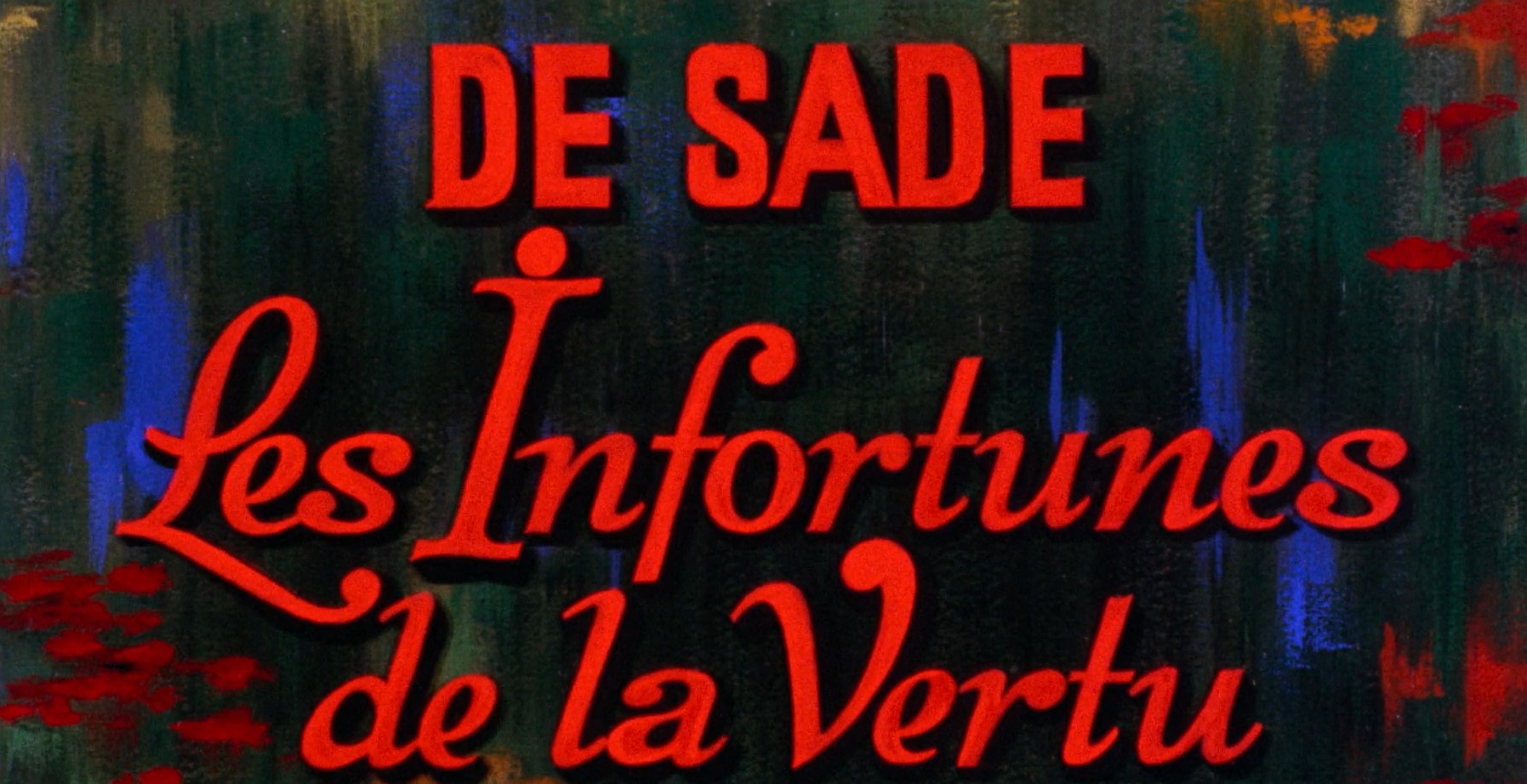
On the heels of my own personal overseas trip to France, a trip for pleasure if you must know, I found it timely and fitting that the Jess Franco directed film, the Marquis de Sade’s “Justine,” would be the next celluloid critique of enticing pulpy obscura.  A part of a pair of Marquis de Sade-themed productions from producer Harry Alan Towers, the other being “Eugenie,” the Eurotrash sexploitation is based off Marquis de Sade’s 1791 novel Justine, or The Misfortunes of Virtue and is adapted for screen by Towers from an original treatment penned by Arpad DeRiso (“Death Steps in the Dark”) and Erich Kronte. “Justine” is one of Franco’s most ambitious visual epics with ornate time period customers, elaborate and grand locations, and an anthology of sorts of the titular character’s misadventures through France that disenchant her chastity. Corona Filmproduktion and the Aica Cinematografica S.R.L. served as the co-productions of this Italian-Spanish 1969 film.

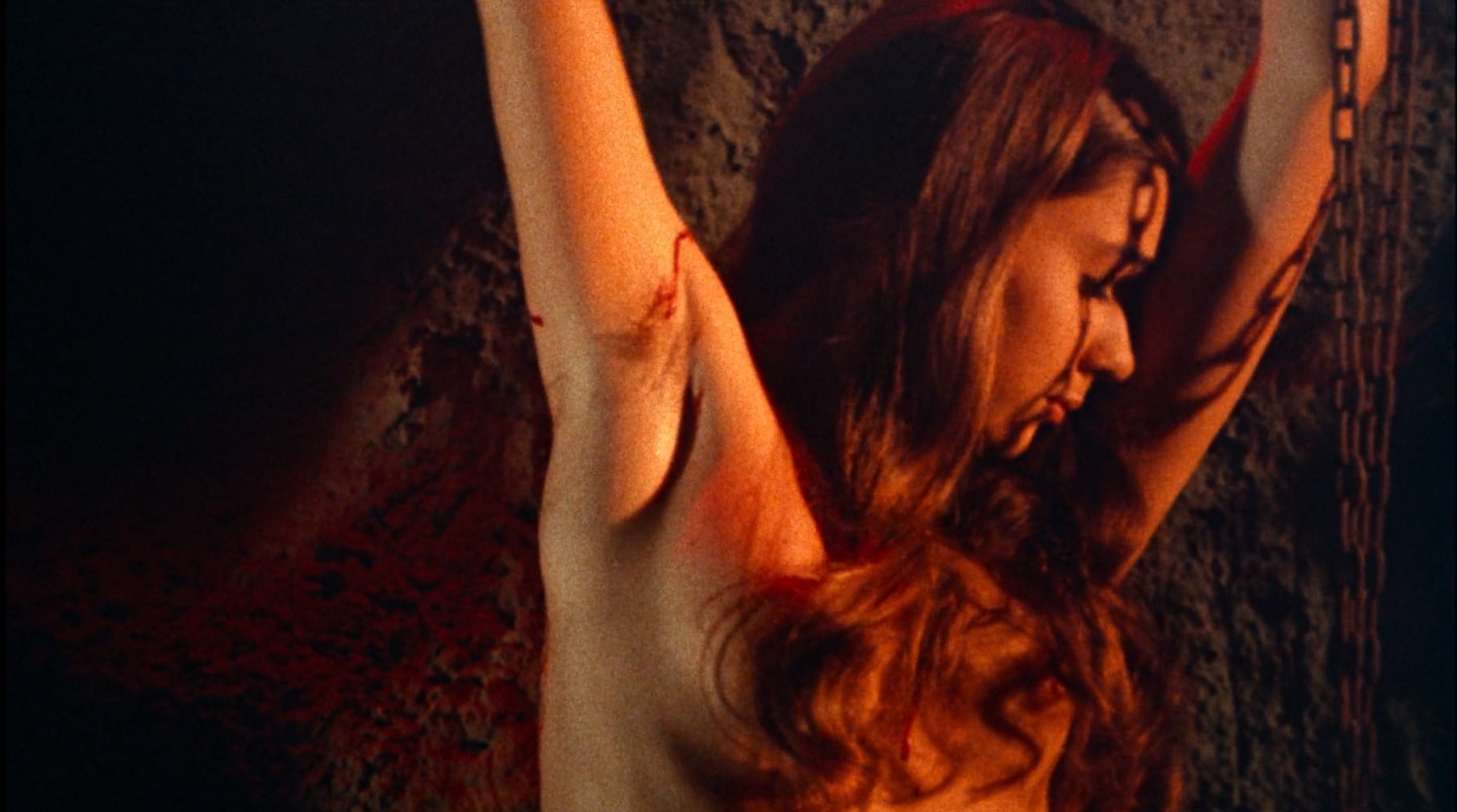
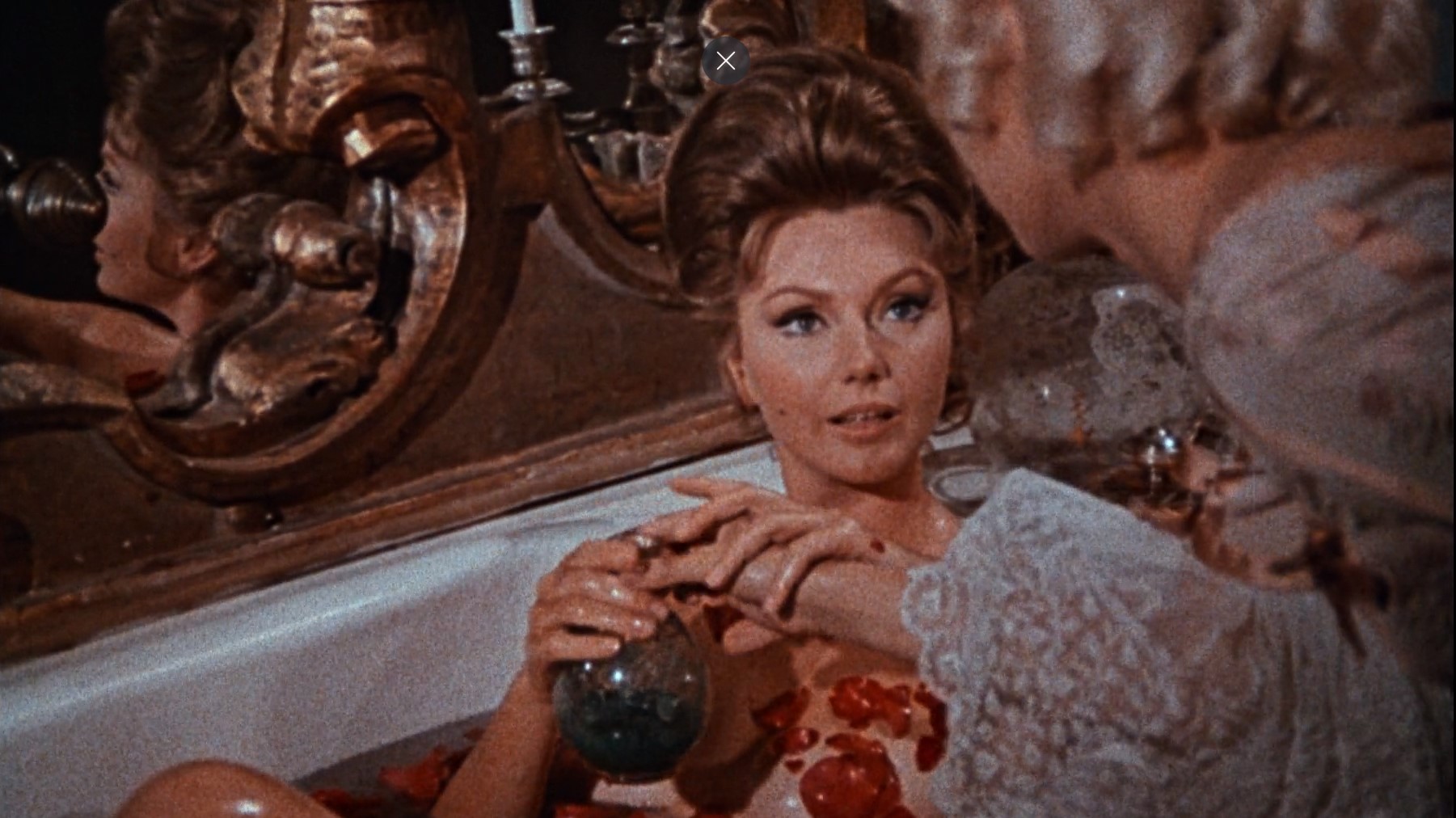
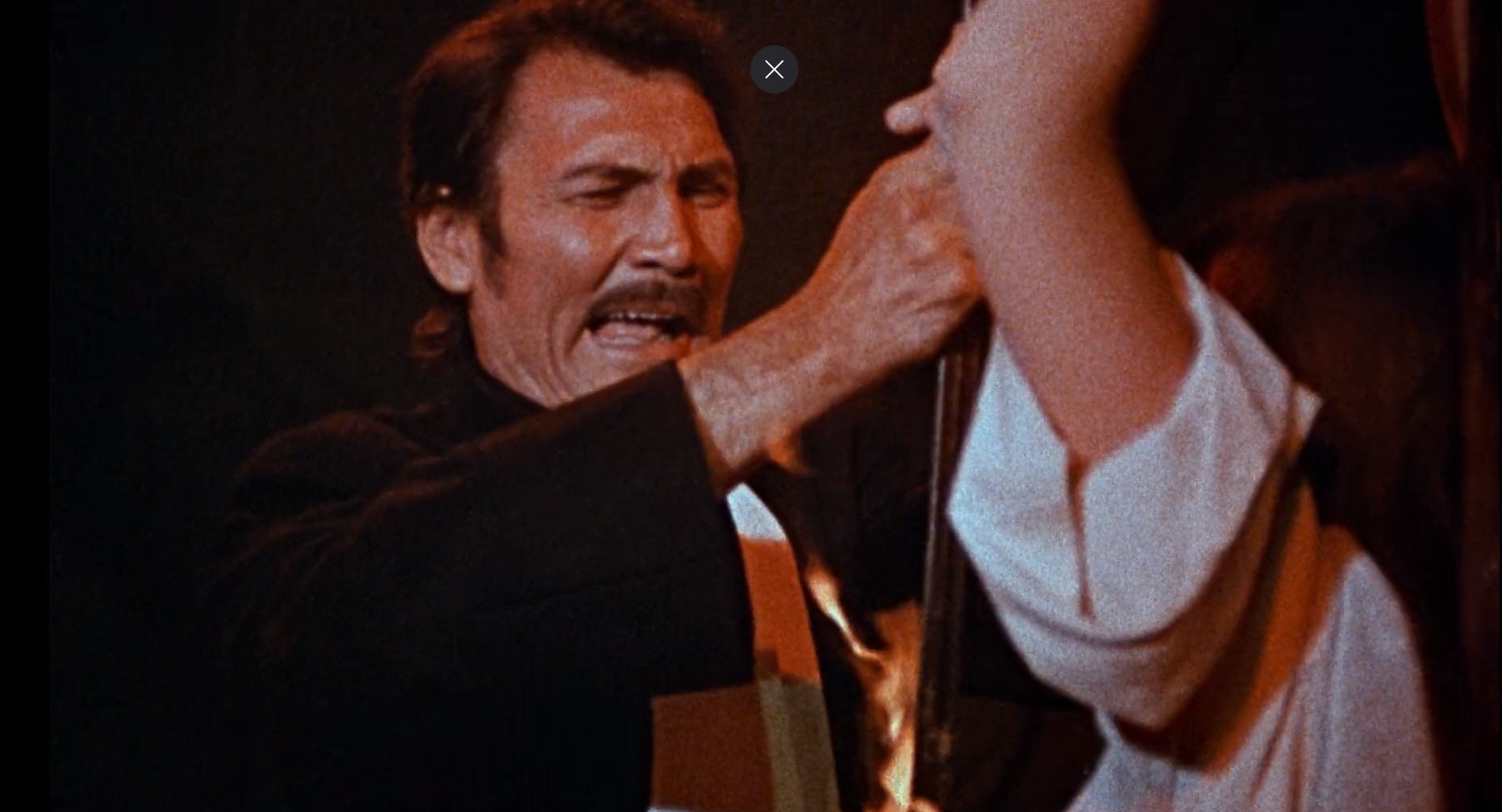
Perhaps the most recognizable and most notable adaptation of Marquis de Sade’s novel, “Justine” is also popularized by its identifiable cast with big names in not only Europe but also in America. The opening scenes with Klaus Kinski, in a wraparound narrative as the Marquis de Sade himself imprisoned and suffering visions of bloodied and bound naked women, immediately draws you into the “Nosferatu the Vampyre” and “Schizoid” actor’s character plight and muted damnation into writing about virtue, a misfortunate respectability. The other famous face in the film, one that spans from Europe to the U.S., is Romina Power as the titular “Justine.” Power, daughter of actor-songwriter Tyrone Power, was, in her own right, a well-known Eurovision singer after the release of the Franco film, but it was her father’s musical talents who landed the sweet-faced Romina into the denigrated young woman role. While Kinski acts on pure facial expression alone, using his iconic, distinct facial features, Power offered a more rigid approach like a child locked by confusion and while unintentional and usually not what any filmmaker wants in a devoid of relaying vicarious expressive emotions, Power naive innocence proves key to Justine’s, well dare I say it, naive innocence. Power’s beauty alone could have stood ground in making the attack from angles perversity film work like a charm. One of the more surprising casted members is Jack Palance. Yes, Curly from “City Slickers” or Jake Stone from “Cops and Robbersons” outlines the formidable pleasure-seeking cult leader Brother Antonin with such gusto flamboyance, the must-see and most-enjoyable performance seemingly feels alien to the usual stoic and stern typecasted actor who could rival Clint Eastwood with a fierce thousand-yard stare. Having co-starred in the Franco-de Sade film “Eugenie” a few years later, Maria Rohm, aka Harry Alan Towers wife, plays the role of Juliette and while the story is ultimately a dichotomy of virtue and sin, there’s an imbalance between the two characters for screen time. The Marquis de Sade’s novel was named “Justine” after all. For her alotted screen time, Rohm provides a suitable sinful scarlet woman climbing the aristocratic ladder by cheating, stealing, and killing her way to the top. The cast fills out with Harold Leiptnitz (“The Brides of Fu Manchu”), Horst Frank (“The Cat o’ Nine Tails”), Gustavo Re (“Horror Story”), Sylva Koscina (“Uncle was a Vampire”), Akim Tamiroff, Rosalba Neri (“The French Sex Murders”), and “99 Women’s” Mercedes McCambridge in an unforgettable role as a nasty gang-leading woman whose high-velocity cruelty rockets are so homed in on Justine it’s explosively devastating to watch.

Having seen the elegance of interior architectures inside Paris’s Opera house, walked the cobblestone streets surrounding the monumental Eiffel Tower, and taking in the laissez-faire of the French way of life, I can honestly say Jess Franco captures France impeccably well for an self-exiled Spaniard known more for his sleaziness and horror than his efforts in cinematic expressionism.   Arching with one big showcase revolving around the idea that virtue will get you nowhere and will be nothing but trouble, ultimately putting to question the validity of the decency concept, the narrative is broken up into a mini-scenarios, mostly of Justine being completely subjugated to the wicked whims of others and a handful of Juliette erecting a better life off the backs of others she’s duped or snuffed.  Franco mastered false hope and misconceptions with each of Justine’s encounters as they lure her in with promises of salvation to then only kick her when she’s down and reap full advantage of her inexperience and gullibility that the world is full of good people.  Sordid and cruel, “Justine” is a contradiction of actionable cynicism in the foreground of depicted magnificence in location, costume, and cinematography choices that hews into the coarse callousness; one particular scene comes to mind involves Jack Palance’s Antonin arranged with hand positioning that abbreviates the name Jesus Christ and as Antonin is holding this hand arrangement, he seemingly glides or floats down the stone corridors toward Justine, demonstrating religious imagery as a form of abusive power or corrupted guidance to serve one’s own deviant devices.  Though labeled in some circles a sexploitation film and certainly full of skin from Romina Power, Maria Rohm, and Rosalba Neri amongst others peekabooing their assets through cut potato sacks during the sex slave orientation scene, much of the sex is heavily implied with a limited gratuitous outcome.  Before going fully into an Eurotrash market by the late 70s and all the way through to the 90s, Franco made every effort to be a considerable filmmaker for a broad audience in numerous countries and his dislike for censorship shines through to his work, despite the likelihood of costing him acclaimed fame as a director. 

“Justine” arrives on 4K UHD in a Blu-ray combo set from Blue Underground.  The two disc set is AVC encoded Blu-ray 50gig and a triple layered Blu-ray 100gig with 1080p (standard BR) and 2160p (UHD) high-definition resolution, and presented in the original European widescreen aspect ratio of 1.66:1.  The brand new 4K restoration from the uncensored original camera negative of the 35mm film with Dolby Vision HDR is a foremost upgrade to the highest power, an ultra-balanced grading that reels in a wide variety of colors from interior to exterior that helps bring the ornamentation of 18th century France to a vivacious life on screen.  The saturation is enriched and finitely retuned to deliver the best and naturalistic grading as humanly possible, or as current technology allows.  The Blu-ray offers a just as reasonable presentation but does lack that high attention to detail because of the lower pixel count.  Bitrate decades are a comfortable average in the high 30s to low 40s.  The UHD and standard Blu-ray offer a clean and free from compression artifacts with immeasurable format capacity to render an unimpeachable picture. Both formats come with an English DTS-HD mono, dubbed in English by voice actors and not the original cast. No hissing, popping, and only a slight interference hum. Dialogue is dub boxy but clean, clear, and right forefront without question of what’s being discoursed and is well-folded into the ambient and Bruno Nicolai epic vein-coursing score that triumphs a military march over a classical base. English SDH are optional. In regard to special features, both formats include a new audio commentary with film historians Nathaniel Thompson and Troy Howarth and the French trailer, but the Blu-ray contains archive interviews with director Jess Franco and writer-producer Harry Alan Towers, an interview with author Stephen Thrower of Murderous Passions: The Delirious Cinema of Jesus Franco, a new interview with actress Rosalba Neri, in Italian with English subtitles, On Set With Jess, a newly expanded poster and still gallery, and a Jess Franco dreaded censored cut of the Americanized shorter version of the film under the “Deadly Sanctuary” title in HD and clocking in at 96 minutes, a nearly 30 minutes shorter. The physical features mirror the “Eugenie” 4k/Blu-ray release with a black Blu-ray snapper case with similar thickness. A shackled Justinne graces the front cover, as with the previous DVD Blue Underground release, and has the same cardboard slipcover with an oval shaped like mirror cutout to not block the half-naked Romina Power. Back covers are both the snapper case and cardboard cover have the same layout design but different still images on each. Inside, there is a disc on each side of the case held in by a push lock. The UHD is a sizzling infrared and sultrier posed version of the snapper cover while the Blu-ray, in the same red hue, is a composition of characters clustered together in a circular design. The film comes not rated, region free, and has the presentation feature with a runtime of 124 minutes. The Marquis de Sade divulges a sardonic, topsy-turvy belief that the more you stay virtuous, the more trouble follows as it’s the way of the world and the more you swindle, the more headway you make in life. Jess Franco brings the Marquis’s vision to cinematic life with a grand and sordid tale, dissevering the two ways toward their individual soul crushing path, and discovering morality within the immoral.

Own Your Piece of Virtue with this 2-Disc “Justine” set from Blue Undergrounda and MVD Visual!  

Copperton Cult Commands You to be EVIL! “Heartland of Darkness” reviewed! (Visual Vengeance / Blu-ray)

Own Your Copy of the Lost Linnea Quigley Film “Heartland of Darkness” by Purchasing at Amazon!  Click Here to Amazon.

Copperton, Ohio – a quaint and quiet, unsuspecting small town if looking to downsize from the big city hazards.  However, beneath the provincial veneer lies a satanic cult spearheaded by the local Reverend Donovan and his flock of townsfolk worshippers.  Donovan’s grip reaches far beyond just the local municipality as the insidious cult schemes to turn the state’s top officials into devoted followers of Satan.  Copperton’s new local newspaper editor, Paul Henson, along with eager reporter, Shannon Cornell, use their journalistic gut instincts to unearth and expose the corruption by Donovan up to the ladder of the town’s sparse governmental hierarchy, but with only a few residents unsubscribed to Donovan’s fanatical sermons, Paul and Shannon have nowhere to turn in order to protect themselves, Paul’s daughter Christine, and the entire state of Ohio from succumbing to Satanic domination. 

Once lost in limbo for three decades, “Heartland of Darkness” finally sees the light of retail shelves day!  Left unfinished for many years, director Eric Swelstad, then an Ohio State film student, supervises the completion of the horror thriller that revolves around satanic cults, grisly sacrifices, and sheep mentality based on the 1980’s satanic panic craze that swept the nation.  Penned by Swelstad, who moved on with this lift and helmed a handful of direct-to-video titles, such as “The Curse of Lizzie Borden 2:  Prom Night” and “Frankenstein Rising” in the early 2000s, and filmed in and around Columbus and the Granville village of Ohio, the 1989 principal photographed production was thought to be ultimately completed by 1992 but due to funding and production constraints, that was not the case.  The film also went through a couple of other titles, beginning with Swelstad’s original script title “Fallen Angels” and then changed to “Blood Church” at the behest of a possible financier that eventually fell through.  In the end, the film settles on “Heartland of Darkness” as a privately ventured production Steven E. Williams (“Draniac!”), Wes Whatley, Michael Ray Reed, Thomas Baumann, Mary Kathryn Plummer, and Scott Spears (“Beyond Dream’s Door”) serving as producers.

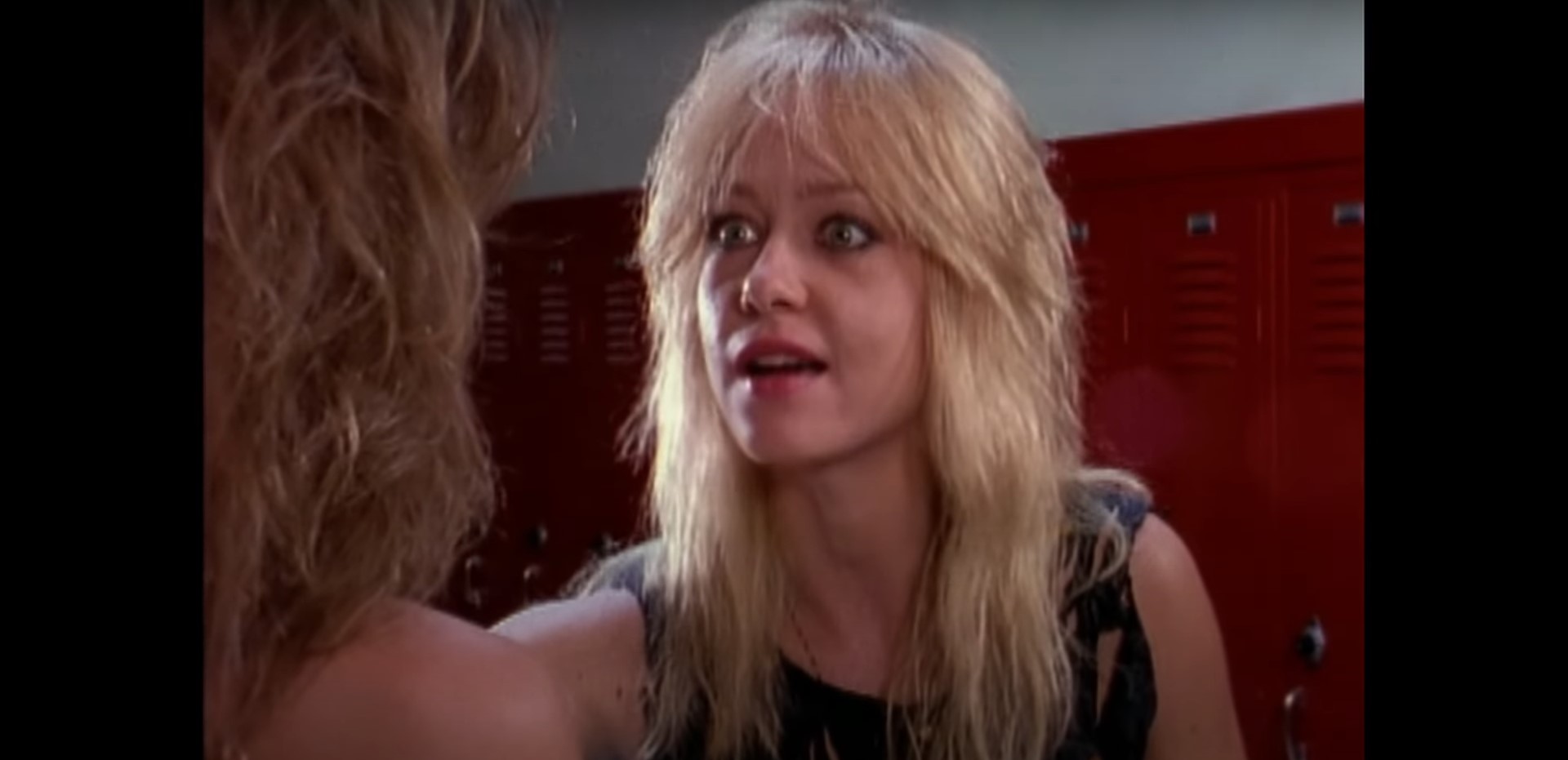
One of the reasons why the obscurity adrift “Heartland was Darkness” was so sought after by horror fans is because the title became one of the lost films of scream queen Linnea Quigley.  Standing at only 5’2’’ tall, the “Return of the Living Dead” and “Night of the Demons” actress was a hot commodity during the late 80’s and a genre film giantess who ended up having a fairly prominent, written-in role just for her hire in what is, essentially, a student film.  Quigley’s role as the town’s high school teacher, Jessica Francine, makes the hormonal boy in me wish my teachers actually looked than beautiful and provocative in high school, but in the same perspective, Quigley doesn’t appear or is barely older than Sharon Klopfenstein as Paul Henson’s daughter, Christine.  The two share a high school hallway moment while sporting crop tops, tight bottom wear, and discussing paganistic occultist Aleister Crowley and Nazi mass murderer Adolf Hitler and while the additional scene gives Quigley screen time, it evokes risibly campy optics.  Dino Tripodis defines the principal lead Paul Henson, a former Chicago Tribunal editor having left the midwestern journalism powerhouse after the death of his wife.  Stepping into a world of cultism, Paul’s eager to save what’s left of his family at all costs by exposing grisly murders as more than just drug-related collateral damage (I didn’t know drug wars were such a big thing in Ohio).  The debut of Tripodis’s performance fairs well enough to solidify himself as the marginalized hero against a Goliathan opposition that’s deep rooted and backed by powerful leaders, but hands down, Tripodis is outdone by Nick Baldasare as the dark featured, maniacally calm Reverend Donovan.  Baldasare has such a tremendous presence as a fire and brimstone agent of the most notable archfiend that his performance swallows the shared screen moments with Tripodis.  A few principals come off as rigid and flat in their efforts.  As the sheriff of Copperton, Lee Page is the biggest offender with an obvious staged act of busting Tripodis’s balls for a better part of the story.  “Heartland of Darkness” is a mixed bag of showings from a remaining hyper-localized cast compromised of new to little experiences actors including Shanna Thomas, Sid Sillivan, Ralph Scott, Dallas Dan Hessler, Ray Beach, Mary Alice Dmas, and with the John Dunleavy in a magnetic role of a cult-crime fighting preacher.

Hard to fathom why but still completely understandable how “Heartland of Darkness” remained in celluloid purgatory for so many years.  Swelstad had tremendous ambitions for a student film that included a visual effects storefront explosion, but the money well dried up to finish shooting, touch ups, effects, and digitizing the filmmaker’s efforts onto a marketable commodity to distribute.   At last, here we are, 33 years later with a finished copy of the “lost Linnea Quigley film” and, boy-oh-boy, does not disappoint, living up to the expectational hype surrounding the film’s once stagnant, hidden from the world existence.  Swelstad creates the illusion of vast world from the small town of Copporton to the big cities where the District Attorney and Governor reside.  Car chases, rock quarries, a church nave, animal intestine smeared ditches, and a slew of constructed sets, an array of offices, and an abundance of diverse exteriors. “Heartland of Darkness” might have a lot going on and is often repetitive in the scenes with Paul and Shannon pleading their case to multiple officials to probe into gruesome deaths and the cult’s leadership but not to the story’s detriment as all the progressive storyline dig Paul and his small band of investigators into a deeper danger hole with Donovan and his Devil devotees under the guise of God’s Church. Scott Simonson’s entrail splayed and blood splattering special effects culminates to a shotgun showdown at a virgin sacrifice and an impressive full-bodied impaling that is, frankly, one of the best edited shots of the film. “Heartland of Darkness” is rayless and scary, callous and cold, formidable and shocking with a pinch of sex and is finally within our grasp!

Visual Vengeance, a pioneer in curating the lost, the forgotten, and the technically shoddy indie cult and horror films, releases for the first time on any format ever “Heartland of Darkness” on Blu-ray. Coming in as VV08 on the spine, the Wild Eye Releasing banner strays their first seven SOV features to bring aboard a 16mm negative transfer, director-supervised from original film elements of the standard definition masters. Visual Vengeance precautions viewers with the usual precursing disclaimer that due to the commercial grade equipment and natural wear of aging, the presentation is the best possible transfer available, but, honestly, the full screen 1.33:1 aspect ratio presentation looks outstanding without much to critique. Obvious softer details were expected but with the celluloid film, there’s not much in way of macroblocking or tracking complications as common with shot-on-video tape features. Compression verges to a near perfect reproduction of the picture quality. Skin coloring and overall grading is congruously natural in grain and stable image. The English stereo mono track doesn’t pack a punch but isn’t also frail with strong mic placement and the dialogue is clean and clear of imperfections as well as major hissing or popping. The faint 16 mm camera whir can be heard but isn’t distracting, adding a comforting churr to the footage. Optional English subtitles are available. Special features include a new 40-minute behind-the-scenes documentary Deeper into the Darkness, an audio commentary by writer-director Eric Swelstad, actor Nick Baldasare, cinematographer Scott Spears, and composer Jay Woelfel, a new interview with cult icon Linnea Quigley, commentary with Tom Strauss of Weng’s Chop magazine, an archival Linnea Quigley TV interview, the complete “Fallen Angels” 1990 workprint, the same workprint with audio commentary with Swelstad, vintage cast and crew Ohioan newscast interviews in the Making of Fallen Angels, the original promotional video for “Blood Church,” a behind-the scenes image gallery and footage, and the original TV spots and trailers, of this feature and other Visual Vengeance films, from the static, composite menu. Ready for more? “Heartland of Darkness” comes with just as much physical bonus swag with a limited-edition prayer cloth, a six-page liner notes from Tony Strauss complete with color beind-the-scene stills, a folded mini-poster of a leather-cladded Linnea Quigley’s high school hallway scene, and retro Visual Vengeance stickers inside a clear Blu-ray latch snapper with new, illustrated cover art that also has reversible art of the original “Blood Church” promo art, sheathed inside a cardboard slip cover with a different and new illustrated cover art. The region free, 101-minute release is unrated. Visual Vengeance continues to pump out gilded, undiscovered treasures and giving them the royal treatment. For “Heartland of Darkness,” this sublime release was 33 years in the making and is one Hell of a bounty!

Own Your Copy of the Lost Linnea Quigley Film “Heartland of Darkness” by Purchasing at Amazon!  Click the Cover Below.

Not All Zombies are EVIL. Some Zombies Save Lives. “The Loneliest Boy in the World” reviewed (Well Go USA Entertainment/ Blu-ray)

“The Loneliest Boy in the World” on Sale Now at Amazon.com!

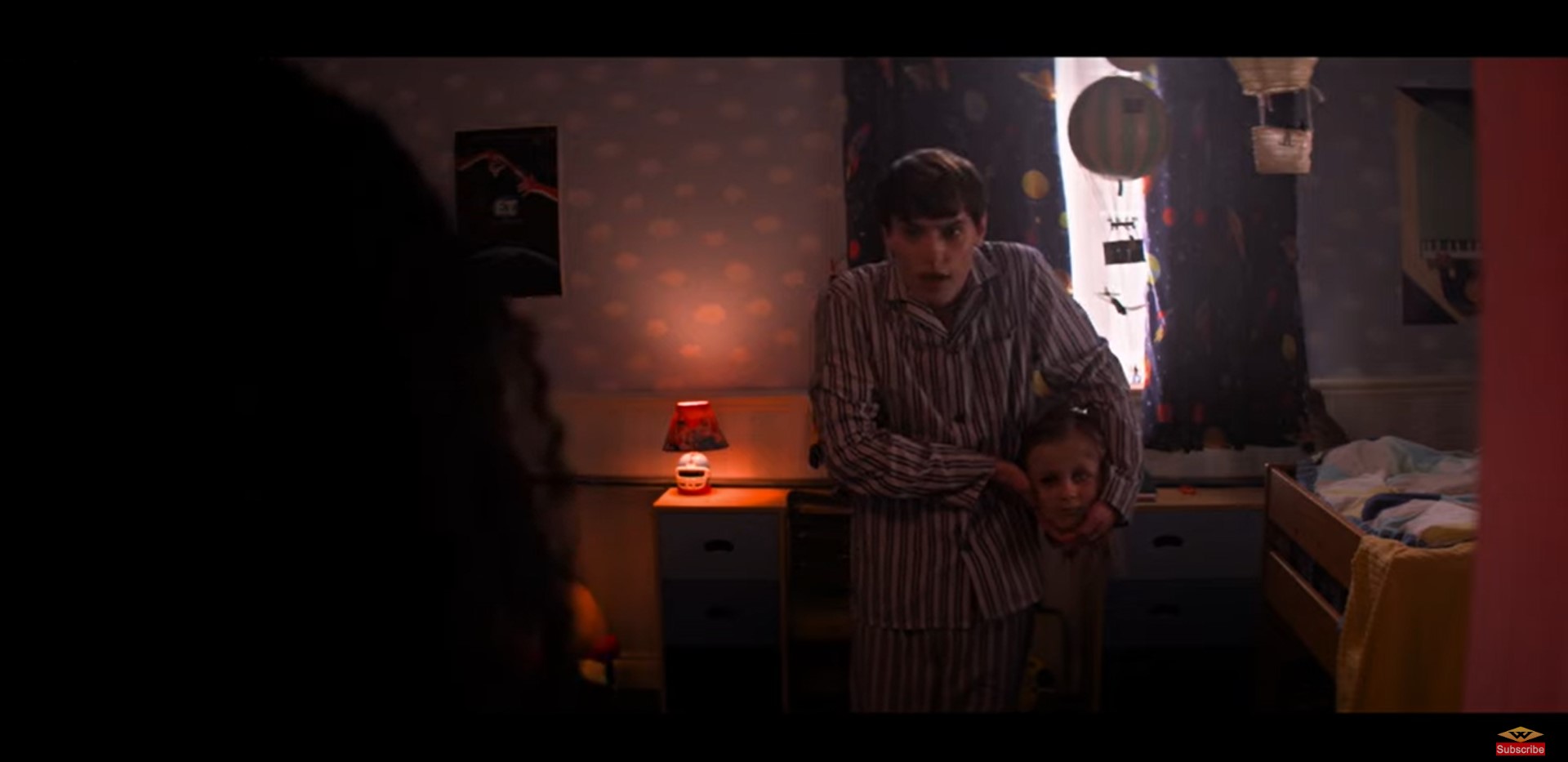
The unexpected tragic death of Oliver’s mother, involving a pool, a television, and a garden gnome, places the now aged-out and deinstitutionalized Oliver into a difficult position. The sheltered, socially awkward young man, living by himself in his mother’s home and still makes like his mother is still with him, is given a last chance ultimatum from his supportive social worker and a pessimistic psychologist to make friends, to lead a normal life, and to sustain impendence or else he’ll have to return to being institutionalized as an adult. Local contemporaries single out Oliver for being weird, unusual, and a loner to the point that his childlike and naive mind turns him desperate enough for a friend to dig up corpses, those who used to be well-liked in the community, but when one morning the exhumed bodies come to life as a nuclear family that eats, breathes, and is sort of living. Though rotting from the outside, the undead family encourage and advise Oliver through his toughest life challenge yet – to be normal.

Described as a modern fairytale with zombies, “The Loneliest Boy in the World” is a satirical comedy horror about the rite of passage into adulthood from the screenwriting team of John Landis’ “Burke & Hare” writer Piers Ashworth, producer of “Director’s Cut” Brad Wyman, and “Maximum Overdrive” star and “Rated X” director Emilio Estevez. Director Martin Owen (“L.A. Slasher”, “Let’s Be Evil”) helms the late 80’s deco piece with a Halloween backdrop, fitting for any undead family to suddenly animate into an eclectic and eccentric fashion that encircles what it means to understand family values in a very trendy niche specific of the late 80’s style. The feature is produced by Piers Ashworth, Ryan Hamilton (“Possessor”), Matt Williams (“Let’s Be Evil”), Pat Wintersgill (“Amulet”) and a conglomeration of executive producers including Emilio Estevez and is a production of the London, UK-based Lip Sync in association with Future Artists Entertainment and presented by Great Point Media and Well Go Entertainment.

Max Harwood gives a peculiar performance as a soft-spoken, sheltered-to-a-fault mother’s boy, Oliver, with a delusional depiction of reality. Though Harwood’s performance pairs well enough with Martin Owen’s rocky shore small town of equally asymmetrical corporeality, the titular Oliver comes off derivative of done before loners and Harwood provides little range to fully arc with the character’s transition from a naive young adult on the fringe of losing everything to the compendious hero of his own story by unearthing not only dead bodies that come to life but learning from their advice, truth, and experience to flesh out his own path of courage and confidence. A part of the LGBTQ community, Harwood is joined by fellow community comrade Tallulah Haddon in a strange turn of casting as Oliver’s love interest, Chloe. Queers play straight in the innate course of acting that, as of late, has often been called out for its hypocrisy of an actor portraying something their actually not. The “Black Mirror: Bandersnatch” Haddon is an outsider to Oliver’s surroundings as isn’t influenced by those who have labeled Oliver weird or strange. Instead, Oliver and Chloe spark interest out of hate for being different, a relatable scenario for someone in the gay community. Oliver’s undead family is undoubtedly the best lot with a wide range of happy homemaker personalities and a decaying best friend that supports Oliver’s wings to fly from the next. Susan Wokoma is the stay-at-home mother with a knack for reading the room while her skin peels off and falls to the floor. Ben Miller is the red-blooded Frank that displays glimpses of being a renaissance man at times and Miller plays the beer drinking, jack-of-all-trades father figure aptly. “Harry Potter and the Half Blood Prince’s” Hero Fiennes Tiffin comes on the scene cool and suave in a skin that’s literally drooping off his bones and his eyes have disintegrated from his sockets; Tiffin’s charming, lively, and a source of verbal wit that would be missing from the film. Lastly, Zenobia Williams rounds out the family as Mel, the little sister who is frankly underused and is quiet and subservient to being nice to her living older brother. “The Loneliest Boy in the World’s” cast rounds out with Jacob Sartorious, Hammed Animashaun, Alex Murphy, Sam Coleman, Mitchell Zhangazha, and “The Curse of Buckout Road’s” Evan Ross and “Alone at Night’s” Ashley Benson as the two sole American actors in a contending professionals betting on Oliver’s outcome in friend making.

The casting is interesting as a melting pot of nationalities and cultures intertwined into an alternate reality where the dead can be willed alive. Again, “The Loneliest Boy in the World” is marketed as a modern fairytale and it’s comparable to the likes of if Andrew Currie’s 2006 “Fido,” where in a managed post-apocalyptic world the zombies are kept on as servants for the living in a 1950’s backdrop, was under the Peter Jackson landscape lens of hilltops, seasides, and graveyards. The obvious farce in the late 1980’s pattern aims to set the bar for a number of themes, including growing up into adulthood, to bring back traditional family values in order to push out and correct absent parent trauma, and to embrace the family as nurturing guidance. Oliver’s struggles are frugally displayed but that doesn’t mean the first act misses the mark on plotting the dots of his lonesomeness with being the target of bully teasing, the subject of an insensitive bet of established adults, and being in a position of having no living family or friends to slake his dependence. The one thing to note about Oliver’s sudden lifeline cut is that he doesn’t appear to bothered or frantic about the death of his mother or the prospect of being alone and possibly end up institutionalized. Instead, the unsocialized introvert falls into a semi-chimera state where he’s still tethered to his mother as he watches her favorite television shows and recalls their play-by-play during his graveside visits with mom. The whole concept of death is seemingly foreign to Oliver as he never calls the demise of his mother her death but rather an accident and he finds exhuming recently dead corpses to be his friends normal though he obviously knows it’s illegal and unacceptable normal behavior as he quickly hides or disguises the pre-animated bodies when visitors show up at his doorstep. There’s never an explanation why the dead come to life, but one thing is for sure is that the expired exhumed did a Frosty the Snowman just for the sake of Oliver’s desperation for companionship and, perhaps, that’s the entire reason why. The need for family was granted to the nice, dissociated boy in a lightning bolt of unexplainable supernatural serendipity to right all the bad things that are happening and will happen to him. Zombies are typically resurrected to take life and eat away at the living while Oliver’s zombies are atypical, restoring life and providing hope in an optimistic paradoxical universe.

Dark and quirky, “The Loneliness Boy in the World” is heartwarming with cold bodies. Well Go USA Entertainment releases the AVC Encoded, 1080p high-definition Blu-ray with a widescreen 1.78:1 aspect ratio. The presentation is quite colorful with a vast palette of foundational primary colors sprinkled with retro-vision, such as tape camcorder view, that splits the difference in extracting the vivid pink-laden house interior as well as the spot colors on the characters with stark contrast against the lush greenery background or the rocky, wave crashing shoreline. Night sequences are often blue tinted but not overly saturating. I didn’t note any issues with compression as blacks are generally deep without splotchiness or banding. Details are mostly fine with intricacies more expressive on the decomposing bodies that give off great muscle, skin, and organ decay. The Blu-ray comes with a single audio option, an English DTS-HD 5.1 Master Audio track. Dialogue never has to outbattle the ambient tracks or The Invisible Men pop score. The ambient range really comes through the auxiliary channels well with the central element focusing on the dialogue. English subtitles are optional. Bonus features include a short behind-the-scenes with more fluff from the cast who seemingly can’t get enough of this project and the theatrical trailer is also included. The physical release comes in a standard Blu-ray snapper with an illustrated mesh artwork of essentially every character in the film, even the dead Dachshund. “The Loneliest Boy in the World” has a runtime of 90 minutes, is regionally hard coded A, and is rated R for language and violent content. Enjoyable yet explainable, “The Loneliest Boy in the World” is more defined by its cadaverous twist of fate than the theme it attempts to convey; nonetheless, the Martin Owen film has heart, soul, and the living dead.

“The Loneliest Boy in the World” on Sale Now at Amazon.com!