In the Middle of the Timor Sea, Lurking EVIL’s Hungry for Raft Afloat WWII Survivors! “Beast of War” reviewed! (Well Go USA Entertainment / Blu-ray)

“Beast of War” on Blu-ray from Well Go USA Entertainment!

Timor Sea, 1942 – A group of newly trained Australian soldiers are heading to fight in the second great war when a Japanese air raid torpedoes their ship, stranding seven soldiers on a floating shrapnel piece of the ship’s hull.  With little food, few defensive measures, and no water, rationing their supplies is key to survival as they float back in the direction they came.  When a hungry great white shark attacks their makeshift lifeboat, dying of thirst is no longer top concern.  Below the surface, the predator circles the prey, sniffing every droplet of blood from their wounds, and striking when the opportunity presents itself to drag one of them under the water.  As hidden danger lurks below, tensions rise above the surface between them and their warfare enemy isn’t quite done with the lot yet either.  Nowhere to run, nowhere to hide, they must fight with everything at their disposal to survive.

Most U.S. military enthusiasts know of the U.S.S. Indianapolis, a heavy cruiser warship sunk by Japanese torpedoes after delivering the atomic bomb on a covert mission, killing over 1000 naval servicemen, and dumping the rest into shark-infested waters where more lives succumbed to mother nature’s deadliest aquatic predators, but I’m sure the sinking of the HMAS Armidale in the Timor Sea is lesser known but follows parallel catastrophes and survivals to the U.S.S. Indianapolis with Australian soldiers left stranded in the middle of a shark-infested Timor Sea of the Indiana Ocean after their ship was sunk by Japanese forces.  Writer-director Kiah Roache-Turner, the Australian filmmaker behind the zombie epic “Wyrmwood” films and “Sting,” gets his feet wet with blending historical war action with sharksploitation in his latest film “Beast of War,” produced by “Daybreakers’s” Chris Brown and Blake Northfield, who saw 2025 as the year of producing period shark horror along with “Fear Below” involving a bull shark and the retrieval of sunken car in the early 1900s.  “Beast of War” is a production of Bronte Pictures and “Pictures in Paradise.” 

“Beast of War” doesn’t begin with a ship full of soldiers you barely get to know before being blown out of the water and become chum for a chomp-happy great white shark.  This route would have undoubtingly provided less setup of character and situation.  Roache-Turner takes us back to bootcamp where the ragteam bunch of privates learn fighting tactics, survival tricks, and comradery.  That last one, comradery, is an important and, in fact, it is the theme of Roache-Turner’s story introduced early in bootcamp trials and present through to the end.  Leo knows all about a comradeship being an aboriginal, Australian natives with an ancestral culture rich with a sense of community.  Embracing his heritage in the character Leo, Mark Coles Smith (“We Bury the Dead”) instills everything morally just within the ranks of man and militarism, earning the respect of his outfit apart from fellow private Des Kelly.  Sam Delich (“Christmas Bloody Christmas”) acts as a simmering bigot against the aboriginal, and perhaps to all those who are not white based off the dialogue, and this places Kelly to be the very anthesis of Leo in how he represents self-serving qualities and an intolerance for other races.  Kelly goes through satisfactory arc when he finds his back against the wall and his acts cause consequences his soul can’t recover from whereas Leo’s confidence brings him selfless courage though his own tragic backstory, the loss of his younger brother to a man-eating shark, may cause him to be more reckless against his own stare into death’s black eyes.  Joel Nankervis steps into somewhat of that little brother role for Leo as Will, a more of a thinker than a physical specimen of a soldier taken under Leo’s wing as Des Kelly shuns the weakest during comradery trials.  The remaining cast fills in with shipwreck beaten meat for the posturing, ultra-aggressive shark as well as other bootcamp attendees in Maximillian Johnson, Lee Tiger Halley, Tristan McKinnon, Sam Parsonson, Lauren Grimson, Laura Brogan Browne, and Masa Yamaguchi.

World War II soldiers versus a ravenous great white shark.  While that scenario might induce post-traumatic stress on a veteran navy seaman who lived through the watery Hell, for this guy, the sharksploitation scenario is salivating entertainment.  Highly stylized through color gels, fog, and a practical shark that’s damn scary, “Beast of War” not only brings high tension swimming beneath the surface but also educates history with a great deal sensationalism, evoking varying levels of bravery, the change in human condition, and a calming sense of sacrifice for a brother in arms, even if the shark took their arm.  The shark itself is pure nightmare fuel and though for cinematic value, it’s also an unfortunate continuation of demonization of the majestic creatures, especially when this particular great white shark acts and looks off from the real deal.  The movie shark, appearing with scars and a giant gaping mouth full of rows of flesh-ripping sharp teeth, doesn’t don the black doll eyes once eloquently put by the salty fisherman Quint in “Jaws.” Instead, this shark’s eyes are cloudy white as if possessed to prey and create havoc amongst the HMAS Armidale survivors, a menacing attribute heightened by the swallowing of an ordinance damaged air raid siren lodged in the interior gill resulting in death wailing screams that indicate its closing presence.  The shark also perches just below the surface with its nose just barely touching the water line, like a puppy dog waiting for a treat, ready to strike when a hand, foot, or even a portion of a blanket that’s wrapped around the injured becomes too appetizing to pass up.  All this adds to the element of certain death if even a toe goes into the water, removing any kind of chance from the safety nets of our minds for anyone who accidently fall or must dive into the water.  Roache-Turner doesn’t burden the shark to be the sole antagonist that spurs problematic situations from a Japanese fighter pilot, to the Des Kelly’s bigotry and self-interests, and there’s even complications from the severely injured parties that threaten their lives.  “Beast of War” is multifaced warfare with jaws. 

If you’re looking for next big shark horror, “Beast of War” on Blu-ray from Well Go USA Entertainment should be your next film! The AVC encoded, 1080p high-resolution, BD25, presented in a widescreen 1.78:1 aspect ratio, doesn’t accommodate Mark Wareham’s visual color range, tinctured with gels and hazed with fog to create that soft glow with blues, reds, and greens, with limited compression that creates black crush around the darker aspects and banding around the outer edges of the coloring. The not-so-hued scenes do depict punctilious details around fatigue textures and the stubby and course skin. The monstrous great white shark in the water, which is a little reminiscent of “Jaws 3-D’s” infamous control room scene, holds more ambiguity than when it breaks the surface, mostly around the gill to the snout to denote the scars, white eyes, and rows of razor teeth. The set stage to mimic a shrapnel raft is greatly constructed with a production design of strewn ship parts, cargo, and deceased bodies floating buoyant about and in play for the protagonist and antagonist to interact against. Wareham and Roache-Turner’s camera movements deliver dynamic scenes between calm and chaos with only seconds apart as the shark can surface at any moment. The English DTS-HD 5.1 master audio offers a complete and complex audio design that very much integrates the background sounds into the problem-at-hand fold. Japanese fighter planes, machine gun fire, explosions, air raid sirens, the swish of a shark in the water, the echoing strains of stretching bulkheads and metal shrapnel, and the back-and-forth splashes of water that give “Beast of War” that extra element of realism and suspense, channeled through the back and side channels to immense audiences inside isolation. Dialogue’s crisp and colorful amongst biting bigotry and Australian military dialect of the era with no issues and obstacles opposing the conveying conversation. English and French subtitles are available. Aside from a string of pre-feature trailer previews for other Well Go USA releases, “Beast of War” is essentially feature-only. A glossy, cardboard slipcover with an embossed title adds a textural bonus overtop the accurate described picture of action. The Amaray inside has the same primary image with no other physical contents. The region A release has a runtime of 87 minutes and is rated R for bloody violent content, gore, and language.

Last Rites: There’s nowhere to hide, nowhere to land, and no one to come save those left behind for the hungry great white in “Beast of War’s” World War II sharksploitation.
“Beast of War” on Blu-ray from Well Go USA Entertainment!

An Invisible, EVILociraptor is No Walk in Jurassic Park! “The Invisible Raptor” reviewed! (Well Go USA Entertainment / Blu-ray)

“Insivible Raptor” Tearing Onto Bluray! Buy it Here!

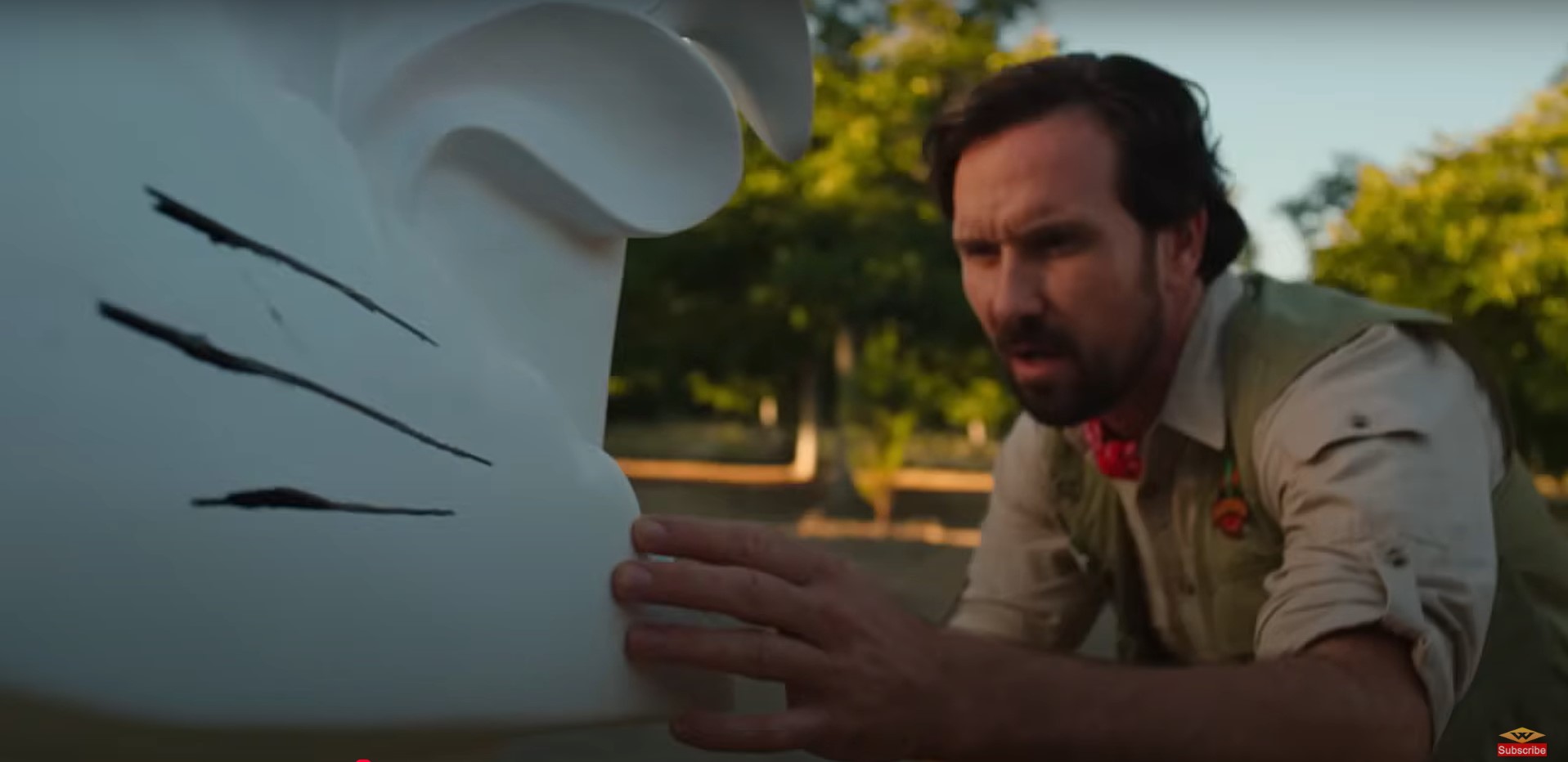
 once promising paleontologist is reduced to being a dinosaur theme park sideshow act after being swindled and sued for a discovery of a lifetime aboard.  When a deadly and intelligent lab created raptor escapes from its maximum-security confines, the paleontologist, an attractive ex-girlfriend returning into his life, and an eager townie security guard with no friends must put a stop to the first living, breathing carnivorous dinosaur in 65 million years, but tracking down an invisible creature with razor sharp talons and teeth is no easy task, and they must follow the carnage and bloodshed of its wake in order to stop it.  With little resources, relying mostly on the paleontologist’s expertise and the chummy security guard’s willingness to take life-or-death risks for his new friends, the trio rope in a local, rough-around-the-edges chicken farmer to persuade the foul ancestor into a madcap trap before the whole town becomes raptor food. 

Audiences shouldn’t care about another “Jurassic Park” sequel.  Instead, any cretaceous period anticipation should all be channeled and focused toward Mikey Hermosa’s “The Invisible Raptor.”  The 2023 comedy-horror is not land of the lost as it lands right in our homes on a new physical media release.  Written between first feature film writers Mike Capes and Johnny Wickham, the “Dutch Hollow” director Hermosa is not one bit phased by the prospect that his main villain is every bit nasty and furious as antagonists come but is entirely out of sight!   With the challenge accepted, Hermosa aims to pull of the next big comedy-horror dinosaur film since “Tammy and the T-Rex” while ribbing in fun it’s bigger, more successful, campy-somber, franchised brethren mercilessly.  Hermosa coproduces the Showbiz Baby and Valecroft production with writers Capes and Wickham as well as William Ramsey and Nic Neary with Well Go USA owning the theatrical and at-home presentation rights. 

Capes writes for himself as the hard-up paleontologist Dr. Grant Walker, a play on Sam Neill’s Dr. Allen Grant, who has succumb to being of caricature of his profession and while the Dr. Walker is downcast despite his credentials, educations, and reputation, opposite him is the town goof Deniel “Denny” Denielson (David Shackelford, “Beneath”), a friendless, family-less, theme park security guard who’s repute amongst his peer is lower than fossilized dinosaur crap, but his attitude remains cheerful and positive.  The two characters complement each other with budding growth in their arcs of Dr. Walker not pushing people away like he did with ex-girlfriend Amber (Caitlin McHugh) and Denny, with every ounce of his hillbilly being, trying to a fault to make a friend.  There’s a slew of eccentric side characters but one not more as colorful as chicken farmer Henrietta McClusky.  Played by the early 70-year-old Sandy Martin, the “Scalpel” role debuting actress who had a profound supporting character career having had a role in “Napolean Dynamite” and “Three Billboards Outside Ebbing, Missouri” in recent years continues her dry humor, dark comedy run with the Henrietta role a crude, rude, and with ton of attitude poultry farmer with a no nonsense way about her and while Henrietta is a deeply sexual creature in her own right, the amorous tension lies in between Walker and Amber that have instantly become two magnets in rekindling their lost flame.  The ease of which the two characters are written to be instantly smitten is greatly construction to be an almost an unattainable relationship by introducing a child with no relationship to either one of them, a decade long gap without a ton of hurt feelings for the other’s sudden decision of career over love, and, the obvious, a large, man-eating, invisible predator repelling the two magnets apart.  Sprinkled with familiar faces, “The Invisible Raptor” rounds out with notable cult film actors, such as Richard Riehle (“Office Space,” “Hatchet”), Larry Hankin (“Armed and Dangerous,” “Home Alone”), and Sean Astin (“Encino Man,” “Lord of the Rings”) as well as a cameo appearance from Vanessa Chester who played Dr. Ian Malcolm’s daughter in “The Lost World” in another potshot at the “Jurassic Park” series.

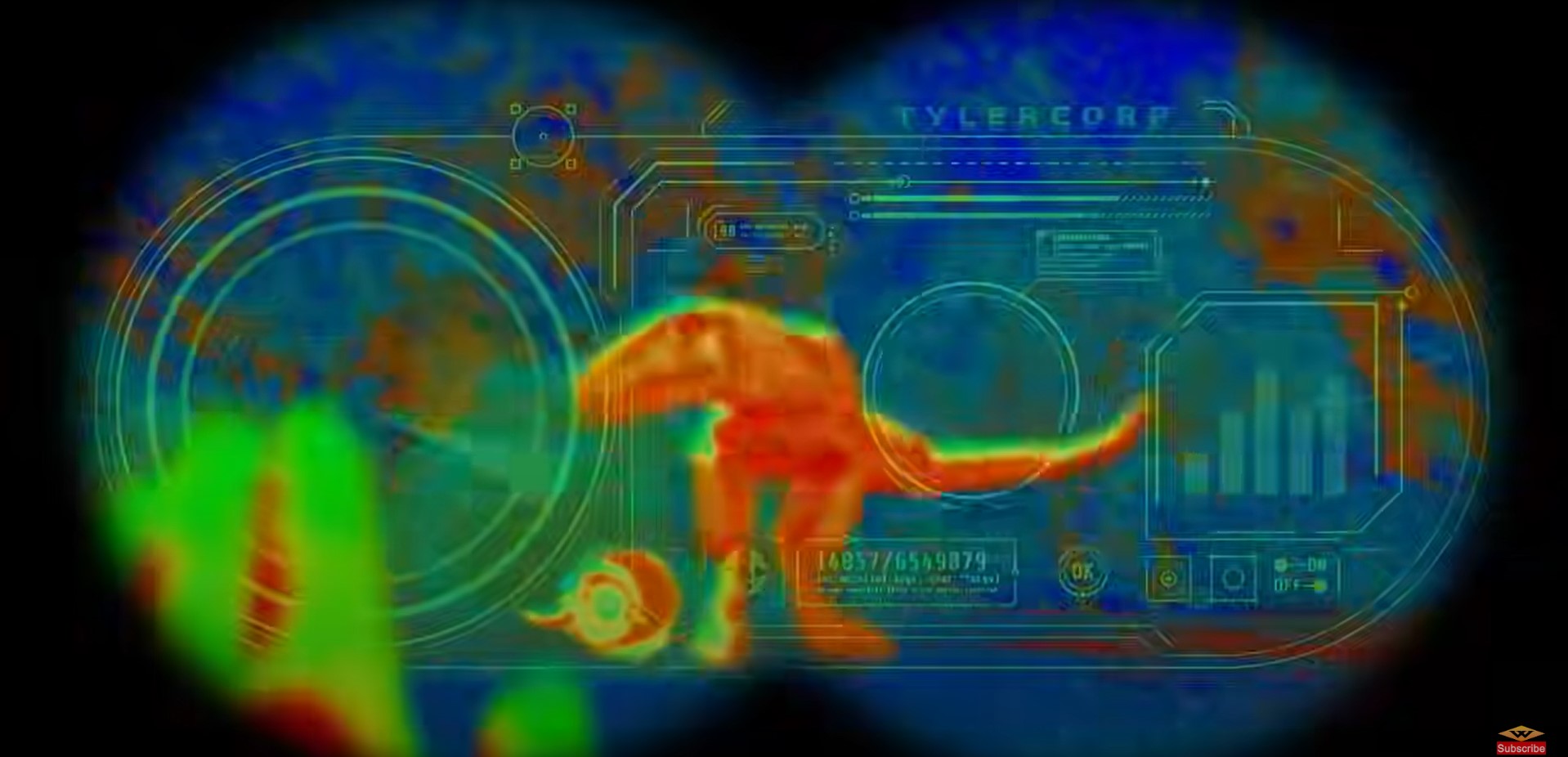
Between the hilariously staged “Jurassic Park” callback moments and an unnerving number of gags around the butt region (raptor feces, fossilized raptor buttholes, butt jokes in general), “The Invisible Raptor” has a lot of humor that’s either smart or misses the mark, but not by much in the cogently confined venture packed full of heart, heroism, and havoc on a prehistoric, science-fiction level.  “The Invisible Raptor” may be a modern-day gory comedy-horror but that gory-horror element combined with a bit of underground covert weaponization of dinosaur has a real throwback sense to the early 90’s to early 2000’s dino-horror, such as the “Carnosaur” films, “Tammy and the T-Rex,” and, of course, “Jurassic Park.”  Dino-horror is a niche subgenre that’s rare explored unless it’s totally satirical (“The Velocipastor,” “The Jurassic Dead”) or rooted more in a lost world aspect, sporadically released throughout the decades with “Raptor Island” or the more perilous journey of “Land of the Lost,” original series and it’s more comedic feature remake.  Hermosa quickly moves out from the testing bunker lab that has been the Raptor’s home and where the scientist treat it like an adored, harmless child, a theme of attachment to harmful things we shouldn’t be attached to and gets right into the mayhem by letting it loose in only a way one could perceive a raptor would – in indiscriminating bloodshed.   Hermosa also doesn’t flinch with an invisible titular foe, one the actors have to mentally conjure up to play against in a combative or cat-and-mouse scene, with neatly composited special and visual effects of floating objects, quickly consumed severed heads, and silhouette work through blood spray, heat vision, and a shower curtain by the talented Steve Johnson (“Lord of Illusions,” “Species II”) and Dorian Cleavenger, both of who bring years of experience and both of whom have worked together for the effects of Robert Englund’s “Fear Clinic.” 

Audiences won’t see this one coming!  “The Invisible Raptor” debuts onto an AVC encoded, high-def 1080p, Blu-ray courtesy of Well Go USA Entertainment.  The single-layer BD initiates some cause for concern on the image presentation prior to viewing but the picture produced is solid and stable with no banding in the darker voids, especially in those areas since there is no Raptor to be seen mostly during the night exteriors, poorly lit underground laboratory, or in the lowly key-lit interiors, there’s more shaded and hallow space exposed in the 1.78:1 widescreen aspect ratio.  Textured details are generally adequate with a softer, smoother touch from capacity compression, coupled with a hazy warm yellow-green lighting scheme.  The more standard, non-stylistic shots have better definition to where the details on Dr. Walker’s paleontologist outfit stand out amongst the eye glazing brown-and-tan colors and in the gooey grooves of the Velociraptor fecal matter complete with yellow kernels of corn.  Visual effects are handled with not too revealed explicitly to limit noticeable computer imagery and keep all that is practical the focus.  Audio options come in two English formats – a DTS-HD 5.1 and Stereo 2.0.  The range on this mix is explosive as it is subtle right down the clicks and grunts of the assumed noises one would be led to believe a prehistorical, carnivorous raptor would make.  Dialogue renders clearly and definitively prominent amongst ensuring bedlam cacophony whenever there’s a dino-crises in a more than one people grouping; the audio compilation has been carefully layered to denote exactly what’s intended to be discerned at that moment. English and French subtitles are available. There are no encoded special features on fluid menu of this feature only release but there is a quick bonus scene at the end credits. The physical copy has only a little bit more in the way of extra content with a cardboard, tactile-titled O-slipcover sporting the current state of arranged character pyramid composite. The snap lock Blu-ray Amaray is standard with the same cover art and no tangible extras inside. Rated R for bloody violence and gore, crude sexual material, drug use, and brief graphic nudity, Well Go USA’s release is region A encoded for playback and has a runtime of nearly 2 hours at 114 minutes.

Last Rites: Though the raptor may be invisible, this release should be seen by all! “The Invisible Raptor” is a hilarious “Jurassic Park” parody with plenty of bite, plenty of fun, and plenty of non-visible computer-generated dinosaurs, especially for those who are feeling the dinosaur fatigue.

“Insivible Raptor” Tearing Onto Bluray! Buy it Here!

Daddy’s EVIL Little Secret. “The Beast Within” reviewed! (Well Go USA Entertainment / Blu-ray)

“The Beast Within” is Calling! Own Your Copy Here!

Infirmed 10-year-old girl Willow witnesses one night a month her mother whisking away her rather distant father into the dense woods deep within the English countryside.  When brought home the next day, her father must be helped carried in, appearing haggard and weak from his strange and mysteriously kept overnight departure far from home.  The secret festers between the parents, as well with her grandfather, to a point where tensions rise to the surface and the family is slowly falling and drifting apart.  One night, Willow decides to sneak onto one of those one-a-month egresses and discovers her father, left chained inside a dilapidated structure in the middle of the wooded nowhere, transforms into a horrible beast.  From that point on, the family secret was no more, and she must come to terms with her parents’ deception and their struggling family cohesion before the next full moon rises above their isolated home compound.

Lycanthrope films are on the rise with the anticipation of two new theatrical releases that have seen positive reactions just by their trailers alone with “The Invisible Man’s” Leigh Whannell staying in the Dark Universe with “Wolf Man,” slated for the silver screen January of 2025, and “Scream of the Banshee’s” Steven C. Miller going wild and hair near this Christmas season with his chaotic and carnage-ladened “Werewolves.”  Kicking it off in the werewolf category however is English director Alexander J. Farrell making his debut fictional feature with “The Beast Within.”  The 2024 released conceited thriller plays on a child’s perception of events, especially when she sees her parents joyless faces, co-written by Farrell and more seasoned screenwriter Grear Ellison (“A Woman At Night”) and both have worked previously on Farrell’s last two projects, a documentary entitled “Making a Killing” that sheds like an antiquated law that results in capping financial need after preventable medical negligence and another cowritten session, a RomCom in “How to Date Billy Walsh” that was also released in 2024.  The UK production comes from a conglomerate of companies in Paradox House, Future Artist Entertainment, and private equity group Filmology Finance and is produced by the father-son duo Gary and Ryan Hamilton of Archlight Films who oversaw global sales of the film, Martin Owen, Tammy Batshon, Spencer Friend, Evan Ross, Sebastian Street, and Paolo Pilladi.

Looking for his next big hit to branch out from the shadow of “Game of Thrones’” bastard hero, Jon Snow, is Kit Harrington taking the headlining role as an intermittent explosive disorder father struggling to keep his family whole because of his own family curse.  Often resembling the HBO role that made him a household name when donning that iconic large fur coat that became an innate symbol of the Stark family, Harrington’s Noah character fails to become uniquely recognized as he’s quite the mystery with little background to his compound abode and his occupation of what seems to be a lumberjack of sorts, always cutting down trees in the nearby forest.  What’s even more mysterious is the family lineage of temporarily transmogrifying into an aggressive, animalistic beast when the full moon is high.  His reason for being cursed stems mostly from anecdotal knowledge of his own grandfather’s tragic history with being plagued by the same condition.  This places Noah’s family onto spider-cracking eggshells as his wife Imogen (Ashleigh Cummings, “NOS4A2”) finds herself loyal to a fault by caring for Noah’s condition but taking the brunt of his abusive behavior all the while daughter Willow (“Caoilinn Springall, “Stopmotion”) initially doesn’t know what’s truly happening but has this underlining fear of her father, noted by wedging her rocking horse underneath her room’s door handle every night.  Willow’s grandfather and Imogen’s dad Waylon (James Cosmo, “Highlander”) serves as a buffer between Noah and his family, maybe even perhaps the voice of reason.  Performances are mostly strong with Harrington forcing Noah’s hand a little to be brutish, a quality that doesn’t quite stick as intended.  There’s also some finale unresolve essentials with Waylon that doesn’t determine his fate as we’re left with only a threadbare implied outcome, an unfortunate state for one of the handful of principal characters.  The supporting actors rounds out with Ian Giles and Martina McClements (“When the Lights Went Out”) who never share scenes with the key intimate cast.

Aforementioned, “The Beast Within” is from the perspective of a child, in this case a child with great imaginative qualities as seen with her hobby of matchitecture of her home and nearby buildings, but the story is also definitively an allegory for an abusive husband and father that uses the lycanthrope mythology as a bestial symbol for one man’s vile nature.  Noah’s deceptive behavior lures in what the family wants, a loving husband and adoring father providing, protecting, and caring for them, but Farrell strings along a hidden truth with spot visual clues of Noah’s true self.  Those clues are terribly evident to the family devolution but there’s also a stasis of hope when Noah’s charm and smile glimmer through the cracks of his monstrous shell that’s mostly kept at bay from the audience.  The allegory keeps well until the end and then the allegory loses its legs and not mounting to much when everything laid before our eyes in the story is suddenly washed away by Farrell’s inability to stick with his metaphorical story and go explicit in the last few scenes when the child’s perspective veil is dropped, as if the new feature director couldn’t trust audiences to come to their own conclusions.  Yet, timeless set locations in the expansive English countryside, the compound set design, performances, and the limited but practical effects of the wolf man add to the independent film’s slow burn horror-dramaturgy that seizes the opportunity to label man a beast under his worst genetical conditions. 

A terrible, dark, ancestral secret can never be contained and now the terrible animal is loose onto Blu-ray home video from Well Go USA Entertainment.  The AVC encoded, 1080p high-definition, BD25 stacks up against the rest of the label’s catalogue as par for the course with a slightly softer image mostly under natural daylight and key night lighting and foundationally based with a mixture of yellow and red hues.  Though soft, details are not lost.  There’s an abundance of sharper medium to closeup shots, especially in darker scenes, where granular textures surface and the layers separate more distinctly.  Where the softness prevails is in the exterior wide shots of the 1.78:1 aspect ratio that can’t seem to not only create a greater sense of space but also can’t fathom the finer diversities of road, land, forest, and structure in what is likely a dovetail diffusion of color around the edges.  Ultimately, your brain figures it out but to the eyes the landscape is a bit one noted.  There is a pinch of splodgy murkiness in the shadows that doesn’t affect the presentation immensely.  The English DTS-HD Master Audio 5.1 diffuses the layers with solid balance.  There’s plenty of isolated audio capillaries to carry over the ambiance denotations of an ever-present fear, such as the howling wind, the violent banging of a fortified gate, or even the animalistic sounds deep in the distance, creating the depth needed to present danger from afar.  This is also coupled with tighter tension of closer vibrations, the hacking of the trees, the creaking of a floors, etc., for heightened lossless reproduction.  Dialogue renders clearly and cleanly throughout.  English and French subtitles are available for preference.  In the special features department, this Well Go USA release only comes with the film’s trailer plus pre-feature previews of other label releases.  The Blu-ray disc is pressed with a clawed imagery inside a standard Blu-ray Amaray with snap-lock and has only an advert card in the insert for this film, sharing space with “Twilight of the Warriors:  Walled In” and “You Gotta Believe.”  Rated R for Strong Violent Content and Language, “The Beast Within” has a runtime of 97 minutes and is listed as region A playback only but I was able to play the disc in Region B. 

Last Rites: “The Beast Within” is a by-the-book and subdued English allegory for fearsome behavior and Farrell’s debut is finely drawn but up to a point when audiences are quickly subjected to an unnecessary and redundant end-all, tell-all of daddy’s true being.

“The Beast Within” is Calling! Own Your Copy Here!

Digging Up the EVIL Disentombs the Past! “Exhuma” reviewed! (Well Go USA Entertainment / Blu-ray)

Open the Blu-ray Coffin on “Exhuma” Today!

A shaman and her assistant recruit a geomancer and a mortician to investigate the case of an American newborn boy’s distressing grave calling that has also haunted every patriarch member of the family for generations.  The large paying job sends them to remote forest where the unmarked grave of the boy’s great, great grandfather lies beneath the dirt.  For the geomancer, all signs point to not disturbing the grave but the father’s eagerness to cure his son’s troubles and the shaman’s persistence for a big payday goes against the wise geomancer’s better judgement.  All is seemingly well after exhuming and transferring the ancestral coffin to be cremated at a nearby hospital the next day until a greedy, hospital official pries open the sealed casket, releasing a long-awaited evil, and digging up out of the same burial ground another malevolent and mysterious ancient force that reaches far beyond the borders of Korea. 

Here as of late, ItsBlogginEvil.com’s last three reviews have taken readers on a genre-diverse tour of Asia, from Japan with Yu Nakamoto’s meta-slashers in “Ikenie Man” and “Harawata Man,” to Hong Kong with David Chung’s affrayed police actioner “Royal Warriors,” to conclude in South Korea with the supernatural horror in the realm of cultural superstitions of P’ungsu, or geomancy, in Jang Jae-hyun’s latest written-and-directed thriller “Exhuma.”  The 2024 film follows a string of religious related, supernatural themes Jae-hyun has put out in his prior two directed projects with “The Priests” and “Svaha:  The Sixth Finger,” and like “Ikenie Man,” “Harawata Man,” and “Royal Warriors,” a portion of Jae-hyun’s films are touched by Japanese culture.  “Exhuma” amounts to the same standard of crisscrossing the two cultures with dangerous results with “Exhuma” digging up a past better left alone.  Park Hyeong Jin and Kwon Ji Yong (“Ghost Mansion”) produce the spiritually turbulent story under Showbox Entertaiment and Pinetown Productions. 

“Exhuma” encircles four culturally inclined characters that entrench themselves into an unorthodox means of exhuming a disturbed essence for what is essentially an exorcism variant to alleviate living perturbation beyond the grave.  The superstition here revolves around the land temperament.  Geomancers find good sites to lay people to rest, ones that exert extrasensory, or grave call, troubles onto family members that place upon them a grief, anxious, and other mentally uneasy state, and it’s the “Exhuma’s” Geomancer who has story predominance, shared only with the young and beautiful shaman woman with tagalongs who resemble more of assistants than coequals.  In an age-old and cautionary tale of wisdom and inexperience, Choi Min-sik (“Oldboy”) and Kim Go-eun (“Monster”) play the respective roles of the reluctant and experienced Geomancer Kim Sang-deok and the naïve eager yet gifted shaman Lee Hwa-rim.  Receiving character voice over monologue introductions and becoming the ultimate deciding factors of this new job is worth the pay, they completely overshadow the Shaman apprentice (Lee Do-hyun,) and the mortician (Yoo Hae-jin) who works with the Geomancer.  Pivotal as these support characters are to the story, not only buffers for the evil that beleaguers them but also as latched on friends and family of the isolating weird and strange subculture to most but normalized in Korea, the shaman apprentice and mortician definitely take a back seat to the more prominent players to the point where they almost seem contributorily worthless to the task.  As a whole, the dynamic works because the shaman and geomancer alone would not be sufficient for diabolical misadventures of an exhumation gone wrong and supplement only when necessary to aid the fight against an ancient evil twice over.  The cast fills out with Hong Seo-jun, Jeon Jin-ki, Kim Jae-Cheol, and Lee Jong-goo.

The wafting back and forth between Korean and Japanese culture, the fraternization of beliefs and superstitions, tells “Exhuma” differently than most hilltop haunts and horrors.  Themes of a haunted past and inexplicable guilt riddle holes through family lineage, resulting rancorous ripples in the form of mental illness, and devised as a story vehicle device of supernatural subverting trauma from the sins of the father.  In America, Shamanism and Geomancy don’t exist, especially in the history, but for Korea and its people, the country is rich in transcendent ritual and mythology that shapes society, even in their cinematic culture as regularly do we see period films of feudal Korea.  History also dictates “Exhuma’s” need to be a representation of purging the long Japanese occupation of Korea for nearly three and half decades from 1910 to 1945.  The occupation was a disruption in Korean way of life with oppression and war machinations stitched into Korean’s fabric, hence the Korean plot of land being very spoiled with vileness in “Exhuma’s” tale of one historically troubled family’s course to remove that uneasiness that has plagued and followed them to America.  Yet, the past is rooted deep and Jang Jae-hyun’s understands the difficulty of eradicating a sullied ancestry by dichotomizing his darkly toned, folklore valued, and occult twisted story into two parts with sublayers as deep as the dirt surrounding the coffin, or rather, coffins with a formidable presence created and conjured by malicious Japanese Yōkai and represented in one of the most iconic Japanese figures as remnants of an Imperial Japan occupation.

Lying in wait underneath the high-definition terra firma is Well Go USA Entertainment’s “Exhuma” on an AVC encoded, 1080p resolution, BD25, presented in a widescreen 1.78:1 aspect ratio. Accompanied by no information on the video vehicle, IMDB.com lists Jang Jae-hyun and cinematographer Lee Mo-gae shoot with an Arri Alexa Mini which offers the ease of use of multiple lenses, and that shows here with a vast stretch to encompass the Korean mountains into the frame as well as keeping tight on characters while keeping in focus the immediate surroundings. Details are sharp under a flinty tone of saturated grays and blacks with spot pops and glows of in-scene lighting and under the capacity’s umbrella, finer textural elements suffuse through the darkness and into the fold. Audio options include the original Korean language DTS-HD 5.1 and an English dub DTS-HD 5.1. Crystal clear dialogue runs through parallel with the visual counterpart and is well timed and potent, touching the side and back channels with the eerie callings of the grave and its inhabited spirits running rampant free while harnessing focus on the character on scene to create a ranging discarnate of deep, ominous sounds that stalk and haunt the principals. English translation paces well and appears to be translated grammatically and is error free. Well Go USA Entertainment releases are feature focused and this one too containing only a making of featurette in the bonus content along with the trailer. The interior of the traditional Blu-ray Amaray comes with a disc pressing of the four principal characters peering into a dug grave. The exterior has a two-tone, subsoil profile forming a face out of a grave with the four principals on the topsoil and the same image also graces the cardboard O-slip that has a pseudo-lenticular sheen. Authored to have a region A playback, “Exhuma” runs just over two hours long at 135 minutes and is not rated.

Last Rites: The addition of learning authentic, practiced rituals benefits “Exhuma’s” folklore frights tenfold and with neat, grounded performances and a superb blend of visual and practical effects, this original, supernatural thriller raises the Korean movie industry up a notch on the global scale.

Open the Blu-ray Coffin on “Exhuma” Today!

The Itsy-Bitsy EVIL Crawled Down Your Throat and Ate Your Insides! “Sting” reviewed! (Well Go USA Entertainment / Blu-ray)

“Sting” Is Available for Pre-Order for a Blu-ray July 30th Release!

A rebellious, preteen girl wading through the stepfather muck of new family dynamics befriends a small spider she discovers while snooping around a neighbor’s room in her apartment building.  The unique, small spider can mimic her every vocal sound, quickly captivating the girl’s interest as she seeks solace from her upended life, and the spider is constantly hungry being sequestered to a jar as the girl’s newfound pet.  The more she feeds the spider she’s named Sting the bigger it grows in a short period of time.  During the night, Sting unconfines itself and roams the airducts, immobilizing apartment residing animals and people alike with a potent paralyzing bite, to then web-encase them in the ducts and feast upon her captured prizes while still alive.  When Sting threatens the girl’s family, she must put her angsty squabbles and feelings aside and take the fight to her once beloved pet that has now become a giant, flesh-eating, arachnid.

There hasn’t been this much fun in a giant spider movie since “Eight Legged Freaks!”  “Sting” is a 2024, Australian creature feature from “Wyrmwood” franchise director Kiah Roache-Turner who pours portions of his own experiences in life into the script, metamorphosing “Sting” from being not only just a monstrous amount of arachnophobia but also a personally purging of multitude of fears rolled up into one web-slinging scary movie.  The story is set inside a slum apartment building in New York City at the centric mercy of a Northeastern blizzard; however, “Sting” is actually shot on a production stage in Sydney, in the New South Wales province of Australia, that has taken on the doubling duty for The Big apple.  “Sting” is a coproduction between Align Films, Pictures in Paradise, and See Pictures with “Wyrmwood:  Road of the Dead’s” Michael Potin, Jaimie Hilton, and “Daybreakers’” Chris Brown producing.

The cast is comprised of mostly Australian actors modulating their voices to the American accent and doing a rather impeccable job at it with only a slight slip of a slower drawl.  The principal nuclear family opens in the middle of new dad throes, the building’s handyman Ethan (Ryan Corr, “Wolf Creek 2”) struggling to not only meet the demands on his slumlord boss / stern aunt by marriage named Gunter (Robyn Nevin, “The Matrix Reloaded”) but also navigate a path toward a better, more-to-his-liking job while also reaching through and connecting with his defiant stepdaughter Charlotte (Alyla Browne, “Furiosa:  A Mad Max Saga”).  Sting, the spider, runs through the apartment tenants that include a depressed and alcoholic widower (Silvia Colloca, “Van Helsing”), a monotone marine biology grad student (Danny Kim), and even a spirited exterminator (the only American in the film in Jermaine Fowler, “The Blackening”) who holsters a nail gun for NYC protection as well as vermin gas bombs on his utility belt.  All-in-all, diversity is rich if not slightly stereotyped, but Roache-Turner does a really good job at telling their backstories through the camera shots and without the need for much expositional dialogue, such as the unsaid death of the widower’s family but enough visuals and grief expressions do formulate what happened.  Components of backstory life heighten the tension, or even share awkward moments, collectively between neighbors and family members that lead to presumptions and to, eventually, an explosion of distrust and anger that makes the perfect screener to blind them what’s really creepily-crawlingly around.  Noni Hazlehurst and Penelope Mitchell (“Hellboy” ’19) conclude the casting as immigrant mother with Alzheimer’s and her first-generation daughter married to Ethan and trying to also navigate a precarious life out from under her slumlord aunt’s grasp.

“Sting” is one of those movies that reminds horror fans why the genre is great and beloved.  Titular spider named after the “Lord of the Ring’s” sword that injured Shelob, the giant spider, in “Return of the King” and a definitive “Alien” inspired film, complete with a viciously blood-thirsty extraterrestrial bug that suspends prey with webbing and a badass female heroine, “Sting” masters the giant spider effect by mostly using practical means.  That’s right, a giant spider puppet, manned by eight puppeteers, checks most of the computer-imagery at the door and enters with confidence from master of effects Sir Richard Taylor and his team from Wētā Workshop, who has help build effects for the recent “Mortal Kombat,” Ti West’s “MaXXXine” films, and has had a helping hand in the MCU.  Skulking on ceilings, stealthily silking down, locomoting with smooth, natural movements as the spider, approximately the size of large black Labrador, has manipulated properties to lurk and hunt to visually feed the need and scare the phobia right into your once comforted being.  The story’s struggling family and honesty-is-the-best-policy themes ground “Sting’s” rabid arachnida with relatable turmoils, especially from a parenting and child point of views and anyone who has had children or parents, like the majority of us do, will understand preteen problems.  Ultimately, Sting represents childish hidden secrets, something they can control of their own volition, and a rebellious cause that’s ironically not good for them, turns uncontrollable, and is an obvious problem, akin to doing drugs for an extended period.  Sting might not be a line of cocaine or a hypodermic needled filled with narcotic poison, but space spider does have toxicity that courses a paralyzing agent conveyed by a single bite. 

Spiders are the demonized sharks of the land and continue to string webs of fear inside audiences.  Well Go USA Entertainment Blu-ray of “Sting” proves spiders still secrete a damn good monster movie that’s one part “Aliens” and one part “Charlotte’s Web” with an AVC encoded, 1080p high-definition, BD25 release presented in a 1.85:1 aspect ratio.  For a Well GO USA product, “Sting” is one of their better compressed discs that I’ve seen, retaining unexpurgated blacks and fling out glistening, texture palpable details throughout, and there were a plenty of black and low-lit areas to what afflicts most of the label’s releases, a potentially image sidelining obstacle. Coloring is a tad soft but moderately sound when juxtaposed against an enormously, slick gun-metal toned spider. The English DTS-HD 5.1 Master Audio surround sound mix renders with strength, a solid, multi-channel testing sound design when the spider creates a clatter in the airducts for back, side, and front localization. Depth appropriate is fine as well as a wide range of audio action onomatopoeia. No issues or obstacles obstructing the clean and clear dialogue, layered in the forefront and level weaved into the action where needed. English subtitles, as well as English SDH and French subtitles, are optionally available. Typically, we do not usually receive in-depth special features from Well Go USA due in part of his long history with Eastern films where bonus content seems nearly nonexistent. For “Sting,” there’s a substantial behind-the-scenes featurette taking a long look on the Roache-Turner’s concept and inspiration, the Creation of the Monster sizes up how the special effects were completed by Sir Richard Taylor’s company, interviews with the cast and crew on making the film, and the theatrical trailer. Encased inside a conventional Blu-ray Amaray, Sting has, in my opinion, a very effective, genuinely creepy poster of a spider walking across the floor next to a body, graded in a blue hue and working deep with the shadow angle for potency. Well Go USA surprises again with the fun disc pressed art of a toon-ish illustration that doesn’t seemingly fit the rest of the package marketing but becomes clear from the storyline. An advert for the company’s other newer releases, “The Flying Swordsman,” “Your Lucky Day,” and “A Creature Was Stirring,” is adjacently tucked in. “Sting” has a well-paced 91-minute runtime, is region A encoded for playback, and is rated R for violent content, bloody images, and language.

Last Rites: No doubt about it. “Sting” is fang-tastic! A modern spidersploitation film that flexes hard, built upon the strong backs of some great pop culture and science-fiction horror moments as an endearing tribute.

“Sting” Is Available for Pre-Order for a Blu-ray July 30th Release!