Three Men, a Boat, and One Giant, EVIL “Crocodile” reviewed! (Synapse Films / Blu-ray)

“Crocodile” on Blu-ray and Lurking Behind the Wates of Thailand’s Film Industry!

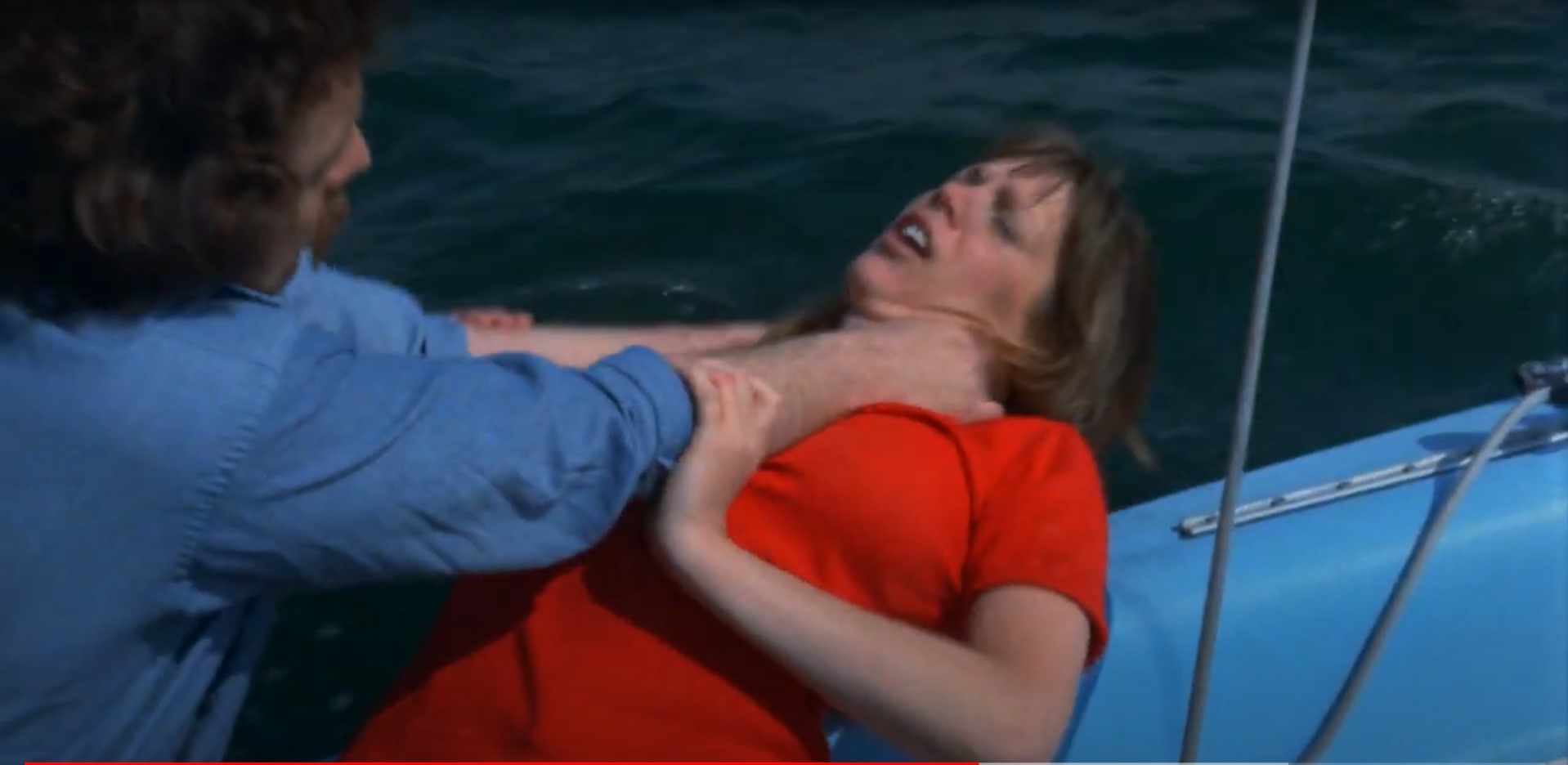
Along the serene Thailand shores, a doctor and his young colleague take their family and fiancé to a beach resort for some much-needed time away after a massive casualty natural catastrophe on a nearby island swallows the entire village with seismic volcano bedlam.  Little do they know that a component of the disaster has swam to their very watery spot on the beach resort and gnashed without remorse on the doctor’s family and fiancé.  Not knowing what kind of creature could do such carnage, they soon discover through first hand witness accounts and the evidence gathered that a large crocodile, mutated by man’s own disregard for mother nature, is the culprit.  The men, along with a fisherman who believes in a destiny of a beastly showdown, swear to track down the killer croc and kill it.  The crocodile’s bloodlust on mankind is seeming unstoppable as it wreaks havoc swimming down river, destroying entire villages in its destructive and hungry path.

Thailand’s reptilian “Jaws” equivalent, “Crocodile” wriggles with wayward ferocity in this giant creature feature horror that rivals Bruce the shark.  “Computer Superman” director Sompote Sands oversees the enormous amphibious aggressor versus frantic and frightened man film that merged or morphed from Won-se Lee’s “Crocodile Fangs” into a blending of the two productions of the same film of one seamless man versus animal hunt above and below the surface of the water.  Sompote Sands produces the venture along with a postdated credit toward exploitation producer Dick Randall (“Pieces,” “Escape from Women’s Prison”) from “Crocodile Fangs.”  Coproduced by Robert Chan and Pridi Oonchitti, “Crocodile,” or rather “Crocodile Fangs,” was a multi-national undertaking with Thailand and Korean actors and crew and a Japanese special effects company bringing the giant, carnivorous maneater to cinematic actualization.  The Chaiyo Productions spliced feature was distributed into the U.S. under Cobra Media. 

Doctors Tony Akom and John Stromm have it all; Akom (Nard Poowanai, “Ghost Hotel”) has a beautiful wife and child and leads a charmed life despite his vocation challenges of being a doctor always on call. and Stromm (Min Oo) is recently and happily engaged to Angela (Ni Tien, “Black Magic” 1 & 2).  Their vacation doses audiences with a picturesque double date plus one child but does a rough patch setup of Dr. Akom’s family neglecting workaholism that isn’t crafted to be a strain on the relationship he has with his family but rather bring upon him tremendous guilt and inset the good doctor into a studious montage of crocodile research after his family becomes crocodile chow.  Sympathy toward the doctors is incurred but the level of sympathy falls low as the ladies’ death scene falters in the editing room, or perhaps was only partially shot, as only one of them is visually attacked while the others are grieved over in postmortem.  Character will is strong enough to carry the anticipated revenge but the giant crocodile is truly the main star stud, a vicious, village-obliterating mammoth of armor and teeth goes full Godzilla on the riverside communities and dining buffet style on anyone, land or sea, who makes a splash in his kill radius.  Unlike in “Jaws,” “Crocodile” is back-and-forth without the mysteriousness of the shark’s lurking underneath the glassy surface, snatching swimmers and boaters to a watery, gory grave, and this really solidifies the crocodile as an intended principal figure as a well-known, full-visible, antagonistic killing machine spurred by man’s own atomic-making hand; an idea that’s only theorized in exposition and not practically fleshed out.  “Crocodile’s” cast fills out with Kirk Warren, Angela Wells, Hua-Na Fu, Bob Harrison, and Nancy Wong.

“Crocodile” very much embodies the “Godzilla” and “Jaws” with deference without being a total negligent rip of either more widely successful hit.  The crocodile, in the form of its oversized whipping tail and rather big and detailed puppet head, raze miniaturized villages, much the same way Godzilla tramples over Tokyo in the 50s through the 80s, and the storyline for “Crocodile” parallels portions of Steven Spielberg’s 25-foot man-eating Great White tale of three men boarding a boat to hunt down a formidable creature, complete with yellow barrels and a sinking ship to an exploding finale.  Antiquated by today’s standards, for late 70’s, the special effects are a marvel to behold.  Kazuo Sagawa, of the special effects company, Tsuburaya Productions, lead the department with size-mattering scale and detailed depictions of villages and boats being quickly and violent undone by either a crocodile puppeteer or a mini-croc circling the boat and even, at times, being wire-flown through the air, bombarding the model ship with WWF elbows (do crocodiles have elbows?).  Action sustains an intensity that’s wrathful and keeps the heart palpitating with excitement.  The same thing can’t be said about the story through the choppy editing style, often times revisiting cut scenes being spliced into progressive context, but the setting, exterior weather, and clothing haven’t changed.

Synapse Films obtains the original Cobra Media distributed U.S. release and meticulously restores “Crocodile” in a 2K scan from the original 35mm camera negative, premiere the film for the first time on Blu-ray worldwide.  With an aspect ratio of 2.35:1, the AVC encoded, 1080p high-definition, BD50 is a deathroll of beauty and when Synapse says meticulously restored, the poof is in the details and coloring.  Not a ton of age wear or damage, a nearly pristine print for some intricate touchups to invigorate the content.  One brief series of scenes appeared as if the film cell was folded with a blended vertical line down the right side, much like a scratch would appear on the film but this looked different; however, the line did not substantially affect viewing.  Between the rapid severity of the crocodile thrashing and the reduced frames of select slow-motion sequences, there is nothing to fault about Synapse’s compression with objects keeping intact and away from ghosting or aliasing.  Blacks are generally faded but don’t show signs of posterization or banding.  The English print audio spec is a DTS-HD MA 2.0 mono dub.  Fidelity of the original audio is retained, uncompressed for lossless sound in all areas of the ADR, Foley ambience, and the cue soundtrack of the impending or attacking crocodile, with a hint of John Williams theme in the opening credit track.  English subtitles are available, but the dub is perfectly clear and prominent.  Special features include an audio commentary with writer and film historian Lee Gambin, a video interview with Won-se Lee, director of “Crocodile Fangs,” deleted and alternate scenes from different country versions of the film, and the original theatrical trailer.  The standard release comes in a green Blu-ray Amaray without the “nude” slipcover but has the same original, clothed illustrated artwork.  Inside, the disc is pressed with a toothy faceless creature versus and a scantily cladded bikini woman.  Opposite side is the usually accompanying Synapse catalogue for this year, 2024.  The R-rated feature has a runtime of 92 minutes and is region free! 

Last Rites:  A Thailand terrorizing monster movie with unrelenting savagery and terrific special effects for circa late 70s.  if you can withstand the story’s choppy waters, “Crocodile” is a fun and fierce swim through predatory, blood-suspended waters. 

“Crocodile” on Blu-ray and Lurking Behind the Wates of Thailand’s Film Industry!

A Gang’s EVIL Ransom Elicits the Wrath of “Zero Woman: Red Handcuffs” reviewed! (Neon Eagle Video / Blu-ray)

“Zero Woman: Red Handcuffs” is Number One on Our Must Have Lists!

When undercover officer Rei lets her overwhelming emotions kill a suspect on an assignment, her displeased colleagues lock her into a cell, unable to decide her fate with fear of public outcry of police brutality that would blemish the department and force leadership regsinations.  When a prime minister candidate’s daughter is kidnapped by a ruthless gang of rapists and murderers and brought to a cathouse for sale, the brothel madam believes the young woman is better exploited by issuing a large ransom for her safe return.  Unwilling to face public scandal, the politician and a rigid yet loyal investigator of the clandestine Zero Division rig up a covert plan to eliminate every person involved with the kidnapping by offering a murderous deal to Rei in exchange for her freedom.  Rei’s able to infiltrate the gang’s inner circle only to see the plan devolve into chaos and blood between the gang and corrupt authorities.   

Japan doesn’t make films like “Zero Woman:  Red Handcuffs” anymore!  The violent Toei company pinkusploitation production, released in 1974, played a major role in unifying the sexual appetites of Japan’s pink pornos with the rough-and-tumble violence of exploitation action films.  The rising of Nikkatsu Roman Pornos forced the hand of the Toei Company to expand their portfolio, creating such as combinational conquest over salivating grindhouse cinema patrons that the radical subgenre deserved a new sublet coinage labeled pinky violence.  Toei company man Yukio Noda, a staple yakuza filmmaker for the company, helms the visuals translated from a script penned by “Female Prisoner #701:  Scorpion” writers Fumio Kônami and Hirô Matsuda.  Loosely based off the manga written by Tooru Shinohara (who also penned the manga of “Female Prison Scorpion series”), “Zero Woman: Red Handcuffs” stitches its own blood soaked and sexually provocative clothing that would later continue “Zero Woman’s” adventures throughout the years with more films.

Cladded in a chic long red coat, black boats strapped up just below the knee, and wielding an extra-long connector chain pair of red handcuffs, Rei is the anti-heroine of our manga fantasies.  Miki Sugimoto works deep into that fantasy vision as Rei, Division Zero’s lady cop who will do anything and everything, clothed or undressed, to get the job done, even with extreme prejudice.  A frequent delinquent girl portrayer for Toei Company’s gritty bad girl gang pink pictures (try saying that five times fast), Sugimoto’s filmography include the “Girl Boss” series, “Terrifying Girls’ High School:  Women’s Violent Classroom, and “Criminal Woman:  Killing Melody,” and so Sugimoto already had established this foundational layer for Rei as a fortitude of badassery and now tacking on another layer of a moral high ground, justified only by seeing her word through to the end.  Rei is up against a gang of five – four street thugs led by the recent prison released Nagumo (Eiji Go,” The Executioner”) and one lesbian brothel madam (Yôko Mihara, “Sex & Fury”) – as she agrees to a back-against-the-wall deal and slyly subverts the gang by helping Nagumo during a faux ransom sting operation.  Along with Sugimoto’s stoicism, the Toei porn actress retains her promiscuous allure, one where she doesn’t have to do anything to be seductive but just be herself, working not only toward the favor of her character, who continuously is taken advantage of sexually without shame, but also keeping the integrity of the Toei élan for Japanese sleaze.  “Harakiri’s” Tetsurô “Tiger” Tanba resides to the general’s overlooking hill as the prime minister candidate who sends his battlefield colonel in Hideo Murota (“Rape and Death of a Housewife”) to be the Zero Woman’s handler.  Their scheme quickly devolves as their plan evolve when the operation goes slower than expected and the gang’s leader Nagumo begins feel the pressure of paranoia and starts to unhinge, especially around his ruffian acolytes played by Seiji Endô, Rokkô Toura, Iwao Dan, Kôji Fujiyama, and Ichirô Araki as Saburo the mysteriously quiet, aviator-waring knifeman who in himself is an interesting character.  Cast fills in with the Japanese speaking Westerner Ralph Jesser in a wild opening sequence that results in a gunshot to the groin!  

Like most pinky films, “Zero Woman:  Red Handcuff’s” incorporates an X-rated sexual violence but unlike most pinky films, the pinky violence subgenre omits the softer side of sensuality, creating more of a nihilistic viewpoint toward sex of taking what you want, when you want it, and aggressively at that.  Yukio Noda picture contains hostile lesbianism, gang rape, and pressurized perversions that take control thematically in pinky violence.  The corrosive context that has a guilty pleasure pull in most patriarchal dominated cultures and fleapit cinemagoers goes hand-in-hand with the over-the-top violence conjoined at the hip of cause-and-effect.  Usually, the narrative goes an ugly rape equals hard-fought revenge; in Noda’s film, the cause is the kidnapping, and subsequent deflowering of a power politician’s little girl leas to the Zero Woman effect of silencing with corporal punishment that circumvents the law.  Stylish like a spaghetti western and brutally violent, “Zero Woman:  Red Handcuffs” is a meanspirited, out-for-blood, femme fatale engendered on the verge of the pinkusploitation genesis.

Neon Eagle Video, a collaborative boutique label effort between Cauldron Films and Mondo Macabro’s Jared Auner, releases “Zero Woman: Red Handcuffs” onto a new Blu-ray, restored in 4K from the 35mm print. The transfer is AVC encoded, 1080p high-definition, onto a BD50 and shown in the widescreen aspect ratio of 2.35:1. A relatively clean 50-year-old print hardly displays any age wear, if any at all. Scarcely marred by blue vertical emulsion scratches in only a single scene, the print retains and is stored with care to diffuse the range of color and to effectuate as much detail as possible in textures and skin while without taking away from Noda’s underbelly surrealism. The lower contrast infuses a pulpy layer to create softer shadows, but contouring manages to stick an outline thanks to key Rembrandt lighting precision, akin to Hammer Horror with a splash of Kensington gore. The uncompressed Japanese DTS-HD MA 2.0 mono peaks with the best possible optical audio. While not much in the way of depth creation, there’s plenty of range in the Foley, even if it’s artificially abstract and illogical compared to shotgun microphone captured audio. The ADR synch is one of the best inlaid post-recordings with visuals that renders hardly any feedback or unnatural noises on the audio layer. English subtitles are burned into the only available Japanese language picture on the release. Special features include a feature length audio commentary by author and producer for Vinegar Syndrome Samm Deighan, Sex + Violence = Pink Violence TokyoScope author Patrick Macias analyzes “Zero Woman: Red Handcuffs,” and an image gallery. Graphic designer Justin Coffee produces a new, rich-in-red, and taletelling composite illustration of what kind of film to expect on the front cover art of the clear Amaray Blu-ray. The reverse cover houses another illustration, one pulled from the feature’s original poster line. The BD is pressed with more Coffee fiery and red-laced artwork. This particular copy reviewed is not the limited edition set with accompanying slipcover and neither copy contains insert material. The region A playback release comes unrated and has a runtime of 88 minutes.

Last Rites: “Zero Woman: Red Handcuffs” is a fine introductory film into the world of Pinky Violence, a starting line for those perverse-thirsty for the unification of sex and violence in Japanese cinema. Neon Eagle Video delivers excellences with their restored print, second to none in its picture and audio quality that will provide a sterling experience.

“Zero Woman: Red Handcuffs” is Number One on Our Must Have Lists!

If the Tenants Keep on Dying, Better Get Out of that EVIL High-Rise! “The Case of the Bloody Iris” reviewed! (Celluloid Dreams / 2-Disc Blu-ray and 4K UHD Set)

Own Your 4K and Blu-ray copy of “The Case of the Bloody Iris” today!

A pair of beautiful women are heinously murdered in a respectable high-rise apartment building.  As the case remains unsolved, a real estate architect, Andrea Antinon, is looking for models to market his new property, happening upon models Jennifer Langsburgy and Marilyn Ricci during his photographer friend’s photoshoot, and entices them by offering a sublet of the now vacant apartment in the building where one of the girls was murdered.  Jennifer, who finds herself slowly falling for the Andrea, is stalked by her polyamorous sect past and the group’s leader, her ex-husband, Adam who refuses to let her go and while he proves himself dangerous, attempting to kill Andrea after one of his dates with Jennifer, Adam is found dead in her new apartment.  The suspect pool grows as police are continuing to be baffled by an elusive killer remaining at large and set their sights on Andrea with his brief connections in two of the three victims.  Evidence against Andrea swells as those around Jennifer wind up dead and she’s next on the kill list. 

“The Case of the Bloody Iris,” the Iris represented as the delicately beautiful flower that symbolized the bound between Jennifer and her deranged, sex cult ex-husband Adam, is the 1972 giallo thriller from the prolific spaghetti western, Italian director Giuliano Carnimeo (from the previous “Sartana” series and would later helm “The Exterminators of the Year 3000″) and prolific giallo screenwriter Ernesto Gastaldi (“Your Vice is a Locked Room and Only I Have the Key,” “Torso,”) shot in the city of Genoa doubling as Milan.  Full of eccentric suspects, taboo desires, and handsome principals, “The Cast of the Bloody Iris” is a very attractive, violent, and superbly shot whodunit.  Under the original native title of “Perché quelle strane gocce di sangue sul corpo di Jennifer?” aka “What Are Those Strange Drops of Blood on the Body of Jennifer?” Galassia Films serves as the production company with Luciano Martino (“The Strange Vice of Mrs. Wardh”) having produced the giallo. 

The story floats back-and-forth between a pair of co-headlining stars, one of them being the retrospective cult and sex icon actress Edwige Fenech in one of her earlier performances, and who has starred in “Strip Nude for Your Killer” and “The Strange Vice of Mrs. Wardh.  Co-star George Hamilton also stars in that latter giallo, reteaming the handsome-faced “The Case of the Scorpion’s Tail” actor born in Uruguay, and whose birth name is Jorge Hill Acosta y Lara, with Fenech in their respective roles of model Jennifer and architect Andrea intertwined into what is a romantic tale of love at first sight that becomes mangled by a crazed killer on a murder spree and they’re at the heart of the matter.  If revisiting Giuliano Carnimeo, comedies and watching some of his interviews, you can see why he folds in subtle comedic elements that doesn’t allow “The Case of the Bloody Iris,” or a good chunk of his credits, to be a totally engaged, heart-racing murder mystery; those comedic elements come in the form of bumbling police, a too dead-set on commissioner (Giampiero Albertini, “Commandos”) and his more ungainly assistant (Franco Agostini, “The Sex Machine”), who are always one step behind and in the wrong direction.  The juxtaposition may be too evident yet it’s also welcoming, breaking up the forbidding business with a little levity, and creates a backend sense of assurance knowing police, just like today, can be human and clueless on serious natured instances.  The suspect pool and other salient supporting principals include Paola Quattrini as Jennifer’s roommate Marilyn (no doubt based loosely on Marilyn Monroe), Ben Carra as Jennifer’s sex cultist ex-husband, Jorge Rigaud as the professional violinist neighbor, Annabella Incontrera as the professor’s lesbian daughter, Oreste Lionello as a sleazy photographer, Carla Brait as a nightclub’s dominating femme, and Maria Tedeschi as the unfriendly neighbor.

Even though giallos did not appeal to him nor did they really become a staple of his oeuvre, director Giuliano Carmineo had a different perspective than most and that closely aligns with masterclass filmmakers like Dario Argento.  Carmineo and cinematographer, who’ve collaborated previously on a pair of Sartana westerns, had purpose in their odd and first person camera shots and movements, such as laying the camera down and sideways as characters perform routine events before being attacked or looking up and doing a 360-degree turn as if scanning a stairway, that coincided with the usual first person perspective of the conventionally masked and gloved killer wielding a deadly blade.  The technique engages the viewer, as in a sort of tell that something is about to happen or is amiss in a scene to create breath holding, heightened anxiety, but the multi-faceted narrative itself doesn’t need assistant in keeping viewers glued to the edge of their seats with the eclectic mix of sultry and taboo eroticism, lampooning the authority figures, designed seamless red herrings, unique characters, a variety in murder, and an elaborate, mysterious complexity that’s downright deviant. 

If you’re a distributor looking to shoot your shot on your first release, new boutique physical media label, Celluloid Dreams, hit the bullseye with a 2-disc 4K UHD and Standard Blu-ray release of “The Cast of the Bloody Iris” on a HVEC encoded, 2160p resolution, 100 gigabyte 4K UHD and on an AVC encoded, 1080p, 50 gigabyte Blu-ray, scanned and restored brand new in 4K on a pin-registered Arriscan from the film’s original 2-perf Techniscope camera negative, and presented in the original widescreen aspect ratio of 2.35:1.  Coloring grading and restoration is noted on the interior insert being entirely completed by Celluloid Dreams Studios to remove all the celluloid and age imperfections and stimulate a vivid, vibrant picture quality and, by the giallo-Gods, this has to be one of the more flawless image presentations I’ve seen on 4K and Blu-ray in a very long time, or ever!  Meticulous precision techniques reveal a straight from-farm-to-table quality, organic for its era with a balanced, natural grain and color saturation.   Details have delineated trim and higher contrast leveling where appropriate for darker scenes, such as an unilluminated bedroom or a basement boiler room, that retains the rich inkiness of the negative space.  No signs of compression issues in the negative spaces as well and no signs of unnecessary enhancing.  Two, lossless audio options are available for selection:  an Italian 1.0 DTS-HD and an English 1.0 DTS-HD.  Both remastered tracks from the optical sound negative provided full fidelity through the single channel.  Concise and crisp dialogue renders through in full, robust effect with ample detail in the ambience and depth to create a dynamic space.  No hissing, crackling, or popping in the ADR dialogue or ambient tracks and swanky tuned by Bruno Nicolai’s multi-instrumental base, drum, sintir-like guitar, and more score.  English subtitles are available on the Italian track.  With the larger capacity on the UHD, both formats are able to handle the included three featurettes with star George Hilton, principal actress Paola Quattrini, and director and writer, Guliano Carnimeo and Ernesto Gastaldi in Italian language.  Also included is a new commentary track from film critic and Celluloid Dreams co-founder Guido Henkel, an outtake reel that extend out certain scenes, photo gallery, the original Italian Opening Credits that beginning of the feature, and Italian and English theatrical trailers. Inside a dual-sided cardboard slipcover with both the feature’s baptized titles and illustrated cover art representation of Edwige Fenech, the black 4K UHD Amaray case possesses a second and more fleshy-erotic illustration of Fenech. The same art and arrangement are on the reverse side but with the Italian title. Each disc is housed on either side of the interior snapped firmly on a press-lock on with a release acknowledgements and an advert for their next physical feature, “La Tarantola Dal Ventre Nero” aka “Black Belly of the Tarantula.” The region A playback release has a runtime of 94 and is not rated.

Last Rites: Showing such diligence in the restoration efforts, Celluloid Dreams is the new kid on the block, the promising young boutique label with the Midas touch, with a killer first presentation in “The Case of the Bloody Iris.” We can’t wait to see more!

Own Your 4K and Blu-ray copy of “The Case of the Bloody Iris” today!

Is this EVIL Real or is it a “Deathdream” reviewed! “(Blue Underground / 4K UHD and Blu-ray Combo)

The Nightmare is Here. “Deathdream” on 4K UHD Blu-ray!

The Brooks family just sat down for dinner before receiving a personal house call by a military commander, conveying the tragic killed in action telegram of their son Andy during a Vietnam War skirmish.  Very early next morning, Andy inexplicably arrives at their doorstep and the whole family is elated with his return and relieved in the military’s gross error about his death.  But something isn’t right with Andy; he isn’t the same affable young man his family and friends knew.  All day, every day Andy sits in his room, gliding back and forth in his rocking chair, won’t eat or drink anything, and has the social personality of a slug.  While his father can’t grasp Andy’s bizarre behavior, his mother defends him, being overjoyed, comforted, and relieved by her son’s safe return.  Anybody who comes close to discovering what Andy has done or has become is preyed upon by Andy’s need for concealment and need for blood. 

If there was ever the quintessential anti-Vietnam War film, Bob Clark’s “Deathdream” is it.  The 1974, Alan Ormsby (“Cat People,” “The Substitute”) scribed grindhouse classic introduces combat shock to audiences through a macabre and ghoulish lens as the U.S. involvement in the Vietnam War came to an official end in 1973.  Before becoming one of the holidays’ household names with “A Christmas Story” and “Black Christmas,” Bob Clark sat in what would be one of his first films as a director, a film that wasn’t sold in taking just one title having also been bestowed “Dead of Night,” “The Veteran,” “Night Walk,” and “It Came from the Grave.”  The U.S.-based shot and crewed feature, filmed in and around Brooksville, Florida, is a production of Quadrant Films and Impact Films with United Kingdom producers Gerald Flint-Shipman, Peter James (“Children Shouldn’t Play with Dead Things”), and Geoffrey Nethercott (“Blue Blood”) with John Trent and Bob Clark coproducing.  

For the ambiguous terror of “Deathdream” to work without baffling audiences to a nonsensical death, the cast had to really give it their all and not only that but also sell the deteriorating dynamics of an American nuclear family when the son returns home strangely different from then when he left for war.   The debut film of Richard Backus, playing the reclusive and uncharacteristic Andy who has returned home from the battlefield, is complimented by the heart-wrenching performances miseries of his onscreen parents in John Marley (“The Dead Are Alive!”), as the distraught father over Andy’s peculiar behavior, and Lynn Carlin (“Superstition”), as the denialist mother who can’t or won’t see the issues with Andy, the gift of her little boy returning home. Not only does Andy’s return ignite a slow-burning divisive wedge between parents and child but it also exposes pre-war schisms that were long established years ago.  We’re initially introduced the family sitting around the dinner table filled with compassion, hope, and happiness but Andy’s return kicks the wasp’s nest and we can see their true nature.  The father is a crotchety, dogged man who can’t connect with a more sensitive son and the mother spoils his only boy the point where Andy must enlist himself voluntarily to prove something to toward his father’s disappointment.  Then, there’s sister Cathy.  Poor sister Cathy, the gentle, positive, and sweet daughter who is all buy nearly forgotten by her parents as they push her out of the way by her father stating to mind her own business or is exclaimed in so many words of her little worth in compared to her brother by her mother.  Yet, Cathy, played softly and attractively by Alan Ormsby’s then wife, Anya Ormsby (“Children Shouldn’t Play with Dead Things”), continues a cool and level head about her shoulders as the only true family member willing to give Andy time, to let him be himself, while acclimating back into society, let alone his family.  However, the family’s opposing forces is ultimately what destroys them in conjunction with Andy’s terrible, morbid secret.  Henderson Forsythe, Jane Daly, Arthur Anderson, Michael Mazes, and David Gawlikowski fill out the cast.

All of the costly signs of shell shock and PTSD are present within the context of “Deathdream,” blanketed under a sensationalized, representational guise, but the film’s cinematic façade of Tom Savini’s rot and decay special effects and the appalling imagery of living death doesn’t alleviate or even dilute the horror of the revenant in the actual disorder.  In fact, it pales in comparison if you ruminate on it for a while.  Andy’s withdrawn from the likes of acquaintances, friends, and family alike and is severely impassive at signs of cordiality.  Director Bob Clark emphasizes the effect even further in one scene where a World War II veteran anecdotally describes in nonchalant detail the death of a brother in arms and this flashes images in Andy’s mind of him and his friend’s own mortal wounds in the jungles of Nam, sending the young man into a minor fight or flight moment, two of the associated signs of shell shock:  fight and flight.  Within the sensationalized horror context, Andy requires blood to keep his body from decaying, like a reanimated corpse trying to hang on a little long before his skin and muscle tissue just seep and ooze off, and in one scene of attack, Andy shoots up his victim’s blood with a hypodermic needle in a reminiscent drug addiction scene of shooting up narcotics right into the vein of one’s arm, an experience afflicted on many PTSD vets. Ormsby’s script might be specific in the anti-Vietnam War propaganda but is not so detailed in the narrative’s whys and wherefores as much of Andy’s unlikely, and undead, return to his family falls into that inexplicable, ambiguous, “Twilight Zone,” and “Tales from the Crypt” category to foster a greater cloud of mysticism and darkness around the story, one in which has a hopeful, desperate mother conjure will and desire in order to see her son come home again.

In continuing to upgrade their catalogue to the best possible format currently available, “Blue Underground” pulls an Andy and returns “Deathdream” from the dead, heading home to the nearest ultra high-definition player. The 2-disc 4K Ultra HD and Blu-ray combo set arrives with a brand-new restoration, scanned in 4K 16-bit from the 35mm negative with Dolby Vision HDR in honor of its 50th anniversary. The UHD is HVEC encoded onto a 66GB Blu-ray with 2160p resolution while the Blu-ray is AVC encoded, 1080p resolution, on a BD50, both presented in a widescreen 1.85:1 aspect ratio. A grainy 35mm print is ingrained with superior color saturation and understanding of how to manage the perceptibility of image. Blue Underground’s previous restorations show a spectrum, step-by-step improvement to get to where the film is today in a higher, upgraded format. “Deathdream” can be a very dark film at times and often, but this release eliminates speculation of events without collapsing the contrast integrity, providing a clear and concise image for its spot in history. Blu-ray is a step down albeit only minorly and with some color stability shimmer, more notably in the finale with a less than standardized and wear-showing deleted scene that is integrated back into the story. A single, English DTS-HD master audio mono track is available. The lossless option doesn’t need any more or any less to effectively be the overlaid track. Distinction runs through the single channel with managed assurances that dialogue, ambience, and soundtrack divide and conquer their respective uniquities. English SDH, Spanish, and French subtitles are available. Due to space on 4K UHD disc, all of the package’s special features are encoded onto the standard Blu-ray. The UHD Blu-ray includes an archival commentary from director Bob Clark, a commentary by writer Alan Ormsby, and a brand-new commentary with a pair of film historians Troy Howarth and Nathaniel Thompson, plus the theatrical trailer. All that and a slew of previously recorded content, including a recollection featurette with Alan Ormsby and star Anya Liffey (Ormsby), an interview with composter Carl Zittrer Notes for A Homecoming, an interview with production manager John “Bud” Cardos Flying Down to Brooksville, an interview with star Richard Backus Deathdreaming, an interview with Tom Savini regarding his early years in special effects, a screen test of the original Andy actor Gary Swanson, an alternate opening title sequence, Alan Ormsby’s student film, theatrical trailer and still galleries. The only other new content is an interview with the original Andy actor Gary Swanson The First Andy. The same illustrated cover art composite from the 2017 Blue Underground Blu-ray is recycled for the 4K UHD Blu-ray with tactile elements of a raised title and taglines on the cardboard slipcover. The primary art also resides on the black UHD Amary but the reverse side has retro traits of the film’s starkly contrasted yellow and blue poster art and the “Dead of Night” title to which, once again, is preferrable for me to have diverging slipcover and case cover arts. The two discs reside on their respective sides of the interior with the 4K UHD pressed with the illustrated art and the Blu-ray going contrarily retro like the reverse cover art. There are no loose insert materials. With an 88-minute runtime, Blue Underground release comes region free and is rated R.

Last Rites: Andy didn’t destroy his family. He was only the last straw, a catalyst that tipped the boat over into a sea of slowly brewing tempest. Doesn’t help that he was also decaying right before their eyes as the embodiment of walking death and looked good doing it too with the help from Blue Underground’s sharp-edged and solidly sound 4K upgrade.

The Nightmare is Here. “Deathdream” on 4K UHD Blu-ray!

How Many Chickens Need to Have Their Throats Cut to Satisfying Ritualistic, Naked EVIL! “Voodoo Passion” reviewed! (Full Moon Features / Blu-ray)

Get Entranced by Full Moon’s “Voodoo Passion” Blu-ray!

Newly married Susan House travels to Haiti to join her consulate husband, Jack House, who has been stationed at the British Embassy.   Captivated by the Haitian voodoo religion and culture, Susan is eager to tour the island nation’s most ambiguous practice most don’t or will never understand all the while Jack’s naked and nymphomaniac Sister, Olga, makes forward, flirtatious advances toward her.  That fervor for voodooism and Olga’s point-blank seduction has seemingly incepted terrible nightmares of naked, animal sacrificial rituals and murder conducted beguilingly by a priestess in the form of Jack House’s native housekeeper, Inês.  When Susan awakes, the realism of her dreams afflicts her but her husband Jack and his colleague, a psychiatrist by the name of Dr. Pierre Barré swear there have been no police reported murders.  Night after night, Susan’s entranced nightmares continue to be vivid with murderous mysticism that’s slowly driving her mad in the land of voodoo. 

One of Jesus “Jess” Franco’s more bosom and bush erotic-thrillers, “Voodoo Passion” is nearly a fully naked runtime feature sprinkled with hints of the nation’s cultural religion.  The 1977 released, German Production, also known by the titles “”Call of the Blonde Goddess” or “Der Ruf der blonden Göttin,” was less about his own stylistic substance and auteur stamp and more about spasmatic, gyrating nudity under rhythmic bongo beats for the Spanish sleaze and exploitation genre filmmaker.   The gratuitously sexed-up, multinational feature is penned by the Switzerland born, sexploitation and adult genre screenwriter Erwin C. Dietrich under one of his pen names, Manfred Gregor.  Dietrich also produces the film amongst a substantially historical collaborative effort between himself and Franco over the course of the late 70s to early 80s.  Nestor Film Producktion serves as the production company, filming entirely not in Haiti but in the beautifully scenic and old-world allure of the seaside capital of Lisbon, Portugal.  

Lots of hot body action in this beat-driven, voodooism thriller primarily between a trio of character-diverse, titillating ladies and peppered with peripheral nude women and men tribals engaged in a ceaseless native, ritual thrusting, pulsing, and shaking trance dance.  “Voodoo Passion” grips itself around the rags-to-riches character of Mrs. Susan House in what is a matron-look for Spanish actress Ada Tauler (“The Sexy Horrible Vampire,” “Love Camp”) brought to Haiti at the behest of her British consult, newlywed husband Jack House, played by the stony-faced and “Eugenie” and “Pieces” American actor Jack Taylor able to swing both thrills and feminine frills in his films.  While Tauler’s doesn’t shy away from full nudity of Susan House’s fever dream state, the actress pales in comparison to the other two-thirds who are more engaged in sexual promiscuity and the liberating fervor of ethnic ceremony.   Those two actresses are “Caged Women’s” Karine Gambier as the nymphomaniac sister of Jack House and the face of most of “Voodoo Passion’s” physical marketing with French actress Muriel Montossé (“Cecilia”), under the more westernized stage name of Vicky Adams.  With a face and body like a model, Vicky Adams’s wild arm and stoic expression dance moves will hypnotize viewers entranced with the bongo tempo’s transfixing pomp, contributing to the film’s psychotronic premise of magical and religious rites, obfuscated nightmares, and, cue Austin Powers’s voice, murder.  Yeah, Baby!  “Voodoo Passion” has curves for days and in all different personas that keep things weirdly, but welcomingly, platonic on some level and not just an overly saturated sex-fest.  The film’s cast rounds out with Vitor Mendes (“Swedish Nympho Slaves”) and Ly Frey.

If asked to describe or give an opinion on “Voodoo Passion,” one would say cheekily the Jess Franco film is a thriller swathed in an eyeful of bosom and bush.  If the 4-minute introductory scene with voiceover exposition to the ceremonial voodoo band and half-naked native dancers wasn’t enough of a clue, Ada Tauler and Karine Gambier pull you right back into the soaking tub with their soapy, wet bodies as they immediately take a bath together upon meeting for the first time.  From that point on, the bosom and bush bar has been set and in that the thicket of unshaven landing strips, there’s a good story underneath about the mystics and misconceptions of Haitian voodooism.  Unfortunately, much of that story falls behind the showcases of skin, thrusting the principal ladies into the spotlight, overshadowing Jack Taylor’s performance as well as doing nothing for the poor psychologist in Vitor Mendes, and undercutting the very theme of ritual exploitation and misconduct which is half of “Voodoo Passion’s” concept.  The entirety is all quickly surmised in one fell swoop of exposition without the necessary leg work, that should have been carried out by either Susan House or the consul assistant Inês, of building evidence for or against the contrary exposed in the finale.  Then again, does gorgeous naked women dancing about really need a well-rounded plot?  All depends on the eyes of the beholder and these eyes needed that equilibrium!

Full Moon Features conjures up a Blu-ray for this Jess Franco thriller debased in sexploitation slather.  The AVC encoded, high-definition 1080p, is housed on a single layer BD25, yet not encoded heavily with bonus content, “Voodoo Passion” is able to retain a full-bodied image from a remastered German original negative owned by producer Erwin C. Dietrich.  Vivid color saturation, contrast levels accompanying each other, natural looking skin tons, and the stunning detail render this Full Moon Features release the bees’ knees.  No signs of blocking or banding but some celluloid frames are slightly grainier than others that might be a result of age, wear, or the variable of film stock.  There is only a single audio option, an English LPCM 5.1 renders lossless audio, clearing each channel with ease, and delivering a rhythmic bongo drum beat with intensity.  Dialogue mirrors the richness despite the ADR track overtop the diverse nationalities’ native tongues.  There are no English subtitles, or any setup option for that matter, for this English only track release.  Special features included are an archival interview with Jess Franco with forced English subtitles Franco, Bloody Franco, a rare photo slideshow of images from the film, the German trailer, and a Jess Franco vintage trailer reel of most of his schlocky Eurosleaze fair.  What’s party treasured about these newly re-released films onto a new full HD transfer is Full Moon’s physical package redesigns that offer a cardboard slipcover with new illustrated, pinup-esque, art.  “Voodoo Passion” has a half-naked woman, presumably the nymphomaniac sister Olga, moaning in ecstasy while holding a…hand mirror?  Wonder if that should have been the champaign bottle Olga uses to, well, you know, pleasure herself with.   There’s also a striking, NSFW, Muriel Montossé pose in a scene from the film on the traditional Blu-ray Amaray front cover with additional explicit scenes on the backside.  The disc is pressed with the same slipcover illustration and there are no inserts inside the case.  Presented uncut and region free, this Full Moon release of Jess Franco’s vintage sleaze has a runtime of 86-minutes.   

Last Rites:  Another wholly impressive picture quality presentation of another unwholesome, softcore sexploitation by Full Moon Features, a friend to Haitian voodoo and you, the licentiously greedy viewer! 

Get Entranced by Full Moon’s “Voodoo Passion” Blu-ray!