Blind, EVIL, Undead Templar Knights Hunt for a Bite to Eat! “Tombs of the Blind Dead” reviewed! (Synapse / Special Edition 2-DiscBlu-ray)

“Tombs of the Blind Dead” 2-Disc Blu-ray Available for Purchase Here!

Maria, Betty and Roger take a train across the Spanish countryside to see the landscape sights.  When Maria feels like a third wheel stuck in between Betty and Roger’s flirtations, she jumps off the moving train, leaving her friends aboard, and camping out under the ruins of an old countryside Church.  There’s only one problem, the Church was home to the ancient order of the Knights of Templar who took a blood oath for Satan by sacrificing young virgins by drinking their blood and lynched by the Church for their crimes against man and God.  The Cursed Knights, reduced to rags, bones, and without eyes, rise from underneath their graves every night and roam the countryside on the hunt for anybody in proximity they can feast upon.  Betty and Roger learn of Maria’s strange demise without knowing the details and form a four-person search party only to step into the same dangerous den of the Knights of Templar. 

“Tombs of the Blind Dead,” or as known as the U.S. as just “The Blind Dead,” is the first in a series of four undead Templar Knights films that would come to be known as The Blind Dead collection by Spanish filmmaker Amando de Ossorio.  Natively titled “La noche del terror ciego” was released in 1971 and penned by Ossorio who laid a new path of Spanish horror that didn’t involve Paul Naschy or Jess Franco with undoubtedly slow dread of the undead that resembled more of the Italian-bred beyond the grave films where ghouls and ghosts return to life and wreak bloody havoc on the living, a guise for social context and for political dictatorship.  Themes of rebellions, rape, and bisexuality course through the feature’s necrotic veins as the film receives Spanish and Portugal co-production support from Plata Films and Interfilme with executive producer Salvadore Romero (“The Werewolf Versus the Vampire Woman”) spearheading pre-production and behind the scenes.   

Following of a newly formed trio of friends traveling the countryside to take in the sights, an underlying green-eyed trouble brews right from the moment when an enchanted Roger, the debut film and character of 1973’s “Green Inferno’s” César Burner, meets gorgeous red head Betty, “It Happened at Nightmare Inn’s” Lone Fleming,” and Roger’s travel companion and Betty’s Catholic boarding school roommate/best friend, Virginia, “The House that Screamed’s Maria Elena Arpón, feels the twinges of jealousy as her amorous covets for Roger never materializes and she sees her future with relationship with roger forever in the friend zone.  Virginia becomes so intolerant of Roger and Betty’s innocent flirtations that she’s willing to hop off a not-so-speeding train and camp inside the creepy, ruined structures at centerstage of a burial ground.  Arpón’s passive aggressive behavior is quite convincing, even the part where she tucks and rolls off a moving train in what stupid things do when people are frustrated, especially in the gray territory of love.  The love triangle is so simplistically arranged, each behavioral component goes without being farfetched.  From Virginia’s first sexual experience at the caressive, soft hands of her roommate/best friend Betty while at boarding school to Roger and Betty’s blameless attraction to one another that spurs Virginia’s irrational, self-serving behavior, Ossorio’s characters are written very well when homogeneously compared to other outside of cinema love triangles.  José Thelman (“Night of the Sorcerers”) indulges as the smuggler swine Pedro who’s roped into the reconning of the Templar tomb to clear his name with authorities by proving someone else had murdered Roger and Betty’s friend.  Joined by his floosy sidepiece María, played by another María in the iconic Spanish B-horror actress.  María Silva (“The Awful Dr. Orlof”), Pedro brutishly flaunts arrogance and confidence, taking what he wants, especially with the women uncharmed by the male sex, and that’s curious, fluid attribute when he attacks Betty but in the wake of the moment, the two of them are silently surfeited as they share the scene and that’s severely different from what anyone other filmmaker was doing at that time.  Andrés Isbert (“The Kovak Box”), Antonio Orengo (“Love Letters of a Nun”), Francisco Sanz (“Django Kill… If You Live, Shoot!”), Rufino Inglés, and Verónica Llimerá (“Hatchet for the Honeymoon”) round out the cast.

Performances give “Tombs of the Blind Dead” credibility in anxiety-riddled survival and turbulent human interactions but where those performances start to give way coincides with Ossorio’s building of dread.  No doubt the use of slow-motion sets the ghoulish, harrowing tone of the depraved, unabating, skeletally-cursed Templar Knights giving chase on horseback as they track down their flailing fresh meat, but in the process of that spinetingling, in between the Knights self-unearthing and the eventual snare and snack of their human victims, Ossorio doesn’t quite know how to flesh out formidable trepidation.  Pursued, screaming characters stand in the face of danger as if their feet are hardened in cement, stopping at every brief moment when out of sight of the hooded decaying bones and rags with dusty swords, and absentmindedly run right into the exposed radius and ulnas of the slow-moving and blind medieval damned maniacs in sequences that run out too long to be wholly gratifying.  Ossorio better pedestals the ingrained Spanish themes of never escaping your gruesome, haunting past, as seen with the circular narrative of always return back to the Knight’s ruins, and the sexual taboos of bisexuality and rape that lead to destruction.  These course through a more classically presented gothic horror. Perhaps explaining the fervent melodramatics of flamboyant fear, under the dictatorship regime of Francisco Franco and his cult-like ritualization in fascism oversight of Spain.

The sightless, flesh-feasting Templar Knights have found a new home in the Synapse Films’ tomb of terror with a new restoration transfer on a 2-Disc Blu-ray. Refurbished from the uncut original camera negative, the AVC encoded, 1080p high-definition, BD50 capacity suppresses any compression issues to display polychromatic decadence in front of a backdrop of steely graded blues. Plenty of a darker scenes to be affected by artefact corruption but the blacks are greatly dyed-in-the-wood saturated and not delineated or in spectrum of lesser decoding. Scenes never approach being flat, in color tone and in field depth, as beads of glistening sweat can be visually elaborated on and the distinction between color, shadow, and scale discern wonderfully. Two audio option tracks are available: a lossless Spanish PCM 2.0 mono track and a lossless hybrid of Spanish-English (Spanglish?) PCM 2.0 mono track. Both tracks are of a post-production dub with the Spanish option having greater synchrony with the articulating native Spanish actors of this Spanish coproduction. Audibly clean with little-to-no hissing, popping, or crackling, Synapse’s singular restoration is in good company with a high impact, high clarity, and low distortion dialogue track that meets eye-to-eye with the visual components as well as the film’s ambience cluster and Antón García Abril’s breathy and discordant, Gothically canticle score. Option subtitles are available in English on both tracks. Special features on the first disc contains individual audio commentaries by horror film historian Troy Howarth, Betty actress Lone Fleming, and the NaschyCast podcasters Troy Guinn and Rod Barnett. A feature-length documentary Marauders from the Mediterranean go from head-to-toe on not just detail Ossorio’s “Tombs of the Blind Dead” as the Spanish stamp in the juggernauting zombie genre of the times but also going in depth with the Spanish laid in horror from the 1960s to 1980s, featuring interviews with Lone Fleming, John Russo (“Night of the Living Dead”), director Jorge Grau (“The Living Dead at Manchester Morgue”), Sitges Film Festival director Mike Hostench, critics Kim Newman and John Martin, film academics Steve Jones and Calum Waddell, actors Helge Line, Manuel de Blas, Antonio Mayans, and Jack Taylor, and even Paul Naschy’s son, Sergio Molina. An alternate U.S. opening sequence Revenge of Planet Ape gives expositional insight on how the success of “The Plant of the Apes” films influenced the American distribution market to rebrand “Tombs of the Blind Dead” as an ape rebellion piece to ride the coattails of the series’ success on a lower, foreign budget. Rounding out the special features is a featurette Awakening of Spanish Horror Cinema, Salem Pop’s “Templar Tears” music video, the original theatrical trailer, and a still gallery. While Synapse has 3-Disc limited-edition set of only 4000 copies made with all the bells-and-whistles of the visual elements of new artwork, a slipcover, and a 3rd disc audio CD, the 2-Disc standard edition comes with all the same special features and all three versions of the film inside the black Amaray Blu-ray case and classic “Tombs of the Blind Dead” poster for cover art. Inside, you’ll get Synapse’s physical media catalogue and a disc on each side of the Amaray’s interior with disc 1 “Tombs of the Blind Dead” and disc 2 “The Blind Dead,” housing the shortened 83-minute U.S. re-edit on a BD25, that sport their own pressed artworks. The uncut disc 1 has a runtime of 101-minutes and has region free playback.

Last Rites: “Tombs of the Blind Dead” is Spain’s answer to “Night of the Living Dead” with discerning individualities ingrained by director Amando de Ossorio to include his country’s own social and political subtext and while Blue Underground’s The Blind Dead DVD collection is an impressive physical media crown jewel of upscaled 720p, the Blu-ray gods favor Synapse with an impressive hi-def A/V release with stellar bonus features.

“Tombs of the Blind Dead” 2-Disc Blu-ray Available for Purchase Here!

He’s a Beast. He’s Ferocious. He’s EVIL! “Mad Dog Killer” reviewed! (Cheezy Movies / DVD)

“Mad Dog Killer” Unleashed onto DVD!

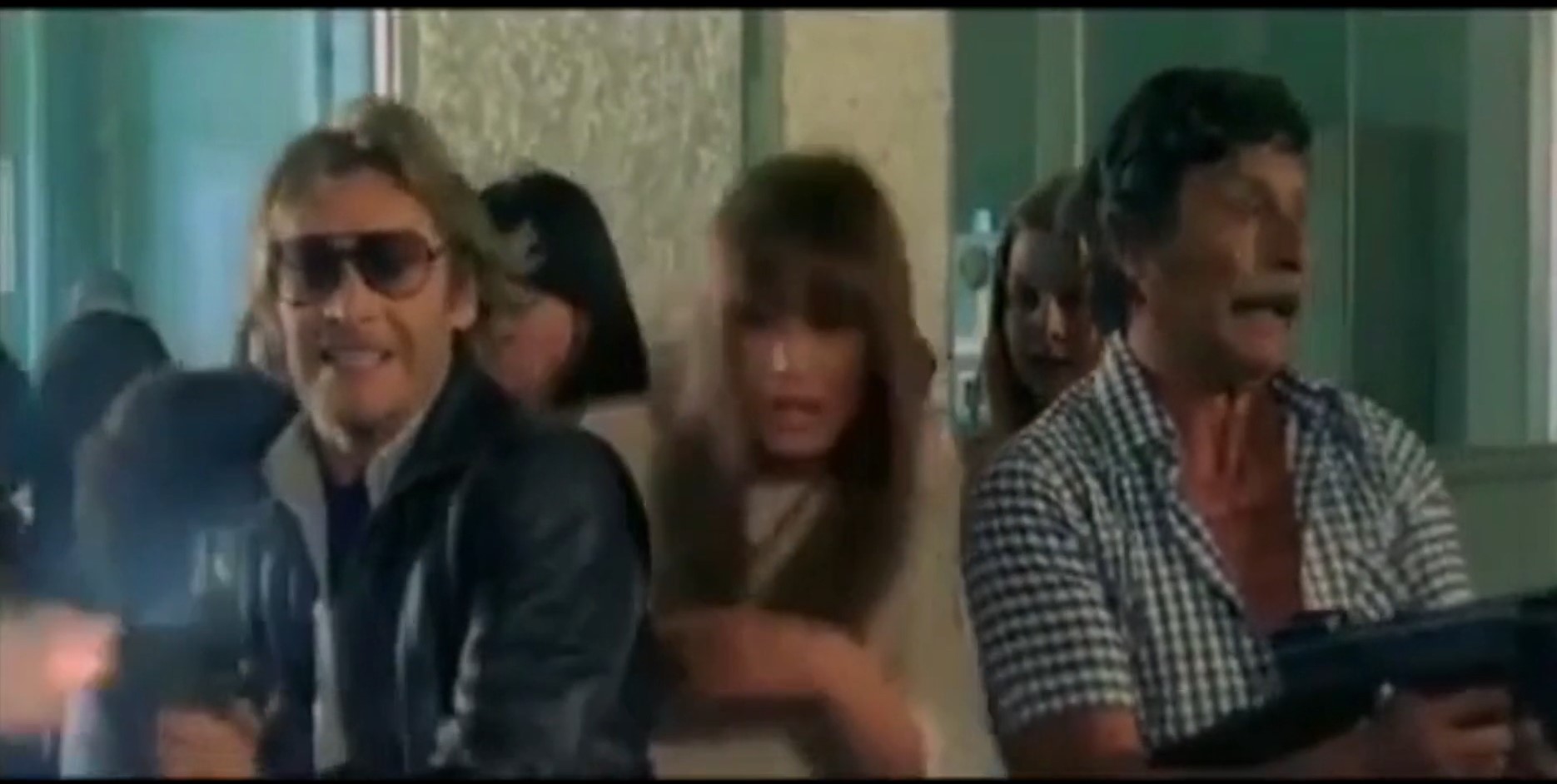
A daring hostage-taking breakout of an Italian prison puts four of the most ruthless killers back on the streets.  Sadistic and full of revenge, Nanni Vitali, the leader of the gang, has one thing of his mind before he begins a reign of outlawing terror, to find and exact due mortal punishment on a stool pigeon that cemented his incarcerated fate during the trial.  Hot on his trail is officer Giulio Santini who will stop at nothing to bring Vitali back into custody or even put a bullet between his eyes, that is until a young woman, Giuliana Caroli, girlfriend of the police informant, becomes caught unwillingly in Vitali’s web of sexual obsession and deviant plans as she’s raped and exploited for Vitali’s personal pleasure and robbery schemes.  When the frightened Caroli betrays Vitali’s trust, she becomes a kill target while Santini’s family also falls into the miscreant’s violence coursing crosshairs. 

“Mad Dog Killer,” aka “Beast with a Gun,” aka “Ferocious Beast with a Gun,” aka “La Belva col mitra,” is an Italian action-crime thriller from the late “The Sinful Nuns of Saint Valentine” and “Violence for Kicks” director Sergio Grieco in what would be his last directorial before his death five years later.  The Rome-born filmmaker also writes the 1977 exploitative and violent caper with additional dialogue from fellow Roman screenwriter, and furthermore director, Enzo Milioni who has had a hand in “The Sister of Ursula” and “Escape of Death.”  A part of the larger, multi-faceted Euro Crime subgenre, or better known as Poliziotteschi, “Mad Dog Killer” hits all the trademark elements, squeezing in a packed lot of similar content as well as stretching out for breathing room by elbowing out the era popular Italian subgenre of the phasing-out Spaghetti Western and bracing for impact against the up-and-coming Giallo films which starts get a footing with Dario Argento and Lucio Fulci paving the way.  The Supercine production is produced by Armando Bertuccioli (“The Sister of Ursula”).

In the crazed-eyed, take-no-prisoners, sandy-blonde shoes of a handsome yet hardnosed criminal in Nanni Vitali is the Austrian born Helmut Berger.  The “Salon Kitty” and “The Bloodstained Butterfly” star is another international actor who found modest success in the Italian film industry of the 1960s-1970s as well as the German movie industry afterwards, but as Nanni Vitali, the rugged actor with piercing eyes doesn’t hold back in a defining performance that’s nowhere near a one-time paltry pass over.  Vitali is so animated and over-the-top, the hot-headed character completely overshadows Inspector Giulio Santini as a counterpart, played by American actor Richard Harrison of “Orgasmo Nero” and portraying many Ninja Master Gordon films in Hong Kong in the late 80s.  No Ninja kicks or ostentatious smoke screens with officer Santini in a rather matter of fact, routine chaser of escape convicts.  The personal connection he has with Nanni, where Santini’s Judge father (Claudio Gora, “The Nun and the Devil”) was Nanni’s convicting judge, is greatly underused to extrude the ferocity needed to match Nanni’s, as so he is described in one of the many titles – a ferocious beast.  This beastly criminal takes captive and tries to psychologically manipulate through sex and threat the wrong place, wrong time victim Giuliana Caroli by the chiseled facial features of Marisa Mell (“Violent Blood Bath”), a fellow Austrian actress.  Caroli’s tall and beautiful on screen but lacks that damsel in distress in initially helpless apprehension of a woman who must restructure her bearings to take matters into her own hands.  Mell’s acting is forced throughout her span, and without that frightened bird despondency in her eyes, she looks as if she could handle Nanni Vitali by herself with ease in stature, broad shoulders, and a fierce look, diminishing Richard Harrison’s Santini role almost out of the picture entirely.  “Mad Dog Killer” rounds out the cast with Marina Giordana, Luigi Bonos, Ezio Marano, Albert Squillante, Nello Pazzafini, Antonia Basile, Sergio Smacchi, and Vittorio Duse.

“Mad Dog Killer” lives up to the designation that attentively develops the lengths the titular principal will go to achieve a wrongful debt that must be paid in full with excessive violence to spare.  Sergio Grieco lays Nanni’s nihilistic sleaze and transgressions on thick, coating the character with monolithic and enduring characteristics of a sordid and lawless bandido with Spaghetti Western type intensity, especially inside a compositional scene where he slowly walks back to the car toward a frightened Giuliana Caroli, eyes affixed onto her soul, and the all-pervading, debut score by Umberto Smaila just swallows you into the moment.  Like a true mad dog, the story never lets up on an unpredictable temperament and trajectory; it foams at the mouth with rabid blackguard that is true Euro Crime fashion, but unlike most Euro Crimes, “Mad Dog Killer” ends on an unconventional note, perhaps an unsatisfactory to some, but definitely askew yet fresh compared to the genre’s dominantly preordained doppelgangers. 

A film that goes by many names usually suggests numerous releases from around the world.  “Mad Dog Killer” receives a cheapie DVD release from our friends at Cheezy Movies with a MPEG-2 encoded, standard definition 480i, DVD5.  Not an upscaled presentation, the transfer used retains the lower quality pixel count that bleeds the definition, often better in brighter contrast scenes than in the darker settings. The forced English dub LPCM mono track, though you can clearly lip read that most principals actors are speaking English, has auditory value; the lossless quality removes compression from the table, offering a clean and robust dialogue and Smaila score through just a thin, faint even, layer of interferential static, and pops. The English dub track is the only audio option available with no optional English, or any other language, subtitles. Cheezy Movies primary goal favors a feature only release so there are no special features encoded or tangible supplementary content. Cheezy Movies pulls the stark front cover image, laced intently with suspense, sex, and violence, from one of the marketing one sheets, used by other labels such as foreign companies like 88 Films and Polar. The disc is pressed with the same image. Not rated and region free, “Mad Dog Killer” has a runtime of 91 minutes.

Last Rites: An enjoyable sadist manhunt romp, “Mad Dog Killer” does criminals gone wild Italian style. Without a higher resolution release, quality of life with this Euro Crime actioner is not at peak levels but the film, by itself, lays waste to many counterparts with a fiercer hand and a charismatic leading villain in Helmut Berger that tips the scale in the film’s favor.

“Mad Dog Killer” Unleashed onto DVD!

EVIL Sentences You to the Torture Dungeon and his Bedroom! “Night of the Blood Monster” reviewed! (Blue Underground / 4K UHD + Blu-ray)

“Night of the Blood Monster” on 4K + Blu-ray is Here and On Sale!

After the death of King Stewart, 17th century England went into asunder chaos with the ruthless, usurping King James and the rightful, exiled King William of Orange who sought to return and topple King James’s authoritarian rule of a false claim to monarchy.  During the beginning and at the height of the revolution, Chief Justice George Jefferies presides over witchcraft cases with extreme and unethical prejudice, subjecting them to the torture chamber for what is labeled a ‘thorough examination” of their heretic ways, and eventually sentencing to public execution.  When the sister of one of the condemned women attempts to flee the country with a nobleman’s son, Jefferies learns of their dissidence and sends his henchmen to fetch the lovely woman to exploit her within the context of his own licentious litigiousness but closer and closer do the rebels and William of Orange’s men come to men like Chief Justice Jefferies who believe their power, influence, and proximity to God will save them from the noose.

A 17th century Eurotrash period piece forged out of mostly flesh and wolfish self-importance, “The Night of the Blood Monster” is yet another reteaming of Jesús (Jess) Franco and Sir Christopher Lee based loosely on historical context despite Lee’s best efforts for the contrary.  Also wildly and otherwise known as “The Bloody Judge,” and not to neglect mention the exorbitant unofficial titles from around the globe like “Witch Killer of Broadmoor,” “Throne of the Blood Monster,” and “Trial of the Witches” to name a few, the Spanish-German-British coproduction, cowritten between Jess Franco and Enrico Columbo (“Hell Commandos”) is a biographical interpretation of the Chief Justice George Jefferies and the brief span of his cruel litigator’s life set against an epic regime kerfuffle and grimy, exploitation barbarity.  The storyline concept was imagined by longtime Jess Franco producer and overall B-movie votarist Harry Alan Towers (“99 Women,” “The Blood of Fu Manchu”) alongside Columbo and Arturo Marcos (“She Killed in Ecstasy”) under production firms of Fenix Cooperative Cinematografica, Prodimex Film, and Towers of London Productions.

In yet another instance similar to Jess Franco’s “Eugenie” of a prior year or two where Christopher Lee channels the spiritual embodiment of a pain-and-pleasure pundit connected to the Marquis de Sade yet is unaware of the actual skin-and-sleaze that’s happening all around him while he crafts his melodramatic character, “The Night of the Blood Monster” has Lee conduct a stern symphony for Chief Justice George Jefferies’ conceited righteous carnage, living true to the factual George Jefferies designation of a hanging judge.  Lee is ruthless and cold while proper in public as he peeps beautiful bosoms and skirts from afar.  His costar, the gorgeous blonde with soul pierce eyes in fellow “Eugenie” thespian, Maria Rohm, who was also Harry Alan Towers wife at the time, definitely wasn’t clueless about the more undressed scenes, going full frontal in a couple of occasions with one of the supposedly with Lee as the exploiter of her beauty and circumstances.  However, Lee is never shown and only Jefferies’ hands are seen caressing Rohm’s character’s, Mary Gray, bare skin with post-event moments alluding to the implied affect.  Yet, there’s plenty of well-scripted dynamic play for Lee to bounce off against, which Franco is good at in his work as long as his at least 75% of the work makes it to the screen and not too terribly chopped up and spliced for the sex appeal and gratuitous blood.  Milo Quesada (“The 10th Victim”) swings a mean bastard sword as one of Jefferies head knights of dirty work, Hans Hess (“X312 – Flight to Hell”) is more vanilla than complex as the rebellious nobleman son and Mary Gray paramour Harry Selton, and Leo Genn, who initially wasn’t supposed to play the Lord Wessex, really cements Lee’s genuine performance with his own as the aristocratical, oppositional counterpart to Jefferies sadism.  “Night of the Blood Monster” rounds out with Peter Martell (“The French Sex Murders”), Margaret Lee (“Asylum Erotica”), Howard Vernon (“Angel of Death”), and Maria Schell (“99 Women”) as the clairvoyant old woman Mother Rosa living in the hills. 

Like “Eugenie,” “The Night of the Blood Monster,” and most of Franco’s scripts and films, the historical accuracy you must take with a grain of salt.  Though the underline basis of historical figures and perhaps time periods are more-or-less on point, there’s a greater number of misrepresentation of events or an imprecise use of period appropriate props and costuming that is deemed close enough by a fast-and-loose industry standard. Yet, with any Jess Franco film, the modern-day consumer is not expecting award-winning and emotionally moving cinema but rather fleapit flicks of the fleshy kind with handfuls of equally perversive cruelty.  “The Night of the Blood Monster” fits the bill perfectly with a dressing that, to the untrained eye, would pass historical surroundings, give tribute to sordid bygone figures, and revel in its own unabashed filth outside the interpretations of its own core group of filmmakers.  On one hand I feel bad for Christopher Lee who didn’t know, maybe, that the edification of the character was being twisted into something more carnal but on the other hand, the man has been in quite a few Franco and Towers productions to have learned by then.  However, Franco does depict a remarkable presence of a low-level epic with fabricated Classicism set dresses and interior architecture while keeping the budget down by having multiple scenes of men on horses gallop through an unrecognizable, middle-of-world forest.  With that said, the story doesn’t have perfect fluidity with a choppy sense of tempo that fails to coordinate our specific concepts of time.  Seasons don’t change yet months pass between the wrongful execution of Alicia Gray and the impending arrival of William of Orange’s invasion. In all, there’s a brilliance in the behind the face value and a heart to make Chief Justice George Jefferies the worst person possible yet the timing feels off and the story suffers for it.

I’m curious to understand why Blue Underground used the title “Night of the Blood Monster” on their new 2-Disc 4K UHD and Blu-ray set instead of their previous DVD that had the less-generic-more-fitting title “The Bloody Judge.” No judge-ment here really other than “Night of the Blood Monster” isn’t as catchy. The 4K UHD is HVEC encoded, 2160p high-definition, on a double layered BD-66 presents a new 2023 Dolby Vision HDR 4K scan that is gorgeously sharp in detail of interior structures, brighter exteriors, and even the dungeon scenes invoke the dewy coldness and bloodletting squirms. The skin tones can get a little funky at times with an overly warm, and orange-ish, glow not conducive to elements around the ambiance. Other than a few instances of the skin tones, the grading is overall rich in saturation where we get some really nice and thick contrasting reds and yellows with no artefact inference that cause distraction in darker spots or around the edge of objects. The Blu-ray format offers a lesser immersive picture with a lower pixel count but the compression decoding around 35-38Mbps and the compilation of transfer as well as the high-definition pixels is worth the combo set alone. The English language DTS-HD Master Audio Mono track has lossless compression that renders a clean and unfiltered fidelity in dialogue and in the other audio composited audio layers. Granted, some actors are dubbed due to the international co-production with German and Spanish natives not speaking their native tongues but the dub itself, especially in Lee’s own dubbed track, is one of the better inlaid and integrated tracks compared to most with not a load of static feedback. Blue Underground was able to obtain a cut that is the complete and uncensored version of “Night of the Blood Monster” by combining multiple transfers but in adding additional scenes of nudity and blood from a German transfer, the English dialogue track does briefly switch over to German with burned in English subtitles for two segments. English, French and Spanish optional subtitles are available. The 4K UHD carries with it three historian audio commentaries: 1) Troy Howarth and Nathaniel Thompson, 2) Kim Newman and Barry Forshaw, and 3) David Flint and Adrian Smith. The Blu-ray carries a bit more. Including the aforementioned commentaries, there is also deleted scenes and alternate scenes that rework scenarios or add stylistic choices, an archival interview Bloody Jess with Jess Franco and Christopher Lee, an interview with Stephen Thrower, author of “Murderous Passions: The Delirious Cinema of Jesus Franco, in Judgement Day, an interview with Alan Birkinshaw and Author Stephen Thrower as they discuss producer Harry Alan Towers in In the Shadows, and rounds off with trailers, TV spots, and still galleries. What I love about this new Blue Underground UHD+Blu-ray combo release is not only the picture but also the cardboard slipcover, a remarkable blend of film factuality and gratuitous sleaze of half-naked and scared women chained up in the dungeon with the embossed tactile title “Night of the Blood Monster” in bold gothic lettering. The same image graces the front cover of the black 4K UHD Amary case but if you do want “The Bloody Judge” title, you can reverse the cover art and there it is but with a different, less fun front cover art that’s more in tune with the narrative. Each disc, punch locked into its own side of the interior case, is pressed with a different illustrated image, 4K being the same as the slipcover while the Blu-ray is more Lee and Executioner focused. No inserts or books included. The not rated, 103-minute release comes region free on both formats.

Last Rites: The verdict is in! “The Night of the Blood Monster” now has the best-looking, most-complete version possible with a new, uncensored cut from Blue Underground. Christopher Lee heralds in hopelessness in squalid measure while holding his nose up high as one of England’s most notorious magistrates to ever rule and the brazen Jess Franco brandishes brilliance that glints through the cracks of an overrun production.

“Night of the Blood Monster” on 4K + Blu-ray is Here and On Sale!

A CIA Plan is Being Sidelined by EVIL’s Rooftop Terrace Sniping! “Goodbye & Amen” reviewed! (Radiance Films / Blu-ray)

Own a Copy of “Goodbye & Amen” from Radiance Films. Click here to Purchase.

Ambitiously confident CIA agent John Dannahay eagerly wants to begin his plan for an African nation coup.  Based in Italy, Dannahay runs through his team the stage of events when suddenly a current administrative African agent, known for sniffing and snuffing out power-overthrowing schemes, suddenly arrives in town, Dannahay’s friend Harry Lambert up-and-leaves his wife and child and takes a rifle with him, and a gunman, supposedly Lambert, is at the top of a hotel terrace sniping down pedestrians.  Whatever surgical strike Dannahay had plan is now in jeopardy as a hostage situation occurs in one of the hotel rooms and agent Dannahay and Italian inspector Moreno must piece together why a longtime compliant and clean nosed American embassy worker has suddenly gone murderously berserk.  A public stir amidst a shrewd madman with a high-powered rifle creates a confounding panic of national security and for fear of what will happen next in the moment of mayhem.

Italian filmmaker Damiano Damiani, known for his crime thrillers, such as “Mafia” and “Confessions of a Police Captain,” and his small footprint in horror with the sequel “Amityville II:  The Possession,” had cowrite and directed an intense espionage thriller outside the confines of actual cloak-and-dagger activities with a multi-national cast.  The 1977 film titled “Goodbye & Amen”  is first and foremost an Italian production, cowritten by Damiani alongside “Wanted:  Babysitter” screenwriter Nicola Badalucco and is based off the novel “The Grosvenor Square Goodbye” by British writer Francis Clifford.   The gripping story draws upon multi-layered themes and twists to keep the narratively recycling on fresh and to never become stale with its intriguing mystery and taut tension, shot right in the heart of Rome, Italy at the Cavalieri Waldorf Astoria hotel.  “Goodbye & Amen” is a product of Capital Film and Rizzoli Film and produced by the profound producer Mario Cecchi Gori of Michele Soavi’s “The Sect” and Dino Risi’s “The Tiger and the Pussycat.”

Italians.  Americans.  British.  “Goodbye & Amen” has an all-star international cast that lines up and knocks down the perfectly scripted and beguilingly complex roles that warrant nothing less than the utmost praise for their personal performances. What starts off as a CIA caper to overthrow an African nation regime pivots acutely into a hostage standoff with many unanswered questions pelting down almost simultaneously in mass confusion and uproar in what translates to a very relatable, real moment.  Introductions begin with the CIA’s operational leader John Dannahay (Tony Musante, “The Bird with the Crystal Plumage”) spearheading the preparation meeting when suddenly his operational plans become under jeopardy.  Musante’s strongheaded approach to not lose control of the situation is fierce against the challenge his character faces – a lone gunman, a man Dannahay calls a friend played by “Tenebrae’s” John Steiner, holding hostage an actor (Gianrico Tondinelli, “Enter the Devil”) and his illicit mistress (Claudia Cardinale, “8 ½”).  Steiner delivers a sophisticated, twangy-accented killer hellbent on making a statement with a M1 Carbine rifle and a thought-out plan being a step ahead of Dannahay and Italian Inspector Moreno (Fabrizio Jovine, “The Psycho”).  The dynamic between Dannahay and Moreno, in my opinion, is rather lite for a fast and loose Dannahay and a by-the-book Moreno being two stags vying over how to handle an American mess on Italian land.  Other supporting characters add their creative two cents to “Goodbye & Amen’s” already swelling storyline with great additional principals from Renzo Palmer (“The Eroticist”), Wolfango Soldati (“The House at the Edge of the Lake”), John Forsythe (“Scrooged”), and Anna Zinnemann (“My Sister of Ursula”) that fillet down the mystery to reveal its coldblooded nature.

Not lately have I’ve impressed with a crime thriller and said to myself, wow, that was really engaging and unexpectedly good.  With confidence, “Goodbye and Amen” hit that satisfying note, a note thought to have strayed into an obscure black void never to be seen again, but the story coupled by Damiani perceptive big-world direction and some great camera work and angles by cinematographer Luigi Kuveiller, that shimmers hints of Kuveiller’s work on previous films like “Deep Red” and “A Lizard in a Woman’s Skin,” and “Goodbye and Amen” is one of the better Italian crime thrillers to come out of the country that isn’t in the giallo subgenre.  Incorporating wide shots with depth and a seriously oversaturation of characters and extras, plus not to forget to mention helicopters and shoot outs, create the illusion of a bigger film without manufacturing too many atmospherics to hoist suspense.  Plenty of red herrings and blunt force action, peppered with bare flesh sensuality, and heedful acting provides the film with an incredibly firm bite that sinks its teeth in and never releases.  Compelling and always one step ahead, “Goodbye & Amen’s” layers of excitement keep viewers simultaneously abreast and in the dark and with the seesaw suspense, which never falters with an overly opaque complex ingenuity, there’s a pleasant rollercoaster effective of up and downs between penetrating thrills and just enough down to Earth exposition in order to catch one’s breath.   

In a new limited edition Blu-ray release from UK distributor Radiance Films on their North American lineup, “Goodbye & Amen” receives a 2023 2K restoration scan from the original camera 35mm negative and presented on an AVC encoded, high-definition 1080p, BD50 in an anamorphic 1.85:1 aspect ratio. Certainly, a smooth image with no enhancement fluff or over-corrective, off-tilted coloring, the restoration brings out the best parts of Damniano Damiani’s natural approach with key lighting supporting exteriors and some intensely lit interiors without a smidgen of banding or posterization to complicate it. Details are razor sharp and the hue saturation is full-bodied and deep even along the line of a sunny Italian coastline where contours are a nice edge drop-off and shape. The English version has three exclusive shots pulled and scanned from the 16 reversal elements that create a slight grain difference that manages to nearly go unnoticed. Audio options come with the original Italian DTS-HD Master Audio 2.0 mono and, for the first time on home video, the English export in a DTS-HD Master Audio 2.0 mono. The English export’s audio track does come with a proclaimed statement right on the main menu about its unresolved damage. Like being pushed through a filter of interference, the English track is intelligible if not entirely clear and free from static and squelch. The Italian track offers a cleaner ordonnance albeit a few in-and-out moments of faint distortion of unrestorable audio ribbon snippets. New and approved English subtitles on both lossless, uncompressed tracks help alleviate some of the technical pain audio aficionados may suffer but, in my honest opinion, the Italian meets the bar whereas the English is under the bar by just a few clicks. Radiance’s special features include a new audio commentary track by Eurocrime experts Nathaniel Thompson and Howard S. Berger, a new interview with editor Antonio Siciliano, and an archival interview with actor Wolfango Soldati. Both interviews are in Italian with burned in English subtitles. Radiance’s physical approach to their releases is highly unique in format by using obscure poster elements, and sometimes often new illustrated art and compositions, to exact a striking front cover image. With “Goodbye & Amen,” the rendition of Italian’s finest in their version of S.W.A.T. body armor within the sites of a crosshair is clever and engaging to know more. The reverse cover offers more of the common language poster art. A 19-page color booklet, that contents the cast and crew information, transfer notes and credits, and a new essay from Lucio Rinaldi entitled “The American Connection: Damiano Damiani’s Goodbye & Amen,” accompanies a reserved blue background and yellow font disc art that befits Radiance’s retro-classy style. Being a UK distributor releasing in the North American market lends the title to have a region A and B playback for two varied runtimes, for the Italian and English version tracks, of 110 (Italian) and 102 (English) minutes. Radiance’s 38th release is also not rated.

Last Rites: “Goodbye & Amen” is a collaborative triumph, an arresting story anchored by monolithic performances, and imparted by director Daminano Damiani with attention, detail, and substance that makes the film a pillar amongst the Eurocrime narrative.

Own a Copy of “Goodbye & Amen” from Radiance Films. Click here to Purchase.

This Spy’s Sex Serum Will Drive Men EVILLY Mad! “Blue Rita” reviewed! (Full Moon Features / Blu-ray – DVD)

Own “Blue Rita” on Blu-ray and DVD Combo Set Today!

Misandrist Blue Rita owns a high-end gentlemen’s cabaret.  Her renowned nightclub is also a front for espionage activities.  With the help of a Bergen, her handling, and her right-hand club manager Gina, she’s fed male targets that are affluent and powerful to kidnap and torture to extract sensitive intelligence information.  As a side hustle, a perk that comes with exploiting the naked and chained up men in her underground boxed cells, Blue Rita uses her chemical powers of seduction to sexually torture her captives into withdrawing their bank accounts dry.  When new girl Sun is hired in to not only titillate the nightclub client with her erotic Pippi Longstocking performances, the Blue Rita pledger works her first mission to reel in a wealthy, international boxer as the next target but Sun’s own conflictions collide with Rita’s sworn hate for all men, cracking the door open ajar just enough for Interpol and the Russian intelligence agencies to try and undermine Blue Rita’s confrontational spy operations. 

What’s renowned most about eurotrash filmmaker Jesus (Jess) Franco is his diverse contributions to the European and American movie-making markets.  Though most of his work is regarded as schlocky, beneath the sleaze and sordidness is a carefully calculating psychotronic director.  True, Franco may not be famously esteemed as, let’s say Martin Scorsese or Steven Spielberg, but his infamy should not be ignored amongst the present company of similar filmmakers like Tinto Brass or even Roman Polanski.  One of the late Franco’s few spy game theme films, “Blue Rita” is a hot house of sleaze and deceit, written by the director.  Filmed in Germany with German actors and actresses, the film went under the original title “Das Frauenhaus” translated as “The House of Women,” referring to the Blue Rita’s distaste for men and keeping an all-femme fatale, and mostly nude, workforce for her clandestine affairs.  Elite Film is the production company with Erwin C. Deitrich (“Love Letters of a Portuguese Nun,” “Swedish Nympho Slaves”) producing.

Much like Franco’s diverse dips into a variety of subgenres, “Blue Rita’s” cast is also quite an assorted lot in talent from sexploitation, horror, and the XXX industry.  The German production also garnered not just homefield advantage with German actors but also lured into the fold some of the French cast cuisine to spice up the affair.  Martine Fléty is one of those French foreigners, embodying the lead role of Blue Rita.  An adult actress of primarily the 70s, “Blue Rita” became Fléty only titular role but wasn’t her last Jess Franco feature, having continued her X-rated run with the director in “Elles Font Tout,” “I Burn All Over,” and “Claire.”  Either half or entirely naked for the entire narrative, Fléty’s comfortability bare-bottom relays power in her performance as an unwavering femme fatale agent that has men begging for sex and begging for their very lives.  Back then, the lines blurred between porn and sexploitation, often times melding into European coalescence hitting the same marquee theaters until it’s eventual separation.  Esther Moser (“Around the World in 80 Beds,” “Ilsa, The Wicked Warden”), Angela Ritschard (“Jack the Ripper,” “Bangkok Connection”), Vicky Mesmin (“Dancers for Tangier,” “Love Inferno”), Roman Huber (“Girls in the Night Traffic,” “Sex Swedish Girls in a Boarding School”), Olivier Mathot (“Diamonds of Kilimandjaro,” “French Erection”) and Pamela Stanford (“Sexy Sisters,” “Furies sexuelles”) rode, among other things, that fine line between grindhouse gauche and the taboo and certainly do well to incorporate both traits in Franco’s equally indeterminate genre film.  German actor and one of the principal leads Eric Falk (“Caged Women,” Secrets of a French Maid”) too dappled between crowds as a tall, dark, and chiseled chin but the actor chiefly sought limelight in sexploitation and as the haughty boxer Janosch Lassard, who karate chops at lightning speed, Falk adds to “Blue Rita’s” sexy-spy thriller.  Opposite the titular vixen is “Wicked Women’s” Dagmar Bürger who, like the rest of the cast, have crossed paths in a handful of exploitation exciters.  Bürger has perhaps the least built-up character Sun as she’s subtly folded into Blue Rite’s innermost circle without as much as a single ounce of doubt in her character, perhaps due in part to Bergen, Blue Rita’s handler, was once Sun’s direct-to, but Sun becomes the impetus key to everything falling apart at the seams and her role’s framework feels unsatisfactory just as her crumbling infatuation that’s more arbitrary than motivationally centric.

“Blue Rita” doesn’t necessarily broach as a film by Jess Franco whose typical undertakings are coated with sleazy gothic and historical context.  The 1979 feature, set around the extraction of international intelligence data by way of chemical approach, not terribly farfetched considering how the CIA once used LSD as a truth serum, is about as sordid and sexually graphic as any Jess Franco film gets but brings about a futuristic air laced with not just super cool spy gadgets and weaponry, to which there are really none to speak of as an example, there lies a more ultramodern verge upon unseen in much of the earlier, Spanish-born director’s work.  A futuristic holding pen with a capacity no bigger than an industrial-sized washing machine with a descending spiked barred ceiling, a hyper-aphrodisiac goo that makes men so horny it puts them on the edge of insanity and death, and the sleek, contemporary sex room with translucent furniture and stark white walls all in the routine hustle and bustle of Paris, France. “Blue Rita’s” contrarian patinas add to the film’s colorful charisma of avant-garde stripteases and a black operations nightclub, two of which combined play more into the “Austin Powers” funky 1970s ecosphere rather than in the high-powered espionage world of James Bond, the Roger Moore years.

For the first time on Blu-ray in the North American market, Full Moon Features puts out into the world a fully remastered, high-definition, 2-disc Blu-ray and DVD set. The AVC encoded, 1080p, BD25 entails picture perfect image quality that sharpen “Blue Rita” with greater resolution in comparison to previous DVD versions with full-bodied color, in setting tones and in body tones, and a contour-creating delineation that establishes depth and texture better, presented in a widescreen 1.85:1 aspect ratio. Not flawless mind you with soft spots rearing up every so often in the variety of interior and exterior, organically and inorganically lit scenes but there’s distinct contrast that delivers a recognizing lighting scheme that deepens the shadows in the right places without signs of an inadequate compression, especially on a single layer Blu-ray, and the Full Moon release retains natural grain with no DNR or other image enhancements. The release comes with two audio options, a lossy Dolby Digital 5.1 and a French Dolby Digital 2.0 Stereo, both of which have a horrendously acted burned-in English dub of not the original actors’ voices. Banal dub does take the quality of Franco’s dialogue down a good peg or two, which the original dub track was likely spoken in native German and some French judging by the cast list nationalities and where the bigger distribution market was for the planned; yet, though the dialogue is verbose and ploddingly straightforward to make do, losing some of the depth in the process, the quality is voluminous to ensure no mistake is made in underemphasizing the story’s outline when necessary. Ambience and other design markers hit more than well enough to sell the surroundings and the action to make those qualities palpable. English subtitles are option but not available on the setup; they will have to added in per your setup’s options. The Blu-ray extras come with a rare photo gallery, an archived interview with Chris Alexander with Peter Strickland discussing Franco circa 2013, and a vintage Jess Franco Trailer Reel. The DVD houses a different set of special features, separate from the Blu-ray’s, with Slave in the Women’s House interview with Eric’s Falk plus the DVD also offers Eurocine trailers. Those interested in supplementary content will be forced to pop in both discs to fully abreast of all bonus material. What’s eye-catching about the Full Moon Feature’s release is the erotic front cover on the cardboard O-slipcover, sleekly illustrated for your kink and perversive pleasure. The Blu-ray Amary inside has a NSFW story still of Dagmar Bürger walking down a spiral staircase in the buff. The same Dagmar Bürger image graces the DVD cover while a new illustrated luscious lips are pressed on the Blu-ray disc opposite side. There is no insert or booklet included. The region free release has a runtime of 78 minutes and is not rated.

Last Rites: The late Jess Franco may have a cache full of sleaze in his repertoire, but the director had a sense of panache and intensity that’s sorely underrated outside his fanbase. “Blue Rita” shows Franco’s range, stylistically and genre, and Full Moon’s sultry release is now high-definition gold in the color blue.

Own “Blue Rita” on Blu-ray and DVD Combo Set Today!