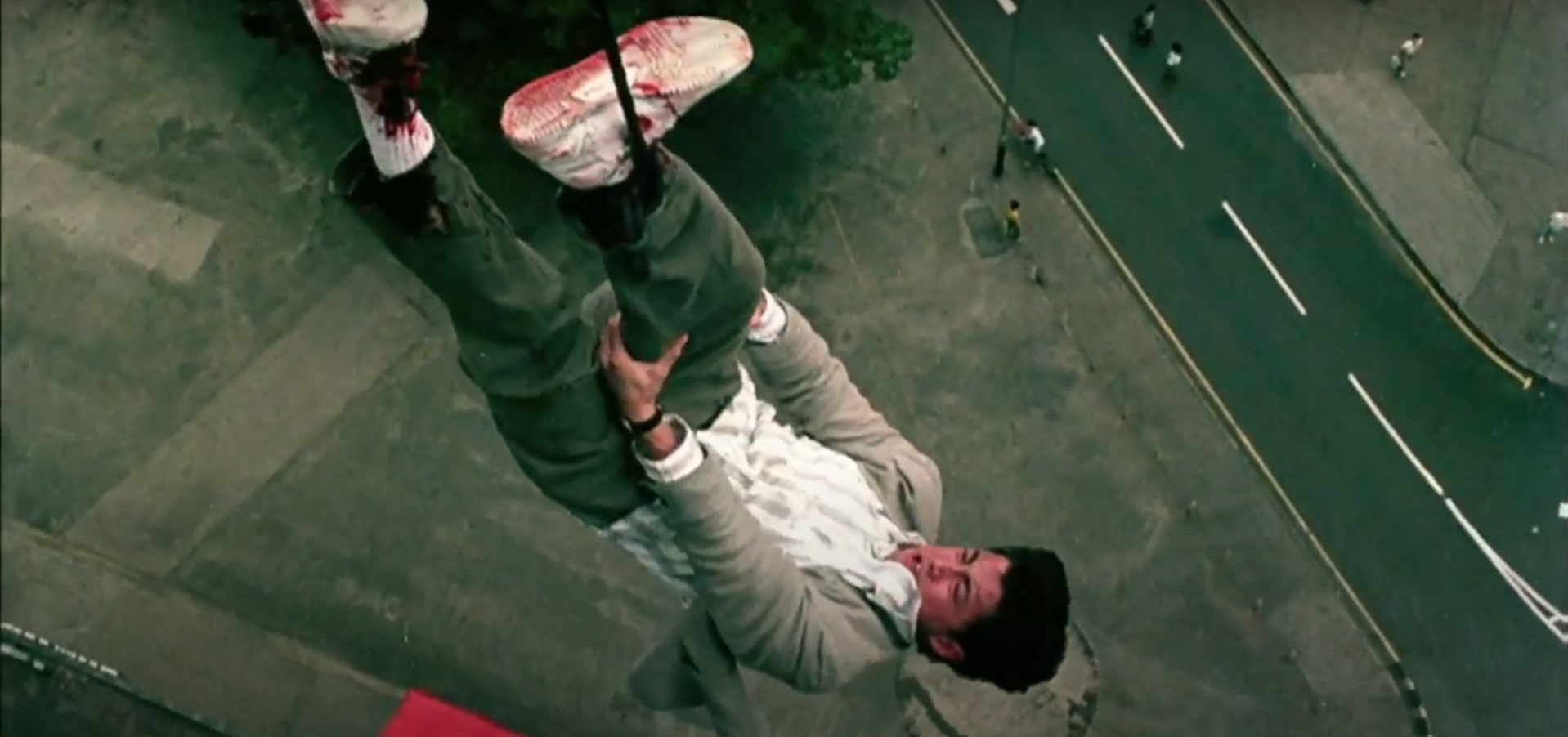
A Pact Plans EVIL Revenge on Crime Fighting Heroes! “Royal Warriors” reviewed! (88 Films / Blu-ray)

“Royal Warriors,” a Revenge Tale, Now on Blu-ray from 88 Films!

Hong Kong police inspector boards a Hong Kong bound plane on return from her vacationing in Japan.  She meets Michael Wong, the plane’s air marshal, as well as her across the aisle seat mate, Japanese native, Yamamoto, a retired cop returning to Hong Kong to retrieve his wife and daughter and retreat back to Japan to start their new life.  Also on the plane, an escorted criminal being extradited to Japan for prosecution.  When a criminal accomplice takes the plane at gunpoint, Michele, Michael, and Yamamoto spring into action and thwart an aero catastrophe with the two terrorists dead.  After celebrating their success of saving many lives, the heroic trio begin to depart their separate ways when suddenly Yamamoto’s car explodes with his wife and daughter inside.  The assassination attempt puts a target on the backs of all three of them as two war veterans swear vengeance for their slain combat brothers from the airplane hijacking.

“Royal Warriors,” also known in other parts of the world as “In the Line of Duty,” “Ultra Force,” and “Police Assassin,” is the 1986 Hong Kong police action-thriller from “Web of Deception” director and “Once Upon a Time in China” director of photography, David Chung.  Stephen Chow’s regular screenwriter Kan-Cheung Tsang, who penned Chow’s “Kung Fu Hustle” and “Shaolin Soccer,” as well as “Magic Cop” and “Intruder,” reteams with Chung on their sophomore collaboration following the comedic-crime film “It’s a Drink!  It’s a Bomb!” starring the Hong Kong humorist John Sham, and a denotes a shared three-way perspective of protagonist principals while simultaneously providing sympathetic seedlings for the principal antagonists who though are coming wrongdoings and murdering up a storm of people, a wartime conflict bond between them holds them a higher level of honor between close brothers in arms.  Dickson Poon and D&B Films produce the explosive and hard hitting with prejudice venture with John Sham (Remember him from earlier?) and Yiu-Ying Chan, serving as associate producer.

Michelle Yeoh plays Michelle Yip, the level-headed chopsocky cop returning from some rest and relaxation only to wind up on a dish best served cold “Royral Warriors” for Yeoh, who then under the less recognizable moniker Michelle Khan, is the risk-it-all action film for the actress still in the earlier days of her what would be a prolific international career.  Her breakout hit “Yes, Madam,” saw both Yeoh and also then newcomer Cynthia Rothrock punch and kick into silverscreen success as unlikely onscreen partners to take down a crime syndicate.  In the Yeoh’s next film, she rides solo but only in the actress category, being a third of the good guys, yet holding her own as a strong female, lead between another prolific Asian cinema actor Michael Wong (“Tiger Cage III,” “Dream Killer”) playing essentially himself as Michael Wong (not a typo), the plane air marshal turned love sick puppy for Hong Kong’s tough cop Michelle Yip, and yet another prolific Asian actor whose career in Japanese films started well before Yeoh and Wong and has been rising internationally amongst the ranks of American cinema in Hiroyuki Sanada (“Sunshine,” “Mortal Kombat”) playing retired officer Yamamoto, a revenge-seeking justifier on those responsible for killing his family.  The level of how these three come together in a post-incident instantaneous bond borders an idealistic way of an extreme shared experience.  Yeoh and Sanada offer a cool, collective approach with degrees of vindictive separation with a layer of compassion thinly in between with Wong providing calculated lighthearted measures of chasing Yip with infatuated eyes to break any kind of monotonous, stagnant composure between the other two, yet they’re seemingly different lives, connected ever so vaguely by being around law enforcement one way or another, doesn’t seem to thwart an instant relationship immediately after the plan incident.  What’s also odd, especially with Yamaoto, is there is more background to the villains of the story than there is with him, providing rewarding elements for reason why the two men are hunting down Yeoh, Wong, and Yamamoto and seeking deadly revenge.  Ying Bai, Wait Lam, Hing-Yin Kam, and Michael Chan Wait-Man are the pact-making, behind-enemy-lines soldiers of some unknown war from long ago who neither one of them will turn their back on a combat brother in need.  Through a series of none linear flashbacks, a union of honor between them is made and while respectable and moral during war, that pact turns rotten overtime outside the context of global conflict, suggesting ever-so-lightly toward a combat shock issue between the four men that builds a bit of sympathy for them even though blowing up a mother and child and shooting to shreds a whole lot of nightclub patrons in their misguided revenge runs ice through their veins.  Peter Yamamoto wears his sleeve on his shoulder and there is this uncertainty with his character, and his wife too, that something is amiss, creating a tension that goes unfounded and sticks out.  “Royal Warriors” rounds out the cast with Kenneth Tsang, Siu-Ming Lau, Jing Chen, Reiko Niwa and Eddie Maher.

As part of the In the Line of Duy series, a strict criterion needs to be met:  Police Action, check.  Martial Arts, check.  A Level of High Intensity, check.  And a Female Heroine, check.  “Royal Warriors” meets and exceeds the bar with another bar, a no holds bar, of spectacular stunt work done by the Hong Kong standard way of action now, think later which looks phenomenal on camera and the resulting footage.  Hoi Mang’s martial arts choreography showcases a fast-striking combinations that cut traditional sparring with melee improvisation dependent on the surroundings, moving the action left-to-right, top-to-bottom by never staying in the same place and expanding the field of play with collateral damage of bystanders and family.  A couple of components are missed between that focused innocence and whiplash of violence.  For example, the playfully amorous affections between two of the characters are not poignantly shattered like precious stained glass when one is suddenly offed.  There are other examples of once a downspin cataclysm occurs, the aftershock of loss and change does not rear its ugly head.  “Royal Warriors” just pushes forth, continuing pursuit, in a rage of retribution and righteousness. 

88 Films releases “Royal Warriors” onto an AVC encoded, 1080p high definition, BD50, presented in the film’s original widescreen aspect ratio of 1.85:1.  If you own the “In the Line of Duty” four film boxset, the version in the boxset contains the same transfer as this standalone, standard version that stuns with a new 2K restoration from the original 35mm print.  When I say this restoration stuns, I mean it.  A clean-cut natural gain, color balanced saturation, and with all the detail trimmings laud 88 Films’ work, as such as with the rest of their higher definition catalogue in the older Asian film market.  Range of atmospherics challenge with a different lighting scheme and mise-en-scene cinematography, such as the pink and purple warmth of a nightclub glow or the brilliantly lit restaurant ferry boat.  Skin and texture tones cater to a slight darker pastel but is consistent through-and-through without appearing to unnatural.  The restoration does have a positive to a fault, revealing stunt equipment during the fast-paced fighting, such as the exterior stone ground turning bouncy with creases when Yeoh vault kicks one of the Japanese yakuza members to the ground.  The release comes with four, count’em four, audio tracks:  a Cantonese DTS-HD 2.0 mono theatrical mix, a Cantonese DTS-HD 2.0 alternate mix, an English dub DTS-HD 2.0, and an English dub DTS-HD 5.1.  Of course, I go with the theatrical mix to comply with the original fidelity as much as possible with any films using ADR for an immersive experience within the original, intended language.  the 2.0 mix keeps a midlevel management of the voluminous aspects to bombastic range but never muddles or mutes the tracks.  Dialogue comes out clear with a microscopic static lingering way deep in the sublayer but, again, has negligible effect on the mix.  Special features content includes an audio commentary by Hong Kong film expert Frank Djeng, missing airplane inserts which are spliced out shots of an inflight plane exterior, and the Cantonese and English trailers.  The standard edition comes pretty standard but does feature the new character compilation artwork of Sean Longmore on the front cover with the reversible sleeve featuring the original Hong Kong poster.  The disc is individually pressed with Michelle Yeoh doing what she does best in most of her films, kick butt.  There are no inserts or other tangible bonus content.  88 Films’ North American release comes with a region A encoded playback, not rated, and has a runtime of 96 minutes.

Last Rites: 88 Films’ “Royal Warriors” Blu-ray release captures Hong Kong cinema impeccably with monumental stunts, hard-boiled police work, and permeates with color, detail, and a cleanly, discernible audio mix. In the Line of Duty, “Royal Warriors” is the first, and foremost, cop crusading caper that began it all.

“Royal Warriors,” a Revenge Tale, Now on Blu-ray from 88 Films!

Nothing Will Stop Detective Belli from Bringing Down EVIL Heroin Traffickers!

Perhaps the Best Itali-Crime Film Ever!

A hot-headed and determined police commissioner will not stop his pursuit until all the drug trafficking in Genoa is annihilated but the insidiousness of the crime’s reach within society is proving to be difficult to root out.  With the help of one of Genoa’s long-in-the-tooth drug kingpins, living out the last of days before terminal illness overcomes him, the commissioner is able to put a dent into a rival organization’s trafficking schemes.  When a case-building chief commissioner, aiming to get the very head of the organization’s snake, is brutally gunned down in the middle of the street and his evidence files stolen, more pressure is placed upon the criminal syndicate with more arrests, more drugs seized, and a bigger impact is made by one resolute cop while attempting to build a more damning case file his predecessor had worked on for years but the drug traffickers will not be deterred and mercilessly go after the commissioner’s loved ones.

Enzo G. Castellari’s “High Crime” is quintessential poliziotteschi.  “The Inglorious Bastards” and “Keoma” director’s 1973 Italo-crime feature is about as fast-paced as it’s energetically loose-cannon of a principal protagonist.  The screenplay, under the original Italian title of “La Polizia Incrimina, La Legge Assolve,” is treated by a conglomerate of Italian writers in Tito Carpi (“The Shark Hunter”), Leonard Martin (“Tragic Ceremony”), Gianfranco Clerici (“Off Balance”), and Castellari himself based off a story by producer Maurizio Amati (“The Eroticist”) and shot on and near the story locations of Genoa, Italy and the French city of Marseille.  “High Crime” is actually a sequel to Romolo Guerrieri’s 1969 “Detective Belli” in which that titular character reappears in “High Crime” but more righteous and justice-prone compared to the corrupt background of Belli in antecedent film.  Both movies star the same actor in the main role but have little connective elements.  The feature is a production of Star Films and Capitolina Produzioni Cinematografiche and is coproduced by Edmondo Amati, father of Maurizio. 

The blue-eyed “Django” actor Franco Nero is that actor portraying Commissioner Belli in both films.  In “High Crime,” Nero is an exuberantly moral cop to the point he looks to be almost throwing a temper tantrum when in the face of his superior Chief Commissioner Aldo Scavino, played by American actor James Whitmore of “Them!” and “The Shawshank Redemption.”  The two characters resemble night and day of how they handle crime; Scavino’s reserved nature evokes a cautionary tale to run down crime slowly but surely in building a case that would settle everything all at once whereas Belli’s take is to chase with wild abandonment that’ll risk all that he holds dear as he chips away toward a heavily fortified crime lord.  Nero and Whitmore exact the personas down to the letter, nailing in the thematic message from Scavino that that the chair he sits in is hot, heavy, and full of responsibility, much the way Uncle Ben tells Peter Parker about great power carries great responsibility.  In Belli’s ear, working his way into the mind of a gung-ho lawman, is drug kingpin is Cafiero by Fernando Rey, who two years prior played in a similar story of William Friedkin’s American, lone-wolf cop story “The French Connection.”  Rey adds sophisticated demure to his really bad guy character to appear like an ally in not only the eyes of Belli, who really puts his trust in Cafiero, but also the audiences who will forget he’s an equal in the drug game.  What’s interesting and dynamic about “High Crime” is the woven character arcs and fats that quickly develop and quickly diminish through Belli’s investigation.  In the mix of this unsafe space for any character is Della Boccardo (“Tentacles”), Silvano Tranquilli (“The Bloodstained Butterfly), Duilio Del Prete (“The Nun and the Devil”), Mario Erpichini (“Spasmo”), Ely Galleani (“A Lizard in a Woman’s Skin”), Stefania Castellari (“1990:  The Bronx Warriors”), Bruno Corazzari (“Necorpolis”), and Luigi Diberti (“The Stendhal Syndrome”).

“High Crime” deals in high impact.  Car chases, shoot outs, foot pursuits, murder hits, and more that genetically makeup Castellari’s film with a centralized hero destined for tragedy spurred by his own ambition, texturing the character with an anti-hero wallpaper as he can’t see past his own objective and the direct danger that blind ambition poses.  Kneaded into this notion is Caastellari’s fantastic use of editing and scene transition that provides a seamless continuity as also misleading truths.  Editor Vincenzo Tomassi (“Zombie”) cuts and splices with great continuity care to arrange multiple shoots of one scene, such as the opening car chase between Belli’s squad car pursing a Lebanese drug supplier, to match every angle without losing track or bewildering audiences with implausibility.  The transition scenes also stun with zoom-in and zoom-outs that segue different scenes, a previous moment may bleed into another with deceptive infiltration of the next scene, and Castellari uses sounds too to transition to the next shots.  These on-your-toes transitions commingling with the ever-dynamic, fast-paced crime story with a high mortality rate, high character development, and high emotional roller coaster loop-the-loops whirling around the abundant and impressively rounded characters solidify “High Crime” as the holy grail of highly valued and highly entertaining poliziotteschi!

If you’ve ever wanted more out of Enzo G. Castellari’s “High Crime,” Blue Underground has you covered with a limited edition 3-Disc, UHD HD Blu-ray, Standard Blu-ray, and soundtrack CD set packed with content in the HVEC and AVC encoded double layers of the 2160p 4K UHD BD66 and 1080p Blu-ray BD50.  The brand-new 2024 Dolby Vision HDR 4K master stuns.  Image resolution connected with balanced contrast results in a vibrant, crisp-sharp quality rendered from a stellar original 35mm print, presented in the original aspect ratio of a widescreen 1.85:1.  There’s not an arresting softness to be had as details emerge in the various Genoa and Marseilles ship ports, manufacturing parks, and concrete city landscapes bursting with infrastructural texture.  There’s also plenty of minute detail on skin textures with a touch of technicolor process for a dash of properly installed pigmentation.  This sort of scrutinizing care translates also to the post-ADR English 1.0 DTS-HD audio mix with an uncompressed, lossless fidelity.  Dialogue is post-recorded with the original actor’s voices providing better authenticity in comparison to other voice actors, especially over the gruff American voice of James Whitmore.  Environmental ambience doesn’t miss an action with a complete and broad line of virtual city sounds coupled with in-scene ambient sound, all converted and individualistic defined through the single channel, supported by Oliver Onions brothers Guido and Maurizio De Angelis providing a catchy copper beat whether be car chase or foot pursuit.  There also an Italian dub 1.0 DTS-HD.  English subtitles for the deaf and hard of hearing are optionally available as well as French, Spanish, and English for the Italian audio feature.  Hours of bonus materials lined the encoded BDs, more so on the second disc, the Standard Blu-ray, due to capacity.   Disc 1, the 4K UHD, houses an audio commentary with director Enzo G. Castellari, a second audio commentary with star Franco Nero, a third audio commentary with film history Troy Howarth, Nathaniel Thompson, and Eugenio Ercolani, an alternate ending that fades to black rather than the original freeze frame, and the theatrical trailer.  Disc 2, the standard Blu-ray,, has all of the above plus interviews with Castellari and Nero The Genoa Connection, an separate interview with Castellari From Dus to Asphalt, an interview with stuntman Massimo Vanni Hard Stunts for High Crimes, an interview with camera operator Roberto Girometti Framing Crime, an interview with soundtrack composers Guido and Maurizio De Angelis The Sound of Onions, a Mike Malley directed featurette The Connection Connection featured in EUROCRIME!, and a poster with still gallery.  The double wide Amaray case also comes with its own special attributes, such as a rigid O-slipcover with compositional illustration of pretty much all the action you’ll see in the film.  The slipcover also contains embossed textile elements for a junior-sized 3D effect.  The set has a reversible front cover with the primary art the same as the slipcover’s while the inside contains an original poster art replica.  The insert side contains a dual-sided cardboard track list and soundtrack info on top of the back and red original motion picture soundtrack CD.  The 4K UHD and Blu-ray on the opposite side are staggered in individual push locks where you have to remove the top disc in order to get the bottom disc and they’re too pressed with the same art from the reversible front cover.  Blue Underground outdid themselves with “High Crime’s” first Blu-ray release, curated to perfection, in the U.S.  The Not Rated Blue Underground set is playable on all regions and has an uncensored, uncut runtime of 103 minutes.

Last Rites: To simply write positively about “High Crime” and Blue Underground’s merit 3-disc set is simply not enough. Fans of William Friedkin’s “The French Connection” and other moviegoing fans can find this Eurocrime thriller to be captivating from start to finish.

Grab this Limited Edition Set of “High Crime” Before Its Gone!

In the Canals, An EVIL Lurks! “Amsterdamned” reviewed! (Blue Underground / Blu-ray)

The Horror of “Amsterdamned” Canals Are Now Available at Home!

A killer emerges out of the depths of an Amsterdam canal and mercilessly kills a prostitute, dragging her into the water, and suspends her lifeless, stabbed-riddled corpse over one of the canal bridges.  Detective Eric Visser is baffled by the canal killer’s unusual technique but aims to track down the bravado murderer while living the single dad life with daughter Anneke.  When another couple of heinous killings takes place out in the middle of the water and the mutilated bodies wash ashore, panic begins to creep into administrative officials with the thought of a scuba diving maniac swimming in the hundreds of Amsterdam canals.  Investigating the underwater hobby leads Visser to meet Laura, a diving enthusiast and museum tour guide who sparks instantly with the ruggedly handsome detective, but as the Visser gets closer to the truth and the killer, Laura becomes emmeshed in a crime that’s deadlier than an embolism. 

If scuba diving wasn’t already deadly enough, the murky waters of canal rivulets become the hunting grounds of a deranged, underwater killer in Dick Maas’s 1988 Dutch crime thriller “Amsterdamned.”   The elevator horror filmmaker of “The Lift” Maas wrote and directed the red-running canal of carnage with a fast-paced, action-packed, hard-boiled, giallo film outside the conventional Italia-construction.  Shot mostly in the red-light district capital of the world of Amsterdam, shooting locations also include Utrecht to accommodate additional speedboat scenes, plus studio work in Leiden and Heemstede, Netherland.  Maas self produces the action-horror alongside Lauren Geels, a longtime collaborator with Maas who’ve worked previously on comedies “Voyeur” and “Flodders” and subsequent projects, such as the English-dialogued apocalyptic drama “The Last Island” helmed by provocative feminist filmmaker Marleen Gorris and Maas’s own American remake of “The Lift,” known as “The Shaft” or “Down.”  “Amsterdamned” is distributed theatrically by First Floor Pictures.

Huub Stapel (“The Cool Lakes of Death,” “The Lift”) stars as the world-weary, tough as nails cop Eric Visser.  Also, as a single dad raising a small preteen and nearly self-independent child Anneke (Tatum Dagelet, ”Stuk!”), the setup doesn’t automatically constitute the detective as a cynically hardboiled man of the law but evokes more of a seasoned and skeptical vigilant persona of a man who is willing to leave circumspection at the door when duty calls.  Stapel wonderfully fits the bill of Eric Visser’s rugged and assured good looks with a force in tune with being a father and a police investigator when the occasion calls for it.  Being a single father also invites the opportunity to spark an exciting love interest to later put into danger.  The infectious smile of Monique van de Ven (“Turkish Delight,” “A Woman Like Eve”) fills that void as Stapel and Ven engage in teetering flirtation that makes us wonder how astute is Visser now on a case that’s causing havoc on the streets of, or rather the waterways of, Amsterdam.  Luckily, fellow police partners Vermeer (Serge-Henri Valcke, “Sl8n8”) and John van Meegeren (Wim Zomer), the latter a professional scuba diver and once jealous rival lover of Visser, keep the detective mostly focused with investigative conversation, joint crime scene speculation, and the gruesome death of one of them when they get too close.  That ancient rivalry between Visser and Meegeren stays put in the re-introduction of their assembly with no hard feelings and bygones will be bygones attitude, missing the change for any exterior or addition tension outside the murderer’s reign of terror.  “Amsterdamned” rounds out the cast with Lou Landré, Tanneke Hartzuiker, and Hidde Maas.

The fascinating aspect of Dick Maas’s “Amsterdamned” is taking the idyllic, ingrained, and utilitarian that is a cultural and landmark staple of Amsterdam and turning into an unpleasant gateway of fear and anxiety.  Transferring soundbite cues and following a storyline that’s not terribly too dissimilar from that of Steven Speilberg’s iconic oceanic death-dealing “Jaws,” and toss in Dick Maas’s enthusiastic fervor for a heart-racing effervescence, and you have the singular crime-thriller “Amsterdamned” in a nutshell that’s doesn’t deliver trite and uninspired horror or thrills but rather spoils the innate grandeur of a worldclass city that’s soaked in splendor as well as carnal sin; a fact lost upon espionage thrillers who overuse “Amsterdam” as an assembly of salvo and high-speed chases.  Maas does add his own variation of high-speed chase with a lengthy and complex speedboat pursuit through the on-site in Amsterdam and Utrecht canals with gripping and well edited ramp jumps and fiery explosions that predate some of the more renowned speedboat chases of modern cinema.  What’s also interesting about “Amsterdamned” is the adversary that doesn’t have a lot of bells and whistles to make a convoluted story stick; instead, the killer is rather simply pieced together but descriptively held at bay until the finale for maximum suspense on unveiling the identity. 

Surfacing just beneath the depths is a 2K restoration from the original 35mm negative, approved by Dick Maas, from Blue Underground; however, these Blu-ray specs mirror the 2017 Blu-ray and DVD combo set and is more than likely the same transfer but for this standard edition, also labeled special edition, release.  The single disc, AVC encoded, BD50 is presented in high-definition 1080p and in a widescreen 1.85:1 aspect ratio.  Color saturation stands out here with a specified density that results in a pop of color and a diffusion of light that’s brilliant and revealing in the day without a bleeding wash and cold, wet, and with a noir-like steeliness at night, accentuated by inky solid shadows.  The original 35mm print has flawless approach into the restoration that makes the 2K scan candid and, perhaps, a walk in the park for another Blue Underground upgrade to high-definition in their established genre catalogue.  The original Dutch soundtrack is presented in a 5.1 DTS-HD, greatly tightened around the milieu and dialogue to isolate each track for separation and clarity.  Dick Maas, a filmmaker of many talents, scores his own feature with an unintrusive and dynamic soundtrack that ebbs and flows with the trepidation terror and tension-riddled action.  Dialogue is clean and clear but does have that ADR artificiality to it.  English subtitles render over promptly and error free.  Two other soundtrack mixes are available on the dual layer disc:  a lossless hybrid English-Dutch 2.0 DTS-HD and a French dubbed and lossy Dolby Digital 2.0 Stereo.  English SHD and Spanish subtitles are also optionally available.  Extras are pulled from the previous Blue Underground release and are an audio commentary from writer/director/composer Dick Maas and editor Hans van Dungen, a making of “Amsterdamned,” an interview with star Huub Stapel Tales from the Canal, an interview with stunt coordinator Dickey Beer Damned Stuntwork, the Dutch and US trailer, the Lois Lane music video directed by Dick Maas, and poster and still galleries.  Behind the wild ride illustrated composition of the Blu-ray front cover, the reverse cover lists the encoded scene chapters on top of one of Huub Stapel’s stunt work performances. The disc is pressed with the masked scuba diver head holding a gleaming diver’s knife cover art from Blue Underground’s limited-edition Blu-ray and DVD combo set of 2017. The all region encoded disc holds a 113-minute feature and is rated R.

Last Rites: If looking to save a buck against purchasing the limited edition, dual format combo set, the standard special edition Blu-ray of “Amsterdamned” is worth it, especially since the film has been absent from U.S. home markets up until 2017. Dick Maas is a premier Dutch horror filmmaker with the ability to keep us engaged as well as on edge.

The Horror of “Amsterdamned” Canals Are Now Available at Home!

Yeoh, Rothrock Beat the EVIL to a Pulp! “Yes, Madam!” reviewed! (88 Films / Blu-ray)

“Yes, Madam!” on Blu-ray from 88 Films!

Hong Kong’s Inspector Ng and Scotland Yard’s Inspector Carrie Morris reluctantly join forces to solve the murder of an undercover British national on the verge of exposing a fraudulent real estate contract helmed by crooked businessman Mr. Tin.  When a small piece of key case evidence, a microfilm, winds up in the bumbling hands of three low-level thieves after coincidently robbing the undercover British agent’s hotel room, they find themselves at a crossroads; do they give up the kill-for microfilm to the police in the name of self-preservation or ransom it against Mr. Tin’s syndicate for a big payday?  The elusive Mr. Tin becomes enemy number one in Ng and Morris’s crosshairs despite his circumventing the law.  Not deterred by the failed arrest, the tough as nails inspectors track down the microfilm thieves to make their case and take down by force one of Hong Kong’s most powerful criminal organizations.  

An accelerating knockaround action-comedy from Corey Yuen (“Ninja in the Dragon’s Den,” “The Transporter”), “Yes, Madam!” is a fight-heavy, female-driven super cop emprise with martial arts daggers drawn and slicked in a vigorously lubed burlesque dark comedy.  The 1985 Hong Kong production, penned by Barry Wong (“Hard Boiled”) and James Clouse, as his sole credit, teams an unlikely and highly skilled, international partnership between a twosome of type A personalities who not only initially combat each other and then the unscrupulous bad guys and their mischievous plans but also against the historically prejudiced gender role reversals outside the borders of the story.  Action-packed choreography mixed with slapstick comedy, “Yes, Madam!” is entertainingly fun to watch and hard-hitting, produced by stuntman Sammo Hung (“Long Arm of the Law”) and film’s costar John Sham (“Royal Warriors”) and along with Sammo Hung, executive producer Sir Dickson Poon develops “Yes, Madam!” under their cofounded martial arts and action feature producing D&B Films.

If you’re ever looking for a celebrity roots film, a launching pad feature of success, “Yes, Madam!” has that inner circle, star-studded power and deliverance that not only showcases the beginnings of two presently well-known action and martial art film women but also joins the East with the West in a singular chop-socky fracas.  Oscar winner Michelle Yeoh (“Crouching Tiger, Hidden Dragon,” “Everything Everywhere All at Once”), credited as Michelle Khan, and black belt martial arts competitor and World Champion Cynthia Rothrock (“China O’Brien,” “Tiger Claws”) explode to the thousandth degree on screen as apex inspectors forced to work together to take down crime boss Mr. Tin (James Tien, “Fist of Fury”).  They’re fast, they’re ferocious, they’re incredibly talented in what could be considered their debut principal performances, especially Rothrock in her first feature film in which she doesn’t speak an ounce of either of the native Hong Kong’s Cantonese or Mandarin dialects.  Yeoh and Rothrock are top dog heroines in a yard full of marginal, blundering thieves caught in the middle of a grander operation.  Under incognito with pain reliever aliases are actor-producer John Sham (“Winners & Sinners”) as Strepsil, Hoi Mang (“Zu:  Warriors from the Magic Mountain”) as Aspirin, and Hark Tsui (“Working Class”) as Panadol and though they act like, and sort of resemble, the Three Stooges, the three thieves and counterfeiters embody a mutual brotherhood with background history and a all-for-one, one-for-all attitude as their minor caper turns into a full collapse of their con game.  Characters and performances are all over the board between the various groupings in the melee but does weirdly gel together in an artificial way toward a poignant culmination collision of what’s just and unjust that destroys, and unites, friendships and bonds.  “Yes, Madam” rounds out the cast with Melvin Wong, Wai Shum, Eddie Maher, Michael Harry, and Dick Wei (“Five Deadly Venoms”) and Fat Chung (“To Hell with the Devil”) as Mr. Tin’s nonpareil sub-bosses. 

Barreling along from the very beginning of an armored car hijacking turned into a bloody shootout to the grand finale that pageants the marvelous, born-for-this skill of Michelle Yeoh and Cynthia Rothrock as they plow down foes with acrobatic fists and kicks galore, “Yes, Madam” doesn’t dwindle as a debut disappointment but rather is a tour de force of destruction, drollery, and delictum prevention.  Outlandish at times, of course, with a story slightly straying off course here and there but that feverishly, cyclonic filmmaking condenses to being nothing new or novel for the reputably fast-paced, churn-them-out style of Hong Kong cinema and palpable fighting is taken to a whole new level of ouch and woah.  Multiple takes from various angles equates to the stunts being depressed continuously onto the repeat button, solidifying prolific editor Peter Cheung (“Ready to Rumble,” “Mr. Vampire”) as one of the best in the business, globally, to manage the multiple strands of film and make a coherent and entertaining yarn out of the celluloid chaos.  The crux of the kerfuffle isn’t delineated well enough to justify and muster this kind of police force and exaggerated villainy but the theme majority inside the broadly cartoonish veneer is mostly about respecting the girl boss and grasping friendship that has been taken for granted, dipped in a furiously candy-coated rouse of visually exciting stimulation. 

88 Films adds “Yes, Madam!” into their U.S. distribution cache with a new, well-curated Blu-ray release.  The AVC encoded, 1080p high-definition, BD50 presented 2K scanned and restored feature has the original aspect ratio of 1.85:1 in the Hong Kong cut. Beautifully diffused and vibrant color, there’s no hue deficiency under this well-lit production, restored to nicely detail skin tones and textures in every aspect of the lighting. No issues with compression during the rapid-fired sequence cells, such as aliasing or ghosting, and black levels are solid albeit there’s not a ton, if any, negative space to experience as even the night shots are illuminated in a “moon” diffusion. Delineation reflects a deepened background contrasted against foreground objects, creating ideal space between objects in what is mostly a close quartered, hand-to-hand combat with only a handful of medium, medium-long shots to make the scenes more realistic than choreographed on a wider frame. Two audio options encoded are the original Cantonese DTS-HD 2.0 mono and an English DTS-HD 5.1, both use ADR dialogue which incurs only minor negative separation and synch between actor and script. Cantonese track fairs slightly better with the native tongue but much like the story’s brisk pace, vocals are also quick as a whip and often times outpace the lips. What’s interesting about “Yes, Madam!’ is the score which is credited to Romeo Díaz (“A Chinese Ghost Story”) but samples much of John Carpenter’s “Halloween” in tense moments. “Halloween” comes through so prominently that it shadows and hurts Díaz’s own work, if any of it exists. Ambience tracks work with the grain with some of the fighting emphasized for chop-socky effect. English subtitles synch fine and have scribed errorfree. Product special features an audio commentary by Frank Djeng on the Hong Kong cut, a new interview with star Cynthia Rothrock, Rothrock and Djeng also provide select scene commentary, a new interview with Mang Hoi who played Aspirin, archive interview with Michelle Yeoh, an archive Battling Babes featurette, and with the Hong Kong trailer rounding things out. New action-packed compositional artwork from graphic designer Sean Langmore graces the primary cover art with original artwork on the reverse side. The disc art is pressed to promenade the two female actresses and there is nothing across the way in the insert clips. The region A playback release has a runtime of 93 minutes and is listed as not rated.

Last Rites: There’s nothing more to say other than “Yes, Madam!” A top-notch, assertive action film starring two worldclass women in the fighting subgenre who stir in the cool and the kickass with silky, smooth ease.

“Yes, Madam!” on Blu-ray from 88 Films!

A Gang’s EVIL Ransom Elicits the Wrath of “Zero Woman: Red Handcuffs” reviewed! (Neon Eagle Video / Blu-ray)

“Zero Woman: Red Handcuffs” is Number One on Our Must Have Lists!

When undercover officer Rei lets her overwhelming emotions kill a suspect on an assignment, her displeased colleagues lock her into a cell, unable to decide her fate with fear of public outcry of police brutality that would blemish the department and force leadership regsinations.  When a prime minister candidate’s daughter is kidnapped by a ruthless gang of rapists and murderers and brought to a cathouse for sale, the brothel madam believes the young woman is better exploited by issuing a large ransom for her safe return.  Unwilling to face public scandal, the politician and a rigid yet loyal investigator of the clandestine Zero Division rig up a covert plan to eliminate every person involved with the kidnapping by offering a murderous deal to Rei in exchange for her freedom.  Rei’s able to infiltrate the gang’s inner circle only to see the plan devolve into chaos and blood between the gang and corrupt authorities.   

Japan doesn’t make films like “Zero Woman:  Red Handcuffs” anymore!  The violent Toei company pinkusploitation production, released in 1974, played a major role in unifying the sexual appetites of Japan’s pink pornos with the rough-and-tumble violence of exploitation action films.  The rising of Nikkatsu Roman Pornos forced the hand of the Toei Company to expand their portfolio, creating such as combinational conquest over salivating grindhouse cinema patrons that the radical subgenre deserved a new sublet coinage labeled pinky violence.  Toei company man Yukio Noda, a staple yakuza filmmaker for the company, helms the visuals translated from a script penned by “Female Prisoner #701:  Scorpion” writers Fumio Kônami and Hirô Matsuda.  Loosely based off the manga written by Tooru Shinohara (who also penned the manga of “Female Prison Scorpion series”), “Zero Woman: Red Handcuffs” stitches its own blood soaked and sexually provocative clothing that would later continue “Zero Woman’s” adventures throughout the years with more films.

Cladded in a chic long red coat, black boats strapped up just below the knee, and wielding an extra-long connector chain pair of red handcuffs, Rei is the anti-heroine of our manga fantasies.  Miki Sugimoto works deep into that fantasy vision as Rei, Division Zero’s lady cop who will do anything and everything, clothed or undressed, to get the job done, even with extreme prejudice.  A frequent delinquent girl portrayer for Toei Company’s gritty bad girl gang pink pictures (try saying that five times fast), Sugimoto’s filmography include the “Girl Boss” series, “Terrifying Girls’ High School:  Women’s Violent Classroom, and “Criminal Woman:  Killing Melody,” and so Sugimoto already had established this foundational layer for Rei as a fortitude of badassery and now tacking on another layer of a moral high ground, justified only by seeing her word through to the end.  Rei is up against a gang of five – four street thugs led by the recent prison released Nagumo (Eiji Go,” The Executioner”) and one lesbian brothel madam (Yôko Mihara, “Sex & Fury”) – as she agrees to a back-against-the-wall deal and slyly subverts the gang by helping Nagumo during a faux ransom sting operation.  Along with Sugimoto’s stoicism, the Toei porn actress retains her promiscuous allure, one where she doesn’t have to do anything to be seductive but just be herself, working not only toward the favor of her character, who continuously is taken advantage of sexually without shame, but also keeping the integrity of the Toei élan for Japanese sleaze.  “Harakiri’s” Tetsurô “Tiger” Tanba resides to the general’s overlooking hill as the prime minister candidate who sends his battlefield colonel in Hideo Murota (“Rape and Death of a Housewife”) to be the Zero Woman’s handler.  Their scheme quickly devolves as their plan evolve when the operation goes slower than expected and the gang’s leader Nagumo begins feel the pressure of paranoia and starts to unhinge, especially around his ruffian acolytes played by Seiji Endô, Rokkô Toura, Iwao Dan, Kôji Fujiyama, and Ichirô Araki as Saburo the mysteriously quiet, aviator-waring knifeman who in himself is an interesting character.  Cast fills in with the Japanese speaking Westerner Ralph Jesser in a wild opening sequence that results in a gunshot to the groin!  

Like most pinky films, “Zero Woman:  Red Handcuff’s” incorporates an X-rated sexual violence but unlike most pinky films, the pinky violence subgenre omits the softer side of sensuality, creating more of a nihilistic viewpoint toward sex of taking what you want, when you want it, and aggressively at that.  Yukio Noda picture contains hostile lesbianism, gang rape, and pressurized perversions that take control thematically in pinky violence.  The corrosive context that has a guilty pleasure pull in most patriarchal dominated cultures and fleapit cinemagoers goes hand-in-hand with the over-the-top violence conjoined at the hip of cause-and-effect.  Usually, the narrative goes an ugly rape equals hard-fought revenge; in Noda’s film, the cause is the kidnapping, and subsequent deflowering of a power politician’s little girl leas to the Zero Woman effect of silencing with corporal punishment that circumvents the law.  Stylish like a spaghetti western and brutally violent, “Zero Woman:  Red Handcuffs” is a meanspirited, out-for-blood, femme fatale engendered on the verge of the pinkusploitation genesis.

Neon Eagle Video, a collaborative boutique label effort between Cauldron Films and Mondo Macabro’s Jared Auner, releases “Zero Woman: Red Handcuffs” onto a new Blu-ray, restored in 4K from the 35mm print. The transfer is AVC encoded, 1080p high-definition, onto a BD50 and shown in the widescreen aspect ratio of 2.35:1. A relatively clean 50-year-old print hardly displays any age wear, if any at all. Scarcely marred by blue vertical emulsion scratches in only a single scene, the print retains and is stored with care to diffuse the range of color and to effectuate as much detail as possible in textures and skin while without taking away from Noda’s underbelly surrealism. The lower contrast infuses a pulpy layer to create softer shadows, but contouring manages to stick an outline thanks to key Rembrandt lighting precision, akin to Hammer Horror with a splash of Kensington gore. The uncompressed Japanese DTS-HD MA 2.0 mono peaks with the best possible optical audio. While not much in the way of depth creation, there’s plenty of range in the Foley, even if it’s artificially abstract and illogical compared to shotgun microphone captured audio. The ADR synch is one of the best inlaid post-recordings with visuals that renders hardly any feedback or unnatural noises on the audio layer. English subtitles are burned into the only available Japanese language picture on the release. Special features include a feature length audio commentary by author and producer for Vinegar Syndrome Samm Deighan, Sex + Violence = Pink Violence TokyoScope author Patrick Macias analyzes “Zero Woman: Red Handcuffs,” and an image gallery. Graphic designer Justin Coffee produces a new, rich-in-red, and taletelling composite illustration of what kind of film to expect on the front cover art of the clear Amaray Blu-ray. The reverse cover houses another illustration, one pulled from the feature’s original poster line. The BD is pressed with more Coffee fiery and red-laced artwork. This particular copy reviewed is not the limited edition set with accompanying slipcover and neither copy contains insert material. The region A playback release comes unrated and has a runtime of 88 minutes.

Last Rites: “Zero Woman: Red Handcuffs” is a fine introductory film into the world of Pinky Violence, a starting line for those perverse-thirsty for the unification of sex and violence in Japanese cinema. Neon Eagle Video delivers excellences with their restored print, second to none in its picture and audio quality that will provide a sterling experience.

“Zero Woman: Red Handcuffs” is Number One on Our Must Have Lists!