
While embarking through Kentucky on a camping road trip, four friends make a pit stop at a Kentuckian scream park called Talon Falls, suggested to them by squirrelly and unusual gas station attendant. As they work their way through a labyrinth of gore and torture, the realization that the local attraction harnesses realistic inflictions of pain hits them squarely in the jaw as they become unwilling participants instilled into the hyper-horrific entertainment that’s recorded onto a snuff tape. In order to not be strapped to a jerry-rigged electrocution chair or be the guinea pig for a sadistic mad doctor with a niche for painful exploratory surgery, they must fight the entire company of Talon Falls’ scream park in order to not be a piece of recorded snuff.
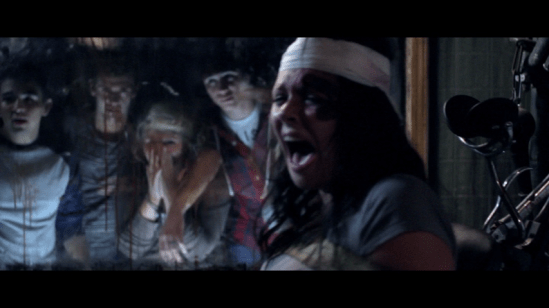
“Talon Falls” is the 2017 torture and survival horror named after and shot on location at the real life scream park located in Melber, Kentucky and written, directed, and co-produced by indie filmmaker Joshua Shreve. Shreve’s story tip-toes around being a familiar narrative that might not seem so different from other works ranging from Nimród Antal “Vacancy” to maybe even Rob Zombie’s murder-world fun-n-games “31,” but if you take a step back and take a long, hard look at “Talon Falls'” gore scenes that don’t just secretly record the assortment of death, but exhibits the ghastly torture for the entire public eye to see. If you’ve been to a Halloween Horror theme park, you know very well the adrenaline pumps, the hearts thump, and the fear tops into a knot in your throat and “Talon Falls” simply adds that what if factor. What if it’s not fake? What if these people being dismembered and vilely tortured are ultimately put to death right before our eyes, like some Captain Spaulding backwoods horror show with a side bucket of his famous fried chicken?

In any case, the four friends, made up of two couples, don’t have one ounce of star power behind their name, but each one of them spearhead the project with enough enthusiasm and gusto that there’s no short fall of trepidation even if the level of fear stalls slightly on overkill at times. Brad Bell, Jordyn Rudolph, Sean Rudolph, and Morgan Wiggins don’t necessary have the on-screen chemistry as friends or couples, even if Sean and Jordyn Rudolph are an offscreen husband and wife, but the palpitating consternation dynamic solidly sells when all hell breaks loose inside the walls of Talon Falls. Between Jordyn Rudolph and Morgan Wiggins, either actress could be a vocal stretching scream queen, especially Wiggins who reaches ranges that could pierce eardrums.

When the spectrum-filled makeup palettes and every single destructive deconstruction prop is laid out at your finger tips, the special effects comes as second nature and to introduce a high level of design detail to the already elaborate set, inside a really monstrous horror park, then “Talon Falls” without a doubt will walk, talk, and look like a top-notch horror film. However, not all aspects are perfect with the Shreve film, produced by Kent Hammond and Todd Ferren, as the story progression with the characters becomes minimized that result in haphazard camaraderie between the friends who are more turnstile acquaintances than lustful lovers or deep-rooted long time friends. Also, characters make hot-headed or stupid-minded questionable decisions when in hot pursuit of an axe-wielding, piggy-masked killer and the scribing of the irresponsible decisions when safely stowed away when being pursued, roots out Shreve’s inexperience in a time of a building block career.

MVDVisual and Lost Empire present “Talon Falls,” the Terror Films and Flashback Pictures production, onto DVD home entertainment in a widescreen 2.35:1 that atheistically gritty in the detail. Even the darker scenes, with well established and positioned shadowing, bring substantial substance to liven up and level up this independent feature from Kentucky. The 5.1 surround sound track has stable range through and through with a caustic toned score to convey terror and a clear and prominent dialogue track that doesn’t muddle through a surplus of ambient tracks. Bonus material include a behind-the-scenes featurette that runs through a randomizer of footage markers and some bloopers. A theatrical trailer is also included. Josh Shreve can only get better from his Sophomore film as a director whose hot off his solid genre entry in “Talon Falls” with the aid of the scream park’s unlimited horror resources and though popping with toe-nail pulling moments, the extremely short runtime of 75 minutes suggests a stiffened premise with undercooked character development that diminish that high production value and bloody effects.
Category Archives: Death


In Search for Evil, Evil is Always Close! “Lycan” review!
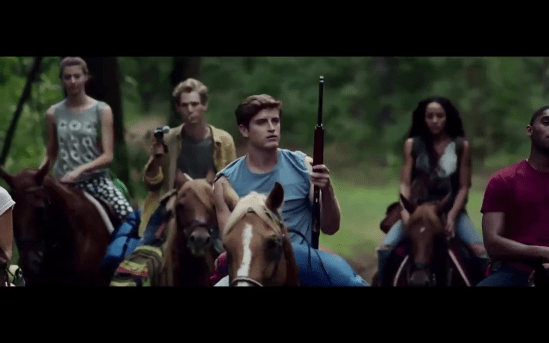
Set in Talbot County Georgia of 1986, six university students are assigned a write a 25-page report on a moment in history. The subject for the report was ultimately based off of local lore, a haunting story from a century old newspaper clipping that told legend of Emily Burt who was the prime suspect of being the notorious wild animal that tore through the local sheep herds. Ill-prepared and flippant for the report’s hot Georgia weathered journey into the woods, the students ride horseback through a labyrinth of trails on the Burt property and come under attack by a lurking bloodthirsty presence hellbent on separating them and tearing them to pieces. Desperation sets in when tensions flare, sides are taken, and perceptions are misled in a time of grave crisis, leaving the schooled students being taught a lesson in isolation and confusion in a classroom of ill-fated situations.
“Lycan” is the 2017 released survival horror thriller from co-writer and director Bev Land, making his inaugural feature film debut. Michael Mordler co-wrote the script that’s been described as “Hitchockian” and resembles a backdoor twist much to the similitude of M. Night Shayamalan films. Like Shaymalan’s earlier work, “Lycan’s” horror is extremely effective without having to bare witness an antagonistic beast and by leaving the girth of the killer’s destructive path to the imagination, our minds begin to formulate diegesis theories and build hypotheticals to the killer’s characteristics. The use of wolf-o-vision is a past time tool that flashes all it’s teeth to bring life to an unseen threat, but Land and Mordler pen a breadcrumb trail of hints that compound to a head in the midst of the chaos, unveiling the true threat in a full frontal way that’s a silver screen rarity, but nearly takes the fun out of the mystery.

Starring in “Lycan” is Bev Land’s wife, Dania Ramirez (“Quarantine”), in the lead role of the mysterious Isabella Cruz. Ramirez’s has to accomplish multiple feats with Isabella Cruz whose a bit of an awkward loner who then has to reintegrate herself into the social realm of a group of variously distinguished characters. Parker Croft portrays as pot smoking, wise-cracking, pervert named Kenny McKenzie who documents the trip with an 8mm camera, Rebekah Graf is the stuck up and prissy Blair Gordon who only accompanies the group on this trip because of Jake Lockett’s baseball jock Blake Simpson. Craig Tate, unfortunately, falls into the stereotypical ‘token black guy’ Irving Robinson while Blair’s sorority pledge, Kalia Prescott’s Chrissy Miller, opts to the gal to get laid. Aside from Ramirez, the rest of the cast of characters fall into formulaic limbo, stuck in their own devices, and never really elevate into more than just surface level characters. Two of the more eyebrow raising actors that never saw the character development light of day were that of Gail O’Grady (“Chromeskull: Laid to Rest 2”) and Vanessa Angel (television’s “Weird Science”). O’Grady’s Ms. Fields warranted more background into how the ranch owner came to have Isabella Cruz enter her life and much more unopened mysteries about their dynamic.

While “Lycan” offers an up-to-snuff survival horror, the story’s bookends fall short of fully completing the story. The opening puts big man Presley Melson’s lonely farm boy stuffing lady of the night Anna, played by Alina Puscau (“Dracuala: The Dark Prince”), full of his pork roll. As the wolf-o-vision circles the lovemaking barn setting, Melson and Puscau trot out with only their skivvies to check out the outside racket and become, uh, victims of the antagonist? Not really sure because the scene starts from afar and the wolf-o-vision glides right up to Melson’s face without much of a peep from either Puscau or Melson. The ending is just as enigmatic with a brief present day scene (the story is set in Georgia 1986) of an unknown little girl picking up a razor sharp object from the leaf strewn ground and then there’s a cut to black to roll credits. Before this useless segment, the pinnacle moment of the third act springs too many leaks to plug. Combined with the stagnant and underdeveloped characters, “Lycan” is an unkempt story left wide open becoming a victim by it’s own scripted structure.
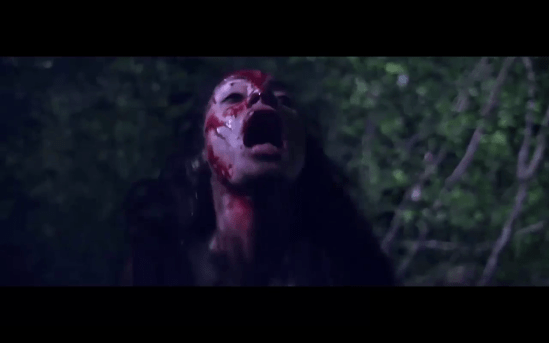
MVD Visual presents onto a region one, unrated DVD, the 1 Bullet in the Gun production, “Lycan.” Presented in anamorphic widescreen 1.85:1, MVD’s DVD image is beyond spectacular with immense details in every scene, even in the production illuminated night scenes. Digital noise is completely absent and the coloring is naturally vibrant. The Dolby Digital 5.1 Surround Sound has an effective ambient track with clarity and range in the wolf howls and the cracks and snaps of outdoor living. The original soundtrack by Devine Adams and score by Jason Pelsey revel in distortion free perceptible measures. An audio downside would be the dialogue track that suffers from unfortunate mic placement, leaving major story affected parts of the dialogue left muddled and indiscernible. Bonus material includes interviews with director and co-writer Bev Land, along with co-writer Michael Mordler, the cast including with Dania Ramirez, Rebekah Graf and Vanessa Angel, and Crystal Hunt (Executive Producer) and Steven C. Pitts (2nd Unit Director). A panel discussion with the Lycan producers and the original theatrical trailer round out of the extras. Land and Mordler’s “Lycan” disperses moments of original horror with snap-witty dialogue, but as a whole, the story trends toward a paint-by-the-numbers route without breaking the mold as a low tier “Hitchockian” thriller.

Buy “Lycan” on DVD at Amazon!

Beer, Guns, and A Giant Crocodile! This is One Helluva Evil Ozploitation Film! “Dark Age” review!

In the Australian outback, a prehistoric and ginormous crocodile has surfaced in the wake of mankind’s gentrification of the wilderness land. Between ambushing crocodile poachers and snatching little Aborigine children from off the river shore, the ancient saltwater hunter has become the hunted as park ranger and crocodile preservation expert Steve Harrison has been assigned to kill the beast, but the local Aborigine tribe holds the killer croc sacred, calling it Numunwari, an ancient, spirit carrying crocodile that has embodied the bones and souls of ancestral aborigine. Together, Harrison and local tribe leader Oondabund must find a way to stop the chaos without terminating the Numunwari while combating drunken poachers and a rattled ranger chief looking to abruptly end public fear. With the enthusiastic help of Harrison’s ex-lover, Cathy Pope, the three devise a dangerous plan to sedate the massive croc and transport it to a secluded habitat before death rears it’s ugly head once again.

Arch Nicholson’s “Dark Age” is the Australian “Jaws” equivalent, introducing a massive crocodile that puts the fear of the murky rivers into the hearts of audiences much like a giant great white shark did for the ocean beaches. “Dark Age” is a raging adventure with a delicate undertone about nature fighting back against an aggressive, occupying force called man, especially the white man, who kills without cause, who plagues without consciousness, and whose power instills a reactionary fear to kill. A single, monstrous crocodile embodies and symbolizes the essence of an entire habitat, chomping through flesh and doing a death roll to make known that nothing can stop nature or as “Jurassic Park’s” Dr. Ian Malcolm so eloquently put it, “Life, uh, finds a way.” Nicholson’s film, from the novel of Grahame Webb novel Numunwari, isn’t solely a man versus nature horror despite marketed as one; instead, “Dark Age” unveils more the cruel side of human nature that’s more Machiavellian than nature running its course.

“Wolf Creek” star John Jarrett, who I better know from “The Odd Angry Shot,” stars as the conflicted park ranger and crocodile preservation expert Steve Harrison. Jarrett’s more convincing a maniac outdoors man than a crocodile conversationalist, but the iconic Aussie convinces us all that being in between two opposing sides is no easy task with this willingness to do what’s right on both sides. Nikki Coghill portrays Steve Harrison’s love interest, Cathy Pope, and Coghill is a dominating female lead by, not only being the only prominent female character, but with her striking ability to overpower Jarrett in scenes and with her also very striking beauty that comes to peak in a fleshy sex scene with Jarrett. The second most recognizable face behind Jarrett is aborigine descendant David Gulpilil. Most Stateside filmgoers may recall Gulpilil’s long locks and distinctive facial features from Crocodile Dundee in a ceremonial Aborigine dance alongside Paul Hogan. In “Dark Age,” Gulpilil plays Adjaral, son of Aborigine tribe leader Oondabund played by Burnham Burnham. “The Howling III” actor acts as a spiritual liaison between the crocodile and the white man world and Burnham Burnham’s childlike presence onscreen makes the actor very memorable and likable. Ray Meagher, Max Phipps, Jeff Ashby, Paul Bertram, and Ron Blanchard co-star.

There have been many installments and versions of crocodile leviathans. In fact, in It’s Bloggin’ Evil’s last review, Sion Sono’s Tag, there’s a dream sequence of a giant crocodile gorily snapping down upon a Japanese schoolgirl with blood spraying everywhere. While the scene is graphic, eye-catching, and notable, the croc was a mockery of reality with disproportionate jowl and a flimsy design that’s more cartoonish than substantially factual. Kuddos to the monster effects and long time visual effects artist Roger Cowland for constructing a frightening behemoth of a crocodile. Though slightly stiff in some scenes, Nicholson camera placement exhibits just enough to warrant a shortage of breath whenever the crocodile goes in for the kill or stalks a prey with the round eyes popping just above the water’s surface. This effect is masterfully executed by the late director who didn’t feel the need to be gratuitously gory with the death scenes that are modest, intense, and sheerly practical.

Yet to be on DVD or Blu-ray in the U.S.A., the good blokes over at Umbrella Entertainment release ultra-rare “Dark Age” for the first time hi-definition on Blu-ray as part of Ozploitation Classic series presented in a 1080p widescreen, 16:9 aspect ratio, format. The image looks clean without any noticeable enhancements, distortions or print damage with only some heavy noise in the darker scenes. The Dolby Digital 2.0 audio track is just as perfect with clarity in the dialogue, a pulsating synthesizing score, and fine fidelity and range. No hissing, popping, or any other noise annoyances were detected. Umbrella unleashes a slew of bonus material includes an audio Commentary with Actor John Jarratt and Executive Producer Antony I. Ginnane, a Bicentenary with Bite: Revisiting “Dark Age”, panel discussion with film historians Lee Gambin, Alexandra Heller-Nicholas, Emma Westwood and Sally Christie, and Uncut Not Quite Hollywood Interviews with John Jarratt and Antony I. Ginnane which are tremendously enlightening about the film’s birth and concluding reactions. There’s also a 1986 documentary entitled Living With Crocodiles with Grahame Webb, author of Numunwari, trailers, and an image gallery. Forget “Rogue.” Forge “Lake Placid” Lets even forget “Dinocroc!” Umbrella Entertainment’s “Dark Age” is the ultimate formidable 90-minute action-horror with trembling induced fear and adrenaline produced thrills accompanied inside a hi-definition release packed to the razor sharp teeth with extras.
Sion Sono’s Brings the Evil Back to the Japanese School Girls! “Tag” review!
Life is seemingly pleasant and happy-go-lucky when two fully loaded coach buses of high school girls travel down a forestry passageway toward a lakeside hotel until sudden violence and gore turns Mitsuko’s classmates into minced meat. Overcome with shock and fear, Mitsuko escapes the terror only to find herself in another horrifying scenario. The vicious cycle continues as Mitsuko is thrusted into one chaotic, blood-splattering world after another, quickly losing her identity with each threshold crossing, and with no clue of what’s going on and how she got into this limbo of hell, Mitsuko must stay alive and unearth the truth behind the surreality of her being.

Nothing is more terrifying than being in a heart-pounding situation and not having one single clue why bodies are being sliced in half like corks popping violent out of champagne bottles, why childhood mentors break their professional oath and slaughter students with a ferocity of a mini-gun, or why being chased by a tuxedo-decked out groom with a gnarly pig head is in tow ready to drop kick anything, or anybody, standing in the way. Writer-director Sion Sono manifests that very chaos entrenched world in the 2015 action-horror “Tag” and, once again, the “Suicide Girls” director puts Japanese school girls back into the harrowed ways of gore and death over salted with an existential surrealism based off a novel by Yûsuke Yamada entitled Riaru Onigokko aka Real Game of Tag. Yamada’s story is followed more closely to that of Issei Shibata’s 2008 “The Chasing World” that involves a Government influence and parallel universes, “Tag” serves more as an abstract remake that Sono masters a soft touch of irrational poetry bathed in gore and strung with chaos rectified with a tremendously talented cast of young actresses.

Actresses such as the Vienna born Reina Triendl. Being Japanese doppelgänger to Mary Elizabeth Windstead with soft round eyes and the picturesque of youthfulness, Triendl transcends tranquility and innocence when portraying a content Mitsuko in the midst of many of her classmates boorishly bearing the typical, low-level adolescent anarchy. When Mitsuko’s thrusted into phantasmagorical mayhem, Triendl steps right there with her discombobulated character in an undried eye panicky frenzy whose character then spawns into two other fleshy vessels, a pair of recognizable names of J-Pop fandom in Mariko Shinoda and Erina Mano, when Mitsuko enters another zone in her fictional world. Though different in all aspects of their appearance and in name – Misuko, Kieko, and Izumi, the three women share the same existence and fathom a unbroken entity of character that hacks her way through the brutal truth. The remaining cast, Yuki Sakurai, Aki Hiraoka, and Ami Tomite, sport the high school miniskirt wardrobe and garnish a bubbly-violent J-horror persona very unique to the genre.

“Tag” is a plethora of metaphors and undertones likely to be over-the-head of most audiences, but if paying close enough attention and understanding the subtle rhythmic pattern of Sono’s direction, the gore and the fantastic venues are all part of an intrinsic, underlining message of feminism and sex inequality that’s built inside a “man”-made, video game structure thirty years into the future. Sono points out, in the most graphic and absurd method, how men treat women like objects or playthings. There’s also a message regarding predestination with white pillow feathers being the metaphor for fate and being spontaneous is the key to break that predestined logic and all of this corresponds to how Misuko, the main character, needs to break the mold, to choose her path, and to remember her past in order to free all the women trapped inside a male-driven purgatory of pain, punishment, and pleasure. Supporting Sono’s ability to disclose an epic survival-fantasy horror in such a way comes from multiple production companies, one of them being NBCUniversal Entertainment, providing the cash flow that allows Sono to flesh out the gore, to acquire massive amount of extras, and to scout out and obtain various locations.

Eureka Entertainment presents a dual format, Blu-ray-DVD combo, of “Tag” for the first time in the United Kingdom. However, the disc provided was a feature-only screener and a critique on the video, audio, and bonus material will not be conducted, but in itself, “Tag” is a full throttle encephalon teaser warranting a need for no supplementary content aside from conventional curiosity into what makes Sono’s “Tag” tick. When all pistons are firing, from the visual effects of Satoshi Akabane to “The Walking Dead” familiar score, “Tag” is no child’s game with a heavily symbolic, touch-and-go and bloodied pro-feministic essence that would serve as an abrupt and acute wakeup call to all the Harvey Weinsteins in the world that women are not to be simply playthings and that their gender destiny lies solely with them despite the misconstrued male manipulation.
An Evil Hog Demon Won’t Let You Escape this Island! “The Forlorned” review!
Just off the rough stormy shores of Nova Scotia is a remote island where American Tom Doherty becomes the newly hired lighthouse caretaker in search for good money. Already overwhelmingly cloaked with the lighthouse’s creepy adjacent housing and being forewarned by the island’s infamous legends, an isolated Tom experiences the abilities of dark force first hand and doesn’t know whether the forces are real or madness has swallowed him from the extreme isolation. As Tom continues the work, he discovers clues along the way that suggest the island holds a nefarious past involving murder, suicide, and cannibalism, but an old bible with a list of names is the key that has the potential to unlock all the island’s mysterious doors and can also be Tom’s unfortunate undoing if he maintains being the lighthouse caretaker.

Based off the Angela Townsend book with the same title, “The Forlorned” is the 2017 silver screen adaptation of Townsend’s mystery-thriller from “Dead Noon” director Andrew Wiest who has helmed a jolting, supernaturally visual and auditory accompaniment to Townsend’s literary work. To maintain authenticity, Townsend co-wrote a script alongside Wiest and Ryan Reed that’s riddle with an ill-omened story leading audiences down a path of insanity-ladened darkness. But what exactly is “The Forlorned?” Forlorn has two definitions: 1) pitifully sad and abandoned or lonely 2) unlikely to succeed; hopelessness. Either of the disparaging definitions, if not both, can be used to described “The Forlorned’s” eerily gloomy story that’s saturated in a motif of burdensome loneliness and relentlessly bashes the concept into our heads in a constant reminder that no one can ever escape the island even in postmortem. The character Tom is the very definition of the forlorned. Whether because of due diligence or a dark force, his role of caretaker is a permanent position allotted to him unwillingly by a sadistic, secret-keeping demon that seeks to swallow more unfortunate souls.

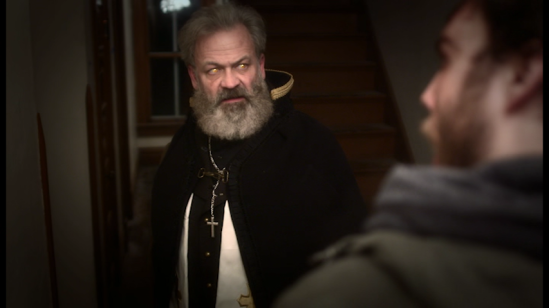
Colton Christensen inarguably shapes the role of Tom Doherty into his own with a solid solitary performance for more than half the film. Christensen also, for much of the last ten minutes of the story, had to systematically break away from his character in order to forge a combative persona to Tom and while Christensen does the job well for one character, shouldering a second didn’t suite the actor’s abilities despite a total embrace of character and a few jabs at his own humility. Wiest has worked with Christensen prior to “The Forlorned” and has seemed to continue the trend of using his own entourage of actors with the casting of Elizabeth Mouton (also from “Dead Noon”). Mouton’s character is briefly mentioned near the beginning as a little girl of a previous caretaker, but her adult version only makes the scene in the latter portion of the story to provide a better clarification and exposition into the demon’s background. Also serving exposition as story bookends and peppered through as emotional support is Cory Dangerfield’s “Murphy,” a sea-salty old bar owner who liaisons with the lighthouse committee and can make a mean clam chowder. Murphy hires Tom to do the restoration and caretaker work and while Murphy initiates Tom existence into the fold, Murphy, for the rest of the film, serves as slight comic relief and, in a bit of disappointment, an unfortunate waste of a character. I also wanted Benjamin Gray, Shawn Nottingham’s priest character, to be built upon and expanded more because the character is a key portion that, in the end, felt rushed with quick, messy brush strokes in order to finish painting the picture.
At first glance, Townsend, Wiest, and Reed’s script screens like a typical, if not slightly above par level, haunting where Tom encounters sportive spirits, ghastly visions, and a slew of ominous noises inside a time-honored lighthouse home, but then a twist is written into play, pitting Tom against a masterminding demon whose conquered many other bygone caretakers and whose the epicenter of all that is sinisterly wrong with the island. The demon, who has taken the form of a man hungry hog, lives only vicariously through the camera’s point of view, never bestowing an appearance upon to Tom or even the audience, but referenced numerous times by island locals and boisterously given hog attributes whenever the demon is near. The concept fascinates with this demon-hog thing kept stowed away deep inside the isle’s bedrock even if the dark entity never makes a materializing appearance, but where that aspect thrives in “The Forlorned,” a pancake thin backstory for the demon goes simply construed with a slapped together account of its languished two-century long past and wilts the demonic character wastefully down with backdropped uncertainly, powerlessness, and puzzlement that’s forlornly misfired. There’s no deal with the devil, no selling of the soul, no medieval rite that gives the demon-hog it’s power; it just turns into an evil spirit out of greed.
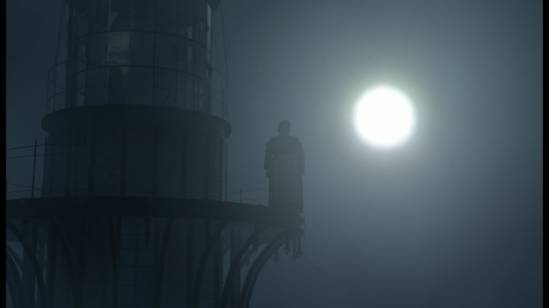
Andrew Wiest’s production company, Good Outlaw Studios, presents “The Forlorned” that found a distribution home in Midnight Releasing, the fine folks who released “Blood Punch” and “WTF!” “The Forlorned” is available on DVD and multiple VOD formats such as iTunes, Vimeo, Vudu, Xbox Video, and Google Play. Since a screener was used for this critique, a full review rundown of the technical specs will not be provided and no bonus materials were featured on the disc. Director Andrew Wiest and his cast and crew entourage are able bodied participants in assembling a good, entertaining, and sufficient indie mystery-thriller brought to fruition out of Angela Townsend’s story with the author’s pen ship assistance. With a little tweak here and there on the antagonistic demon-hog, “The Forlorned” might have necessarily escalated into a richly dark territory of a more volatile, blood thirsty spirit that’s scribed to have racked up body after body, century after century; however, the fleeting chronicle of how the demon-hog came to be a malevolent being leaves a bittersweet aftertaste on a premise that started out spooky and strong.

Available on DVD at Amazon.com!

 It's Bloggin Evil!