The Evils After World War III! “The Aftermath” review!


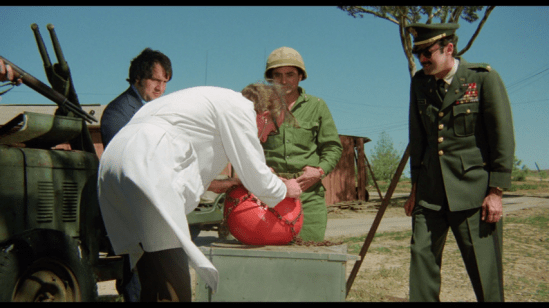
On the space shuttle Nautilus, three astronauts are returning home after one year in deep space. Their outbound transmissions to Earth are not being returned nor are they being received and as their ship draws closer to Earth, the only option for reentry is to take a risky crash landing into the Pacific Ocean, just off the coast of California, hoping someone, anyone, would see their shuttle coursing downward from the sky. Only two survive the crash and swim to shore where no boats, no planes, nor onlookers were around to receive them. They soon find out why. World War III had engulfed much of the Earth during their time in space, reaping the land of the urban jungles and making food and living conditions scare. Germ warfare had mutated much of the population to cannibalistic creatures and when torrentially raining, acid rain pours from the war torn atmosphere from ferociously brilliant and deadly clouds. Only a small band of good people remain and the two astronauts seek to keep them safe from the harsh elements, even against a merciless gang of thugs.

In the early 1980s, an ambitious and visionary filmmaker sought to produce, write, direct, and star in his very own modest budget feature film that would rival Hollywood’s glamourous and expensive effects while still maintaining a down-to-Earth independent production. That filmmaker was none other than Steve Barkett, creating his debut film, the 1982 science fiction post-war catastrophe, “The Aftermath.” “The Aftermath” is like if the “Planet of the Apes” met “The Walking Dead,” a sheer blunt for trauma of returning to your home to discover the world in shambles with different factions of hard nose killers ready to plunder all that you own and all that you will ever have. Barkett, with assistance from the brothers Dennis and Robert Skotak, who’ve went on to work on major studio films such as “Aliens” and did the matte work for John Carpenter’s “Escape from New York,” create a destroyed Los Angeles landscape through the power of some serious movie magic considering the time period and the budget.

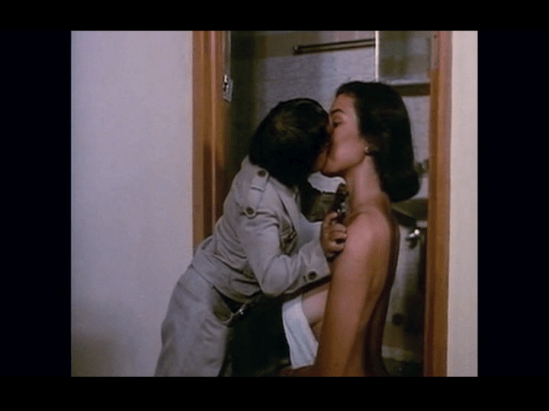
Steve Barkett is Newman, one of the three astronauts with no first name, and the tough hombre’s hard disposition comes from his background exposition where he lost his wife and child before going up into space. Newman’s cold, but not heartless, and Barkett taps into that fairly well despite some robotic and formulaic performances. However, Christopher Barkett, Steve’s son, was a complete first generation cyborg, a regular toaster oven with teeth and eyeballs that monotones through all the lines and actions. The most interesting casting here is Lynne Margulies, who at the time of this release, was or was not yet the late Andy Kaufman’s girlfriend. Margulies, who previous worked on an adult film entitled “Young, Hot ‘n Nasty Teenage Cruisers,” continued the racy trend with a shirt-pokey role in Sarah, Newman’s quick-to-sack love interest with a briefly, well-endowed nude scene. Yet, Sig Haig manages to steal the Barkett’s film from right under his nose. The young and ruggedly muscular “The Devil’s Rejects” star sports his trademark shaved head and thick, dark goatee, labeling him the perfect casting choice in gang leader Cutter. Alfie Martin, Forrest J. Ackerman (“Dead Alive”), Larry Latham, Linda Stiegler, and Steve’s young daughter, Laura Anne Barkett costar.

One aspect that’s really appreciated in Barkett’s enterprising venture through post-war commentary and morally righteous themes is the special effects matte work from the Skotak brothers. Detailed paintings, such as exampled in the war-ravaged metropolis that was formerly L.A. embodying the once towering buildings, are now destructively cut short in a mangled heap in a matte effect with live actors. Practical effects work wonders for Barkett’s large scale premise despite the small scale performances, except from Sid Haig. The detail in the violence dawns a newly restored faith in early 1980’s sci-fi films; violence that was more prevalent in the genre later in the decade, in such films as “Aliens” or “Robocop,” making Barkett’s film a trail blazer that paved the way to deliver more sensational savagery and lots of blood of a high body count to a already fantastic genre.

MVDVisual and VCI Entertainment release Steve Barkett’s “The Aftermath” onto a dual format, DVD and Blu-ray, combo pack. Presented in 1080p on a MPEG-4 AVC encoded BD-50, the post apocalypse never looked so good in a widescreen 1.78:1 aspect ratio from a 2K remastered transfer of the original 35mm negative. VCI has bested the rest with colorfully enriched scenes and untouched framing. Slight grain more so over the matte special effects that optically contrasts between the two different layers where a little touchup could have smoothed out the indifferences, but other than that, the details are quite stark. The clean and untarnished English LCPM 2.0 mono track is also vastly well constructed that contains minuscule hissing and the occasion pop, clearly making the dialogue a prevalent force. Composer John Morgan’s traumatically dramatic score is full-bodied and robust that coinciding renders well with the action sequences and tranquil moments. The extras offer the original laserdisc bonus material that provide snippets of interviews from cast and crew, Steve Barkett’s short film “Night Caller,” over an hours’ worth of John Morgan’s soundtrack complete with title information, VCI promo announcement for Barkett’s other director “Empire of the Dark, and the original theatrical trailer. A retrospective journey to the early 1980’s science fiction indie sector is also a visually stunning resurrection of “The Aftermath” courtesy of VCI Entertainment and with impressive effects and a bigger-than-life concept despite an underwhelming performance as an actor, director Steve Barkett’s legacy as a filmmaker remains stronger than ever with this prominent and well-deserved upgrade of the lazer-gun and mutant inhibiting world reckoning.

The Aftermath available at Amazon.com!

From the Garden of Evil Come the “Attack of the Killer Tomatoes” review!


The United States comes under a relentless siege from a formidable foe unlike any other. An enemy that’s risen from the ground up to overthrow the very soil Americans’ inhabit. Flashing proudly their red colors, this adversary will fight and destroy anyone in their path. The attack of the killer tomatoes will seek to end mankind and take over the world! As desperation sets in, top U.S. generals, under the aloof guidance of the President of the United States, assemble a motley crew of special ops that become America’s best hope against a vicious barrage from the killer fruit….or are they vegetables? Under the leadership of Mason Dixon, his team will infiltrate, investigate, and, if lucky, exterminate the rotten to the core tomatoes. From the glossy red cherries to the plump big boys, the round ripe killers are hungry from human pulp and only Dixon and his team can stop them!

Courtesy of the MVD’s Rewind Collection, a newly released line of retro cult cinema, comes the impeccably unsystematic comedic spoof “Attack of the Killer Tomatoes!” for the first time on high definition Blu-ray! Writer-director John DeBello, along with his co-writers and fellow many hat wearing cohorts Costa Dillon and J. Stephen Peace, takes satire to the composter, lets it fester for a month, and releases a heaping pile of slapstick gold to the masses. The zany indie production, backed by various family members and local mom and pop retail operations, has been a horror comedy staple for past 40 years with not-so-cutting edge timeless humor that pokes a satirical finger at other more serious ventures such as Alfred Hitchcock’s “The Birds” with the film opening with a message about viewers brushing-off jovially the Hitchcock subtle creature until the event actually happened with aggressive, unflinching fowls terrorizing a small town and in that context, a film about killer tomatoes was born. DeBello’s film aimed to poke fun at many other things as well and successfully pulled the wool over the eyes of critics who remarked how awful his film was to behold, but that was the director’s sought-to, goal line intention.

Out of a cast of untrained talents and actors and actresses who never saw the bright lights and prepped sets ever again, only one actor stands out as a recognizable face and household name and that face and name was of Jack Riley as a Government slug. I might be a sucker for classic re-runs, but I remember Riley from his stint on “The Bob Newhart Show” and his very presence in “Attack of the Killer Tomatoes” legitimizes not on the film’s creditability but set the humor tone that was to be expected and despite almost being killed during filming as the rented helicopter accidentally crashes with him in it, the comedian rose from the ashes like a reborn phoenix and suggested to use crash footage to seemingly boost the pint-sized production value. However, it’s David Miller, who has zero interactions with Riley, in the lead role as a Mason Dixon. Though with an uncanny resemblance to the late funny man John Belushi with the wavy dark hair upon his short round figure, Miller goes fairly dark, as in quiet, for his leadership role as perhaps the only sane, and logical, character in the entire sequence of misfits. Dixon’s right hand Lt. Wilbur Finletter is played by co-writer, co-producer J. Stephen Pearce who courageously commits himself to doing all his own stunt work in a film that proudly wishes to just have a good time. Pearce’s approach to the lieutenant is with a sullied gung-ho persona that’s effective, but barely in the eyes of Mason Dixon. Dixon’s love interest Lois Fairchild, the only credited role of actress Sharon Taylor, inarguably is involved in an awkward game of being coy with Finletter as Fairchild, being a rookie reporter, aims to get the story at any cost while Finletter’s dimwit has him skate around her advances and oblivious to her information seeking intentions. Rounding out the cast is George Wilson, Eric Christmas (“Porky’s), Ernie Meyers, and Ron Shapiro.

Before “Scary Movie,” before “Naked Gun”, and even before “Airplane!,” “Attack of the Killer Tomatoes” had tailored, if not probably pioneered, this particular gag humor and in today’s day-and-age of political correctness, films like John DeBello’s are much like the Dodo bird – extinct. In the mix of light hearted witticisms, a number of racial, sexist, and overall bad taste cracks lie sporadically about the 87 minute runtime that wouldn’t make past the MPAA standards of today, that would invoke public ridicule and outcry for the filmmakers’s heads, and would unjustly place on a blacklist mark all involved, but just like a many number of these cinematic relics, they’re grandfathered into the fold. Though I doubt many millennials have even heard of the killer tomato franchise which would be baffling since health conscious wackos would enjoy seeing genetically modified tomatoes run a rampage, proving their points.

“Attack of the Killer Tomatoes” arrives on a special collectors edition Blu-ray/DVD combo set from MVD’s Rewind Collection. For the 1978 film, this release, presented in an AVC encoded 1080p 4k digital transfer of a 1.85:1 aspect ratio, is by far the best yet with a rich coloring range that pop and bring new life to the cult favorite. Hair line blemishes and some blotchy moments rear ugliness every so often, but the outcome of this release is astonishing when compared to previous DVD versions. The mono uncompressed PCM track reinforces a well rounded release when technically speaking. The dialogue is crystal clear and the musical numbers go off without a hitch. Perhaps, not as resonating as one would hope, but in the end, the mono track really sounds good here. Bonus features aplenty with audio commentaries from director John DeBello, J. Stephen Pearce, and Costa Dillon, three delete scenes, a collection of old interviews from cast and crew entitled Legacy of a Legend, a discussion on the helicopter crash, and “Attack of the Killer Tomatoes” original 8mm short film plus much, much more. Roughly about two hours of bonus content on this release makes it certainly a definitive collection. It took only 40 years for “Attack of the Killer Tomaotoes” to receive the treatment the John DeBello directed creature feature rightfully deserves and though might stink like rotten organic matter, there’s certainly nothing like the splat-fest riot of rolling, death-dealing fruit fleshed with trail blazing comedy unlikely to be repeated in today’s uptight community.

Own this version of “Attack of the Killer Tomatoes!”

In a Seemingly Fresh Corpose Lies a Legendary Evil.  “The Autopsy of Jane Doe” Review!


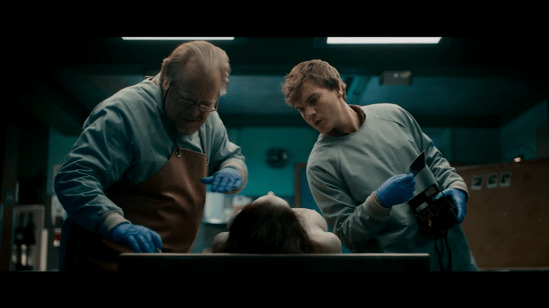
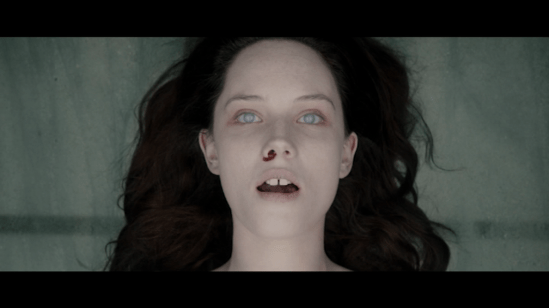
An unknown corpse of a young woman, found naked and half-buried in the basement of a home involved in a gruesome crime scene, is strolled into a small town family morgue and crematorium by a puzzled local sheriff.  Without any idea who this woman is and how to explain the her presence at the scene, the sheriff wants a cause of death on his Jane Doe as soon as possible and it’s up to Tommy and his son, Austin, to investigate what caused her demise and to determine her involvement in the grand scheme of the grisly events.  When the medical examiners begin to peel back the layers, each segment of the autopsy reveals impossible and unspeakable horrors underneath her cold flesh that go against their combined years of medical experience and the deeper they dig into her body, the more the autopsy room becomes a spine-tingling area as strange occurrences begin to happen to the father and son. Their only hope in stopping the ominous terrorizing presence and surviving the hell-bent stormy night is to continue the examination in order to unravel the enigma that surrounds Jane Doe.

“Troll Hunter” director André Øvredal helms a contemporary horror masterpiece with the Americana horror film,”The Autopsy of Jane Doe, that can be described as American folklore lit ablaze with modern day macabre that plays like a gruesome adult version of the children’s game Operation. Øvredal pulls inspiration from present day classical horror, including such films as the widely popular James Wan franchise, “The Conjuring,” by not embarking on an overkill journey of heavy duty effects or relying on gallons upon gallons of fake blood to sell his film. Instead, André Øvredal’s “The Autopsy of Jane Doe” is patient, subtle, and massively creepy, utilizing the dated morgue and crematorium basement setting to construct a dreadful, despairing dungeon atmosphere and focus on being very particular with every scene having a function to take advantage of the overwhelming brooding aurora and pop scare moments that can scare the pants off a mannequin. Øvredal heightens moments of complete pin-drop silence to amplify the terror and plays with camera angles that linger longer to leave an unsettling residue pooled in a spine-tingled soul.

Not only is the Ian Goldberg and Richard Naing script palm-sweaty frightening, tack on A-list actors like Brian Cox (“Manhunter”) and Emile Hirsch (“Killer Joe”) as a father and son team pitted against a dead body and “The Autopsy of Jane Doe” jumps up by tenfold as a must-see. Brian Cox is masterful as the widowed mortician whose numb to the pain of life and shock of work, making him a dedicated professional at uncovering the truth inside corpses, and he’s well companioned with Emile Hirsch, the mortician’s eagerly loving son and apprentice to the family business. The only problem is Austin doesn’t want to be a part of the family legacy, but is rooted by his continuously cloaked grieving father and you can see the struggle in Hirsch’s wish-washy character. The pair of veteran actors play off each other well being a medical super duo by conducting examination procedures and digging right into the corpse of dead, disfigured bodies like it’s just another day at the office. The gorgeous Olwen Catherine Kelly is dead on being a dead body. Though Kelly literally doesn’t move an inch for the entire runtime, her slim frame and blank facial expressions are truly haunting, if not also alluring to behold.

Immediately, my first impression of André Øvredal’s film had me stroll back to the past, nearly a decade a go to 2008, with the Marcel Sarmiento and Gadi Harel thriller “Deadgirl.” The premise of the film told the story of two high school aged boys discovering a seemingly near dead young woman in an abandoned asylum; the dead girl being played by Jenny Spain.  Whereas each film have their separate horrific identities, their end games bare supernatural similarities. What also separates André Øvredal’s film from Sarmiento and Harel’s “Deadgirl” are the two protagonists; instead of two teen boys pulling hormonal hijinks on a motionless attractive female body, Tommy and Austin are strictly professional, focused on their task to answer the riddle lying inside the very fabric and bones of Jane Doe. The only gripe I can bottom barrel scrape out is how Tommy and Austin had this big ‘what if’ epiphany that becomes the very basis of the entire film and, in my opinion, felt that scene was extremely chintzy and a cop out.

Lionsgate Home Entertainment delivers “The Autopsy of Jane Doe” from production companies 42, Impostor Pictures, and IM Global onto UK DVD and Blu-ray.  Unfortunately, a DVD-R screener was sent to me, resulting in no true examination of the audio and video qualities and the only extra on the disc was a Q&A with directorAndré Øvredal. Even if viewers might be able to guess the nature of the corpse – I did about halfway through – “The Autopsy of Jane Doe” is still way ahead of it’s genre brethren in being the best horror film of 2017 with an unlimited amount of sinister wretchedness that tugs at your soul strings and weighs heavy in your mind’s cache as soon as the lights go out for bedtime. I would recommend this title to anyone seeking an unadulterated horror experience.

For All The Evil in the World, There is One Pint-Sized Hero! “The Search for Weng Weng” review!


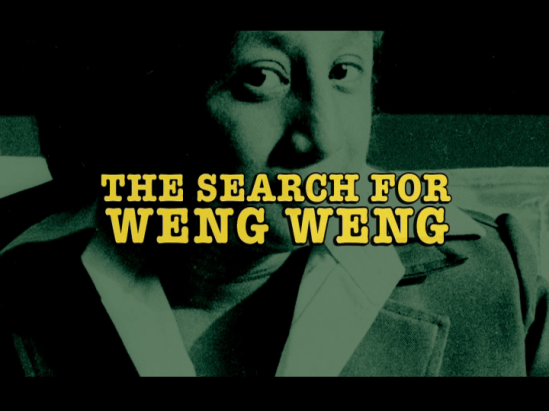
Australian filmmaker Andrew Leavold set forth on an adventure of answers to discover the legendary, the one-and-only, pint-sized actor known internationally as Weng Weng. In the early 1980’s, Weng Weng became the Guinness World Record’s smallest lead actor in a slew of rare, some never-before-seen, Filipino spy films and took the world by storm, creating a bizarre cult following on social media, and for Andrew Leavold, the only way to learn more about the Weng Weng, who could actually act and do his own stunts despite his small stature, was to create a documentary film that would take years in the making, but would hopefully answer three very simple, yet extremely difficult, questions: Who really was Weng Weng? How did he become Weng Weng? And where was Weng Weng now?

Weng Weng might be a humorous name for some, odd in fact, and his James Bond spinoffs as Agent 00 (double zero) flourished with zany stunts, practical special effects, and a tremendous amount of improbability – just like the Bond films themselves – but the Weng Weng films, even his Westerns, had an attractive aurora about them and not only because of the 2’9” sized actor. “The Search for Weng Weng’s” main focus was its titular star, but the film also displayed how the Pinoy films had engrained much of the Filipino culture and embraced their own charismatic star actors while, at the same time, being a byproduct of America’s Hollywood and other nation’s cinematic scenes. The Pinoy films were much akin to India’s Bollywood, replacing the musical and dancing segments with more action and comedy. Though Weng Weng’s films, including “For Y’ur Height Only” and “The Impossible Kid,” were whimsical and charming, Leavold’s documentary points out the darker side of the actor’s fame by comparing and explaining how Weng Weng’s “handicap” could be examined as a freak show gimmick that exploited Weng Weng out of cinematic earnings from his so-called adopted producers. The film also noted his lack of relationships with women and his health issues later on in life. Yet, “The Search for Weng Weng” highlighted much that was unknown about the actor, such as his real name, and that he was impressive and skillful at Karate; though small, Weng Weng wasn’t a traditional short person. He was fit and muscular and this helped him accomplish much of his own stunt work, which the Filipino stunt people have been claimed to be some of the best in the world.

Leavold doesn’t leave a stone unturned as he tracks down the persons involved in Weng Weng’s life. From the film crew who worked on the Agent 00 flms to his neighbors who grew up alongside him and from one of the five siblings, a brother whose the only surviving member of his impoverished family, to, perhaps, the wealthiest former first lady adored by all, Leavold checks every nook and cranny, every minute cubby hole to obtain that much more information about how Weng Weng lived and influenced their lives. In all, not a single person disliked the tiny personality as they appreciated much about him from his squeaking voice – that was always dubbed more masculine in the films – to his overall childlike serious, but calm nature. Weng Weng, in essence, was born a star guided by unscrupulous caregivers that was ultimately bittersweet for the childlike build and mentality.

“The Search for Weng Weng” hits the nail square on the head with the exactness of the title. Leavold’s impartialness leaves the wrongdoings against Weng Weng properly in the past as a good documentarian should impress. The editing is well done, taking a non-linear journey through Weng Weng’s short lived life and movie career and Leavold’s research and dedication to the project really amplifies through the film, giving Weng Weng the appreciation he rightfully deserves despite his height limitations.

Wild Eye Releasing in association with Monster Pictures presents “The Search for Weng Weng” on home video DVD. The region free, unrated DVD is shot in various formats from standard definition full screen to 16:9 widescreen with archival footage of the best of the best from the B-Asia film stock. Bonus features are plentiful with audio commentary from the director, Andrew Leavold, extended sequences of certain interviews, deleted scenes, the official “I Love Weng Weng” music video, and trailers. Who knew that there would be 92 minutes plus of content about a man not even three feet tall? Weng Weng was a mystery to us all and now, thanks to director Andre Leavold, everyone in the world can revel in that that is the amazing Weng Weng!

Buy Here “The Search for Weng Weng” on DVD!

Welcome to the Family. Resident Evil 7: Biohazard Review

I want you all to try to go back to 1996. You just got your Playstation and you picked up the newest game called Resident Evil. You know nothing about it and when you start playing you have a wave of emotions hit you. You feel fear, excitement, and anxiety; but yet you keep playing. You were just introduced to the world of Survival Horror. Now it’s 2017 and we are now into seventh main installment of the Resident Evil franchise and sort of a moment of truth for Capcom. Last few years have been rough for Resident Evil so lets see how the latest installment stands.

Resident Evil 7: Biohazard is a survival horror video game developed and published by Capcom. It is the seventh main installment in the Resident Evil series and was released on the Playstation 4, Xbox One, and PC.

2017-02-07_1456

The game takes place in the fictional town of Dulvey, Louisiana. You play as Ethan Winters who goes searching for his wife 3 years after her disappearance. The only information you have of her location is at the Baker estate, this is where your nightmare begins.

There is no denying that the RE engine is amazing. Resident Evil 7 passes with flying colors when it comes to visuals, the game is absolutely gorgeous. Realistic graphics with so much attention to detail really makes the atmosphere. Paired up with its excellent sound design which really puts you on edge, hearing random foot steps and loud bangs some where in the house can quickly make you stop what you’re doing and check behind you. Unlike older Resident Evil games, there really isn’t much background music. The only time i’ll hear music is either in the save rooms or during cut scenes, which is fine. No music really does build the tension and makes you listen to your environment.

2017-02-07_1455

The most controversial aspect of the game is its change to game play. Resident Evil 7 now puts the player in first person view, which this isn’t the first time they’ve experimented with this. Resident Evil: Survivor being the first one that was in first person, so I was quite interested when they said they were trying it again. As a big Resident Evil fan I can tell the skeptical fans that the first person view works. Resident Evil now feels even more immersive with it. The game still has its slow and sluggish movement, puzzle solving, save rooms , and combat just like the previous titles and the first person view fits perfectly. I haven’t played the game in VR because I’m broke but I have heard that game is even better with it, so now I guess I’ll have start saving up for one.

2017-02-07_1506

I feel I have to talk more about combat since I still see people complain how the game is like other non combat horror games, like Amnesia or Outlast. The combat feels just like an older Resident Evil, except Resident Evil 5 and 6. Thank god Capcom abandon the combat from the previous two and went right back to how Resident Evil 1 through 3 combat worked. Ammo and healing items are extremely scarce and you must manage your inventory to survive in certain situations. Enemies will move unpredictably and you must control your shots and keep your distance if you want to take down your foe. When it comes to difficulty, the game on normal is pretty easy, some parts can be a little challenging but if you’re careful and know where to go, then the game is a breeze.

Now Resident Evil 7 isn’t a long game. It took me about 7 to 8 hours to beat on normal difficulty my first time. It can easily be finished faster when you know where to go and what to do, There have been people who finished it in under 2 hours. But if you’re like me and like to explore then it will take you a while to finish. The story is where this game made me fall in love with it. This is by far my favorite Resident Evil story. The team they have behind this game is solid, the director behind the Revelation games is directing it and the writer behind the F.E.A.R 2 expansions made this a memorable experience and I hope Capcom keeps this team for future installments. Everything about the story is great, every character was interesting, and every location was awesome. The story to Resident Evil 7 is definitely more competent compared to the previous games.

As much as I love Resident Evil 7, I do have some minor gripes with the game. First one isn’t a big deal but I was a bit disappointed. Resident Evil has a tradition, when a player presses start on the main menu, they will hear a loud, deep voice reading the title of the game. Example:

Like I said this isn’t a big deal or a turn off for me but I was a bit bummed they broke tradition. Another gripe I had was the lack of variety with enemies. Before you always fought zombies, mutant dogs, and big hulking monsters. But now the only enemy you fight besides the Baker family are the ”Molded” which look very similar to Resident Evil 4 ”Regeneradors”. Yes these enemies are creepy and hard to take down but after a while you just get tired of fighting them and want something else. Hopefully in Resident Evil 8 we get a bigger cast of monsters.

2017-02-07_1507

In conclusion, Resident Evil 7: Biohazard is a great game. I’m so happy that Capcom put the brakes on the franchise and went back to how it originally was. Unlike other companies that have completely abandon their horror franchises. I’m glad that I stuck with Capcom all these years and going through many disappointments to finally see my favorite horror series come back on top. Resident Evil veterans would love this and for new people I highly recommend it. It is a great starting point for newcomers to get invested into world of survival horror.

My final score for Resident Evil 7: Biohazard is a 9/10