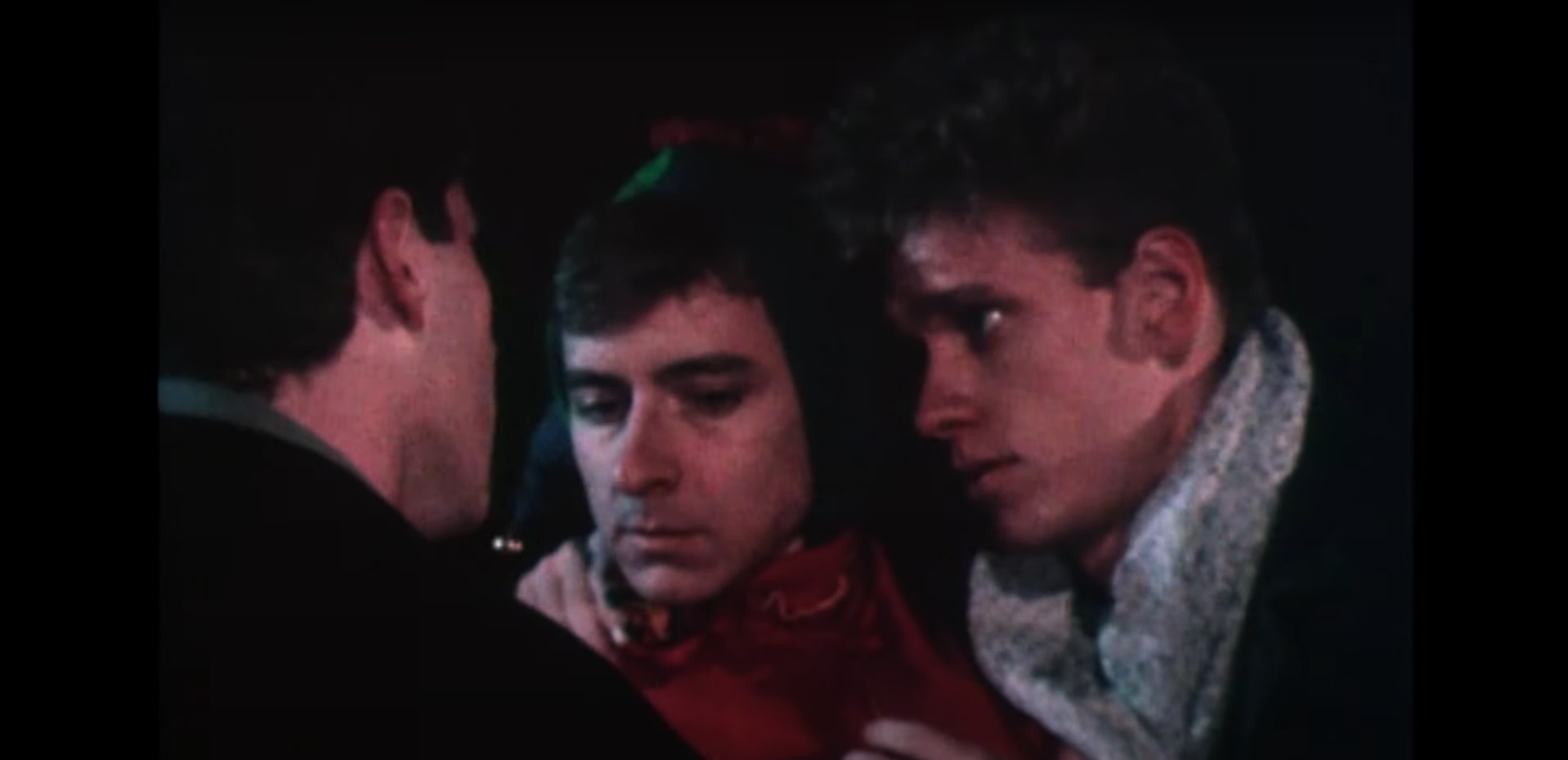
EVIL Minds the Door! “Raw Meat” reviewed! (Blue Underground /2-Disc 4K UHD Blu-ray and Standard Blu-ray)

“Raw Meat” Its What’s for 4K UHD and Standard Blu-ray Dinner!

Young lovers Alex Campbell, an American studying abroad, and Patricia Wilson discover an unconscious man on the steps of a London metro subway station.  When they alert a beat cop and make their way back to the spot, the man had vanished.  Assuming the well-dressed man an alcoholic sleeping off a bender, David and Patricia move on with their lives while the police report comes across the desk of Inspector Calhoun, an eccentric investigator who recalls a recent string of disappearances surrounding the same London station.  Over the next few days, several more station related disappearances occur, forcing Inspector Calhoun to dig deeper into the mysterious circumstances involving a missing Mi-5 agent and three subway employees with David and Patricia his only witness to at least one of them.  When Patricia suddenly goes missing with her last known siting at the subway station, a concerned David explores the train tunnels that connect the last known whereabouts of all whom have vanished, leading him to a tragic history of collateral damage survival, long forgotten generational lineage, and cannibalism. 

London, England was the first to introduce the metro subway station to the world in 1863 with the Metropolitan Railway.  It seems only fitting that London be the setting for “Raw Meat,” a subterrain horror that integrates London’s metro history with the consequential hazards of an early underground railway, the insufficient costs that prove to be costly, and the pitied blamelessness of unthinkable survival from neglectful businesses.  Originally entitled “Death Line,” rebranded to “Raw Meat” for American audiences, the 1972 film is actually directed by an American, Chicagoan Gary Sherman, in his debut and would go on to helm “Dead & Buried” and “Poltergeist III.”  Based off an original concept form Sherman, one that takes the plausibility and some fact of workers being buried under a collapsed railway project and survive generationally living off the nourishment of each other in more ways than one, the script is penned by Ceri Jones and is a production of Harbor Ventures and Kanter-Ladd Productions with the late “Police Academy” franchise’s Paul Maslansky producing

I’m going to preface this character introduction with “Raw Meat” would not have been as entertaining if it wasn’t for the peak performance by a more eccentric Donald Pleasance in a pre-“Halloween” performance.  As Inspector Calhoun, Pleasence is fully in charge as an intimidating case investigator with a snarky wit, or as Christopher Lee’s MI-5 character put it, what a droll fellow you are in a stiff yet jab remark exchange interaction between the two British icons of a bygone cinema industry.  Lee’s role is only a fraction in comparison to Pleasance and would have been two big personalties too big for the meager production to contain.  Another staggeringly highlighted performance comes from an unknown in Hugh Armstrong’s portrayal of the subhuman cannibal whose fellow inbred family members have all left by deceased means, leaving him alone and the last of his kind with mumbling tunnel vernacular and unkempt open sores all over his body and face in a state of unhealthy living conditions.  Armstrong’s acted ungainliness renders the man a monster amongst society standards but also sheds a softer, compassionate light upon reflection of his forced position into a world he knowns no better about having grown up completely in the railway tunnels all his life, living off what he can scramble up which included human flesh and organs.  In contrast to Pleasance and Armstrong, David Ladd (“The Klansman”) and Sharon Gurney (“Crucible of Horror”) impress as middle ground, plain as can be, characters being two lovers in the midst of mystery, almost becoming history themselves when the man targets her to amend his loneliness in a gibberish mind the door effort to show her affection.  Normal Rossington (“House of the Long Shadows”) and Heather Stoney are the only two understated completely overstated in the film as Inspector Calhoun’s constant whips demands for bolos and tea.  James Cossins, Hugh Dickson, Jack Woolgar, Clive Swift, Gerry Crampton, Terence Plummer, and Gordon Petrie pull into the station as the remaining cast.

Hovering between the horrifying truth of early construction, underground railway accidents and the urban legend of trapped workers under tunnel collapses, Gary Sherman unearths middle ground terror somewhere in between the two with a plausible terror line narrative that not only instills recognition of the past and those who gave the ultimate sacrifice but also invites the nonfictional hunting-cannibal rising to the surface in search for food and, to an extent, companionship.  The cast elevates “Raw Meat’s” character efflorescence but there’s also other areas to illuminate its noteworthiness that take the film from out of the tunnel shadows as cinematographer Alex Thomson’s bleak tunnel aesthetic rouses filth and a sense of hardcore survival over a century.  The 7-minute tracking shot near the beginning, at the introduction of the cannibal’s tunnel home depicted with a decorum of decaying and freshly strewn corpses salvaged for their organic parts, is an astonishing backwards tracking shot without a blip of hesitation and lingering just enough to seed an unsettling undergrowth of grisly ghastliness.  The only drawback from “Raw Meat,” if looking for one or perhaps it’s not even a big deal, lies with the young couple Alex and Patricia.  It’s possible to stumble into a situation, as they did after coming off the last train for the night and crossing paths with an unconscious man on the staircase up to the surface; however, Alex and Patricia were not exactly looking for trouble or pursuing a follow up on the man’s health-and-wellbeing, God knows they argued over about their stance on helping ailed strangers in public, but they wind up having this off topic tangent about said contentious topic and rebuild the tumbled down building blocks of their relationship for a stronger bond.  Yet, lightning strikes twice in the subway tunnel and Patricia is whisked away by the tunnel ghoul in a second pure coincidental interaction that ignites Alex to make good on that stronger bond with Patrica by investigating her last known whereabouts.

Be a cannibal and consume “Raw Meat” on a new 4K UHD and Standard Blu-ray 2-Dsic combo set from Blue Underground. Restored and scanned in 4K 16-bit from the original uncensored camera negative with Dolby Vision HDR and presented in a widescreen 1.85:1 aspect ratio, “Raw Meat” comes from out of the near total blackout of tunnelling darkness of standard definition and poorly contrasted previous Blu-ray editions with a precision of delineating crafting brilliance, adding depth of separation between object and background.  The HVC encoded,2160p ultra high-definition resolution, BD66 was well aimed to squash any compression issues, leaving blacks black and textures coarse that nearly lift off the screen.  You can actually try and count the whiskers on Christopher Lee’s caterpillar mustache.  Colors have also improved and enhanced in saturation without being overly intensifying; “Raw Meat” thrives on the dank, dark world of not only the abandoned tunnel line but also the cold and sleazed London streets.  Alex Thomson’s tunnel life aesthetic musters an earthy and dingy frontage and coupled with some hard glowing red, yellows, and the subsequently mix orange, there’s a real harrowing subterranean tone in the man’s macabre ossuary home.  The 2nd disc standard Blu-ray is AVC encoded, 1080p resolution, BD50.  Blue Underground’s release offers multiple audio options, including a new Dolby Atmos mix alongside the already established DTS-HD 5.1, both rendered in English.  Toggling between both surround sound mixes, there’s little-to-no difference in the immersive experience.  Atmos provides an echoier shaft experience that can be heard as directionless whereas the DTS specifies the reverberating soundwave direction based on channel markers.  Mind the Door is certainly more accentuated as it lingers through the chambers just a little more ubiquitous and chillingly underscored.  With no crackling or hissing, dialogue is clean, clear, and robust that solidifies Donald Pleasance as a master of quick wit and blunt investigation tactics as well as the track cherishing the quality of all other players involved.  Some instances of dialogue are ADR, likely due to poor record quality, resulting in an artificial separation between the action frame and the post-production recording.  Train sounds play a supporting factor and are acutely integrated into the design of a makeshift substation construction from an abandoned platform.  The other audio options include an English 1.0 DTS-HD and a dubbed French 1.0 DTS-HD.  English SDH are available.  Disc 1 – the 4K UHD Blu-ray – contains two commentaries a 1) archived writer-director Gary Sherman, producer Paul Maslansky, and assistant director Lewis More O’Farrell and 2) a new critique and analyst commentary discussion from film historians Nathaniel Thompson and Troy Howarth.  Bringing up the UHD rear are radio/TV spots and various trailer cuts.  Disc 2 – standard Blu-ray – has all of the above on disc one plus an interview with writer-director Gary Sherman and executive producers Jay Kanter and Alan Ladd Jr. Tales from the Tube, an interview with star David Ladd, producer Paul Maslansky, and assistant director Lewis More O’Ferrall From the Depths, and an interview with the now late Hugh Armstrong, the cannibal tunnel man, Mind the Doors.  An extended poster and still gallery flesh out the standard Blu-ray’s supplemental content.  The classic poster art has been upgraded to a textile vision of blood red and half-naked men and women with blank chromium eyes within the embossed image on the slipcover and that extends to the sides and back of the O-slip.  The same illustration also graces the black 4K UHD Amaray as primary cover art, but this different variation has more natural coloring on the hair, tattered clothes, and skin tones on the white-eyed ghoulish faces.  The reverse side of the cover is the original “Death Line” titled cover art as seen on the old MGM DVD with the bearded man walking on the railway with a lit-up train to his back and a woman lying seemingly dead on the rails in front of him.  The Blue Underground release is Not rated, clocks in at 87-minutes, and is encoded to play in all regions.

Last Rites: A classic of subterranean horror, “Raw Meat” is much more than a broad line of cannibalistic terror. The new Blue Underground Ultra Hi-Def release illuminates the wretched state of being and the ugly truth of generational survival that provides a strange brew of compassion for the forced feral human who feeds on human flesh.

“Raw Meat” Its What’s for 4K UHD and Standard Blu-ray Dinner!

Snuff is the New EVIL Industry Fad! “Snuff Queen” reviewed! (Dark Arts Entertainment / DVD)

“Snuff Queen” on DVD from Dark Arts Entertainment!

Snuff, a hot commodity amongst patrons of the black market and dark web provides real violence and real death for real morbid viewers.  Laws are challenged and circumvented by consent of women willing to die for money through various ways of asphyxiation in front of the camera and sold under the controversial snuffing genre.  A Ten-minute window of revival separates the actors and actresses from permanent brain damage or certain expiration.  A snuff performer interfaces with the complexity of thrills and easy money that counterbalances against relationship troubles, social stigma, and the constant threat of actually dying hanging over their heads, or more literally, pressed against their throats.  A handful of willing performances lets a documentarian illustrate their niche profession, lifestyle, and personal struggles to the world with included behind-the-scenes footage on set and in their private spaces as they put on their line mind, body, and soul have to survive.

Those who seek out snuff, even if represented in a sensationalized, fictious way to glorify gore, violence, violence against women, and a fascination, obsession need to satisfy murder lust, likely need to have their heads thoroughly scoured for the tiniest ounce of sociopathic tendencies.  Films like “Effects,” “Faces of Death,” “8MM,” “A Serbian Film,” and the like all contribute to that black desire of control of another person’s existence and getting off perversely on the sadism.  Films like Sean Russell’s “Snuff Queen” are nothing like those more aberrant productions of cruel reproductions.  The 2023 pseudo-documentary and mockumentary hybrid began in 2008 with AVN interviews with porn stars and their take the matter of snuff or overall rough sex.  Shelved for many years because no producer at the time deemed the material worth making a movie out of it, Russell is approached by Dark Arts Entertainment’s Brian Yuzna and John Penney to finish the film with new scenes based off the 2008 script but cut most of the comedy out for a darker tone.  David Navarro producers the film.

Previously shot 2008 AVN interview footage with some of the then biggest talent in the industry, such as Sasha Grey, Bree Olson, Stormy Daniels, Jenna Haze, Stoya, Faye Reagan, Jesse Jane, Belladonna, Aurora Snow, Jessica Drake, Sunny Lane, and even Larry Flynt, is cut into snippets of a montage as they comment on death and sex in various contexts.  The series of comments and quips puts into perspective individual limitations, mindsets, behaviors, and an unfiltered truth underneath the layers of makeup, fake breasts, and forged happiness in the adult entertainment industry masked in glitzy red lights, supersized sex drives, and a prospecting tease of getting laid.  As the 2008 prologue interviews ends, the 2023 interviews begin with mostly scripted talk following the daily lives of a handful of snuff performing women, 4 principal female characters to be exact.  Moxie Owens (“Girl Lost:  A Hollywood Story”) as Jane Doe, Lexie Leone (“It Don’t Bother Me at All”) as Amy Doe, Juliet Kennedy as Angela, and Lindsay Normington (“Anora”) as Audrey Doe become the diverse batch of short-listed actresses of controversial and law-bending snuff films. These core cast of women are joined by gap-filling support, ranging from gays, to blacks, to Asians, and so forth by extenuating out from just a white female dominated industry in touching cultural and race by the less promoted numbers of adult entertainment. Much of “Snuff Queen’s” inauthenticity garb comes from the acting that’s densely overplayed and exaggerated because of the less-comedic directive by shot-calling distributors and performances stand out amongst a darker theme as too watery and less potent, like off-brand prescription drugs. Ironically enough, IMDB.com gives in the title’s controversial nature by not listing the film under any of the actor’s individual credits as to say or allure “Snuff Queen” documentary as real evidence and content based. Tuesday Knight (“A Nightmare on Elm Street: The Dream Master”), Josie Hung (“Staycation”), Gina DeFlilippo, Captain Dare, Zac Mendoza, Neill Flemming (“It Kills at Midnight”), Christopher Parker (“Spider”) and Jake Holley costar.

Much of what is laid out in “Snuff Queen,” all the provocative and debatable ethics, legality, and portentous aspects of Snuff, is all a load of crap and the director, Sean Russell, would be the first person to tell you that.  What Russell intends to convey is an allegorical emotional evaporation in adult entertainment performers and how apathetic the industry is toward the safety and responsibility for its talent who battle with low self-esteem and anger issues that either drive wedges between friend and family or ensue verbal spouts.  There’s also the treatment or being seen as just a bag of meat for the slaughter when getting the shot is important than the person taking all the risk for little reward.  Russell achieves that endgame message despite the cuts of levity humor that do squeeze through every so often but with that squeeze-in of a dark humor chuckle, coincided with a reserved approach to a documentary surrounding Snuff of all things extreme, in lies an off-putting characteristic going against the grain of the film’s black toned nature and Russell’s indelicate undercurrent theme.  “Snuff Queen” is nowhere near the shock level its required to have, especially being bestowed a taboo title, with little-no-effort in the thickness of the story’s creative girth; instead, the 2008 interviews, snipped scenes from previous controversial films, and one atypical scene at the heart of the story teases with stark nudity and blood are the only edgier content of a rather dull feature length pseudo-documentary. 

Presented in a widescreen 1.78:1 aspect ratio, Dark Arts Entertainment distributes the home release of “Snuff Queen” on DVD.  The MPEG2, 720p and 1080p, DVD9 has stark grade resolutions due to the 2008 recorded interviews and footage shoot 15-years later in 2023 with the former a blockier, less-pixelated digital camcorder for ease of AVN, working the crowd, person-to-person use.  Recent footage has the polished look of a high-dollar digital recording sans any artistic grading or stylistic lens.  No issues with compression codec that produces a very fine, detailed image reproduction that sinks into inky blacks and retains a natural color palette.  “Snuff Queen” is authored with a LPCM English stereo mix that’s an imitation of a hot mic of continuous dialogue, as many real, pseudo, and mock documentaries are, that renders cleanly through from one bookend to the other.  There’s also not a ton of interference other than in the 2008 interviews at the AVN with perhaps more commercial equipment or audio setup.  The onboard mic snags the milieu sounds with the raw range and depth.  English subtitles are available.  Encoded special features include a director’s commentary that goes through the first planned steps for the film and its subsequent rejections from producers back in 2008, deleted scenes, and the film’s trailer.  Physical features are stark and spartan with a convention DVD Amaray that has a mock polaroid border and the redacted eyes and mouth of a faceless, chest high naked woman that draws attention in conjunction with the title.  Dark Arts Entertainment presents the release not rated, region free, and has a runtime of 92 minutes. 

Last Rites: “Snuff Queen” might have worked 15-years ago with the old footage that contained real pornstars and real enough gore effects that could have turned this concept onto a creative machination in illusion of the truth or a clever black comedy that really pokes the porn industry in the ribs, but instead time and too many hands the creative pot has relinquished any power “Snuff Queen” may have wielded, dethroning it definitly out of shock contention.

“Snuff Queen” on DVD from Dark Arts Entertainment!

Weak Meekness Leads to One’s Own EVIL Destruction. “Catacombs” reviewed! (Imprint / Blu-ray)

Own Your Copy of Imprint’s “Catacombs” on Blu-ray!

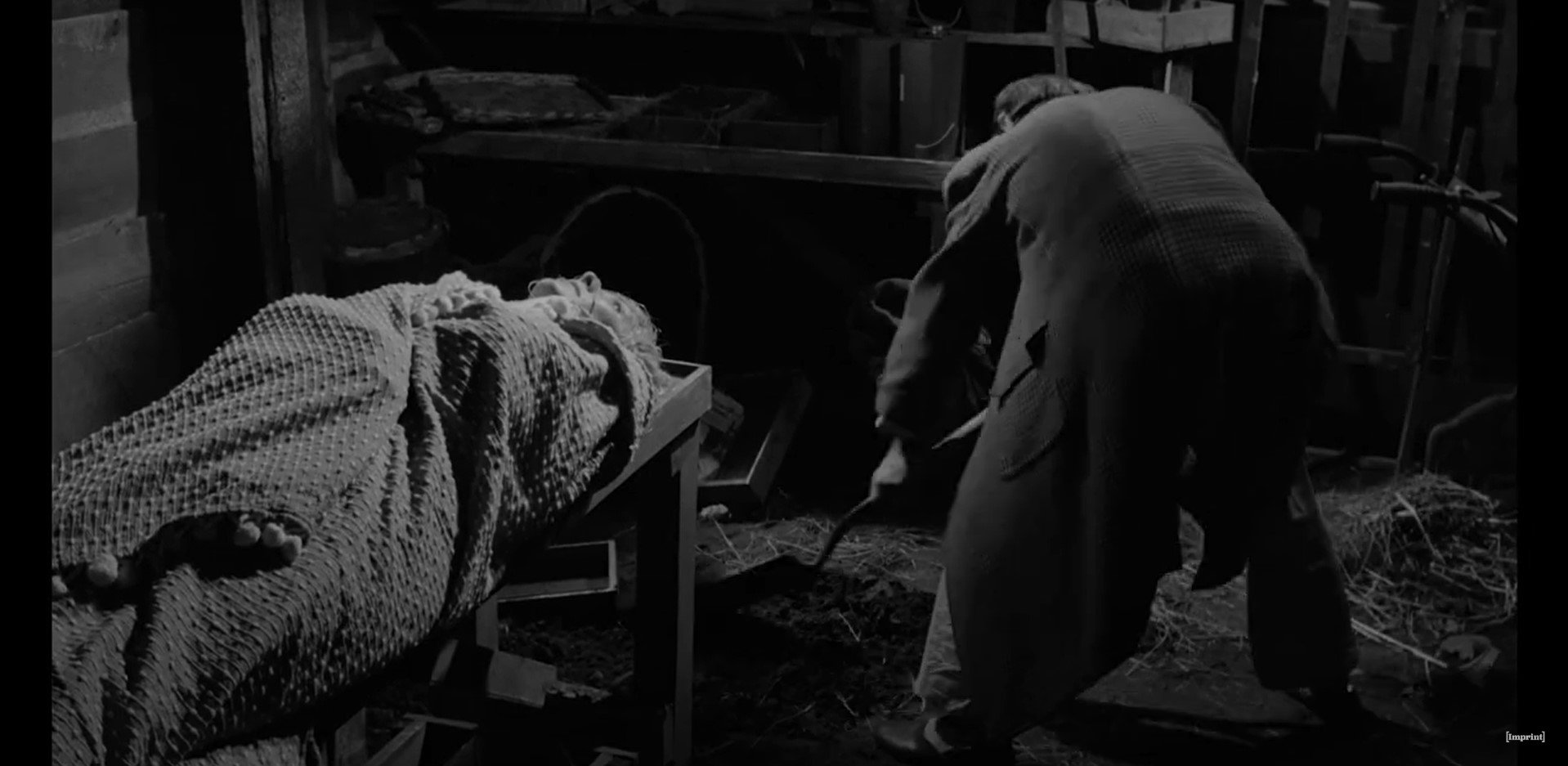
Ellen Garth, a strong willed and wealthy but physically afflicted businesswoman devotes her all her love to an enervated doormat of a husband, Raymond.  When Ellen’s beautiful young niece, Alice, returns to London from Paris after a year abroad, Raymond is smitten by her flirtations for older men and strikes up an affair behind his very perceptive and sly wife’s back who catches them in each other’s embrace.  Tired of being a slave to his wife’s controlling behavior and wanting to be free to court Alice, Raymond kills Ellen and buries her in the potting shed behind their honeymoon house in a plot conceived with Ellen’s right-hand secretary and former con, Dick Corbett.  Believing he’s free of her and having been willed her fortune to share with Alice, Raymond suddenly suspects, after a series of strange events, that he’s being haunted by Ellen’s ghost, or even worse, the undead Ellen herself. 

Black and while horror from half a century or more ago always leaves a lasting impression that terror and suspense can be created by virtually story and acting alone instead of a heavily reliance of special effects and visceral coloring, such as with gore or grotesqueness of the unfathomable creature.  The British film “Catacombs,” or otherwise known as “The Woman Who Wouldn’t Die” in America, is one of those fear manufacturing films generated by pure acting talent and the managing cleverness behind the camera.  The 1965 film is directed by “The Oblong Box” and “Scream and Scream Again” director Gordon Hessler with American screenwriter Daniel Mainwaring (“Invasion of the Body Snatchers”) penning the script based off an American novelist Jay Bennett’s novel of the same UK title.  Shepperton Studios served as house of operations for the Parsons-McCallum production under Neil McCallum and Jack Parsons and distributed by the BLF, British Lion Films.

There’s no such thing as wasted parts or throwaway performances in Hessler’s murderous-revenge haunt with precision-acute actors and actresses chin deep in their characters’ cruelty, callousness, conformity, and control.  Twists and tension-riddle rods help elevate this nearly 60-year-old film to refrain from aging poorly.  Gary Merrill, former husband of silverscreen actress Bette Davis and star of “All About Eve,” plays the meek husband Raymond wed into money but at the cost of his manhood.  Merrill plays convincingly into Raymond’s submissive, passive nature under the more dominant but fair and kind mogul lady Ellen Garth, a hip-afflicted women that doesn’t feel the ailment impede her wealth or attitude in life by way of British actress Georgina Cookson.  In the mix is Ellen and Raymond’s parentless niece Alice who has returned from her studies in Paris seemingly transfigured from a chubby child to a beautiful lady.  Jane Merrow, who co-headlines “Catacombs” with Merrill, finds her stride as the elder-entangling Alice secretly at-odds with her aunt by seducing Raymond behind her back.  Rounding out the principal foursome is Neil McCallum (“Dr. Terror’s House of Horrors’) as Ellen Garth’s sneaky secretary Dick Corbett who has a façade of a hard worker, but Corbett can’t keep up with boss’s demanding energy and is itching to subvert her.  When the story’s peak turning point hits, the expectation of character change recedes back to status quo as if Ellen’s death changed nothing other than open the door of opportunity for Raymond and Alice to connect without concern.  Yet, that inkling of shame, guilt, and fear, mixed under a plot of deception and murder, has the reverse effect of a now burdenless happiness, producing a very little capricious life-change, especially in Raymond who is still as amiable as ever.  “Catacombs’” fills out the intimate cast with Rachel Thomas and Frederick Piper.

The actual use of catacombs, or subterranean burial grounds, has little do in the film other than in its infinitesimal moment of being a key piece of evidence toward something amiss, a tell for foreboding or already doomed health, and serves as one playful, paralleling reason to Ellen’s resurrection, though not reflected in plain sight as playful or parallel by Hessler.  What’s intended the most is building the mysterious dread around Ellen Garth’s return in a semi-gloss gothic polish aimed to crack Raymond and Alice’s psyche in half.  Hessler breeds tension after tension to engulf the characters in an unrelaxing state of disgrace and distrust and what makes the matters worse for Raymond and unscrupulous company is while Ellen Garth may have held all the cards being an authoritative woman of status and wealth, she showed loyalty, humility, and adored her family, friends, and lover despite their flaws and circumstances.  That unjustifiable murder stings audiences the most, a straight shot to the sympathetic heart that creates a need to see those responsible punished by Ellen’s earth-soiled, grave-escaping, dead-cold hands with edge of your seat anticipation.  Is Ellen Supernaturally haunting her killers or is the guilt driving them mad? 

The only way to find out in glorious high-definition is to pick up a copy of Imprint Film’s definitive Blu-ray version of “Catacombs” on an AVC encoded, 1080p, BD50 presented in a 1.66:1 European aspect ratio. The black and white picture receives a 4K scan from the original nitrate negative for its worldwide Blu-ray debt and though not much to mention in regard to colorization and black levels, the monochrome remains sharp at all times in a pristine negative that sees no damage. Usually, black and white can issue fuzziness, heavy grain, and ghosting during spliced cell overlap but this print, or rather this scanned print, looks amazingly fresh, holding patterns and transitioning seamless to the highest of restorative care. The English language is a mix between American and British English encoded with an uncompressed LPCM 2.0 mono, rendering a dialogue centric audio with composter Carlo Martelli brass band that’s minor keys taut tension to swell during the height of suspense. Dialogue is clean and clear with very minimal crackling; there’s no wispy or hissing detected. Although the mono feed vectors flatly, the range surrounding “Catacombs” is vast and timed to tackle distinction between the audio idiosyncrasies. Optional English subtitles are available. Special features include an exclusive feature-length audio commentary with authors Jonathan Rigby (“English Gothic: Classic Horror Cinema 1897-2015”) and Kevin Lyons, a new interview with co-star Jane Merrow on her experiences in “Catacombs” Merrow & Merrill, new interview with continuity supervisor Renee Glynne and sound designer Colin Miller The Glynne-Miller Story, a new interview with composer Carlo Martelli Martelli & Martell, and with a still gallery ending the bonus material. Housed in a Hammer blood red cardboard slipcase designed with a rendition of the original poster, the Imprint release is it’s 317th title. The clear Blu-ray Amaray case is even more colorful with a giallo-colored title and back cover, overtop a frightened scene with stars Merrow and Merrill. The reverse side of the cover has more of the psychotronic photo of Ellen Garth (Georgina Cookson) staring blankly into a pocket mirror to submit herself under a trance. The BD is pressed with the same red coloring and half-woman, half-death figure as the slipcase with no inserts included. One thing I will say on the negative side of the package is that the Amaray case is a bit difficult to extract from the slipcase; you kind of have to shimmy and shake it out enough to pull the case out. The 90-minute feature is unrated and did play on our region free player without having to setup flip to the desired region for playback.

Last Rites: Gorgeously macabre yet classic packaging, Imprint’s Blu-ray release of “Catacombs” is must-own Machiavellian umbra of greed and foul play, a timeless tale yarned to yield a megaton of shadow-lurking, supernatural suspense.

Own Your Copy of Imprint’s “Catacombs” on Blu-ray!

Underneath the Pulpit Waits an EVIL Difficult to Stomach! “The Borderlands” reviewed! (Second Sight Films / Limited Edition Blu-ray)

Order the Limited Edition Blu-ray of “The Borderlands” Here at Amazon.com

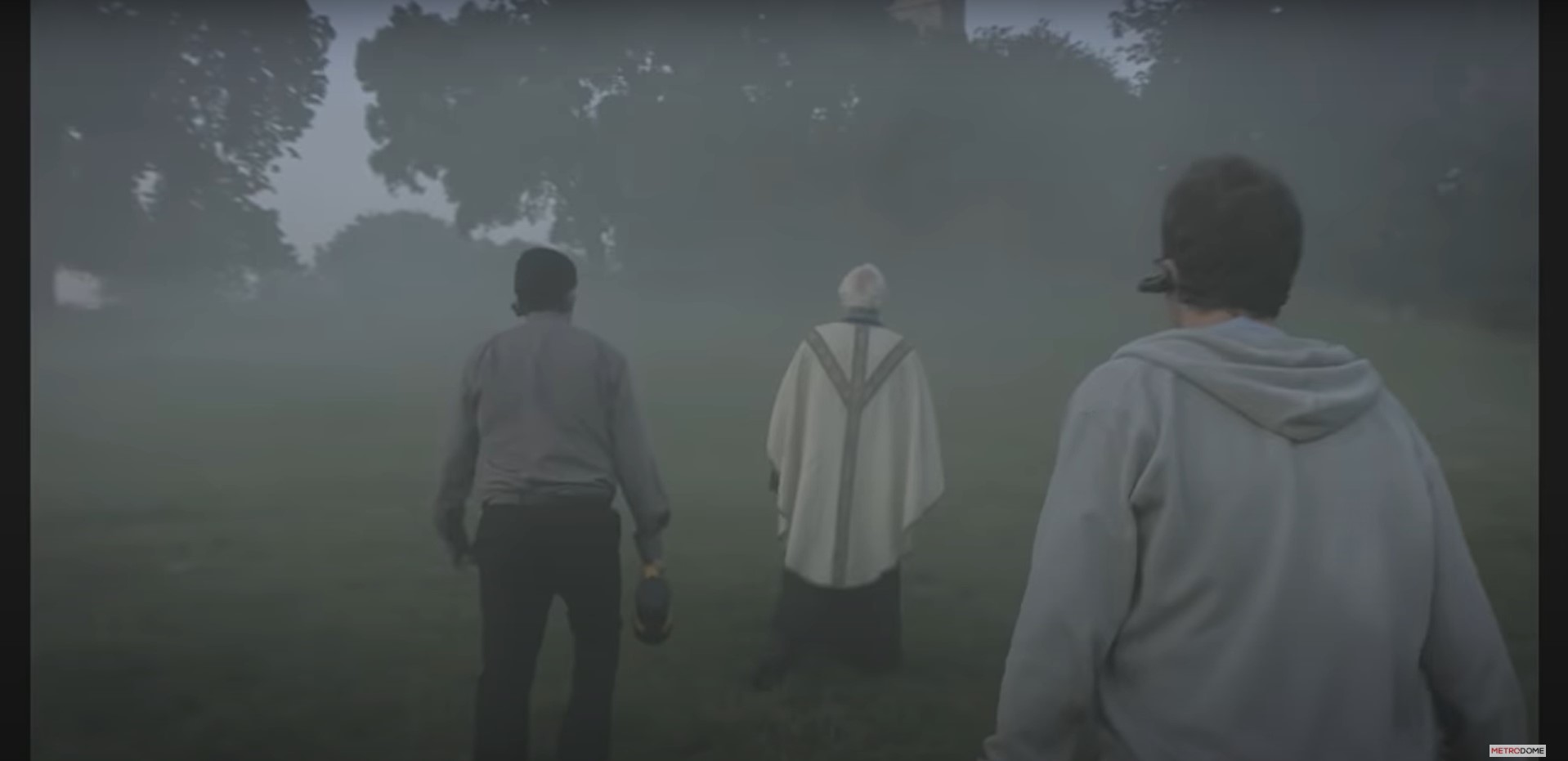
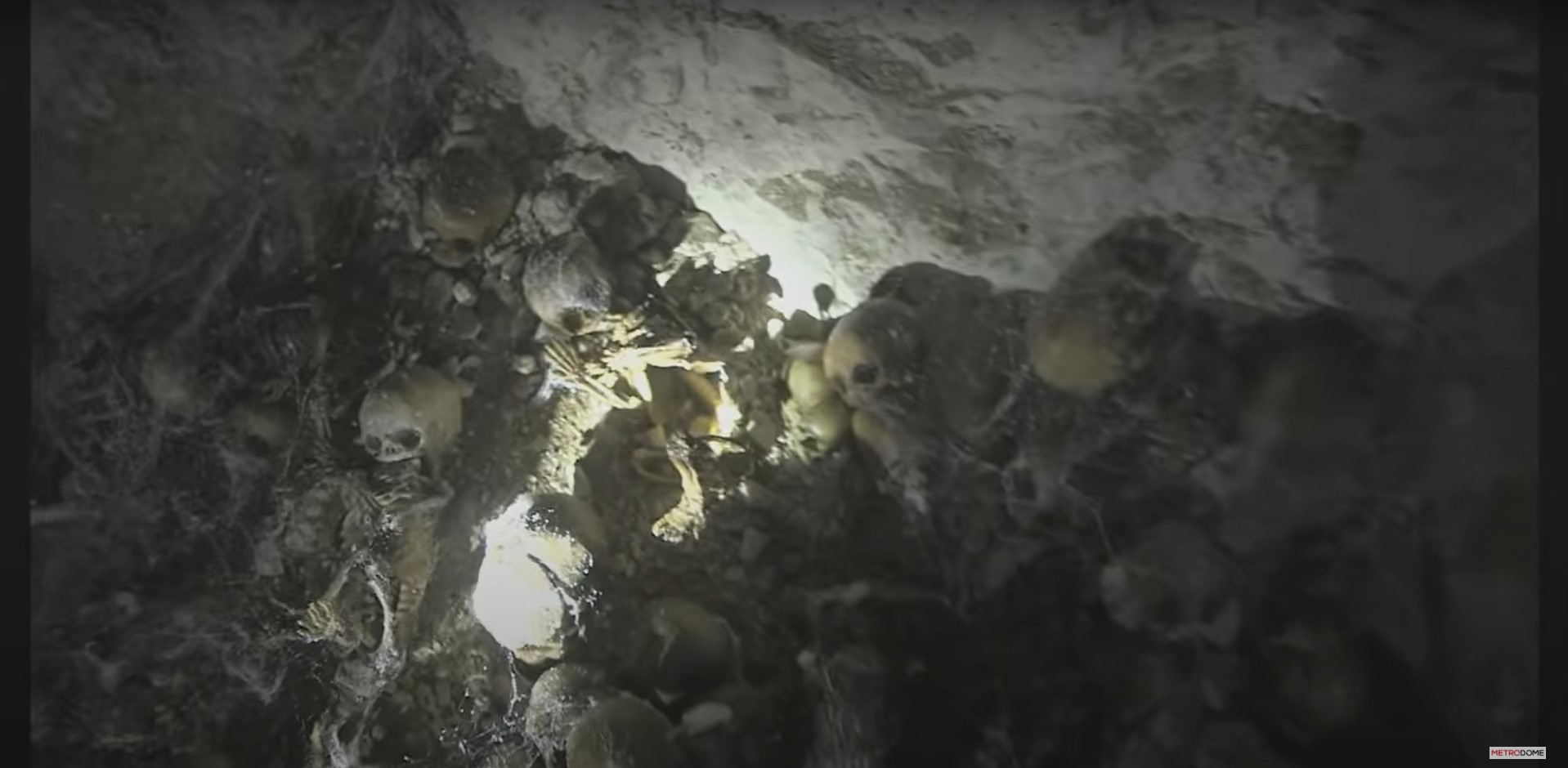
After exposing phony divine miracles at a Catholic Church in Brazil that resulted in the death of fellow Catholics, including a Cardinal, Vatican investigator and religious brother Deacon starts to lose faith with every fraud upon fraud case that points to the non-existence of a higher being.  Having fallen on the drink, the skeptical Deacon is dispatched to the English countryside of Devon where a Father Crellick had reopened a 13th century abandoned church and has been experiencing, in the Father’s words, miracles from God.  Joined by a Gray, a hired technology expert with agnostic beliefs, and a stern Father Mark, eager to disprove another false hope, the three men descend upon the Church with full, unequivocal examination to swiftly reveal the hoax and part ways.  Tensions rise between when logical explanation can’t be unearthed during Church rumblings, disembodied baby cries, and a behind-the-wall, shifting scratch sound that leads them to an underground labyrinth that will swallow them whole. 

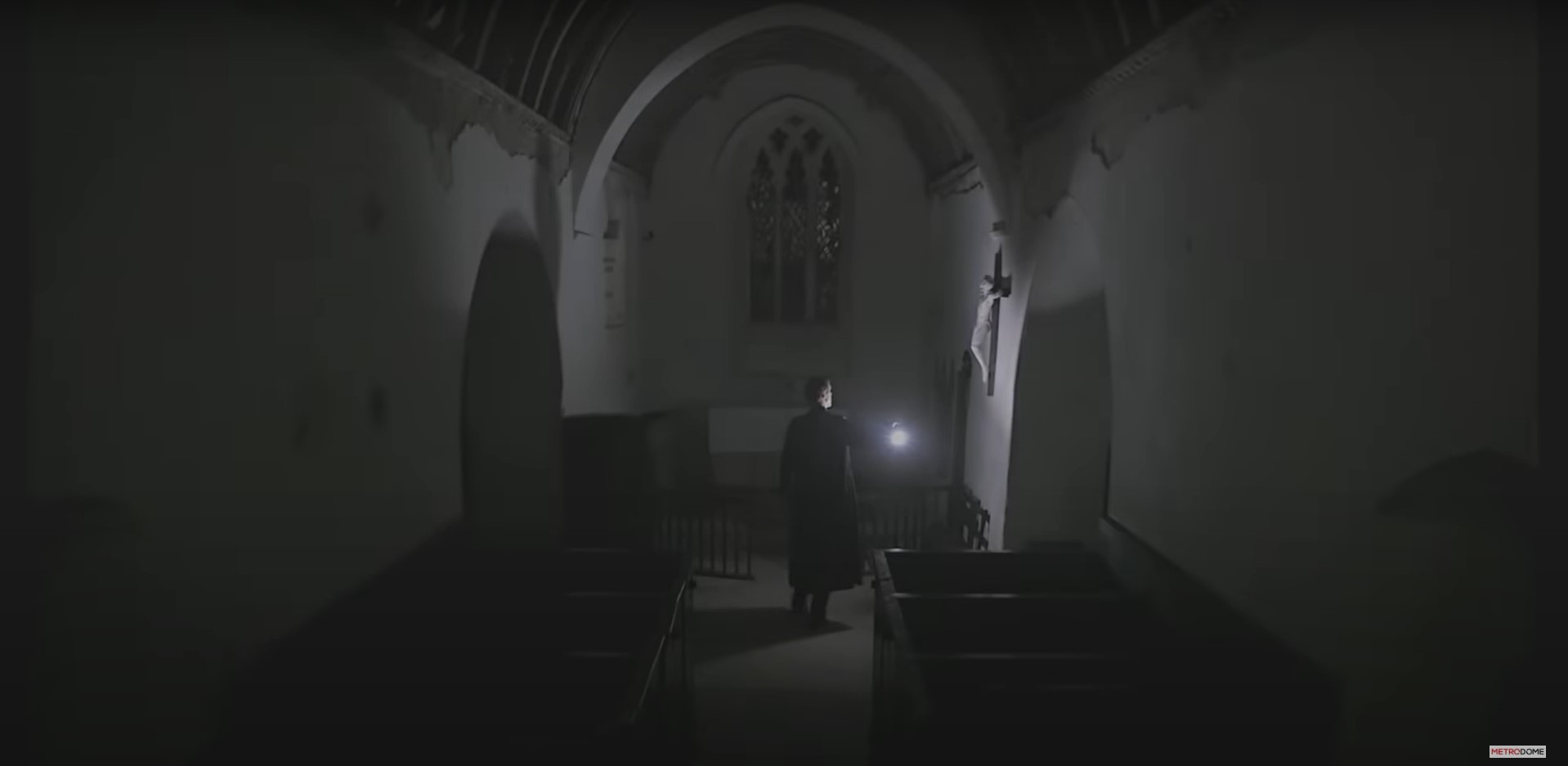
Released in the U.S. under the title “Final Prayer,” Elliot Goldner’s 2013, found-footage UK horror “The Borderlands” is the director’s debut, and only, feature that places you right into the belly of the beast at POV level.  In a sea of found footage horror, “The Borderlands” seizes the opportunity to separate itself from the overwhelming portions of shaky camera, purposeful variable video and audio quality, and practical, obscured effects to put into question the strength of faith, specifically here in the Catholic setting, and what ultimately brings about the inevitable in that no matter what religious denomination or outlook you might have, no one is exempt from the grim reality that awaits.  Filmed mostly on location in Devon, UK, as well as West Ogwell and Chislehurst, London for many of the interior scenes, “The Borderlands” is a production of Metrodome Distribution and is produced by Jennifer Handorf (“Prevenge”) with Jezz Vernon (“They’re Outside”) serving as executive producer. 

Our team of Vatican investigators follows three men with starkly differing handles on religious faith.  Coinciding on their stance on the existence of a higher power, individualistically, they’re also incompatible to each other which makes for palpable tension and livens up the dynamic when predictability and patterns can be discerned with likeminded characters.  On the scale of human compositions, polar opposite of both spirituality and comportment is Father Mark (Aidan McArdle, “Metamorphosis”), a by-the-book priest unamused by the elaborate ruses created by those swimming in the same faith pool as himself, and Gray (Robin Hill, “Meg 2:  The Trench”), an untroubled, exuberant, hired techie eager to believe the face-value of the supposed miracles before him.  Aidan McArdle’s tenacity for dogma character comes through well enough to know that good Irish Catholic Father Mark is about as numb as the next investigating Catholic never on the verge of a true miracle as the frustration just oozes out him after one after another hoax divine ephiphany.  Robin Hill, on the other hand, could be the best John Oliver, of Max’s “Last Week Tonight,” impersonator I’ve ever seen and heard.  In all serious, Hill exacts a man looking for religion through the lens of paycheck and a fanboy of the supernatural, like as if the average horror movie enthusiastic came upon the real Freddy Kruger and just geeks the Hell out.  Then, there’s Deacon (Gordon Kennedy, (“T2 Trainspotting”) and like Father Mark, Deacon’s faith hangs in the balance after a botched investigator inadvertently sees the death of a Cardinal at the hands of pious locals.  Kennedy doubles down with Deacon’s wavering faith by drowning the character in alcohol and doubting every inexplicable Devon church oddity.  Yet, Deacon and Gray meld together to a near swap of credence, seesawing in their religious principles, when the things that go bump in the church can’t be explained.  Luke Neal (“Wilderness”) and Patrick Godfrey (“The Count of Monte Cristo”), who’s been practicing the acting craft for over half a century, play a couple of dissimilar priests lured by the Church’s mysterious forces.

What’s noticeably different about this particular bleak found footage nailbiter is the audience is integrated into story by the investigator’s strapped-on headcam, not just some schmo glued to a handheld camcorder running, yelling, and hiding for his life while still depressing the record button.  There’s also the element of a shrouded backstory that becomes unraveled overtime and speaks volumes to a couple of the character’s colorful conducts.  Those elements are then intensified by the cinematic crux, an archaic, resurrected small church’s unexplainable, mostly terrifying, daily disturbances the local priest indiscriminately deems miracles.  Not a single character has arbitrary or useless purpose for the sake of being an in-frame victim of circumstance as each exhibit a radical change over the course of investigation, adding copious ground to the big question, the question that’s on every character’s mind, is there an almighty presence beyond our corporeal plane and cerebral understanding really exist?  Come to find out, the characters are not asking the right question and get sucked into a terror on the terra the more curious they become in finding God amongst them.  Often times, found footage doesn’t fit into the storyline, whether be the aforesaid necessarily handling of the camera through the an insane ordeal or just doesn’t work with a regularly structured narrative, but “The Borderlands” couldn’t be received with success without the stunt of seeing through the eyes of the characters that subsequently emits a trick of light or an overactive imagination that smooths out solid jump scares when needed in what is a definitely watch in the dark type diabolical goosebumper. 

Second Sight Films takes charge with curating a definitive, all-expense paid trip to Elliot Goldner’s “The Borderlands” on Blu-ray home video.  The AVC encoded, high definition 1080p, BD50, hovering around 24 FPS and presented in an anamorphc widescreen 1.78:1 aspect ratio, leverages the capacity and the encoding to sharpen a relatively dark picture with more clarity without losing the unsettling spookiness with overreaching contrast.  Image presentation resembles closer to an upscaled 720p because of the found footage piece, and so we experience patchy spots, static ripples, and other miscellaneous plays into the supernatural sarcophagus that is the Devon church.  Skin tones and grading stays in tune with a brightly lit infusion of handheld torches as well as delineating the necessary with night vision cameras.  Goldner does a fine job with depth with the viewers being the foreground and using a lot of the peripheral and background to keep things hair-raising and interesting.  The English DTS-HD 5.1 audio track has lossless compression and really does throb with a wallop of balanced LFE and to-scaled dialogue.  What throws me off about this particular found footage, as well as some select others, that I find more a bothersome nuisance than a technical gaffe is an inlaid soundtrack.  A slow burn industrial score is used for “The Borderlands” to promote a greater sense of ominous omniety, like a background, repetitive, and sometimes swelling drone you might hear in certain first-person shooters from 20 to 30 years back. Dialogue tops the audio layers without being diluted by poor onboard cameras or having to contend with too much with the score, suggesting well-placed mics and sound design to achieve appropriate range and depth inside the frame configuration or even off-frame, behind or to the side of camera. Optional English subtitles are available. Like most Second Sight Films limited editions, “The Borderlands'” set packs a punch with encoded special features, such as a new audio commentary with actors Robin Hill and Gordon Kennedy, producers Jennifer Handorf, and special effects designer Dan Martin, a new interview that brings Robin Hill and Gordon Kennedy recollecting the behind-the-scenes and their characters in Dressed the Part, a new interview with producer Jennifer Handorf in Losing Faith, a new interview with special effects artist Dan Martin in Monster Goo, and a behind-the-scenes archival featurette. The limited-edition portion of this set includes a rigid slipcase with gorgeously bleak and grim illustrated artwork by Christopher Shy, a thick, 70-page color and black and white book with pictorials and new perspective and analytical essays from Tim Coleman, Martyn Conterio, Shellie McMurdo, and Johnny Walker, and 6 collector’s art cards, mostly resembling a distorted interlaced video and in an imperial purple-ish appearance from haunting scenes of the film. The artwork sheathed inside the translucent green Amaray case is the same as slipcase with no reverse cover work; it’s also pressed on the disc art. This release came with no inserts. One of the few Second Sight limited edition pieces to be licensed with a region free playback and the film itself has a runtime of 89 minutes and is UK certified 15 for strong language and threat.

Last Rites: Second Sight’s filmic selection pool for major league limited editions has been nothing short of stellar with “The Borderlands” being their latest, but definitely not their last, to be knighted worthy of physical media acclaim. Yet, it’s not like “The Borderlands” needed the boost as the film itself has a cult following for its shuddering tale and its monstrous ending that will have you reeling, maybe even screaming, in horror.

Order the Limited Edition Blu-ray of “The Borderlands” Here at Amazon.com

Might Be Dressed as a Fool, but EVIL Can’t Outwit This Jester! “The Wrong Door” reviewed! (Visual Vengeance / Blu-ray)

“The Wrong Door” Collector’s Set Available at Amazon!

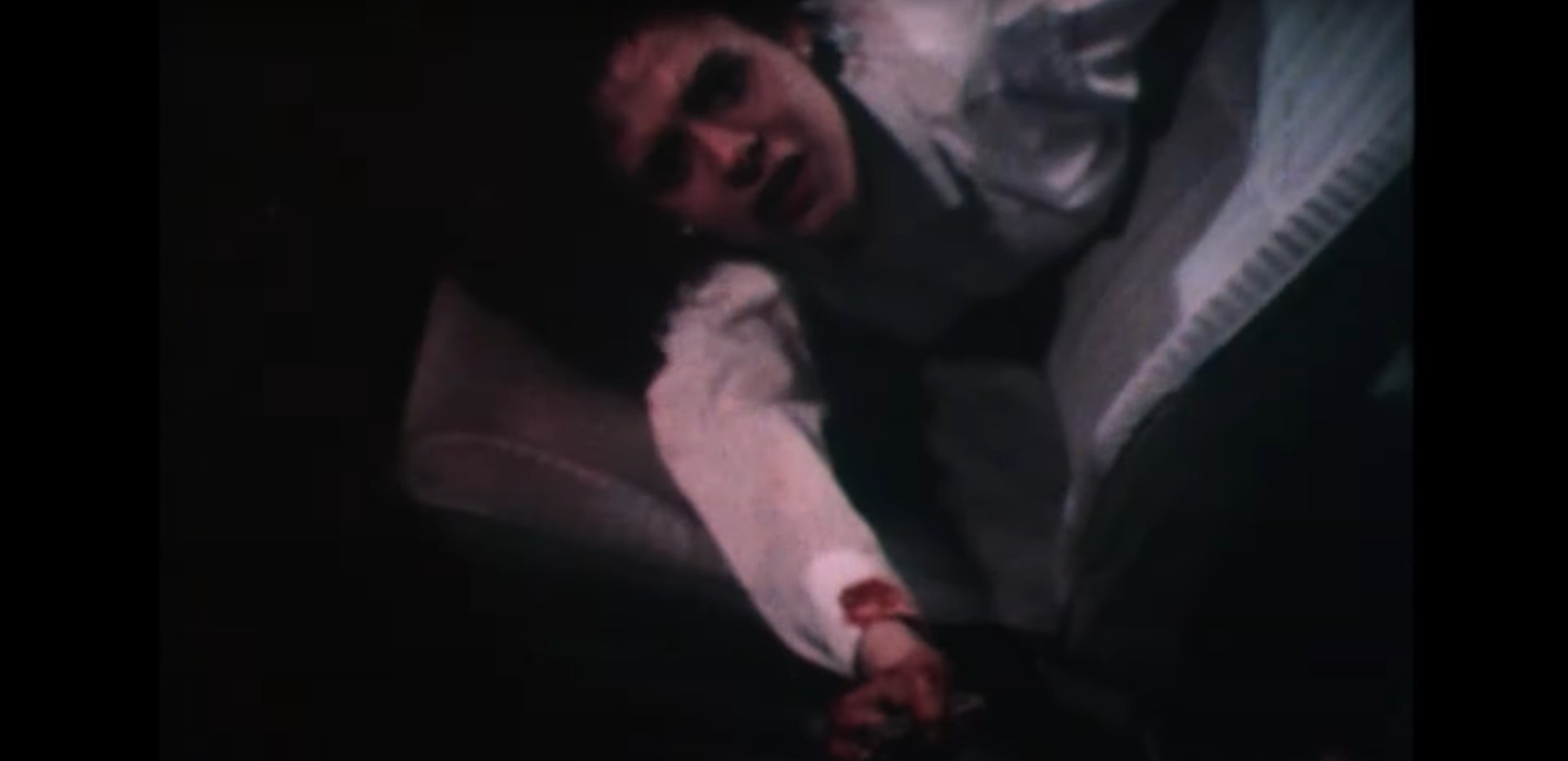
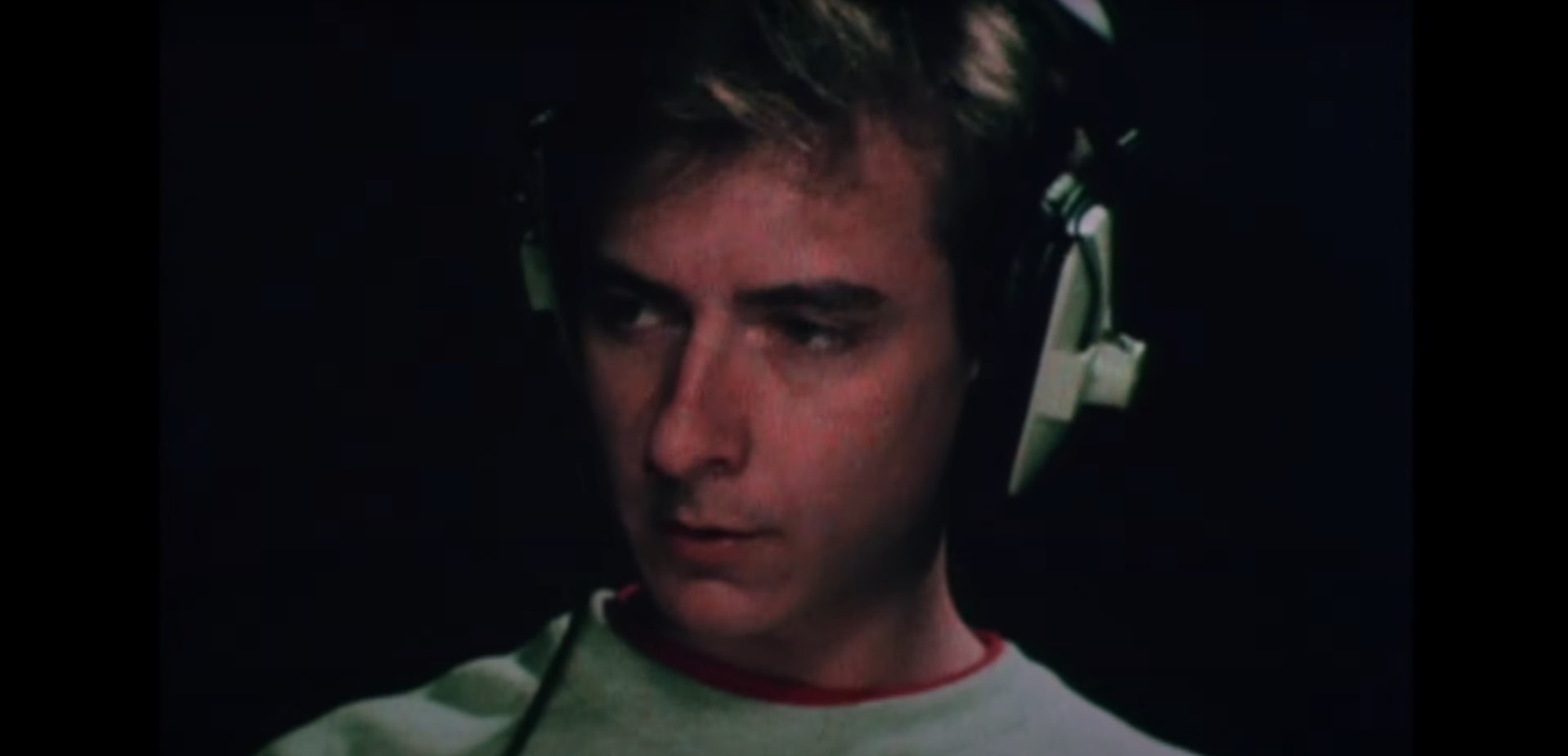
Ted, a radio sound design student, has to perform a singing telegram dressed in a jester costume on the very evening of having to pull an all-nighter to finish his final college class project.  After his melodic duties are fulfilled and the guests are entertained, he discovers a girl’s unconscious, bleeding body in an adjacent, dark apartment, a girl that he recognizes from campus.  Frightened by the sight and the shadowy figure in the apartment with him, Ted goes for help only to discover the girl vanished with no one else inside the apartment.  His drive back home is full of contemplation on the shocking memory when he notices the girl lying lifeless in the backseat of his car.  From then on out, Ted becomes embroiled into a murder mystery and pursued by the killers who are hellbent on tracking down the Jester-cladded man to cover up incrimination evidence and tie up loose ends.

Even though our unlucky protagonist wears a court jester outfit, there’s nothing funny about the 1990 thriller, an intense bird-dogging murder-mystery, known as “The Wrong Door.”  Helmed by the creative ensemble of friends, the film is written and directed by James Groetsch, Shawn Korby, and Bill Weiss who eagerly sought to make a feature film on a strapped for cash budget after success of their Super 8 short films.  Contemplating using tape for their inaugural throes into feature film land, the auteurs revert their thinking back to film, settling on a faithful celluloid format to which they have experience with in, the ever gritty Super 8.  What results is a tenebrous yet effectively taut confrontation of frenetic hunting and a shocking homicide driven more with ambient sound than character dialogue.  The three creative minds behind “The Wrong Door” formed Sandman Films and coproduced alongside John Schonebaum for the Minneapolis Twin Cities’ production.

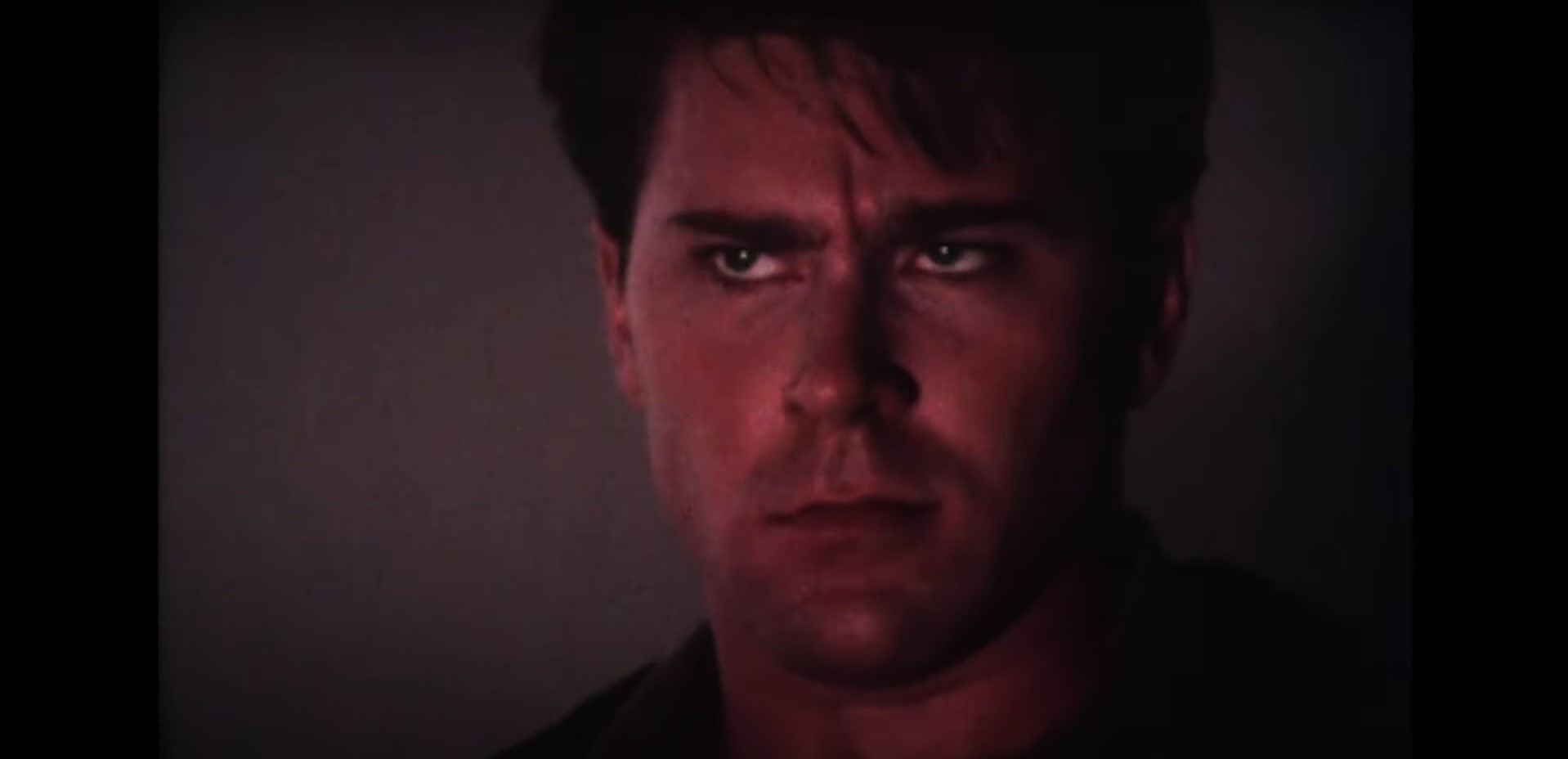
Cast locally around Minneapolis area, “The Wrong Door” is chock full of directors’ acquaintances who turned out to be really quite good at the parts they play.  Matt Felmlee stars in his debut performance as Ted, the class assignment under the gun student looking to knock out one last paying singing telegram gig before cutting and splicing audio for a final exam.  Felmlee isn’t given much dialogue to work with and his credibility relies burdensomely on nearly a vocally silent rundown from Jeff Tatum and Chris Hall respectively as deranged stalker and ransacking lunatic Jeff and his accomplice Vic.  Jeff Tatum makes for a good hardnosed psycho in a subtle yet menacing take of a trench coat robed coup de grâce kind of thug but the thug’s partner Vic is left as an nearly obscured sidekick and we don’t get to see Chris Hall ever come out and shine independently from Tatum’s enormous shadow.  Concluding on the three talking roles, unless you consider Loreal Steiner’s mostly dead body popping up performance where she speaks only in Ted’s nightmares, “The Wrong Door” instruments of interaction circulate around the three male principals peppered with Steiner’s maybe lifeless, maybe lively body stringing Ted along in order to slip him damning evidence on who and why she is being brutally murdered, in a nod of Hitchcockian hamboning.  A cast of supplementary, locally sourced pop-ins, including Jeanine Bourdaghs as Ted’s Radio classmate bestie, Stephanie.

Obscured to the depths of regional relevance, “The Wrong Door” is opened only to adventurous cinephiles who are willing to spend hours upon hours scouring through the vastly lower-to-no budget, independent films lost behind the borders of zonal solitude  A Hitchcockian thriller venerated on a humble scale in regard to the storytelling’s use of focused sound design to narrate a chased protagonist under the gun, literally and figuratively, that turns a studious radio sound design student with a final exam project to complete into a marked man hunted down in a foolish jester suit.  Bookend by dialogue setup and a tense, skirmishing climax, the near omission of dialogue in order for sound to reign supreme as atmospheric tensions force viewers, and force them appealingly I might add, into Ted’s chest-tightening, alone-in-fear experience with not only being incognizant of the particulars of the murder surrounding the young woman he was once smitten with but also to his being pursued by goons that hangs us on tenterhooks.  There’s also pulsing paranoia of where the dead set antagonists are hot on his trail and will suddenly appear unforeseen out of the blanketing darkness of an exterior cat-and-mouse game.  This leads into ambiguity near the end that asks the question, did Ted experience all of this strife or was it a clever cut and splice of imaginative audio files to create a whodunit thriller?  A brief sense of hesitation brings a sigh of relief from the nightmare and also onsets a different kind of anxiety of not knowing what truly went down until the very last shot that explains it all. 

Wrong place at the wrong time is the theme for “The Wrong Door” which is the right door to open if looking to walk-through to an understudied tensioner. Well versed in greatly misunderstood, profound stepped over, and overall underdog pictures is the smaller picture championing Visual Vengeance, the distributor behind the collector’s edition Blu-ray release of “The Wrong Door” with an AVC encoded, 1080p high-definition, BD50 product presented in a full screen 1.33:1 aspect ratio. For the first time on disc anywhere, the Super 8mm film receives a brand new, director approved 2K HD transfer from the original elements. The perception of Super 8mm does not hold water here with a relatively pristine image quality for the sized celluloid with a mighty clean image. Other than the white speckles of dust, other signs of minute debris, and the natural amount of grain of Super 8mm, no cigarette burns, light emitting on the frame edges due to perforation alignment, and hardly any scratches hinder quality. Poor lighting conditions in the exterior, and even some interiors, plays to the strengths of negative voids but, in my opinion, adds to the gloomy puzzler filled with action, suspense, and acrimony. While 8mm’s grasp on a grittier saturation, the tonal shading refuses to pop inside the faded film stock. The English Dolby Digital 2.0 stereo doesn’t do the new transfer justice. The lossy format likely not the best choice on a sound gimmicky, indie film that uses more innate ambient sound and Foley to tell the story rather than through dialogue. Though manageably capable to pull through to the end, the already lo-fi standard now compressed audio file has anemic energy through the dual channels but while the distinctions are dainty, some distinct distancing between more than two effects does convey. Switching between ADR and boom, there’s never a sense of uniformity with the dialogue that can sounds lively and volumes with post-production recordings yet also be frail within natural earshot of a recording device. Optional English subtitles are available. What’s most impressive about this 14th release from Visual Vengeance amongst 13 titles before it is the seemingly incalculable number of special features within the submenu of the flat, rodded colorful cutouts on the fluid main screen. New grouped audio commentaries with directors Bill Weiss and Shawn Korby in one and the third director James Groestsch and John Schonebaum on the second kick off the content followed by a new documentary with interviews from all three directors in Men Make Movie, If Not Million$, individual interviews with James Groetsch, Shawn Korby, Bill Weise, and actor Bill Felmlee, an interview with Film Threat founder Chris Gore who was one of the few in the field to put the film in his magazine, an alternate, director’s cut of “The Wrong Door” coming in as a second feature, Super 8 shorts: Raiders of the Lost Bark and The Pizza Man, a 20-minute television episode from The Gale Whitman Show, the original unedited Muther Video VHS intro, image gallery, original storyboard gallery, the original ran print from Film Threat, a Visual Vengeance 2023 cut trailer of “The Wrong Door,” and other Visual Vengeance trailers. Tangibly, the release comes with a rigid O-slipcover hypnotically graded in Jester colors of subtle pink and purple. Inside is a clear Amary Blu-ray case with the illustrated cover art that also does double duty for the motion menu and the folded mini-poster insert. Also inserted is a double-sided Blu-ray acknowledgment one sheet, a Visual Vengeance exclusive “Do Not Disturb …The Disturbed!” doorknob hanger, and a retro sticker sheet that’s come standard with every release to date. Reversible cover art displays the original VHS cover, and the disc is pressed as a mock play of a cassette tape’s supply reel teeth – neat! The region free Blu-ray comes unrated and has a runtime of 73 minutes.

Last Rites: Do you hear what I hear? No longer lingering in the vacuous space of radio static, “The Wrong Door” was once another shamefully sidestepped film that has been resurrected by Visual Vengeance for the first time anywhere on disc and, all I can say is, it’s about damn time.

“The Wrong Door” Collector’s Set Available at Amazon!