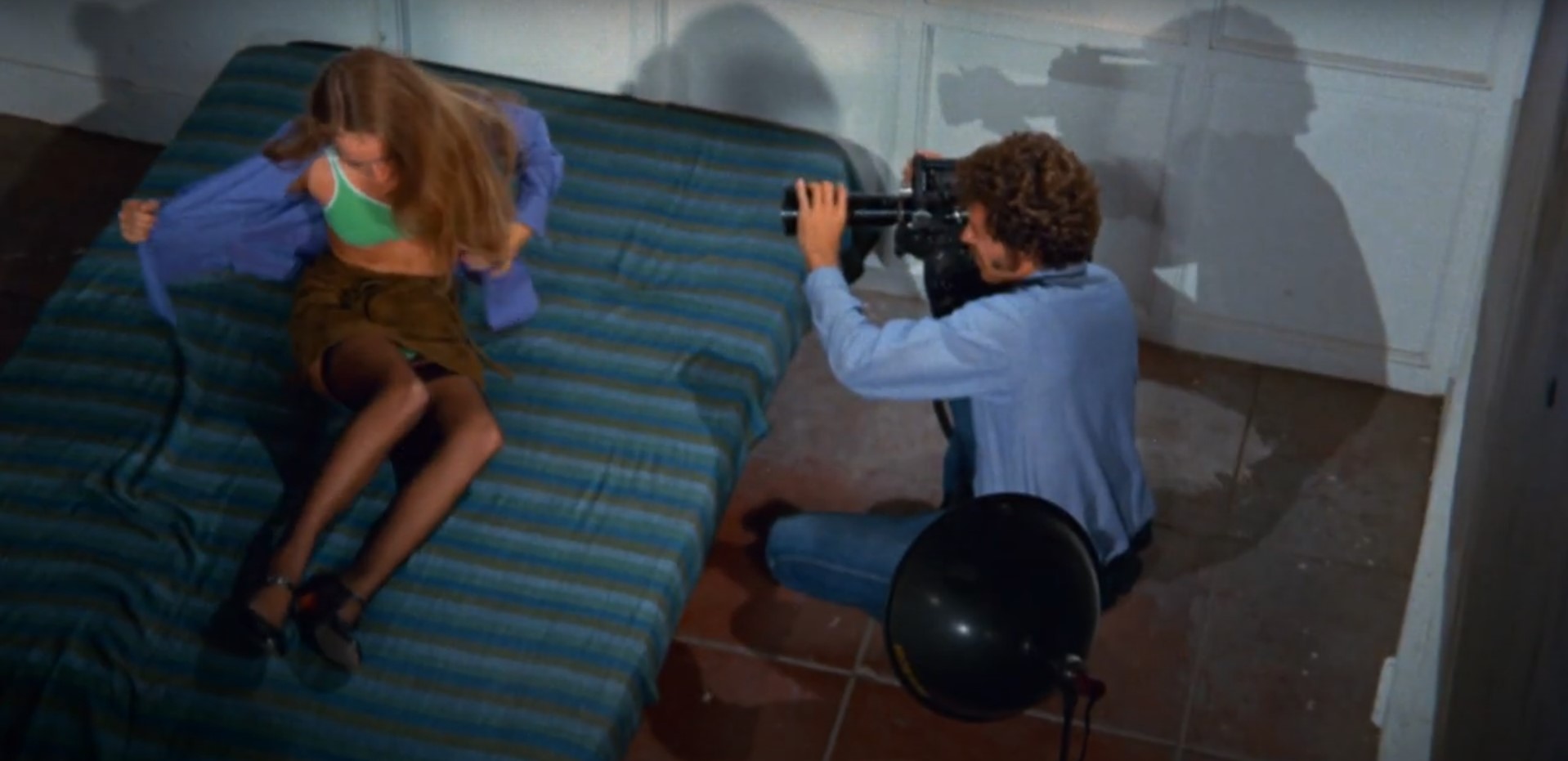
Interrogating EVIL Mounts to Hundreds of Deaths. “Confessions of a Serial Killer” reviewed! (Unearthed Films / Blu-ray)

An Unearthed Classic Now Available on Blu-ray! “Confessions of a Serial Killer”

Daniel Ray Hawkins drives an unsettling, nomadic lifestyle as he travels across different parts of the country.  With no money, no place to call home, and little friends, Hawkins lives a life of mostly solitude, odd jobs, and equally as strange as him acquaintances spurred from his childhood, shaped by his promiscuously prostitute mother and a war veteran disabled father who gruesomely took his own life, both of which displaying their iniquities right in front of him.  Hawkins also lives a life of torture and murder, being one of the most prolific American serial killers ever of mostly young women.  When caught by authorities, Hawkins is willing to confess to everything and help unearth bodies from over decades on the road to ensure families he’s stolen from receive some sliver of solace.  His anecdotal accounts of individual disappearances and murders shock authorities to the core, so much so that Hawkins may just be unstable and not telling the truth.  That is until he informs them of and leads them to the cached polaroids and decaying corpses. 

Based on the American serial killer Henry Lee Lucas, who notoriously claims killing over 200 people has earned him a trio of film adaptations, at least, with “Henry:  Portrait of a Serial Killer,” directed by John McNaughton and starring Michael Rooker in the titular role, the subsequent lesser part II, and the more obscurely known Mark Blair written and directed production, “Confession of a Serial Killer.”  Much like “Armageddon” and “Deep Impact,” or “End of Days” and “Stigmata,” both movies fall into the paradoxical twin film phenomena of sharing the same them and having both been released approx. within a year of each other.  While “Henry:  Portrait of a Serial Killer” may have taken the top spot with a bigger budget played in more widespread venues, Blair’s rendition was released prior and closer to Lucas’s active killing spree that saw an end in 1983, just didn’t get released in America until a few years later to not duel with McNaughton’s film and thus didn’t succeed as much.  The Cedarwood Productions film was produced by Cecyle Osgood Rexrode, distributed by Roger Corman and his company, Concorde Pictures. 

While he was not the first choice for the titular character of Daniel Ray Hawkins, production designer, the late Robert A. Burns, filled in the sociopathic shoes with great monotonic conviction.  Burns, who has ties as Art Director and makeup effects on some of the most iconic and seminal genre films, such as “The Texas Chain Saw Massacre,” “The Hills Have Eyes,” and “Tourist Trap,” matches the makings of an unempathetic, unsympathetic, natural born killer with a glazed deadpan austere and matter-a-fact knowledge and every evil committed.  “Confessions of a Serial Killer” would not be as laced with depravity if Burns didn’t push the demented drugs to keep audiences hooked on overdosed deviancy.  Not a tall or broadly muscular stature, curly outstretched and receding hair, scruffily unshaven with a consistent 5 o’clock shadow, and wide rimmed glasses, Daniel Ray Hawkins epitomizes the very essence of a creep and accentuates the behavior even further with his leisurely composure and straight-faced simplicity.  Other side characters exist around Hawkins’ maniacal run with the bisexual Moon Lewton (Dennis Hill) and his sister Molly (Sidney Brammer), who marries the pansexual Hawkins out of necessity rather than sexual desire, and while Moon and Molly share Hawkins deranged apathy, they are completely overshadowed by the more controlling and interesting lead principal character due to half the murderous anecdotes are solo ran and all of the perception in the stories is through Hawkins’ recollection, giving him more power in the trio in perceptional self-interest, if Hawkins is capable of such consciousness.  The cast fleshes out with lawmen and victims in Berkley Garrett, Ollie Handley, DeeDee Norton, Demp Toney, Eleese Lester, Colom L. Keating, and Lainie Frasier in the opening stranded motorist scene that sets up Hawkins diabolical reach in turning a car into a trap. 

Bathed in realism, “Confessions of a Serial Killer” does not embellish with surrealistic temperament.  The story never dives into Hawkins’ head to show any indication or any kind of visual mental degradation or reality breakage toward being a coldblooded killer.  His violence is spartan, acidic, and raw to the bone, leaving a gritty taste in your mouth, with only a bleak childhood to blame for his adult obsessions to kill that he describes as necessary as breathing.  Blair distills the story to a “Mindhunter’” episode in trying to understand the killer and recover skeletons from his past, literally, through rational and respect ways rather than boiler room beatings and power-tripping threats.   Blair’s concept humanizes the inhuman and having Hawkins’s reminiscence each account is like recalling childhood memories with a smirk and fond remembrance splayed across his face adds another layer of iciness.  Grounded by pedestrian scenarios, “Confessions of a Serial Killer” disrupts the routine, the familiar, and the unscripted ways we live our lives unconsciously to the fiends living among us that look like you or me.  It’s a very palpable fear Blair conveys under the semi-biopic film.  The director does eventually let loose the reigns in the final third act with a finale account of Hawkins, Moon, and Molly shacking up with an amiable doctor, his suspicious assistant, and his shapely young daughter that boils to a head when one bad decision leas to another. 

For the first time on Blu-ray anywhere as a part of Unearthed Films’ Unearthed Classics sub-banner, “Confessions of a Serial Killer” receives a high-definition, 1080p release on an AVC encoded, single ring BD25.  Higher contrast and a lesser diffusion to create a harsher, flatter color scheme, the intention is to fully base the story in reality as much as possible, to structure an abrasive look of grain and low lighting that parallels the seediness the tale touts. inspired from the facts of an American serial killer without having to fully give recognition to the actual killer.  Shadows are key to Hawkins nightly runs, adding back-alley value to his viciousness, and the more lighter scenes, such as brighter-by-color interiors or day exteriors, are ample with natural grain that cut into the details but don’t necessarily knock them out entirely.  With the lesser capacity disc, compression doesn’t appear to be an issue with no sign of macroblocking, banding, or posterization. The English language LCPM 2.0 mono possesses lo-fi aspects kept true to the original audio master. The dual-channel conduit amasses the layers mostly in the forefront without ascendancy in the environment, creating a flat approach, rendering the audio mostly fixed and depthless with the action creeping onto the dialogue, but this also adds the realism of a real world chaos where cacophony reigns. William Penn’s effectively, inlaid soundtrack has hallmarks of Wayne Bell and Tobe Hooper’s “Texas Chain Saw Massacre in the minor key with added notes of an otherworldly tune fork keyboard and lingering bass elements that’s just infests with the sounds of deceit and death, reminding me also a lot of a George A. Romero’s “Night of the Living Dead’s” atmospheric arrangement. English SDH are an available option. The collector’s edition contents include a commentary with director Mark Blair, aka John Dwyer, director of photography Layton Blacklock, and actor Sidney Brammer (Molly), The Henry Lee Lucas Story by author and former TV news reporter James Moore, and a full-lengthy documentary Rondo and Bob examines Robert Burns being the foremost expert on uniquely deformed actor Rondo Hatton as well as examines Burns’ own career, a polaroid gallery, promotional gallery, and the trailer. Displaying the iconic poster, a profit from rip of Hannibal Lector with a devilishly masked killer behind bars, Unearthed Films’ releases the stark image onto a planar cardboard slipcover. Same image is used from the standard Blu-ray Amaray case with no reverse side. Disc is pressed with a memorable and anxiety-filled chase scenes. There are no inserts material included. The region A encoded Blu-ray has a runtime of 107 minutes and is unrated.

Last Rites: One of the better biopics on U.S. serial killers even if a little bit of speculation and sensationalism increases the already verbose notoriety of one Henry Lee Lucas. Scary and bleak, “Confessions of a Serial Killer” continues to remind us that no one is safe from the everyday sociopath.

An Unearthed Classic Now Available on Blu-ray! “Confessions of a Serial Killer”

Weak Meekness Leads to One’s Own EVIL Destruction. “Catacombs” reviewed! (Imprint / Blu-ray)

Own Your Copy of Imprint’s “Catacombs” on Blu-ray!

Ellen Garth, a strong willed and wealthy but physically afflicted businesswoman devotes her all her love to an enervated doormat of a husband, Raymond.  When Ellen’s beautiful young niece, Alice, returns to London from Paris after a year abroad, Raymond is smitten by her flirtations for older men and strikes up an affair behind his very perceptive and sly wife’s back who catches them in each other’s embrace.  Tired of being a slave to his wife’s controlling behavior and wanting to be free to court Alice, Raymond kills Ellen and buries her in the potting shed behind their honeymoon house in a plot conceived with Ellen’s right-hand secretary and former con, Dick Corbett.  Believing he’s free of her and having been willed her fortune to share with Alice, Raymond suddenly suspects, after a series of strange events, that he’s being haunted by Ellen’s ghost, or even worse, the undead Ellen herself. 

Black and while horror from half a century or more ago always leaves a lasting impression that terror and suspense can be created by virtually story and acting alone instead of a heavily reliance of special effects and visceral coloring, such as with gore or grotesqueness of the unfathomable creature.  The British film “Catacombs,” or otherwise known as “The Woman Who Wouldn’t Die” in America, is one of those fear manufacturing films generated by pure acting talent and the managing cleverness behind the camera.  The 1965 film is directed by “The Oblong Box” and “Scream and Scream Again” director Gordon Hessler with American screenwriter Daniel Mainwaring (“Invasion of the Body Snatchers”) penning the script based off an American novelist Jay Bennett’s novel of the same UK title.  Shepperton Studios served as house of operations for the Parsons-McCallum production under Neil McCallum and Jack Parsons and distributed by the BLF, British Lion Films.

There’s no such thing as wasted parts or throwaway performances in Hessler’s murderous-revenge haunt with precision-acute actors and actresses chin deep in their characters’ cruelty, callousness, conformity, and control.  Twists and tension-riddle rods help elevate this nearly 60-year-old film to refrain from aging poorly.  Gary Merrill, former husband of silverscreen actress Bette Davis and star of “All About Eve,” plays the meek husband Raymond wed into money but at the cost of his manhood.  Merrill plays convincingly into Raymond’s submissive, passive nature under the more dominant but fair and kind mogul lady Ellen Garth, a hip-afflicted women that doesn’t feel the ailment impede her wealth or attitude in life by way of British actress Georgina Cookson.  In the mix is Ellen and Raymond’s parentless niece Alice who has returned from her studies in Paris seemingly transfigured from a chubby child to a beautiful lady.  Jane Merrow, who co-headlines “Catacombs” with Merrill, finds her stride as the elder-entangling Alice secretly at-odds with her aunt by seducing Raymond behind her back.  Rounding out the principal foursome is Neil McCallum (“Dr. Terror’s House of Horrors’) as Ellen Garth’s sneaky secretary Dick Corbett who has a façade of a hard worker, but Corbett can’t keep up with boss’s demanding energy and is itching to subvert her.  When the story’s peak turning point hits, the expectation of character change recedes back to status quo as if Ellen’s death changed nothing other than open the door of opportunity for Raymond and Alice to connect without concern.  Yet, that inkling of shame, guilt, and fear, mixed under a plot of deception and murder, has the reverse effect of a now burdenless happiness, producing a very little capricious life-change, especially in Raymond who is still as amiable as ever.  “Catacombs’” fills out the intimate cast with Rachel Thomas and Frederick Piper.

The actual use of catacombs, or subterranean burial grounds, has little do in the film other than in its infinitesimal moment of being a key piece of evidence toward something amiss, a tell for foreboding or already doomed health, and serves as one playful, paralleling reason to Ellen’s resurrection, though not reflected in plain sight as playful or parallel by Hessler.  What’s intended the most is building the mysterious dread around Ellen Garth’s return in a semi-gloss gothic polish aimed to crack Raymond and Alice’s psyche in half.  Hessler breeds tension after tension to engulf the characters in an unrelaxing state of disgrace and distrust and what makes the matters worse for Raymond and unscrupulous company is while Ellen Garth may have held all the cards being an authoritative woman of status and wealth, she showed loyalty, humility, and adored her family, friends, and lover despite their flaws and circumstances.  That unjustifiable murder stings audiences the most, a straight shot to the sympathetic heart that creates a need to see those responsible punished by Ellen’s earth-soiled, grave-escaping, dead-cold hands with edge of your seat anticipation.  Is Ellen Supernaturally haunting her killers or is the guilt driving them mad? 

The only way to find out in glorious high-definition is to pick up a copy of Imprint Film’s definitive Blu-ray version of “Catacombs” on an AVC encoded, 1080p, BD50 presented in a 1.66:1 European aspect ratio. The black and white picture receives a 4K scan from the original nitrate negative for its worldwide Blu-ray debt and though not much to mention in regard to colorization and black levels, the monochrome remains sharp at all times in a pristine negative that sees no damage. Usually, black and white can issue fuzziness, heavy grain, and ghosting during spliced cell overlap but this print, or rather this scanned print, looks amazingly fresh, holding patterns and transitioning seamless to the highest of restorative care. The English language is a mix between American and British English encoded with an uncompressed LPCM 2.0 mono, rendering a dialogue centric audio with composter Carlo Martelli brass band that’s minor keys taut tension to swell during the height of suspense. Dialogue is clean and clear with very minimal crackling; there’s no wispy or hissing detected. Although the mono feed vectors flatly, the range surrounding “Catacombs” is vast and timed to tackle distinction between the audio idiosyncrasies. Optional English subtitles are available. Special features include an exclusive feature-length audio commentary with authors Jonathan Rigby (“English Gothic: Classic Horror Cinema 1897-2015”) and Kevin Lyons, a new interview with co-star Jane Merrow on her experiences in “Catacombs” Merrow & Merrill, new interview with continuity supervisor Renee Glynne and sound designer Colin Miller The Glynne-Miller Story, a new interview with composer Carlo Martelli Martelli & Martell, and with a still gallery ending the bonus material. Housed in a Hammer blood red cardboard slipcase designed with a rendition of the original poster, the Imprint release is it’s 317th title. The clear Blu-ray Amaray case is even more colorful with a giallo-colored title and back cover, overtop a frightened scene with stars Merrow and Merrill. The reverse side of the cover has more of the psychotronic photo of Ellen Garth (Georgina Cookson) staring blankly into a pocket mirror to submit herself under a trance. The BD is pressed with the same red coloring and half-woman, half-death figure as the slipcase with no inserts included. One thing I will say on the negative side of the package is that the Amaray case is a bit difficult to extract from the slipcase; you kind of have to shimmy and shake it out enough to pull the case out. The 90-minute feature is unrated and did play on our region free player without having to setup flip to the desired region for playback.

Last Rites: Gorgeously macabre yet classic packaging, Imprint’s Blu-ray release of “Catacombs” is must-own Machiavellian umbra of greed and foul play, a timeless tale yarned to yield a megaton of shadow-lurking, supernatural suspense.

Own Your Copy of Imprint’s “Catacombs” on Blu-ray!

The Itsy-Bitsy EVIL Crawled Down Your Throat and Ate Your Insides! “Sting” reviewed! (Well Go USA Entertainment / Blu-ray)

“Sting” Is Available for Pre-Order for a Blu-ray July 30th Release!

A rebellious, preteen girl wading through the stepfather muck of new family dynamics befriends a small spider she discovers while snooping around a neighbor’s room in her apartment building.  The unique, small spider can mimic her every vocal sound, quickly captivating the girl’s interest as she seeks solace from her upended life, and the spider is constantly hungry being sequestered to a jar as the girl’s newfound pet.  The more she feeds the spider she’s named Sting the bigger it grows in a short period of time.  During the night, Sting unconfines itself and roams the airducts, immobilizing apartment residing animals and people alike with a potent paralyzing bite, to then web-encase them in the ducts and feast upon her captured prizes while still alive.  When Sting threatens the girl’s family, she must put her angsty squabbles and feelings aside and take the fight to her once beloved pet that has now become a giant, flesh-eating, arachnid.

There hasn’t been this much fun in a giant spider movie since “Eight Legged Freaks!”  “Sting” is a 2024, Australian creature feature from “Wyrmwood” franchise director Kiah Roache-Turner who pours portions of his own experiences in life into the script, metamorphosing “Sting” from being not only just a monstrous amount of arachnophobia but also a personally purging of multitude of fears rolled up into one web-slinging scary movie.  The story is set inside a slum apartment building in New York City at the centric mercy of a Northeastern blizzard; however, “Sting” is actually shot on a production stage in Sydney, in the New South Wales province of Australia, that has taken on the doubling duty for The Big apple.  “Sting” is a coproduction between Align Films, Pictures in Paradise, and See Pictures with “Wyrmwood:  Road of the Dead’s” Michael Potin, Jaimie Hilton, and “Daybreakers’” Chris Brown producing.

The cast is comprised of mostly Australian actors modulating their voices to the American accent and doing a rather impeccable job at it with only a slight slip of a slower drawl.  The principal nuclear family opens in the middle of new dad throes, the building’s handyman Ethan (Ryan Corr, “Wolf Creek 2”) struggling to not only meet the demands on his slumlord boss / stern aunt by marriage named Gunter (Robyn Nevin, “The Matrix Reloaded”) but also navigate a path toward a better, more-to-his-liking job while also reaching through and connecting with his defiant stepdaughter Charlotte (Alyla Browne, “Furiosa:  A Mad Max Saga”).  Sting, the spider, runs through the apartment tenants that include a depressed and alcoholic widower (Silvia Colloca, “Van Helsing”), a monotone marine biology grad student (Danny Kim), and even a spirited exterminator (the only American in the film in Jermaine Fowler, “The Blackening”) who holsters a nail gun for NYC protection as well as vermin gas bombs on his utility belt.  All-in-all, diversity is rich if not slightly stereotyped, but Roache-Turner does a really good job at telling their backstories through the camera shots and without the need for much expositional dialogue, such as the unsaid death of the widower’s family but enough visuals and grief expressions do formulate what happened.  Components of backstory life heighten the tension, or even share awkward moments, collectively between neighbors and family members that lead to presumptions and to, eventually, an explosion of distrust and anger that makes the perfect screener to blind them what’s really creepily-crawlingly around.  Noni Hazlehurst and Penelope Mitchell (“Hellboy” ’19) conclude the casting as immigrant mother with Alzheimer’s and her first-generation daughter married to Ethan and trying to also navigate a precarious life out from under her slumlord aunt’s grasp.

“Sting” is one of those movies that reminds horror fans why the genre is great and beloved.  Titular spider named after the “Lord of the Ring’s” sword that injured Shelob, the giant spider, in “Return of the King” and a definitive “Alien” inspired film, complete with a viciously blood-thirsty extraterrestrial bug that suspends prey with webbing and a badass female heroine, “Sting” masters the giant spider effect by mostly using practical means.  That’s right, a giant spider puppet, manned by eight puppeteers, checks most of the computer-imagery at the door and enters with confidence from master of effects Sir Richard Taylor and his team from Wētā Workshop, who has help build effects for the recent “Mortal Kombat,” Ti West’s “MaXXXine” films, and has had a helping hand in the MCU.  Skulking on ceilings, stealthily silking down, locomoting with smooth, natural movements as the spider, approximately the size of large black Labrador, has manipulated properties to lurk and hunt to visually feed the need and scare the phobia right into your once comforted being.  The story’s struggling family and honesty-is-the-best-policy themes ground “Sting’s” rabid arachnida with relatable turmoils, especially from a parenting and child point of views and anyone who has had children or parents, like the majority of us do, will understand preteen problems.  Ultimately, Sting represents childish hidden secrets, something they can control of their own volition, and a rebellious cause that’s ironically not good for them, turns uncontrollable, and is an obvious problem, akin to doing drugs for an extended period.  Sting might not be a line of cocaine or a hypodermic needled filled with narcotic poison, but space spider does have toxicity that courses a paralyzing agent conveyed by a single bite. 

Spiders are the demonized sharks of the land and continue to string webs of fear inside audiences.  Well Go USA Entertainment Blu-ray of “Sting” proves spiders still secrete a damn good monster movie that’s one part “Aliens” and one part “Charlotte’s Web” with an AVC encoded, 1080p high-definition, BD25 release presented in a 1.85:1 aspect ratio.  For a Well GO USA product, “Sting” is one of their better compressed discs that I’ve seen, retaining unexpurgated blacks and fling out glistening, texture palpable details throughout, and there were a plenty of black and low-lit areas to what afflicts most of the label’s releases, a potentially image sidelining obstacle. Coloring is a tad soft but moderately sound when juxtaposed against an enormously, slick gun-metal toned spider. The English DTS-HD 5.1 Master Audio surround sound mix renders with strength, a solid, multi-channel testing sound design when the spider creates a clatter in the airducts for back, side, and front localization. Depth appropriate is fine as well as a wide range of audio action onomatopoeia. No issues or obstacles obstructing the clean and clear dialogue, layered in the forefront and level weaved into the action where needed. English subtitles, as well as English SDH and French subtitles, are optionally available. Typically, we do not usually receive in-depth special features from Well Go USA due in part of his long history with Eastern films where bonus content seems nearly nonexistent. For “Sting,” there’s a substantial behind-the-scenes featurette taking a long look on the Roache-Turner’s concept and inspiration, the Creation of the Monster sizes up how the special effects were completed by Sir Richard Taylor’s company, interviews with the cast and crew on making the film, and the theatrical trailer. Encased inside a conventional Blu-ray Amaray, Sting has, in my opinion, a very effective, genuinely creepy poster of a spider walking across the floor next to a body, graded in a blue hue and working deep with the shadow angle for potency. Well Go USA surprises again with the fun disc pressed art of a toon-ish illustration that doesn’t seemingly fit the rest of the package marketing but becomes clear from the storyline. An advert for the company’s other newer releases, “The Flying Swordsman,” “Your Lucky Day,” and “A Creature Was Stirring,” is adjacently tucked in. “Sting” has a well-paced 91-minute runtime, is region A encoded for playback, and is rated R for violent content, bloody images, and language.

Last Rites: No doubt about it. “Sting” is fang-tastic! A modern spidersploitation film that flexes hard, built upon the strong backs of some great pop culture and science-fiction horror moments as an endearing tribute.

“Sting” Is Available for Pre-Order for a Blu-ray July 30th Release!

One Out of 7 Most Freaky, if not EVIL, Places on the Planet! “Gonjiam: Haunted Asylum” reviewed! (Second Sight / Limited Edition Blu-ray)

Become Engulfed by the “Gonjiam: Haunted Asylum” on Second Sight’s LE Blu-ray!

Horror Times, a web series dedicated to horror and hits, travels to the Gwangju providence for their next big event, a special episode aimed to rake in 1 million views worldwide as they explore the supposedly haunted, deserted, and derelict Gonjiam psychiatric asylum after midnight on its anniversary date of its closing.  Already buzzing with historical disappearances of those curious and brave enough to investigate the dilapidated corridors and rooms, Horror Times brings in four guests to join his three-man crew to record every second of what CNN labels one of the seven freakiest places on the planet.  Setup with wall-mounted motion activated cameras, harnessed with individual GoPros, and given a multi-layered script to follow on each of Gonjiam’s four floors, all is going as planned broadcasting live the strange atmospherics that slowly see climbing views from the director’s camped base outside the structure, pulling some fabricated strings to not only heighten his viewer pool but also get genuine frightened reactions from his guest team, but when the team and the cameras unexplainable paranormal occurrences, how far will a director go to reach his milestone goal.

Based off the actual CNN listicle of the top 7 freakiest places on the planet, “Gonjiam:  Haunted Asylum” was a real brick-and-mortar edifice committed to the committedly insane and one of the most suspected haunted places in South Korea until it’s demolishment shortly after the 2018 film’s release.  “Epitaph” writer-director Jung Bum-shik joins the ranks of the South Korean supernatural spookies, accompanying notable entries such as “The Tale of Two Sisters,” “Phone,” and “Cinderella.”  Cowritten by Sang-min Park, Gonjiam:  Haunted Asylum” refreshens the ramshackle mental institutionalized horror subgenre with a dash of social media influence and found footage that entangles grudging ghosts with cyber terror.  Historical thriller and drama producer Won-guk Kim spearheads the project under Hive Media productions and distributed globally by Showbox Films. 

Like a cable-aired, modern-day version of “Ghost Hunters” or “Kindred Spirits,” the vessel Horror Times exploits people’s spirituality beliefs by mingling the exploration of urban legends with gimmicky ploys to keep eyes glued to the show, run up viewership, and earn the root of all evil, money.  The Mystery Incorporated meddling kids might not have a talking Great Dane, but the Gonjiam ghost hunters are a dynamically doomed blend of greed and curiosity, helmed by their captain Ha-joon (Wi Ha-joon, Squid Game) and his on-the-ground, string-pulling marionettes Seung-wook (Lee Seung-wook) and Je-yoon (Yoo Je-Yoon) to conjure up not spirits but pranks under the guise of Gonjiam ghosts.  The unsuspecting portion of the team react as expected, believing the unexplainable as genuine articles of a haunted asylum, until the jokes bleed into the reality of the structure’s incensed force.  Other than Charlotte (Mun Ye-won), a Korean American who travels to Gonjiam to add the location to her lists of CNN’s freakiest places on the planet, there isn’t another mise-en-place character.  Perhaps the others’ backstories are lost in translation but Sung-hoon (Park Sung-hoon, “Hail to Hell”), Ji-hyun (Park Ji-hyun, “The Divine Fury”), and Ah-yeon (Oh Ah-yeon) lose sympathy points for just being there for the sake of being there.  If you haven’t caught on already, the characters and actors name match to add to the faux realism of found footage. 

Veritably surrounded by the actual notoriety of the former Gonjiam psychiatric hospital, the story adds to the established frightening folklore of the rundown building and though the filmmakers were not allowed to shoot inside or on the grounds of the restricted abandoned building, Gonjiam blueprints were used to reconstruction the grimy, trash-laden hallways and various rooms inside a high school.  The effect works like charm used to teleport audiences, along with the help of social media GoPros, selfie sticks, and the like, right into the crumbling ruins; you can almost smell the mold and stank of beyond putrid chemicals and filth.  Yoon Byung-Ho’s cinematography plays with the signal disruption touch, often deploying randomized and intentional interference to convey signal disruptions or, perhaps even, the foreshadowing with the wraithy wrath of spirits; yet “Gonjiam” never truly feels like a found footage film due to its radical differences in video media being implemented and there’s often the unexplainable, no camera-in-use angle that dilutes the subgenre medium.  “Gonjiam” falls into this unquantifiable realm of storytelling that’s hard to digest.  The chaos that ensures in the third act is more palpable, geared toward developing a heavily reliant, hard and fast tension and trembling fear without needing bloodshed for the crowd-pleasing shock factor.

Second Sight sees through the dense barrage of found footage films and spots the pearl amongst the muck with “Gonjiam:  Haunted Asylum,” curating a limited edition, big box, Blu-ray release.  The AVC encoded, 1080p high-definition, BD50, presented in a widescreen 1.85:1 aspect ratio, nears 24 FPS and has flawless technical recording in its digital capturing.  Blacks are dense and rich to create that unknown void apprehension, the neglected belongings of a forlorn hospital have palpable consistency that’s grimy and rusty, and skin textures appropriate lose definition but maintain quality to the extent of equipment limits with GoPros, cell phones, and camcorders in low and hazy key lighting, onboard camera lighting, and some night vision for authentic found footage grip.  There’s not much in the way of diverse color for what is a graded tone of tenebrous obscurity throughout.  I’ve already touched upon Byung-Ho’s purposeful transmissive trouble that impresses more of an annoyance than an integrated factor of fear.  The Korean DTS-HD Master Audio 5.1 delivers on the need-to-hear atmospherics that shudders in echoes and the frantic churn of survival.  What there is not a ton of, and gratefully kept to a minimum, was the eerie wails of the dead as their moments are kept mostly visual in a virtually scoreless runtime that focuses on the surrounding milieu rather than building tension artificially through minor key notes.  Dialogue comes through clearly and clean, especially when muzzled by video camera audio band transmissions.  English subtitles are translated well and synch fine enough with the rapid procession.  Special features include an feature-length audio commentary by Mary Beth McAndrews (Dread Central editor-in-chief) and Terry Mesnard (Gayly Dreadful editor-in-chief), UK’s Zoë Rose Smith’s Fear the Unknown visual-essay on the Gonjiam’s origin, history, and what makes the Korean film scary, and archived featurettes with interviews, including with director Jung Bum-shik amongst various crew, that explore the rumored beginnings of Gonjiam’s notoriety that fuels the production into recreating Gonjiam nearly identically, live recordings of the film’s sheer eeriness told through the images captured by the camera harnesses and phone footage, the new faces of fear that circles around the cast and behind-the-scenes table reads, The Sanctum of Horror that aims to explore the connection between the actual freaky locations and their cinematized yarn to create a legacy of folklore for the now demolished Gonjiam hospital, The Truth of the Ghostlore explores Gonjiam’s history and urban myth and how that forms the ghosts in the film, Korean press conference film launch, and the film’s trailers.  As much as we love Second Sight’s authored special features, which from films of the East are rarely produce, there also plenty to be excited about with the physical attributes of the limited edition set, including a rigid and thick sleeve box with a Luke Headland designed Gonjiam building in red and black.  The inside contents include a 6 collector’s art cards in the same red and black color scheme, a 70-page book with new essays from Sarah Appleton (“The J-Horror Virus”), James Marsh (“Wisconsin Death Trip”), film critic Meagan Navarro, and horror content creator Amber T, and finished off with the film itself, encased in a green-colored Amaray with the same front cover artwork as the rigid slip box.  There are no inserts, and the disc is pressed simply with the title, English and Korean, splashed in red on a black background.  The LE set is hardcoded with a region B playback, has a runtime of 94 minutes, and is UK certified 15 for Strong Supernatural Threat and Language.

Last Rites: “Gonjiam: Haunted Asylum” is not just another shaky cam of paranormal activity. The film incorporates a component of reality, embellishing more on top an already suspected haunted building by giving the story teeth, and released with cultural purpose that binds fact and fiction with a terrorizing outcome of some really pissed off spirits.

Become Engulfed by the “Gonjiam: Haunted Asylum” on Second Sight’s LE Blu-ray!

Yeoh, Rothrock Beat the EVIL to a Pulp! “Yes, Madam!” reviewed! (88 Films / Blu-ray)

“Yes, Madam!” on Blu-ray from 88 Films!

Hong Kong’s Inspector Ng and Scotland Yard’s Inspector Carrie Morris reluctantly join forces to solve the murder of an undercover British national on the verge of exposing a fraudulent real estate contract helmed by crooked businessman Mr. Tin.  When a small piece of key case evidence, a microfilm, winds up in the bumbling hands of three low-level thieves after coincidently robbing the undercover British agent’s hotel room, they find themselves at a crossroads; do they give up the kill-for microfilm to the police in the name of self-preservation or ransom it against Mr. Tin’s syndicate for a big payday?  The elusive Mr. Tin becomes enemy number one in Ng and Morris’s crosshairs despite his circumventing the law.  Not deterred by the failed arrest, the tough as nails inspectors track down the microfilm thieves to make their case and take down by force one of Hong Kong’s most powerful criminal organizations.  

An accelerating knockaround action-comedy from Corey Yuen (“Ninja in the Dragon’s Den,” “The Transporter”), “Yes, Madam!” is a fight-heavy, female-driven super cop emprise with martial arts daggers drawn and slicked in a vigorously lubed burlesque dark comedy.  The 1985 Hong Kong production, penned by Barry Wong (“Hard Boiled”) and James Clouse, as his sole credit, teams an unlikely and highly skilled, international partnership between a twosome of type A personalities who not only initially combat each other and then the unscrupulous bad guys and their mischievous plans but also against the historically prejudiced gender role reversals outside the borders of the story.  Action-packed choreography mixed with slapstick comedy, “Yes, Madam!” is entertainingly fun to watch and hard-hitting, produced by stuntman Sammo Hung (“Long Arm of the Law”) and film’s costar John Sham (“Royal Warriors”) and along with Sammo Hung, executive producer Sir Dickson Poon develops “Yes, Madam!” under their cofounded martial arts and action feature producing D&B Films.

If you’re ever looking for a celebrity roots film, a launching pad feature of success, “Yes, Madam!” has that inner circle, star-studded power and deliverance that not only showcases the beginnings of two presently well-known action and martial art film women but also joins the East with the West in a singular chop-socky fracas.  Oscar winner Michelle Yeoh (“Crouching Tiger, Hidden Dragon,” “Everything Everywhere All at Once”), credited as Michelle Khan, and black belt martial arts competitor and World Champion Cynthia Rothrock (“China O’Brien,” “Tiger Claws”) explode to the thousandth degree on screen as apex inspectors forced to work together to take down crime boss Mr. Tin (James Tien, “Fist of Fury”).  They’re fast, they’re ferocious, they’re incredibly talented in what could be considered their debut principal performances, especially Rothrock in her first feature film in which she doesn’t speak an ounce of either of the native Hong Kong’s Cantonese or Mandarin dialects.  Yeoh and Rothrock are top dog heroines in a yard full of marginal, blundering thieves caught in the middle of a grander operation.  Under incognito with pain reliever aliases are actor-producer John Sham (“Winners & Sinners”) as Strepsil, Hoi Mang (“Zu:  Warriors from the Magic Mountain”) as Aspirin, and Hark Tsui (“Working Class”) as Panadol and though they act like, and sort of resemble, the Three Stooges, the three thieves and counterfeiters embody a mutual brotherhood with background history and a all-for-one, one-for-all attitude as their minor caper turns into a full collapse of their con game.  Characters and performances are all over the board between the various groupings in the melee but does weirdly gel together in an artificial way toward a poignant culmination collision of what’s just and unjust that destroys, and unites, friendships and bonds.  “Yes, Madam” rounds out the cast with Melvin Wong, Wai Shum, Eddie Maher, Michael Harry, and Dick Wei (“Five Deadly Venoms”) and Fat Chung (“To Hell with the Devil”) as Mr. Tin’s nonpareil sub-bosses. 

Barreling along from the very beginning of an armored car hijacking turned into a bloody shootout to the grand finale that pageants the marvelous, born-for-this skill of Michelle Yeoh and Cynthia Rothrock as they plow down foes with acrobatic fists and kicks galore, “Yes, Madam” doesn’t dwindle as a debut disappointment but rather is a tour de force of destruction, drollery, and delictum prevention.  Outlandish at times, of course, with a story slightly straying off course here and there but that feverishly, cyclonic filmmaking condenses to being nothing new or novel for the reputably fast-paced, churn-them-out style of Hong Kong cinema and palpable fighting is taken to a whole new level of ouch and woah.  Multiple takes from various angles equates to the stunts being depressed continuously onto the repeat button, solidifying prolific editor Peter Cheung (“Ready to Rumble,” “Mr. Vampire”) as one of the best in the business, globally, to manage the multiple strands of film and make a coherent and entertaining yarn out of the celluloid chaos.  The crux of the kerfuffle isn’t delineated well enough to justify and muster this kind of police force and exaggerated villainy but the theme majority inside the broadly cartoonish veneer is mostly about respecting the girl boss and grasping friendship that has been taken for granted, dipped in a furiously candy-coated rouse of visually exciting stimulation. 

88 Films adds “Yes, Madam!” into their U.S. distribution cache with a new, well-curated Blu-ray release.  The AVC encoded, 1080p high-definition, BD50 presented 2K scanned and restored feature has the original aspect ratio of 1.85:1 in the Hong Kong cut. Beautifully diffused and vibrant color, there’s no hue deficiency under this well-lit production, restored to nicely detail skin tones and textures in every aspect of the lighting. No issues with compression during the rapid-fired sequence cells, such as aliasing or ghosting, and black levels are solid albeit there’s not a ton, if any, negative space to experience as even the night shots are illuminated in a “moon” diffusion. Delineation reflects a deepened background contrasted against foreground objects, creating ideal space between objects in what is mostly a close quartered, hand-to-hand combat with only a handful of medium, medium-long shots to make the scenes more realistic than choreographed on a wider frame. Two audio options encoded are the original Cantonese DTS-HD 2.0 mono and an English DTS-HD 5.1, both use ADR dialogue which incurs only minor negative separation and synch between actor and script. Cantonese track fairs slightly better with the native tongue but much like the story’s brisk pace, vocals are also quick as a whip and often times outpace the lips. What’s interesting about “Yes, Madam!’ is the score which is credited to Romeo Díaz (“A Chinese Ghost Story”) but samples much of John Carpenter’s “Halloween” in tense moments. “Halloween” comes through so prominently that it shadows and hurts Díaz’s own work, if any of it exists. Ambience tracks work with the grain with some of the fighting emphasized for chop-socky effect. English subtitles synch fine and have scribed errorfree. Product special features an audio commentary by Frank Djeng on the Hong Kong cut, a new interview with star Cynthia Rothrock, Rothrock and Djeng also provide select scene commentary, a new interview with Mang Hoi who played Aspirin, archive interview with Michelle Yeoh, an archive Battling Babes featurette, and with the Hong Kong trailer rounding things out. New action-packed compositional artwork from graphic designer Sean Langmore graces the primary cover art with original artwork on the reverse side. The disc art is pressed to promenade the two female actresses and there is nothing across the way in the insert clips. The region A playback release has a runtime of 93 minutes and is listed as not rated.

Last Rites: There’s nothing more to say other than “Yes, Madam!” A top-notch, assertive action film starring two worldclass women in the fighting subgenre who stir in the cool and the kickass with silky, smooth ease.

“Yes, Madam!” on Blu-ray from 88 Films!