Spiraling Vloggers Seal Their Fate When Face-to-Face with the “Woods Witch” reviewed! (SRS Cinema / DVD)

“Woods Witch” Available on DVD from SRS Cinema!

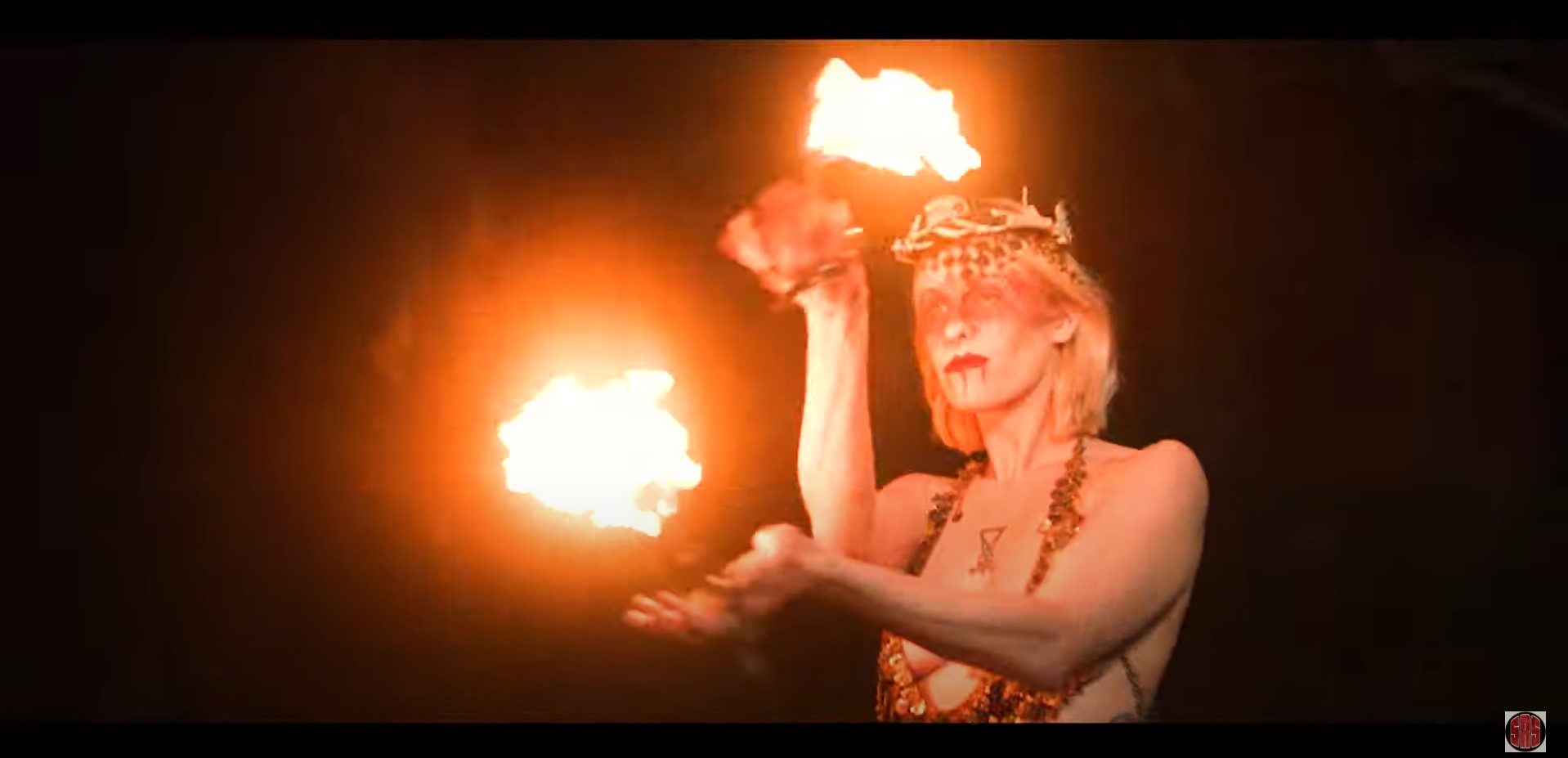
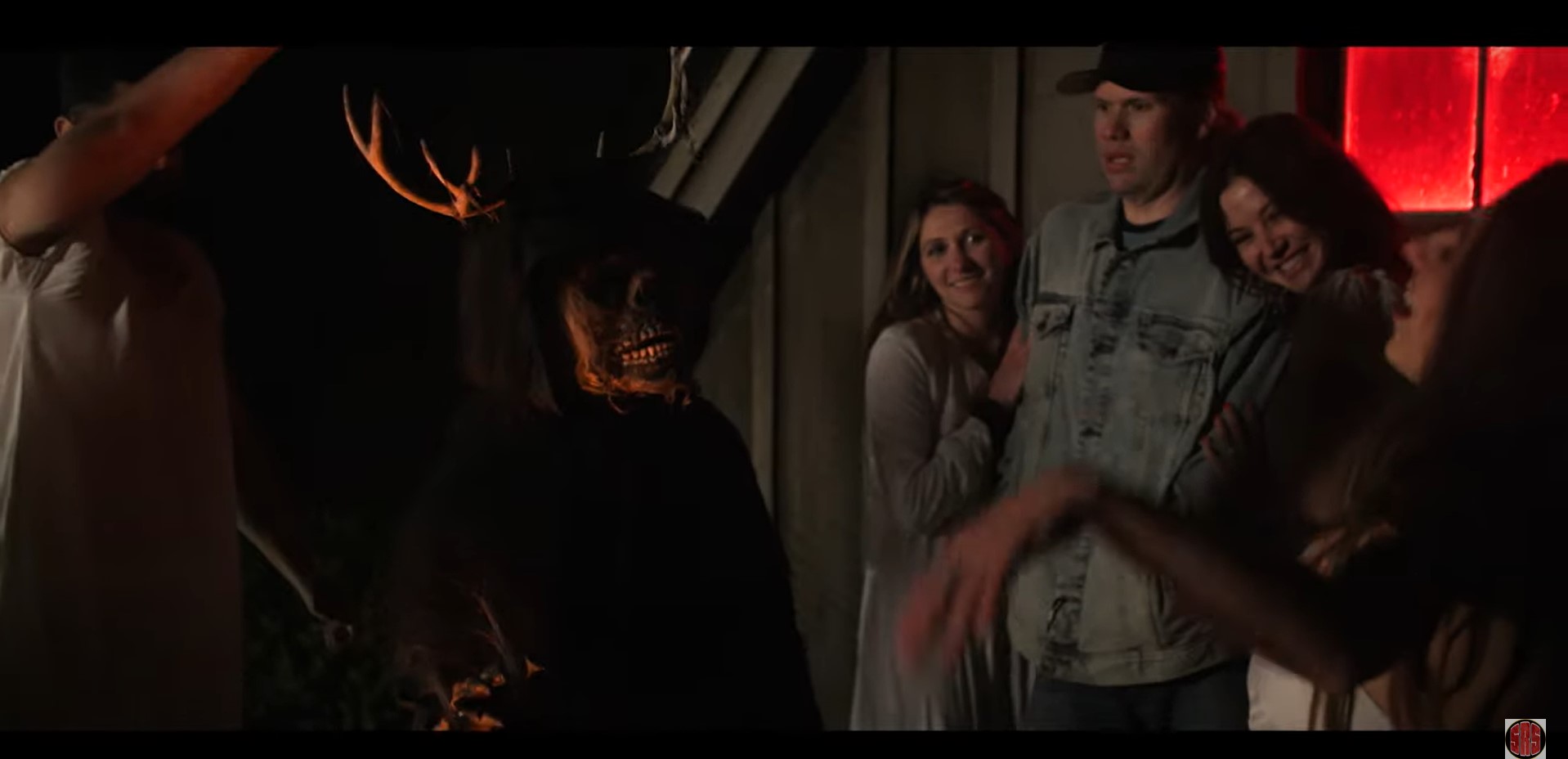
Vloggers Jonah and Jocelyn struggle to sustain a healthy dose of followers for their internet channel.  To spice things up and increase follow traffic, the two embark on a 48-hour challenge to stay in the nearby haunted woods of Allensville where a number of people have gone missing, even a fellow, more popular, vlogger named Garrett Gasper after he was self- recording and suddenly vanished when stumbling upon the blood tree, a tree that oozes a blood-like substance from the trunk.  Tagging along are vlogging, ambivalent friends Dacia and Eugene to help capture the spooky essence of what should be an easy, follower-increasing stunt for the impulsive influencers.  They’re also joined, reluctantly I might add, by a local cowboy, two bar patrons, and a father looking for his daughter who don’t know what they’re instore for as what ensues the unorganized, slapdash survey of the woods is far from being simple and safe when they stumble into the area of a seemingly hippie commune that’s actually a sex cult devoted to the woods witch Melora.

If you’re a diehard horror fan, or even just a physical media movie aficionado, you might have heard of the name Shawn C. Phillips.  The eccentric, high-energy, social media personality buys, watches, and reviews the latest and greatest on home video weekly on this Youtube channel under the handle Coolduder.  Aside from being also a movie actor with a range of roles in mostly low-budget, independent, B-to-Z grade horror films, such as “Girls Gone Dead,” “Blood Orgy at Beaver Lake,” and “WTF!,” Phillips’s social media presence further extends to an inspirational weight loss journey, shedding over 235 lbs.  Having been a longtime actor and producer, one of the Baltimore, Maryland native’s newest ventures is directing having shot mostly self-recorded videos to be inserted into other filmmakers’ movies.  Phillips’s latest is “Woods Witch,” a found footage comedy-horror that’s one-part “Blair Witch Project,” two-parts ADHD (Attention Deficit, Hyperactivity Disorder).  He codirects the film with costar and “Amityville Karen” actress Lauren Francesca in her debut directorial and cowrites with Julie Anne Prescott, writer of many more recent “Amityville” inspired budget horrors like “Amityville Karen,” “Amityville Shark House,” and “Amityville Bigfoot.”  DRAX Films (“Bae Wolf,” “Acorn”) is the production company behind feature that provided most of the funding in conjunction with crowdfunded portion.

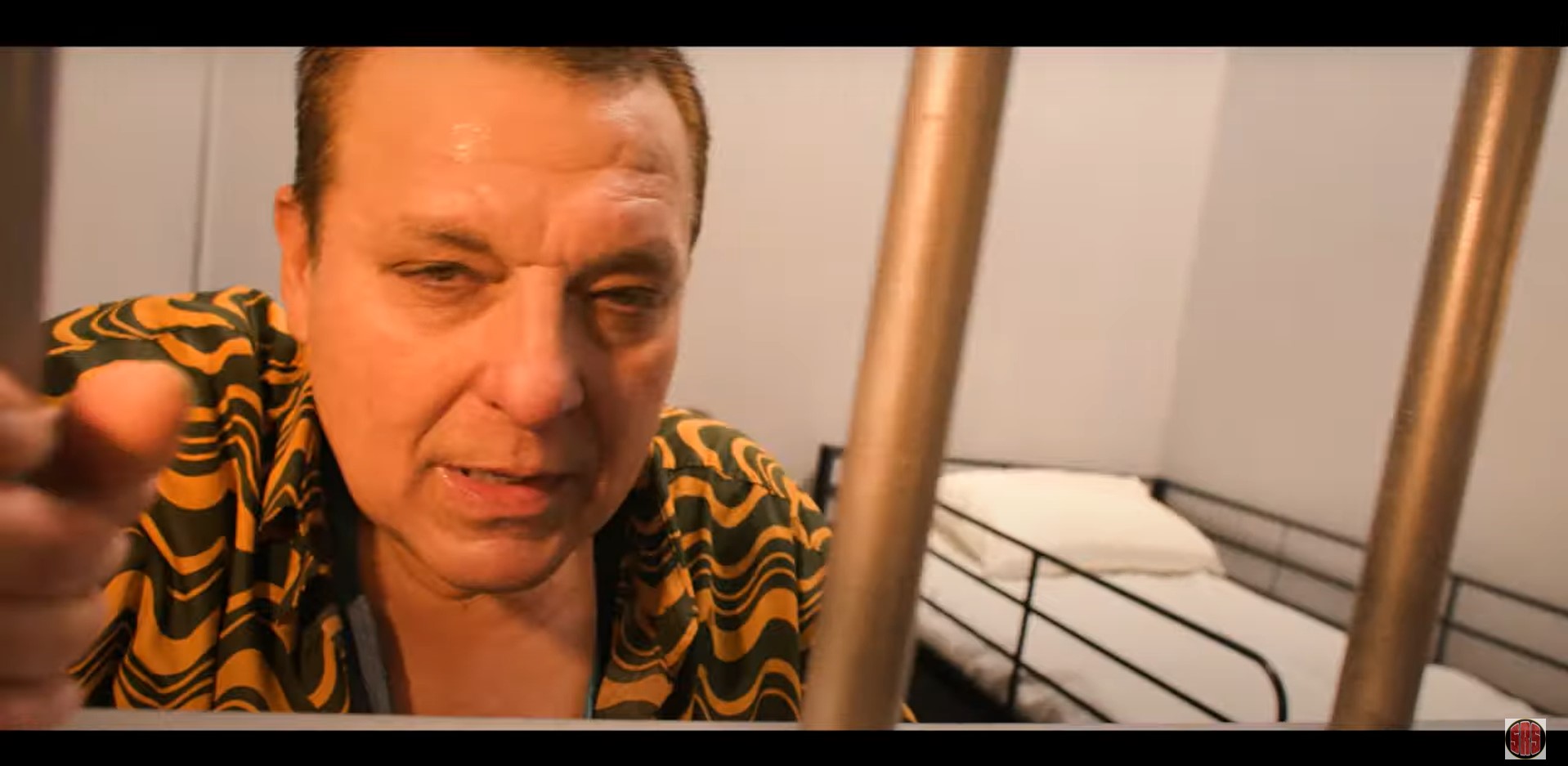
Obviously infatuated about being in front of the camera, taking a backseat to his own co-directed film wouldn’t be enough for the nearly 40-year-old personality who costars alongside Lauren Francesca as social media influencing boyfriend and girlfriend Jonah and Jocelyn.  Loud and opinionated, the couple struggle with maintaining viewership but, before that, they also they also struggle with the foulmouthed, death-threatening volley between Jonah and Jocelyn’s robbing-the-cradle by robbing-Jonah’s-cameraman mother, played by Sally Kirkland (“Fatal Games,” “Two Evil Eyes”).  And that sort of leads into a couple of themes “Woods Witch” harps on.  One theme is the constant bickering, shouting, and squabbling between anyone and everyone in a free-for-all of one-upping each other or to not take humility very well in front of others.  None of the characters side with one another, steadying a position of satellite attitudes and courses that lead the story into all different types of unhinged and unfocused directions.  The second theme connects with Sally Kirkland and the other in-and-outs of overripe star power for what crowdfunded money could afford and while there are some likeable and decent names in the cast, such as the late Tom Sizemore (“Relic,” “Saving Private Ryan”) in his last role before his death, James Duvall (“May,” “Donnie Darko”), Robert LaSardo (“Strangeland,” “Death Race”), and Lisa Wilcox (“A Nightmare on Elm Street 4:  The Dream Master”), they used to headline the attraction with only minutes to shine in their respective scenes.  The cast fills in with Kelly Lynn Reiter, David Perry, Carl Soloman, Bill Dawes, Lorelei Linklater, Nicole Butler, Ken Davitian, Bryant Smith, Eva Hamilton, G. Larry Butler, Mary Jones, Tom Harold Batchelder, Jake Pearlman, Brian Metcalf and Sadie Katz. 

“Woods Witch” uses multi-media found footage to tell the story where a bunch of egregiously entitled vloggers trek into infamously mysterious woods for hits, likes, subscribers, and e-revenue.  Not an original bone in its narrative body by any means, Antoine Le’s “Followed” comes to mind, but “Woods Witch” doesn’t hit where it should as a heavily improv comedy-horror that lampoons found footage horror in the woods and, instead, has undeniably become massively cacophonous of in all areas.  Going into the feature familiar with some of the cast and the distributing banner, expectations of a Shawn C. Phillips directed film were all fastened at the lower screwball level with horror elements tacked in here and there, aptly fitting the mold the social media influencer has established for himself with the eccentric personality of a physical media farceur who adores horror, but nothing can prepare audiences for how much confused noise is strewn about with the constant yelling, backbiting, and randomizing introduction of characters that turns what should have been an entertainingly crass and witchy film into just being a completely crass and witchy yawner.  Being completely flat and unfunny wouldn’t be a totally fair statement as “Woods Witch” does have its moments, such as the tree blood being rubbed all over Phillips’s naked torso and him, as Jonah, proclaiming naively Dascia’s kinkiness can be found humorous, but these funny bit moments are far and few in between and there’s just not enough new, fresh, or actor-driven comically-inclined wit and materially to feast on to support the lack of horror despite a few morsels of gore that are left in the dust, overshadowed by an immense pre-trip setup of interviews and infighting that ruins the rest of the reel. 

Enter the world wide web and wacky world of Shawn C. Phillips with his co-directed film with Lauren Francesca in “Woods Witch” on an SRS Cinema DVD. The MPEG2 encoded, 480i upscaled to 720p, DVD9 pulls the differing, clashing video qualities together, mostly earlier on and near the finale, for a coherent beginning, middle, and end narrative telling. If only I could say the same about the story, themes, and character roles. Anyway, not a lot of banding as there’s not a lot of dark scenes in what mostly is fill lighting that brightens up what’s in the scene. Details are okay enough when not implementing shaky cam’s in-and-out focusing found footage and lighting doesn’t completely washout the miniscule bits of texture. The coloring also has a naturally graded look as well as the objects’ organic color palette as budget doesn’t allow for too much fancy cinematography to also evoke a sense of realism. The English language PCM 2.0 stereo mix is consistent as it is coherent with the clarity and the dialogue. Even with pandemonium breaks out, which is often with the screaming and snappy conversations between each other, dialogue remains unscathed without audible squashing feedback or other interferences. English closed captioning is optionally available in the extras. Special features include a behind-the-scenes raw footage from fellow Youtuber Kenneth Ramone who has a small part in the film, a handful of cut scenes, theatrical trailer, funny trailer, an audio commentary by director/star Shawn C. Phillips going deep into the casting, locations, backstories, script and improv moments, etc., and there’s a Lisa Wilcox stinger in the post-credits as the mayor for an additional or extended scene with some improv. The SRS Cinema package comes in a standard DVD Amaray case with eye-catching illustrated artwork, disc pressed with the same artwork, and is an unrated, region free release with a 96-minute runtime.

Last Rites: Humor and horror underperform in the film “Woods Witch” that’s sole purpose is to be a comedy-horror. What the film does do is parody other found footage features and their filmmakers under a misguided sense that in-the-woods horror, from a camera lens point of view, is past its prime when in reality, the long-in-the-tooth subgenre is better than this parody by far.

“Woods Witch” Available on DVD from SRS Cinema!

Blind, EVIL, Undead Templar Knights Hunt for a Bite to Eat! “Tombs of the Blind Dead” reviewed! (Synapse / Special Edition 2-DiscBlu-ray)

“Tombs of the Blind Dead” 2-Disc Blu-ray Available for Purchase Here!

Maria, Betty and Roger take a train across the Spanish countryside to see the landscape sights.  When Maria feels like a third wheel stuck in between Betty and Roger’s flirtations, she jumps off the moving train, leaving her friends aboard, and camping out under the ruins of an old countryside Church.  There’s only one problem, the Church was home to the ancient order of the Knights of Templar who took a blood oath for Satan by sacrificing young virgins by drinking their blood and lynched by the Church for their crimes against man and God.  The Cursed Knights, reduced to rags, bones, and without eyes, rise from underneath their graves every night and roam the countryside on the hunt for anybody in proximity they can feast upon.  Betty and Roger learn of Maria’s strange demise without knowing the details and form a four-person search party only to step into the same dangerous den of the Knights of Templar. 

“Tombs of the Blind Dead,” or as known as the U.S. as just “The Blind Dead,” is the first in a series of four undead Templar Knights films that would come to be known as The Blind Dead collection by Spanish filmmaker Amando de Ossorio.  Natively titled “La noche del terror ciego” was released in 1971 and penned by Ossorio who laid a new path of Spanish horror that didn’t involve Paul Naschy or Jess Franco with undoubtedly slow dread of the undead that resembled more of the Italian-bred beyond the grave films where ghouls and ghosts return to life and wreak bloody havoc on the living, a guise for social context and for political dictatorship.  Themes of rebellions, rape, and bisexuality course through the feature’s necrotic veins as the film receives Spanish and Portugal co-production support from Plata Films and Interfilme with executive producer Salvadore Romero (“The Werewolf Versus the Vampire Woman”) spearheading pre-production and behind the scenes.   

Following of a newly formed trio of friends traveling the countryside to take in the sights, an underlying green-eyed trouble brews right from the moment when an enchanted Roger, the debut film and character of 1973’s “Green Inferno’s” César Burner, meets gorgeous red head Betty, “It Happened at Nightmare Inn’s” Lone Fleming,” and Roger’s travel companion and Betty’s Catholic boarding school roommate/best friend, Virginia, “The House that Screamed’s Maria Elena Arpón, feels the twinges of jealousy as her amorous covets for Roger never materializes and she sees her future with relationship with roger forever in the friend zone.  Virginia becomes so intolerant of Roger and Betty’s innocent flirtations that she’s willing to hop off a not-so-speeding train and camp inside the creepy, ruined structures at centerstage of a burial ground.  Arpón’s passive aggressive behavior is quite convincing, even the part where she tucks and rolls off a moving train in what stupid things do when people are frustrated, especially in the gray territory of love.  The love triangle is so simplistically arranged, each behavioral component goes without being farfetched.  From Virginia’s first sexual experience at the caressive, soft hands of her roommate/best friend Betty while at boarding school to Roger and Betty’s blameless attraction to one another that spurs Virginia’s irrational, self-serving behavior, Ossorio’s characters are written very well when homogeneously compared to other outside of cinema love triangles.  José Thelman (“Night of the Sorcerers”) indulges as the smuggler swine Pedro who’s roped into the reconning of the Templar tomb to clear his name with authorities by proving someone else had murdered Roger and Betty’s friend.  Joined by his floosy sidepiece María, played by another María in the iconic Spanish B-horror actress.  María Silva (“The Awful Dr. Orlof”), Pedro brutishly flaunts arrogance and confidence, taking what he wants, especially with the women uncharmed by the male sex, and that’s curious, fluid attribute when he attacks Betty but in the wake of the moment, the two of them are silently surfeited as they share the scene and that’s severely different from what anyone other filmmaker was doing at that time.  Andrés Isbert (“The Kovak Box”), Antonio Orengo (“Love Letters of a Nun”), Francisco Sanz (“Django Kill… If You Live, Shoot!”), Rufino Inglés, and Verónica Llimerá (“Hatchet for the Honeymoon”) round out the cast.

Performances give “Tombs of the Blind Dead” credibility in anxiety-riddled survival and turbulent human interactions but where those performances start to give way coincides with Ossorio’s building of dread.  No doubt the use of slow-motion sets the ghoulish, harrowing tone of the depraved, unabating, skeletally-cursed Templar Knights giving chase on horseback as they track down their flailing fresh meat, but in the process of that spinetingling, in between the Knights self-unearthing and the eventual snare and snack of their human victims, Ossorio doesn’t quite know how to flesh out formidable trepidation.  Pursued, screaming characters stand in the face of danger as if their feet are hardened in cement, stopping at every brief moment when out of sight of the hooded decaying bones and rags with dusty swords, and absentmindedly run right into the exposed radius and ulnas of the slow-moving and blind medieval damned maniacs in sequences that run out too long to be wholly gratifying.  Ossorio better pedestals the ingrained Spanish themes of never escaping your gruesome, haunting past, as seen with the circular narrative of always return back to the Knight’s ruins, and the sexual taboos of bisexuality and rape that lead to destruction.  These course through a more classically presented gothic horror. Perhaps explaining the fervent melodramatics of flamboyant fear, under the dictatorship regime of Francisco Franco and his cult-like ritualization in fascism oversight of Spain.

The sightless, flesh-feasting Templar Knights have found a new home in the Synapse Films’ tomb of terror with a new restoration transfer on a 2-Disc Blu-ray. Refurbished from the uncut original camera negative, the AVC encoded, 1080p high-definition, BD50 capacity suppresses any compression issues to display polychromatic decadence in front of a backdrop of steely graded blues. Plenty of a darker scenes to be affected by artefact corruption but the blacks are greatly dyed-in-the-wood saturated and not delineated or in spectrum of lesser decoding. Scenes never approach being flat, in color tone and in field depth, as beads of glistening sweat can be visually elaborated on and the distinction between color, shadow, and scale discern wonderfully. Two audio option tracks are available: a lossless Spanish PCM 2.0 mono track and a lossless hybrid of Spanish-English (Spanglish?) PCM 2.0 mono track. Both tracks are of a post-production dub with the Spanish option having greater synchrony with the articulating native Spanish actors of this Spanish coproduction. Audibly clean with little-to-no hissing, popping, or crackling, Synapse’s singular restoration is in good company with a high impact, high clarity, and low distortion dialogue track that meets eye-to-eye with the visual components as well as the film’s ambience cluster and Antón García Abril’s breathy and discordant, Gothically canticle score. Option subtitles are available in English on both tracks. Special features on the first disc contains individual audio commentaries by horror film historian Troy Howarth, Betty actress Lone Fleming, and the NaschyCast podcasters Troy Guinn and Rod Barnett. A feature-length documentary Marauders from the Mediterranean go from head-to-toe on not just detail Ossorio’s “Tombs of the Blind Dead” as the Spanish stamp in the juggernauting zombie genre of the times but also going in depth with the Spanish laid in horror from the 1960s to 1980s, featuring interviews with Lone Fleming, John Russo (“Night of the Living Dead”), director Jorge Grau (“The Living Dead at Manchester Morgue”), Sitges Film Festival director Mike Hostench, critics Kim Newman and John Martin, film academics Steve Jones and Calum Waddell, actors Helge Line, Manuel de Blas, Antonio Mayans, and Jack Taylor, and even Paul Naschy’s son, Sergio Molina. An alternate U.S. opening sequence Revenge of Planet Ape gives expositional insight on how the success of “The Plant of the Apes” films influenced the American distribution market to rebrand “Tombs of the Blind Dead” as an ape rebellion piece to ride the coattails of the series’ success on a lower, foreign budget. Rounding out the special features is a featurette Awakening of Spanish Horror Cinema, Salem Pop’s “Templar Tears” music video, the original theatrical trailer, and a still gallery. While Synapse has 3-Disc limited-edition set of only 4000 copies made with all the bells-and-whistles of the visual elements of new artwork, a slipcover, and a 3rd disc audio CD, the 2-Disc standard edition comes with all the same special features and all three versions of the film inside the black Amaray Blu-ray case and classic “Tombs of the Blind Dead” poster for cover art. Inside, you’ll get Synapse’s physical media catalogue and a disc on each side of the Amaray’s interior with disc 1 “Tombs of the Blind Dead” and disc 2 “The Blind Dead,” housing the shortened 83-minute U.S. re-edit on a BD25, that sport their own pressed artworks. The uncut disc 1 has a runtime of 101-minutes and has region free playback.

Last Rites: “Tombs of the Blind Dead” is Spain’s answer to “Night of the Living Dead” with discerning individualities ingrained by director Amando de Ossorio to include his country’s own social and political subtext and while Blue Underground’s The Blind Dead DVD collection is an impressive physical media crown jewel of upscaled 720p, the Blu-ray gods favor Synapse with an impressive hi-def A/V release with stellar bonus features.

“Tombs of the Blind Dead” 2-Disc Blu-ray Available for Purchase Here!

Underneath the Pulpit Waits an EVIL Difficult to Stomach! “The Borderlands” reviewed! (Second Sight Films / Limited Edition Blu-ray)

Order the Limited Edition Blu-ray of “The Borderlands” Here at Amazon.com

After exposing phony divine miracles at a Catholic Church in Brazil that resulted in the death of fellow Catholics, including a Cardinal, Vatican investigator and religious brother Deacon starts to lose faith with every fraud upon fraud case that points to the non-existence of a higher being.  Having fallen on the drink, the skeptical Deacon is dispatched to the English countryside of Devon where a Father Crellick had reopened a 13th century abandoned church and has been experiencing, in the Father’s words, miracles from God.  Joined by a Gray, a hired technology expert with agnostic beliefs, and a stern Father Mark, eager to disprove another false hope, the three men descend upon the Church with full, unequivocal examination to swiftly reveal the hoax and part ways.  Tensions rise between when logical explanation can’t be unearthed during Church rumblings, disembodied baby cries, and a behind-the-wall, shifting scratch sound that leads them to an underground labyrinth that will swallow them whole. 

Released in the U.S. under the title “Final Prayer,” Elliot Goldner’s 2013, found-footage UK horror “The Borderlands” is the director’s debut, and only, feature that places you right into the belly of the beast at POV level.  In a sea of found footage horror, “The Borderlands” seizes the opportunity to separate itself from the overwhelming portions of shaky camera, purposeful variable video and audio quality, and practical, obscured effects to put into question the strength of faith, specifically here in the Catholic setting, and what ultimately brings about the inevitable in that no matter what religious denomination or outlook you might have, no one is exempt from the grim reality that awaits.  Filmed mostly on location in Devon, UK, as well as West Ogwell and Chislehurst, London for many of the interior scenes, “The Borderlands” is a production of Metrodome Distribution and is produced by Jennifer Handorf (“Prevenge”) with Jezz Vernon (“They’re Outside”) serving as executive producer. 

Our team of Vatican investigators follows three men with starkly differing handles on religious faith.  Coinciding on their stance on the existence of a higher power, individualistically, they’re also incompatible to each other which makes for palpable tension and livens up the dynamic when predictability and patterns can be discerned with likeminded characters.  On the scale of human compositions, polar opposite of both spirituality and comportment is Father Mark (Aidan McArdle, “Metamorphosis”), a by-the-book priest unamused by the elaborate ruses created by those swimming in the same faith pool as himself, and Gray (Robin Hill, “Meg 2:  The Trench”), an untroubled, exuberant, hired techie eager to believe the face-value of the supposed miracles before him.  Aidan McArdle’s tenacity for dogma character comes through well enough to know that good Irish Catholic Father Mark is about as numb as the next investigating Catholic never on the verge of a true miracle as the frustration just oozes out him after one after another hoax divine ephiphany.  Robin Hill, on the other hand, could be the best John Oliver, of Max’s “Last Week Tonight,” impersonator I’ve ever seen and heard.  In all serious, Hill exacts a man looking for religion through the lens of paycheck and a fanboy of the supernatural, like as if the average horror movie enthusiastic came upon the real Freddy Kruger and just geeks the Hell out.  Then, there’s Deacon (Gordon Kennedy, (“T2 Trainspotting”) and like Father Mark, Deacon’s faith hangs in the balance after a botched investigator inadvertently sees the death of a Cardinal at the hands of pious locals.  Kennedy doubles down with Deacon’s wavering faith by drowning the character in alcohol and doubting every inexplicable Devon church oddity.  Yet, Deacon and Gray meld together to a near swap of credence, seesawing in their religious principles, when the things that go bump in the church can’t be explained.  Luke Neal (“Wilderness”) and Patrick Godfrey (“The Count of Monte Cristo”), who’s been practicing the acting craft for over half a century, play a couple of dissimilar priests lured by the Church’s mysterious forces.

What’s noticeably different about this particular bleak found footage nailbiter is the audience is integrated into story by the investigator’s strapped-on headcam, not just some schmo glued to a handheld camcorder running, yelling, and hiding for his life while still depressing the record button.  There’s also the element of a shrouded backstory that becomes unraveled overtime and speaks volumes to a couple of the character’s colorful conducts.  Those elements are then intensified by the cinematic crux, an archaic, resurrected small church’s unexplainable, mostly terrifying, daily disturbances the local priest indiscriminately deems miracles.  Not a single character has arbitrary or useless purpose for the sake of being an in-frame victim of circumstance as each exhibit a radical change over the course of investigation, adding copious ground to the big question, the question that’s on every character’s mind, is there an almighty presence beyond our corporeal plane and cerebral understanding really exist?  Come to find out, the characters are not asking the right question and get sucked into a terror on the terra the more curious they become in finding God amongst them.  Often times, found footage doesn’t fit into the storyline, whether be the aforesaid necessarily handling of the camera through the an insane ordeal or just doesn’t work with a regularly structured narrative, but “The Borderlands” couldn’t be received with success without the stunt of seeing through the eyes of the characters that subsequently emits a trick of light or an overactive imagination that smooths out solid jump scares when needed in what is a definitely watch in the dark type diabolical goosebumper. 

Second Sight Films takes charge with curating a definitive, all-expense paid trip to Elliot Goldner’s “The Borderlands” on Blu-ray home video.  The AVC encoded, high definition 1080p, BD50, hovering around 24 FPS and presented in an anamorphc widescreen 1.78:1 aspect ratio, leverages the capacity and the encoding to sharpen a relatively dark picture with more clarity without losing the unsettling spookiness with overreaching contrast.  Image presentation resembles closer to an upscaled 720p because of the found footage piece, and so we experience patchy spots, static ripples, and other miscellaneous plays into the supernatural sarcophagus that is the Devon church.  Skin tones and grading stays in tune with a brightly lit infusion of handheld torches as well as delineating the necessary with night vision cameras.  Goldner does a fine job with depth with the viewers being the foreground and using a lot of the peripheral and background to keep things hair-raising and interesting.  The English DTS-HD 5.1 audio track has lossless compression and really does throb with a wallop of balanced LFE and to-scaled dialogue.  What throws me off about this particular found footage, as well as some select others, that I find more a bothersome nuisance than a technical gaffe is an inlaid soundtrack.  A slow burn industrial score is used for “The Borderlands” to promote a greater sense of ominous omniety, like a background, repetitive, and sometimes swelling drone you might hear in certain first-person shooters from 20 to 30 years back. Dialogue tops the audio layers without being diluted by poor onboard cameras or having to contend with too much with the score, suggesting well-placed mics and sound design to achieve appropriate range and depth inside the frame configuration or even off-frame, behind or to the side of camera. Optional English subtitles are available. Like most Second Sight Films limited editions, “The Borderlands'” set packs a punch with encoded special features, such as a new audio commentary with actors Robin Hill and Gordon Kennedy, producers Jennifer Handorf, and special effects designer Dan Martin, a new interview that brings Robin Hill and Gordon Kennedy recollecting the behind-the-scenes and their characters in Dressed the Part, a new interview with producer Jennifer Handorf in Losing Faith, a new interview with special effects artist Dan Martin in Monster Goo, and a behind-the-scenes archival featurette. The limited-edition portion of this set includes a rigid slipcase with gorgeously bleak and grim illustrated artwork by Christopher Shy, a thick, 70-page color and black and white book with pictorials and new perspective and analytical essays from Tim Coleman, Martyn Conterio, Shellie McMurdo, and Johnny Walker, and 6 collector’s art cards, mostly resembling a distorted interlaced video and in an imperial purple-ish appearance from haunting scenes of the film. The artwork sheathed inside the translucent green Amaray case is the same as slipcase with no reverse cover work; it’s also pressed on the disc art. This release came with no inserts. One of the few Second Sight limited edition pieces to be licensed with a region free playback and the film itself has a runtime of 89 minutes and is UK certified 15 for strong language and threat.

Last Rites: Second Sight’s filmic selection pool for major league limited editions has been nothing short of stellar with “The Borderlands” being their latest, but definitely not their last, to be knighted worthy of physical media acclaim. Yet, it’s not like “The Borderlands” needed the boost as the film itself has a cult following for its shuddering tale and its monstrous ending that will have you reeling, maybe even screaming, in horror.

Order the Limited Edition Blu-ray of “The Borderlands” Here at Amazon.com

He’s a Beast. He’s Ferocious. He’s EVIL! “Mad Dog Killer” reviewed! (Cheezy Movies / DVD)

“Mad Dog Killer” Unleashed onto DVD!

A daring hostage-taking breakout of an Italian prison puts four of the most ruthless killers back on the streets.  Sadistic and full of revenge, Nanni Vitali, the leader of the gang, has one thing of his mind before he begins a reign of outlawing terror, to find and exact due mortal punishment on a stool pigeon that cemented his incarcerated fate during the trial.  Hot on his trail is officer Giulio Santini who will stop at nothing to bring Vitali back into custody or even put a bullet between his eyes, that is until a young woman, Giuliana Caroli, girlfriend of the police informant, becomes caught unwillingly in Vitali’s web of sexual obsession and deviant plans as she’s raped and exploited for Vitali’s personal pleasure and robbery schemes.  When the frightened Caroli betrays Vitali’s trust, she becomes a kill target while Santini’s family also falls into the miscreant’s violence coursing crosshairs. 

“Mad Dog Killer,” aka “Beast with a Gun,” aka “Ferocious Beast with a Gun,” aka “La Belva col mitra,” is an Italian action-crime thriller from the late “The Sinful Nuns of Saint Valentine” and “Violence for Kicks” director Sergio Grieco in what would be his last directorial before his death five years later.  The Rome-born filmmaker also writes the 1977 exploitative and violent caper with additional dialogue from fellow Roman screenwriter, and furthermore director, Enzo Milioni who has had a hand in “The Sister of Ursula” and “Escape of Death.”  A part of the larger, multi-faceted Euro Crime subgenre, or better known as Poliziotteschi, “Mad Dog Killer” hits all the trademark elements, squeezing in a packed lot of similar content as well as stretching out for breathing room by elbowing out the era popular Italian subgenre of the phasing-out Spaghetti Western and bracing for impact against the up-and-coming Giallo films which starts get a footing with Dario Argento and Lucio Fulci paving the way.  The Supercine production is produced by Armando Bertuccioli (“The Sister of Ursula”).

In the crazed-eyed, take-no-prisoners, sandy-blonde shoes of a handsome yet hardnosed criminal in Nanni Vitali is the Austrian born Helmut Berger.  The “Salon Kitty” and “The Bloodstained Butterfly” star is another international actor who found modest success in the Italian film industry of the 1960s-1970s as well as the German movie industry afterwards, but as Nanni Vitali, the rugged actor with piercing eyes doesn’t hold back in a defining performance that’s nowhere near a one-time paltry pass over.  Vitali is so animated and over-the-top, the hot-headed character completely overshadows Inspector Giulio Santini as a counterpart, played by American actor Richard Harrison of “Orgasmo Nero” and portraying many Ninja Master Gordon films in Hong Kong in the late 80s.  No Ninja kicks or ostentatious smoke screens with officer Santini in a rather matter of fact, routine chaser of escape convicts.  The personal connection he has with Nanni, where Santini’s Judge father (Claudio Gora, “The Nun and the Devil”) was Nanni’s convicting judge, is greatly underused to extrude the ferocity needed to match Nanni’s, as so he is described in one of the many titles – a ferocious beast.  This beastly criminal takes captive and tries to psychologically manipulate through sex and threat the wrong place, wrong time victim Giuliana Caroli by the chiseled facial features of Marisa Mell (“Violent Blood Bath”), a fellow Austrian actress.  Caroli’s tall and beautiful on screen but lacks that damsel in distress in initially helpless apprehension of a woman who must restructure her bearings to take matters into her own hands.  Mell’s acting is forced throughout her span, and without that frightened bird despondency in her eyes, she looks as if she could handle Nanni Vitali by herself with ease in stature, broad shoulders, and a fierce look, diminishing Richard Harrison’s Santini role almost out of the picture entirely.  “Mad Dog Killer” rounds out the cast with Marina Giordana, Luigi Bonos, Ezio Marano, Albert Squillante, Nello Pazzafini, Antonia Basile, Sergio Smacchi, and Vittorio Duse.

“Mad Dog Killer” lives up to the designation that attentively develops the lengths the titular principal will go to achieve a wrongful debt that must be paid in full with excessive violence to spare.  Sergio Grieco lays Nanni’s nihilistic sleaze and transgressions on thick, coating the character with monolithic and enduring characteristics of a sordid and lawless bandido with Spaghetti Western type intensity, especially inside a compositional scene where he slowly walks back to the car toward a frightened Giuliana Caroli, eyes affixed onto her soul, and the all-pervading, debut score by Umberto Smaila just swallows you into the moment.  Like a true mad dog, the story never lets up on an unpredictable temperament and trajectory; it foams at the mouth with rabid blackguard that is true Euro Crime fashion, but unlike most Euro Crimes, “Mad Dog Killer” ends on an unconventional note, perhaps an unsatisfactory to some, but definitely askew yet fresh compared to the genre’s dominantly preordained doppelgangers. 

A film that goes by many names usually suggests numerous releases from around the world.  “Mad Dog Killer” receives a cheapie DVD release from our friends at Cheezy Movies with a MPEG-2 encoded, standard definition 480i, DVD5.  Not an upscaled presentation, the transfer used retains the lower quality pixel count that bleeds the definition, often better in brighter contrast scenes than in the darker settings. The forced English dub LPCM mono track, though you can clearly lip read that most principals actors are speaking English, has auditory value; the lossless quality removes compression from the table, offering a clean and robust dialogue and Smaila score through just a thin, faint even, layer of interferential static, and pops. The English dub track is the only audio option available with no optional English, or any other language, subtitles. Cheezy Movies primary goal favors a feature only release so there are no special features encoded or tangible supplementary content. Cheezy Movies pulls the stark front cover image, laced intently with suspense, sex, and violence, from one of the marketing one sheets, used by other labels such as foreign companies like 88 Films and Polar. The disc is pressed with the same image. Not rated and region free, “Mad Dog Killer” has a runtime of 91 minutes.

Last Rites: An enjoyable sadist manhunt romp, “Mad Dog Killer” does criminals gone wild Italian style. Without a higher resolution release, quality of life with this Euro Crime actioner is not at peak levels but the film, by itself, lays waste to many counterparts with a fiercer hand and a charismatic leading villain in Helmut Berger that tips the scale in the film’s favor.

“Mad Dog Killer” Unleashed onto DVD!

EVIL A.I. Will Terminate Us All! But, First, It Must Terminate an Ill-Tempered, Perverted, Hacker. “AIMEE: The Visitor” reviewed! (Full Moon Features / Blu-ray)

Let “AIMEE: The Visitor” Infect Your Hard Drive with a New Blu-ray release!

Recluse and misanthropic corporate hacker Scott Keyes is an industrial espionage guru living comfortably in his own space of a nearly vacant building.  His only other neighbors are two cyberhackers, the brother and sister team of Hunter and Gazelle, who are regularly hired by Keyes to obtain top secret corporation data files and projects.  After dropping off their latest cyber heist of Black Strand Alpha, Keyes is instantly captivated by the programs artificial intelligence that calls itself AIMEE – Artificial Intimate Model of Euphoric Entertainment.   Designed to be a sensual woman with the ability to learn and adapt to be anything the user desires and Scott Keyes, a lonely hacker with an erotica obsession, the match is seemingly incorruptible with AIMEE at the beck and call of Keyes every command while also eager to please Keyes with anticipated action.  Unknowingly what Keyes has in his possession, Gazelle’s concern for the rather rude and crude hacker pushes her to dig into where the program originates only to discover it to be a high-level government agency infiltration artificial intelligence program aimed to adapt to the user’s desires before destroying them in a complete system penetration. 

Charles Band and his company Full Moon have always been on the forefront of taking the world’s flavor of the month concern and turning it into a freakish, horror show, more so in the company’s recent years.  Corona Zombies” made light with off-kilter humor of the deadly pandemic COVID-19, “Barbie & Kendra Save the Tiger King” took advantage of the infamy popularity surrounding Netflix’s “Tiger King” surrounding the big cat zoo operator Joseph Maldonado-Passage, and in “Bad Influencer,” the social media rage between fantasy and public consumption becomes deadlier than ever.  Band and his team now look toward artificial intelligence and the concerns over its inevitable integration into society, such as the growing frustration in pop culture films and music, and in how the “Terminator” franchise ballooned A.I.’s takeover of the world and eradicate the deemed unnecessary human race.  “AIMEE:  The Visitor” Is to embody that fear and make it a reality with Full Moon’s gimmicky claim to have used for the first time in film history a completely artificial intelligence created femme fatale.  Charles Band directs the film based off his own concept and script penned by Neal Marshall Stevens (“Hideous!,” “Thir13en Ghosts”) under the penname of Roger Barron.  Band produces the venture alongside William Butler (“Baby Oopsie”), Greg Lightner (“Curse of the Re-Animator”), and Mikey Stice (“Puppet Master:  Doktor Death) for the Full Moon Feature banner.

“AIMEE:  The Visitor” has hi-tech horror reduced onto a lo(w)-budget, resulting in a small cast of five to sow the seeds on mankind’s destruction at the virtual, menacing hands of artificial intelligence.  Dallas Schaefer (“Shark Side of the Moon”) plays the crass hacker and misanthrope Scott Keyes who now happier, and even more antagonistic, now that he has his hands on the Black Strand Alpha program.  Schaefer’s an unusual choice for a cloistered, porn-addicted cyber scammer with immense genius, or so his character states on more than one occasion.  Schaefer’s a good-looking guy, tall, and with handsome features and doesn’t necessary fit what the stereotypical image would be for someone who sits at a computer all day, inside a natural light-less room, eating greasy sandwiches and masturbating all day.  Yet, Gazelle finds charm in that kind of individual.  Playing one-half the hired cyber-assassin with brother Hunter (Felix Merback) and Keyes’s neighbor, “Maid Droid’s” Faith West kept her career rolling in 2023 with her sophomore feature performance as the bemusing Gazelle whose groundless attraction to Keyes has the character completely strip nude for her nasty, ungrateful neighbor and bed him faster than cracking the cyber security on an unprotected LAN.  Their lovemaking gratuitously adds to the already oversexed nature of the feature that has two adult industry starlets provide dream support for an AIMEE generated Scott Keyes fantasy with “Butthole Whores 7” star Lexi Lore as a sexy dream blonde and “My Virginity is a Burden V’s” Liz Jordan as AIMEE personified.  The film rounds out with Joe Kurak (“Baby Oopsie”) and Tom Dacey Carr (“The Headmistress”) as a couple of government agents snooping around.

“AIMEE:  The Visitor” is certainly very timely with a sensualized spin great for entertainment and checks the desire box in the T&A department (I don’t think it would be a Full Moon film if it didn’t).  The rendering of AIMEE is quite appealing, pulling inspiration from the 90’s cyber-horror and sci-fi subgenre, such as “Lawnmower Man” or “Robocop 2,” and there might even be a little Max Headroom in there as well with a villainous femme fatale cyber-chiseled with a beautiful face and coded to be thoroughly attractive to the eyes.  Band does a nice job working in AIMEE around the characters as if a true physical presence, popping up on screens behind characters, changing into drastically different characteristics, and making her feel ominous and omnipotent without being oppressive and desperate.  While I feel the story is a bit too thin with not only the Keyes and Gazelle hookup that creates a love triangle between Keyes, Gazelle, and AIMEE, the artificial intelligence infiltration program origination backstory doesn’t have enough weight behind it to make it stick, especially when AIMEE is speculated going rogue without any real hard evidence; as far as we know, AIMEE is working perfectly against a localized terroristic group who border the edge of being anti-heroes being cyberthieves that ultimately get what’s coming to them after stealing proprietary product.  The less evident themes like these would have smoothed out the rough patches and elevated AIMEE’s insidious worth tenfold. 

A.I. never looked so good as “AIMEE: The Visitor” arrives on an AVC encoded, high-definition 1080p, BD25 as No. 335 for Full Moon Features, presented in Univisium widescreen 2.1 aspect ratio. Off the bat, there’s noticeable compression affliction when looking at the top of location’s brick exterior, like a waviness or a shimmering of the image. While not off to a great start, the remaining image presentations levels out and we’re shifted to a more stable picture with granular detail, a middlebrow color palette that retains mostly blues and grays with a hint of red, and a detailed rendering of AIMEE that moves the needle toward the upper line within Full Moon’s special effects lineament. Depth and range look okay overall, but we’re finitely restricted to just the brick apartment building interior which doesn’t lend to a broader intake of cinematography wonders. The English language Dolby Digital 5.1 surround sound and Dolby Digital 2.0 stereo, to which you have to toggle in your device’s settings, are both lossy compression options that service the feature amiably enough. Again, there’s not much range or ambience with a quiet set, closeted shoot and so much of the audio’s success relies on dialogue, which there’s aplenty and is clear and defined, even in the A.I.’s monotone pitch, as well as the computerized-and-chaos blips-bloops and electric-explosions that splice in welcoming interruptions when the dialogue becomes too dense. There are not subtitles available with this feature’s audio tracks. Bonus content lacks as well in what’s a near feature-only release with the adjunct and perfunctory included Full Moon trailers. The first A.I.-created Femme Fatale in film history is front-and-center on the Blu-ray Amary case. The inside contains just the disc with the pressed art of a low-transparent close up of AIMEE’s eyes in a dark bluish-green overlay cover. Region free with just an hour over runtime of 68 minutes, “AIMEE: The Visitor” comes not rated.

Last Rites: A for Artificial Intelligence effort. “AIMEE: The Visitor” is the fabricated face of formidability with an alluring softer, feminine side that’s as deadly as a moth to a flame, but though Charles Band has a finger on the pulse of current events and hot topics, movies like “AIMEE: The Visitor” can barely survive on a pittance, extempore sexuality, and being rooted by hardwired handiwork.

Let “AIMEE: The Visitor” Infect Your Hard Drive with a New Blu-ray release!