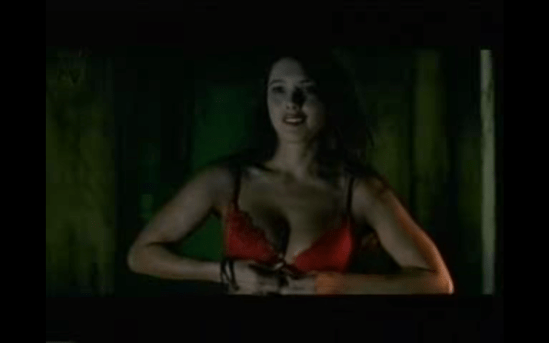
Richard, a wealthy businessman, and Jen, his young, candy arm mistress, helicopter in onto Richard’s desert retreat house. While his wife and children are at home, Richard plans to spend his time away relishing a pleasurable weekend that involves relaxing by the outdoor firepit, swimming in the infinity pool, being sultry with Jen, and do a bit of hunting along the mountains, canyons, and riverbeds. When Richard’s associates, Stan and Dimitri, arrive a day early, a party filled night rapidly ensues, but events turn sour when Jen is brutally attacked the next day and Richard plans to snuff out the scandal before it unravels to ruin him. Unwilling to cooperate with a coverup, Jen is nearly murdered by her three attackers only to arise like the rebirth of the Phoenix, igniting a vengeful fire inside her as she uses everything she has at her disposal to finish what they started.

In a day and age when the slightest bit of a woman’s attention can explode into a vile reaction of testosterone warped misguidance and it’s the woman who is shamed as the accosted criminal being barked at aggressively by the unequivocal fearful and condemning voices of the male species, it’s movies like Coralie Fargeat’s action-packed “Revenge” that symbolizes woman’s resiliencies against men’s efforts in a show of violent force that’s “First Blood” without John Rambo, but rather with a scorned princess for retributive capital justice. “Revenge” is the French filmmaker’s first full-length penned and directed feature film that’s one gritty and bloody grindhouse vindictive sonovabitch, a pure punch to the throat, and a direct message to misogyny everywhere. Filmed in the Morocco desert during Winter, the small cast is swallowed by the vastly arid landscape of transfixing cruelty, a synonymous parallel to the feat the heroine Jen is drawn to task. It’s also a feat that Fargeat managed to salvage to finally release a rape-revenge thriller backed by a conglomerate of production firms and financiers to stand with a film from a first time director whose treatment offers up maltreatment of women, such as the rape, along with the savagery, the concept of revenge, and ridiculous amounts of blood. M.E.S. Productions, Monkey Pack Films, Charades, Logical Pictures, Nextas Factory and Umedia are just to name a few of the production companies to be supporting capital.

With a role embodying the symbolic brutalization of physical and mental rape, a role of complete loneliness in a fatal skirmish against their attackers, and in a role forsaken in the face of death only to be reborn from the ashes of their former self, Matilda Lutz’s fully charged capacity to tackle such a demanding performance is beyond praiseworthy, scrapping the timid traits from Jen’s ravaged glossy persona and replacing with a rigid exterior ready and willing to combat to the death. The Italian born Lutz has to go through a metamorphosis and refashion Jen to be able to differentiate from her more bubbly first half self as the easy kill or the disposable male plaything. In a twisted turn of events, Jen’s mortal adversaries have every advantage to douse out Jen’s existence: gear, guns, vehicles, clothes, water, fuel, numbers, etc. Yet, despite all the advantages, the desert, much like Jen, is unforgiving as it is bare. Richard (Kevin Janssens), Stan (Vincent Colombe), and Guillaume Bouchede (Dimitri) exude the utmost confidence their grip around Jen’s throat. Janssens’ fortifies as the rigorous cutthroat, a misogynistic philanderer, determined to save his own skin no matter the cost while Colombe’s Stan is a retracting coward with regretful impulses. Colombe’s brings the comedy to a grimly tale and positions Stan to be the teetering villain tarnished by his guilt of nearly killing Jen, but never apologizes to being the catalytic rapist that initiates the whole debacle. Bouchede supplements with his divestment to charm as the overweight, do-nothing witness to save Jen from Stan’s seizing urges. As Dimitri, Bouchede stalls his typical niceties to be the silent violator who can open up the flood gates of aggression when transgression warrants it.

“Revenge” has an ultra-violent and super-synth finish chapping with multiple motifs of a rebirth theme and supplies a hefty bloodletting of incorporeal measures. Knocking it out of the park in her first feature film, Fargeat’s cauterizes the unnerving serious tone with alleviated black comedy of the bloodiest kind. The roundabout endgame chase comes to mind, involving a frazzled Jen and a wounded, but indomitable Richard in a merry-go-round of a shotgun standoff is some of the best editing work of fast and ferocious content I’ve seen in some time while still able to vitalize a transparent sense of what’s occurring. However, not all the slick editing is flawless. Some minor inconsistencies in the editing are noticeable and while these moments of lapse are not detrimental or pivotal to the story, they reflect Fargeat’s challenges of making a hyper-stylized action-thriller in her freshman full-length feature. In a sense, everything Fargeat’s deploys positions “Revenge” into a surreal tonality, glamorized for those thirsty for blood gushing in a canyon-vast desert bristled with rape and payback where a mere four players in this ebb and flow game of killer combat chess can effortlessly locate each other, but one can always find their prey by following their blood trail, another motif that continues to pop up that speaks metaphors of their life blood is the very object gives them away in the end.

Giving the limited edition treatment that it deserves, Second Sight Films’s Blu-ray release of “Revenge” is a mouthwatering narcotic of raging cathexis and while the Blu-ray BD-R can’t be technically critiqued, the LE release offers HD 1080p transfer of the original, 2.39:1 aspect ratio and sports an English language DTS-HD Master Audio 5.1 mix. While Fargeat might be inspired by Lynchian themes, the cinematography work by Robrecht Heyvaert also resembles “Pitch Black” director David Twohy’s films with making something small larger than life and a particular chase scene involving all four characters at the edge of a canyon stroke a familiar chord with Twohy’s “A Perfect Getaway.” There were Second Sight Films’ exclusive bonus features included on the disc, featuring new interviews with director Carolie Fargeat and star Matilda Lutz (entitled “Out for Blood”) an interview with Dimitri actor Guillaume Bouchede (entitled “The Coward”), a interview with Robrecht Heyvaert (entitled “Fairy Tale Violence”), a new interview with composer Robin Coudert and the synth sounds of “Revenge,” and a new audio commentary by Kat Ellinger, author and editor of Diabolique. The release is sheathed inside a rigid slipcase featuring new artwork by Adam Stothard as well as a poster and a new soft cover book with new writings by Mary Beth McAndrews and Elena Lazic Overall, “Revenge” received a monster packaged release ready for the taking on May 11th. “Revenge” destroys toxic masculinity and breathes a vindictive hope from the fiery embers of rebirth and destruction.
EVIL is a Slice of Deep Dish Hell in “Creepy Tales of Pizza and Gore” reviewed! (Bayview Entertainment / Screener)

Pizza, that delicious concoction of bread, marinara, cheese, and your topping of choice kneaded and pieced together in a gooey circular of staple culinary awesomeness, has somehow found its way baked into an Italian-sans-meatball horror anthology that promises an equally saucy taste of crusted blood red gore. Five varied, harried tales of horror molded into a gruesome and terrifying VHS-style that will send chills down your spine as you swallow your first piping hot bite of pizza will either have you hungry for more or hurling out your pepperonis. These tales of macabre include the cursed audio tracks of a deadly screaming ghost, the grisly torture and murder in the name of Satan, the tragic and supernatural deaths of two ill-fated lovers, a wooded creature stalking stranded motorists, and a VHS tape that seeks revenge on its former, ungrateful owner.

Let’s take our time traveling machine back to 2014 where Italian filmmaker, Lorenzo Fassina, releases his second feature directorial film behind the horror-comedy, “Anamnesi Mutante,” transmitting by way of a five tale anthology humorously entitled “Creepy Tales of Pizza and Gore;” the titles of the shorts are “Screaming Ghost,” “Devil of the Night,” “Alone in the House,” “Wood,” and “Killer Tape.” Co-directed with producer Marco Giangiarelli, The Milan born Fassina’s background also includes being a director of a collection of short films and music videos for bands that include Italian metal bands Cripple Bastards and Viscera///, similar music scores the anthology. The eclectic tales that greatly homage horror of the 80’s that include rich in color film titles and poignant atmosphere audio mixes, each have a runtime average of approx. 10 minutes long, and offer a mixed macabre of subgenre goodness from technological horror to inanimate object horror besieged with an interlacing host, a faceless, demon-like presenter with much to say, much like the Crypt Keeper. My apologies in advance as the screener that was provided didn’t have subtitles so the host’s soliloquy goes mostly misunderstood, but by the way of editing and how the syntax is structured, one would assume the ghoulish emcee sets up the pizza eaters with the next short video nasty. “Creepy Tales of Pizza and Gore” is produced by Fassina’s indie company, DirtyTape.

Most of us in the States more than likely won’t find any familiar faces inside the confines of these five tales and, know what? That’s okay! Aside from our hell bound host, there’s not a lick of dialogue spoken, but the capability to connect with the characters and the capacity to understand the story without words is as transparent as crystal clear waters of the Venice canals. An assemble of facial and eye expressions and a well edited together script and structure by Fassina for each short provides a sustainable and a sufficient menacing mixed bag of mouthwatering horror. The largely novice cast has either worked on previous projects with Fassina before or are an unknown delight to us viewers and cast list includes Sara Antonicelli, Beatrice Cartoni, Jonathan Farlotta, Jacopo Grandi, Francesco Marra, Tommaso Meledina, Alessandro Melito, Riccardo Tiberi, and Bunny Roberts with a cherry on top topless scene for good measure.

I’m not a terribly big fan of anthologies. Yes, I enjoy “Creepshow 2,” like every other horror fanatic smuck, and I do revel in the grave zest of the low-budget spectrum, especially with compilations from directors of the “HI-8”, aka “Horror Independent 8,” that featured the bloodbath films of some 80s/90’s SOV prodigies in Ron Bonk, Donald Farmer, Tim Ritter, and Marcus Koch, but most anthologies find their unsuccessful way right toward the trash bin, condensed to third-rate releases with little-to-no marketing and hardly any surplus material in the special feature department. “Creepy Tales of Pizza and Gore” may be a foreign anthology barely making an insignificant speck in the cinema market, but certainly shouldn’t be overlooked as the derived golden age of an immensely beloved straight-to-VHS horror courses through the veins of Fassina’s reverencing anthology. The stories garnish b-reel content, but not necessarily effortless or incompetent in substance and range from serious, to tongue-in-cheek, and out right absurdity, with the latter stories being the weaker links. In all, it’s a fun and entertainment horror show from our Italian friends.

“Creepy Tales of Pizza and Gore is delivered fresh and blood warm onto DVD home video courtesy of the New Jersey based distributor, Bayview Entertainment. As aforementioned, Bayview Entertainment publicity provided a streaming screening link so the audio and video aspects will not be critique for this review, but the DVD specs include a single disc, Anamorphic widescreen presentation, with an unrated rating on an Italian language anthology that, supposedly, has English subtitles – my screener did not have subtitles. Bayview Entertainment’s DVD casing resembles entirely like a VHS-cassette with faux movie rental stickers stuck on the outer plastic. The packaging is a nice and warranted touch to a VHS-homaging anthology. There were no special features included with the screener or released in the press release. Chow down on night with “Creepy Tales of Pizza and Gore;” a validating horror anthology worthy of time and effort and reaffirming the faith in anthologies once again with wild, imaginative macabre ambitions without the stiffening efforts of pushy financiers calling behind-the-wheel shots.
Vampire + Psychopath = Evil in “Blood Widow” reviewed! (Indican Pictures / Screener)

A serial killer with severe mother and father issues stabs to death beautiful young women in urban Arizona. Two detectives are hot on his trail, but when they begin to find his victims with nonidentical wound patterns, including bite marks on their necks, the detectives are thrown into a loop of ancient supernatural proportions. Another pair of seekers, vampires whom have lived for centuries, track down the same serial killer for one very specific reason – his blood. The blood is a certain and rare hemoglobin type needed to resuscitate their dying breed, but with the killer’s instability rendering him volatile and dangerous, turning him into one of the powerful undead becomes risky business for humans and vampires alike.

With the backdrop of the city of Tucson, Arizona comes an off plumb detective-crime thriller smack dab in the middle of a vampiric rebirthing with Brendan Guy Murphy’s unconventional modern vampire tale, “Blood Widow.” Directed by Murphy and co-written by Dominic Ross (who had a main role in the Ron Jeremy starring’s “Blood Moon Rising,” “Blood Widow,” which is also known as “Viuda de Sangre,” is Murphy’s first venture into full length feature films. The veteran actor has starred in such films such as “The Minstrel Killer” and the unbeknownst to all, 2012 follow up to Dennis Hopper’s “Easy Rider,” “Easy Rider 2: The Ride Home,” but to his directorial credits, only a couple of short films are listed, testing Murphy’s hand at the proverbial helm of a multi-branched story with hard-nosed detectives, deranged killers, and a desperate vampire faction. “Blood Widow” is a production of Brendan Guy Murphy’s Tucson based production company, MurphySpeaking Films.

Murphy steps into the villainous shoes of Keller, the disturbed serial killer with mommy and daddy issues who remains elusive from two of Arizona’s finest detectives, played by James Craven, who has been virtually cinematically silent since the early 2000’s, and Dallas Thomas. Keller troubling backstory is briefly visual in the aftermath of his rage resulting in his terribly abusive and estranged parents. Murphy and Ross poorly incorporate the effects of Keller’s horrendous maltreatment into his transformed character; a battering character flaw untapped for persona turmoil that ultimately subsides to Keller’s newfound powers that give him nearly unstoppable bloodthirst and debauchery. Craven’s detective Valentine and the original vampire duo, Lilith (debut performance by Melissa Aguirre Fernandez) and Slight (Hector Ayala), also suffered from feebly storylines that involves a cocktail of Craven’s alcoholism and on-the-job trauma and Lilith and Slight’s early 20th century bond during the violent prejudicial times of vampire inquisitions in New Mexico. Each backstory is only merely, and half-heartedly, touched upon to give just a morsel of the full character that can never entirely arc to either redemption and falter. Aside from that, performances all around are solid enough to be enthusiastic charged. James Craven is chin deep into being a defiant detective with an obsession for capturing a killer who has become an elusive and terrifying figment of subconscious stress and haunting visions. Audiences can, again only briefly, be pulled into detective Valentine’s grim existence, provided by Craven’s unsullied efforts. Cisiany Oliver (“Jessicka Rabid”) and Abdul Salaam El Razzac (“Terminator 2: Judgement Day”) co-star.

I keep returning to the title, over and over again, puzzled in trying to explain or articulate why the film is titled as “Blood Widow.” Nothing apparent and explicit comes to the presentation forefront or to the bio-gears of my mind that would make the first instance of vampire activity with Lilith, I assume, a widow. Lilith’s brief backstory confides no pain of loss or grief and the little evidence that supports the possible catalyst front might have inkling hints at her sexual orientation, a prejudice witch hunt which would result in bearing bereavement, even if it’s 80+ years strong. Lilith has an arbitrary flashback that exhibits the brutal staking of another woman in her group of suspected vampires in broad daylight, one of the select unconventional vampire motifs revamped for “Blood Widow,” and though Lilith and the rest in her group were denying every aspect of the claim, their elongated fangs were in clear view and didn’t necessarily assist in their defense. The slain woman could have been a possible lover perhaps, paralleling a symbolic labeled perversion of lesbianism, but the fact that all suspects were women is the only clue toward that theory. Again, this is all objective and circumstantial on my part, but I can’t pinpoint another reason for such a title. Lack of connection comes to be a reoccurring theme in “Blood Widow” that fails to materialize more contextual value toward the scenes, titles, and characters for beneficial storytelling and less inscrutable acts.

Ultimate power is laced in the blood, but what if that power is used for evil? That’s what the Indican Pictures’s distributed “Blood Widow” sinks it’s teeth into with a digital platform release and the promise of a DVD home video release soon again. Unfortunately, I was provided with a DVD-R screener, so the video and audio technical aspects will not be critiqued for this review, but the dialogue audio mix is in English and Spanish with English subtitles. Some bonus features were included, such as outtakes and the trailer. “Blood Widow” has a premise of a promising, independent contemporary vampire hook, but without enriching mythos and some sort of connective coherency, “Blood Widow” wobbles through the approach to an unsatisfactory finale.
When Life Hands You EVIL, You Make EVIL-ade! “American Zombeland” reviewed! (ITN Distribution / DVD)

In Corsicana, Texas, Sam’s a zero-budget horror filmmaker whose trying to make it big in Hollywood, submitting every garbage zombie movie he can muster. When he receives a letter back from a film festival, he immediately calls for a party with all his friends and family in attendance, but the letter is actually a rejection letter, proving once again, that Sam’s still a filmmaking loser. In a stroke of turnaround events, an actual zombie apocalypse breaks out and the undead are knocking at his door. Jumping at the opportunity of top-notch, free special effects and a horde of zombie “actors,” Sam delegates his friends as the production crew, going out into a zombie infested Corsicana, Texas to shoot his legacy, non-Hollywood zombie epic.

If there was ever an American political and cultural lampooning zombie film, “American Zombieland” is it. Originally titled “Fat Ass Zombies,” the George Bennett written and directed horror-comedy nixes the original title, albeit keeping the rubric for Sam’s movie, and seemingly goes hot off the coattails of the Woody Harrelson and Jesse Eisenberg crowd-pleasing and long awaited sequel, “Zombieland 2: Double Tap.” As Bennett’s freshman directorial, he co-writes the feature with Christopher De Maria and Brave Matthews that’s has little to do with the loveably gory Ruben Fleischer riot. Instead, “American Zombieland” is a none-politically correct satirical farce that’s sticking a hard poker at red state, gun-toting conservatives and the morbidly obese American subsociety lifestyle, sporting the red, white, and blue as if being patriotically proud being 300+ pounds. Brother and sister, George and Karina Bennett, co-founded company, MagicBullet Media, and Summertown productions fund and serve as the production company.

As a running joke, the story continues to deface one of Sam’s zero-budget films, “Dead Beat Zombie Dad.” In reality, “Dead Beat Zombie Dad” is a zero-dollar budget short comedy by David Slayter who wore multiple hats in the cast and crew of “American Zombie” and was not, in fact, a film directed by MagicBullett Media executive product and lead actor of the film, Dave Mussen in his first horror-comedy performance as the downtrodden, piss-poor director Sam. Mussen’s resembles the average joe; he bares no chisel chin, he’s balding, and does a good enough job being a mediocre individual so pretending a hectored filmmaker for his obscene and schlocky small horror ventures didn’t perceive challenging. One of the more memorable characters is the flagrantly perverse, yet harmless Poppers, played by FX’s “The Bridge’s” Johnny Dowers. Dowers dons a Joe Exotic-like green dyed hairstyle, handlebar mustache, and a slippery slope into unfashionable redneck garb with a more than less-Tiger King pizazz. Dowers steals much of Dave Mussen’s scenes as an unforgettable caricature a grease monkey yokel. On the opposite spectrum is A.D. Johnson as Horatio, a tragic character not exactly from the same vain as William Shakespeare’s Hamlet, but deride a proper Englishman’s snide accent to be the ever condescending and stanch critic of Sam’s projects. “American Zombieland” cast and extras are vast, including Kristen Renton (“Xenophobia”), Samantha Walker (“Ghost Story Chronicles”), Bryan Handy, Stephen Archer, Sondra Currie, and Benjamin Chamberlain.

George Bennett and crew attempt a horror-comedy aimed at desensitizing and making light of beliefs and lifestyles. What results is a crude, rude, and painfully stale fly by the seem of the pants zombie ruckus on an average entertainment scale that relies heavily on poop and fart jokes, missing the mark of sarcastic repartee targeting misrepresentative patriotism embodied by big corps, big bodies, and big racism. “American Zombieland” ultimately is a big mess of a narrative with characters coming and going without a visual diagram, segues are muddled beyond the power of understanding, and, again, the ill-approached poop and fart jokes. “American Zombieland” is also a big F.U. to the uppity and disheartening inner workings of Hollywood and, in my opinion, this is where Bennett and “American Zombieland” excels, casting caution to the wind with an unorthodox, zomedy to be frank as possible and not really giving a care of what others think – my self more than likely included. Not everything in the film is unfunny or uninteresting, such as with a pothead’s vivid visual quest of an animated interjection of seemingly random bits of American identifiers, consumerism, and, again, poop and fart jokes; a scene that reminded me of the dessert hallucination/Rob Zombie music video segment from “Beavis and Butt-head Do America.”

“American Zombieland” is the anti-Hollywood, independent zombie-comedy brought to DVD home video by ITN Distribution and Millcreek Entertainment. The DVD is presented in an anamorphic widescreen 1.78:1 aspect ratio, and features a steady natural lighting for much of the 1 hour and 28 minute runtime, not focusing on creative mattes or visual tweaks to up the ante. There are some impressively seamless drone ariel shots that exhibit little lag from the compression. Amongst a lot of the foreground focusing, skin tones look correct despite a minor softness in the detail and the night scenes are balanced out properly. Lastly, the visual effects are above par quality, the ariel shots of smoke and fire coming out of houses, the lawnmower death, and other visual sfx renders out nicely. The English Dolby Digital dual channel audio output has limitations, especially for a zombie film that powers it’s fear by the moans of the undead, but for what it is, the audiophiles are better than expected with a robust two channel mix. Dialogue is clear, soundtrack has range, and ambience is a bit overzealous…again, with the poop and fart jokes. Bonus features only include the trailer. Scatterbrained undead folly, “American Zombieland” is a rash whack of cultural farce without literally scattering brains, falling short of the intended meaning, and becoming tousled in it’s own jumbled message.
EVIL Choo-Choo Choses You! “Infernum” reviewed! (Indican Pictures / Screener)

When Camille’s parents awake to an unknown and encompassing rumbling and what sounds like agonized wailing, they decide to go investigate not too far from their camping tent where their daughter, Camille, still sleeps. When Camille awakes, the rumbling is now deafening and her parents have disappeared into the night, leaving the young child frightened beyond belief. 25 years later and still haunted by the phenomena, art post-graduate Camille conducts recorded interviews with witnesses of the event along with James, a film studies student working on a documentary project. When the rumbling returns in the Nevada desert, Camille and James take a train to record research just outside the affected area and not become too close to the dangers that’s traumatized Camille, but when the train stalls in a tunnel halfway to the destination, Camille and James awake alone with no passengers or conductors in sight and a rumbling noise that isn’t the train’s engine. Camille finds herself once again in the midst of wailing and now something outside the train is trying to get in.

Stick “Infernum” into the sub-horror category of the great and fear-inducing unknown perhaps based loosely off the unexplained low-frequency hums, such as a Taos hum, stretching from the U.S. to the U.K., writer-director Dutch Marich sensationalizes the phenomena by adding the trimmings of tortured souls howling in torment as a rift opens up between Camille’s world and, supposed, Hell. Filmed primarily inside an antique rail train from the Northern Nevada Railway Museum and inside the railway tunnel west of Ely, Nevada, the “Hunting” and “Miserable Sinners” filmmaker, Marich, slow churns a low-budget friendly and simple plot into a materializing worst case scenario with the anxiety-riddle markings of being trapped, surrounded, and alone inside a dark and confined space with a cacophony of screams, as if in a dark-padded psychiatric cell. Mariach’s Luminol Entertainment and Vekinis Studios, headed by former Luminol Entertainment employee, Peter Panagiotis Vekinis, collaborate on the project.

Playing the traumatized Camille is “American Mummy” and “Dude Bro Party Massacre III” b-movie actress, Suziey Block, who has to not only struggle with coping against the hauntingly strange event plaguing her past, but also deal with an overprotective, yet also apathetic boyfriend in a role filled by who could very well be a young Christopher Meloni lookalike, “Happy Camp’s” Michael Barbuto. Block’s become something of a scream queen over the last few years and “Infernum” continues to make the Michigan born actress keep screaming her lungs out; however, its Camille and Hunter’s hot-and-cold relationship that topples the main theme here as Camille, through Block’s insensate performance, feels disinterested in unearthing what happened to her parents while being too engaged in Hunter’s desensitize, if not rightly justified, position toward her glazed over stress, but Block is engrossed by the fear just enough to sell it. Rounding out Infernum’s cast is Clinton Roper Elledge, Sarah Schoofs (“The Theatre of Terror”), and Rita Habermann.

“Infernum” can feel like a simmering slow burn of paranormal byproduct and resonates closely with Milla Jovovich’s extraterrestrial faux found footage thriller, “The 4th Kind.” The lingering scenes with tedious exchanges render a remote sense of terror that’s teamed with more tension from Hunter and Camille’s argumentative discourse. Yet, when things seem to be dwindling as Camille and her filmography friend, James, board the vintage train to the ghost town of Kimberly (and when I say ghost town, I mean an abandoned mining area), that’s when things go from a steadfast numb to a terrifying turn of the inexplicable circumstance kind. Camille finds herself in a familiar situation like 25 years ago, but the environments different with desolate train, an ominous presence over the loudspeaker, and though most passengers have disappeared, there are some who are found, blue as ice in the face, and lifeless. The tension is thick with the engine rumbling of an infernal-sounding machine that reeks havoc with cries and screams to amplify night jitters. The open ending leaves room for a wide berth of possibilities and interpretation, making “Infernum” metaphysically loiter in between the rifts of our minds.

“Infernum” is a spooky train ride to hell and back, pulling into the DVD home video and digital platform station from the independent film distributors, Indican Pictures. Unfortunately, the video and audio quality will not be covered because of the DVD-R screener, but I can say that the LFE audiophiles are immensely characteristic and behooves viewers to play on a surround sound system or quality headphones will also do the trick. The film’s innate hues are on the bleaker, gloomier side, backdropped by the frigid air of a wintery Nevada dessert. Other than Indican Pictures’ trailers for other films, including “The Lurker” among other films, there were no other special features beyond a static menu. I highly recommend “Infernum’s” spooky vibe and unlimited possibilities all aboard it’s simple, yet effective paranormal premise.