X-rated Adult EVIL Without Any Calling Cards. “Man at the Door” reviewed! (Impulse Pictures / DVD)

X-rated and Exploitational “Man at the Door” on DVD!

Virtuous Anne arrives home after a stretch of day shopping and answers the ringing phone.  On the other line is her more uninhibited sister Jill telling Anne she’ll be working late, undeclaring her naked reverse cowgirl position on top of her equally naked boss’s lap.  Immediately after, Anne receives a phone call asking if Jill or if Anne’s roommate is home.  The stranger quickly hangs up soon after Anne admits their absence.  A following knock at the front door opens to Anne meeting a tall man claiming to be her roommate’s date.  Skeptical, Anne is at first hesitant about letting him inside until he forces his way in, ties her up, and molests her half-naked body before stealing her virginity with one thrust before the opening of the front door and an Anne’s unsuspecting roommate encounters the brute, but she takes his aggressive perversion in stride, eager to partake into his sexual tyranny, and finally able to bed the sweet and innocent Anne after long-lusting after her.  When promiscuous sister Jill arrives, more-the-merry for the horny home invader.

As far as time encapsulated sleaze goes, the 1976 sin-street stag film and home invasion obscener “Man at the Door” is about as obscure and odd as it’s chaste title.  Yet, there’s not a lick of chaste about the beyond-the-canoodle content of X-rated exploitation and the only licking happening here is with the scores of cunnilingus with every new starlet entering from stage left.  The lower-rung adult film has plenty of action in the simplistic of narratives but much of this a film by John Ruyter production is left unknown to the universe with no identifying credits to properly give recognition for the cast’s improper behaviors, with the crew’s dedication to stagnancy yet consistent and staid presentation, and with the sordid studio behind what was likely an obvious low-budgeted blue movie featured only in the darkest, dankest, and stickiest cornered cinemas on the infamous 42nd Street for a measly buck-fifty to get your rocks off.

Where to start with the cast?  I couldn’t even tell you.  The three satisfying starlets, unpretentious with their set dress but heady in their roles, come under the thrusting hips of a two pedestrian, stud-less joes lucky enough to engage coitally with the fairer sex.  Out of the two male performers, the titular “Man at the Door” character could pass for a less-intimidating and skeezier Edmund Kemper in a wet-blanket flesh suit looking like a former military analyst fired for his inability to hack it and tried his luck at philistine porn.  Perhaps my attitude to the casted intruder is a bit harsh, unfair, and hypercritical of some historical schlub with average measurements and downgraded fanfare – I don’t even know the guy or even his name – but my sixth sense knows the type and his type fits the bill to a T, a balding, mid-to-late 30s, man whose onscreen personality is about as dry as an overtoasted piece of stale day-old bread.  However, with much of the triple-X industry, men don’t sell product, women do.  The three ladies gracing the screen outperform above expectations after scanning the undervalue pinning synopsis with their distinct, amongst themselves beauty, able to individualize their roles, and entice with their own energies to make a synergy-coupling during the girl-on-girl scenes.  One blonde and two brunettes even liven up the boy-girl scenes against dull male talent who’s supposed to be knife-wielding sex fiend, but the women wear that personality down, grinding it to a halt as they grind on against each other.  I apologize in the lack of cast detail for this mysterious sleaze, but the DVD also mentions the lack of credits and there’s nothing on the web to match against it, not even doing image search on the actors’ faces and so we’re left with nameless sensualists of the mid-70’s sex scene.

When reviewing porn, especially from the New Hollywood era of the 70s, I always have to remind myself substance and story are going to take a backseat to skin and sex.  That is what’s laid out in “Man at the Door,” a rudimentary home intruder gimmick to extract the ethical-swathed deviancy deep inside us with sexual assault, uninhibited perversions, and even a humiliation peeing scene for those urophilia fanatics who get off on distressed whizzing.  Humdrum performances from a rather unflattering and uncharismatic male lead fashions little enthusiasm and in atypical swanky retro-porn flair, expositional statements, such as Now I’m going to fuck you both, said in perfunctory banality that it takes the story’s wind out of the sails.  Though production studio is unidentified, “Man at the Door” has blueprint echoes of an Avon assembly that prominently reeled in profit by paraphilia with fetishisms and rough-sexual-play shot on 16mm that feels very similar to this John Rutyer film.  Perhaps, John Rutyer was another of Phil Prince’s pseudonyms and “Man at the door” was his trial-by-fire initiation into the Avon Dynasty.  We can’t prove but we do love to speculate!  Avon’s skeletal productions undress the glam of fantasy for more feral roughies and “Man at the Door” has, more-or-less, the same façade with a handful of natural, sparse sets, carelessly visited by the boom mic and a few wandering heads into frame, and so this mysterious adult roughie is about as unspectacular as the next, only finding its way into our physical media devices by the pure unadulterated grindhouse gravitational pull and our extreme curiosity for its archaic and, once considered, sub-rosa period compared to what is today an easily accessible porn industry.

If curious like me or have a knack for any and all types of film, “Man at the Door” can be an interesting minor blast from the past and Impulse Pictures, a subsidiary label of Synapse Films, has secured the relatively unknown and unheard of title for DVD distribution.  Presented in a pillar boxed full screen presentation, 1.33:1 aspect ratio,” size of the storage capacity won’t affect your viewing pleasure with every typification of a dog-eared 16mm print to please the grindhouse appreciators.  To be honest, the print is in relatively good shape with faint vertical scratches pretty much from start to finish, plenty of good grain, dust, dirt, and a pinch of blink-and-you’ll-miss-it frame damage.  Grading is on what I believe to a high-key color saturation because of the heavy fill lighting casting clear shadows onto the backwalls and so skin tones can look more orange than natural but for older celluloid, I’m quite pleased with the finished product look.  The audio is an English Dolby Digital 2.0 mono track.  The collapsed audio channeled through more than one speaker doesn’t amplify the weak dialogue track, likely root issued by inferior commercial equipment or bad boom placement.   The track also has plenty of crackle and pop amongst the constant shushing interference that essentially muffles and muddles the already feeble dialogue so you may not understand half of what is being said on what is more than likely barely a script or half a script for a hour-long porn feature.  Forget about depth and range with the limited setting and confined to the actors’ close vicinity.  There’s some hint of swank laced in the soundtrack that’s feels more like looped bossa nova than like rock or funky bubblegum pop.  There are no subtitles available.  Also not extensively available are special features in this barebones disc that has been set with chapters and a sneak peek at Impulse Pictures’ “42nd Street Forever: The Peep Show Collection” preview; however, I do adore Impulse’s new types of crude color-pencil illustrations on the front cover that roughly represents the narrative concept in what is a blend of childish drawn nightmares and erotic art.  Inside the common DVD amaray case is a Synapse Films product catalogue insert and a disc pressed with the same front cover image.  The region 1 locked playback disc is not rated, obviously, and has feature runtime of 60 minutes.  Impulse Pictures has paraded “Man at the Door” more than the film deserves but it’s a fine, old obscure romp film from the porn of yore now on a contemporary format and with odd-neat packaging.

X-rated and Exploitational “Man at the Door” on DVD!

Who Dat? Dat EVIL! “Creature from Black Lake” reviewed! (Synapse / Blu-ray)

“Creature From Black Lake” on Blu-ray is Bigfoot’s Bestfriend

Two University of Chicago students interested in discovering the legendary creature bigfoot take a road trip down to Oil City, Louisiana where there have been multiple reports and sightings of a ape-like man wandering in the Bayou and even an attack on a local trapper, witness by the gruffy drunk, Joe Canton.  Met with stern resistance from the Oil City Sheriff Billy Carter and some reluctance from scared locals in the Bridges family after an mortal encounter with the beast that killed two of their family members, the students dig in and continue their swampy-laden search for bigfoot as well as finding the time to mingle with Louisiana women.  When they discover the mythical beast actually exists, nothing can stop them into catching sight of the creature or maybe even snaring it, not even the Sheriff’s threat of jail time if they don’t high tail it out of town could persuade their mania, but their expedition deep into the swamp and coming in proxmital contact with the aggressive primate outlier may prove to be a fatal mistake rather than a claim to fame. 

Having searched high and low for many years to review just any Bigfoot film that’s above average worthy has been a wearisomely long and arduous task.  A slew of movies dedicated to the big hairy fella have been nothing but a mockery, whether intention or unintentional, of the Sasquatchsploitation horror subgenre.  Instead of being subjugated to the countless, blasphemous modern tales of the mythical monster, I had to travel back in time to 1976 to retrieve what I’ve been searching for in the last decade or so.  The late J.N. Houck Jr’s “Creature from Black Lake” fulfills a great need with very little in its idiosyncratic cast and its obscure visibility of the creature that creates upscale mystery.  The based out of Louisiana “Night of Bloody Horror” and “The Night of the Strangler” director, whose father, owner of The Joy Theaters, already had an established footing not only in the movie business but also in the horror genre when helming a script penned by Jim McCullough Jr. as his first grindhouse treatment blessed by his father, producer Jim McCullough.  McCullough Jr. co-produces the film under the Jim McCullough Productions banner along with William Lewis Ryder Jr. serving as executive producer of the shoot shot on location in Oil City and Shreveport, L.A.

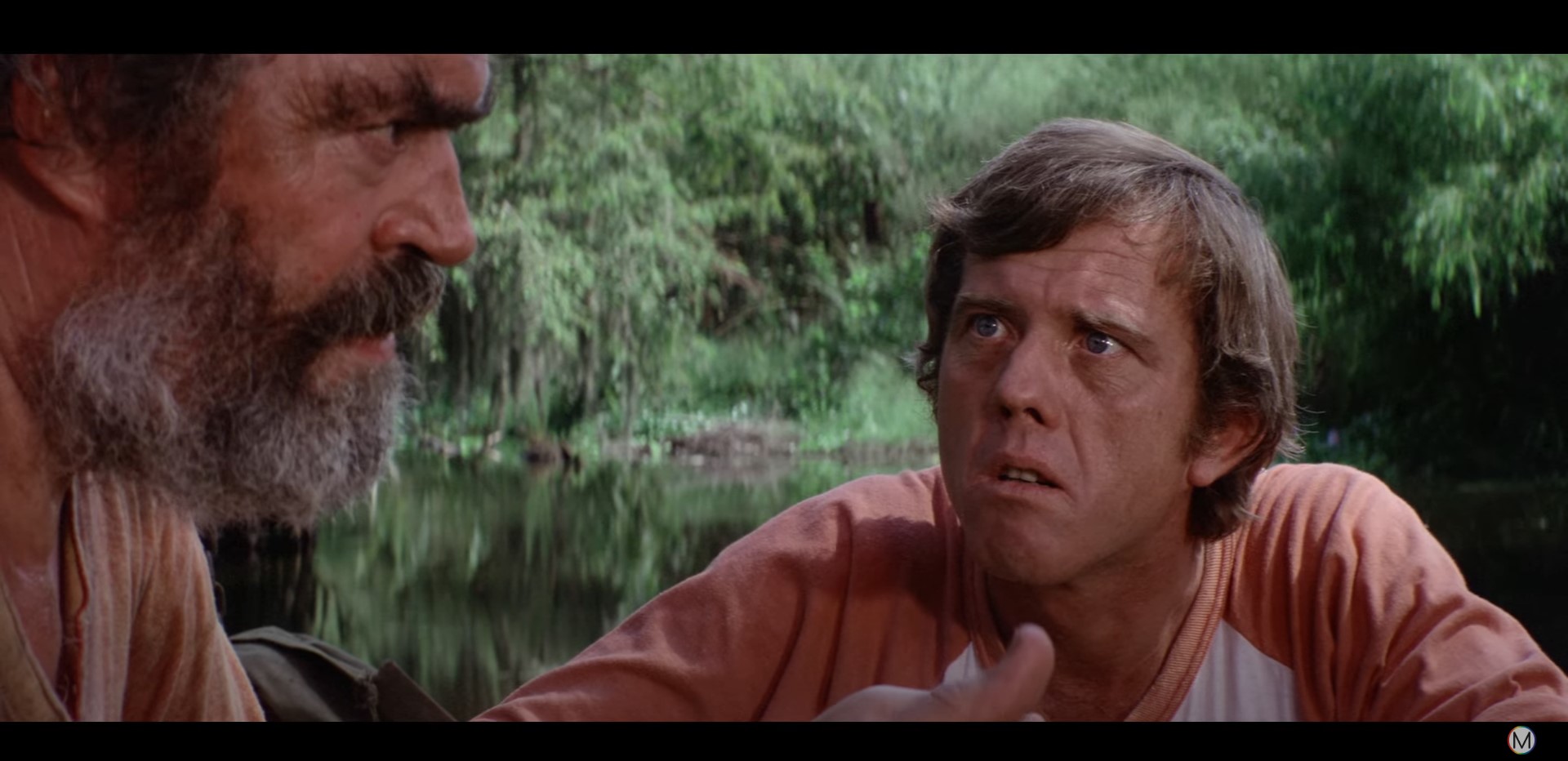
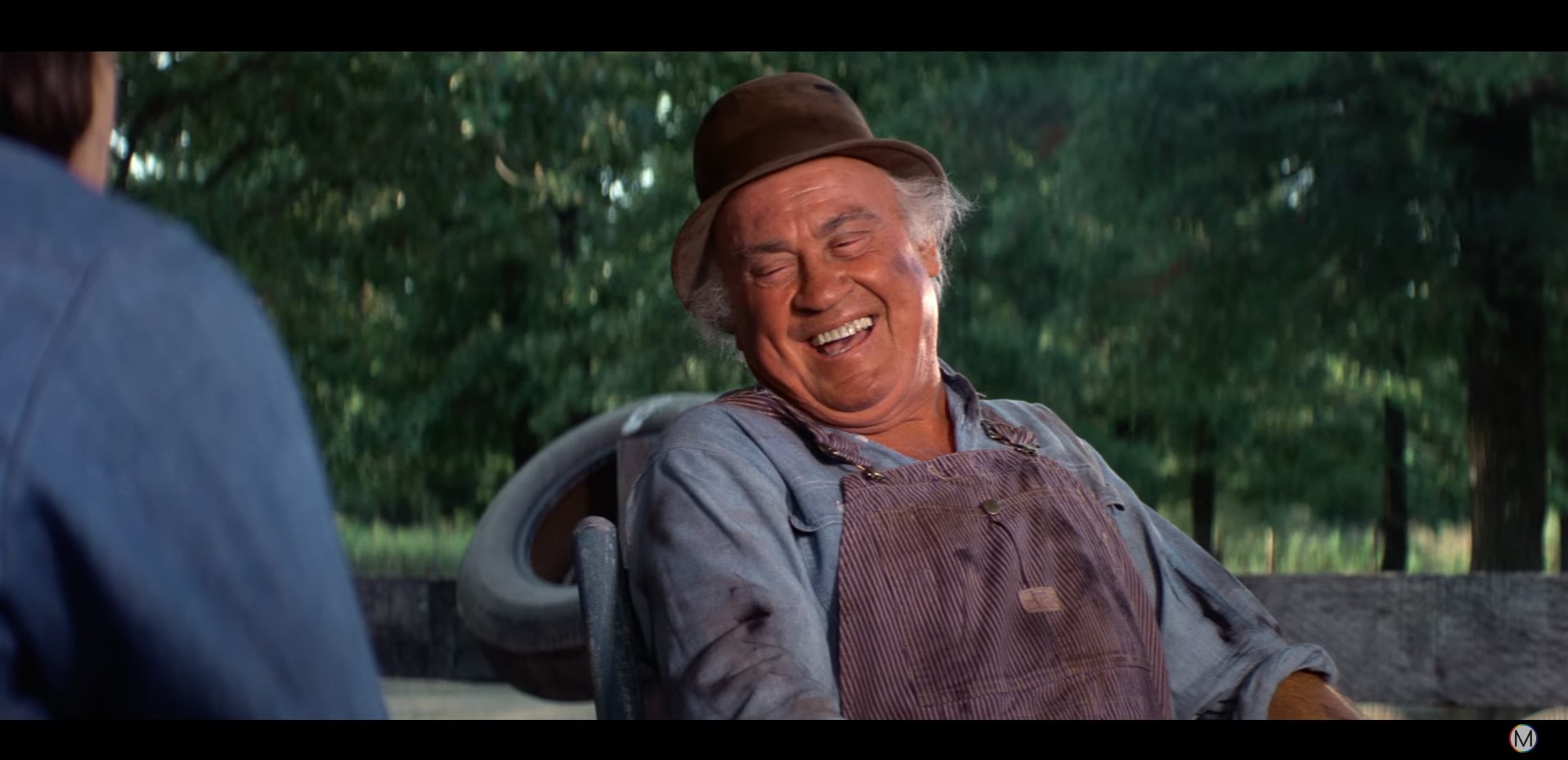
“Creature from Black Lake’s” cast is a distinctive assembly as aforementioned earlier.  Not only do they play their roles well by incorporating localisms where needed but they add a blend of intensity with chunky bits of comedy marbled through a storyline that’s half-anecdotal and half-present action. University of Chicago students Rives (John David Carson, “Empire of the Ants”) and Pahoo (Dennis Fimple, “House of a 1000 Corpses”) set course to Oil City, Louisiana where an indistinct creature is suspected to be in area based of science and suspected fish stories told by local kooks and drunks that turned out to be horribly true. Rives and Pahoo, who in McCullough script is constantly chaffed about his unique name but shrugs and deflects like he’s done it all his life, interview Oil City residents who believed to have bare witnessed firsthand the beast’s atrocities that has taken the lives close to them. These Bayou denizens are enriched by veteran actors with robustly created caricature personalities. Surly voiced with bulging, wild eyes, typecasted western actor Jack Elam had branched out from films like “Gunfight at the O.K. Corral” and “Once Upon a Time in the West” to play a similar grouchy character dwelling in the swamps as a trapper. Elam’s great a feigning an intoxicated mess as you can literally taste the alcohol sweat from his porous skin sheltered by an unkempt beard and a loose fitting crumpled up onesie that’s staple motif for any drunk Cajun or drunk cowpoke, so Elam was fairly comfortable in the role. Dub Taylor is another big old-timey name in the western genre and rarely saw horror as a place to call home. For Taylor, his role as Grandpaw Bridges gave the actor a chance to play an old hayseed complete with a solid effort in Cajun English. Taylor’s lively at times with an animated excitement but can turn somber and stern as soon as his character’s scorned and calls for a more serious tone. Compared to Elam and Taylor, youngsters Carson and Fimple pilfer very little from the veteran’s epic role characteristics but do fine in their own rite with carrying the hunt’s harrowing third act. Bill Thurman (“‘Gator Bait”), Jim McCullough Jr., Cathryn Hartt (“Open House”), Becky Smiser, Michelle Willingham, and Evelyn Hindricks round out “Creature from Black Lake’s” cast.

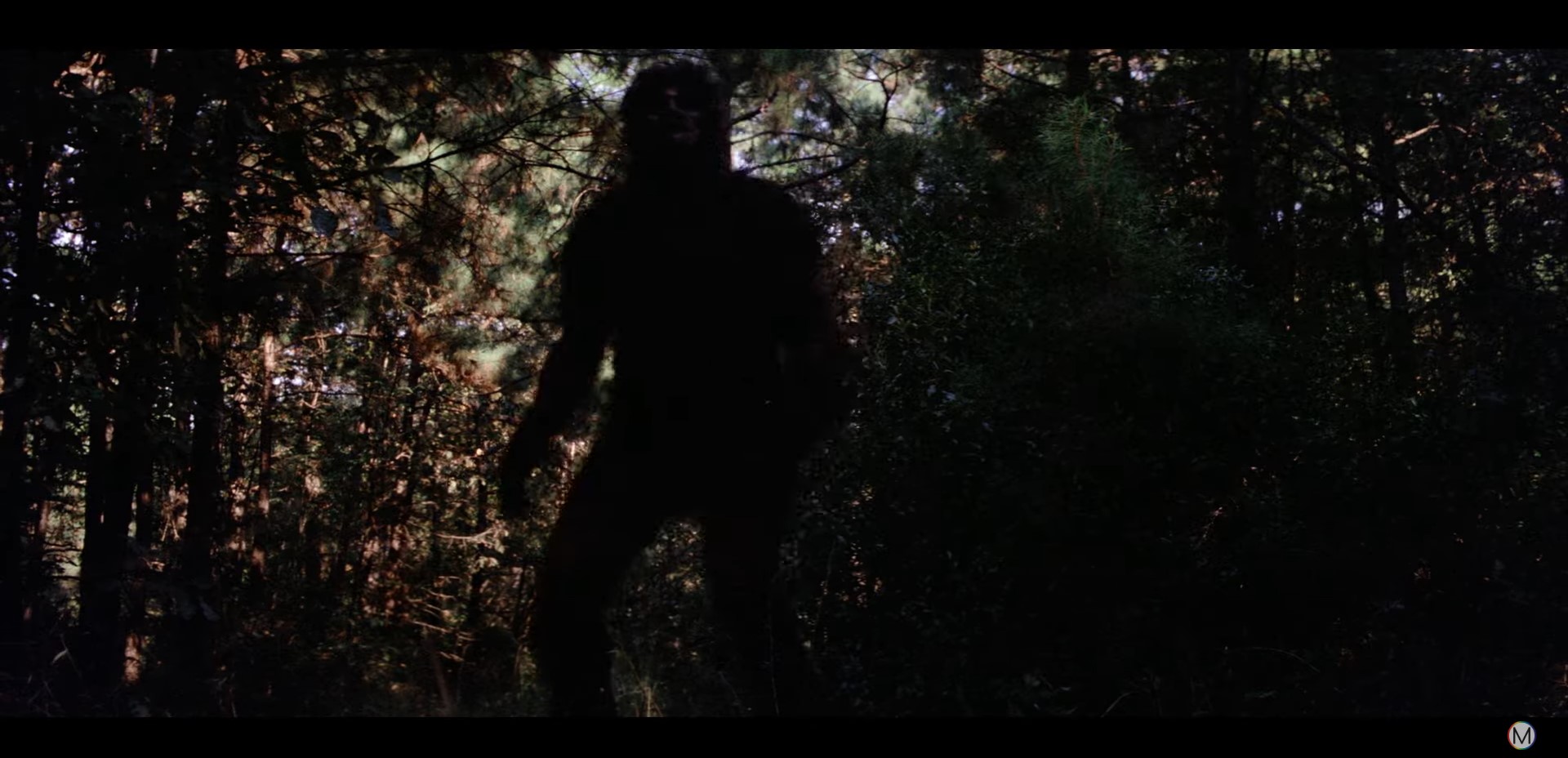
How could a 1976 bigfoot feature be more surprising and compelling than any modernized version? Well, one of the biggest pros to “Creature from Black Lake’s” success is Jim McCullough Jr.’s script that’s surprisingly well written by the first go-around screenwriter and while I’m not primarily speaking on behalf of the principal leads’ motivation or the slightly lack thereof, there lies more interest in the quick-witted dialogue and the blunt banter to keep Rives and Pahoo from being dullards and to keep the story from being a slog. Another aspect that is sharp as a tack is Dean Cundey’s cinematography that keeps the creature firmly in the shadows, producing that suspenseful and mysterious “Jaws” effect where we actually don’t see the shark until the third act. Cundey, best known for handling the cinematography on titles you might have heard of such as “Jurassic Park,” “Death Becomes Her,” and “Big Trouble in Little China,” made a name for himself first in grindhouse horror and exploitation of the early 1970s.  Cundey keeps the apelike creature shrouded from direct light, lurking mostly in the shadows with only a glimmer quickly streaking across the snarling face and an animalistic outline of its furred body and tall stature.  The full effect of bigfoot is never directly in your face or full in view which can be best at times depending on the look of the creature.  Cundey had partially designed the face of bigfoot and thus covering up perhaps his own shoddy work with how to film the titular antagonist of Black Lake.  Now, Black Lake is an actual lake in Louisiana but is about 100 miles SE of Oil City and Shreveport and likely used a combination of Big Lake and Cross Lake that were near the majority of shooting locations to serve as representation of Black Lake.  Where “Creature from Black Lake” struggles is with the Rives and Pahoo dynamic that barely tether’s to how their friendship, though diverse individually, becomes stronger up the end with a near death experience.  Pahoo’s a Vietnam vet and with his wartime experience, he’s the more on edged character out of the two suggesting an underlining PTSD theme when the creature’s roar and circling of the camp puts Pahoo into an eye-widening internal panic.  Rives is cool as a cucumber and is determined to prove something inexplicable in pushing forth and bagging a big hairy beast.  At times, contention flares up between them but is quickly extinguished with a simple sharing of homemade fireside baked beans to sate Pahoo’s ever ravenous stomach.  Their hot and cold amity and indeterminable mission into the Bayou shapes very unsatisfactory their resulting unbreakable bond that hints at something more than just friendship, as if there is metaphorical points of betrayal and forgiveness that makes their connection scar tissue stronger but are not clearly delineated.

Finally!  A bigfoot feature that works mostly at every angle, is more than just palatable from a story standpoint, and has a formidable bigfoot presence that’s more than just a man in a monkey suit. Synapse Films restores not only “Creature from Black Lake’s” original widescreen 2.35:1 aspect ratio onto a high-definition Blu-ray from the dreadfully cropped VHS and TV versions but also restores the creature feature with a brand new 4K scan from the original 35mm camera negative. The result is phenomenal with a widow’s peak view and the grading is touch of tailored class that freshens the 46-year-old with new vigor. No instantaneous signs of compressions issues on the AVC encoded BD50 with inky black shadows and profiles that are sharp around the edges, never losing sight of image and never losing the quality. The Blu-ray comes with only one audio option – DTS-HD Master Audio 2.0 mono track. Not the best representation but perhaps the best that’ll get, some audio elements succumb to the production limitations, such as the stifled dialogue track early on in the film that leaves exchanges between Rives and Pahoo soft and scarcely perceptible. The dialogue issues alleviate as the story progresses, falling in line into an even keeled dual channel output. “Creature from Black Lake” has ample range between the booming closeup shotgun and rifle shots to the light tinkering of utensils and camping gear. We don’t receive much depth, not even with the creature’s roar as it thunders into much of audio space and overtakes everything else. Newly translated English subtitles are available. Bonus features includes an audio commentary with author/filmmaker Michael Gingold and film historian Chris Polliali, a brand-new featurette with cinematographer Dean Cundey Swamp Stories, the original theatrical trailer, and radio spot. The physical release comes in a blacked-out Blu-ray snapper, Synapse Films’ catalogue insert, and has Ralph McQuarrie illustrated cover art that’s an unmistakable masterstroke of his craft. The region free Blu-ray of “Creature from Black Lake” is rated PG and has a runtime of 95 minutes. If you’re on a quest to quench a midnight movie about bigfoot, journey no further as Synapse Films delivers one of the better, more comical and terrifying, Sasquatch movies of our time and in beautiful high definition!

“Creature From Black Lake” on Blu-ray is Bigfoot’s Bestfriend

The Reining Bullies Get the EVIL They Deserve! “Massacre at Central High” reviewed! (Synapse / Blu-ray)

“Massacre at Central High” is Grade A Exploitation!

David just transferred to Central High School, reuniting with his good friend Mark, but Mark is no longer a part of the outcasted crowd at his new high school as he has joined Bruce and his pals to be the apex elite in the school’s lopsided social hierarchy.   Refusing to abide by the relentless and ruthless bullying, attempted rape, and intended bodily harm, David stands up for the oppressed with firm and actionable rebuke.  Bruce and his gang don’t take kindly to David’s opposing behavior and purposefully cripple him to teach him a lesson in disobedience punishment under their sovereign thumb, but what doesn’t kill David makes him a retribution killer as he begins his one-by-one takedown of the disparaging upper-class.  When there are no more bullies left at Central High, the once oppressed turn into the oppressors and it’s up to David to continue the cleanse of megalomanias.   

Now here’s a unique take on the revenge thriller that doesn’t involve the conventional concepts of a slaughter escapade return from being nearly raped to death or to exact revenge for the untimely and heinous murder of a loved one at the hand of sociopathic other.  “Massacre at Central High,” written and directed by the late Netherlands filmmaker Rene Daalder, is the sociopolitical, slashereseque picture from 1976 that is just as parentless and bizarre as it is cold in its exaggerated truth of undiplomatic ways.  Also known as “Sexy Jeans,” the Italian X-rated interposed cut, “Massacre at Central High,“ is Daalder’s second feature behind his 1969 exploitation and organized crime thriller “The White Slave” that tells the story of one man’s righteous crusade turns into a bungled mess with him being intertwined in a scheme to sell unsuspecting young Dutch women into sexual slavery.  Daalder’s sophomore film might not be as controversial, but certainly maintains that provocative and erotica bravado under the otherworldly shadow of an ultra-angsty high school veneer.  Filmed in and mostly around Los Angeles’s Griffith Park that included an abandoned private high school in Burbank, “Massacre at Central High” is produced Harold Sobel (“Very Close Quarters”) with Jerome Bauman serving as executive producer.

Before he was the four-eyed face of the franchise where it was cool to be square in “Revenge of the Nerds,” Robert Carradine landed one of his first principal roles in Daalder’s “Massacre at Central High” as free-lovin’ hippie, Spoony. Though Spoony is an activist idealist and gets two chicks, the half-brother of David Carradine wasn’t in the star lead though he certainly had the presence and the state of mind to withstand it. Instead, Derrel Maury enveloped the role David that seeks vigilante justice to a bunch of entitled school bullies lead by Bruce (Ray Underwood, “Jennifer”) with Craig (Steve Bond, “The Prey”) and Paul (Damon Douglas) being a part of his gang. Maury’s deep eyes and good looks make him a shoe in to be one of the top-predators to join Bruce’s paleoconservative circle and, as David, his personal connection with good friend Mark (Andrew Stevens, “The Terror Within”) who eggs, basically begging and pleading, David continuously to join or face the consequences of Bruce’s wrath. The acting and dynamics between this already complicated group of late teens is basic in its formulaic high school turmoil but also very disturbing on many levels that puts the boys-will-by-boys mantra into a whole new comfortless light. We all know characters like Bruce and his lackeys from High School where guys like him think the student body pledges allegiance to their unofficial rule; Ray Underwood, Steve Bond, and Damon Douglas do a phenomenal job of letting you hate them for who they portray with characters who are not beneath attempting the rape of two female peers in broad daylight and in one of the classrooms. To provide another twist to this tale, Bruce and his gang are not the real antagonists in the story but rather just a part of a bigger, broader discernment that’s infectious as it is dangerous in the realm of political power and hierarchy. Kimberly Beck is the angling love interesting that teeters between good friends Mark and David and “Friday the 13 Part IV: The Final Chapter” actress ultimately doesn’t become the focal purpose to David’s revenge (remember, this isn’t a typical revenge narrative) as Beck more than spurs jealously with her feelings for David as well as become eye candy with gratuitous and beachy full frontal nudie scenes. “Massacre at Central High” rounds out the cast with Steve Sikes (“Horrid”), Tom Logan, Jeffrey Winner, Rainbeaux Smith, Dennis Kort, and Lani O’Grady.

The sociopolitical aspect of “Massacre at Central High” is by far the most compelling with the story’s uncompromising subcomponents of teenage high school perils. The fact that are zero parents introduced into the mix makes Daalder’s narrative that much crisper in its poignancy as these children are left to fend for themselves in like some bizarro version of William Golding “Lord of the Flies” that dives into similar themes such as groupthink mentality, social organizations that reshuffles into a lemming trajectory, and even outlier themes comparing Bruce’s gang to Nazism. Behaviors turn on a dime for the worst and bring out the worst when the opportunity to govern the school affairs leads to an asymmetrical power struggle. Even David, our hero of the story, isn’t immune to the adverse effects of change when pushed beyond reasonable reaction after having his leg crushed and he left maimed by Bruce. To David, this turning point reduces down below differentiating the difference between morality and immorality as he views them as equals to right-the-wrongs and to be a way to level out toward equity for all, a quality that’s been an attribute to David’s pre-murderous existence ever since transferring to the school, but the all-around good guy couldn’t rub off the impartial view of the world to others and so he finds himself in a continuous solo crusade of course correcting. “Massacre of Central High” isn’t as austere as “House of the Flies” as its facade is campy and contrived in an artificial manner. The parentless environment disintegrates principles right at the door in “Massacre of Central High’s” biodome of guttersnipes and that sections off this gem from other exploitation ventures in a must-see good way.

Enroll yourself for September 13th releasing of “Massacre at Central High” on Blu-ray home video from Synapse! The spectacular course offers a region free, AVC encoded BD50 Blu-ray that presents the feature in 1080p at a widescreen 1.78:1 aspect ratio and the take on the director’s approved 35mm remastered presentation is tight, detailed, and utterly clean. Color palette is warm but diverse with a great bit of contrast where needed, such as the nighttime skinny dip and love-makin’ beach scenes. Virtually free of wear and imperfections, the impeccable transfer dodges four and half decades of negative ageing with great delineation to show for it. The original English DTS-HD Master Audio mono soundtrack is the only audio option on this release and is more than adequate with the same clarity as the picture. There’s quite a few, ACME-ish style explosions, a tumbling rocks scene, and spates of variable automobile revs, exhausts, and engines to quench an audiophile’s interest with a broad ambient range. With the original soundtrack comes Tommy Leonetti’s clashing lead melodic and easy listening track “Crossroads” that sticks out like a sore love song thumb in the background of murderous revenge. Newly translated optional English subtitles are available. The bonus material includes an audio commentary by “The Projection Booth” podcaster Mike White interviewing cast members Andrew Stevens, Robert Carradine, Derrel Maury, and Rex Steven Sikes. Also included is an archived audio interview with director Renee Daalder with horror historian Michael Gingold, Hell in the Hallways making of featurette with new recollection interviews from the cast and cinematographer, fellow Netherlands native Bertram van Munster, theatrical trailer, TV, and radio spots, and a still gallery. The film is rated R and has a runtime of 88-minutes. “Massacre at Central High” focuses more on detonation than detention as bodies pile high in this explosive dog-eat-dog hatchetjob of unsupervised minors gone wild.

“Massacre at Central High” is Grade A Exploitation!

The Best Spies Seek Thrills When Taking Down EVIL! “Deathcheaters” reviewed! (Umbrella Entertainment / Blu-ray)

If Anyone Can Hide from the Grim Reaper, It’s the “Deathcheaters” on Blu-ray from Umbrella Entertainment!

Vietnam War brothers-in-arms Steve Hall and Rodney Cann banded together well after the fighting was over and channeled all their pent up energy into being adrenaline junky stuntmen for movies, television series, and commercials as a living and as a lifestyle.  When the two Australians are duped and setup into a high speed chase and a daring rescue mission by one of their country’s own clandestine government agencies in a ploy to test Steve and Rod’s daredevil abilities, they pass the qualifying assessments and are offered an espionage job by agency head under the pseudonym of Mr. Culpepper who has no other incentive to provide other than the job to be the most challenging, death-defying operation to gorge on by two extreme sport enthusiasts.  Unable to resist, the stuntmen embark to a secret base on a remote island of the Philippines where they’ll dodge bullets, explosions, and over 100 guards to fight their way in and out to obtain classified documents for their country.

“Deathcheaters” became the third viewing adventure involving the actor-director combination of stuntman Grant Page and director Brian Trenchard-Smith that falls right in between “The Man from Hong Kong” and “Stunt Rock” and clearly delineates an understanding that Grant Page was a genuine fascination for Trenchard-Smith who sought to take the daring stuntman out of solely stunt role and puree him into a leading man role, showcasing Page’s hang-gliding, dune buggy, and skyscraper falls,  for the director’s second feature film released in 1976.  And, then, there’s John Hargreaves who we will dive into his there-but-not there presence later on. “Deathcheaters” is an ozploitation action-comedy that fulfilled two of Trenchard-Smith’s obsessions – stuntmen and spy films – from a story by the director and penned to script by Michael Cove and is produced by Trenchard productions alongside a conglomerate of production companies, including “Mad Max’s”  Roadshow Entertainment (a subsidiary of Village Roadshow), D.L. Taffner (“Ghost Stories”), Nine Network Australia, and the Australian Film Commission.

Undoubtedly, “Deathcheaters” stars Grant Page as the relationship unattached and cocky Rodney Cann whose only other interest besides bedding the single ladies is his enamored basset hound, Bismark.  Cann’s best friend, Steve Hall, is newly hitched to Julia who more-or-less disapproves of her husband’s risky vocation.  “Long Weekend’s” John Hargreaves plays the cheeky Steve Hall with sarcastic charm, matching his complement stunt partner and while Hargreaves has the chops to pull of the persona, the late Sydney born actor is well behind the curve when matched up with Grant Page.  Page is a stuntman playing a stuntman while Hargreaves is an actor portraying to be a stuntman and, unquestionably, that delta shows pretty radically when Page is driving the dune buggy, is descending rapidly from a tall building, or scaling a rock cliff without a harness and Hargreaves is relatively stationary.  Hargreaves has his moments but is greatly overshadowed by the veteran Page.  Before she was Brian Trenchard-Smith’s wife, “Stunt Rock’s” Margaret Gerard was John Hargreaves on screen romance who is vocal but wishy-washy on her husband’s exploits, even on the highly dangerous, international espionage mission assigned by the enigmatic Mr. Culpepper (Noel Ferrier, “Turkey Shoot”).  “Deathcheaters” round out with Judith Woodroffe, Drew Forsythe, Annie Semler, and Vincent Ball.

“Deathcheasters’ falls on the heels of the martial arts success of “The Man from Hong Kong” and is another stunt celebratory film from the ozploitation director with a penchant for large explosions and need-for-speed car chases.  All the stunts were perfectly poised in design and well executed.  Trenchard-Smith isn’t at all afraid to have the camera right in the middle of the action, strapping the 16mm camera to whatever plausible to place the audience in the action with the heroes.  As much as Trenchard-Smith goes full throttle with a tour de force, the same tricks become a little stale after, unfortunately, having previously watched “Stunt Rock” and “The Man from Hong Kong” that also featured self-set wet-gel fires, hang gliding, free falling, and among others aerobatic and dangerous acts that are seemingly in Page’s limited bag of showstopping routines.  There’s rarely anything new in “Deathcheaters” that warrant an awe response and that can be cliched, tiresome, and overall detrimental to the experience unless you’ve never seen a Trenchard-Smith film. If you’re one of those people never to have popped in one of his films, don’t expect “Deathcheaters” to be gritty, tough-as-nails, spitfire. Many of Trenchard-Smith’s earlier films, including “Deathcheaters,” sells solely on the witty, clean banter and a knack for the implied something really terrible happened to the bad guys with nothing ostentatiously explicit in the demise category. “Deathcheaters” can be wholesome, light, and aromatic of a repartee trashcan, but you get some great stunt work, explosions, and a car chase from this 1970’s Australian picture.

Like “The Man from Hong Kong” and “Stunt Work,” “Deathcheaters” too receives the Ozploitation Classics Blu-ray honor bestowed upon it from Umbrella Entertainment as spine number 10. Newly scanned in high definition 4K for the first time, John Seale’s cinematic vision has never looked better in this region free release, presented in standard widescreen 1.85:1 aspect ratio. The original vault materials held up nice enough to warrant a clear picture with only a few, brief blemishes. The super 16mm shot film, blown up to 35mm, often still feels ever so lightly flat in contour definition and in color; yet all the scenes look naturally aboriginal from the masters. The English language DTS-HD master audio 2.0 mono is a naturally lossy single speaker audio mix that doesn’t exact full representation of the action on screen though robust in fidelity. Dialogue perceives feebler during exterior scenes as capturing dialogue competes with the elements due to poor boom placement or just inferior equipment. Like the other releases, bonus features are nicely packed with a newly extended interviews with Brian Trenchard-Smith, Grant Page, and John Seale from the Not Quite Hollywood documentary, a new audio only interview Remembering “Deathcheaters” with executive producer Richard Brennan, new liner notes from Trenchard-Smith, a 2008 commentary with the director, executive producer, and leading lady Margaret Gerard (listed as Margaret Trenchard-Smith), Trenchard-Smith trailer reel, theatrical trailer, and a Trenchard-Smith directed bonus feature in “Dangerfreaks – The Ultimate Documentary.” The clear snapper case is housed inside a cardboard slipcover and inside the snapper’s liner is a 16-page comic book adaptation from Dark Oz, much like Umbrella accompanied with “Stunt Rock.” “Deathcheaters” shows its age but still pulls out all the stops with amazing stunt choreography and gave way to Grant Page being solidified lead man material, even with his corny one-liners, and simultaneously building upon Brian Trenchard-Smith’s early career in a niche field of being obsessed with overachieving, arrogant, and unafraid stuntmen.

If Anyone Can Hide from the Grim Reaper, It’s the “Deathcheaters” on Blu-ray from Umbrella Entertainment!