EVIL, Over a Decade in the Making! “Profane Exhibit” reviewed! (Unearthed Films / Blu-ray)

“The Profane Exhibit” is Finally Here! Come And Get It!

Forged, smelted, and baked from the fiery grounds of hell, 10 stories of bleak and utter horror crimson the soul with blood and pale it with terror.  Ten directors, ten stories, ten obscure unfathomable depictions tell of a draconian religious sister matron with a despotic rule over a child orphanage, a daughter held prisoner by her parents in her own home basement, a cult willing to sacrifice newborns for the sake of their demonic tribute, the Third Reich submitting to extreme measures to keep their ranks pure, a reenactment of a father and son’s unnatural skin-to-skin bonding, a nightclub’s underground bloodletting witchery, and more unnervingly bizarre ballads.  These tales of torment tatter the life force piece-by-piece until there’s nothing left to exhibit, nothing left of one’s humanity, nothing left of being human.  A cruel anthology awaits just beyond the play button, ready to shock, appeal, and maybe even stimulate the perverse, primal nature in us all.   

An anthology a decade in the making or, to be more specific, a decade plus one year in the making in the long awaited “The Profane Exhibit.”  The 10-short film anthology is the brainchild of Amanda Manuel that began principal production in 2013 and finally saw completion and release in 2024 after a slow slog of shoots, edits, and post-production this-and-thats to finally crossover the finish line.  Varying from micro shorts and to average length short films, the anthology employed 10 different in degree genre directors from all over the world to make the mark in what would become a manic syndrome of monsters, mayhem, and molestation.  Yes, we’re talking about some really gross things, some terrifying things, and some other abnormal, abstract, and abysmal things that could be happening right now in your nightmares, or under your nose.  Anthony DiBlasi (“Malum”), Yoshihiro Nishimura (“Tokyo Gore Police”), Uwe Boll (“Bloodrayne”), Marian Dora (“Cannibal”), Ryan Nicholson (“Gutterballs”), Ruggero Deodato (“Cannibal Holocaust”), Michael Todd Schneider (“August Underground’s Mordum”), Nacho Vigalondo (“Timecrimes”), Sergio Stivaletti (“The Wax Mask,”) and Jeremy Kasten (“Attic Expeditions”) helm shorts they’ve either written themselves or by contributing screenwriters Carol Baldacci Carli (“The Evil Inside”) and Paolo Zelati (“Twilight of the Dead,”).  Harbinger Pictures and Unearthed Films, who also premiered it’s at-home release, co-produced the anthology.

Much like the diversity of directors, the cast is also an assortment of aggregated talent that stretches the global gamut.  Popular and classic horror figures like Caroline Williams (“The Texas Chainsaw Massacre 2”) and Clint Howard (“Ice Scream Man”) play the normal couple next door conversating about politics, date night, and work while all the while they’ve locked their daughter away from the world and use her as daddy’s little sex slave in Uwe Boll’s “Basement,” depicting the normal and safe is actually abnormal and danger right in the middle of suburbia.  Others such as the underrated scream queens Monique Parent (“The Witches of Breastwick”) as a fully naked and willing “Goodwife” to her sadistic husband, Mel Heflin (“Queen Dracula Sucks Again”) donning a pig mask, naked by the way, in a rave club along with Tina Krause (“Bloodletting”), Elhi Shiina (“Audition”) and Maki Mizui (“Mutant Girl Squad”) finding happiness amongst death, and notable global genre actors Thomas Goersch (“Voyage to Agatis”) as the German father crippled by his son’s retardation, Dan Ellis (“Gutterballs”) as the hardworking husband who has everything but it all means nihilistically nothing, and Art Ettinger, the editor name and face of Ultra Violent Magazine doing his part with a bit patron part in the nightclub.  Mostly all listed have previously worked with their short film directors previously that denotes a sense of ease and expectation from their performances but that still makes their acts nonetheless shocking.  “The Profane Exhibit” also sees a few newer faces in the conglomerated cast with Christine Ahanotu, Tayler Robinson, Tara Cardinal, Mario Dominick, Witallj Kühne, Valentina Lainati, Josep Seguí Pujol, Dídac Alcaraz, and Stephanie Bertoni showing us what they can dish out disgustingly. 

Was the 11-year wait worth it?  Over the last months years, “The Profane Exhibit” received substantial hype when Unearthed Films announced its home video release, pelting social media with here it comes, get ready for it posts, tweets, and emails and for fans who’ve been following the decade long progress, director Amanda Manuel’s “The Profane Exhibit” does not disappoint as the content storyline harks back to the lump-in-your-throat, gulp-swallowing roots of general discomfort from an Unearthed Films release.  While it may not “Slaughter Vomit Dolls” level gross of upheaved bile and whatever was ingested moments before shooting, the filmmakers go deeper into the viscerally ignorant, ugly truths.  We’re not talking monsters or supernatural entities tearing Hell a new rectum, but “The Profane Exhibit” delineates the sordid nature of the human condition in an egregiously behavioral way that some of these ideas are not so farfetched.  A select few of the filmmakers incorporate surrealism into their shorts, such as with Yoshihiro Nishimura’s aberrant Mary Poppins, known as Hell Chef, replaces a spoon full of sugar with a bowl full of cooked human when turning a frown upside down of a young girl who just killed a man who she suspected tried to rape her.  The Geisha-garbed Hell Chef flies through the air holding up her Wagasa, Japanese umbrella, when her job is done.  Most others are grounded by realism with sadism being the primary culprit – “Basement,” “Goodwife,” and, to an extent, “Sins of the Father” and “Mors of Tabula.”  And then, there are shorts like the late, and great, Ruggaro Deodato’s “The Good Kid’s” that feels hackneyed and unimpressive coming up short amongst the others and makes one think if his name alone awarded the short a spot in Manuel’s lineup. 

In all, “The Profane Exhibit” delicately caters to the indelicate and is a visual instrument of visceral imagery curated for pure shock value. Unearthed Films’ Blu-ray release has finally arrived and is now in our bone-exposed and gory fingertips. The AVC encoded, 1080p high-definition, BD50 allows for dual-layer capacity for not only to squeeze in the 108-minutes’ worth of micro shorts, but allow for extended extras, deserving to fans who’ve waited years for this production to see the light of day.  Like any other anthology, a mishmash of styles but up against each other with the assemblage of different stroke directors and cinematographers but there seems to be no issues with compression, such as banding, blocking, aliasing, or any abundance of blurry noise, in the flexing widescreens aspect ratios of 2.35:1 and 1.78:1.  A good example of Unearthed Films’ codec processing is Deodato’s bridge scene; while I don’t care for the short all that much, the long shots of the bridge are nicely detailed in the nighttime, lit only be the bridge’s powered light poles, creating a downcast of warm yellow along a solid shadow-spotty bridge.  You can see and realize the stoned texture without even using your imagination on how it should look and that tell me there’s not a ton of lossy codec at work here.  An English, Spanish, Italian, and German mix of uncompress PCM 2.0 audio serves as the common output to be as collective and unified as possible.  No issues with hampered dialogue with a clear and focused track.  There dual channel quality is robust and vibrant, living up to Yoshihiro Nishimura’s surreal energy and a commanding Japanese tone while still finding voice prominence in other shorts, if dialogue exist.  Depth is fleeting without the use of a surround mix with an anthology that’s centered around the human condition rather than atmospherics, but I do believe Jeremy Kasten’s Amuse Bouche would have greatly benefited from the distinct gnashing, squirting, and smacking sound elements of a pig being processed to consumption in his wraparound.  English and Spanish subtitles are optionally available. Years of bonus content has been produced and collected for this special release which includes an audio commentary Director Michael Todd Schneider, Producer Amanda Manuel and Ultra Violent Magazine’s Art Ettinger, a world premiere interview with creator Amanda Manuel and short director Michael Todd Schneider at the Buffalo Dreams Fantastic Film Festival, a world premiere Q&A, a 15-minute mini documentary Ten Years Later with “Mors in Tabula” director Marian Dora, an extended short entitled “Awaken Manna” with introduction and discourse, PopHorror’s Tiffany Blem Zoom interviews select directors with Michael Todd Schneider, Uwe Boll, Jeremy Kasten, and showrunner Amanda Manuel, image gallery, and trailer. The 2024 release has a runtime of 110 minutes, is not rated, and is region free.

Last Rites: Worth it. That’s the bottom line for this long-awaited film imbuing with bottom-feeders. Unearthed Films returns to roots with rancidity and fans will find their bloodlust satisfied.
“The Profane Exhibit” is Finally Here! Come And Get It!

Underneath the Pulpit Waits an EVIL Difficult to Stomach! “The Borderlands” reviewed! (Second Sight Films / Limited Edition Blu-ray)

Order the Limited Edition Blu-ray of “The Borderlands” Here at Amazon.com

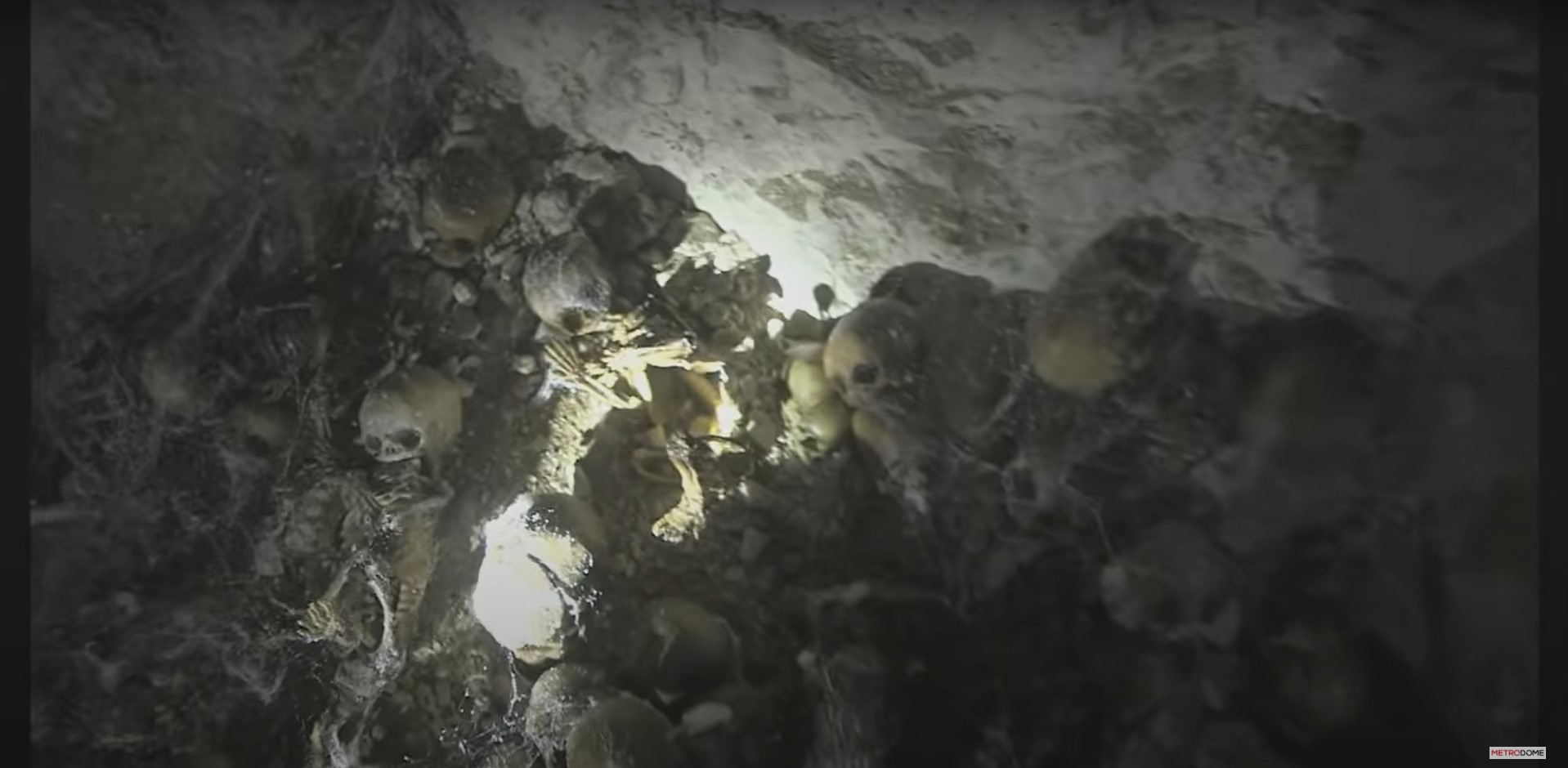
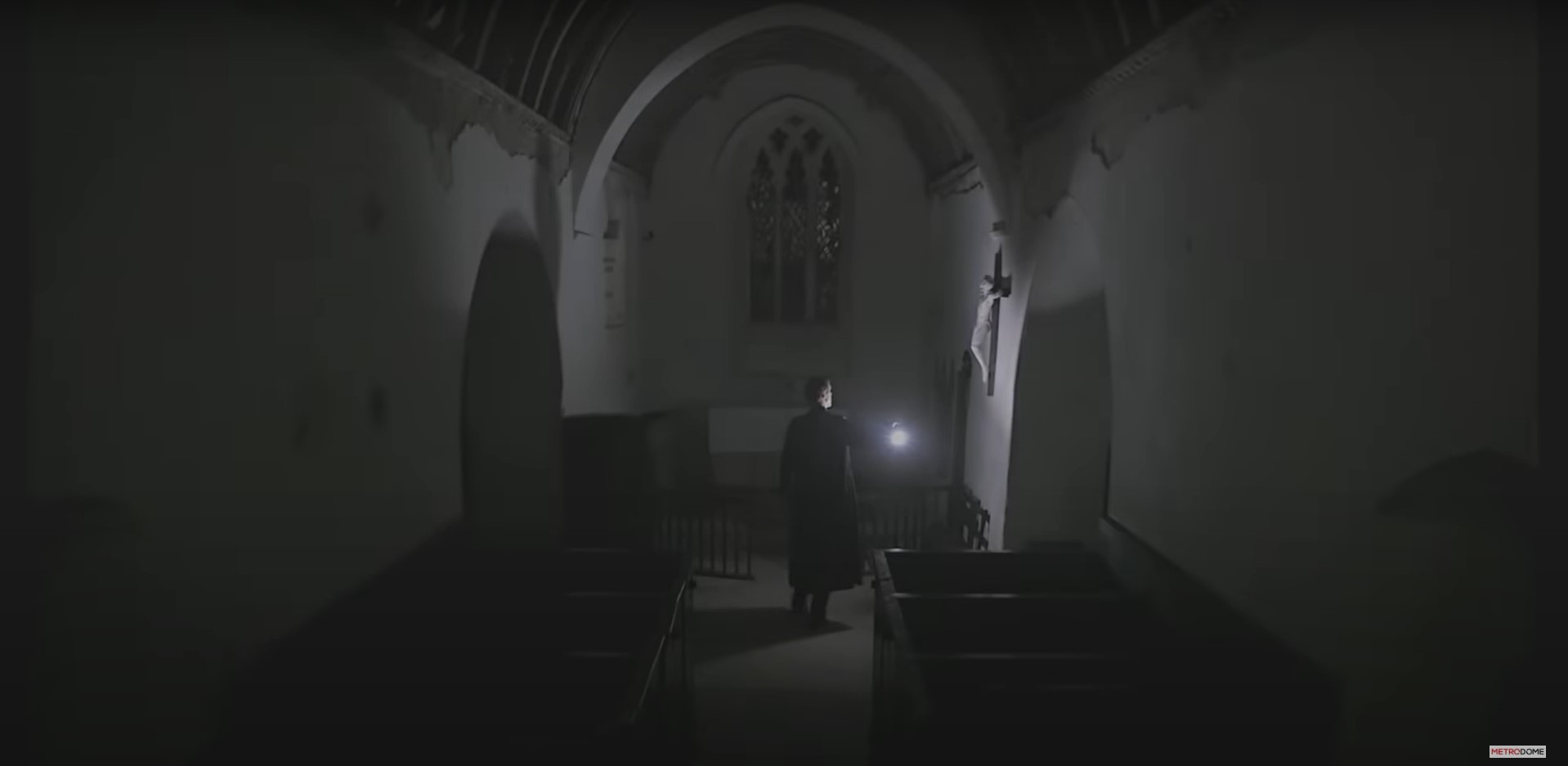
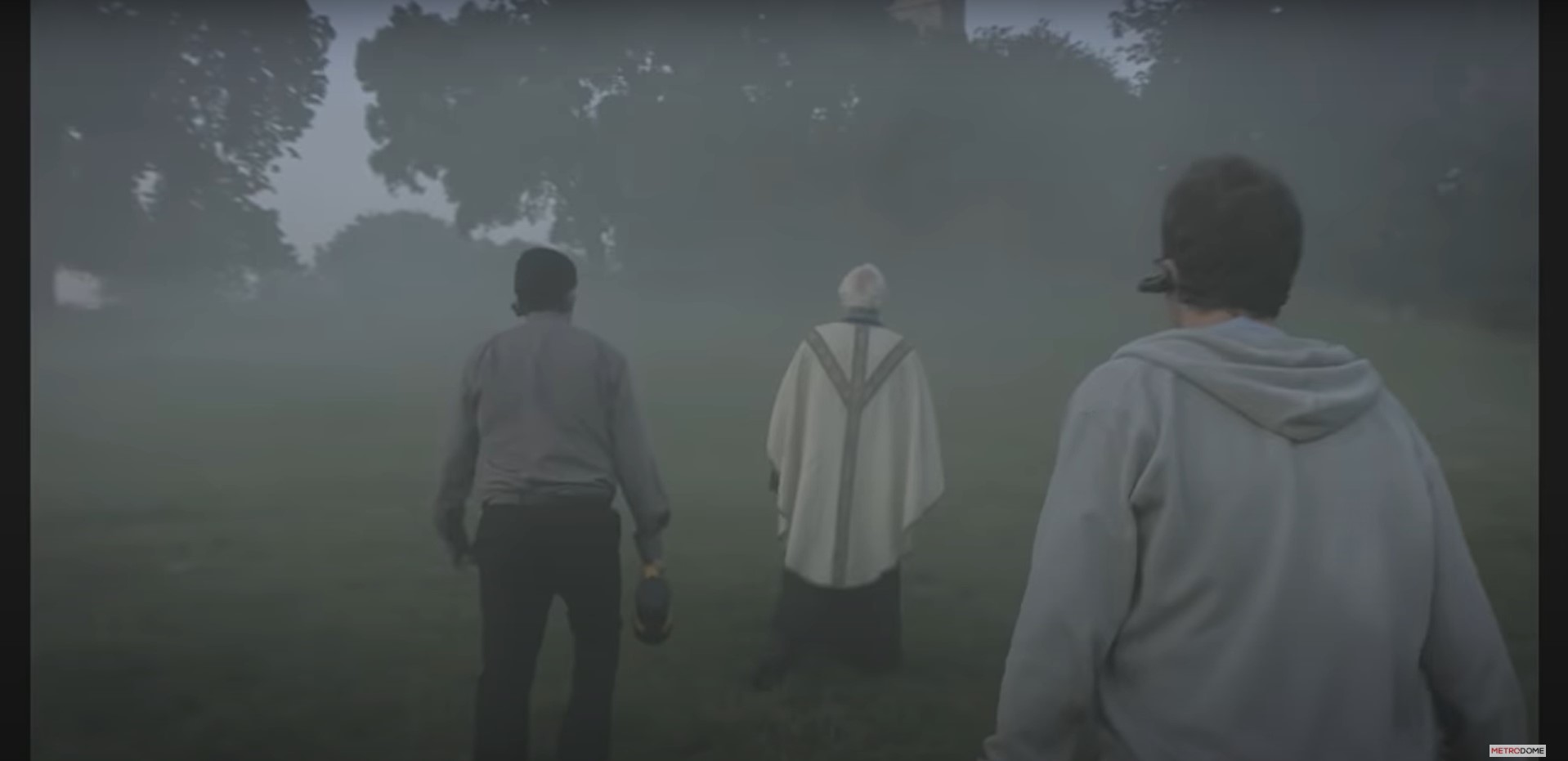
After exposing phony divine miracles at a Catholic Church in Brazil that resulted in the death of fellow Catholics, including a Cardinal, Vatican investigator and religious brother Deacon starts to lose faith with every fraud upon fraud case that points to the non-existence of a higher being.  Having fallen on the drink, the skeptical Deacon is dispatched to the English countryside of Devon where a Father Crellick had reopened a 13th century abandoned church and has been experiencing, in the Father’s words, miracles from God.  Joined by a Gray, a hired technology expert with agnostic beliefs, and a stern Father Mark, eager to disprove another false hope, the three men descend upon the Church with full, unequivocal examination to swiftly reveal the hoax and part ways.  Tensions rise between when logical explanation can’t be unearthed during Church rumblings, disembodied baby cries, and a behind-the-wall, shifting scratch sound that leads them to an underground labyrinth that will swallow them whole. 

Released in the U.S. under the title “Final Prayer,” Elliot Goldner’s 2013, found-footage UK horror “The Borderlands” is the director’s debut, and only, feature that places you right into the belly of the beast at POV level.  In a sea of found footage horror, “The Borderlands” seizes the opportunity to separate itself from the overwhelming portions of shaky camera, purposeful variable video and audio quality, and practical, obscured effects to put into question the strength of faith, specifically here in the Catholic setting, and what ultimately brings about the inevitable in that no matter what religious denomination or outlook you might have, no one is exempt from the grim reality that awaits.  Filmed mostly on location in Devon, UK, as well as West Ogwell and Chislehurst, London for many of the interior scenes, “The Borderlands” is a production of Metrodome Distribution and is produced by Jennifer Handorf (“Prevenge”) with Jezz Vernon (“They’re Outside”) serving as executive producer. 

Our team of Vatican investigators follows three men with starkly differing handles on religious faith.  Coinciding on their stance on the existence of a higher power, individualistically, they’re also incompatible to each other which makes for palpable tension and livens up the dynamic when predictability and patterns can be discerned with likeminded characters.  On the scale of human compositions, polar opposite of both spirituality and comportment is Father Mark (Aidan McArdle, “Metamorphosis”), a by-the-book priest unamused by the elaborate ruses created by those swimming in the same faith pool as himself, and Gray (Robin Hill, “Meg 2:  The Trench”), an untroubled, exuberant, hired techie eager to believe the face-value of the supposed miracles before him.  Aidan McArdle’s tenacity for dogma character comes through well enough to know that good Irish Catholic Father Mark is about as numb as the next investigating Catholic never on the verge of a true miracle as the frustration just oozes out him after one after another hoax divine ephiphany.  Robin Hill, on the other hand, could be the best John Oliver, of Max’s “Last Week Tonight,” impersonator I’ve ever seen and heard.  In all serious, Hill exacts a man looking for religion through the lens of paycheck and a fanboy of the supernatural, like as if the average horror movie enthusiastic came upon the real Freddy Kruger and just geeks the Hell out.  Then, there’s Deacon (Gordon Kennedy, (“T2 Trainspotting”) and like Father Mark, Deacon’s faith hangs in the balance after a botched investigator inadvertently sees the death of a Cardinal at the hands of pious locals.  Kennedy doubles down with Deacon’s wavering faith by drowning the character in alcohol and doubting every inexplicable Devon church oddity.  Yet, Deacon and Gray meld together to a near swap of credence, seesawing in their religious principles, when the things that go bump in the church can’t be explained.  Luke Neal (“Wilderness”) and Patrick Godfrey (“The Count of Monte Cristo”), who’s been practicing the acting craft for over half a century, play a couple of dissimilar priests lured by the Church’s mysterious forces.

What’s noticeably different about this particular bleak found footage nailbiter is the audience is integrated into story by the investigator’s strapped-on headcam, not just some schmo glued to a handheld camcorder running, yelling, and hiding for his life while still depressing the record button.  There’s also the element of a shrouded backstory that becomes unraveled overtime and speaks volumes to a couple of the character’s colorful conducts.  Those elements are then intensified by the cinematic crux, an archaic, resurrected small church’s unexplainable, mostly terrifying, daily disturbances the local priest indiscriminately deems miracles.  Not a single character has arbitrary or useless purpose for the sake of being an in-frame victim of circumstance as each exhibit a radical change over the course of investigation, adding copious ground to the big question, the question that’s on every character’s mind, is there an almighty presence beyond our corporeal plane and cerebral understanding really exist?  Come to find out, the characters are not asking the right question and get sucked into a terror on the terra the more curious they become in finding God amongst them.  Often times, found footage doesn’t fit into the storyline, whether be the aforesaid necessarily handling of the camera through the an insane ordeal or just doesn’t work with a regularly structured narrative, but “The Borderlands” couldn’t be received with success without the stunt of seeing through the eyes of the characters that subsequently emits a trick of light or an overactive imagination that smooths out solid jump scares when needed in what is a definitely watch in the dark type diabolical goosebumper. 

Second Sight Films takes charge with curating a definitive, all-expense paid trip to Elliot Goldner’s “The Borderlands” on Blu-ray home video.  The AVC encoded, high definition 1080p, BD50, hovering around 24 FPS and presented in an anamorphc widescreen 1.78:1 aspect ratio, leverages the capacity and the encoding to sharpen a relatively dark picture with more clarity without losing the unsettling spookiness with overreaching contrast.  Image presentation resembles closer to an upscaled 720p because of the found footage piece, and so we experience patchy spots, static ripples, and other miscellaneous plays into the supernatural sarcophagus that is the Devon church.  Skin tones and grading stays in tune with a brightly lit infusion of handheld torches as well as delineating the necessary with night vision cameras.  Goldner does a fine job with depth with the viewers being the foreground and using a lot of the peripheral and background to keep things hair-raising and interesting.  The English DTS-HD 5.1 audio track has lossless compression and really does throb with a wallop of balanced LFE and to-scaled dialogue.  What throws me off about this particular found footage, as well as some select others, that I find more a bothersome nuisance than a technical gaffe is an inlaid soundtrack.  A slow burn industrial score is used for “The Borderlands” to promote a greater sense of ominous omniety, like a background, repetitive, and sometimes swelling drone you might hear in certain first-person shooters from 20 to 30 years back. Dialogue tops the audio layers without being diluted by poor onboard cameras or having to contend with too much with the score, suggesting well-placed mics and sound design to achieve appropriate range and depth inside the frame configuration or even off-frame, behind or to the side of camera. Optional English subtitles are available. Like most Second Sight Films limited editions, “The Borderlands'” set packs a punch with encoded special features, such as a new audio commentary with actors Robin Hill and Gordon Kennedy, producers Jennifer Handorf, and special effects designer Dan Martin, a new interview that brings Robin Hill and Gordon Kennedy recollecting the behind-the-scenes and their characters in Dressed the Part, a new interview with producer Jennifer Handorf in Losing Faith, a new interview with special effects artist Dan Martin in Monster Goo, and a behind-the-scenes archival featurette. The limited-edition portion of this set includes a rigid slipcase with gorgeously bleak and grim illustrated artwork by Christopher Shy, a thick, 70-page color and black and white book with pictorials and new perspective and analytical essays from Tim Coleman, Martyn Conterio, Shellie McMurdo, and Johnny Walker, and 6 collector’s art cards, mostly resembling a distorted interlaced video and in an imperial purple-ish appearance from haunting scenes of the film. The artwork sheathed inside the translucent green Amaray case is the same as slipcase with no reverse cover work; it’s also pressed on the disc art. This release came with no inserts. One of the few Second Sight limited edition pieces to be licensed with a region free playback and the film itself has a runtime of 89 minutes and is UK certified 15 for strong language and threat.

Last Rites: Second Sight’s filmic selection pool for major league limited editions has been nothing short of stellar with “The Borderlands” being their latest, but definitely not their last, to be knighted worthy of physical media acclaim. Yet, it’s not like “The Borderlands” needed the boost as the film itself has a cult following for its shuddering tale and its monstrous ending that will have you reeling, maybe even screaming, in horror.

Order the Limited Edition Blu-ray of “The Borderlands” Here at Amazon.com

Enter the Patron Saint of EVIL Cannibalism! “The Spanish Chainsaw Massacre” reviewed! (Wild Eye Releasing / DVD)

“The Spanish Chainsaw Massacre” now on DVD!  

A degenerate heavy metal rock band and their pressurized manager are cast off on their very first ever music tour by their financing dictatorial mogul eager to recoup his investment as quickly as possible.  While en route, their van breaks down at the edge of a small town who welcome them with open armed hospitality, warm accommodations, and a hot meal with the promise of a day turnaround on fixing their van for free.  The next day proves to be a joyous occasion for the villagers celebrating their patron saint and little does the band know they’re an unwittingly big part of the ceremony as every villager is a ruthless cannibal ready to devour to the bone their haplessly stranded guests. 

About as vile and gross as they come, “The Spanish Chainsaw Massacre” is a Spanish-bred, slop-house, comedy-horror that plucked from the horror history timeline an unfaithful and a stretch comparison to a portion of the iconic title from the 1974 “The Texas Chain Saw Massacre.”  Writer-director Manolito Motosierra helms nothing remotely familiar to the Tobe Hooper classic, there’s barely the sweet exhaust coughing sound of a chainsaw ripping and shredding through Motosierra’s actual film, but “The Corpse Grinders 3” director has brought one well-known component to his film, lots of crazy long pig action!  Originally titled more appropriately as “Carnivoros” – Carnivores –  in Spain, the 2013 release only saw a U.S. release date merely 5 years ago in 2017 with supplementary prologue footage from Scorpio Film Releasing’s Richard Griffin and his entourage that bares big breasts as well as the only big chainsaw under its unaffiliated storyline of a woman double-double crossing two men to get away with $30K only to find herself inside a seedy hotel room and the unsuspecting starlet of her very own snuff film.  Though I usually adore Griffin and Michael Thurber, who usually has a role in a Griffin release in some random capacity, the opening fits like a square peg being jammed into triangle hole, accumulating confusion more than making sense.  “The Spanish Chainsaw Massacre” is a Fantastika Team and Olga Underground production presented by Tyrannosaurus Entertainment. 

If you can get past all the fart and poop jokes, the band known as “The Metal Cocks” are the epitome of well-received degeneracy in their unromantic, polyamorous pansexual quickies, blatant addictive vices, and an overall uncouth behavior and appearances in a mockery of hair metal bands from the 80s.  Dani Mesado as Rasputin, Óscar Gilbert Escarabajal as Petete, Torete playing himself as Torete, El Capitan Almendra as Bull, and Nereida López Vilaplana as Penny Pussy are Las Pollas del Metal – The Metal Cocks – taking on a rocking tour de force against insatiable backwoods cannibals of Spain.  If you think the band is depraved, wait until you see the villagers’ madness for meat foul up the screen with a mangled dick scene (someone call the expert Felissa Rose!), an intestine eating contest straight from the gut, and the recipe with baking instructions for a popular diarrhea shake.  With viciously varicolored characters like the Spanish whore (“Vampire:  Hounds of Horror’s” Yolanda Berneguer), the unsanitary naked food prepping cook known as The Chef (“Fucking Bastard’s Tam Sempere Miro), and the murderous simpleton Guti (Michael Rodriguez) among others, a motley macabre bunch of crazed cannibals have systematic knowledge of separating and conquering their dinner, each involved in a role important to the façade that plays to the prey’s vulnerability before digging into their food with both hands clawing.  Everything and everyone are over-the-top and that really defines the line between the cold simmering terror family of Texas massacre and the wild family of maniacs of the Spanish massacre; though the idiom says everything is bigger in Texas, Spain certainly has the most peculiar of películas between the two territories.  “The Spanish Chainsaw Massacre” rounds out with Hilario Blas, Miriam Larragay, Ezequiel Campos-Zeta, Raul Dario Gandoy, Richardo Pastor, José Luís Tolosa, Mayama Lia, and Yolanda Diaz Dengra.

Gore aplenty!  “The Spanish Chainsaw Massacre” bathes in troughs of blood as well as other human body fluids that make your eyes sink deeper into the back of your head while your eyes lids slowly act like shutters trying to protect the vision and mind pure of only the blood and not anything else.  That task is a lost cause of impossibility as Motosierra lathers a thick, slick of sick onto every frame, leaving no grotesque rock unturned before and after the victims’ final curtain call.  Yet, in the end, what Motorsierra constructs is the Looney-Toons of descendental cannibalism that’s full of maniacal laughter and delusional actions with no rhyme or reason to determine causality.  The celebrated patron saint seems to require the villagers, or strongly encourages them, to act a fool, to put on a show, and to treat human meat as a delicacy to plunder.  Neither The Metal Cocks nor the villagers receive a proper introduction, backstory, or arc in what is basically a show up and be present for gratuitous slaughter in a variety of random pockets that not all necessarily have to do with the band.  In some scenes, an old military man is tied to a tree, sitting down, and being tossed firecrackers at this crotch while a clown eggs on the kids with frenzied laughter and, in another scene, two adolescent boys are tied to a tree standing and sliced across the belly so they’re intestines can be used for a food race.  Where these characters came from is never touched upon or explained but understood that they’re a part of the festivities toward the patron saint.  Like what AC/DC once said – if you want blood, you’ve got it! – with “The Spanish Chainsaw Massacre” having gallons of it. 

“The Spanish Chainsaw Massacre” is a DVD re-release for the indie distributor, Wild Eye Releasing, as spine number 54 on the company’s Raw & Extreme sublabel.  The DVD, distributed by MVD Visual, presents the 70 minute, 56 minutes of actual feature with 14 minutes of Richard Griffin’s snuff film preface, unrated film in a widescreen 1.78:1 aspect ratio.  I really like this transfer from Wild Eye because of the sole fact of virtually no compressions issues obviously present and that’s not just because of the lack of bonus feature, which is common amongst most of Wild Eye’s library, on the DVD’s limited capacity.  Previous studies on other single feature releases proved Wild Eye to be a mixed bag regarding quality.  With “The Spanish Chainsaw Massacre,” the image quality is highly detailed and lush in black areas and in texture that makes Motosierra’s stomach-churning content that much more stomach-churning. The warm color palette of yellows and reds provides an exaggerated tint of a rural Spanish village.  In contrary to the DVD back cover, the feature’s native language is not English but rather a Spanish 2.0 stereo track.  Much of the dialogue track is all yelling synched well with the English subtitles that are not entirely accurate.  The subtitles are extremely abridged and loosely translated.  A robust metal soundtrack plays into the whole metal brand, but the other tracks lack depth as all outputs, much like the characters on screen, are upfront and loud; yet the compression handling sustains an agreeable fidelity with little no popping or screeching within or on the tail end.  Bonus features include promo videos and the official trailer with a stretch into a credits gag reel of sorts with candid and shooting mistakes in crediting the cast and there’s also an end credit scene that setups the cannibal family’s return with a Christmas themed sequel.  However, 9 years has passed and don’t think Motorsierra is working on any drafts at the moment.  The snap case comes with reversible DVD cover art with a touched up-front cover not pulled from the film itself while the inside has a blown-up bloody aftermath still of the narrative’s first victim with a dislodged lower jaw and a hunk missing from her face.  Ultra-indulgent with biofluid glop, “The Spanish Chainsaw Massacre” is a ruthless, toothless puta de madre of a film if you can get past the stink of butt humor.

“The Spanish Chainsaw Massacre” now on DVD!  

Dutch Avant-garde is the Next Evil on the Butcher’s Slab! “Meat” review!

screen-shot-2016-09-23-at-8-50-29-amA young and beautiful butcher shop assistant succumbs to the middle-aged butcher’s sexual advancements and fantasies at the workplace after she catches glimpses his sorrow, but when the butcher ends up naked on the shop’s floor with his throat cut, the assistant becomes the number one murder suspect for an inspector who coincidently looks almost identical to the deceased butcher. As the investigation deepens into the assistant, the inspector’s solemn, solitary life blurs to an assimilation into the butcher’s and his suspect turns from being a prime target to being a crucial part of the his physical and mental altering integration into the dead butcher.
screen-shot-2016-09-23-at-2-45-58-pm
“Meat” is a powerful transcending film seismically barreling through a Lynchian structure consigned to provoke the consequences of unhappiness and the consequences of poor choices during unhappiness. Directors Victor Nieuwenhuijs and Maartje Seyferth have orchestrated a moderately expressionistic arthouse Dutch drama told in a spiraling sexual context. The meat in “Meat” and the sex in “Meat” clearly share a correlation, peppered as motifs from start to end, and the positive and negative dimensions of the two are so obscured that pinpointing the differences between them are impossible, but both are for sure the last hope for the butcher and his assistant Roxy to embody the essence of sex and meat for opposite reasons. Whereas Inspector Mann simply drags wholeheartedly through his existence, expressing his numbness toward his mundane job and harshly breaking up with his lover without an ounce of compassion. Its until the butcher’s case lands in his lap does the Inspector shows signs of life again.
screen-shot-2016-09-23-at-2-36-30-pm
If you notice that lead actor Titus Muizelaar’s dual roles have purposefully generic labels. The butcher is credited as just the butcher while the Inspector has a proper name, but the name Mann is just as indistinguishable as if the character was christened Guy. The synonym character was intended for blending, to blur their personas, and to transform one into another. To explore the transformation, “Meat” begins a parallel between the butcher who, in a metaphorical sense, has his cake and eats it too and the inspector painstakingly limps from one spot to another. A contrasting experience between the two firmly establish their individualities. Then, the film shifts gears midst a catalyst with the butcher’s mysterious death, forcing the female assistant, an uninhibited role performed uninhibitedly by Nellie Benner, to be the resilient gateway for the inspector. Third gear shifts into the inspector being more and more intrigued, if not extremely envious shown very subtly, by the butcher’s seemingly unchained facade. Each character emits an expressionless stature with a deep-rooted ugliness burrowed inside and each desire a change in their turmoiled lives, whether it’s sustaining love, seeking love, or able to love in order to battle every aspect of oppressive depression.
screen-shot-2016-09-23-at-2-55-21-pm
The uncomfortable open and intimate relationship between the butcher, Wilma Bakker’s Tiny, and the shop owner and the psychosexual workplace harassment involving the enthusiastic, video-documenting assistant filets the juicy bits from the bone with numerous innuendoes and explicit carnal exhibitions taking brazen residence within the animal blood stained walls of the butcher’s small meat market. You’ll never look at steak, pork chops, and leg of lamb the same way again! Only when “Meat” transitions into that second gear does the erotica becomes less erotic and more forced and horrifically exploitive. Scenes of undisclosed rape and of blatant genitalia speak upon that aforementioned correlation of raw meat and sex; no choice is given to the cow when the cow is killed and slaughtered for the cow’s delicious beef and the same can be said in sex as it’s taken without much consent and it’s being reaped for the benefit of others.
screen-shot-2016-09-23-at-9-22-48-am
Graphically infrasexual and skewed beyond simplicity, “Meat’s” refreshingly loaded with unpleasantries and basted moistly with an outer layer of perversion that drips into an oven of thriller surreality. The Artsploitation team lives up to the moniker by, after being long overdue, crafting a home video release of 2013’s “Meat” aka “Vlees” onto DVD and on digital home video. The digital screener provided for review doesn’t give much insight into the audio and video qualities or speak to the testament of the special features. However, “Meat” is a phenomenal film that’s well-aged and ready to be rubbed, tenderized, devoured in all senses of the meaning.

Buy “Meat” on DVD!

Living Alongside Evil. “A Plague So Pleasant” review!

vlcsnap-2015-10-03-20h33m16s247
In the zombie post-apocalypse, the human discovered that by not firing their weapons allowed the flesh eating hordes to calm their desires, resulting in the protection of the zombie species and institutionalizing laws against the killing zombies for fear of another undead swarm attack. One of the many survivors Clay has lived in a zombie cooperation world for over a year after the initial outbreak along with his sister Mia, whose boyfriend Gerry didn’t survive, but still roams the Earth as the walking dead. With no one truly dying, the whole idea of existence becomes meaningless and where people, like Mia, won’t move on when they’re loved ones still feel very much alive. When Clay discovers his sister’s attachment to undead Gerry, he takes it upon himself to kill Mia’s zombie boyfriend, releasing a zombie swarm post-apocalypse apocalypse on the his town.
vlcsnap-2015-10-03-20h33m43s6
Unprecedented and gushing with rage, “A Plague so Pleasant” redefines the way audiences would view the zombie since 1968, constructing still a vicious species of man-eating undead while domesticating them to a lumbering land fixture much like the way pigeons amongst the birds. First time directors Benjamin Roberds and Jordan Reyes triumph amongst the modern zombie competition, spilling their heart and soul onto the script and onto the screen. With a story to match, a Romero-inspired social commentary zombie film held true to form by instilling normality to a post-apocalyptic world. Zombie and man living together. What was that Bill Murray line in “Ghostbusters?” “Cats and dogs living together… mass hysteria.” Clay and Mia were living a mundane life while the dead remained alive and protected, socially poking fun at how society maintain a normal livelihood with zombies: the U.S. Government made killing zombies a national felony, companies were mandated to go through a yearly undead awareness program as a formality, and there’s a guarded visitation area full of the undead much like a graveyard without graves.
output_hgiPVw
Stunning cinematography added much needed life to “A Plague so Pleasant” which settles into an already over saturated zombie genre. Starting in black and white, Clay introduces his life in a offscreen monologue, conveying much of the post-apocalyptic and zombie information. The black and white symbolizes how simple and plain life has become with the living with zombies regulations. When Clay breaks the law by offing Gerry for good, thats when the movie turns to color and creating complications in a black and white life. The once unvarying and shuffling zombie nuisance goes into full berserk mode with “28 Days Later” sprinters thirsty to tear into anything with a heart beat. Only when the zombies turn calm is when life goes back to being black and white, considering the option that normality needs to be simplified to live peacefully.
vlcsnap-2015-10-03-20h34m26s181
The special effects by first timer Tyler Carver are a great effort clashing together a classic European Giannetto De Rossi style with Carver’s own settle flair by not being overly gruesome. There’s not an over-the-top, chart-topping special effects moment that defines the “A Plague so Pleasant,’ but there the solid effects subtly throughout satisfies. The zombies overall look are the usual stock type, yet they’re exhilarating to watch with an army of intense actors who are no doubt from the Athens, GA Halloween attraction named Zombie Farm where Tyler Carver has a connection. Not everything about the creation of a frightening zombie was accomplished as much of the audio tracks were out of sync and just too gaudy.
vlcsnap-2015-10-03-20h35m38s135
Actor David Chandler as Clay does a fine job portraying a bored survivor and a clueless big brother while also performing the second zombie swarm nearly without speaking during the entire engagement. Mia, played by Eva Boehnke, resembles the gorgeous Lebanese-American porn star actress Mia Khalfia with her giant nerdy glasses. Boehnke creates a free spirited, yet delusional, persona in Mia whose holding onto the past and coping the only way she knows how and that’s by not separating from her undead boyfriend Gerry. We round out the cast with Todd played by Maxwell Moody. Todd becomes the catalyst of the coming events by placing the idea of him and Mia being a couple and putting a bullet into Gerry’s rotting brain. Chandler, Boehnke, and Moody on paper are amateur actors in an estimated $1,500 budget, independent movie, but they own their performances and shine through budgetary constraints.
output_YwwcFE
Another awesome release from Wild Eye releasing that would make a worthy and unique edition to a zombie fanatic’s movie collection. Don’t judge to harsh the production value with the slight aliasing, the out of sync zombie audio tracks, and the muffled off screen Clay character monologue. Instead, focus on the cinematography, the actors performances, and the genuine story telling of a socially awkward scenario. Let “A Plague so Pleasant” infect, let it sink it’s teeth deep, and let it help turn your undying attention unto a lively concept.