EVIL Wants You Tour Your Own Personal Hell! “Trapped Ashes” reviewed! (4K UHD and Blu-ray / Deaf Crocodile)

4K and Blu-ray “Trapped Ashes” from Deaf Crocodile. Available Here!

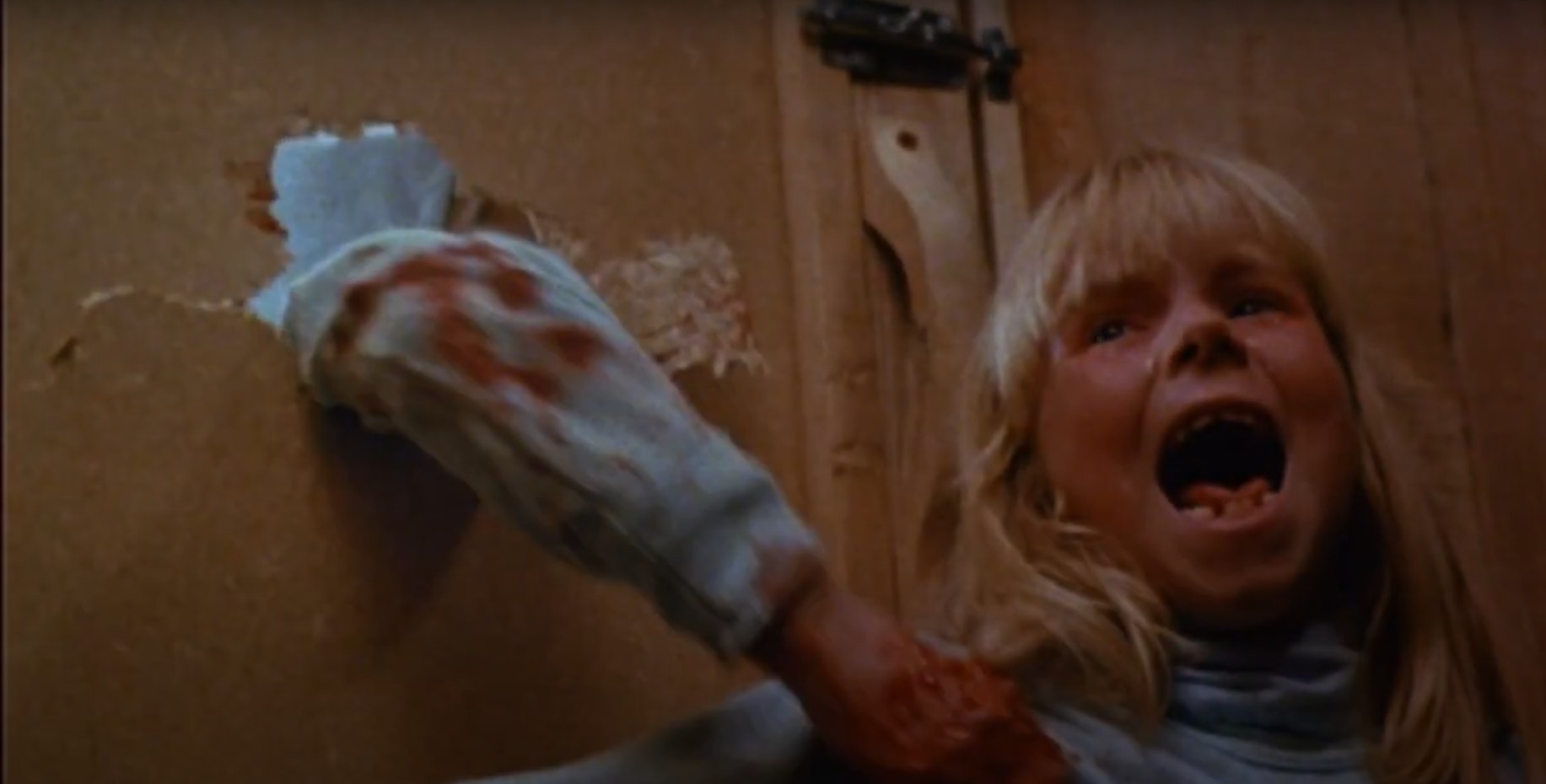
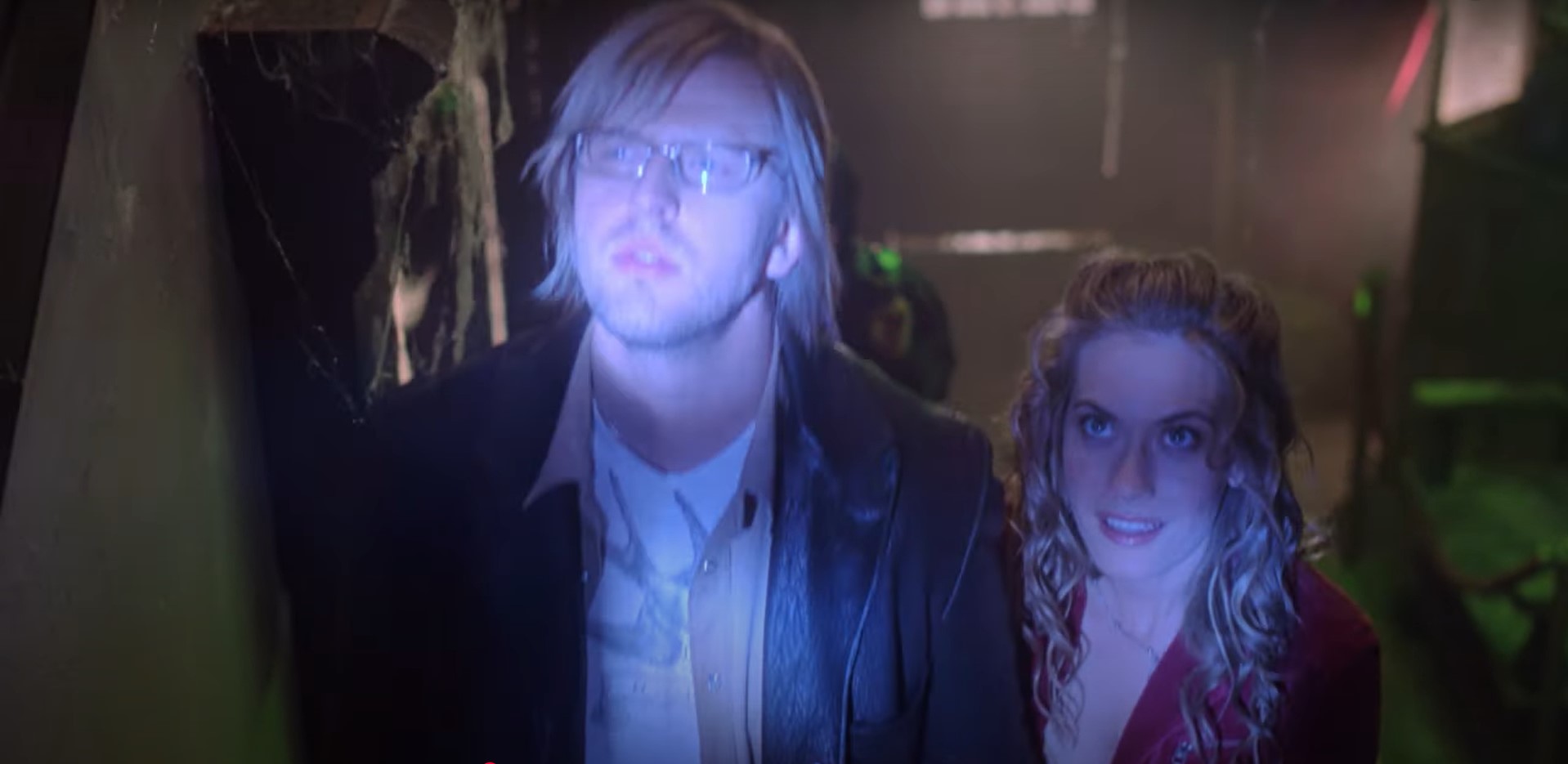
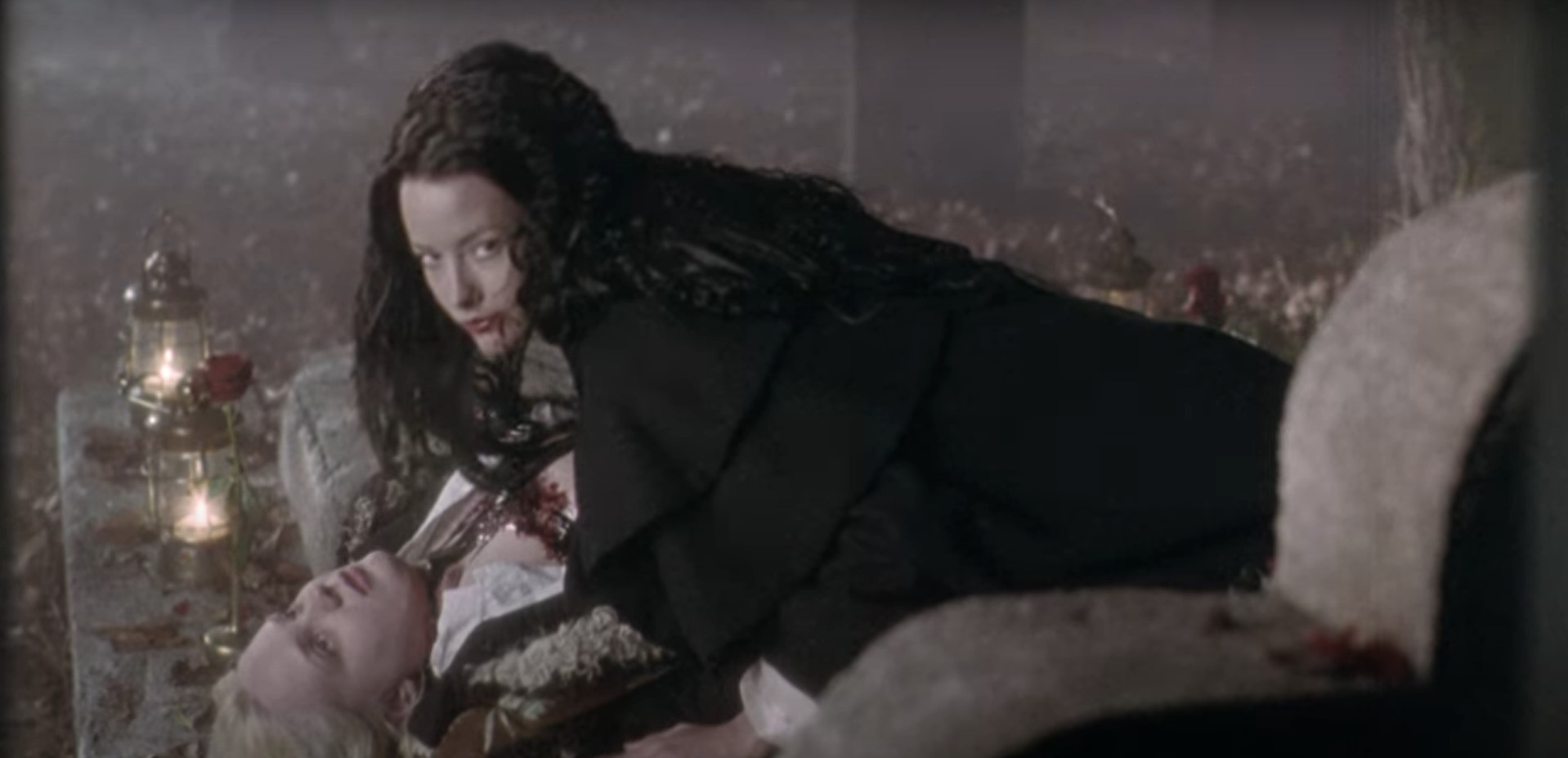
The VIP package for a historical studio backlot tour gives seven strangers a behind-the-scenes look at how movies were made and the background behind them.   When their cart pulls up to one of the more infamous movie houses for Desmond Hacker’s fright flick Hysteria, the tour group are eager to explore what’s typically off limits for normal, non-VIP tour attractions.  Once inside the backlot house, much of the Hacker’s funhouse tricks and odd designs are although covered in cobwebs are still very functionally practical as the group separates and goes room-by-room to peruse a movie house.  When they all gather in what looks to be the commune dining area, they find themselves unable to locate the way out no matter which unlocked door they choose, which circles them back.  The tour guide mentions Hacker’s movie had similar parallels and that the only way to free themselves would be to tell their own personal horror story.  With nowhere to go and nothing to lose, the stories begin their descent into terror. 

For someone who doesn’t go out of their way to watch horror anthologies, I’ve been on a kick lately with a decent string of short film compilation feature, starting with the latest entry from the popular “V/H/S” franchise, “V/H/S/Beyond.”  Next up takes us back to 2006 with “Trapped Ashes,” a campy horror anthology that not only brought together legendary genre directors, such as “Friday the 13th’s” Sean S. Cunningham, “Gremlins’s” Joe Dante, “The Matrix” visual effects arts John Gaeta, “Silent Night, Deadly Night 3:  Better Watch Out’s” Monte Hellman, and the late director of “Altered States,” Ken Russell, but also brings together aged, yet still legendary, familiar faced actors that have since past that short time between 2006 and 2025   Dennis Bartok wrote the anthology piece and is his brainchild, producing the film.

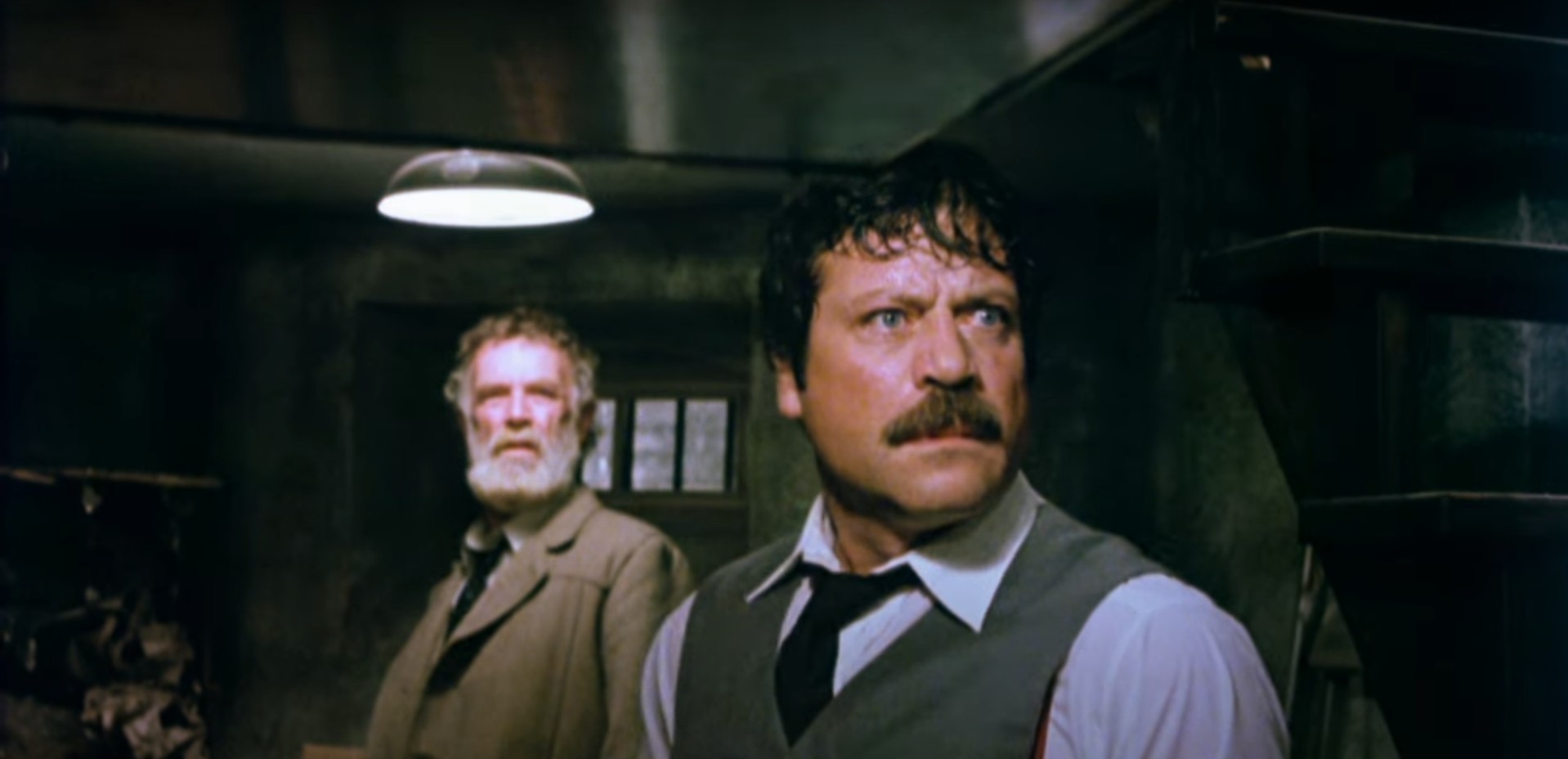
Those aforesaid actors have a combined nearly centuries (plural!) of experience with careers spanning an average of 50 years each.  Henry Gibson (“The ‘burbs”), John Saxon (“A Nightmare on Elm Street”), and Dick Miller (“Gremlins”) all together in one film.  Granted, Dick Miller’s cameo was so short that all three were only together for a brief scene but the trio alone should bring in genre fans to witness Henry Gibson in a persona he does best, a round faced under stark white hair and with puppy dog eyes that draws one closer to his innocence only to have the rug snatched right from under you when he turns sinisterly dark as the seemingly harmless tour guide.  Saxon also plays true to his conventional character archetype as a wise-cracking tough guy too cool for school; this time, he plays a screenwriter haunted by his own betrayal toward his best friend while being infatuated with a bewitching beautiful woman.  Unlike most horror anthologies, “Trapped Ashes’” individual tales contain mostly the same cast as the wraparound with Saxon, Jayce Bartok (“Founder’s Day”), Lara Harris (“The Dogfighters”), Rachel Veltri (“Pray for Morning”), Michèle-Barbara Pelletier (“Brainscan”), and Scott Lowell as the tour guests with personal hell to tell.  The heterogeneous group convey their supernatural-laced anecdotes that mingle inside the context of their being or life whether body image, marriage, friendships, and childhood, subjective intimacies that shape their excruciating experiences that, if audiences see them on screen for the first time, wouldn’t be clear how deeply burdened or troubled they are at first glance.  Once the story is told, moods and personalities shift, or perhaps seemingly normal habits are made clearer, and this is made possible by the eclectic bunch of actors to carve away their characters’ exterior shells to see who they really portray.  Ryo Ishibashi (“Audition”), Yoshinori Hiruma, Mina E. Mina (“Eastern Promises”), Winston Rekert (“Eternal Evil”), Ken Russell, Tahmoh Penikett (“Trick r’ Treat”), Tygh Runyan (“Disturbing Behavior”), Amelia Cooke (“Species III”), Luke Macfarlane, Deanna Milligan, and Matreya Fedor (“Slither”).

Riffling through the obvious camp “Trapped Ashes” touts very proudly, there are nuggets surrounding the unsavory themes.  Body dysphoria within “The Girl with Golden Breasts” is one of these topics, where an actress feels compelled to enhance her bosom for better, younger roles, and that speaks the relevance ill of the movie industry’s perverse tidings of late as actors and actresses continue to fill, inject, scar, and manipulate themselves into being their unnatural self to satisfy producers, execs, and audience likes and expectations when, in reality, hurts nothing but themselves.  Dissatisfaction marriage, or perhaps better labeled stagnant marriage, leads into invasive third party to sate long neglect passion and in this case, that third party is an ancient Japanese demon named Seishin (Japanese for Spirit) who lures the wife’s sexual appetite down to the pits of the netherworld.  From there, themes love triangles, obsession, cheating, and dysfunctional family structures formulate a pod of personal pate smeared with victimization, the victims being the storytellers stuck in the Desmond Hacker’s Hysteria backlot house.  “Trapped Ashes” isn’t about being victim, it’s more about playing the victim and those playing may not be victims of their own tales at all that adds a morsel of supernaturality to the recipe that changed the course of the idiosyncratic anecdotes that are close to their emotions and mental well-beings as well as proximally physically hazardous. 

Our first time covering the Dennis Bartok and Craig Rogers founded Deaf Crocodile release and it doesn’t disappointment with a sleek new 2-Disc 4K UHD and Blu-ray of “Trapped Ashes,” scanned and restored in 4K for its Blu-ray debut.  Presented in a widescreen 1.85:1 aspect ratio, the Deaf Crocodile UHD is HVEC encoded, 2160p Dolby Vision, BD66 and the Blu-ray is AVC encoded, 1080p high definition, BD50.  For an early 2000 production, “Trapped Ashes” doesn’t have the digital veneer of early 2000s film besides some visual effects work of the image manipulation drooping effect.  The extra pixels of UHD really brighten and elevate the image to today’s standards to surface the most inconspicuous details lost in standard definition.  Color saturation and skin tones appear natural and organic with no signs of compression issues or imbedded problems with the digital equipment.  Depth has really opened up in areas like the funhouse illusions of the Hysteria house in the wraparound segment and or in “Twin” when reality of the situation is made clear to put the explanation in one single medium-to-medium closeup frame.  Blu-ray copy mimics a lot same UHD accolades with a less fine tune edge around the background.  The English DTS-HD 5.1 surround sound is the only audio option available on both formats.  More than ample, the lossless provides a deepening immersion the deeper you go into stories with balanced side and back channels complimented by an even-keeled LFE to register the bass near the front while whispery events hover around a surrounding backside, such as with Cunningham’s “Jibaku’s” drawing-in hallucination moment of a Japanese painting that instills reverberating echoes and Shepherd tones.  English SDH subtitles are available.  Bonus features include threw new interviews – Dennis Bartok moderates a feature-length, online platform interview with director John Gaeta, cast members Jayce Bartok, Scott Lowell, and Lisi Tribble, producers Yuki Yoshikawa and Yushifumi Hosoya, and cinematographer Zoran Popvic, a second feature-length interview with cast members Tahmoh Penikett and Tygh Runyan and production designer Robb Wilson King, and the last approx. 40-minute interview is with producers Mike Frislev of Nomadic Pictures.  Extras do not stop there with a director’s cut of Monte Hellman’s “Stanley’s Girlfriend,” the original full-length cut of Ken Russell’s “The Girl with the Golden Breasts,” and a 5-part making-of with cast and crew archive interviews, a new visual essay Hollywood Parasite:  Hysteria in Trapped Ashes by journalist and physical media expert Ryan Verrill and film professor Dr. Will Dodson.  This is the so-called standard release compared to its Deluxe Limited Edition companion release, but this release is also pretty deluxe physically.  There’s no limited O-slipcover but the unique, almost 70’s-eseque cover design is appealing yet simple with a reverse side depicting an image of the wrapround characters inside the Hysteria house dining room or commune area.  The UHD and Blu-ray overlap each other in their differentiated locking mechanism on the ride of the clear Amaray case while the left insert portion holds a Deaf Crocodile QR code for access of the transcribed bonus content.  This release has the rated R cut with a runtime of 104 minutes and is region encoded A playback only.

Last Rites: Anthologies can be the antithesis of horror – building and dropping tension, an innate broken narrative, different stylistic choices that disunify the entire film, etc., but if campy enough, if not taken too seriously, if cast John Saxon, Henry Gibson, and Dick Miller, “Trapped Ashes” can find a home in the genre and in our collections with a new and extra-loaded Deaf Crocodile 4K UHD and Blu-ray set.

4K and Blu-ray “Trapped Ashes” from Deaf Crocodile. Available Here!

Mother Russia’s Most EVIL Serial Killer is “Evilenko” reviewed! (Unearthed Films / Limited Collector’s Edition 4K UHD and Blu-ray)

Limited Collector’s Edition 4K and Blu-ray Available Here!

Kyiv, 1984 – An aging schoolteacher named Andrej Evilenko is stuck in Josef Stalin’s quickly dwindling sociopolitical communism party and finds himself dismissed from the school after being accused of attempted rape of one of his preteen students.  His release from vocation obligates him to write letters to the Communist party still clinging to control and from those letters comes a job with the KGB under the guise of a railroad inspector.  Evilenko’s empowerment by the party drives his dangerous urges to rape, kill, and cannibalize women and children over years around Kyiv and Crimea, using his position of inspector to travel.  In 1987, Magistrate inspector, Vadim Lesiev, is assigned by the D.A. to hunt down the serial killer who has by then murdered over 30 victims.  Over the course of the next eight years, Lesiev finds himself chasing his tail and fearing for his own family’s safety against a monster that has all of Kyiv frightened. 

Based off the true crime story of notorious Soviet Russian serial killer Andrei Chikatilo, “Evilenko” tells the fantastically frightful tale of the real “Butcher of Rostov” who did confess and was convicted for rape, murder, and the cannibalization of 52 young women and children, of both sexes, from 1978 to 1990.  The Italian-English production is spearheaded by Italian filmmaker David Grieco who directs the film as well as supplies the story’s base material from his own semi-biographical novel on Andrej Chiktilo, entitled “The Communist Who Ate Children” (“Il comunista che mangiava i bambini”).  Grieco, the son of the of the founding members of the Communist party, finds a financial means to produce a visual adaptation from Britain’s Pacific Pictures consisting of Michael Cowan and Jason Plette of “Killer Tongue” and produced by Italy’s Mario Cotone (“Malena”), representing the MiBAC, the Italian Ministry of Cultural Activity.

Who better than to portray a variant of the child molesting, murdering, and eating Soviet Andrej Chikatilo than Malcolm McDowell, the British actor who is no stranger to controversial films and performances having the lead roles in both Stanley Kubrick’s celebrated violence in a dystopian society in “A Clockwork Orange” and in the pornography spliced infiltrated titular performance film of the sultry period drama “Caligula.”  Being older and wiser doesn’t phase McDowell to shy away from committing to difficult scenes involving minor aged costars, especially scenes with sexually ambiguous dialogue and being pants less while speaking it, and while not a physically demanding role for McDowell nor is it filled with the intense-eyed actor’s usual fiery fervor, but in the shoes of Evilenko, he nails down the real serial killer Chikatilo’s exterior appearance, despite attempting to make McDowell appear younger with just only a wig to convince audiences of the 20-year span in the story, and touches upon the oddities and the quirks that make Chikatilo a delusionally faithful comrade, justified by his own investment into the communist party.  Evilenko’s archnemesis comes in the form of district attorney magistrate investigator Vadim Lesiev, played by the underutilized New Zealand born actor Marton Csokas (“Lord of the Rings,” “Cuckoo”).  “Evilenko” is clearly the Malcolm McDowell show but Csokas gives his all to a man not only doing his duty as an official of the Russian pervading prosecution but also as a family man haunted by his inadequacies and his inabilities to catch the perverted serial killer that might just strike close to home, putting Lesiev on edge with that nagging worriment.  Grieco’s editing and story development greatly undercurrent Csoka’s motivations and plights, distorting his complexities to a minor key of his true self, and letting McDowell have free reign over his subsidiary counterpart.   Yet, neither character is fleshed out definitively, none to compel a reason for their idiosyncratic methods and behaviors, which goes hand-in-hand with the purgatorial editing that is loose with the timeframe.  Ruby Krammer (“Alien Exorcism”), Frances Barber (“Superstitition”), Vladimir Levitskiy, Ihor Ciszkewycz, John Benfield (“Hitler’s S.S.:  Portrait in Evil”), and Ronald Pickup (“Zulu Dawn”) as a psychotherapist assisting tracking down the killer.  

As much as the Grieco and McDowell dynamic works to monstrously depict a coldhearted and crafty serial killer coupled with a sliver of slithering supernatural propensities to lure women and children in a fixed trance or, in more conventional means, into doing what he wants with an spellbinding combination of stares, manipulative conversation, or just overall emitting a towering communist cloud of authority, “Evilenko” is deflated by the story’s time lapsing.  Opening with Kyiv 1984 and then subsequently in Crimea five years later in 1989, the noting of years or periods is hereafter eliminated from the narrative that becomes a back-and-forth yarn between a select of Evilenko’s pied piper lures and kills and magistrate Lesiev always behind the eightball pursuit of the elusive, unknown killer.  There’s a loss of sight on Lesiev’s psyche that is very important to the story and more so at the climatic interrogation scene where both men are stark-naked in a power and controlling situation that harks back to Evilenko’s mesmerizing tactics used against the adolescent prey and Lesiev’s fear and obsession of losing his family to what once was an uncatchable slaughterer who hallmarked with mutilation and devouring.  Grieco’s willingness to be grisly is tamer than the expected based off the prologue scenes of Evilenko exploiting and nearly raping a preteen girl but doesn’t take away the effect that the entire narrative arouses an uncomfortable experience teased to always be on the edge of overly graphic but never breaking that threshold; “Evilenko” is one of the biggest blue balls instigators is in last 20 years and that rush of not seeing or knowing can be more thrillingly charged for some than anything totally explicit ever could produce. 

Unearthed Films limited collector’s edition has 2-disc, dual format capacity with a 4K UHD and Blu-ray.  The second 4K UHD from the label, behind their release of “The Guyver,” solidifies the extreme horror company a player in the ultra high-definition game.  The New 4K transfer restoration of the original camera negative is HVEC encoded, presented in a widescreen 1.85:1 aspect ratio with 2160p UHD, on a massive three layered BD100.  The Blu-ray comes AVC encoded, 1080p high-definition, on a BD50, presented in the same aspect ratio.  What’s gathered from both presentations is that there’s nothing to fault them with as both excel to their max output abilities.  In fact, the transfers are pretty much identical, integrally achieved by digital optimization of an already optimized digital camera, a Sony PMWEX3 with 35mm adapters, which at that time was the bigger brother and flagship model of the Sony line.  A slight grading reduction instills a sense of austere or lackluster coloring that mocks a communist Russia veneer.  Close ups on McDowell’s unique features and the expound of particulars in the surroundings, especially when engulfed in leaf-covered and tree-thick woods, tell of the emerged details and textures in a higher pixel count.  An English DTS-HD 5.1 Master Audio is the sole mix available.  The back and side channels are essentially used sparing for a few flakes of brief ambient hubbub in what’s mostly a frontloaded conversational piece of mostly McDowell in one of his great monologuing moments. We get some nice oblong orchestral pieces from the late David Lynch regular composer Angelo Badalamenti (“Lost Highway,” “Twin Peaks”) that incorporates haunting harmonies and soft, ethereal vocals that play into the loss of innocence theme. Dialogue’s healthy and prominently favorable next to the unchallenged low ran range. English subtitles are available for selection. The BD100 offers only the feature, and a new commentary track with director/writer David Griece and star Malcolm McDowell while the Blu-ray offers the same commentary plus Evilenko Dossier: Andrei Chikatilo, the examination of the real killer against the onscreen rendition, cast and crew interviews with Grieco, McDowell, and Badalamenti, a photo gallery, and the original film trailer all within the bonus content of a fluid menu with Badalamenti’s and vocalist Dolores O’Riordan’s main track “Angels Go to Heaven.” The limited collector’s edition is housed in a cardboard slipcover of one of the many variants of Malcolm McDowells face slathered in soviet red. The black Amaray has the same cover art with no reversible cover. The discs are snap-locked in place on opposite sides, pressed with another slathered in red image pulled from powerful interrogation scene between Evilenko and Lesiev. Both formats are not rated, locked region A encoded, and have a runtime of 111 minutes.

Last Rites: “Evilenko” is a heavy story that needed to be told. You don’t hear much about the USSR vulnerability and the real-life serial killer had frightened the proud, the stoic, and the impoverished alike as “Evilenko” seers as a case study mental illness, is a metaphor for deteriorating Communism, and a tale too terrible to forget and despite some pacing issues and timeline infractions, Grieco and McDowell pull off a rather nasty semi-doc of one of the worst killers to ever live.

Limited Collector’s Edition 4K and Blu-ray Available Here!

Low Box Office Attendance Won’t Stop This EVIL From a Having a 4K Release! “Zyzzyx Road” reviewed! (Dark Arts Entertainment / 4K UHD and Blu-ray)

“Zyzzyx Road” Collector’s Edition Now Available on Amazon.com!

Tax accountant Grant has become an unfulfilling, steady husband and father bred by many years of walking the straight line.  When he meets the young, hot Marissa while gambling in Las Vegas, Grant quickly becomes enamored by the youthful blonde with the two of them ending up in a hotel room together, but when Marissa’s violently jealous boyfriend Joey breaks into the room, Grant inadvertently kills him in self-defense.  Eager to do anything for Marissa, the once unadventurous accountant lugs Joey’s corpse into the back of his car and the two drive hours through the night to the middle of the Las Vegas desert off Zyzzyx Road in attempt to bury him.  Intermittent visions and voices drive Grant to put into question Marissa’s intentions and the death of Joey, whose has suddenly absconded the trunk and is out for blood for jilted revenge, puts a snag into his plan of being with Marissa forever. 

Infamously known at one time for being the lowest grossing theatrically run film ever, only making a grand total of $30, “Zyzzyx Road” is an American mystery-thriller from “The Kindred” and “Return of the Living Dead III” writer and debut directorial of John Penney.  The 2006 independent feature, based off and intentionally mislabeled Zzyzx Road, a 4.5 mile-long road in the same name California town formerly known as Soda Springs, was mishandled during it’s limited release by showing in just one cinema during it’s theatrical stretch, being dethroned by “The Worst Movie Ever!” In 2011 with a total earning of $11, and rightfully so.  “Zyzzyx Road” did not justifiably garner such notoriety but isn’t totally faultless it’s misunderstood essence.  Shot in the Mojave Desert, the film’s principal star Leo Grillo funded the project under an LLC with Penny and casting director Valerie McCaffrey serving as co-producers.  

As tax accountant Grant, Leo Grillo has no issues stepping into a role that’s supposed to sound as vanilla as the character’s vocation.  Whether it’s Grillo’s limited expressive range or perhaps playing Grant to the very letter, Grant’s monotony doesn’t exude any kind of excitement, suspense, trepidation, or passion.  It short, Grant is about as plain as white bread.  Being in the embrace of a younger woman nor skirmishing with a violent man in the desert seems to get Grillo out of his austere shell, even when in the final, when Grant is supposed to be elevated as an unpredictable loose cannon, the Massachusetts-born, animal rescuer and sanctuary founder can’t muster a three out of ten on an intensity scale.  Opposite Grillo and a ten on the intensity scale, for any he’s ever made, is the late Tom Sizemore at what was perhaps the height of his drug-fueled career.  The “Relic” and “Saving Private Ryan” actor’s aggression is harnessed for Joey, Marissa’s out-of-control yet controlling ex-boyfriend.  Sizemore’s unusual hand movements, long wide-eyed stares, and sneering tone provide the fervor needed for the thriller as the two men mix it up all because of the sweet and innocent Marissa.  Or is she sweet and innocent?  Katherine Heigl (“Valentine,” “Bride of Chucky”) had not really blown up yet in her career but the then up-and-coming, mid-20 something Heigl is playing a seemingly odd choice for a late teen woman, but Heigl pulls off being a candy-coated frighten kitten for as long as the story says so as Marissa may not be as she appears.  Heigl’s performance grounds the two extremes within her male co-star counterparts, bringing with her a better operating perspective for “Zyzzyx Road’s” twisting, winding, out-in-the-middle of nowhere road. 

Within “Zyzzyx Road’s” framework, therein lies a good premise.  However, the story, as a whole, has a number a plot holes that notch out and negate earlier elements along its enigmatic journey of a couple heading to desert without a game plan to bury a human corpse.  The rewound flashbacks that hark to the catalytic incident work to an extent to setup visuals and circumstances audiences are thrusted into right after the opening credits roll and this structural design is a cognitive tell, a non-linear, trope device used to say that everything is not initially laid out.  Crucial pieces of the puzzle are omitted for something that is more inconspicuously afoot that will explain the whole ordeal in an epiphanic ah-ha moment.  Penney ten breaks the film in two with a sharp snap, presenting “Zyzzyx Road” now with more than one perspective that changes the game from one thriller genus to another thriller genus. 

Brian Yuzna and John Penney are quickly making a name for themselves in the boutique label department. Penney’s own “Zyzzyx Road” receives the ultra high-definition treatment with a Collector’s Edition, 2-Disc 4K UHD and Blu-ray combo set with the restoration supervised by Penney and presented in HDR 10 and the original widescreen 1.85:1 aspect ratio. The 4K is HVEC encoded, 2160p resolution, with a BD66 capacity while the Blu-ray is AVC encoded, 1080p resolution, BD50. The UHD provides a cleaner look with intrinsic detailing mostly around daylit exteriors while both formats instill finesse with the fathomable. Where not fathomable are the nighttime interiors and exteriors that trade shadow and depth delineation for lineless and dark atmospherics under an interesting choice of garage grading until multi-perspectives emerge, dichotomizing the grading between a super flat and natural, desert sunlight to shed light. No signs of compression issues during these scenes which would be more than half of the runtime, biding its time with the cat-and-mouse ménage à trois in the desert. Practical effects mixed with visual effects endure the early 2000s variety of inorganic movement and off-texturing. Another interesting aspect of this collector’s set is the audio contains a lossless and a lossy surround sound mix with an English DTS-HD 5.1 Master Audio and a Dolby Digital 5.1. Not sure why there’s a need for both on both formats as most cine- and audiophiles would prefer more fidelity over compressed, reproduced audio any day of the week; yet, both files render a clean presentation with forward and prominent dialogue. Being in the desert where space is abundant, depth appears deeply snubbed by the initial recording and sound design, but the added ambience of critter chirping, heavy winds, and rustling of the brush diffuse nicely into the whole that barely isolates and recognizes the unique distances. English subtitles are available on both discs. UHD special features is quite compact to the Blu-ray because of the limited capacity with 4K’s size but does come with a new commentary track with actor-producer Leo Grillo and a new commentary with producer-writer-director John Penney. The commentaries, along with a new feature introduction by Grillo and Penney, are also included on the Blu-ray disc, plus The Legacy of Zyzzyx Road, feature-length discussion between Johny Penney, Leo Grillo, and co-producer and casting director Valerie McCaffrey going down memory lane covering everything from the film’s genesis to the box office bomb. Also encoded is 11 archival behind-the-scenes featurettes, an older interview with John Penney, a then & now shooting location revisitation, storyboard to live shots, a storyboard slideshow, the music video The Mystery of Zyzzyx Road, and the trailer. Outside from the inside, Dark Arts Entertainment’s physical presentation comes with a cardboard O-slipcover that speaks to the story’s puzzling mystery in a compositional layout with actual puzzle pieces with the flipside displaying no technical or credit information but rather a series of scattered photographs of certain scenes. The black 4K UHD Amaray case has the original one sheet artwork with the backside filling in the technical and credit information; however, there’s a noticeable error in the listing of both formats where the back cover doesn’t list the Blu-ray. Instead, 4K UHD is listed twice and the corresponding supplements representing the 4K UHD and the Blu-ray. At the bottom, under cast and crew acknowledgments, you’ll see both formats separated for A/V specifics. On the inside, each disc is kept in separately, one on each side, and pressed with arid Leo Grillo with a shotgun in hand. Both formats are hardcoded region A playback and have a runtime of 81 minutes in it’s not rated tale.

Last Rites: Though spelled differently from the actual road Zzyzx, “Zyzzyx Road” isn’t a long, dull stretch of unattractive landscape the box office numbers had suggested. Yes, “Zyzzyx Road” has potholes, or rather plot holes, that need to be addressed and filled and some minor tweaking with its cast, but the tangling, tangoing trio of Heigl, Grillo, and Sizemore is an amusing 81 minutes of cerebral-damage cat-and-mouse.

“Zyzzyx Road” Collector’s Edition Now Available on Amazon.com!

Tonight’s Next Guest is EVIL! “Late Night with the Devil!” reviewed! (Second Sight Films / Limited-Edition 4K UHD and Standard Blu-ray)

Check Out the Package on Second Sight’s Latest Limited Edition – “Late Night with the Devil!

In the golden age of late-night television shows, Jack Delroy was one of the hottest late-night comedians and talk show hosts of the early 1970s, only to be beaten out by inches by rival talk show host Johnny Carson every year.  By 1977, Delroy’s viewers and popularity on his show Night Owls was slipping after multiple failed attempts to revive the show’s viewership figures and to hit the number one spot for syndicated station UBL during sweeps week year after year.  That years Halloween episode, during the sweeps week, would promise to be one to be remembered when Delroy brings a medium, a magician-turned-magician promulgator, a paranormal psychologist, and her adopted subject, a young girl who was the last known survival of a Satanic cult.  While the lineup entertains the live audience and those viewers at home throughout the night as well as being excellent for the ratings game, Halloween thins the layer between the real world and the supernatural world and an awry demon summoning goes horribly wrong, caught on the station’s camera, and with Jack Delroy and his guests caught in the middle.

If you’ve never had the pleasure of seeing “100 Bloody Acres,” the 2012, underrated Australian comedy-horror has a fine entertaining balance of black humor, gore, and suspense.  The directors behind the little-known venture, brothers Cameron and Colin Cairnes, may not have moved the needle with their debut feature in Australia, nor globally for that matter, but their latest, a 1970s, found footage, period piece surrounding demonic catastrophe on live television entitled “Late Night with the Devil,” carries with it significance and growth, personally and globally.  Having also written the script, the Cairnes recreate a time period when television use to capture grotesque and jarring images to shock the masses in full, unbridled color through the whimsical lens of a late-night television show.  In a production company opening that seemingly would never end, “Late Night with the Devil” is a conglomerate effort from IFC Films, Shudder, Image Nation Abu Dhabi, Spooky Pictures, Good Fiend Films, AGC Studios, VicScreen, and Future Pictures and produced by Adam White, Steven Schneider (“Trap”), John Mulloy (“Killing Ground”), Mat Govoni, Derek Dauchy (“Watcher”), and Roy Lee (“Barbarian”).

In order for “Late Night with the Devil” to work, the Carines brothers needed a principal lead to understand what it means to be a charismatic and funny host of 1970s late night television.  They found niche trait in “The Last Voyage of the Demeter” and James Gunn’s “Suicide Squad’s” David Dastmalchian who is an adamant man of horror himself from genre scripts, articles, and comic books to being a horror themed host himself as Dr. Fearless hosted by Dark Horse comics.  Dastmalchian plays a different sort of host for the film, a quick-wit, neat as a pin, and handsome Jack Delroy who has lofty goals of elevating his show to the number one spot in the domestic market.  Early success drives Delroy who will do anything to outscore late night king Johnny Carson but when his wife (Georgina Haig, “Road Train”) falls ill and dies early, the ratings battle slows for Delory’s show until his return to try and revive glory with kitschy content.  Halloween 1977, sweeps weeks, proves to be a chance for Delroy and his manager (Josh Quong Tart, “Little Monsters”) to spice things up with phantasmagoric guests in Christou (Fayssal Bazzi), an arrogant former magician turned cynic (Ian Bliss, “The Matrix Reloaded”), and a paranormal psychologist (Laura Gordon, “Saw V”) and her adopted subject Lilly, the debut feature-length film of Ingrid Torelli.  Aside from Chicago-born Dastmalchian, the rest of the Australian production is casted natively and do an impeccable vocal mimicry of an American accent while stunning and convincing in their respective roles, especially for Torelli whose piercing blue eyes, rounded check line, and gently raspy voice gives her an uneasy accompaniment to her off-putting innocence that works to the story’s advantage.  The cast rounds out with key principal Rhys Auteri playing Jack Delroy’s quirky sidekick host Gus McConnell whose story progression trajectory borders the voice of reason ironically enough and without McConnell and Auteri’s spot-on depiction of host announcer and comedic adjutant, there wouldn’t be steady fidelity for those who grew up on late night TV.

Late night TV essence is beautifully captured with mock production set of a 70s television studio, acquired era garbs, costumes, and accessories, and performances that provide a real flavor for programming of that time, and I would know as I would obsessively glue my attention to Johnny Carson reruns at a young age in the 1980s to early 90s.  The Cairnes and director of photography Matthew Temple deploy a studio reproduction of a three-way camera system to unfold the carnage; yet the forementioned behind-the-scenes moments in between live-air tapings feels forced, unnecessary, and artificial to the story with a lack of explanation to who and why these in-betweens are being done.  The black-and-white scenes vary in cameraperson positions from behind the coffee and snack table, behind fake floral, or just right in their face that steals from the live-tape realism.  What then ensues when the demonic light beams from one of the guest’s split open head does redirect attention to the psychokinesis death and destruction and this removes those behind-the-scenes fabrications with a replaced personal, interdimensional Hell for Delroy, shot in a more conventional style outside the confines of found footage under omnipotent means.  Cameron and Colin’s part-documentary, part-found footage, and part-conventional efforts prologue the story with an out, one that sets up connections to link violence on a single character lightning rod with maximum collateral damage, and that lead up of information almost seems trivial but works to the advantage on not only the character’s background but also generates a real spark of juicy, full-circle, nearly imperceptible greed that comes with a cost. 

Second Sight Films knows a good movie when they see one and quickly snatches up the rights to release “Late Night with the Devil” on a limited-edition, dual-format collector’s set.  The UK distributor’s 4K UHD and Standard Blu-ray combo box comes with an HVEC encoded, HDR with Dolby Vision 2160p, BD66  and an AVC encoded, 1080p high-definition, BD50, both formats decoding at a refresh rate around 24 frames per second and presented in the three aspect ratios to reproduce 70’s era television ratios with a 1.33:1 and European ratio 1.66:1 as well as seldomly switching to a 2.39:1 widescreen for more down the rabbit hole sequences.  Much like the variety of aspect ratios, an intentional ebb and flow design between color and black-and-white draws demarcating lines from the colorful live tapings to the monochromic backstage footage after the live cameras stop broadcasting.  To help lift the period piece, three-way studio cameras film within a broadcast simulated fuzzy aberration, interlacing or analog abnormalities, and color reduction used to flatten out the vibrancy some, just enough to be perceptible, until the transcendental camera takes hold and the color because richer, glossier in a moment of unclear clarity.  Textures are often lost in the fuzziness but emerge better out of the backstage footage and the eye-in-the-sky scenes.  The lossless English language DTS-HD Master Audio 5.1 adds an eclectic charge to the mostly grounded television broadcast, rooted by a single set nearly most of the duration.  In frame band elements and instrumentation adds that upbeat and jazzier score denoting late night introductions and commercial breaks.  Vocals are often muffled when viewing the show on a screen and in depth but becomes more robust and clearer when switched to camera angle; this goes hand-in-hand with the dialogue which is clear and acute when needed.  The demonic presence can come off as artificial but still manages to work within the construct.  The range is impressive for a single setting that sees audience’s reactions and loop tracks, the hustle and bustle of backstage when off air, spontaneous combustion, sickening wrangling of bodies, and, naturally of course, a blazing beam of light.  English subtitles are optionally available for the hearing impaired.  With Second Sight’s limited-edition contents, you know you’re getting your money’s worth in exclusives.  Both formats include bonus features, which is surprising considering the UHD takes up a lot of space.  These features include a new audio commentary by film critics Alexandra Heller-Nicholas and Josh Nelson, a new interview with The Cairnes brothers Bringing Their ‘A’ Game, an interview with actor Ian Bliss Mind if I Smoke?, an interview with actress Ingrid Torelli We’re Gonna Make a Horror Movie, an interview with actor Rhys Auteri Extremely Lucky, a video essay entitled Cult Hits by Second Sight content creating regular Zoë “Zobo With A Shotgun” Rose Smith, behind-the-scenes, the making-of the Night Owls brassy band music, the SXSW 2023 Q&A panel with star David Dastmalchian and directors Colin and Cameron Cairnes.  Limited-edition contents come with a rigid, black slipcase of minimalistic but effective artistic work of Jack Delroy and the devil’s pitchfork complete with pentagram on the backside.  Inside the slipcase is a tall, media jewel case to hold both discs on each side, each represented with a story character in front of black backdrop.  A 120-page color book provides new essays by Kat Hughes, James Rose, Rebecca Sayce, Graham Skipper, Juliann Stipids, and Emma Westwood, plus storyboards, costume designs, and a behind-the-scenes gallery.  Lastly, there are six 5 ½’ by 7” character collector cards.  Second Sight’s Blu-ray release is hard encoded region B playback only but the 4K is region free with both formats clocking in with a runtime of 93 minutes and are UK certified 15 for strong horror, violence, gore, and language.

Last Rites: Once again, Second Sight Films clearly has their eyes on the prize and contributes to dishing out the best possible transfers and exclusives when considering physical media. Their latest, “Late Night with the Devil,” is no longer the host but the hosted with a tricked out limited-edition set best watched from under the sheets late at night and thoroughly enjoyed within its special features after the film credits roll.

Check Out the Package on Second Sight’s Latest Limited Edition – “Late Night with the Devil!

No Train Coach is Safe from a Family of EVIL Bandits. “Kill” reviewed! (Lionsgate / 4K UHD and Standard Blu-ray)

Get Your “Kill” on! 4K UHD and Standard Blu-ray Available at Amazon!

Captain Amrit of India’s National Security Guard boards a commuter train to stop the arranged marriage of his true love, Tulika.  As the two lovers reunite and promise each other to one another, a large family of thieves hijack the coach cars to loot the passengers.  Amrit and fellow captain and friend Verish fight to protect Tulika, her family, and the innocent passengers for the sake of their very lives.  When Tulika is taken by the hands of Fani, the ruthless thug son of the thieves’ leader, Amrit’s kill switch engages an unstoppable force of ferocity to get his blood-soaked hands around Fani’s neck.  He’ll first have to brutally bulldoze his way through 40 melee-weapon armed looters, all related to Fani, to get to his target while, at the same time, protect more innocent passengers from the hands of killer, uncompressing thieves and it’s a long train ride to destination New Delhi.

An India film that doesn’t have the typical unrealistic Bollywood action and violence and is labeled India’s most violent and gory film ever, “Kill” comes from writer-director Nikhil Nagesh Bhat (“Long Live Brij Mohan”).  Every ounce of close-quartered, free-for-all action is set entirely inside carefully detailed and constructed railcars that replicate almost down to the paint the very commuter diesel trains coursing the India rail lines. “Kill” accurately describes what Bhat accomplishes with a nonstop drive to protect the ones you love at no matter the cost and when moral planks are broken right underneath your feet.  The Lionsgate and Roadside Attractions presentation is a production of Sikhya Entertainment and Dharma Productions and is produced by Guneet Monga Kapoor (“Darkness Visible”), Apoorva Mehta (“Bhoot:  Part One – The Haunted Ship”), Achin Jain, Hiroo Johar (“Bhoot:  Part One – The Haunted Ship”), and Karan Johar (“Bhoot:  Part One – The Haunted Ship”).

“Kill” introduces actor Lakshya as the one-man army and killing machine Amrit, driven by love’s unflinching rage that’s about as unstoppable as the freight train he’s on.  The train has become a bout ring of carnage when a literal 40-person family of thieves, or dacoits, suddenly disperses to take control of multiple train cars, killing some passengers in the process.  At the head of the snake is a battle in itself between father Beni Bhushan (Ashish Vidyarthi, “AK 47”)) and son Fani (Raghav Juyal) but though they don’t see eye-to-eye on handle a sudden downturn with Amrit being a wrench in their looting scheme, there’s a glue that keeps them aligned.  Much of the loyalty is present throughout without ever a sense of treachery on either side but Vidyarthi and Juyal delineate juxtaposition well, especially with Fani’s loose cannon antics that make him formidable even if he’s not fully in charge. Lakshya and the rest of the cast move with intent when considering their action choreography but Lakshya offers one step further being a romantic and a tragic hero when it comes to his darling Tulika (Tanya Maniktala, “Tooth Pari:  When Love Bites”) as she’s used a pawn when the bandits discover her wealthy and powerful father on the train, Baldeo Singh Thakur (“Harsh Chhaya), to exploit him for more ransom riches.  There are also great dynamic interactions with standout sublevel principals in Amrit’s brother in arms and best friend, Viresh (Abhishek Chauhan) and Fani’s towering large and strong cousin Siddhi (Parth Tiwari) that support the main adversarial opposites.  The Bollywood actors in “Kill” round out with Pratap Verma, Devang Bagga, Adrija Sinha, Meenal Kapoor, and a train load supporting cast to play bandits and passengers.

Bollywood films are known for their grandiose appeal with beautifully crafted costumes, large scale sets, and physics defying action that’s makes the “Matrix” look like child’s play.  “Kill” hits different.  “Kill” offers some of the same characteristics of a “Bollywood” production, such as a lone-wolf hero slathered in a focused and swathed cool aura, but the film heavily contrasts with aspects that are uncommon in India’s moviemaking industry.  “Kill” is uber-violent that’s graphic, gory, and on a more realistic scale than other Bollywood action films which typically go against the laws of physics for pure ego-eccentric entertainment.  “Kill’s” heroic heart goes icy cold, reforming the moral principles of a man who out of duty and respect upheld life as precious to a man hurting with antiheroic qualities that sees every bad guy as just another disposable body in the way of his goal – revenge.  Amrit doesn’t turn into a Frank Castle killing machine until a little after 45 minutes when, at the same moment, the title drops in a surprise move of editing.  You really find yourself unaware that “Kill” did not name itself until almost halfway into the story and it becomes an indicator, a switch if you will, that Amrit, as too with the story’s tone, is different from before.  The kills pre-title and post-title change from barely a whisper with a few shrouded stabbings to a varietal, punchy onslaught of massacre proportions.

Pulling into the physical media station, carrier a story all the way from India, is “Kill” from Lionsgate.  The 2-Disc 4K UltraHD and Standard Blu-ray set comes with an HEVC encoded, 2160p resolution, BD100, per other source outlets on the UHD capacity; however, I only see two layers with code identifiers, which might suggest BD66.  Given that the UHD houses the movie plus special features, I’m inclined to agree with the BD100.  The Standard Blu-ray is AVC encoded, 1080p resolution, on a BD50.  HDR on the UHD provides a deeper saturation with easy transition between hues with the Blu-ray accomplishing much of the same with lesser color reproduction but that doesn’t stop the release from being vibrant and bold as mood density changes from a colorfully rich, jovial scheme of celebration and love to a colder tone with muted yellows, harsh grays, and milky blue as destruction and death continue down the rabbit hole.  The trains confined space doesn’t deter depth in either the parallel or perpendicular view of camera direction.  There’s also a great reproduction of textural details from clothes to skin to finer points, like hair or silks.  The Hindi Dolby Atmos 5.1 is a blaze of glory with full-bodied, immersive sound that puts you right in the middle of Coach A1 for the hand-to-hand melee with the rear and front channels while the back channels isolate the train’s depth of railway locomotion and exterior audibles created by the train’s passing, such as air ambient rearrangement when occupying the same space.  Dialogue is not compromised with a clean and forefront present track that progresses with each state of action.  The English subtitles are burned into the coding.  If native language audio tracks are not your thing, there is an English dub Dolby Digital 2.0 track available.  Spanish subtitles are optionally included on both tracks with English subtitle optionally available only on the English dub.  An approx. 46-minute making-of featurette How to Kill:  Making of a Bloody Train Ride goes into depth with set construction, interviews with cast and crew, action choreography, and the overall cinematography from the blood to standout in the picture to the natural colors of India being tweaked for the camera.  There are also individual behind-the-scenes and interviews that are basically Cliff Note versions of the arterial bonus feature with Making of the Train, Introduction Lakshya, Behind the Blood, and Behind the Action.  The theatrical trailer is also included.  The dual format release centers Amrit (Lakshya) about to take on knives, axes, and pipe-wielding attackers with the title yellow and largely in bold behind him.  The green UHD Amaray comes housed inside a rounded cardboard O-slipcover with a glossier version of the same cover art.  A disc of each format is snapped into each side interior with a blue hued 4K UHD for the hero and a red hued Standard Blu-ray for the villain.  A digital code is included in the insert of the 4K and Blu-ray release but is feature only.  Rated R for strong bloody violence throughout, grizzly images, and language, “Kill” is presented with a hard-encoded region A playback and clocks in at 105 minutes. 

Last Rites: Kill, Kill, Kill! India has stepped up the violence not yet seen in the land of Bollywood and “Kill” introduces a whole lot of new to the country’s movie industry that will revolutionize India’s filmmaking game.

Get Your “Kill” on! 4K UHD and Standard Blu-ray Available at Amazon!