Desert Rats Doing EVIL To Anyone Crossing Their Path! “Motorpsycho!” reviewed! (Severin Films / Blu-ray)

“Motorpsycho!” on a new 4K scan Blu-ray from Severin Films!

Three motorcycle hooligans on their way to Las Vegas through the Mojave Desert ride up on a smalltown Veterinarian named Cory Maddox and his voluptuous wife Gail.  A minor brush with the gang does little harm to the Maddoxes and the couple move on with their life certain the gang has moved on to the next town, but little does Cory know while on a professional checkup of a local mare, the gang invades his home and violently rapes his wife.  Hellbent for vengeance, Cory tracks their transgressive escapades through the arid landscape and comes across Ruby, a beautiful woman left for dead after her husband is gunned down and she herself being grazed by a bullet fired by the same delinquents.  The two track them down into an inescapable, unidirectional corner of the desert but with both sides facing car trouble, injury, and seeping slowly into mental instability, only one side will come out alive. 

By and large, “Motorpsycho!” is the Russ Meyer helmed B-picture that side straddles less explicit content.  The 1965 exploitational action feature, that sported less-than-speedy Honda Trials, flirted with bare-chested women, and immersed itself in light and dark innuendo, is nestled amongst two other Meyer films, “Mudhoney” and “Faster, Pussycat! Kill! Kill!,” released the same year and are showcase of unscrupulous violence and sexual content and innately sets the stage for Meyer’s bosomy and barren set movies that bestowed the former World War II photographer turned sexploitation director accolade success later in his career with the “Vixen!” branded films.  “Motorpsycho!” is co-written by Meyer and fellow “Mudhoney” writer William E. Sprague from an original idea from the screenwriters along with James Griffith (“Russ Meyer’s Lorna”) and Hal Hopper.  The Meyers, being Russ and wife Eve, produce the story in cahoots with Ross Massbaum (“Beach House”) and is produced and distributed theatrically by Eve Meyer’s Eve Productions.

The way Meyer sequences the “Motorpsycho!” story is an ebb and flow of events that culminate into a showdown and audiences, perhaps, won’t know exactly who the leads are until well into the chaos, such as with the female principal lead Ruby, a Cajun woman down on her luck travelling in a forced by necessity marriage to an older man in order ot start a new life in California, played by Haji, a Canadian dancer with a unique face and beautiful curves who caught Meyer’s eye for “Faster, Pussycat!  Kill!  Kill!”   For a new actress, Haji is impeccable and easy on the eyes while working off another first-time actor, principal lead Alex Rocco (“The Godfather”), playing vengeful veterinarian Cory Maddox.  Haji and Maddox have unquestionable sexual chemistry and tension despite their slight platonic relationship of seeking revenge as Meyer provides a great deal of sexual innuendo and reference instead, beating around the bush for the ultimate tease.  Don’t worry, “Motorpsycho!” doesn’t hang around the coquettish scene for entire duration as there’s plenty of one-on-one racy and salivating spiciness to sate sexploitation fans between the playful bedtime arousals of Rocco and on-screen wife Lane Carroll (“The Crazies”) and the playfully aggressive rape of Carroll and a fisherman’s wife a bikini-cladded large bosom.  “Motorpsycho!” has a man to woman ratio that strays from the normal Russ Meyer credits with the female cast rounding out with Sharon Lee in her usual typecasted role of a blonde bombshell and, more specifically in this story, a mare-owning flirt for Cory Maddox’s services.  While not a large breasted woman craving sex in every episodic scenario, this Meyer run has an interesting arc for the three ruffians who initially start with copasetic unity in their troublemaking fun through the Mojave only to end themselves in disbandment of backstabbing and derangement in unswerving performances from Timothy Scott (“Lolly-Madonna XXX”) as the handheld radio melomaniac, Joseph Cellini (“Beyond the Valley of the Dolls”) as a hip cat love-taker, Steve Oliver (“Werewolves on Wheels”) as their military vet leader with a stoic expression but unpredictably violent.  “Motorpsycho!” rounds out the cast with Coleman Francis (“Beyond the Valley of the Dolls”), Steve Masters, Fred Owens (“Supervixens!”), George Costello and Russ Meyer as the unsympathetic, cynical Sheriff.

Not as sordidly sleazy or insatiably randy as many of the Russ Meyer films we all know and love for their perky antics, voluptuous vixens, and zany comedy with a isolated desert town backdrop, “Motorpsycho!” is virtually nudity free in comparison to his thereafter work and shot entirely in black and white that, too, tones down the situationally shaded situations of diverging sexual overdrives that conclude around a centered focus, usually around something sexually themed.  That’s not to say just because production year is in the cinema puritanical early 60s and is in black and white does that mean the film goes without a fair amount of brief nudity as Meyer slips into a couple of nipple slipping instances and countless sideboob that would be deemed too salacious for media content harking back 60-years ago.  Innuendo has always been fair game in all sorts of production sizes and studios but couple what Meyer has done with the sexualized material with the gang violence and what you have is one of the earliest known grindhouse pictures prior to its monikered labeling in the 1970s.  Production value and authenticity floats around the low-budget spectrum with a film titled “Motorpsycho!” that spends what little funds there is to supply Honda Trials that are more the speed and look of Mopeds than motorcycles, but Meyer competently adds and edits fast paced car chases, the discharging of a single pump action rifle, and a curtain calling explosion with body prop fragmenting special effects to level up the value where it counts. 

The Museum of Modern Art and Severin Films restore and scan Russ Meyer’s “Motorpsycho!” onto a new 4K transfer from the original camera negative and encode the transfer onto a new Blu-ray release as part of the Russ Meyer’s Bosomania collection.  The region free AVC encoded, 1080p high-definition, BD25 is a perfect, snug fit for a well-endowed black-and-white feature restored to a virtually free of dust, dirt, and damage.  Meyer’s an eclectic electric editor and every transition is smooth and robust without fading reduction of quality in the rapid, rambunctious edits of his assembling panache.  Though in black-and-white, details don’t suffer from monochromic flattening and every inch of desert is captured with precision, every bodily curve is shapely contoured, and even when a resembled nights dims the lights, there’s plenty of definition of outline to let the mind do the rest of the work with textures and delineation within the presented 1.85:1 widescreen aspect ratio.  The English LPCM 1.0 track is about as expected, flat, but pumps through the single channel with great vitality and strength to be an effective, agreeable sound mix that, again, sees little-to-no distortion or interference.  Dialogue renders over clean and clearly without hissing or crackling in its ADR form with obvious but little asynchronous measure between visual and audio.  Closed captioning English subtitles are available.  Severin Films compiled special features, in association with the Russ Meyer Trust, include an audio commentary with queer film historian Elizabeth Purchell and “Malevolent” editor and filmmaker Zach Clark, archived interviews with stars Haji and Alex Rocco Desert Rats on Hondas, and the film’s trailer.  Primary red boxes in a mustard yellow background cover art with Steve Oliver and Sharon Lee providing the film’s genre caliber with fast bikes and big breasts plastically encased inside a black Blu-ray Amaray with the inside disc pressed with the same image, following suit to the previous first three Bosomania installments of “Vixen,” “Supervixens,” and “Beneath the Valley of Ultra-Vixens.”   The region free release has a runtime of 74-minutes.

Last Rites: “Motorpsycho!” is Russ Meyer convincing us he’s more than just a T&A sex hound with a 100% pure exploitation revved up with revenge, violence, and sordid sexual behavior.

“Motorpsycho!” on a new 4K scan Blu-ray from Severin Films!

Low Box Office Attendance Won’t Stop This EVIL From a Having a 4K Release! “Zyzzyx Road” reviewed! (Dark Arts Entertainment / 4K UHD and Blu-ray)

“Zyzzyx Road” Collector’s Edition Now Available on Amazon.com!

Tax accountant Grant has become an unfulfilling, steady husband and father bred by many years of walking the straight line.  When he meets the young, hot Marissa while gambling in Las Vegas, Grant quickly becomes enamored by the youthful blonde with the two of them ending up in a hotel room together, but when Marissa’s violently jealous boyfriend Joey breaks into the room, Grant inadvertently kills him in self-defense.  Eager to do anything for Marissa, the once unadventurous accountant lugs Joey’s corpse into the back of his car and the two drive hours through the night to the middle of the Las Vegas desert off Zyzzyx Road in attempt to bury him.  Intermittent visions and voices drive Grant to put into question Marissa’s intentions and the death of Joey, whose has suddenly absconded the trunk and is out for blood for jilted revenge, puts a snag into his plan of being with Marissa forever. 

Infamously known at one time for being the lowest grossing theatrically run film ever, only making a grand total of $30, “Zyzzyx Road” is an American mystery-thriller from “The Kindred” and “Return of the Living Dead III” writer and debut directorial of John Penney.  The 2006 independent feature, based off and intentionally mislabeled Zzyzx Road, a 4.5 mile-long road in the same name California town formerly known as Soda Springs, was mishandled during it’s limited release by showing in just one cinema during it’s theatrical stretch, being dethroned by “The Worst Movie Ever!” In 2011 with a total earning of $11, and rightfully so.  “Zyzzyx Road” did not justifiably garner such notoriety but isn’t totally faultless it’s misunderstood essence.  Shot in the Mojave Desert, the film’s principal star Leo Grillo funded the project under an LLC with Penny and casting director Valerie McCaffrey serving as co-producers.  

As tax accountant Grant, Leo Grillo has no issues stepping into a role that’s supposed to sound as vanilla as the character’s vocation.  Whether it’s Grillo’s limited expressive range or perhaps playing Grant to the very letter, Grant’s monotony doesn’t exude any kind of excitement, suspense, trepidation, or passion.  It short, Grant is about as plain as white bread.  Being in the embrace of a younger woman nor skirmishing with a violent man in the desert seems to get Grillo out of his austere shell, even when in the final, when Grant is supposed to be elevated as an unpredictable loose cannon, the Massachusetts-born, animal rescuer and sanctuary founder can’t muster a three out of ten on an intensity scale.  Opposite Grillo and a ten on the intensity scale, for any he’s ever made, is the late Tom Sizemore at what was perhaps the height of his drug-fueled career.  The “Relic” and “Saving Private Ryan” actor’s aggression is harnessed for Joey, Marissa’s out-of-control yet controlling ex-boyfriend.  Sizemore’s unusual hand movements, long wide-eyed stares, and sneering tone provide the fervor needed for the thriller as the two men mix it up all because of the sweet and innocent Marissa.  Or is she sweet and innocent?  Katherine Heigl (“Valentine,” “Bride of Chucky”) had not really blown up yet in her career but the then up-and-coming, mid-20 something Heigl is playing a seemingly odd choice for a late teen woman, but Heigl pulls off being a candy-coated frighten kitten for as long as the story says so as Marissa may not be as she appears.  Heigl’s performance grounds the two extremes within her male co-star counterparts, bringing with her a better operating perspective for “Zyzzyx Road’s” twisting, winding, out-in-the-middle of nowhere road. 

Within “Zyzzyx Road’s” framework, therein lies a good premise.  However, the story, as a whole, has a number a plot holes that notch out and negate earlier elements along its enigmatic journey of a couple heading to desert without a game plan to bury a human corpse.  The rewound flashbacks that hark to the catalytic incident work to an extent to setup visuals and circumstances audiences are thrusted into right after the opening credits roll and this structural design is a cognitive tell, a non-linear, trope device used to say that everything is not initially laid out.  Crucial pieces of the puzzle are omitted for something that is more inconspicuously afoot that will explain the whole ordeal in an epiphanic ah-ha moment.  Penney ten breaks the film in two with a sharp snap, presenting “Zyzzyx Road” now with more than one perspective that changes the game from one thriller genus to another thriller genus. 

Brian Yuzna and John Penney are quickly making a name for themselves in the boutique label department. Penney’s own “Zyzzyx Road” receives the ultra high-definition treatment with a Collector’s Edition, 2-Disc 4K UHD and Blu-ray combo set with the restoration supervised by Penney and presented in HDR 10 and the original widescreen 1.85:1 aspect ratio. The 4K is HVEC encoded, 2160p resolution, with a BD66 capacity while the Blu-ray is AVC encoded, 1080p resolution, BD50. The UHD provides a cleaner look with intrinsic detailing mostly around daylit exteriors while both formats instill finesse with the fathomable. Where not fathomable are the nighttime interiors and exteriors that trade shadow and depth delineation for lineless and dark atmospherics under an interesting choice of garage grading until multi-perspectives emerge, dichotomizing the grading between a super flat and natural, desert sunlight to shed light. No signs of compression issues during these scenes which would be more than half of the runtime, biding its time with the cat-and-mouse ménage à trois in the desert. Practical effects mixed with visual effects endure the early 2000s variety of inorganic movement and off-texturing. Another interesting aspect of this collector’s set is the audio contains a lossless and a lossy surround sound mix with an English DTS-HD 5.1 Master Audio and a Dolby Digital 5.1. Not sure why there’s a need for both on both formats as most cine- and audiophiles would prefer more fidelity over compressed, reproduced audio any day of the week; yet, both files render a clean presentation with forward and prominent dialogue. Being in the desert where space is abundant, depth appears deeply snubbed by the initial recording and sound design, but the added ambience of critter chirping, heavy winds, and rustling of the brush diffuse nicely into the whole that barely isolates and recognizes the unique distances. English subtitles are available on both discs. UHD special features is quite compact to the Blu-ray because of the limited capacity with 4K’s size but does come with a new commentary track with actor-producer Leo Grillo and a new commentary with producer-writer-director John Penney. The commentaries, along with a new feature introduction by Grillo and Penney, are also included on the Blu-ray disc, plus The Legacy of Zyzzyx Road, feature-length discussion between Johny Penney, Leo Grillo, and co-producer and casting director Valerie McCaffrey going down memory lane covering everything from the film’s genesis to the box office bomb. Also encoded is 11 archival behind-the-scenes featurettes, an older interview with John Penney, a then & now shooting location revisitation, storyboard to live shots, a storyboard slideshow, the music video The Mystery of Zyzzyx Road, and the trailer. Outside from the inside, Dark Arts Entertainment’s physical presentation comes with a cardboard O-slipcover that speaks to the story’s puzzling mystery in a compositional layout with actual puzzle pieces with the flipside displaying no technical or credit information but rather a series of scattered photographs of certain scenes. The black 4K UHD Amaray case has the original one sheet artwork with the backside filling in the technical and credit information; however, there’s a noticeable error in the listing of both formats where the back cover doesn’t list the Blu-ray. Instead, 4K UHD is listed twice and the corresponding supplements representing the 4K UHD and the Blu-ray. At the bottom, under cast and crew acknowledgments, you’ll see both formats separated for A/V specifics. On the inside, each disc is kept in separately, one on each side, and pressed with arid Leo Grillo with a shotgun in hand. Both formats are hardcoded region A playback and have a runtime of 81 minutes in it’s not rated tale.

Last Rites: Though spelled differently from the actual road Zzyzx, “Zyzzyx Road” isn’t a long, dull stretch of unattractive landscape the box office numbers had suggested. Yes, “Zyzzyx Road” has potholes, or rather plot holes, that need to be addressed and filled and some minor tweaking with its cast, but the tangling, tangoing trio of Heigl, Grillo, and Sizemore is an amusing 81 minutes of cerebral-damage cat-and-mouse.

“Zyzzyx Road” Collector’s Edition Now Available on Amazon.com!

100-Year Return Brings a Plague of Flesh-Eating EVIL to a Small Town! “Messiah of Evil” reviewed! (Radiance Films / Blu-ray)

The “Messiah of Evil” has Come to Blu-ray Home Video!

Arletty travels up the California coast to a small beach town known as Point Dune.  The reason for her visit is to find her artisan father after a series of bizarre letters came to an abrupt stop.  She arrives at his mural-graffitied home to discover it empty and decides to stay a few days to ask around town about his whereabouts and to be present for his return home.  Her inquiries at art gallery shopkeepers lead to a motel where Thom, a wealthy collector of urban legends and spooky stories, and his two travelling female companions, Laura and Toni, have also sought out Artletty’s father for his bizarre experiences.  As the days pass, Point Dune slowly becomes a literal ghost town that forces Thom and his companions to stay with Arletty and, together, they experience the horrible truth of what’s really happening to the  residents of the west coast community who eagerly await the arrival of the dark stranger. 

Once married filmmakers Willard Huyck and Gloria Katz are the creative minds behind the stories of “Howard the Duck” and “Indiana Jones and the Temple of Doom.”  They also wrote “American Graffiti” in what was to become their link toward working on Steven Spielberg’s Indiana Jones sequel since both “American Graffiti” and “The Temple of Doon” were both produced by the father of “Star Wars,” George Lucas.  Yet, in the midst of “American Graffiti,” the couple also penned and Huyck came into the entrance of directing with the 1974 horror-thriller “Messiah of Evil” that pulled from various themes of mindless consumerism and the rising fears of dangerous and deadly cults in the U.S.  Also known by a variety of titles around the world, including “Dead People,” “Night of the Danmed,” “Messiah of the Evil Dead,” “Revenge of the Screaming Dead,” and “Blood Busters” to name a few, the Californian coast shot film is a production of the International Cine Film Corp and V/M Productions with Gatz producing and Alan Riche (“Deep Blue Sea”) serving as executive producer. 

“Messiah of Evil” slinks into the soul leaving behind dread’s unwashed pull against what we know as conventional horror.  In order to accomplish such a fear-induced feat, a cast must envelope themselves fully in world of weird and irregularities that nestle an uneasiness stemmed not solely from their performances but from how they react to the eccentric environment, to the crumbling small town society, and to ghastly behaviors of normal-looking people.  Like most daughters, Arletty has concerns for her father and seeks to understand the truth behind his unhinged letters.  Marianna Hill (“Schizoid,” “The Baby”) plays the quietly curious at a cat daughter dabbing residents with barely an effort in interrogational questioning of her father’s whereabouts.  Hill floats Arletty through stages of a slow descent into madness that simmers slowly to a boiling point understanding of what’s taking shape around her.  The same happens to Thom, played by Richard Greer (“The Curious Female”), who initially is a fraction of the nonconformity surrounding Point Dune with his obsession toward collecting strange stories and his polyamorous collection of women.  Of character, Greer is resoundingly in control without being dominating with Thom who has wealth and magnetisms but isn’t someone to be beholden to forever as we see with Laura (Anita Ford, “The Big Bird Cage”) who deserts him for his open-door intimacy policy in his pursuit of Arletty and with the childish Toni (Joy Bang, “Night of the Cobra Woman”) in her infinitely naïve opinions surrounding the dull Point Dune.  One actor I wish we had more of but is utilized perfectly as Arletty’s father and a harbinger of what’s coming is Royal Dano (“Ghoulies II,” “Spaced Invaders”) in a non-humorous nor drunken idiot role that seemed to typecast him later in his career.  Dano’s short but sweetly terrifying stretch divulges a man torn between his previous life and a new terror that now occupies him as he interacts with Marianna Hill as concerned and contaminated father holding it all within toward his frightened, confused daughter.  “Messiah of Evil’s” cast rounds out with Elisha Cook Jr (“Rosemary’s Baby”), Bennie Robinson, and Charles Dierkop (“Grotesque”). 

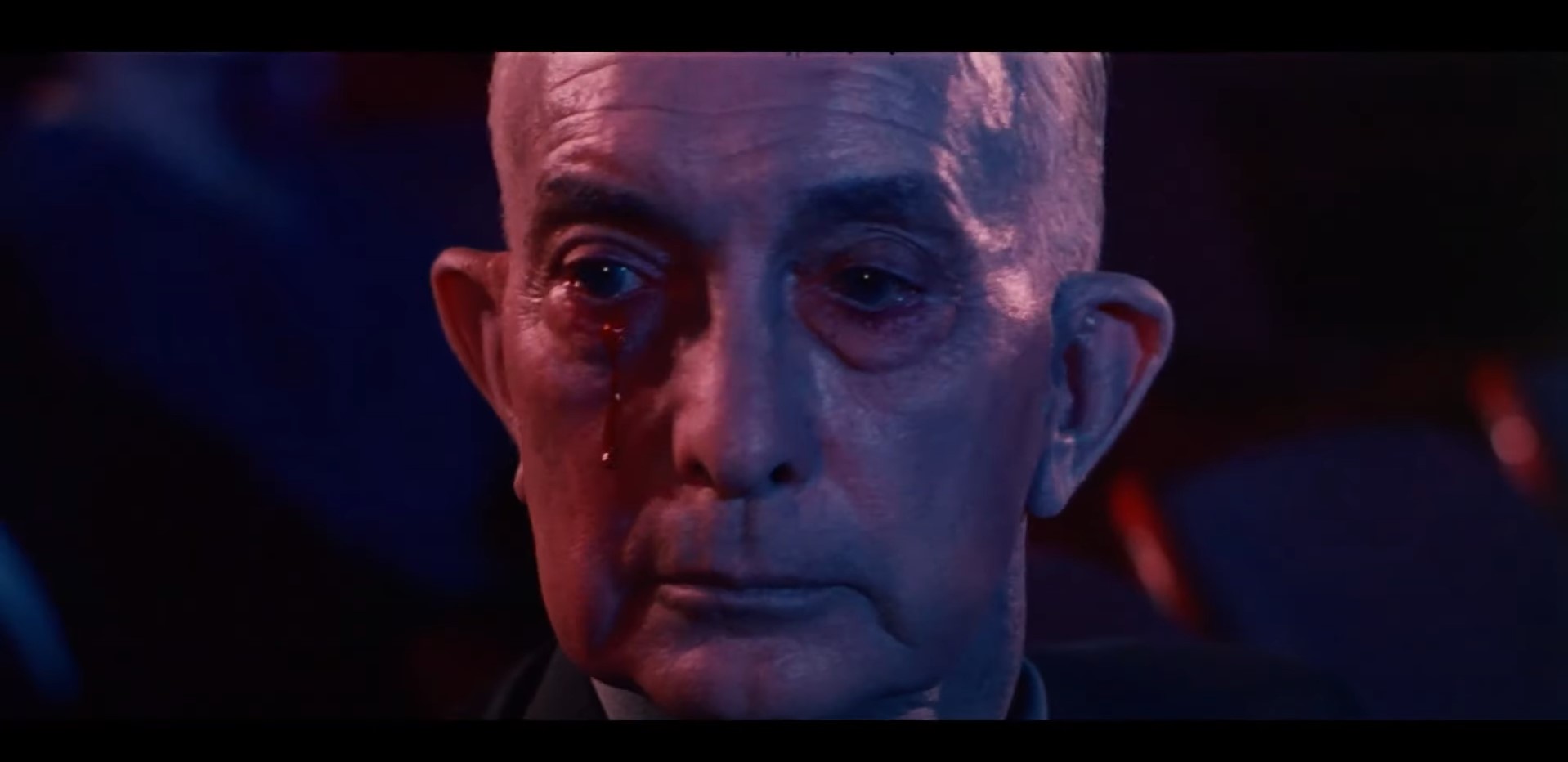
Huyck directs with colorful and verismo synergism that takes the positives of what should be life’s routine pleasures and turns them against us as fantastical and harrowin deadly elements of false securities.  The rolling crashes of Point Dune’s waves takes on a constant cacophony of sinister foreshadowing, a bright and welcoming supermarket becomes a vacant trap in every aisle, the entertaining movie theater darkens with blood on the screen, and an artist’s home, full realistic murals and colors, is an oppressive feast of lifeless eyes.  Point Dune becomes a dead town, literally, as the inhabitants succumb to dark forces from beyond their years, turning primeval in their contemporary three-piece suits and evening blouses.  Huyck and Gatz story pulls inspiration from U.S. history and folklore to mark the 100-year return of spreading evil amongst the land, an evil that resorts to cannibalism by either spellbinding archfiend, an internal infection, or the rise of the undead and not just any mindless, shuffling, flesh-eating zombie but a transmogrified plotter able to move fast and think as a single unit with the touched by evil masse with telltale signs of a single rivel of blood seeping from out of their eye and their insatiable need to consume other people. ”Messiah of Evil” is not overtly graphic like George A. Romero zombies or like the unbridled number of zombie films to follow inspired by Romero’s zombie game-changing wake for the last 60 plus years, separating the flesh-eaters from Romero’s gut-gnashing, pale faced, and slow-walking undead and Huyck and Gatz’s transmitted pestilent receiving horde running fast in their best church shoes with vastly different traits. Huyck and Gatz dip into more eldritch means with the return of a paganistic dark stranger in a pared down explanation without explicitly being definitive who or what the dark stranger (a demon?Antichrist?) is that is driving foreboding signs to a doomsday-disseminating end. ”Messiah of Evil” thrives as the mysterious and strange fulcrum of the beginning of the end told through the point of view of young woman left to tell the world of what’s to come only to be about as believed as much as a man wearing a polka-dotted tutu who has delusions of unicorns dancing the waltz with garden gnomes in his front yard. 

United Kingdom distributor Radiance Films releases a new restoration transfer of “Messiah of Evil” also on their U.S. line. The AVC encoded, 1080p high-definition, BD50 presents a 4K scan of the best-known surviving 35mm print from the Academy Film Archive in a widescreen 2.35:1 aspect ratio. As noted in the release’s inserted booklet, the restoration processes used was the Digital Vision’s Phoenix Finish and DaVinci Resolve was used for color correction, under the supervision of Sebastian del Castillo at the Heavenly Movie Corporation. Audio was also restored with the Izotope RXB. For a surviving print, the original elements look pretty darn good with barely any celluloid hiccup. No vinegar syndrome, not significant tearing, or exposure to name a few issues of possibility. There are a few minor blemishes and missing or damaged frames that seem to provide an unwanted cut but most of “Messiah of Evil’s” film problems stem mostly behind the camera with a rework of the story during the stop-and-go production and conflicts in marketing the film, hence the various title aliases of the film from around the globe. Other detail low points are when the film is bathed in blue and purple gels and tint for to set an apprehensive wander and wonder while retaining more natural grading in its majority throughout. The resorted audio is a lossless English LPCM mono mix. Really focusing on the electronic score of Phillan Bishop (“The Severed Arm”), the low-frequency score sets a perpetual and durable tone of dread out of place in a prosaic small town, much like the Arletty’s father’s work-of-art home that sticks out amongst the mediocrity. In design, dialogue remains robust yet delicate when the scene calls for it, such as Elisha Cook Jr. story of how he was born in what is essentially him, as a vagrant paid for his story, making the only noise in the room. Dialogue in these moments is greatly discernible with negligible electronic interference. Depth layers the permeating isolation of a town gone mad in unison with the range stretching from the distressing design of rolling, crashing, oppressive waves to the scuffles of zombies’ consuls and heels scuffing against asphalt, pavement, and shattering through panes of glass. Radiance provides English subtitles with their release. Bonus features include a new audio commentary by film historian and horror archetype authors Kim Newman and Stephen Thrower, an archived interview with director Willard Huyck, and a new, feature-length documentary showcasing “Messiah of Evil’s” background, themes, production, and influences by various horror scholars, including Kat Ellinger who also voiceovers a visual essay on American Gothic and Female Hysteria, which if I’m being honest, parallelly treads on similarities with Ellinger’s Motherhood & Madness: Mia Farrow and the Female Gothic on Imprint’s “The Haunting of Julia.” Radiance has in the short time poured their heart and soul into their releases and “Messiah of Evil” is no different with a sleek cladded and clear Amara Blu-ray case that’s subtle in showing less but feeling more on the cover art, opposite of the reverse side that houses a classical black and white compositional illustration of characters. Inside the 28th release for the label is a 23-page color booklet insert with the appraisal writings of Bill Ackerman, transfer notes, release credits, and acknowledgements. The disc is pressed red, much like the red moon in the film, with a stark black title. The Radiance release is unrated, region free, and has a runtime of 90 minutes. ”Messiah of Evil” uses cult fears, satanic panic, and the loss of ordinary life to penetrate the spirit by way of slowly eating at it. The crawling, creeping dread meanders, much like Artletty who is seemingly held in place at Point Dune, and we’re glued to the engrossing rate of the terror to come orchestrated by the captivations of a once married couple on a fast track toward success.

The “Messiah of Evil” has Come to Blu-ray Home Video!

The Slammer is Full of Correctional Officer EVIL in “Lust for Freedom” reviewed!

The Jailed Chicks “Lust for Freedom” on Blu-ray!

Broken by the violent death of her partner, who she was also engaged to marry, after a drug bust goes south, undercover officer Gillian Kaites abandons law enforcement and drives across country in an internal turmoiled mess.  She’s pulled over by a Georgia County cop after she aids a frantic woman fleeing to escape two men in a black van.  Framed for narcotics possession by the corrupt officer, Gillian is drugged and locked away in the County’s women’s penitentiary overseen a strong-handed matron and an unscrupulous warden who dabbles in prostitution trafficking, drug smuggling, and even the occasional snuff filmmaking.  Back into a cellblock corner, Gillian must defend herself against the warden’s goons, protect other girls also falsely incarcerated, and lean into the sympathetic ear of the same corrupt cop that framed her after voicing his years of disgust with the warden’s malfeasance.

Part II of our bamboozled behind bars and following the 1986 examination of Eric Karson’s military simulation turned enslavement “Opposing Force,” is our next feature helmed by another director named Eric, notably Eric Louzil, with “Lust for Freedom.”  The debut film of Louzil, who went on to helm “Class of Nuke ‘Em High Part II and Part II” for Lloyd Kauman and Michael Herz of Troma Entertainment as well as slaving over standalone horror and sleazy schlockers in “Bikini Beach Race” and “Night of the Beast,” was also the first feature penned by the American-born, UCLA grad with a penchant for low-budget lewidies, cowritten alongside the “Shadows Run Black” writing duo, Craig Kusaba and Duke Howard.  With the working title of “Georgia County Lockup,” which in actuality the film was shot in various California and Nevada locations, such as Ely, Nevada, “Lust for Freedom” is an 8 x 8 cell of nudity, violence, and corruption under the co-production companies of Mesa Films and Troma Entertainment, with the latter reediting the original script and adding ADR adlibs to apply a sexed up and Troma-fied integration of product into their independent collection.  Louzil and Laurel A. Koernig produce the film with Troma bigwigs Lloyd Kaufman and Michael Herz as executive producers.

“Lust for Freedom” has many eccentric characters with many assorted plotlines in what is essentially an all women battle royal brawl in the cat-scratchin calaboose.  Stirring up trouble like a piece of scrap metal lodged in the gears of a well-oiled machine is tall and beautiful former cop, Gillian Kaites.  Played by Melanie Coll in her only known role, Kaites is only the bear in the bees’ nest, forced into confinement under false pretenses and to be subjugated by the likes of a wayward officialdom with lust in their eyes, greed in their pockets, and a disdain for disobedience.  Coll’s a bit flat footed with her performance and her Karate Kokutsu Dachi stance could use some improvement, but the tall, muscular, curly haired and light blonde actress can wield a multi-round popping automatic rifle with authority.  Stark against her Amazonian physique, not in a hard pressed and sexualized way, is main antagonist is the unbecoming Southern gentleman Warden Maxwell under the balding and overweight guise Howard Knight, but Kaites is more in tune against the procrustean penitentiary matron Ms. Pusker and Judi Trevor gives a Hell in a cell pastiche of early fascist women of Roger Corman produced WIP films, enforcing her will with prison muscle in the miscreant tough Vicky (Elizabeth Carlisle, “Evil Acts”) and the oversized guerilla (professional wrestler Dee “Matilda the Hun” Booher, “Spaceballs,” “DeathStalker II”).  Ultimately, Kaites sees her only path to escape through the very same person that wrongly confines her in the first place.  William J. Kulzer (“Class of Nuke ‘Em High Part II:  Subhumanoid Meltdown”) doesn’t quite fit the corrupted bill of Sheriff Coale, a mild manner and seemingly reasonable officer who goes with the despicable flow of sex trafficking amongst other indelicacies.  Yet, maybe that’s the purpose in Kulzer’s character, to be conflicted by the choices he and his callous cohort has made that made him stick out as the least repulsive individual behind the concreate and metal barred big house.  “Lust for Freedom” rounds out the cast with Donna Lederer, John Tallman, George Engelson, Rob Rosen, Shea Porter, Rich Crews, Raymond Oceans, Elizabeth Carroll, Lor Stickel, and Joan Tixei.

Gratuitous, full-frontal lesbian sex.  Yes, “Lust for Freedom” appeals to the very definition of its own title, like many other WIP productions and though a core element to the integrity of the subgenre, the creamy smoothness of two curvaceous, naked bodies getting it on shouldn’t always be the main selling point.  Luckily, Louzil ponies up more salacious material for his pinks in the clink caper.  An elaborate spiderweb of activity balloons and pulsates outward from the moment Kaites crosses path with an evening-dressed escapee being chased by a scary looking Native American and his sociopathic hooligan partner in a black van.  “Lust for Freedom” may be hammy and cheesy but what it’s definitely not is dull in its multifaceted approach to expose character layers.  Some characters grade more toward deviancy, such as Warden Maxwell and Ms. Pusker, while others are lifted toward a more redemptive means, such as with Sheriff Coale; that shepherd “Lust for Freedom” into a culminating jailbreak.  The narrative doesn’t necessarily focus around Kaites but she’s on a redemption arc to dig her out of a despair pit and into a fight worth fighting for purpose after the death of her finance, set up in the opening act.  As she evades the Vickey’s directed infringement to rough up the new girl, Kaites takes under her wing a fright clink chick named, another wrongly accused prisoner after being taken wandering the road, a theme that is a reoccurring motif from Kaites to Donna in thinking the young women can manage the world and their problems on their own accord but at a cost. However, whatever semblance is left of Louzil’s original script has likely been lost once Troma revamped it into the finished product you see today. Riddled with choppy cuts and incoherent segues, we have to wonder about Kaites’ role that may have been transmuted into a lesser core commodity in the final product.

Troma Entertainment releases a high-def, Blu-ray release of “Lust for Freedom.” The AVC encoded, 1080p resolution, widescreen release, in a 1.78:1 aspect ratio, compressed from its original aspect ratio of 1.85:1. Lloyd Kaufman mentions Louzil had shot the film on 16 mm and Troma subsequently blew up the negative to a 35 mm print that reframes the transfer for projection. Image-wise, the picture appears relatively clean albeit a plush grain and a few visible 16 mm cigarette burns with little-to-no age wear or exposure issue and the BD25 storage format has capacity aplenty to render an adequately compressed image with hardly any loss to the quality. Since the quality is heavily granulated, definitely no DNR implemented, the compression doesn’t suffer from a lack of a sharper, restored image. The audio is an English language Dolby Digital 2.0 Stereo can be echoey at times, as if the boom is catching warehouse reflection, but dialogue does topple in an appropriately laid out track mix that’s intertwined with hair metal band Grim Reaper’s titular “Lust for Freedom” single. We don’t get a ton of depth in the close quarters of the prison set but neither do we receive any depth in the exteriors either, sustaining most of the volume in a forefront stasis. Troma adds spotty ADR to kitschy up to Troma’s ludicrous level and its quite evident like a sore thumb that doesn’t quite match the ingrained audio mix. There are no subtitles available. Extras include the original DVD intro by Lloyd Kaufman, which also plays automatically at the startup of the feature, a directory’s commentary by Eric Louzil that is asynchronous with the feature in what is an approx. one-minute delay behind the Louzil’s retrospect, the original theatrical trailer, an interview with Lloyd Kaufman, a brief, brief clip of Eli Roth’s encouragement to just go and do a movie to the best of your ability, a Troma-themed showcase of one of their more modern Tromettes – Mercedes the Muse, the Radiation March, Gizzard Face 2: The Return of Gizzard Face, which has been on a slew of Troma’s releases over the past year, and coming attractions from the independent company. The Blu-ray comes in a tradition snapper with a guard tower, barbed wired, and Gillian Kaites with a semi-auto in her grip and barely cladded and torn clothes. No insert inside the case and the disc pressed art is the same as the cover illustration. This Troma release comes unrated, is region free, and has a runtime of 94 minutes. Plenty of desire for “Lust for Freedom,” busty babes behind bars barely bores and this vintage Troma keeps the WIP lacquer wet with self-satisfactory sadism and sexual spiciness.

The Jailed Chicks “Lust for Freedom” on Blu-ray!

Heart and Body Reunited Forges Immortal EVIL! “Witchtrap” reviewed! (MVD Visual / Blu-ray)

Get Caught in the “Witchtrap” on Blu-ray!

A motley crew of parapsychologists and private security are hired to investigate the haunted house of powerful warlock and accused serial killer Avery Lauter.  Before the graveyard side home can be turned into a themed Bed & Breakfast by Lauter’s inheriting next of kin, the team is brought in to eradicate the infamous house of any kind of malevolent spirits after the mysterious and gruesome death of a magician who agreed to stay at the house as a test run of the level of malignance.  When the investigators make contact with a confident and evil Lauter, the warlock tricks them by using the team’s physical medium to murder a far-too-inquisitive investigator one-by-one in order to finish a satanic ritual he started before his death that will make him immortal.  It’s up to non-believer, and wise-cracking, private detective Tony Vincente to make sense of the murders and put an end of Lauter’s reign of terror from beyond the grave before it’s too late.

A necromantically-charged slaughterhouse of a film, “Witchtrap” is the 1989 phantasmal thriller of the omnipresent, omni-powerful dead versus a group of clueless living always one-step behind in attempting to make sense of everything.  Also known as “The Haunted” or “The Presence,” the Kevin S. Tenney written-and-directed film succeeds the director’s cult classic “Night of the Demons” and Tenney’s debut film “Witchboard,” which is not a sequel to “Witchtrap” despite a similar title and the hiring of some of the same actors.  Shot in Fairfield, California on a 400K budget, the independence production showcases topnotch gore and pyro effects from makeup artist Judy Yonemoto (“Dance or Die,” “The Newlydeads”) and special effects supervisor Tassilo Baur (“House,” “DeepStar Six”) and is produced by Tenney alongside Daniel Duncan under Mentone Pictures; Duncan also produced Tenney’s “Brain Dead” later in the filmmaker’s career.  Cinema Plus, represented by executive producer Ryan Carroll, serves as the presenting company.

Tenney has been noted saying “Witchtrap” was a gift for the actors who have stuck with him over the years, playing pivotal parts in his student films that pole-vaulted his career into being a cult horror director.  “Witchtrap’s” leading man, James W. Quinn, has worked with Tenny since grade school and was cast in a principal role in “Witchboard” as well as in a minor role in “Night of the Demons.”  Quinn’s Tony Vincente is by far the best dialogue deliverer of the principal ensemble with a smartass ex-cop script that highlights Quinn to be the good guy but while being a complete jerk.  The rest of the cast is painfully flat, with little-to-no inflections, and a severe lack of dynamism or gesticulation that, despite how interesting their character backgrounds are, are just too dull with monotone script-reading.  “Night Visitor’s” Kathleen Bailey is likely the second best to liven up her character of Whitney O’Shea, the religious and reluctant physical medium with shark thrashing spams every time Avery Lauter channels her for to violently wipe out a parapsychologist team member, spearheaded by an eager ghost trapper Dr. Agnes Goldberg (Judy Tatum, “Witchboard”) and her mental medium husband Felix (Rob Zapple), and the accompanying private security forces that also include Vincente’s partner Levi Jackson (Clyde Talley II) and boss man Murphy (Jack W. Thompson).  Dangerous ambitions and irrational greed stir the pot between each of these groupings that side with personal stake over the safety of their existence that make for better character building underneath the rickety performance framing.  And, of course, we can’t neglect mentioning Linnea Quigley bringing up the rear with her rear as the bleached blonde, cropped seater topped A/V technician that can capture ghosts with her ectoplasm detecting gear.  Quigley, and also Judy Tatum, provide a bit of T&A, especially Quigley with an eye-popping full frontal in the prime of her career.  The remaining cast includes Hal Havins (“Sorority Babes in the Slimeball Bowl-O-Rama”) as the creepy groundskeeper and J.P. Luebsen (“Witchboard”) as the cap-wearing and wild-eyed bearded warlock Avery Lauter. 

Oddly enough, what makes “Witchrap” entertainingly great, is Tenney’s attractive and amusing dialogue.  Between the quips, banters, diatribes, and the depth conversations, Tenney formulates a dialogue that can match or even surpass the outstanding special effects that course through the narrative.  Without Vincente’s brutal mockery of the entire paranormal research and investigation scheme as well as an unmercifully, nonstop degrading position toward his contentious boss, left with only the tedious prosaic to hear, “Witchtrap” would be one of those great-gore, dull-dialogue features that force your hand to fast-forward to the good parts in order to not pass out asleep from the in between drag.  Instead, “Witchtrap” is 80’s cult-horror treasure, comfortably embedded somewhere between the cinematic Earth’s lithosphere and asthenosphere layers just waiting for someone to unearth and dust off its sheening crimson colored cabochon.  Definitely not elevated horror that makes one think about the auteur intended message, the feature remains true to Tenney’s previous like-mad credits with an outlandish and mortally fair game theurgy that’s surface-level eye candy and audibly dulcet, despite the audio recording snafu that sent the entire dialogue track to the post-production recording studio.  Though producers and marketing attempted to cash-in on “Witchboard’s” moderate success with a similar, familiar title, “The Haunted” and “The Presence” are no more than generic designation fodder that lacked tremendous flavor; “Witchtrap’s” a kitschy and blunt title that works and literally estimates what audiences should and will expect although Avery Lauter is a Warlock and not necessarily a witch per se. 

A part of the Eric Wilkinson’s throwback video club and Rewind Collection series from MVD Visual, “Witchtrap” arrives a fully restored, high-definition Blu-ray, presented on an AVE encoded, 1080p, BD50 and in a widescreen 1.85:1 aspect ratio.  This transfer essentially mirrors the Vinegar Syndrome release a few years back that had reinstated many of the MPAA cuts the general public hasn’t laid eyes for nearly 30 years until 2016.  Picture quality retains a fresh, renewed look without compromising the natural characteristics, such as grain, of the 35 mm celluloid.  There are sporadic scenes that slip due to generational loss but, for the most part, a solid 2K scan restoration of the interpositive. The English LPCM 2.0 mono track is post-production concomitant due to an inexperienced sound mixer that resulted overbearing hum throughout the dialogue. ADR was introduced in post subsequently diminishing depth and creating an artificial sounding mix with a silver lining being a near perfect match for actor emotionality, inflections, and synchronization. Optional English subtitles are available. Bonus material includes a commentary track with director Kevin Tenney, producer Dan Duncan, Cinematographer Tom Jewett, and actor Hal Havins. Also included are interviews with Kevin Tenney, Linnea Quigley, Tom Jewett, and Tassilo Baur who more-or-less say a lot of the same retrospective accounts regarding “Witchtrap’s” sound issues, pranks on Kevin Tenny, cheap film hints outside of L.A., and how constrained the budget was. This release also comes with the edited VHS version at 92-minutes, same as the Blu-ray, a photo gallery, and the original trailer. Physical features include a sweet throwback cardboard O-Slipcover of the original poster compressed inside a 1-inch, matte red border that’s back and front. The O-slip covers a clear Blu-ray case that holds a reversible Rewind Collection cover art that’s roughly the same as slipcover poster art with cropped out credits for a vivid red filled, white-lined title. On the other side of the cover is alternative European cover art of a puffy white cloud merged with a demonic face hovering over a white picket fenced house, reminiscent of the MGM “Return of the Living Dead” or the original Columbia “Fright Night” DVD covers. Inside the case is a folded mini-poster of the factory-wrapped front cover. MVD’s release is rated R and comes region free. “Witchtrap” epitomizes restless ghost syndrome with a head coup de grace motif and is a seance that conjures potent witty dialogue to hoist Kevin Tenney’s third feature up to another plane of existence.

Get Caught in the “Witchtrap” on Blu-ray!