EVIL’s Beauty is in Her Catwalk Madness! “Nothing Underneath” reviewed! (Rustblade / Blu-ray)

“Nothing Underneath” 40th Anniversary Blu-ray Available Here!

Bob Crane, a Wyoming park ranger, suddenly sees visions of gloved hands wielding long, sharp shears entering his supermodel, twin sister’s hotel room in Milan, Italy.  His  psychic experience with his sister sends him packing frantically to Italy, specifically to the Hotel Scala, where his sister, amongst many other gorgeous supermodels, reside when working in Milan.  Unable to locate her and without a sign of disturbance in her hotel room, her disappearance is seemingly nothing more than that – a disappearance – but an aging police detective, Commissario Danesi, is willing to investigate the disappearance which will be his very last case before retirement.  Without any leads, Crane and Danesi don’t have much evidence to go off of until another supermodel is brutally murdered in the same hotel and a pair of scissors is the forensically determined cause of death.  The once case of disappearance now turns into a murder investigation and goes deeper into the ugliness of the fashion world with a deranged killer targeting supermodels. 

Considered to be a prominent gem of the giallo genre but not entirely considered to be a full-fledged horror by the filmmakers is Carlo Vanzina’s “Nothing Underneath.”  Known natively as  “Sotto il vestito niente,” inspired by the title only written by Marco Parma, a pseudonym for journalist Paolo Pietroni, Vanzina cowrote the novel extraneous story alongside brother Enrico Vanzina (“Call Girl”), who are siblings more suited in the measures of comedic premises initially, and the prolific horror writer Franco Ferrini’s, whose screenplays of Dario Argento’s “Phenomena,” “Opera,” “The Card Player,” and amongst others, as well as Lamberta Bava’s “Demons”, gave the writer formidable cult status and creditability amongst the international horror fan base, not to forget to mention regular work and collaboration with a master of horror, Dario Argento.  “Nothing Underneath” is shot on location in Milan under the Faso Film productions with executive producer Raffaello Saragò (“The Witches’ Sabbath”) and producer Achille Manzotti (“Beyond Darkness”).
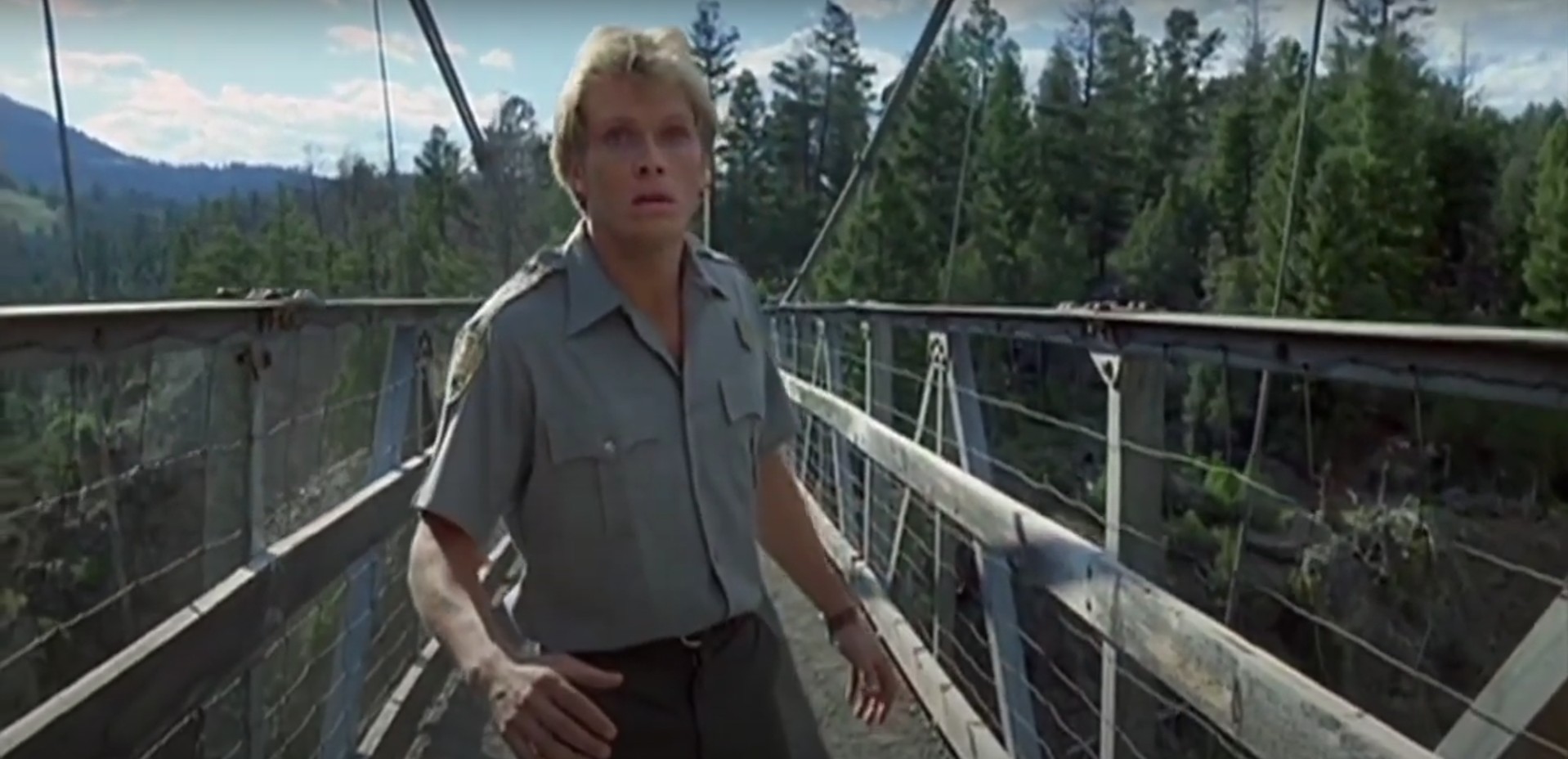
What’s interesting and more infrequent for this Italian production is that it’s entirely shot in English and not dubbed in post-production ADR.  Reason for this was for “Nothing Underneath” to be a synch-sound production with the image and to market it better internationally because of the main cast comprised of American and English actors.  The American actor, starring in his debut feature film, is Tom Schanley (“Savage”) as Wyomning park ranger Bob Crane and the way the story is structure really homes in Crane as the principal lead with a complete credit setup and character follow-through of the Yellowstone National Park.  Schanley’s blonde hair and muscular toned good looks embodies a likeness to his on-screen supermodel sister, played by Nicola Perring, who, as the story displays her, is not in the business of acting with very little dialogue and is only used for her short platinum blonde hair and thin figure for narrative form fitting.   The other native English speaker in a cooperative lead role is “Halloween’s” Donald Pleasence as an investigator on the verge of retirement.  Pleasence is no stranger to Italian cinema, seeing his fair share in the 1980’s psychotronic pictures, including Dario Argento’s “Phenomena” released prior.  The prolific British actor still manages to produce mountains of charm even in his most rubbish Italian accent as the long in the tooth comminssario eager to solve one more exciting, mysterious case and buddying up with young, handsome, and outdoorsy Bob Crane with twintuition.   The love interest falls upon real life model and Denmark native, then 19-year-old Renée Simonsen who is absolutely stunning with her looks and with her debut into acting in what is a significant role that involves a lot of screentime, a lot of dynamic and interactive dialogue, and does show some brief nudity with intimate sexual situations with Schanley.  “Nothing Underneath” has a roster that fills out with Catherine Noyes and Maria McDonald as Milan models, Paolo Tomei as a coke-head jeweler and model philanderer, Cyrus Elias as Comminssario’s Danesi’s assistant, and Phillip Wong as the peculiar fashion photographer Keno Masayuki.

“Nothing Underneath” isn’t a skimpy, loose garment with nothing going for it.  Instead, Carlo Vanzina offers more with his giallo by making it less giallo in terms of its cinematic style and with Pino Donaggio’s score which is in the style of, much like the rest of the filmed and narrative structure, a Brian De Palma erotic thriller.  With plenty of sexy sashaying from beautiful models, a balance between sex and sadism teeters as the alluring aspects of a promiscuously titled are dissected and interspersed with a long sheer psycho engrossed by a theme rarely explored and depicted, but certainly skimmed, during those times of 1980’s Europe and completely disconnected from Paolo Pietroni’s story with keeping only the fashion world and the murder mystery as core elements and adding a supernatural flavoring with the brother and sister telepathy.  Donaggio’s suspenseful brass orchestration and conduit synth-infusion score separate itself others in the subcategory that deploy synth-rock, haunting discord, and, perhaps, even a late 70’s swanky cop thriller piece typically layered alongside.  The composition, coinciding with the temporary expat cast as most giallo’s permit, often feels more westernized while still striking notes of unnerving tension and having collaborated with De Palma on “Dressed to Kill” and “Body Double” years prior, Donaggio imports those arrangement qualities for the Italian market and reaping success amongst the rest of the frayed giallo conventions. 

Italian boutique label Rustblade extends their release of “Sotto il Vestito Niente,” aka “Nothing Underneath” to the North American market with a new region free, 40th anniversary special edition Blu-ray release as well as releasing deluxe releases that come with accompanying limited edition lobby cards postcards, a polaroid, a poster, a colored vinyl, a book, CD soundtrack, a tote bag, and even, yes you’re going to read this correctly, underwear.  The standard release isn’t that supplementally sexy but does have great standalone supplementals in its AVC encoded, 1080p full hi-def, BD50.  The newly restored version stems from the original 35mm negative and presented in 1.85:1 widescreen aspect ratio.  The negative print looks to have been in pristine condition that rendered an impeccable transfer that fully provides depth and detail accentuated by well-adjusted and put together color grading that elevates the pop of the natural hues.  No signs of compression issues or smoothing over with sharp detail textures on skin and fabrics alike as well as the metallic shears having reflective qualities as it sheens and shines in mirrored property.  Two audio options are available, an Italian DTS Master Audio 2.0 Mono and an English DTS Master Audio 2.0 Stereo, the latter comes from the English living synch recording mixed in Dolby Stereo.  The English track is preferred here as its natural with innate reflections and tones of the actors on screen.  I noticed brief moments of Italian actors being English dubbed as a mismatch in the A/V synchronization as well as a disturbance in the aural consistency.  The dialogue track has prominence but has intermittent hissing and crackling, likely from the video-synch recording.  English, Italian, Spanish, and German subtitle are available.  Special features include interviews with co-writer Enrico Vanzina and composer Pino Donaggio, plus a film analysis by Francesco Lomuscio, the theatrical trailer, and a still image gallery.  For the standard packaging, the clear Amaray encasement has the supermodel in sheer and blood artwork used in previous DVD and Blu-ray versions and the reverse side as a still image with the opposite a black and red silhouette of shears and blood drop splatters.  The disc is pressed with the same cover art image.  Rustblade’s release is not rated and has a total runtime of 94 minutes.

Last Rites: Rustblade’s 40th Anniversary Edition Blu-ray of Carlo Vanzina’s “Nothing Underneath” is a great leap toward a go-to less giallo that’s tragically overlooked and underappreciated but ranks high above the bar and near the top sure to please in seduction and in murder.

“Nothing Underneath” 40th Anniversary Blu-ray Available Here!

EVIL’s Brew Just Needs a Severed Head! “The House of Witchcraft” reviewed! (Cauldron Films / Blu-ray)

“The House of Witchcraft,” a part of The Houses oof Doom series, Now on Blu-ray!

Luca Palmer has experienced the same reoccurring nightmare for months of him finding shelter from being chased inside a large countryside house with an ugly hag boiling his severed head in a large cauldron.  The dreams have required him to find professional help in a psychiatric ward but without any real mental or physical health concerns, he’s released to his incompatible, witchcraft practicing wife Martha who sets up a country house getaway in a last ditch effort to save their dwindling marriage.  When they pull up to the house, Luca immediately recognizes it from his nightmares.  From then on Luca believe he’s seeing the malicious old woman from his dreams around on the estate grounds and urges his psychiatrist, who is also his late brother’s wife, to visit him to assess his state of mind, but the visions keep coming and those around him keep dying a horrible death with his wife being the key suspect of witchcraft related deaths.

“La casa del sortilegio,” aka “The House of Witchcraft” is a made-for-television, witch-centric movie for the four-film series The Houses of Doom concept created under the companies of Dania Films and Reteitalia’s producing team Massimo Manasse and Marco Grillo Spina.  The 1989 witchy-slasher hybrid and the third film of the series is helmed by another notable Italian schlock and shock director, Umberto Lenzi (“Seven Blood-Stained Orchids,” Cannibal Ferox”), as well as Lenzi writing the script from the story of The Houses of Doom envisaging duo Gianfranco Clerici and Daniele Stroppa.  “The House of Witchcraft” speaks the very essence of what to expect in a traditional sense regarding witches while really stepping up with Italian nastiness inside the slasher principles, filmed in the heart of Italy in the popular Chianti wine municipality of Rufina where the landscape is lined with vineyards, churches, and castles.

Luca Palmer is committed to his mental health by committing himself to his sister-in-law’s psychiatric hospital after months of nightmares involving a witch and his severed head as the main ingredient for her boiling stew.  Perhaps, because of his rocky relationship with wife Martha, played by French actress Sonia Petrovna (“Flashing Lights”), Luca just needed a break from her witchcraft obsession and loveless aloofness to clear his head.  Either way, the American-born and ‘Naked Rage” actor Andy J. Forest is one of Umberto Lenzi’s go-to action stars, of such Lenzi’s war films “Bridge to Hell” and “The Kiss of the Cobra”, whose taken off the film battlefield and positioned as the confounded centerpiece of a cackling witch tale, completing his task as a the tall, handsome, and flawed hero of a man haunted and driven by unpleasant night terrors of the long face, broad features of the fittingly named Maria Cumani Qausimodo as the dolled-down witch.  Quasimodo is no stranger to the filth and frights of Italian schlock with roles in “Behind Convent Walls,” “Five Women for the Killer,” and even the notoriously porn augmented “Caligula” and her physical traits, long stare of blue eyes, and pandering of character’s wickedness transform her into an ideal archetype of the original folk-acholic Brewmeisters.  Characters for the slaughter tin this supernatural slasher and to be intertwined into the suspect and innocent pool are played by Paul Muller (“Lady Frankenstein”), as the sixth sense blind homeowner Andrew Mason, Marina Giulia Cavalli (“Alien from the Deep”) as Andrew’s visiting niece Sharon, Susanna Martinkova (“Fracchia Vs. Dracula”) as the psychiatrist sister-in-law Dr. Elsa Palmer, and Maria Stella Musy as the doctor’s daughter Debra tagging along with her mother to visit the barely mentally managing Luca. 

Umberto Lenzi’s rollercoaster career has seen its fair share of misses overtop what are today considered trashy, cult triumphs that lure fans to seek out his even lesser known, poorly critiqued titles more often than required for any more than the casual horror moviegoer. However, “The House of Witchcraft” is not one of those latter, threadbare produced pictures as Lenzi instills more aesthetic style and cinematic substance of searing phantasmic enthrall and danger with an unwavering villainess vile down to her very rotten teeth and scraggly, gray hair.  Offing houseguests left and right is the witch’s supernatural birthright but why exactly Luca Palmer, a stressed out journalist, to be the target of precognitive events is more opaque than it is clairvoyantly evident but we get some great malevolent manipulation and sleight of hand with black cat familiars, bulgy maggot-infested corpses, unusual indoor freezing precipitation, severed heads, and a face transfiguration that’s pretty damn good that has no right to be in a Lenzi film, mostly in part to special f/x and makeup artist Giuseppe Ferranti (“Anthropophagus,” “Nightmare City’), his favorable, collaborative relationship with Lenzi, and the fact he’s locked into the 4-part film series The Houses of Doom provides him creative freedom, flexibility, and fluctuation in diversity.  “The House of Witchcraft” is not the one-all, be-all witch story but does scratch that warty itch in the foulest of cloak-wearing evils without flying a broomstick! 

The second of four Blu-rays for The Houses of Doom lineup produced by Cauldron Films, “The House of Witchcraft” is an AVC encoded, 1080p high-definition, BD50 with a transfer scanned into 2K, uncut and restored, from the original film negative.  Very similar to Lucio Fulci’s “The House of Clocks,” Cauldron Films scan is quite impeccable.  A pristine picture with no wear or tear and age deterioration, “The House of Witchcraft” is deep and rich with immense coloring timing efforts, defining an authentic look without overcorrecting to a fault.  There’s no perfunctory enhancing or extreme variability with contrasting, retaining a smooth, consistent picture quality throughout its European aspect 1.66:1 presentation.  Even in the more stylistic lighting work that creates clear tone of how the indoor snow should feel cold or the lightning strikes and wind brings a chill of ominous doom, there’s plenty of delineation to provide space and demarcations of depth between objects.  There are two DTS-HD 2.0 mono mixes with an ADR Italian and an ADR English dialogue.  Synchronously smooth, a noticeable dialogue separation between audio and video is not easily perceptible, which is kudos to the post work on the post-crew efforts, and Cauldron’s mixes have clarity without a fault in the compression means.  The two channel funneling of the mono output separates the dialogue and ambience/score.  Backing of the boiling cauldron stew or the knife swipes that severe heads and stab fleshy trunks, leaving impacting thuds and thwacks, are good examples of the conveyed foley audio that leaves a lasting impression through component construction in the audio design.  There are optional English subtitles on both language tracks.  Special features include Cauldron Films’ produced interviews with FX artist Elio Terribili Artisan of Mayhem, cinematographer Nino Celeste The House of Professionals, and a commentary track with Eugenio Erolani, Nathaniel Thompson, and Troy Howarth.  Also like “The House of Clocks” release, Matthew Therrien and Eric Lee compose a composition of illustrative graphic artistry of film’s decomposing and maniacally laughing madness and logo design for The Houses of Doom series on the front cover inside the clear Scanavo case.  Reverse cover has a still image of the black cat and the disc is pressed with the same front cover artwork but cropped to focus primarily of the witch with title and company logos at the bottom half.  The region free release has a runtime of 89 minutes.

Last Rites: Umberto Lenzi’s “The House of Witchcraft” casts a spell over the hex canon, beguiling it with mystery, enchanting it with surrealism, and bewitching it with blood. Cauldron Films’ Blu-ray is topnotch for an obscure made-for-TV Lenzi production.

“The House of Witchcraft,” a part of The Houses oof Doom series, Now on Blu-ray!

Babysitter Wanted….by EVIL! “The House of the Devil” reviewed! (Second Sight Films / Blu-ray)

University student Samantha is strapped for cash when trying to express her independence from an invasive and inconsiderate college roommate by renting a house.  In need of quick money to put down the first month’s rent by upcoming Monday, Samatha answers a babysitting billboard ad that leads her to an isolated house outside city limits on a night when the moon is going to be fully eclipsed.  Misled by her employers, the Ulmans, that the care job is not for a child, but rather Mrs. Ulman’s elderly mother and in her desperation, Samantha accepts the odd job for the money needed to secure her new home.  Alone in a dark old house, Samantha’s nerves quickly tingle and recoil at every sound and strange occurrence, quickly coming to realize the Ulmans may be lying to her more than she knows, especially behind the locked rooms where satanic secrets reside and she’s the key to their black practices during the occultation. 

Perhaps one of the hottest directors in the horror genre today with his “X” trilogy, within the trilogy is also “Pearl” and “MaXXXine,” Ti West has been a consistent genre filmmaker since his first feature “The Roost” two decades ago.  Yet, before the “X” trilogy, the year was 2009 when West caught the attention of horror fans with his 198’s inspired and veneered satanic panic film, “The House of the Devil.”  Shot in Connecticut, primarily in an older woman’s gothic Victorian style home, West wanted to bring back the alone babysitter and old dark house theme from decade the story is set, shooting entirely on 16mm that, too, provides that grainy image and darker aesthetic through each frame of the stock.  Initially called just “The House” in initial script treatments, Ti West’s completed film is a production of Larry Fessenden’s Glass Eye Pix (“The Last Winter”) in association with RingTheJing Entertainment and Construtovision with MPI Media Group (“Henry:  Portrait of a Serial Killer” presenting and is produced by Fessenden, Josh Braun (“Creep”), Derek Curl (“Stake Land”), Roger Kass (“A History of Violence”), and Peter Phok (“X”).

In her western, button-up plaid shirt and high-rise mom jeans, Jocelin Donahue (“Doctor Sleep,” “The Burrowers”) epitomized the look of young college girl of the 1980s and with her dialogue and her eclectic 2-minute dance session through the Ulman house proved she has the speech and movements that resemble the timeframe as well.  Donahue is extremely good of taking her character, Samantha Hughes, from a panic scale of one straight up to panic scale of ten in this slow burn, tension-building thriller that isn’t a rollercoaster ride of the next attention deficient disorder event but rather a steady increase of anxiety and anticipation that nags in the back of one’s mind.  Donahue has good reason to be as frightened as she appears on screen with the towering presence of the ever something’s-terribly-off-about-this-character portrayal by “Manhunter’s” Tom Noonan and the malicious grim of a steely wolf under a pearly sheep’s wool from “Night of the Comet’s” Mary Woronov as a pair of satanists.  Noonan and Woronov don’t have immense screentime and are behaviorally underused in the interactions with their babysitter Samantha as West intended target is for Samantha to dynamically degrade within the shadows and creaks of a creepy old house rather have characters be the foremost formidable, focused fear.  In the peripherals is Samatha’s wealthy and vocally blunt friend Megan (Greta Gerwig and, yes, the same Greta Gerwig who wrong and directed that “Barbie” movie) who provides that calling of rationality toward a strange situation only to find herself too wrapped up in her friend’s choices rather than seeing the danger that’s in front of her and there’s also fellow Satan cultist Victor (AJ Bowen, “You’re Next”) who is more or less the son in this Ulman trio of terror.  The cast rounds out with Heather Robb (“The Roost”) as Samantha’s inconsiderate roommate and the genre actor Dee Wallace (“Cujo”) in a small cameo role of the Landlady who, refreshingly, isn’t part of the core plot to burden the actress as an accelerant to pulse the heart of the story faster.

Ti West really did harness and recreate the dark, solemn energy of the alone babysitter and/or the old dark house subgenres that propelled films such as “When a Stranger Calls,” “Black Christmas,” and even “Halloween” into the cult favorite cosmos.  These particular horror categories are obviously nothing new to diehard fans but they have unfortunately been, for a lack of a better term, forgotten, conjured up only in stored memory banks of those old enough, like me, to have lived consciously through the 70s and 80s and, maybe because of West, audiences starting to see a revival of sorts with modern day retrograding to relive the golden age of the slasher renaissance, popularized by hardcore and gory scares with films like “All Hallows Eve” and the “Terrifier” trilogy,.  Yet, “The House of the Devil” is not an overly gory and squirmy disgusting feature as West meticulously structures the narrative to be evidently tense in an uncomfortable, unfamiliar environmental setting of an antiquated house owned by equally antiquated, and frankly weird, bunch in Tom Noonan and Mary Woronov and West guides audiences step-by-step very slowly up to craggy edge before pushing us violently into the infernal grips of satanists and the demons that seek a female vessel for, whom we presume will be, their unholy lord and destructor.  The third act rips ferociously in contrast to earlier acts in a spiral fit of rite and sacrifice that incorporates more characters, more blood, and a cynical ending that requires no more exposition, no more scenes, and no further explanation in its wayward wake. 

Second Sight Films delivers Satan to us with a new UK Blu-ray release.  The AVC encoded, 1080p high-definition, BD50 is jam-packed with bonus content and a more than satisfactory A/V package.  Presented in a widescreen aspect ratio of 1.78:1, the colorist reproduction leans into that of an 80s horror with a diffused, mid-level saturation of frame cells on 16mm stock, bestowing the image quality with more noticeable grain elements because of its smaller size blown up.  The seemingly white fleck-riddled darker areas or clustering grain experience may discourage audiences of a broad digital generation but for those who know, know how great “The House of the Devil” aesthetically looks as a whole, complete with era appropriate wardrobe and set dressings.  Textures and details do come through despite the stock naturalities but they’re not terribly overpowering or as substantially present an a mostly tan or brown color scheme in a lower contrast.  The English language DTS-HD 5.1 Master Audio offers superb audio reproduction and spatial dissemination, especially through the wood-laden house to where the strain creaks of wood floors and doors offer a side and back-channel chill.  There’s plenty of front loaded, two channel action between the dialogue and the rest of the meium-to-close range shots with a range of diegetic effects – i.e. gunshots, telephone rings, and other actionable movements within the frame – and non-diegetic effects that include demonic whisper through moveless lips and, of course, those creaky noises amongst the empty house.  Dialogue is clean, clear, and prominent throughout.  There are English subtitles optionally available for selection.  Second Sight films did a ton of legwork here for special features, conducting and encoding new interviews with director Ti West The Right Vibe, actress Jocelin Donahue Satanic Panic, actor AJ Bowen Slowing Down is Death, producer Peter Phok A Level of Ambition, producer Larry Fessenden An Enduring Title, director of photography Eliot Rockett It All Feels Appropriate, and composer Jeff Grace Hiding the Seams, sound designer Graham Reznick Writing Through Sound.  There are also a pair of audio commentaries with 1) writer-director Ti West and actress Jocelin Donahue and 2) West with producers Larry Fessenden and Peter Phok along with sound designer Graham Reznick and the rounds out with a making-of featurette, deleted scenes, and original trailer.  Since we’re reviewing the standard Blu-ray release from Second Sights, this version does not call with all the physical bells and whistles associated with the limited, rigid slipbox releases that contain lobby cards and booklet, usually.  Instead, the standard release is a streamlined, green-hued Blu-ray Amaray with uncredited illustrated artwork of Donahue’s character overtop of the titular house with the dark and spooky moon in the background.  Instead, is just the disc pressed with the same front cover image of the house sans Donahue and the moon.  The UK certified 18 release contains strong violence and gore, is hard encoded B for regional playback, and has a runtime of 95 minutes.

Last Rites: The 80’s knock back with Ti West’s satanic panic inspired alone babysitter thriller with a sleek new Blu-ray, overflowing with new retrospective interviews, from Second Sight Films!

The Jack-O-Lantern of EVIL Curses! “The Pumpkin Man” reviewed! (Scream Team Releasing / DVD)

Don’t Accidently Curse Yourself by Not Owning “The Pumpkin Man” on DVD!

The town of Cromwell lives and breathes off the demonic urban legend known as Pumpkin Man during the town’s full embracement of the Halloween season. College student Catherine, the town’s biggest savant of Pumpkin Man lore, has been given a tidbit of information of where to look for clues in discovering the lost book of spells that can summon the demon. After Catherine incantates the book’s passages, the frenetic young woman receives the intended reaction out of her friends, to scare the living daylights out of them with a legendary prank, but as true legend goes, those who read the words and summon Pumpkin Man back from the depths of Hell will become cursed to die by the demon’s elongated claws. Now, Catherine and her friends are haunted while they sleep, and their reality is twisted while awake as the Pumpkin Man toys with them until those who evoke his name is dead.

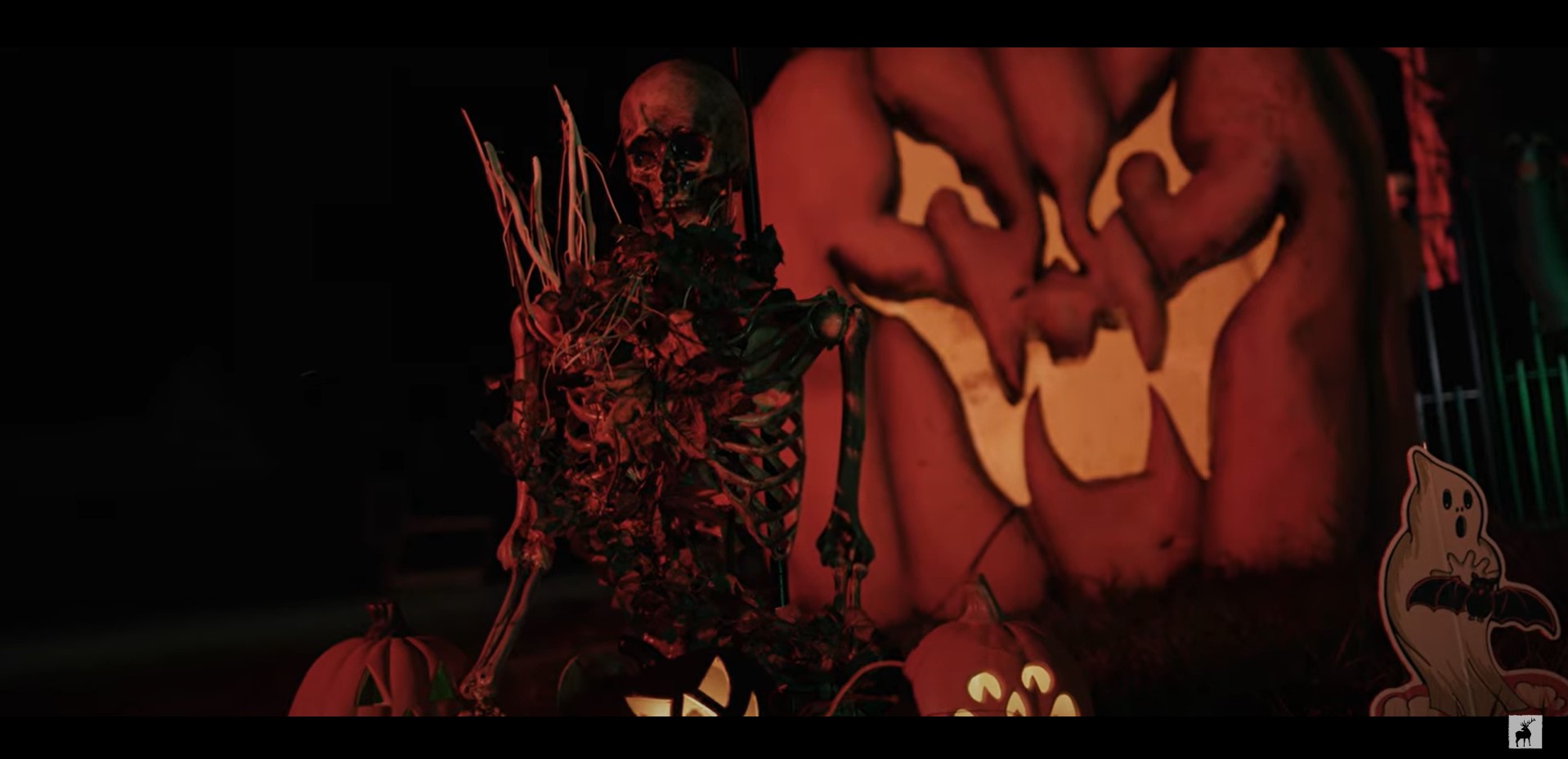
Halloween may be over, Thanksgiving too, but the spirit and the fear will always remain, especially when we all embark into the jolliest times of year.  There would be no shame in watching “The Pumpkin Man” while drinking hot cocoa and basking in the warm glow of your red, white, and green tree lights as you sit in the dark.  The glow of the television setup will keep you cozy and warm as a tall, pumpkin-headed demon literally rips the faces off cursed kids in director Ryan Sheets’ first feature-length film based off his short films series of the titular, iconic character.  Sheets’ inconspicuous indie franchise has spawned 5 short film sequels from the original 2016, 4-minute short, including a versus pitted against another Ryan Sheets’ regular character Kreepy the Clown.  Sheets cowrites the feature with Nick Romary, the original Pumpkin Man actor Jeff Rhodes, and his wife Janae Muchmore, pieced together by the central Florida team’s production company South Ridge Films with Sheets’ daytime colleague, fellow attorney Jason P. Herman, footing most of the bill as executive producer. 

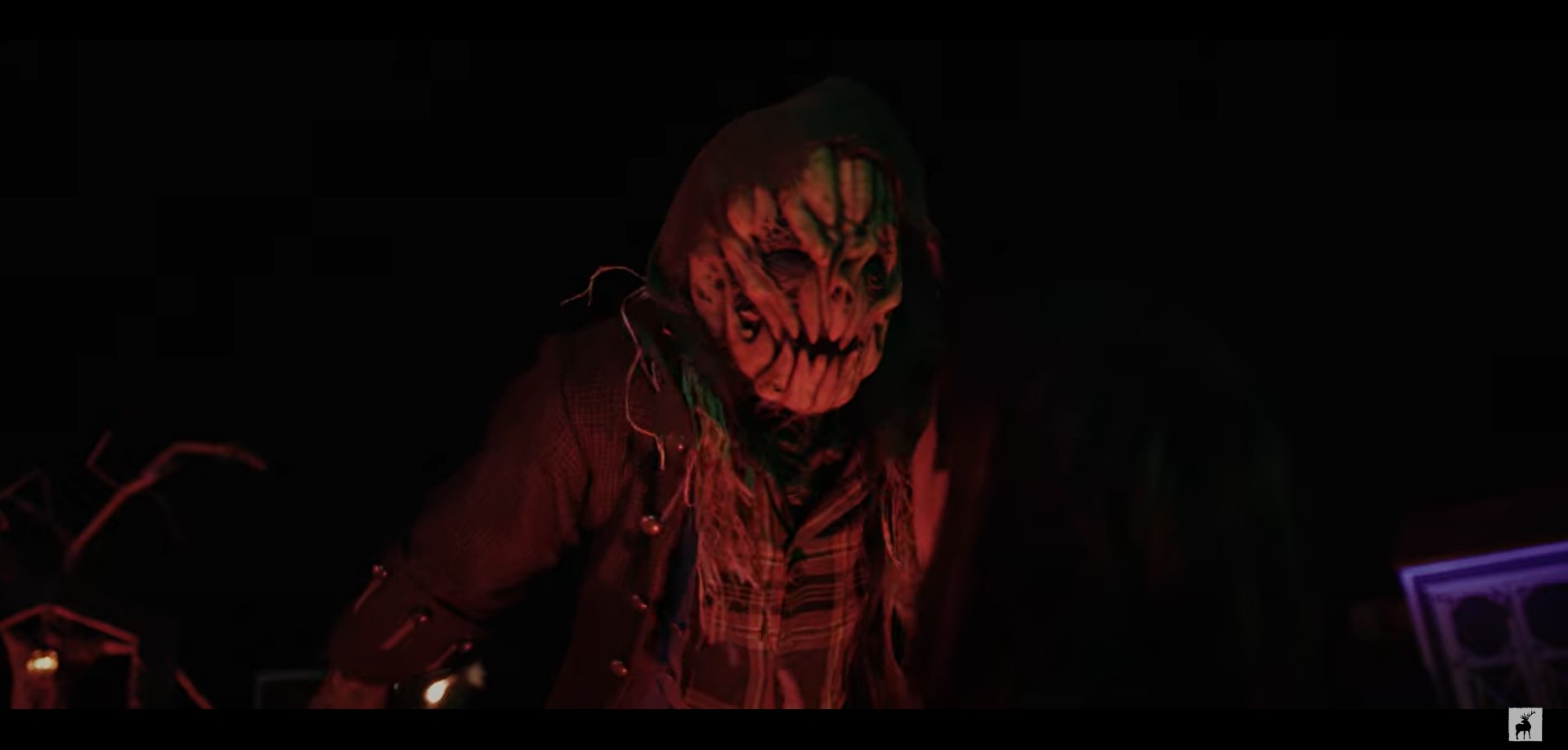
Unlike the shorts, the feature features a whole new cast of carefully crafted victims for the demon to shake up and slaughter.  Even the Pumpkin Man himself is not played by Jeff Rhodes, who previous played the titular villain by more slasher-esque means with a butcher’s knife and a slow gait.  Instead, Ryan Sheets reimagines Pumpkin Head’s supernatural aesthetic and bearing by playing the demon gourd himself, in stilts, with less Michael Myers essence, and providing a proper name for the demon of Fall known as Kürbis.  The holiday spirited demon with a Cromwell history of whomever summons him will be cursed to die by him plagues a new set of fool-hearted conjurers nearly three centuries after a supposed Cromwell witch took her own life to stop the demon.  The film introduces the first-time principal role for Barbara Desa, a social media influencer and Orlando-based actress with a ton of a spunk, as Catherine Quinn, a quirky, Kürbis-obsessed Cromwell denizen with no real substantial motivation for finding the lost book of Kürbis other than to play a Halloween trick on her friends and be heedless to the consequential power it holds.  This makes Catherine dangerously unstable, and she feels more like a villain than the Pumpkin Head when irresponsibly meddling with something she truly doesn’t understand, compromising not only her own life but her friends too for fun at their expense.  The development of supporting characters outshines the simpleton needs of the principal Catherine as her friends, and outside the clique but stay in close proximity, find themselves having to make choice, such examples lie with Catherine’s best friend Jenny (“Stephanie Kirves) who chooses the demise of another just to save her own skin while Cather’s cop older brother Tim (Estaban Abanto) can’t ignore the gruesome facts of his little sister’s involvement in a couple of Cromwell murders and disappearances.  There’s also Michael (Matthew Beaton), a potential love-interest for Catherine being pulled from out of the friend zone and into more flirtatious foundations but is quickly blocked by the presence of Pumpkin Man’s uncanny ability to enter dreams and stir their existence into an unbalanced waking nightmare.  “The Pumpkin Man” rounds out with more local Floridian casting with Ariel Taylor, Krysti Reif, and Josh Rutgers.

This isn’t the Great Pumpkin, Charlie Brown. “The Pumpkin Man” doesn’t start off super strong with a tattered accumulation of characters and backstory that barely carve out the shinier surface’s meatier pith that provides traces of sympathy and capability for situations and characters before the turning point turns dour.  Yet, if you stick around through “The Pumpkin Man’s” missteps, what you get is a progressively better reconstruction of a supernatural slasher that sees some decently gore-soaked effects for an independent production.  The added bonus being the cost-saving aspects of Sir Henry’s Haunted Trail, a Florida Halloween walk-through attraction that provides the spooky atmospherics and ghoulishly made-up cast of jump-scare actors as background or pop-in macabre aesthetics.  What starts as a demon resurrecting, potentially unleashing Hell on Earth represented by Halloween synecdoche, the story hits a turning point and switches gears toward slasher properties that work more ideally with a Freddy Krueger inspired killer, embodying the spirit of Halloween in a different and welcoming way than other Samhain-centric killers with a high seasonal watch repeat and an unforgettable antagonist.

Scream Team Releasing shows what happens when the pumpkin smashes back in “The Pumpkin Man” on DVD home video.  Presented in a widescreen 1.78:1 aspect ratio, the MPEG2, upscaled 1080p, single-layered DVD5 has lower image resolution because of the single layer compression that’s encoded with not only the feature but also a fair amount of bonus pumpkin batch content.  Black areas are not as clean and void with some noticeable posterization, details and overall picture crispness are not as sharp with a smoother contour between interior and exterior scenes, and coloring is often muted with missed opportunities for a punchier palette as the cinematography is completely ungraded, appearing as mostly raw, jittery footage underneath a more dynamic audio layer.  The lossless English Dolby Digital 2.0 stereo levels range from an anemic muffled to just at the edge of overextending the audio capacity but keep in line for better precision.  The diverse band soundtrack livens up downtime sequences to evoke a Halloween and rock or rockabilly mood and the sound design digs into the atmospherics with bug chirps, floorboard creaks, clock ticks, and the intertwinement of the brief ominous minor keys.  Dialogue is clean and clear, but Pumpkin Head’s post-added dialogue doesn’t ride parallel to the actor’s which is slightly isolated and boxy but is not terribly sync to make an audible make-or-break difference.  Extras include a director’s feature accompanying audio commentary with Ryan Sheets, a making-of featurette Carving a Pumpkin, Tales from the Book of Kürbis an 8-part short horror anthological series directed by Ryan Sheets, and two trailers.  The DVD comes with a Casey Booth designed cover art that’s yells diabolical autumn harvest with a disc pressed with a more traditional, evil-cut pumpkin head overtop the orange-colored, rough-carved, and spikey “The Pumpkin Man’ font.  The not rated DVD has a runtime of 91 minutes and is region free for all.

Last Rites: Could “The Pumpkin Man” be worth exploring deeper into the mythos? After many successful short films in the last decade, Ryan Sheets has perfected the formula for his own temporal-traversing, gourd-headed demon and with a little more refining and stamina, we wouldn’t mind seeing “The Pumpkin Man” more on screen, or in our nightmares.

Don’t Accidently Curse Yourself by Not Owning “The Pumpkin Man” on DVD!

Tonight’s Next Guest is EVIL! “Late Night with the Devil!” reviewed! (Second Sight Films / Limited-Edition 4K UHD and Standard Blu-ray)

Check Out the Package on Second Sight’s Latest Limited Edition – “Late Night with the Devil!

In the golden age of late-night television shows, Jack Delroy was one of the hottest late-night comedians and talk show hosts of the early 1970s, only to be beaten out by inches by rival talk show host Johnny Carson every year.  By 1977, Delroy’s viewers and popularity on his show Night Owls was slipping after multiple failed attempts to revive the show’s viewership figures and to hit the number one spot for syndicated station UBL during sweeps week year after year.  That years Halloween episode, during the sweeps week, would promise to be one to be remembered when Delroy brings a medium, a magician-turned-magician promulgator, a paranormal psychologist, and her adopted subject, a young girl who was the last known survival of a Satanic cult.  While the lineup entertains the live audience and those viewers at home throughout the night as well as being excellent for the ratings game, Halloween thins the layer between the real world and the supernatural world and an awry demon summoning goes horribly wrong, caught on the station’s camera, and with Jack Delroy and his guests caught in the middle.

If you’ve never had the pleasure of seeing “100 Bloody Acres,” the 2012, underrated Australian comedy-horror has a fine entertaining balance of black humor, gore, and suspense.  The directors behind the little-known venture, brothers Cameron and Colin Cairnes, may not have moved the needle with their debut feature in Australia, nor globally for that matter, but their latest, a 1970s, found footage, period piece surrounding demonic catastrophe on live television entitled “Late Night with the Devil,” carries with it significance and growth, personally and globally.  Having also written the script, the Cairnes recreate a time period when television use to capture grotesque and jarring images to shock the masses in full, unbridled color through the whimsical lens of a late-night television show.  In a production company opening that seemingly would never end, “Late Night with the Devil” is a conglomerate effort from IFC Films, Shudder, Image Nation Abu Dhabi, Spooky Pictures, Good Fiend Films, AGC Studios, VicScreen, and Future Pictures and produced by Adam White, Steven Schneider (“Trap”), John Mulloy (“Killing Ground”), Mat Govoni, Derek Dauchy (“Watcher”), and Roy Lee (“Barbarian”).

In order for “Late Night with the Devil” to work, the Carines brothers needed a principal lead to understand what it means to be a charismatic and funny host of 1970s late night television.  They found niche trait in “The Last Voyage of the Demeter” and James Gunn’s “Suicide Squad’s” David Dastmalchian who is an adamant man of horror himself from genre scripts, articles, and comic books to being a horror themed host himself as Dr. Fearless hosted by Dark Horse comics.  Dastmalchian plays a different sort of host for the film, a quick-wit, neat as a pin, and handsome Jack Delroy who has lofty goals of elevating his show to the number one spot in the domestic market.  Early success drives Delroy who will do anything to outscore late night king Johnny Carson but when his wife (Georgina Haig, “Road Train”) falls ill and dies early, the ratings battle slows for Delory’s show until his return to try and revive glory with kitschy content.  Halloween 1977, sweeps weeks, proves to be a chance for Delroy and his manager (Josh Quong Tart, “Little Monsters”) to spice things up with phantasmagoric guests in Christou (Fayssal Bazzi), an arrogant former magician turned cynic (Ian Bliss, “The Matrix Reloaded”), and a paranormal psychologist (Laura Gordon, “Saw V”) and her adopted subject Lilly, the debut feature-length film of Ingrid Torelli.  Aside from Chicago-born Dastmalchian, the rest of the Australian production is casted natively and do an impeccable vocal mimicry of an American accent while stunning and convincing in their respective roles, especially for Torelli whose piercing blue eyes, rounded check line, and gently raspy voice gives her an uneasy accompaniment to her off-putting innocence that works to the story’s advantage.  The cast rounds out with key principal Rhys Auteri playing Jack Delroy’s quirky sidekick host Gus McConnell whose story progression trajectory borders the voice of reason ironically enough and without McConnell and Auteri’s spot-on depiction of host announcer and comedic adjutant, there wouldn’t be steady fidelity for those who grew up on late night TV.

Late night TV essence is beautifully captured with mock production set of a 70s television studio, acquired era garbs, costumes, and accessories, and performances that provide a real flavor for programming of that time, and I would know as I would obsessively glue my attention to Johnny Carson reruns at a young age in the 1980s to early 90s.  The Cairnes and director of photography Matthew Temple deploy a studio reproduction of a three-way camera system to unfold the carnage; yet the forementioned behind-the-scenes moments in between live-air tapings feels forced, unnecessary, and artificial to the story with a lack of explanation to who and why these in-betweens are being done.  The black-and-white scenes vary in cameraperson positions from behind the coffee and snack table, behind fake floral, or just right in their face that steals from the live-tape realism.  What then ensues when the demonic light beams from one of the guest’s split open head does redirect attention to the psychokinesis death and destruction and this removes those behind-the-scenes fabrications with a replaced personal, interdimensional Hell for Delroy, shot in a more conventional style outside the confines of found footage under omnipotent means.  Cameron and Colin’s part-documentary, part-found footage, and part-conventional efforts prologue the story with an out, one that sets up connections to link violence on a single character lightning rod with maximum collateral damage, and that lead up of information almost seems trivial but works to the advantage on not only the character’s background but also generates a real spark of juicy, full-circle, nearly imperceptible greed that comes with a cost. 

Second Sight Films knows a good movie when they see one and quickly snatches up the rights to release “Late Night with the Devil” on a limited-edition, dual-format collector’s set.  The UK distributor’s 4K UHD and Standard Blu-ray combo box comes with an HVEC encoded, HDR with Dolby Vision 2160p, BD66  and an AVC encoded, 1080p high-definition, BD50, both formats decoding at a refresh rate around 24 frames per second and presented in the three aspect ratios to reproduce 70’s era television ratios with a 1.33:1 and European ratio 1.66:1 as well as seldomly switching to a 2.39:1 widescreen for more down the rabbit hole sequences.  Much like the variety of aspect ratios, an intentional ebb and flow design between color and black-and-white draws demarcating lines from the colorful live tapings to the monochromic backstage footage after the live cameras stop broadcasting.  To help lift the period piece, three-way studio cameras film within a broadcast simulated fuzzy aberration, interlacing or analog abnormalities, and color reduction used to flatten out the vibrancy some, just enough to be perceptible, until the transcendental camera takes hold and the color because richer, glossier in a moment of unclear clarity.  Textures are often lost in the fuzziness but emerge better out of the backstage footage and the eye-in-the-sky scenes.  The lossless English language DTS-HD Master Audio 5.1 adds an eclectic charge to the mostly grounded television broadcast, rooted by a single set nearly most of the duration.  In frame band elements and instrumentation adds that upbeat and jazzier score denoting late night introductions and commercial breaks.  Vocals are often muffled when viewing the show on a screen and in depth but becomes more robust and clearer when switched to camera angle; this goes hand-in-hand with the dialogue which is clear and acute when needed.  The demonic presence can come off as artificial but still manages to work within the construct.  The range is impressive for a single setting that sees audience’s reactions and loop tracks, the hustle and bustle of backstage when off air, spontaneous combustion, sickening wrangling of bodies, and, naturally of course, a blazing beam of light.  English subtitles are optionally available for the hearing impaired.  With Second Sight’s limited-edition contents, you know you’re getting your money’s worth in exclusives.  Both formats include bonus features, which is surprising considering the UHD takes up a lot of space.  These features include a new audio commentary by film critics Alexandra Heller-Nicholas and Josh Nelson, a new interview with The Cairnes brothers Bringing Their ‘A’ Game, an interview with actor Ian Bliss Mind if I Smoke?, an interview with actress Ingrid Torelli We’re Gonna Make a Horror Movie, an interview with actor Rhys Auteri Extremely Lucky, a video essay entitled Cult Hits by Second Sight content creating regular Zoë “Zobo With A Shotgun” Rose Smith, behind-the-scenes, the making-of the Night Owls brassy band music, the SXSW 2023 Q&A panel with star David Dastmalchian and directors Colin and Cameron Cairnes.  Limited-edition contents come with a rigid, black slipcase of minimalistic but effective artistic work of Jack Delroy and the devil’s pitchfork complete with pentagram on the backside.  Inside the slipcase is a tall, media jewel case to hold both discs on each side, each represented with a story character in front of black backdrop.  A 120-page color book provides new essays by Kat Hughes, James Rose, Rebecca Sayce, Graham Skipper, Juliann Stipids, and Emma Westwood, plus storyboards, costume designs, and a behind-the-scenes gallery.  Lastly, there are six 5 ½’ by 7” character collector cards.  Second Sight’s Blu-ray release is hard encoded region B playback only but the 4K is region free with both formats clocking in with a runtime of 93 minutes and are UK certified 15 for strong horror, violence, gore, and language.

Last Rites: Once again, Second Sight Films clearly has their eyes on the prize and contributes to dishing out the best possible transfers and exclusives when considering physical media. Their latest, “Late Night with the Devil,” is no longer the host but the hosted with a tricked out limited-edition set best watched from under the sheets late at night and thoroughly enjoyed within its special features after the film credits roll.

Check Out the Package on Second Sight’s Latest Limited Edition – “Late Night with the Devil!