A Bond of Friendship Formed Over an EVIL Annual Contest. “The Long Walk” reviewed! (Lionsgate / Blu-ray)

“The Long Walk” on Blu-ray for the Holidays!

Over a decade ago, a divisive civil war nearly tore the United States of America apart, leaving in it’s wake a country on the brink of financial ruin and its place in the world behind other nations.  To help heal the nation back into an industrial superpower, an annual long walk was enacted to be a show of encouragement, an act of bravery, and to instill a sense of duty and production amongst the citizens of America.  Voluntary participants of young men, one from each state, must walk continuously at 3 ore more miles per hour with a military escort.  Last man standing will be bestowed a large cash prize and granted one wish of their choosing.  Those unable to continue their trek at the required pace will be issued three warnings before being gunned down, punching out their ticket.  Home state’s Ray and Georgia’s Peter form a bond on their walk that’ll test not only their friendship but their will to live in hopes to change the contest’s cruelty.  

“The Long Walk” has itself been on a long walk to being adapted on film from the first official novel by the prolific and renowned suspense writer Stephen King under his pseudonym of Richard Bachman.  I’ve italicized official because the late 60’s novel wasn’t published and released until 1979, five years later after “Carrie” was published in 1974.  Through the hands of George Romero and Ridley Scott, neither could materialize a filmic rendition of what is considered his most grim work.  That is until “Constantine,” “I Am Legend,” and “Hunger Games” director Francis Lawrence came along, acquired the rights, hired “Strange Darling’s” JT Mollner to script the project, and produced perhaps the most disturbed dystopian film of 2025.  “The Long Walk” feature is a collaborative production from Spooky Pictures, Electric Lady, and Miramax, is produced by Steven Schneider, Francis Lawrence, Roy Lee, Cameron MacConomy, Rhonda Baker, Ellen Rutter, and Carrie Wilkins, and has been given executive producer Stephen King’s blessing for minor, yet impactful, creative control.

“The Long Walk” courses with a young but up-and-coming cast with a veteran icon bringing up the rear as coxswain spurring the unpleasant action.  “Licorice Pizza’s” Cooper Hoffman, son of the late Philip Seymour Hoffman, and English actor David Jonsson whose just came off his part in a big science-fiction horror franchise with “Alien:  Romulus” from last year.  Together, Hoffman and Jonsson play the central characters of Ray Garrity and Peter McVries, two young men who formulate a bond while voluntarily participating in the annual deadly contest that traverses for hundreds of miles through heartland portions of an undisclosed state.  Right from the get-go, Ray and Peter hit it off as the check in for the contest simultaneously upon arrival with the story quickly introducing and discerning a select sundry of other walkers that are either in it to make friends, be an in-it-to-win-it antagonists, or be a formidable indifferent with a spectacular end to their ticket or otherwise arc toward either direction.  In these walk-along parts are Ben Wang, Charlie Pummer (“Moonfall”), Joshua Odjick, Tut Nyuot, Roman Griffin Davis, Garrett Wareing (“Independence Day:  Resurgence”), and Jordan Gonzalez supporting the Ray and Peter narrative with their own in-state regionalism and dialect backstories and motives for sacrificial strutting, which their exit that much more poignant.  Then you have Mark Hamill, who needs no introduction, in a performance on a totally different plane of existence than the young man walking for their very lives.  Blind to compassion and stern on his belief sacrifice is necessary for the greater good of the nation, Hamill as no nonsense brass, known only as The Major,” is a mythical figurehead initially held in high esteem and awe or overall indifferent amongst the young men.  All except one with Ray being the firm outlier of contrarian using passive aggressive measures that build to an endgame goal.  Sporting large aviators, green fatigues, and occasionally holding and firing a sidearm, Hamill’s method ways really come alive within The Major’s gung-ho disposition inside an authoritarian America.  Judy Greer (“Jurassic World”) and Josh Hamilton (“Dark Skies”) round out the cast as Ray’s parents. 

No matter how grim “The Long Walk” spans the 108-minute runtime, the story isn’t necessarily all bleak.  While the time period is unknown and the war that has seemingly divided the nation goes unsaid, one can assume the decade is late 1960s to early 1970s based off the military fatigues and weaponry, the dialect and slang vernacular, and the outer shell of the world with clothing, cars, and storefronts that speak to a simpler time where no cell phone exists, transmitter radios are the news and music, and the presence of any modern-day convenience lost amongst the vast fields and deprived brick-and-mortars of small town America.  Yet, the story walks along the lines of some alternate, dystopian reality, pre-dating a “Hunger Games” like contest involving the permanent elimination of young people in effort to better society.  Fortunately for “The Long Walk,” director Francis Lawrence directed “Hunger Games” and that gives him a leg up on the tone this adaptation needed for the big screen but although the two share a similar theme, the differences between them are vast with “The Long Walk” set in a past instead of a future dysphoria, objects and places are established and grounded by reality rather than creative fiction, and the violence is by far the grislier.  Often, violence can be gratuitously supplemental and unaffecting but Lawrence’s intention to show closeup executions contrasts with weight against the boys’ bond building during their fear and their ambition test.  With every explosion of brain matter and bits of flesh the stakes are real and the tension is thick even if the panic is subdued amongst the walking competitors.  Yet, with every ticket punched, that tightness starts to show signs of shuttering in conjunction with fatigue and that carries on for miles.  Much like the film adaptation of Frank Darabont’s “The Mist,” the ending for “The Long Walk” has been altered from the novel with prior Stephen King approval and while “The Mist” absolutely shatters all the hope with tons of despair and irony in a blaze of glory ending where one’s heart drops like a cannonball in the ocean, “The Long Walk’s” finale barely fizzle to make the same impact and can even be said to be a predictable modern moving ending. 

“The Long Walk” puts one foot in front of the other toward a new Blu-ray release from Lionsgate.  The AVC encoded, high-definition presentation in 1080p, is stored on a BD50 with a widescreen 1.39:1 aspect ratio.  Sharp detail in the small percentage desaturated picture offers a mid-20th century America air along with the costuming and production sets and locations.  Fabric textures result better in sweat-induced cotton Ts overtop a variety of muted shaded pants and solid army fatigues while the rest of the landscape has a green, brown, and tan landscape of a scarce Midwest, harnessing widescreen and medium shots for the open terrain that equally freeing and beautiful yet also confining and harsh in the grim, dystopian contest; however, the textures take a back seat to the chunky bits of exploded flesh, blood, and brain matter splattering either in gray and painted asphalt or spreading amongst the wind.  While the detail doesn’t provide all the gory bits and pieces there’s enough there to really cause alarm from within.  The English Dolby Amos is the primary English track for best to enclose the immediate space surrounding the 50 State participates feet hitting the pavement and the escorting military convoy tank and wheel tracks.  Gun shots are jolting that tear into the audio senses in step with the graphic nature of the scene of apathetic militaristic executions.  There are curious post-execution sounds from the blood pooling on the street in what sounds like a continuous gush of blood that hits the side channels; its an odd action for sound to take audible shape, especially in scenes that are not an extreme close up but rather materialize out of medium shots.  Dialogue is perfectly suitable in the conversational piece between the young men and the gruff Major.  Other audio format choices include a Spanish Dolby Digital 5.1 and a French Dolby Digital 5.1.  There are also an English 2.0 descriptive audio and subtitles in English, Spanish, and French.  Special features include feature length documentary Ever Onward:  Making the Long Wal” with crew – such as director, writer, and DP – and cast – including Cooper Hoffman, David Jonsson, Garrett Wareing and more – interviews discussing the depths of “The Long Walk” from A-to-Z, from it’s previous adaptation concept rights held in limbo down to the individual character mindsets.  Two theatrical trailers are the only other special features encoded.  Lionsgate Blu-ray Amaray case is encased a O-slipcover with straightforward (pun intended) artwork that’s also on the case artwork.  The digital copy leaflet is inside for digital moving watching pleasure.  The 108 minute film is encoded region A and is rated R for strong bloody violence, grisly images, alcohol, pervasive language and sexual references. 

Last Rites: An intense and somber America born out of division and fear is a reverse reality, an alternate take on what could have been or could be soon, as “The Long Walk” glorifies sacrifice as a scapegoat for national pride, strength, and the greater good in a warped sense of authoritarian rule and industrial encouragement.

“The Long Walk” on Blu-ray for the Holidays!

Piloting Toward a Path of Mob Hired EVIL! “Flight Risk” reviewed! (Lionsgate / Blu-ray – DVD – Digital)

“Flight Risk” Blu-ray Takes Off and Is Now Availablle to Own!

After tracking down and arresting a criminal kingpin’s accountant in an Alaskan hotel, U.S. Marshall Madolyn agrees to a plea deal with the accountant in exchange for his incriminating testimony that would lock away the mob boss for years, but before prosecution can get underway, the U.S. Marshall must get her witness to New York City.  Charactering a Cessna 208 light aircraft to escort them out of Alaska, the more-than-eccentric rustic pilot is more tirelessly inquisitive than charismatically charming toward the Marshall about having a suspect chained to the seat in the rear of his plane while also gabbing about casual, byway pleasantries and his rural, for-hire lifestyle as a pilot.  Little do Madolyn and the accountant know is that their pilot is a sadist assassin hired by mob boss and by the time they reach cruising altitude, Madolyn finds herself confined with a relentless killer and without the knowhow to fly a plane herself.  

Not since 2016 has “Lethal Weapon” and “Mad Max” actor Mel Gibson directed a film, that film being the World War II action-drama, “Hacksaw Ridge.”  Gibson returns to being behind-the-camera in 2025 with his latest venture, an aerial, hitman thriller “Flight Risk” from a contained debut big picture script by Jared Rosenberg.  “Flight Risk” strays from the normal course of being an epic feature that usually draws the cinematic eye of Gibson with being a smaller production, an intimate cast, and isolated mostly on a deconstructed light aircraft in front of what is essentially a floor-to-ceiling, 180-degree IMAX screen simulator to depict coursing through the snow-topped mountains of the Alaska Range.  Gibson produces the story along with Bruce Davey, John Fox, and John Davis in a Lionsgate presented combined company production from Davis Entertainment, Icon Productions, Media Capital Technologies, Hammerstone Pictures, and Blue Rider Pictures.

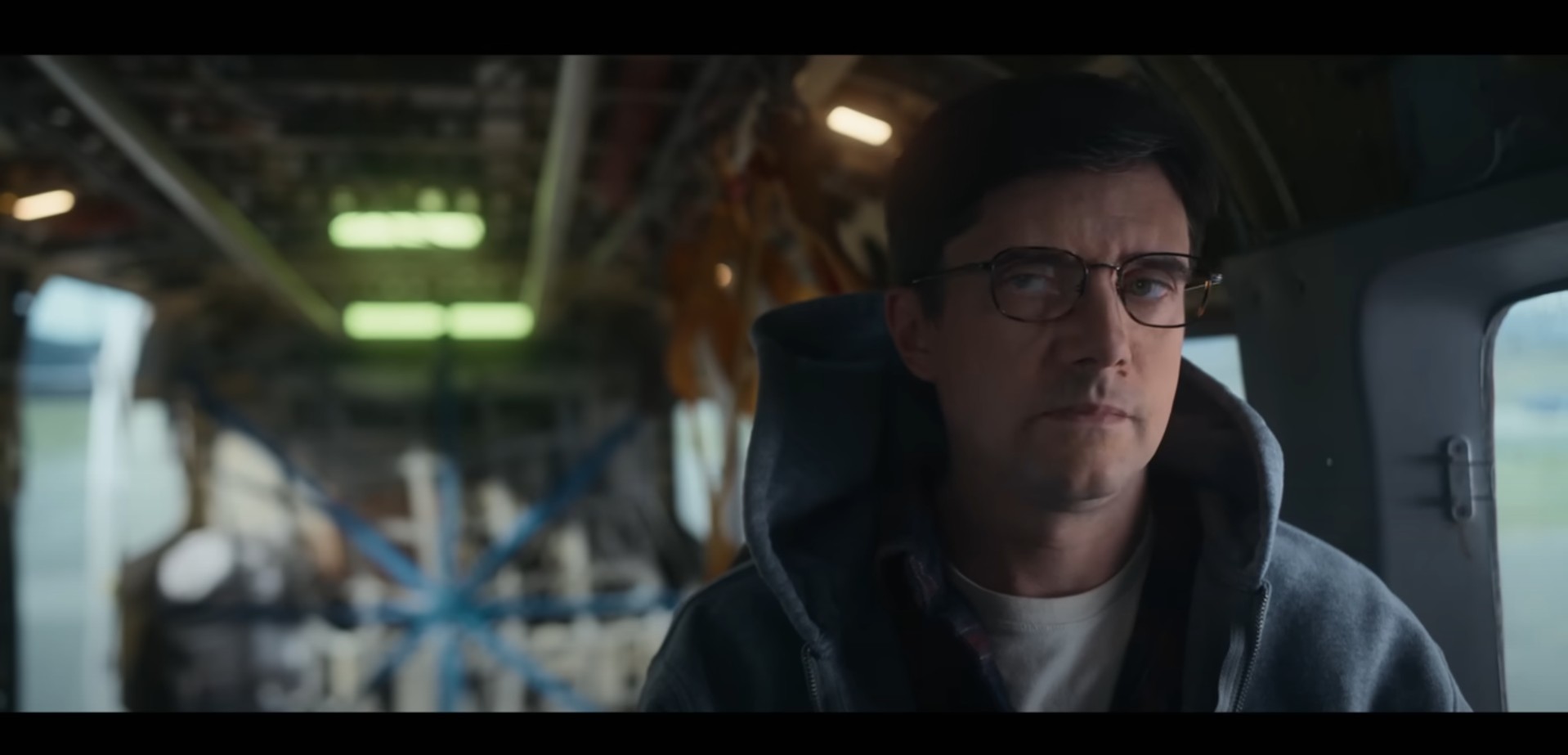
Three onscreen principals and a handful of voiceover work is all there is to “Flight Risk’s” casting with many of the scenes “high” above ground inside the tight confines of a personal aircraft to intensify the close-quartered combat with the unspoken caveat of nowhere to run, nowhere to hide thousands of feet up in the clouds.  Actress Michelle Dockery, known for her role as Lady Mary Crawley in the dynamic upstairs, downstairs period drama series “Downton Abbey,” exchanges her glittering ballroom gowns and British accent for a sidearm Glock and a flat American-beurocratic accent as U.S. Marshall Madolyn with a complicated backstory that places her back into the field after being assigned desk duty when a witness dies in her custody.  Dockery is all business and no pleasure with a retaining wall that holds all her emotions in so she can focus on the important opportunity to be back into the field.  Audiences will be thrusted right the middle of the opportunity and experience her unpleasant history being unraveled exposition as she begins to empathize and sympathize with her current witness, Winston, a skilled accountant with a harmless, passive proclivity played by with the sarcastic reflex of a frightened squirrel in Topher Grace (“Predators,” “Spider-Man 3”).  Madolyn and Winston slowly, simmering bond, merging into a fight or flight friendship out of from being an authoritative escort and detainee, is forged by fire when Mark Wahlberg’s receding hairline, eccentrically crazy, sadistic rapist of a hitman pilot attempts to restrain Madolyn and divert Winstown for his own personal pleasure on the behalf of the Mob Boss instruction.  Likely Wahlberg’s most depraved role since 1996’s “Fear,” the “Transformers” and “Daddy’s Home” actor puts forth less of his muscular tone and good looks by stepping into a balding, gum-chewing wild eye maniac, relentlessly bloodthirsty with the gift of grotesque gab, in a cat-and-mouse tit-for-tat game for the plane yoke and control.  A voice cast rounds out the rest that push the story in deception and direction with Leah Remini (“Old School”) and Paul Ben-Victor (“Body Parts”) as Madolyn’s colleagues who may or may not be corrupt and Maaz Ali (“Anxious”) as your friendly and flirtatious pilot instructor. 

An absolute different kind of project for director Mel Gibson that’s not historical, period, or epic as he takes off into unknown territory and elevating as a director who can remove himself from the bigger picture for a smaller one.  “Flight Risk” is a prime example of what Hollywood should be putting into production rather than squandering millions on grand flops but limited the budget that, in turns, limits the star power and conceding the story to saturate with substance rather than with ostentatious effects.  “Flight Risk” proved to be a modest profiting film on what is now considered a meager budget of $25 million, but a profit is a profit, and the thriller is highly entertaining and engrossing with solid performance supporting a step-by-step, linear story arc.  Granted, the film isn’t completely without flaws.  While Johnny Derango (“Fatman”) can capture the correct angles in the plane’s small, confined space and gratifying the depth with the visual screen through the plane windows, these aspects are negatively counterbalanced by visual effects that stunt the aesthetics with cheap-looking knockoffs of exteriors at the beginning and end of the film.  Fortunately, these scenes are scarce and does continue the yard forward without looking back as girth of Mark Wahlberg, Michelle Dockery, and Topher Grace vie for their moment in the spotlight with their character’s idiosyncrasies. 

The Lionsgate presented “Flight Risk” takes cue from the locomotive folktale being the little film that could, replacing the small train for a small plane and chugging, climbing up the Alaska mountain of nonstop thrills.  The new combo format Blu-ray, DVD, and Digital set from the company evokes many ways to enjoy the latest, and humblest, Mel Gibson picture.  The Blu-ray is AVC encoded, 1080p high-definition, BD50 while the DVD is MPEG2 encoded, upscaled to 1080p, on a DVD9.  In covering the Blu-ray, the picture is near perfect without compression issues faulter a landscape of whites, blues, and the spotted greeneries in between that make up the Alaska geography on the big 180’ volume screen for pseudo flight. The matte visual mixed with the angle of the cameras work to the location’s authenticity and the camera angles solidify that the illusion while the pixel range sharpens any loose ends that might occur in presentation.  Coloring and breadth of saturation diffuse fine with an organic look except for the VFX that stands out like a sore thumb.  English Dolby Atmos creates an immersive audible impression, splicing through the channels that reflect more in the back channels of Mark Wahlberg’s frantic, and sordid, diatribes from the plane’s cargo tail.  Exteriors are not as explosive around the plane as expected with the Dolby’s loss of fidelity but, to the advantage of the story, the engine him and the turbulence has an agreeable depth muffle to it in the surrounding channels and into the frontloaded dialogue, which is intelligible and without unintended equipment interference.  Also included are French and Spanish Dolby Digital 5.1 tracks and an English descriptive audio.  English, Spanish and French subtitles are optional.  Risk Management:  Making flight Risk is the standard fare behind-the-scenes cast-and-crew interviews with some raw behind-the-camera shots surrounding the genesis of “Flight Risk” and the how certain aspects of the film, such as cinematography and Mark Wahlberg’s devilish persona, are achieved.  The theatrical trailer rounds out the encoded special features.  Personally, I was not impressed with the cover art that’s on the Amaray and the cardboard O-slip with a sheen coating that puts Wahlberg front-and-center of a misleading campaign of the ruthless killer looking oddly unflappable while zipping fighter jet theatrics are composited over his midsection; the whole illustration just doesn’t speak the “Flight Risk’s” disposition.  Nothing else to note tangibly other than the 4K digital code insert in its usual slot.  Rated R for violence and language, Lionsgate Blu-ray is region A encoded and has a textbook runtime of 91-minutes.

Last Rites: “Flight Risk” cruises at a palatable attitude of flight dynamics, aerial assassinations, and the rehabilitation of broken character in Mel Gibson’s smaller, but mighty, latest feature.

“Flight Risk” Blu-ray Takes Off and Is Now Availablle to Own!

No Train Coach is Safe from a Family of EVIL Bandits. “Kill” reviewed! (Lionsgate / 4K UHD and Standard Blu-ray)

Get Your “Kill” on! 4K UHD and Standard Blu-ray Available at Amazon!

Captain Amrit of India’s National Security Guard boards a commuter train to stop the arranged marriage of his true love, Tulika.  As the two lovers reunite and promise each other to one another, a large family of thieves hijack the coach cars to loot the passengers.  Amrit and fellow captain and friend Verish fight to protect Tulika, her family, and the innocent passengers for the sake of their very lives.  When Tulika is taken by the hands of Fani, the ruthless thug son of the thieves’ leader, Amrit’s kill switch engages an unstoppable force of ferocity to get his blood-soaked hands around Fani’s neck.  He’ll first have to brutally bulldoze his way through 40 melee-weapon armed looters, all related to Fani, to get to his target while, at the same time, protect more innocent passengers from the hands of killer, uncompressing thieves and it’s a long train ride to destination New Delhi.

An India film that doesn’t have the typical unrealistic Bollywood action and violence and is labeled India’s most violent and gory film ever, “Kill” comes from writer-director Nikhil Nagesh Bhat (“Long Live Brij Mohan”).  Every ounce of close-quartered, free-for-all action is set entirely inside carefully detailed and constructed railcars that replicate almost down to the paint the very commuter diesel trains coursing the India rail lines. “Kill” accurately describes what Bhat accomplishes with a nonstop drive to protect the ones you love at no matter the cost and when moral planks are broken right underneath your feet.  The Lionsgate and Roadside Attractions presentation is a production of Sikhya Entertainment and Dharma Productions and is produced by Guneet Monga Kapoor (“Darkness Visible”), Apoorva Mehta (“Bhoot:  Part One – The Haunted Ship”), Achin Jain, Hiroo Johar (“Bhoot:  Part One – The Haunted Ship”), and Karan Johar (“Bhoot:  Part One – The Haunted Ship”).

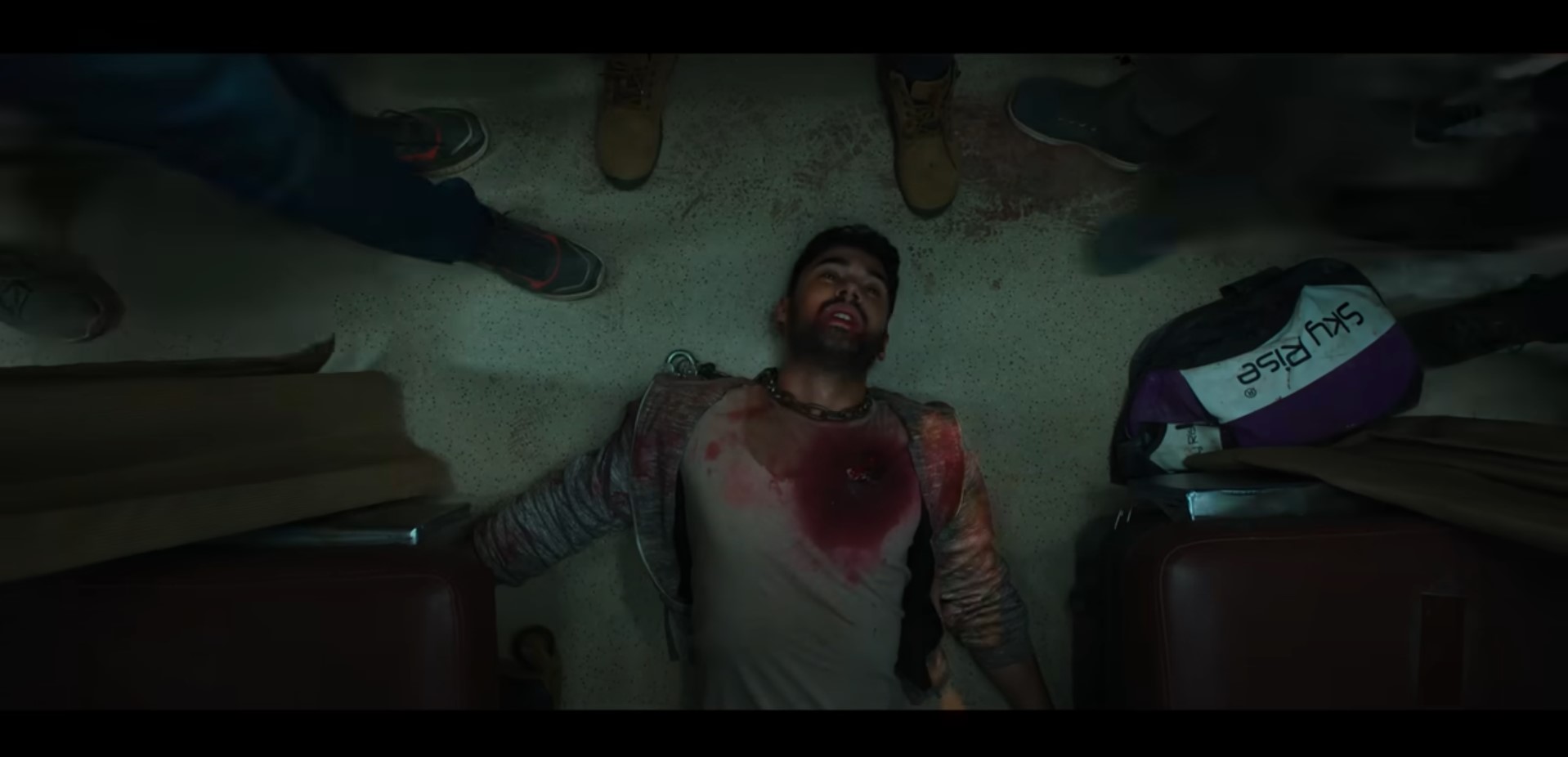
“Kill” introduces actor Lakshya as the one-man army and killing machine Amrit, driven by love’s unflinching rage that’s about as unstoppable as the freight train he’s on.  The train has become a bout ring of carnage when a literal 40-person family of thieves, or dacoits, suddenly disperses to take control of multiple train cars, killing some passengers in the process.  At the head of the snake is a battle in itself between father Beni Bhushan (Ashish Vidyarthi, “AK 47”)) and son Fani (Raghav Juyal) but though they don’t see eye-to-eye on handle a sudden downturn with Amrit being a wrench in their looting scheme, there’s a glue that keeps them aligned.  Much of the loyalty is present throughout without ever a sense of treachery on either side but Vidyarthi and Juyal delineate juxtaposition well, especially with Fani’s loose cannon antics that make him formidable even if he’s not fully in charge. Lakshya and the rest of the cast move with intent when considering their action choreography but Lakshya offers one step further being a romantic and a tragic hero when it comes to his darling Tulika (Tanya Maniktala, “Tooth Pari:  When Love Bites”) as she’s used a pawn when the bandits discover her wealthy and powerful father on the train, Baldeo Singh Thakur (“Harsh Chhaya), to exploit him for more ransom riches.  There are also great dynamic interactions with standout sublevel principals in Amrit’s brother in arms and best friend, Viresh (Abhishek Chauhan) and Fani’s towering large and strong cousin Siddhi (Parth Tiwari) that support the main adversarial opposites.  The Bollywood actors in “Kill” round out with Pratap Verma, Devang Bagga, Adrija Sinha, Meenal Kapoor, and a train load supporting cast to play bandits and passengers.

Bollywood films are known for their grandiose appeal with beautifully crafted costumes, large scale sets, and physics defying action that’s makes the “Matrix” look like child’s play.  “Kill” hits different.  “Kill” offers some of the same characteristics of a “Bollywood” production, such as a lone-wolf hero slathered in a focused and swathed cool aura, but the film heavily contrasts with aspects that are uncommon in India’s moviemaking industry.  “Kill” is uber-violent that’s graphic, gory, and on a more realistic scale than other Bollywood action films which typically go against the laws of physics for pure ego-eccentric entertainment.  “Kill’s” heroic heart goes icy cold, reforming the moral principles of a man who out of duty and respect upheld life as precious to a man hurting with antiheroic qualities that sees every bad guy as just another disposable body in the way of his goal – revenge.  Amrit doesn’t turn into a Frank Castle killing machine until a little after 45 minutes when, at the same moment, the title drops in a surprise move of editing.  You really find yourself unaware that “Kill” did not name itself until almost halfway into the story and it becomes an indicator, a switch if you will, that Amrit, as too with the story’s tone, is different from before.  The kills pre-title and post-title change from barely a whisper with a few shrouded stabbings to a varietal, punchy onslaught of massacre proportions.

Pulling into the physical media station, carrier a story all the way from India, is “Kill” from Lionsgate.  The 2-Disc 4K UltraHD and Standard Blu-ray set comes with an HEVC encoded, 2160p resolution, BD100, per other source outlets on the UHD capacity; however, I only see two layers with code identifiers, which might suggest BD66.  Given that the UHD houses the movie plus special features, I’m inclined to agree with the BD100.  The Standard Blu-ray is AVC encoded, 1080p resolution, on a BD50.  HDR on the UHD provides a deeper saturation with easy transition between hues with the Blu-ray accomplishing much of the same with lesser color reproduction but that doesn’t stop the release from being vibrant and bold as mood density changes from a colorfully rich, jovial scheme of celebration and love to a colder tone with muted yellows, harsh grays, and milky blue as destruction and death continue down the rabbit hole.  The trains confined space doesn’t deter depth in either the parallel or perpendicular view of camera direction.  There’s also a great reproduction of textural details from clothes to skin to finer points, like hair or silks.  The Hindi Dolby Atmos 5.1 is a blaze of glory with full-bodied, immersive sound that puts you right in the middle of Coach A1 for the hand-to-hand melee with the rear and front channels while the back channels isolate the train’s depth of railway locomotion and exterior audibles created by the train’s passing, such as air ambient rearrangement when occupying the same space.  Dialogue is not compromised with a clean and forefront present track that progresses with each state of action.  The English subtitles are burned into the coding.  If native language audio tracks are not your thing, there is an English dub Dolby Digital 2.0 track available.  Spanish subtitles are optionally included on both tracks with English subtitle optionally available only on the English dub.  An approx. 46-minute making-of featurette How to Kill:  Making of a Bloody Train Ride goes into depth with set construction, interviews with cast and crew, action choreography, and the overall cinematography from the blood to standout in the picture to the natural colors of India being tweaked for the camera.  There are also individual behind-the-scenes and interviews that are basically Cliff Note versions of the arterial bonus feature with Making of the Train, Introduction Lakshya, Behind the Blood, and Behind the Action.  The theatrical trailer is also included.  The dual format release centers Amrit (Lakshya) about to take on knives, axes, and pipe-wielding attackers with the title yellow and largely in bold behind him.  The green UHD Amaray comes housed inside a rounded cardboard O-slipcover with a glossier version of the same cover art.  A disc of each format is snapped into each side interior with a blue hued 4K UHD for the hero and a red hued Standard Blu-ray for the villain.  A digital code is included in the insert of the 4K and Blu-ray release but is feature only.  Rated R for strong bloody violence throughout, grizzly images, and language, “Kill” is presented with a hard-encoded region A playback and clocks in at 105 minutes. 

Last Rites: Kill, Kill, Kill! India has stepped up the violence not yet seen in the land of Bollywood and “Kill” introduces a whole lot of new to the country’s movie industry that will revolutionize India’s filmmaking game.

Get Your “Kill” on! 4K UHD and Standard Blu-ray Available at Amazon!

Invisible As They May Be, Their EVIL is Palpable. “Imaginary” reviewed! (Lionsgate / 2-Disc Blu-ray and DVD Combo)

Chauncy Wants You To Be his Friend! “Imaginary” on Blu-ray DVD/Combo set!

Jessica purchases her family home, moving in with her new husband and stepchildren where she reminisced being happy once as a child up until her father’s mental breakdown forced her to move out of the house and live with her grandmother.  Returning to her childhood home might have suppressed most of memory but has also spurred a few good recollections she aims to share with the conflicting attitudes of her stepdaughters, the angsty, teenager Taylor and her little sister, Alice, who suffers from a traumatic past.  When Alice discovers a stuffed bear in the basement and conjures up an imagery friend named Chauncy, Jessica feels content knowing Alice is coping with a new friend outside intense therapy sessions but when Chauncy’s seeming innocent scavenger hunt turns to hurt Alice, all the forgotten, difficult memories of her past surface and Chauncy is more than an Alice’s imaginary friend but spurned entity seeking to reconnect to Jessica, feed off her unique creativity, and keep her always in the Never Ever world of imagination.

At least once during our childhood, we all had an imagery friend to lean on, to play with, to cope with difficult situations.  For me, my imagery friend was an 8-foot white teddy bear I would snuggle into its lap and read my adventurous stage one or two books to.  For Lionsgate and Blumhouse, their imagery friend is much, much more sinister!  “Imaginary’s” dark twist on the juvenile fantasy is the brainchild of writer-director Jeff Wadlow, the filmmaker behind 2018’s “Truth or Dare” and 2020’s “Fantasy Island.”   The Charlottesville, Virginia native seemingly has thing for spinning games and fantasies into crooked, ill-fated variants.  “Princess and the Frog” writers Greg Erb and Jason Oremland cowrite the script with Wadlow, adding their experiencing in writing children stories for Wadlow’s eviscerating of childhood joy.  Lionsgate Films and Blumehouse Productions distributor the Tower of Babble Entertainment film with Jason Blum, Sean Albertson, Paige Pemberton, Paul Uddo, Jennifer Scudder Trent, and Jeff Wadlow producing.

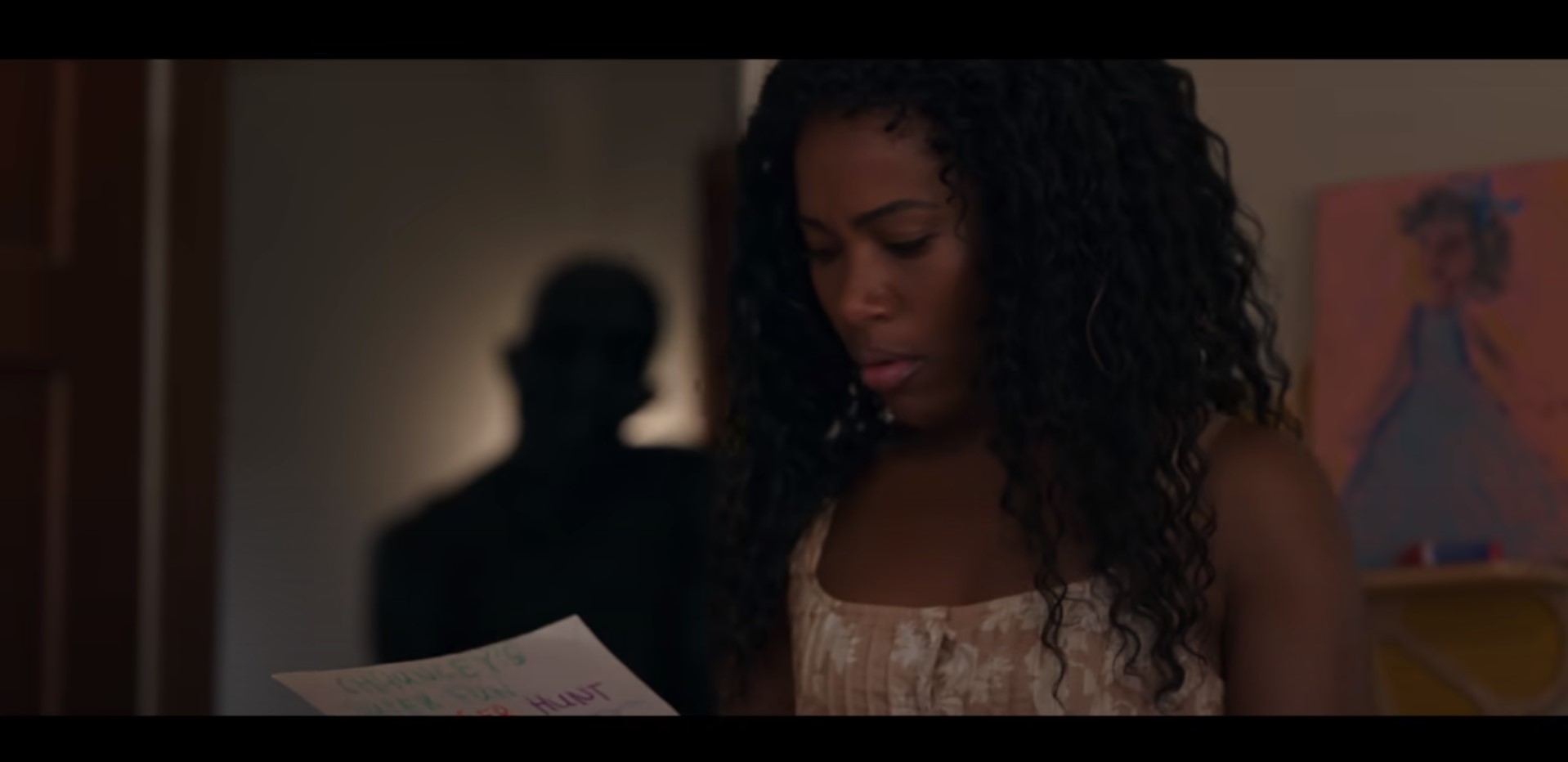
In the crosshairs of a targeting imaginary friend is Jessica, a successful children’s book author on the outside of trying to assimilate herself into a new family while, at the same time, struggling to understand her nightmares and troubled childhood past.  DeWanda Wise (“Jurassic World:  Dominion”) stars the struggling, but good-natured stepmother Jessica who’s married to “The Walking Dead’s” Jesus, I mean Tom Payne.  Taegen Burns and Pyper Braun play Payne’s sibling daughters in their respective roles of Taylor and Alice as they make their horror film debut.  Detrimental to “Imaginary’s” silkiness of a happy couple is the artificial interactions between Wise and Payne who appear to be just going through conventional motions of a very awkwardly scripted and painfully garish couple.  When Payne departs the entire climatic acts for his character’s musical tour, other characters begin to flourish more naturally from between Wise, Burns, and Braun who become entwined into a certain teddy bear’s revengeful plan and this fountains a pleasant range of character arcs with overcoming fears, building character emotions, and settling the tension between them within the context of a common foe narrative.  One crucial, tell-all character goes critically by the wayside because, at the very last possible moment, Betty Buckley (“Carrie”) as the longtime neighbor Gloria becomes a deluge of exposition and she’s only introduced in full much later into the story because the writers had no idea how to integrate her earlier and make the information Gloria sits make sense until desperate moments arise.  Buckley, though monotone at times, makes for a good crazy lady.  “Imaginary’s” cast fills out with Veronica Falcón (“The Wind of Fear”), Samuel Salary, Matthew Sato, and Alix Angelis (“The Cleansing Hour”).

Audiences will need to expand their imaginations to get immersed into “Imaginary’s” interdimensional, child creativity-eating plot that careens through the specifics and details.  “Imaginary” suggests children have this invisible pal that snake tongues into their ears, feeding them childish ploys and harrying shame to get them to do what they want, and, inevitably, suck them into the Never Ever world through a checklist bizarre ritual.  The story suggests a globally subversive circle of these entities have been explains that every culture has a take on the imaginary friend concept and even throws into the dialogue other children having disappeared shortly after speaking of the Never Ever but the shorted change of the widespread disappearances background and the fact that crazy old, neighbor lady Gloria somehow surmised a pile of information on the subject, self-published knowledgeability on the ritual, being, and even the Newer End world, provides threadbare, credulous support for the storyline.  Stylistic and visually, “Imaginary” endorses its own title with tactile manifestations of the entity’s power.  Men in nightmare costumes is always preferable over overly silky-smooth and impalpable computer-generated monsters and the work done by the effects crew greatly engenders childish fears with an overgrown, toothy, scary teddy bear and a topsy-turvy world that are magical yet foreboding. 

Snuggle up with your Teddybear and get ready to be scared in “Imaginary” on a 2-Disc DVD and Blu-ray set from Lionsgate Films. The AVC encoded, 1080p high-definition, BD50, presenting the film in a 2.39:1 widescreen aspect ratio, is a solid showing of image integrity with crafty cinematography from James McMillan (“Twisted Metal“) that avoids the seams of the monster suits, keeping them in a considerable degree of low-level shadows, and using odd angles to make contradictory scenes flush in the Never Ever. Yet, despite the max storage capacity of a 50-gigabyte disc, compression banding still rears its ugly between gradient tones contrasting dark and lit scenes; problematic areas are not entirely throughout the picture but intermittently spotty to say the least. The DVD9 is MPEG-2 encoded with an upscaled 1080p. The English language option is a three-dimensional Dolby Atmos surround sound and if Dolby Atmos was going to be used for anything feature, “Imaginary” would be that feature with tons of range and depth mechanicals to float audio into the spatial fields above and below. When Never Ever doesn’t formulate a logical structure and up is down and down is up, Atmos caters and evolves to the fluid environment, emitting pinpoint ambience to be shaped to the size of television room. Dialogue comes over clean and clear, established in the forefront amongst the other audio layers. Spanish and French 5.1 Dolby Digital surround sound are also available audio options with English, Spanish, and French subtitles to select from. Special features include a feature length audio commentary by director, and cowriter and producer, Jeff Wadlow with producer-actress DeWanda Wise. Also, encoded into one long featurette, are four medium-short mini-featurettes of Meet Your New Imaginary Friends of getting to know the characters of “Imaginary,” Frills and Thrills of taking a child’s joyous creativity and twisting it into a creature-laden nightmare, Crafting the Beast of Imaginary is a look at the tangible creations of “Imaginary’s” monsters, and Bringing Nightmares to Life looks at how the Never Ever is constructed and shot to get the illusion of an upside down interior slice of another dimension. Sheathed inside a glinty, nearly lenticular, cardboard slipcover is the traditional Blu-ray Amary, both with the innocently, ominously looking Chauncy bear on the front cover. In the interior, each side houses a respective format within a push lock. A digital copy does come with the release within the insert clasps. “Imaginary” is a PG-13 horror (are they trying to appeal to kids?) with a runtime of 104-minutes and a region A playback.

Last Rites: I Imagine “Imaginary” could have gone over ten times as smoothly and more coherent with a longer runtime time to flush out more characters and a better designed narrative. Instead, pacing is quickened to race through unpacking more complex themes: childhood abuse, childhood trauma, the division of the original and regluing of a new nuclear family, family history of mental illness, the concept of imaginary friends, and so forth. The result is a less than desirable bastardization of an imaginary friend that leaves us high and dry for more context and substance than just a puppeteered scare bear.

Chauncy Wants You To Be his Friend! “Imaginary” on Blu-ray DVD/Combo set!

Travel to Mexico, EVIL Said. Cure my Cancer, EVIL Said. Let the Game Begin, I Said. “Saw X” reviewed! (Lionsgate / Blu-ray)

Become A Part of the Game in “Saw X” on 4k/Bluray/DVD

Having a finished a trial by fire game of rebirthing the morally bankrupt that has coined him notoriety as the Jigsaw Killer, a terminal ill John Kramer ceaselessly searches a cure in order to continue his work.  Meeting a fellow cancer therapy group member outside of session provides hope when John learns a radical new and unauthorized surgery and serum cocktail that is seemingly a miracle cure for cancer.  His desperation led inquiry lands him in Mexico where he meets a team of specialists prepping his next day surgery and just when post-surgery John Kramer believes he’s beaten cancer, Kramer realizes he’s been a victim of fraud that’s exploits the most vulnerable and desperate ill-fated people.  Now, a new game begins to test the con artists on how far they will go to live. 

Six years has passed since the last “Saw” sequel was released with the Chris Rock helmed tangent spinoff “Spiral” and 13 years has passed since the last time John Kramer was a part of the game in “Saw 3D.”  2023 marked the return of to the basics with no divergent story from the Book of Saw or fleeting three-dimensional gimmicks to feign tangible blood and body parts in the tenth feature length film of the franchise known as “Saw X.”  The original story-lined sequel also reengages director of “Saw VI” and “Saw 3D” Kevin Greutert to pick up where he left off with a prequel that explores more of Kramer’s more vulnerable side as well as explore the time in between “Saw” and “Saw II” and it’s now unveiled characters who were then shrouded from view, working side-by-side with John Kramer, many years ago.  The writing duo of Peter Goldfinger and Josh Stolberg return from to the franchise after “Jigsaw” and “Spiral” to pen the script for the Twisted Pictures and Liongsgate Production with franchise decision making team of Mark Burg and Oren Koules producing.

So what has Tobin Bell, the face and persona creator behind John Kramer, been up to since 2017’s “Jigsaw?”  Well, let’s just say the now 81-year-old actor has starred in a string of under-the-radar, non-theatrical films that can’t seem to break him out of his bread-and-buttered pigeonhole as a man testing people’s will to overcome by severe measure.  The past year’s dysfunctional family rollercoaster “Sleep No More,” Darren Lynn Bousman’s creepy Saudi Arabian horror “The Cello,” and even a stint of various roles through “The Flash” television series over the years in between have barely moved the needle amongst audiences despite the projects critical and public acclaim.  While it’s a shame Bell receives little recognition for other projects, seeing him return to the role that made him a household name amongst horror fans is a sign of relief knowing Tobin Bell can still draw in a crowd, stepping almost seemingly effortless into John Kramer’s shoes of controversial convictions and never losing a step to bring a cunning and complex antihero back to the big screen with more blood on this hands, literally.  Kramer is not the only familiar to return as Amanda Young comes into the fray prior to her coming out in – ***Spoiler Alert***- “Saw II.”  Shawnee Smith reprises the role donning an unflattering pixie cut that’s even shorter than her “Saw II” hairdo, which keeps true to the timeline, but what plagues both Bell and Smith for a prequel is father time that rears his ugly head on both actors who are not getting any younger to play supposedly younger versions of their characters from which they last portrayed them.  This applies especially to Shawnee Smith who resembles very little of herself from her last appearance in a “Saw” film.  Yet, this doesn’t stop both Bell and Smith to re-embrace their roles and add more layers to their already nuanced identities as John and Amanda ensnares new game players South of the border in Gabriela (Renata Vaca), Valentina (Paulette Hernandez, “My Demons Never Swore Solitude”), Mateo (Octavio Hinojosa, “Come Play With Me”), and Cecilia Pederson (Synnøve Macody Lund, “Haunted”). ”Saw X” co-stars Steven Brand (“Mayhem”), Michael Beach (“Deep Blue Sea 2”), Costas Mandylor, Joshua Okamoto, and Jorge Briseño.

What most will come to realize about “Saw X’s” series placement in time is the foreshadowed knowledge of when and where John Kramer and Amanda Young meet their demise. What can the writers and producers add to a prequel that will enthrall and cause apprehension knowing that the two biggest players in “Saw’s” franchise ultimately live at the end of this intermittent story that mainly surrounds Kramer’s desperation for a cancer cure? To enthrall is simple by adding new bad apples into new escapable blood-drawing, death-dealing traps inside a humanizing John Kramer footnote outside the core city games that intertwine, interweave, and intersect from the very first Saw to the very last Saw in 3D. To surface apprehension for our foretold survivors would take some creative effort. In comes Jorge Briseño playing an adolescent Mexican boy innocent in all of this die-cathlon caught in the wrong place at the wrong time. While the boy, Carlos, adds an X-factor to the dilemma, the fate unknown is relatively short-lived as the boy only becomes a noteworthy shake up of emotional twists between the game’s masterminds near the very tail end, leaving only the wills to struggle painfully as they face themselves in forced contrition. The games Kramer quickly rigs up after the disbelief of being scammed are as industrial medieval and terrifyingly tense as any other “Saw” but unlike the other installments where Jigsaw has planned and engineered meticulously each game, these new set of trap trials are quickly welded and mechanically put together in a blink of an eye, or at least it seems, with no real show for the time put into the turnaround from fraud to fear and that lack of attention can seriously dull “Saw’s” already serrated credibility. 

Saw X” arrives onto a 2-disc and digital combo set from Lionsgate home video.  The Blu-ray is an AVC encoded, high-definition 1080p, BD50 and the DVD is MPEG2 encoded, DVD9 and both formats present the film in a 1.85:1 widescreen.  Through the lens of franchise newcomer Nick Matthews, there’s a sense that the “Spoonful of Sugar” director of photography tries to reproduce some of the style of the first six of David A. Armstrong’s steely industrial color palette but emulating more of his own personal choices to match the out-of-the-city harsh blues and greys for more warmer tones, like mustard yellow, but those progressive hues establish in the second half after really teetering on a natural lens and a harsh saturating tints, such as when John Kramer enters the surgical cube and is bathed in a navy blue hue that eliminates details entirely but only for that tinted moment.  For the rest of the picture, details are grisly good with lots of medium-to-extreme closeups to detail out exposed anatomy of what makes “Saw” rotate so well.  Charlie Clouser returns to score the tenth film on an English Dolby Atmos mix with Dolby Digital TrueHD 7.1 and 5.1 Spanish and French options available.  A really potent and powerful recreation of fidelity scores well for Clouser who recaptures the original crescendo of the final twist while keeping an industrial discordance floating behind the storyline with rising volume during trap countdowns that never interferences with the range of sounds or depth between each of the character sand the traps and the characters.  Dialogue is clean as a whistle and balances perfectly on that serrated slack line of a chaotic countdown to one’s own demise.  English descriptive audio and English SDH are available with regular English, Spanish, and French subtitles also included.  Special features include an audio commentary by director Kevin Greutert, cinematographer Nick Matthews, and production designer Anthony Stabley, a Reawakening documentary that discusses how the prequel was actually “Saw 9” but was shelved for the Chris Rock produced spin-off and how the sequel evolves since it’s rejuvenation years later, there’s a drawing inspiration look into bringing the series to Mexico and all its unique culture and mythos, makeup department trap tests, deleted scenes surrounding more depth between Kramer and Amanda, and the theatrical trailer. On the outside features, a slightly embossed titled and eye-sucking trap victim grace the rigid cardboard O-slipcover, keeping true to most of the “Saw” theme traps in home video posters and home video art, with the traditional Amaray cover art sporting the same design without the embossing. Along with the digital code insert, the two discs are housed separated on each side of the case, both pressed with the same Aztecan-inspired circular saw. The Lionsgate release is locked on region A North American playback with a runtime of 118-minutes and is rated R for sequences of grisly bloody violence and torture, language, and some drug use. ”Saw X” breaks many of its own traits like set not in a city and doesn’t have an incorporated investigation parallel but, in the same breath, feels very much like a back to basics, not only in proximity to the original “Saw” story and with the return of familiar faces and characters, but also in John Kramer’s preadolescence in figuring out and shaping himself to what he would become as the notorious Jigsaw Killer. 

Become A Part of the Game in “Saw X” on 4k/Bluray/DVD