Sleep Studies Tap into an EVIL Dimension! “Shadowzone” reviewed! (Full Moon Features / Remastered Blu-ray)

“Shadowzone” Available Now on Blu-ray!

The accidental death of a test subject during a highly immersive REM sleep project deep underground of abandoned nuclear fallout shelter resulted in the dispatch of a NASA investigator, Capt. Hickcock, to determine if the accident was a fluke or project negligence by the scientist staff.  The skeleton crew are eager to assist Capt. Hickcock with whatever he needs to wrap up his investigation and get back to the extreme deep sleep research aimed for NASA deep space pilots, but Hickcock is not so easily persuaded the research adds up, questioning the data that possibly lead to a volunteer’s brain to fatally hemorrhage.  A male and female volunteers rest in deep stasis sleep and while testing the lengths of the project’s capacity on the male subject, to sate Hickcock’s review, they inadvertently open a door to a parallel dimension through the unconscious mind and something has come through.  The facilities radioactive sensory system locks down the entire complex, trapping the captain, scientists, and staff with an unknown, and deadly, creature that will stop at nothing to return home. 

One of the few Full Moon productions to go outside their bread and butter of runt creatures and murderers, “Shadowzone” branches out with parallel dimensions and antagonistic alien creatures with molecular modifying capabilities in one hell of a star-studded, claustrophobic creature feature from the turn of the decade in 1990.  J.S. Cardone (“The Forsaken,” “8MM 2”) writes-and-directs cloistered camp of unseen terror that uses scientific research on REM, rapid eye movement, sleep research as the foundational base for breaking through the barrier of our existent and tap into another’s without cause or concern, until whatever comes out bites them.  Shot in and around the Griffith Park of Los Angeles, “Shadowzone” is produced by the master of dolls and everything small, Charles Band, as well as longtime collaborating producer Debra Dion and Cardone’s wife, Carol Kottenbrook, under the Full Moon Entertainment production company.

For a Full Moon production in the 90’s, “Shadowzone” had some unexpected star power between James Hong, the prolific Hong Kong-American actor who was a household name in the cult realm having been villainous black magician Lo Pan in John Carpenter’s “Big Trouble in Little China” as well as having roles in “Blade Runner,” “Revenge of the Nerds II,” and “Tango & Cash,” and Louise Fletcher, an equally prolific actress and a best actress Academy Award winner for her detestable Nurse Ratchet role in “One Flew Over the Cuckoo’s Nest, a wicked performance that suited Fletcher very well in her career with natural way to express a sarcastic tone.  Hong and Fletcher are not necessarily portraying bad guys in “Shadowzone” but they’re no heroes either as scientists eager to explore the unknown by ripping a hole in the plane of existence and both veterans of the trade give their best in this low run but highly thrilling Full Moon creature feature.  Hong and Fletcher are joined by an eclectically charged cast that while don’t have the recognizable charisma of established names, they each contribute a valued service in the parts portrayed, especially with David Beecroft (“Creepshow 2”) in the protagonist lead of the outsider Captain Hickock, investigating in toward the unknown.  Beecroft plays a suitable military-esque high ranking officer with a semi-relaxed demeanor that goes against the grain of the stereotypical stern and regimented leader you usually see in low-budget horror and sci-fi.  “Shadowzone” fills out the cast with bodies for the interdimensional meatgrinder with performances from Shawn Weatherly (“Amityville 1992:  It’s About Time”), Lu Leonard (“Circuitry Man”), Frederick Flynn (“The Forsaken”), Robbie Rives, Maureen Flaherty (“Bikini Traffic School”) and the always underscored, underrated, and understated horror supporting actor, Miguel A. Núñez Jr. (“Friday the 13th Part V,” “Return of the Living Dead”).

Where does “Shadowzone” fit into the grand Full Moon scheme?  Before the company solidified itself in the mid-1990s with miniature maniacs invading the majority of projects and their respective fast-tracked sequels, Charles Band took chances on other tales of titillating terror from all sides of the complex cinematic prism.  Sci-fi oddities, like “Trancers” and “Robot Jox,” of the legacy company Empire, took footing on beyond dystopian while more classical horror centric productions, like “The Pit and the Pendulum” and “Re-Animator,” provided a wider berth of subgenres under the phantasmagoria.  “Shadowzone” takes a little bit from both the horror and the science fiction tropes, coupling the scientific research of new age technology that rips a hole in the fabric of space and time to introduce an unimaginable, supernatural creature that virtually goes unseen as it morphs into the subconscious fears of the people it hunts down one-by-one.  What audiences will enjoy is the medley of figures this particularly nasty being can warp into when going for the kill.  What audiences will not enjoy is the sorely underutilized creature potential that’s left more to the imagination than to screentime.  All but one kill is off camera and in two of those instances, the creature isn’t even in frame as a burst of blood splatter becomes the demising indicator.  This shortchanging affects “Shadowzone’s” longevity for repeat viewings with no outstanding or satisfying purge of fated characters in an otherwise underground and dark corridor deathtrap of otherworldly proportions.

Full Moon Features continues to toot their own catalogue with remastered, high-definition releases of their older features with “Shadowzone” being one of the latest and greatest to be remastered onto a new Blu-ray.  The AVC encoded, 1080p, single-layer BD25 offers a soft, metallic palette to a harsh subterranean laboratory where shadows run thick, and lighting is keyed on exact spaces and people for effect. I quite enjoy the softness of stark industrial that does not even relieve primary color as this remastered version sees no color correction, but rather color reduction retainment of a sunless, cavernous crypt.  Healthy grain against the details brings more attention to the textures, especially when we do get the see the true form of the being in a bone-chilling scene of its final war cry moment, a scene that will often haunt me because solely of its A/V compositional construction.  The matted visual effects don’t hold true to original first look during its brilliancy dissimilarity when compared to the rest of the film’s cold tone.  The English language LPCM 5.1 and 2.0 disperses through the multiple channels to convey echo location of the front and back while the 2.0 does the job to channel audio layers through with a balance for differential treatment, especially separating Richard Band’s less than jaunty score that’s replaced with more common composition of intensifier notes.  Nothing overtakes the dialogue layer that runs clear and prominent without any hissing or crackling.  English subtitles are optional available.  Other than the original theatrical trailer, the only other special feature is Full Moon feature trailers.  If it’s not a Jess Franco sexploitation special, these remastered releases of originally Full Moon produced titles receive a touched-up version of the VHS cover art and, fortunately, “Shadowzone” already had an eye-catching art, gorgeously illustrated to the point of what to expect.  Like usual, there are no inserts or other tangible bonus materials included.  The disc is pressed with almost a lenticular look of the toothy creature in a scientist coat.  The 63rd title to be released from Empire has a new Blu-ray that comes rated R, has region free playback, and a runtime of 88 minutes.

Last Rites: “Shadowzone” definitely has the feeling of a little film that could, and for a better part it it did with fantastic casting, an isolating atmospheric tomb, and a transmogrifying creature of our personal stress inducers. The Remastered Blu-ray caps off the success with high definition not from this world.

“Shadowzone” Blu-ray is Here to Stay and Is Coming For You!

EVIL Backwoods Cannibals Are Back for Seconds! “Butchers Book Two: Raghorn” reviewed! (Breaking Glass Pictures / DVD)

Ready to Eat? “Butchers Book Two: Raghorn” Available Here on DVD!

The abduction of a wealthy family’s daughter drives the four kidnappers onto the backroads of rural America toward their way to riches.  However, things turn south as their vehicle strikes a large raghorn, instantly dissolving their escape route and their previously teetering plan.  A festering betrayal and greed divide the group that leads them into the cannibalistic hands of the sadistic, backwoods inhabitant Clyde and his monstrous freak of a brother Crusher.  Always looking for a good piece of meat and with a brutal penchant for playing with his food, Clyde takes them hostage at gunpoint, ties them up, and has fun torturing and tenderizing his foraged prize before chopping them up to pieces on a bloody stump for stew makings.  Yet, the abducted woman refuses to be the victim and let terrible, awful atrocities happen to her, and not even let it happen to her kidnappers, by escaping her confines and managing to get ahold of a double barrel shotgun.  A standoff ensues but nothing gets in between Clyde and his food. 

“Butchers Book Two:  Raghorn” is director Adrian Langley’s 2024 standalone sequel to his lowkey breakout 2020 hit, the indie backwoods cannibal-survivor picture, “Butchers”.  The sequel doesn’t stray too far from the precursory film’s primary premise with a family of degenerate provincials with a taste for human flesh whisking away stranded travelers in some kind deranged version of roadside assistance.  Langley directs and writes the script for the film based off a story conceived by Langley and Kolin Casagrande, who previously collaborated with Langley as a producer on his 2010 crime thriller directed feature entitled “Donkey.”  More than a decade later, Casagrande and Langley are again making beautiful violence together with Blue Fox Entertainment’s James Huntsman (“Bunker”), a parent company of the film’s distributor, Red Hound Entertainment, and “Butcher’s” Doug Phillips as producers and another “Butcher” producer, Kevin Preece, as associate producer.

Aforementioned, “Butchers Book Two:  Reghorn” doesn’t subsequently follow the first feature and introduces new set of paltry protagonists versus a new set of insatiable and vile cannibals deep within the middle of the woods of Nowheresville, America.  The party forcibly partook in the cannibals’ cruelty isn’t necessarily all an innocent party as they’re mostly kidnappers looking to score big from their captive.  Dave Coleman (“Ghoul House”), Miguel Cortez, Sam Huntsman (“Bunker”), son of producer James Huntsman, and Hollie Kennedy portray the ensnared antiheros with the latter two being most of the focus amongst them, seeing that they are cousins that evoke more empathy than the less empathic former.  The wild car outside of that and who are not the viciously outweighing outliers is the girl in the trunk, who is actually a man named Corgand Svendsen.  The androgynous model from Canada hikes up a skirt and wears a tight top crop to become the damsel Ash but Ash is no damsel in distress.  The story shifts from Ash’s bagged head and wrists tied helplessness to become the infiltrating protagonist to take up Clyde and Crusher to do what’s right, even if that means saving the skin, literally, on a couple of her captors.  Svendsen gives a calm and subdued performance, especially as a hostage in the money scheme and in the bloody mitts of cannibals, but perhaps there’s more than what meets the eye for Ash.  Perhaps, Ash is a part of the kidnapping scheme in a theorized plot between Ash and Sam Huntsman character Josh who frequently tries to make Ash comfortable in the whole ordeal and Ash is just trying to salvage her investment, but the strength of that theory never fully materializes in Ash’s motivation to go against two ruthless killers rather than to flee free with her life.  Clyde and Crusher are the two mysteriously originated characters who live in the woods and eat people.  Their background is not specified or shared in any minute way but “What Lurks Beneath’s” Nick Biskupek plays a mean, man-eating son of a bitch in Clyde while Michael Swatton, who previously played one of the Watson brothers in original “Butchers,” compliments his “little” brother as a colossal, head-crushing freak of a nature left in the audience’s peripheral view.  The sequel’s casts ends with Mark Templin (“We Are the Missing”) as a moment of reprieve stopgap sheriff tracking down the vehicular accident victims who may not be victims after all.

Watching “Butchers Book Two:  Raghorn” is like watching in a déjà vu fog.  The similar premise to the 2020 film peruses familiar aisles of country-chic cannibals chopping careless characters who stumble into their killing grounds.  What the sequel drops is the perversive and family legacy angle, reducing the story to just two brothers living isolated on the outskirts and barbequing people as they happenstance wander by.  Langley also doesn’t up the graphic nature but sustains the same amount of gore and mordacious violence.  Even when cutting down the killer contingent down half its size, violence remains taut and palpable for shock effect as Langley does make the savagery purposeful rather than just gratuitous.  “Raghorn” is by no means a bigger, badder sequel, as most sequels tend to try and exceed expectations and outdo the first, i.e. more blood, bigger body count, detailed special effects, etc., but the indie roots that made the original film palpable are still firmly grounded with a, literally, grab-it-by-the-balls, suit yourself story without the poking and prodding influences of a rapacious producer or studio with flashing dollar signs in their eyes. 

Breaking Glass Pictures’ “Butchers Book Two:  Raghorn” would have been a perfect fit for the distributor’s short-lived extreme horror sublabel, Vicious Circle Films.  However, we’re still glad the sequel made the home video market under one of Philadelphia’s most prominent indie distributor labels with a DVD release.  The MPEG-2, single layered, DVD5 is presented in an upscaled 1080p with a widescreen 16:9 aspect ratio.  While not receiving high-definition resolution, you’ll be fairly pleased with the quality of this release that retains some faithful reproductions in textural details, such as Clyde’s cutoff jean jacket and overall grimy attire that does highlight the jacket’s frayed ends and the outlined dirt patches or the engulfing variety of foliage that naturally exhibited innate green shades, but also the general appearance is soft in the more depth of details.  Langley, who wears multiple production hats between editing, directing, and writing, also is behind the cinematographer lens to create the space of depth and to be stylistic with a few pan and track occurrences.  The English Dolby Digital 5.1 surround mix is the only lossy option available that renders a traversable diffusion of sound throughout with balanced layers between dialogue, ambience, and soundtrack layers.  Clyde’s intelligent intelligibility under a twang tongue clearly finds the audio receptors with the remaining dialogue denoting clarity in the same fashion. English subtitles are available for optional use. While Breaking Glass Pictures’ releases do not have a wealth of bonus content, most have some content to peruse; however, this particular release is feature only. The region 1 playback DVD has a runtime of 89 minutes and is not rated.

Last Rites: From the book of Andrian Langley’s cannibal misfits, a second story lives and breathe in “Butchers Book Two: Raghorn,” a gruesome, miscreant fanned, survival of the hungriest for their cravings tale wrapped just a tad too lightly for proper consumption.

Ready to Eat? “Butchers Book Two: Raghorn” Available Here on DVD!

An EVIL Cult Summons Back “The Hangman” reviewed! (Dread / Blu-ray)

“The Hangman” Now Available on Blu-ray!

Turbulent connecting father and teenage son, Leon and Jesse, retreat to the West Virginia wilderness for a little rekindling before Jesse goes off to college.  Still reeling after his mother’s death five years ago, Jesse blames his father’s inactivity and his rebuff mismanagement of their family’s pain.  The next morning, Jesse has disappeared, the car has been sabotaged, and Leon fears his son might be in the hands of a pair of racist rednecks encountered the day before.  However, what Leon finds himself in the middle of is much worse when a demon summoning cult retrieves The Hangman from the depths of one of Earth’s seven gates of hell and needs a fresh, young, and angst-riddled body to continue his unharnessed hell on Earth.  Jesse becomes the unfortunate soul at stake and it’s up to his father, and a few local God-fearing allies, to try and stop The Hangman’s noose from gripping tighter.

New York City-based director Bruce Wemple has teamed up again with Dread Production to bring another terrifying tale.  The “Monstrous” and “Island Escape” director cowrites the script with frequently collaborator, actor LeJon Woods (“Baby Oopsie:  The Series,” “Island Escape,” to deliver “The Hangman,” a demonic horror thriller that catapults a father and son’s dysfunctionality into the throes of Hell.  Filmed in the rural regions of upstate New York, doubling as the rural Appalachian wilderness of West Virginia, which makes filming having occurred likely around the Adirondack Mountains instead, “The Hangman” carries with it a longstanding racial infamy attached to a father’s supernatural pickle, being the middle of a demon conjuring cult and the lynching-loving demon itself.  Traverse Terror productions, a division of executive producers Cole Payne Traverse Media, in association with Dread Presents sees executive producer Patrick Ewald from the Epic Pictures Group back “The Hangman” feature while Daniel Booker and Vincent Conroy coproduce.

LeJon Woods not only cowrites the script but the actor for Cleveland, Ohio essentially customizes the role of the father, Leon.  What starts as a man looking to just escape into the great outdoors quickly closes in around him as he feels the pressures of latent hostility when son Jesse (Mar Cellus, making his feature film debut) accuses him of running from his past after the death of his mother, Leon’s wife.  What exactly happens to her is not yet apparent other than an offscreen gunshot but the palpable tension between Woods and Cellus is worth noting in a handwringing moment of enmity around the first night’s campfire; a good tall tale sign that this camping trip is going to be doomed from the start.  This tension sets the stage for what’s to come, a missing son, aggressive bigots, murderous cultists, and a Netherworld lyncher, showcased with an awfully underutilized purpose and screentime appeal, especially being the titular villain.  “An Angry Boy’s” Scott Callenberg gets his chance to shine as an inhuman character, prosthetically made-up with burn scars, greasy strands of hair, and cladded darkly in country chic, but doesn’t have the room to spread havoc or really build the character who’s mostly reduced to lurking the background and letting the telekinesis-driven rope to asphyxiate those not in the know of cult activity.  There’s also a slew of throwaway characters that either are too short-lived to really flesh out their role, such as the eye-gouged, bedridden clairvoyant and the tied-up local Leon saves and becomes a flirtatious love interest/gun-toting assassin (see what I mean by not really understanding the character?) in Lindsay Dresbach (“Pitchfork”).  Except for LeJon Woods, the rest of the cast is comprised of mostly short film or background actors and actresses given the opportunity for an expanded principal performance, including Kaitlyn Lunardi, Rob Cardazone, Jefferson Cox, Daniel Martin Berkley, William Shuman, Ameerah Briggs, Jessy Holtermann, and Richard Lounello.

Riding parallel to “The Hangman’s” resurrected demon on Earth, a father and son’s struggle to grow in postmortem of the only woman in their lives, and the fact that there is one of the gates of Hell located in the West Virginia’s Appalachians premise, the story entails a rather barefaced, as well as slightly overtone, racism theme coursing through its veins.  The Confederate flag sporting rednecks and the all-white, Southern accent contingent of white people against a black man and his son shout bigotry as louds as possible through your personal media setup.  Yet, the Hangman himself is the very representation of lynching, a heinously taboo act that has become a stain on America history, typically executed by racially prejudice Southerners on black people when that simmering, seething hate turns red and vigilante justice rears its ugly head.   Though the villain doesn’t don a white hood and gown or perform any gesture of white power, to say Leon, a black man, who must stop the evilly monikered hangman from taking his son’s soul to Hell, is too big a coincidence to not call a spade a spade.  Wemple and Woods make it clear that Leon’s calling is to be a savior, the chosen heroic that can destroy the Hangman, but while the first two acts climb the ladder of an naïve hero, all the indicating signs point to arbitrary means met with arbitrary characters for Leon with no concrete reasoning why his being deceived into the gateway to Hell area is more than just serendipitous destiny, turning the last act of “The Hangman” into just a one man wrecking ball of hillbilly hell spawn that loses that fate-driven connotation.

“The Hangman” nooses a high-definition, 1080p Blu-ray from Epic Picture Group, the at-home distribution label of Dread Presents.  The AVC encoded, single-layered, BD25 has good curb appeal with negligible compression issues in the feature’s 2.00:1 widescreen aspect ratio, so we get a deeper, broader picture with less resolution flaws.  While the certain background or tree-top scenes present a good visual intake of a bird’s eye views, the grading resides to just above a flat overlay, likely within the 10th percentile of grading possibilities, resulting in a more natural tone.  Details are generally fine when in focus or out of the shadows, which is where the Hangman lurks most of his screentime.  The presented audio options are a lossy English Dolby Digital 5.1 and a Dolby Stereo 2.0.  Dialogue has clear and prominent staying power throughout the stock soundtrack that slightly chintzy the ambience audio works of self-acting rope and other mystical milestones whenever the hangman comes calling.  There’s not a ton of spatial volume to diffuse the audio with balance, leaving a lot of the milieu and action resonances as lopsided near the foreground.  English and Spanish subtitles are optionally available.  The Blu-rays special features include a Bruce Wemple commentary track, a making of featurette with interview snippets with LeJon Woods, a lengthier interview with writer-star LeJon Woods, and a deleted scene.  Physically, the deep scar recesses of “The Hangman”s” white-eyed face and long, unkempt hair becomes the front cover face of Dread’s conventional Blu-ray with a disc pressed with more fascination of a coiled hangman’s noose working down the center ring.  There are no tangible bonus materials included. The region free release comes not rated and has a runtime of 90 minutes. 

Last Rites: “The Hangman” won’t snap the neck of novelty and wanders off the path of the tangent, but does instill a strength of cause, a father-son bond that’s being challenged and motivated when threatened, backdropped by systemic racism.

“The Hangman” Now Available on Blu-ray!

This EVIL Has Brains! “Head of the Family” reviewed! (Full Moon Features / Remastered DVD)

Get Ahead in Life with “Head of the Family” on DVD!

The Stackpooles are a little strange and are usually the talk of the small town of Nob Hollows when the zombified trio of siblings pick up the groceries at Lance’s Stop and Shop general store and diner.  Yet, the Stackpoole’s are not Lance’s problem, not yet anyway, when Howard, a no-good shakedown thug, forces his might into Lance’s business as a silent partner.  Little does Howard know that Lance has an ongoing affair with his wife, Loretta, and they devise a plan to get rid of Howard using the newly discovered dirt on the Stackpoole family’s bizarre kidnappings to take care of Howard once and for all.  Lance figures he’s found his meal ticket after blackmailing Mryon, the fourth, and unseen, sibling who’s the mastermind and head of the family – literally a giant head – using telepathy and mind control to against his brothers and sister to do his bidding, but Myron is no fool to be taken advantage of so easily. 

Who just is this Robert Talbot?  The director of “Head of the Family,” who hides behind a black mask and speaks through a voice modulator, is none other than Full Moon’s secret identity for Charles Band under a pseudonym persona to exact a different kind of picture outside the context he’s expected to continue as well as an empire built on the image of horror.  “Head of the Family” may not be tiny dolls inflicting an affliction based on their evil ways or the resurrection of the formerly dead and abnormal to, once again, inflect damage upon their creators, and possibly, the world we know it.  Instead, “Head of the Family” slips out of Full Moon’s comfort zone and into another, different kind of shadowy namkeen to small plate audiences’ bizarre fascination with the weird and fantastical.   Also, to exhibit T&A more than like the usual in the Full Moon repertoire.  The less horror, more zany cult 1995 feature structures around the titular big headed villain, a band of his freakshow kin, and a constantly copulating couple that’s penned by Neal Marshall Stevens (“Thir13en Ghosts”), also under a pseudonym of Benjamin Carr, based off a “Talbot” story, and produced by, also “Talbot,” and “Hideous!” and “Witchouse” producer, Kirk Edward Hansen.

I couldn’t tell you if J.W. Perra is big-headed or not in real life, but the actor is certainly quite cranial as the family-telepathic, wheelchair bound Myron Stackpoole.  The literal pun of the title plays in tune with Full Moon’s madcap maniacal ties while having Perra’s large head shine, or rather sweat gland glisten, under a miniature lame body.  Myron’s enfeebled corporeal flesh drives his hunger to join the ranks of normal people as he kidnaps and surgically operates on the minds of unsuspected townsfolk to incorporate a portion of his higher intellect into a stronger body.  Myron uses his stupefied siblings’ talents, bestowed upon them through a paternal quadruplet birthing, with Wheeler (James Jones, “Dark Honeymoon”) given superhuman bugeye sight and hearing, Otis (Bob Schott, “Gymkata”) given the twice the strength of a normal man, and Georgina (adult actress Alexandria Quinn, “Taboo VIII”) given, you guessed it, the hot and voluptuous body to attract men like moth to a flame.  Speaking of hot bodies, former adult actress and “Femalien” star Jacqueline Lovell, aka porn handle Sara St. James, is absolutely supple as Loretta, a twangy blonde girlfriend to the scheming Lance, played with Cajun confidence by Blake Adams (“Lurking Fear”), and every chance Lance and Loretta get, they’re steaming the scene with erotically charged expo and exposition.  I’m fairly certain Lovell has more lines topless than she does with her clothes fully on.  In the supporting cast inventory, Vicki Lynn (“Fugitive Rage”) and Gordon Jennison Noice (“Virtuosity’) make up the remaining. 

I’ll admit I fell into that hole of expecting “Head of the Family” to play out just like any conventional Full Moon feature, comprised of pint-sized and mischievous devils to a carnivalesque tune of irregular horror.  To my surprise but not to my dismay, Band’s incognito oddity has the bones of a blackmailing thriller spiced with eccentric and caricature types and gratuitous sex at every turned corner.  “Head of the Family” progresses through interacting conversation to outline exploitation arrangements and to be informed of dangers of crossing a big headed brainiac, interjected with the occasional display of drooling operated rejects, Otis and Wheeler’s utilizing their inborn side effects, and, I keep coming around to this motif and hopefully not in a pervy way, the female toplessness that bares bountiful.  The depth perception effect to enlarge J.W. Perra’s head as Myron is executed pretty well with Adolfo Bartoli’s camera work that reflects the actors facing generally at the correct angle, as if they’re eye-to-eye with the Myron, and the edits do the effect justice as well, spliced precisely to account for dimensional space, the effects are reminiscent of Randy Cook’s illusionary work on “The Gate” films using dimensional animation and scale between live actors in the same frame but some distance apart.  If you excuse the upcoming intended pun, Band’s film is more of a talking head production than one of grotesque action, a realization you won’t be aware of until well stretched into the runtime and because of this that’s the reason there’s likely a ton of Jacqueline Lovell nudity.  Okay, okay, I’ll stop blabbering on about the nudity!   

“Head of the Family” arrives onto newly remastered DVD from Full Moon Features.  The MPEG2, upscaled 720p, DVD5, presented in a widescreen 1.78:1 aspect ratio, doesn’t have any detail regarding the remastering on the latest re-release but I suspect it’s the identical image or a slightly touched up 35mm negative used for the original Full Moon release from 1999 scanned in 2K.  15 years later, a reimagined “Head of the Family” retains the softer, radiant picture quality with a highly extensive color palette through the aura glow and a natural, yet reduced, grain.  The negative does have a flaw in what looks to be cell damage a little halfway through the runtime with a brief, dark cut line making itself known, if you blink, you’ll miss it.  This sort of obvious damage does lean more toward an identical transfer being used for the 2024 release with just a 2k scan without restorative elements.  Remastered restoration likely went hot and heavy into the audio elements.  The English language LPCM is available in two channel formats, a dual-channeled 2.0 and a surround sound 5.1 mix.  Robust with added nuances, “Head of the Family’s” soundtrack breathes new aural acuities that not only clean any distortions, if there was any, but also sharpens the tracks like a knife on a wet stone, cutting and clean.  Dialogue is clear and assertive through what is mostly a talking head span.  English close caption subtitles are available.  Much of the special features are reused from the 2016 Blu-ray release, including an audio commentary track from Actor J.W. Perra (Myron), promo behind-the-scenes video of the long anticipated “Bride of Head,” which has been stagnant for years, the original trailer, and other Full Moon Features’ trailers.  The DVD release is an exact mirror image of the physical Blu-ray release from 8 years prior with a disc press image of Myron’s closeup through a murky filter and no inserts included.  The region free release has an 82-minute runtime and is rated R without specifying the content but there is language, nudity, strong sexuality, and violence. 

Last Rites: “Head of the Family” bucks the lucrative trend of miniature killer imps for the Full Moon empire but keeps moderately in line with eccentric characters, unabashed skin, and a Richard Band jaunty soundtrack, accentuated even more in a brand-new remastered DVD version of the film that was helmed by Charlie Band himself in anonymity.

Get Ahead in Life with “Head of the Family” on DVD!

Interrogating EVIL Mounts to Hundreds of Deaths. “Confessions of a Serial Killer” reviewed! (Unearthed Films / Blu-ray)

An Unearthed Classic Now Available on Blu-ray! “Confessions of a Serial Killer”

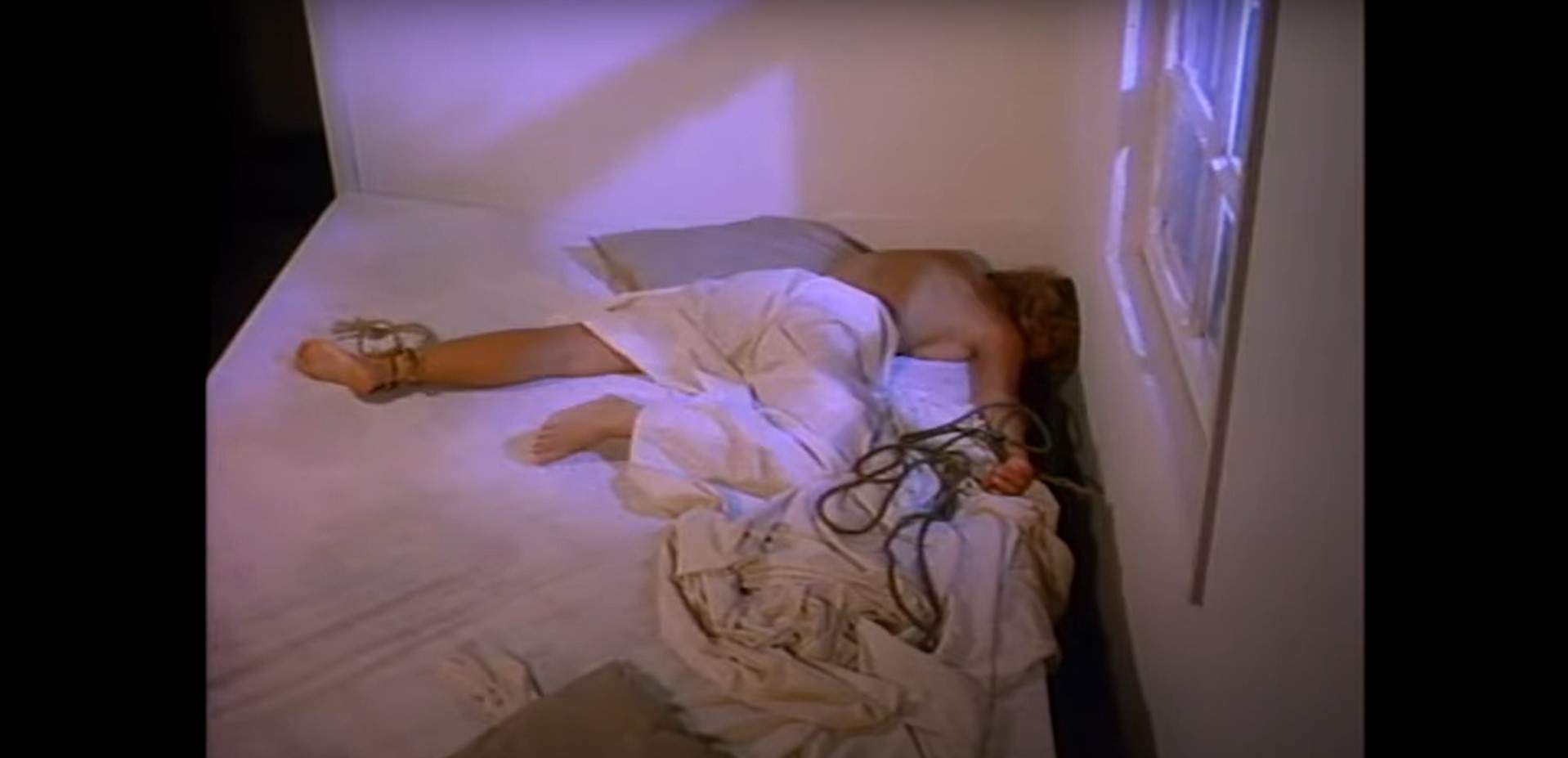
Daniel Ray Hawkins drives an unsettling, nomadic lifestyle as he travels across different parts of the country.  With no money, no place to call home, and little friends, Hawkins lives a life of mostly solitude, odd jobs, and equally as strange as him acquaintances spurred from his childhood, shaped by his promiscuously prostitute mother and a war veteran disabled father who gruesomely took his own life, both of which displaying their iniquities right in front of him.  Hawkins also lives a life of torture and murder, being one of the most prolific American serial killers ever of mostly young women.  When caught by authorities, Hawkins is willing to confess to everything and help unearth bodies from over decades on the road to ensure families he’s stolen from receive some sliver of solace.  His anecdotal accounts of individual disappearances and murders shock authorities to the core, so much so that Hawkins may just be unstable and not telling the truth.  That is until he informs them of and leads them to the cached polaroids and decaying corpses. 

Based on the American serial killer Henry Lee Lucas, who notoriously claims killing over 200 people has earned him a trio of film adaptations, at least, with “Henry:  Portrait of a Serial Killer,” directed by John McNaughton and starring Michael Rooker in the titular role, the subsequent lesser part II, and the more obscurely known Mark Blair written and directed production, “Confession of a Serial Killer.”  Much like “Armageddon” and “Deep Impact,” or “End of Days” and “Stigmata,” both movies fall into the paradoxical twin film phenomena of sharing the same them and having both been released approx. within a year of each other.  While “Henry:  Portrait of a Serial Killer” may have taken the top spot with a bigger budget played in more widespread venues, Blair’s rendition was released prior and closer to Lucas’s active killing spree that saw an end in 1983, just didn’t get released in America until a few years later to not duel with McNaughton’s film and thus didn’t succeed as much.  The Cedarwood Productions film was produced by Cecyle Osgood Rexrode, distributed by Roger Corman and his company, Concorde Pictures. 

While he was not the first choice for the titular character of Daniel Ray Hawkins, production designer, the late Robert A. Burns, filled in the sociopathic shoes with great monotonic conviction.  Burns, who has ties as Art Director and makeup effects on some of the most iconic and seminal genre films, such as “The Texas Chain Saw Massacre,” “The Hills Have Eyes,” and “Tourist Trap,” matches the makings of an unempathetic, unsympathetic, natural born killer with a glazed deadpan austere and matter-a-fact knowledge and every evil committed.  “Confessions of a Serial Killer” would not be as laced with depravity if Burns didn’t push the demented drugs to keep audiences hooked on overdosed deviancy.  Not a tall or broadly muscular stature, curly outstretched and receding hair, scruffily unshaven with a consistent 5 o’clock shadow, and wide rimmed glasses, Daniel Ray Hawkins epitomizes the very essence of a creep and accentuates the behavior even further with his leisurely composure and straight-faced simplicity.  Other side characters exist around Hawkins’ maniacal run with the bisexual Moon Lewton (Dennis Hill) and his sister Molly (Sidney Brammer), who marries the pansexual Hawkins out of necessity rather than sexual desire, and while Moon and Molly share Hawkins deranged apathy, they are completely overshadowed by the more controlling and interesting lead principal character due to half the murderous anecdotes are solo ran and all of the perception in the stories is through Hawkins’ recollection, giving him more power in the trio in perceptional self-interest, if Hawkins is capable of such consciousness.  The cast fleshes out with lawmen and victims in Berkley Garrett, Ollie Handley, DeeDee Norton, Demp Toney, Eleese Lester, Colom L. Keating, and Lainie Frasier in the opening stranded motorist scene that sets up Hawkins diabolical reach in turning a car into a trap. 

Bathed in realism, “Confessions of a Serial Killer” does not embellish with surrealistic temperament.  The story never dives into Hawkins’ head to show any indication or any kind of visual mental degradation or reality breakage toward being a coldblooded killer.  His violence is spartan, acidic, and raw to the bone, leaving a gritty taste in your mouth, with only a bleak childhood to blame for his adult obsessions to kill that he describes as necessary as breathing.  Blair distills the story to a “Mindhunter’” episode in trying to understand the killer and recover skeletons from his past, literally, through rational and respect ways rather than boiler room beatings and power-tripping threats.   Blair’s concept humanizes the inhuman and having Hawkins’s reminiscence each account is like recalling childhood memories with a smirk and fond remembrance splayed across his face adds another layer of iciness.  Grounded by pedestrian scenarios, “Confessions of a Serial Killer” disrupts the routine, the familiar, and the unscripted ways we live our lives unconsciously to the fiends living among us that look like you or me.  It’s a very palpable fear Blair conveys under the semi-biopic film.  The director does eventually let loose the reigns in the final third act with a finale account of Hawkins, Moon, and Molly shacking up with an amiable doctor, his suspicious assistant, and his shapely young daughter that boils to a head when one bad decision leas to another. 

For the first time on Blu-ray anywhere as a part of Unearthed Films’ Unearthed Classics sub-banner, “Confessions of a Serial Killer” receives a high-definition, 1080p release on an AVC encoded, single ring BD25.  Higher contrast and a lesser diffusion to create a harsher, flatter color scheme, the intention is to fully base the story in reality as much as possible, to structure an abrasive look of grain and low lighting that parallels the seediness the tale touts. inspired from the facts of an American serial killer without having to fully give recognition to the actual killer.  Shadows are key to Hawkins nightly runs, adding back-alley value to his viciousness, and the more lighter scenes, such as brighter-by-color interiors or day exteriors, are ample with natural grain that cut into the details but don’t necessarily knock them out entirely.  With the lesser capacity disc, compression doesn’t appear to be an issue with no sign of macroblocking, banding, or posterization. The English language LCPM 2.0 mono possesses lo-fi aspects kept true to the original audio master. The dual-channel conduit amasses the layers mostly in the forefront without ascendancy in the environment, creating a flat approach, rendering the audio mostly fixed and depthless with the action creeping onto the dialogue, but this also adds the realism of a real world chaos where cacophony reigns. William Penn’s effectively, inlaid soundtrack has hallmarks of Wayne Bell and Tobe Hooper’s “Texas Chain Saw Massacre in the minor key with added notes of an otherworldly tune fork keyboard and lingering bass elements that’s just infests with the sounds of deceit and death, reminding me also a lot of a George A. Romero’s “Night of the Living Dead’s” atmospheric arrangement. English SDH are an available option. The collector’s edition contents include a commentary with director Mark Blair, aka John Dwyer, director of photography Layton Blacklock, and actor Sidney Brammer (Molly), The Henry Lee Lucas Story by author and former TV news reporter James Moore, and a full-lengthy documentary Rondo and Bob examines Robert Burns being the foremost expert on uniquely deformed actor Rondo Hatton as well as examines Burns’ own career, a polaroid gallery, promotional gallery, and the trailer. Displaying the iconic poster, a profit from rip of Hannibal Lector with a devilishly masked killer behind bars, Unearthed Films’ releases the stark image onto a planar cardboard slipcover. Same image is used from the standard Blu-ray Amaray case with no reverse side. Disc is pressed with a memorable and anxiety-filled chase scenes. There are no inserts material included. The region A encoded Blu-ray has a runtime of 107 minutes and is unrated.

Last Rites: One of the better biopics on U.S. serial killers even if a little bit of speculation and sensationalism increases the already verbose notoriety of one Henry Lee Lucas. Scary and bleak, “Confessions of a Serial Killer” continues to remind us that no one is safe from the everyday sociopath.

An Unearthed Classic Now Available on Blu-ray! “Confessions of a Serial Killer”