Visions of Evil From a Disturbed Mind. “Lung” review!


An unidentified man, wearing medical scrubs and gloves, wanders through town, encountering hellishly gruesome scenes of death.  He wanders barefoot through a  ghastly journey that might figuratively expresses his back story of how he came to witness such visions and be relatively undisturbed by the horror they represent.  The filthy, gory, and ill-fated moments might also be hallucinations brought upon by a traumatic occurrence that wrenches him out of reality and into grisly purgatory.  Either way, the nameless man is a lost soul with no ambition, no emotion, and no direction to guide him through an inner conflict of blood-soaked entombment.

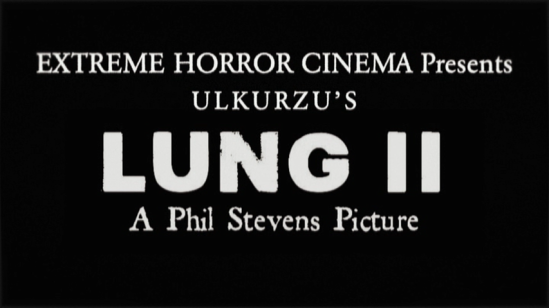
Unearthed Films’ 2-disc collector’s edition of “Lung I” and “Lung II” continues with the distribution company’s legacy of delivering the best underground cinema to the forefront of home entertainment.  Phil Stevens, director of positive-reviewed “Flowers,” writes, stars, and directs both feature films about the wandering man in a foggy, distorted haze, but “Lung II” is not a sequel to “Lung I.”  Instead, “Lung I” is the softcore version of events whereas “Lung II” is a hardcore redux – think along the lines of “The Evil Dead” and “Evil Dead II” – that’s much more detached from rationality and by collaborating with “American Guinea Pig: Bloodshock’s” Marcus Koch seizing upon the special effects, you can damn well count on “Lung II,” and certainly “Lung I” as well, being bare-faced dark, violent, and twisted. In more a sequential reality, “Lung” is part of the Phil Stevens’ proposed trilogy entitled the Violence of Dawn with “Flowers” leading the horrific charge. This review will focus more on “Lung II.”

Stevens stars as the unnamed lead, waking up lost under a creek bridge, dressed in medical scrubs, and haunted by unspeakable, bloody post-violence mayhem while continuously battling his evil doppelgänger self. Is this just a strange nightmare or a telltale sign of this man’s troubled past? Then, again, Stevens’ impassive take feels more like wandering through one hell of a dream, an endless journey into one’s post-traumatic warped mind rather than spelunking into one of a murderous soul’s, even if one of the moments of trauma could be his wife – or girlfriend – cheating on him and he catches her in the act with ill-fated consequences. Characters also related to the medical profession, such as a psychologist (David Copping) and quick flashes of a nurse (Angela Jane), are a part of this visceral vision quest. Finally, we come to The Exile character. The Exile might sound familiar if you’ve read my review on “Flowers” as he’s the only character, portrayed once again by Bryan W. Lohr Sr., that connects the two films. The Exile continues to mystify us about his presence, an extremely large and intimating brute with a deathly blank stare and a “don’t fuck with me” attitude.

Unlike “Flowers,” Stevens went the devoid of color route, constructing a black and white feature that, like “Flowers, goes without as much as a sentence of dialogue. Actions, expressions, and every sense of the word “art” tell the story. Non-linear editing and brutally realistic scenes of savagery in the confines of special effects exercise and sparks your brain’s neurons to try spitfire pieces together to cement a coherent narrative. Stevens is almost able to re-tap into and revitalize the silent film genre with “Flowers” and “Lung”, and with the help of a vehement brooding score by Mark Kueffner, I believe this type of experimental horror story telling can fascinate just about anyone without a weak stomach.

Unearthed Films and MVDVisual’s 2-disc DVD collector’s set a beautifully monochrome piece of art with roached infested severed heads, a halfway decomposed homeless man, and a pile of refrigerated sexual organs meshed together like something out of Brian Yuzna’s “Society,” but more gnarly. Im interested to see how Paradis, aka Paradis III, comes to conclude the trilogy and see how Unearthed FIlms releases Phil Stevens’ visionary tales. The Borderline Cinema and Extreme Horror Cinema “Lung” is comprised of two discs that entail “Lung I” Feature Film, “Lung II” Feature Film, Directors Commentary, Editors Commentary, Isolated Sound FX Track, Making of Lung 2 (which is very informative and fun to watch underground cinema come to the fold), Mark Kueffner: Lung Composer Featurette, Martin Trafford: Artwork Featurette, “Cats” Short Film, “Descent” Short Film, and Unearthed Trailers. “Lung” will not tickle everybody’s taste; surely sick and part of a niche network of darkly persuaded and humored people will most likely get it, but there’s still very much to appreciate here from director Phil Stevens and his eye for detail and disturbia. This gore and shock is worth a look and worth a chance.

Buy LUNG at Amazon!

Evil Invades Musically Inclined Fetish Nightclub! “Splatter Disco” review!


Kent Chubbs manages a popular fetish nightclub called Den O’Iniquity in a small conservative town and the demanding, ever-present pressure to close his proclaimed “smut” club from the angry puritanical protestors and unethical politicians have Kent on the hair pulling fences about what to exactly do with his beloved club and loyal employees. To make the matters worse, Kent’s father and club owner, Shank Chubbs, is knocking on death’s door with a bad ticker. To make the matters even more worse, the club’s been a remarkable safe haven for those who choose to express their closeted intimate desires in spanking, furry sex, or lube wrestling, but, during the holiday season, the club has had a low hanging dark cloud in a form of a deranged killer whose been destructively rampaging through the club’s most precious employees and enthusiastic patrons. In order to save everything he holds dear, Kent must find a way to keep everything afloat despite the challenges and his ill-advised legal advice from his acid tripping hippie attorney while also tracking down a psychopath.

In 2007, Richard Griffin directed a hybrid film that structured an abled bodied comedy and interjected moments of gruesome horror and fashioned it with elaborate musical numbers and the result was a niche slasher-musical simply known as “Splatter Disco.” We like this film. Actually, we love this film. Not because we enjoy watching and reviewing Richard Griffin films (see “Flesh for the Inferno,” “The Sins of Dracula,” “The Disco Exorcist,” “Frankenstein’s Hungry Dead,” “Future Justice”) and enjoy seeing where his toddler career began, but because “Splatter Disco” embodies the unlikely mixture of oil and water genres, doesn’t take itself seriously, and was whole-heartedly invested in by some of the biggest names in cult cinema as well as some talented actors and actresses you’ve may have never heard of before, but should certainly know.

Ken Foree, Lynn Lowry, and Debbie Rochon. Three big, well-known names that add their own delectable charm into the mix and, also, three big names who have developed a dynamic, who know each other’s styles, and who can still churn new material on the fly like it’s no big deal. Tack on Trent Haaga (“The Ghouls”) and the then new and Richard Griffin regular from that point on, Sarah Nicklin, who both have the favorably b-movie glow and “Splatter Disco” goes to a whole new level. One of the best performances goes to Jason McCormick as Echo, a DJ Qualls lookalike, with a timely comedic toss that provides a unique schtick to keep the character rememberable and McCormick nails the character right on the flat head. Overall, there were no slacking performances; every actor was chin deep getting into their respective roles with the various fetishes, cloak and dagger shades, and violent intentions. Rounding out the cast is Carlos Brum (“Beyond the Dunwich Horror”), William DeCoff (“The Haunting of Alice D”), Robin L. Watkins (“Poultrygeist”), and Brian L. Mullen III (“Pretty Dead Things”).

If you never experienced a Richard Griffin feature, you’ll pleasantly find out very quickly the director goes all out and the Providence, Rhode Island born director has a great 1970’s-1980’s homage style side dished with lots of vibrant colors and the abundance of suspending smoke and you’ll see why we cater to much of his work. The script’s dialogue, co-written by Griffin and producer Ted Marr, also excellently defines and solidifies the quick wit and whimsical nature of the comedy-horror and to make no mistake, this comedy-musical-horror has no shame with perversions, has well edited bloody special effects, and is ultimately a blast of lively cult cinema! “Splatter Disco” is a self-proclaimed first slasher musical of it’s kind; honestly, I couldn’t think of a prior film of it’s kind, but “Splatter Disco” has hit and catchy imitative tunes provided by Tony Milano and performed by Daniel Hildreth that go hand-and-hand with the humbling dance choreography.

MVDVisual, POP Cinema, and Shock-O-Rama re-releases “Splatter Disco” onto a not rated DVD home video with a 16:9 widescreen presentation. Regrettably, I’m sorely disappointed in the video quality that fully suffers from the distorting and blotchy compression artifacts that make night scenes fuzzy and flimsy in defintion. The lossy 2.0 stereo track is par for the course, even with musical pieces and soundtrack overlay, but does provide a little restitution for the image loss. Bonus features are aplenty that include a commentary with director Richard Griffin and star Lynn Lowry, a behind-the-scenes documentary, alternate scenes, and a Shock-O-Rama trailer vault. “Splatter Disco” is an entertaining 87 minute Richard Griffin slasher capsule classic full of degenerate song and dance!

Eyeing Up Evil! “Child Eater” review!


A small and sleepy town has a haunting and grisly past. Old man Robert Bowery, stricken with a degenerative eye disease, once believed his failing eyesight would return if he gouged and digested the eyes of young children. Younger the eyes, the better. Thought to be long dead, Robert Bowery’s legacy of sadistic evil has left a dreadful impact on the town, so much so that the young townie and Sheriff’s daughter, Helen Connolly, still feels the long lasting fright of the horrific stories of Bowery’s hide-and-seek hunt of his adolescent victims at his dilapidated campground compound which he knew every inch of it’s isolated wooded location. When Helen is persuaded by her father to babysit Lucas, a little boy whose family is new in town, she begrudgingly accepts to take care of the boy in Robert Bowery’s former home, but Lucas goes missing during the middle of the night. Helen tracks him down to Bowery’s rundown hunting ground where the child eater lies in wait to sink his razor sharp teeth into children’s eyes and burst their anatomical fluids!

Based upon the short film of the same title, “Child Eater” is director Erlingur Thoroddsen’s unholy birth of a slasher paragon. The subtle, patient approach Thoroddsen establishes stretches an unlimited amount of a brooding atmosphere that compliments the gangly stature and unpigmented color of the demon-looking Robert Bowery. With Bowery’s round, tinted spectacles, thin whipping cane, and bald top, the fragile elderly have a new heroic face when combating youthful brats. Thoroddsen, who also penned the script, purposefully leaves Bowery in an ambiguous light, never really obtaining a good solid shot of the villain’s icy and bleak veneer until near the very end, that mystifies a character with such a monolithic and infamous lore surrounding him. Every character in town knows one version or another the story of Robert Bowery and his sick obsession of regenerative eye method, but not one person can put truth to the plague of his affliction and that makes the town stain that more tough to remove.

Cait Bliss returns as Helen Connolly from the 2012 short as the conflicted heroine with change of heart toward her perspective on children, especially when feels obligated in her duty to serve and protect a snatched Lucas. Bliss feels a little too old for the role that involves her character living with her Sheriff father, but Helen might be part of the millennial group where you live with your folks until your thirty or older; yet Bliss teeters on the fine line of being a final girl, similar to Heather Lagenkamp’s Nancy in “A Nightmare on Elm Street,” turning her entitled life of aimless wandering into one possibly worth living and fighting for once the life changing ordeal is over. “You Can’t Kill Stephen King’s” Jason Martin provides the elephant ears, bald head, and lanky features that spectacularly builds Robert Bowery and Martin also provides a persona for a character whose always in the shadows, intoxicating the scene when visible with a nefariously bowie knife grin under a pair of Nazi-era mad scientist eyewear. Melinda Chilton, Brandon Smalls, Colin Critchley, Dave Klasko, James Wilcox, Andrew Kaempfer, and Kara Durrett make up the remaining cast in “Child Eater,” a unforgettable dooming blood junket.

Thoroddsen masterfully crafts “Child Eater’s” unsettling composure with unrivaled pacing, well edited jump scares, and an unchained animalistic killer crutched on sense other than his sight and who wouldn’t love a wretch plucking out peepers from eye sockets or ripping out jugulars with a single forceful bite? Robert Bowery could be a villainous idol and deservingly needs to be just that, but the vast weight of the Bowery mythos was attempted to be explained in too little of narrative run time, killing much of the hype that engulf’s his presence. The nearly unexplained death defiance follows into the trope trap similar to that of Jason Voorhees or Michael Myers, but the background provided on Bowery is unique, stemming from a vague portion of German and Polish folklore in which the latter may explain the child eater’s power, donned symbolically and, perhaps, even physically given his ability to be in the right place at the right time almost in simultaneous moments, that has been granted by the Devil.

Technically, I adore much of Thoroddsen’s slasheresque style blended with a calming patient that’s nearly unseen in the slasher genre. The only technical aspect I was not fond of was the fish eye lens used mainly in the beginning that spun a sickening wave of nausea through my corneas, the same sensation felt by viewers watching the jerky motions of a handheld found footage film. Still, Thoroddsen’s use of space, lighting, and special effects by Fiona Tyson states more than just another indie production and mesh those attributes with a superbly captivating and haunting string score by Einar Sv. Tryggvason and “Child Eater” strives further from being just another horrendously dubbed horror shunned aside for it’s nothing new attitude.

Black Stork Productions in association with Wheelhouse Creative and Blue Fox Entertainment deliver 82 minutes of toe curling fear in 2016’s “Child Eater.” MVDVisual distributes the Elingur Thoroddsen film onto a region free, not rated DVD that’s presented with an Anamoprhic Widescreen 1.85:1 presentation that’s definitely sharp even during the film’s mostly nighttime scenes. There are two audio options available: a Dolby Digital Surround 5.1 and a stereo 2.0. The 5.1 draws back the dialogue leaving more room for Tryggvason’s excellent score. Bonus features include a theatrical trailer, deleted scenes, and an audio commentary with director Erlingur Thoroddsen and stars Cait Bliss and Jason Martin. The deleted scenes leave good insight, explaining some scenes that might need more detailed clarification, and round out a rough edges. “Child Eater” eats into being an well played atmospheric horror on a budget with a rememberable child predator who can go eye-to-eye with foundational renaissance slashers!

“Child Eater” available for purchase at Amazon!

Colleen and Colleen Versus the Evil Bratzis! “Yoga Hosers” review!


Colleen Collette and Colleen McKenzie are best friends. They’re also two superficial 15-year-old girls who are nose deep into their social media campaigning cell phones, jamming in their girl punk band Glamthrax, and living by the unorthodox, yet namaste driven, yoga practices while exasperatingly working at one of girl’s father’s convenient stores called “Eh-2-Zed.” Set in the Great White North of Canada, the Winnipeg, Manitoba sophomores are surprisingly invited to a senior party, a lure by a popular, good-looking senior boy who has a darker, Satanic side to him. The Colleen girls’ run in with a murderous devil worshipping senior inadvertently opens another hidden danger lurking 37 feet beneath their “Eh-2-Zed” soles. A slumbering Nazi mad scientists has been awoken and aims to finish his Third Reich master plan to take over Canada with a cloned army of Bratzis, living Bratwurst sausages who are pint-sizes Nazis, and seeks to unleash evil upon the Manitoba Earth.

Kevin Smith’s latest pop-cultural flick, a comedy-horror feature, entitled “Yoga Hosers” is the second installment, following 2014’s film “Tusk”, in Smith’s horror-inspired trilogy known as The True North Trilogy. Did you noticed I labeled “Yoga Hosers” as a comedy-horror instead of a horror-comedy? The “Mallrats” and “Clerks” director basks more in the familiarity of witty, profane humor in this second of three films, but Kevin Smith has known to dapple, gradually stepping over to the dark side into horror with his radical religious sect piece “Red State” and, like aforementioned, the body-horror “Tusk.” The Jersey native also has an occasional appearance on AMC’s “The Talking Dead,” a talk show about “The Walking Dead’s” post-premier of each episode, and has meddled in the realm of the fantastic. Not only is Smith a strong advocate and sincerely passionate comic book enthusiast, coinciding with his own AMC show “The Comic Book Men,” but “Dogma,” starring the late Alan Rickman, delivers divine revelations and, now, with “Yoga Hosers,” a villainous Nazi clones miniature Bratwurst soldiers. Smith holds, in my opinion, one of the most extremely diverse bodies of work in our lifetime.

Where as “Tusk” goes gritty and gory with R rated horror-comedy, Smith’s intentions for “Yoga Hosers” has always leaned toward that of PG-13 and, maybe, that’s due in part of the two films’ minoring connection. The connection, presumably set in the same whacked out alternate universe, stem from the two Colleens, one played by Smith’s hysterically funny daughter, Harley Quinn Smith, and the other being Harley’s longtime, kindergarden friend Lily-Rose Depp. Yes, the daughter of mega star Johnny Depp and French singer Vanessa Paradis brings her inherited talent and French dialect to one-half of a buddy comedy. The 15-year old girls, who are also 15-year old in character, transfer their natural offscreen relationship into being an entitled millennial pair with every intent on neglecting responsibility until faced with the moment of truth. Teamed up well with Lily-Rose’s father, Johnny Depp, under the heavy makeup of a fictional French manhunter named Guy Lapointe, also from “Tusk,” with scene-to-scene rotating facial mole, the crime fighting, buddy trio awkwardly moves across the plain in an enjoyable double entendre performance of simple wit. Accompanying Depp, Smith, and Depp are an eclectic roster of Kevin Smith’s usuals such as Justin Long (“Tusk,” “Jeepers Creepers”) as a reality-severed Yoga instructor named Yogi Bayer, Jason Mewes (“Jay and Silent Bob Strike Back”) in a bit part, and, of course, Kevin Smith himself as the devilish Bratzis. New faces also make the scene with an unrecognizable Haley Joel Osment (“Sixth Sense”) as a young Canadian Nazi and “Orange is the New Black” Natasha Lyonne portraying a slutty Eh-2-Zed manager who sleeps her way to the top with Colleen C’s father, “Veep’s” Tony Hale.

“Yoga Hosers” explodes with Canadian farce that’s laced heavily with jokes on ‘aboots,’ hockey jersey-wearing patrons, an alternate version of Lucky Charms called Pucky Charms, and many more stereotypical references that satirically poke a good humored finger at Canadian culture and pop-culture. To top this satire sundae, the smug Colleens define the very title of the film with their dimwitted sludge and white girl yoga written into every storyboard moment. “Yoga Hosers'” buddy film concept gives an opportunity to two young and clueless teen girls who genre pirate the story with a jalopy of unsystematic plot humor, sucking away and discarding like garbage the sole ounce of blended “Gremlins” and “Puppet Master” cavalier subgenre horror that’s comfortably pleasant and inarguable right for a fun film of this triviality. Though I think the Colleens’ have had their story told, I’m intrigued to see what the pair of aloof teens offer in Smith’s third film of the trilogy, “Moose Jaws.”

MVDVisual distributes a dual format Blu-ray, DVD, and Digital HD release of the various production companies’, including main investor, Invincible Pictures, and Kevin Smith’s founded SModcast Pictures, “Yoga Hosers.” The Blu-ray disc is a MPEG-2 encoded 1080p transfer with a 2.38:1 presentation and, rarely, flutters under a mediocre bitrate. Image brightens with a glossy coating that revels in brighter hues of blue, pink, orange, and yellow while starker bolds such as red and purple pop with vividness. Yet, sharp details are thin, less defined to bring high definition to present technological age. The English Dolby Digital 5.1 track slightly elevates the ambient noise, especially during the girls’ punk rock practice that muffles out portions of their vocals, yet still manages to vary and balance. The only bonus feature available is a behind-the-scenes featurette that includes some insightful interviews. “Yoga Hosers” oppresses a melancholy reminder that the old Kevin Smith is no more and dawns a Kevin Smith 2.0 who transforms his satirical trademarks and his witty banter into strange misadventures, involving, in this case, two teenage fools flighting from one sub-narrative to another in a mixed bag of comedy and inferior minion horror.

Buy “Yoga Hosers” on Bluray/DVD/Digital HD at Amazon!

Enter Into Your Darkest, Evilest Fantasies. “We Are The Flesh” review!

screen-shot-2017-02-25-at-8-55-19-pm
Struggling to survive the conditions of the outside world, a brother and sister locate shelter inside a desolated complex and stumble upon it’s strange inhabitant, a solitary middle-aged man named Mariano with a penchant for welcoming his insanity. The alcohol distilling and isolating embracing Mariano has a twisted offer for harboring the young siblings as he also puts the two to work, constructing Mariano’s trash-ridden home into a cavernous structure from taped scraps of lumber and cardboard. Mariano desperately needs them to explore unorthodox depravities upon themselves to become one with their unhinged host that forms, in more than one way, one flesh-ravenous happy family.
screen-shot-2017-02-25-at-8-51-52-pm
“We Are the Flesh,” aka “Tenemos la carne” in the original title, is an experimental art house feature from controversial Mexican director Emiliano Rocha Minter. The 2016 film harbors more than just three hermit individuals dipping their toes into a forbidden pool of acts, but also provides numerous metaphors and symbolisms that might be hard to swallow and difficult to sit through during the 79 minute runtime. “Sin Nombre” actor Noé Hernández stars as Mariano and there isn’t enough praise in the art house world from his performance that consumes his mortal being, transforming him into a well oiled psychotic machine with a blazing stare, a certifiable grin, and a defined muscular physique. Hernández steals scenes left and right from his young and novice co-stars María Evoli and Diego Gamaliel, whom are equally as brave as the more experienced Hernández in their respective roles. “We Are the Flesh” emits racy undertones by just hearing the title alone and, absolutely, lives up to the title’s very core by displaying non-simulated sex acts. Think about it. Minter’s film only has three main characters for most of the narrative and two of them are siblings. Yup, Minter went the incest route for the sake of art.
screen-shot-2017-02-25-at-8-51-43-pm
In the opening scene, heavy breathing creeps upon a black screen until the image pops open to a Mariano’s face, laboring over something. Next cut is Mariano hunched over with a high stack of baled cardboard, walking in the color tone of a dark cool blue with a slight haze engulfing him. This opening scene is one instance where Mariano is portrayed the Messiah prophet Jesus. Other religious symbolistic events that connect Mariano, who would be condemned for his actions in the Christian scope, to Jesus that occur throughout, such as being dying and being reborn, the cave aspect, the motifs of faith from the mysterious eye dropper liquid, and being the sacrificial body as if transpiring to be some sort of demented wafer during a crazed cannibal communion orgy. Of course, opening anybody’s eyes or mind to this notion can be immensely difficult and profanely sacrilegious to even spell it out in text because seeing the streaming drug use, the attempted murder, the cannibalism, and the sibling incest rule the majority of the narrative makes a case that affiliates more with an unholy antichrist rather than Christ, but I believe director Emiliano Rocha Minter, being a Mexican national and growing up in a Catholic, like the majority of Hispanics, culture aimed to blur the lines between the heavens above and the fires below and embodying them as a singular whole.
screen-shot-2017-02-25-at-8-51-34-pm
Intrinsically irrational and insatiably grotesque, “We Are the Flesh” has momentum in a colorfully abrasive form, quickly evolving from act to act with characters reemerging anew every second onscreen. What might seem as a visionless quest for the sole purpose of producing shock value can be re-construed as a message more aesthetically beautiful in man’s most detested nature. Yollótl Alvarado’s cinematic vision is absolutely dripping with gripping, mature atmospherics that are well doused in vividness while, at the same time, being despairing in a post-apocalyptic haze. The experience charges at you, pulls you into this cavernous womb, and scratches at your tender barrier lining, trying to sneakily slip into your soul. The sensation is as much unreal as the film’s avant-garde structure.
screen-shot-2017-02-25-at-8-54-38-pm
Produced by production companies Piano, Detalle Films, Sedna Films, Estudios Splendor Omnia, and Simplemente, “We Are the Flesh” is a poetic approach experimental wonder, gratifyingly brought to home entertainment fruition from Arrow Films in the United Kingdom and Arrow Films, in conjunction with MVD Visual, in the United States on Blu-ray and DVD. Between Lex Ortega’s brutal social commentary gore-flick “Atroz” and Emiliano Rocha Minter’s art house metaphor “We Are the Flesh,” Mexican filmmaking stands high and bold, unafraid to tell unapologetic stories in conservative societies; a mere taste of what’s to come, I’m positive. While recommending this type of film isn’t the easiest for status quo movie lovers, “We Are the Flesh” hopefully will expand minds, open eyes, and encourage skin-on-skin contact for the cinematic adventurers.

“We Are the Flesh” available in USA! and in the United Kingdom!