The Most Dangerous EVIL Isn’t the Hunter! “Slave Girls from Beyond Infinity” reviewed! (Full Moon Features / Blu-ray)

The future for beautiful women holds little promise as they are slaves across a patriarchal-oppressed galaxy.  Daria and Tisa are two of those women, scantily cladded and stowed away in shackles on a galactic starship.  Their harrowing escape crash lands them on the shores of a jungle planet where they’re recovered and hosted by game hunter Zed and his two robot servants in his lavish castle abode.  Dressing, feeding, and providing them comfortable room accommodations, Zed appears to be Daria and Tisa’s savior against those who have enslaved them and from the wreckage of their getaway ship, but along with another couple of salvaged survivors from another ship, Zed has nefarious plans for each one of them.  Plans that put the survivors back into the mutant-infested jungle where fervent game hunter Zed’s need for worthy sport aims to capture and kill his pampered and mount their heads on his trophy room wall.

In a male-controlled universe, the battle of the sexes rages on!  “Slave Girls from Beyond Infinity” takes gender warfare into the jungle thicket with assumed male insuperability going up against the strength and will of woman.  The amalgamating sex, violence, and horror director Ken Dixon, known for his credits in exploitation with “The Erotic Adventures of Robinson Crusoe,” “Filmgore,” and the documentary “The Best of Sex and Violence,” helmed his last entry in 1987 with this underclothed and campy science-fiction chase of human game.  Dixon, along with John Eng, Mark Wolf, and Don Daniel produce progressive gender boundaries with the film’s opposition to the laid ideology of Charles Darwin who once said man have a higher eminence, in whatever he takes up while woman intuition powers are characteristic of a lower race.  “Slaves Girl from Beyond Infinity” worked to balance the scale with women who won’t lie down and die because of man-favored gifts of sexual selection.  Beyond Infinity and Titan Productions served as the co-production companies and distributed theatrically by then Charles Band’s Full Moon Entertainment subsidiary, Urban Classics, until It’s sequential acquisition by Band and its assimilation into the Full Moon collective.

With the title like “Slave Girls from Beyond Infinity,” there better be a skimpy garbed cast of gorgeous women pew-pewing with futuristic laser guns and using their sexual promiscuity as a dangerous weapon.  Fortunately for us, Ken Dixon doesn’t drop the ball fulfilling the fantasy or, how I see it, is necessary for such a midnight showing title.  The film follows the imprisonment, escape, and into the hands of a human hunting madman story of Daria and Tisa, played by the super fit, super sexy blondes Elizabeth Kaitan (“Necromancer,” “Friday the 13th:  The New Blood”) and Cindy Beal (“My Chauffeur”).  Kaitan edges out Beal as the lead set early with Daria’s relentless confidence and better adept at taking advantage of a situation but both women play into the strong female heroine as they knock out well-armed and body-armored male guards, intoxicate the male, and even to the implied extent of a male identifying robot, gaze, and take on the murderous Zed in his own devious game albeit both barely having any clothes on for most of the duration in the cold of space and in the heat of the jungle.  Kaitan and Beal are not the only bodacious bods in the cast with the 80’s household scream queen Brinke Stevens (“The Slumber Party Massacre,” “Sole Survivor”) puts a foot out of the girl in a shower and other unnamed nude girl role and into a more principal character with Shala, a fellow planet stranded survivor from a previous crash told anecdotally, and in an opening, nonspeaking minor role, but definitely bursting with screams, and at the seams, of a barely covered flesh, is the unknown beauty Sheila White.  Stevens is sister to whom would become the “The Dark Half’s” special and visual effects supervisor, Carl Horner, as he plays Rik, a handsome, young man with a sneaking suspicion about their too-gracious of a host and a toying, on-the-brink love interest to a firm and more confident Daria in a steamy show sex scene to throw Zed off their conniving scent toward his do-no-good plans.  Zed’s a hard card to turn over and understand his true nature.  Played with impeccably classy and sporting glittery adorned, gun metal leather like a Niel Diamond on-stage outfit, Don Scibner has a traditional charm about him that he’s carried with him from his debut role in this Dixon film to other B-pictures laced with cult impression, such as “Moon of Scorpio,” “Night Shade,” and “Witchcraft XI: Sisters in Blood,” and really sells it as a game hunter giddy with the opportunity for new blood to track – male and female.  Between starship guards, robots, and planetoid mutants, Kirk Graves, Randolph Roehbling, Bud Graves, Jeffery Blanchard, Fred Tate, Jacques Schardo, Mike Cooper, and Gregory Lee Cooper fill in the supporting role gaps. 

“Slave Girls from Beyond Infinity” sounds like a busty-bust-up from the likes of Jim Wynorski but whereas Wynorski goes after a blend of buffoonery and boobs, and we’re talking about to the likes of really big, Russ Meyer-sized voluptuousness, Ken Dixon’s takes on a more earnest and natural approach, to an extent that “Slave Girls from Beyond Infinity” feels like a science fiction film of yore, circa 1950s with starship models, impractical attire, men in creature suits, and a timeless tone that is at odds with a futuristic setting.  A subtle whiff of campiness keeps the film from being monotonically stale.  The story itself is constructed from a historical literary framework, loosely based off the 1924 short story “The Most Dangerous Game” by Richard Connell with a big Russian aristocrat and game hunter, bored out of his gourd hunting animals, has turned to hunting shipwrecked people that find themselves stranded on his island.  Dixon replaces the Russian aristocrat with a lavishly leathered bachelor served by robots and skilled with a laser crossbow and the prey is technically shipwrecked but no longer worthy game man bur rather half-naked women comfortable in their loincloths and confident in their survival in an alien jungle amongst mutants, zombies, and a deranged hunter.  “Slave Girls from Beyond Infinity” certainly has that sublevel of sexual objectification and fantasy, or even perhaps is on par level with the murder of another human for sport premise as Kaitan, Beal, and Stevens not only bare most of their bodies, but their bodies are used as tools to subvert Zed’s snooping and are used by Zed in an exploitational sex act stemmed for this post-hunt thrill.

Full Moon delivers the most dangerous game in space down to insatiable fans of 80’s sex symbols and sci-fi oddities with a new Blu-ray release.  Unlike previous re-issue catalogue releases, either from standard definition to high-definition or high-definition to high-definition, “Slave Girls from Beyond Infinity” does not notify of any restoration or remastered efforts onto the AVC encoded, 1080p resolution, BD25.  However, not much needed to be improved on the already stellar picture from a virtually clean 35mm film.  I will say that the transfer did buffer out the natural grain of the film stock, but the details appear greatly featured amongst bronze and near blemish free skin tones from the model-esque actresses with big, teased hair down to the stubble and scarred faces of Rik and Zed, respectively.  Fabrics also come out on top with Zed’s outfit showing the stress marks of a leathery hide to the entirety of jungle epidermis, and even the forced perspective effects of composite mattes to enlarge the jungle setting, though an obvious matte effect, looks positively punctuated in detailed.  The soft lighting used to make the women stargazing eye candy does go against the detail grain but more accentuates the warm tones of a portrayed early science-fiction capture-and-kill.  The English LCPM audio comes in two formats:  a 2.0 stereo and a 5.1 surround sound mix.  The latter immerses you quite effectively but keeping the bass level and handled by the subwoofer reigns, dialogue comes over clean and clear in the front channels, and the sides offer atmospheric chitter of a strong world jungle.  Plus, all the laser fodder presents a satisfactory electric discharge familiar with the genre over the decades.  This suggests an optimization of the audio design for a full package of a sci-fi sonic palette.  This release does not contain a subtitle option.  The modest special features bundled with the feature include a skin-idolizing tribute to Elizabeth Kaitan that showcase her most memorable clothes-on and clothes-off moments from her film credits, the original theatrical trailer, and other Full Moon Features trailers.  The new HD suffers from the company’s consistent business structure of re-issue the film onto just a standard release with barely an encoded special features and little-to-no physical content, but the original film one sheet for the one-sided cover art offers an illustrated sexy and science-fiction splendor and the disc is pressed with select faces from the cover art floating amongst the stars in near translucency.  “Slave Girls from Beyond Infinity” Blu-ray is the R rated cut with a well-paced 75-minute runtime and is region free for global players, presented in a 1.78:1 aspect ratio.

Last Rites: Entertaining and easy on the eyes, “Slave Girls from Beyond Infinity” is an homage to the old science fiction psychotronic that’s vixenly sexy and savagely saucy under the guise of a cruel and deadly hunt on another world.

“Slave Girls from Beyond Infinity” Blu-ray Now Available! Order Here!

Fascist EVIL Takes on Freedom of Expression! “School in the Crosshairs” reviewed! (Cult Epics / Blu-ray)

“School in the Crosshairs” on a Cult Epics Blu-ray! Purcahse here at Amazon.

Yuka Mitamura is the smartest, most well-rounded student at her high school that’s embattled by a constant debate on whether physical edition and clubs are a necessary requisite for academic success, jeopardizing physical activities such has her best friend Koji’s Kendo club.  When Mitmura’s latent psychokinetic powers emerge, she struggles to cope with the change that’s out of her control and the new acquaintances with similar powers that show up in her life, such as with new female student Michiru Takamizawa whose sudden enrollment sees a quick rise in the ranks of school politics and sparks an insidious need for a totalitarian and fascist reign to control dissident and unapproved behavior within the school.  As an oppressive crack down on the total student body sparks a civil war amongst the students, Michiru and her mentoring demon Kyogoku aim to enslave the human race and it’s up to Mitamura, unknowingly Earth’s champion, to fight against the forces of evil. 

Adapted from the 1973 science fiction and fantasy novel “Psychic School Wars” by Taku Mayumura, “School in the Crosshairs” is every ounce those Japan famous hyper-intensity and colorfully assertive commercials with visual sparkle and great enthusiasm for their hawked products.  You know them well when they go internet viral.  The 1981 Japanese adaptation is helmed by Nobuhiko Ôbayashi, director of “Hausu” and “His Motorbike, Her island,” from no script but rather from Mayumura’s novel as script.  Keeping faithful to nearly the entire novel and adding Ôbayashi’s variegated touch, “School in the Crosshairs” is a flamboyant Earth invasion in its divisive influence of the study body, especially between the studious academics and physical clubs.  Also known as “The Aimed School” and “School Wars” elsewhere in the world, as well as titled “ねらわれた学園,” ”School in the Crosshairs” is produced by “Island of the Evil Spirits’” Haruki Kadokawa, who also produced our last Japanese reviewed title, the traumatically powerful and wonderfully performed “The Beast to Die,” under his company Kadokawa Haruki Jimusho.

“School in the Crosshairs” circles around principal character in film and in book Yuka Mitamura as she juggles her newfound powers.  Between feeling like a stranger in her body as well as the weird visitations of her powers and of the otherworldly figure with a cap and green skin and having to not only rebel against an authoritarian rule overtaking her high school but also to save all of the world from that said otherworldly and powerful figure, Mitamura’s plate is undoubtedly full for a teenage girl.  Hiroko Yakushimaru (“Sailor Suit and Machine Gun”) comes to the role as a teenage girl herself at the age of 16-17 years old by the time of principal photography and seizes the high school melodramatics with ease as the carefree smartest kid in school.  Yet, finding Yakushimaru a formidable character stemmed by her performance is not so easily rendered in an indifference projection toward her newfound abilities; Yakushimaru is unable to really compel audiences with body language or even in her dialogue on why the teen has to soul search cope when she discovers she’s different.  We get more out of Ryôichi Takayanagi (“His Motorbike, Her Island”) as the quasi love interest and Kendo club leader Koji as his kendo tournament matches and failings in academics that affect his beer story-owning family dynamics are heavily emphasized and given more weight against a floundering leading lady character with superpowers and uses those powers to put Koji in good standing amongst the Kendo culture with win-after-win.  Not until the world starts to unravel at the hands of fascist student leader and fellow telekinetic Michiru Takamizawa (Masami Hasegawa, “The Tragedy in the Devil-Mask Village”) and her despot leader, the manipulative demon Kyogoku (Tôru Minegishi, “Main Line to Terror”) in a technicolor brilliance of a cosmic showdown held within the interdimensional layers but even then the last gasp of defeat has lackluster strength after a mountainous buildup of dictatorship control and potential student civial war.  The cast fills out with Keiko Mitamura, Noriko Sengoku, Yûsuke Okada, Kôichi Miura, Hiromitsu Suzuki, Macoto Tezuka, and Kôichi Yamamoto.

Pushing a few of the acting and character flaws aside and off the table, “School in the Crosshairs” is essentially manga embodied by live-action film.  There’s stellar mass group choreography near the beginning when the clubs merge for a rush invite to encourage recruitment, there is an extravagantly caped character in green makeup and a white afro wig, and there’s the painted-on-cell colorization I’ve mentioned a few times already that really ups the fantastical sci-fi features of Mayumura’s novel with a director like Nobuhiko Ôbayashi unafraid to get deep with saturation and long in experimentation.  Themes on fear of individualism, forced conformity, friendship, and the rise up out from that powerlessness feeling for what’s right showcase through metaphorical fascism, akin to the likes of the evil Nazi Germany party with a fear mongering nationalist’s convincing motivational speeches and confidence commands that seduce the ears of the waning high school minority, the academic kids, seeking alternative solace and a way to regain control as they are not as popular in contrast to those in clubs.  The Nazi tropes don’t end there as rounding up nonconformists, Nazi-like uniforms, and even a modified heil make their way into the overall story and that’s the darkest part in “School in the Crosshairs” light and airy jeopardizing of innocence and individuality. 

Catching a glimpse of Nobuhiko Ôbayashi’s pre-“Hausu” filmmaking brilliancy is now as easy as catching “School in the Crosshairs” on a North American Blu-ray release from Cult Epics.  The dazzling high-definition and an equally impressive, supplemented release is AVC encoded onto a BD50 with a 2K transfer and restoration of the original 35mm print and presented in a widescreen 1.85:1 aspect ratio.  The “School in the Crosshairs” restoration visuals need to be seen to be believed in a newly graded touch up that offers a glassy darker side within the fascism themes and a richer color palette to make the hued pinwheel spectrum a living, breathing character between good versus evil.  The grain comes through naturally on nearly all scenes with some of the shadowy moments favoring less delineation through the consistent optical texture.  The composited effects are boldly vibrant inside a creative streak that’s idiosyncratic only to Ôbayashi and are implemented into the live scenes with precision that doesn’t make it awfully clumsy or clunky.  Cult Epics made sure to cover any and all viewer’s at-home audio setup with three Japanese language options:  an uncompressed LPCM 2.0 Stereo, a Dolby Digital 5.1 Surround Sound, and a DTS-HD MA 5.1 Surround Sound.  Each carry their own weight and attributes with the LPCM 2.0 and DTS-HD 5.1 similar in fidelity, but the DTS offers an expansive girth that fills in the left and right channels of interdimensional ambience with laser strikes and gameshow tonal keys.  Dialogue is constructed through ADR that carries a level and balanced layer field and holding its own against the fantasy ambient that sometimes rises to meet the dialogue decibel; however, dialogue is clean and clear without any issues in clairaudience.  Newly improved English subtitles are optionally availably.  The set is quite complete, and likely comprehensive, with the physical and encoded special features.  Film critic Max Robinson offers a feature parallel commentary track, Phillip Jefferies provides a video essay on Nobuhiko Ôbayashi’s body of work in Sailor Suits and Sound, an Ôbayashi film poster gallery, and the theatrical trailer.  Physically, the clear Blu-ray Amaray case keeps inside the reversible cover art with both sides featuring the Japanese poster arts and housing that package is the limited edition cardboard O-slip with a fantastic compositional design by Sam Smith.  Inserted inside is the back cover unlisted, 22-page booklet full of black and white as well as color adverts, feature stills, characters bios, and other writings but all in Japanese, no English.  The 90-mean feature comes no rated and is region free.

Last Rites: More so now than ever in the current political climate, freedom of expression endangerment is the critical theme for Ôbayashi’s “School in the Crosshairs,” a color melange of resistance against the forces of evil hard to differentiate looking like our friends, family, and the everyday student.

“School in the Crosshairs” on a Cult Epics Blu-ray! Purcahse here at Amazon.

An EVIL Alien Blob Storms Earth in Search for Space Feline! “The Cat” reviewed! (88 Films / Limited Edition Blu-ray)

If you missed the Blu-ray, “The Cat” Standard Edition is Available!

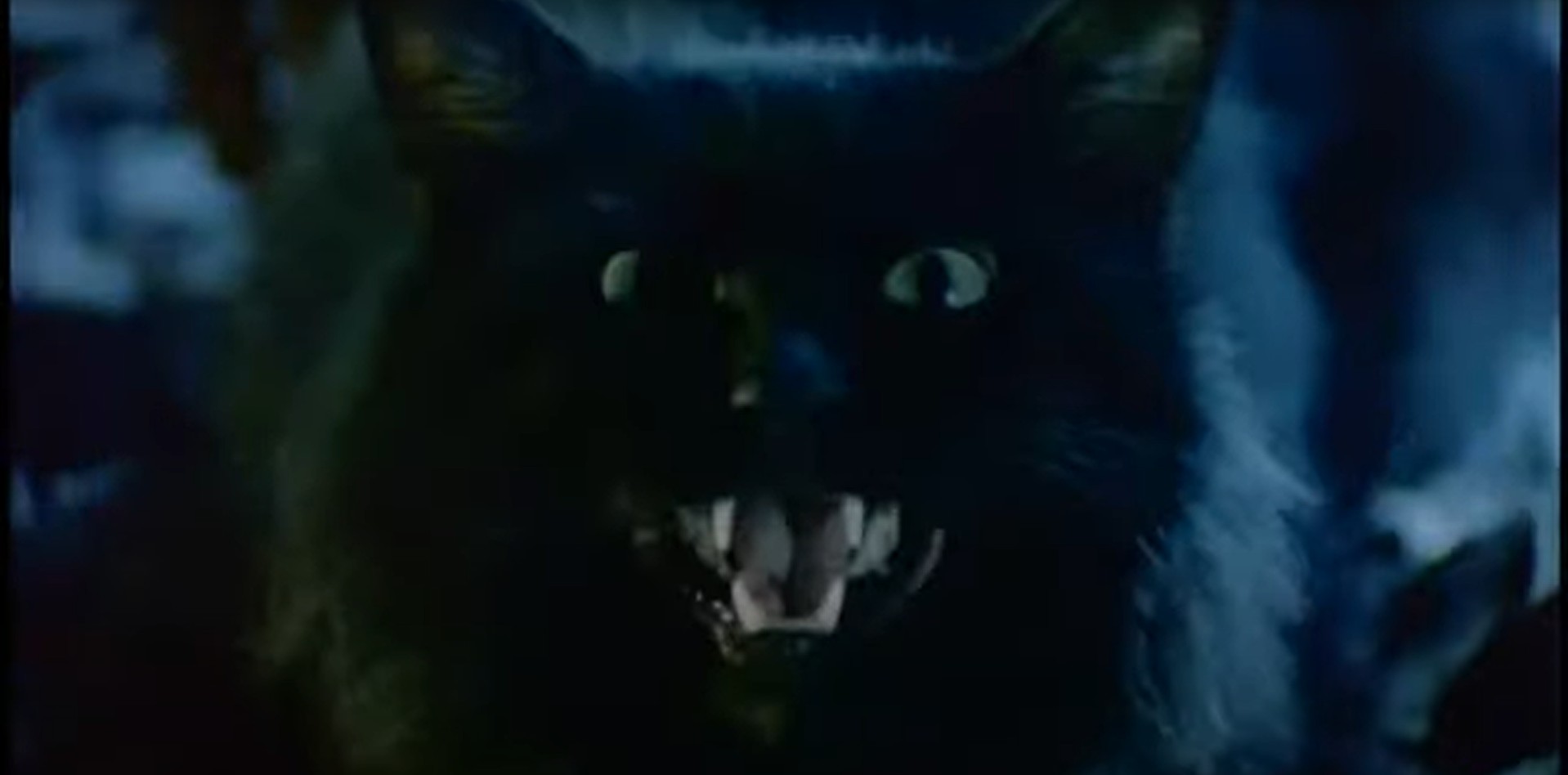
Storytelling author Wisely recounts one of his more fantastical pieces originating from more truth than fiction.  The writer reminisces investigating the mysterious occurrences surrounding a black cat and a young woman involved in a museum heist of an ancient, unknown artifact and, previously, in a strange encountering with Wisely’s friend Li Tung involving strange hammering noises and strewn about cat guts in an adjacent apartment.  Wisely soon discovers he’s bitten off more than he can chew becoming mixed up in extraterrestrial battle between the gentile but fierce fighting space cat and the young woman from another world versus a vicious and imposing orange alien blob that can inhabit dead humans and slip through tight confining spaces, leaving a burn trail of electrified bodies in its wake.  Wisely and his girlfriend, Pai so, decide to help the girl retrieve a second piece of the artifact that be used as a weapon against the relentless alien aggressor before the cat and girl can return to their home planet.

A strange science fiction thriller hailing from Hong Kong, “The Cat,” or “Lo mau,” is the 1991 filmic adaptation of author Ni Kuang’s “Old Cat” from a part of the Wisely adventure series of novels.  Written by frequent collaborating screenwriters Hing-Ka Chan and Gordon Chan (“Cat and Mouse,” “Behind the Yellow Line”) as well as numerous team-ups of Hing-Ka penning Gordon director helmed works (“Beast Cops,” “Thunderbolt”) and directed by “Riki-Oh:  The Story of Ricky” director Ngai Choi Lam, “The Cat’s” bizarrely unraveled as it is unrivaled but evokes a commingling of Hong Kong mysticism, science fiction, horror, and creature personification that’s hard to find not entertaining in its converging Daoism with creature feature movies!  Golden Harvest and Paragon Films, in association with Japan’s Nippon Television Network as a Hong Kong-Japanese alliance, are the companies behind the picture production with Chan Tung Chow (“Riki-Oh:  The Story of Ricky”) and Seiji Okuda (“Pulse”) as producers.

Hong Kong beauty Gloria Yip (“Riki-Oh:  The Story of Ricky,” “The Blue Jean Monster”) took Hong Kong cinema by storm in the early 90s before quietly taking a step back from acting to focus on building a family when newly married in 1995.  Since her divorce, Yip has been active in the last decade and half but to experience her best, early work, “The Cat” is a good start to behold her natural girl-next-door charisma and attractive attributes as an alien inside a human body.  Where she obtains this human form is unknown and her species social status, her name or how she became trapped on Earth is also vague, but Yip’s character can float waltz and is seemingly the caretaker of the Cat, who is a general of sorts in the alien race.  Her alien sidekick, Errol (Siu-Ming Lau, “Shaolin vs Evil Dead:  Ultimate Power,” “A Chinese Ghost Story”), too has an equivocal backstory as they search for weaponry relics and evade the caustic and electrically charged blob monster that threatens their world.  The story falls in more in tune with the three friends buried by the extraterrestrial struggle for survival and dominance with “A Chinse Ghost Story II and III’s” Waise Lee as principal lead character Wisely, a humble story writer living off the riches of girlfriend Pai So (Christine Ng, “Crime Story”), at least based on their dialogue of her owning a big house, playing tennis, and providing.  It’s an oddly laid out relationship that shows no quarrel or being tested when up against alien beings.  Li Tung (Lawrence Lau, “3-D Sex and Zen:  Extreme Ecstasy”) is Wisely’s first friend to encounter the girl and cat as noisy above neighbors but it’s their cop friend, Wang Chieh-Mei (Philip Kwok, “Hard Boiled”) who takes the unfortunate brunt being inhabited by the alien blob and becoming a Rambo-arsenal assassin.  The last piece to “The Cat’s” cast is actually the “Old Cat” author Ni Kuang having a cameo appearance as a warrior dog handler, Processor Yu.

Did I mention already that “The Cat” is beyond bizarre?  The campy story suffers from connective tissue deficiency syndrome, meaning there’s not enough exposition or explanation in the subdued, mild-manner interactions to really bring together and segue the really cool action and creature sequences that involve, but not limited to, pyrotechnics, forced perception effects, stop-motion, blood squibs, prosthetics and makeup, and high-flying wire acts involving not only people but cats and dogs!  The cat versus dog fight is a rough-and-tumble showstopper.  The special effects and choreographic teams of Hong Kong’s special makeup effects artist Chi-Wai Cheung (“Riki-Oh:  The Story of Ricky”) and stunt coordinator Philip Kwok taking their cogs and working into the grand effects design along with Japan’s f/x crew from visual effects artist Takashi Kawabata (“Dark Water”) and special effects Shinji Higuchi (“Gamera, the Guardian of the Universe”) is a masterful amalgamation of two cultures and two styles into one, blending high-flying acrobatics with the strange, bold stop-motion and visual effects that incorporate puppets and molds is optical buffet aimed stimulate and confound.  Nearly experimental in its narrative and effects while bordering being derivative, such as from the 1988 “The Blob” remake, “The Cat’ prowls, growls, and meows as a welcoming hot mess of feline phantasmagoria. 

On a new limited-edition Blu-ray set with exclusive, new artwork by graphic artist Sean Langmore, “The Cat” purrs with a fully-loaded, out of this world high definition release from UK label 88 Films and distributed by MVDVisual in the North American market.  A new 2K restoration of the original 35mm negative is encoded on a AVC encoded BD50 with a 1080p resolution in an aspect ratio of 1.85:1 widescreen.  Image presentation has the stellar glow of regular Hong Kong film stock, a stock that doesn’t dilute the defining particulars but only softens them slight.  The original negative has withstood the test of time and any improper handling providing the restoration effort with a focus-driven goal of grading and detail. The other side of that coin is that all the rubbery and irregular textures are now more in the spotlight instead of being lost in the lower resolution and more opaque video qualities.  Brilliant gel lighting and a comprehensive range of primary reds and blues coupled with an electric orange and blood red of the antagonistic monster seduces contrastingly inside a dark atmosphere with a story mostly told during the nighttime hours.  Remastered with a Cantonese DTS-HD mono track, the compositional track is about as good as it’s going to get but that’s not saying the audio is bad at all.  Clean and clear in ADR dialogue and distinct in the ambience and action, “The Cat’s” remastering is mighty without being punchy with broad-range, consistent audio that doesn’t have any holes poked into it and has an epic, original score by Phillip Chan (“Her Vengeance”).  Newly translated English subtitles are burned onto the only video file feature.  The encoded special features include an audio commentary by Asian film expert Frank Djeng of the NY Asian Film Festivial, a new interview with writer Gordon Chan in Cantonese with an English introduction, the Japanese cut of the film in standard definition, an image gallery, and theatrical trailer.  All of the encoded features will be available on the limited-edition and standard release sets.  Langmore’s artwork graces the LE O-ring slipcover and rigid slipbox with a crazy illustrative arrangement that details how bonkers “The Cat” gets.  Inside the slipbox, a full-bodied colored and detailed booklet with more original Langmore artwork, one sheets, stills, and other contents that include cast and crew acknowledgements, a Paul Bramhall retrospective essay on director Ngai Choi Lam That Cat is Dangerous, a second essay in regard to Nai-Choi’s niche cinematic credits by Matthew Edwards entitled Body Horror, and a special thanks roundup and more acknowledgements in the making of the Blu-ray release.  There’s also a collectible art card stuffed in between the clear Amaray case and the booklet.  The reversible cover art’s secondary slip-shell is of an original poster art, a good alternative to an already overused Langmore illustration that’s on the O-Ring and slipbox.  While not a numbered limited-edition release, news of the set already being or nearly sold out at most retailers is circulating, but there will be a standard edition slated for release late November ICYMI!  The not rated release has a 89-minute runtime and is encoded region A and B for playback.

Last Rites: Ngai Choi Lam’s science fiction, body horror, and creature feature inundated “The Cat” has all the weirdness and practical prosthetics, including deeply bizarre force perception visuals, that’s beyond our galaxy and capacity for understanding, landing with great precision onto a well-deserved, highly anticipated, and must own 88 Films’ limited-edition boxset!

If you missed the Blu-ray, “The Cat” Standard Edition is Available!

No One Can Hear You Scream in EVIL Found Footage Space! “V/H/S/Beyond” reviewed! (Acorn Media International / Blu-ray)

Go Beyond the Limit with “V/H/S/Beyond.” Now on Blu-ray!

Six new tapes push the boundaries of what we know is true and what we know as reality.  Six new tapes confirm that we are not alone on this Earth or even in this universe.  Sex new tapes shows the horrors beyond our plane of existence and into another dimension of fear of the unknown.  A special tasked police force raids a house horded by violent, brainless baby-nappers only to discover the horrible creature lurking in the attic.  A megastar under the pressures to perform breaks from the mortal chains of human greed and power.  Skydiving friends encounter an alien attack miles above the Earth surface.  A doggie-daycare aims to transfigure and train people to sit, rollover, and behave like good, obedient hybrid canine creatures, a woman determined to find proof of extraterrestrial’s in the Mojave desert found curiosity didn’t just kill the cat, it also brought it back to life to kill it again and again and again, and a two flea market bought VHS self-tapings quite possibly reveal the horrifying truth of if we are alone in the world.

The next grand tour through “V/H/S” horror has entered orbit!  “V/H/S/Beyond” abducts and probes our fear receptors with invasive and terrifying cold instruments of science-fictional horror tales.  “Beyond” marks the 7th entry into the found-footage anthological franchise formed over a decade ago in 2012, created and produced by genre devotee Brad Miska under his founded, longstanding horror website Bloody Disgusting, and this entry’s theme “Beyond” denotes a sci-fi flare from the hellish man-made creations to vicious visitors from the void above.  Miska returns as producer alongside Josh Goldbloom, James Harris, and Michael Schreiber all of whom have been a part of the series since 2022’s “V/H/S/99.”  Cinepocalypse Productions, Studio71, Spooky Pictures, and Shudder serve as coproduction companies for the shorts directed by Jay Cheel “Abduction/Adduction,” Jordan Downey “Stork,” Virat Pal “Dream Girl,” Justin Martinez “Live and Let Dive,” Christian and Justin Long (yes, that Justin long from “Jeepers Creepers” and “Tusk”) “Fur Babies,” and Kate Siegal “Stowaway.”

“Beyond” introduces a variety of situations, mostly flipping between man-made mistakes to alien encounters, with a medley of spirited characters to shepherd the shorts where they need to end in a timely outcome.  Each found footage story is inherently different with no two situations nearly alike, keeping to the same synonymous rhythm that has garnered fandom for the “V/H/S” anthologies.  The wraparound segment has the facsimile of a mystery documentary of two flea market purchased tapes that are believed to be evidence of alternate life beyond this universe with mock interviews given by the actors casted in the film – Brian Baker, Gerry Eng, Sam Gorski, Mitch Horowitz, Wren Weichman, and Trevor Dow discussing the history of tapes and the house they’re filmed in, social alien background and perception, and determining if the tapes are authentic.  Like all the other wraparounds, story progression is interspersed between the five other shorts with the first being “Stork” where the special police task force W.A.R.D.E.N. takes the fight to the paranormal.  Officers Broome (Thom Hallum, “Bull Shark”), Aubert (James C. Burns, “Lake Dead”), Bennet (Jolene Andersen, “Doctor Death”), Ivy (Tyler Andrews), and E.T. (Vas Provatakis, “Children of the Pines”) storm an infested monster house with rookie Segura (Phillip Andrew Botello, “Devil’s Revenge”) to save stolen infants.  From here, paparazzi Arnab (Sayandeep Sengupta) and Sonu (Rohan Joshi) find themselves at the mercy of an all-powerful and vengeful goddess in megastar Tara (Namrata Sheth), birthday boy Zach (Bobby Slaski, “White Terror”) finds himself free-falling into an alien invasion, doggie daycare owner Becky (Libby Letlow) is dead serious about Frankensteining the purrfect fur babies, and UFO researcher Halley (Alanah Pearce) will find that discover the truth will be a painful purgatorial experience.  “Beyond” brings a wide range of talent to the table with ensemble casts, streamers, Bollywood actors, and solo preformists to exact another side of fear for the franchise with a principal supporting cast rounding the anthology with Virat Pal, Rhett Wellington, Hannah McBride, Matthew Layton, Braedyn Bruner, Phillip Lundquist, and Kevin Bohleber.

One would think an anthology series built upon the idea of a found footage would eventually become stale amongst the public who are feeling the fatigue of an overused subgenre, much like the zombie subgenre in the early 2000s to early 2010 where every George Romero wannabe with a handheld camera set out to either homage or hit it big with the next undead head success.  Found footage is currently, or rather vaguely, in the throes of being overworked because of how cost efficient and effective films of its ilk can be to those inspired to create.  However, the “V/H/S” series hits differently.  For one, it’s an anthology series that brings a fan of imagination to its whole and we’re not subjected the one type of found footage narrative as dissimilar styles, tastes, direction, writing, etc., converge by means of short films.  Another element of “V/H/S” staying power is the series created and developed by genre admirers, such as Brad Miska whose veins course with literally nothing else but the blood cells of the horror.  Lastly, “V/H/S” continues to evolve by colliding past and present, nostalgia and current, and myth and fact together with a serrated surrealism that can thrill you with, often times, hell on Earth entertainment as well as scare the living bejesus out of you.  “Beyond” maintains the trend by coming out of the 80’s and 90’s vibe from the last three installments and diving headfirst into beyond the scope of traditional monsters, terrestrial creatures, and iconic monsters for nothing born of his Earth, such as with the wraparound story, “Stork,” “Live and Let Dive,” and “Stowaway,” and nurturing more a mad-science madness in “Dreamgirl” and “Fur Babies.”  A possible detriment to “Beyond’s” ability to connect with fans of fear and frights with the latest entry leaning heavily on the physical side of action-gore that sometimes is a tall order of campiness rather than the instillation of underlaying, psychological terror aside from the Mike Flanagan (“Oculus,” “Doctor Sleep”) penned “Stowaway” that evokes some segregated space isolation and a death-defying situation that still feels the repetitive painful sting.

“V/H/S/Beyond” lights up the night sky with blood red intergalactic splatter and takes mad science to a whole new abominable level with a new Blu-ray from the UK label Acorn Media International.  The AVC encoded, 1080p high-definition, BD50 presents the film in a widescreen 1.78:1 aspect ratio with an occasion retro-slip into pillar box 4:3 for that VHS façade.  Image presentation ranges because of the home movie, handheld camera, and body cam found footage trope that’s this series bread-and-butter.  Through the intended static, interlacing and tracking lines, fuzzy darkness, quick movements, and mostly whichever video interference objects one can think of, minus authentic celluloid print damage, to pseudo-sell found footage realism.  The outcome is superbly effective and highly captivating albeit moments that are too agitated to understand and connect objects and sounds in the narrative, another part of the collective that makes it effective yet also makes it wasted runtime space for viewers.  What’s not wasted is the chainsaw point of view in “Stock” where ripping through and decapitating monsters has DOOM inspiration all over it. A majority English with some Hindi DTS-HD 5.1 surround sound mix is, too, designed to mimic the gimmick of handheld found footage. Distortions and other audio mic cuts and external interference on the audio system are included to sell the illusion and are often done at great detail in time, overlay, and spatial fractions in-between viewer and what the view is experiencing on screen. Depth is mostly front loaded within the context of first-person viewpoints while the surrounding channels take a subtle backseat but whisper through when there’s a sound behind the camera. LFE charges in during more rambunctious moments, which there are a lot of, and are not quelled for the sake of dialogue that’s mostly discernible when necessary. English subtitles are available. The encoded special features on a static menu include the pre-visuals of explosions, disintegrations, and free-falling bodies on the practical skydiving of the cameraman explain how many jumps were needed to put the pieces altogether for that breathtaking scene at 20,000 miles in the sky, actress Libby Letlow’s audition tape for Becky in the “Fur Babies” short, the making of “The Dreamgirl,” a behind the scenes of “Stork” with IGN, and the how the timelapse was created in “Stowaway.” Physical areas of the releases are about the same other Acorn Media Releases with the thicker UK Amaray casing that has the illustrated cover art of the “V/H/S” thematic skull worked into the swirling steller-laden of scary space. Inside is just the disc pressed with the same image art. UK certified 18 for strong violence and injury detail, “V/H/S/Beyond” has a runtime of 114 minutes and is not noted on the back cover in regard to the region playback, usually Acorn Media releases are hard encoded with region B, but this particular release play on a Region A setting and could be very well region free.

Last Rites: The “V/H/S” team continues to maintain a sustainable supply of fresh meat for the grinder in relation to its current theme. Plenty of splatter, mayhem, lunacy, and backbone quivering chills to get lost in “Beyond’s” cosmic Hell. Can’t wait to see what’s next in store for the anthology!

Go Beyond the Limit with “V/H/S/Beyond.” Now on Blu-ray!

The Apex Predator of the Sea is Now the EVIL From Beyond the Stars! “Space Sharks” reviewed! (Wild Eye Releasing / DVD)

Your Daily Dose of Sharksploitation with “Space Sharks” on DVD!

Interstellar scientists voyage home after discovering and retrieving a new species of shark and carnivorous plant from the planet Crypt-X.  When a rogue meteoroid field strikes the hull and sends their ship careening toward the Nevada desert, only one human survivor emerges from the wreckage to face off as the only resistance against a deadly combinational species of highly technological and predatory sharks and the piranha-like swarm of hungry vegetation.  At the same time, a group of recovering addicts are led onto a scenic desert trail for a spiritual nature hike while a conspiracy theorist, toyed with by clandestine organizations, makes his way west to locate the crash and uncover the truth connecting the space sharks with every other conspiracy theory known to man.  Man versus space shark versus killer plant in an extraterrestrial showdown on Earth’s terrain and only one will survive in what’s surely be a massive Government coverup.

Tornadoes whip man-eating sharks through the air in “Sharknado.”  Engineering virtuosos yet undead World War II Nazi soldiers ride monstrous, flying sharks to wreak havoc on modern civilization in “Sky Sharks.”  Now, outer space is no longer quiet and safe as a newly, deadly breed of predator is brought to Earth in “Space Sharks.”   Director Dustin Ferguson, a director with an oeuvre of low-budget horror going back as far as 2010, pens and helms the adjunct indie horror-comedy under his pseudonym of Dark Infinity and his latest is to infinity and beyond being right up there at the top of the schlockiest of sharksploitation.  Filmed and around Burbank California, doubling with no much likeness to the deserts of Nevada near the Grand Canyon, the team behind “5G Zombies” and “Amityville in the Hood” SCS Entertainment in a co-joint effort with Wild Eye Releasing, who also distributes the title, releases “Space Sharks” with Wild Eye Releasing’s founder Rob Hauschild producing and associate produced by Julie Ann Ream and Joe Williamson.

For all of roughly five minutes and a couple of lines of dialogue, Eric Roberts secures top bill on this what’s sure to be lost in the sharksploitation pit of nonsense.  The once formidable 1980s and 1990s star, and brother to the high-powered and elegant Julia Roberts, “Best of the Best” and “Runaway Train” star has ebb-and-flowed vertically between mainstream Hollywood films and the lowest-of-the-low indies.  “Space Sharks” is definitely in the latter category and doesn’t showcase much of Roberts’ given talent that has in recent years strayed to the more eccentric in a countless number of Dick, Jane, and Harry productions.  Longtime scream queen Brink Stevens is another familiar who you’ve might not even known existed in the film if it wasn’t for the credits.  Playing the nature hike leader but enveloped under the shade of a large sun hat, hidden behind large black sunglasses, and, too, with very little screentime, Stevens comes and goes like the snap of a finger.  Other cult film actors are added to this ridiculous recipe with Mel Novak (“Game of Death,” “RoboWoman”) and Scott Schwartz (“A Christmas Story,” ‘Café Flesh 2”) folded into a cheap, B-movie run cast batter of Ferguson regulars to give this tasteless schlock some spice.  If “Space Sharks” had to select a true principal lead, Allie Perez (“Amityville Emanuelle”) would be the closest as the lone surviving scientist with arms training to fend against the upright and muscularly athletic sharks while trying to make her way home to dad, Mel Novack, but tasked to protect desert lost civilians Nick Caisse (“Apex Predators 2:  The Spawning”), Traci Burr (“Death Bitch”), Janet Lopez (“Liza: Warden from Hell”), Ben Anderson (“Witchblossom”), Breana Mitchell (“Cocaine Couger”), Daniel Joseph Stier (“The Clown Chainsaw Massacre”), Christine Twyman (“It Wants Blood!”) and Joshua Mooney (“Axed to Pieces”) from being chum. 

An “Alien” and “Predator” rip-off integrated into the multifaceted farce that has become sharksploitation.  As premises go, “Space Sharks” has a promising plotline of a newly discovered, extraterrestrial species of shark being returned to Earth for scientific, governmental weaponization or examination and then runs amok the desert when things go terribly South.  That story is far more lucid than previous low-rent, quick-produced features of a supernatural shark emerging jaws first out of a toilet bowel.  Also, the way the trailer was cut had “Space Sharks” perk ears of interest with a very similar appearance to “Street Sharks,” a mid-1990s Saturday morning, animated television series of muscular man-eaters that were half-man, half-shark heroes running around beating up bad guys on a weekly basis.  Then, we see the film and we were wrong, dead wrong.  “Space Sharks” is a half-cocked mashup of too much, too little of unwanted knockoffs and crisscrossing ideas.  Computer-generated designs of the brawny tech-sharks are not terrible for budget but do borrow quite an uncomfortable bit from our favorite jungle and urban hunter, the Predator, with heat vision, cloaking ability, and the methods of skinning and suspending corpses upside down.  The pull from “Alien” is more subtle with an opening credit title that comes about in the same gradual style as the Xenomorph films.  Ferguson is no stranger in his cache of flattery and audiences likely wouldn’t have minded the echoes that entail if it wasn’t for the nonsensical chasing of conspiracy theories, a space mission stemmed with little-to-no details, explanation of tiny alien sharks grown to be elite hunters, man-eating plants, giant spaceship crash that befell no concern, zero character developments, dynamics, and arcs, and a story edit too perfunctory to keep focus.  

“Space Sharks” invades retail shelves with a Wild Eye Releasing DVD. The MPEG-2 encoded, upscaled 1080p, DVD5 houses essentially the encircling feature presented in a widescreen 1.78:1 aspect ratio. The upscale barely registers with a mid-range decoding rate at approximately 5 Mbps. Textures are not as defined inside the context of tangible captured frames whereas any post-production object, computer generated with commercial animation software, is about as backwards realistic as an early 90s source coded video games, such as the blockiness, square-pegged Doom or Duke Nukem 3D. “Space Sharks” has an ungraded, unpolished overlay that leaves colors desaturated or muted and the compression seizes control with blatant aliasing issues when characters run around like free range chickens evading foxes. The long opening through galaxy is the best “Space Sharks” will get that exposes colors, multi-shaped object, and an ease of poorly rendered animation burden with a rather decent composition of visuals and soundtrack to kick off the film. The English language stereo 2.0 mix too rides that sliding scale of independent filmmaking with a low-frequency, heavily saturated audio mix that can’t harness and real in isolated elements, and without that even diffusion of sound, every exterior noise maker attaches itself to the dialogue and the intended ambient sound. Dialogue renders through anemically but has enough strength to be heard and intelligible, even if what’s scripted is not. English subtitles are not available. DVD unfolds as a feature-only product with an al carte selection of Wild Eye trailers that are usually on every Wild Eye home video releasing, special features withstanding. A time warping 70-minutes runtime has this just over hour long feature feel much longer in is unrated, region free format.

Last Rites: Simply put, if you’re looking to watch something jawsome, “Space Sharks” is more space junk and not worth going anywhere near its orbit.

Your Daily Dose of Sharksploitation with “Space Sharks” on DVD!