In the Canals, An EVIL Lurks! “Amsterdamned” reviewed! (Blue Underground / Blu-ray)

The Horror of “Amsterdamned” Canals Are Now Available at Home!

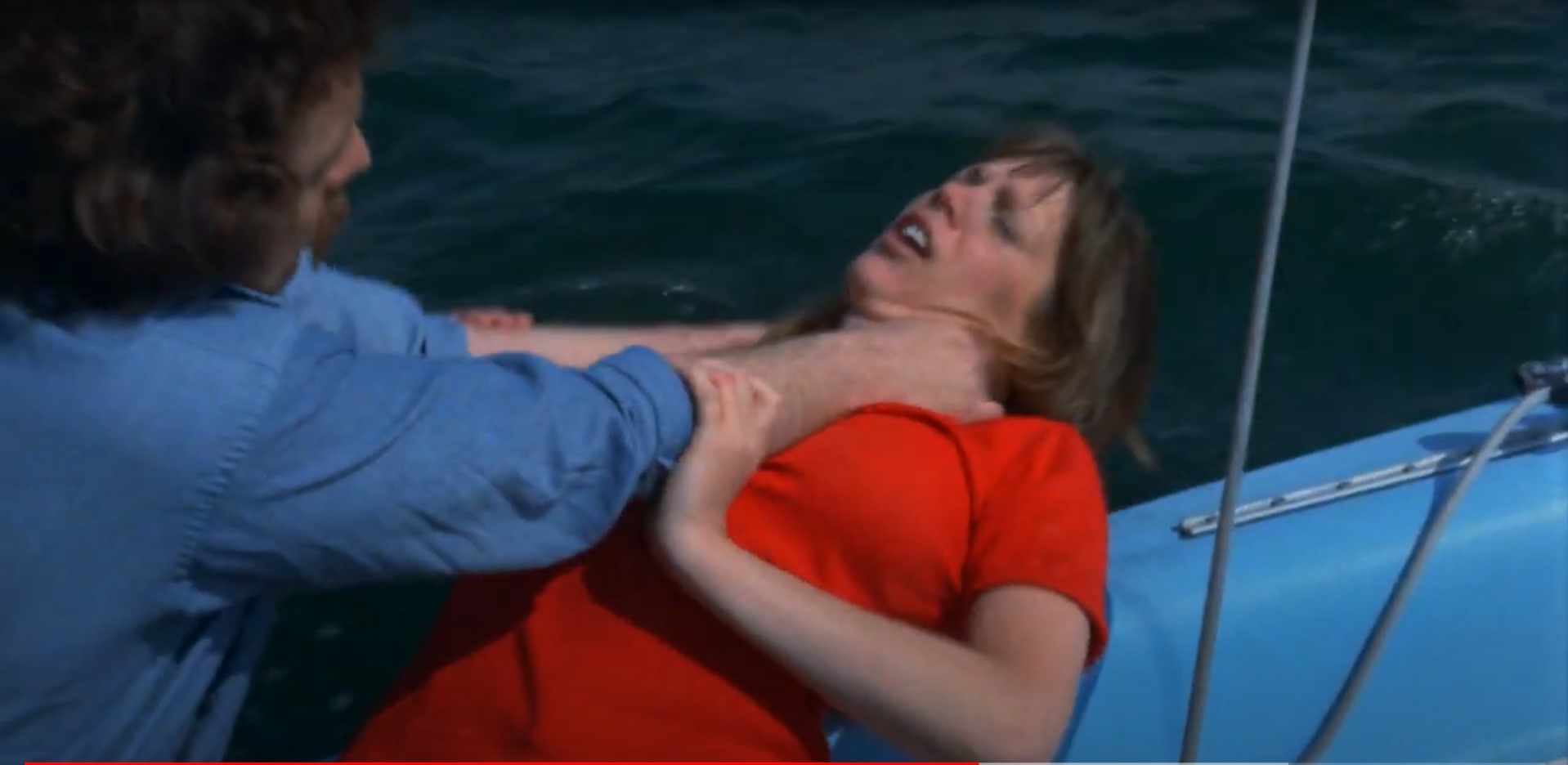
A killer emerges out of the depths of an Amsterdam canal and mercilessly kills a prostitute, dragging her into the water, and suspends her lifeless, stabbed-riddled corpse over one of the canal bridges.  Detective Eric Visser is baffled by the canal killer’s unusual technique but aims to track down the bravado murderer while living the single dad life with daughter Anneke.  When another couple of heinous killings takes place out in the middle of the water and the mutilated bodies wash ashore, panic begins to creep into administrative officials with the thought of a scuba diving maniac swimming in the hundreds of Amsterdam canals.  Investigating the underwater hobby leads Visser to meet Laura, a diving enthusiast and museum tour guide who sparks instantly with the ruggedly handsome detective, but as the Visser gets closer to the truth and the killer, Laura becomes emmeshed in a crime that’s deadlier than an embolism. 

If scuba diving wasn’t already deadly enough, the murky waters of canal rivulets become the hunting grounds of a deranged, underwater killer in Dick Maas’s 1988 Dutch crime thriller “Amsterdamned.”   The elevator horror filmmaker of “The Lift” Maas wrote and directed the red-running canal of carnage with a fast-paced, action-packed, hard-boiled, giallo film outside the conventional Italia-construction.  Shot mostly in the red-light district capital of the world of Amsterdam, shooting locations also include Utrecht to accommodate additional speedboat scenes, plus studio work in Leiden and Heemstede, Netherland.  Maas self produces the action-horror alongside Lauren Geels, a longtime collaborator with Maas who’ve worked previously on comedies “Voyeur” and “Flodders” and subsequent projects, such as the English-dialogued apocalyptic drama “The Last Island” helmed by provocative feminist filmmaker Marleen Gorris and Maas’s own American remake of “The Lift,” known as “The Shaft” or “Down.”  “Amsterdamned” is distributed theatrically by First Floor Pictures.

Huub Stapel (“The Cool Lakes of Death,” “The Lift”) stars as the world-weary, tough as nails cop Eric Visser.  Also, as a single dad raising a small preteen and nearly self-independent child Anneke (Tatum Dagelet, ”Stuk!”), the setup doesn’t automatically constitute the detective as a cynically hardboiled man of the law but evokes more of a seasoned and skeptical vigilant persona of a man who is willing to leave circumspection at the door when duty calls.  Stapel wonderfully fits the bill of Eric Visser’s rugged and assured good looks with a force in tune with being a father and a police investigator when the occasion calls for it.  Being a single father also invites the opportunity to spark an exciting love interest to later put into danger.  The infectious smile of Monique van de Ven (“Turkish Delight,” “A Woman Like Eve”) fills that void as Stapel and Ven engage in teetering flirtation that makes us wonder how astute is Visser now on a case that’s causing havoc on the streets of, or rather the waterways of, Amsterdam.  Luckily, fellow police partners Vermeer (Serge-Henri Valcke, “Sl8n8”) and John van Meegeren (Wim Zomer), the latter a professional scuba diver and once jealous rival lover of Visser, keep the detective mostly focused with investigative conversation, joint crime scene speculation, and the gruesome death of one of them when they get too close.  That ancient rivalry between Visser and Meegeren stays put in the re-introduction of their assembly with no hard feelings and bygones will be bygones attitude, missing the change for any exterior or addition tension outside the murderer’s reign of terror.  “Amsterdamned” rounds out the cast with Lou Landré, Tanneke Hartzuiker, and Hidde Maas.

The fascinating aspect of Dick Maas’s “Amsterdamned” is taking the idyllic, ingrained, and utilitarian that is a cultural and landmark staple of Amsterdam and turning into an unpleasant gateway of fear and anxiety.  Transferring soundbite cues and following a storyline that’s not terribly too dissimilar from that of Steven Speilberg’s iconic oceanic death-dealing “Jaws,” and toss in Dick Maas’s enthusiastic fervor for a heart-racing effervescence, and you have the singular crime-thriller “Amsterdamned” in a nutshell that’s doesn’t deliver trite and uninspired horror or thrills but rather spoils the innate grandeur of a worldclass city that’s soaked in splendor as well as carnal sin; a fact lost upon espionage thrillers who overuse “Amsterdam” as an assembly of salvo and high-speed chases.  Maas does add his own variation of high-speed chase with a lengthy and complex speedboat pursuit through the on-site in Amsterdam and Utrecht canals with gripping and well edited ramp jumps and fiery explosions that predate some of the more renowned speedboat chases of modern cinema.  What’s also interesting about “Amsterdamned” is the adversary that doesn’t have a lot of bells and whistles to make a convoluted story stick; instead, the killer is rather simply pieced together but descriptively held at bay until the finale for maximum suspense on unveiling the identity. 

Surfacing just beneath the depths is a 2K restoration from the original 35mm negative, approved by Dick Maas, from Blue Underground; however, these Blu-ray specs mirror the 2017 Blu-ray and DVD combo set and is more than likely the same transfer but for this standard edition, also labeled special edition, release.  The single disc, AVC encoded, BD50 is presented in high-definition 1080p and in a widescreen 1.85:1 aspect ratio.  Color saturation stands out here with a specified density that results in a pop of color and a diffusion of light that’s brilliant and revealing in the day without a bleeding wash and cold, wet, and with a noir-like steeliness at night, accentuated by inky solid shadows.  The original 35mm print has flawless approach into the restoration that makes the 2K scan candid and, perhaps, a walk in the park for another Blue Underground upgrade to high-definition in their established genre catalogue.  The original Dutch soundtrack is presented in a 5.1 DTS-HD, greatly tightened around the milieu and dialogue to isolate each track for separation and clarity.  Dick Maas, a filmmaker of many talents, scores his own feature with an unintrusive and dynamic soundtrack that ebbs and flows with the trepidation terror and tension-riddled action.  Dialogue is clean and clear but does have that ADR artificiality to it.  English subtitles render over promptly and error free.  Two other soundtrack mixes are available on the dual layer disc:  a lossless hybrid English-Dutch 2.0 DTS-HD and a French dubbed and lossy Dolby Digital 2.0 Stereo.  English SHD and Spanish subtitles are also optionally available.  Extras are pulled from the previous Blue Underground release and are an audio commentary from writer/director/composer Dick Maas and editor Hans van Dungen, a making of “Amsterdamned,” an interview with star Huub Stapel Tales from the Canal, an interview with stunt coordinator Dickey Beer Damned Stuntwork, the Dutch and US trailer, the Lois Lane music video directed by Dick Maas, and poster and still galleries.  Behind the wild ride illustrated composition of the Blu-ray front cover, the reverse cover lists the encoded scene chapters on top of one of Huub Stapel’s stunt work performances. The disc is pressed with the masked scuba diver head holding a gleaming diver’s knife cover art from Blue Underground’s limited-edition Blu-ray and DVD combo set of 2017. The all region encoded disc holds a 113-minute feature and is rated R.

Last Rites: If looking to save a buck against purchasing the limited edition, dual format combo set, the standard special edition Blu-ray of “Amsterdamned” is worth it, especially since the film has been absent from U.S. home markets up until 2017. Dick Maas is a premier Dutch horror filmmaker with the ability to keep us engaged as well as on edge.

The Horror of “Amsterdamned” Canals Are Now Available at Home!

This EVIL Has Brains! “Head of the Family” reviewed! (Full Moon Features / Remastered DVD)

Get Ahead in Life with “Head of the Family” on DVD!

The Stackpooles are a little strange and are usually the talk of the small town of Nob Hollows when the zombified trio of siblings pick up the groceries at Lance’s Stop and Shop general store and diner.  Yet, the Stackpoole’s are not Lance’s problem, not yet anyway, when Howard, a no-good shakedown thug, forces his might into Lance’s business as a silent partner.  Little does Howard know that Lance has an ongoing affair with his wife, Loretta, and they devise a plan to get rid of Howard using the newly discovered dirt on the Stackpoole family’s bizarre kidnappings to take care of Howard once and for all.  Lance figures he’s found his meal ticket after blackmailing Mryon, the fourth, and unseen, sibling who’s the mastermind and head of the family – literally a giant head – using telepathy and mind control to against his brothers and sister to do his bidding, but Myron is no fool to be taken advantage of so easily. 

Who just is this Robert Talbot?  The director of “Head of the Family,” who hides behind a black mask and speaks through a voice modulator, is none other than Full Moon’s secret identity for Charles Band under a pseudonym persona to exact a different kind of picture outside the context he’s expected to continue as well as an empire built on the image of horror.  “Head of the Family” may not be tiny dolls inflicting an affliction based on their evil ways or the resurrection of the formerly dead and abnormal to, once again, inflect damage upon their creators, and possibly, the world we know it.  Instead, “Head of the Family” slips out of Full Moon’s comfort zone and into another, different kind of shadowy namkeen to small plate audiences’ bizarre fascination with the weird and fantastical.   Also, to exhibit T&A more than like the usual in the Full Moon repertoire.  The less horror, more zany cult 1995 feature structures around the titular big headed villain, a band of his freakshow kin, and a constantly copulating couple that’s penned by Neal Marshall Stevens (“Thir13en Ghosts”), also under a pseudonym of Benjamin Carr, based off a “Talbot” story, and produced by, also “Talbot,” and “Hideous!” and “Witchouse” producer, Kirk Edward Hansen.

I couldn’t tell you if J.W. Perra is big-headed or not in real life, but the actor is certainly quite cranial as the family-telepathic, wheelchair bound Myron Stackpoole.  The literal pun of the title plays in tune with Full Moon’s madcap maniacal ties while having Perra’s large head shine, or rather sweat gland glisten, under a miniature lame body.  Myron’s enfeebled corporeal flesh drives his hunger to join the ranks of normal people as he kidnaps and surgically operates on the minds of unsuspected townsfolk to incorporate a portion of his higher intellect into a stronger body.  Myron uses his stupefied siblings’ talents, bestowed upon them through a paternal quadruplet birthing, with Wheeler (James Jones, “Dark Honeymoon”) given superhuman bugeye sight and hearing, Otis (Bob Schott, “Gymkata”) given the twice the strength of a normal man, and Georgina (adult actress Alexandria Quinn, “Taboo VIII”) given, you guessed it, the hot and voluptuous body to attract men like moth to a flame.  Speaking of hot bodies, former adult actress and “Femalien” star Jacqueline Lovell, aka porn handle Sara St. James, is absolutely supple as Loretta, a twangy blonde girlfriend to the scheming Lance, played with Cajun confidence by Blake Adams (“Lurking Fear”), and every chance Lance and Loretta get, they’re steaming the scene with erotically charged expo and exposition.  I’m fairly certain Lovell has more lines topless than she does with her clothes fully on.  In the supporting cast inventory, Vicki Lynn (“Fugitive Rage”) and Gordon Jennison Noice (“Virtuosity’) make up the remaining. 

I’ll admit I fell into that hole of expecting “Head of the Family” to play out just like any conventional Full Moon feature, comprised of pint-sized and mischievous devils to a carnivalesque tune of irregular horror.  To my surprise but not to my dismay, Band’s incognito oddity has the bones of a blackmailing thriller spiced with eccentric and caricature types and gratuitous sex at every turned corner.  “Head of the Family” progresses through interacting conversation to outline exploitation arrangements and to be informed of dangers of crossing a big headed brainiac, interjected with the occasional display of drooling operated rejects, Otis and Wheeler’s utilizing their inborn side effects, and, I keep coming around to this motif and hopefully not in a pervy way, the female toplessness that bares bountiful.  The depth perception effect to enlarge J.W. Perra’s head as Myron is executed pretty well with Adolfo Bartoli’s camera work that reflects the actors facing generally at the correct angle, as if they’re eye-to-eye with the Myron, and the edits do the effect justice as well, spliced precisely to account for dimensional space, the effects are reminiscent of Randy Cook’s illusionary work on “The Gate” films using dimensional animation and scale between live actors in the same frame but some distance apart.  If you excuse the upcoming intended pun, Band’s film is more of a talking head production than one of grotesque action, a realization you won’t be aware of until well stretched into the runtime and because of this that’s the reason there’s likely a ton of Jacqueline Lovell nudity.  Okay, okay, I’ll stop blabbering on about the nudity!   

“Head of the Family” arrives onto newly remastered DVD from Full Moon Features.  The MPEG2, upscaled 720p, DVD5, presented in a widescreen 1.78:1 aspect ratio, doesn’t have any detail regarding the remastering on the latest re-release but I suspect it’s the identical image or a slightly touched up 35mm negative used for the original Full Moon release from 1999 scanned in 2K.  15 years later, a reimagined “Head of the Family” retains the softer, radiant picture quality with a highly extensive color palette through the aura glow and a natural, yet reduced, grain.  The negative does have a flaw in what looks to be cell damage a little halfway through the runtime with a brief, dark cut line making itself known, if you blink, you’ll miss it.  This sort of obvious damage does lean more toward an identical transfer being used for the 2024 release with just a 2k scan without restorative elements.  Remastered restoration likely went hot and heavy into the audio elements.  The English language LPCM is available in two channel formats, a dual-channeled 2.0 and a surround sound 5.1 mix.  Robust with added nuances, “Head of the Family’s” soundtrack breathes new aural acuities that not only clean any distortions, if there was any, but also sharpens the tracks like a knife on a wet stone, cutting and clean.  Dialogue is clear and assertive through what is mostly a talking head span.  English close caption subtitles are available.  Much of the special features are reused from the 2016 Blu-ray release, including an audio commentary track from Actor J.W. Perra (Myron), promo behind-the-scenes video of the long anticipated “Bride of Head,” which has been stagnant for years, the original trailer, and other Full Moon Features’ trailers.  The DVD release is an exact mirror image of the physical Blu-ray release from 8 years prior with a disc press image of Myron’s closeup through a murky filter and no inserts included.  The region free release has an 82-minute runtime and is rated R without specifying the content but there is language, nudity, strong sexuality, and violence. 

Last Rites: “Head of the Family” bucks the lucrative trend of miniature killer imps for the Full Moon empire but keeps moderately in line with eccentric characters, unabashed skin, and a Richard Band jaunty soundtrack, accentuated even more in a brand-new remastered DVD version of the film that was helmed by Charlie Band himself in anonymity.

Get Ahead in Life with “Head of the Family” on DVD!

Interrogating EVIL Mounts to Hundreds of Deaths. “Confessions of a Serial Killer” reviewed! (Unearthed Films / Blu-ray)

An Unearthed Classic Now Available on Blu-ray! “Confessions of a Serial Killer”

Daniel Ray Hawkins drives an unsettling, nomadic lifestyle as he travels across different parts of the country.  With no money, no place to call home, and little friends, Hawkins lives a life of mostly solitude, odd jobs, and equally as strange as him acquaintances spurred from his childhood, shaped by his promiscuously prostitute mother and a war veteran disabled father who gruesomely took his own life, both of which displaying their iniquities right in front of him.  Hawkins also lives a life of torture and murder, being one of the most prolific American serial killers ever of mostly young women.  When caught by authorities, Hawkins is willing to confess to everything and help unearth bodies from over decades on the road to ensure families he’s stolen from receive some sliver of solace.  His anecdotal accounts of individual disappearances and murders shock authorities to the core, so much so that Hawkins may just be unstable and not telling the truth.  That is until he informs them of and leads them to the cached polaroids and decaying corpses. 

Based on the American serial killer Henry Lee Lucas, who notoriously claims killing over 200 people has earned him a trio of film adaptations, at least, with “Henry:  Portrait of a Serial Killer,” directed by John McNaughton and starring Michael Rooker in the titular role, the subsequent lesser part II, and the more obscurely known Mark Blair written and directed production, “Confession of a Serial Killer.”  Much like “Armageddon” and “Deep Impact,” or “End of Days” and “Stigmata,” both movies fall into the paradoxical twin film phenomena of sharing the same them and having both been released approx. within a year of each other.  While “Henry:  Portrait of a Serial Killer” may have taken the top spot with a bigger budget played in more widespread venues, Blair’s rendition was released prior and closer to Lucas’s active killing spree that saw an end in 1983, just didn’t get released in America until a few years later to not duel with McNaughton’s film and thus didn’t succeed as much.  The Cedarwood Productions film was produced by Cecyle Osgood Rexrode, distributed by Roger Corman and his company, Concorde Pictures. 

While he was not the first choice for the titular character of Daniel Ray Hawkins, production designer, the late Robert A. Burns, filled in the sociopathic shoes with great monotonic conviction.  Burns, who has ties as Art Director and makeup effects on some of the most iconic and seminal genre films, such as “The Texas Chain Saw Massacre,” “The Hills Have Eyes,” and “Tourist Trap,” matches the makings of an unempathetic, unsympathetic, natural born killer with a glazed deadpan austere and matter-a-fact knowledge and every evil committed.  “Confessions of a Serial Killer” would not be as laced with depravity if Burns didn’t push the demented drugs to keep audiences hooked on overdosed deviancy.  Not a tall or broadly muscular stature, curly outstretched and receding hair, scruffily unshaven with a consistent 5 o’clock shadow, and wide rimmed glasses, Daniel Ray Hawkins epitomizes the very essence of a creep and accentuates the behavior even further with his leisurely composure and straight-faced simplicity.  Other side characters exist around Hawkins’ maniacal run with the bisexual Moon Lewton (Dennis Hill) and his sister Molly (Sidney Brammer), who marries the pansexual Hawkins out of necessity rather than sexual desire, and while Moon and Molly share Hawkins deranged apathy, they are completely overshadowed by the more controlling and interesting lead principal character due to half the murderous anecdotes are solo ran and all of the perception in the stories is through Hawkins’ recollection, giving him more power in the trio in perceptional self-interest, if Hawkins is capable of such consciousness.  The cast fleshes out with lawmen and victims in Berkley Garrett, Ollie Handley, DeeDee Norton, Demp Toney, Eleese Lester, Colom L. Keating, and Lainie Frasier in the opening stranded motorist scene that sets up Hawkins diabolical reach in turning a car into a trap. 

Bathed in realism, “Confessions of a Serial Killer” does not embellish with surrealistic temperament.  The story never dives into Hawkins’ head to show any indication or any kind of visual mental degradation or reality breakage toward being a coldblooded killer.  His violence is spartan, acidic, and raw to the bone, leaving a gritty taste in your mouth, with only a bleak childhood to blame for his adult obsessions to kill that he describes as necessary as breathing.  Blair distills the story to a “Mindhunter’” episode in trying to understand the killer and recover skeletons from his past, literally, through rational and respect ways rather than boiler room beatings and power-tripping threats.   Blair’s concept humanizes the inhuman and having Hawkins’s reminiscence each account is like recalling childhood memories with a smirk and fond remembrance splayed across his face adds another layer of iciness.  Grounded by pedestrian scenarios, “Confessions of a Serial Killer” disrupts the routine, the familiar, and the unscripted ways we live our lives unconsciously to the fiends living among us that look like you or me.  It’s a very palpable fear Blair conveys under the semi-biopic film.  The director does eventually let loose the reigns in the final third act with a finale account of Hawkins, Moon, and Molly shacking up with an amiable doctor, his suspicious assistant, and his shapely young daughter that boils to a head when one bad decision leas to another. 

For the first time on Blu-ray anywhere as a part of Unearthed Films’ Unearthed Classics sub-banner, “Confessions of a Serial Killer” receives a high-definition, 1080p release on an AVC encoded, single ring BD25.  Higher contrast and a lesser diffusion to create a harsher, flatter color scheme, the intention is to fully base the story in reality as much as possible, to structure an abrasive look of grain and low lighting that parallels the seediness the tale touts. inspired from the facts of an American serial killer without having to fully give recognition to the actual killer.  Shadows are key to Hawkins nightly runs, adding back-alley value to his viciousness, and the more lighter scenes, such as brighter-by-color interiors or day exteriors, are ample with natural grain that cut into the details but don’t necessarily knock them out entirely.  With the lesser capacity disc, compression doesn’t appear to be an issue with no sign of macroblocking, banding, or posterization. The English language LCPM 2.0 mono possesses lo-fi aspects kept true to the original audio master. The dual-channel conduit amasses the layers mostly in the forefront without ascendancy in the environment, creating a flat approach, rendering the audio mostly fixed and depthless with the action creeping onto the dialogue, but this also adds the realism of a real world chaos where cacophony reigns. William Penn’s effectively, inlaid soundtrack has hallmarks of Wayne Bell and Tobe Hooper’s “Texas Chain Saw Massacre in the minor key with added notes of an otherworldly tune fork keyboard and lingering bass elements that’s just infests with the sounds of deceit and death, reminding me also a lot of a George A. Romero’s “Night of the Living Dead’s” atmospheric arrangement. English SDH are an available option. The collector’s edition contents include a commentary with director Mark Blair, aka John Dwyer, director of photography Layton Blacklock, and actor Sidney Brammer (Molly), The Henry Lee Lucas Story by author and former TV news reporter James Moore, and a full-lengthy documentary Rondo and Bob examines Robert Burns being the foremost expert on uniquely deformed actor Rondo Hatton as well as examines Burns’ own career, a polaroid gallery, promotional gallery, and the trailer. Displaying the iconic poster, a profit from rip of Hannibal Lector with a devilishly masked killer behind bars, Unearthed Films’ releases the stark image onto a planar cardboard slipcover. Same image is used from the standard Blu-ray Amaray case with no reverse side. Disc is pressed with a memorable and anxiety-filled chase scenes. There are no inserts material included. The region A encoded Blu-ray has a runtime of 107 minutes and is unrated.

Last Rites: One of the better biopics on U.S. serial killers even if a little bit of speculation and sensationalism increases the already verbose notoriety of one Henry Lee Lucas. Scary and bleak, “Confessions of a Serial Killer” continues to remind us that no one is safe from the everyday sociopath.

An Unearthed Classic Now Available on Blu-ray! “Confessions of a Serial Killer”

Weak Meekness Leads to One’s Own EVIL Destruction. “Catacombs” reviewed! (Imprint / Blu-ray)

Own Your Copy of Imprint’s “Catacombs” on Blu-ray!

Ellen Garth, a strong willed and wealthy but physically afflicted businesswoman devotes her all her love to an enervated doormat of a husband, Raymond.  When Ellen’s beautiful young niece, Alice, returns to London from Paris after a year abroad, Raymond is smitten by her flirtations for older men and strikes up an affair behind his very perceptive and sly wife’s back who catches them in each other’s embrace.  Tired of being a slave to his wife’s controlling behavior and wanting to be free to court Alice, Raymond kills Ellen and buries her in the potting shed behind their honeymoon house in a plot conceived with Ellen’s right-hand secretary and former con, Dick Corbett.  Believing he’s free of her and having been willed her fortune to share with Alice, Raymond suddenly suspects, after a series of strange events, that he’s being haunted by Ellen’s ghost, or even worse, the undead Ellen herself. 

Black and while horror from half a century or more ago always leaves a lasting impression that terror and suspense can be created by virtually story and acting alone instead of a heavily reliance of special effects and visceral coloring, such as with gore or grotesqueness of the unfathomable creature.  The British film “Catacombs,” or otherwise known as “The Woman Who Wouldn’t Die” in America, is one of those fear manufacturing films generated by pure acting talent and the managing cleverness behind the camera.  The 1965 film is directed by “The Oblong Box” and “Scream and Scream Again” director Gordon Hessler with American screenwriter Daniel Mainwaring (“Invasion of the Body Snatchers”) penning the script based off an American novelist Jay Bennett’s novel of the same UK title.  Shepperton Studios served as house of operations for the Parsons-McCallum production under Neil McCallum and Jack Parsons and distributed by the BLF, British Lion Films.

There’s no such thing as wasted parts or throwaway performances in Hessler’s murderous-revenge haunt with precision-acute actors and actresses chin deep in their characters’ cruelty, callousness, conformity, and control.  Twists and tension-riddle rods help elevate this nearly 60-year-old film to refrain from aging poorly.  Gary Merrill, former husband of silverscreen actress Bette Davis and star of “All About Eve,” plays the meek husband Raymond wed into money but at the cost of his manhood.  Merrill plays convincingly into Raymond’s submissive, passive nature under the more dominant but fair and kind mogul lady Ellen Garth, a hip-afflicted women that doesn’t feel the ailment impede her wealth or attitude in life by way of British actress Georgina Cookson.  In the mix is Ellen and Raymond’s parentless niece Alice who has returned from her studies in Paris seemingly transfigured from a chubby child to a beautiful lady.  Jane Merrow, who co-headlines “Catacombs” with Merrill, finds her stride as the elder-entangling Alice secretly at-odds with her aunt by seducing Raymond behind her back.  Rounding out the principal foursome is Neil McCallum (“Dr. Terror’s House of Horrors’) as Ellen Garth’s sneaky secretary Dick Corbett who has a façade of a hard worker, but Corbett can’t keep up with boss’s demanding energy and is itching to subvert her.  When the story’s peak turning point hits, the expectation of character change recedes back to status quo as if Ellen’s death changed nothing other than open the door of opportunity for Raymond and Alice to connect without concern.  Yet, that inkling of shame, guilt, and fear, mixed under a plot of deception and murder, has the reverse effect of a now burdenless happiness, producing a very little capricious life-change, especially in Raymond who is still as amiable as ever.  “Catacombs’” fills out the intimate cast with Rachel Thomas and Frederick Piper.

The actual use of catacombs, or subterranean burial grounds, has little do in the film other than in its infinitesimal moment of being a key piece of evidence toward something amiss, a tell for foreboding or already doomed health, and serves as one playful, paralleling reason to Ellen’s resurrection, though not reflected in plain sight as playful or parallel by Hessler.  What’s intended the most is building the mysterious dread around Ellen Garth’s return in a semi-gloss gothic polish aimed to crack Raymond and Alice’s psyche in half.  Hessler breeds tension after tension to engulf the characters in an unrelaxing state of disgrace and distrust and what makes the matters worse for Raymond and unscrupulous company is while Ellen Garth may have held all the cards being an authoritative woman of status and wealth, she showed loyalty, humility, and adored her family, friends, and lover despite their flaws and circumstances.  That unjustifiable murder stings audiences the most, a straight shot to the sympathetic heart that creates a need to see those responsible punished by Ellen’s earth-soiled, grave-escaping, dead-cold hands with edge of your seat anticipation.  Is Ellen Supernaturally haunting her killers or is the guilt driving them mad? 

The only way to find out in glorious high-definition is to pick up a copy of Imprint Film’s definitive Blu-ray version of “Catacombs” on an AVC encoded, 1080p, BD50 presented in a 1.66:1 European aspect ratio. The black and white picture receives a 4K scan from the original nitrate negative for its worldwide Blu-ray debt and though not much to mention in regard to colorization and black levels, the monochrome remains sharp at all times in a pristine negative that sees no damage. Usually, black and white can issue fuzziness, heavy grain, and ghosting during spliced cell overlap but this print, or rather this scanned print, looks amazingly fresh, holding patterns and transitioning seamless to the highest of restorative care. The English language is a mix between American and British English encoded with an uncompressed LPCM 2.0 mono, rendering a dialogue centric audio with composter Carlo Martelli brass band that’s minor keys taut tension to swell during the height of suspense. Dialogue is clean and clear with very minimal crackling; there’s no wispy or hissing detected. Although the mono feed vectors flatly, the range surrounding “Catacombs” is vast and timed to tackle distinction between the audio idiosyncrasies. Optional English subtitles are available. Special features include an exclusive feature-length audio commentary with authors Jonathan Rigby (“English Gothic: Classic Horror Cinema 1897-2015”) and Kevin Lyons, a new interview with co-star Jane Merrow on her experiences in “Catacombs” Merrow & Merrill, new interview with continuity supervisor Renee Glynne and sound designer Colin Miller The Glynne-Miller Story, a new interview with composer Carlo Martelli Martelli & Martell, and with a still gallery ending the bonus material. Housed in a Hammer blood red cardboard slipcase designed with a rendition of the original poster, the Imprint release is it’s 317th title. The clear Blu-ray Amaray case is even more colorful with a giallo-colored title and back cover, overtop a frightened scene with stars Merrow and Merrill. The reverse side of the cover has more of the psychotronic photo of Ellen Garth (Georgina Cookson) staring blankly into a pocket mirror to submit herself under a trance. The BD is pressed with the same red coloring and half-woman, half-death figure as the slipcase with no inserts included. One thing I will say on the negative side of the package is that the Amaray case is a bit difficult to extract from the slipcase; you kind of have to shimmy and shake it out enough to pull the case out. The 90-minute feature is unrated and did play on our region free player without having to setup flip to the desired region for playback.

Last Rites: Gorgeously macabre yet classic packaging, Imprint’s Blu-ray release of “Catacombs” is must-own Machiavellian umbra of greed and foul play, a timeless tale yarned to yield a megaton of shadow-lurking, supernatural suspense.

Own Your Copy of Imprint’s “Catacombs” on Blu-ray!

The Itsy-Bitsy EVIL Crawled Down Your Throat and Ate Your Insides! “Sting” reviewed! (Well Go USA Entertainment / Blu-ray)

“Sting” Is Available for Pre-Order for a Blu-ray July 30th Release!

A rebellious, preteen girl wading through the stepfather muck of new family dynamics befriends a small spider she discovers while snooping around a neighbor’s room in her apartment building.  The unique, small spider can mimic her every vocal sound, quickly captivating the girl’s interest as she seeks solace from her upended life, and the spider is constantly hungry being sequestered to a jar as the girl’s newfound pet.  The more she feeds the spider she’s named Sting the bigger it grows in a short period of time.  During the night, Sting unconfines itself and roams the airducts, immobilizing apartment residing animals and people alike with a potent paralyzing bite, to then web-encase them in the ducts and feast upon her captured prizes while still alive.  When Sting threatens the girl’s family, she must put her angsty squabbles and feelings aside and take the fight to her once beloved pet that has now become a giant, flesh-eating, arachnid.

There hasn’t been this much fun in a giant spider movie since “Eight Legged Freaks!”  “Sting” is a 2024, Australian creature feature from “Wyrmwood” franchise director Kiah Roache-Turner who pours portions of his own experiences in life into the script, metamorphosing “Sting” from being not only just a monstrous amount of arachnophobia but also a personally purging of multitude of fears rolled up into one web-slinging scary movie.  The story is set inside a slum apartment building in New York City at the centric mercy of a Northeastern blizzard; however, “Sting” is actually shot on a production stage in Sydney, in the New South Wales province of Australia, that has taken on the doubling duty for The Big apple.  “Sting” is a coproduction between Align Films, Pictures in Paradise, and See Pictures with “Wyrmwood:  Road of the Dead’s” Michael Potin, Jaimie Hilton, and “Daybreakers’” Chris Brown producing.

The cast is comprised of mostly Australian actors modulating their voices to the American accent and doing a rather impeccable job at it with only a slight slip of a slower drawl.  The principal nuclear family opens in the middle of new dad throes, the building’s handyman Ethan (Ryan Corr, “Wolf Creek 2”) struggling to not only meet the demands on his slumlord boss / stern aunt by marriage named Gunter (Robyn Nevin, “The Matrix Reloaded”) but also navigate a path toward a better, more-to-his-liking job while also reaching through and connecting with his defiant stepdaughter Charlotte (Alyla Browne, “Furiosa:  A Mad Max Saga”).  Sting, the spider, runs through the apartment tenants that include a depressed and alcoholic widower (Silvia Colloca, “Van Helsing”), a monotone marine biology grad student (Danny Kim), and even a spirited exterminator (the only American in the film in Jermaine Fowler, “The Blackening”) who holsters a nail gun for NYC protection as well as vermin gas bombs on his utility belt.  All-in-all, diversity is rich if not slightly stereotyped, but Roache-Turner does a really good job at telling their backstories through the camera shots and without the need for much expositional dialogue, such as the unsaid death of the widower’s family but enough visuals and grief expressions do formulate what happened.  Components of backstory life heighten the tension, or even share awkward moments, collectively between neighbors and family members that lead to presumptions and to, eventually, an explosion of distrust and anger that makes the perfect screener to blind them what’s really creepily-crawlingly around.  Noni Hazlehurst and Penelope Mitchell (“Hellboy” ’19) conclude the casting as immigrant mother with Alzheimer’s and her first-generation daughter married to Ethan and trying to also navigate a precarious life out from under her slumlord aunt’s grasp.

“Sting” is one of those movies that reminds horror fans why the genre is great and beloved.  Titular spider named after the “Lord of the Ring’s” sword that injured Shelob, the giant spider, in “Return of the King” and a definitive “Alien” inspired film, complete with a viciously blood-thirsty extraterrestrial bug that suspends prey with webbing and a badass female heroine, “Sting” masters the giant spider effect by mostly using practical means.  That’s right, a giant spider puppet, manned by eight puppeteers, checks most of the computer-imagery at the door and enters with confidence from master of effects Sir Richard Taylor and his team from Wētā Workshop, who has help build effects for the recent “Mortal Kombat,” Ti West’s “MaXXXine” films, and has had a helping hand in the MCU.  Skulking on ceilings, stealthily silking down, locomoting with smooth, natural movements as the spider, approximately the size of large black Labrador, has manipulated properties to lurk and hunt to visually feed the need and scare the phobia right into your once comforted being.  The story’s struggling family and honesty-is-the-best-policy themes ground “Sting’s” rabid arachnida with relatable turmoils, especially from a parenting and child point of views and anyone who has had children or parents, like the majority of us do, will understand preteen problems.  Ultimately, Sting represents childish hidden secrets, something they can control of their own volition, and a rebellious cause that’s ironically not good for them, turns uncontrollable, and is an obvious problem, akin to doing drugs for an extended period.  Sting might not be a line of cocaine or a hypodermic needled filled with narcotic poison, but space spider does have toxicity that courses a paralyzing agent conveyed by a single bite. 

Spiders are the demonized sharks of the land and continue to string webs of fear inside audiences.  Well Go USA Entertainment Blu-ray of “Sting” proves spiders still secrete a damn good monster movie that’s one part “Aliens” and one part “Charlotte’s Web” with an AVC encoded, 1080p high-definition, BD25 release presented in a 1.85:1 aspect ratio.  For a Well GO USA product, “Sting” is one of their better compressed discs that I’ve seen, retaining unexpurgated blacks and fling out glistening, texture palpable details throughout, and there were a plenty of black and low-lit areas to what afflicts most of the label’s releases, a potentially image sidelining obstacle. Coloring is a tad soft but moderately sound when juxtaposed against an enormously, slick gun-metal toned spider. The English DTS-HD 5.1 Master Audio surround sound mix renders with strength, a solid, multi-channel testing sound design when the spider creates a clatter in the airducts for back, side, and front localization. Depth appropriate is fine as well as a wide range of audio action onomatopoeia. No issues or obstacles obstructing the clean and clear dialogue, layered in the forefront and level weaved into the action where needed. English subtitles, as well as English SDH and French subtitles, are optionally available. Typically, we do not usually receive in-depth special features from Well Go USA due in part of his long history with Eastern films where bonus content seems nearly nonexistent. For “Sting,” there’s a substantial behind-the-scenes featurette taking a long look on the Roache-Turner’s concept and inspiration, the Creation of the Monster sizes up how the special effects were completed by Sir Richard Taylor’s company, interviews with the cast and crew on making the film, and the theatrical trailer. Encased inside a conventional Blu-ray Amaray, Sting has, in my opinion, a very effective, genuinely creepy poster of a spider walking across the floor next to a body, graded in a blue hue and working deep with the shadow angle for potency. Well Go USA surprises again with the fun disc pressed art of a toon-ish illustration that doesn’t seemingly fit the rest of the package marketing but becomes clear from the storyline. An advert for the company’s other newer releases, “The Flying Swordsman,” “Your Lucky Day,” and “A Creature Was Stirring,” is adjacently tucked in. “Sting” has a well-paced 91-minute runtime, is region A encoded for playback, and is rated R for violent content, bloody images, and language.

Last Rites: No doubt about it. “Sting” is fang-tastic! A modern spidersploitation film that flexes hard, built upon the strong backs of some great pop culture and science-fiction horror moments as an endearing tribute.

“Sting” Is Available for Pre-Order for a Blu-ray July 30th Release!