Re-Electrifying a Dead Cop to Stop EVIL! “The Blue Jean Monster” reviewed! (88 Films / Blu-ray)

Click Here to Purchase “The Blue Jean Monster” available on Blu-ray!

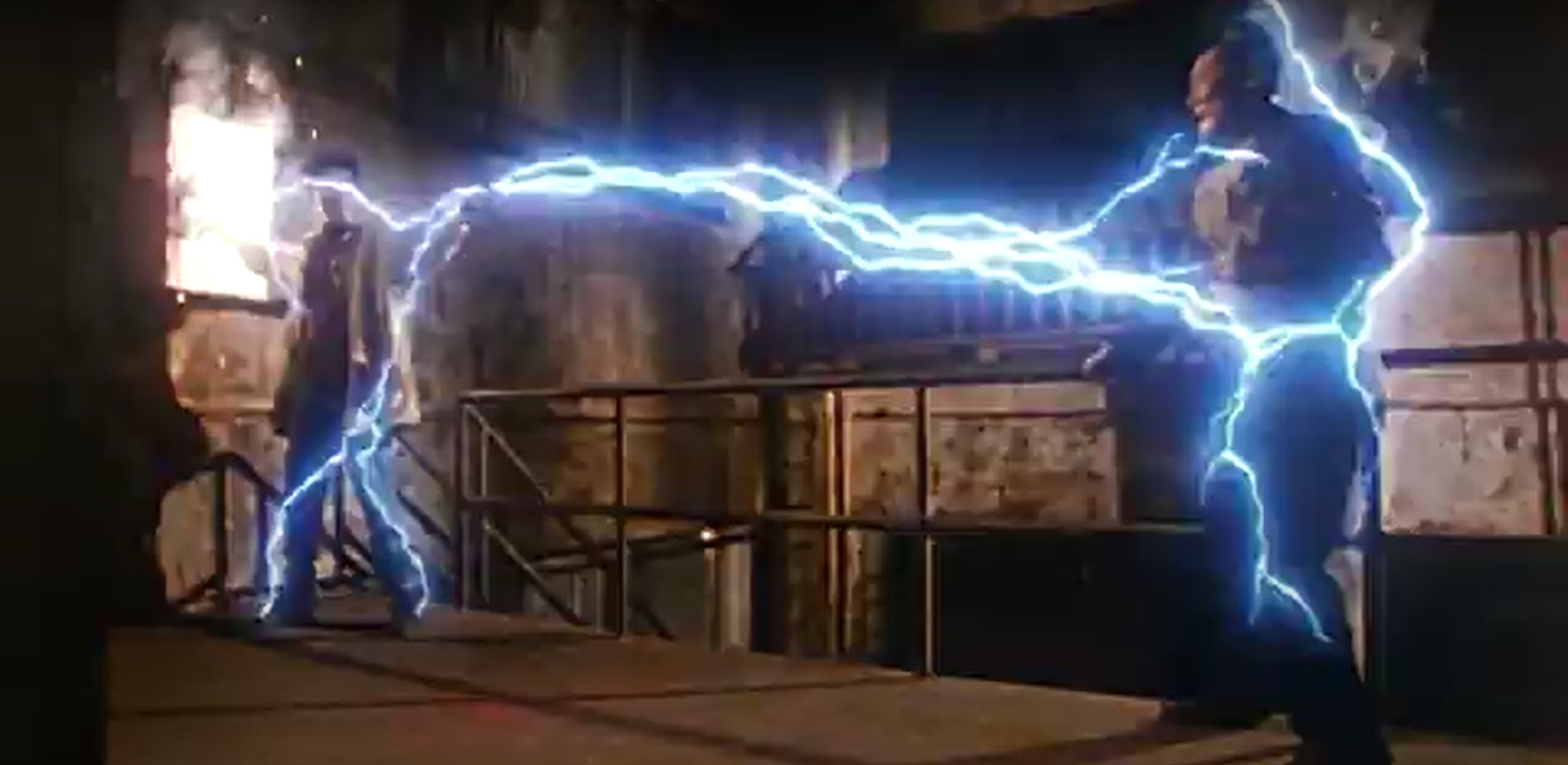
Soon-to-be first-time dad Tsu Hsiang can’t wait to meet his son.  Often times, his cop vocation intrudes on being there for his wife during her pregnancy as his torn between work and family, trying to be a good man in both regards, but when a tip comes through of a suspected bank robbery, Hsiang can’t neglect his duty and pursues the thieves in a high speed and gun-blazing chase that ends in his death as a construction site pile of steel rebar crushes him during the arrest.  His corpse left under the rebar overnight, a storm causes a transformer to fall on top of him and a cat providing a mystical lifeforce.  The electrical currents course through his dead body, reanimating him with the superhuman strength and invulnerable to pain, but with a cost as Tsiang is slowly rotting away, unable to heal or enjoy any of his senses.  Tsiang also has to recharge his body with electrical volts direct to body in order to continue being reanimated.  With time running out, the cop’s two goals are to meet his unborn child and to capture the gang responsible for him becoming an undead monster. 

While “The Blue Jean Monster” is not the eminent representation of comedy-action with elements of science fictional horror to come out of the Hong Kong movie industry, the early 90’s Category III film does rank high marshalling an entertaining “Dead Heat” (1988) interpretation for Eastern audiences.  The sophomore film of director Ivan Lai, aka Kai-Ming Lai, (“Daughter of Darkness,” “The Peeping Tom”) and the last script credit for Kam-Hung Ng emerges as a bucket list imbroglio of the inexplicable mysticisms at play as well as the good die young but win in the end.  The Jonathan Chow (“Haunted Jail House”) produced film is a coproduction of Golden Harvest Films, Diagonal Pictures, and Paragon Films. 
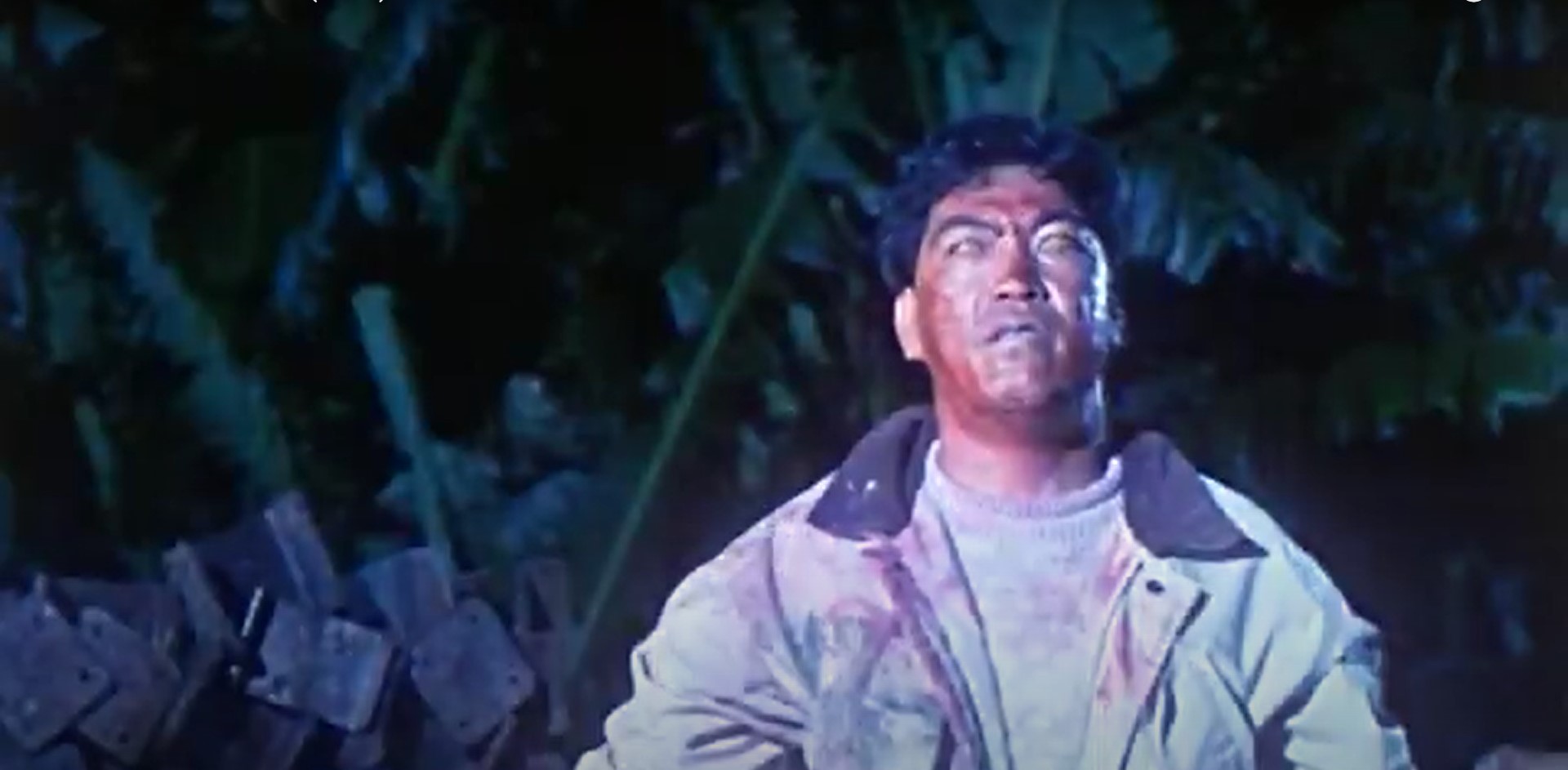
Not just a mindless killing machine resurrected like an electrified phoenix for revenge and murderous rout, Tsu Hsiang’s rebirth out of death arouses complications around fleeting special moments.  Playing exactly his profile of a mid-30-year-old is the late “Her Vengeance” and “The Killer” actor Fui-on Shing as a cop torn between life and death, literally.  Struggling to comprehend what’s happened to him, Tsu Hsiang has no time to explore the root cause; instead, Hsiang instantly moves forward, learning on the fly, his newfound postmortem powers of invulnerability, immense strength, and to be exasperated right into a pale-eyed version of the angry Hulk.  Shing’s duality on levity and fierce cleaves “The Blue Jean Monster” into its well-intended multifaceted of genres with soft buttery ease.  Shing’s square jaw and large frame doesn’t quell the lighter touch he brings an even softer side to Tsu Hsiang with his intake of Power Steering (Wai-Kit Tse, “Mr. Vampire 1992”), a street nickname for a former hooligan took under Hsiang’s wing after killing his father, in a supposed criminal altercation gone awry.  Power Steering best friend Gucci (“Gloria Yip, “Riki-Oh: The Story of Ricky”) becomes the primary target for the gang as she inadvertently becomes a hostage and winds up with the thieves’ hard stolen loot.  The circular, trifold connection between Hsiang, the troublesome young acquaintances, and the gang, helmed by Japanese actor Jun Kunimura (“Audition”) creates double edged complications Hsiang has to juggle and manage while being undead and a soon-to-be father.  Mei-yee Wu, Bei-Dak Lai, and “Mr. Vampire’s” Siu-Fung Wong playing Fui-on Shing’s wife Chu along with “Sex and Zen” star Amy Yip as the lustfully bosomed Death Ray, a gay man conversion therapy seductress, fill out the cast. 

The 1991 film has fast-paced action, politically incorrect humor, and spectacular physical and hand-drawn visual effects.   “The Blue Jean Monster” relied heavily on the skill of the cast and crew to elevate a staggering, fast-and-loose story that barely bridges gaps of its presaged plot holes.  There’s also some fast-and-loose editing slips that expose oversights, such as reused unmasking scene of Jun Kunimura’s head robber and showing five members of a five-member gang huddled behind a flipped van in a scene that was supposed to be sans Kunimura as his character was chasing after Gucci and the money through a construction zone.  Yet, “The Blue Jean Monster” is too enjoyable, too funny, and too drop-dead neat that any and all flaws can be written off as negligible.  Heedless humor encapsulates an antiquated way of thinking that shapes “The Blue Jean Monster” into a time bygone novelty.  When Tsu and Power Steering are suspected gay lovers, as they’re physically intertwined in electrocution to recharge Tsu undeadness, and AIDs becomes the center of the joke, casually tossed in a handful of times even by the brief portrayal of two colorfully sweater-wearing, feminine-displayed men wanting nothing to do with Tsu and Power Steering’s misperceived actions for fear of the deadly virus.  That just epitomizes the slapstick wackiness this not typical but warranted Cat III feature that transfixes with a lot of borderline insensitive satire kneaded into the modish action and special effects of every other Hong Kong film in a saturated market. 
“The Blue Jean Monster” takes over United States and North America courtesy of the UK distributor 88 Films, through MVD Visual from the Fortune Star Media Limited catalogue, with a new AVC encoded, 1080p high definition, Blu-ray.  The BD50 comes top of the line within the limits of the format with a bitrate decoding the original aspect ratioed widescreen 1.85:1 presented and newly restored 2K scanned film an average of at or just under 35Mbps.  Nearly being a non-issue coinciding with a pristine original print, the dual layer disc offers plenty of breathing room to display “The Blue Jean Monster’s’ range of motion, sufferable color palette, painted composite effects, and masterstrokes in lighting a fast-paced pressing without the blight of artefacts.  A few darker scenes are not as rich because of compositional effects but still render significantly with detail under a slightly more penetrating grain.  The overall grain naturally infuses with the 35mm print and translates nicely to a transferred digital scan.   The original, uncompressed Cantonese LPCM 2.0 mono track is the sole offering that, in truth, is all this comical, cosmic caper needs with agreeable action Foley and ambience and some looney absurdity tacked on for good measure.  None of the assortment ever sounds pressed and squished through the single channel suggesting a pretty clean, well-kempt sound design from over the years.  ADR dialogue favors less spatial position but that’s expected with 90’s Hong Kong cinema and is also well-preserved in its fidelity with a clear and damage free recording.  English subtitles are optionally available.  This special edition includes a new interview with assistant director Sam Leong Man Made Monster, the original Hong Kong trailer, and image gallery.  The limited-edition set comes with reflective and glistening slipcase sheathing the same but lusterless composite illustration, artwork created by James Neal.  Inside the green Amaray Blu-ray case, the reverse side of the cover art sports the original Hong Kong one sheet illustration stretching both ends, inferring nearly all the action and characters in the story, along with a doubled-sided cardboard poster of the reversible cover art.  The not rated release comes region locked on A and B and has a runtime of 96 minutes.

Last Rites: If a fan of “Dead Heat,” “The Blue Jean Monster” can prolong the action-caffeinated, narcotized high with supercharged unrest, necropsy humor, and the walking, talking, inexplicable undead in another stellar package and quality release from 88 Films!

Click Here to Purchase “The Blue Jean Monster” available on Blu-ray!

100-Year Return Brings a Plague of Flesh-Eating EVIL to a Small Town! “Messiah of Evil” reviewed! (Radiance Films / Blu-ray)

The “Messiah of Evil” has Come to Blu-ray Home Video!

Arletty travels up the California coast to a small beach town known as Point Dune.  The reason for her visit is to find her artisan father after a series of bizarre letters came to an abrupt stop.  She arrives at his mural-graffitied home to discover it empty and decides to stay a few days to ask around town about his whereabouts and to be present for his return home.  Her inquiries at art gallery shopkeepers lead to a motel where Thom, a wealthy collector of urban legends and spooky stories, and his two travelling female companions, Laura and Toni, have also sought out Artletty’s father for his bizarre experiences.  As the days pass, Point Dune slowly becomes a literal ghost town that forces Thom and his companions to stay with Arletty and, together, they experience the horrible truth of what’s really happening to the  residents of the west coast community who eagerly await the arrival of the dark stranger. 

Once married filmmakers Willard Huyck and Gloria Katz are the creative minds behind the stories of “Howard the Duck” and “Indiana Jones and the Temple of Doom.”  They also wrote “American Graffiti” in what was to become their link toward working on Steven Spielberg’s Indiana Jones sequel since both “American Graffiti” and “The Temple of Doon” were both produced by the father of “Star Wars,” George Lucas.  Yet, in the midst of “American Graffiti,” the couple also penned and Huyck came into the entrance of directing with the 1974 horror-thriller “Messiah of Evil” that pulled from various themes of mindless consumerism and the rising fears of dangerous and deadly cults in the U.S.  Also known by a variety of titles around the world, including “Dead People,” “Night of the Danmed,” “Messiah of the Evil Dead,” “Revenge of the Screaming Dead,” and “Blood Busters” to name a few, the Californian coast shot film is a production of the International Cine Film Corp and V/M Productions with Gatz producing and Alan Riche (“Deep Blue Sea”) serving as executive producer. 

“Messiah of Evil” slinks into the soul leaving behind dread’s unwashed pull against what we know as conventional horror.  In order to accomplish such a fear-induced feat, a cast must envelope themselves fully in world of weird and irregularities that nestle an uneasiness stemmed not solely from their performances but from how they react to the eccentric environment, to the crumbling small town society, and to ghastly behaviors of normal-looking people.  Like most daughters, Arletty has concerns for her father and seeks to understand the truth behind his unhinged letters.  Marianna Hill (“Schizoid,” “The Baby”) plays the quietly curious at a cat daughter dabbing residents with barely an effort in interrogational questioning of her father’s whereabouts.  Hill floats Arletty through stages of a slow descent into madness that simmers slowly to a boiling point understanding of what’s taking shape around her.  The same happens to Thom, played by Richard Greer (“The Curious Female”), who initially is a fraction of the nonconformity surrounding Point Dune with his obsession toward collecting strange stories and his polyamorous collection of women.  Of character, Greer is resoundingly in control without being dominating with Thom who has wealth and magnetisms but isn’t someone to be beholden to forever as we see with Laura (Anita Ford, “The Big Bird Cage”) who deserts him for his open-door intimacy policy in his pursuit of Arletty and with the childish Toni (Joy Bang, “Night of the Cobra Woman”) in her infinitely naïve opinions surrounding the dull Point Dune.  One actor I wish we had more of but is utilized perfectly as Arletty’s father and a harbinger of what’s coming is Royal Dano (“Ghoulies II,” “Spaced Invaders”) in a non-humorous nor drunken idiot role that seemed to typecast him later in his career.  Dano’s short but sweetly terrifying stretch divulges a man torn between his previous life and a new terror that now occupies him as he interacts with Marianna Hill as concerned and contaminated father holding it all within toward his frightened, confused daughter.  “Messiah of Evil’s” cast rounds out with Elisha Cook Jr (“Rosemary’s Baby”), Bennie Robinson, and Charles Dierkop (“Grotesque”). 

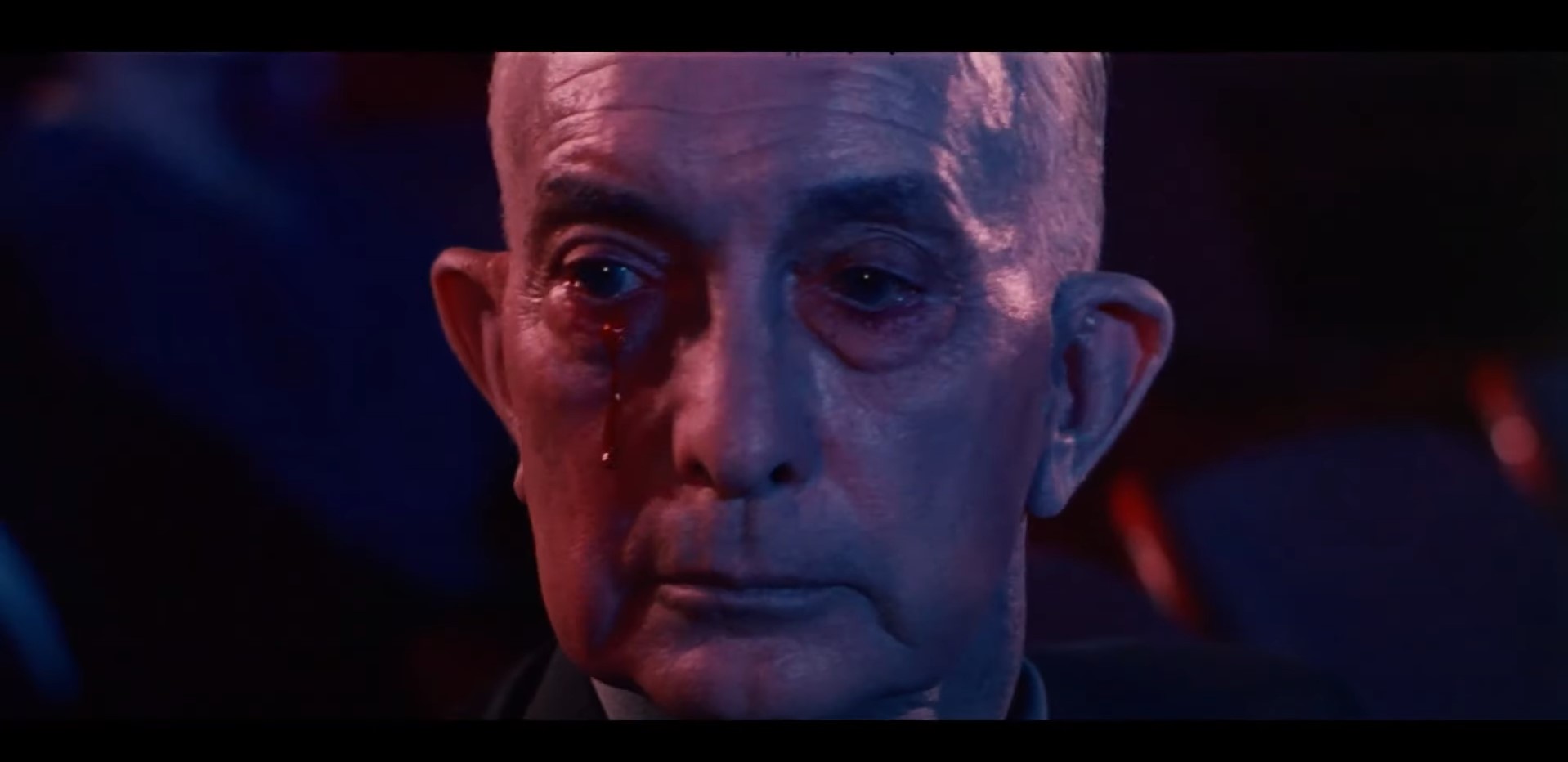
Huyck directs with colorful and verismo synergism that takes the positives of what should be life’s routine pleasures and turns them against us as fantastical and harrowin deadly elements of false securities.  The rolling crashes of Point Dune’s waves takes on a constant cacophony of sinister foreshadowing, a bright and welcoming supermarket becomes a vacant trap in every aisle, the entertaining movie theater darkens with blood on the screen, and an artist’s home, full realistic murals and colors, is an oppressive feast of lifeless eyes.  Point Dune becomes a dead town, literally, as the inhabitants succumb to dark forces from beyond their years, turning primeval in their contemporary three-piece suits and evening blouses.  Huyck and Gatz story pulls inspiration from U.S. history and folklore to mark the 100-year return of spreading evil amongst the land, an evil that resorts to cannibalism by either spellbinding archfiend, an internal infection, or the rise of the undead and not just any mindless, shuffling, flesh-eating zombie but a transmogrified plotter able to move fast and think as a single unit with the touched by evil masse with telltale signs of a single rivel of blood seeping from out of their eye and their insatiable need to consume other people. ”Messiah of Evil” is not overtly graphic like George A. Romero zombies or like the unbridled number of zombie films to follow inspired by Romero’s zombie game-changing wake for the last 60 plus years, separating the flesh-eaters from Romero’s gut-gnashing, pale faced, and slow-walking undead and Huyck and Gatz’s transmitted pestilent receiving horde running fast in their best church shoes with vastly different traits. Huyck and Gatz dip into more eldritch means with the return of a paganistic dark stranger in a pared down explanation without explicitly being definitive who or what the dark stranger (a demon?Antichrist?) is that is driving foreboding signs to a doomsday-disseminating end. ”Messiah of Evil” thrives as the mysterious and strange fulcrum of the beginning of the end told through the point of view of young woman left to tell the world of what’s to come only to be about as believed as much as a man wearing a polka-dotted tutu who has delusions of unicorns dancing the waltz with garden gnomes in his front yard. 

United Kingdom distributor Radiance Films releases a new restoration transfer of “Messiah of Evil” also on their U.S. line. The AVC encoded, 1080p high-definition, BD50 presents a 4K scan of the best-known surviving 35mm print from the Academy Film Archive in a widescreen 2.35:1 aspect ratio. As noted in the release’s inserted booklet, the restoration processes used was the Digital Vision’s Phoenix Finish and DaVinci Resolve was used for color correction, under the supervision of Sebastian del Castillo at the Heavenly Movie Corporation. Audio was also restored with the Izotope RXB. For a surviving print, the original elements look pretty darn good with barely any celluloid hiccup. No vinegar syndrome, not significant tearing, or exposure to name a few issues of possibility. There are a few minor blemishes and missing or damaged frames that seem to provide an unwanted cut but most of “Messiah of Evil’s” film problems stem mostly behind the camera with a rework of the story during the stop-and-go production and conflicts in marketing the film, hence the various title aliases of the film from around the globe. Other detail low points are when the film is bathed in blue and purple gels and tint for to set an apprehensive wander and wonder while retaining more natural grading in its majority throughout. The resorted audio is a lossless English LPCM mono mix. Really focusing on the electronic score of Phillan Bishop (“The Severed Arm”), the low-frequency score sets a perpetual and durable tone of dread out of place in a prosaic small town, much like the Arletty’s father’s work-of-art home that sticks out amongst the mediocrity. In design, dialogue remains robust yet delicate when the scene calls for it, such as Elisha Cook Jr. story of how he was born in what is essentially him, as a vagrant paid for his story, making the only noise in the room. Dialogue in these moments is greatly discernible with negligible electronic interference. Depth layers the permeating isolation of a town gone mad in unison with the range stretching from the distressing design of rolling, crashing, oppressive waves to the scuffles of zombies’ consuls and heels scuffing against asphalt, pavement, and shattering through panes of glass. Radiance provides English subtitles with their release. Bonus features include a new audio commentary by film historian and horror archetype authors Kim Newman and Stephen Thrower, an archived interview with director Willard Huyck, and a new, feature-length documentary showcasing “Messiah of Evil’s” background, themes, production, and influences by various horror scholars, including Kat Ellinger who also voiceovers a visual essay on American Gothic and Female Hysteria, which if I’m being honest, parallelly treads on similarities with Ellinger’s Motherhood & Madness: Mia Farrow and the Female Gothic on Imprint’s “The Haunting of Julia.” Radiance has in the short time poured their heart and soul into their releases and “Messiah of Evil” is no different with a sleek cladded and clear Amara Blu-ray case that’s subtle in showing less but feeling more on the cover art, opposite of the reverse side that houses a classical black and white compositional illustration of characters. Inside the 28th release for the label is a 23-page color booklet insert with the appraisal writings of Bill Ackerman, transfer notes, release credits, and acknowledgements. The disc is pressed red, much like the red moon in the film, with a stark black title. The Radiance release is unrated, region free, and has a runtime of 90 minutes. ”Messiah of Evil” uses cult fears, satanic panic, and the loss of ordinary life to penetrate the spirit by way of slowly eating at it. The crawling, creeping dread meanders, much like Artletty who is seemingly held in place at Point Dune, and we’re glued to the engrossing rate of the terror to come orchestrated by the captivations of a once married couple on a fast track toward success.

The “Messiah of Evil” has Come to Blu-ray Home Video!

The End of Days Runs on EVIL Fuel! “Wyrmwood: Apocalypse” reviewed! (101 Films / Blu-ray)

“Wyrmwood:  Apocalypse” – Z-Nation on Steroids!  Available at Amazon.

In a zombie apocalypse wasteland, the gaseous belching undead are used as the primary energy source, but the sight for a cure is still the goal for survival.  At least that is for boots-on-the-ground foot solder Rhys who lives in an isolated camp surrounded by the dead and ventures out to retrieve uninfected humans to bring them to the bunker-dwelling Surgeon General in hopes in discovering a cure.  After snagging a hybrid female named Grace who can control her turning by drinking single vial of blood, Rhys quickly learns that the Surgeon General and his armed entourage are experimenting to death the people he’s delivering to the bunker for their own selfish objectives.  Teamed up with Grace’s people – Grace’s sister Maxi, Barry, and Barry’s sister Brooke who is also a hybrid – Rhys is determined to no longer retrieve people but rather retrieve his soul from a group of well-armed maniacs while trying to not get eaten by the zombie hordes.

For someone like me, a film reviewer, whose fairly anal about watching a series, franchises, sequels, etc., in sequential order, I am stepping outside my comfort zone and out of my own convictions and into unknown territory by watching “Wyrmwood:  Apocalypse,” the direct sequel to Kiah and Tristan Roache-Turner’s 2014 Australian bloody zombie comedy-romp, “Wyrmwood” aka “Wyrmwood:  Road of the Dead”, before the first film.  While typically a no-no in my book, and very much likely in the rest of the filmic community, I like to live dangerously.  Any who, Kiah Roache-Turner sits once again in the director chair with the direct, follow-up sequel that picks up immediately where the other film left off or, I at least think so.  In reading the ending to the 2014 film, I see no mention of a couple of characters that are present at the beginning of “Apocalypse” and so I’ll be interested to watch “Road of the Dead” to see for myself how both films tie together.  The script is penned by Kiah and brother Tristan after fan support of the first film urged the filmmakers to do a sequel to their brainchild inspired by the blood-soaked and vaudeville slapstick horror of New Zealand and Australia – such as Peter Jackon’s “Dead Alive” aka “Braindead” and the Spierig brother’s “Undead.”   “Wyrmwood:  Apocalypse” is a Bronte Pictures production (“Out of the Shadows”) in association with Roache-Turner’s Guerilla Films and backed by the executive producer team of Todd Brown, Tim Nagle, Rhys William Nicolson, Sam Gain-Emery, Clement Dunn, and Maxime Cottray.

To make matters more confusing for someone like myself who hasn’t seen the first film, Tasia Zalar and Shantae Barnes-Cowan, nor their badass sisterhood characters Grace and Maxi, are listed in the cast of the first film nor are they in the short-lived teaser episodic series from 2017, causing a bit of disconnect for a nobody like myself who knows absolutely nothing of Wyrmwood universe when beginning the Roache-Turner series will the latest production. The “Uninhabited” Zalar and the “Frostbite” Barnes-Cowan quickly establish themselves as survivors devoted to each other by blood as their introduced rather quickly, harshly, and without background in the company of returning actors Jay Gallagher as Barry, described in the first film as a talented mechanic, and Bianca Bradley as the zombie hybrid Brooke who can control the regular horde of gas-chucking dead heads. Of course, being that a direct sequel, at least that’s how the Roache-Turner plays it, follows up 8-years later, some of the characters don’t quite look the same as when we first left them. For instance, Barry’s a little rounder and beefier and Brooke is, well, blonder. However, the bond between brother-sister is still strong and is even reinforced by Grace and Maxi’s relationship that blood trumps all. Another actor returns for the sequel but not toward the same character as Luke McKenzie adds to the theme of family by playing the avenge-longing brother of the first film’s antagonist known only as The Captain. Rhys (McKenzie) has more of a pure heart in contrast to his brother, or so we’re informed by returning characters, and becomes the unintended principal character amongst an ensemble cast by being the retriever, the deceived, and the reclaimer of his soul when he discovers the paramilitary survivors – The Doctor (Goran D. Kleut, “Alien: Convent”), The Colonel (Jake Ryan, “Out of the Shadows”), and the Surgeon General (Nicholas Boshier_) – are experimenting and killing captives for their own survival and grinding their corpses to make into anti-viral pills. There’s nothing bland about the Roache-Turner brothers’ character diversity and charisma as they each stick to a persona throughout the unfolding that quickly established who-is-who in the bad and good category.

“Wyrmwood: Apocalypse” is dieselpunk coated dead and delirium. With a definite George Miller approach and a zany-zombie gift of gore and gags, I can see where fans of the zombie genre can feel freer and more relaxed outside the confines of the somber-and-serious toned oeuvre of zombie films of the last two decades that has literally been beaten like a dead horse with a stick at every angle. The gonzo-gearhead carpet definitely matches the drapes in an outlandish universe where zombies are the Duracell and Diehard batteries of the future and while the story engrains a kindred theme and blood splatter fun, one element still guts me more than the multiple eviscerated entrails in the movie. Being a zombie movie of the flesh-eating kind, one would hope scenes of flesh-eating would be apparently present. Unfortunately, “Apocalypse” has zilch on zombie feasts. Though close in one scene where a big toe might be become an appetizer, in the end, there isn’t one bite of rotting teeth be pressed and puncturing flesh or viscera. What “Apocalypse” offers quite the opposite in where the dead are the exploited, utilized as a fuel source by feeding them beef and harnessing their oral gasses to drive vehicles and run high-powered miniguns or be under-the-influence of control by telepathic hybrids to do their bidding, aka suicide bombers or take the hits so the living can stroll in without garner so much as a scratch in a skirmish.

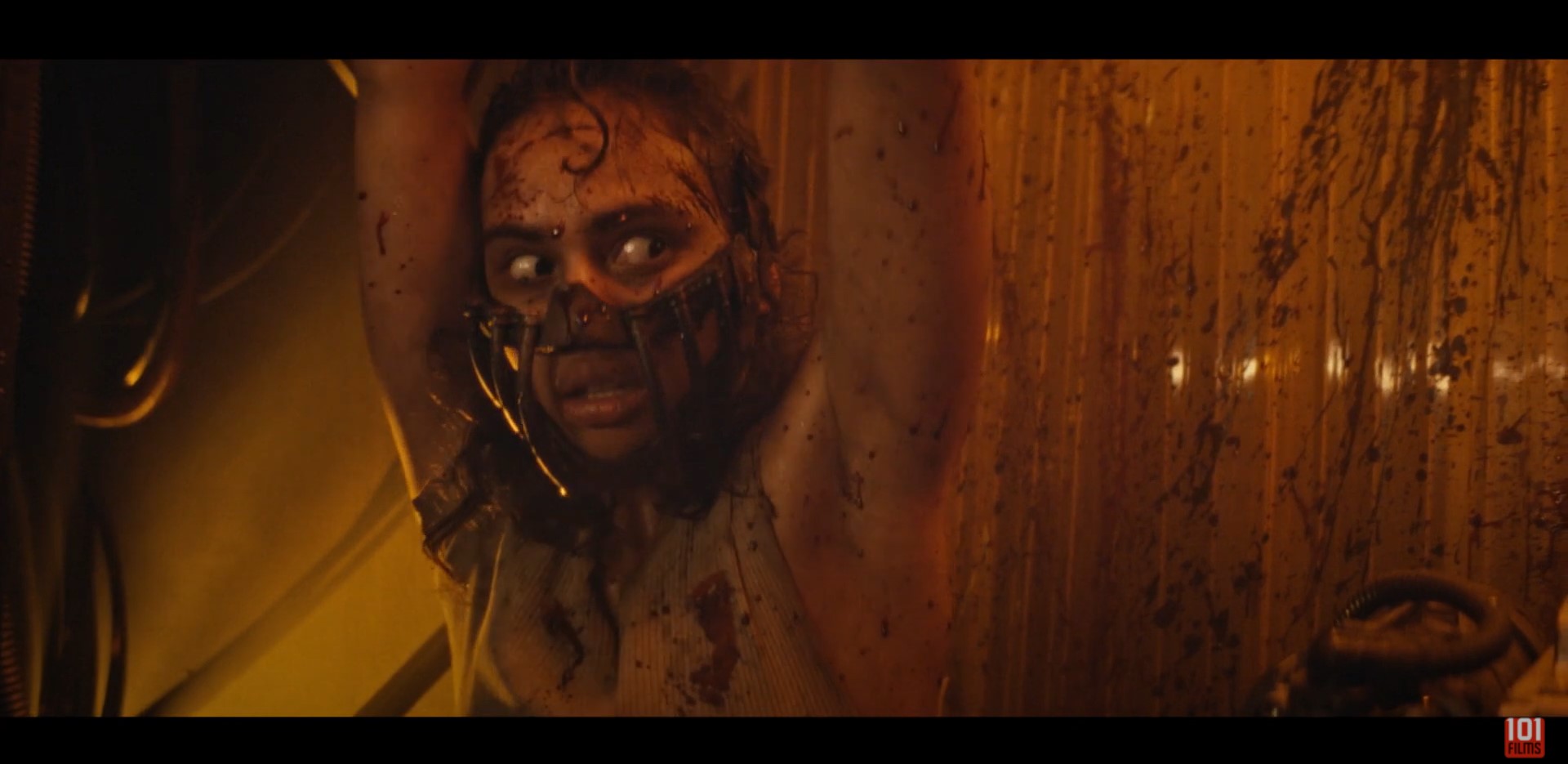
The final conclusion about “Wyrmwood: Apocalypse” is this, watch “Road of the Dead” first. Then, enjoy the rip-roaring and violent horror-action zomedy now available on an UK Blu-ray from 101 Films. The hard region B locked, AVC encoded Blu-ray is presented in 1080p, high definition, with an aspect ratio of 2.35:1. “Apocalypse” has the look of the early comic-book era style of pre-“300” Zack Snyder that hovers around the practical properties of “Tank Girl” in what’s fashioned together by the director of photography, and co-producer, Tim Nagle to appeal to a tactile of cold and grimy steel, sweet, and blood. The film uses very little visual effects which is mostly on the blood splatter, and you can tell the splatter is a bit off in having a waxy look to it. The decoding runs efficiently well to provide a clean picture through an edit heavy story. The English language audio mixes come in two options: a Dolby stereo PCM and a DTS-HD 5.1 surround sound. While there’s nothing wrong with the stereo PCM track that offers a clean and lossless recording, the 5.1 audio mix is a robust beast that channels every engine roar and isolates a zombie belch to be more inclusive for a viewer. If you’re in the mood for a longer sitting and bonus content, perhaps this 101 Films release is not for you as the runtime hits just above an hour at approx. 70 minutes long and just contains the feature and a scene selection. However, there is reversible front cover art. Easily, continuing the journey by working backwards in the Wyrmwood universe is worth the time as “Wyrmwood: Apocalypse” catapults the zombie into a new and unexplored rancid category of reverse exploitation in parallel with carnage, mayhem, and all of the anarchical above.

“Wyrmwood:  Apocalypse” – Z-Nation on Steroids!  Available at Amazon.

Let the Heavens Fall to Cleanse the EVIL Away! “Undead” reviewed! (Umbrella Entertainment / Bluray)

The small finishing town of Berkley, Australia comes under siege by blazing meteoroids that turn the quaint residents into mindless flesh-hungry zombies. A small band of survivors led by the town’s dismayed local beauty queen and a fisherman turned doomsday prepper fight the undead hordes in order to escape the carnage by reaching the city limits, but when faced with an otherworldly monolithic barrier surrounding the town and blocking the exits, a hopeful way out becomes quickly fleeting. To make matters worse, unusual rainstorms drench them with fear of what’s really in the rainwater of the apparent alien attack. In a last-ditch effort, the remaining survivors board a personal prop plane to scale the great extraterrestrial wall that’s imprisoning them with the undead. An onslaught of end of days catastrophes drives their instinct to battle on, to push forth toward living, despite all the evidence of a contrary methodology to the misunderstood, overwhelming alien actions.

A 9-year marriage, three children, the death of my dog, two states, a new home, four jobs, four presidents, and a global pandemic in more than almost two decades’ passing has transpired since the first and last time I saw the Spierig brothers’ 2003 zombie-comedy “Undead” and, still, the 2003 Australian film impresses with a large-scale gore show on a small-scale budget. Before terraforming new vampire words with Ethan Hawke in “Daybreakers” and taking a stab at an entry in the “Saw” franchise with “Jigsaw,” the brothers Michael and Peter Spierig’s first full feature-length venture was an ambitious love letter to their’ most endeared cult films of their youth, more heavily influenced by Sam Raimi’s “The Evil Dead.” Blowing through the meager budget halfway into filming and shooting an insane 40 to 50 shots per day for the better part of two months, the completion of “Undead” was a must for the self-funding brothers under their production banner of Spierigfilm and the success of “Undead” also jumpstarted the careers of cinematographer Andrew Strahorn (“Hostel III,” “Lethal Weapon” television series), production designer Matthew Putland (“San Andreas”), and special effects artist Julian Summers (“Bait,” “Mortal Kombat” ’21).

“Undead” was the first film for Felicity Mason and Mungo McKay in a lead role as that dismayed local beauty queen, Rene, and that fisherman turned doomsday prepper, Marion, mentioned in the above synopsis. Rene seeks to leave the town of Berkley in the wake of the tragic death of her parents before becoming the burdened beholder of their debt; instead, she thrusted into a crisis that won’t allow her to escape so easily from a destiny laid out for her in hometown. Mason’s humble portrayal of Rene is nearly invisible compared to her more boisterous and gun-fu counterparts but grounds us to an agreeable realism of reactions whereas Marion’s limitless gun-toting out of his fishing overalls and Matrix-like gunplay moves adds that layer of voguish fun of the Chow Yun-fat variety. The other four survivors fall into the run-of-the-mill of yowlers and cutting personality types who throw around their weight and cowardly sarcasms in immediate show of unfounded animosity. Supposedly, a longer cut of “Undead” provides more backstory for father-to-be charter pilot Wayne (Rob Jenkins, “Australiens”) and the law enforcement neophyte Molly (Emma Randall, “Bullets for the Dead”) but the release copy which this review is based off was not of that longer cut. Dirk Hunter supplies a purge of negative comic relief as Harrison, the chief constable without a clue, and Lisa Cunningham’s Sallyanne is Wayne’s antagonizing pregnant lover of bitterness as she comes in second place next to Rene at the local beauty pageant and seizes moments, during all Hell breaking loose, to confront Rene’s rope-wrangling talent that won her the cast prize.

Over the past year, I watched and reviewed another Australian sci-fi horror “Dustwalker” from director Sandra Sciberras where crash landed space objects turned the local dustbowl residents into the resemblance of zombies and connected to the chaos is a not from this world creature. I likened “Dustwalker” to be a lesser, weaker, total rip-off of the Spierigs’ ozploitation rager and I still stand 100% behind my claim as I reaffirm “Undead” to be the reigning supreme champion, and “did it first” as far as story goes, between the two nearly identical narrative plots. There’s an uncrushable affinity for “Undead’s” bold risk of looking at the bigger picture head on and absolutely landing each scene whether in prosthetics or in post with better than your average computer rendered imagery. Are the effects the sleekest, most realistic, graphics you’ve ever seen? Absolutely not but what they are are ultra-rich in creative detail rather than quality detail and can give most substantial budgeted films a run for the money, especially in the closeup shots that can be an obvious slapdash, might as well be silicone, fake. The Spierig brothers also don’t overcomplicate the plot with survivors trying to simply quickly decamp the overran town madness with plot points sensible to character designs and not relying on gratuitous happenstance scenarios for the sake of gore alone. However, do believe me when I say that “Undead” will delight gore geeks with a gut-spilling, face-lifting, head-decapitating mixture of zany zombie knockoffs that are steady throughout. If you’re deciding between the more recent “Dustwalker” and the now almost considered antique 15+ year-old “Undead,” the choice is clear with “Undead’s” superior campy, shoot’em, blood-splattering zombie mayhem.

For U.S. horror viewers looking for something that borders obscurity and might be out of their comfort zone, “Undead” has yet to make an appearance on Blu-ray, surprisingly enough. Only the Lionsgate DVD version is the known, and authorized, copy to be released in America. For those searching high and low, the all-region Blu-ray from the Australian distributor, Umbrella Entertainment, offers a 2-disc alternative with a new 1080p, Full High-Definition, release as volume # 12 on the company’s World on Film: Beyond Genres banner. The Aussie cult modern classic is presented in a widescreen 1.77:1 aspect ratio and with a runtime of 97 minutes, mirroring the U.S. DVD length which is a bit disappointing as longer cuts of the film do exist on other European releases. Day scenes play into an agreeable enough flat, more natural, color scheme with some serious grain in the 16mm film stock use, moving the photography toward a retro de-aged semblance courtesy of Spierigs’ cult film homage, but the darker scenes, mostly through a moderately intense blue filter, sees the unstable pixelation flareups, especially in black blank spaces and I’m taken aback by the lack of touchup to clear up any stylized misgivings. Umbrella offers two audio options – an English 5.1 DTS-HD Master Audio and an English 2.0 DTS-HD Stereo. Paired with an excellent soundtrack, the audio tracks do “Undead” complete justice without a smidgen of lossy fidelity. With plenty of action to go around – firearm discharges, explosions, zombie grunts/groans/sneers, and sundry of miscellaneous and oddball effects – each elemental output is distinct and clear. The dialogue renders nicely as well. Umbrella holds a few exclusive and rehashed special features that include an audio commentary from Peter and Michael Spierig and cinematographer Andy Strahorn, a raw video behind-the-scenes look on the set of “Undead,” the more production quality making of “Undead,” “Attack of the Undead” short films from the Spierig brothers that inspired the feature, home-made Dolly Video, the camera and makeup tests, still gallery, and theatrical trailer. Plus, an exclusive Simon Sherry illustrated art on the front covers of the snap case and the cardboard slipcover along with reversal DVD cover art and a second disc containing the complete 17-track soundtrack from Cliff Bradley. The rating is listed as an Australian certified MA 15+ for horror theme, medium level violence. which sounds severely tamer than it is for the more recent video nasty with all its zombies punching holes through hapless skulls, bloody brain munching, gooey face ripping, and severed torsos with spine exposures.

Next Gen to Regain What EVIL Took. “The Walking Dead: World Beyond” reviewed! (Acorn Media International / Blu-ray)

Ten years after the sky fell and the undead walked the Earthed, a new generation of survivors live comfortably behind gated walls at the Nebraska University campus.  Sisters Iris and Hope sometimes counteract each other’s position on campus hardly see eye-to-eye and, especially when dealing with the clandestine Civic Republic Military who has recruited their scientific father to do research in New York, but when secret messages about their father’s safety in potential jeopardy, Iris and Hope come together, along with campus outcasts Elton and Silas, to trek East on foot through the hordes of undead and the dangerous obstacles that separate them from their father.  The first generation to grow up in the apocalypse must learn to survive in the ravaged world of today and battle not only the dead and evad the mighty Civic Republic Military but also confront their individual haunting pasts. 

“The Walking Dead” executive showrunners Scott Gimple, Robert Kirkman, Brian Bockrath, Matthew Negrete and David Alpert envision a vast Walking Dead universe filled with endless storylines searing with undead mayhem on the precipice a human emotional depth charge explosion.  In 2020, a new and limited two-season spinoff series of AMC’s “The Walked Dead” lumbered forward with “The Walking Dead:  World Beyond” that aimed to explore the untapped emotive locomotive with teenagers having grown up naïve of usual adolescent behavior while also learning how to survive the outside world having been safe behind guarded walls most of their young lives living inside a smaller-scale social structure and guidelines like pre-apocalypse.  While “The Walked Dead” focused on the mid-Atlantic, stretching from George to West Virginia, and “Fear of the Walking Dead” went to the West Coast in Cali, down the border to Mexico, and finally landing near the Gulf coast, “World Beyond” takes the Pacific Northwest beginning inside Nebraska then stretching our main character’s journey to New York state, through the upper areas of what’s left of the country, but filming is actually shot in yours truly home state of Virginia surrounding the capital Richmond area.  Based not off the popular graphic novel series by Robert Kirkman, albeit with a few minor connections, “World Beyond” is a production of AMC, Idiot Box, Skybound Entertainment, Circle of Confusion, and Valhalla Entertainment.

A younger, fresher cast of faces grace “The Walking Dead:  World Beyond” with an innocence facade and juvenile decision making that lifts the series into that rite of passage in adolescent-hood where the children of the apocalypse must explore their own needs and desires as if the evolutionary behavior of growing up has never changed.  Only this time, someone’s trying to bite your face off or actually steal everything you possess off your back.  Aliyah Royale and “Unfriended: Dark Web’s” Alexa Mansour play the contrasting adopted sisters Iris and Hope with an underlining bond that’ll blossom sluggishly forward to season one’s conclusion.  Iris has always conformed to safe living behind the campus walls, but takes a page out of Hope’s book of radical ideas to venture out against policy to find their CRM recruited, and possibly distressed, father.  Through the series, I found Royale to be slightly unauthentically preachy in her delivery that never fastens an emotional connection to her saintly-turned-intrepid persona.  Hope has more complexity turmoil tinned up inside of her pulled and worked very delicately by Mansour in becoming the wild card amongst the group.  “Nine Perfect Strangers’s” Hal Cumpston and voice actor Nicolas Cantu join Iris and Hope as the reserved Silas and the ever hopeful pessimistic Elton, searching for a fresh start and answers to their philosophical questions.  Silas and Elton add more dramatic complications than friendly assistance on the journey with personal violent demons resurging out form Silas’s past to the death of Elton’s mother in which Hope hesitant disclosure of her involvement in the killing of his mother back during the first days of apocalypse sets the tension for a good portion of their travels.  As supporting characters, Silas and Elton also provide sub-storylines “The Walking Dead” thrives on along with two more characters, a pair of campus security details in Nico Tortorella (“Scream 4”) and Annet Mahendru (“The Americans”) playing close friends and colleagues Felix and Huck venturing out to rescue the four inexperienced youngsters from a fate far worse than being a gnawed on scrap of undead jerky. Mahendru’s pulled up hair, facial scar, and widely inflated draw is quite a far cry from her dolled up and partial nudity espionage performance in “The Americans,” a performance that makes her nearly unrecognizable, while Tortorella shoulders a lot of personal baggage in self worth and difficult promises to his makeshift family built on friendship – a regular theme throughout not just with Felix but with the youth group searching for answers.  “World Beyond” rounds out the cast with Ted Sutherland (“Fear Street:  Part Two” and “Part Three”), Natalie Gold (“Birdman or (The Unexpected Virtue of Ignorance”)), Joe Holt, Jelani Alladin, and Julia Ormond (“Inland Empire”) as the CRM spearheading a covert operation.

The enormity of the “TWD” universe and with end in sight of the undead not working the Earth would inevitably bring up the question of how young children would grow up and face old world teenager issues.  Their not-so-normal childhood forged when the sky fell, as phrase that use to describe the day the dead risen, has ultimately molded who they are when we meet the characters 10 years after that doomed day, but the series dives into backstories on the regular with flashes back, turning every episode of the 10 episode series into a non-linear segment, something that strays, but is not completely foreign, to the “TWD” universe.  Another aspect that’s different, and is terribly detrimental, is the lack of graphic bloody violence, especially against the living.  “World Beyond” tries very hard to shield the viewers from gruesome dispatching of the undead by offscreen kills to implied deaths and not until the latter half of the season does “World Beyond” begin to ooze out of it’s conservative shell as the story becomes more complicated and into more adult themes from lies and betrayals to violence and loss, a parallel of the passage from childhood to adulthood when reality of the real world hits you in the face.  What does stay true to it’s origins us the same is the overgrown sets, the detailed decay, and same beautiful morbid imagery that really compliments to effort in production value and budget.  My only gripe is that many of the actors look fresh out of the shower with perfect hair and loads of makeup in a scenario that would harried and haggard any individual. The story also connects to it’s more fierce bigger brothers with a broader introduction of the Civic Republic Military whose symbol shows up in “The Walking Dead” when whisking Rick Grimes away in one of their helicopters and also in “Fear of the Walking Dead” in the troops who were the bite impervious suits, sleek black helmets, and the assault rifles with dual piercing bayonets. “World Beyond” builds upon their mysterious nature by giving an wider, longer look into their enigmatic, cavillation building window.

With the series finale, aka season two, in full swing this fall at AMC, Acorn Media International concurrently delivers the first season onto an UK 2-disc Blu-ray. The region 2, PAL encoded, BD50s are presented in a televised widescreen 1.78:1 aspect ratio with a total runtime of 453 minutes. Not discernable issues with the digital image that renders virtually the same veracious tone as the other two “Walking Dead” series with “World Beyond” being a tinge bit more colorful as if the saturation provided more youthful characteristics. There really is some nice imagery happening in certain episodes, such as in episodes “Brave” and “The Blaze of Gory,” that work the dead into being connected with the surrounded elements as if the dead are now the more natural bond with Earth. The English language Dolby Digital 5.1 surround sound audio channels with clarity and equally amongst the five points. Dialogue is clean and unobstructed with a balanced breadth of depth and range amongst the various scenarios of death and deception they stumble into. English subtitles are also optional. Bonus features include A Look at the Series that dives into what “World Beyond” aims to accomplish with a fresh young cast, A Meet the Character segment that, obliviously, dives into the actors going over their character profiles, and the Making of Season 1, split into two parts with one on each disc, with the cast and creators provided a deeper understanding of character headspaces. “World Beyond” is rated 15 for the violence, some language, and some gore. Diluted decimation of the dead with a softer complexion in an overall comparison, “The Walking Dead: World Beyond” is the naïve little brother of two juggernauting series macheting a path of blood and guts for the less traumatic to have a spot in the world. Yet, the sluggish first few episodes clears out for a much more palatable and gripping series that we’ve come to expect from a universe built on rotting corpses and collective violence.

Catch Up on “The Walking Dead: World Beyond” season 1.  Purchase the Blu-ray/DVD here!