Fulci Turns Back Time to Bring EVIL Back from the Dead! “The House of Clocks” reviewed! (Cauldron Films / Blu-ray)

“The House of Clocks” Delivers Time as an Illusion. Blu-ray now available!

An isolated Italian villa becomes the looting target for three thieves looking for an easy score.  Villa residents, an elderly couple, are tricked into letting them into their estate adorned with elegant clocks of all shapes and sizes but as the plane unfolds it goes awry when the imposing grounds man arrives and both homeowners are killed.  Yet, the villa owners were no saints and no ordinary couple as soon as the husband’s heart stops, the clocks begin to move counterclockwise and that’s when the peaceful villa turns into a strange nightmare where time goes in reverse and those short and long dead come back to life with wounds miraculously healed as if it never happened.  As time continues to reverse, the thieves find themselves trapped inside the house and on estate grounds being hunted down by the merciless grounds man, but the skeletons in the elderly couple’s closet will soon resurrect and be thirsty for vengeance.

“The House of Clocks” is the Lucio Fulci made-for-TV movie that never saw the light of television programing.  Deemed too gory and violent for public broadcast, Fulci’s 1989 Italian film, to which he created the concept for and the screenplay treated by the duo team of Gianfranco Clerici  of “Cannibal Holocaust” and Daniele Stroppa of “Delirium,” was shelved for many years until it’s eventual home video release because, as you can tell just from the high-powered Italian horror names attached to the project, the finished film would certainly frighten those general audiences with easy turn-of-the-knob and bunny ear-antenna access.  Also known natively as “La casa nel Tempo,” was a part of a four-film horror special surrounding a theme of the houses of doom and was a production of Dania Film and Reteitalia production companies with “You’ll Die at Midnight” and “Delirium” producers Massimo Manasse and Marco Grillo Spina serving as executive producers.

The film initially opens with Maria, the nosy for her own good housemaid, discovering two rotting corpses ostentatiously displayed in the villa’s chapel.  Why Maria (Carla Cassola, “Demonia” and “The Sect”) decides to snoop around is not explained but the act does start a chain events, leading up to elder Villa owners in Sara Corsini and her clock obsessed husband Vittorio, played by the role age appropriate Bettine Milne (“The King’s Whore”) and Paolo Paoloni (“Cannibal Holocaust”) in a lot more makeup and prosthetics to make him appear as an older man.  As mysterious senior citizens go, Milne and Paoloni are the malevolently cryptic under a façade of geniality, possessing and maintaining the corpses of their niece and nephew they’ve murdered in order to keep their wealth.  The backstory between the two pairs has vague clarity but there’s enough to keep the pistons pumping toward the crux of why the uncanny time about-face.  While, again, no sense of explanation on why time reverses, we’re under the assumption Paolo is essentially Father Time, a personification of the time concept represented as an old, bearded man with an hour glass and a scythe to represent a span from life to death.  When thieves Paul (Peter Hintz, “Zone Troopers”), Tony (Keith Van Hoven, “Black Demons”), and Sandra (Karina Huff, “Voices from Beyond”) put an end to the Corsinis, that is when time stops and reverses itself, affecting the once dead to return back to life, and creating a nightmare scenario for now three trapped thieves under the chase of not only the Corsinis but those also killed by the Corsinis as their deteriorating bodies rejuvenate into active flesh and bone as well as flesh and blood.  “The Beyond” and “Zombie’s” Al Cliver rounds out the principal cast and the overall cast with his menacingly evil, Corsini’s jack-of-all-trades grounds man with a scarred over eye and a double barrel shotgun to hunt down the thieves.

“The House of Clock’s” is quite an interesting concept without a durably designed reason for all the madnesses.  At its core, three thieves home invade an older couple for their valuable objects and accidently kill them in the process when the standoff goes bad.  With that oversimplified version of events, a hellish cog in the pocket watch gearbox links the old man’s ticker with the tons of tickers that adorn his villa home, causing a chain reaction of turn back the clock proportions to which audiences never receive a proper understanding and while this may bother a sample size few, most will find the story too weird, gory, and trepidatious tense to care in what becomes a fair-game free-for-all against all characters who don’t have an ounce of virtue.  The lot of thieves, schemers, and murders are all trapped inside time’s ill-reverse affect without a sign of slowing down and while it might seem advantageous at first for some, as time continues to revert, the worse the situation becomes as old adversaries emerge from their graves and tombs.  Fulci’s visualized gore also emerges through with the fantastic effects by Guiseppe Ferranti, including a high right through the crotch impalement.  Ferranti would also be behind the effects for two other the house of doom television movies.

“The House of Clocks” may not have been safe for television but for a new Cauldron Films Blu-ray, the Lucio Fulci film fits right in and comes in the nick of time!  Restored from a 2K scan of the 35mm film negative, the AVC encoded, 1080p high-definition, BD50 offers a visually invigorated, audibly astounding, and special features saturated release that presents Fulci’s lesser known and once previously shelved work!  Presented in a European widescreen 1.66:1, color saturation is beyond reproach with a beautifully natural grading that pops textures and objects right off the screen, adding density and tangibility to each.  Disc capacity affords the codec compression with no artefact issues in the reproducing of the encoded image that nearly replicates an ideal exhibition and appearance of a made-for-TV movie, especially in the macabre moment where extra slimy ooziness of the decaying corpses or the perforation of the servant’s crotch area is as clear as clear can get without misinterpretation.  Skin tones aren’t flared and are naturally set within a healthy, though smoother, grain layer.  The release comes with two audio mixes – a PCM English 2.0 mono and a PCM Italian 2.0 mono.  Both tracks are produced from ADR and have been scrubbed with no issues of hissing or crackling.  There’s a brilliant touch of echoing within the estate to create reverberations and a range, open quality to the exterior dialogue.  Vince Tempera’s synth piano is a ticking measure of modified vocals and integrated milieu elements with a organ tone like quality that’s ghoulishly soft.  English subtitles are optional on both mixes.  Special features include a handful of new interviews from behind-the-camera with cinematographer Nino Celeste Lighting the House of Time, composer Vince Tempera Time and Music, first assistant director Michele De Angelis Working with a Master, FX artist Elio Terribili Time with Fulci, as well as unmentioned archival interviews with actors Paolo Paoloni, Al Cliver, and Carla Cassola.  There’s a parallel audio commentary with film historians and critics Eugenio Ercolani, Nathaniel Thompson, and Troy Howarth who regularly step in to commentate on Italian horror.  Graphic artist Matthew Therrien designs an illustrative composition artwork, pulling inspiration from the film’s most iconic and chaotic moments, while Eric Lee designs the titular logo sitting pretty dead center.  The reverse side of the cover art displays a rotting hand still from the movie.  The 19th title has a clear Amaray that houses a cropped version of the front cover image pressed onto the disc, which is region free, uncut, and has an 83-minute runtime.

Last Rites: Most people wish they could turn back time. For Lucio Fulci and his penchant for beyond death, going counterclockwise in “The House of Clocks” is more frightening and deadly as time can’t be owned and controlled. Simply put, there’s just no stopping the sands of time, forwards or backwards, for the past will catch up to you and the future is mercilessly uncertain.

“The House of Clocks” Delivers Time as an Illusion. Blu-ray now available!

Scarf Michael and the Fiddler’s Power that Draws Upon EVIL! “The Outcasts” reviewed! (Deaf Crocodile / Blu-ray)

“The Outcasts” on Blu-ray Now Available Here!

Ireland 1810 – a small farming village sustains a livelihood off their crops, marital successors, and superstitious belief.  Widower Hugh O’Donnell and his three teenage-adult daughters find themselves in the midst of all three mechanisms with his eldest daughter forced to live with him into widowed spinsterhood, a middle daughter’s secretive betrothal to a neighboring farmer boy despite Hugh’s disdain for the family, and Maura, the youngest daughter, who acts strange and fearful making her an easy target for ridicule.  When the village crop faces blight, bad luck ensues many of the surrounding farmers, and a sudden, expected snow fall threatens harvests and income, Maura is accused of conspiring with witchcraft of a wraith fiddler known as Scarf Michael whose music invokes visions and creates mischief.  Nearly crucified by the fearful villagers, most of whom derided for her aberrating strangeness, Maura is saved by Scarf Michael to be taught his outlier ways that could lead the young woman to never return home again.

Through themes of folkloric belief, societal class structures, family, marriages, mental illness and how it’s ostracized in an early 1800s setting, “The Outcasts” is a cold, hard, and solemn look at daily affairs of a 19th century, poor Irish seaside village, fenced in with the unusual conducts of Maura whose mind is more curious and vastly hungry for knowledge than her peers’ and that creates an escapism component to try and be equal, or perhaps get even with, those that look down upon her.   English writer-director Robert Wynne-Simmons tackles his debut feature-length film with great understanding of tradition and human fear, elemental human nature bred from the uneducated and localized myth seen in his original devilish script from 1971’s “The Blood on Satan’s Claw” by director Piers Haggard.  “The Blood on Satan’s Claw” was certainly far better suited for success with Haggard’s additional scenes of brackish deviltry aesthetics, plenty of full-frontal nudity, and visible vibrant and rich blood.  “The Outcast” is a return to the slow born of an eventual decline and degradation of not just Maura but her family and her village.   “The Outcast” is part of an Irish production conglomerate of companies, including Arts Council of Ireland, The Irish Film Board, and the Toymyax Company with Tony Dollard producing.

Mary Ryan is the centerpiece of the fantastical and fraught tale because of her teenage character’s childlike innocence that’s deemed unusual, weird, and, eventually, in bed with a spiteful spirit, labelling her character, Maura, as a cursing occultist.  Ryan, who would go on to have minor roles in “Rawhead Rex” and “The Courier,” brings a balance of beauty and blamelessness to Maura’s undesired disposition, one that allows her no friends and is even on the edge of displeasure from her older sister Breda (Brenda Scallon) and father Hugh (Don Foley) whom both found love and lost them over a rough course of untimely death.  There’s still obvious love between them, but Maura likely reminds them of mother, especially from Hugh, and sees a same early grave fate for the youngest and adrift daughter.  Middle Daughter Janey resides on the opposite side of the spectrum with unconditional love and support for Maura only to be intertwined with her own serendipitous affairs with local farm boy Eanon (Máirtín Jaimsie), finding themselves rushed into proper marriage when Janey comes home expecting.  And while Maura made faultless inconsequential ripples through the family and the village, she was initially not on the forefront of everybody’s concern as Janey and Eanon became a jovial celebration that sought the joining of two well-known families and farms until Scarf Michael reappeared to play his fiddle.  Mick Lally fiddles as the musical wraith casting his violin strokes against those essentially bullying Maura with trickery that led to subsequent fears and accusations of agricultural assassination and magical maligned mischief that turn the rural villagers away from Janey and Eanon’s blessed marriage to an acute decline of rationality that put Maura in the crosshairs of suspected supernatural conjuring.  Scarf Michael’s intentions are not to whisk Maura away into what she sees and believes is as blissful freedom from those nasty looks and mocking that surround her as well as Michael’s tenderness to which she falls in love for the first time, like a child growing into adulthood.  “The Outcasts” round out with Tom Jordan, Cyril Cusack, Gillian Hackett, Brendan Ellis, Hilary Reynolds, Donal O’Kelly, James Shanahan, and Paul Bennett.

Not ever story about the loss of innocence from growing up is portrayed in a good light.  Maura wants to hurry grow up and be free of her childish qualities without realizing the consequences.  Falling in love with Scarf Michael proves to be perhaps folly of Maura who gives into the dream, or fantasy, of a man who quickly enters her life and charms her with the mystical fiddle.  By the end, indications of Scarf Michael nothing more than a rake leaves a sour and sad aftertaste that shutters Maura from the rest of her family as she willing joins him on the other side, practically begging him to free her from an unforgiving reality.  Perhaps Maura was also led to believe in no other choice, condemned to a watery grave, the same fate that befell Scarf Michael, by her fearful village peers and elders.  Robert Wynne-Simmons is often playing devil’s advocate by building up Scarf Michael as a savior and a romantic, but Maura drinks the Celtic Kool-Aid because, frankly, she knows no better and received no beneficial direction from those who surround her, leaving the alluring fiddler to warn her of the choices she desires.  Wynne-Simmons and Seamus Corcoran’s soft-and-dreamy fairytale indulges a bit of surrealism through soft-lighting, soft focus, and crude yet effective editing tricks to create a specter’s intermittent visibility amongst other slight of sight practical effects. 

If ever a time to be totally physical media inclusive toward all the obscure outliers, now is the time with “The Outcasts” arriving onto a newly restored 2K transfer for the first ever Blu-ray in the U.S. courtesy of Deaf Crocodile.  Presented in an European widescreen 1.66:1 aspect ratio, the AVC encoded, 1080p high definition, BD50, plus the restoration efforts conducted by the Irish Film Institute – Film Archive, retains that airy softness of a daydream inlaid to suggest a surrealism surrogation but the story is rooted in reality, the reality of early 1800s Ireland to be exact, and so this impoverish, austere, and salt of the Earth land and it’s people are often absorbed by superstition belief that’s awfully real for them but to the audiences, it’s bordering the illogical.  Details are generally soft but the upgrade increases the contours and create a nice layer of depth between foreground and background, bathed in the muted and ascetic green, brown, and tan color scheme of a traditional period piece wardrobe and materials, leaving behind any ounce of hue pop to not spoil the intended grading that lives and dies by somewhere between the RGB and the average grayscale, but there are times of an eerie dressed lighting of added backlit blues and bright whites to secure a fantasy, or spooky, flare.  The fidelity reproduction on the Irish-English DTS-HD mono track diffuses distinct aspects through the single channel without any vague overtaking.  The brogue English did, at least for me, require the optional English subtitles to be turned on for my untrained ear to decipher certain antiquated period terminology and the strong Irish accents that would drown out an entire sentence; this is not an issue concerning the quality of the audio track as it’s nicely achieved without any damage to note or crackling, hissing, or other obstructions to interfere.  The dialogue is also fairly robust and prominent.  Steve Conney’s lyrical and guitar score enchants with traditional Irish folk and is ascertains the mix of commonplace and otherworldly mood Wynne-Simmons seeks to create.  Bonus content includes a new video interview with writer-director Robert Wynne-Simmons, a new video interview with composer Steve Conney, producer and film professor Rod Stoneman, former head of The Irish Film Board, and physical media expert Ryan Verrill provide a video essay, and concludes with five Robert Wynne-Simmons’ short films:  “L’Eredita di Diavolo,” “The Greatest All-Star Advertial of All Time,” “Bomb Disposal,” “The Scrolls,” and “The Judgement of Albion – Prophesies of William Blake”  These shorts include appearances/cameos by Charlton Heston, Sammy Davis Jr. and Peter O’Toole to name a few.  The clear Blu-ray Amaray has an appearance that’s about a stark as the film’s aesthetic with a gray coverart composition of celebration fiddlers in their straw masks overtop an isolated Maura.  An insert advert with a QR code offers to access transcribed bonus content.  The disc is pressed with the same front cover image and the reverse side of the primary cover has a still from the film.  The unrated release has a runtime of 105 minutes and is hard-locked with region A encoding.

Last Rites: An obscure gem of Irish cinema, a folklore and social explication of “The Outcasts” outlives antiquation with a new Blu-ray release from obscure aficionados Deaf Crocodile!

“The Outcasts” on Blu-ray Now Available Here!

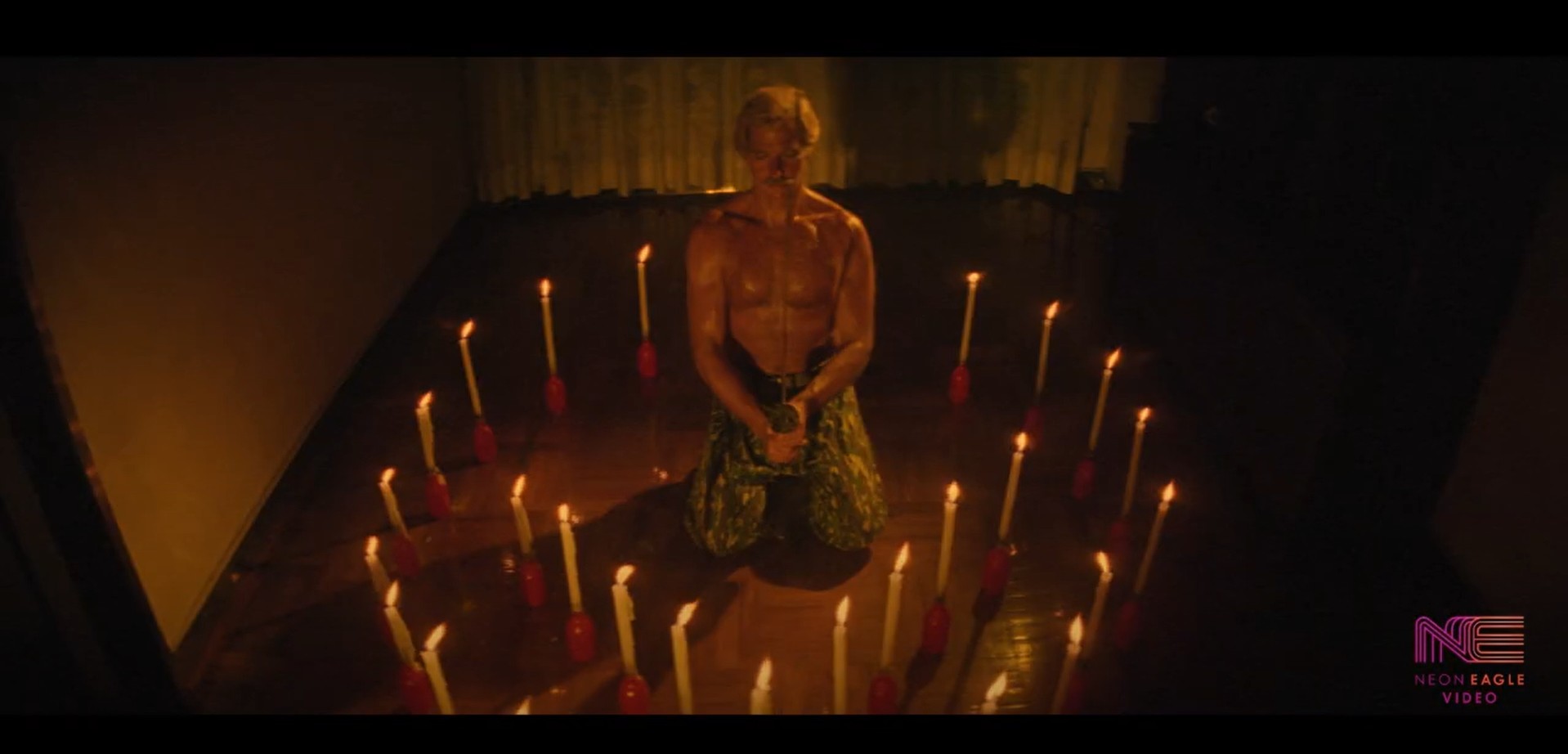
The Golden Ninja Warrior Turns Good Ninja Masters to EVIL! “Ninja Terminator” reviewed! (Neon Eagle Video / Blu-ray)

The Golden Ninja Warrior is the corrupt Ninja Empire’s most valued and powerful artifact with mystical powers to whomever posses it’s three pieces, granting them near invincibility against enemy attacks.  The Supreme Ninja leader displays the power of the golden bust, resembling a beastly torse and head wielding a katana, to three of the Empire’s Ninja Masters – Tamashi, Baron, and Harry.  The three Ninja Masters betray their supreme leader, each stealing a piece of the statue for their own intent and purposes.  With one piece back in the hands of the Supreme Ninja leader after Tamashi’s demise, the now crime boss Baron seeks Tamashi’s piece and will do anything, and kill anyone, to get it with the aid of his cruel right hand man Tiger Chan.  Meanwhile, Harry resigned from the Ninja Empire to reform the organization’s criminality but has been unearthed by the Empire’s Supreme leader with an ultimatum to return the pieces of the Golden Ninja Warrior.  With the help of his cocky and confident partner, Jaguar Wong, Harry and Jaguar investigate into Tamashi and his brother’s death, try and protect their surviving sister from those looking for Tamashi’s piece of the Golden Ninja warrior, and defeat any Baron or Empire warriors that stand in their way.

One of the numerous released Godfrey Ho productions in which the director shot new scenes with Caucasian, abroad actors and edited them into an pre-existing film his company owned the international rights.  “Ninja Terminator,” a bestowed title at the height of James Cameron’s highly popular cybernetic, time-travelling thriller “The Terminator,” is the 1986 Hong Kong feature that breathes new life into the South Korean,1984 released, martial arts gangster film “Uninvited Guest” as Ho splices new additional footage to create his own, half-cocked storyline for a cost-effective ninja themed film starring a recognizable white actor.  Ho writes and directs the IFD Films production that’s produced by Ho’s makeshift Ninja feature team of Betty Chan (“Ninja Strike Force”), Joseph Lai (“Full Metal Ninja”), and Steve Kam who regularly took popular U.S. tiltes and integrated them into their own for advantageous marketing.

Where to start with actors and actresses?  Two films shot in two completely different times with renamed characters and additional characters in a jumbled-up mesh of a ninja film.  Lets start with Richard Harrison, an American actor with muscles and good looks who couldn’t quite land the parts he wanted in his home country but found lead man success in other parts of the world, especially in the filmic industries of Italy (“Orgasmo Nero,” “One Hundred Thousand Dollars for Ringo”) earlier in his career and, in this case, Hong Kong (“Inferno Thunderbolt,” Diamond Ninja Force”) later in his career collaborating a handful of times with filmmaker Godfrey Ho.  For “Ninja Terminator,” Harrison isn’t a stealthy cybernetic ninja master but rather an idealistic, benevolent ninja master sporting a unique camo ninja-yoroi to, I guess, blend in around his home and urban environment…?  Still, the camouflaged attire has to be more clandestine than the hot red ninja-yorois of the Ninja Empire.  At least fellow western actor, Jonathan Wattis, as one of the three ninjas who stole a piece of the Golden Ninja Warrior statue and became a crime lord himself, donned a near traditional, black-dyed ninja garb.  Harrison and Wattis do the best they can being spliced into Jack Lam’s film “Uninvited Guest.”  Reconstructed or replayed to be named Jaguar Wong, for his character’s Jaguar fighting style, Jack Lam bests Wattis and levels with Harrison for screen time as a fellow principal lead despite the 2-3 year difference between principal photography but Jaguar fits in aptly enough into an inept chaos of a near nonsensical ninja narrative that jumps to inconclusive subplots with little connective tissue to the core plot.  Maria Francesca, Jeong-lee Hwang, James Chan, Simon Kim, Phillip Ko, Keith Mak, Tae-Joon Lee, Nancy Chan, Gerald Kim, Andrew Lee, and Eric Leung costar.

Cheaply made knockoffs and spirited, gung-ho capitalizing on popular film titles saw fists-of-fury in Hong Kong circa 1970s through the 1980s, much the same way the Italians also didn’t believe the copyright laws when they too took advantage with unofficial sequels, especially in the horror genre.  “Ninja Terminator” is obvious one of those projects and the sly Godfrey Ho manipulated the international market to garner new public interest in what is basically an old film with additional scene, a scheme done pretty much on the regular in various countries, even in the United States.  However, “Ninja Terminator” is not a good movie but rather a hilariously bad one weighed down by irrelevant offshoots to flesh out a scantily structured half-script.  With the additional scenes of Richard Harrison and the others spliced in, plus Jack Lam’s one-man army showdowns against henchmen and sub-bosses, the combat saves “Ninja Terminator” from full frontal embarrassment with competent choreographed fights, plenty of sword, ninja star, and ninja trickery play, and a fair amount of acrobatics, even if some of the scenes are just gratuitous cartwheels and flips in an ostentatious display of skill and of trying to raise the value of a low-budget production.  Granted, there are no cartwheels or flips in Jack Lam’s storyline, nor is there a single ninja, but Lam’s take-on-the-world scenes are confidently hip for the period and that is the jelly to the bold Ninja peanut butter that makes “Ninja Terminator” work on an amusingly bad level. 

Neon Eagle Video, a subsidiary label of Cauldron Films that focuses on the best of the worse of Asian cinema, scour the globe and deliver the best and authorized reproduction of “Ninja Terminator” on Blu-ray in North America, restored from a 4K scan of the original negative and presented in its proper anamorphic widescreen aspect ratio of CinemaScope 2.39:1. I must agree with Neon Video Eagle that this transfer renders the cleanest and clearest reproduction to date, likely ever, in this compilation of source materials to render a corrective, singular 4K scan. The AVC encoded, 1080p high-def resolution, BD50 offers ample storage to limit or squash any compression indelicacies on an already delicate Godfrey Ho production that’s been bootlegged to bastardization for decades. Corrected color timing sizes up the landscape, the mise-en-scene elements, and the characters too with a diffused scheme that holds firm vibrancy across an early 1980’s hip and preppy Japanese fashion. The audio is a forced English dub with an encoded LPCM 2.0 mono. The ADR definitely is seen and sounded as expected with total unsynchronized lips and dialogue, especially when the story is forged from splitting two films into one. What’s also evident amongst the three-prong, rough-and-ready sound design is the unrealistic fighting sounds, overzealous and overexerted to be more like the Hong Kong Kung-Fu movies of the decade before. The last element is the soundtrack that’s got some funk and groove in its ninja-yorois that likely borrowed and repurposed from another Godfrey Ho production to fit this particular need. Optional English subtitles are avaialble.. Special features include brand new material, including an audio commentary by Kenneth Brorsson and Phil Gillon of the Podcast on Fire Network, a second audio commentary by Asian film expert Arne Venema and Mike Leeder, an interview with director Godfrey Ho Ninja Master discussing the popularity of ninja films in the United States and the appropriation of the “Terminator” title as well as touching upon Richard Harrison and his onboarding onto the film, a second Godfrey Ho interview alongside separately dubber Simon Broad Golden Ninja Dubs discussing the quick and loose ADR of Hong Kong cinema, an interview with “These Fits Break Bricks” co-author Chris Poggiali Ninjamania, and the trailer. Neon Eagle Video’s standard release, showcased inside a clear Blu-ray Amaray, presents new artwork by graphic artist Justin Coffee. The reverse side of the cover holds the still capture composition of the original one-sheet. No insert material included, and the disc is pressed with the same Coffee illustration. The region free disc has a runtime of 90 minutes and though not listed as unrated, the film is surely such.

The First Authorized Blu-ray of “Ninja Terminator” Now Available!

Next Step in Evolution Leads to EVIL’s War Against the Common Man. “Scanners” reviewed! (Second Sight / 4K UHD)

“Scanners” 4K is Head Popping Good! Buy it Here!

Dr. Paul Ruth is a ConSec scientist, the head of the private contract weapons department on the “Scanner” project.  A Scanner is a highly developed human with psychic and telekinetic powers able to control and damage the minds of others through the nervous system.   Ruth’s latest case is Cameron Vale, a vagrant helped by Ruth to control his self-detriment powers with the use of a scanning suppressive drug known as ephemerol.  When one of Ruth’s past subjects, a renegade Scanner known as Revok, infiltrates and assassinates a live public demonstration of the Scanner project with the intent to wage war on non-Scanners, Ruth’s only hope is to convince to conscript Vale to join the fight and infiltrate against Revok who kills any Scanner who doesn’t join his growing army.  Vale’s search for Revok leads him to learn of a treacherous mole within ConSec and that ephemerol is being weaponized against the normal human race.

On the heels of our Second Sight 4K review of David Cronenberg’s 1979 film “The Brood,” Cronenberg’s following film “Scanners” released two years later in 1981 ups the ante in elaborate special effects and high conceptual themes twirling around in a bowl of body horror soup and is now also available on 4K UHD from the UK Second Sight label!  Like “The Brood,” Cronenberg writes-and-direct a dysphoric film in his birth country of Canadian, per his normal track record of principal production countries, specifically shooting in in the urban and greater areas of Québec, Canada.  The first film of a trilogy, to which Cronenberg did not return to direct the subsequent sequels with both films released a decade later in 1991 and helmed by “Screamers” director Christian Duguay, is a production of the  CFDC (Canadian Film Development Corporation), Filmplan International, and Montreal Trust Company of Canada with Pierre David and Claude Héroux both returning from “The Brood” as executive producer and producer, respectively. 

The face of Scanners has been and always will be Michael Ironside, included on most poster and home video release stills and artworks of a flaringly distorted Ironside as Revok deep in a frighteningly milky-white eyed scanner turbulence.  The “Total Recall” and “Starship Troopers” actor has a face the camera loves, especially in an antagonistic role with Ironside’s gifted devilish grin, dagger eyes, and sarcastic stoic expressions.  However, he is not the heroic lead of Cronenberg’s “Scanners.”  Ironside is not even in the top three headlining credits.  That foremost distinction is consumed by Stephen Lack (“Perfect Strangers,” “Dead Ringers”) in the Cameron Vale role and Lack’s performance is indicative of his name in a completely overshadowed protagonist role.  Lack’s monotonic bordering dangerously to catatonic presence is swallowed up by Ironside who has fewer scenes but instills punchier passion toward his character’s rebellion against humanity cause, plus the contour control over his mannerism and expressions are impeccably cinematic  There are other actors credited ahead of Ironside, beginning with the greatly dramatical Patrick McGoohan (“Escape from Alcatraz”) as the pro-scanner ally Dr. Paul Ruth whose commanding the Vale assignment, “The Clown Murders’” Lawrence Dane as a traitorous ConSec company man Keller in Revok’s pocket lining, and “The Psychic’s” Jennifer O’Neill as fellow pacificist scanner and Vale love interest Kim Obrist.  Each actor finds their individual, attributable, character voice while giving into the required performance with commitment, a sentiment that was not shared by Lack in a strong leading man contender against the forces that face him or scan his mental space.  “Scanners” rounds out the cat with Robert A. Silverman (“The Brood,” “Jason X”), Mavor Moore (“Heavy Metal”),  Fred Doederlein (“Shivers”), Adam Ludwig (“Short Circuit 2”), and Victor Desy (“Rabid”) with that iconic head explosion scene.

To follow up “The Brood” almost right on its heels with “Scanners,” David Cronenberg’s creative synapses were just thunder stroking on all cylinders with ways to evolve mankind into next level grimdark science fiction.  The simple premise of the advanced human condition sparking a potential war between normal man and Scanner man with a private weapons developer in the middle, perhaps inadvertently or intentionally coaxing a new breed of man, is elevated by the special effects of Gary Zeller (“Visiting Hours, “Amityville II: The Possession”) and the makeup alley-oop by Dick Smith (“The Exorcist”) to give audiences those head-exploding, vein-popping, fire-starting special effects that are sear so well into the mind they’re virtually unerasable from the mind, as if real life scanners were implementing the reel into the occipital lobes themselves.  Plot devices like these inarguably saturate the cloak-and-dagger, on-the-run, and species-eradicating storyline with leadup anticipation, building suspense through the truth and lies of Vale’s assignment as well as Vale understanding and, ultimately, accepting his gift rather than seeing it as a burden or a blight to his being.  Unlike “The Brood,” “Scanners” leans more into the physical method of effects with not only the pulsing veins and the white contact lenses but Cronenberg amps up the pyrotechnics with violent and fiery explosions, both of which do a number of the body with blunt invisible force ravaging soft tissue, and also sets ablaze characters’ specific, isolated areas for visual awe and a presentation of a whole new possibility dimension plane of the mind and body that can create, endure, and eventually destroy.   

“Scanners” rounds out the pair of Second Sight’s David Cronenberg releases onto 4K UHD, in conjunction with “The Brood.” The HEVC encoded, 2160p ultra high-definition, BD100 houses the director approved 4K restoration transfer, presented in Dolby Vision HDR10 and in a widescreen 1.85:1 aspect ratio. Previous HD releases favored a slightly anemic image with a tilted color grading that never approached the aesthetics of the cinematic era. Second Sight improves on this with a present in time natural grading true to the late 70s into the early 80s. Healthy, organic grain filter through with an agreeable measure, never overtaking the details that effect upon texture and substance, such as from the massive head explosion with all the intricate gory bits of hair and flesh flying splattering about make for ideal visual immersion to the more macrolevel of inside circuitry when Vale enters the computerized nervous system through scanning. Skin tones render over organically with no flashes of a slightly orange tinge as in previous releases, corrected to overall completed neatness on the finer points. An English DTS-HD 5.1 master audio and a LPCM 1.0 mono consummate the release with fidelity honoring mixes. The surround sound offers a constructed immersive dynamic riddled with explosions and a feverish Howard Shore score engulfing the echoing of the scanner waves to denote the telekinetic or psychic use, but the mono track offers something far greater than any retroactive designed immersion track could offer, a genuine, unforced mix. Both tracks offer clean, robust dialogue with a clarity to match. English subtitles are available on both. Special features include a new audio commentary by Canadian film writer Caelum Vatnsdal and a second audio commentary by film academic William Beard. If comprehensive interviews straight for the horses’ mouths are your thing, than Second Sight has you covered with new and archive interviews with Stephen Lack My Art Keeps Me Sane, Michael Ironside A Method in His Madness, Lawrence Dane Bad Guy Dane, cinematographer Mark Irwin The Eye of Scanners, composer Howard Shore Mind Fragments, executive producer Pierre David The Chaos of Scanners, makeup artist Stephen Duplus Exploding Brains & Popping Veins, and with makeup effects artist Chris Walas Monster Kid. A new visual essay by Tim Coleman Cronenberg’s Tech Babies cabooses the special features. Encased in a traditional back UHD Amaray, the new artwork also sports a prominent and looming Michael Ironside as a raging scanner Revok but now Stephen Lack has presence space with his own iconic and disturbing moment from the film now on the front cover, as the little spoon of course. The companion standard Second Sight release of “Scanners” is UK certified 18, has a runtime of 103 minutes, and is region free!

Last Rites: “Scanners” never looked so good. An exceptional inception of a release from Second Sight Films that continues to aim high and raise the bar with every title they touch, like King Midas without being cursed by their success.

“Scanners” 4K is Head Popping Good! Buy it Here!

A Prince’s EVIL Plan to Gain the Throne Meets High-Flying, Kung Fu Rebel Resistance. “The Lady Assassin” reviewed! (88 Films / Blu-ray)

“The Lady Assassin” LE Blu-ray Now Available!

Emperor Ching’s health is rapidly declining and before his death, he challenges his 14 princes to find the best candidate to rule of his kingdom.  Ultimately, the 4th and 14th princes are vying for the throne but embark on different moral paths that set them starkly apart.  Fourth Prince Yung Cheng will lower himself to any ignoble scheme worth gaining him the throne while the 14th Prince, who might be weaker in strength, would be a better, more compassionate, ruler for the people.  When Yung Cheng plots an assassination against the 14th Prince, his plans are foiled by the prince’s skilled bodyguard Tsang Jing, the greedy Prince takes an alternate route to the throne by conning Han loyalists, who feel the Manchu clans have treated them unfairly by abusively restricting their power and fortune, into a plot to steal the Emperor’s royal decree of announcing the new Emperor and forging his name into the document.  By this very deception, Yung Cheng is announced Emperor and turns his back on the Han loyalists who joined forces with Tsang Jing and Han rebel Si Nang to end his dishonest rule over both the Hans and the Manchus.

The eclectic Shaw Brothers produced fantastical fights, high-flying stunts, and a story interweaved with deception, death, and melodramatics in the immersive period of dynastical China with the film “The Lady Assassin.”   Filmed in Hong Kong, the film is written-and-directed by acclaimed action filmmaker Chin-Ku Lu at the height of his career.  “The Black Dragon” and “Holy Virgin vs. The Evil Dead” director delivers a deluging epic of sensationalized kung fu interspersed with a usurping back-and-forth story of cutthroat politics and deceit and the minority that attempts to dethrone villainy with punitive justice, the only kind of justice ancient China knew to dish.  Mong Fong (“Killer Constable,” “The Mad Monk”) produced the feature with Run Run Shaw serving as executive producer.

One would think the title being “The Lady Assassin” would focus on a solo female kung-fu killer aimed to strike ruthlessly in a clandestine caper, but most of the story’s principal shoulders have an equal share burden amongst a deep protagonist cast of characters.  Leanne Liu plays the titular assassin Si Niang, a Han rebel whose father (Ku Feng, “Erotic Ghost Story,” “Vengeance of a Snowgirl”) is head dissident number one against the Manchu leaders, and the “Bastard Swordsman” and “Hong Kong Playboys” actress doesn’t become introduced into the story until about midway through as much of the Prince-on-Prince, good-vs-evil, tale is spearheaded by those vying throne-seekers with much emphasis on their guards, assassins, and the skilled in Kung Fu company they keep.  Tony Liu (“Fists of Fury”) and Mok Siu-Chung (“Nightmare Zone”) are respectively the evil scheming 4th Prince and the good-natured but weaker 14th Prince seeking the throne of their dying Emporor father (Ching Miao, “The Devil’s Mirror”) and the two give into their roles very efficiently, delineating a clear line where they stand in the grand scheme of the plot with the 4th Prince proactively trying to destroy any chance others may have at the throne with the 4th keeps in the shadows and avoids conflict; the latter heavily emphasized by a lot of do-nothing from the 4th Prince’s character.  A great deal of the first two acts relies heavily on Tsang Jing’s honorable service to the people who showed him kindness.  “Zu Warriors from the Magic Mountain” actor Norman Chui imposes impeccable fighting ability and timing but is strangely engrossed by his character’s life to serve those who he owes and we’re not talking a purse debt or for saving his life but rather a loyalty aspect for kindness, morality, and justice that contrasts against Min Geng Yiu, played by Jason Pai Piao, who initially is introduced as an upstanding citizen fighting against unethical behavior until his hypocrisy lands him greedily in the arms of a deceiving 4th Prince, twisting You to accomplish his bidding while he always subverts his lord with his own deceptive plans of power.  Backstabbings and desperate mesasures, along with stellar, high-flying, hand-to-hand and sword fighting, zip “The Lady Assassin” into another level of martial arts mania with a rounded out cast of Cheung King-Yu, Yeung Jing-Jing, Yuen Tak, Kwan Fung, Sun Chien, and Johnny Wang Lung-wei. 

Kung Fu films, especially in the 1970s through well into the 1990s, are a dime a dozen so what makes Chin-Ku Lu ‘s “The Lady Assassin” different from the rest?  One area to note is fight and stunt choreography that smooths the edges around the other contemporaries slower, less theatrical, routines with vigorous and diverse long sequences containing large quantities of combatants.  Usually, most fight sequences are limited to 1-on-1, 2-on-2, and maybe 3-on-3 or 3 or 4-on1 at most, but hordes of swords, staffs, and topographical anomalous landscapes, constructed on a stage of course, are seamlessly dynamic and meritoriously fast paced and thrilling, produced by the stunt work team of Yak Yuen, Kin-Kwan Poon, and Yung Chung.  The other area to note, and one that goes hand-in-hand with the stunt choreography in order for it to work, is Shao Kuang Liu’s editing, taking footage and just going to town with a series of cut and tapes and still coherently fashioning a continuous fight and flight, complete with pulley wires, despite its rapid strikes that might have some accelerated motion of the film.  What’s inherently captivating for “The Lady Assassin” can also be a tiring visual as the fights flare up brief plot points in between, the fights can feel a bit long in the tooth come the third act; however, the final showdown, a last ditch effort between the last of the Han rebels versus the 14th Print and his crazy-faced, hired gun Japanese martial artist levels up the violence that halves fighters horizontal and vertical.  The story’s an effort to keep up with as the continuous double crossing and changes of heart nearly blend together and too many assumed interpretations toward the fate of characters off screen can work the thinker double time, compounding the ambiguous clarifications profoundly. 

88 Films continues to restore-to-rejuvenize the Shaw Brothers extensive catalogue of Hong Kong produced eclectic films with the UK company’s latest high-definition scan of “The Lady Assassin” from the original negative and release the 45th title on a part of their 88 Asia line  Cleanly saturated and rich in beautiful coloring, the AVC encoded, 1080p, BD50, presented in the original widescreen aspect ratio 2.35:1, is a marvel to watch. The original print has been kept well-preserved with barely a flaw to note albeit a less than a handful rough tape cut or damage framed moments that are so insignificant that if you blink, you’ll miss them.  The vivid and vibrant mise-en-scene is a convergence of stark contrasts and itemized delineation that creates space and depth while also visually stunning, even with what I like to call peacock fighting, or showing off fighting.  Of course, there’s also tiger fighting, praying mantis fighting, etc.  The gain is naturally pleasing without being too thick or smoothed over.  Skin tones and gleams are natural and absolute with a sense of popping right off the screen.  The Cantonese 2.0 mono is post-production ADR but syncs well with not an egregious division between mouth movements and dialogue.  Dialogue is overall clean and clean with faint hissing here and there.  Chopsocky audio layers have clean hand and foot, leg and arm whacks and full-bodied swish and swing of sword and glaive swipes.  There’s not lucrative range with much else, specifically the ambient environment as all the audio design is done in post, with a few only a handful of moments, such as Tsang and Si Nang fishing or a few interiors fights implementing room objects require foley.  The soundscape is epically charged but not terribly memorable and there are quite a few fights that go without a score to provide the action effects more prominence.  The newly translated English subtitles are errorfree, do sync well, and keeps with the pace.  Special features include an interview with Kin-Kwan Poon conducted by Fred Ambroisine From Child Actor to Fight Coordinator as well as the film’s trailer and gallery stills. 88 Films’ houses the Blu-ray in a limited-edition glint of golden cardboard slipcover of new art featuring the titular assassin. The same image is primary Amaray cover art with the original poster art on the reverse side. In the insert, a thick, dual-sided folded poster of both cover illustrations rounds out the tangible elements. The Blu-ray is encoded with A and B region playback, is unrated, and has a runtime of 86 minutes.

Last Rites: A spectacle of soaring Kung Fu with a spruced-up restoration that makes “The Lady Assassin” that much deadlier in all its dynasty melodrama and game of thrones strife. One of the best Shaw Brothers offerings from the early 1980s!

“The Lady Assassin” LE Blu-ray Now Available!