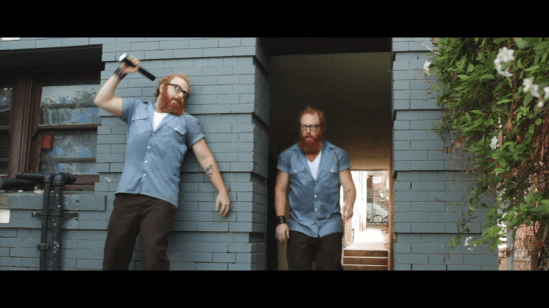
Ethan Walker is a brilliant scientific engineer, though he doesn’t look it with his long fire-hued beard and pot-belly midsection, but Walker, along with his colleague, believe to have accomplished the impossible: teleportation. When Walker decides to try his machine on himself, the realization of something terribly wrong overwhelms him. Walker didn’t invent a teleporter, he accidentally constructed a time machine, sending himself six months into a grim future where his wife and sister have been brutally murdered and he’s the sole prime suspect. The only way to make sense of the future and to solve the crime against him is to travel back to the past multiple times to unravel a sinister plot and stop the murder of those close to him.

To simply and conventionally tagline “Counter Clockwise,” George Moise’s 2015 directorial debut can easily be described as Terry Gilliam meets David Fincher. Part sci-fi thriller part dark comedy, the adventure of Ethan’s misadventures ingeniously signifies a harsh outlook on the saltiness of our predetermined universe while encountering outrageous and weird characters along the time warp. Ethan, no matter what he does or how he does it, has to use the accidental time machine to thwart the brutal death of his wife and sister and while his reasoning sounds fairly comical being the groundwork of what Albert Einstein calls madness, on-screen it’s rather heartbreaking and tragic to see this guy, an everyday looking joe, desperately attempt to deconstruct, from the unsolicited help of his future selves, a dastardly plot that will destroy everything he holds dear.

Penned also by George Moise, based off a story by brother Walter Moise, along with the film’s lead star, Ethan himself, Michael Kopelow, “Counter Clockwise” will change the way critics will perceive time travel storylines by not as a means of zipping back only once to change the forsaken past, but as a respawning Shakespearean tale of tragedy in order to continue to amend a hapless situation. A respawned Super Mario had more luck saving Princess Peach through the thicket of Koopa Troopas and the fire breathing Bowser. Though the character Ethan repeats his voyage, the way “Counter Clockwise” is written doesn’t convolute itself in the repetition, staging clues as a window into beyond the present and generating eerie and problematic, if seriously disturbed, episodes that doesn’t give Ethan a minute from tirelessly being objective. Combine those elements with George Moise’s neurotic direction and the result seizes to capture not only science fiction aficionados, but movie enthusiasts of every category in this genre-breaking feature. From the first moment of the opening scene, a strong familiar inkling of Ridley Scott’s “Alien” washes over you; the subtle hum of machinery, the slow panning from side-to-side, the very soft touch George Moise applies is uncanny and so endearingly respectful that the direction doesn’t feel like an absolute rip of Scott’s 1979 space horror classic.

Kopelow is the centerpiece that glues the story whole. As Ethan, Kopelow’s gentle giant approach is such a stark contrast to the surrounding darkness that has embodied nearly every other location and character, even his lip flapping, hard loving mother. Extreme opposite on the polar spectrum is voice actor Frank Simms as Roman, head of major corporation aiming to steal pioneered technology from Ethan at any cost. Simms’ talent has two settings in this film, hot and cold; his sound binary method works to composite a character so reasonably rational that when Roman snaps, a trickle of pee squeezes out and runs down your leg at his abrupt and menacing counter personality. The rest of the cast follows suit with pinpoint precision on their coinciding characters and even the eccentric cameo performances were otherworldly good from Chris Hampton’s relishing water fountain patron to Marty Vites one-eyed creepy landlord. Ethan’s landed in bizarre world that hums a very familiar tune in Terry Gilliam’s “Fear and Loathing in Las Vegas” while the amount of downbeat content spurs moments of gritty David Fincher thrillers, especially in one particular scene with the brawny New Jersey native Bruno Amato being the ultimate bad guy henchman by raping a dead woman for spite and for pleasure. The cast fills out with Devon Ogden, Kerry Knuppe, Joy Rinaldi, Alice Rietveld, and Caleb Brown.

The Sex Scene Crew production, “Counter Clockwise,” is not an effects driven project. The indie sci-fi film relies on the trio of coordination efforts in refined editing, camera angles, and practical effects to deliver the intended message. Like I said before, George Moise is neurotic, providing the attention and detail to every scene as if a climatic money shot. Value is placed in the story and in the direction rather than diluting and cheapening with overrated, big budget computer generated special effects that can snap a film’s heart and soul like a thin twig. The biggest effect comes in the form of a composite, placing two Ethans in the same scene and working action off each other. Even the time traveling sequences are a basic edit that’s well timed with simple lighting techniques, gentrifying low budget films more toward a respectable level of filmmaking.
Artsploitation Films’ DVD release of “Counter Clockwise” is an edgy rip in space time continuum sci-fi thriller presented in a widescreen 2.35:1 aspect ratio with Dolby Digital 5.1 surround sound audio option. Image quality pars well with modern releases and the same can be said about the audio, especially with the prevalent dialogue. Aside from conventional specs, Moise adds a sensory surplus to stimulate sight and sound hell-bent to strike an unnerving chord strummed simultaneously with providing an awesomely surreal effect. The DVD contains bonus features include “The Making of Counter Clockwise featurette, going behind the scenes of pre-production, production, and post-production. There are also five deleted scenes with commentary and a trio of commentary tracks that include the director, director and editor, and director and co-writer. “Counter Clockwise” is 91 minutes of time hopping suspense, packed with adversity and pitch black humor from start to finish and finish to start.
Category Archives: Evil Reviews
Become Internet Famous From Being Buried Alive by Evil! “6 Plots” review!

Seven close friends use “Screen It” to live stream online a drug and alcohol bender while partying hard at a vacant swanky home. When Brie awakes in a quiet, dark room of the luxurious house with no sign of her friends, she believes an odd prank is being played at her expense, but when she receives a frantic call from one of her frightened friends trapped inside a wooden box, Brie becomes their only hope of survival. She realizes that her six friends were abducted and buried in wooden boxes around the city, all of which contain it’s own deadly nightmare coinciding with each teen’s personal life. To heighten the tension, their fates are live streamed on the internet for the world to witness. Brie must connect the dots, find the pattern, and save the survivors before they all perish alone.

Australian survival horror “6 Plots” capitalizes on popular teens being terrorized and murdered by a game mastering and mysterious sadist. The story, devised along with live streaming online the six teens’ fates, stems from director Leigh Sheehan and was commercially penned by the newcomer Tim C. Patterson. Alice Darling stars as Brie, the girl left untouched to save her shallowly engrained friends, along with “Wolf Creek 2” star Ryan Corr, Penelope Mitchell (“The Vampire Diaries”), Eliza Taylor, Emily Wheaton, Joey Coley-Sowry, Damien Harrison, Andrew Clarke, and PJ Lane. “6 Plots” introduces characters to face their fears, putting them up against a destined wall of death if unable to overcome challenges inspired by their own lives. Though the challenges are no where near the legacy of the “Saw” games where players have an opportunity to win their freedom themselves by sacrificing something dear to them and are constructed with their good fortune resting in the hands on one sole person, Sheehan’s race against the clock suspense thriller loses steam, never establishing momentum to strike the edge-of-your-seat nerve.

Conceptually, placing unconscious disrespectful teens claustrophobic coffin structures and strategically scattering them along a small island coastal town only to direly drown their body and minds in a game of their own primal fears sounds amusingly devious. To pull off a grand recipe of intertwining cruelty, time would be the most difficult obstacle to hurdle and the plan’s organization and successfulness was ultimately determined on whether or not Brie and her friends were having a party at some random swanky house, which was on the verge of possibly being canceled priorly stated by one of the characters. Time spatially speaking, getting all six of her friends completely setup in boxes miles a part from each other would have taken most of the night, pending on how many hands were involved, and the story indulges a, perhaps, 3 to 4 hour workable time frame from each of seven passing out unconsciously due in part of whatever their drugs were laced with to the time they wake up alone in a confinement of darkness with only an element of personal fear accompanying them. In short, and this might spoil the end for a few readers, The Flash was able to accomplish casket coordination without much hassle. Just kidding…

The biggest issue with “6 Plots” is the story never really comes to a head, never really providing that spark-lit surge of intensity at the point of apex. Instead, the course of action flounders at a lifeless flat line when a moment of clarity for Brie dawns upon her and she figures out the bedeviled jokester’s pentagram pattern, simply by hooking up to the internet and plotting lines onto charts of the island of possible casket locations. Brie made their tormentor’s Russian signal jamming plan the most elementary scheme to deconstruct and solve to date, but that’s due in part to poor character development as well. We know absolutely zilch about Brie, except for the facts that the daredevil rides a motorcycle off road, gives the local authoritative putz a run for his money, and likes to partake in drugs and alcohol. That’s basically all the information we’re given about Brie’s character and, somehow, a character who traditionally would have been nixed right about now was able to unravel a plan much too elaborate for her primitive Netgear hookup intelligence. Not even her tech savvy friend, Marty, could keep up with Brie’s uncanny genius, remarking a couple instances where Brie outthought his intellect about their predicament.

Sheehan’s directorial style hinges upon a fair amount on the horrendously oppressive alternative music soundtrack and mawkish scenes of melodramatics with an example being after witnessing the horrifying demise of one of the teens on live stream, Sheriff Gary awkwardly drops the phone and hastily crosses the room to give Brie a clutching embrace as they both sob in each others’ arms. I’ve seen less over the top performances in soap operas. Certainly a first where melodrama meets tech horror, I found the technology to be sorely obsolete, especially for a film produced only four years ago. “6 Plots” was for sure a champion for Apple products, focal pointing on MacBooks and a Safari internet browser, but, yet, iPhones are rarely used and, instead, a healthy combination of Brie’s Blackberry and Sheriff Gary’s flip phone ultimately saves the day, proving that the latest and greatest tech gear can’t save you from a casket and can’t aid you in murdering people any faster.

Lionsgate home entertainment label delivers the 87 minute Eagle I production onto DVD and Digital Video with a widescreen 2.35:1 presentation and an English 5.1 Dolby Digital audio mix. A high point of this “6 Plots” DVD is the video quality, though now fairly standard with current films in their home release formats. Image quality pops with detail and clarity bringing out the worst specifics in the poorly illustrated representation of the antagonist on ancient cell phones. Audio, again, lies in the realm of modern day conventions, albeit the down under accents are sometimes difficult to decipher. From the start, survival horror “6 Plots” quickly snuffs itself out from ever materializing into, what could have been, a gripping thriller by burying the best parts under a 6-foot deep layer of indigestible fluff that’s rudimentary right to the bone.
Put Evil Into Submission! “From Parts Unknown” review!

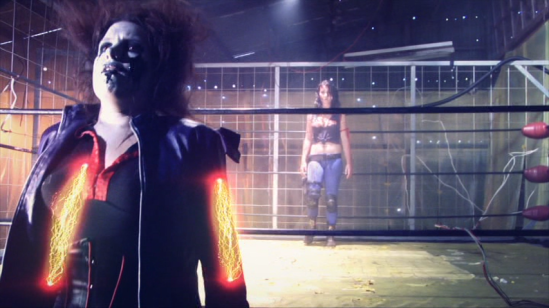
Charlie, the daughter of a famed pro-wrestler named Daddy Bison, witnesses the tragic and accidental decapitation death of her masked father while in the ring. Years later, Charlie labors for a video game corporation with underhanded values, but she still feels the call to wrestling, secretly competing and honoring her father’s memory in moonlight matches despite her lover’s wishes. When her corrupt employer illegal obtains Nano byte technology to engineer into their latest wrestling video game entitled ‘From Parts Unknown’ in order to financially steal from gamers, Charlie accidently becomes more involved than just being an innocent bystander. A side effect to the Nano bytes turns people into a horde of flesh hungry monsters on the cusp of being let loose and only Charlie can pile drive a stop to the infected corporate white-collar workers and vicious female wrestlers from embarking on a worldwide takeover.

It’s Bloggin’ Evil is familiar with director Daniel Armstrong’s work, reviewing the Australian born director’s 2013 roller derby slasher “MurderDrome” on the Camp Motion Picture’s home entertainment label. Armstrong’s latest horror installment, 2015 released “From Parts Unknown: Fight Like a Girl,” blends a healthy dose of wrestling into the terror folds. However, this body slamming, drop kicking horror film was produced and completed by 2009, years before “MurderDrome” hit the market, and was shelved in a period of postponement because of post-production reasons, but the Strongman Pictures team bouts with more than half a decade of delays to eventually release “From Parts Unknown: Fight Like a Girl,” a complete horror-comedy battle royal!

With a DIY façade, a talented actor pool dedicates themselves to undertake the high flying, death defying professional wrestling moves of PCW, Professional Championship Wrestling, in Australia and, I must confess, the actors looked legit. There’s an indescribable amount of pleasure and respect that goes into actors braving the chance of injury and accomplishing their own stunt work. Kudos to lead actress Jenna Dwyer for her stunt work to which in an example of her character, Charlie, is air-flung across the square ring and into a metal cage and she falls behind the ropes, landing hard on the mat below. The stunt looked fantastic. To coincide with the physical performances, Armstrong’s script uses slapstick comedy that’s heavy on the satirical undertones. Ross Ditcham’s a good character to spotlight as his role of Frank is the story’s buffoon, branded as being the best friend who doesn’t get the heroine girl of his dreams while running wildly whenever danger, or a brazen female supervisor, is hanging on his coattails.

The combination of performance and wit does hunker slightly from being overshadowed by the wonky cinematography. Every applied color of the rainbow saturates various scenes to, perhaps, wash away the dull gray and white tones of the minimalistic warehouse location or to attempt to upscale production value, but the extreme use of this method conflicts with sharp image details, leaving an opaque and blotchy picture. There’s also some odd framing from either the production or postproduction distribution that’s disrupts the clarity of the actions in the scenes. On the plus side, a solid, passable effort was put forth for the gory special effects, especially when Josh Futcher’s Misha violently implodes the head in of one of the henchwomen with a fire extinguisher, splattering upward a healthy amount of blood while Misha quoting, many times, Ash from “Army of the Darkness.” Tack on superimposed electric current superpowers, a tactical high-powered Uzi, and a little person donning a luchador mask and tights and “From Parts Unknown” tickles all the right parts of your delinquent, shameless senses.

Story wise, a loose introduction semi-torpedoes the backend of Charlie’s growth and embattlements, albeit the killer effects and various degrees of solid acting. The convoluted scenes of stealing the Nano bytes and sprinkled in segments of the Bison Daddy’s fate attempt to set up two simultaneous merging narratives that end up not meshing well or delivering the intended message. After the progression surpasses the Nano Byte mishap, the story starts to take shape, forming more coherently and appropriately to pit our lovely Charlie against an apocalyptic foe, setting up define characters, and setting the stage for an all out slobber-knocker! When Charlie and her mortal allies have the odds against them when rivaled against superhuman opponents, a clear indication that’s just more than good versus evil. Under the surface, Charlie is faced with life adversaries: her unethical boss, an advantage taking supervisor, and other female wrestlers. All of which become flesh eating maniacs and want to rip Charlie apart.

“From Parts Unknown: Fight Like a Girl” has pinned a DVD distributor with the indie label Camp Motion Pictures. The not rated DVD contains a short film “Post-Apocalyptic Chic,” “Fight Like A Girl” music video, Haunted by Humans Music Video, Demented music video, and a trailer vault. Like previously mentioned, the posterized video quality is noticeable within the confines of darker color hues and, especially, in the blacks. The LCPM 2.0 mix audio quality goes in and out with rocky levels of dialogue and ambiance. Graced with an ozploitation with great collaged cover art, Daniel Armstrong’s “From Parts Unknown” and Camp Motion Pictures are a wrestling match made in a hell in a cell! The best wrestling horror film since Mexico’s El Santo films!
The terror continues. Resident Evil 7: Beginning Hour demo (Post final update review)
December is finally here and that means one thing. Well yes you could say the holidays but for me, it means we are a month away from Resident Evil 7! In recent years I never thought I would be excited for another Resident Evil game, seeing how downhill the series went and the disappointment I had with Capcom. Now that the demo is complete and Capcom is getting their game ready for release, let’s look at what this small teaser has to offer.
The demo starts off the same. You wake up in the same room with a fireplace, piano and TV set, as well as the same objective; escaping from the house. The new addition in the final update is the locked door on the right is now unlocked and leads you into a creepy hallway. Already this is where I sort of felt like I was playing an old Resident Evil game. Walking into another part of this creepy house where I am greeted with a hallway or room that feels different from the previous one. Different wall colors, sounds and all around the feeling of something bad is going to happen.
The First room on the right is a bathroom where for some reason is a blood filled bathtub with a bike in it. Cool. Anyway, between the bathtub and the toilet is a pipe missing a valve. Next to the pipe is a blood filled toilet which we need to flush to get what’s inside (spoiler alert: It’s a gun). So thus begins my journey of finding this valve and collecting my weapon. Continuing down this hallway and collecting several handgun bullets and other items we come to an iron gated door that leads to the house’s basement.
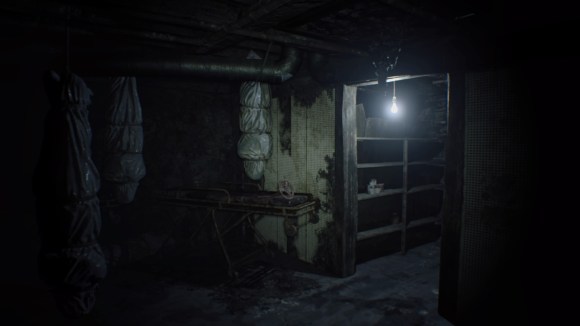
Before entering the basement, I could hear something lurking inside the room and that feeling of dread came right over me. After opening the door and taking a few steps in, this room is just not sitting right with me. Bodies dangling from the ceiling, weird noises, the valve I’ve been looking for is right across from me and oh look; Black slime that we have seen before is dripping from the vent. This isn’t good. Just like the older games, I was preparing myself for what I am going to trigger by picking this valve up.
Picking up the valve I walk to the door and see that good old Jack Baker has blocked me in with god knows what. The model of Jack is really well done and his facial expressions are amazing. He almost frightened me when he showed himself on the other side, laughing at me. Once Jack takes his leave and our first encounter with a monster begins, I manage to break out of the basement and back track my way to the bathroom to retrieve my weapon. After finally getting a gun I must go back to the basement and face the monster again.
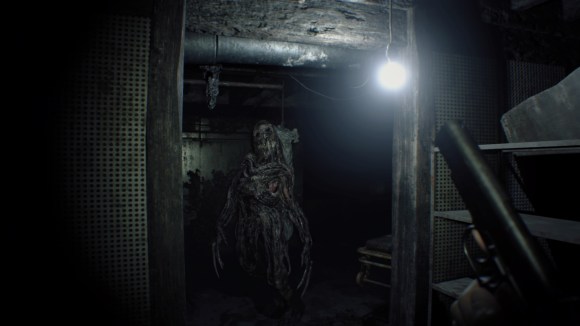
After going back into the basement and collecting a final item, I must fight the monster. The monster looks very similar to the regenerador in Resident Evil 4, but this is actually a new enemy called ”molders”. The design of the monster is nice and looks like something you really don’t want to run into. Fighting it can be pretty hard. It’s attack is pretty fast and being in a small room doesn’t help since it can grab you pretty easily. Along with the fast and creepy music playing during the fight it can really get your heart racing.
Now we come to the end of the demo. After getting your items and fighting the molder you must get to the attic window and escape. There are two new endings in this update, which I will not spoil. Both endings are based on how you play the demo, one ending is the ”True” ending and the other is the ”infected” ending. Each ending left me with more questions and wanting to continue on. Capcom did really well with this demo and did more than enough to show me that they care for this franchise. If you have a Playstation 4 please download this demo and give it a try, whether you’re new or a veteran. For Xbox One and PC players, don’t worry the demo is coming December 9th. Capcom I am ready to return to the world of survival horror.
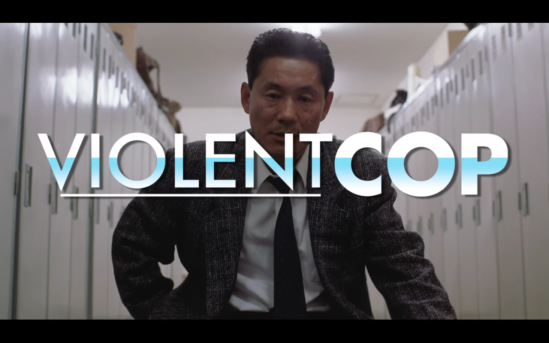
Dope Dealing Evil Doers Meet Their Match! “Violent Cop” review!

In a city fueled by constant drug trafficking and violence, a weak and corrupt police department has revolving leadership, but one good cop, detective Azuma, of the vice squad doesn’t have the taste for dope. Azuma’s wild card police tactics stir much controversy in his department, placing him on extremely thin ice, but he manages to get the job done no matter the destructive, if yet effective, trail left behind. When the detective learns that his long time colleague and best friend, detective Iwaki, has been involved with trafficking drugs, Iwaki ends up dead in apparent suicide and Azuma will stop at nothing to discover the truth behind his friend’s sudden death. Azuma’s Dirty Harry-style methods catch the attention of a powerful yakuza henchman who kidnaps her and lets his entourage gang rape his mentally unstable sister and with nothing else to lose, the rogue officer shoots first and never asks questions later.

“Violent Cop” is the breakout 1989 directorial film from Takeshi Kitano, one of the most recognizable names and faces in the revival of Japan’s film industry and a staple amongst other mediums including stage performance, television, and other various liberal arts. Kitano also headlines the yakuza genre film as the lead character, the ungovernable detective Azuma, in this unforgiving cop drama under his pseudonym ‘Beat’ Takeshi. Kitano’s harden plastered mug and short, stocky stature caters to the era of lone wolf. rogue cops, providing a hearty performance familiar to that of Clint Eastwood or Charles Bronson. “Violent Cop” quietly packs a punch, patiently waiting to seize the opportunity to display explicitly graphic violence while also being sleek in it’s construction, charmingly odd in it’s humor, and basking more in the parameters of performance than in it’s exposition of dialogue, which is kitano is known more for in his acting.

Much of the film revolves around Azuma’s cavalier and stoic personality. In the opening, three teenage boys unjustifiably harass and assault an elder homeless man. Azuma, who happened to witness the assault, follows one of the boys to his home, knocks on the door, identifies himself as a police offer to the boy’s mother, walks up the stairs alone, and slaps the boy around in his own room until the boy confesses and agrees to turn himself in at the station the following day. This introduction not only showcases Azuma’s descriptive title character as the violent cop, but also informs that the work alone Azuma has a vigilante moral principle that even isolates him from his unstable sister. Once a student of comedy, Kitano re-wrote the Hisashi Nozawa original comedic script into a brutal police drama, wanting to exhibit a serious side, but left alone some of the script’s initial comedy elements that blend the spirited yakuza film to being just inside the genre. Kitano’s progressive camera work includes deep long shots along with tight quarter setups, extensive and angled crane shots, slow motion sequences, and long track work that pinpoints Kitano’s diverse style.

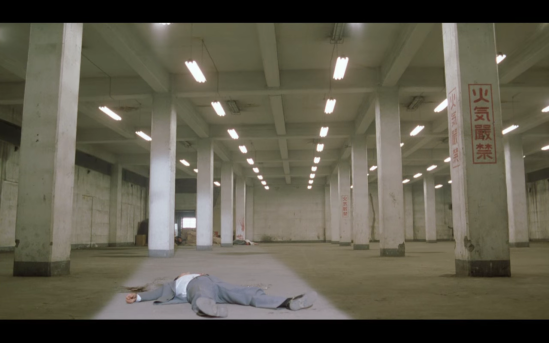
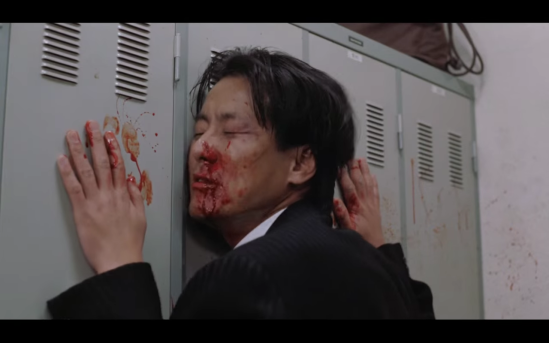
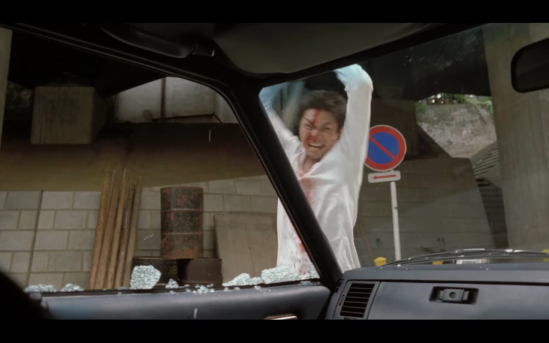
“Violent Cop” lives up to the title. Heads being bashed with an aluminum bat, multiple gory-soaked stabbings, and a sadistic, punishing maltreatments are just a few examples of “Violent Cops” barbaric qualities. The violent scenes feel almost peppered throughout, but they’re really strategically placed between character building segments that only support the necessity of brutality. Did detective Azuma really need to run over a suspect, who just murdered a colleague, down twice with the squad car? Yes, because the suspect desperately and dangerously wielded a baseball bat as a weapon and attacked them numerous time. The actions of the criminal warranted Azuma’s unethical position of bulldozing him over, twice. Only when Azuma is pushed beyond his limits does he lose what was left of any shred of restraints that were holding him back. Azuma meets an antagonistic match, a blood thirsty foe equally resistant and, at the same time, loyal with his boss, creating a villainous mirror image whose just as a loose canon as himself.

Film Movement, the New York based award-winning and foreign cinema distributor, presents a specialized hi-definition Blu-ray treatment of “Violent Cop” in a sharply detailed 1.85:1 aspect ratio stored on a single disc BD-50. The region A disc provides the best transfer quality of this 1989 film to date with stunning, natural coloring, balanced hues, and defined edges with no signs of compression artefacts. Darker scene noise is present, but to affect the experience, the noise would need to be more extensive. With Film Movement’s release, the noise is minimal and shouldn’t be considered a factor. The Japanese LCPM 2.0 audio track is quality with no hiss or pops. Dialogue is evident in the forefront, all other tracks seem level with an accompaniment range of ambiance, and, like aforementioned, all tracks are clean and clear of distortions. Extras include a featurette entitled “That Man is Dangerous: The Birth of Takeshi Kitano” and an booklet essay with the topic of Takehsi Kitano, written by Asian film expert and film curator Tom Vick. “Violent Cop” offers no sympathy, but provides an abundance of rich, dedicated filmmaking in a raw format that seems almost archaic in the present. Film Movement and “Violent Cop” go hand-in-hand, a foreign yakuza melodrama that saw the beginning stages of rebirth in the last days of a struggling Japanese cinema market and Kitano’s face is at the forefront of that movement.