Enjoy The Last Night in EVIL’s Hotel. “The Innkeepers” reviewed! (Second Sight Films / 4K UHD Blu-ray)

Book a Copy of “The Innkeepers” on 4K Ultra High-Definition!

The Yankee Pedlar is a historic hospitality hotel with over 100 years of service that comes with its own notorious past and haunted tidings.  On the verge of closing for good, the Yankee Pedlar has one more weekend to remain open and house guests but with only a handful of rooms occupied, there’s not much else to do for the two innkeepers, Claire and Luke.  As a way to pass the time, Claire is eager to video capture spooky events to feed into Luke’s website based off the hotel’s history in the death of Madeline O’Malle, a bride to be who committed suicide on her wedding day when the finance no-showed and her corpse was left to rot for 3 days in the basement as hotel owners feared for bad publicity, but when eerie begin to plague, call for her, with visions of a bloodied O’Malle in a white gown, Claire finds herself in the dangerous company with a permanent guest at the dying hotel. 

Ti West, the established genre director with the famed “X” trilogy, kept audiences pale in fear and the hairs on the back of their neck stiff and straight up with his written-and-directed horror films that retained staying power amongst fans.  2009’s “The House of the Devil” is considered one of the more recent better throwback horrors of our time surrounding classic tropes like a satanic cult and a home alone babysitter.  West’s 2011 film  “The Innkeepers” comes at a rebound time when his commercial picture, “Cabin Fever 2:  Spring Fever”, sequel to Eli Roth’s breakthrough hit from 2002 about a flesh-eating virus, didn’t quite feel like his film and “The Innkeepers” also hit a little different by shielding audiences from any type of horrific, on screen splatter violence and be concentrated on pure fear of the senses.  Though narratively set in perhaps Pennsylvania due to some references of towns an hour outside of Philadelphia, “The Innkeepers” was actually filmed more North in Connecticut with the real-life Yankee Pedlar building.  Larry Fessenden (“The Last Winter,” “Rehab”) of Glass Eye Pix and Derek Curl of Darksky Pictures co-produce the film along with Peter Phok and Ti West. 

In the two principal roles of Claire and Luke is “Barbarian’s” Sara Paxton as an unmotivated hotel clerk coasting until the very, bitter end and “Cheap Thrill’s” Pat Healy as a blasé and uninterested front desk colleague interested in getting on the popular haunted house train with his own website about their employer’s centenarian hotel.  Paxton inarguably shoulders much of the screentime as the girl who cried wolf when she experience’s the sounds of a wolf, aka the spooky serenades of one Madeline O’Malle, and the visual eviscerations of her bloodied corpse that would scare the bejesus out of anyone.  However, the frights are not enough to seemingly strike fear in Paxton’s shield of composure or even enough to put West’s story to rest with a simple I’m outta here as most of us chickens would flock toward the exit on the first instance waking from a vivid dream too real for comfort.  Healy ultimately steals the primary performance away from Paxton with his own gruff and irritated by everything:  the hotel, the guests, his own pitiful existence.  Healy does a nice job creating that subtle tension between Luke and Claire, knowing Luke’s own hangups lie somewhere in between and haven’t been exposed yet, all the while being a sarcastic boor for most of the time.  There are also side characters in the form of random guests occupying the skeleton-crewed hotel bringing with them their own set of baggage.  One of guests is Kelly McGillis and the “Top Gun” actress, in a bit of a meta-role of an aging actress turned mystic.  There’s also Alison Bartlett (Gina from various Sesame Street shows and specials) and Jake Ryan (“Asteroid City”) as scorned wife and her son and the peculiar older gentlemen, played by George Riddle, who requests a special room and will not take no for an answer.  One of the more curious castings is Girls’ Lena Dunham as a coffeeshop barista in a one and only brief scene that doesn’t add really anything to the whole in a pointlessly random interaction with Claire that, perhaps, plays off Claire’s repetitiveness and stasis life of going there everyday but not really knowing much about the barista, who is apparently always there too. 

Juggling between the blended tones of comedy and horror, Ti West doesn’t commingle the two directly into one scene, keeping distinction for one or the other in their individualized moments.  This leaves little room for alleviating dread levity inside the scare moment after building tension and fear of being chased or waiting for the silence to be broken but an unsuspected jump scare.  Outside the context of the fright-filled moment, back and forth quips and playful antics between Luke and Claire as two bored and starved for company innkeepers in the hotel’s waning days are delivered in brightly lit rooms and mostly shared with another person to be a telltale safe space against the malevolence of serrating spook-house intensity that often lingers and waits on with bated breath.  In the innermost between is Claire’s internal struggle to cope with the impending outcome that there is nothing on the horizon for her.  No secure job, no ambitions, no plans of any kind are seemingly providing the character with no hope and in that stagnation, she desperately holds onto what’s nearby – Luke’s interest in the Yankee Pedlar’s hauntings.  Enhanced by the odd actions and placement of the modicum of guests – McGillis as a crystal charm intuitive and Riddle as a strange-enough older man with a specific room fascination – Claire motivation to reveal Madeline O’Malle becomes tenfold because of her unconscious lack to move forward in life, which then spurs the question, is Claire’s experiences grounded in truth or are they just a downspout of manifestations induced compensation?  You’ll have to be the judge.

Like “House of the Devil,” another of Ti West films makes the Second Sight Film cut onto a newly restored 4K scanned UHD Blu-ray release.  “The Innkeepers” HVEC encoded, 2160p ultra high-definition, BD100 has the true presence of quality video with a gradual improvement in the finer details of a greater pixel count inside the HDR with Dolby Vision.  Though digitally recorded with a no imperfections to note from previous releases, Second Sight’s release does appear sharper and deeper around the black levels that often improve with better resolution and suitable compression and with a good portion of the story taking place in the dark recesses of a hotel basement and the in the shadows of unlit rooms, there’s no visual compression issue or loss of expected detail.  Contrastively, darker scenes appear more lit by a lower contrast but still, the details are there in depth and in closeup.  The English DTS-HD 5.1 surround sound audio track diffuses the spread of atmospheric creepiness – ghosts whispers, nondiegetic bangs and clangs, and a Jeff Grace building orchestral score that keeps the heart bumping (think Richard Band’s “Re-Animator” but with more lulls”).  Dialogue is prominently clear and in front of the aforesaid layers with depth mostly between Claire and Luke’s conversing in the lobby and range limited to, again, the aforesaid.  English subtitles are available.  Though this review is catered to the limited edition, rigid slipbox release full of tangible goodies, the standard release does have encoded a small army of special features that has two audio commentaries with the first including Ti West, producer Larry Fessenden of Glass Eye Pix, producer Peter Phok, and sound designer Graham Reznick and the second commentary also West but with principal actors Sara Paxton and Pat Healy.  A slew of new interviews provide a well-rounded, in-depth look at the creative design as It West A Lasting Memory, Pat Healy Let’s Make This Good, Larry Fessenden Our Dysfunctional World, director of photography Eliot Rockett Living in the Process, composer Jeff Grace Cast a Wide Net, and line producer Jacob Jaffke A Validating Moment contribute to the retrospective.  Special features round out with archival behind-the-scenes and the trailer.  The physical presence of Second Sight’s “The Innkeepers” keeps in-line with previous standard edition 4K releases with a black Amaray case and a monochromic grayish illustrative cover art setting audiences up for ghostly expectations.  The UK certified 15 release contains strong horror, gore, language, and sex reference – though the gore is subtle and definitely not over-the-top or even explicit.  This particular UK release, that has a runtime of 101 minutes, is region free and presented in a widescreen 2.40:1 aspect ratio.

Last Rites: “The Innkeepers” works, if not wriggles, into the brain, much like the invasive worthlessness inside Claire’s swirling mind, and the Second Sight Films’ 4K UHD Blu-ray is an ultimate celebration of not only the film itself, but also the venerable work of the horror genre’s freshest master Ti West.
Book a Copy of “The Innkeepers” on 4K Ultra High-Definition!

An EVIL Alien Blob Storms Earth in Search for Space Feline! “The Cat” reviewed! (88 Films / Limited Edition Blu-ray)

If you missed the Blu-ray, “The Cat” Standard Edition is Available!

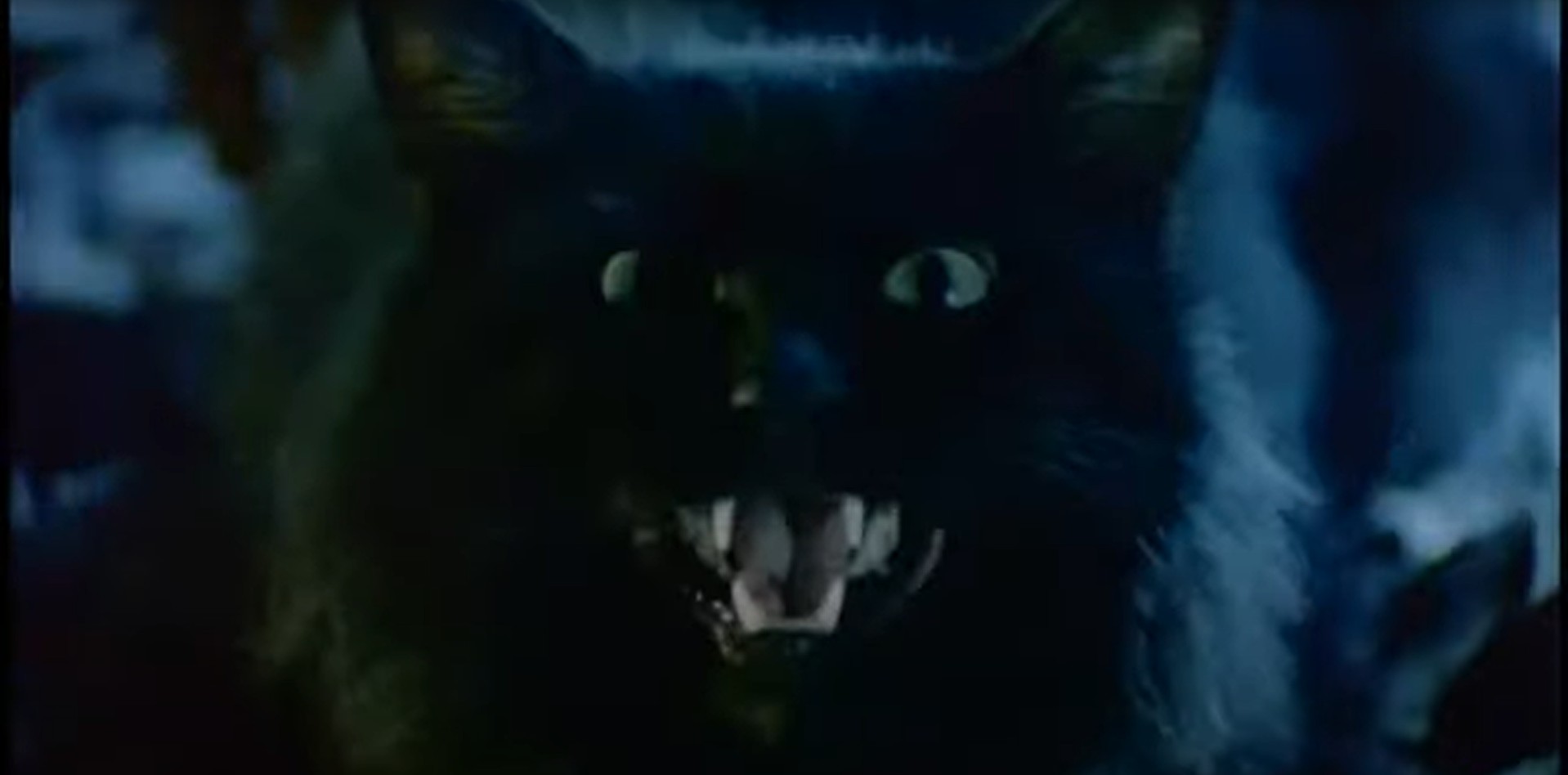
Storytelling author Wisely recounts one of his more fantastical pieces originating from more truth than fiction.  The writer reminisces investigating the mysterious occurrences surrounding a black cat and a young woman involved in a museum heist of an ancient, unknown artifact and, previously, in a strange encountering with Wisely’s friend Li Tung involving strange hammering noises and strewn about cat guts in an adjacent apartment.  Wisely soon discovers he’s bitten off more than he can chew becoming mixed up in extraterrestrial battle between the gentile but fierce fighting space cat and the young woman from another world versus a vicious and imposing orange alien blob that can inhabit dead humans and slip through tight confining spaces, leaving a burn trail of electrified bodies in its wake.  Wisely and his girlfriend, Pai so, decide to help the girl retrieve a second piece of the artifact that be used as a weapon against the relentless alien aggressor before the cat and girl can return to their home planet.

A strange science fiction thriller hailing from Hong Kong, “The Cat,” or “Lo mau,” is the 1991 filmic adaptation of author Ni Kuang’s “Old Cat” from a part of the Wisely adventure series of novels.  Written by frequent collaborating screenwriters Hing-Ka Chan and Gordon Chan (“Cat and Mouse,” “Behind the Yellow Line”) as well as numerous team-ups of Hing-Ka penning Gordon director helmed works (“Beast Cops,” “Thunderbolt”) and directed by “Riki-Oh:  The Story of Ricky” director Ngai Choi Lam, “The Cat’s” bizarrely unraveled as it is unrivaled but evokes a commingling of Hong Kong mysticism, science fiction, horror, and creature personification that’s hard to find not entertaining in its converging Daoism with creature feature movies!  Golden Harvest and Paragon Films, in association with Japan’s Nippon Television Network as a Hong Kong-Japanese alliance, are the companies behind the picture production with Chan Tung Chow (“Riki-Oh:  The Story of Ricky”) and Seiji Okuda (“Pulse”) as producers.

Hong Kong beauty Gloria Yip (“Riki-Oh:  The Story of Ricky,” “The Blue Jean Monster”) took Hong Kong cinema by storm in the early 90s before quietly taking a step back from acting to focus on building a family when newly married in 1995.  Since her divorce, Yip has been active in the last decade and half but to experience her best, early work, “The Cat” is a good start to behold her natural girl-next-door charisma and attractive attributes as an alien inside a human body.  Where she obtains this human form is unknown and her species social status, her name or how she became trapped on Earth is also vague, but Yip’s character can float waltz and is seemingly the caretaker of the Cat, who is a general of sorts in the alien race.  Her alien sidekick, Errol (Siu-Ming Lau, “Shaolin vs Evil Dead:  Ultimate Power,” “A Chinese Ghost Story”), too has an equivocal backstory as they search for weaponry relics and evade the caustic and electrically charged blob monster that threatens their world.  The story falls in more in tune with the three friends buried by the extraterrestrial struggle for survival and dominance with “A Chinse Ghost Story II and III’s” Waise Lee as principal lead character Wisely, a humble story writer living off the riches of girlfriend Pai So (Christine Ng, “Crime Story”), at least based on their dialogue of her owning a big house, playing tennis, and providing.  It’s an oddly laid out relationship that shows no quarrel or being tested when up against alien beings.  Li Tung (Lawrence Lau, “3-D Sex and Zen:  Extreme Ecstasy”) is Wisely’s first friend to encounter the girl and cat as noisy above neighbors but it’s their cop friend, Wang Chieh-Mei (Philip Kwok, “Hard Boiled”) who takes the unfortunate brunt being inhabited by the alien blob and becoming a Rambo-arsenal assassin.  The last piece to “The Cat’s” cast is actually the “Old Cat” author Ni Kuang having a cameo appearance as a warrior dog handler, Processor Yu.

Did I mention already that “The Cat” is beyond bizarre?  The campy story suffers from connective tissue deficiency syndrome, meaning there’s not enough exposition or explanation in the subdued, mild-manner interactions to really bring together and segue the really cool action and creature sequences that involve, but not limited to, pyrotechnics, forced perception effects, stop-motion, blood squibs, prosthetics and makeup, and high-flying wire acts involving not only people but cats and dogs!  The cat versus dog fight is a rough-and-tumble showstopper.  The special effects and choreographic teams of Hong Kong’s special makeup effects artist Chi-Wai Cheung (“Riki-Oh:  The Story of Ricky”) and stunt coordinator Philip Kwok taking their cogs and working into the grand effects design along with Japan’s f/x crew from visual effects artist Takashi Kawabata (“Dark Water”) and special effects Shinji Higuchi (“Gamera, the Guardian of the Universe”) is a masterful amalgamation of two cultures and two styles into one, blending high-flying acrobatics with the strange, bold stop-motion and visual effects that incorporate puppets and molds is optical buffet aimed stimulate and confound.  Nearly experimental in its narrative and effects while bordering being derivative, such as from the 1988 “The Blob” remake, “The Cat’ prowls, growls, and meows as a welcoming hot mess of feline phantasmagoria. 

On a new limited-edition Blu-ray set with exclusive, new artwork by graphic artist Sean Langmore, “The Cat” purrs with a fully-loaded, out of this world high definition release from UK label 88 Films and distributed by MVDVisual in the North American market.  A new 2K restoration of the original 35mm negative is encoded on a AVC encoded BD50 with a 1080p resolution in an aspect ratio of 1.85:1 widescreen.  Image presentation has the stellar glow of regular Hong Kong film stock, a stock that doesn’t dilute the defining particulars but only softens them slight.  The original negative has withstood the test of time and any improper handling providing the restoration effort with a focus-driven goal of grading and detail. The other side of that coin is that all the rubbery and irregular textures are now more in the spotlight instead of being lost in the lower resolution and more opaque video qualities.  Brilliant gel lighting and a comprehensive range of primary reds and blues coupled with an electric orange and blood red of the antagonistic monster seduces contrastingly inside a dark atmosphere with a story mostly told during the nighttime hours.  Remastered with a Cantonese DTS-HD mono track, the compositional track is about as good as it’s going to get but that’s not saying the audio is bad at all.  Clean and clear in ADR dialogue and distinct in the ambience and action, “The Cat’s” remastering is mighty without being punchy with broad-range, consistent audio that doesn’t have any holes poked into it and has an epic, original score by Phillip Chan (“Her Vengeance”).  Newly translated English subtitles are burned onto the only video file feature.  The encoded special features include an audio commentary by Asian film expert Frank Djeng of the NY Asian Film Festivial, a new interview with writer Gordon Chan in Cantonese with an English introduction, the Japanese cut of the film in standard definition, an image gallery, and theatrical trailer.  All of the encoded features will be available on the limited-edition and standard release sets.  Langmore’s artwork graces the LE O-ring slipcover and rigid slipbox with a crazy illustrative arrangement that details how bonkers “The Cat” gets.  Inside the slipbox, a full-bodied colored and detailed booklet with more original Langmore artwork, one sheets, stills, and other contents that include cast and crew acknowledgements, a Paul Bramhall retrospective essay on director Ngai Choi Lam That Cat is Dangerous, a second essay in regard to Nai-Choi’s niche cinematic credits by Matthew Edwards entitled Body Horror, and a special thanks roundup and more acknowledgements in the making of the Blu-ray release.  There’s also a collectible art card stuffed in between the clear Amaray case and the booklet.  The reversible cover art’s secondary slip-shell is of an original poster art, a good alternative to an already overused Langmore illustration that’s on the O-Ring and slipbox.  While not a numbered limited-edition release, news of the set already being or nearly sold out at most retailers is circulating, but there will be a standard edition slated for release late November ICYMI!  The not rated release has a 89-minute runtime and is encoded region A and B for playback.

Last Rites: Ngai Choi Lam’s science fiction, body horror, and creature feature inundated “The Cat” has all the weirdness and practical prosthetics, including deeply bizarre force perception visuals, that’s beyond our galaxy and capacity for understanding, landing with great precision onto a well-deserved, highly anticipated, and must own 88 Films’ limited-edition boxset!

If you missed the Blu-ray, “The Cat” Standard Edition is Available!

Sometimes It Takes EVIL To Bring Out the EVIL In Us All. “Jacob” reviewed! (Crazed House and MVDVisual / Unrated, Director’s Cut Blu-ray)

“Jacob’s” EVIL is Coming to Blu-ray! Order Here!

In the Texas smalltown of Melvin Falls, a dark history engulfs the Kell family.  Edith Kell and her two children have lived in ostracized notoriety for years amongst their neighbors as Edith’s husband, obsessed with restoring a suddently inherited house immersed in haunted opine, walked into the town crowded bar and started violently killing patrons before being shot dead by the local sheriff.  Years later, Edith’s son Jacob is now a quiet, large, and lumbering young man with a death stare that’s akin to looking into the abyss, but Jacob’s underlining rage and psychopathic tendencies are comforted by his younger sister, Sissy, when tensions rise between his mother and her boyfriend, the abusive town drunk Otis.  When Otis inadvertently kills Sissy, Jacob’s bloody rampage is unleashed and the townspeople, led by a capital punitive sheriff, form a posse to bring down the vengeful Jacob, if they even can, in another Kell family massacre.

IMDB.com

Larry Wade Carrell writes-and-directs the dysfunction family and rural community horror “Jacob,” released over a decade ago in 2012.  The film is Carrell’s debut solo directorial that earned the filmmaker best Indie Fantasy-Horror, Best Young Actress, and Best Music Score at the WorldFest Houston before embarking into more recent horror of the last decade with “She Rises,” “Girl Next,” and “The Quantum Devil” that run the subgenre gamut with supernatural terror, trafficking abductions, and evil on a whole other plane of existence.  Carrell’s humble backwoods basket case thriller has broad stroke inklings of a supernatural catalyst.  Filmed in and around Richmond, Texas, “Jacob” is the last feature from Odyssee Pictures and the first for Javaline 98 Productions, produced on a low budget by Carrell, Odyssee Picture’s Stacy Davidson and Jeremy Sumrall (“Domain of the Damned,” “Sweatshop”), William B. Davis, Catherine and Frederick Rushford, James Martinelli, and Chuck Norfolk (“Conjoined”).

IMDB.com

Like most indie features, multiple hats are being worn in front of and behind the camera.  Not only does director Larry Wade Carrell write the script, he also dons the twin brother roles of drunkard abuser Otis and the gentile deputy Billy.  Edited so the two characters are never fully faced in a scene together, Carrell manages to pull off contrast personalities by portraying, essentially, the epitome of bad versus good with the no-good delinquent and intoxicated aggressor Otis up against the mild-mannered solicitous nature of Billy, a deputy.  While Carrell may be the core of the story playing two characters, he’s written a narrative that has to battle out against the titular character Jacob, played by Dylan Horne, and the venerated genre name of Michael Biehn (“Terminator”), in what can be considered as the worst impersonation of a whoopie-exclaiming Podunk, literally with the character yelling whoopie when learning of inheriting a house.  Aside from Biehn’s cringy performance, the acting is generally positive and compelling.  Carrell goes beyond the bar in melodramatics but manages to keep grounded by much of dynamic interactions supplied by scrupulous actors with Krystn Caldwell (“Psychic Experiment”) as Edith Kell, the staying in victim of abuse, Leo D. Wheeler (“Domain of the Damned”) as the manbun sheriff with a firm but gentle approach, and Grace Powell (“Hell of a Night”) as Jacob’s soothing little sister Sissy.  Horne, in the Jacob role, is voiceless throughout but imparts Jacob’s ogre-esque killer from inside out but is still overshadowed by Carrell’s double-edge role that takes away from his menancing run through the simpleminded townsfolk.   Dustin Lane (“The Darq’), Travis Hester, Sandy Ray (“Hairmetal Shotgun Zombie Massacre: The Movie”), Shane Stewart, Karen Schlag (“Domain of the Dead”), Nick W. Nicholson (“Pickaxe”), and Deke Garner (“The Void”) rounds out the “Jacob” cast.

IMDB.com

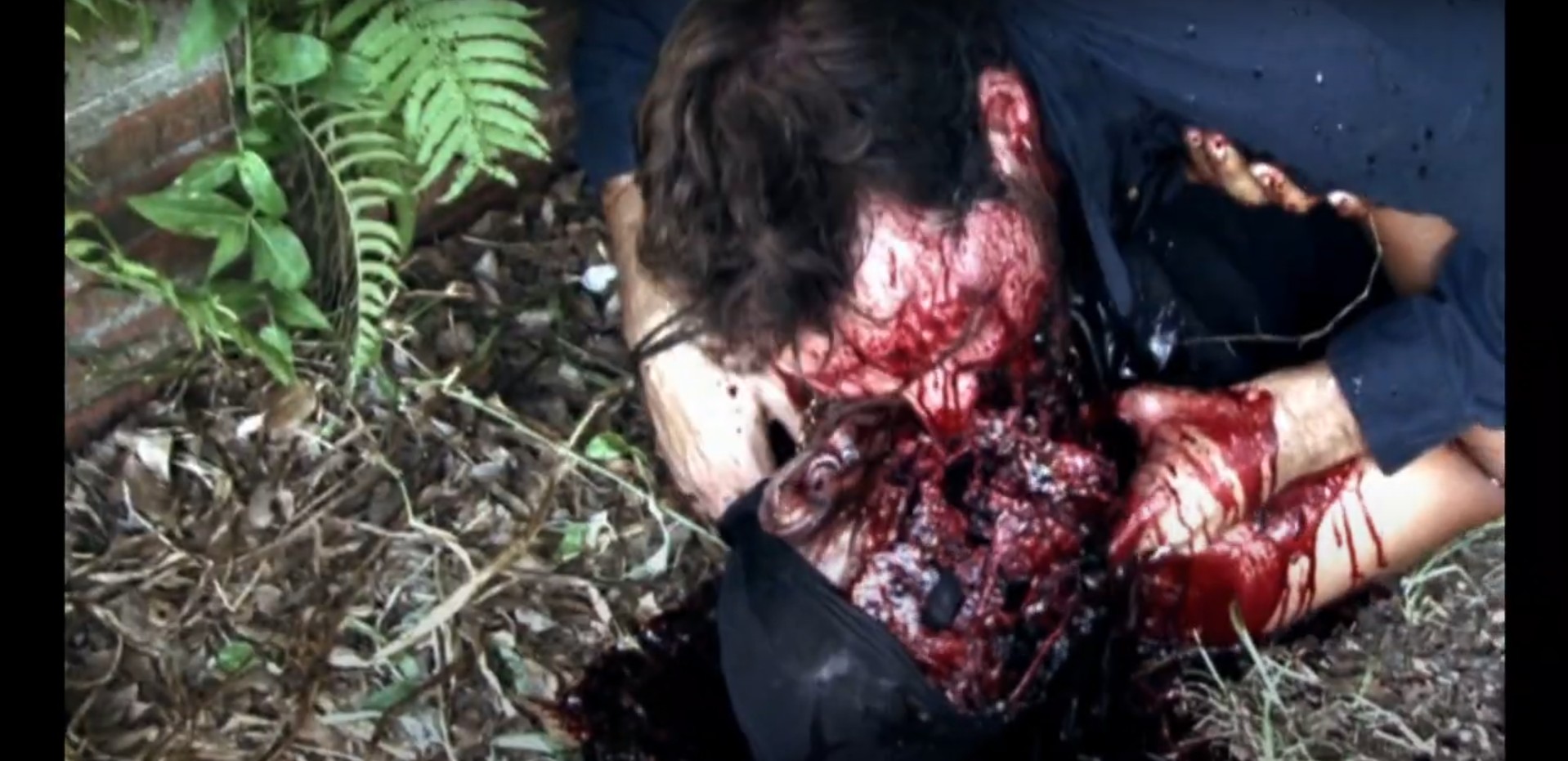
“Jacob” is one of those horror-thrillers that wears the trope suit of a large, quiet, countryside hulk with little intelligence but makes up for with strength and goes on a killing spree when a cataclysmic moment, usually spurred by external elements like peer bullying or the death of significant person, in this case the death of his sister, Sissy, breaks Jacob’s dammed violent tendencies and what ensues is a deluge of body mangling carnage in a big ole heap of misunderstanding as the Melvin Falls residents believe, with prior judgement and without a doubt, Jacob finally snapped and murdered his sweet baby sister, though far from the truth.  However, the reason for Jacob’s turn to madness is a little more complex than just dead sister vindictiveness.  In this case, less is more would have suited Carrell’s film more aptly as Carrell adds in a supernatural element with Jacob’s father inheriting a supposed haunted house.  As the father attends to the house rehab, a montage of him finding a book and able to read and be beguiled by the demon scripture inside causes him to slowly become obsessed and insane while fixing their newfound home which then leads to the bar massacre Jacob witnesses.  Jacob also comes in contact with his father’s spilled blood that night and that presumably passes whatever supernatural forces the father was affected by to his son, an evident metaphorical theme of hereditary genes gone wild through blood lineage that’s also demonstrated within Sissy who mentions hearing the house’s callings to her but she was not tainted by the touch of her father’s blood with her being inside mother’s womb. There’s a lot to digest and decipher but not properly arranged or the demonic mainspring is sorely underplayed to really nail the occult supernaturality on its head.

The Unrated, Director’s Cut of Larry Wade Carrell’s “Jacob” lands onto Blu-ray from Carrell’s current release company Crazed House and distributor MVDVisual.  The AVC encoded, 1080p, BD50 and presented in a widescreen 1.78:1 aspect ratio.  Picture quality is a bit all over the place and its likely not from the compression codec but rather stylistic choices for flashbacks for a narrative that goes into a flashback while already inside a flashback, creating multiple tonal layers to distinguish the vying eras.    Carrell really gets his hands into a sepia and desaturated grading that sucks the color out in a fit leaning toward overexposure taking with it much of the finer detail points.  Combined with digital stock, the gritty tone Carrell goes for often loses the battle to an ultra-sheen effect.  The English LPCM 5.1 surround sound plays to the rigors of the dialogue.  The loquacious script, delivered on point by the actors, goes unobstructed with a prominent dialogue layer underscored by its Iain Kelso score that evokes a slightly better grittier tone Carrell attempts to achieve with the film’s appearance.  Range is limited to just what’s in frame and within the nucleus bubble and that often goes together with eliminating much of the depth when all the centered focus objects are making all the noise in the room and scene, diegetic speaking.  English subtitles are available.  The director’s cut has special features that include two commentaries with one including writer-director Larry Wade Carrell and the other including Stacy Davidson, a behind-the-scenes documentary The Journey of Jacob that has retrospective cast and crew interviews as well as raw footage and film footage of the film’s from alpha to omega, an interview at the “Jacob” Canadian premiere hosted by Yell Magazine, actors screen test, extended and deleted scenes with Carrell commentary, a storyboard comparison with Carrell commentary, and the theatrical trailer.  There is no stinger scene post credit.  The cover art screams low-budget and photoshop but is an adequate shoe that fits the rural horror and lumbering maniac concept.  “Jacob” comes in a standard Blu-ray Amaray for its region free, 92-minute feature presentation.

Last Rites: “Jacob’s” a good first effort in the big chair for filmmaker Larry Wade Carrell with solid acting, interesting characters, and palpable bloodshed. Where the weaknesses lie is with the story’s inability to connect the demonic, haunted house, ghost story, or whatever supernatural force may be to the essence of backwater calamity and dysfunctional family lineage.

“Jacob’s” EVIL is Coming to Blu-ray! Order Here!

EVILFormers: Robots in Disguise! “Crash and Burn” reviewed! (Full Moon Features / Remastered Blu-ray)

“Crash and Burn” on Blu-ray from Full Moon Features!

In the year 2030, the global economy has collapsed and the most powerful organization on the planet, Unicom, controls most of the national markets with scrutinizing oversight.  What makes matters worse is years of pollution and nuclear naivety is dissipating the ozone layer, exposing the Earth and its denizens to altering ultraviolet rays that scorch the Earth with thermal storms, turning much of the terrain into wastelands. Out in the middle of nowhere in one of those barren lands, Unicom errand boy Tyson Keen delivers freon to an isolated Unicom television station fabricated from an old powerplant.  An impending thermal storm forces Keen to stay overnight with the motley crew of station personnel and televised guests.  When the thermal storm knocks out the power, they discover the station chief has been murdered, revealing the chief’s involvement with the Independent Liberty Union, a rebellion group against the mighty repressive Unicom, and secret plot involving Unicom’s illegal use of synthetic people to infiltrate the station to stop dissident behavior. 

2030.  That’s only five years away, folks!  Get ready for the global financial downfall and fallout when the ozone also says peace out after years of abuse.  Giant robots and subverting T-800s, I mean synthetic androids, are exploited for corporate gain and power over the few who resist.  Actually, if you think about it, the premise of 1990’s “Crash and Burn” might actually be happening now, today, five years earlier by the sound of it!  The Full Moon production, helmed by company founder Charles Band, (“Trancers,” “Doctor Morbid”) and written by J.S. Cardone (“Shadowzone,” “The Forsaken”), is seemingly ahead of its time with the exceptions of mecha robots and a vastly dusty wasteland of the Earth’s surface, complete with temperature rising thermal storms.  Unofficially considered a sequel to Stuart Gordon’s “Robot Jox,” another Full Moon production released the year prior, “Crash and Burn” is produced by “Nightmare Sister’s” David DeCoteau and John Schouweiler with Band and Debra Dion serving as executive producers.

The futuristic dystopian thriller plays out much like a slasher with a group of people hunkered down safely in shelter until one-by-one they’re picked off.  Paul Ganus (“The Monolith”) acts as the Unicom outsider Tyson Keen, a motorcycle-riding delivery boy just needing cash to get by in turbulent times, inside an established dynamic of a reclaimed power station used for Unicom television broadcasting where Ralph Waite dons the station chief shoes of Lathan Hooks, Megan Ward (“Arcade”) in the role of Lathan’s tech expert, teenage daughter Arren, Bill Moseley (“House of a 1000 Corpses”) as the station’s handyman Quinn, Eva LaRue (“Robocop 3”) educating the children over the TV waves as Parice, and Jack McGee (“Rumpelstiltskin”) in the blowhard and perverse egotistical TV host role Winston Wickett.  There are also two Winston Wickett guests, flesh and blood adult actresses who came back into the business after Unicom banned robot porn star and are being roasted by Wickett for their licentiousness, played by Elizabeth Maclellan (“Puppet Master II”) in the non-nude role of Sandra and Katherine Armstrong (“The Arrival”) in the topless required role of Christie.  Sandra and Christie are opaquer when it comes to their purpose as the two seemingly nomad women obviously need the money Wickett promises them to do the show to continue moving from place-to-place, but they put up with Wickett’s pompous and chauvinistic degrading being, even sleeping separately in the same quarters as the television host without wearing clothes.  There are dialogue moments between them that suggest there’s more to their relationship than what’s in exposition but never fleshes out; instead, Christie fleshes out in a shower scene with Bill Moseley’s Quinn for a brief cleansing.  The above cast of characters set the same for a “The Thing” similar mistrust when one of them is suspected to be a sabotaging, murderous robot in human skin, they even do a blood test too.  Solid performances all around with Moseley outshining most and Megan Ward’s innocence really comes through in her debut as a teenager while Ganus can be a suitable leading man but lacks the presence where it matters.  Jon Davis Chandler (“Carnosaur II”) and Kristopher Logan (“Puppet Master III:  Toulon’s Revenge”) round out the cast as two wasteland gas attendants close to the isolated power station.

“Crash and Burn” is an enjoyably campy, science-fiction horror that derivatively cherry-picks from other films in the genre.  From “The Thing” to “Aliens,” to even Full Moon’s own production “Robot Jox,” “Crash and Burn” puts other sci-fi cult films’ best elements together to form something new that instills a sense of isolating tension and heart-racing thrills from the man versus machine narrative.  Charlie Band adds his localized flavoring of beautiful women, sometimes teasing to bare it all, to zhuzh it up in a different light.  Like most of Full Moon’s earlier productions, and what separates the company’s catalogue from the modern features of today, is the practical effects.  Greg Cannom (Francis Ford Coppola’s “Dracula”) and his assistant Larry Odien’s make up effects, plus “Terminator 2’” Steve Burg’s robot design with the puppeteering, have longevity over the decades rather than today’s fly-by-the-seams visuals that often look cheap and mismatch against the live action with no tangibility and hardly anything the actors can work off against.  The under skin, robot skull exposure looks phenomenal for the era and budget with multiple layers peeling off in its prosthetic application and makeup arrangement. 

Full Moon continues to remaster their catalogue into high definition with their 1990 title “Crash and Burn” next on the docket. Remastered from the original 35mm negative, that was recently unearthed, the image has greatly improved from the flat colored transfers of previous positive prints, AVC encoded with 1080p high-definition resolution on a BD25. Full Moon’s remastering adds richness to the color pallet and a fine texture point that discrete objects the internal boiler room of the television station and, in contrast, the arid desert of Alabama Hills, California doubling as the futuristic wasteland. Skin textures are filled with stubble, ridges, imperfections, sweat, and robotic skin peels in every frame without the softening or smoothing over process to work quicker rather than precise. Full Moon offers two English Dolby Digital audio tracks, a Stereo 2.0 and a surround sound 5.1, which has been standard fair with the re-released remastered lineup. As fidelity reproduction goes, the layers perceive repressed for a bigger approach, especially one that has giant mecha action and a whipping thermal storm that causes a giant satellite crashing into a building. There’s nothing innately substandard about the Dolby mix, it’s perfectly adequate to handle the action, ambience, soundtrack, and the forefront dialogue and exact clear prominence without the lift in its intermediate range. English SDH are optionally available. Charles Band and actor Bill Moseley launches off the special features portion with a feature parallel audio commentary that’s entertaining between Moseley’s quips and Band’s stories in relation to the “Crash and Burn.” Also included is the making of the film, a blooper reel, the original trailer, and other trailers from Full Moon. Housed in a traditional Blu-ray Amaray, the original VHS art is reiterated, again, for the Blu-ray that’s more mecha oriented rather than stealthy robot assassins. There are no inserts inside or other physical features with the release that has a runtime of 85 minutes, is unrated, and is encoded as region free.

Last Rites: “Crash and Burn” does not do just that, crash and burn, but has real world dystopian concepts underscoring a Full Moon slasher reanimated by remastering for high-definition fanatics.

“Crash and Burn” on Blu-ray from Full Moon Features!

White Space Men are the EVIL Captains of the Zombie-inducing Slave Trade and Intergalactic Fast-Food Industry! “Race War: The Remake” reviewed! (Wild Eye Releasing: Raw & Extreme / DVD)

Get Caught Up in the Middle of a “Race War: The Rmeake” on DVD

Drug dealer Baking Soda is feeling the peddling pangs of dropped traffic for his crystal pure PCP.  With no one buying his smack, he and his friend G.E.D. reside back home to drink with their close fish-headed friend Kreech and sleep off the day’s failure to try again tomorrow.  Their persistence to sell puts them on the radar of a white supremacy group vending a new drug on the street, the cause for Baking Soda’s drop in sales, but their product isn’t just going to get users high, it will turn them into flesh-eating zombie slaves.  When G.E.D. is kidnapped by the group, Baking Soda and Krrech have to run through the list of suspects – Jews, Hispanics, Chinese, and others – for the source of his sale woes and to rescue his friend, guns blazing if necessary or if unnecessary, but there may be more extraterrestrial motives that haven’t yet been unearthed. 

“Race War: The Remake” is a 2012 politically incorrect, ultra-offensive spoof comedy and blaxploitation horror from writer-director Tom Martino.  A Tom Savini school graduate, te special effects artist Martino (“Dead of Knight,” “Return to Nuke ‘Em High Volume 1,” “Doll Factory”) takes helm in the director’s chair for his debut in indie feature productions with one of the wildest, crudest, and tactlessly funny comedy-horrors I’ve seen since Troma’s “The Taint.”  Set in and around Houston, Texas and the greater surrounding area with guerrilla filming in locations such as the Houston Space Center and shooting with permission at the Darke Institute’s Phobia Haunted House, “Race War:  The Remake” doesn’t have an originating film despite the title in what is considered a spoof sequel – think of examples “Dude Bro Massacre III” and it’s standalone release or the non-existent second sequel between  “Thankskilling” and “Thankskilling III.”  Martino produces his own work under his outside of Houston-based company DWN Productions that doubles in making horror theme masks, busts, and props.

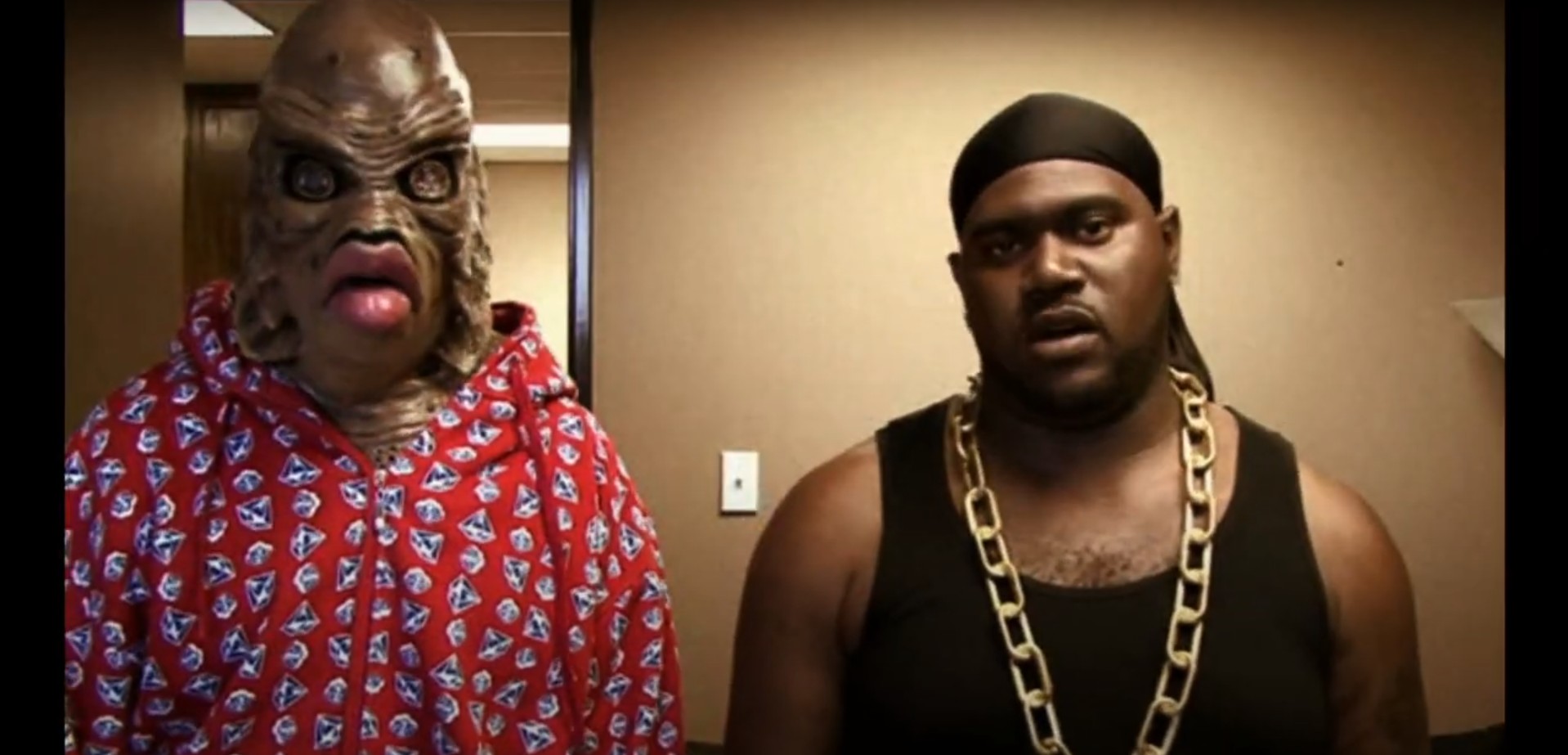
Thick-skinned actors comfortable with the narrative’s uncomfortable themes begin with Howard Calvert and Jamelle Kent as Baking Soda and G.E.D.  Calbert and Kent have become regulars in the Tom Martino catalogue of cast members for his more recent films and their humble beginnings in “Race War:  The Remake” proved their longevity to stay with the director, who is white, who wrote extensive race, gender, sexuality, and fart jokes in the context of a comedy-horror with cringy stereotypes and genuine tributes.  Calvert and Kent have great comedic timing to pull off all the zany editing, sound bites, and practical effects distaste Martino has flaming axe tosses at them to achieve his vision.  The two are joined by Danny McCarty, who would become another regular and be the visual effects supervisor for the film, dressed head-to-toe in loose-fitting urban attire to match the theme of Calvert and Kent’s black A-shirt and do-rags but his hands and face are masked to become the Creature from the Black Lagoon, aka Kreech.  Martino’s “Race War:  The Remake” isn’t just about the terrestrial races but intergalactic ones as well and we soon see that later on with the intentions of neo-Nazi white drug suppliers, led by Matt Rogers’ vulgarity in the horseshoe mustached Tex.  There are various other encountered gross stereotypes in the trio’s urban quest, such as a large nosed, greedy Jewish lawyer, Mexican luchador bodyguards, and a Pai Mei-esque Shifu speaking gibberish har har sounds and listing off popular Americanized Chinese dishes in attempt to be derogatorily funny.  With a film titled as “Race Wars:  The Remake,” the cast is mostly white and black actors poking uncouth fun with a big unconcerned and insensitive stick with Corey Fuller, Kerryn Ledet, Sam Rivas, and Coady Allen listed in the cast.

“Race Wars:  The Remake” isn’t funny, it’s stupid funny!  Having grown up in the 1980-2000s, consciously I might add, Martino’s politically incorrect and his brand of juvenile humor resonates with me, reminding me how cinema has become numb to the spoof humor.  Granted, Martino’s humor is over the top cutting, gross, and full of jest bigotry, traits that would trigger many in today’s sensitive awareness, and while cringy after a tasteless joke may result, there’ll likely be some a side of the mouth chuckle to go along with it.  On the opposite side of the spectrum, Martino tributes to references of certain popular culture icons, though slightly bastardizing some for laughs.  From Peter Jackson’s “Bad Taste,” to “Creature from the Black Lagoon,” to even “Mortal Kombat,” “Race Wars: The Remake” integrates the best parts of each these staples of pop culture and that gives his film a leg up on other offensive spoofs of the same crass caliber.  Th one negative story structure item to  highlight is the act one narrative takes a while to work the gears and get going as it attempts to setup the 40oz-drinking chumminess of Baking Soda, G.E.D., and Kreech but lags to a stagnant stall for hot second while still surround with the here-and-there gags, themed with G.E.D. homosexual tendencies and Baking Soda’s drug peddling woes on and off the streets, but once the antics pickup, there’s no stopping Martino and his filmic entourage from raining down an assault of insults. 

If you’re easily offended or put off by off-color race comedy, then Wild Eye Releasing’s “Race War:  The Remake” DVD is not for you!  For me, and those like me, unaffected by the type of uncouth spoof, Tom Martino’s debut is for you!  The Raw & Extreme sublabel’s DVD is MPEG2 encoded, 720p resolution, on a DVD5.  Presented in widescreen 1.78:1 aspect ratio, there is a breadth of visual presentation not confined within’ pillar and letterboxing but is stretched vertically that affects the already par level resolution.  Guerilla filmmaking also involves no production lighting and natural lighting is more than used here in Martino’s run around the Houston area, but one thing good about Martino’s naturally lit cinematography is its neutral set, avoiding under and overexposure.  The lesser used interiors have some tint lighting and key lighting to avoid total flat, dark outcomes but give the image a haze of hue, especially inside Baking Soda’s living room scene in the first act that sees a thin layer of red and green.  The English PCM Stereo has inconsistencies in volume.  Some scenes discern quieter than others because of the guerilla filmmaking constraints as well as just using commercial recording equipment.  However, the dialogue does land well enough for the jokes to hit and overlayed sound effects greatly lift the sound design where needed, such as with the Mortal Kombat video game sequence or with the array-spray of gunshots throughout and soundboard gag effects.  There are no subtitles with this release.  Included in the special features is Tom Martino director’s commentary, a gag/blooper reel, a behind-the-scenes reel of the gory moments, and Wild Eye Releasing trailers that include “Race War:  The Remake.”    The clear, ECO-Light Amaray DVD case houses stellar covert art illustration work by Belgium graphic artist, Stemo, with the inlaid narrative intensity and characters in collage.  The reverse side includes a gory still from one of the scenes.  The disc is pressed with the same front cover image but there are no other physical materials.  The unrated DVD runs for 95 minutes and is region free.

Last Rites:  Wild Eye Releasing re-unleashes another outrageous title on their Raw & Extreme label and the Tom Martino film is every ounce of the sentiment in it’s indie underground hokum of gore, racism, homosexuality, and aliens! 

Get Caught Up in the Middle of a “Race War: The Rmeake” on DVD