Re-Electrifying a Dead Cop to Stop EVIL! “The Blue Jean Monster” reviewed! (88 Films / Blu-ray)

Click Here to Purchase “The Blue Jean Monster” available on Blu-ray!

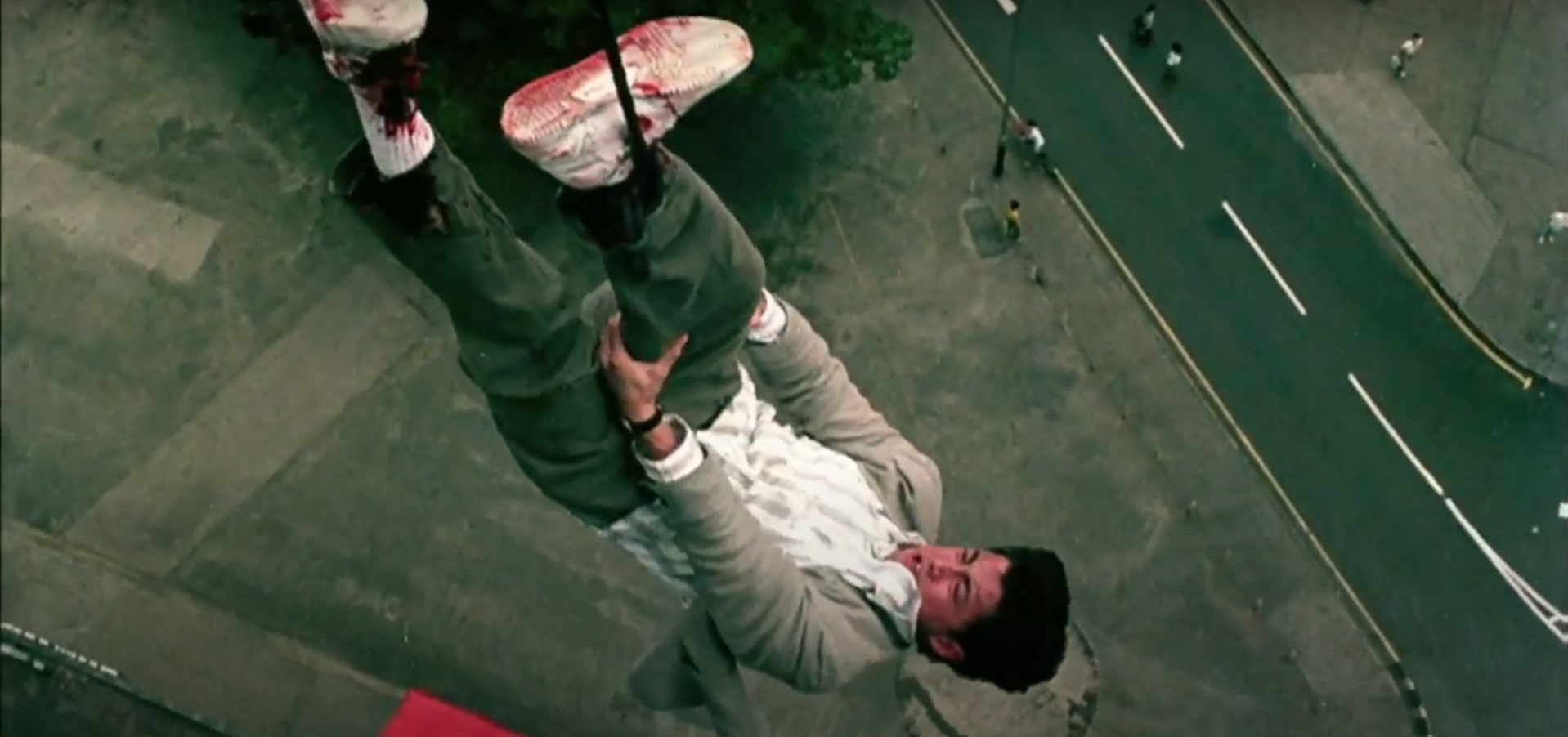
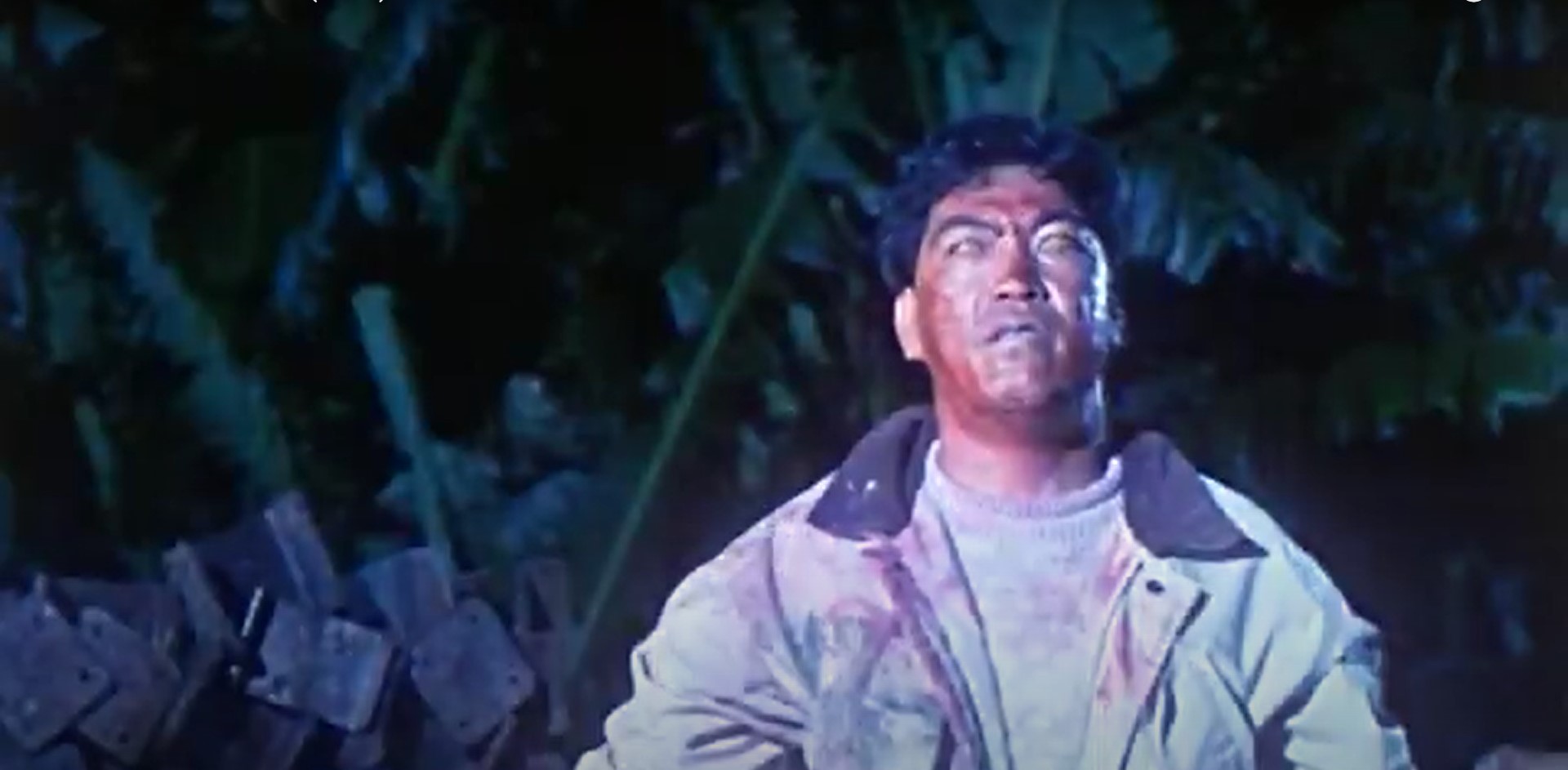
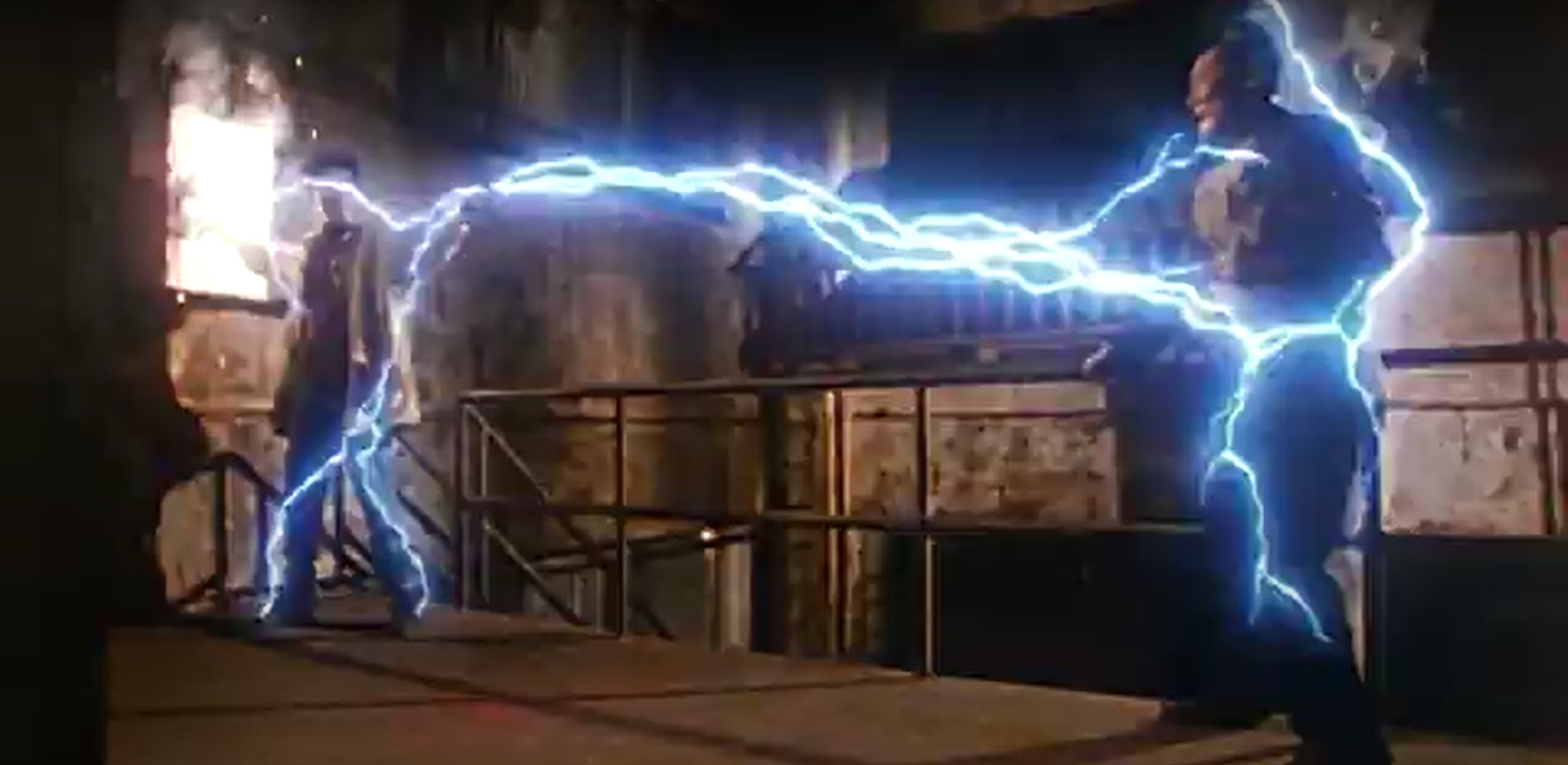
Soon-to-be first-time dad Tsu Hsiang can’t wait to meet his son.  Often times, his cop vocation intrudes on being there for his wife during her pregnancy as his torn between work and family, trying to be a good man in both regards, but when a tip comes through of a suspected bank robbery, Hsiang can’t neglect his duty and pursues the thieves in a high speed and gun-blazing chase that ends in his death as a construction site pile of steel rebar crushes him during the arrest.  His corpse left under the rebar overnight, a storm causes a transformer to fall on top of him and a cat providing a mystical lifeforce.  The electrical currents course through his dead body, reanimating him with the superhuman strength and invulnerable to pain, but with a cost as Tsiang is slowly rotting away, unable to heal or enjoy any of his senses.  Tsiang also has to recharge his body with electrical volts direct to body in order to continue being reanimated.  With time running out, the cop’s two goals are to meet his unborn child and to capture the gang responsible for him becoming an undead monster. 

While “The Blue Jean Monster” is not the eminent representation of comedy-action with elements of science fictional horror to come out of the Hong Kong movie industry, the early 90’s Category III film does rank high marshalling an entertaining “Dead Heat” (1988) interpretation for Eastern audiences.  The sophomore film of director Ivan Lai, aka Kai-Ming Lai, (“Daughter of Darkness,” “The Peeping Tom”) and the last script credit for Kam-Hung Ng emerges as a bucket list imbroglio of the inexplicable mysticisms at play as well as the good die young but win in the end.  The Jonathan Chow (“Haunted Jail House”) produced film is a coproduction of Golden Harvest Films, Diagonal Pictures, and Paragon Films. 

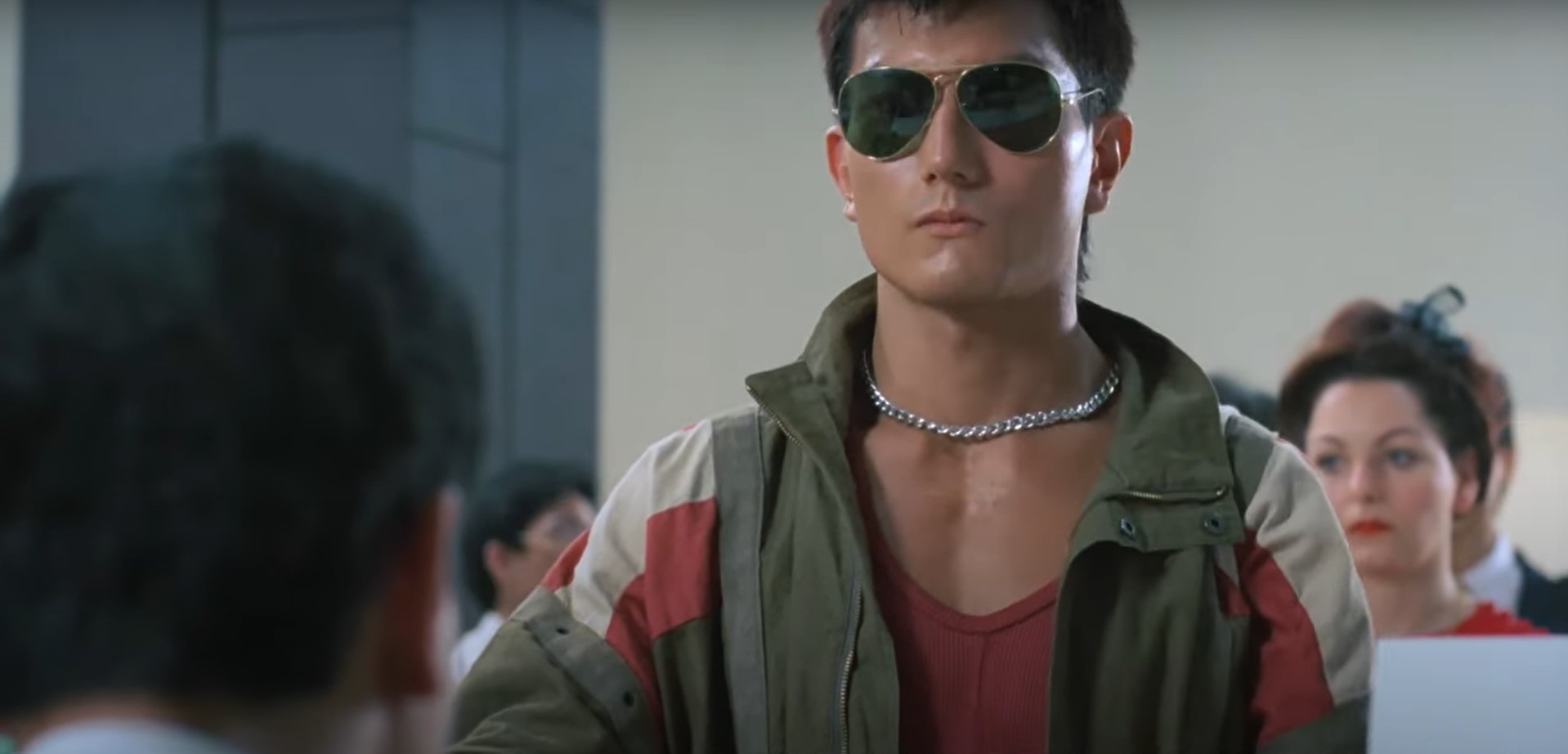
Not just a mindless killing machine resurrected like an electrified phoenix for revenge and murderous rout, Tsu Hsiang’s rebirth out of death arouses complications around fleeting special moments.  Playing exactly his profile of a mid-30-year-old is the late “Her Vengeance” and “The Killer” actor Fui-on Shing as a cop torn between life and death, literally.  Struggling to comprehend what’s happened to him, Tsu Hsiang has no time to explore the root cause; instead, Hsiang instantly moves forward, learning on the fly, his newfound postmortem powers of invulnerability, immense strength, and to be exasperated right into a pale-eyed version of the angry Hulk.  Shing’s duality on levity and fierce cleaves “The Blue Jean Monster” into its well-intended multifaceted of genres with soft buttery ease.  Shing’s square jaw and large frame doesn’t quell the lighter touch he brings an even softer side to Tsu Hsiang with his intake of Power Steering (Wai-Kit Tse, “Mr. Vampire 1992”), a street nickname for a former hooligan took under Hsiang’s wing after killing his father, in a supposed criminal altercation gone awry.  Power Steering best friend Gucci (“Gloria Yip, “Riki-Oh: The Story of Ricky”) becomes the primary target for the gang as she inadvertently becomes a hostage and winds up with the thieves’ hard stolen loot.  The circular, trifold connection between Hsiang, the troublesome young acquaintances, and the gang, helmed by Japanese actor Jun Kunimura (“Audition”) creates double edged complications Hsiang has to juggle and manage while being undead and a soon-to-be father.  Mei-yee Wu, Bei-Dak Lai, and “Mr. Vampire’s” Siu-Fung Wong playing Fui-on Shing’s wife Chu along with “Sex and Zen” star Amy Yip as the lustfully bosomed Death Ray, a gay man conversion therapy seductress, fill out the cast. 

The 1991 film has fast-paced action, politically incorrect humor, and spectacular physical and hand-drawn visual effects.   “The Blue Jean Monster” relied heavily on the skill of the cast and crew to elevate a staggering, fast-and-loose story that barely bridges gaps of its presaged plot holes.  There’s also some fast-and-loose editing slips that expose oversights, such as reused unmasking scene of Jun Kunimura’s head robber and showing five members of a five-member gang huddled behind a flipped van in a scene that was supposed to be sans Kunimura as his character was chasing after Gucci and the money through a construction zone.  Yet, “The Blue Jean Monster” is too enjoyable, too funny, and too drop-dead neat that any and all flaws can be written off as negligible.  Heedless humor encapsulates an antiquated way of thinking that shapes “The Blue Jean Monster” into a time bygone novelty.  When Tsu and Power Steering are suspected gay lovers, as they’re physically intertwined in electrocution to recharge Tsu undeadness, and AIDs becomes the center of the joke, casually tossed in a handful of times even by the brief portrayal of two colorfully sweater-wearing, feminine-displayed men wanting nothing to do with Tsu and Power Steering’s misperceived actions for fear of the deadly virus.  That just epitomizes the slapstick wackiness this not typical but warranted Cat III feature that transfixes with a lot of borderline insensitive satire kneaded into the modish action and special effects of every other Hong Kong film in a saturated market. 

“The Blue Jean Monster” takes over United States and North America courtesy of the UK distributor 88 Films, through MVD Visual from the Fortune Star Media Limited catalogue, with a new AVC encoded, 1080p high definition, Blu-ray.  The BD50 comes top of the line within the limits of the format with a bitrate decoding the original aspect ratioed widescreen 1.85:1 presented and newly restored 2K scanned film an average of at or just under 35Mbps.  Nearly being a non-issue coinciding with a pristine original print, the dual layer disc offers plenty of breathing room to display “The Blue Jean Monster’s’ range of motion, sufferable color palette, painted composite effects, and masterstrokes in lighting a fast-paced pressing without the blight of artefacts.  A few darker scenes are not as rich because of compositional effects but still render significantly with detail under a slightly more penetrating grain.  The overall grain naturally infuses with the 35mm print and translates nicely to a transferred digital scan.   The original, uncompressed Cantonese LPCM 2.0 mono track is the sole offering that, in truth, is all this comical, cosmic caper needs with agreeable action Foley and ambience and some looney absurdity tacked on for good measure.  None of the assortment ever sounds pressed and squished through the single channel suggesting a pretty clean, well-kempt sound design from over the years.  ADR dialogue favors less spatial position but that’s expected with 90’s Hong Kong cinema and is also well-preserved in its fidelity with a clear and damage free recording.  English subtitles are optionally available.  This special edition includes a new interview with assistant director Sam Leong Man Made Monster, the original Hong Kong trailer, and image gallery.  The limited-edition set comes with reflective and glistening slipcase sheathing the same but lusterless composite illustration, artwork created by James Neal.  Inside the green Amaray Blu-ray case, the reverse side of the cover art sports the original Hong Kong one sheet illustration stretching both ends, inferring nearly all the action and characters in the story, along with a doubled-sided cardboard poster of the reversible cover art.  The not rated release comes region locked on A and B and has a runtime of 96 minutes.

Last Rites: If a fan of “Dead Heat,” “The Blue Jean Monster” can prolong the action-caffeinated, narcotized high with supercharged unrest, necropsy humor, and the walking, talking, inexplicable undead in another stellar package and quality release from 88 Films!
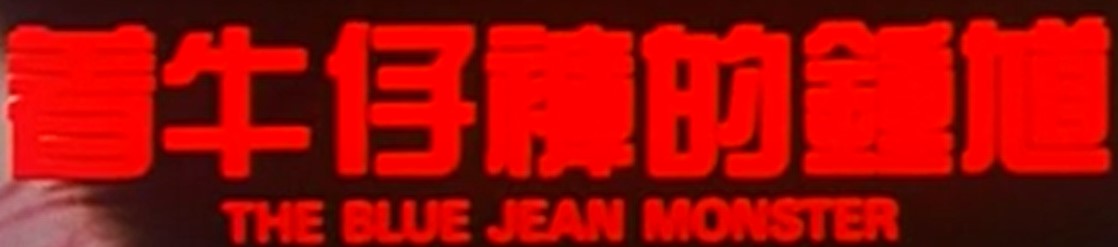
Click Here to Purchase “The Blue Jean Monster” available on Blu-ray!

To Be an Intolerant Human Is to Be EVIL! “Lion-Girl” reviewed! (Cleopatra Entertainment / Blu-ray)

Here is “Lion-Girl.” Hear Her Roar on Blu-ray!

In the year 2045, a rain of meteorites harbingers the possible destruction of the human race as the space rocks contain harmful, radioactive rays that either kill a human within seconds or doesn’t kill them at all but transformers them into bloodletting, mutated beasts with superhuman abilities known as Anoroc.  While the rest of the world collapses, only Tokyo remains as the last human stronghold governed by a fascist dictator Nobuhide Fujinaga and his band of ruthless, police state Shogun led by despotic Kaisei Kishi.  Fujinaga and Kishi’s prejudices extend decades later when children in utero are exposed to Anoroc rays that keep their human appearances and behaviors only to have gained the psychokinetic energy powers.  These evolved man and Anoroc are labeled Man-Anoroc and are sought out for extermination but one defender of the weak and less fortunate, known as Lion-Girl, takes a stand against the forces of evil and bigotry, making Lion-Girl Earth’s last and only hope.

Inspired by the prolific manga works of Gô Nagai (“Cutie Honey,” “Devilman”) and Nagai providing the conceptual illustrations, the Japanese filmmaker behind the pulse-pounding pistol-whipper  “Gun Woman,” starring cult erotic-actress Asami, and the Italian yellow picture, or giallo, influenced “Maniac Driver” turns his eclectic, electric style to reproduce his love for manga and the classic Japanese superhero canon with a new heroine in “Lion Girl.”  Kurando Mitsutake endears to his audiences through passion for cutting-edge manga’s commanding nudity, a hero’s odyssey in a dystopian future, and a comic’s style depicting graphically good versus evil.   The COVID era stymied production costs due to supply issues, affecting various departments such as special effects and even the cast with relative unknown faces, but Mitsutake pushes forward with the Japanese Toei Video Company (“Battle Royale”) co-production with America’s Flag Productions and Nagai’s Dynamic Planning.  Masayuki Yamada, Gaku Kawasaki (“The Parasite Doctor Suzune”), and Mami Akari (“Maniac Driver”) produce the film.

As stated, “Lion-Girl” is filled with unrecognizable faces save for one, an actor who is usually behind the masks, such as in “The Hills Have Eyes 2” ’07,” “Predators,” and even donning the iconic hockey mask for the 2009 reboot of “Friday the 13th” as Jason Voorhees.  Derek Mears headlines being the film’s core villain, shogun Kaisei Kishi, the remorseless, power-hungry right-hand man of the Fujinaga state, as Mears’ towering 6’5” stature and unique facial features pit him against a then 22-year-old newcomer Tori Griffith in a highly visibly protagonist role requiring fully onboard nudity and choreographed physical altercations.  Griffith pulls off both requirements going through the tokusatsu, hoodoo cliffside and other desert terrain, geometries of motion that fortunately conceal a more softened performance when compared to Mears’ who actually puts a fair amount of attitude into the shogun role.  As the Lion-Girl’s sworn protector, as well as one-eyed uncle, Damian Toofeek Raven (“Komodo vs. Cobra”) resembles the sempai fostering and mentoring a younger, stronger apprentice to one day save the world.  Raven, like most of the film’s cross-cultural influences, is able to ride the line as force into an honorable fatherhood with Ken Shishikura but the character poorly exorcises compassion of a father substitute until the very end when the right moment in the script calls for it.  One flaw in “Lion-Girl’s” casting stitch is the feature could have been meatier as keystone supporting characters come and go so quickly that it could rival the likes of “Mortal Kombat 2:  Annihilation.”  Thus, rapid firing subordinate roles just to progress the story creates more questions than answers and creates more plot holes than necessary.   Nobuhide Fujinaga (Tomoki Kimura, “A Beast in Love”) leads as the iron fist of bigotry in a tyrannically society but barely has presence other than on television announcements, a pair of Kishi entourage lackeys (David Sakurai, “Karate Kill,” and Jenny Brezinski, “From Jennifer”) get lifted up by the dialogue and some action but have the rug cut out from under them from really being developed and explored, and even principal character Marion Nagata (Joey Iwanaga, “Tokyo Vampire Hotel”), the gunslinging coyote, has zero foundational building blocks being a love interest for Lion-Girl yet crowns as such at the story’s climatic showdown.  “Lion-Girl” is saturated with supporting cast and stock characters with round out by Marianne Bourg, Matt Standley, Shelby Lee Parks, Hideotoshi Imura, Holgie Forrester, Katarina Severen, Stefanie Estes, and Wes Armstrong.

“Lion-Girl” roars as a wild, untamed animal, mangy in its worst moments but also majestic at the same time.  This paradoxical cultural expression befits the co-superpowers production, blending Japanese and American flavors and faults into one oversized bag of live-action manga.  With a derision mostly toward western affairs, such as the media circus surrounding the xenophobic administration’s handling of the corona virus, to which the filmic beasts known as Anaroc is corona spelled backwards, the haughty, bullying state doesn’t stray far from Kurando Mitsutake’s pen-to-paper handiwork as he also invokes Gô Nagai’s freedom sense of nudity and violence aimed to shake up with acculturation in high level eroticism that’s not seen as sleazy or objectifying but rather empowering and artistic.  What Mitsutake does really well and what’s also to the film’s misstep for today’s audiences is the complete blitzkrieg of background setup that’s bombastically overwhelming with incident backstory, dystopian factions, and the new terminologies in a single, longwinded breath, culminating to an early point in the film with a fight between Lion-Girl and an Anaroc beast where mutated breasts are essentially turned into a flamethrower and psychokinetic battles are commissioned in headspace.  That’s the kind of psychotronic tone that bears the cult seal of approval, or in this film, the lion’s share of cult approval. 

Cleopatra Entertainment, the filmic subsidiary company of Cleopatra Records, scores big with Kurando Mitsutake retro-fitted superhero “Lion-Girl” on Blu-ray.  The AVC encoded, high-definition 1080p, single-layered BD25 is literally stuffed to the brim, presented in a 1.78:1 widescreen aspect ratio.  Compression bitrate swings the pendulum, decoding between low 30s and high teens resulting in smoothed over details.  To the film’s advantage, the abated details play into the old-style Japanese action flicks of yore, creating a pseudo-illusion of a flatten color palette and lower resolution last seen on tube televisions.  Okay, might not be to that extent as therein lies decently popping color scheme and rough contouring and lighting in more scarce settings to make the scenes less complex and rely on more smoke and mirrors to stretch the interior-exterior location budget.  The lossy English language Dolby Digital 5.1 surround track is accompanied with also a Dolby Digital 2.0 stereo.  While nothing to negatively harp on in regard to “Lion-Girl’s” sound design and soundtrack as a whole, there’s plenty to like about the wide-ranged, heavy rock-riffing audio with unequivocal balance between the sounds and channeling albeit a lesser fidelity.  Peppered with Japanese words, the dialogue is forefront and clear that red-carpet the numerous monologues with all-day importance.  The release does not come with any subtitle option.  Bonus content includes a director’s commentary track, a conversation between Kurando Mitsutake and manage artist Gô Nagai as they discuss nudity, working in America, genesis for “Lion-Girl,” and their COVID era collaborations, the making-of “Lion-Girl,” “The Hollywood premier screen with cast and director Q&A, a picture slideshow, and the theatrical trailer.  Cleopatra’s release caters to a conventional standard retail market with a commonplace Amaray and disc release and nothing more.  The front cover design is not terribly appeasing with a crowded image composite bathed in an eye-deafening and searing red.  Disc represents the same front cover image and there is no insert inside the Amaray casing.  The region free release is unrated and has an impressively entertaining runtime of a 121-minutes.  Marketed to be a different kind of superhero movie, “Lion-Girl” is certainly more than that, portrayed by Kurando Mitsutake as a love song toward the pulp exposure of his childhood and the film really glows passionately like an Anaroc with supernatural powers ready to strike with nostalgia at the heart of Japanese pop culture.

Here is “Lion-Girl.” Hear Her Roar on Blu-ray!

When There is EVIL in the Seoul! “Gangnam Zombie” reviewed! (Well Go USA Entertainment / Blu-ray)

Well Go USA’s “Gangnam Zombie” on Blu-ray Hi-Def!

In the Gangnam district of Seoul, South Korea, former backup to the national taekwondo team Hyeon-seok works underpaid and unhappily for a smalltime viral video streaming company.  His colleague and crush, Min-jeong, is a content editor constantly being hit on by the knavish company owner.  Unhappy at their jobs, the two miserably plug away while avoiding the elephants in the room until an infected, flesh-eating man walks into their office rental building, biting and infected the surrounding professionals that turn the place of business into a place of horror and survival.  With the doors chained shut and no way to call for help, Hyeon-seok, Min-jeong, their small band of coworkers, and the building’s landlady react antagonistically against the quickly devolving situation that seeks to sink its teeth into them.  The upstanding Hyeon-seok does the only thing he knows how, to fight his way out while protecting Min-jeong from a mass army of blood-stained teeth.

In the wake of the popular successful running and rampaging outbreak spread of zombie-madness in “Train to Busan,” the 2016 all-aboard the zombie train thriller not only blazed the rails with a hyper-intense, body-over-body, dog-eat-dog infected film confined to the cramped aisles of linked train cars but it also set the tone for years to come with imitators to rake in the cash of the outbreak breakout success.  Though the concept is nothing new, South Korea has adopted the fast-running infected flesh-eater and shaped it with mass affect with newer entries being submitted every year since the release of “Train to Busan.”  “Rodeukil” director Soon Sung Lee has helmed one of those new entries with “Gangnam Zombie,” a far more contained zombie burst confined to a mall-like office building set in the heart of the Gangnam district, hence the title.  “Gangnam Zombie” is a self-produced production of Soon Sung Lee in association with JNC Media Group and Joy N Cinema with co-producer Choe Gwang-rae.

The aphorism less is more can be applied to many things and many situations, often generally true, much like overthinking a simple problem.  For the cast buildup of Soon Sung Lee’s “Gangnam Zombie,” the saying torpedoes any kind of chance connecting with the chaos-engrossed characters.  Opening to Cho Kyoung-hoon and his partner’s breaking and entering of a shipping container full of boxes of I-don’t-know-what, objectively were lost to the here and why this crime becomes not only ground zero for the epidemic, Cho Kyoung-hoon’s Wang-I is attacked by a container-hitching infected cat of all things, but also the motivation for their transgressions of thievery.  I honestly could not tell you what was being hijacked from the container boxes; to me, the contents appeared to be COVID-19 test kits which would make sense since “Gangnam Zombie” forces the paralleling global epidemic done our visual esophagus with a cat instead of a bat.  After dispatching his partner with a bite to the neck, in what is a very vampiric method I might add, Wang-I wanders his dazed self into the city of Seoul, especially the Gangnam district, where he steals red meat from a grocer and stumbles with a self-image conflict into Hyeon-seok and Min-jeong’s office building.  Indiscriminately unhappy with their jobs with a mild sense of attraction between them, the characters are played by Ji Il-ju and Park Ji-yeon who can’t really get into the tumultuously thrown together chemistry needed to make their emotionally pulling tug work with viewers.  The supposed coupling actors’ scenes feel one-sided with Park Ji-yeon in a defensively scared and uncertain shoes but very much guarded against Ji Il-ju who can wear his heart on his sleeve as he roundhouses zombie extras left and right.  Cho Kyoung-hoon feels more enthused in his black-eyed, rabid-smile zombie mode while still able to grasp his humanity with close-quarters hand-to-hand, an enthusiasm not really shared by the others when faced with ground zero apocalypse that doesn’t quiver under one-liners and vapid, vacuous vernacular and vigor.  Min Choi, Tu-in Tak, and Yi-joo Jung round out the cast.

“Gangnam Zombie” falls into the cheap-thrills trap of comparing itself the deadly strain of COVID-19 not because of the cat and bat reference above but because the opening title sequence hammers in a quick recap of the epidemic era in massive overload of visuals with the occasional infected person flashing into frame.  Though not mentioned once of COVID into the dialogue, a tumbling of slowly progressing confusion settles itself inside the narrative of what director Soon Sung Lee is trying to convey comparing COVID to chaotic cannibalism.  The exploit is egregiously akin to Full Moon’s capitalizing indecorous “Corona Zombies.”  The two not only share germs but also share essentially the same title and are both more comedic and lighter, shadowing over and taking away any intensity it intended in this more comedy-horror than horror-comedy.  Zombie carnage is laid waste to bad continuity editing as we see some of the same zombies looking down one hallway and then in the next scene and in a different hallway there is the same infected head, zombies inexplicably rolling on the floor into frame, zombies sneaking up behind people only to hesitate an attack with more of an intent to scare them when the chased turns around, and the infected are not brainlessly dulled and have the ability, or at least only one of them has the ability, to fight back with blocks and other defensive and offensive moves.  “Gangnam Zombie” milks the stouter predecessors with a haphazardly duck taped lesser vessel to slog forward what other South Korean filmmakers have previously perpetuated so well in the subgenre.

On Blu-ray now from Well Go USA Entertainment is “Gangnam Zombie” with an AVC encoded, 1080 hi-def, BD25, presented in a listed widescreen 1.78:1 aspect ratio that works well in the compressed environment of the office building. Exterior scenes of the city, overall general landscape, suggest a wider aspect ratio, perhaps a 2.35:1 to capture more the of the urban landscape. Speaking of the office building, the well-lit environment provides less complexities on the digital image with the same gray, steel, and translucent facing in most of the scenes. Varying saturations of red diverse the blood shading around the body and face with darker tints often looking like motor oil to match the midnight irises. Details in the digital age rarely see a loss of face with natural skin tones, to the minute details of reflective surfaces, and a properly sterile office space. The only audio track built into the release is a Korean DTS-HD 5.1 master audio that’s balanced appropriately with forefront dialogue and a backseat generic soundtrack mix of heavy metal and crescendo builds. The zombie grunts, groans, and roars tear into the channels, nicely through the backend channels, but with cacophonous irritation at times. There’s decent secondary sound design with the baseball bat being hit across infected faces and the floor, despite revealing its rubbery bounce, and Ji Il-joo kick and punch melodies. Sometimes a hit-or-miss with bonus features on the international releases, this particular Well Go USA release comes bare bones with no special features on the software. The hardware, aka physical features, is also not terribly spectacular with a standard Blu-ray casing with a sketch and paint cover that’s slightly misleading where our protagonist will be when the outbreak breaks. Unlatching the case reveals an advert insert for three Well Go USA distributed films, likely rotational with different features, with a unique fascination disc press art of rope tied radio with outstand hands and fingers appearing to grab the bottom of it. It’s a Blu-ray opening enigma viewers will have watch the feature to understand. Clocking in at 82 minutes, “Gangnam Zombie” is region A locked and is not rated. The bite marks of “Gangnam Zombie” are a familiar pang and now nearly a decade after a formidable Korean zombie subgenre began, we’ve become too desensitized for hackneyed carbon copies.

Well Go USA’s “Gangnam Zombie” on Blu-ray Hi-Def!

EVIL Has the Right to Remain Dead! “Magic Cop” reviewed! (88 Films / Blu-ray)

No Two-Bit Magician In ‘Magic Cop” on Blu-ray!  

Hong Kong cops are confounded by a chaotic drug bust when learning that their female suspect, who had managed to overpower an entire unit of male officers and even take a bullet ambling deadpan into the streets, had died 7 days prior.  An outlying officer, and practicing Taoist, Uncle Feng is called to Hong Kong to not only quickly solve the narcotic crime but also investigate the unnatural properties of the case.  Feng is accompanied by his city eager niece Lin and two Hong Kong cops, a Taoist devotee and skeptic of Ancient Chinese spiritual mythologies.  Together, they track the drug trail to The Sorceress, a Japanese witch with powers that rival Feng and that can resurrect the dead into zombies and vampires to do her bidding, such as trafficking narcotics.  When the investigation closes in her business, The Sorceress and her right arm, skilled fighter plan to remove the only man worthy of stopping her.

Fans of Ricky Lau’s “Mr. Vampire” will once again be amazed and entertained by the fantastical and mystical action of Stephen Tung Wai’s “Magic Cop.”  Tung, a fellow martial artist and stunt man who had roles in “The Fatal Flying Guillotine” and John Woo’s “Hard Boiled,” helms his debut directorial penned by Chi-Leung Shum (“Vampire vs Vampire”) and the longtime Stephen Chow script writer Kan-Cheung Tsang (“Shaolin Soccer,” “Kung-Fu Hustle”).  The screenwriting duo brought lighting quick comedy to the mostly fictionally invented yet sprinkled with slivers of hard-pressed veracity and definitive entertaining occultism and what resulted resurrected “Mr. Vampire” semblance out of the being a period piece and into the modern day, backdropped in the year of 1990 when the film was released.  Long rumored to be the fifth sequel of the “Mr. Vampire” franchise, “Magic Cop” is a coproduction between Movie Impact Limited, Millifame Productions Limited, and Media Asia Film with star Ching-Ying Lam producing.

“Magic Cop,” and even “Mr. Vampire,” wouldn’t have such a cult following if it wasn’t for the Vulcan eyebrows and thin mustache of Ching-Ying Lam in costume.  The short-statured, Shanghai-born Lam delivers the same vigorous choreography and tranquil demeanor to this particularly stoic character of Uncle Feng, a Taoist practitioner to essentially wrangle unruly entities and please the spirits in the in-between our world.  Feng is old world and finds himself in surrounded by modernism when in Hong Kong, goaded by the young lead sergeant attached the case.  Practical as well as disrespectful, Sgt. Lam (Wilson Lam, “Ghost for Sale”) epitomizes today’s, or rather back then the 1990’s, modern man who has forgotten tradition and deference to those who came before.  Though padded with a fair amount of comedy coursing throughout, balanced against the impeccably edited tango fight sequences, Sgt’ Lam’s partner, known only as Sgt. 2237 played by “Centipede Horror’s” Kiu-Wai Miu, risibly wants to understudy Uncle Feng’s powers while Feng’s niece Lin, played by Mei-Wah Wong of “The Chinese Ghostbusters,” provides the subtle and quirky opposite sex that catches of the philandering eyes of Sgt. Lam.  The ragtag quartet of influx mindsets and personalities become challenged by their single common goal, to stop whoever is behind breathing life into the formidable dead and stop the unorthodox method of drug smuggling.  Former Japanese bodybuilder Michiko Nishwaki (“City Cops”) embodied that very dark magic antagonist.  Nishiwaki handles The Sorceress character with ease despite not having a surfeit army under her thumb; instead, this forces Nishiwaki to become the entire villain body with the slight, full-contact support for her right-hand bodyguard (Billy Chow, “Future Cops”) and a couple of undead lackeys, including Frankie Chi-Leung Chan of “Riki-Oh.”  “Magic Cop’s” cast rounds out completely with well-versed and seasoned, late actor Wu Ma (“Mr. Vampire,” “Return of the Demon”) as the chief inspector polarized in a complicated history with Uncle Feng.

What director Stephen Tung Wai boils down in essence is another variation of good executants of spirit humbled caretakers versus the wicked necromancers existing inside the fabric of the highly praised and cult-following “Mr. Vampire” universe.  Frankly, there’s nothing wrong with that derivativity since Ching-Ying Lam, Mr. Vampire himself, produces and stars as the titular hero.  Lam can conjure whatever-the-hell he wants in order to battle Hell itself.   “Magic Cop” is also a well-made, entertaining story, balanced between the contest wizardry, slapstick comedy, and the character dynamics, and stacked with improbable yet gratifying step-intensive fight orchestration that has gawked early martial arts films a wonder to behold and continues to do so to today but now trickles with pizzazz more-after-more due to put in place industry safety measures.  “Magic Cop” contains that lost art of potentially hazardous palatable physicality that beguiles more than the movie’s faux magic exhibited on screen.  To add to the authenticity, very little painted composited visual effects were used with makeup and the actors doing much of the heavy lifting with the editing team of Ting-Hung Kuo and Kee Charm Wu in full cut-and-paste fortifying mode to button up each sequence with comprehendible continuity of each punch, kick, and magical chopsocky.  One overtone made well known in “Magic Cop” is the unfillable chasms between old and new, respect and disrespect, and myth and science from whence solves no problems until some unified common ground can be reached in order to succeed, in this case, to stop a bitch of a witch.    

An age-resistance 35mm print scanned onto a buffed 2K Blu-ray that extracts the best print elements to-date. The AVC encoded, 1080p, Blu-ray presents Stephen Tung Wai’s picture in a widescreen 1.85:1 aspect ratio. A fine-tooth comb through the celluloid couldn’t unveil any major issue with the 88 Films release. Colors are richly grafted within the sabulous surfaces that are exceedingly defined with delimited, shadow-creating depth. Decoding speeds average around 35Mbps on a BD50, securing categorical choiceness amongst other releases and formats (that is until the potential 4K release). The release comes packed with four audio options to explore: The original Cantonese DTS-HD master audio 2.0 mix, a Cantonese DTS-HD 2.0 home video mix, an English DTS-HD 5.1 master audio dub, and an English DTS-HD 2.0 dub. Between the variated audio mixes, we preferred the original Cantonese DTS-HD 2.0 due to its cadence with the image and welcoming exactness through the lossless compression process. You can make do with the other three options, but the fidelity is much better with the original mix and only anti-subtitle sectarians would be pleased with an English dub. English subtitles are optional and synch well the dialogue but be prepared to speed read as the pacing is quick much like the dialect. Software special features include an audio commentary with Hong Kong film experts Frank Djeng and Marc Walkow, an alternate, standard definition Taiwanese cut of the film with alternate score, an interview with director Stephen Tung Wai, image gallery, and trailer. Endowed with a limited-edition, cardboard slipcover, the dark green Blu-ray snapper has newly illustrated, front cover artwork by Manchester graphic designer and 88 Films resident artist Sean Longmore, which is also on the cardboard O-slip. The reversible cover art has a reproduction of the original Hong Kong poster art. Stuffed in the insert is a mini-folded poster of Longmore’s front cover and a disc art, a scene moment captured in spherical rotunda, of the opening sequence. Available with a regional playback limited to A and B, the 88 Films release is not rated and has a runtime of 88 minutes. ‘Magic Cop, perhaps, wasn’t the sole proprietor of influence but certainly had a black talisman plying hand in the substrata of more Western favorites like “Big Trouble in Little China” and is a crucial cornerstone in representing the best of the Hong Kong Golden Age of cinema.

No Two-Bit Magician In ‘Magic Cop” on Blu-ray!  

Don’t Mess with Texas Unless You’re EVIL Going Up Against “Shanghai Joe” reviewed! (Cauldron Films / Blu-ray)

East Doesn’t Just Meet the West, It Kicks It’s Ass in “Shanghai Joe!”

A Chinese immigrant arrives into San Francisco looking to begin a life as an American cowboy.  Met with extreme prejudice, he pushes forward to avoid the Western stereotypes of his race by taking a stagecoach to anywhere Texas in order to become a true-to-form Cowboy.  Mocking monikered Shanghai Joe, even in Texas Joe is met with bigoted resistance in every way and in every exchange with the locals despite his uncanny fighting, intellect, and horse-riding skills that are far superior to his meanspirited rivals who think of him nothing more than a dumb foreigner.  When Joe become inadvertently involved with human traffickers and slave owners of downtrodden Mexicans, Joe aims to set things right against an oppressive and murderous rancher named Spencer who runs the entire region.  Spencer knows his usual hired posse can’t match the supernatural abilities of Joe and hires out the $5,000 bounty to the four most cunning and ruthless killers that will seek Joe’s head as well as possibly commit other atrocities to him for the sole joy of it.

The sun rises on the dawn of the East Meeting the West with “Shanghai Joe” at the center   of subgenre.  The Italian made spaghetti western helmed by “Nightmare Castle” and “Nazi Love Camp 27” director Mario Caiano who exhibits what happens when an unstoppable force hits an immovable object as quick hands and feet of the Asian East combat with the quick gunslinging showdowns of the American West.  Penned by Caiano alongside Carlo Albert Alfieri (“Sodoma’s Ghost”) and Fabrizio Trifone Trecca, credited as T.F. Karter, “Il mio nome è Shangai Joe” or “The Fighting Fists of Shanghai Joe,” as the film is originally entitled in Italian, keeps true to the graphic and vehement violence that ultimately lacked from the U.S. Western and sought to bring a martial arts foreigner into the fold of brute and barbarity as Kung-Fu flicks were up-and-coming with the rise of Bruce Lee and the Italian wanted a piece of that cinematic success without having to spend a fortune of turning sets appear oriental when already built saloons, corals, and spittoons were a plentifully available from previous films.  Producers Renato Angiolini and Robert Bessi serve under the production companies Compagnia Cinematografica Champion (“Torso”) and C.B.A. Produttori e Distributori Associati (“Emergency Squad”).

Leave it to the Italians to make a Western set in Texas and to have protagonist Chinese hero be played by a Japanese actor.  Performing under the stage name of Chen Lee, the Aichi, Japan born actor’s real name is Myoshin Hayakawa and he plays the role of Chin Hao, a nomadic Chinese immigrant, taught the rare fighting ways of an ancient martial arts, travels to America in hopes to reside in the American dream.  Lee’s certainly a presence on screen in his quiet and reserve composure but equally as self-assured and as competent to take on the worst-of-the-worst in the exploitative West where law has yet to reach it’s firm grasping hand.  Lee lands fight sequences with fierce finesse, though perhaps not on a Bruce Lee level, but does it so with his own distinct style of chopsocky flair with laws of physics breaking gliding through the air and tremendous accuracy in all areas of throwing weapons, even hyperbolizing his Yo-yo as a coconut splitting, head-cracking weapon.  When not wiggling his way out of impossible no-win situations with smarts and strength and when it comes to the interests of romantics, Chin comes to find solace being twisted into a paired fate with Mexican national Christina, played by Italian actress Carla Romanelli (“Lesbo”), after saving her father from being executed. As if destined to fall in love at first sight, the two outlanders are in each other’s embrace but before anything could be commutated by any sense of the term, head honcho rancher Mr. Spencer (Pierro Lulli, “Django Kill… If You Live, Shoot!”) hires out assassins to relieve him of a troublesome Shanghai Joe. The killers are just as colorful and individualizes as the titular character with quirky personalities and traits that make them indubitably daunting by their mere nicknames: Pedro, the Cannibal (Robert Hundar, “Cut-Throat Nine”), Burying Sam (Gordon Mitchell, “Evil Spawn”), Tricky the Gambler (Giacomo Rossi Stuart, “The Night Evelyn Came Out of Her Grave”), and Scalper Jack (Klaus Kinski, “Nosferatu the Vampyre). The eclectic bunch of Western-horror tropes level out Shanghai Joe’s uncanny abilities with their own big penchants for demise but the actors behind the characters also have bigger personalities, especially Kinski who is only in the film for a few scenes but is second billed in both before and after credits. “Shanghai Joe” fills out the cast with Dante Maggio, Andrea Aureli, George Wang, and another Japanese actor and martial arts master, Katsutoshi Mikuriya, as the showdown villain trained in the same ancient combat arts as Chin but turned his back against the teachings’ moral principles for his own greed.

Plot pointed by a series of bad case scenarios to showcase Shanghai Joe’s superior skillset as not only a fighter, but also an intelligent, almost con-like, mentalist as well as being good at just about everything else, the film is laced with repetitive derogatoriness from all races except white.  “Shanghai Joe’s” indelicacies, coupled with graphic, moderately bloodied violence, adds to the laundry list of idiosyncrasies of this unique old West spectacle.  The Caiano and team’s scripted narrative exacts the epitome of the label the Wild West where the unexplored, uncultured, and uncivilized country gives way to lawlessness and opportunity, especially the latter at the expense of others.  Joe becomes a beacon of moral hope, a foreigner who seeks, by way of a semi forced hand, to correct the system from within using his rare training only as a position of defensiveness or to right a terrible injustice.  Caiano has the eye to make a legitimate Italian spaghetti western that hits all the hallmarks and the director can also fashion a two-prong narrative with a unified purpose that builds up the hero first with a series of outlaw confrontations before immersing him into a rigorous roughhouse recruited by the rotten rancher.  While each face-off spars differently, Caiano letting the actors build upon and have fun in their villainy, the ultimately take the place of the tip of the spear antagonist, rancher Stanley Spencer, who doesn’t get what’s owed him by the roll of the end credits.  The high-flying combat wires, that you can plainly see during the air time fight sequences, and the personal and frame stylistic choices of the actors and Caiano tend to distract viewers from the unfinished business, concluding on a satisfactory note that what we just experienced was felicitously violent, engrossingly entertainable with appealing characters, and just waggish enough to provide levity amongst the harsh racism and the aforesaid brutality. 

“Shanghai Joe” is a must-have, must-see Italian Western for the subgenre aficionado and, luckily, Cauldron Films delivers the 1973 film onto Blu-ray for the first time ever in North America. The AVC encoded BD50 is presented in high definition, 1080p, with a widescreen aspect ratio of 2.35:1 of a 2K restoration scan from the original 35mm negative. Cauldron Films’ restoration is a labor of love for an atypical western of the obscure nature with a generous tactile intensification to bring the warm dust of the tumbleweed West down upon the anomalist Asian in a blue Tang suit and pants with a conical hat. A few and very faint scratches are the only issues observed that come and go as quickly as they came, but the there’s a nice richness to the coloring, a natural grain, and zero compression issues or unnecessary enhancements detected. The DTS-HD Master Audio 2.0 mono comes in two options – An English dub and an Italian dub. Preferably, I went with the English dub over the Italian despite “Shanghai Joe” being an Italian production. For one, Myoshin Hayakawa spoke English which you can tell by reading his lips so the English track paired better. Secondly, the Italian track is quite orotund to the point of losing some minor ambient detail as well as not feeling to be a part of the whole package team. Slight hissing at times during dialogued scenes but the clarity comes through with the decent dub pronunciations and the chopsocky ài yas are often repeated in the same audio tone and level in every evasive or attack flight by Joe but is not ostentatiously annoying. “Marquis de Sade Justine’s” Bruno Nicolai and his twangy score, channeling his best Ennio Morricone, has great purpose as “Shanghai Joe’s” main theme that rowels up and shapes Joe’s hero role. English and English SDH subtitles are available. The special features include an interview with Master Katsutoshi Mikuriya on how he was approached for the role and the martial artists also discusses the fight sequences in Samurai Spirit, film historian Eric Zaldivar puts together a visual essay with the topic East Meets West: Italian Style, an audio commentary by Mike Hauss from “The Spaghetti Western Digest,” the original trailer, and an image gallery. The physical portions of the release include a translucent Blu-ray snapper with a reversible cover art featuring two stylishly illustrative posters in contrast to the simple disc art of the red “Shanghai Joe” title set upon a black background. The early 70’s feature comes not rated, has a runtime of 98 minutes, and is region A locked. “Shanghai Joe’s” singularity scores high on the limited East meets West subgenre novelty but certainly aces as a versatile Kung-fu period piece with ridiculously good fight scenes, a handful of callously charming characters, and a disparaged hero, who embodies the good in all of us, you can gladly cheer for from beginning to end.

East Doesn’t Just Meet the West, It Kicks It’s Ass in “Shanghai Joe!”