Your Test Will EVILLY Hunt You! “Prey” reviewed! (20th Century Studios / Blu-ray)

The Hunt is On.  “Prey” Available on Blu-ray from 20th Century Studios!

Set in the Northern Great Plains of 1791, a young and fierce Comanche woman, Naru, craves to break conventional gender barriers as a tracker and hunter, separating herself from the assumed woman’s place in her tribe as a gatherer of medicine and food.  Naru tirelessly trains herself in the ways of the warrior and has become better than her male counterparts who often look down on her as an inequal; yet, she continues her pursuit to prove her worth not only to men hunting parties but also her own brother who, with all the love in his heart for her, doubts her abilities to meet and become victor over her tribe’s warrior test of hunting a predator that can hunt you back.  A big-game hunting alien with high-tech arsenal invades the land, tracking down the area’s biggest predators, and conquering them essentially his bare hands.  Naru comes face-to-face with the extraterrestrial predator that threatens her people but her cries of wolf fall on deaf ears until the tribe’s bravest war party is defeated and the nearby shrewish French fur trappers are slaughtered despite their gunpowder weaponry, Naru is all that is left between her people and a high-powered killing machine.

From a year and half after the success of its premier release on Hulu, “Prey,” the prequel to the highly popular “Predator” franchise has finally berthed onto the home video market.  “10 Cloverfield Lane” director Dan Trachtenberg helms what is essentially a primal and back to roots prequel with a screenplay penned by television writer-producer Patrick Aison set nearly 200 years prior to John McTiernan’s 1987 action-packed, science-fictional horror “Predator” starring Arnold Schwarzenegger battling a skull-trophy hunting alien with advanced and otherworldly armaments.  Though included as canon, “Prey” separates itself from the pack, especially from the string of “Alien vs. Predator” crossover and the 2018 Shane Black director “The Predator,” and not just in title alone but the title is certainly very significant with a focus on the developing heroine to become respected and an equal amongst the men of her tribe whereas the rest of the franchise focuses on the rudimentary conflict between the very best-of-the-best of tough man and a highly skilled, kill-efficient creature from another planet.  Original “Predator” screenwriters and brothers Jim and John Thomas return as executive producers alongside Ben Rosenblatt, Marc Toberoff, and Lawrence Gordon (“Predator”) with John Davis (“Predators”), Marty Ewing (“It”), and Comanche-Blackfeet American Indian Jhane Myers producing for production companies Davis Entertainment and Lawrence Gordon Productions with 20th Century Studios continuing its long history of distribution presentation of the game hunter. 

Much of the cast, as well as the crew, consists of people of indigenous people heritage, honoring First Nations with representation and authenticity.  At the very heart of the story, as the face of the principal hero, and as a young woman who unfortunately in this industry is the atypical-appearing action star is Amber Midthunder (“14 Cameras”) as Naru, a skilled hunter-tracker disparaged and scoffed at by most of her tribe for not following traditional suit.  Naru is an outsider thinking outside the box while still maintaining the traditions of her people, such as wanting to participate in the Kuhtaamia, a hunting rite of passage that leads to being a warrior.  Midthunder executes the character free from vanity but maintaining strength, courage, and quick thinking despite some inexperience which is a greatly adorned flaw to have in a grounded main character battling against the odds.  Naru is at odds with her younger brother Taabe, an adored and venerated hunter who wants to believe in his sister but edges more toward conformity or conventional ways.  Dakota Beavers tackles Taabe’s athleticism, showing no hesitation in battling the predator on horseback, while also softening the eyes and feeling compassion for his onscreen sibling handled a raw deal.  While Dane DiLiegro (“Monsters of California”) is no Kevin Peter Hall, the original actor donning the Predator suit in the first two films, the 6’8” former oversees professional basketball player fit into the large shoes of a new kind of a predator, one we haven’t seen on screen before, and giving the powerful alien creature a fresh take without breaking off too much of the character’s franchise stride and still being a monolithic monster of formidability.  “Prey” rounds out the cast with Stormee Kipp, Bennett Taylor, Michelle Thrush (“Parallel Minds”), Nelson Leis (“The Curse of Willow Song”), Mike Paterson (“Crawler”), Tymon Carter, Skye Pelletier, Harlan Blayne Kytwayhat, and Samuel Marty (“Don’t Say Its Name”).

From the very title, “Prey” is the analogous prequel and follow-up “Predator” story that strays away from the rough-and-tough, highly trained killers in harsh combat terrains and settings with overkill tech and firepower that blasts everything to smithereens path.  Instead, Dan Trachtenberg travels back in time, back when more primal and essential courses of survival were relied upon by grit and skill.  Even the predator is not as technologically advanced as his descending successors. Trachtenberg mentions in one interview that this particular predator, with a vastly different shaped head and having more low-tech gear, and I use that in the loosest of terms considering the predator’s technological advancements compared to 18th century man, may be from another hemisphere of his world, but I’d like to think this earlier version is more like earlier man prior to evolution, or else how can we explain the flintlock pistol connection with “Predator 2.”  This canonical link plus Taabe’s bordering cheesy throwback line, if it bleeds, we can kill it, give tribute to the acclaimed two films that paved the path to setup “Prey’s” success to stand on its own two monstrous feet being set not in a hot jungle, an urban heatwave, or in the midst of an alien race’s civil war or long historical combat with another race, but in the serene, idyllically raw landscape of Northwest America and that is faced with a lead hero we’ve never seen before in a Predator film.  Character driven elements provide a substantial arc in Naru’s story, encrusted by challenges, failures, and successes that make the Comanche woman worthy of the hunt. 

From its Hulu premier on July 22nd, 2022 to its at home, physical media release a year and change later on October 3rd, 2023, “Prey” has come home on Blu-ray home video from 20th Century Studios home entertainment.  The AVC encoded, 1080p, BD50 presents the film in a widescreen 2.39:1 that captures the vista survey with breathtaking sharpness in detail in the 4K scanned print, adding that ever-so-delicate crispness to each foliage-laden and mountainous range landscape.  Even the visual effects, such as a plain rabbit running from a wolf, the bear versus predator, or the deadly rattlesnake, had Its near immaculate rendering show every texturized detail albeit very minor clunky movements.  Color and lighting result in natural tones and sources except for the ashen dead timber sequence that reduces the saturation to make the added fog denser and provide an area of casualty when the predator comes to call.  “Prey” has an outstanding five language audio tracks to choose from:  An English DTS-HD 7.1 master audio, an English Dolby digital 2.0 descriptive audio, a Spanish Dolby Digital 5.1, a French Dolby Digital 5.1, and, for the first time ever, a Comanche Dolby Digital 5.1.  From one of the bonus feature’s deleted scenes, Trachtenberg’s voiceover commentary suggests, at one point in time, the dialogue was going to be fully Comanche, and some scenes, such as the deleted one on the Blu-ray, was filmed in the native tongue.  However, English was decided upon for the final product, but the full-bodied English DTS-HD 7.1 track is masterclass with great attention to extracting those detail elements, such as the serrating gore moments, the whizzing and blips of the predator’s gadgets, and the action associated between minor and major scuffles that build to “Prey’s” one-on-one climax.  Depth elements has space between background and foregrounds, channeling nicely through side and back setups, and the range is extensive in those aforesaid moments of detailed instances plus a few LFE moments of explosions and a thunderous ship landing and takeoff.  Dialogue is clean, clear, and prominent between the audio’s varied language blend of mostly English sprinkled with Comanche and French.  What’s missing from “Prey” that’s a staple through all of the “Predator” films is a rendition of Alan Silvestri’s iconic score, but that omission will likely feel more heartfully loss with diehard fans of the franchise.  However, composer Sarah Schachner’s (“Remains”) orchestra composition is of epic storytelling that pulls similar grand dramatics from another similar time period, Native American film, “Last of the Mohicans.”  English SHD, Spanish, and French subtitles are available to the feature only.  Bonus extras include an audio commentary with director Dan Trachtenberg, actress Amber Midthunder, cinematographer Jeff Cutter, and film editor Angela M. Catanzaro, a Making of Prey behind-the-scenes with cast and crew clip interviews and action footage, Prey FYC Panel with cast and crew discussion, and deleted scenes and alternate openings with a Trachtenberg commentary that explains why the scene was shot and left cut on the editing room floor as well as a visual storyboard of Naru and the predator in a chase in the treetops.  20th Centry Studio’s Blu-ray comes in a conventional snapper amaray with a rigid O-slipcover of Naru’s warpainted eyes overtop one of the original first key arts released of the film – predator in the background of the decaying timber forest ready to strike with its large wristblades as a Comanche warrior, presumably Naru, in a defensive crouch with tomahawk in hand.  The amaray’s front cover sports the same image.  Inside there is a NECA advert for a 7” figure of the feral predator with a matte red disc print with the title and the three target dots reflected in mirror.  “Prey” is rated R for strong blood violence, has a runtime of 100 minutes, and is surprisingly region free, a solid additional to anyone’s Predator film collection. Dan Trachtenberg is on to something here, guiding the extolled Predator toward a new, yet familiar path in what has become an exciting new beginning or pivot for the trophy hunting alien race just begging for the big screen one more time.

The Hunt is On.  “Prey” Available on Blu-ray from 20th Century Studios!

EVIL is Ready to Administer Your Physikill! “Puppet Master: Doktor Death” reviewed! (Full Moon Features / Blu-ray)

The Doktor Will See You Now. See You in Hell!  Blu-ray Available on Amazon.com!

The sudden death of a World War II veteran leaves the employees and residents of Shady Oak retirement home to mourn his loss to their humble community.  April, new to the Shady Oak employee family and starting her very first day in the wake of resident’s death, is tasked to assist clean out the family-less resident’s leftover belongings.  Along with a couple of other orderlies, April discovers a trunk bound with a chain lock and breaking into it proves to be a creeper endeavor when the contents of the battered chest is a single doll, dressed in a blood-stained doctor’s gown with a hideously grinning skull upon it’s shoulders.  Soon after, the handful of residents and orderlies of Shady Oak are being hunted down and the maniac-looking doll with a scalpel is suspected to be cause of the grim reaper knocking early on the retirement home attendees’ doors.

One-by-one, and slowly and surely over the decades, Full Moon continues its campaign in broadening the “Puppet Master” universe.  For 34 years and an over three dozen films, including same universe and spinoffs, “Puppet Master” has been the porcelain, wood carved, and rubber-molded face of Charles Band’s Full Moon empire.  “Puppet Master’s” legacy continues to live on animating inanimate dolls into malevolent marionettes with their strings cut.  2020 saw the release of the company’s first character standalone with the more popular, if not the poster doll, Blade in “Blade:  The Iron Cross.”  Next, the span of a year between 2021 and 2022, Baby Oopsie from the “Demonic Toys” universe became the subject of a television series compiled until a three-part TV movie released by Full Moon on Blu-ray and DVD in the last six months.  Presently, Full Moon has ventured back to the “Puppet Master” universe with their release of “Doktor Death,” officially titled “Puppet Master:  Doktor Death,” that resurrects the miniature medical murderer last seen from “Retro Puppet Master” in 1999.  Helmed by the director of “The Dead Hate the Living!” and “The Hills Run Red,” Dave Parker chapters in a darker, gorier edge to the “Puppet Master” series that makes Dr. Kevorkian look like Florence Nightengale.  “Puppet Master:  Doktor Death” is a production of William Butler’s Candy Bar Productions, produced by Butler, who directed the “Baby Oopsie” television series/movies, Charles Band, representing Full Moon distributing powers, and alongside Josh Apple, Greg Lightner, and Mikey Stice.

The non-anthropomorphic cast is about as fresh faced as they come with young actors and actresses who likely weren’t even twinkle in their parents’ eyes yet when “Puppet Master” was released.  A new generation, integrated as victims and conspirators, are folded into this new line of a “Puppet Master” offshoot, beginning with Jenny Boswell in her sophomore feature film role as Shady Oaks’ new employee, April.  Having traversed from California to a small town in the middle of nowhere to work a retirement home, April mentions her strange choice of life-changing circumstances was due in part of searching for a lost relative.  This morsel of mystery puts an enigmatic taste swirling around in our mouths, but Boswell plays the statement casually enough to not throw up warning flags in a natural delivery of her character’s new girl innocence and candor with the rest of her Shady Oak counterparts, which include a perverse man-child Flynn (Zach Zebrowski), a pay for promiscuity Jennifer (Emily Sue Bengston, “Smiley Origins”), and all-around nice guy Ryan (Chad Patterson).  Intertwined by their occupational relation are the patients, clients, or residents, if you will, of Shady Oaks that are more of an interesting, eclectic bunch than the genre trope orderlies that become run of the mill victim fodder for Doktor Death.  Rick Montgomery Hr. (“Gore Orphanage”) plays the wealthy old perv with uncontrollable pinch fingers for the female bottom, John Capocci (“Praetorian”) is an unfiltered opinionate and avid golfer, Melissa Moore (“Sorority House Massacre II”) as a painter who whips up portraits embedded in her clairvoyant visions, and Tary Lyn Bergoine as a mute kleptomaniac living in fear off an oxygen tank.  See – much more interesting and with concrete performances to express who they are precisely as individuals.  “Puppet Master:  Doktor Death” fills the cast void with Erin Eva Butcher, Asthon Wolf, wrestler Jesse Guilmette, and Bill D. Russell.

Between “Demonic Toy’s” “Baby Oopsie” and “Puppet Master’s” “Doktor Death” spinoff projects, “Doktor Death” has a tighter story and more effective gore.  Granted, “Doktor Death” only has single under-an-hour film to its name but with completed and out in the world today, “Baby Oopsie” came off the rails as the series progressed with Oopsie’s look appearing different between the opening drive and the two latter parts, the story unhinges itself with the arbitrary introduction of a fembot, and doll kills that dwindled into dullness.  So, if you’re like me and was irked and turned off by “Baby Oopsie” when it was all said and done, you are likely hesitant to jump right into Full Moon’s next departure from the foremost franchise.  Don’t.  “Puppet Master: Doktor Death” may have the same aesthetic veneer but the guts of story are better compacted to keep audiences on track and the “Doktor Death’s” malevolent malpractice renders a far better disturbing slasher.  On the flip side of that coin, most of the deaths happen offscreen.  Out of “Doktor Death’s” personal 8-kill body count, only one is visually graphic within the scene.  I would say two but the character is later found not dead but just severely injured and we’re left unresolved with their life status.  The other deaths are done offscreen and are implied, denoting signs of demise with blood splatter against the wall or glass, a bloodied club repetitively bashing into a victim just out of the frame, or bodies are misappropriated post-mortem, posed in different discoveries of death, one in a very neat, very marionette, way.  The short runtime falls in sync with the nowadays Full Moon line of quick, cheap, and dirty modern movie, but what it also does is provide quick pacing into “Doktor Death’s” acrid atrocities against the elderly and their clueless caregivers and also opens up the potential for a sequel with a revelation, open ended finale that’ll surely see the return of psychotic puppet. 

Dave Parker brings his knowledge of blood-soaked carnage and maniacal macabre to a resurrected retro puppet for “Puppet Master:  Doktor Death!”  The Doktor is in and has arrived on Blu-ray home video from Full Moon Features with an AVC encoded BD25 presented in high-definition 1080p and a widescreen aspect ratio of 1.78:1.  From my last few previous views of Full Moon productions, there hasn’t been a whole lot of effort into creating an atmosphere but this latest entry levels out what’s been missing from contemporary Full Moon Features for some time, a dark and gloomy, evocatively tropey canvas that looks past the mundane sheen of digital recorded image and into another world of terror. In regard to storage format and compression, there was anything to note that stood out with artefact reproach. The Blu-ray comes with two audio options, an English Dolby Digital stereo 2.0 mix and an English Dolby Digital 5.1. Toggling between the two audio format, not a ton of variance between them, if any at all, that has to make you wonder about the credibility of the multi-channel mix. In any case, both formats offer a well-balanced diet of dialogue, ambience, and soundtrack with dialogue in front and prominent. Range is diverse with all the squishiness of Doktor Death’s puppeteering his golems inside an internal organ orchestra. The Full Moon release offers no subtitles for SDH. Bonus features only include a Full Moon Video Zone featurette of Retro Puppet Master with Charles Band, the original trailer, and other Full Moon trailers, including “Retro Puppet Master,” “Puppet Master 3,” “Don’t Let Her In,” “Piranha Women,” “Blade: The Iron Cross,” “Weedies: Halloweed Night,” and “The Resonator.” case physicality includes a traditional Blu-ray snapper with Doktor Death predominantly taking up the entire front cover with trademark maniacal grin, glowing eyes, and double fisting hypodermic instruments – a scalpel and syringe. The Disc art is pressed with the same front image. The film comes region free, uot rated, and has a runtime of 59 minutes, confirmed against IMDB.com’s listing of 75 minutes. So, either IMDB is incorrect, or the film is heavily edited down. “Puppet Master: Doktor Death” not only expands upon the legacy of the franchise but beefs up the ancillary side puppets that didn’t receive enough screen time and with a constructed filmic narrative worthy of Full Moon’s early canon of films, going back to the Doktor is a necessary follow up.

The Doktor Will See You Now. See You in Hell!  Blu-ray Available on Amazon.com!

To Do EVIL, You Must Pay EVIL a Ton of Euro. “La Petit Mort 2: Nasty Tapes” reviewed! (Unearthed Films / Blu-ray)

Step Back into La Maison de “La Petit Mort” for a Sequel that’s Hard to Stomach!  

La Maison de la Petit Mort’s doors remain open under new management, continuing to serve the dark web public interest with a wide variety of snuff services.  For the right price, a fantasy-driven in-person torture show can be arranged for your liking, and one can be an commanding observer or one can get their hands dirty in participatory play where anything goes and pleasures are on-demand.  The German snuff house expands their reach to a global level with live webcam shows that can be directed by the high price paying patron and the leather-cladded vixen staff carry out their illicit instructions exactly.  A robust menu of dark pleasures, displayed on a new showreel of select gruesome services, are available at the simple transfer of a money wire or cash in hand for the depraved to make their fantasies a reality.

In 2009, German born director Marcel Walz helmed a linear, three-act narrative of tourists laid over in the big city winding up at patronizing a dark and dingy dive bar, La Maison de la Petit Mort, only to be abducted as inventoried stock for the rich to exploit in a slew of murder perversions.  Five years later in 2014, Walz returns for a sequel, “La Petit Mort 2:  Nasty Tapes,” with reprising principal actress Annika Strauss co-writing the film alongside Walz as well as stepping back into the sadistic black platform shoes of Dominique, one of the two lovely ladies with a lecherous and violent vocation.  The direct sequel that follows a day-in-a-life of the snuff house’s employees making an advert showreel does not follow suit in the way the first film was structured.  Instead of a linear, chronological narrative, “Nasty Tapes” evolves into an anthology of different kill archetypes for the marketing video. Walz’s Matador Films serves the production oversight with Harald Schmalz (“Collar”) coproducing the anthological torture porn feature.

“La Petit Mort 2: Nasty Tapes” doesn’t seen a whole lot of return on the original cast.  The tourists were all mangled, mutilated, and murdered, the original Monique bit the dust in an escape attempt, and the first Maman rode off into the sunset rich with blood money.  Instead, and among other things, “Nasty Tapes” folds a new treatment of terror with the same old eggs and flour by reinventing itself into an anthology type, introducing a new, blonde Monique (Yvonne Wölke, “Bad End”) into the batter, and disclosing the new owner of the freaky, fetish club, a feminine man by the name Monsieur Matheo Maxime (Mika Metz, “The Curse of Doctor Wolffenstein”).  Annika Strauss is the only original cast member to reprise her original role of Dominique, the brunette to Monique’s blonde and who showed slight inkling of hesitation before being summoned to torture and murder.  Strauss doesn’t buck the character trend as Dominque still displays disgust on her face when slicing a man’s facial features in a Picasso style portrait.  Yet, Dominique remains loyal to the Monsieur and to the La Maison de la Petit Mort by committing the atrocities without question, unlike the regular administrative bookkeeping and housecleaning she regularly remains vocal in opposition in what’s a slither of dark humor contrast between her gruesome work compared to mundane work.  Unlike Cyanide Savior singer Manoush, who was a very convincing merciless club owner Maman, Mike Metz plays a very different, more layered proprietor portrayed as someone who sees the work as a paycheck to fund his deepest desire – to be a beautiful woman just like his wife Jade Maxime (Micaela Schäfer, “Sky Sharks”).  That’s about the gist of complexity the sequel has to offer with much of the thinly laid foundation is bricked up by a compilation of back-to-back kill scenarios that involve some extreme genre directors as special guests, such as Uwe Boll (“House of the Dead”), Dustin Mills (“Bath Salt Zombies”), Mike Mendez (“Big Ass Spider!”), and the late Ryan Nicholson (“Gutterballs”), taking part in the clandestine, underground activities in-person or on the web.  The film fills out the cast with victims and victimizers in Armin Barwich (“The Terror Stalkers”), Bea La Bea, Babriela Wirbel (“Plastic”), Nichol Neukirch, Marc Rohnstock (“Necronos”), Thomas Pill (“Moor-Monster!”), Kai Plaumann, Markus Hettich (“No Reason”) and the twins, Barbara and Patrizia Zuchowski.

When going into a German gore film, such as “La Petit Mort 2:  Nasty Tapes,” you have to go into It having an affinity for, or at least an understanding of, complete shameless representation of torture and killing of another human being for the simple and pure joy of the act.  In other words, you have to be somewhat sick in the head.  For me, personally, the sickness is rooted out of admiration for special effects and how the F/X artist(s) can create a realistic depiction of an unofficial autopsied anatomy. Filmmaker Ryan Nicholson, who passed away in 2019 of brain cancer, not only had a role in the Marcel Walz sequel, but was also the special effects artist, following in the footsteps of one of the notable German underground special effects artists, Olaf Ittenbach (“Premutos:  The Fallen Angel”) who had done the graphic gags on the first film with head turning results.  Nicholson, with a credit list that has a foot in independent productions and more mainstream, Hollywood productions, such as “Final Destination” and the remake of “Blair Witch” from 2016, doesn’t disappoint and keeps the blood, guts, and stringy sinew seamless in a gruesome pageantry of death that rivals and continues Olaf’s original stamp.  Beyond the glossy surface of a blood glaze, “Nasty Tapes” is nothing more than a kill-after-kill anthology with no concrete premise for either of the individual slaughter vignettes.  Title cards setup the kill moments with basic victim descriptors, such as married status, age, and how much their life has been paid for, but doesn’t humanize them in the least, creating zero compassion for the unsuspecting abductee fated for something far worse than death.  Instead, Walz flips the script with more background on the clients with ipre-and-post interviews of their most intimate time at La Petit Mort.  This structure can be monotonous as there’s nothing else to look forward to or to absorb empathetically as a viewer in an anthology that simply glorifies the leisure time of an undisturbed murder.  

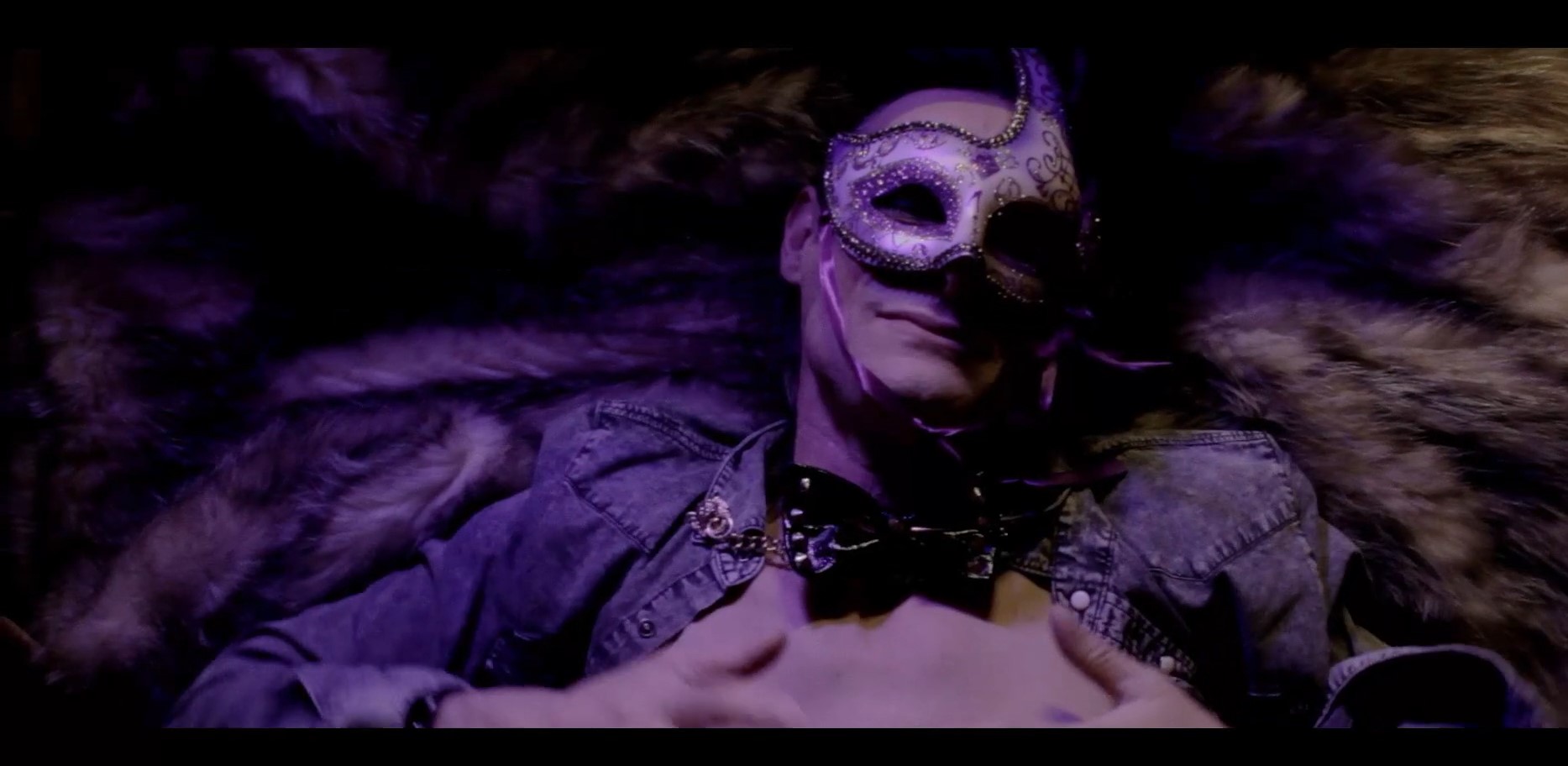
As a nail-pulling, nose-cutting, drill-holing, lip-stitching, dick-scissoring, gut-stabbing anthology, “La Petit Mort 2: Nasty Tapes” is a gory, good time and is even better now in high-definition with a 1080p Blu-ray release from Unearthed Films The AVC encoded BD25 looks as good as can expected for a shaky cam, hectically edited, and filthy dark German gore film presented in a 2.35:1 widescreen aspect ratio.  Details are oleaginous wet with blood and tissue that incongruently with the Roland Freitag’s gloomy yet suppressed cinematography and Kai E. Bogatzki discordance and chaotic editing technique that is supposed to elicit extreme shock but consequently results in a loss of the intended grisliness.  Unearthed Films‘ release exhibits no issues with compression, but the hues and tones appear to fuse in the near eliminate of some contours where there should be some.  The German-English DTS-HD 5.1 mix can be score heavy, especially a hard and energized Tekkno title credits from composer Klaus Pfreundner that’s distinctive German, but “Nasty Tapes” has profound focus on its core selling point – torture.  The very few scenes of intercut dialogue shots spliced into the client’s sociopathic session are well understood and do have prominence over the score, as well as the ambient milieu of screams and the integrated flesh destroying Foley, despite the cam-esque quality of the pseudo-testimonials.  The burned-in English subtitles under the German Language only are synced well without error and with consistently good pacing.  Disc extras include a behind-the-scenes making of cut out from the main camera, an alternate torture scene, a behind-the-scenes still gallery, a short advert of a naked woman strung up by her arms and being stapled with signs, and Unearthed Films trailers.  The Blu-ray physical features don’t stray to far from normal Unearthed Films releases with a standard Blu-ray snapper case with grisly cover art of a marred victim’s plucked out eye and a Jade Maxime holding a bone saw and wearing ripped fishnet stockings and black lingerie.  The pressed disc art has the rehashes the back cover image of Monsieur Maxime wearing a venetian mask.  The Blu-ray comes unrated, region A locked, and has a manageably sufficing runtime of 83 minutes to not overkill the overkilling.  Transparent in its surreptitious atrocities, “La Petit Mort II: Nasty Tapes” subsists as Marcel Walz charnel house of horrors with a new revamped anthology approach to razzmatazz special effects wetwork without any due remorse. 

Step Back into La Maison de “La Petit Mort” for a Sequel that’s Hard to Stomach!  

On the Verge of a New Millennium, New Faces and Stories Tell Their Terror on the Same Old EVIL Video Format! “V/H/S/99” reviewed! (Acorn Media International / Blu-ray)

Found Footage is all the 90’s Craze These Days! “V/H/S/99” Available at Amazon!

The year:  1999.  The format:  VHS.  The theme:  The most horrifying experiences caught on found footage camera.  A horror anthology for the turn of the century puts together five of the most terror-drenched short films that resurrects the punk-rock dead, turns urban legends into vindictive playthings, televises Lovecraftian game show frights, peers into the stone-cold eyes of a Gorgon neighbor, and goes to Hell and back!  All caught on camera from a first-person view as VHS vicariously relives the glory days through a digital world, capsulated by the horror realm and all its fanatical acolytes for the analogue video format to live undead forever. 

Living in the age of a VHS comeback is admittedly kind of weird.  VHS has become a hot collectible, especially and obvious the rate and obscure that mostly resides in the horror and cult genre.  Most recently, a discovery on a Brazilian VHS cut of Jaws 2 has a couple of minutes of shot footage that no other release holds to this day.  That, being just one example, is sought after power of VHS that saw various versions of one film be disperse far and wide across continents, which the same could be said about DVD that too saw a variety of different cuts due to the diversity of playback formats, distribute cuts, and numerous levels of censorship between countries.  VHS is also making a comeback in format style with gritty, faded, flat colored image veneer and tracking lines and the absent transmission signal of snow statically adorning the screen with beautifully hypnotical and flickering white dots.  So, it’s now surprise that on the heels of 2021’s “V/H/S/94,” another analog anthology is greenlit in 94’s wake with “V/H/S/99” for 2022, written and helmed by newcomers to the series but not necessarily newcomers to the horror scene.  The movie’s sequential lineup Is as follows:  Short filmmaker Maggie Levin writes-and-directors “Shredding,” taking a break from killer sharks is Johannes Roberts to oversee his “Suicide Bid” entry, musician Flying Lotus directs and co-writes with Zoe Cooper with “Ozzy’s Dungeon,” “Tragedy Girls’” director Tyler Macintyre writes-directs “The Gawkers” along with co-writer and fellow “Tragedy Girls’” screenwriter Chris Lee Hill, and the husband and wife tag team of Joseph and Vanessa Winter, filmmakers of “Deadstream,” helms-and-pens “To Hell And Back.”  The Shudder exclusive series latest is produced by Josh Goldbloom (“V/H/S/94”), David Bruckner (director of “Hellraiser” ‘22), Chad Villella (producer of the of 2022’s “Scream”), Bloody Disgusting’s Brad Miska, and “Scream” ’22 and “Scream VI” director Matt Bettinelli-Olpin under the production banner of Studio 71 and presented by Cinepocalypse Productions and Bloody Disgusting.

A new set of five tales of analog rendered terror invoke a new set of actors in each short film that carrier with them a broad range of experience. While a couple of the stories shred the narrative with hectic editing (I’m looking at you “Shredding”), performances throughout come over with blistering consternation and definitely a late 90’s grunge attitude with “Shredding” and “The Gawkers” delivering the full blunt force of period, heckling away in their baggy clothing, bohemian hairstyles, and a penchant for skateboard thrashing. The other films are merely timeless with only mere mentions of date, or their timestamped on the video tape recording, or are just a thematical proverbial nod to the specific point in time, lacking the keep it real essence that is quite idiosyncratic to the hop from a phasing out decade and into a whole new other. The cast of these shorts play their roles with exuberance and wackiness, which if you have lived in or can look back to the converging decades/millennium and see some of the gameshows or cultural shenanigans that defined America as people or, if you want to go smaller, just the pop culture, wacky is a pinpoint descriptor. The short films’ of “V/H/S/99” are comprised of a cast including, selectively, Steven Ogg (“The Walking Dead”), Ally Ioannides (“Synchronic”), Keanush Tafreshi, Jesse LaTourette (“There’s Someone In Your House”), Dashiell Derrickson, Isabelle Hahn, Sonya Eddy (“Blast”), Emily Sweet (“Castle Freak” ’20), Melanie Stone (“Deadstream”), Archelaus Crisanto, Luke Mullen, and Ethan Pogue.

Anthologies have been around for decades and are a great medium to showcase a multitude of individual storytelling from a variety of filmmakers walking different paths in life.  Fans can often salivate over these types of jump-the-shark formats that can start off with the zombie undead, transition 10 minutes later into a supernatural spooky, and then segue into a creature feature with a wraparound bonus story that may or may not connect them all and squeeze each episodic terror vision in a full-length feature runtime.  Though I enjoy a good collection of short and sheer frightful films, anthologies are not my cup of sanguinary tea.  Hopefully, no partisan takes seep out of this review as I attempt to examine “V/H/S/99” objectively.  Out of the five segments, three have landed strong with a right amount combination of style, gore, performance, narrative logic, and, of course, terror, and if you like comedic sugar in your black cup of horror then “To Hell And Back” is a perfect Venti-sized, well-blended mulatto of choice that thrusts two dimwitted demonic ritual documentarians into the pits of dark, gloomy, and malformed creature Hell and fight their way back to their own plane of existence.  Though one flaw some make catch when watching the caboose film of the anthology is that it doesn’t particularly reflect 1999 other than the small caveat, which is pivotal to the story, that at the turn of the millennia is when the veil between our world and Hell is as it’s thinnest.  The other two better entries capture more infinitesimally in detail of the late 90s, early 2000s clothing and discourse.  “The Gawkers” taps hard into the weird aggressive hormones of a teenage boy while exploring the newfound ways to use technology as spyware.   Webcams aboard big boxy desktops chauffeur in a whole new way to be creepy that lands them in hot water not by the law but by the wrath of ancient femme fatale of Greek mythology.  Johannes Roberts rounds out the better half with a sorority haze gone wrong that evokes an urban legend to become more than just a story and Roberts “Suicide Bid” offers, again, that period presence that feels like a tribute throwback to the 1998 “Urban Legend” film itself, but adds a supernatural surprise that utterly creepy and not as deep with only 6 feet underground rather than a 47 meters down, the director is slowing raising his fear to the surface.  The shorts left hanging below the bar are “Shredding” and “Ozzy’s Dungeon” and for reasons that have to do with their style and story. “Shredding” promising premise is plagued not by punk phantasms back from the dead but simply pilfered of focus with a hectic, if not severely chaotic, VHS-graded editing scheme that shocks the perception senses while “Ozzy’s Dungeon” is inspired by Nickelodeon’s Legends of the Hidden Temple gameshow where kids have to compete in toned down ancient society games to race up the temple to win the big prize. “Ozzy’s Dungeon” definitely is weird, sadistic, and Lovecraftian-inspired for sure but its story design loses motivation and often cheats rounding the bases in order to reach the shocking climatic finale.

Acorn Media International brings tape to the United Kingdom with a Blu-ray home entertainment release of “V/H/S/99.” Presented in a widescreen 1.78:1 aspect ratio, though doesn’t cater to the standard 4:3 ratio of video tape, the provided image quality purposefully varies to give audiences the titular analog experience. Faded grading, tracking lines, static and that jittery playback is all part of the visual environmental experience and even a few of the filmmakers shoot the film digitally to then run it through VHS to garnish with unnatural base video turbulence. The English DTS-HD 5.1 surround sound mix heightens the exposure and familiarity to of being that person behind the camera as all of these shorts of short POV. Intense and, often, cacophonous, the audio tracks still manage to level out, be discerned, and manage to relay the chaos no matter how much bedlam is thrown at the screen. From the zoom in-and-outs of the video tape recorder, there’s a clean sense of depth and the range is bountiful as the ambient track runs the gamut of omnifarious sounds that give each episode an individualized stamp. English SHD is optional. Bonus content includes an exclusive panel from New York’s Comic Con with guests producer Josh Goldbloom, “The Gawkers'” Tyler Macintyre, and “To Hell And Back’s” Joseph and Vanessa Winter as well as a total arc gag reel. After that encompassing project feature, the girth of the bonus content breaks down into the individual shorts with “Shredding” having a deleted scene and the complete fictious band BitchCat music video, “Ozzy Dungeon” has two deleted scenes, “The Gawkers” has a deleted scene as well as bloopers, camera tests, and The Making of Medusa, and “To Hell And Back” rounds out the features with a hefty look at the raw footage, scouted location, and a storyboard and blocking rehearsals. There are no bonus features for Johannes Roberts’ “Suicide Bid.” Physical features include a slightly thicker traditional Blu-ray snapper, a Europe standard, with a cover art that matches the North American RLJE release, a city being loomed over by skull made out of colorful galactic stars and a pair of video lenses for blank eyes. The disc art is pressed with the same front cover image. Though no mention of a region playback on the back cover, I suspect a region B encoded release as per usual with Acorn Media Interntional. “V/H/S/99” has a total runtime of 109 minutes and is UK certified 18 for strong blood violence/gore. “V/H/S/99” is not my kind of off the heasy subgenre, but the latest series anthology packs a punch and I would never discourage anyone from not experiencing firsthand an homage trip through terror.

Found Footage is all the 90’s Craze These Days! “V/H/S/99” Available at Amazon!

EVIL Told You Not to the First Time! “Don’t Fuck in the Woods 2” reviewed! (Wild Eye Releasing / Blu-ray)

“Don’t Fuck in the Woods 2” on a Special Edition Blu-ray!  Purchase Your Copy Here!

Beginning where the last film left off, alien attack survivor Jane, bruised and bloody, stumbles into the under-renovation Pine Hills Summer Camp where a group of newly hired and horny camp counselors, a nurse chaperone, and a handy-man ex-con spruce up the place.  Jane is met with hostility when sounding off about monsters and death, but when the Pine Hills staff realize that a few of their friends are missing and haven’t checked in, Jane’s story is beginning to resonate and take traction.  Out in the woods, the rape-impregnated sperm of the monster are parasitic and seek out human hosts to infect with raging hormones and adrenaline, transforming hosts into razor-sharp teethed, superhuman mutants hellbent on procreation of a new monster.  The invading parasites turn the isolated camp into a slaughter yard of bloodshed and chaos and it’s up to the remaining survivors to nut up and put violent stop to an alien’s insidious carnage. 

Well, by God, Shawn Burkett did it!  The director made a sequel to his straight-forward, out-of-nowhere, 2016 indie hit “Don’t Fuck in the Woods,” directly following up from where the first film left us off with a lone survivor having just blown up a sex-crazed, blood-lusting alien creature who clawed, tore, and banged his way through a bunch of naked women and some off-color guys doing the dirty in the woods.  The first film made such a splash of interest with the provocative and often controversial title as well as being one of the most pirated movie in the last decade due to said title, The Ohio-born Burket began to formulate the next step of “Don’t Fuck in the Woods 2” with a story co-written with one of the sequel’s principal stars, Cheyenne Gordon, writer of the Tory Jones directed films “The Wicked One” and “They See You.”  The enticingly crass, but greatly adored and sought after title aims to be gorier and even more nudity-laden as the first film with the story situated at an actual family-owned campground, Hannon’s Camp America, in College Corner, Ohio.  Shot in the Summer of 2019, the pre-pandemic film, “Don’t Fuck in the Woods 2,” is a production of Concept Media, Studio 605, Rising Fire Films, Taintbad Productions, and Head on a Stick Productions with Burkett producing and John Lepper (aka Johnny Macabre, executive producer of “Smoke and Mirrors:  The Story of Tom Savini” and “The VelociPastor”) as executive producer.

Though the sequel does not mark the return of the voluptuously captivating adult actress Nadia White, as her character (spoiler alert) was ripped apart by the creature (end spoiler alert), the sequel casts a whole new lot of ladies willing to let Mr. Skin archive and immortalize all their bare body parts forever…or at least until the servers crash, the internet dies, or the world ends.  It’s not like eternity or anything.  The one returning principal to return is the first film’s sole survivor, Jane, and returning to fill her blood-soaked shoes is Brittany Blanton that has officially solidified the Houston, Texas native as a scream queen, franchise final girl, and an overall badass slayer of otherworldly creatures.  Blanton is just one of several actresses to play into the popular campy motif and titular theme of open sexuality and nudity as a formulaic no-no in horror films.  B-to-Z horror movie regulars, starting with “RIP:  Rest in Pieces’” Kenzie Phillips, “Model Hunger’s” Kaylee Williams, “Slaughterhouse Slumber Party’s” Kayla Elizabeth, “5G Zombies’” Julie Anne Prescott, “Blood Moon River’s” Cara McConnell, and Nessa Moore, who I suspect used a body double for her bare all scene, follow suit (birthday suit that is) playing chopping block babes abreast of their outcome.  Burkett doesn’t completely make void his sequel of complex human emotions, supplying bitter love triangles, an oversexualized third wheel, and two more adult-ish characters running from their unpleasant past,  One of those two is ex-con Gil (co-writer Cheyenne Gordon) forced into a corner as the camp’s handyman while attempting to turn his life around for the better but finding the path to redemption difficult when being harassed and threatened by corrupt law enforcement officer.  Already down in the dumps being judged and juried by fellow campers and law enforcement, Gil is sympathetic role that earns his keep when going toe-to-toe with mutation spawn.  Mark Justice (“Atomic Shark”), Jason Crowe (“Dead Moon Rising”), Tom Komisar (“Slaughterhouse:  House of Whores 2.5), Alex Gottmann, and returning from the first film for a brief but memorable scene is Brandy Mason completes the cast. 

No contextual messages. No metaphors. No symbolizing themes. “Don’t Fuck in the Woods 2” pumps you full of the same obligatory creature feature construct as the first, those who have sex, get murdered….horribly. The only slight difference this time around is director Shawn Burkett gets himself out of the man-in-a-monster suit element and into a state of possession as the cast of characters become heinous hosts to parasitic alien slugs, essentially turning people on themselves in a battle to the death. The concept brings a new angle to the series to build upon the creature’s never say die multi-nefarious abilities that keeps it returning, in one form or another, from the grave. Blood runs rampant with the special effects team implementation of a blood gun into their bag of tricks that soaks the cast in more than one scene, but I would say between the two films, both are equally matched in blood shedding as the sequel, that doesn’t see the return of the first film’s SFX artist Deryk Wehrly but hires the 2016 film’s producer, Rob Collins to fill that void, doesn’t surpass the antecedent’s practical butchery. Looking through a technical critical lens, the indie feature has noticeable issues with crew mistakes, such as shadows of the boom operator in the frame, and scenes that hit the cutting room floor would have shed light on a few second and third act scenes that ended up not keeping the story smooth in a logical sense; one of the bigger scenes in question is one two large arms break through a wall and grab Gib from behind. The arrangement of character positions didn’t quite work out and the feature’s after credits bonus scene cements that misalignment even more. “Don’t Fuck in the Woods 2” might have filmic gaffe (there might be a cream for that) but what started as a straight-shooting, sex and slaughter, potboiler has become Shawn Burkett’s undeniable magnum opus and he’s only just beginning.

Wild Eye Releasing camp on one of the most campiness horror to date with “Don’t Fuck in the Woods 2” on a special edition Blu-ray release. Presented in high definition, 1080p, the transfer is exhibited with widescreen 2.35:1 aspect ratio. First thing I noticed about the independent film and distributor release is there are virtually no issues with compression. The black areas remain deep and inky, hues naturally come across without any fluctuation, and there are no visible banding or artefact issues. In comparison to the first film, the sequel is quite brighter with more lighting available and Burkett isn’t too heavy on gels or tints unless in slug-vision mode with a tinge of low opacity fuchsia. The release comes with a lossy English 2.0 stereo mix that’s every bit languid as it sounds with current releases. Dialogue is clean and clear of damage and interference but is too underweight for full-bodied effect. Sound design offers arm’s length depth but is ample in range with slimy sluggy-ness slithering about and skirmish associated hubbubs to make the action excitable. Optional English subtitles are available. The special features include a behind-the-scenes featurette that gives a walking tour of the Hannon’s family camp shooting location building-by-building, blooper reel which can be seen during the end credits, two deleted scenes, the original producer trailer, Wild Eye Releasing trailers, and a feature length documentary “What Happens in the Woods: The Story of Don’t Fuck in the Woods” that digs deep not only into the genesis of “Don’t Fuck in the Woods,” but also into the personal strifes of Burkett and how the story’s title was turbulent, controversial, and heated from the beginning but became a wildly great success that spurred greenlights for future sequels, such as the after credit scene that may or may not involve space and/or time travel! The clear Blu-ray snapper with latch has physical special features that include a folded-mini poster insert, reversable cover art with a composited image on the front and a bloodied Brittany Blanton screengrab snippet on the opposite, and cardboard slipcover with a mashup character collage on the front. The brisk 81-minute runtime compacts the blood and boobs in this region free, unrated disc. Shawn Burkett teases fans with a third picture that’ll surely bring the wanton woods into the world of tomorrow but, for now, bask in “Don’t Fuck in the Woods 2” unfettered maverick success.

“Don’t Fuck in the Woods 2” on a Special Edition Blu-ray!  Purchase Your Copy Here!