EVIL’s the Bacon, the Pork Roll, and the Scrapple All Mixed and Slashed together! “Butcher’s Bluff” reviewed! (Breaking Glass Pictures / DVD)

“Butcher’s Bluff” on DVD from Breaking Glass Pictures!

Film students Rodger, Nicole, and Derrick decide to head to the rural Texas town of Emerald Falls and make their class project documentary around the 28 missing persons over the years and the Hogman, an urban legend of an escaped killer now roaming the woods of Butcher’s Bluff.  Bringing along their friends to make it concurring party getaway at Rodger’s family vacation cabin, the trio conduct interviews with the eccentric town locals to build a story around the Hogman myth, even ascertaining the original location for the mask Hogman wore during his first kills before escaping psychiatric prison.  The more they investigate into the Hogman, the more the locals warn them to stay away from Butcher’s Bluff but in a case of curiosity killed the cat, the documentary film students and their drug-fueled, sexed-up friends find themselves being hunted with no cell service, no help within miles, and no way out of the Hogman’s kill radius. 

Co-directors William Instone and Matt Rifley helm their first collaborative feature “Butcher’s Bluff,” a 2023 small town slasher reminiscent of the renaissance slasher movement of the 1980s, packed with practical gore effects, odd backwoods characters, a campy party of vice-riddled youth, and, moist importantly – excuse me – most importantly, T&A.  Instone, whose all-in director, writer, and producer debut horror “Jon” from 2012 brings one man’s delusions into horrifying reality, cowrites his latest grim story with writer, painter, and overall liberal arts connoisseur Renfield Rasputin.  Filmed in Texas with principal locations taking place in Bastrop, New Braunfels, and San Marcos to composition a story set in the fictional town of Emerald Falls and its rural woodland of Butcher’s Bluff.  The film is a crowdfunded venture that raised an approximate $60K to cover principal shooting and post-production costs with Instone and Rifley serving as primary producers amongst an amalgamation of crowdfunded producing backers   Instone’s Thunder Mountain Films, in association with Dull Knife Productions and Spicey Ramen Productions, go hog wild with their slasher horror. 
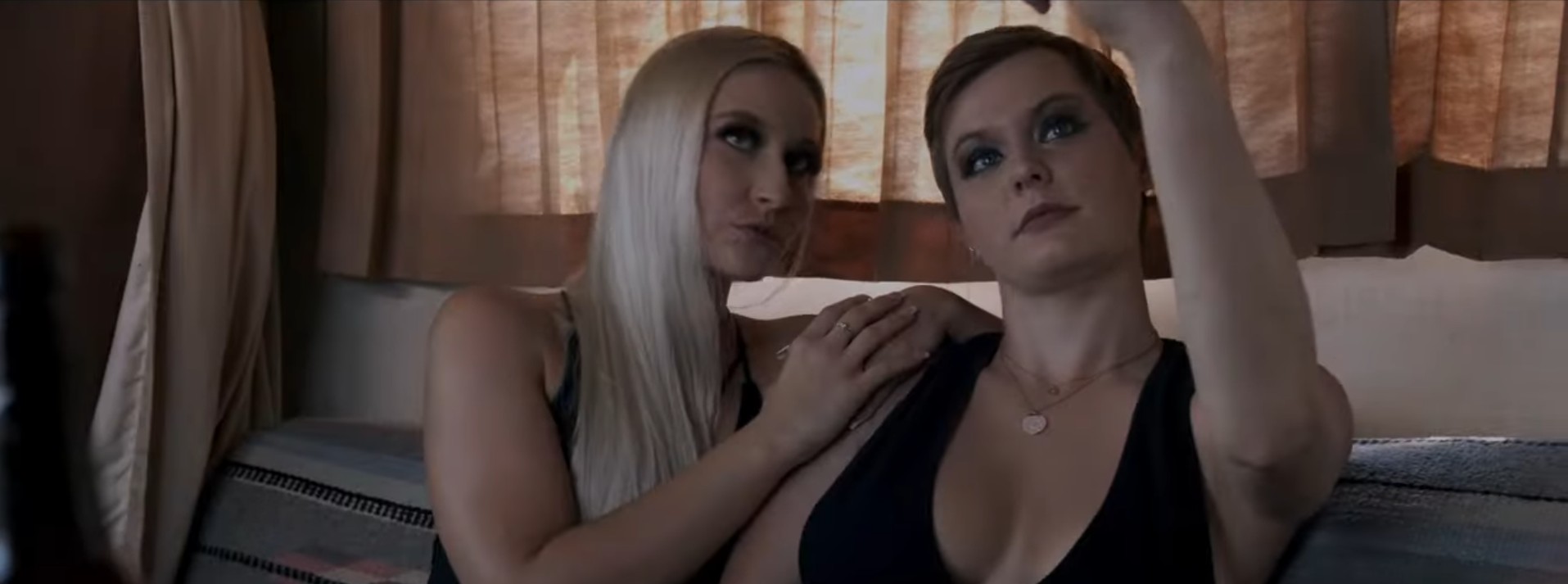
As if he doesn’t have enough on his plate writer, directing, and producing “Butcher’s Bluff,” Instone also portrays the main antagonist Hogman, masked with a stitched together pig head complete with cockeyed tusks and garbed with a dingy mechanic jumpsuit and tan jacket.  The Hogman is a walk-and-run chaser with a duel-sided axe and rusty, broad curved knife as main melee weapons though he’ll get his bare hands dirty from time-to-time.  Instone’s not flashy with the villain and doesn’t key-light any iconic poses, stances, or stares to incite a nerve coursing fear.  Hogman’s victims are anyone and everyone who enters the Butcher’s Bluff forest, from necking lovers (Jacqueline Hays and “Mallrats’s” Jeremy London), to lost pot farm thieves (“You’re Next’s” L.C. Holt, “Scare Package’s’” Christopher Winbush, “Girls Gone Dead’s” Shawn C. Phillips), to finally, but not limited to, the Rodger’s friends and classmates on their excursion investigation and party.  Fortunately, the group displays different caricature tropes without going full-blown cliché.  Between them you have the exuding sexy yet overly bitchy duo of Sam and Tina (a cut pixie cut but broodingly built Samantha Holland and a slender yet high-end platinum blonde Kayla Anderson), Rodger’s sex-driven, dweeb cousin Bobby (Dakota Millett) who Sam and Tina torment, the polar opposite to Bobby stud with Jake (Santiago Sky) and of course the three documentarians:  Rodger (Michael Fischer), Derrick (Johnny Huang), and Nicole (Paige Steakley), each reside in their own attribute world consistently, dying the way they live, that’s very telling of their moral fiber.  In additional to Jeremy London and Shawn C. Phillips, who have worked themselves into being staples of the indie genre films, other notable names to mention for their brief but key roles are Brinke Stevens (“Nightmare Sisters”), Paul T. Taylor (“Hellraiser:  Judgement”), Bill Oberst Jr. (“3 From Hell”), and Bill Johnson (“The Texas Chainsaw Massacre II”) peppered into the rest of the supporting cast to draw in fandom.

“Butcher’s Bluff” has the necessary bone structure to be a digestible slasher, checking all the elemental boxes, and Instone and Rifley manage to technically pull off a nearly 2-hour film on a crowdfunded budget.   The problem is “Butcher’s Bluff” has a hackneyed routine about it.  Instead of creating something new and wonderfully, gory and diabolical, under a distinct flag of novelly progressive storytelling, every scene feels all too familiar, a telltale sign to horror fans that we’ve seen this kind of story before.  From Hogman’s stony silence and indiscriminate aggression bores him as a Michael Myers carbon copy, a family in cahoots with a s flesh-stitched maniac plays the tune of “Texas Chainsaw Massacre,” and there’s even a character moment of yelling What Are You Waiting For? aimlessly into the dark forest while spinning around with arms wide apart that oozes Jennifer Love Hewitt vibes.  Add in some rather uninspiring frame, shot design, and editing and “Butcher’s Bluff” very much embodies the crowdfunded costs rather than the intended crowdfunded spirit.  Now while all of this portion of the review sounds grossly negative, don’t just run for the hills to the next slasher film in line just yet as Instone and Rifley still manage to keep an engagement lock on what makes the slasher film enjoyable to behold with some decently inlaid practical gore effects, including a pleading head being sliced horizontally through from mouth to hair or a posthumous, lawn chair display of one fine girl’s nipples and eyes plucked from her body and posed on her eye-gouged out person as if giving a blood offering to the audience Gods.  There’s also the inviting gratuitous T&A from Samantha Holland, Kayla Anderson, and Jacqueline Hays that keeps the old theme motif alive within the campy slasher genre as well as keeping young boys’ dreams from becoming dry.

Breaking Glass Pictures distributes the archetypical slasher “Butcher’s Bluff” onto DVD home video.  The MPEG2 encoded, 720p upscaled standard definition, DVD9 really has a tough go with the compression capabilities as there’s quite a bit of data to encode/decode within a near full-time night shoot picture and color accompaniments that blend right into the darkness, melding out of a clean definition.  Presented in a widescreen 1.78:1 aspect ratio, banding and splotching render a difficult deciphering of data in inkier fields.  When colors do contrast or arise into lighter hues, there’s a pop of demarcation with its full potential held back by an ungraded layer.  Textures are extremely fluid throughout with the prominent skin scenes offering a decent, natural look but most scenes are fuzzy as if the upscale fights the downscaling for supremacy.  The English Dolby Digital 5.1 surround sound offers an adequate compression for a routine slasher with mid-level range with clear and clean dialogue overtop eerie forest soundscape of breaking branches, tree knocks, and leave crunching footsteps.  The mix doesn’t convey much depth with dialogue and ambience hanging around the front channels while medium shots and some tree knocking flirt with the side channels.  A mainstay slasher should have a memorable, tense-riddles soundtrack for the chase or create omnipresence fear but “Scream, Queen!  My Nightmare on Elm Street” and “Dinner with Leatherface” composer’s Alexander Taylor’s insipid inspiration can’t be held in the memorable bank and fails to elevate the Hogman’s imposing sheer terror.  English closed captioning is available.  Special features include a proof on concept trailer for the crowdfunding campaign that stars a handful of the actors from the feature film, such as Michael Fischer and Paige Steakley, and a behind-the-scenes music video that contains behind-the-scenes footage.   The DVD presence is standard fair for Breaking Glass Pictures with a DVD Amaray and a one-sided front cover art, which subjectively pleasing in its retrograde mockup of an illustrated Hogman looming over a scared, running Steakley (supposedly) in her white tank top and high cut shorts.  There is at least one noticeable error on the back cover that spells Paige Steakley’s name incorrectly in the credits, listing her last name as Steakely.  The Not Rated release is hard encoded with region 1 and has a two-hour runtime which can appear quite long, but the pacing was not terrible and the long runtime for an indie slasher didn’t feel overly immeasurable. 

Last Rites: “Butcher’s Bluff’s” has little to offer as far as the next novel and generational slasher but scratches the genre itch with a large body count, solid kills, and campy campers looking to buy, sell, and trade their vices for being violated.

“Butcher’s Bluff” on DVD from Breaking Glass Pictures!

EVIL Minds the Door! “Raw Meat” reviewed! (Blue Underground /2-Disc 4K UHD Blu-ray and Standard Blu-ray)

“Raw Meat” Its What’s for 4K UHD and Standard Blu-ray Dinner!

Young lovers Alex Campbell, an American studying abroad, and Patricia Wilson discover an unconscious man on the steps of a London metro subway station.  When they alert a beat cop and make their way back to the spot, the man had vanished.  Assuming the well-dressed man an alcoholic sleeping off a bender, David and Patricia move on with their lives while the police report comes across the desk of Inspector Calhoun, an eccentric investigator who recalls a recent string of disappearances surrounding the same London station.  Over the next few days, several more station related disappearances occur, forcing Inspector Calhoun to dig deeper into the mysterious circumstances involving a missing Mi-5 agent and three subway employees with David and Patricia his only witness to at least one of them.  When Patricia suddenly goes missing with her last known siting at the subway station, a concerned David explores the train tunnels that connect the last known whereabouts of all whom have vanished, leading him to a tragic history of collateral damage survival, long forgotten generational lineage, and cannibalism. 

London, England was the first to introduce the metro subway station to the world in 1863 with the Metropolitan Railway.  It seems only fitting that London be the setting for “Raw Meat,” a subterrain horror that integrates London’s metro history with the consequential hazards of an early underground railway, the insufficient costs that prove to be costly, and the pitied blamelessness of unthinkable survival from neglectful businesses.  Originally entitled “Death Line,” rebranded to “Raw Meat” for American audiences, the 1972 film is actually directed by an American, Chicagoan Gary Sherman, in his debut and would go on to helm “Dead & Buried” and “Poltergeist III.”  Based off an original concept form Sherman, one that takes the plausibility and some fact of workers being buried under a collapsed railway project and survive generationally living off the nourishment of each other in more ways than one, the script is penned by Ceri Jones and is a production of Harbor Ventures and Kanter-Ladd Productions with the late “Police Academy” franchise’s Paul Maslansky producing

I’m going to preface this character introduction with “Raw Meat” would not have been as entertaining if it wasn’t for the peak performance by a more eccentric Donald Pleasance in a pre-“Halloween” performance.  As Inspector Calhoun, Pleasence is fully in charge as an intimidating case investigator with a snarky wit, or as Christopher Lee’s MI-5 character put it, what a droll fellow you are in a stiff yet jab remark exchange interaction between the two British icons of a bygone cinema industry.  Lee’s role is only a fraction in comparison to Pleasance and would have been two big personalties too big for the meager production to contain.  Another staggeringly highlighted performance comes from an unknown in Hugh Armstrong’s portrayal of the subhuman cannibal whose fellow inbred family members have all left by deceased means, leaving him alone and the last of his kind with mumbling tunnel vernacular and unkempt open sores all over his body and face in a state of unhealthy living conditions.  Armstrong’s acted ungainliness renders the man a monster amongst society standards but also sheds a softer, compassionate light upon reflection of his forced position into a world he knowns no better about having grown up completely in the railway tunnels all his life, living off what he can scramble up which included human flesh and organs.  In contrast to Pleasance and Armstrong, David Ladd (“The Klansman”) and Sharon Gurney (“Crucible of Horror”) impress as middle ground, plain as can be, characters being two lovers in the midst of mystery, almost becoming history themselves when the man targets her to amend his loneliness in a gibberish mind the door effort to show her affection.  Normal Rossington (“House of the Long Shadows”) and Heather Stoney are the only two understated completely overstated in the film as Inspector Calhoun’s constant whips demands for bolos and tea.  James Cossins, Hugh Dickson, Jack Woolgar, Clive Swift, Gerry Crampton, Terence Plummer, and Gordon Petrie pull into the station as the remaining cast.

Hovering between the horrifying truth of early construction, underground railway accidents and the urban legend of trapped workers under tunnel collapses, Gary Sherman unearths middle ground terror somewhere in between the two with a plausible terror line narrative that not only instills recognition of the past and those who gave the ultimate sacrifice but also invites the nonfictional hunting-cannibal rising to the surface in search for food and, to an extent, companionship.  The cast elevates “Raw Meat’s” character efflorescence but there’s also other areas to illuminate its noteworthiness that take the film from out of the tunnel shadows as cinematographer Alex Thomson’s bleak tunnel aesthetic rouses filth and a sense of hardcore survival over a century.  The 7-minute tracking shot near the beginning, at the introduction of the cannibal’s tunnel home depicted with a decorum of decaying and freshly strewn corpses salvaged for their organic parts, is an astonishing backwards tracking shot without a blip of hesitation and lingering just enough to seed an unsettling undergrowth of grisly ghastliness.  The only drawback from “Raw Meat,” if looking for one or perhaps it’s not even a big deal, lies with the young couple Alex and Patricia.  It’s possible to stumble into a situation, as they did after coming off the last train for the night and crossing paths with an unconscious man on the staircase up to the surface; however, Alex and Patricia were not exactly looking for trouble or pursuing a follow up on the man’s health-and-wellbeing, God knows they argued over about their stance on helping ailed strangers in public, but they wind up having this off topic tangent about said contentious topic and rebuild the tumbled down building blocks of their relationship for a stronger bond.  Yet, lightning strikes twice in the subway tunnel and Patricia is whisked away by the tunnel ghoul in a second pure coincidental interaction that ignites Alex to make good on that stronger bond with Patrica by investigating her last known whereabouts.

Be a cannibal and consume “Raw Meat” on a new 4K UHD and Standard Blu-ray 2-Dsic combo set from Blue Underground. Restored and scanned in 4K 16-bit from the original uncensored camera negative with Dolby Vision HDR and presented in a widescreen 1.85:1 aspect ratio, “Raw Meat” comes from out of the near total blackout of tunnelling darkness of standard definition and poorly contrasted previous Blu-ray editions with a precision of delineating crafting brilliance, adding depth of separation between object and background.  The HVC encoded,2160p ultra high-definition resolution, BD66 was well aimed to squash any compression issues, leaving blacks black and textures coarse that nearly lift off the screen.  You can actually try and count the whiskers on Christopher Lee’s caterpillar mustache.  Colors have also improved and enhanced in saturation without being overly intensifying; “Raw Meat” thrives on the dank, dark world of not only the abandoned tunnel line but also the cold and sleazed London streets.  Alex Thomson’s tunnel life aesthetic musters an earthy and dingy frontage and coupled with some hard glowing red, yellows, and the subsequently mix orange, there’s a real harrowing subterranean tone in the man’s macabre ossuary home.  The 2nd disc standard Blu-ray is AVC encoded, 1080p resolution, BD50.  Blue Underground’s release offers multiple audio options, including a new Dolby Atmos mix alongside the already established DTS-HD 5.1, both rendered in English.  Toggling between both surround sound mixes, there’s little-to-no difference in the immersive experience.  Atmos provides an echoier shaft experience that can be heard as directionless whereas the DTS specifies the reverberating soundwave direction based on channel markers.  Mind the Door is certainly more accentuated as it lingers through the chambers just a little more ubiquitous and chillingly underscored.  With no crackling or hissing, dialogue is clean, clear, and robust that solidifies Donald Pleasance as a master of quick wit and blunt investigation tactics as well as the track cherishing the quality of all other players involved.  Some instances of dialogue are ADR, likely due to poor record quality, resulting in an artificial separation between the action frame and the post-production recording.  Train sounds play a supporting factor and are acutely integrated into the design of a makeshift substation construction from an abandoned platform.  The other audio options include an English 1.0 DTS-HD and a dubbed French 1.0 DTS-HD.  English SDH are available.  Disc 1 – the 4K UHD Blu-ray – contains two commentaries a 1) archived writer-director Gary Sherman, producer Paul Maslansky, and assistant director Lewis More O’Farrell and 2) a new critique and analyst commentary discussion from film historians Nathaniel Thompson and Troy Howarth.  Bringing up the UHD rear are radio/TV spots and various trailer cuts.  Disc 2 – standard Blu-ray – has all of the above on disc one plus an interview with writer-director Gary Sherman and executive producers Jay Kanter and Alan Ladd Jr. Tales from the Tube, an interview with star David Ladd, producer Paul Maslansky, and assistant director Lewis More O’Ferrall From the Depths, and an interview with the now late Hugh Armstrong, the cannibal tunnel man, Mind the Doors.  An extended poster and still gallery flesh out the standard Blu-ray’s supplemental content.  The classic poster art has been upgraded to a textile vision of blood red and half-naked men and women with blank chromium eyes within the embossed image on the slipcover and that extends to the sides and back of the O-slip.  The same illustration also graces the black 4K UHD Amaray as primary cover art, but this different variation has more natural coloring on the hair, tattered clothes, and skin tones on the white-eyed ghoulish faces.  The reverse side of the cover is the original “Death Line” titled cover art as seen on the old MGM DVD with the bearded man walking on the railway with a lit-up train to his back and a woman lying seemingly dead on the rails in front of him.  The Blue Underground release is Not rated, clocks in at 87-minutes, and is encoded to play in all regions.

Last Rites: A classic of subterranean horror, “Raw Meat” is much more than a broad line of cannibalistic terror. The new Blue Underground Ultra Hi-Def release illuminates the wretched state of being and the ugly truth of generational survival that provides a strange brew of compassion for the forced feral human who feeds on human flesh.

“Raw Meat” Its What’s for 4K UHD and Standard Blu-ray Dinner!

Fascist EVIL Takes on Freedom of Expression! “School in the Crosshairs” reviewed! (Cult Epics / Blu-ray)

“School in the Crosshairs” on a Cult Epics Blu-ray! Purcahse here at Amazon.

Yuka Mitamura is the smartest, most well-rounded student at her high school that’s embattled by a constant debate on whether physical edition and clubs are a necessary requisite for academic success, jeopardizing physical activities such has her best friend Koji’s Kendo club.  When Mitmura’s latent psychokinetic powers emerge, she struggles to cope with the change that’s out of her control and the new acquaintances with similar powers that show up in her life, such as with new female student Michiru Takamizawa whose sudden enrollment sees a quick rise in the ranks of school politics and sparks an insidious need for a totalitarian and fascist reign to control dissident and unapproved behavior within the school.  As an oppressive crack down on the total student body sparks a civil war amongst the students, Michiru and her mentoring demon Kyogoku aim to enslave the human race and it’s up to Mitamura, unknowingly Earth’s champion, to fight against the forces of evil. 

Adapted from the 1973 science fiction and fantasy novel “Psychic School Wars” by Taku Mayumura, “School in the Crosshairs” is every ounce those Japan famous hyper-intensity and colorfully assertive commercials with visual sparkle and great enthusiasm for their hawked products.  You know them well when they go internet viral.  The 1981 Japanese adaptation is helmed by Nobuhiko Ôbayashi, director of “Hausu” and “His Motorbike, Her island,” from no script but rather from Mayumura’s novel as script.  Keeping faithful to nearly the entire novel and adding Ôbayashi’s variegated touch, “School in the Crosshairs” is a flamboyant Earth invasion in its divisive influence of the study body, especially between the studious academics and physical clubs.  Also known as “The Aimed School” and “School Wars” elsewhere in the world, as well as titled “ねらわれた学園,” ”School in the Crosshairs” is produced by “Island of the Evil Spirits’” Haruki Kadokawa, who also produced our last Japanese reviewed title, the traumatically powerful and wonderfully performed “The Beast to Die,” under his company Kadokawa Haruki Jimusho.

“School in the Crosshairs” circles around principal character in film and in book Yuka Mitamura as she juggles her newfound powers.  Between feeling like a stranger in her body as well as the weird visitations of her powers and of the otherworldly figure with a cap and green skin and having to not only rebel against an authoritarian rule overtaking her high school but also to save all of the world from that said otherworldly and powerful figure, Mitamura’s plate is undoubtedly full for a teenage girl.  Hiroko Yakushimaru (“Sailor Suit and Machine Gun”) comes to the role as a teenage girl herself at the age of 16-17 years old by the time of principal photography and seizes the high school melodramatics with ease as the carefree smartest kid in school.  Yet, finding Yakushimaru a formidable character stemmed by her performance is not so easily rendered in an indifference projection toward her newfound abilities; Yakushimaru is unable to really compel audiences with body language or even in her dialogue on why the teen has to soul search cope when she discovers she’s different.  We get more out of Ryôichi Takayanagi (“His Motorbike, Her Island”) as the quasi love interest and Kendo club leader Koji as his kendo tournament matches and failings in academics that affect his beer story-owning family dynamics are heavily emphasized and given more weight against a floundering leading lady character with superpowers and uses those powers to put Koji in good standing amongst the Kendo culture with win-after-win.  Not until the world starts to unravel at the hands of fascist student leader and fellow telekinetic Michiru Takamizawa (Masami Hasegawa, “The Tragedy in the Devil-Mask Village”) and her despot leader, the manipulative demon Kyogoku (Tôru Minegishi, “Main Line to Terror”) in a technicolor brilliance of a cosmic showdown held within the interdimensional layers but even then the last gasp of defeat has lackluster strength after a mountainous buildup of dictatorship control and potential student civial war.  The cast fills out with Keiko Mitamura, Noriko Sengoku, Yûsuke Okada, Kôichi Miura, Hiromitsu Suzuki, Macoto Tezuka, and Kôichi Yamamoto.

Pushing a few of the acting and character flaws aside and off the table, “School in the Crosshairs” is essentially manga embodied by live-action film.  There’s stellar mass group choreography near the beginning when the clubs merge for a rush invite to encourage recruitment, there is an extravagantly caped character in green makeup and a white afro wig, and there’s the painted-on-cell colorization I’ve mentioned a few times already that really ups the fantastical sci-fi features of Mayumura’s novel with a director like Nobuhiko Ôbayashi unafraid to get deep with saturation and long in experimentation.  Themes on fear of individualism, forced conformity, friendship, and the rise up out from that powerlessness feeling for what’s right showcase through metaphorical fascism, akin to the likes of the evil Nazi Germany party with a fear mongering nationalist’s convincing motivational speeches and confidence commands that seduce the ears of the waning high school minority, the academic kids, seeking alternative solace and a way to regain control as they are not as popular in contrast to those in clubs.  The Nazi tropes don’t end there as rounding up nonconformists, Nazi-like uniforms, and even a modified heil make their way into the overall story and that’s the darkest part in “School in the Crosshairs” light and airy jeopardizing of innocence and individuality. 

Catching a glimpse of Nobuhiko Ôbayashi’s pre-“Hausu” filmmaking brilliancy is now as easy as catching “School in the Crosshairs” on a North American Blu-ray release from Cult Epics.  The dazzling high-definition and an equally impressive, supplemented release is AVC encoded onto a BD50 with a 2K transfer and restoration of the original 35mm print and presented in a widescreen 1.85:1 aspect ratio.  The “School in the Crosshairs” restoration visuals need to be seen to be believed in a newly graded touch up that offers a glassy darker side within the fascism themes and a richer color palette to make the hued pinwheel spectrum a living, breathing character between good versus evil.  The grain comes through naturally on nearly all scenes with some of the shadowy moments favoring less delineation through the consistent optical texture.  The composited effects are boldly vibrant inside a creative streak that’s idiosyncratic only to Ôbayashi and are implemented into the live scenes with precision that doesn’t make it awfully clumsy or clunky.  Cult Epics made sure to cover any and all viewer’s at-home audio setup with three Japanese language options:  an uncompressed LPCM 2.0 Stereo, a Dolby Digital 5.1 Surround Sound, and a DTS-HD MA 5.1 Surround Sound.  Each carry their own weight and attributes with the LPCM 2.0 and DTS-HD 5.1 similar in fidelity, but the DTS offers an expansive girth that fills in the left and right channels of interdimensional ambience with laser strikes and gameshow tonal keys.  Dialogue is constructed through ADR that carries a level and balanced layer field and holding its own against the fantasy ambient that sometimes rises to meet the dialogue decibel; however, dialogue is clean and clear without any issues in clairaudience.  Newly improved English subtitles are optionally availably.  The set is quite complete, and likely comprehensive, with the physical and encoded special features.  Film critic Max Robinson offers a feature parallel commentary track, Phillip Jefferies provides a video essay on Nobuhiko Ôbayashi’s body of work in Sailor Suits and Sound, an Ôbayashi film poster gallery, and the theatrical trailer.  Physically, the clear Blu-ray Amaray case keeps inside the reversible cover art with both sides featuring the Japanese poster arts and housing that package is the limited edition cardboard O-slip with a fantastic compositional design by Sam Smith.  Inserted inside is the back cover unlisted, 22-page booklet full of black and white as well as color adverts, feature stills, characters bios, and other writings but all in Japanese, no English.  The 90-mean feature comes no rated and is region free.

Last Rites: More so now than ever in the current political climate, freedom of expression endangerment is the critical theme for Ôbayashi’s “School in the Crosshairs,” a color melange of resistance against the forces of evil hard to differentiate looking like our friends, family, and the everyday student.

“School in the Crosshairs” on a Cult Epics Blu-ray! Purcahse here at Amazon.

Protect Yourself from EVIL Because “Tonight She Comes!” reviewed! (Jinga Films – Danse Macabre – MVDVisual / DVD)

“Tonight She Comes” is Now Available on DVD! Purchase Here!

Two women looking to spend quality debauchery time with their friend at her family’s rural cabin arrive find their friend is nowhere to be seen or heard from but they do discover a lost mailman asleep on the cabin porch on his first day.   As the trio yuck it up with plenty of booze and flirtation around the campfire, locked out of the cabin with still no sign of their girlfriend, the day turns to night and they’re eager to get into each other’s pants for an alcohol fueled fling.  Unfortunately for them, their lost friend just showed up naked out from the adjacent lake.  What usually would be an invitation for an extended good time, the naked friend is stained head to toe in blood and determined to kill anyone in her path.  In their escape, they run into a backwoods family of black magic occultists trying to fix their titanic satanic mistake before everyone dies.

If a campy, gory, backwaters horror engulfed in occult get your filmic scary movie juices flowing, then “Tonight She Comes” should be at the top of your must-watch list.  The 2016, American-made feature from writer-director Matt Stuertz takes the cabin-in-the-woods trope to the extreme to the likes of a farcical feat many have tried but only a few achieve.  “Tonight She Comes” is Stuertz’s sophomore picture behind the cleverly titled found footage horror “RWD,” or “<<RWD,” as in the rewind symbol you’d typically see on VHS players, and has since his bloodthirst for horror with the practical effects-driven and supernatural terrorizing of a young woman in this year’s “Human” and is currently in production with a gory vampire flick, “Wake Not the Dead.”  Gory is Stuertz niche tinged with a repulsive tone that’s not just splatter nor intestinal evisceration.  Cinematographer Chris Benson and sound designer Jamison Sweet, of the St. Louis-based production company Lamplight Films, and Twenty Eighteen Seventy-Six’s Stuertz produce the film.

What’s neat about the progressing script, acutely angling 90 degrees to keep the story fresh and unsuspecting, is the principal leads constantly change hands.   By conventional standards, the young, good looking, white male mail with a pleasant disposition in James (Nathan Eswine) places audiences on that path with a post title opening of the inexperienced, first-day-on-the-job James doing his route diligently despite difficulties locating an address.  Also, in comparison to his dimwitted and degenerate best friend Pete (Adam Hartley, “The Slender Man”), James is a pedestalled prince.  As the day turns to night, James begins to show cracks in his gallantry and the baton is roughly passed to the rough around the edges but tough as they come Ashley (Larissa White, “Charlatan”).  In another dynamic duo curiosity, her best friend in Lyndsey (Cameisha Cotton) drunkenly sluts her way to the end of the whiskey bottle and toward the inside of James’ pants, demarcating the horror tropes between the two pairings by sticking up and out the perverted goofball and the alcoholic promiscuous while keeping in protagonist good graces and staid James and Ashely up until the baton is passed along again inside the trio of an occult practicing backwoods family who messed up a reincarnation spell and inadvertently resurrected a powerful, murderous demon.  Between the family-first Pa, Frances (Frankie Ray, “Bad Haircut”), the near silent big brother, Philip (Brock Russell) and the rational sister, Felicity (Jenna McDonald), the protagonist shift lands in the lap of the younger sister who takes charge in a show of no nonsense command and force that deserves respect for a role that’s usually diluted or wasted in isolated cabin horror.  Each actor performs exactly on Stuertz given script with the cast rounding out with former model Dal Nicole in her full birthday suit for most of her screentime as the Kristy inhabited demon plodding to kill in a nonstop wrath.  

Most audiences and critics will pan “Tonight She Comes” as nonsensical drivel touting a gauntlet of gore and a fixed nudity to carry it into a favorable edge with fans.  All I have to say about Matt Stuertz script and vision is it breaks the conventional stereotypes into shattered shards and uses those shards as gouging, bloodletting weapons.  On it’s face, “Tonight She Comes” appears to be another run-of-the-mill cabin-in-the-woods horror with throwaway characters and many vague plot points that don’t have an encircling reference.  Stuertz purposefully throws cation to the wind and makes the movie he wants to see, a no-holds barred blood fest geared to obliterate the tropes and only provide slivers of important information, just enough to pass the bar to the next round of ironfisted thrashings.  The story never allows the sediment to settle between the character action and dialogue debauchery, the eclectic and interesting POV shots, the diabolical practical effects, the sparingly used but effective visual effects, the continuously guess where this story is heading and, of course, the unabashed eye candy that is Dal Nicole fully nude in full time.  The other thing that can bog down viewers, and rightfully so, is the time check title cards that are supposed to tick down to the moment the demon emerges into the fold, turning the events of youth fun into a grind of survival. Randomized and spelled out, literally, the interjected times don’t seemingly match the span of time passed on screen.  What should take a few minutes between scenes, the title card states hours had passed; I’m not positive if this is part of Stuertz’s trope lampooning or not but this portion excels as more distracting from its theme-bombing track.

Another great and gory to the extreme release from the collaborating collective of Danse Macabre, Jinga Films, and MVDVisual.  “Tonight She Comes” comes to a new DVD release that’s MPEG2 encoded, 720p standard resolution, on a DVD5 and presented in a widescreen 1.78:1 aspect ratio.  Not peak image quality by any means of available formats out today, solidifying this DVD release a roll back to a lesser picture quality, but digital capturing goes without saying that DVD can still be a formidable format in regard to picture quality.  Likely, you will not see too much different between standard and high-definition but there are subtle areas of contrast, such as the black areas does contain faint banding and the details don’t inlay a zing of crispness like they should.  A film that starts off with a title card reading, THIS FILM SHOULD BE PLAYED LOUD… AS HELL, the DVD does the statement and Stuertz’s film justice with an uncompressed English 5.1 surround sound mix that highlights on and hits upon the important sound effects, screams, and building discordance, tumbling minor tone, and spiny synth-rock and 80’s horror-inspired score of Wojciech Golczewski (“We Are Still Here”).  Dialogue lands with prominence amongst the clatter and chaos layers that gives a real sense and elevation to the dialect of Jenna MacDonald’s tough backwoods occultist.  Not much in the way of depth as mostly everything is taken to the extreme volume, actions far and near, but range is aplenty by spanning the innocent swashing of alcohol in a bottle to the splatter of brains on the wall, from the crackling of fire to the gnarly rip of flesh being torn apart, and the robust force of bullets being fired to the deluge of menstrual blood filling a cup.  Yes, it’s one of those movies!  English subtitles are available for selection.  Special features include a Matt Stuertz commentary track, deleted scenes, a behind-the-scenes and raw footage look with cast and crew interviews with some still in character wardrobe, the Stuertz’s short film “Slashers,” and the teaser and theatrical trailer.  The DVD packing is about as generic as they come with the naked silhouette of the titular villainess standing in front of not the cabin the film in not the forest this movie takes place.  The arrangement is reminiscent of an “Evil Dead” knockoff.  The tall DVD Amaray case has nothing more to note in terms of physical prowess.  Aforementioned, this DVD is a rollback release in a few ways, and one is, unfortunately, the rating with a Rated R cut with a runtime of 84 minutes whereas previous releases were not rated clocking in at 90 minutes.  However, as far as I can tell, the Jinga Films, Danse Macabre, and MVDVisual does offer region free playback unlike early editions locked in at region 1.

Last Rites: If looking for something not too serious, checks all the gory and gross boxes, has decent practical and visual effects, and bares skin, “Tonight She Comes” is a fierce, ferocious, and fight-to-the-death option worth the viewing calories!

“Tonight She Comes” is Now Available on DVD! Purchase Here!

EVIL’s Path to being a Psychopath. “The Beast to Die” reviewed! (Radiance Films / Limited Edition Blu-ray)

“The Beast to Die” on Limited Edition Blu-ray from Radiance Films!

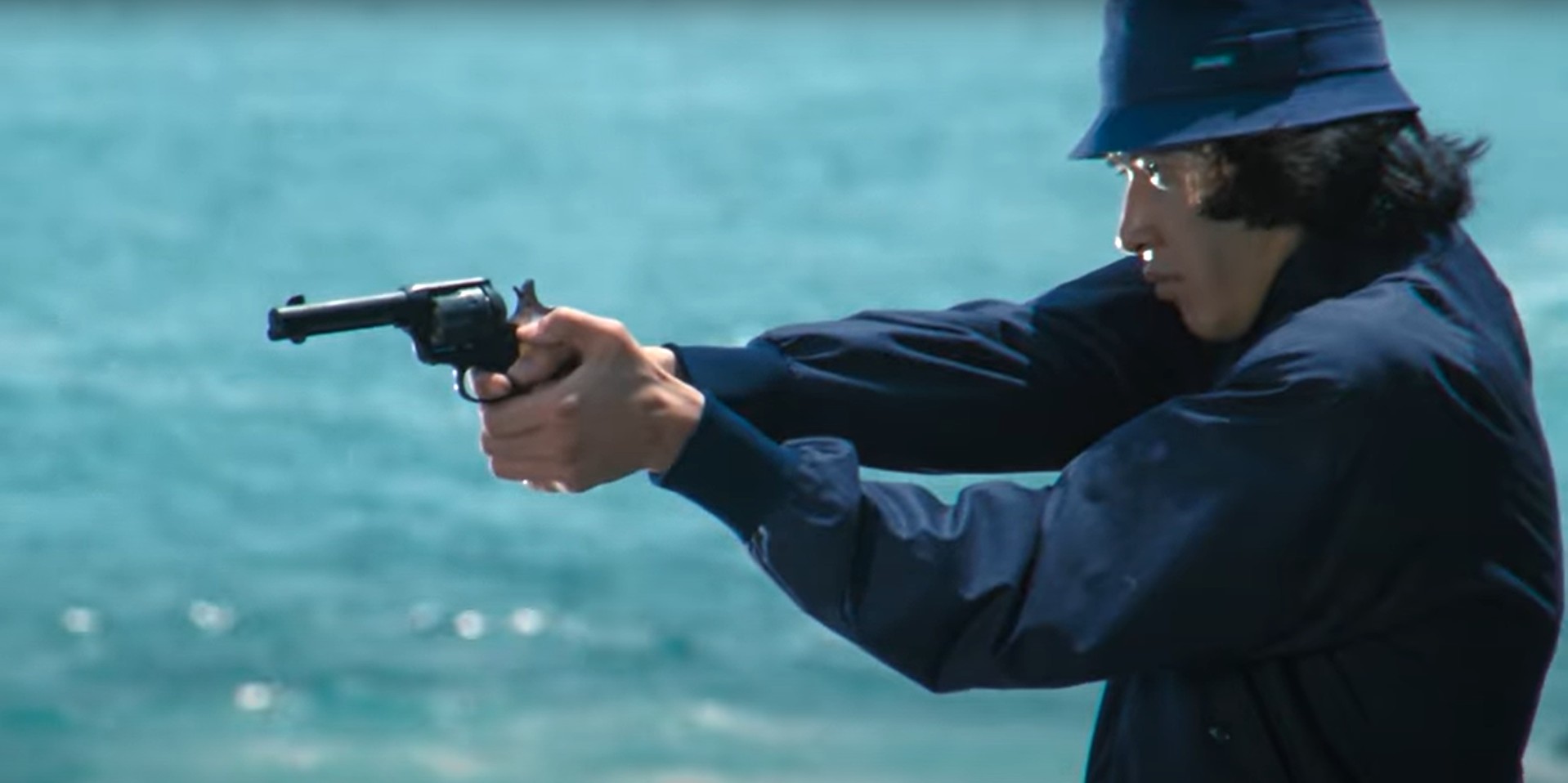
Former war journalist, Kunihiko Date, stabs a veteran police investigator to death.  He then uses the detective’s revolver and guns down three, after hours casino employees in cold blood and steals the day’s earnings.  Date’s seemingly random acts of violence and theft from a respected war journalist and photographer are not just random acts but part of a methodical plan for an upcoming heist of a bank in Tokyo’s Nihonbashi district.  Casing the bank’s security, personnel, and layout, Date’s perfect plan has one hitch; Because of the bank’s size and bustling busines, he’ll need a little help.  By chance, he comes across Tetsuo Sanada at an annual school alumni dinner with his closest friends who have a violent run-in with Sanada as their antagonistic waiter.  Seeing the same potential disregard for life and disdain for existence conventions, Date approaches Sanada and mentors him under a nihilistic wing.  Now with a plan and an accomplice, Date’s violent holdup can move forward but to what end is the length of his sociopathic carnage. 

“The Beast to Die,” aka “野獣死すべし, Yajū shisubeshi,” is the intense and violent noir-thriller from Japan, directed by “Dead Angle’s” Tôru Murakawa and a script by Shoichi Maruyama (“The Triple Cross”).  The 1980 released feature would be Murakawa and Maruyama’s second feature length production together behind 1979’s “The Execution Game,” the second film of a trilogy known as “the Japanese Game Trilogy is a visceral yakuza tale of a kidnapped hitman unable to escape the criminal underworld. “The Beast to Die” is a step away from the Japanese gangster film; instead, focuses on the interpretation of war trauma, the cynical views of precious life, and has subtle presences of U.S. big brothering, asexual themes, and coarse, unforgiving violence at the highest level of sophisticated society.  Adapted from the Haruhiko Ôyabu novel of the same name, the written origin mirrors the vehemency of visual art with the film produced by Haruki Kadokawa (“Virus”) and “The Resurrection of the Golden Wolf’s” Mitsuru Kurosawa and Tatsurô Shigaki under the Toei Company and Kadokawa Haruki Jimusho.

Undoubtedly one of the best sociopathic performances of our lifetime, “Horror of the Wolf” and the Japanese Game trilogy’s Yûsaku Matsuda is a cool, awkward, and, if not, plotting cucumber amongst the masses of jovial and hustling Tokyo denizens.  There’s a serenity about Matsuda’s Kunihiko Date that’s unparalleled, represented by blank stares, a patient demeanor, and precise movements that come in stark contrast in the film opener where Date takes down four people in one night in a show of murderous inexperienced bravado.  Even in the thick of combative survivalism, there’s only objective goal in his sweat infused brow and focused eyes while others gesture and make an invitational show of his attack or of their pleas for mercy.  Date becoming lost in classical music is a formidable way of grounding himself, not only from the high of excitement and thrills of killing, but also a way to retain sanity in the notes, an aspect he quickly unravels from when not exposed to classic music for an extended period.   Oppositely, Tetsu Sanada is full of pent-up anger as if he’s constantly hitting his head on the wall aiming to break free of the surroundings that confine his wild tiger attitude, yet Takashi Kaga (“Isle of the Evil Spirits”) maintains a personal struggle lock on the full emergence of Sanada as Kunihiko’s equal.  This dichotomy between the anger and tranquility of two sociopaths is immensely palpable that leads to a purposeful instability in a number of areas – hesitation and certainly, the sweat-inducing fear and the cooled fearless, and, eventually, the relationship’s ultimate internal destruction.  Thrown into the Kunihiko and Sanada tango is a potential love interest in the puppy-eyed Asami Kobayashi (“Sixteen Years Old:  Nymphets’ Room”) and her shared classical music and tenderness connection with Kunihiko and a happenstance Detective, played with casual approach by Toshie Negishi (“The Rapacious Jailbreaker”), being in Kunihiko’s consciously aloof presence as a pressuring force that suspects something between something off with Kunihiko and the murder of his detective colleague. 

“The Beast to Die” explores various themes around the indirect damage of post-war trauma and living and feeling like an outsider of the what’s consider the normal societal collective, but there’s another avenue to look down when consider Murakawa’s villainous protagonists.  Kunikhiko Date may have been scarred by war, but his mind always had an inkling for bloodthirst, sated through the images of a photographic lens that captured the horrors of global conflict from military losses to the collateral damage.  Upon his return to Japan, Date had lost the exciting sensation of death that has exceled his rationality beyond being Godlike, able to take life without conscious due reproach.   Sanada, in a way, is similar in his radical viewpoints but Date finds him more talk than action, held behind the line he has yet to cross unlike Date’s journalistic meatgrinder and his self-drive to kill the detective and casino workers.  As far as vices go, neither men have an appetite for sex:  Kunikhiko  watches a sex worker masturbate with little interest and his connect with Reiko doesn’t go beyond the gazes into each other’s eyes and Sanada’s fortunate relationship with his girlfriend provides him with well-off opportunity in money, business, and romance but because she dapples in rendezvous with a U.S. sailor, Sanada finds himself engrossed with spite.  Both men become essentially sexually impotent with seeing red, in anger and in blood, replacing that primal need or ravenous appetite.  The last scene between the two men becomes a crucial turning point in their cruel comradery as the forceful sex act with an unconscious woman sends the other unravelling their partnership for good.  “The Beast to Die” is a cynically cold narrative without regard for human life in the traumatizing belief one can surpass the omnipotent Gods by ending the existence of others.

A compelling dark thriller relatable to contemporary trauma feeding mentally warped violence, “The Beast to Die” arrives onto a limited-edition Blu-ray from Radiance Films.  The UK label produces a Kadakawa Coprporation-created digital 4K restoration transfer from the original and pristine 35mm print.  AVC encoded onto a BD50 and presented with 1080p high-definition resolution in a 1.85:1 widescreen aspect ratio, this Stateside edition is the picture of health with a rich palate that’s stark with contrast.  Skin tones and textures, as well as fabrics, emerge into perspicuousness without missing or dropping a beat.  Negative spaces and shadows enshroud appropriate with the keyed lit dim levels.  The grain is pleasant, stable, and natural and there are no real issues with the print itself, withstanding the test of time.  The uncompressed Japanese PCM 2.0 Stere track offers a reasonably ample sound design and fidelity with post-production dialogue, foley, and ambience recordings that creates some mismatch and distancing space between the action and atmosphere audio and the character diegetic dialogue.  There are no rough patches to mention within the audio recordings, producing more than fine discernible quality to the technical threshold.  Japanese to English translator Hayley Scanlon provides newly translated English subtitles that are spotless in the Blu-ray’s world premiere with English subtitles.  Limited to 3000 units, Radiance offers exclusive special features, including new interviews with director Toru Murakawa, screenwriter Shoichi Maruyama, and a film critique and analysis from novelist and screenwriter Jordan Harper.  The newly commissioned artwork by TimeTomorrow revamps with a new look and layout on the classic, original poster art as the primary Amaray front cover with a reversible side housing an alternate rendition.  There are new and archival essays and archival in the limited edition booklet with 27-pages of color stills, a Tom Mes Yusaku Matsude:  Lost Rebel essay from 2004 showcasing the art and films of the lead actor, a new Tatsuo Masuto essay Shadow of the Beast, cast and crew acknowledgements, and transfer notes and Blu-ray release acknowledgements.  Encoded with a region A/B lock, Radiance Films release has a runtime of 119 minutes and is not rated.

Last Rites: Radiance Films’s limited edition run of “The Beast to Die” is immaculate in every aspect – filmically, technically, packaging – and is an important piece of Japanese culture and cinematic criterion.

“The Beast to Die” on Limited Edition Blu-ray from Radiance Films!