Travel to Mexico, EVIL Said. Cure my Cancer, EVIL Said. Let the Game Begin, I Said. “Saw X” reviewed! (Lionsgate / Blu-ray)

Become A Part of the Game in “Saw X” on 4k/Bluray/DVD

Having a finished a trial by fire game of rebirthing the morally bankrupt that has coined him notoriety as the Jigsaw Killer, a terminal ill John Kramer ceaselessly searches a cure in order to continue his work.  Meeting a fellow cancer therapy group member outside of session provides hope when John learns a radical new and unauthorized surgery and serum cocktail that is seemingly a miracle cure for cancer.  His desperation led inquiry lands him in Mexico where he meets a team of specialists prepping his next day surgery and just when post-surgery John Kramer believes he’s beaten cancer, Kramer realizes he’s been a victim of fraud that’s exploits the most vulnerable and desperate ill-fated people.  Now, a new game begins to test the con artists on how far they will go to live. 

Six years has passed since the last “Saw” sequel was released with the Chris Rock helmed tangent spinoff “Spiral” and 13 years has passed since the last time John Kramer was a part of the game in “Saw 3D.”  2023 marked the return of to the basics with no divergent story from the Book of Saw or fleeting three-dimensional gimmicks to feign tangible blood and body parts in the tenth feature length film of the franchise known as “Saw X.”  The original story-lined sequel also reengages director of “Saw VI” and “Saw 3D” Kevin Greutert to pick up where he left off with a prequel that explores more of Kramer’s more vulnerable side as well as explore the time in between “Saw” and “Saw II” and it’s now unveiled characters who were then shrouded from view, working side-by-side with John Kramer, many years ago.  The writing duo of Peter Goldfinger and Josh Stolberg return from to the franchise after “Jigsaw” and “Spiral” to pen the script for the Twisted Pictures and Liongsgate Production with franchise decision making team of Mark Burg and Oren Koules producing.

So what has Tobin Bell, the face and persona creator behind John Kramer, been up to since 2017’s “Jigsaw?”  Well, let’s just say the now 81-year-old actor has starred in a string of under-the-radar, non-theatrical films that can’t seem to break him out of his bread-and-buttered pigeonhole as a man testing people’s will to overcome by severe measure.  The past year’s dysfunctional family rollercoaster “Sleep No More,” Darren Lynn Bousman’s creepy Saudi Arabian horror “The Cello,” and even a stint of various roles through “The Flash” television series over the years in between have barely moved the needle amongst audiences despite the projects critical and public acclaim.  While it’s a shame Bell receives little recognition for other projects, seeing him return to the role that made him a household name amongst horror fans is a sign of relief knowing Tobin Bell can still draw in a crowd, stepping almost seemingly effortless into John Kramer’s shoes of controversial convictions and never losing a step to bring a cunning and complex antihero back to the big screen with more blood on this hands, literally.  Kramer is not the only familiar to return as Amanda Young comes into the fray prior to her coming out in – ***Spoiler Alert***- “Saw II.”  Shawnee Smith reprises the role donning an unflattering pixie cut that’s even shorter than her “Saw II” hairdo, which keeps true to the timeline, but what plagues both Bell and Smith for a prequel is father time that rears his ugly head on both actors who are not getting any younger to play supposedly younger versions of their characters from which they last portrayed them.  This applies especially to Shawnee Smith who resembles very little of herself from her last appearance in a “Saw” film.  Yet, this doesn’t stop both Bell and Smith to re-embrace their roles and add more layers to their already nuanced identities as John and Amanda ensnares new game players South of the border in Gabriela (Renata Vaca), Valentina (Paulette Hernandez, “My Demons Never Swore Solitude”), Mateo (Octavio Hinojosa, “Come Play With Me”), and Cecilia Pederson (Synnøve Macody Lund, “Haunted”). ”Saw X” co-stars Steven Brand (“Mayhem”), Michael Beach (“Deep Blue Sea 2”), Costas Mandylor, Joshua Okamoto, and Jorge Briseño.

What most will come to realize about “Saw X’s” series placement in time is the foreshadowed knowledge of when and where John Kramer and Amanda Young meet their demise. What can the writers and producers add to a prequel that will enthrall and cause apprehension knowing that the two biggest players in “Saw’s” franchise ultimately live at the end of this intermittent story that mainly surrounds Kramer’s desperation for a cancer cure? To enthrall is simple by adding new bad apples into new escapable blood-drawing, death-dealing traps inside a humanizing John Kramer footnote outside the core city games that intertwine, interweave, and intersect from the very first Saw to the very last Saw in 3D. To surface apprehension for our foretold survivors would take some creative effort. In comes Jorge Briseño playing an adolescent Mexican boy innocent in all of this die-cathlon caught in the wrong place at the wrong time. While the boy, Carlos, adds an X-factor to the dilemma, the fate unknown is relatively short-lived as the boy only becomes a noteworthy shake up of emotional twists between the game’s masterminds near the very tail end, leaving only the wills to struggle painfully as they face themselves in forced contrition. The games Kramer quickly rigs up after the disbelief of being scammed are as industrial medieval and terrifyingly tense as any other “Saw” but unlike the other installments where Jigsaw has planned and engineered meticulously each game, these new set of trap trials are quickly welded and mechanically put together in a blink of an eye, or at least it seems, with no real show for the time put into the turnaround from fraud to fear and that lack of attention can seriously dull “Saw’s” already serrated credibility. 

Saw X” arrives onto a 2-disc and digital combo set from Lionsgate home video.  The Blu-ray is an AVC encoded, high-definition 1080p, BD50 and the DVD is MPEG2 encoded, DVD9 and both formats present the film in a 1.85:1 widescreen.  Through the lens of franchise newcomer Nick Matthews, there’s a sense that the “Spoonful of Sugar” director of photography tries to reproduce some of the style of the first six of David A. Armstrong’s steely industrial color palette but emulating more of his own personal choices to match the out-of-the-city harsh blues and greys for more warmer tones, like mustard yellow, but those progressive hues establish in the second half after really teetering on a natural lens and a harsh saturating tints, such as when John Kramer enters the surgical cube and is bathed in a navy blue hue that eliminates details entirely but only for that tinted moment.  For the rest of the picture, details are grisly good with lots of medium-to-extreme closeups to detail out exposed anatomy of what makes “Saw” rotate so well.  Charlie Clouser returns to score the tenth film on an English Dolby Atmos mix with Dolby Digital TrueHD 7.1 and 5.1 Spanish and French options available.  A really potent and powerful recreation of fidelity scores well for Clouser who recaptures the original crescendo of the final twist while keeping an industrial discordance floating behind the storyline with rising volume during trap countdowns that never interferences with the range of sounds or depth between each of the character sand the traps and the characters.  Dialogue is clean as a whistle and balances perfectly on that serrated slack line of a chaotic countdown to one’s own demise.  English descriptive audio and English SDH are available with regular English, Spanish, and French subtitles also included.  Special features include an audio commentary by director Kevin Greutert, cinematographer Nick Matthews, and production designer Anthony Stabley, a Reawakening documentary that discusses how the prequel was actually “Saw 9” but was shelved for the Chris Rock produced spin-off and how the sequel evolves since it’s rejuvenation years later, there’s a drawing inspiration look into bringing the series to Mexico and all its unique culture and mythos, makeup department trap tests, deleted scenes surrounding more depth between Kramer and Amanda, and the theatrical trailer. On the outside features, a slightly embossed titled and eye-sucking trap victim grace the rigid cardboard O-slipcover, keeping true to most of the “Saw” theme traps in home video posters and home video art, with the traditional Amaray cover art sporting the same design without the embossing. Along with the digital code insert, the two discs are housed separated on each side of the case, both pressed with the same Aztecan-inspired circular saw. The Lionsgate release is locked on region A North American playback with a runtime of 118-minutes and is rated R for sequences of grisly bloody violence and torture, language, and some drug use. ”Saw X” breaks many of its own traits like set not in a city and doesn’t have an incorporated investigation parallel but, in the same breath, feels very much like a back to basics, not only in proximity to the original “Saw” story and with the return of familiar faces and characters, but also in John Kramer’s preadolescence in figuring out and shaping himself to what he would become as the notorious Jigsaw Killer. 

Become A Part of the Game in “Saw X” on 4k/Bluray/DVD

Never Trust a Script Written by an Egotistically EVIL “Scream Queen” reviewed! (Visual Vengeance / Blu-ray)

This Chainsaw’s Made for Cutting! “Scream Queen” on Blu-ray!

Malicia Tombs, an acclaimed horror actress known for B-movies and bad attitude, bursts into a wreckage of flames when her car sudden explodes after storming off the set of her new movie, “Scream Queen,” in which she wrote and starred as the titular character.  Part of the cast and crew were devastated by the accident that had cut their own career short while others were relieved the egotistical Tombs had perished despite publicly feigning grief over the loss of a genre fan-favorite.  Months later, the small cast and crew receive a mysterious invitation to gather at a creepy mansion butlered by Runyon.  When their host is unveiled as to be a very much alive Malicia Tombs, she offers them a lucrative sum of money to finish the film they’ve started but with a new script.  As the guests read through the new treatment, the cast and crew realize their present moments read just as their being played out in the script, even their deaths. 

If there was ever a single face deserving the representative distinction within an overpopulated categorized scream queen genus, Linnea Quigley would be that green-eyed, blonde-topped, beautiful face with an infectious smile.  Quigley worked with an array of filmmakers, ranging from some of the most renowned cult films of all times amidst reams of horror movies for nearly half a century (yes, we’re feeling old now) to the most independent of the independents films never having really receive the proper exhibition format or audience attention.  To what would be a delight to Quigley’s fanbase, one of those obscure features is Brad Sykes’ “Scream Queen,” a late 90’s filmed, 2002-released, SOV, U.S. slasher written-and-directed by the “Camp Blood” and low-budget filmmaker with Quigley in mind to play the scream queen character Malicia Tombs, now available, officially, on Blu-ray.  “Scream Queen” is the first major project for Brad Sykes in a collaborating effort in not only as a director but also as a co-producer alongside David Sterling of Sterling Entertainment.

“The Return of the Living Dead” and “Night of the Demons” Quigley puts on another memorable and wickedly fiendish performance as the haughty genre scream queen Malicia Tombs who superiority has gone to her head as she embraces her designation to an exact mania, displayed early on when her character’s character attempts to choke-kill another actress despite the numbered scene not being a death scene and Malicia harps on wanting to continue with the resembling act of murder.  As much as Malicia Tombs embraces the killer instinct inside of her, Linnea Quigley very much embraces Malicia Tombs without having to take her top off and despite having less screen time than her costars.  While Quigley fades in and out of the linear story, the narrative progresses with livelihood hardships of the now out-of-work cast and crew who relied heavily on that small film to boost their acting and filmmaking careers.  That crop of characters falls short tipping into their expectations, aspirations, and even their relations to be just slasher fodder for the mysterious maniac roaming the house.  Jenni (Emilie Jo Tisdale,” Escape from Hell”) and Devon (Nova Sheppard) are inferred romantic roommates who sell clothes on the side of the street to make ends meet post failed film but don’t have surmountable direction to either be a full-fledged couple to sympathize or seem terribly concerned about opening their own clothing shop other than what would be a bad decision to reside at the mansion overnight.  Again, no sympathy there either.  The special effects goof Squib (Bryan Cooper churns chuckles relentlessly by relating more to his crafted effects dummy more than people, marking him conclusively comedy relief as well as fated for death that, like in life, no one takes him seriously when he shows up gruesomely mutilated.  The other principal actress across from Tombs is Christine (Nicole West, “Dimension in Fear”), a buxom blonde tired of secretary work succumbing to lead man flirtations in a dark and scary house where every shadowy corner is lodged with threat.  The pair fall into that horror character cliché of have sex, will die, quickly downgrading their pre-professional relationship into nothing more than dark house desire.  Director Eric Orloff (Jarrod Robbins, “Evil Sister 2”), a presumed spin on the Awful Dr. Orloff and perhaps hints at his motives, seems to be stuck in angsty avoidance and melancholy stemmed by what could have been with Scream Queen but that also peters to a gross negligence end of an arc waste.  Rounding out the cast are a couple of special bit parts played by prolific Full Moon Entertainment and overall horror movie screenwriter C. Courtney Joyner (“Puppet Masters III,” “From A Whisper to Scream”) as a televised homicide detective and Kurt Levee in a quasi-return of his character Runnion from “Evil Sister” but alternatively spelled “Runyon” in “Scream Queen.”  

Though obviously and definitely not the first to do this, “Scream Queen” humors metacinema measures built upon horror tropes and spherical plot points that redirects the story back upon itself for a killer effect.  The feature has no issues making and poking fun at itself within a campy context albeit the usually grave apprehensions of a true scary slasher movie that’s less campy of which a scream queen is born – think Jamie Lee Curtis in “Halloween” or Neve Campbell in “Scream.”  Bryan Cooper not only portrayed the foolish effects guy persona but also actually did a lot of the gore gags for the film, achieving very detailed inlaid gore prosthetics for a smalltime picture with an axe embedded into a chest and a mangled face to name a few.  The story itself feels a bit rough and ready as it slips into supernatural obscurity and, as aforementioned, character setups flounder to a stagnation, killing instantly the miniscule arcs that were structured prior to their mansion gathering in what becomes a slapdash of serial offing that wraps up the story post-haste without much cat-and-mouse tension.  With that said, “Scream Queen’s” unpolished plot had once mirrored its fallowed physical release until recently but now witnessing its birth out of twilight has been multitudinous worth the wait. 

Another of Linnea Quigley’s lost films has been resurrected from the format graveyard by Visual Vengeance with a new Blu-ray release of “Scream Queen.”  The Wild Eye Releasing sublabel release comes with an AVC encoded, high definition interlaced scanned and director approved 1080i transfer from the 480p tape elements on BD50 capacity and comes also with the qualitative joys of a standard definition shot on video experience.  SOV tape upconversion can never completely eradicate the imperfections associated with tape and we also know this going in courtesy of Visual Vengeance’s standard practice of a fair warning before the film, but the overall “Scream Queen” presentation passes as clear content despite some minor tracking blips, 1.33:1 aspect ratio, original lower resolution, and scan line visibility, which is smoothed out nicely by the 1080i conversion. Exteriors and brightly lit scenes take on more shape compared to darker and low-lit areas that become like a void in standard DEF, which also hits the natural grading into a washed-out drab.  The English Dolby Digital 2.0 stereo labors to maintain some form of auricular strength but often nearly goes dark to where certain Linnea Quigley monologues periodically go silent for a few seconds, so the dialogue isn’t entirely clear but when it is, it’s relatively clean. There’s no hardiness pop in the audio track, staying suppressed throughout, and having little-to-no range or depth to the compile contexture. Some electro-interference throughout but nothing to be bothered by considering the grade of the SOV. Optional English subtitles are available. Special features include a commentary with writer-director Brad Sykes, a new behind-the-scenes documentary Once Upon A Time Horrowood that’s mostly Brad Sykes going through the stages of making “Scream Queen” and his recollections of his first big time produced film, a new interview with star Linnea Quigley, a new interview with one of the three various editors Mark Polonia (director of “Splatter Farm”), an original full-length feature producer’s cut of “Scream Queen,” a behind-the-scenes image gallery, Linnea Quigley image gallery, snippets from the original script, original trailer, and other Visual Vengeance distribution trailers. Along with the hearty software special features, hardware physical features include a six-page trifold with behind-the-scenes color photos notes by Weng’s Chop Magazine’s Tony Strauss and beautifully illustrated with dripping blood, a chainsaw, and Linnea Quigley on the front cover, a folded up mini color poster of a scantily-leathered Linnea holding one of the film’s murderous weapons, retro stickers, and your very own Four Star Video plastic rental card. All of this great stuff is stuffed inside a clear Blu-ray Amary case with a pressed disc art of a bloody illustrated Linnea sawing some unknown guy’s face off. The same illustrated graces the front cover in an expanded form and under a different hue. If you don’t like it, which I would be hard-pressed if you don’t, the reverse side contains one of the original cover arts with, again, a scantily-leathered Linnea holding that murderous weapon. The entire package is sheathed inside a rigid O-slipcover with an extended view of that chainsaw scoring with a bloody spray the eyeball from some guy’s face. The 13th Visual Vengeance release comes region free, unrated, and has a runtime of 78-minutes. Lost vintage now found and digitally revived to give us even more Linnea Quigley than we knew we needed with a meta-film shows initiative and fit special effects but swerves off trajectory into a more-of-the-same pathway. 

This Chainsaw’s Made for Cutting! “Scream Queen” on Blu-ray!

EVIL Wants Your Brain Fluid! “Vile” reviewed! (MVD Visual / Blu-ray)

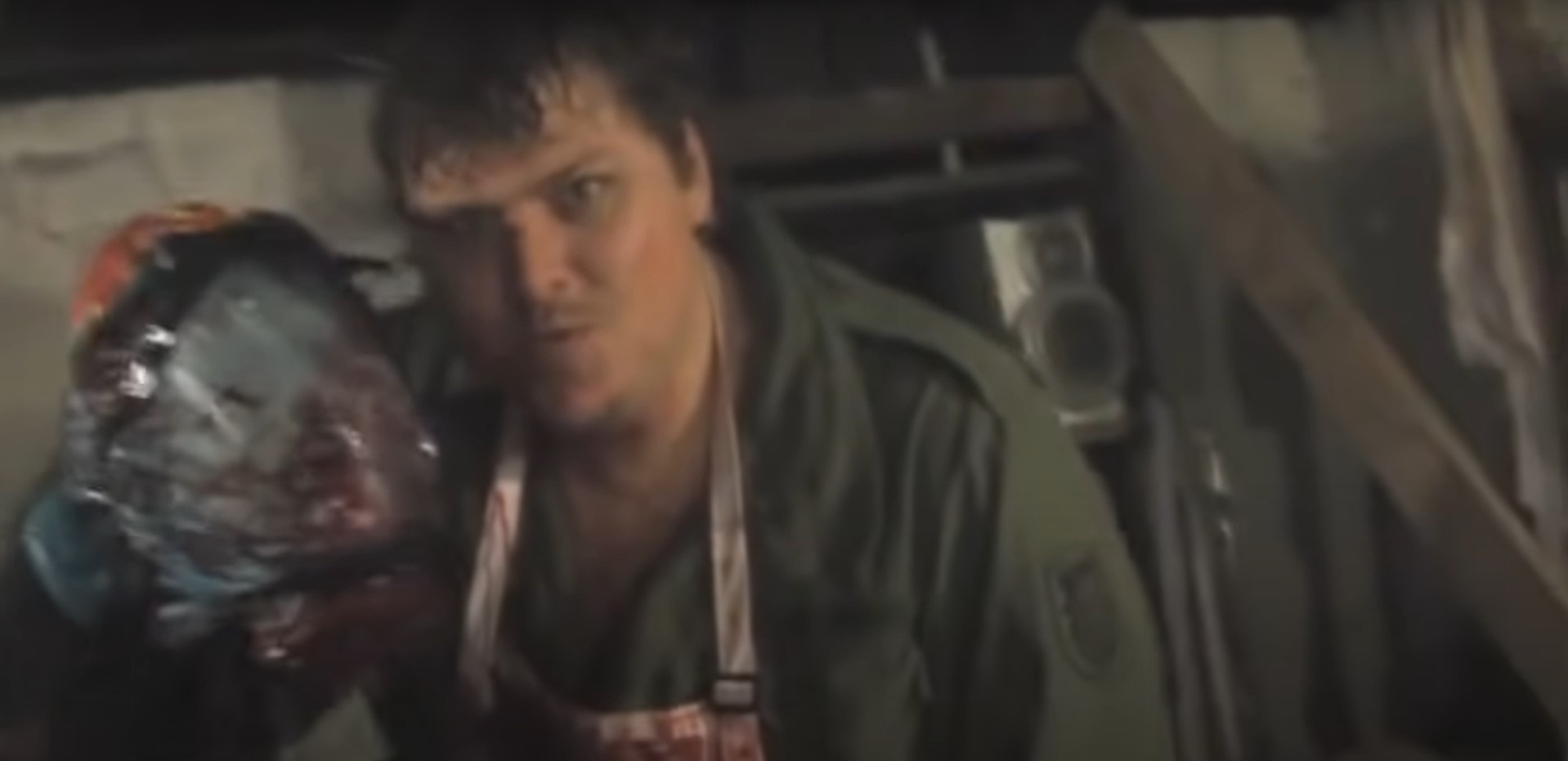
These “Vile” Atrocities are now on Blu-ray!

What was supposed to be a relaxing camping trip amongst friends has turned into a torturous nightmare when four friends wake up to find themselves in the company of five strangers in a basement and learn they’ve all been kidnapped for a purpose.  Behind the illicit arrangement is an illegal drug manufacture whose formula is produced from the byproduct of the brain’s fear and pain induced chemicals.  With a 22-hour clock counting down from the first act of violence, the puzzled lot must fill a 100% quota before time runs out in order to be set free from the reinforced house they awoke in and the only way to do that is by hurting each other to fill the vials connected to the backside of their heads.  Framing a plan, a vote proceeds a numerical order of voluntary participation of torture, each contributing a fraction of the pain percentage needed to survive and be free, but egos, fears, and secrets cost them more than a few moments of unbearable pain.   

Before becoming Paramount Network’s golden nugget for creating the more recent acclaimed American television drama with shows like “Yellowstone,” “1883,” “1923,” “Tulsa King,” and “Special Ops:  Lioness,” Taylor Sheridan had first directed a small-time horror movie over ten years ago in 2011.  The title “Vile,” a play on words used to not only describe the cruel atrocities done from one character to another but also alluding to vial containers used to fill up with fear and pain fluid, is the brainchild of scriptwriters Eric Beck and Rob Kowsaluk.  Certainly, a different tone compared to hardnosed westerners and high-profile casted thrillers, Sheridan filmmaking roots from “Vile” mold his next stage directions of cruel character dynamics.  Beck produces the feature with Noël K. Cohan (“Into the Void”), Tina Pavlides (“100,000 Zombie Heads”), and Kelly Andrea Rubin (“Skeeter”) with presumably father Larry Beck footing some of the funding under the LLC of Vile Entertainment in association with Bosque Ranch Productions and Signature Entertainment.

An ensemble cast thrusts strangers into the throes of do-or-die but amongst the cast of characters, a delicate introduction of a core four put forth the wheels in motion of the sick extraction technique all in the name of drugs and profit.  The preliminary meet-and-greet of Nick (Eric Beck), Tayler (April Matson, “Primrose Lane”), Tony (Akeem Smith, “Holla II”), and Kai (Elisha Skorman) sets up love interests, Tayler’s secret pregnancy, Kai’s drug problem, and a playfully semi-morbid game of would you rather that foreshadows another choice pick of torture later the group has to contend with when joined with the other five test subjects – a dark and cryptic Greg (Rob Kirkland), a subtly anxious Julian (Ian Bohen, “5 Souls”), a selfish hothead Tara (Maya Hazen, “Shrooms”), a young and frightened Lisa (Heidi Mueller) and a level-headed Sam (Greg Cipes, “Deep Dark Canyon”). The variety of character provides varying shades of distrust, betrayal, and hope as factions form and convictions are about-faced, jostling those steadfast at first and solidifying principals for those teetering on the edge.  As whole, the cast works well together to provide adequate and satisfying suspicion as well as selling a particular attitude despite a couple of red herrings that are hidden really well within the framework. As individuals, lots of the dialogue pertains to self-explanatory states of the obvious that stick out like a sore thumb of colloquial filler with a story set in one location with the same nine people for approx. an hour long. ”Vile’s” cast rounds out with McKenzie Westmore and the unmistakable Maria Olsen (“I Spit on Your Grave 2: Deja Vu”) in a procedure-nothing televised head. 

As much as I disfavor comparing one film to another outside of sequels, series, or franchises, “Vile’s” voice is lost as an individual. Seven years prior, James Wan and Leigh Whannell began what would become one of the biggest contemporary horror franchises with “Saw,” spanning sequels through two decades, and concluding, thus so far, with this past year’s “Saw X.” What does this have to do with “Vile?” ”Vile” follows much of the same formula Wan and Whannel concocted in the earlier 2000s with a very to-the-manual approach of “Saw’s” collaring of individuals, media announcing a timed-task, and the players of the game have to hurt themselves, or others, in order to be set free. Fundamentally different with “Vile” has more to do pure greed and profit at the expense of those unfortunate to be in the path of profiteers whereas “Saw” forces transgressors into rebirth through pain and suffering. ”Vile” is also not as explicitly graphic with much of the torturous violence done out of sight, off screen, or in a blink of an eye. Nevertheless, the intriguingly staid premise takes the human condition to the limit and steps across the line of no return of committing what is self-destructively necessary to survive. Beck and Kowsaluk tweak the formula by a narrow margin but the manner of how the narrative plays out distances “Vile” to almost unitary means. For example, “Saw” almost always had a dual storyline that eventually converges with a shocking twist-tie conclusion. ”Vile’s” straightforward with a singular storyline that isn’t dichotomized with a parallel storyline, a periodization storyline, or any other type of storyline to be a crutch for the other, leaving audiences in the undivided present that’s an around-the-clock time crunch to live or die by the hands of themselves or at the mercy of others, and with a palpable enough twist that you’ll kick yourself in the chin for not predicting it ahead of time. 

“Vile” comes to Blu-ray from MVD Visual on the company’s Marquee Collection label. The AVC encoded, 1080p High-Definition, BD25 has the film presented in a widescreen 1.78:1 aspect ratio. Limited to a two-tone grading of steely blues and canary yellows, picture quality range has spasmodic bursts of interiority to agreeable presentations. More of the pre-ensnarement night scenes appear granulated by macroblocking, degrading the image to pre-high definition pixelated rate. Bitrate decoding jumps sporadically from mid-teens to mid-30Mbps, most likely due to an unstable data compression transfer. Compression appears better, though not flawless, later in the runtime with tighter contouring and a finer detail on a grungy, dirty, dilapidated house where the main set takes footing. The English Dolby Digital 5.1 and the uncompressed LCPM 2.0 are the available audio options, both of which lack commodious conviction with a suppressed volume. While the dialogue renders sufficiently with discernibility and clarity, much of the eye-averting torture sound design, the milieu audio, and even the rock-hard rock soundtrack retains an undeliberate lo-fi quality. English subtitles are optionally available. Special features include two deleted scenes that expand on more of the earlier character interactions, a behind-the-scene moment of director Taylor Sheridan mopping the kitchen set and singing, and the feature trailer plus other MVD Marquee Collection trailers. Tangible features include a cardboard O-slipcover, first pressings only, vaunting the nastiness to come and, again, appropriates a “Saw” cover with that nastiness of an extracted, bloody tooth in a pair of vice grip, a nod to the “Saw III” poster/home video art. The Amary case has reversible cover art with the original “Vile” artwork on the inside. The unrated, 88-minute MVD Marquee Collection feature has a region free playback. If “Saw” is deluxe imperial crab, then “Vile” is the suitable imitation equivalent with a steady pace of group-wrenching contrition and contempt that forgoes the games for straight up blunt force trauma. 

These “Vile” Atrocities are now on Blu-ray!

Your Train Has Come in on the Platform EVIL! “The Ghost Station” reviewed! (Well Go USA / Blu-ray)

Cho-Cho-Choose “The Ghost Station” on Blu-ray!

The Oksu train station’s past has incur many strange occurrences over the 17-years since it’s construction but more recently has seen a string of bizarre deaths. When a public service worker Woon-won witnesses a man’s death on the rails, he reluctantly informs friend Na-young, a struggler gossip journalist in need of a good, multi-click story after being hit with a lawsuit from her previous writeup and landing in hot water with the editor. As Na-young and Woon-won dig deeper to save Na-young’s begrudging career, they soon discover there’s more to this story than meets the eye as train station commuters and workers begin exhibiting scratches over their arms and neck. Those marked eventually die horribly. Bodies pile up as the story leads Na-young to the past of a razed orphanage and visions of grotesque children become the center of the young journalist’s investigation until her friend Woon-won displays the same marks. Now, they must solve the curse before it’s too late.

Based off the real Oksu Station operated by Seoul Metro in the Seongdong-gu district of South Korea and the short digital manhwa webtoon entitled “The Ghost Station of Oksu” from Horang’s Nightmare, the 2022 movie adaptation “The Ghost Station” waters the short story webtoon and grows a surrounding plot around the only adapted portion of a near empty Oksu platform except for one bench-sitting man and a stumbling lady who appears to be intoxicated.   The South Korean-Japanese co-produced picture is written-and-directed by So-young Lee (“Apt”) and Hiroshi Takahashi, the latter is the Japanese filmmaker behind the popular “Ringu” series which crosses orient borders by being the most important or influential in “The Ghost Station’s” inhabited identical J-horror elements.   Co-productions Mystery Picture and ZOA Films pull the train into “The Ghost Station,” produced by Yoo Jang-Hun and is theatrically distributed globally between Smile Entertainment and Contents Panda.

The webtoon is only a leaping point for the film version.  Not establishing any cited characters in the illustrated horror story, a whole new plot is built around and extended upon the webtoon narrative of the drunk platform woman that ends in a horrific accident for the young gawker on his phone texting ridicule commentary of her inebriation.  Story continues with a gossip Na-Young on the heels of being reprimanded for not receiving consent for her story of labeling her subject a him despite being very convincingly a woman in looks.  Bo-ra Kim plays the tenacious yet conflicted journalist, self-deprecating her career as clickbait material rather than honorable news reporting until the supernatural Oksu Station occurrences shed light on a bigger, corruptible conspiracy.   The “Ghost Mansion” actress sleeps through what should be a cold-clenching tale of sprog spirits and callous coverups that form a mighty-gripped grudge on those unlucky enough traipsing through the station yet doesn’t really affect her directly.  Oppositely, her friend Woon-wan epitomizes exaggerated fright within the performance of Jae Hyun Kim who can express translated fear in breath holding moments but outside of that Kim dons childish whimpering and yelling as if it’s a fad.  Together, the actors cancel out their characters flaws by embodying one investigative team as a public station worker and a journalist uncovering the truth and to save themselves the next victims of vicinity vindictive spirits.  “The Ghost Station’s” richer performances are yoked by stinted deuteragonists that actually drive the story but feel suspended in their integrated impact and relegated to being flashbacks or wedged into one particular location without a ton of exposition or background.  The dictatorial gossip editor (Kim Na-Yoon), the creepy alcoholic mortician (Kang-il Kim, “I Saw the Devil”), and the first victim’s externally anxious, psychosomatic dreaming sister (Shin So-yul, “Pyega”) are colorfully acted, complex in character, and plod the story along intrinsically, yet they’re underutilized hanging around the peripheral with only the sister edging out the other two with a more direct connection to the grudge or curse. 

Without unwrapping “The Ghost Station” before watching the film, the story progresses along without any cause for concern with a supernatural sleuth story of a horrible train accident causing a domino effect of curses.  Deeper into the feature, a water well becomes a focal object, then abnormal faces of ghastly children appear, and the principals are using keywords, like grudge, grudge this, grudge that, and where have we heard of this before?  With Hiroshi Takahashi “Ringu” films dappled intermittently with “Ju-on” insignias that turn the initially promising K-Horror into a full blown J-Horror in repeated attire.  While directors So-young Lee and Hiroshi Takahashi are able to garner a handful of scares through technique, makeup effects, and morose aesthetics and dolor, “The Ghost Station” has a creative deficiency as there are just too many coincidental “Ringu” and “Ju-on” suspense devices to craft an original curse tale despite the positivity just oozing out from the idea of two nations blending their respective horror niches into one project that dissects the integrity of the individual.  Na-young’s ethical dilemma as a tabloid journalist carries weight and is tiptoed around when her editor urges for better clickbait material, Woon-won struggles with self-preservation and a friendship bond, and other minor examples add up to the summation of choice.  Many made bad choices that resulted in an orphanage full of pissed off preadolescents using their spook powers for premeditated parricide.   

Walk down to the platform and wait for your train to come into “The Ghost Station,” servicing now on Blu-ray home video from Well Go USA Entertainment.  The AVC encoded, 1080p High-Definition, BD25 is presented in a widescreen 2.39:1 aspect ratio.  What the release showcases, as far as image quality, is a more than adequate transfer of the substantially tenebrous picture that renders shadows without analogous banding or splotching.  The low-light grading offers a polished appearance with deep, rich shadows to provide a natural ominous atmosphere and partially shroud characters without compromising distinctive detailing.  The Korean language audio options include a DTS-HD Master Audio 5.1 and a Dolby Digital 2.0 Stereo track. A more than viable digital audio recording that clear and comprehensible with formidable sound design for quotidian scare devices that abled to still produce fear, using the back and side channels to flesh out the scare factor in a fine-tuned direction. Dialogue’s renders nicely without any technical or interfering barriers. English subtitles are optionally available, come error free, and pace well with the rapid Korean dialect. Like many of the Well Go USA titles, not a ton of bonus features are inlaid and the same is said with “The Ghost Station” that only holds trailers for other Well Go USA Entertainment films. In a traditional Amary Blu-ray case, the front cover pays homage to the Horang webtoon. Inside, an advert insert is included with other Well Go USA films from the company’s Hi-Yah! collection. The not rated feature has an 80-minute runtime and has a region A playback only. ”The Ghost Station” undertakes a mesh of identity between K-Horror and J-Horror that sought to pull up to the platform as a singular, supernatural, scare package and, in the end, the film pulls in as a train of consumable terror.

Cho-Cho-Choose “The Ghost Station” on Blu-ray!

100-Year Return Brings a Plague of Flesh-Eating EVIL to a Small Town! “Messiah of Evil” reviewed! (Radiance Films / Blu-ray)

The “Messiah of Evil” has Come to Blu-ray Home Video!

Arletty travels up the California coast to a small beach town known as Point Dune.  The reason for her visit is to find her artisan father after a series of bizarre letters came to an abrupt stop.  She arrives at his mural-graffitied home to discover it empty and decides to stay a few days to ask around town about his whereabouts and to be present for his return home.  Her inquiries at art gallery shopkeepers lead to a motel where Thom, a wealthy collector of urban legends and spooky stories, and his two travelling female companions, Laura and Toni, have also sought out Artletty’s father for his bizarre experiences.  As the days pass, Point Dune slowly becomes a literal ghost town that forces Thom and his companions to stay with Arletty and, together, they experience the horrible truth of what’s really happening to the  residents of the west coast community who eagerly await the arrival of the dark stranger. 

Once married filmmakers Willard Huyck and Gloria Katz are the creative minds behind the stories of “Howard the Duck” and “Indiana Jones and the Temple of Doom.”  They also wrote “American Graffiti” in what was to become their link toward working on Steven Spielberg’s Indiana Jones sequel since both “American Graffiti” and “The Temple of Doon” were both produced by the father of “Star Wars,” George Lucas.  Yet, in the midst of “American Graffiti,” the couple also penned and Huyck came into the entrance of directing with the 1974 horror-thriller “Messiah of Evil” that pulled from various themes of mindless consumerism and the rising fears of dangerous and deadly cults in the U.S.  Also known by a variety of titles around the world, including “Dead People,” “Night of the Danmed,” “Messiah of the Evil Dead,” “Revenge of the Screaming Dead,” and “Blood Busters” to name a few, the Californian coast shot film is a production of the International Cine Film Corp and V/M Productions with Gatz producing and Alan Riche (“Deep Blue Sea”) serving as executive producer. 

“Messiah of Evil” slinks into the soul leaving behind dread’s unwashed pull against what we know as conventional horror.  In order to accomplish such a fear-induced feat, a cast must envelope themselves fully in world of weird and irregularities that nestle an uneasiness stemmed not solely from their performances but from how they react to the eccentric environment, to the crumbling small town society, and to ghastly behaviors of normal-looking people.  Like most daughters, Arletty has concerns for her father and seeks to understand the truth behind his unhinged letters.  Marianna Hill (“Schizoid,” “The Baby”) plays the quietly curious at a cat daughter dabbing residents with barely an effort in interrogational questioning of her father’s whereabouts.  Hill floats Arletty through stages of a slow descent into madness that simmers slowly to a boiling point understanding of what’s taking shape around her.  The same happens to Thom, played by Richard Greer (“The Curious Female”), who initially is a fraction of the nonconformity surrounding Point Dune with his obsession toward collecting strange stories and his polyamorous collection of women.  Of character, Greer is resoundingly in control without being dominating with Thom who has wealth and magnetisms but isn’t someone to be beholden to forever as we see with Laura (Anita Ford, “The Big Bird Cage”) who deserts him for his open-door intimacy policy in his pursuit of Arletty and with the childish Toni (Joy Bang, “Night of the Cobra Woman”) in her infinitely naïve opinions surrounding the dull Point Dune.  One actor I wish we had more of but is utilized perfectly as Arletty’s father and a harbinger of what’s coming is Royal Dano (“Ghoulies II,” “Spaced Invaders”) in a non-humorous nor drunken idiot role that seemed to typecast him later in his career.  Dano’s short but sweetly terrifying stretch divulges a man torn between his previous life and a new terror that now occupies him as he interacts with Marianna Hill as concerned and contaminated father holding it all within toward his frightened, confused daughter.  “Messiah of Evil’s” cast rounds out with Elisha Cook Jr (“Rosemary’s Baby”), Bennie Robinson, and Charles Dierkop (“Grotesque”). 

Huyck directs with colorful and verismo synergism that takes the positives of what should be life’s routine pleasures and turns them against us as fantastical and harrowin deadly elements of false securities.  The rolling crashes of Point Dune’s waves takes on a constant cacophony of sinister foreshadowing, a bright and welcoming supermarket becomes a vacant trap in every aisle, the entertaining movie theater darkens with blood on the screen, and an artist’s home, full realistic murals and colors, is an oppressive feast of lifeless eyes.  Point Dune becomes a dead town, literally, as the inhabitants succumb to dark forces from beyond their years, turning primeval in their contemporary three-piece suits and evening blouses.  Huyck and Gatz story pulls inspiration from U.S. history and folklore to mark the 100-year return of spreading evil amongst the land, an evil that resorts to cannibalism by either spellbinding archfiend, an internal infection, or the rise of the undead and not just any mindless, shuffling, flesh-eating zombie but a transmogrified plotter able to move fast and think as a single unit with the touched by evil masse with telltale signs of a single rivel of blood seeping from out of their eye and their insatiable need to consume other people. ”Messiah of Evil” is not overtly graphic like George A. Romero zombies or like the unbridled number of zombie films to follow inspired by Romero’s zombie game-changing wake for the last 60 plus years, separating the flesh-eaters from Romero’s gut-gnashing, pale faced, and slow-walking undead and Huyck and Gatz’s transmitted pestilent receiving horde running fast in their best church shoes with vastly different traits. Huyck and Gatz dip into more eldritch means with the return of a paganistic dark stranger in a pared down explanation without explicitly being definitive who or what the dark stranger (a demon?Antichrist?) is that is driving foreboding signs to a doomsday-disseminating end. ”Messiah of Evil” thrives as the mysterious and strange fulcrum of the beginning of the end told through the point of view of young woman left to tell the world of what’s to come only to be about as believed as much as a man wearing a polka-dotted tutu who has delusions of unicorns dancing the waltz with garden gnomes in his front yard. 

United Kingdom distributor Radiance Films releases a new restoration transfer of “Messiah of Evil” also on their U.S. line. The AVC encoded, 1080p high-definition, BD50 presents a 4K scan of the best-known surviving 35mm print from the Academy Film Archive in a widescreen 2.35:1 aspect ratio. As noted in the release’s inserted booklet, the restoration processes used was the Digital Vision’s Phoenix Finish and DaVinci Resolve was used for color correction, under the supervision of Sebastian del Castillo at the Heavenly Movie Corporation. Audio was also restored with the Izotope RXB. For a surviving print, the original elements look pretty darn good with barely any celluloid hiccup. No vinegar syndrome, not significant tearing, or exposure to name a few issues of possibility. There are a few minor blemishes and missing or damaged frames that seem to provide an unwanted cut but most of “Messiah of Evil’s” film problems stem mostly behind the camera with a rework of the story during the stop-and-go production and conflicts in marketing the film, hence the various title aliases of the film from around the globe. Other detail low points are when the film is bathed in blue and purple gels and tint for to set an apprehensive wander and wonder while retaining more natural grading in its majority throughout. The resorted audio is a lossless English LPCM mono mix. Really focusing on the electronic score of Phillan Bishop (“The Severed Arm”), the low-frequency score sets a perpetual and durable tone of dread out of place in a prosaic small town, much like the Arletty’s father’s work-of-art home that sticks out amongst the mediocrity. In design, dialogue remains robust yet delicate when the scene calls for it, such as Elisha Cook Jr. story of how he was born in what is essentially him, as a vagrant paid for his story, making the only noise in the room. Dialogue in these moments is greatly discernible with negligible electronic interference. Depth layers the permeating isolation of a town gone mad in unison with the range stretching from the distressing design of rolling, crashing, oppressive waves to the scuffles of zombies’ consuls and heels scuffing against asphalt, pavement, and shattering through panes of glass. Radiance provides English subtitles with their release. Bonus features include a new audio commentary by film historian and horror archetype authors Kim Newman and Stephen Thrower, an archived interview with director Willard Huyck, and a new, feature-length documentary showcasing “Messiah of Evil’s” background, themes, production, and influences by various horror scholars, including Kat Ellinger who also voiceovers a visual essay on American Gothic and Female Hysteria, which if I’m being honest, parallelly treads on similarities with Ellinger’s Motherhood & Madness: Mia Farrow and the Female Gothic on Imprint’s “The Haunting of Julia.” Radiance has in the short time poured their heart and soul into their releases and “Messiah of Evil” is no different with a sleek cladded and clear Amara Blu-ray case that’s subtle in showing less but feeling more on the cover art, opposite of the reverse side that houses a classical black and white compositional illustration of characters. Inside the 28th release for the label is a 23-page color booklet insert with the appraisal writings of Bill Ackerman, transfer notes, release credits, and acknowledgements. The disc is pressed red, much like the red moon in the film, with a stark black title. The Radiance release is unrated, region free, and has a runtime of 90 minutes. ”Messiah of Evil” uses cult fears, satanic panic, and the loss of ordinary life to penetrate the spirit by way of slowly eating at it. The crawling, creeping dread meanders, much like Artletty who is seemingly held in place at Point Dune, and we’re glued to the engrossing rate of the terror to come orchestrated by the captivations of a once married couple on a fast track toward success.

The “Messiah of Evil” has Come to Blu-ray Home Video!