Re-Electrifying a Dead Cop to Stop EVIL! “The Blue Jean Monster” reviewed! (88 Films / Blu-ray)

Click Here to Purchase “The Blue Jean Monster” available on Blu-ray!

Soon-to-be first-time dad Tsu Hsiang can’t wait to meet his son.  Often times, his cop vocation intrudes on being there for his wife during her pregnancy as his torn between work and family, trying to be a good man in both regards, but when a tip comes through of a suspected bank robbery, Hsiang can’t neglect his duty and pursues the thieves in a high speed and gun-blazing chase that ends in his death as a construction site pile of steel rebar crushes him during the arrest.  His corpse left under the rebar overnight, a storm causes a transformer to fall on top of him and a cat providing a mystical lifeforce.  The electrical currents course through his dead body, reanimating him with the superhuman strength and invulnerable to pain, but with a cost as Tsiang is slowly rotting away, unable to heal or enjoy any of his senses.  Tsiang also has to recharge his body with electrical volts direct to body in order to continue being reanimated.  With time running out, the cop’s two goals are to meet his unborn child and to capture the gang responsible for him becoming an undead monster. 

While “The Blue Jean Monster” is not the eminent representation of comedy-action with elements of science fictional horror to come out of the Hong Kong movie industry, the early 90’s Category III film does rank high marshalling an entertaining “Dead Heat” (1988) interpretation for Eastern audiences.  The sophomore film of director Ivan Lai, aka Kai-Ming Lai, (“Daughter of Darkness,” “The Peeping Tom”) and the last script credit for Kam-Hung Ng emerges as a bucket list imbroglio of the inexplicable mysticisms at play as well as the good die young but win in the end.  The Jonathan Chow (“Haunted Jail House”) produced film is a coproduction of Golden Harvest Films, Diagonal Pictures, and Paragon Films. 
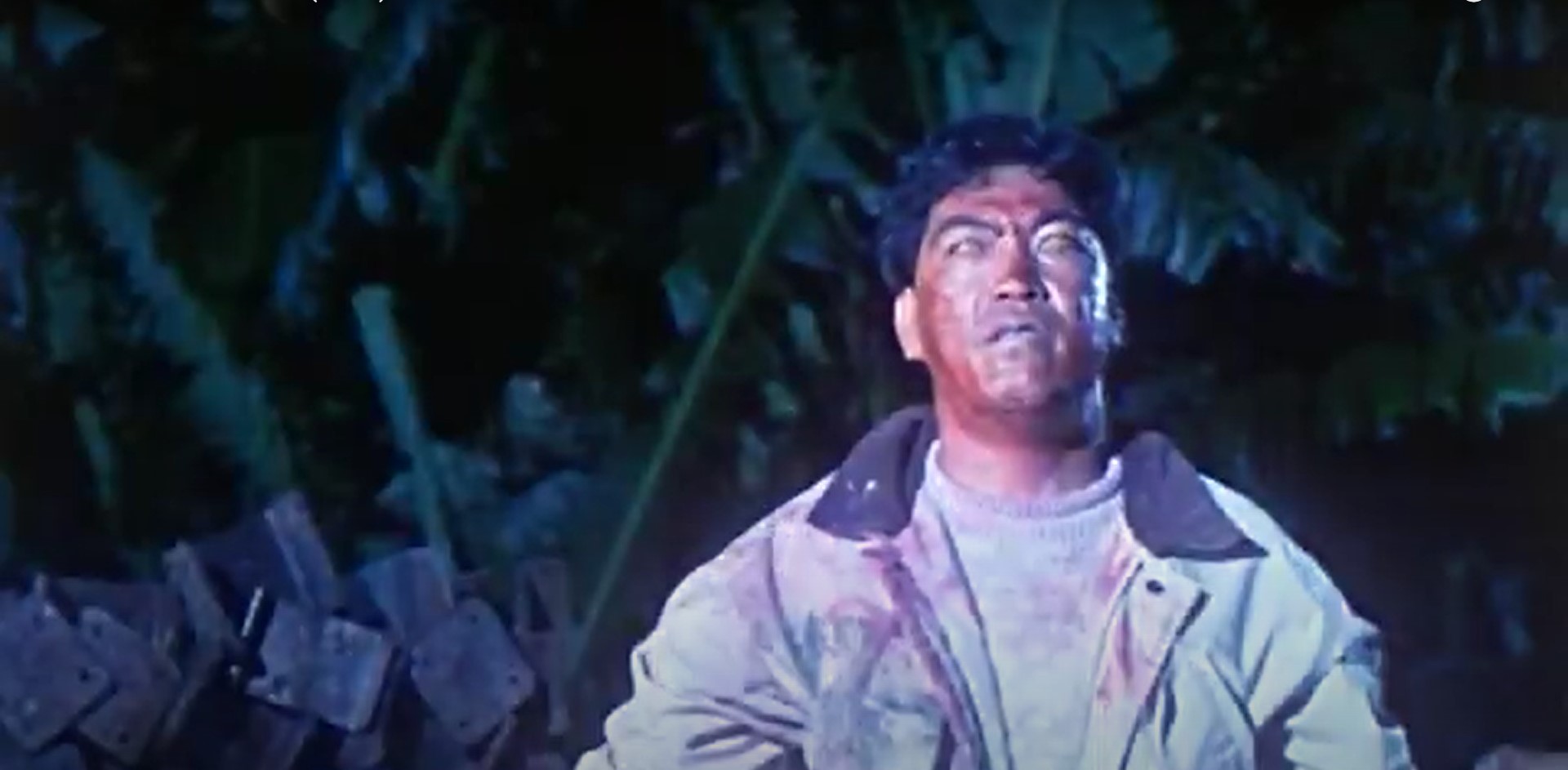
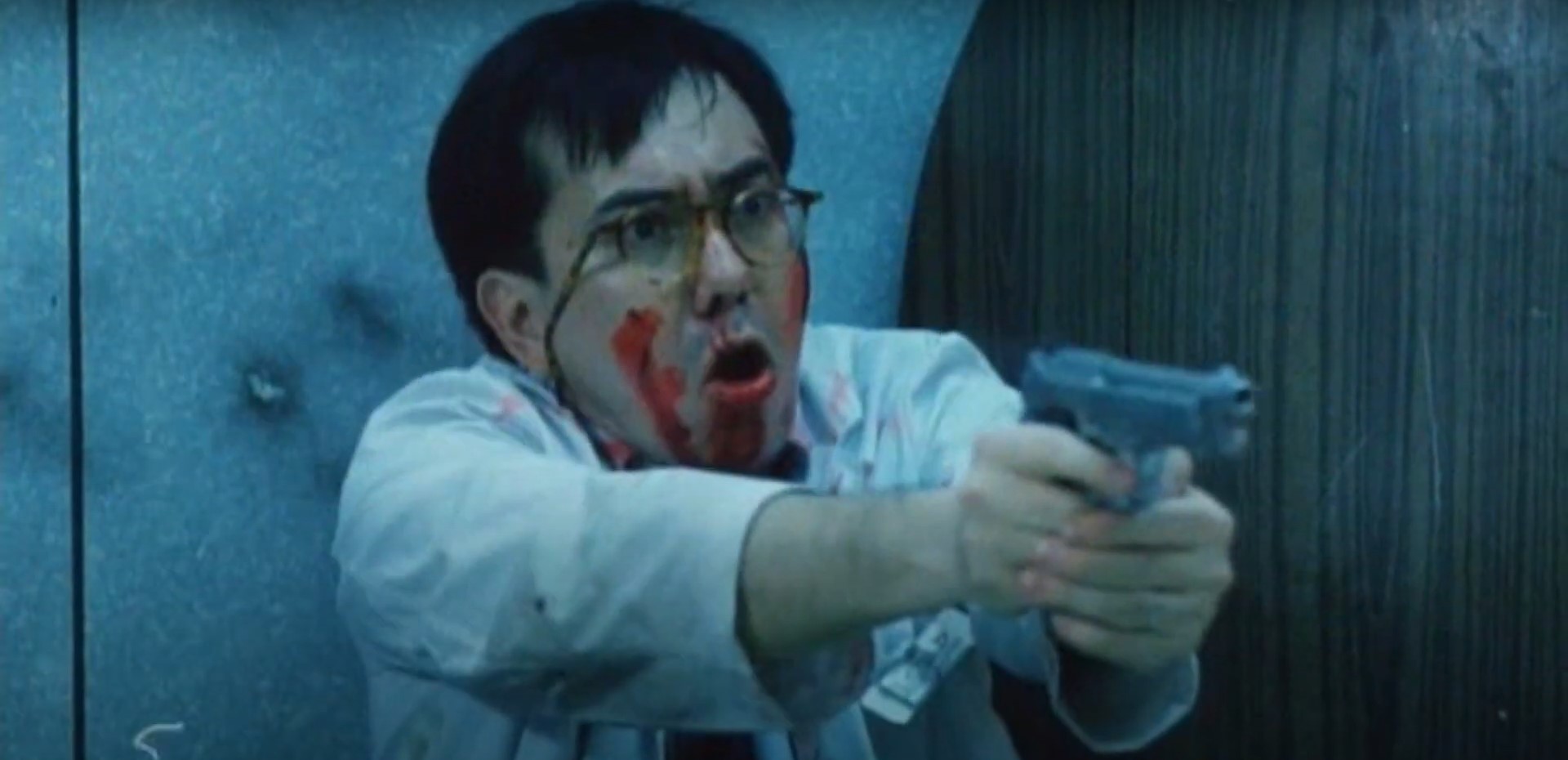
Not just a mindless killing machine resurrected like an electrified phoenix for revenge and murderous rout, Tsu Hsiang’s rebirth out of death arouses complications around fleeting special moments.  Playing exactly his profile of a mid-30-year-old is the late “Her Vengeance” and “The Killer” actor Fui-on Shing as a cop torn between life and death, literally.  Struggling to comprehend what’s happened to him, Tsu Hsiang has no time to explore the root cause; instead, Hsiang instantly moves forward, learning on the fly, his newfound postmortem powers of invulnerability, immense strength, and to be exasperated right into a pale-eyed version of the angry Hulk.  Shing’s duality on levity and fierce cleaves “The Blue Jean Monster” into its well-intended multifaceted of genres with soft buttery ease.  Shing’s square jaw and large frame doesn’t quell the lighter touch he brings an even softer side to Tsu Hsiang with his intake of Power Steering (Wai-Kit Tse, “Mr. Vampire 1992”), a street nickname for a former hooligan took under Hsiang’s wing after killing his father, in a supposed criminal altercation gone awry.  Power Steering best friend Gucci (“Gloria Yip, “Riki-Oh: The Story of Ricky”) becomes the primary target for the gang as she inadvertently becomes a hostage and winds up with the thieves’ hard stolen loot.  The circular, trifold connection between Hsiang, the troublesome young acquaintances, and the gang, helmed by Japanese actor Jun Kunimura (“Audition”) creates double edged complications Hsiang has to juggle and manage while being undead and a soon-to-be father.  Mei-yee Wu, Bei-Dak Lai, and “Mr. Vampire’s” Siu-Fung Wong playing Fui-on Shing’s wife Chu along with “Sex and Zen” star Amy Yip as the lustfully bosomed Death Ray, a gay man conversion therapy seductress, fill out the cast. 

The 1991 film has fast-paced action, politically incorrect humor, and spectacular physical and hand-drawn visual effects.   “The Blue Jean Monster” relied heavily on the skill of the cast and crew to elevate a staggering, fast-and-loose story that barely bridges gaps of its presaged plot holes.  There’s also some fast-and-loose editing slips that expose oversights, such as reused unmasking scene of Jun Kunimura’s head robber and showing five members of a five-member gang huddled behind a flipped van in a scene that was supposed to be sans Kunimura as his character was chasing after Gucci and the money through a construction zone.  Yet, “The Blue Jean Monster” is too enjoyable, too funny, and too drop-dead neat that any and all flaws can be written off as negligible.  Heedless humor encapsulates an antiquated way of thinking that shapes “The Blue Jean Monster” into a time bygone novelty.  When Tsu and Power Steering are suspected gay lovers, as they’re physically intertwined in electrocution to recharge Tsu undeadness, and AIDs becomes the center of the joke, casually tossed in a handful of times even by the brief portrayal of two colorfully sweater-wearing, feminine-displayed men wanting nothing to do with Tsu and Power Steering’s misperceived actions for fear of the deadly virus.  That just epitomizes the slapstick wackiness this not typical but warranted Cat III feature that transfixes with a lot of borderline insensitive satire kneaded into the modish action and special effects of every other Hong Kong film in a saturated market. 
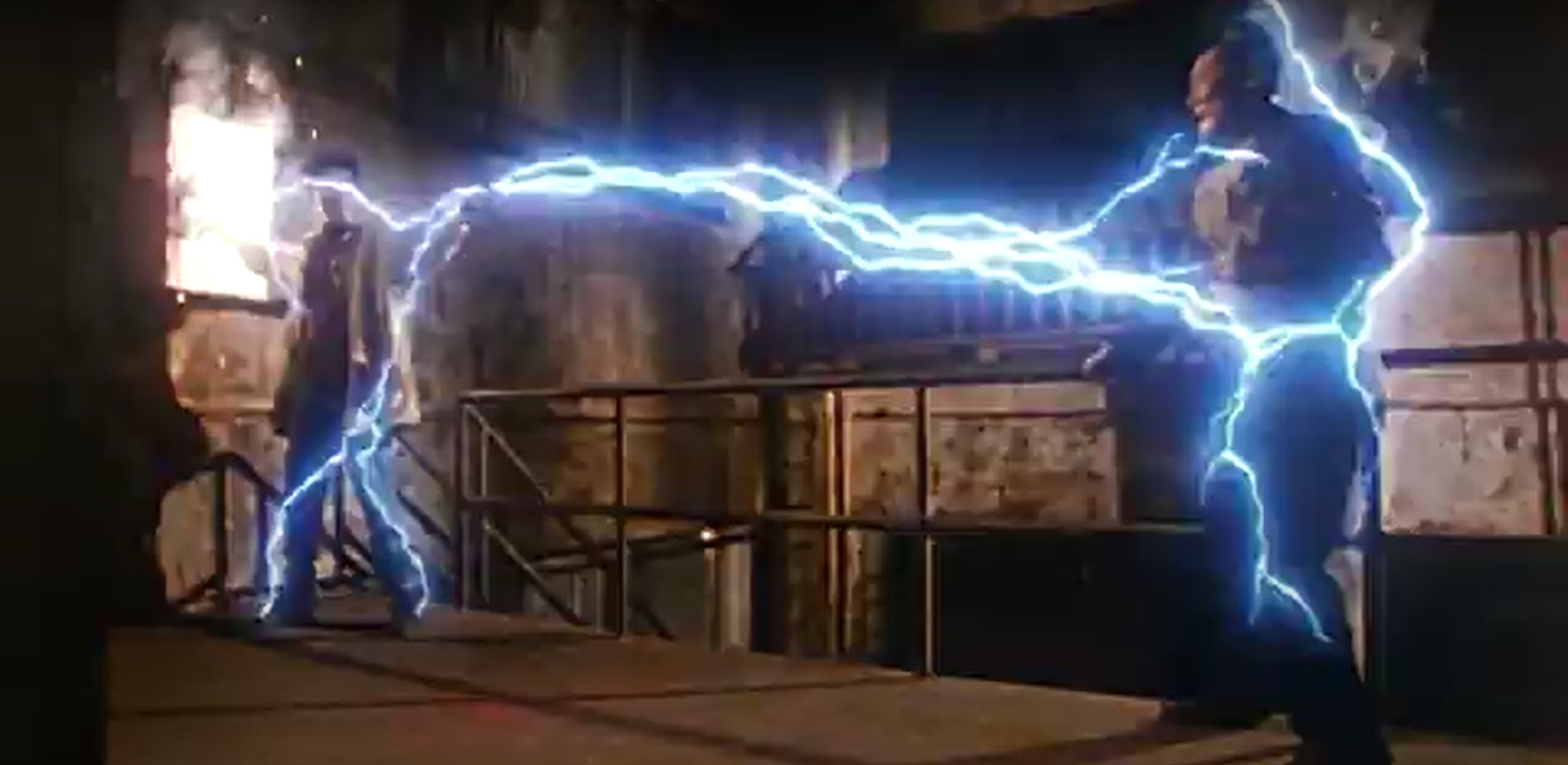
“The Blue Jean Monster” takes over United States and North America courtesy of the UK distributor 88 Films, through MVD Visual from the Fortune Star Media Limited catalogue, with a new AVC encoded, 1080p high definition, Blu-ray.  The BD50 comes top of the line within the limits of the format with a bitrate decoding the original aspect ratioed widescreen 1.85:1 presented and newly restored 2K scanned film an average of at or just under 35Mbps.  Nearly being a non-issue coinciding with a pristine original print, the dual layer disc offers plenty of breathing room to display “The Blue Jean Monster’s’ range of motion, sufferable color palette, painted composite effects, and masterstrokes in lighting a fast-paced pressing without the blight of artefacts.  A few darker scenes are not as rich because of compositional effects but still render significantly with detail under a slightly more penetrating grain.  The overall grain naturally infuses with the 35mm print and translates nicely to a transferred digital scan.   The original, uncompressed Cantonese LPCM 2.0 mono track is the sole offering that, in truth, is all this comical, cosmic caper needs with agreeable action Foley and ambience and some looney absurdity tacked on for good measure.  None of the assortment ever sounds pressed and squished through the single channel suggesting a pretty clean, well-kempt sound design from over the years.  ADR dialogue favors less spatial position but that’s expected with 90’s Hong Kong cinema and is also well-preserved in its fidelity with a clear and damage free recording.  English subtitles are optionally available.  This special edition includes a new interview with assistant director Sam Leong Man Made Monster, the original Hong Kong trailer, and image gallery.  The limited-edition set comes with reflective and glistening slipcase sheathing the same but lusterless composite illustration, artwork created by James Neal.  Inside the green Amaray Blu-ray case, the reverse side of the cover art sports the original Hong Kong one sheet illustration stretching both ends, inferring nearly all the action and characters in the story, along with a doubled-sided cardboard poster of the reversible cover art.  The not rated release comes region locked on A and B and has a runtime of 96 minutes.

Last Rites: If a fan of “Dead Heat,” “The Blue Jean Monster” can prolong the action-caffeinated, narcotized high with supercharged unrest, necropsy humor, and the walking, talking, inexplicable undead in another stellar package and quality release from 88 Films!

Click Here to Purchase “The Blue Jean Monster” available on Blu-ray!

Hail Down EVIL for a Ride! “Taxi Hunter” reviewed! (88 Films / Blu-ray)

“Taxi Hunter” Now Available on Blu-ray!

A moderately successful and mild-mannered insurance salesman is soon to be a new father.  As he and his wife baby prep with shopping around town for supplies, a few run ins with crabbily rude and scamming cab drivers make it known that the cab drivers flood the market with lawlessness.  When his wife unexpectedly goes into labor and his personal car out of service, he has no choice but to hail a cab but when the cabbie refuses the fare due excess vaginal bleed, the cabbie quickly shuts the passenger door and speeds off during the torrential rain stop, not realizing snagging the woman night gown and dragging her down the street a few yards, killing her and the unborn child, and speeding off in attempt to save his own skin.  Spiraling down into a deep depression and pushed beyond his moral limit, he justifies killing the taxi drivers for their abhorrent behavior that makes him a hero of the common people while also making him be public enemy number one with the taxi union and the police. 

History has proven, at least since the pre-2000s, that taxi drivers have had a long notorious stigma of being rude, uncouth, and greedy, especially in big metropolitan areas where traffic jams on a daily basis and the amount of fares determine your livelihood wage can eventually and insidiously get under a driver’s skin and turn the once service-needed necessity into a crabby-cabbie, a side-effect symptom of the profession one could assume.  Hong Kong’s 1993, Cat III shocker “Taxi Hunter” releases that pent up anger most of us have experienced under the clicking of the fare meter when Joe cab takes the long way around town.  Written by Wing-Kin Lau (“The Untold Story III”) and Kai-Chung Mak (“Twist”), “Taxi Hunter” marks the second collaboration effect of the same year as “The Untold Story” and “The Untold Story’s” co-director Herman Yau.  “Black Blood’s” Hung-Wah “Tony” Leung and “Tiger Cage” franchise’s Stephen Shin produce under Galaxy Films Limited and distributed theatrically by Media Film Asia.

Not only do the writers and director Herman Yau reteam to develop another controversial Category III picture but “The Untold Story’s” star Anthony Wong steps foot into another unraveled monster of a man with Kin, an amicable insurance salesman good at his job and eager to be the best father as possible quickly spins into melancholy and murder after the death of his pregnant wife at the hands of an unprofessionally hasty taxi driver.  Unlike the quietly stewing and maniacally murderous pork bun shop owner, Wong’s villainous runs takes backseat to his anti-hero performance, a punisher of taxi scum.  As Kin, Wong can be the delicately wonderful husband and the brazen barbaric with an easy slippery slope transition in between as he works to perfect Kin’s killing craft.  Unbeknownst to him, tracking him down is Kin’s own police detective brother Yu and his fun-loving goofy partner Goh, but unbeknownst to the detectives is the taxi serial killer is Kin.  “Iron Monkey” star Rongguant Yu offers up tough cop like it’s his job, mixing a humble blend martial arts and entrenched investigator into his character while also being blind to his brother’s moonlighting massacres.  Goh, on the other hand, played Man-Tat Ng (“Shaolin Soccer,” “Tiger Cage”) is supposed to provide the levity, the comic relief, the humor, but the cartoony way Goh is portrayed, in garb and in gab, reduces him to be nothing more than a Western Poser of the East with NBA and other Western branded gear from head to toe.  Goh feels very much like an attempt to jab fun at what Hong Kong might have perceived as American culture:  tasteless, worthless, and clueless.  Goh seemingly only exists to be a link between Kin and his brother when Kin hops into Goh’s undercover operation of pretending to be a taxi driver to which Kin takes his numbskull manner as cantankerous cabbie.  “Taxi Hunter” chauffeurs in the rest of the core supporting cast with Athena Chu (“Super Lady Cop”) and Hoi-Shan Lai (“Dr. Lamb”).

However still managing to provoke potency in parental guidance, to me, “Taxi Hunter” is perhaps the least intense Category III film I’ve experienced to date, but don’t let that keep you from taking a ride in Herman Yau’s rancorous retribution vehicle that has scores of variable car action scenes and a sordid glaze of street-level grime amongst the taxi industry.  “Taxi Hunter” engages us to think about the minor point As to point Bs in our lives that can easily subvert the well-oiled machine that is our existence.  Kin has a promising career, money (a motif we’ll revisit later), and a baby on the way and aside from the money, bizarrely enough, it all comes crashing down in the moment of a car door slamming shut. Those micro-fissions separating our good moments with nastiness slog us into another mindset, a killer’s mindset, when we’re wading at the very bottom of the losing everything depression. Lau and Mak don’t immediately set Kin’s path shortly after the turning point event, which also had a good chunk of setup. Posthumous need to kill cabbies didn’t occur directly after the tragedy as the script allowed time for Kin to try and stomach digesting tremendous loss, even giving away much of his money, as aforementioned, for services gone unrendered such as with the prostitute he didn’t end up sleeping with or being overcharged a child’s trading card just to make a crying child, a future version of his own child now deceased, happy when his parents would not purchase it. “Taxi Hunter” has more than just a singular character-driven story with plenty of suspense from Kin’s evolving practice of killing taxi drivers to the plethora of practical car action. “Taxi Hunter” is metered madness that shies away disgusting you with overt violence or seducing you with graphic sex of other Cat III film in its purer requital black comedy only Herman Yau and Anthony Wong could chauffeur in.

Presented in full high-definition 1080p from the original 35mm stock, “Taxi Hunter” has been flagged down for a new Blu-ray release from 88 Films, shown in anamorphic widescreen 1.85:1 aspect ratio. The transferred print keeps the natural grain of the 35mm film but swells the pixelations to ramp up details and textures tenfold without appearing touched up or improperly enhanced. 88 Films’ coloring grading leans slighting into the metallic blue steel, offering a gritty detective thriller with the overcast effect. The print also shows hardly any age or damage that results in a clean redress of a pristine print. Only one audio option is available for selection, a Cantonese LPCM 2.0 mono. Curious to why there isn’t a Mandarin option leads to speculation that Cantonese sole use was due to the dialect being more widespread in Hong Kong to keep a product of Hong Kong, typically with CAT III products where mainland China censorship would have picked “Taxi Hunter” to pieces. Though in original language, ADR is still used in post and while dialogue is cleaning in the forefront of the rest of the audio tracks, there’s not a ton of depth being too at the forefront, especially with Goh’s goofball gab. However, the action-laden and quarrelsome dynamics provide a plentiful range of sounds from screeching of tires, to the car crashes through windowfronts, to the multiple gunshots that make this sound design rich and energetic. English subtitles are offered and though glibly bland and concise, a lot of repetitive words and phrases, such as a wide use of bro, the subtitles are error-free and paced well. This special edition release includes a new audio commentary with Hong Kong film expert Frank Djeng, a new interview with producer Tony Leung Hunting for Words, a new interview with actor Anthony Wong Falling Down in Hong Kong, a new interview with action director James Ha How to Murder Your Taxi Driver?, still gallery, and trailer. Physical features available, if you’re quick enough, include a limited-edition cardboard slipcover with Sean Longmore’s compositional illustrated art and a folded poster insert of the same art. Also available inside the green Blu-ray case is reversible cover art with the initial same design as the slipcover or, my personal favorite, the original Hong Kong poster art that I proudly display on the shelf. Disc art is pressed with a slight variant of Longmore’s art and the not rated disc’s format comes region A and B playback with the film clocking in at evenly paced 90 minutes. Classic 1990’s fare without charging us an arm and a leg in wasted time, “Taxi Hunter” is solid CAT III with more vindictive and veridical visceral moments that change gears often and punches the gas into accelerating this terminal taxi tormentor.

“Taxi Hunter” Now Available on Blu-ray!

Taxi Driver by Day, EVIL Serial Killer by Night! “Dr. Lamb” reviewed! (Unearthed Films / Blu-ray)

“Dr. Lamb” is ready to operate.  See him in action on Blu-ray from Unearthed Films and MVD Visual!

Quiet as a boy verbally and physically abused by his stepmother yet laid to experience the adult perversities at the permission of his unconcerned father, Lam Gor-Yu, now as a man, is still quiet and still has unusual interests as an afterhours taxi driver.  Triggered by rainy nights when a torrent of verbal abuse by his female passengers send the usually reserved taxi driver into a homicidal fury, extending his lonely nights into straggling women, returning their bodies to his family homes, and video tapes his exploits within his fascination for amateur medical procedures.  When the police raid his family home after developed disturbing pictures were discovered at the local print shop, Lam’s entire family is hauled into questioning and it’s to Inspector Lee and his team to unearth exactly what transpired to the lifeless bodies seized by a notoriously sociopathic serial killer.

When you think of serial killers globally, Hong Kong isn’t the first place that comes to mind.  In fact, Hong Kong isn’t even a blip on the radar as the Pearl River Delta residence only has two known serial killers attributed to the city.  One of those killers is Lam Kor-wan – aka The Jars Murderer – aka the Rainy Night Butcher – who terrorized the then British territorialized Hong Kong in the early 80s, killing and post-mortem mutilating four young women.  La Kor-wan became the notorious inspirational material for the Danny Lee and Billy Tang (“Run and Kill”) co-directed Dr. Lamb that was released in 1992 and penned by Kam-Fai Law (“The Close Encounters of Vampire).  “The Killer’s” star Lee, who was more Chinese action star than filmmaker, developed the film, reluctantly at first, during the time when Hong Kong’s Category III classification rating was extending from solely high-end erotica and sleaze into extreme horror and thrillers.  Lee served as executive producer with Parkman Wong, who also worked alongside Danny Lee on “The Killer,” under Grand River Films Ltd.

To be portraying one of two Hong Kong’s serial killers feels like an unsurmountable responsibility burdening the actor’s shoulders in order to parallel the motivational intricacies and the mental mindset as accurate as possible knowing that the character can’t just blend into a vast serial killer fold where you can find multiple variations of John Wayne Gacy or Jeffrey Dahmer being grossly rendered for U.S. pop culture exploitation.  Yet, in steps in front of the camera Simon Yam, one of Hong Kong’s prolific action stars in the late 80s to early 90’s now stepping into the shoes of a real-life maniacal persona and relatively close to where all of Lam Kor-wan’s dirty-little-deeds took place.  Simon Yam could very well be the killer himself, that’s how brilliantly Yam’s performance is in what’s certainly a confident display of range in contrast within his acting opus.  Replacing a gun with a scalpel, Lee and Yam dig deep into the character’s psyche with an interpretation of why Lam Kor-wan did what he did and, frankly, Yam just went stoically wild to reach Lam’s staggering levels of crazy as he descends deeper into the retelling of his encounters with each victim. While “Dr Lamb” is a grim tale, there’s a comical side to it with the police force, supervised by Inspector Lee, played by Danny Lee himself in a duality position of cast and crew. More of the comic relief stems from Inspector Lee’s second-in-command, an experienced, yet overweight, cop who lets others handle his workload. Literally named Fat Bing, comedian and “Human Lanterns” actor Kent Cheng continues his whimsical routine in unvarnished subject matter revolving around separate bits and pieces of people’s tissue and organs for twisted pleasures. Collateral damage of Lam’s horrifying late-night exploratory surgery antics on women involve his family as they also become suspects. Lam’s father (Siu-Ming Lau, “A Chinese Ghost Story”) keeps his blinders on while the evidence piles only to be turned when his son’s transgressions include a minor family member does his own flesh and blood then cross a line of no return.

There are always two sides to every story. No, I’m not saying there are two repelling sides to The Rainy Night Butcher’s homicidal havoc. “Dr. Lamb,” as a film, has a dichotomy about it that’s half biographically true and grim while the other half is crime drama peppered with clownery. The combination is odd and equally as frustrating as the black tone of the historical background and the graphic nature of some authentical depicted acts of inhuman urges find their way weaved into the fabric of cavalier cop buffoonery who, on one hand, seem really good and really intense at their job while, on the other hand, lack the gumption for sobering behavior. Even when investigating Lam’s videotape (to which there is no way in Hell Lam videotaped that himself as the camera moves as he’s engrossed with necrophilia and removing body parts), the cops overact the disgust with what looks like chunky tuna being forced out of their mouth along the lines of appearing like vomit. The underplayed theme is anything but funny in its psychological context of misanthropy and misogyny. All of Lam’s scenes of cruelty are told in flashback through his perspective, molded by his undertone hate for women. “Dr. Lamb” is a misogynistic tale bred out of childhood abuse by a woman close to his family and unabashed and unattended by his lenient father’s lack of concern. Three out of the four women Lam taxis-to-taxidermy often verbally and physically assault him and plague his personal space with their awful behavior, setting a dial backwards in his battered brain that reminds him of the time his stepmother slapped him or forced him into a closet for hours. Is “Dr. Lamb” a Freudian lemma that Lam sees his ruthless stepmother in these women and turns on them to humiliate their corporeal existence? That’s a deep dive, but not as deep as “Dr. Lamb” cuts as a visceral experience based off of one of Hong Kong’s notorious serial killers.

Distributing in at number 8 on the spine of the Unearthed Films’ Unearthed Classics banner is “Dr. Lamb” on a new Blu-ray home video. The region A locked, AVC encoded, BD50 is slicked up with a 1080p high-definition upgrade presented in a widescreen 1.78:1 aspect ratio. As one of cinematographer Kin-Fai Mau’s first few pictures, the cool blue and misty has an interesting allure like a hazy bad dream subdued by an infusion of looking through blue glass with a prism of white light filtering through. Perhaps not as detailed as desired, the release does stand above the rest with low-level continuous speck blemishes that are only noticeable if you’re searching for them. Two audio options are available: a Cantonese LPCM 2.0 Mono and a Mandarin LPCM 2.0 Mono. Both tracks do come with well-sync and accurate English subtitles with the only downside is in their quick sojourning. There are a few instances where the subtitles pop up for literally a second as a result of quick nature of the dialect to get to the next set of text. While toggling between the two languages, my audio receptors really took to the Cantonese for a more natural flow and visually for unison between speech and speaking. The Mandarin is certainly more powerful but also too over-the-top as in watching I relate to watching old Japanese with English dub. The special features include an audio commentary by Ultra Violent’s Art Ettinger and Cinema Arcana’s Bruce Holecheck, a background interview about “Dr Lamb’s” genesis with the story producer Gilbert Po Lamb to the Slaughter, an interview with film critic James Mudge on the Golden Era of Cat III Three Times the Fear, a talking point conversation about “Dr Lamb” from film academic Sean Tierney, an Atomic TV interview with star Simon Yam, and trailers. The physical release itself comes with a 6-page, color booklet essay from cinema academic and author Calem Waddell (producer of “The Collingswood Story” and many horror-film related documentaries). A cardboard slipcover with one of the more provocative poster arts. Unearthed Films’ Blu-ray comes unrated with a runtime of 90 minutes. When perusing what to watch one night, be sure to hail down this cab of fact-based macabre driven by “Dr Lamb’s” psychological psychopathy and his pathologic urge for unnecessary medical procedures.

“Dr. Lamb” is ready to operate.  See him in action on Blu-ray from Unearthed Films and MVD Visual!

Steamed Pork Buns Stuff With EVIL! “The Untold Story” reviewed (Unearthed Films/Blu-ray)

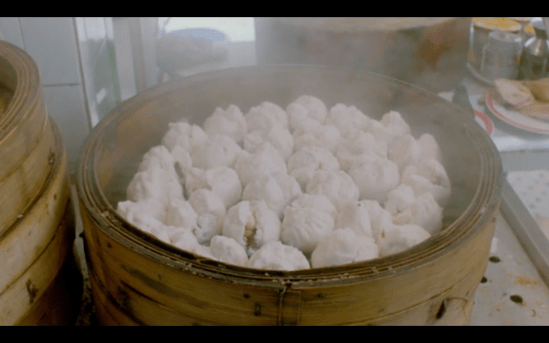
Wong Chi-hang brutally beats and sets fire to a fellow gambler who refuses to lend him money.  After destroying his identification card and creates a new look and identity, Wong flees Hong Kong before he can be hunted down for first degree murder and be served capital punishment for his crime.  For the last 8 years, Wong has lived and worked on the island village of Macau, running a small, but well-known, steamed bun restaurant, Eight Immortals Restaurant.  He receives inquisitive letters everyday asking about the whereabouts of the former owner, Cheng Lam, by Lam’s older brother on the mainland.  The letters force Wong to attempt manipulating lawyers into signing over the restaurant to him without Lam’s presence.  When the police discover dismembered limbs washed up on the beach, an investigation ensues that connects the body parts to a Chan Lai Chun, the mother-in-law to Cheng Lam, leading a small task force of blockheaded detectives to Wong’s restaurant where he becomes the prime suspect in the disappearances, but he won’t break so easily after being apprehended, unwilling to cooperate and confess to the whereabouts of the bodies of the vanished owner, his entire family, and a pair of workers.  Yet, what were exactly in those steam buns that made them so delicious?

Full disclosure.  I’m not too terribly familiar with Hong Kong’s rating system of Category I, II, and III, but I’ve more-or-less dabbled in the Category III (Cat III) horror and exploitation cinematic market, owning only a handful of these gruesome-and-sexually gratifying guilty pleasure full of sex, violence, and taboo concepts of titles such as “Riki-Oh:  The Story of Ricky,”  “The Chinese Torture Chamber,” and “Three…Extremes” and only “The Story of Ricky” has ever been popped into my player for recreational viewing.  Also, in my collection, is a Tai Sing DVD copy of Herman Yau’s 1993 crime-and-cannibalism graphic thriller “The Untold Story” and, frankly, I never opened it either, but when Unearthed Films sent me their new Blu-ray release to review, I’ll never be able to see chop sticks the same way again!  The eye-opening experience also screamed that I should definitely rip open and see those other films to quench my thirst for Cat III’s offensive opulence.  Based off a true story of the Eight Immortals Restaurant murders in 1985 around the Macau area, the nearly unwavering from the truth storyline parallels the Kam-Fai Law (“Dr. Lamb”) and Wing-Kin Lau (“Taxi Hunter”) co-written story in which a madman slaughters an entire family over a gambling dispute and runs their family business, the Eight Immortals Restaurant, until the police capture him, but Yau sticks more sensationalism to the already brutal notoriety surrounding the actual case with ground human barbecue steamed buns to tease with abhorrent flavor under the Golden Sun Films Distribution distribution of the Uniden Investments and Kwan Hung Films production.

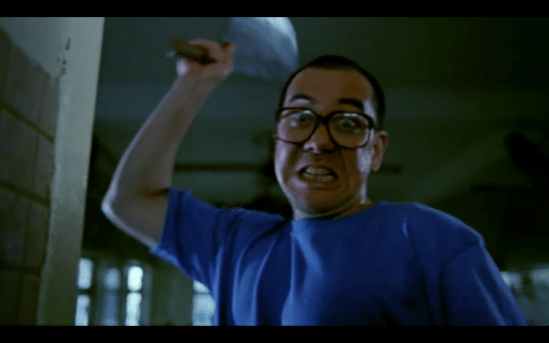
“The Untold Story’s” lead man in the shoes of the maniacal, rage-filled Wong Chi-Hang is “Ebola Syndrome’s” Anthony Wong who initially thought the script was greatly unattractive.  Little did he know that his performance would be so good, so osmosis with his wide-eyed lunatic stare through the luminating pixels of the television screen, that the role would honor him with a Hong Kong Film Award for best actor; Hong Kong’s equivalent to the best actor award for an Oscar in the States.   The “Hard Boiled” actor embodies a soul of frustration and anger to rise his character up to the demented level of nihilism and heartless exploitation that unforgettably scores being the face of “The Untold Story’s” cruelty.  Yet, there is a Jekyll and Hyde complex with Yau’s film that cuts the cynicism with a risible troupe of police officers supervised by Officer Lee (Danny Lee “The Killer”).  With a beautiful foreign woman, a blatantly announced hooker, always at his side and being the sharpest detective on the force, Lee’s a contradictory, authoritative commander meshing immoral principles and duty into one while leading a four-person squad of non-initiatives comprised of three rubbernecking men, craning their gulping jugulars toward Mr. Lee’s arm-candied gals, and one tomboy woman with an affinity for Mr. Lee who struggles with being taken seriously amongst her peers as an unenticing woman in cop’s clothing.  The officers’ western names are a slither of satire to poke fun at the nicknames of tough or macho cops go by in the States with Bo, King Kong, Robert, and Bull (respectively Emily Kwan, King-Kong Lam, Eric Kei, and Parkman Wong of “Dr. Lamb”).  The cast rounds out with Fui-On Shing and Julie Lee. 

“The Untold Story’s” embittered nihilistic violence, gratuitous rape and sodomy, and steamy, mouth-watering cannibalism leverages this Cat III film as tiptop horror exploitation from the far East.  If broken down more, director Herman Yau pins and sews together a liaising three act prong story of a horrid man’s attempt at deadly stability in society and a madcap group of officers, with a penchant for police brutality and coercing confessions, bumbling their way through clues that ultimately funnel into a blended third act of magnetizing the two sides together toward a satisfying, almost faithful, ending of “The Eight Immortals Restaurant:  The Untold Story’s” purloin and murder fiction and non-fiction exploit.  Yau spares no expense for gore, serving up a platter worth the splatter of some nifty chop’em up and grind their meat into the dough effects that’ll turn stomachs as well as heads and doesn’t exude as bargain basement quality; yet, just enough gore goes uncovered to tantalize without a full onslaught tarp covering the ground of disembodied limbs and floor-splattering entrails that boil down to an overshadowing character that detracts from the cast performances as such can accompany with the more extreme Asian horror catalogue.  There’s nothing gentle about the actions of Wong Chi-Hang, but the way he’s scribed to manifest spur of the moment carnage, stemmed by the most minute disputes, and the way Anthony Wong carries and maneuvers of a monstrous villain with ease takes an esthetical point to not stray away from his, or rather his victims’, story.  “The Untold Story” is, in fact, meta-exploitation fiction of non-fiction down to the very last tasty morsel. 

In what is perhaps the epitome of Hong Kong’s Category III film index, “The Untold Story” arrives onto high definition Blu-ray courtesy of the gore and shock genre label, Unearthed Films as part of the label’s Unearthed Classics line and distributed by MVDVisual. The well preserved, near flawless transfer is presented in a widescreen, 1.78:1 aspect ratio, and the picture is a vast improvement over the slightly washed previous DVD releases though favors a higher contrast resolution that ekes trading out the details for a brighter, softer film in an overall compliment of Cho Wai-Kee’s beaming cinematography. Whether in the police station or the restaurant, fluorescent lumens light up the scenes with a sterile-driven madness. The Cantonese, Mandarin, and some English 1.0 PCM audio track denotes, without surprise, the lossy quality doddering from age and antiquated equipment, but renders well enough without the imperfections of hisses, distortions, or any vocal impediments. The option English subtitles display without error with only the issue in their breakneck pacing when attempting to keep up with reading the subtitles and the rapidfire dialogue. You basically have to skim read. The special features include commentaries with star Anthony Wong and Herman Yau, the superbly dark and traditional film score isolated for audible pleasure, commentary with Art Ettinger from Ultra Violent magazine and Bruce Holecheck of Cinema Arcana, a Q&A with Herman Yau, a featurette of the history behind Category III films of Hong Kong Exploitation Cinema, a interview with Rick Baker entitled Cantonese Carnage, and Unearthed Film trailers. There’s also an two-page insert of Art Ettinger’s write up about Hong Kong cinema and “The Untold Story.” Resilient to the test of time, “The Untold Story” benchmarks a high point in High Kong exploitation cinema, recalls the tremendous feat of performance by Anthony Wong, and displays the sheer mastery of disciplined filmmaking from Herman Yau in this unforgettable gruesome black comedy.

Must Own Christmas Gift! “The Untold Story” on Blu-ray!