This EVIL Thanksgiving Bird Has Been Overcooked. “Amityville Turkey Day” reviewed! (SRS Cinema / DVD)

“Amityville Turkey Day” – That’s No Cranberry Sauce! Check Out the DVD Here!

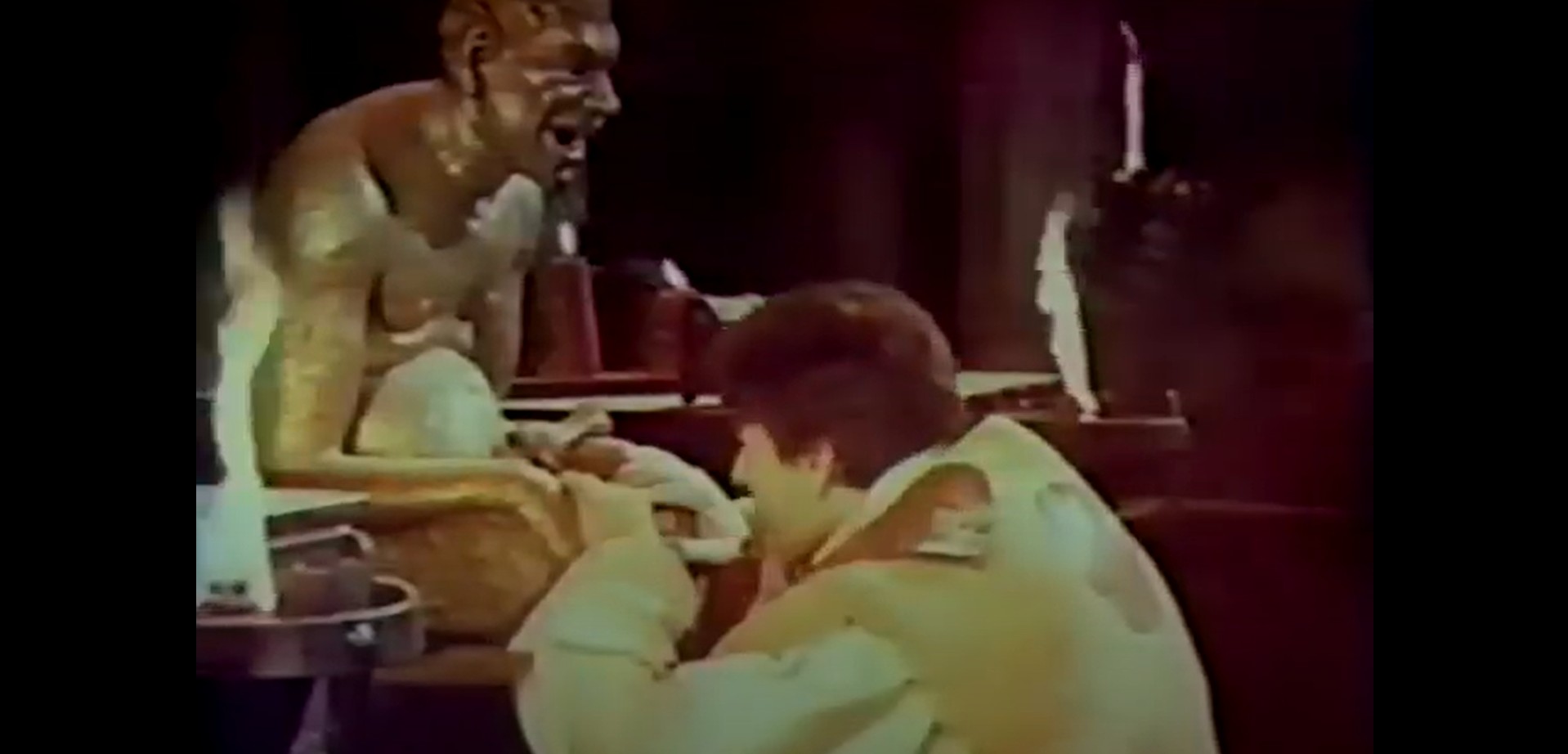
Rocco, a sleazy indie film director, is given one last project to director with the stipulation of not to squander the funds and to make a competent hit movie without completely making principal photography a nightmare for the cast and crew.  Having landed a large estate to shoot his film, the house comes with a manservant named Bram to take care of their needs and see to the estate grounds.  When a man-eating Turkey from Hell, embodied by the evil soul of once infamous doctor, comes home for Thanksgiving dinner, Bram aims to curate a fine feast for the abrasive, wicked bird from the indie film production.  As cast and crew begin to dwindle down and disappear, the show-running producer takes charge to motivate and take care of the slipping through the cracks mess of, yet again, another Rocco botched production.  Yet, the turkey still hungers and when all the excess meat is consumed, he will then find a human mate to reincarnate himself for human form. 

After promising myself, swearing up and down, that I would never, ever watch and review another Amityville titled infused film again, “Amityville Turkey Day” had sucked me right back in, like a moth to the flame into another mindless and pointless, could I even call it this, money-grabbing exploitation of the Amityville title letdown of a holiday-comedy horror film.  The 2024, microbudget Thanksgiving themed sequel to “Amityville Thanksgiving” brings back the writing-and-directing duo of Will Collazo Jr. (“Amityville Shark House,” “Amityville Apocalypse”) and Julie Anne Prescott (indie film scream-queen of “The Amityville Harvest” and “Amityville Thanksgiving”) to add a little more sanguine stuffing in their continuation of a terrorizing wild Turkey.  Alternatively known as “Amityville Thanksgiving 2,” the feature is an indiegogo crowdfunded campaign that raised the $10,000 goal and became a Will Collazo Jr.’s Cult Cinema production.

The sequel doesn’t return most of the cast from the film.  Most sequels don’t, right?  Instead, a whole new batch of rough puff principals are basted over the story to try and moisten the flavor of a rather rough-and-ready follow-up.  Amongst the medley filled in with B-movie talent, there doesn’t seem to be a one standout lead role to take charge in what is more of convergence of counterproductive parts that overlap and overstep each other’s storyline.  Characters also disappear and reappear without context to about where they were and where they go, for example the sleazy director Rocco (Michael Ruggiere) vanishes for most of the story’s midriff and then just reappears in the third act without a sense of where he’s been.  Erica Dyer (“The Town Without Halloween,” “Attack of the Corn Zombies”) plays one of the few characters with an actual intact arc as the pissed off producer Ivy who storms in and takes charge of Rocco’s quickly deteriorating production, proving to be a competent leader to quickly organize the film crew into action, but as cast and crew begin to drop like flies and vanishing from the estate set within the Thanksgiving week, Ivy’s honed in focus doesn’t register the killer Turkey, voiced by Steven Kiseleski (“Amityville Karen,” “Amityville Bigfoot”), and it’s righthand caretaker Bram (Dino Castelli, “Screamwalkers”) slowly filleting the filmmakers for feasting.  A large portion of the character pie is throwaway fodder for the Turkey with only a couple of others to stand out with pointed out substance, that also point back to “Amityville Thanksgiving, with Kevin (Tim Hatch, “Amityville in Space, and the other actor to return from “Amityville Thanksgiving) on a mission to find out what happened to his sister from “Amityville Thanksgiving,” and his planted actress friend Jessica (Jen Elyse Feldy, “The Elder Hunters,” “Camp Blood 666 Part 2”), but their roles do get lost in the fray of the frenzied packed, plot hole-riddled storyline that crams in too much too hastily inside a jerry-built and unnecessary tale.  David Perry, Clint Beaver, Amanda Flowers, Shannon Hall, Jeff Webb, Thomas J. O’Brien, Ralph Rey, James Janso, Stephen Bloodworth, and the late Mark C. Fullhardt, to which this film is dedicated to, fill out as the at will Turkey fodder. And I hope all my listings of “Amityville” named films has brought awareness to this exploitative issue!

“Amityville Turkey Day” is no “Thankskilling.”  Jordan Downey has mastered the smack-talking, rude-with-tude, killer Turkey in style, substance, and outrageous kills.  Will Collazo Jr.’s film feels more like a cheap knockoff to the likes of the Italian unauthorized remakes, sequels, and spinoffs of American films of the 1980s, attaching the Amityville name to draw attention and sponge off the legitimate franchise that has now become a disgusting and disheartening running joke and parody of unoriginality. “Amityville Turkey Day” mirrors every ounce of that last sentiment with a shoddy, low rent feature that not only drags the Amityville title deeper into the overkill mud but also hurts the exposure of Jordan Downey’s “Thankskilling” to those viewers who do get their unsuspecting hands onto Collazo’s film first and leaves a residual bad taste toward more competent Turkey trot terrorizers.  That bitterness is contributed by the lack of story structure and coherency, a lost sense of unique personality and entertainment, and a brutal monotone flow that stagnates upon just one setting over the course of a few days, which is a major gap considering the film crew disappearing here and there during that time and no one happens to care or even hardly notice.  Comedy elements fall flat, reduced to fart and sexual gags and missing-the-mark cheap insults surrounded by dull kills, especially for a Turkey that goes for the juggler.  Very few moments of levity and intrigue can be pulled from “Amityville Turkey Day” with the puppeteered evil Turkey lobbing an occasional humorous one liner – “Look at all that blood!  She’s a squirter!” – and the manifested closet gimp is too strange of a guilty-allure to ignore, and these few and far in between bright spots add a layer of color to what is dull overall. 

The crowdfunded clucker had arrived just in time for this year’s Thanksgiving courtesy of indie film friendly distributor SRS Cinema.  “Amityville Turkey Day” is housed on an MPEG2 encoded, 480p resolution, 5 gigabyte DVD-R.  According to the crowdfunding page, Collazo offered an all-around bigger and better experience from the bareboned, nearly no-budget, precursor, yet the sequel didn’t live up to expectations and appeared to be more of the same slapdash as the first and this translates to a writeable DVD disc with a fuzzy picture, smoothed edges, and plenty of posterization and banding that digs the grave deeper for this overdone bird.  The ungraded picture produces unnatural lighting from a series of gelled flood lights, more so with deep red, aimed upward to evoke thicker upper shadow positions.  What the result constitutes with the unhelpful lower resolution camera is an overly hot and overly diffused image in what would be Turkey and Bram basement scheming scenes that renders any leftover details washed away from the effect.  The English LPCM 2.0 mono track is a flat fixture via the onboard microphone on the digital camera that creates an anemic dialogue presence with subtle distortion.  Range consists of post-production sound effects and the close quartered rooms of the “estate” has depth pretty much nonexistent.  I will say dialogue is prominent and clear though higher decibels overtake and clip the microphone’s volume intake.  English subtitles are optionally available. The release’s special features include a director’s commentary, a making-of behind-the-scenes, the original trailer, and other SRS Cinema prevuews. Aside from an enticing illustrated cover art, the DVD has no other supplemental cover art, inserts, and etc. “Amityville Turkey Day” has a runtime of 93 minutes, is region free, and comes not rated.

Last Rites: “Amityville Turkey Day” is difficult to gobble up. In fact, “Amityville Turkey Day” is much like having to go to your great Aunt’s house for a third Thanksgiving dinner of the day, the one that is the family’s black sheep, wears a muumuu, and her house smells like cheap cigarettes and cat dandruff, it’s a hard no thank you.

“Amityville Turkey Day” – That’s No Cranberry Sauce! Check Out the DVD Here!

Dump Buckets and Buckets of Water Back into this Dry EVIL Well. “Ring Shark” reviewed! (SRS Cinema / DVD)

“Ring Shark” Now Curses the DVD Market! Own It Here!

For the subscribers of her Youtube show, vlogging social media influence Kanamasa and her co-host search for a stone well rumored to be in a haunted forest surrounded by unfriendly villagers who aggressively ward off unwelcomed visitors.  Upon discovering the well, a shark-like creature emerges suddenly and bites Kanamasa, scaring them off.  A few days later, another pair of Youtube investigators of the Psychic Investigations Big Summer learn of Khana’s disappearance after her last video surfaces of what looks to be a shark fin and then a ghastly body surfaces from within her bathtub, attacking her bikini-garbed body.  Seeking the truth and eager to find Khana, the investigators conduct interviews with “shark” experts and attempt to visit the same well only to be shooed off by the villagers until, finally, they’re able to reach the same spot and experience the same sharp-teethed horror lurking within it.  Unknowingly, that same supernatural terror of the well had follow them home. 

Sharksploitation has admittedly gotten out of hand.  The beloved horror subgenre that began with Steven Spielberg and Bruce the mechanical monstrous shark who terrorized the beaches of Amity Island have since drowned in its own watery subcategory of the ocean’s maneater predators with microbudget ineptitude that takes the shark from its natural ecosystem and rehomes it in a miscellany of nonsense locations, such as on land, in the weather, and even circling in toilets.  Well, today is the day we’ve come across a movie been assimilated into that same fatuous collective with “Ring Shark,” aka “Well Shark,” aka “Ido Shark.”  The Japanese, found-footage comedy-horror is the first of a trio of incongruous shark films released between 2023 and 2024 by Taichiro Natsume with “Love Shark” and “Last Shark” to follow, connected by the Big Summer team of Psychic Investigators.  Natsume also wrote and produced the feature.

Unfamiliar with the Psychic Investigator Big Summer series, which there’s uncertainty if Big Summer is a Japanese comedic troupe, equivalent to the Broken Lizard of America, what “Ring Shark, or “Ido Shark” begins is a series of various haunted case probes by the Big Summer team, which in this film in particular include actors using modifications of or using their actual names as characters in the story, such as director Taichiro Natsume being the single male lead in the group under character name Daiichiro Natsume.  Daiichiro Natsume can be a bumbling, yet persistent fool when it comes to the mysterious case of Kana-san with his steady motif of exclaiming his love for big boobs and determination to resolve the mystery.  He’s joined by colleagues on-and-off screen in Momoka Asahi and Chihiro Nishikawa, the latter not to be confused with Chihiro Nishikawa of JVA.  While Nishikawa and Natsume continue the running gag conversating about big breasts, Momoka Asahi enters the picture much later as the third investigating team member when Natsume goes down with a well shark bite infection that haunts him from the inside out and puts him in the hospital.  From there, Nishikawa and Momoka take the reigns on investigation by not only tending to Natsume’s dwindling health but also interviewing internet paranormal sleuths Hiroshima Freddy, a Japanese horror influence in real life, as well as Black Story Kuro, who I imagine is another influencer but couldn’t confirm it.  Typically, the Japanese language has a ton of fluid inflections and tones that dictates situations and mood, but “Ring Shark” avoids much of the vocal ups-and-downs with a consistently level tone of flat and dry humor peppered with fear, arbitrary bickering, and a pinch of kawaii to sustain a semi-serious documentary style investigation.  Maya Mineo, Issei Kunisawa, Yacch Chara, Daiki Mizuno, Honey Trap, Umeki, and the wrestler known as The Shark fills out the cast.

“Ring Shark” is “Blair Witch Project” meets “The Ring.”  The latter having the most prominent appearance as the at home media, that was once titled, or probably is likely titled in Japan, as “Ido Shark,” is marketed for U.S. consumption because every moviegoer is either well versed or knows of Hideo Nakata’s “The Ring” series and its heebie-jeebies Samara spirit.  Instead of a cursed tape that summons Samara out of the depths of her murdered resting spot, a well, to kill anyone after a week of viewing said tape, “Ring Shark” only real connective tissue to “The Ring” is that there is a well in the story and a murdered girl’s body was dumped inside.  That’s it.  From there, the structure is more to the tune of “Blair Witch Project” with a pseudo-found footage of one social media’s disappearance igniting the Psychic Investigator Big Summer team to check it out after the tape is brought to their attention form Kanasama’s co-host.  The docu-style incorporates dry wit of interviewing shark experts, creature academics, urban legend connoisseurs, and thorough analysts and researchers, as well as themselves as angry villagers and a supernatural hand puppet shark head subverts their stratospheric sublayer with soul-chumming results.  Yet, none of everything just said really clicks in a flimsy and slapdashedly put together microbudget story derived for effect for true and absurd exploitation of sharks gone wild. 

“Ring Shark” swims right into SRS Cinema’s well-house with a brand-new DVD from the microbudget cult film distributor.  Upscaled to 1080p, the MPEG2 encoded, single layer DVD5 presents the Big Summer production ion a widescreen 1.85:1 aspect ratio.  Though upscaled to 1080p, the cell phone footage renders stretched limitations under the light of low-budget constraints.  Night vision and poor lighting coupled with closeups-to-extreme closeups, and shaky camera work dematerializes story-important images.  Natural lit and stationary camera work provide cleaner visuals in what is mostly a deluge of exposition and regular camera angles without atmospheric makeup.  The Japanese language Dolby Digital 2.0 stereo provides lean composition with ample inherent surrounding ambience, picking up the natural wildlife chirping in the background, the vocal amplification of someone talking through a microphone, the hustle and bustle of a restaurant, etc. Dialogue isn’t impeded by the commercial phone camera recording that creates a rather good reproduction and diffusion of sound amongst the space.  Added audio effects, such as the shark’s growling or snarling, does feel unnaturally alienated from the rest of the audio but works to the film’s advantage despite the obvious hand puppetry.  English subtitles are burned in but do synch well and appear error free. There’s also what looks to be double English subtitles along with Japanese title cards or subtitles that are a part of the Youtube investigation and often coincide with the main English subtitles in a distracting, screen space absorbing real estate. The Japanese electro-rap graced static menu, which samples Lil Jon’s Yeeeah, contains no bonus feature selection; instead, the bonus content is right on the main menu with short film “Shark of the Dead” (8.26 minutes) and the “Ring Shark” trailer.  I love bad movie cover art and SRS Cinema’s “Ring Shark” is no exception with smokey-eyed, electrically charged, and monstrously toothy shark breaching from a little stone well underneath “The Ring”-font film title.  The disc is pressed with the same image and there are no inserts included.  The barely hour-long film, clocking in at 63-minutes, comes not rated and has a region free playback.

Last Rites: “Ring Shark” is a monumental prosaic mockumentary aimed to swell Sharksploitation into further ill-repute and disrepair with an unfunny and uninteresting undertaking of underwhelming pastiche.

“Ring Shark” Now Curses the DVD Market! Own It Here!

At Odds With Each Other Can’t Stop the EVIL That’s Coming for Them! “House of Dolls” reviewed! (VMI Releasing / Blu-ray)

“House of Dolls” Is Ready to Play! Blu-ray Available at Amazon.

Estranged sisters Jenn, Diana, and Adalene are summoned to reunite by their dying father.  Greeted by their grandmother and a lawyer informing them of an inheritance within their father’s will, the verbally combative sisters are more than eager for their fair share of the will and be happy to never see each other again as they go on with their lives, but the will’s stipulation states the sisters must work together and revitalize the long severed kinship within the walls of his hand-built estate, a life-size representation of a doll house constructed for the love of his life where clues to their inheritance lie hidden inside.  Before even the first ounce of hope to mend their broken bond, one of the sisters is found brutally murdered in one of garish rooms and a masked maniac hunts for not only the two remaining sisters but also those close to them outside the house of dolls.

Juan Sala’s “House of Dolls” is the return to horror for the Texas taught director since his urban-thriller “Alp” in 2016 and the first independent story helmed that didn’t involve Sala’s going pen-to-paper with a script.  That task was handled by another Texas film school graduate, Iv Amenti, in her first feather length screenwriter credit aimed to label itself as a mystery-slasher under the guise of grueling family rejuvenation.  The 2023 released film’s story was shot on location in Los Angeles with Juan Salas solo producing the feature.  Salas is no stranger producing his own work as he’s done with most of his own repertoire (“The Triple D,” “The Wolf Catcher,” and “The Devil’s Ring”) while also branching out occasionally to support and/or fund other creative minds, such as with Brian King’s “Hell of a Night.”  Polar Bear Films produced the film along with Vantage Media International, or VMI Worldwide, who produced and distributed the film.

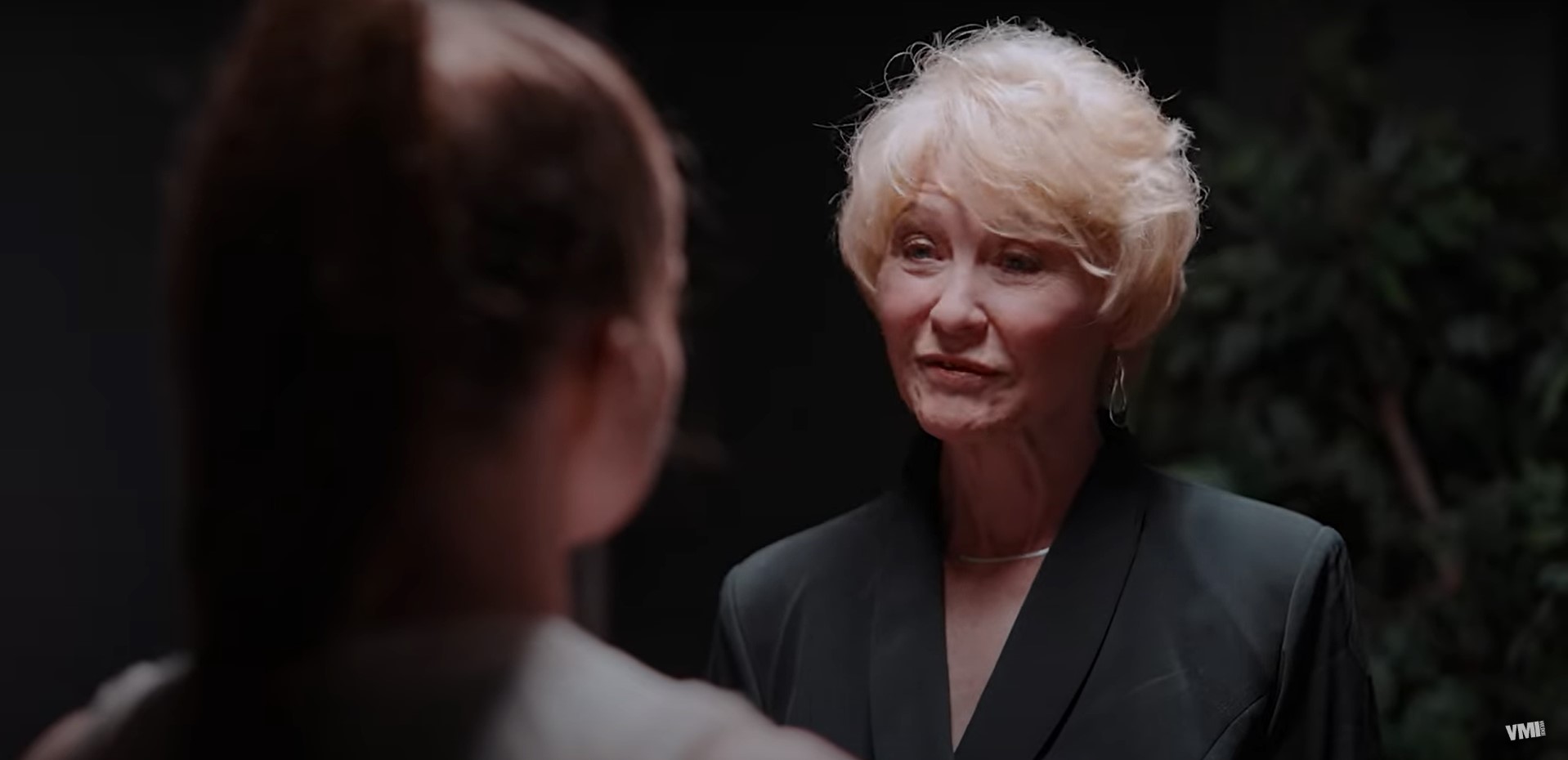
Powering “House of Dolls” vessel into explicit view is headliner Dee Wallace.  The “Cujo” and “Critters” scream queen has been on a junket of mom-and-pop productions for the better part of the last decade for aspiring horror filmmakers to leech off that eye-catching and weight-bearing Dee Wallace name.  Wallace reminds me of Linnea Quigley once said in an interview, if producers meet her price, she’ll star in pretty much anything.  Wallace seemingly has the same philosophy with a continuous stream of projects that screen her for no more than a total of 15-minutes, tops.  While this works to an extent, based off the prominence or the memorability of the role, most of that bankable name and face do little elevating the film, resulting in just a paycheck performance.  Sure, Wallace’s fans will check it out for the sake of Dee Wallace but for “House of Dolls,” as with the story or just as with the entity of the film, the gimmick doesn’t leave a mark.  The plot crux favors the three bickering sisters, Adalene (Violeta Ortega), Jenn (Stephanie Troyak), and Diana (Alicia Underwood).  Sibling diverging personalities uphold their seething hate for each other, that is much as obvious, but for what specific reason is never unfolded, or is unfolded but made unclear in the wake of its untidy heap.  What’s definingly unclear is the mother of these unlikeable brats.  Mentions of individually owning the unfortunate event of a mother’s death makes the ambiguous ruling that there is at least one half-sister.  They could all be half-sisters, but the unbridled dialogue and no conveyed backstory strays away from important pieces of the puzzle that make it as frustrating as trying to match a 2D puzzle piece within a 3D puzzle scheme.  The story also incorporates flimsy relationships with the sisters, Jenn’s drug buddy Justin (Jack Rain) who unexpectantly arrives with the sisters at their father’s estate, Adalene’s semi-sweet boyfriend Caleb (Phil Blevins), Diana’s vague friendzone coworker or perhaps boyfriend Lenny (Matt Blackwell”), and Diana’s out-of-nowhere go-to detective who just happens to be at her father’s hospital, dressed in beat cop fatigues, in Det. Ramierz (Meeko).  All these seedling characters are detached in their gravitational encircling around the sisters, pulling in zero weight on a story that’s quickly deflating.  Rounding out the fleeting supporting cast is Trey Peyton. 

Following “House of Dolls” plotline might as well be riddles with attention deficit disorder.  Too much is happening without the ease of transition or even sense to hold down a floating story that’s constituting forced uniformity and civility amongst rival siblings by way of a mysterious house with mysterious clues. Yet, those clues don’t flesh out and intrigue over what could have been a backstory backbone turns into gelatinous indiscretion of kill-after-kill by a leather coat-wearing masked-maniac with knives that offers up in the end being nothing more than surface level, superficial slasher.  Salas pulls off some decent, gory kills, such as a slimy disembowelment and a bisected torso that spills guts, to add some value to the production that’s ultimately equalized by areas of cut-rate props, such as the obviously flat and dull large knives that look more like cardboard than metal.  Like in true slasher tropes, the killer is seemingly everywhere at once, hopping from one location to the next, even if the other locations are across town, but this punk-cladded, homicidal maniac appears in-and-out of the alternating scenes too lackadaisically without systematic care to at least in try and make it plausible.   

VMI Releasing and MVD Visual handle the physical media distribution with a 1080p, high-definition Blu-ray.  The AVC encoded BD50 has the capacity for the eclectically ranged front lit key lighting and neon lighting, delivering a clean picture without compression issues.  Details waver between certain aspects of lighting, which is expected, but the details that do emerge pinpoint textural qualities and the key lighting reveals appropriate, vivid coloring and skin tones when contrasted against heavier background shadows.  Jorge Villa’s sizzling neon gives a warm glow in purple, blues, reds, and orange that enhances to a near music video quality outside the normal lighting and production parameters.  The film is presented in a 1.78:1 aspect ratio.  The uncompressed DTS-HD 5.1 English audio mix is an upbeat combination of verbal jabs, deregulated dialogue, and a medley of pop music and low-tone beat creator for the villain peppered with hip-hop rhythms, violin and piano down tone, and some suspense synthesized keyboard notes that do lean into what makes a decent horror soundtrack.  No complaints on the dialogue track that’s fairly level but doesn’t explore much in depth as characters are often up front and center on the camera.  There’s also not enough range to really utilize the multi-channel network and so the lack of miscellany fight for audible supremacy. Subtitles are available in English only.  Bonus features are aplenty on this larger capacity disc with Juan Salas commentary track that runs parallel to the feature, Juan Salas and Dee Wallace have a Halloween special video chat to converse about their time in production, a Natasha Martinez hosted cast Q&A for the U.S. premiere, a making-of featurette, and a MiB Legacy music video The Man Who Was Death.  On the outside, VMI’s standard Blu-ray comes with an appealing touchup of the killer in full dress from the chest-up, singled out by a black background and the title just overhead.  The disc is pressed with the same image with no other tangible features.  The film is not rated with region free capabilities and has a runtime of 84 minutes.    

Last Rites: “House of Dolls” crumbles as a clunky attempt at a slasher with a twist ending. The story shatters like someone pulling a pin on a grenade and pieces of act structure shrapnel propel in all different directions and never once hit target in the latest from director Juan Salas.

“House of Dolls” Is Ready to Play! Blu-ray Available at Amazon.

Sadomasochism and Decapitation Seen by a Child Turns Him into An EVIL Adult! “Nightmare” reviewed! (Severin / 4K UHD – Blu-ray)

Your “Nightmare” Should Be in 4K! Own it Here!

A schizophrenic patient continues to have reoccurring dreams of a young boy chopping the head of a woman in the midst of rough sexual fetishism.  The intense nightmares send him into violent stints, delusional states, and severe seizures.  As a test subject for an experimental behavior drug, the troubled man shows promise of recovery and enough so that he’s released from the mental hospital with continued outpatient therapy sessions.  Not long after his release does he skip his sessions to hightail it from New York City to Daytona Beach, Florida, killing people along the way after decapitating nightmare continues to plague and force him to murder.  In Daytona Beach, single mother of three becomes his obsession as he stalks the youngest boy, a mischievous troublemaker, and even breaks into their house when it’s not occupied , but as the bodies begin to pile up on the hands of his need to kill, the more brazen he becomes to entering while they’re home alone. 

Based loosely on the improprieties of government spy agencies using drugs to bend the minds of home and oversee terrorism to their wills, “Nightmare” sensationalizes the concept for the public sector involving a mental patient, experimental drugs, and exasperating an already instable person’s constitution into a hyperdrive of bloodletting carnage.  The U.S. production is written-and-directed by Italian filmmaker Romano Scavolini who came to America to shop around his scripts having failed to secure financial support in Europe, including, you guessed it, “Nightmare.”  Shot in New York and mostly around the Cocoa Beach Florida, the crime thriller filmmaker flexes his muscle with his first attempt at horror and the outcome is nothing short of unadulterated madness.  Once considered to be titled “Dark Games,” and goes loosely by “Blood Splash” and “Nightmare in the Damaged Brain,” the 1981 film is a feature of Goldmine Productions with John Watkins and Bill Milling (“Silent Madness”) producing.

The man behind the nightmare is George Tatum and the man behind George Tatum is Baird Stafford in one of his only two roles as an actor.  “Nightmare” wouldn’t be as skin-crawlingly shocking if it wasn’t for Stafford’s distressing performance of a man whose psychology is being peeled away and you can see Tatum physically fighting the urge, fighting to stay sane, but losing the battle as the grisly terror replays over and over inside his mind.  Stafford’s asunder of Tatum’s equilibrium has unequivocal transference to the audience.  Parallel Stafford is a child, a young child by the name of C.J. Cooke who essentially played his own version of himself in C.J. Temper, a mischievous prankster that ran babysitters up a wall mad and frightened and frustrated the living daylights out of his mother.  C.J. is part of the family Tatum is hellbent on driving down from New York to Florida to see for a reason that isn’t made clear yet until the shocking reveal.  C.J.’s single parent, a mother desperate for love and affection, is played by Sharon Smith who has become romantically involved with nice guy, and yacht owner, Bob Rosen, with Mik Cribben in the role.  Cribben was actually part of the cast but the original actor for Bob Rosen dropped out and Cribben quickly filled into the role that suited him well enough as a suitable suitor for C.J.’s mother.  “Nightmare” rounds out the cast with Danny Ronan, Scott Praetorius, Christina Keefe, William Kirksey, Tammy Patterson, Kim Patterson, Kathleen Ferguson, Candese Marchese, Tommy Bouvier, and producers John L. Watkins and Bill Milling as drug trial executive and psychologist tracking down Tatum to clean up their mistake. 

“Nightmare” combines excellent U.S. thespianism with an Italian way of suspense and violence glued together by the success of the late Leslie Larraine and team’s special effects albeit the controversial assertion on the film’s posters that Tom Savini (“Dawn of the Dead” ’78, “Friday the 13th, ’80) had been the effects supervisor on the film albeit Savini’s adamant claims of the opposite and denying the credit being false and liable for using his name to draw in audiences.  Savini continues to state his contribution “Nightmare” was limited to best to the action of a decapitating swing of the axe.  Ultimately, the whole ordeal mars Larraine’s due recognition for some of the more up-close and personal gory effects this side of the early 80s.  Scavolini also deserves well-received credit for his narrative vision of Tatum’s psychosexual struggles that drive him to kill.  Robert Megginson’s editing and the re-recording mixing team tackle a form of character plummeting that’s unlike any other from the intercut concatenation of events between Tatum’s horrific, blood-soaked nightmares and his antagonizing, sweat-inducing impulses that propel him without a choice.  The simultaneous parallels between Tatum and young C.J., as Scavolini aims to connect the two against-the-grain personalities as a singular link with back-and-forth subplots, leach the shock out of Sharon Smith’s acme line as mother Susan Temper that uncovers the truth when the chaotic smoke clears.  Why Tatum would drive so far from New York City to Daytona Beach, Florida with reason to stop and make roost on this one particular family fails to form mystery around what’s often crafted to be an arbitrary target with some minute hints that may provide clues to the audience is because even without those inklings, the shooting script defines the rationale right from the beginning thus bringing the viewers out from a shrouded suspenser and into being buckled in just along for the ride. 

Severin Films’ 4K scan of the 35mm internegative compositions the print with various foreign element sources for a comprehensive version of Romano Scavolini’s “Nightmare” on a 4K UHD and Blu-ray 2-dsic set.  The UHD is on a HEVC encoded, ultra high-definition 2160p with a 4K resolution, BD66 and the Blu-ray is housed on an AVC encoded, high-definition 1080p, BD50.  What’s released is a very enriched saturation of the technicolor process that defines and differentiates the innate hues.   Details are more than consistent throughout as we’re able to pinpoint the beads of sweat down Tatum’s face or feel the palpable slick sinew of a decapitated head amongst the examples.  Blood is a deep, glossy red and contrasts strikingly in the more sopping moments despite Savini’s claim that it needed more green dye to better pop for the camera.  A consistent layer of agreeable grain runs throughout from the 35mm film stock, as it should, without any inimical dust, dirt, scratches, flares, or of the like to obstruct viewing or cause lapse in the narrative, as it shouldn’t.  Between the resolution diverse formats, there’s a slightly more grindhouse look to the Blu-ray whereas the HDR10 crisps the image for better vibrancy.  Both formats retain inky blacks without shimmering or banding.  The English language audio tracks are available in two lossless options:  DTS-HD 5.1 and a DTS-HD Stereo 2.0.  The surround mix’s dialogue has resounding infusion, spread through the multi-channels to encompass a multi-directional approach to centralize.  The design is effective as it’s prominent to not understate the vocals but leaves little room for spatial distant to which no matter where characters stand, they are almost audible on the same audio plane.  Jack Eric Williams warping harmonica and twangy guitar, intrinsically integrated with piano notes, a variety of percussion, interjecting funk bass chords, and hints of string instruments, that ebb and swell with great intensity and favorable discordance is a real celebration of Williams’ score on Severin’s latest restorative edition of “Nightmare.”  English subtitles are optionally available.  The Ultra HD release comes the film’s trailers and a pair of audio commentaries as the only accompanying special features; commentary one has features star Baird Stafford and special effects assistant Cleve Hall with Lee Christian and David Decoteau and commentary two features producer William Paul.  The Blu-ray also has the commentaries and trailers plus an extended lot of interviews, such as a feature length (71-minute) Kill Thy Father and Thy Mother interview with director Romano Scavolini (Italian with English subtitles), Dreaming Up A Nightmare interview with cast and crew, a brief interview with Tom Savini discussing his role, or rather his not role, in The Nightmare of Nightmare to which Savini looks a little tired of answer the same question about his inaccurate involvement, an interview with makeup artist Robin Stevens The Stuff that Nightmares Are Made of.  Also included is an open matte peepshow as well as untouched deleted scenes, extending beyond the already newly achieved 99-minute runtime for the film.  “Nightmare” from Severin comes in a standard 4K Amaray case with original poster art used for the front cover.  The discs are separated and tab locked on either side of inner casing and this particular release, the 2-disc set, does not come with any insert or content.  The front cover is reversible with the European title “Nightmares in a Damaged Brain” and a different image composition of the European poster art. The disc has region free playback and is not rated.

Last Rites: “Nightmare” on a new, extended restoration in 4K and Blu-ray is a dream of a release. A nerve-wracking performance in Baird Stafford’s schizo vilifies the very classification of the mentally ill in what is sure to go down in history as one of the most disturbing, and disturbed, characters of the video nasty era.

Your “Nightmare” Should Be in 4K! Own it Here!

EVIL Wants to Cut Out Your Unborn Child. “Inside” reviewed! (Second Sight / Blu-ray)

Order The Limited Edition Copy of “Inside” From Second Sight!

Four months after deadly car crash that claimed the life of her husband, a disheartened and depressed Sarah is 24 hours away from being induced into labor on Christmas day.  Just wanting to be left alone, Sarah is eager to lower her head into her work as a photojournalist of capturing horrifying images that bear a resemblance to her own accident and inviting her editor over later to discuss the work ahead.  As the even lingers into night, an unexpected woman knocks at the door and menacingly tries to break into her house.  As the police arrive to investigate the incident, the woman is nowhere to be found and brush off the incident with little concern, but the woman returns, finds herself inside Sarah’s home, and is determined to cut the baby directly from Sarah’s womb to be her own child.  The tormenting violence becomes a cat-and-mouse game between the two women with an unborn child hanging in the balance. 

Extremely violent and soul biting, “Inside” is one of the more corrosively dehumanizing and destructive films under the French New Extremism, French New Wave Horror, flag.  The 2007 French feature cowritten-and-directed by Alexandre Bustillo and Julien Maury broke the duo into the industry as formidable and fearless filmmakers, reaching global heights having helmed later in their careers a segment of the popular anthology “ABCs of Death 2” and tackling one of America’s more renowned and bred-and-buttered horror franchises with the chainsaw-wielding cannibal in “Leatherface.”  “Inside” comes after the tremendous success of Alexandre Aja’s “Haute Tension,” opening the flood gates to other extreme French horror films in early 2000s with also “Martyrs” and “Frontier(s).”  La Fabrique de Films and BR Films in association with Canal+ server as production companies with later “Frontier(s)’s” Teddy Percherancier, Frederic Ovcaric, Rodolphe Guglielmi, and “Witching and Bitching’s” Franck Ribière and Vérane Frédiani producing the film known as “À l’intérieur” in France.

Not your typical home invasion ultraviolence, Sarah and who we know as labeled only as The Woman are two vipers circling each other, ready to strike when the guards are let down.  Of course, both have distinct personalities and strategies in the measured way of attack and survival that will impress on viewers preconceived notions about them.  As Sarah, Alysson Paradis, younger sister of Johnny Depp’s wife Vanessa Paradis, is bathed in exposed light, literally and figuratively, as the pinpointed principal woman from the start, battered and bloodied in the opening two car accident, to the end, in the final harrowing moments with the relentless Woman but though Paradis performance reeks greatly of depression and perhaps hopelessness with the death of her husband with a baby soon to be brought into this world without a companion by her side, the momentum shifts towards proposed surface villain of the story, The Woman, in a frightening portrayal of stony guile and grim severity by the established, character provocateur French actress Béatrice Dalle (“The Witches’ Sabbath”) in comparison to Paradis relatively filmic beginnings.  Dalle’s role expresses more physically than vocally with motivation coursing through her eyes, facial expressions, and body language that strikes a transfixing chord, turning Dalle’s the Woman into not only an unpredictable killer but an on-screen killer with a lighted purpose without confounding arbitrary slaughter as the yearning for The Woman’s reason never breaks silence until the shocking end.  François-Régis Marchasson, Nathalie Roussel, Ludovic Berthillot, Nicolas Duvauchelle, Aymen Saïdi, Emmanuel Lanzi, and Dominique Frot (“Among the Living”) fill out “Inside’s” cast.

Most will plainly see and interpret “Inside” as a regular home invasion thriller of a pregnant woman defending herself to survive a mad woman’s unborn baby obsession, and maybe that’s how Alexandre Bustillo and Julien Maury mostly intends the narrative to be as an overly graphic portrayal of hate and envy that makes us uncontrollable sinners at heart.  However, there’s something inside me to dig deeper below the face value of terrorizing prenatal torment of a young, expecting mother-to-be in what could be construed as a double-edged explanation.  The Woman doesn’t hold a name as she symbolizes all the worst qualities of a mother, such as anger, deceit, and she even smokes, in Sarah that could be considered a split persona or an archetype of duality.  Sarah is cladded in a bright white nightgown while The Woman is dressed all in black from head-to-toe, contrasting a good versus evil, and both want the same child.  The climax does rebuff the split duality theory to an extent but the way the script is written and how the film is shot very much suggest these two women are cleaved from the same whole with a patriarch-less presence and, to add as an interesting note to further examine and contemplate, all the male characters in the story are slain by the same women while the only other female character is brought down by the other in what is a powerful suggestion of split gender and how gender plays a role in their individual lives.

In what can be said to be the most definitive edition of one of the most brutal films ever produced, Second Sight Films’ Limited-Edition boxset of “Inside” is amply packed with goodies, in application and in a tangible sense. Presented in a widescreen 1.78:1 aspect ratio, the AVC encoded, 1080p high-definition, double-layered BD50 from the UK label holds tremendous value with not only new special features and neat and attractive corporeal contents but also valued by retaining image fidelity with a gritty 35mm print. Natural grain and low-fi celluloid present the seedy grindhouse overlay that’ll take audiences from the comfy, cozy reality into a dark, anomalous atmosphere with warm muted coloring, lambency, and an overall light general haze suffused into the setting. The cinematography has been purposefully constructed with analog building blocks for a rough look for a rough story. Not technically applicable here but “Inside” is set around Christmas, Christmas eve into Christmas day to be exact, but the choice production dressing exhibits little holiday spirit with a far less ostentation presentation and in how the characters dress the season feels more fall like than winter. The lossless French 5.1 DTS-HD master audio offers plenty of spatial awareness during intense pocket skirmishes inside the quaint two-story home, which is the primary setting of the story. The range provides laceration slits and surgical squishes of blades and scissors while gunfire shocks with an innate immediacy. Even with a mostly prominent inconversable back-and-forth, the dialogue that does come up carries through with robust confidence without overbearing the action or feeling out of synch. Speaking of being in synch, English subtitles are available with the French audio track and are error-free and pace well. Special features include a new audio commentary by The Final Girls’ and film critic Anna Bogutskaya, new audio commentary by editor Elena Lazic of the online magazine outlet Animus, a newly produced interview with writer-directors Alexandre Bustillo and Julien Maury First Born as well as newly produced interviews with principal actress Alysson Paradis Labour Pains, producer Franck Ribière A New Extreme, cinematographer Laurent Barès Womb Raider, and stunt coordinator Emmanuel Lanzi Reel Action, with The Birth of a Mother, a Jenn Adams analytical essay focusing on a denied mother’s perspective and the opposite. The limited-edition physical elements of the release add additional magic to the whole package with a rigid, cardboard sleeve case with new artwork by Second Sight retainer artist James Neal. Inside the “Inside” sleeve is a 70-page book with color pictures and thematic essays from film historians and critics Chad Collins, Kat Ellinger, Annie Rose Mahamet, and Hannah Strong. There are also 6-5×7 collector art cards adjacent. The green Blu-ray Amary case houses the same Neal front cover from the rigid sleeve, likely will be the face of the standard release, with the interior disc art having a simple yet effective image of a blade open pair of scissors and psycho-split or -sliced title in red and while. UK certified 18 for strong bloody violence and very strong language, this Second Sight release is B region locked and has a runtime of 83-minutes.

Last Rites: Second Sight invests in “Inside” and its first-time French directors nearly two decades after initial release with a comprehensive package that not only elevates beyond what many labels sought to get out of the gore-laden entropy, quick cash, but this premier release also has depth and range into the film’s applied style and dives into demystifying the breadth of thought preluding random terror.

Order The Limited Edition Copy of “Inside” From Second Sight!