Black Mamba Wriggles Only for EVIL! “Venom” reviewed! (4K UHD and Blu-ray / Blue Underground)

Slither into “Venom” on 4K UHD and Blu-ray Combo Set!

American family, the Hopkins, live in London and while Mr. Hopkins travels the globe to attend to his international hotel business, Mrs. Hopkins and son Philip, live wealthy in their three-story row home along with visiting, Safari-expert grandfather Howard Anderson.  When Mrs. Hopkins plans a trip to see her husband after a month a part, she’s worries for Philip’s severe asthma attacks but with the assurances of the grandfather, the housekeeper, and Philip’s rudimentary zoo in his room, full of furry creatures in vivarium cages, Mrs. Hopkins half-heartedly boards her international flight.   Not everything is going to fine, however, when the housekeeper schemes with the family chauffeur and an Interpol criminal Jacmel to kidnap Philip for ransom.  The foolproof plot commences to plan with departure of Mrs. Hopkins and the arrival of Jacmel but one little mishap causes the plan to quicky unravel when a Black Mamba, one of the most aggressive and poisonous snakes in the world, is mistakenly crated and provided to exotic animal enthusiast Philip instead of his harmless ordered common variety garden snake and when the Black Mamba gets loose, it slithers in the house’s ventilation system, the house they’re all hold up in when the police swarm the outside perimeter. 

What was once going to be a Tobe Hooper (“Texas Chainsaw Massacre”) directed production before his eventual and sudden departure from the film after a few weeks, the 1981 crime-thriller with a creature feature twist, “Venom,” is then picked up by the late director of  “The Blood on Satan’s Claw,” Piers Haggard, to finish the Robert Carrington (“Wait Until Dark”) adapted screenplay off the Alan Scholefield novel of the same title.  The American screenwriter Carrington writes nearly a faithful iteration of the Scholefield novel but with more emphasis on the serpent’s over-lurking presence as an important reptilian character to the story, serving as a catalyst for the upended kidnapping plot and determining the fate of certain characters.  The UK film is American produced by Martin Bregman, the spear runner for “Dog Day Afternoon” and “Serpico” as well as “Scarface” and “The Bone Collector” later in his career.  Morison Film Group served as production company on the mostly LLC entrusted venture.  

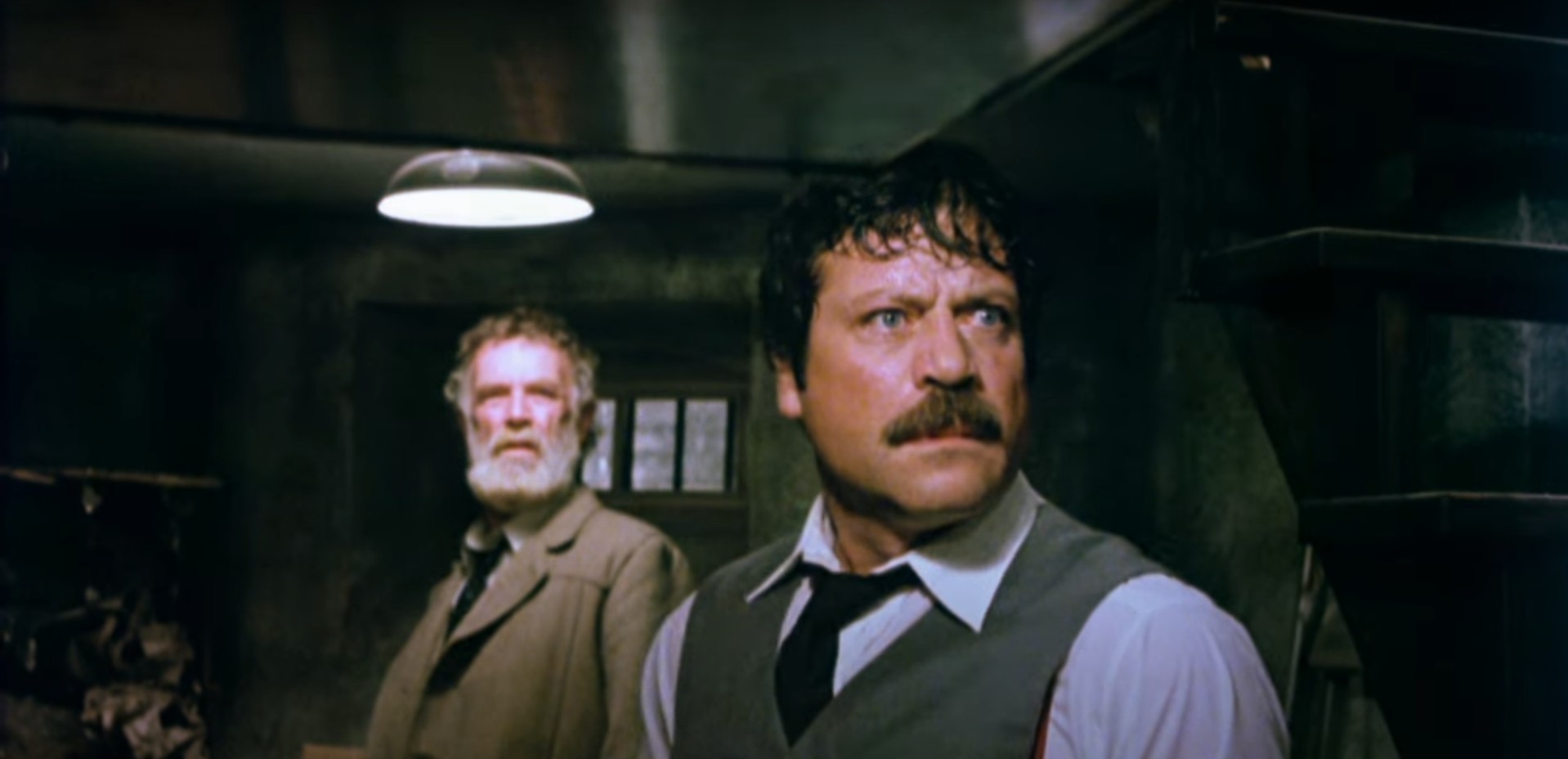
If the American Tobe Hooper did helm this picture, directing Leatherface as an actor would been child’s play in comparison to what would had been if he had to corral a pair of strong-willed, A-type personality Europeans in Germany’s Klaus Kinski and Britain’s Oliver Reed, both with well-known and formidable career of not only in genre films but also to be problematic and difficult to work with.  The “Nosferatu the Vampire” and “Aguiree, the Wrath of God” Kinski was perhaps mostly misunderstood for his not understanding of inflections, innuendos, and gestures of the English language that made him often sounds gruff and antagonistically questioning the director’s every choice whereas the “Paranoiac” and “The Brood” Reed was plagued with alcoholism and was equally gruff in his own right as a dedicated actor saturation with austere method stratagem.  Yet, on screen, Piers Haggard manages to get the two hurricane forces to be on-the-edge cooperating, backed-into-a-corner kidnappers without cutting any tension when interacting with each other.  Distinct in demeanor, Kinski as a calm, trench coat KGB-type and Reed as an anxiously and trigger-happy, hotheaded brute put on a good show in their respective performances and beat the odds of two notorious personas colliding.  Haggard doesn’t coddle them either and lets them loose to exact the carrier in their own right even if off-book and they’re even more vilified by taking hostage a young boy Phillip, the introduction of Lance Holcomb (“Christmas Evil,” “Ghost Story”), his Safari-seasoned grandfather Howard Anderson, played by beard-laden and serial gesticulating Sterling Hayden (“Dr. Strangelove,” “The Long Goodbye”), and a zoo toxicologist named Dr. Marion Stowe who is caught in the middle when checking up on the mishap switcheroo of the snake, played by Sarah Miles (“Blow-up”), neither in shape or in vigor to be a proactive hero.  The no-nonsense Police Commander William Bulloch, shoed with “The Exorcist III” actor Nicol Williamson, a brazen candor and stoic expression with Williamson offering frank wit and a sarcastic dryness that barely gets him one step into the house; instead, it’s the Black Mamba that’s the real and unintentional hero that seemingly only has a fork tongue and fangs for villains, leaving the other hostages alone.  “Venom’s” also has Susan George (“Straw Dogs”) as the traitorous housekeeper, Mike Gwilyn, Paul Williamson, Hugh Lloyd, and the first Butler of the 1980s-1990s Batman quadrilogy Michael Gough playing real life snake wrangler David Ball in tribute. 
From the pages of Alan Scholefield’s novel to the big screen, “Venom” has a slithery way about slipping into between the crosshairs of a crime-thriller and a venomous creature feature.  Leading “Venom’s” charge is an undoubtedly great, if not iconic, cast giving their all to a farfetched plot of bad luck Ophidiophobia.  While the snake seems to have heat vision eyes only for the Klaus Kinski, Oliver Reed, and Susan George trio of kidnap-for-ransom criminals, who amongst themselves are in a deceitful love triangle that’s doesn’t quite come to a head as one would expect, there’s no animal kingdom peril to the other victimized threesome who, on a physical, first glance surface, are less equipped to handle a dangerous snake with a young, asthmatic-plagued boy, an elderly grandfather, and a nerve-bitten woman but, in reality, Phillip Hopkins, Howard Anderson, and Dr. Marion Stowe are respectively the best equipped to handle the black mamba as an small animal atrium hobbyist, a former African safari survivalist and animal expert, and a venomous snake toxicologist.  Perhaps, this is why the Black Mamba avoids these three at all costs and never interacts with them on a perilous level.  The fantastical mist that’s sprays us lightly with a crimefighting snake has comical properties that standout against what is a palpable thriller involving an international criminal, cop killing, child abduction, and the mutilation of a corpse. 

Blue Underground continues to update their catalogue with a 2-disc, 4K UHD and Blu-ray combo set of ‘Venom.” The UHD is HVEC encoded, 2160p ultra-high-definition, BD66 and the Blu-ray is AVC encoded, 1080p high-definition, BD50. In regard to picture quality, both formats are nearly identical transfer that’s stems from an all new 4K 16-bit restoration from the original 35mm internegative, with the UHD receiving Dolby Vision HDR. UHD is slightly sharper around delineation when gliding between dark and light, which is often inside a merge of a half-lit house to draw more tension toward the potential presence of a deadly snake. The 1080p presentation also provides a pleasing clarity that offers little to negatively note. Color grading and saturation between the two formats show signs of varying quality by a thread with the 4K saturating that much more intently across the board with a better control over the grain levels with the Blu-ray appearing a touch thicker for the pixels to flare optically. The native 4K and 1080p come with an English Dolby Atmos as well as options for either an English DTS-HD 5.1 or a DTS-HD 2.0 stereo. Speaking only to the Atmos, the all-encompassing mix shepherds in a clean, discernible quality without any audible seams. Skirmishes, dialogues, and all the commotions in between find isolated channels of distinction that can put you immerse you into the action. And there’s plenty of action to be had coupled with a Michael Kamen’s brass horn and string score that’s both memorably building with excitement and thrilling that preludes Kamen’s orchestrated composition work of “Die Hard,” starring Bruce Willis. Despite the circumference of sound spaced mostly in interiors with a hodgepodge medley of a street full of police, reporters, and gawkers, the dialogue is equally distinct, discernible, clean, and clear without signs of hissing and crackling strains. Subtitles included are in English, French, and Spanish. The 4K special features include a new audio commentary with Film Historians and Blue Underground commenting regulars Troy Howarth, Nathniel Thompson, and Eugenio Ercolani, an archived commentary with director Piers Haggard, and film trailers. The Blu-ray disc contains the same commentaries and trailers but extends further with new exclusives in an interview with editor-second unit director Michael Bradsell Fangs For the Memories, an interview with makeup artist Nick Dudman A Slithery Story, a film historian point of view interview with British critic and author Kim Newman, and an interview with The Dark Side’s Allan Bryce providing his in-depth two cents and historical surveying. TV Spots are finish out the encoded extras. “Venom” 4K and Blu-ray combo set is physical appeasing to hold and behold with a muted black slipcover with tactile elements on both sides of embossed letters and stark coloring that’s striking in its simple snake fang design arraignment. The black, thick Amaray case has the original “Venom” artwork with the optional reverse cover art. I’m not a fan of the inside design that houses a disc on both sides as there is no room place for 18-page collectible, color picture booklet which just floats inside. The booklet features an essay by Michael Gingold, cast and crew acknowledgements, and chapter selection on the back. The discs are pressed with one or the other cover arts. This gorgeous-looking release, on the outside and inside, comes region free, has a runtime of 92 minutes, and is Rated R.

Last Rites: “Venom” might have been snakebitten back when selling book adaptations of crime capers stopped by a single snake might have seemed farfetched but, today, the 1981 film remains a cult classic of the ophidian nature being one of the earliest serpentine creature features with an imposing, impressive cast. Blue Underground proudly presents the film with a new, and improved, ultra high-definition release.

Slither into “Venom” on 4K UHD and Blu-ray Combo Set!

Feminism’s EVIL Plan Thwarted by CIA Hunk in “The Million Eyes of Sumuru” reviewed! (Blue Underground / Extended Edition 4K UHD and Blu-ray)

Sumuru’s Eyes Are Everywhere, Even Here on Amazon! Purchase the 4K and Standard Blu-ray Set Here!

Tall, handsome, and witty CIA agent Nick West is about to go on a much-needed vacation.  As soon as he steps outside of headquarters, he’s approached by British agent Colonel Baisbrook to cash in a favor the CIA owes the British government.  Unable to refuse, West agrees to investigate the assassination plot against one President Boong of an unnamed East Asian country.  The assassins are nothing short of extraordinary as a bunch of femme fatale infiltrators have put themselves in positions of power all over the globe as wives and girlfriends of nation leaders and President Boong is the only one that has refused to take the bait.  West and his good friend Tommy Carter find themselves quipping and philandering amongst the most dangerous female-centric organization on the planet, led by the ruthless and beautiful Sumuru.  To protect President Boong, West must become friendly with Sumuru who uses his likeness in a new elimination plot that puts him front, center, and in between saving the world or watch the men become subservient by an ambitious woman seeking world domination.

Double agents.  Foreign places.  Secret lairs.  Suave operatives.  Sexy women.  These descriptors are the very spirit of a James Bond movie.  At the height of the Sean Connery 007 era, plenty of knockoffs were produced to capitalize on the action and sex appeal of martini-drinking covert agent that rules the 1960s.  One of those copies was helmed by Lindsay Shonteff in 1967, titled “The Million Eyes of Sumuru.”  The “Devil Doll” and “Voodoo Blood Bath” director had already an espionage thriller under his directorial belt with “The 2nd Best Secret Agent in the Whole Wide World,” I bet you can guess who the first was during that time.  Kevin Kavanagh pens the script from the original story by legendary B-movie producer Harry Alan Towers (“The Face of Fu Manchu,” “Psycho-Circus”) that would become an incongruously and acerbically witty-tale of pseudo-feminism with hot pursuits, sensual promiscuity, and a dart gun that can turn a person to stone.  Towers also produces “The Million Eyes of Sumuru” under his LLC and filmed in Hong Kong at the Shaw Brothers Studios. 

As Sean Connery heats up the screen with his double 0 escapades through all over the global to thwart the men of evil and with an astounding amount of carbon copy espionage reels rearing to chase the all mighty buck, “The Million Eyes Sumuru” desperately needed a cast to keep afloat in a flooded spy film market.  For the most part, Towers and Shonteff’s cast pull off exactly what the story needed, a caricature of crowning chuckles subdued only by its slivers of spy game ventures.  That’s not to say there’s an abundance of gun play and fight sequences with terrific tussling as “House of 1,000 Doll’s” George Nadar uses his tall stature and ear-to-ear smile to be a lover, not a fighter in the wise-crackin’ American CIA agent Nick West.  West destroys the all-women Sumuru arsenal with just his manliness in a satirical jab at Ian Fleming’s titular protagonist and, for all intent and purposes, it works in the story to see Sumuru’s plans become ruined by not a gun nor a fist but because women in her organization, even Sumuru (Shirley Eaten, “Goldfinger”) herself, throw themselves onto him at critical moments and Nadar’s timing and screen charm laps every second of it.  Frankie Avalon (“Horror House”) and Wilfred Hyde-White (“The Third Man”) play Nick West’s allies as friend Tommy Carter and cavalier British agent Colonel Baisbrook who both play in two totally different capacities.  Tommy Carter equals West witticisms but falls behind as the friend who must journey solo to find West in the middle of Asia while Baisbrook effortlessly shows up in the nick of time to be either a savior or West’s handler with another mission in his pocket for West to reluctantly tackle.  A pair of principals that are held at bay is the beautiful Maria Rohm (“99 Women”) and the eccentric Klaus Kinski (“Nosferatu the Vampyre”) whose swift takes leave more to be desired as Rohm becomes weak-kneed on her Sumuru femme fatale application and Kinski plays drug-addicted, politically incorrect, and perverse president of this untitled Asian country. 

“The Million Eyes of Sumuru” contests to be a smartly funny, exotically set, and action-invested covert operative film of the late 60s, swimming against the current of some of the hard to beats and who have more of a legacy in the subgenre.  While “The Million Eyes of Sumuru might be more Swinging 60’s with cavalierism rather than sophistication and intent, the production value could rival the best Bond film of it’s time but it’s the stunts that drive this one down below the bar as Shonteff looks toward George Nadar’s quick wit and budding personality to be the masculine sex symbol that drives the rabid female race to their supposed manhating knees.  Its quite comical to see a firm line of feminism course through the plot’s veins, a plot where deadly women penetrate and subvert men world leaders only to become a slave to West’s dunce charm and attractive appearance.  West really isn’t the smartest of secret agents as he’s not trying to evade capture with rapid haste or fool anybody of his intentions; instead, he’s just mildly clever with broad shoulders and, apparently, that’s what women droll over instead of carrying out their loyalty pact of a global coup d’etat.   

Swinging onto the 4k Ultra HD Blu-ray bandwagon is the Blue Underground’s 2-Disc combo set UHD and Standard Blu-ray release of “The Million Eyes of Sumuro.”  The HEVC encoded, 2164p resolution, BD66 has picture quality absolution with a stunning brand-new 4K restoration transfer from the original 35mm camera negative thought originally lost.  The rich and colorful picture hits all the important markers with balanced film density that diffuses the hues nicely into every aspect of depth and focus, from the background to the foreground.  This goes for texture too.  No matter where an object lies in the frame, there’s an accurate representation in the reproduction inside the immense range of color schemes, landscapes, and textures.  Delineation is quite pleasing; the close ups of George Nader’s face exhibit ever facial feature with precision without appearing overly bright or smoothed.  The AVC encoded, 1080p resolution, BD50 Blu-ray captures much of the same finer points too on a slimmer pixel count but still denotes Blue Underground’s improved restoration, complete with inky blacks and no compressional misses to sully the quality.  The extended cut adds approx. 10 minutes of additional footage, which in these cases can often be less-than-pristine upon discovery of the elements but the additional scenes are seamlessly blended into previous releases’ runtime, suggesting the print was greatly protected from all harmful exterior factors.  A single channel English DTS-HD mono is the only mix available. Though standard and not as dynamic as more modern audio designs, the uncompressed track provides superb fidelity clearness, cleanliness, and with an even-keeled throughout.  The snappy dialogue shows prominence amongst a wide-berth range of surrounding elements.  There’s a blend of ADR and live recording, much to the chagrin of the Asian actors who have their English post-dubbed with a more accented stereotype.  English SDH are optionally available.  Capacity limitations on the UHD keep disc one to just two audio commentaries:  Film academics David Del Valle and Dan Marino on the first commentary with usual commentary notables Nathaniel Thompson and Troy Howarth on the second.  These commentaries are encoded on the Standard Blu-ray version of the film, accompanied by a new feature-length documentary England’s Unknown Exploitation Film Eccentric:  The Schlock-Cinema Legacy of Lindsay Shonteff that has historian interviewees, such as Kim Newman, discuss the brilliance of Shonteff’s work amongst the espionage thrillers of the time, an exclusive RiffTrax Edition of the film, riffed by Mike Nelson, Bill Corbett, and Kevin Murphy, the theatrical trailer, and the poster and still gallery.  It’s always a pleasure and a thrill to have tactile elements on the Blue Underground O-slips, such as this release with the embossed title overtop and below the memorable packed compositional, illustrated artwork.  The slightly thicker black Amaray casing houses the same artwork with a reverse side of the original Blue Underground DVD artwork.  Each interior side contain each format disc, pressed individual with the same cover arts, with the Blu-ray on the left and the UHD on the right.  Encoded for all region playback, “The Million Eyes of Sumuru” now clocks in at 89 minutes and is not rated.

Last Rites: “The Million Eyes of Sumuru” has a million positives – a farce of the espionage subgenre, cheekily acted, exotic locations, and an extended, clean-cut version from Blue Underground – to name a few that quickly surmises the Lindsay Shonteff film to be the golden gun of his repertoire.

Sumuru’s Eyes Are Everywhere, Even Here on Amazon! Purchase the 4K and Standard Blu-ray Set Here!

Blind, EVIL, Undead Templar Knights Hunt for a Bite to Eat! “Tombs of the Blind Dead” reviewed! (Synapse / Special Edition 2-DiscBlu-ray)

“Tombs of the Blind Dead” 2-Disc Blu-ray Available for Purchase Here!

Maria, Betty and Roger take a train across the Spanish countryside to see the landscape sights.  When Maria feels like a third wheel stuck in between Betty and Roger’s flirtations, she jumps off the moving train, leaving her friends aboard, and camping out under the ruins of an old countryside Church.  There’s only one problem, the Church was home to the ancient order of the Knights of Templar who took a blood oath for Satan by sacrificing young virgins by drinking their blood and lynched by the Church for their crimes against man and God.  The Cursed Knights, reduced to rags, bones, and without eyes, rise from underneath their graves every night and roam the countryside on the hunt for anybody in proximity they can feast upon.  Betty and Roger learn of Maria’s strange demise without knowing the details and form a four-person search party only to step into the same dangerous den of the Knights of Templar. 

“Tombs of the Blind Dead,” or as known as the U.S. as just “The Blind Dead,” is the first in a series of four undead Templar Knights films that would come to be known as The Blind Dead collection by Spanish filmmaker Amando de Ossorio.  Natively titled “La noche del terror ciego” was released in 1971 and penned by Ossorio who laid a new path of Spanish horror that didn’t involve Paul Naschy or Jess Franco with undoubtedly slow dread of the undead that resembled more of the Italian-bred beyond the grave films where ghouls and ghosts return to life and wreak bloody havoc on the living, a guise for social context and for political dictatorship.  Themes of rebellions, rape, and bisexuality course through the feature’s necrotic veins as the film receives Spanish and Portugal co-production support from Plata Films and Interfilme with executive producer Salvadore Romero (“The Werewolf Versus the Vampire Woman”) spearheading pre-production and behind the scenes.   

Following of a newly formed trio of friends traveling the countryside to take in the sights, an underlying green-eyed trouble brews right from the moment when an enchanted Roger, the debut film and character of 1973’s “Green Inferno’s” César Burner, meets gorgeous red head Betty, “It Happened at Nightmare Inn’s” Lone Fleming,” and Roger’s travel companion and Betty’s Catholic boarding school roommate/best friend, Virginia, “The House that Screamed’s Maria Elena Arpón, feels the twinges of jealousy as her amorous covets for Roger never materializes and she sees her future with relationship with roger forever in the friend zone.  Virginia becomes so intolerant of Roger and Betty’s innocent flirtations that she’s willing to hop off a not-so-speeding train and camp inside the creepy, ruined structures at centerstage of a burial ground.  Arpón’s passive aggressive behavior is quite convincing, even the part where she tucks and rolls off a moving train in what stupid things do when people are frustrated, especially in the gray territory of love.  The love triangle is so simplistically arranged, each behavioral component goes without being farfetched.  From Virginia’s first sexual experience at the caressive, soft hands of her roommate/best friend Betty while at boarding school to Roger and Betty’s blameless attraction to one another that spurs Virginia’s irrational, self-serving behavior, Ossorio’s characters are written very well when homogeneously compared to other outside of cinema love triangles.  José Thelman (“Night of the Sorcerers”) indulges as the smuggler swine Pedro who’s roped into the reconning of the Templar tomb to clear his name with authorities by proving someone else had murdered Roger and Betty’s friend.  Joined by his floosy sidepiece María, played by another María in the iconic Spanish B-horror actress.  María Silva (“The Awful Dr. Orlof”), Pedro brutishly flaunts arrogance and confidence, taking what he wants, especially with the women uncharmed by the male sex, and that’s curious, fluid attribute when he attacks Betty but in the wake of the moment, the two of them are silently surfeited as they share the scene and that’s severely different from what anyone other filmmaker was doing at that time.  Andrés Isbert (“The Kovak Box”), Antonio Orengo (“Love Letters of a Nun”), Francisco Sanz (“Django Kill… If You Live, Shoot!”), Rufino Inglés, and Verónica Llimerá (“Hatchet for the Honeymoon”) round out the cast.

Performances give “Tombs of the Blind Dead” credibility in anxiety-riddled survival and turbulent human interactions but where those performances start to give way coincides with Ossorio’s building of dread.  No doubt the use of slow-motion sets the ghoulish, harrowing tone of the depraved, unabating, skeletally-cursed Templar Knights giving chase on horseback as they track down their flailing fresh meat, but in the process of that spinetingling, in between the Knights self-unearthing and the eventual snare and snack of their human victims, Ossorio doesn’t quite know how to flesh out formidable trepidation.  Pursued, screaming characters stand in the face of danger as if their feet are hardened in cement, stopping at every brief moment when out of sight of the hooded decaying bones and rags with dusty swords, and absentmindedly run right into the exposed radius and ulnas of the slow-moving and blind medieval damned maniacs in sequences that run out too long to be wholly gratifying.  Ossorio better pedestals the ingrained Spanish themes of never escaping your gruesome, haunting past, as seen with the circular narrative of always return back to the Knight’s ruins, and the sexual taboos of bisexuality and rape that lead to destruction.  These course through a more classically presented gothic horror. Perhaps explaining the fervent melodramatics of flamboyant fear, under the dictatorship regime of Francisco Franco and his cult-like ritualization in fascism oversight of Spain.

The sightless, flesh-feasting Templar Knights have found a new home in the Synapse Films’ tomb of terror with a new restoration transfer on a 2-Disc Blu-ray. Refurbished from the uncut original camera negative, the AVC encoded, 1080p high-definition, BD50 capacity suppresses any compression issues to display polychromatic decadence in front of a backdrop of steely graded blues. Plenty of a darker scenes to be affected by artefact corruption but the blacks are greatly dyed-in-the-wood saturated and not delineated or in spectrum of lesser decoding. Scenes never approach being flat, in color tone and in field depth, as beads of glistening sweat can be visually elaborated on and the distinction between color, shadow, and scale discern wonderfully. Two audio option tracks are available: a lossless Spanish PCM 2.0 mono track and a lossless hybrid of Spanish-English (Spanglish?) PCM 2.0 mono track. Both tracks are of a post-production dub with the Spanish option having greater synchrony with the articulating native Spanish actors of this Spanish coproduction. Audibly clean with little-to-no hissing, popping, or crackling, Synapse’s singular restoration is in good company with a high impact, high clarity, and low distortion dialogue track that meets eye-to-eye with the visual components as well as the film’s ambience cluster and Antón García Abril’s breathy and discordant, Gothically canticle score. Option subtitles are available in English on both tracks. Special features on the first disc contains individual audio commentaries by horror film historian Troy Howarth, Betty actress Lone Fleming, and the NaschyCast podcasters Troy Guinn and Rod Barnett. A feature-length documentary Marauders from the Mediterranean go from head-to-toe on not just detail Ossorio’s “Tombs of the Blind Dead” as the Spanish stamp in the juggernauting zombie genre of the times but also going in depth with the Spanish laid in horror from the 1960s to 1980s, featuring interviews with Lone Fleming, John Russo (“Night of the Living Dead”), director Jorge Grau (“The Living Dead at Manchester Morgue”), Sitges Film Festival director Mike Hostench, critics Kim Newman and John Martin, film academics Steve Jones and Calum Waddell, actors Helge Line, Manuel de Blas, Antonio Mayans, and Jack Taylor, and even Paul Naschy’s son, Sergio Molina. An alternate U.S. opening sequence Revenge of Planet Ape gives expositional insight on how the success of “The Plant of the Apes” films influenced the American distribution market to rebrand “Tombs of the Blind Dead” as an ape rebellion piece to ride the coattails of the series’ success on a lower, foreign budget. Rounding out the special features is a featurette Awakening of Spanish Horror Cinema, Salem Pop’s “Templar Tears” music video, the original theatrical trailer, and a still gallery. While Synapse has 3-Disc limited-edition set of only 4000 copies made with all the bells-and-whistles of the visual elements of new artwork, a slipcover, and a 3rd disc audio CD, the 2-Disc standard edition comes with all the same special features and all three versions of the film inside the black Amaray Blu-ray case and classic “Tombs of the Blind Dead” poster for cover art. Inside, you’ll get Synapse’s physical media catalogue and a disc on each side of the Amaray’s interior with disc 1 “Tombs of the Blind Dead” and disc 2 “The Blind Dead,” housing the shortened 83-minute U.S. re-edit on a BD25, that sport their own pressed artworks. The uncut disc 1 has a runtime of 101-minutes and has region free playback.

Last Rites: “Tombs of the Blind Dead” is Spain’s answer to “Night of the Living Dead” with discerning individualities ingrained by director Amando de Ossorio to include his country’s own social and political subtext and while Blue Underground’s The Blind Dead DVD collection is an impressive physical media crown jewel of upscaled 720p, the Blu-ray gods favor Synapse with an impressive hi-def A/V release with stellar bonus features.

“Tombs of the Blind Dead” 2-Disc Blu-ray Available for Purchase Here!

EVIL Sentences You to the Torture Dungeon and his Bedroom! “Night of the Blood Monster” reviewed! (Blue Underground / 4K UHD + Blu-ray)

“Night of the Blood Monster” on 4K + Blu-ray is Here and On Sale!

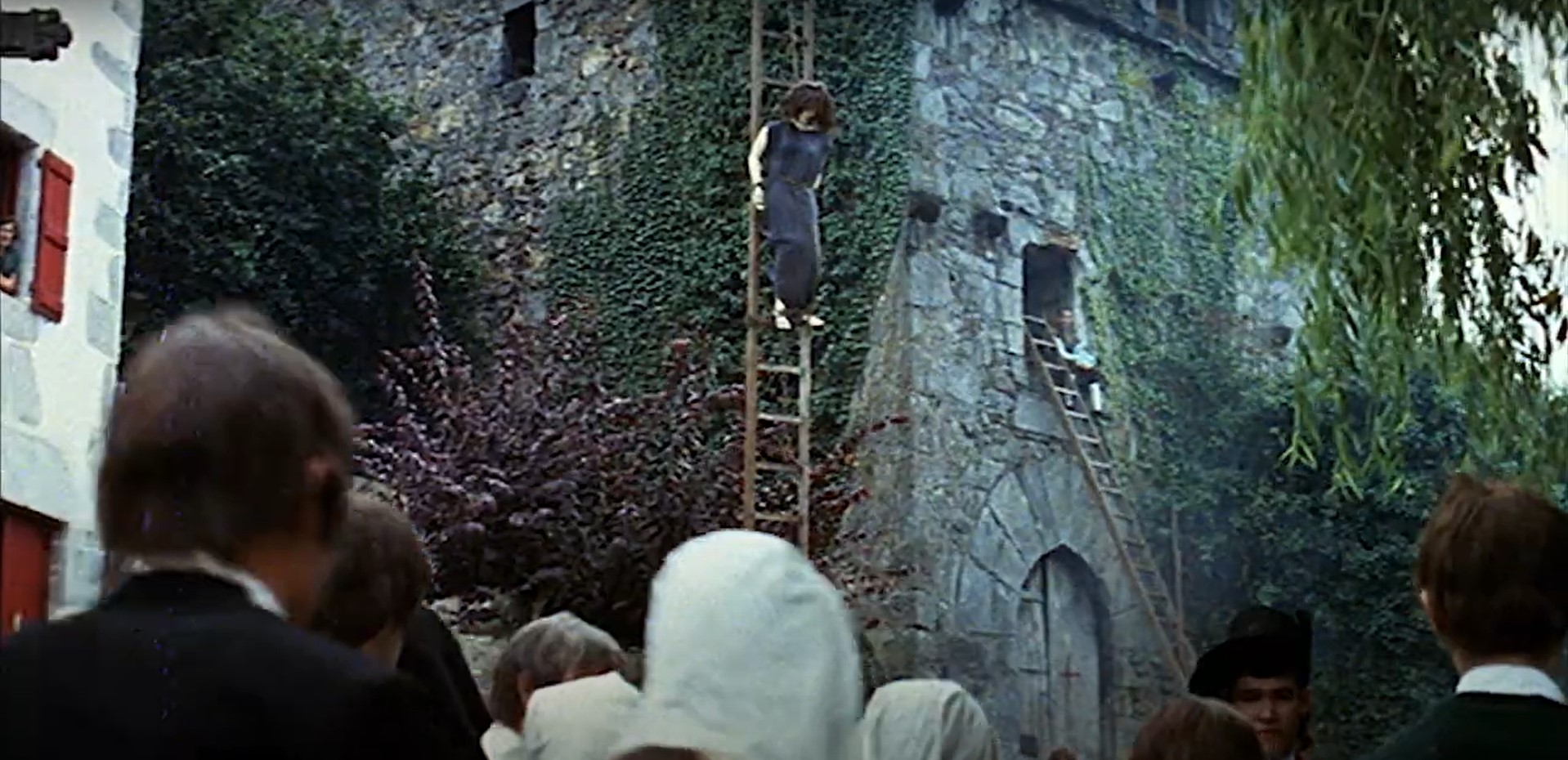
After the death of King Stewart, 17th century England went into asunder chaos with the ruthless, usurping King James and the rightful, exiled King William of Orange who sought to return and topple King James’s authoritarian rule of a false claim to monarchy.  During the beginning and at the height of the revolution, Chief Justice George Jefferies presides over witchcraft cases with extreme and unethical prejudice, subjecting them to the torture chamber for what is labeled a ‘thorough examination” of their heretic ways, and eventually sentencing to public execution.  When the sister of one of the condemned women attempts to flee the country with a nobleman’s son, Jefferies learns of their dissidence and sends his henchmen to fetch the lovely woman to exploit her within the context of his own licentious litigiousness but closer and closer do the rebels and William of Orange’s men come to men like Chief Justice Jefferies who believe their power, influence, and proximity to God will save them from the noose.

A 17th century Eurotrash period piece forged out of mostly flesh and wolfish self-importance, “The Night of the Blood Monster” is yet another reteaming of Jesús (Jess) Franco and Sir Christopher Lee based loosely on historical context despite Lee’s best efforts for the contrary.  Also wildly and otherwise known as “The Bloody Judge,” and not to neglect mention the exorbitant unofficial titles from around the globe like “Witch Killer of Broadmoor,” “Throne of the Blood Monster,” and “Trial of the Witches” to name a few, the Spanish-German-British coproduction, cowritten between Jess Franco and Enrico Columbo (“Hell Commandos”) is a biographical interpretation of the Chief Justice George Jefferies and the brief span of his cruel litigator’s life set against an epic regime kerfuffle and grimy, exploitation barbarity.  The storyline concept was imagined by longtime Jess Franco producer and overall B-movie votarist Harry Alan Towers (“99 Women,” “The Blood of Fu Manchu”) alongside Columbo and Arturo Marcos (“She Killed in Ecstasy”) under production firms of Fenix Cooperative Cinematografica, Prodimex Film, and Towers of London Productions.

In yet another instance similar to Jess Franco’s “Eugenie” of a prior year or two where Christopher Lee channels the spiritual embodiment of a pain-and-pleasure pundit connected to the Marquis de Sade yet is unaware of the actual skin-and-sleaze that’s happening all around him while he crafts his melodramatic character, “The Night of the Blood Monster” has Lee conduct a stern symphony for Chief Justice George Jefferies’ conceited righteous carnage, living true to the factual George Jefferies designation of a hanging judge.  Lee is ruthless and cold while proper in public as he peeps beautiful bosoms and skirts from afar.  His costar, the gorgeous blonde with soul pierce eyes in fellow “Eugenie” thespian, Maria Rohm, who was also Harry Alan Towers wife at the time, definitely wasn’t clueless about the more undressed scenes, going full frontal in a couple of occasions with one of the supposedly with Lee as the exploiter of her beauty and circumstances.  However, Lee is never shown and only Jefferies’ hands are seen caressing Rohm’s character’s, Mary Gray, bare skin with post-event moments alluding to the implied affect.  Yet, there’s plenty of well-scripted dynamic play for Lee to bounce off against, which Franco is good at in his work as long as his at least 75% of the work makes it to the screen and not too terribly chopped up and spliced for the sex appeal and gratuitous blood.  Milo Quesada (“The 10th Victim”) swings a mean bastard sword as one of Jefferies head knights of dirty work, Hans Hess (“X312 – Flight to Hell”) is more vanilla than complex as the rebellious nobleman son and Mary Gray paramour Harry Selton, and Leo Genn, who initially wasn’t supposed to play the Lord Wessex, really cements Lee’s genuine performance with his own as the aristocratical, oppositional counterpart to Jefferies sadism.  “Night of the Blood Monster” rounds out with Peter Martell (“The French Sex Murders”), Margaret Lee (“Asylum Erotica”), Howard Vernon (“Angel of Death”), and Maria Schell (“99 Women”) as the clairvoyant old woman Mother Rosa living in the hills. 

Like “Eugenie,” “The Night of the Blood Monster,” and most of Franco’s scripts and films, the historical accuracy you must take with a grain of salt.  Though the underline basis of historical figures and perhaps time periods are more-or-less on point, there’s a greater number of misrepresentation of events or an imprecise use of period appropriate props and costuming that is deemed close enough by a fast-and-loose industry standard. Yet, with any Jess Franco film, the modern-day consumer is not expecting award-winning and emotionally moving cinema but rather fleapit flicks of the fleshy kind with handfuls of equally perversive cruelty.  “The Night of the Blood Monster” fits the bill perfectly with a dressing that, to the untrained eye, would pass historical surroundings, give tribute to sordid bygone figures, and revel in its own unabashed filth outside the interpretations of its own core group of filmmakers.  On one hand I feel bad for Christopher Lee who didn’t know, maybe, that the edification of the character was being twisted into something more carnal but on the other hand, the man has been in quite a few Franco and Towers productions to have learned by then.  However, Franco does depict a remarkable presence of a low-level epic with fabricated Classicism set dresses and interior architecture while keeping the budget down by having multiple scenes of men on horses gallop through an unrecognizable, middle-of-world forest.  With that said, the story doesn’t have perfect fluidity with a choppy sense of tempo that fails to coordinate our specific concepts of time.  Seasons don’t change yet months pass between the wrongful execution of Alicia Gray and the impending arrival of William of Orange’s invasion. In all, there’s a brilliance in the behind the face value and a heart to make Chief Justice George Jefferies the worst person possible yet the timing feels off and the story suffers for it.

I’m curious to understand why Blue Underground used the title “Night of the Blood Monster” on their new 2-Disc 4K UHD and Blu-ray set instead of their previous DVD that had the less-generic-more-fitting title “The Bloody Judge.” No judge-ment here really other than “Night of the Blood Monster” isn’t as catchy. The 4K UHD is HVEC encoded, 2160p high-definition, on a double layered BD-66 presents a new 2023 Dolby Vision HDR 4K scan that is gorgeously sharp in detail of interior structures, brighter exteriors, and even the dungeon scenes invoke the dewy coldness and bloodletting squirms. The skin tones can get a little funky at times with an overly warm, and orange-ish, glow not conducive to elements around the ambiance. Other than a few instances of the skin tones, the grading is overall rich in saturation where we get some really nice and thick contrasting reds and yellows with no artefact inference that cause distraction in darker spots or around the edge of objects. The Blu-ray format offers a lesser immersive picture with a lower pixel count but the compression decoding around 35-38Mbps and the compilation of transfer as well as the high-definition pixels is worth the combo set alone. The English language DTS-HD Master Audio Mono track has lossless compression that renders a clean and unfiltered fidelity in dialogue and in the other audio composited audio layers. Granted, some actors are dubbed due to the international co-production with German and Spanish natives not speaking their native tongues but the dub itself, especially in Lee’s own dubbed track, is one of the better inlaid and integrated tracks compared to most with not a load of static feedback. Blue Underground was able to obtain a cut that is the complete and uncensored version of “Night of the Blood Monster” by combining multiple transfers but in adding additional scenes of nudity and blood from a German transfer, the English dialogue track does briefly switch over to German with burned in English subtitles for two segments. English, French and Spanish optional subtitles are available. The 4K UHD carries with it three historian audio commentaries: 1) Troy Howarth and Nathaniel Thompson, 2) Kim Newman and Barry Forshaw, and 3) David Flint and Adrian Smith. The Blu-ray carries a bit more. Including the aforementioned commentaries, there is also deleted scenes and alternate scenes that rework scenarios or add stylistic choices, an archival interview Bloody Jess with Jess Franco and Christopher Lee, an interview with Stephen Thrower, author of “Murderous Passions: The Delirious Cinema of Jesus Franco, in Judgement Day, an interview with Alan Birkinshaw and Author Stephen Thrower as they discuss producer Harry Alan Towers in In the Shadows, and rounds off with trailers, TV spots, and still galleries. What I love about this new Blue Underground UHD+Blu-ray combo release is not only the picture but also the cardboard slipcover, a remarkable blend of film factuality and gratuitous sleaze of half-naked and scared women chained up in the dungeon with the embossed tactile title “Night of the Blood Monster” in bold gothic lettering. The same image graces the front cover of the black 4K UHD Amary case but if you do want “The Bloody Judge” title, you can reverse the cover art and there it is but with a different, less fun front cover art that’s more in tune with the narrative. Each disc, punch locked into its own side of the interior case, is pressed with a different illustrated image, 4K being the same as the slipcover while the Blu-ray is more Lee and Executioner focused. No inserts or books included. The not rated, 103-minute release comes region free on both formats.

Last Rites: The verdict is in! “The Night of the Blood Monster” now has the best-looking, most-complete version possible with a new, uncensored cut from Blue Underground. Christopher Lee heralds in hopelessness in squalid measure while holding his nose up high as one of England’s most notorious magistrates to ever rule and the brazen Jess Franco brandishes brilliance that glints through the cracks of an overrun production.

“Night of the Blood Monster” on 4K + Blu-ray is Here and On Sale!

This EVIL, Straight-Razor Killer Has a Novel Idea! “Tenebrae” reviewed! (Synapse / 4K-Blu-ray Combo Set)

2-Disc 4K UHD and Blu-ray Set Now Available of Dario Argento’s “Tenebrae”

While on a media book tour for his latest popular crime thriller novel, “Tenebrae,” American novelist Peter Neal is swiftly entangled in a killer’s puritanical wrath shortly after landing in Rome.  Using Neal’s story as an inspirational guideline to rid the world of what the fictional book labels as depraved people, the killer brutally murders women closely resembling characters in Neal’s book with a straight razor and sends Neal a deranged poetic message shortly after each death.  Police are on the case but always once step behind, even when the murders have seemingly stop connecting to the pages of Neal’s novel.  When the writer investigates by running through the list of possible suspects, the writer in him goes rogue by setting off to solve the case himself that would sensationalize and authenticate him as a crime writer, but the deeper Neal directly involves himself, the more the grislier the murders become and they’re starting to come closer to home than before. 

Dario Argento is unequivocally one of the best masters of horror for half a century, writing and directing not only some of the best Italian crime-mystery Giallos, splashed with hue vibrancy and caked in gruesome blood splatter, but also writing and directing those same films with major success internationally as his films connect with a global audience.  “The Bird with the Crystal Plumage,” “Deep Red,” and “Suspiria” have skyrocketed the filmmaker within the first decade of movie-crafting and Argento would not have been who is now without the guidance and the financial foundation constructed by father, Salvatore Argento.  Before his death in 1987, Salvatore produced one more of his son’s ventures in 1982 with “Tenebrae,” an emblematic mystery that brings Italian and American actors into the fold of Argento’s violent pulp puzzler.  Argento’s younger brother, Claudio, co-produced the feature under the Sigma Cinematografica Roma production company.

The Italiano-Americano production casts a pair of native New Yorkers in Anthony Franciosa (“Death Wish II,” “Curse of the Black Widow”) and John Saxon (“A Nightmare on Elm Street,” “Black Christmas”) who regularly crossed over the Atlantic for roles in international pictures.  Franciosa plays the novelist Peter Neal with Saxon as Neal’s newly hired agent Bullmer.  Their portrayed amicable relationship succeeds expectations of client and manager professionalism, but a good publicity campaign can be torpedoed by a sadistic killer with a throat cutting fetish and Roma’s best officers on the case intruding into the Neal’s personal promotion with Detective Germani, played by spaghetti western regular Giuiliano Gemma (“Day of Anger”), and his partner, Inspector Altieri, played by Carola Stagnaro (“Phantom of Death”).  The third English speaker is John Steiner (“Caligula”), a proper Englishman setup as an Italian television host on the docket to interview Peter Neal’s latest release success.  Steiner becomes an early favorite as the suspected killer with his odd pre-show questioning that falls in line with the Killer’s motives, but he isn’t the only person of interest as Neal’s estranged lover Jane (Veronica Lario) holds a lover’s quarrel with the writer who has seemingly become intimately close with his personal assistant Anne (Daria Nicolodi, “Deep Red”).  A conglomerate of characters gyrate Argento’s maelstrom mystery, each exhibiting profound performances that make each rich in their own right, and fill out with an assemblage of robust supporting characters diffusing through the story with Ania Pieroni (“The House by the Cemetery”), Lara Wendel (“Ghosthouse”), Eva Robins (“Eva man”), and Mirella Banti (“Scandal in Black”), the model most infamously on the front cover of most home video releases and poster one sheets with the iconic neck-sliced open and dripping blood along with her wavy hair suspended in a pose of vivid void and color.

“Tenebrae,” in Latin translates to darkness, describes Argento’s post-“Suspiria” feature intently.  Giallo lives within this time capsulated enigmatic madness, color-coated and visually complex to become an easy pill to swallow amongst all others in the Italian-reared niche.  Accompanying all the hallmarks of a Giallo construct – the killer’s gloved hands in POV, psychosexual tropes, mental instability exposures, violent and gory – Argento also impresses us with baroque mise-en-scene of lavish houses, detailed interiors, and extremely broad, emotionally phrenic individuals.  We also receive technical style wonders like a long boom shot that cranes up a house exterior to follow the idiosyncratic and opposing activities of two presently quarrelling lesbian lovers on a dark, stormy night in a tensely presage moment mixed with the synth-rock sounds of the “Goblin” theme track.  “Tenebrae” is chic in its ugliness and the patience Argento shows is formidably impenetrable without being flawed with lingering stagnancy.  While wallowing into what we’re led to believe, red herrings and other subterfuges to throw off audiences’ keen-to-solve sniffers, the story stirs a cauldron of coherent progression that is, more often than desired, lost in most gialli trying to weave through an intelligible punchy crime-mystery without becoming disoriented by the twists, turns, and topsy-turvy outcomes.   

“Tenebrae” hits 4K onto a 2-Disc, UHD and Blu-ray combo set from the genre-leading distributor, Synapse Films. The HEVC, mastered in Dolby Vision, encoding 2180p UHD and the AVC encoded 1080p high-definition Blu-ray are presented in a widescreen 1.85:1 aspect ratio in both the English and Italian versions of the feature.  One of the more gorgeously restored versions ever to be presented, with sharp delineation and organic popping colors within the narrow margins of infrequent gel lighting, the near flawless original negative is greatly elevated by Synapse’s ultra high-def facelift that resound the lavish textures of various sets, the expressional details of the characters’ face, and the glistening shine of the spraying blood.  There’s real balance between the colors in this presentation, offering not only a wide variety of hues but a great display of the mix.  Gels are not overly used and are more key lighting spotlights to heighten tension or introduce moods on an almost subconscious level.  Both English and Italian versions score a lossless DTS-HD Master Audio 2.0 mono.  This release caters to the very suspense Argento acoustically and phonically propounds that, in the same regard to the eyes, places viewers’ ears right in the middle of the action.  Every sound is distinct and unassuming during the throes of violence, a cleanly serrating effect that compounds killer consternation of being everything, everywhere, all at once.  Typical of the time and cost-efficient ADR usually retains some dubbing disharmony, but “Tenebra’s” tracks are neatly synchronous with Anthony Franciosa and John Saxon’s recordings timed exact and as if captured in the scene.   Some of the dubbing isn’t as in the bag, such as with Giuliano Gemma’s recording that’s does denote that space in between intensified by likely another voice actor’s reading overtop Gemma’s actual dialogue.  UHD offers English SDH on the English version while the Italian version has just regular English subtitles; the Blu-ray disc has the same.  Hours of bonus content, identical on both formats, begin with an audio commentary by Dario Argento: the Man, the Myths, the Magic author Alan Jones and film critic/historian Kim Newman, a second audio commentary by Dario Argento expert Thomas Rostock, and a third audio commentary by Maitland McDonagh, author of Broken Mirrors/Broken Minds:  The Dark Dreams of Dario Argento.  The fun doesn’t end there with a 2016 feature-length documentary “Yellow Fever:  The Rise and Fall of the Giallo” with interviews from Dario Argento, Umberto Lenzi, Luigi Cozzi, and Ruggero Deodato amongst the biggest names in film critic authoritarians, a newly edited archival interview with actor John Steiner, a newly edited archival interview with Maitland McDonagh, an archival featurette Voices of the Unsane with “”Tenebrae’s” Dario Argento, Daria Nicolodi, Eva Robins, Luciano Tovoli, Claudio Simonetti, and Lamberto Bava interviews, an archival interview with actress Daria Nicolodi, an archival interview with writer-director Dario Argento, an archival interview with composer Claudio Simonetti, an archival introduction from Daria Nicolodi, an international theatrical trailer, the Japanese Shadow trailer, an alternate opening credits sequence, “Unsane” end credits sequence, and an image gallery to wrap things up.  Inside the rigid O-slipcover, graced with a high quality and beautifully macabre illustration rendered by Nick Charge, is a Synapse Films’ black, 4K UHD labeled Amaray case with a double side disc lock and a reversible cover art with the Nick Charge graphic as default underneath the slipcover with the reverse side the Synapse Films’ standard Blu-ray cover art pulped with a famous death scene in pop art color. The insert houses a Synapse Films’ catalogue, and the discs are pressed with two notable kill scene frozen moments pulled in still image form. Feature runs at 101-minutes with an uncut presentation of the feature with a region free playback on both formats. ”Tenebrae” is Dario Argento in a cracked-up nutshell, paradoxically beautiful and horrible and burgeoning with suspense and color. The restored and remastered Synapse Films’ UHD and Blu-ray set is equally as such in its gorgeously grotesque packaging of film, its director, and its legacy that will outlive us all.

2-Disc 4K UHD and Blu-ray Set Now Available of Dario Argento’s “Tenebrae”