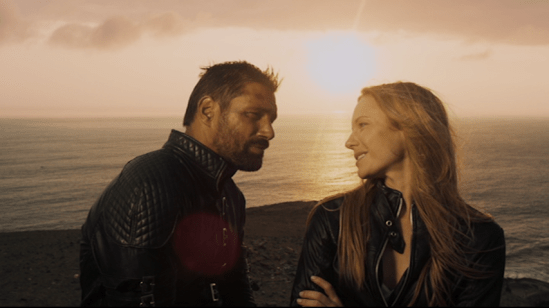
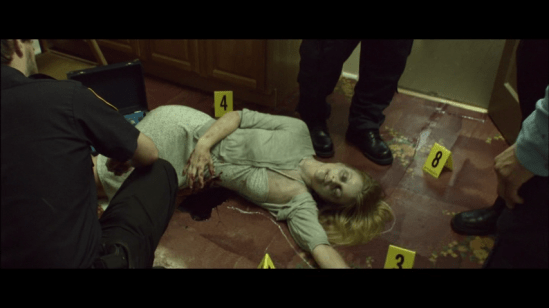
Want to be the Evil Doctor’s Guinea Pig? “American Guinea Pig: Bloodshock” review!

wq7nmcj-imgur
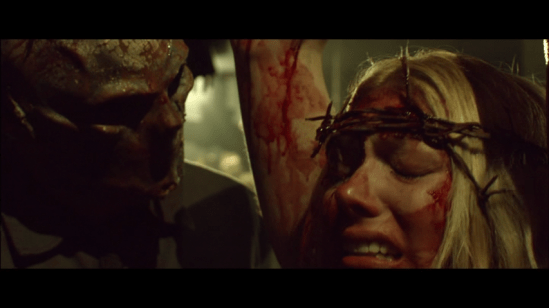
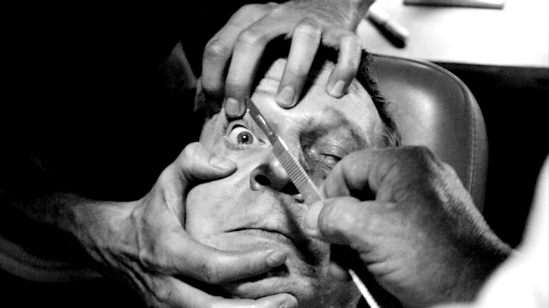
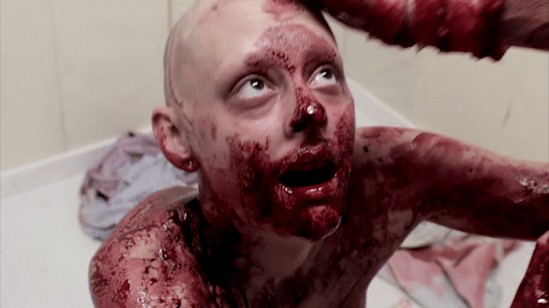
One man becomes the unfortunate subject of ghastly experimentations performed by a sadistic and blood thirsty doctor. Wheeled by abiding orderlies back and forth from his sterile white and padded cell to the mad doctor’s dark and dingy operating room office, the man’s will to live quickly begins to fade, yearning for death before suffering anymore in an alternative Hell. That is, until the handwritten notes start appearing on his padded room floor. The notes seep through between the pads from another tortured soul, a female, in the adjacent room. Withstanding new atrocities done to her before the man receives them, she pleads with the man to not leave her and to make a pact to outlive the inhumanities together.
vlcsnap-00013
Welcome to the new American Guinea Pig series! “Bloodshock” is the 2015 follow up film, on the coattails of 2014’s “American Guinea Pig: Bouquet of Guts and Gore,” from writer-producer and Unearthed Films president Stephen Biro and directed by special effects guru Marcus Koch. Koch, whose effects credentials include the Barbara Crampton starring thriller “We Are Still Here” and Koch’s prior directorial work “Rot” and “100 Tears,” strays away from the straight forward concept with an ultra gore art house expressionistic horror film that aims to break your mind as well as your body. Open for interpretation, “Bloodshock” fits perfectly into the ever provocative Unearthed Films’ wide open cache of underground cinema and will alleviate Koch to the next level of filmmaking. My interpretation of what this poor man and woman are experiencing is simply a penancing purgatory that’s intended to cleanse their souls in the warmth of their own wretched blood; the two victims understand their pain, as if not feeling the invasive effects of being dissected while still yielding breath, and are willing to subdue themselves to a maniacal physician until they’re able to briefly thwart his tireless work to share pain and open wounds in blood-soaked passion of hopeless ecstasy.
vlcsnap-00017
Dan Ellis puts in a powerful performance as the mistreated male patient with Lillian McKinnay, as the female patient, co-starring in an equally bold performance, especially being McKinnay’s first major role. Andy Winton’s diabolical medical maltreatment compares to the similar magnitude of “The Human Centipede’s” Dieter Laser by conducting exploratory, invasive, and unnecessary surgeries for sport while being candor about his blood lusting necessity. Amongst the three main actors, Biro’s script contains little dialogue, banking laboriously on physical renditions since both tortured patients’ tongues have been severed and jarred. Every movement is precisely executed and surged with attention, tuned to tell the story without much verbiage. Ultra gore isn’t everybody’s cup of cinematic tea and with an extremely thin film of dialogue as an outer coating, Ultra gore becomes that much difficult to be entertained by, but, recently, I’ve been lucky enough to come across another gore and shock film, coincidentally enough another Unearthed Films’ release entitled “Flowers” by director Phil Stevens, that had proved to me, as well as Koch has just done, that unspoken gore can be ingeniously crafted and thought provoking.
vlcsnap-00019
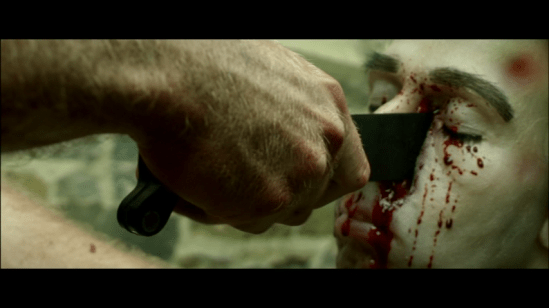
“Bloodshock’s” gore holds nothing back and leaves nothing to the imagination. The meticulous bone-sawing, head-splitting effects from a talented special effects team, consisting of Marcus Koch’s Oddtopsy FX crew, paint a sordid picture with a blood brush. Koch’s decision to go with Donald Donnerson’s cinematography under the two-tone of black and white doesn’t stiffen the poignant sight of blood, inner layers of flesh, or the splintering bone fragments. The Japanese would be pleased with their American counterparts realistically depicting gore and death captured amongst an underlying meaning. Unearthed Films has already taken the steps to continue the series with their next installment, “American Guinea Pig: The Song of Solomon,” which will pertain to a graphic exorcism and, currently, there are preview images and video scenes available.
vlcsnap-00022
The 3-Disc Collector’s Set from Unearthed Films and MVD Visual has priceless collector’s value. Not only does the set have a Blu-ray transfer of the 1.85:1 widescreen presentation, but also contains a DVD presentation and a third disc containing a CD of the Kristian Day industrial-jarring soundtrack. The black and white image quality is sharp and solid for a majority of 91 minute runtime. Some scenes go soft, losing shape to blotchy interference, but the qualities only supplement to “Bloodshock’s” charming grit. Only during the course of the patients unifying do colorful hues gradually seep in, almost unnoticeably, during an ostentatious sex scene involving blood and intestine that’s effectively edited to slowly build the passionate boiling point. Despite two of the main characters have their tongues removed, the Dolby Digital 2.0 audio has the dialogue so sorely crushed under the weight of the Kristian Day soundtrack that at some scenes I can’t even understand what the good mad doctor is saying. Also, on the DVD, I noticed that all audio tracks delay a second behind the action and dialogue. The bonus features are immense with interviews with director Marcus Koch, writer-producer, Stephen Biro, actor Dan Ellis, actress Lillian Mckinney, and two commentary tracks with Marucs Koch and Stephen Biro on one and actor Andy Winton, Gene Palubicki, and Alberto Giovannelli on the other. There’s also a behind the scenes featurette, production videos, and a booklet with a review from Ultra Violent Magazine! Unearthed Films certainly has a definitive release in their collection with “American Guinea Pig: Bloodshock” that’s packed with bonus material and full of venomous content abiding by the guidelines set forth by the Japanese. I don’t foresee the underground cinema juggernaut or the explicitly snuff-like Guinea Pig series ever slowing the flow of blood. “Bloodshock” fulfills the qualifications of the series by having the guts to show the guts and being just as demented and sick for fans who can stomach and endure grisly content.

Isn’t the cover just gore-geous. Get it at Amazon!

This is How to Revolt Against an Evil Empire! “Private Vices, Public Virtues” review!

screen-shot-2017-01-04-at-10-11-23-pm
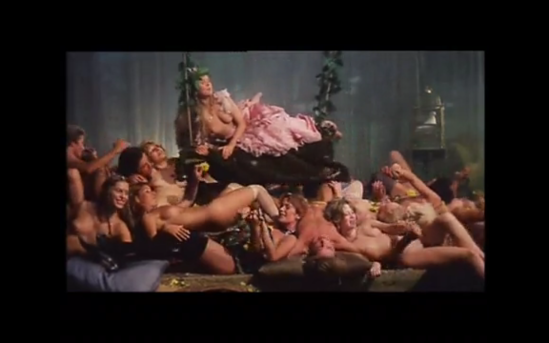
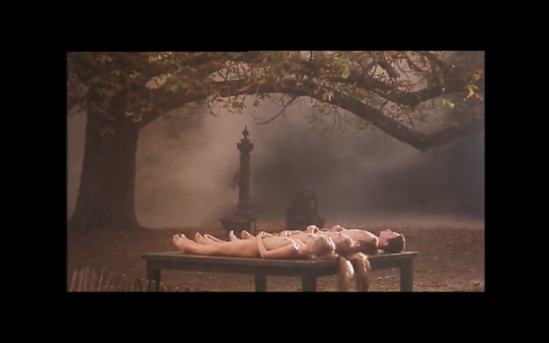
On the countryside of a 19th century central European empire, Crown Prince Rudolf resides at his manor estate with his nanny, faithful servants, and armed guards. However, the Prince abstains from being stately and goes against his father’s, the Emperor’s, wishes. Instead, the pan-sexual Prince frolics through life with his two lovers, his half brother and half sister. Their apathetic about the Emperor’s inclinations and enjoying the carnal pleasures, juvenile games, and the ecstasy of free-spirit inducing drugs with their communal aristocratic friends and feral manor servants. The Prince plans to humiliate his stern father by hosting the biggest festivity with dancing and champagne, laced with uppers that has his guest losing their clothes and parading amongst the grounds in a merry-go-round of uninhibited jovial madness that sends his the Prince’s father into an uproar that calls for the execution of his son and his lovers.
screen-shot-2017-01-04-at-10-09-45-pm
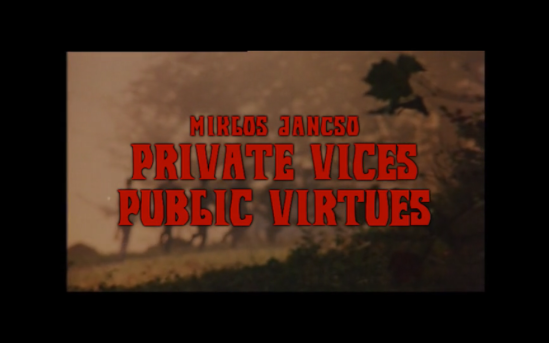
The 1976 “Public Vices, Public Virtues” is a circus of eroticism with a belly full of symbolism and ambiguity. Hungarian director Miklós Jancsó has developed a masterpiece from a script co-written with Giovanna Gagliardo that’s loosely based off the infamous 19th century murder-suicide known as the “Mayerling Incident,” which involved Prince Rudolf, the Crown Prince of Austria and the son of Emperor Franz Joseph I of Austria. Jancsó, called “the greatest Hungarian film director of all time” by his peers, maintains elements of the tragically historical event and morphs it into a melodramatic comedy penned with singsongy dialogue and communicated through various performances of the arts.
screen-shot-2017-01-04-at-10-11-13-pm
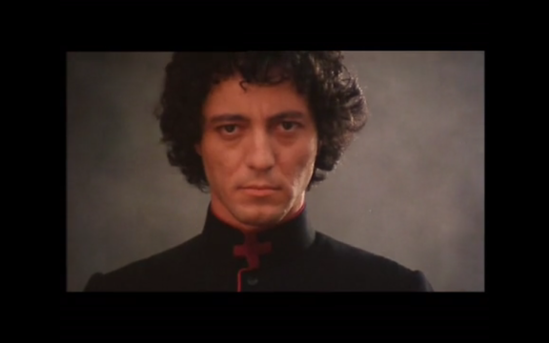
Fellow Hungarian Lajos Balázsovits encompasses the lead role of Prince Rudolf who ravages the screen with a lighthearted and uncut male nudity performance that sets an artistic and ethereal tone of beauty, of love, and of revolt. Alongside Lajos Balázsovits comes cult actors such as Tinto Brass regular Franco Branciaroli (“The Key,” “The Voyeur” which he was spectacular), Teresa Ann Savoy (“Salon Kitty,” “Caligula”), Laura Betti (“A Bay of Blood”), and “Night Sun’s” Pamela Villoresi to be at Jancsó disposal to be free to unclothe in a joyous protest against a ruthless and steely ruler. The mutton chops of Emperor Franz Joseph make a resembling appearance as part of the lucrative backdrop for the boisterous sexual revolution that stormed the cinema markets and Balázsovits fully submerges into a pan-sexual role, gladly submitting himself to women, men, and even his goggly-eyed Nanny, Laura Betti, who gets to touch the royal scepter in more ways than one.
screen-shot-2017-01-04-at-10-10-16-pm
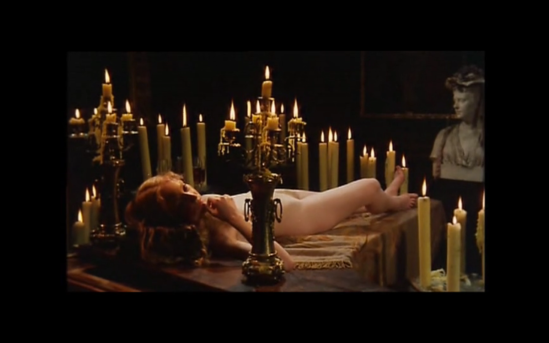
The co-produced Italian and Yugoslavian “Public Vices, Public Virtues” has an astonishing production value for soft core erotica. The elaborate, detailed wardrobe and authentic appeal to recreate the 19th century era is stunningly breathtaking and highly infatuating to be in the midst of an amorous atmosphere. With the costumes and manor home, the cash flow trends toward the amount of extras casted to prance and dance in an everlasting parade of jubilance. “Inglorious Bastards” and “The New York Ripper” composer Francesco De Masi displays his brass, as in brass instruments, continuously conducting a marching tune to the aristocratic orgy that doesn’t attest to a viewer allurement, but does put into place a bit of pizzaz into the melodrama. De Masi’s soundtrack compliments the nursery rhymes and classical scores that round out this Filmes Cinematografica and Jadran Film production.
screen-shot-2017-01-04-at-10-11-09-pm
Proclaimed the wild side of world cinema, Mondo Macabro releases “Private Vices, Public Virtues” on a glorious restored and uncut Blu-ray region ABC release. The original negative restored and transferred to a single layer BD25 displays a vibrant 1080p and progressive widescreen presentation. I’m amazed at the retaining of the natural coloring, the amount of spacial depth, and prolific details that doesn’t display a hint of compression artefacts and maintains very low digital noise interference, especially in the black levels. The LPCM audio contains an English dub track and an Italian track with optional English subtitles on both. The digitized analog audio clearly expresses itself without hisses, pops, or other types of disruption. Mondo Macabro stuffs this Blu-ray with exclusive bonus material including three interviews with writer Giavanna Gagliardo, actress Pamela Villosesi, and film historian Michael Brooke. The original theatrical trailer and Mondo Macabro previews bring up the bonus feature rear. “Private Vices, Public Virtue,” to the naked eye, is 104 minutes of a frisky spectacle of the utmost buffoonery, but in the trenches, the Miklós Jancsó film is a Hungarian filmmaker’s undercurrent of inspiration and revolution against oppression and Mondo Macabro just highly defined the era!

Grab “Private Vices, Public Virtues” on Blu-ray!

When Evil Lurks Outside… “Never Open the Door” review!

screen-shot-2016-12-23-at-10-17-28-pm
Six friends break bread for the holidays in a remote woodsy cabin. As their jovial and joyful conversation continues, a wicked evil lurks in the forest. A sudden and harsh knock at the door confuses the group on who would be calling at their isolated retreat and at the late hour. When Tess volunteers to answer the knocking, a stranger spews blood all over her and falls to the ground as she opens the door. With his dying breath, the aging stranger warns them to never open the door. stunned with complete shock and terror, the group doesn’t realize that the very moment the strange dies on their doorstep is the very moment of the beginning of the end as weird occurrences and odd behavior pits friend versus friend, girlfriend versus boyfriend, and spouse versus spouse when staying or fleeing the cabin becomes a life or death decision.
screen-shot-2016-12-23-at-10-12-19-pm
“Never Open the Door” strikes as an odd feature that marries projecting horror genres with resurrecting structures from the past into modern times. The Vito Trabucco directed 2014 released film, who also had producer Christopher Maltauro collaborate on to pen the script, stirs up vintage Alfred Hitchcock cinematography craftwork and mirrors the enigmatic nature of particular and peculiar “Twilight Zone” episodes. Trabucco and director of cinematographer Joe Provenzano voids the film of color to encompass the mood of bygone black and white thrillers and employs composer Carlos Vivas to enchant the story with a classically engaging score that embellishes upon harrowing pivotal moments in the story. Vivas and Trabucco have a prior working relationship under Trabucco’s previous nunsploitation slasher “Bloody Bloody Bible Camp.”
screen-shot-2016-12-23-at-10-14-57-pm
Vito Trabucco casted his staple entourage of actors. If you’ve ever seen “Bloody Bloody Bible Camp,” you’ll recognize many faces with the exclusion of George Troester, who plays the crude, unhitched Terrence. However, Troester does fit into the whole seven degrees of Kevin Bacon theory, being a co-star in “Crack Whore” along side Kristina Page and Steven Richards, Angel and The Stranger in their respective roles. Contemporary scream queen Jessica Sonneborn, the lead actress in “Never Open the Door’s” quasi-dual Tess performance, has a director’s credit under her name for her work on “The Haunting of Alice D” starring the iconic Kane Hodder. The 2014 film also rostered supporting actresses Kristina Page and Deborah Venegas, who portrays in Trabucco’s film as Maria, Luke’s wife. Luke is portrayed by Mike Wood with fellow “Bloody Bloody Bible Camp” co-star Matt Aidan as Angel’s fiance. Whew. Overall, the actors click as a group with a dinner room dynamic that’s natural with slightly pretentious moments that don’t really kill the mood. When the story ramps up, performances start to dwindle and overacting starts to unfold. Mike Wood absolutely murders the shower performance with ghastly exposition, but, again, this might be playing the retro card. Sonnerborn does well as the headliner. Her demon-like twin dominates, but just didn’t receive much screen presence in measly 66 minute runtime.
screen-shot-2016-12-23-at-10-16-15-pm
Continuing with the Tess demon, the black and white style fortunately masks most of the low budget special effects with the aid of some great uses of silhouettes and editing. Evil Tess’s pudgy demon sausage fingers dressed with cheap plastic looking fingernail attachments couldn’t fool a fool that they’re razor sharp, but with jagged teeth and glowing eyes encircled by a pitch black ring, she’s a nightmare inducing boogeywoman. Aside from a pair of demonic dispatches with one involving the razor blade finger caps, the effects were safely contained inside the realm of an independent feature. A few spurts of black blood and a handful of stabbings share a common bound of having being what remains of the effects which were executed well enough to serve the intended purpose. Mostly, “Never Open the Door” relied heavily on editing. Editing that involves characters’ hallucinating future or past events, attributing their frantic confusion and life threatening situation toward an endless loop of purgatory.
screen-shot-2016-12-23-at-10-15-44-pm
Yes, the characters are afflicted with a hell on repeat, switching identities on a continuous horizon that leaves fragments of prior rebroadcasts. From gathering information about the characters, none of them strike me as a damned souls. Tess is a veterinarian who performs the occasional neutering and spade and dates a man nearly twice her age. Terrence just doesn’t want to grow up, but no skeletons appeared from out of his closet. The couples, Angel and Isaac and Luke and Maria, grow suspicious of each others’ intentions that involve jealousy, paranoia, and hatred. Unlike a “Twilight Episode,” “Never Open the Door” leaves open doors of unsolved questions, such as answering the question of how the group came to acquire the house. Before the abrupt knock at the door, the person who located the isolated question seemed to befuddle the entire group. Another loose end lies with the person texting Luke messages about an illicit affair his wife’s having with one of their friends. Again, the loop doesn’t quite close on this interesting caveat.
screen-shot-2016-12-23-at-10-13-45-pm
Maltauro Entertainment presents in association with Baumant Entertainment the Vito Trabucco film “Never Open the Door” on Blu-ray. Unrated in a HD 1080p, the widescreen 1.78:1 is delectably sharp on a BD-25, but that really isn’t a surprise here with a black and white feature barely over a hour long. However, black-upon-black scenes define the Blu-ray with a low bitrate, displaying some blotchy, compression issues. Audio quality is quite fair. Carlos Vivas score channels through a Dolby Digital dual output that caters, again, to a vintage replication, but in creating an atmospheric feature, having surround sound would have boosted the result tenfold. The dialogue is a bit wish-washy, pending on the scene and character positioning, but forefront evident in the quality and that is what really matters. English subtitles are also available. “Never Open the Door” has grand potential in a small package, but trips over it’s own inconsistencies with erratic editing and walled details. Director Vito Trabucco’s vision in modernizing classic techniques and styles merely becomes just that, a vision, and was inches, or rather seconds, away from opening the door for potentially a far greater anxiety-riddled psychological thriller.

“Never Open the Door” on Blu-ray, DVD, and Video on Demand!

Can You Survive Rob Zombie’s Evil Death War? “31” review!

screen-shot-2016-12-17-at-3-03-46-pm
Traveling across a remote highway, five carnival workers journey to their next small top gig on Halloween day in 1976. Stopped by scarecrow-like figures in the middle of the road, the carnies find themselves led into a hostile trap and are kidnapped, held hostage to be poorly prepped for the dilapidated warehouse “Murderworld.” The violent death labyrinth is set for a hellish game entitled “31”, launched yearly by the sadist Father Death with Sister Serpent and Sister Dragon, that pits the captive against a series of killers, specialized in their own brand of merciless murder. To survive inside “Murderworld,” you have to stay alive for 12 hours in the dark, dank warehouse.
screen-shot-2016-12-17-at-3-02-31-pm
After a self produced campaign, a hefty amount of soul crushing crowdfunding, and a slew of production and distribution ups and downs, “House of a 1000 Corpses” director and shock rocker Rob Zombie was finally able to release this year his latest horror installment “31” since 2012’s “The Lords of Salem.” Lionsgate acquires the home entertainment rights to deliver “31” with a R-rated version of the Zombie’s claimed return to roots horror. The survival slasher, when compared to the director’s other work, capitalizes as the most seriously disturbed work to date, but the premise is not particularly original. We’ve all seen the placing of disoriented victims in a life or death game scenario before; Schwarzenegger’s “The Running Man,” based off the Stephen King novel, strikes many similarities, closely relating the two films by sheer plot alone. With Zombie’s “31,” the differences stagger between the main characters being simple carnies looking for a place in the world and “Murderworld” not being a total dystopian future of skewed justice. Instead, the shock rocker pens in his own ‘motherfucking’ motivations of satanic rituals to filthy the pot of sadism and mayhem.
screen-shot-2016-12-17-at-3-02-05-pm
Overall, I thought “31’s” characters were inviting and interesting even if they’re a cookie-cutter roster engineered by the likes of Rob Zombie. The idea is good to have five ordinary folks enduring a 12 hours bout of being hunted by a pint sized nazi enthusiast, a pair of chainsaw wielding hillbilly whack jobs, a tall German in a pink tutu and his Harley Quinn modeled femme fatale, and, then, there’s Doom-Head, portrayed by the impeccable Richard Brake. My first experience with Brake came from another facet of the word ‘doom,’ 2005’s “Doom,” to be exact, the adaptation of the popular id Software survival horror video game, and even then did Brake have the outer shell of a complete sleaze ball, dipped in an indescribable amount of pure malevolence. Rob Zombie is able to tap into Brake’s true potential with Doom-Head, an egocentric nihilist professionally suited for murder while oozing with unapologetic shamelessness. Along with Brake lies co-stars very familiar from prior Zombie films and these individuals are Jeff Daniel Phillips, deeply blue-eyed Meg Foster, and Judy Geeson from “The Lords of Salem,” the legendary Malcolm McDowell and Lew Temple from the “Halloween” remake, and, of course, Sheri Moon Zombie, the dedicated wife who stars in everything the man does from movies to music videos. Rounding out the film has Lawrence Hilton-Jacobs, Kevin Jackson, Jane Carr, Pachno Moler, David Ury, Torsten Voges, and “Pee-wee’s Big Adventure’s” Elizabeth Daily on the docket.
screen-shot-2016-12-17-at-3-01-49-pm
The problem with the characters are not that their ‘cookie-cutter’ characters, as I aforementioned, but rather their just well, well under written. Developmentally, almost every character becomes wasted space, floating stagnantly across the 103 minute runtime. For the hunters aside from Doom-Head, they’re backgrounds are mysterious which fits the rules of “31.” Doom-Head is a different story because he’s the golden child of “Murderworld,” spoken very highly by Father Murder and graced with so much monologuing that it’s absurdly comical and, unfortunately, predictable. As far as the carnies are concerned, most of the group never blooms into relevancy and I couldn’t help but to root for most of their savage deaths. Sheri Moon Zombie’s Charly character was the slice of life, the slither hope, that showed promise. Yeah, Charly looks and sounds much like Baby Firefly, but Charly is a fantasy heroine with a modest range of emotions and when even faced with defeat, she’s stands strong.
screen-shot-2016-12-17-at-3-03-21-pm
Though I wanted “31” to exceed all my expectations with the promise of untapped brutality, here we stand with a cut version Rob Zombie’s crowdfunded film. I’m interested in what exactly hit the cutting room floor because, just taking in “31” at first viewing, every single scene could be remedied by reimplementing, if any, omitted scenes. From my understanding, Rob Zombie submitted the survival horror numerous times to the MPAA in order to purposely retrieve a R-Rating and the ending result suggests a heavily cut film: off camera moments of attack, choppy warehouse segments, unintended shortened character developments, etc. Something more must be behind the scenes that holds back a fan well-deserved and fan well-funded unrated version and I’m not totally knocking this rated Lionsgate release, but a perception has been cemented on the fact that fans were promised an unadulterated Rob Zombie spook show and ended up not getting what they paid for ultimately.
screen-shot-2016-12-17-at-3-03-43-pm
Lionsgate Home Entertainment will be releasing the Saban Films’ “31” on Blu-ray on December 20th in 1080p High Definition with a 16×9 widescreen 2.46:1 presentation and an English 5.1 DTS-HD Master Audio track. A DVD version is also available. The presentation is in the detail of the image quality with only some minor dialogue loss, slightly muddled amongst the levels, in the DTS track. Certainly not a disparaging opinion, but once in close quarters, such as the carnies’ van, the ambiance hum of the engine, the tires on the road, and the jingle-jangle of objects in the van drown out parts of dialogue from Meg Froster and Jeff Daniel Phillips. An impressive 2-hour comprehensive documentary on the making of the film entitled “In Hell Everybody Loves Popcorn” and an audio commentary with writer-director Rob Zombie completes the bonus material. “31” feels like a Rob Zombie film; the rocker’s trash talking grit and loads of rockabilly swag leaves his unique brand seared into the horror scene, but Zombie’s “Murderworld” story is a promise-filled return to roots sensation for the director. Honestly, Zombie never strayed from his grungy grindhouse of inhuman torture and death origins, but only for a fleeting moment, and so “31” stays the abrasive, distasteful course that’ll speak, like in cult comprehensible tongues, to only his fan base.

Rob Zombie’s “31” on Blu-ray!

“31” on Motherfuckin’ DVD!

This Is One Evil Bunny! “Bunny Und Sein Killerding” review!

vlcsnap-00001
An ambivalent group of people are under the relentless rampaging attack of a half man, half bunny. Kidnapped and given an unknown chemical cocktail, one man looking for creative inspiration in a quiet snowy woodland becomes forced to be the object of experimentation by armed and dangerous thugs, transforming him into a vicious hybrid seeking only one desire…fresh pussy. Shredding through every single body who stands in the beast’s path, the chances of surviving the snowy night dims rapidly in the isolated Finnish Mountainside. Under the sheath of dirty fur, the unstoppable creature runs wildly with large limp genitalia flailing about, ready to stick it anywhere and into everyone with, what constitutes as, a fleshy hole.
vlcsnap-00002
“Bunny und sein Killerding,” otherwise known in English as “Bunny the Killer Thing,” is an insanely phallic and deranged creature feature with special needs under the madness of director Joonas Makkonen. Based off of Makkonen’s short film of the same name with a noticeably different storyline, both inhabit a mythically outlandish villain with a raging hard on and mouth agape to swallow any bulbous genitalia that’s ready for the taking. If you couldn’t tell already, Joonas Makkonen is a Finnish native and, thus, the film comes straight from Finland’s snowy landscape. München, Germany distribution company Tiberius Films releases Makkonne’s pet Bunny project onto a region 2 DVD given the reason for the German title “Bunny und sein Killerding.”
vlcsnap-00003
Makkonen’s unorthodox and unpredictable story scratches at being bold and unprecedented with a maniacal furry woodland animal while still being relative with the typical tropes when creating a horrific atmosphere. When dissecting what the director does best, not one character has been penned to stand above amongst the group that continues a revolving door of hero and heroine perceptions, opening up possibilities for each character on all fronts to come forth for glory. A killer bunny with a veiny stiffy looking for the freshest of the snatches doesn’t even explain the absurd juvenility that went through the creation of this film. Yet at the same time, something has to be said about the endless amount of sleazy enjoyment being had into the viewing experience. A slimy guilt residue overtakes just one piece more of your remaining morality and innocence every time Matti Kiviniemi, in a shamelessly shoddy adult bunny outfit, twirls clockwise the at least ten-inch lifelike dildo in such a menacing and manic manner that it makes turning away from the screen that much HARDer.
vlcsnap-00041
However, there’s plenty to dislike about this particular release and none of the negativity originates from the 2015 Finnish film. The Tiberius Films’ heavily edited treatment of this release has been reworked toward a more anti gun violence propaganda film rather than a bunny rocking out with a large cock out. About four minutes, most of it gun violence, has been purposefully omitted, resulting in a slew of choppy scenes that are attempting to piece together a coherent story. If you’re like me and never seen “Bunny the Killer Thing” before, then you may not know much better, construing a mental story about how foreign films sometimes just like to be too artsy. I did have an inkling that an edited disc was in my possession and I was unfortunately correct. The first two acts are passable in the reassembled manner, but the last act has been reduced to nothing more than shambles of it’s true, gory self and, disappointingly enough, the edit loses the required connectivity tissue needed to fire up the necessary neurons of associating scenes with one another. Pivotal scenes are harshly given the editorial boot to remove any type of explicit gun violence, leaving all overly graphic and icky parts of “Bunny und sein Killerding” involving firearms are solely on the Germany theatrical trailer.

Cut Scene from “Bunny und sein Killerding”


“Bunny the Killer Thing” runs the horror comedy at an uncut 88 minutes, but the Tiberius Films upcoming Region 2 DVD and Blu-ray December release will clock in at a shocking 84 minutes. Fortunately, the DVD and Blu-ray will be presented in a widescreen 2.35:1 aspect ratio with a German and Finnish Dolby Digital 5.1 surround sound and a German DTS option. I won’t be able to critique either the audio or video qualities as I was sent a press screener only; however the Ari Savonen and Janne Andberg special effects and the creations by the visual effects teams along with Makkonen’s directorial style dares to be big production and reminds me a lot of what the Spierig brothers accomplished with their Aussie zombie film “Undead” in 2003. Bonus features consists of a theatrical trailer, behind the scenes featurette, and Makkonen’s 17-minute plus short film of the same title. A remarkable class act of Finland and British actors comprises the film’s lineup in this raunchy and violent horror comedy including a stunning, on-point beauty in Enni Ojutkangas, Jari Manninen, Orwi Manny Ameh, Veera W. Vilo, Roope Olenius, Hiski Hämäläinen, Vincent Tsang, Marcus Massey, Katja Jaskari, Olli Saarenpää, Maria Kunnari, and Matti Kiviniemi as Bunny the killer thing. British actors, you say? Yes! Much like the Bunny creature, the film’s a bit a hybrid itself when on the topic of dialogue. The DVD and Blu-ray will have German or Finland audio tracks with German subtitles, but the natural dialogue track will be a combination of Finnish and English! In conclusion, I watched the film, but, at the same time, I didn’t because of the extreme cuts, whether to discourage gun violence or for whatever reason, made to the original runtime that reduced the intended gruesome firefight ending to nothing more than incomprehensible scenes resembling an intense slap fight.

UNCUT TRAILER!