Wake Up and Get Lost in the EVIL Flowers. “Terror Firma” reviewed! (Dark Arts Entertainment / Blu-ray)

“Terror Firma.” The First Dark Arts Entertainment TItle Now Available!

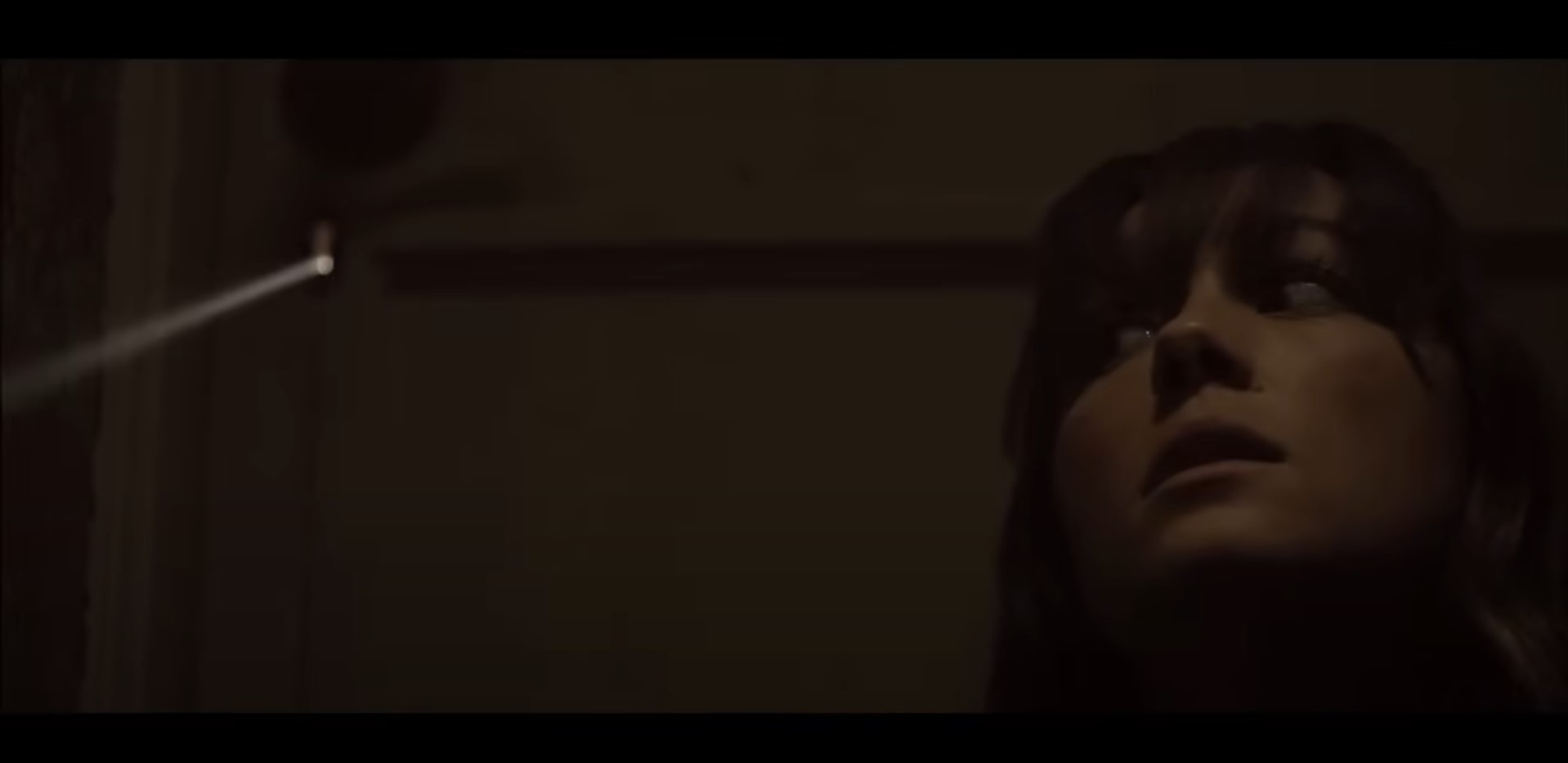
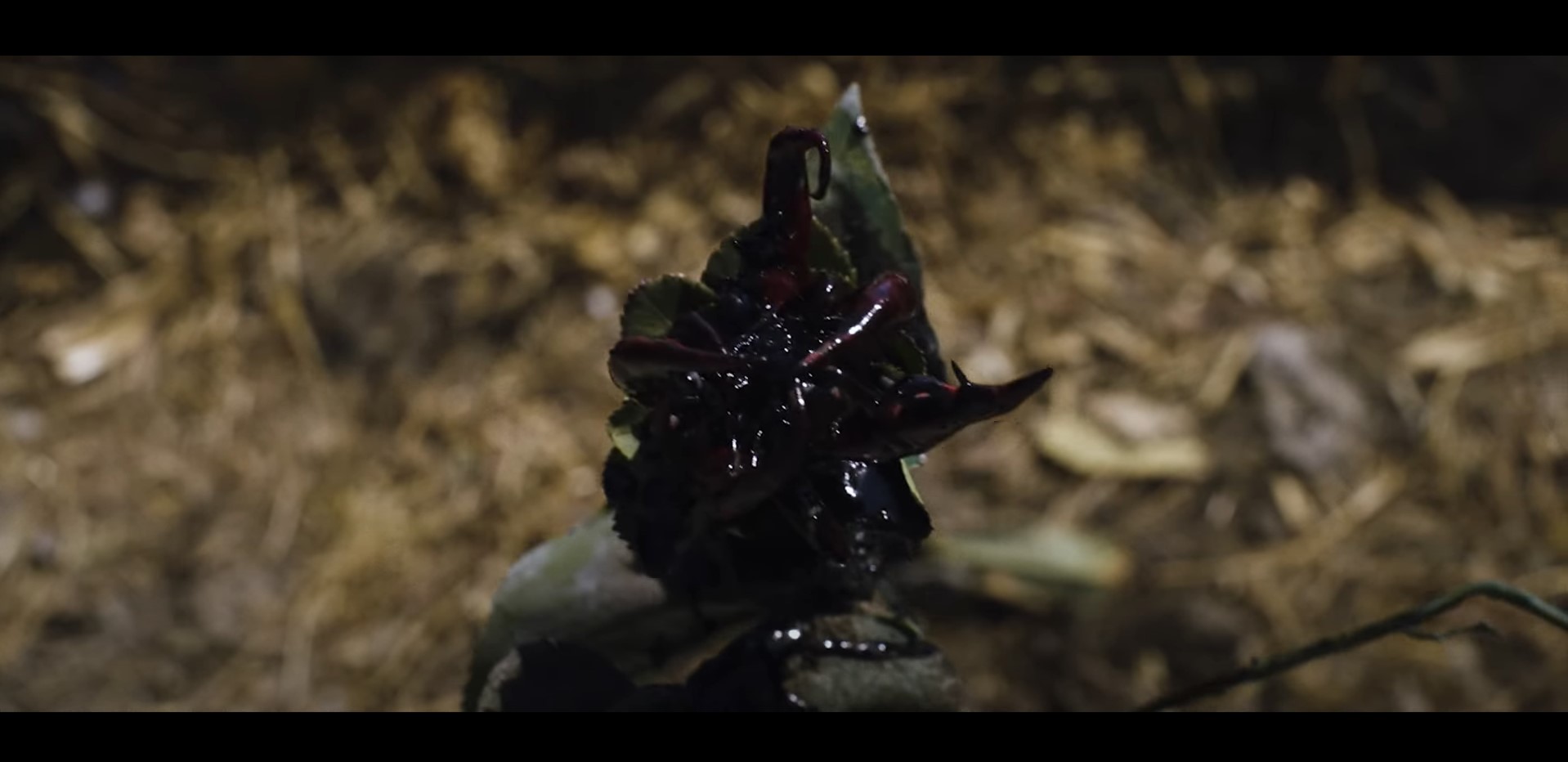
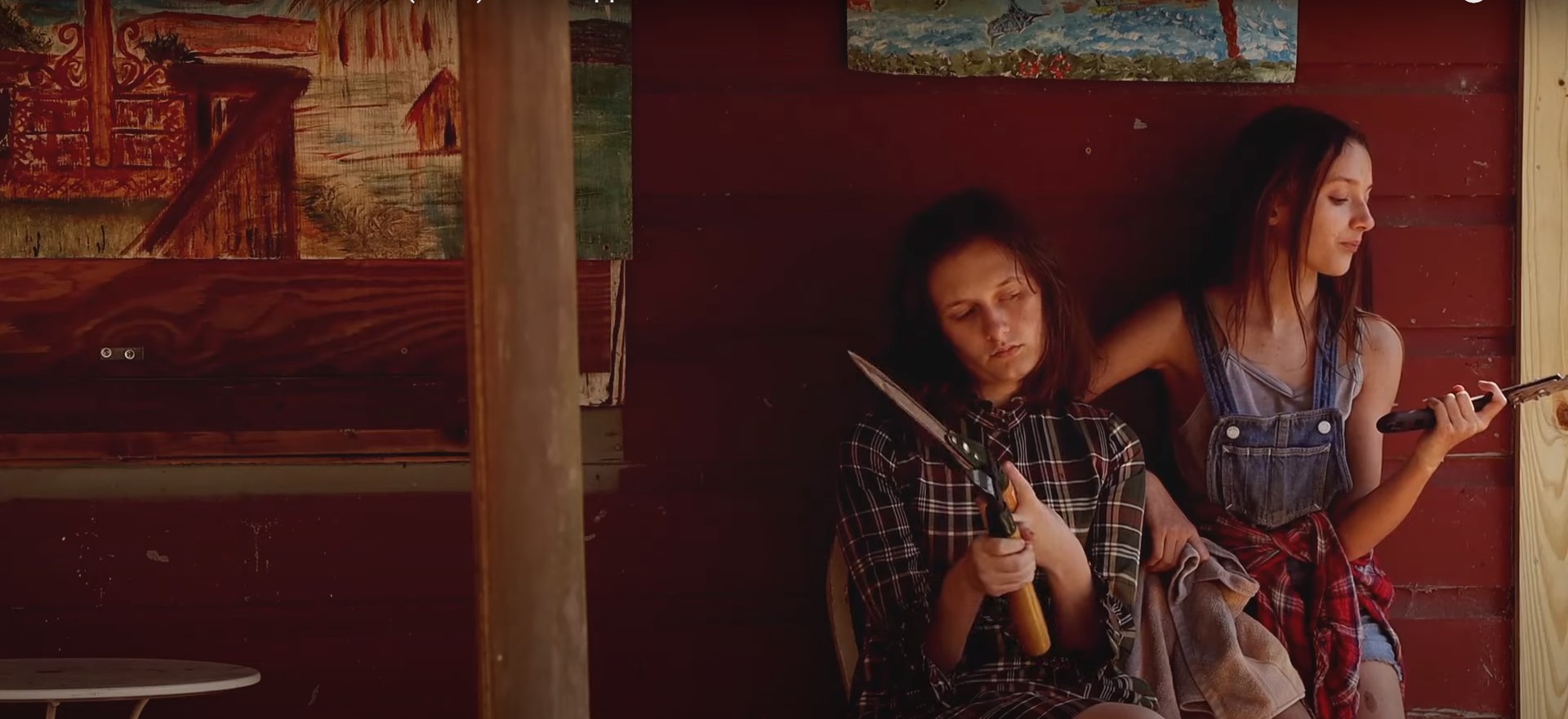
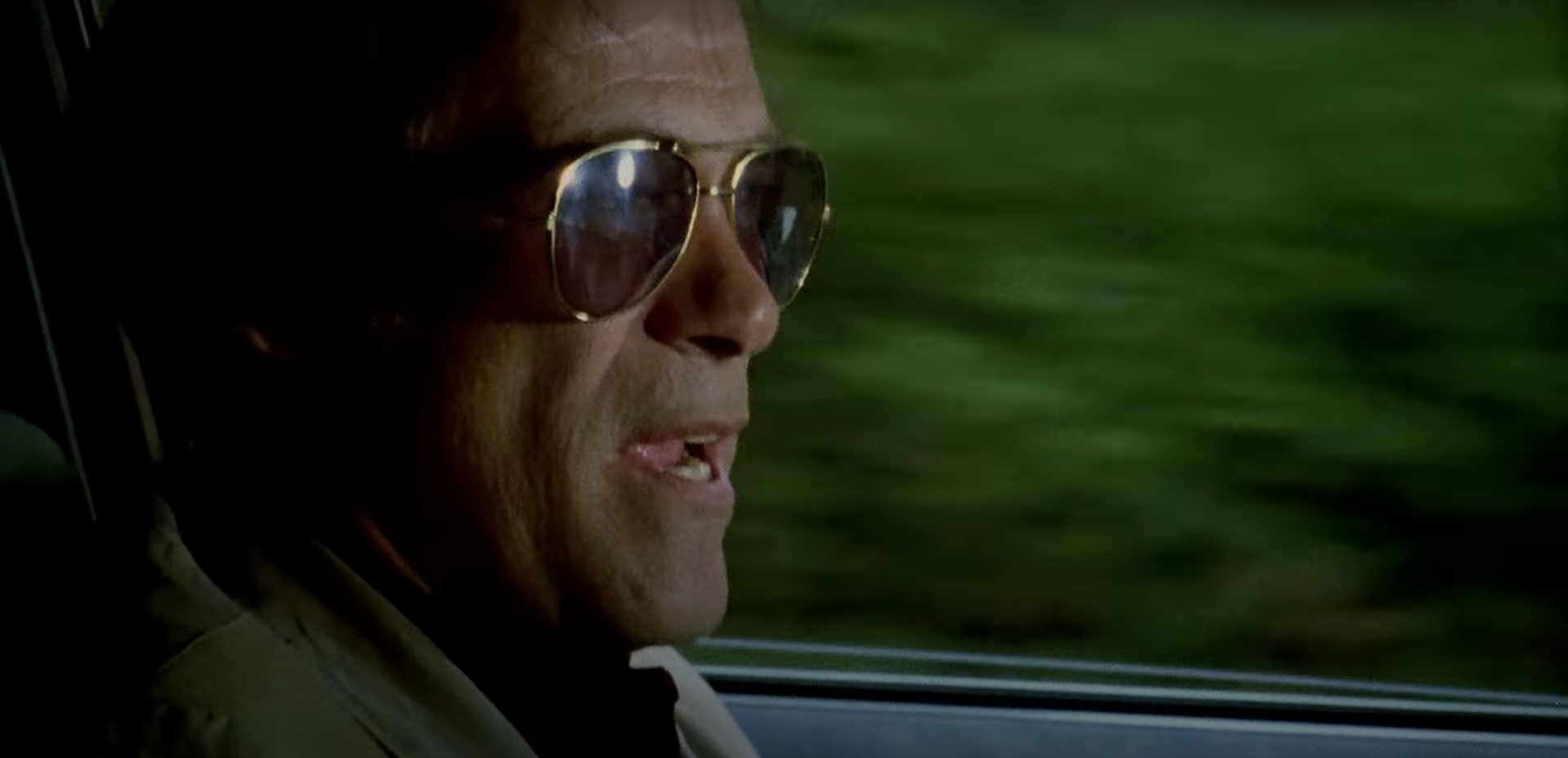
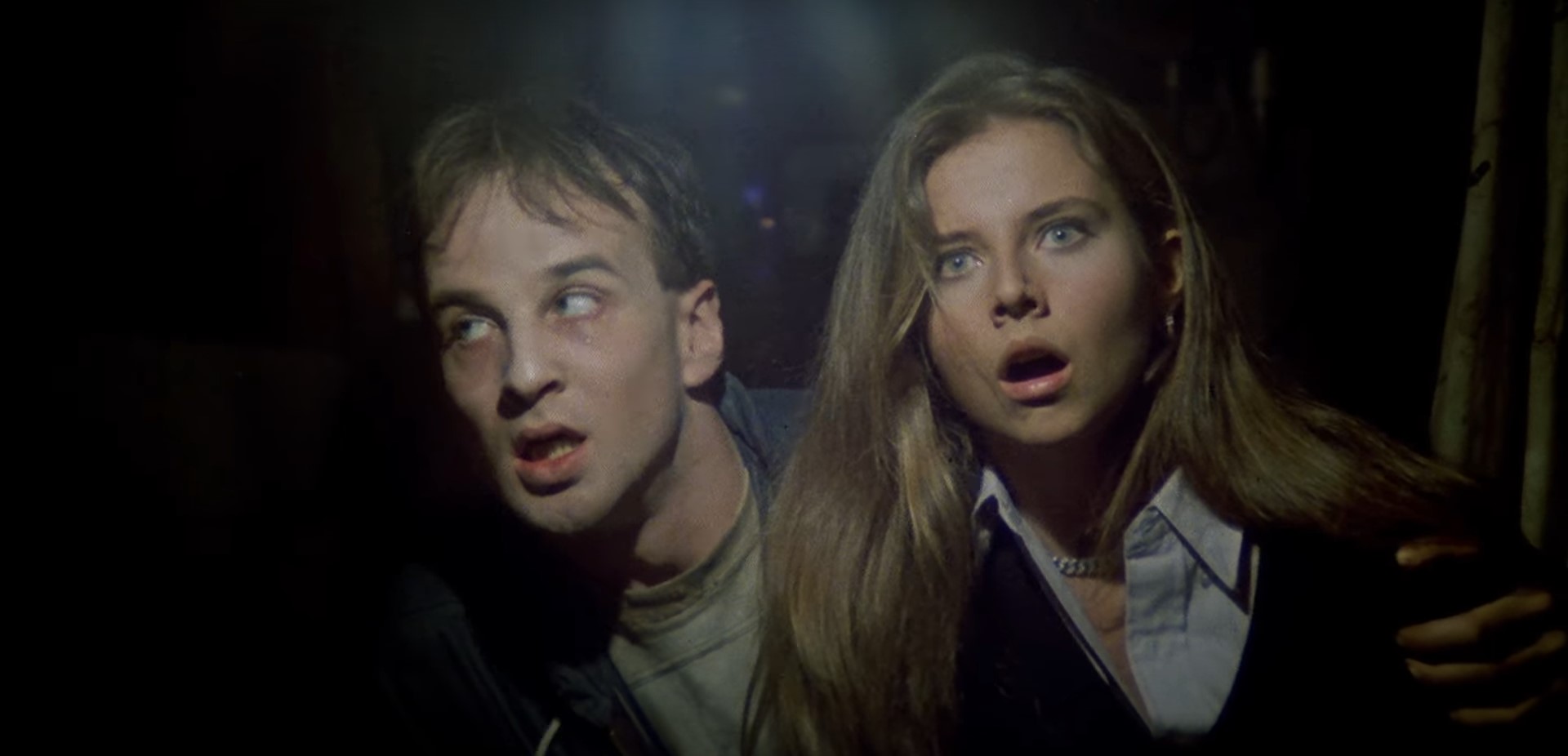
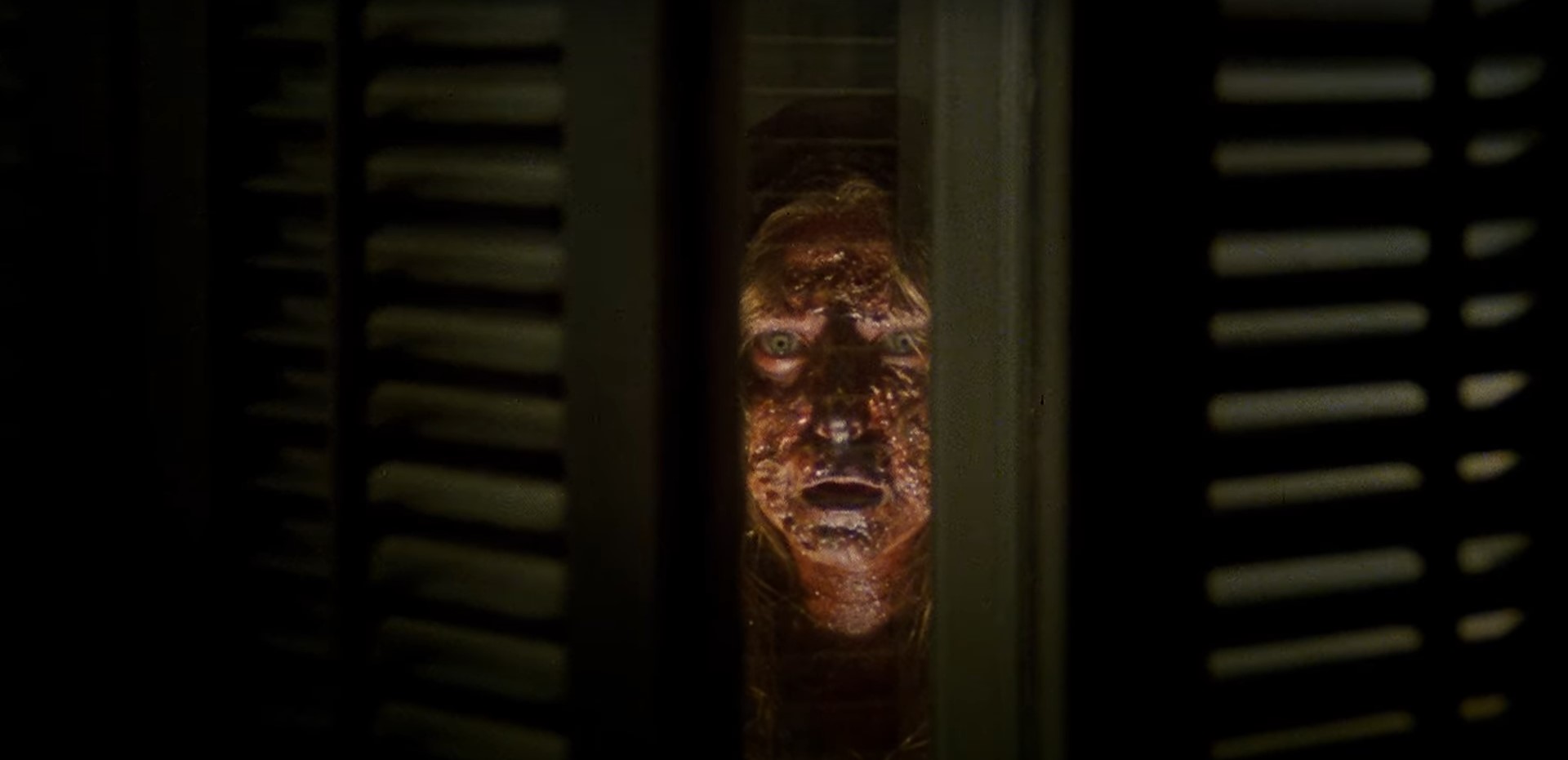
Having no place to go during the middle of an unexplained, national Marshall Law event where citizens must remain indoors or else face imprisonment, Lola bunks in with her fellow adopted brother Louis and his bizarre tenant Cage. Though Lola and Louis have not seen each other in years, they quickly bond to deflect Cage’s peculiar persona that has honed in on Lola. After receiving a government issued drop shipment of food, Lola discovers a seed packet wedged in between the boxes. Her curiosity sows a single seed that results a hole in the ground next day, a hole that produces a jelly that conforms to their individualized favorite flavors, and they become addicted to its intoxication, but when Louis disappears, seemingly trapped between dimensions and communicating underneath an alien flower where the hole use to be, Lola is stuck alone with Cage who’s more and more becoming twisted by the transcendental jelly.

A pun play on the idea of terra firma, defined as the Earth’s ground or surface, “Terror Firma” is a prismatic and cosmic hell hole of a psychological and interdimensional thriller from writer-director Jake Macpherson. Macpherson, a regular music video director of photography and a short film filmmaker, debuts his 2023 feature film with a broader, elephantine story under a bantam budget, reduced to a singular location, and uses the idea of terra firma as the basic premise for natural Earth horror blended with the pandemic confinement of COVID-19 in which the story was conceived and how that isolation acceptance, thralldom from authoritarian instruction, and broken family bridges originate the internal dysfunctions outward toward a destructive, maddening outcome. “Terror Firma” is a production of the Los Angeles based Capture Theory company with Macpherson, John Angeli, Forrest Clark, Theo Linder, Katie Mamie, and Bryan Wilson serving as mostly first-time producers.

Keeping in line with a low-cost production, the story takes root at mostly one location, Lou’s rundown, multi-story house with creaky old floors and compact rooms, extending the location beyond the walls and into the house’s minute front yard where a pile of dirt with a strange jelly hole metamorphizing into an even stranger looking flower becomes the catalyst of weirdness.  Thai-American actress Faye Tamasa is Lola, the weary sister of Louis, played by Burt Thakur, who invites her to come stay with him during the beginning of a nationwide shutdown of unexplained purpose.  Lola and Louis, both once orphans and adopted by the same parents, haven’t seen each other in years and have rarely spoke.  Repeated motifs of isolation, such as the extension of their orphanage, and an awkward disconnect between them display their relationship instable without having an obvious clash to outright scream incompatibility between the two who don’t share bloodline but grew up together.  There’s still an affection quality between them but it is damaged.  And, then, in comes the third wheel that becomes the wedge between Lola and Louis’s relationship rekindling.  Cage, a dodgy spiritual pseud and played with monotonic sleaziness by Robert Brettenaugh (“Strange Blood”), interjects his numinous nonsense as a façade to impress Lola but as Lola sees right through him, Cage diverts his attention to the Jelly that drops the façade and unleashes his true spirit, a sociopath with an obsession.  The trio works to relay a significance in loneliness and isolating desperation in a sensationalized, supernatural way in finding a pathway through the lockdown blues.   Rounding out the cast with a small role that wouldn’t even be considered turning the trio into a quartet is Max Carpenter as a former love interest to Lola.

Not to be confused with or have any similarities to Lloyd Kaufman’s 1999 burlesque slasher titled “Terror Firmer,” Macpherson’s debut is born and bred out of the woes of a global pandemic by formulating a fantastical escape from the reality as we knew it before everything went into an abrupt lockdown.  The sudden stoppage of the world and social gatherings certainly began a snowball effect of emotional distress, some more external than internal that gradually drew to head an uneasy amount of stir crazy.  For the trio of roommates, and like most of us during the beginning of the lockdown, we’re excited and thrill for a break in the norm but as time marches on, those you’re stuck with without anywhere to go is an unusual alienating feeling.  “Terror Firma” expediates the sullied sensation to cosmic proportions with gateways to upside down worlds that mirror our own and develop cultish acolytes to the Jelly’s mystical powers.  Granted, no much of Jake Macpherson’s story makes a whole ton of sense and is very open to interpretation, but one possible avenue I’ve concluded is that the Jelly is a convenient, sweet-tasting poison that one can easily fall for its pseudo-tranquility and limitless euphoria to solve all our immediate problems as a quick fix but ultimately it’s our will and the power within ourselves to reconnect, re-establish, and revitalize what’s missing from ourselves.  Macpherson’s hallucinogenic rabbit hole of a thriller is an abstract course on preservation of relationship and connections while overwhelmed with obstacles.

Prominent genre filmmaker Brian Yuzna, well-known for his behind-the-camera roles on Stuart Gordon’s “Re-Animator” and “Dolls,” as well as his own directorial credits “Society” and “Beyond Re-Animator” to revolutionize the way we see horror in the 80s and 90s, teams up with John Penney, writer of staple cult classic “The Kindred” and “Return of the Living Dead III,” to form a new at-home physical media label known as Dark Arts Entertainment.  “Terror Firma” is the first title to be released by the joint partnership with MVD Visual for distribution.  The AVC encoded, 1080p high definition, BD50 houses the widescreen, 2.39:1, aspect ratio presented blossoming madness.  Picture image varies with the refracting coloring within the polychromatic lenses and in contrast to the post grading of a slightly coarse tone.   Yet, that isn’t to say quality is subpar and we’re treated to a fine digital image compressed without compromising the encoding on a double layered disc.  The English LPCM Stereo 2.0 offers a lossless reproduction of true audio fidelity and while not be a powerful mix course isolated layers through individualized channel outputs, “Terror Firma” isn’t necessarily powerful in range.  There’s only a handful of psychedelic moments of discord tunes and notes to emphasizes the crossing between dimensions and a few minor key moments to evoke fear out of Cage’s madness but other than that, “Terror Firma” specializes mostly in exposition and silently witnessed moments.  Dialogue is clean, clear, and prominently placed with depth dialed in where needed, especially when Lou begins to speak beyond the plane.  English subtitles are available for the feature only.  Inside the bonus material, a second version, an extended director’s cut, of the film is available and does not have the subtitle option.  Also included is Jake Macpherson’s commentary with main feature, a behind the scenes gallery, and the theatrical trailer.  The maiden Dark Arts release package is standard fare with a traditional Blu-ray casing containing no inserts or other tangible material ride alongs.  Release cover art leaves enough to the imagination to be lured in with Faye Tamasa crawling through a dirt hole and coming upon the alien flower.  The not rated feature has a runtime of 84 minutes and is encoded region free.

Last Rites:  “Terror Firma” is a bold first impression for not only writer-director Jake Macpherson as his debut full-length feature film but also for Brian Yuzna and John Penney inaugurating their distribution label with a film that might not strike a likeable chord with most but will certainly leave a relatable lasting impression on us all. 

“Terror Firma.” The First Dark Arts Entertainment TItle Now Available!

Amusing Little EVIL Enjoying the Carnival Rides! “Ghoulies II” reviewed! (MVD Visual / Blu-ray)

Next Time You Sit On the Can, Check the Bowl First!  “Ghoulies II” on Blu-ray!

The travelling Hardin Family carnival has been on a steady decline through the years.  The Hardin Holdings group, aka Mr. Hardin, dispatches his young senior accountant and son, Philip Hardin, as authoritative proxy to ensure sustainable profit.  One of the longstanding attractions, Satan’s Den, lies headfirst on the chopping block with a dismal profit rate.  Determined to recover and avoid being permanently shut down, Larry, his drunk uncle Ned, and actor Sir Nigel Penneyweight won’t give up so easily despite needing a miracle.  That miracle comes in the form of the Ghoulies who hitch a ride on Satan’s Den’s trailer while escaping persecution.   The pintsized demons bring the slowly withering Satan’s Den back to lucrative life but at the deadly cost of the patrons and carneys who fall victim to the Ghoulies impish behavior.  Larry vows to rid the amusement on their infestation after uncle Ned perishes at the demons’ tiny hands but Philip has glimmering money signs in his eyes. 

They’re back!  The Ghoulies return as masterless nomads after a failed attempt of abduction by a devout crusader aiming to destroy the pagan evocations and wreak mischievous havoc on a two-bit amusement park suffering from low attendance.  The late Albert Band, father of Full Moon’s Charlie Band and director of “Dracula’s Dog” and “I Bury the Living,” took over the reins from first film director Luca Bercovici and helmed “Ghoules II,” a vastly different kind Ghoulies tale of terrorizing totality based off the Charlie Dolan story and a polished script from “Re-Animator’s” and “From Beyond’s” Dennis Paoli.  Filmed entirely in Rome, and mostly in a soundstage, where Empire Pictures headquarters were located, the 1987 sequel was the last Ghoulies venture from executive producer Band and his Empire Productions empire before Vestron oversaw the subsequent sequels.  Albert Band produced the feature with Frank Hildebrand (“Once Bitten,” “Project Metalbeast”) serving as associate producer. 

With the contestable exception of the five prosthetic creatures receiving a dust off and sprucing up paint job, none of the lively characters from the first film return for the sequel in what becomes a principal clean slate.  The story starts off with who appears to be a man of God fleeing on foot with a bag over his shoulder from three cloaked cult acolytes.  There’s never a reference to this escaping man (Anthony Dawson) or the shrouded cultists in torch-in-hand tow but does arouse a bit of enigmatic energy around the Ghoulies misadventures through the human plane and happening upon the likes of two opposite side of the spectrum carneys who are also related between the long-in-the-tooth and drunk Ned by the loveable character actor in Royal Dano (“Killer Klowns from Outer Space,” “Spaced Invaders”) and his big top tenderfoot nephew Larry played by Damon Martin.  Ned’s alcoholism combined with stress over possibly losing Satan’s Den makes causes him complexity within his closest confidants for when he happens upon the Ghoulies after citing an incantation, he’s also in a drunken stupor, and so he words of exciting, or maybe even warning, fall on deaf ears as intoxicated imaginations that result in a pity for his dependency.  As Larry and the Shakespearean line spewing Sir Nigel Pennyweight (Phil Fondacaro, “Willow”) continue with setting up the ragamuffin that is the antiquated Satan’s Den, they let Neg wander despite suspecting his delusions of demons due to the pressures of one carnival hotshot Phil Hardin (J. Downing, “Robot Wars”) who has come to town to clean up his family’s carnival act with threatens of shutdowns and layoffs.  Hardin’s your typical weight-throwing antagonist with a pompous attitude and wandering eye for the most gorgeous girl under the tent, in this case it’s with Larry’s love interest Nicole (Kerry Remsen, “Pumpkinhead”), a once great high-wire performer turned belly dancer for the departmental freakshow act.  Nichole’s hidden talents, buried deep beneath past personal pain, will undoubted be utilized for climatic gain as all chaos breaks loose on carnival grounds with the Ghoulies break free of Satan’s Den menagerie of cardboard and latex-crafted horrors.  “Ghoulies II” rounds out the cast with Jon Pennell, Sasha Jenson, Donnie Jeffcoat, Donald Hodson, Dale Wyatt, Romano Puppo, Ames Morton, Michael Deak, and Full Moon actor-turned-director William Butler (“Night of the Living Dead” ’90, “Baby Oopsie”).

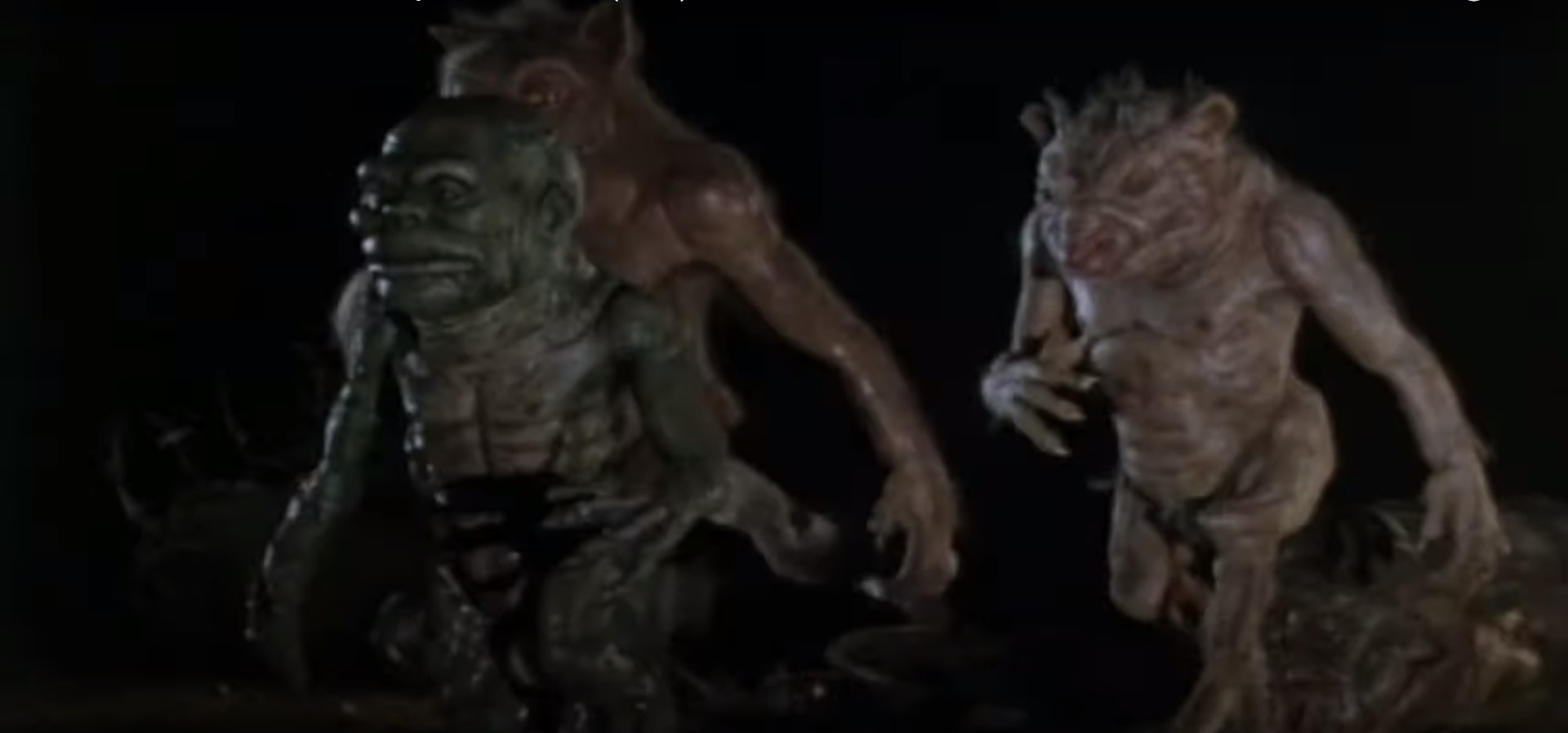
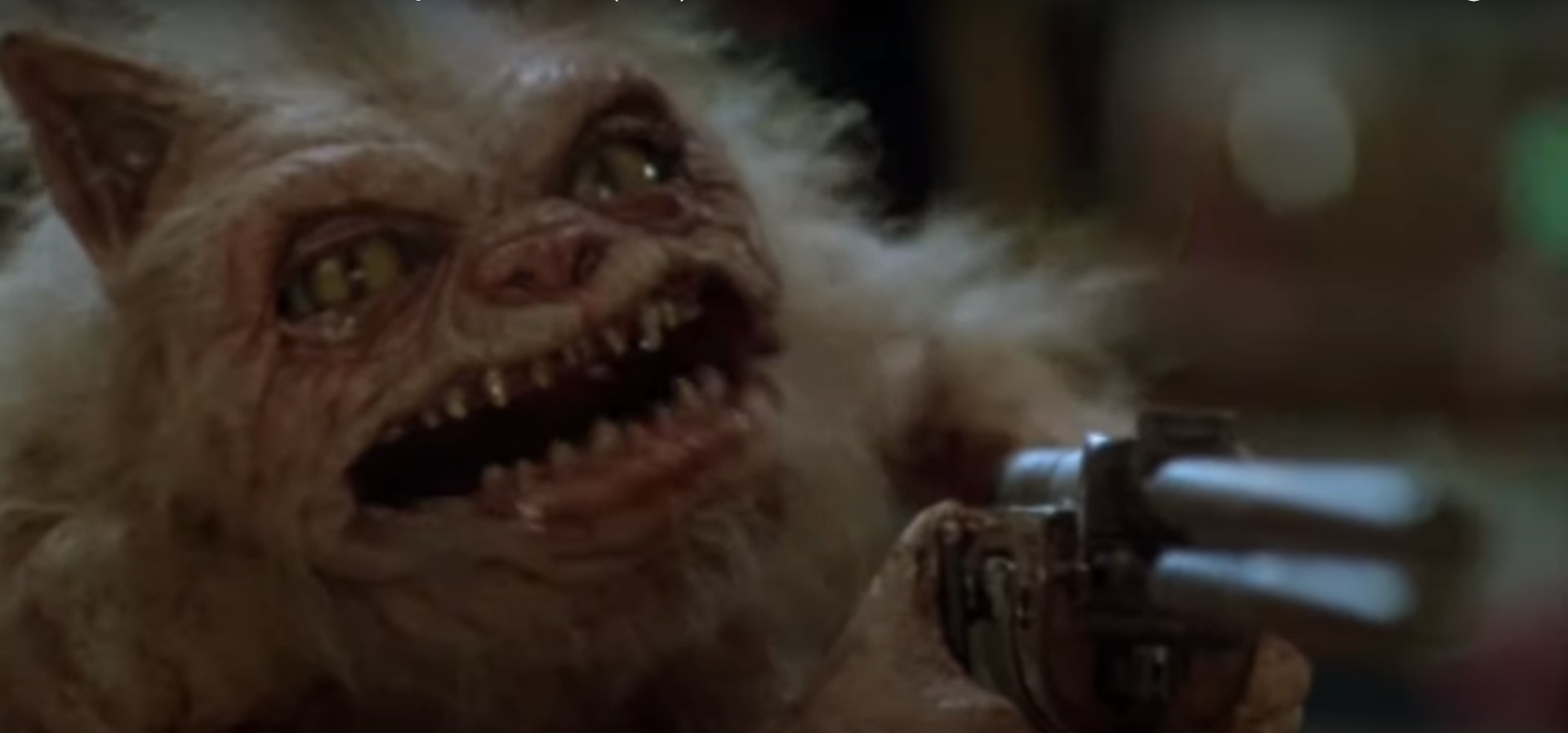
Along with a new set of human characters, “Ghoulies II” also freshens up the trajectory by focusing less on the black magic that saturated the plot of the first film and relying more on the gremlin-like playfulness of the Ghoulies themselves, rightfully giving way into the very creatures of the title. There’s some magic involved but only to the extent that doesn’t have the Ghoulies rely on a master to evocate them from the Netherworld or for the dark powers to be used to perpetuate wickedness upon others.  Instead, the ghoulies are depicted utilizing their skillsets, such as flying, oral expelling sticky-gunk, super-strength, and chomping, which obviously lead to more of a micro-level apocalypse of carnage; however, the print obtained for the MVD Blu-ray release is the edited down version for theatrical circulation so some, not a lot mind you, of the gory bits have been taken out and this makes the storyline stutter with misplaced time with rough segues and an imbalance of edits that aren’t as smooth.  From what I’ve seen, the minuscule timed deleted scenes are not much more violent or gory but add just that tad more context to the next scene instead of our brains working to connect the dots on what should be a brain shutoff, entertaining creature feature.  Yet, you can’t deny the sequel’s appeal that has turned to center around the little demons assiduously but managing to keep the same, steady pace of ferity and gothic skim of mise-en-scene from the first.  Puppetry is retained for that palpable product while also introducing stop-motion, a visual effect that has served Empire/Full Moon well throughout the years and is only used sparingly to wet the limitless capabilities of our miniature monsters to roam free in open spaces. 

“Ghoulies” return with the sequel to MVD’s Rewind Collection as Blu-ray release number 53 on the spine. The AVC encoded, high-definition, 1080p Blu-ray is presented in a widescreen 1.85:1 aspect ratio. A virtual carbon copy of the first film in regard to a well-preserved print, the sequel isn’t noted in having a 4K restoration scan like the antecessor release number 52 but the 2K scan offers an abundancy of positive picture rendering with a seamless color grading that isolates distinction and range as well as a tangible details, especially on characters and the ghoulies alike who are often gleaming and show off every nook and cranny ridge on their dark, hairy bodies. Aforementioned, this print is the theatrical cut, missing some gruesome elements for the sake of a broader audience, and while most of the print is near flawless, there is one dunk tank scene that’s cropped and noticeably marred with horizon creases in the brief airtime. The English LPCM uncompressed 2.0 stereo mix caters to every audible necessity of the “Ghoulies” soundtrack, ambience, Foley, and dialogue. The latter is clean and clear with prominence over the rest of the layers though I wouldn’t label it flawless with some echoey segments, almost a doubling effect, that might be due to the soundstage vibrations at Empire. Ambient track provides a wide range with exact depth with the example being inside Satan’s Den of horrors where doors creak, motorized bats fly overhead, and other models of haunted house spookery, along with an underlining carnivalesque soundtrack by Fuzzbee Morse (“Dolls”), is the epitome of a great sound design suffused together. English, French, and Spanish subtitles are optionally available on this release. Special features include an introduction by screenwriter Dennis Paoli, which is also available as a standalone at the play feature option, More Toilets, More Terror: A Making of Ghoulies 2 is a retrospective lookback with select cast and crew, an interview with Dennis Paoli Under a Magic Moon, the gruesome deleted scenes, a photo gallery, and theatrical trailer. Physical attributes include a VHS retro-esque mockup of the original poster art on a cardboard O-slipcover, fitting for the sub-bannering Rewind Collection. The same image graces the front cover of the clear Blu-ray Amary case, but the cover art is also reversible with one of the film’s most memorable smoochy-kiss moments plus title above. The disc is art pressed similar as the first film, a laser disc veneer on the Blu-ray top. Opposite side is the folded poster insert of the slipcover front image. The region A playback release has a runtime of 90 minutes and is rated PG-13. “Ghoulies II” retains that same diabolical energy as the first film but channels it very differently into the very titular creatures that puts them at the forefront instead of being just an afterthought in a sequel that celebrates their uncontrollable knavery and loving every second of it.

Next Time You Sit On the Can, Check the Bowl First!  “Ghoulies II” on Blu-ray!

This is Not Taylor Swift’s “EVIL” Hit Song. “Cruel Summer” reviewed! (Scream Team Releasing / Blu-ray)

“Cruel Summer” on Blu-ray Home Video!

Heather and Felissa have planned the perfect weekend party for summer kickoff.  The custom invitations are set for their friends to cordially request their attendance for an 80’s themed murder mystery at Heather’s aunt and uncle’s cabin home.  Upon their arrival, the stock up on booze and groceries, fake knives and masks are in hand, and the game is about to begin, but little do they know, the surprises and terror in store for them are not manufactured by the rules of a party game.  A masked serial killer is heading straight for their night of fun and games, killing anyone who steps in his path, including other tourists, locals, and even the law enforcement called in to check on the party noise levels.  When friends suddenly disappear throughout the night, that strange feeling of derealization takes over and worry sets in that something other than being passed out from partying too hard has happened to them and that same fate will soon happen to them. 

Let’s face it.  All horror nowadays is rooted by the inspiration from horror long ago.   Originality has all but faded from the conceptual ideas, script pages, and in what the camera records.  Independent horror filmmaking is basically devotion digitized and the easily accessible equipment has turned every kid, who grew up watching Todd Browning, George A. Romero, and Dario Argento, into splintered, hackneyed versions of their favorite directors.  Most indies either follow similar formulaic narratives and styles or cast and cameo acting icons to draw upon homage or headlined sales, but for Scott Tepperman’s 2021 Indiegogo-funded slasher “Cruel Summer” there lies little effort in either department despite the film’s throwback claim.  The “Nightblade” and “Hell’s Bells” director based in Tallahassee, FL is not opaque with the 80’s obsession he integrates into his COVID production under his cofounded Los Bastardz Productions with Jim O’Rear.

If looking up “Cruel Summer” on IMDB.com or any other online movie database that lists the cast and the associated character names, a trend might pop out at you but might not be evident at first.  Since I personally try to avoid looking up or researching films or watch trailers to sideline any kind of preconceived biases, I began to pick up halfway through the runtime the correlation between all the character names in that they’re nods to renowned horror actors and directors.  Some examples include Ashlyn McCain playing principal lead Heather (as in “A Nightmare on Elm Street’s” Heather Langenkamp), Bridget Linda Froemming plays Felissa (as in “Sleepaway Camp’s” Felissa Rose), Harold McLeod II plays Tobin (as in “Saw’s” Tobin Bell), Will Horton plays Vincent (as in “House on Haunted Hill’s” Vincent Price), and Scott Tepperman plays Gunnar (as in “Texas Chainsaw Massacre’s” Gunnar Hansen.  There’s also references to Barbara Crampton (“Re-Animator”), Doug Bradley (“Hellraiser”), Robert Englund (“A Nightmare on Elm Street”), Tony Todd (“Candyman”), Linnea Quigley (“Night of the Demons”), Katheryn Bigelow (director of “Near Dark”), and William Lustig (director of “Maniac”).  While not an entirely novel idea to use genre names as characters, what’s wholly impressive is this scale of use but the characters themselves more-or-less dawdle without progressing the story or adding much substance.  Once the friends arrive at the house, not much else happens between them and no individual or group character arcs take shape and flesh out, leaving just potential fresh kills for a family of whack jobs with a loose tragic and traumatizing backstory with an incongruitous twist in family relations.  “Cruel Summer’s” cast rounds out with Jimmy Maguire (“Hell’s Bells), Paul Van Scott (“Shark Waters”), Jim O’Rear, H. (Hannah) Marie, R.J. Cecott (“House of Whores”), Keith Bachelor Jr. (“Survival of the Apocalypse”), Kim Casciotti (“I Dared You! Truth or Dare Part 5”), Ashley Casciotti, Abby Graves, and Aria Renee Kenney.

Not to be confused with the popular titular track by the teen enthralling, mega popstar Taylor Swift or the teenage angsty and melodramatic, anthological seasoned series of the same title that once starred Kevin Smith’s daughter Harley Quinn Smith, “Cruel Summer” has loose ties to the other two media consumptions with a rudimentary display of teenage complications that turns full blown slasher in a matter of minutes, ranking the indie horror as bottom shelf goods.  Cruelty lies within the character treatment in an unsatisfactory means to character’s life and/or their demise among a slew of plot holes galore, such as where are Heather’s talked about Aunt and Uncle who own the house?  Why are the killers suddenly interested in the house and the current occupants if they’ve been living next door or in the area all this time?  Is it just happenstance that the killers have imbedded kin in the group of friends travelling to this very house?  My head spins with questions that don’t play out with answers in what is truly a cruel movie that really doesn’t display the ostensible season of Summer with characters in unseasonal jackets, sweats, and flannel and staying in-doors to play in-door games.  Returning to what seems to be an epicenter of importance, the house feels keystone to the merciless slaughter, yet in the same breath, the explanation of executions doesn’t make much sense in the grand scheme of insanity cases, pulling the lynchpin on the narrative structure to have the story collapse on itself by relying on a cock and bull outcome in a slack climax.   

Scream Team Releasing, a distributor who I’ve praised the positive reviewed releases of “Dude Bro Massacre III” and “Rave,” is also home to “Cruel Summer” on Blu-ray home video.  The AVC encoded, high-definition, 1080p resolution BD50 maintains detail composure fairly well with a decoding bitrate average of 30Mbps albeit some fluctuation in the bitrate between exterior lit night scenes and the interior lit scenes.  “Cruel Summer” is more reliant on natural lighting where possible without hyper stylizing with color grading and misfitting CGI blood, resulting in a natural veneer that looks uninspired but adequate for the budget.  There is some minor splotching/banding in darker spots that is the extent of compression issues. The English language Dolby Digital stereo 2.0 mix has difficulty with sealing the rough-and-ready sound design when splicing multiple takes. Dialogue renders over nicely enough but the filtering out of extra elements, such as wind and echoes, that sneak into the recording and though a little background adds a bit of verisimilitude, there’s just too much start and stop audio files and there too intertwined within a varying levels of volume amplitude and varying levels of depth delineation, sometimes muffled or stifled to a softer mix. There are no subtitles available on this release. Bonus features include A Not-So-Cruel Summer featurette with cast and crew interviews, a glimpse behind-the-scenes that goes around scene setups and getting some background on what they’re doing at that time, an audio commentary with director Scott Tepperman going deep into every scene and their backstory with opinions on his cast but eventually Tepperman cuts out near the unveiling climax and he’s just silently watching the film with some snickering or sinus clearings to keep us aware he’s still there, Scott Tepperman, Jim O’Rear, and some of the cast’s Indiegogo crowdfunding campaign fundraiser spiel for a new kind of 80’s slasher, another Indiegogo proof of concept video and pitch, the cast and crew divulge their favorite slasher flick, the grindhouse trailer, and the trailer. The Scream Team Releasing is not rated, runs at a slim 78-minutes, and has region free playback. Don’t sweat over “Cruel Summer” in what is a lukewarm, low-budget slasher with little-to-no curb appeal and the only thing going for the Scott Tepperman feature is the filmmaker’s enthusiasm for 80’s horror which has seemingly been misplaced from the 80’s inspired film itself.

“Cruel Summer” on Blu-ray Home Video!

The Gates Are Opening and The EVIL Wants to Squish Your Brains! “City of the Living Dead” reviewed! (Cauldron Films / 4K UHD – Blu-ray)

Cauldron Films’ “City of the Living Dead” on 4K and Blu-ray 3-disc Release!

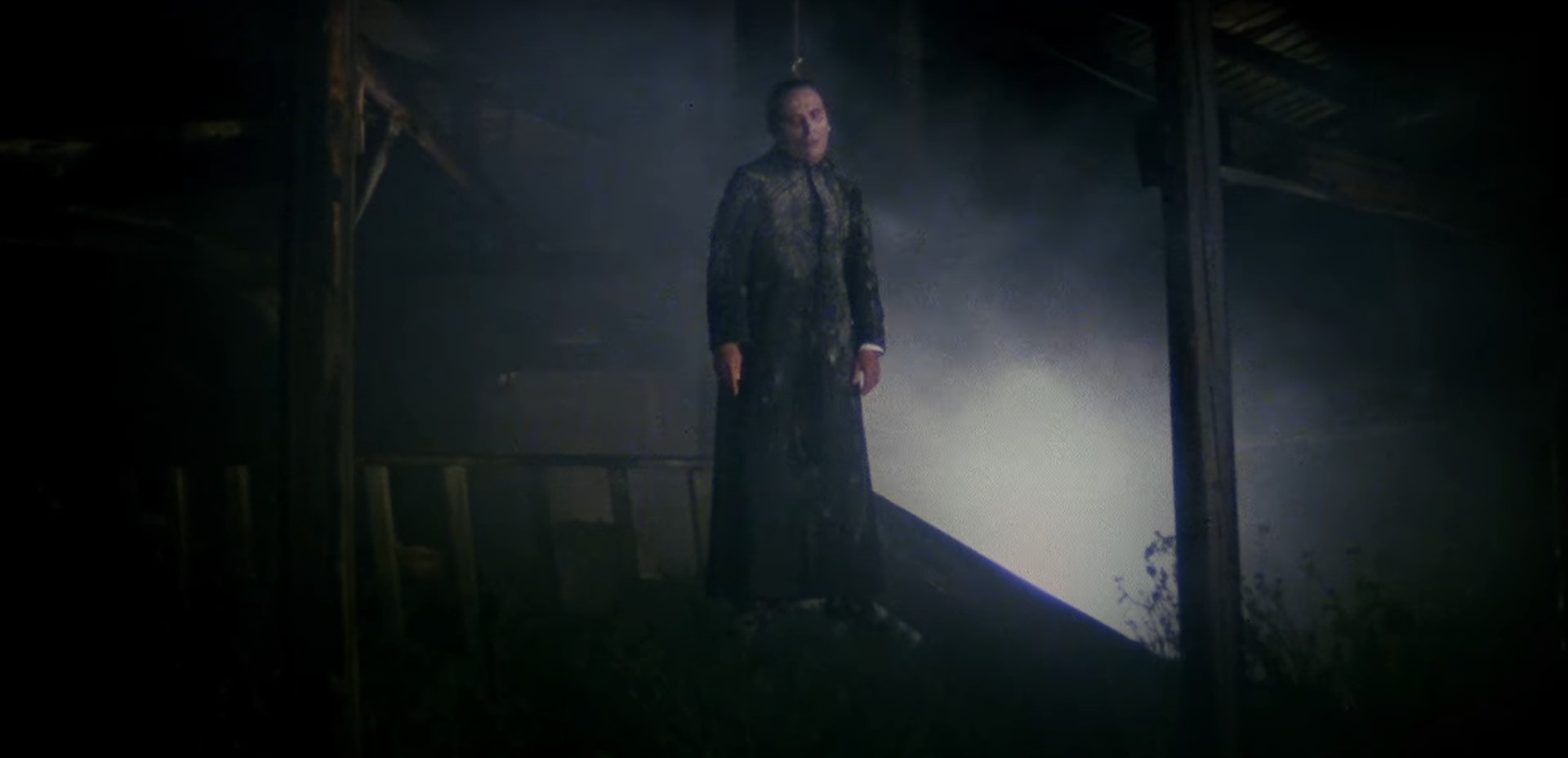
In the Dunwich, a priest commits suicide by hanging himself in the Church’s graveyard.  In the same instance, a psychic based in New York City holds a séance where she witnesses the beginning of the gates of hell opening.  The order sends the psychic into sheer fright that nearly kills her.  A reporter digging deep into the near death of the young woman also buried alive and befriends the psychic, following his nose for a good lead despite its absurd sounding hoodooism of death apocalypse in less than 72 hours.  The psychic and reporter travel to the hard-to-find Dunwich town where the residents have been mysteriously vanishing or discovered dead of curious causes.   Baffled by all the strange occurrences is the town psychiatrist who witnesses first hand the troubles that stir fear into those close to him.  When the psychiatrist teams up with psychic and reporter, they must venture to the very depths of crypt Hell to close the gates and stop the dead for rising before All Saints Day.

The Godfather of Gore Lucio Fulci undoubtedly lives up to his title, establishing himself as one of Italy’s more profound and substantial horror filmmakers before his death in 1996.  “City of the Living Dead” came at the height of Fulci’s success after his breakout into the American market with “Zombie” or “Zombi 2,” an unofficial sequel to George A. Romero’s superb “Dawn of the Dead.”  Yet, Fulci didn’t follow suit with “Dawn’s” social commentary and pale-faced flesh eaters; instead, the writer-director stemmed his undead creatures from black magic hoodooism set in the sunny and sandy Caribbean islands with just as much visceral violence as his inspiring mostly Pittsburgh-based counterpart.  Alternatively known as “The Gates of Hell,” the Italian production of “City of the Living Dead” remains set in the U.S., filmed in New York and the surrounding metropolitan northeast, as the first part of the Gates of Hell trilogy that coincided with “The Beyond” and “The House by the Cemetery,” both of which were released approx. a year later.  “City of the Living Dead” is a Dania Film, Medusa Distribuzione, and National Cinematografica production with Fulci producing as well as the American Robert E. Warner (“Return of the Swamp Thing”) as executive producer.

A medley of nationalities make up “City of the Living Dead’s” who either are or are playing American characters.  Comprised mostly of Italian actors Antonella Interlenghi (“Yeti: Giant of the 20th Century”) as one of the first doomed Dunwich victims, Michele Soavi (director of “The Church”) as a canoodler with his brains being squished, Daniela Doria (“New York Riper”) as the other canoodler having her innards become outers, Fabrizio Jovine (“The Psychic”) as the hung priest who started all this mess and as the harbinger of the living dead, and Carlo de Mejo (“Women’s Prison Massacre”) in the psychiatric lead.  There’s an abundancy of diverse Italian flavor that definitely grounds “City of the Living Dead” as an Italian production, but a minor chunk of the cast are Americans with co-principal Christopher George (“Graduation Day,” “Pieces”) as a rakish NYC reporter forcing his way into a minor lead turned major forthcoming day of reckoning and Robert Sampson (“Re-Animator”) in a minor law enforcement role that bears little significance.  Sprinkled in the cast is also the Swedish-born-turned-Italian actress Janet Argen (“Eaten Alive”) as the psychiatrist patient and UK actress Catriona MacColl rounding out the principal cohort as the psychic.  MacColl is the only actress to have a role in all three of Fulci’s Beyond the Gates films, playing different characters in each.  Between Christopher George’s skeptic playfulness, Janet Argen’s uncontrollable hysterics, and in the unmalleable wrought shock of fear, the sundry cast doesn’t hinder the performances that mesh well under the greater air of portent and the hours leading up to end of days.  Giovanni Lombardo Radice (“Cannibal Ferox”), Luca Venantini (“The Exterminators of the Year 3000”), Adelaide Aste, Venantino Venantini (“Cannibal Ferox”), Robert Spafford, James Edward Sampson (“StageFright”), Perry Pirkanen (“Cannibal Holocaust”), Michael Gaunt (“Forced Entry 2”), and filmmakers Robert E. Warner and Lucio Fulci costar.

Through an unexplained mysticism and preformed stipulations on why the priest was the be all end all gatekeeper to the dead’s awakening on Earth other than Dunwich was original built upon the ruins of a witch-burning Salem, Massachusetts or why the day after the unmentioned Halloween season (likely because Italians do not celebrate Halloween with an abundance of candy and custome), All Saints Day, becomes the zero hour date when clearly the dead are already fatally impacting lives in the corporeal realm, Lucio Fulci masterful magician qualities diverts attention away from seemingly crucial elements of the plot toward a complete and total elemental atmosphere of fear, using eerie fog, whipping wind, and phantasmagoria imagery of the macabre to implant chthonic horror slowly rising above ground.  Makeup artist Franco Rufini recesses the sight sockets with deep, infraorbital darkening under the eyes in stark contrast with the pale shade skin, creating that classic yet effective zombified corpse casing in conjunction with special effects artists Gino de Rossi (“Burial Ground:  The Nights of Terror,” “Cannibal Ferox”) use of ground raw meat or whatever the gushy material used to construct the cerebrum contents that just squishes to a pulp between the fingers of the undead when they grab a fist full of hair, skin, and brains from behind an unlucky left living.  There’s quite nothing like a Lucio Fulci film where the ghouls knock on the door from the other side, threatening the land of the living, the world even, with a sound and steady ghoulish malevolence and death in a well-lit and framed Fulci-scope to hammer down defined purpose that drives a penetrating stake through the chest bone and into a chilled soul.

“City of the Living Dead” goes beyond the format gates and arrives onto a 3-disc 4K/Blu-ray release from Cauldron Films.  2160p Dolby Vision 4K and a 1080p AVC encoded high-definition options really put this Fulci classic back on the map, unlike the small, forsaken city of Dunwich. The 4K UHD is an HEVC encoded, 2160p Dolby Vision ultra high-definition resolution while the AVC encoded Blu-ray sports 1080p high-definition, presented in a widescreen 1.85:1 aspect ratio. Through the translucent mist of natural, good-looking grain, Cauldron Films have hyper-accentuated the atmospherics with a clean rendering of the innate cooler-to-warner photography grades of blue-to-yellow with creating a harsh contrast transition. The encoding never shows an ounce of detail distress to keep textured and palpable image of the darkened crypt or the thick fog exteriors that often would degrade decoding with omitted data. The Cauldron Films release retains and sustains bitrate that fastens the dark levels to a robust and effective pitch black. What’s neat about this release is the ability to toggle between the English DTS-HD 2.0 Mono and the Italian DTS-HD 2.0 mono, both post-recorded in standard with Italian productions. Both tracks are comprehensibly sound with a clear and clean dubbing with the only detailed differences being one in English language and the other in Italian and the title card switched out for the each. Between the two, range is exact on both with not a lot of superfluous ambient sound and both tracks offer a near blemish free experience in a robust context of atmosphere. Disc 1 and 2, 4K UHD and Blu-ray respectively, come with new audio commentaries, including with cult film critic Samm Deighan, author of Italian horror cinema Troy Howarth and film critic Nathaniel Thompson, as well as individual archival commentaries with actors Catriona MacColl and Giovanni Lombardo Radice. Disc 3 includes an interview with production Massimo Antonello Geleng, actor Giovanni Lombardo Radice, and on-stage Q&A with Venantino Venantini and Ruggero Deodata (“Cannibal Holocaust”), a Q&A with Catriona MacColl, a Q&A with composer Fabio Frizzi, interviews with special effects artist Gino de Rossi and principal actor Carlo de Mejo, A Trip Through Bonaventure Cemetary – an explorational and historical account on the main cemetery where the priest in the film hangs himself, trailers, an image gallery, and other archival interviews in a near feature-length collection of conversations with cast and crew reminiscing about Lucio Fulci during filming. The 4K UHD and third disc packed with special features are region free while the Blu-ray remains region A locked in licensed playback on the format. Both features have a runtime of 93 minutes and the release is unrated. Emerging from the gates of standard definition hell, Cauldron Films tempers Lucio Fulci’s “City of the Living Dead” to a foreboding crust, burgeoning with ominous clout the undead’s underscoring resurrection.

Cauldron Films’ “City of the Living Dead” on 4K and Blu-ray 3-disc Release!

Just Because Your EVIL Dad Says Its Okay, It’s Probably Not. “Netherworld” reviewed! (Blu-ray / Full Moon Features)

Enter the Netherworld on Blu-ray!

A wealthy owner of the Thorton plantation bequeaths to his willfully neglected son, Corey, his large Louisiana estate. He’s welcomed by the estate’s unusual lawyer, a house caretaker with an affinity for birds, and her beautiful daughter Diane who, despite her teenage muliebrity, immediately takes an interest and liking to the handsome young man. Corey is also met with his shirker father’s penned testament, to be resurrected from the dead by a sexually alluring brothel woman and necromancer named Delores who works at the local bordello and bar named Tonks. Fascinated by the idea, Corey hangs around the bar and becomes just as engrossed with Delores as his father as he seeks to abide by his father’s supernatural wishes but there’s a warbler cult connected to Delores and Corey’s father with an underhanded scheme that doesn’t favor the new, young estate owner trying to save and possibly get to know the father he never knew, the same one who abandoned him as a small child.

One of the more stranger Charles Band productions to every come out of Full Moon Entertainment, and that’s saying something for a media empire that made killing on hawking killer dolls amongst other oddity-saturated, carnivalesque sci-fi and horror for many decades, “Netherworld” is the early 90’s, Cajun-encrusted, occulter of the Full Moon legacy director of “Tourist Trap” and “Puppet Master,” David Schmoeller, who also cowrote the film alongside Charles Band. “Netherworld” harkens to a time before Band became visionally crazed by dolls, or miniaturized maniacs in general, with a plot that promises Cajun black magic beyond the traditional spells and curses of Louisiana Voodoo, a son desperate to reconnect with his long-lost father who abandoned him, and a flying stone hand with finger extremities that turn into vicious snake-like creatures when attacking the quarried head, but is “Netherworld” too extrusive of the regular and in vogue poured cement of solidified psycho-dolls? ‘Netherworld” is executively produced by Charles Band, produced by Ty Bradford (“Trancers II”) and is a part of the vast Full Moon Entertainment catalogue of productions.

Unsuspectingly walking into between the veil of the living and the dead is predominately television actor Michael Bendetti (“21 Jump Street”) embarking on his first ever horror feature as Corey Thorton, the city boy, or so we assume as he leisurely journeys down a windingly steamy Louisiana tributary in a button-down shirt and tie, who learns his deadbeat, rich father has left him a large amount of property. For having been left fatherless for all of his life, the pill that read as Corey’s deep-rooted longing to familiarize with a flake of a father is a hard one to swallow. The angle that Schmoeller should have attacked more resurrection motivation is the one that involves Corey searching for answers in his father’s disfavor, choosing to live without the flesh and blood legacy of a son, and why now, posthumously, does his father want to reconnect? Audiences will find the answer overly obvious, but Corey Thorton’s thickness proves more difficult to penetrate, especially when he’s beguiled by an enchantress who can summon a flying, snake-fingered hand that emerges an affixing binding wire out from its stony skin and can turn whorehouse johns into caged birdies, literally, if they misbehave or become indelicately frisky. The house keeper’s horseback riding daughter Diane is marred by Holly Floria (“Bikini Island”) with an excessive Southern Belle accent when her character’s status doesn’t stem from sophistication and affluency but rather from the blue collared starry eyes of Anjanette Comer’s (“The Baby”) motherly and hospitality position. When the climax arrives in grand temps and we’re face-to-face with Corey’s ghostly pops, living in the titular Netherworld, the story takes a sudden branch drop that executes any voyage into the void between worlds and there’s quite a bit of neglect for Robert Sampson (“Re-Animator”) as Corey’s father who barely has any scenes to live up to being the film’s primo antagonist pulling the strings of the marionette of his flesh and blood. “Netherworld” fills out the cast with Robert Burr (“Ghost Story”), Alex Datcher (“Passenger 57”), Holly Butler (“Vendetta”), George Kelly (“Jugular Wine: A Vampire Odyssey”) and Denise Gentile (“Ordinary Madness”) as the super-sexy, premium prostitute Delores with parapsychological powers that connect her to the land of the dead.

Off the tip of a gator’s nose, “Netherworld” offers a taste of Full Moon’s 90’s production, promising radically outlandish F/X with a monstrous airborne hand, saucy sexual content, and gore. Corey’s inner thoughts exposition and waterway introduction tends to be more private eye monologuing in the explanation setup of his unplanned inheritance and it also feels like the brittle beginnings of a trashy romance novel: young man travels down the river to his inherited late father’s estate, torn between a pubertal young daughter of the long-standing estate housekeeper and the haram brothel seductress with an eldritch, supernatural inveiglement. Corey’s past lacks backstory, leaving an even playing field across the board of all characters and participating audiences in what to expect from the wild card that is Corey. Immediately drawn to the wanton Tonks not for carnal desires but rather the one woman who her father says can restore his past expiration, Corey’s not a wild card of ambiguity as his role lacks the pull of tough decisions, often between character versus character conflict, with basically a mind already made up to visit the bar-and-bordello despite the ominous warning signs between George Kelly’s sloppy bayou cajuner wanting to dance with Corey at Tonks, Diane’s strong opposition for Tonks in general, and amongst others dubious gratifying points. “Netherworld” very much lives in a world of opposition, like Superman’s bizarro world that defies logic. Logic such as the transition of people into birds, or being inducted into a clan of avian cultists, or ciphering who’s a good guy and who’s a bad guy, or, and this is the most important or, the suddenly cleaved ending that not only doesn’t allow a satisfying ending but also doesn’t explain much, in dialogue or in action, what came into existence once Corey was stuck in the Netherworld other than the obvious trade his father wanted to force.

Full Moon Features brings Hell to Blu-ray with an uncut and remastered from the original camera negative transfer of “Netherworld” in the continuous effort by the empire to upgrade all their classics for a new wave of format availability. Scanned into 2K from the 35mm negative, the AVC encoded, 1080p, high-definition Blu-ray looks pretty darn good. Well kempt over the years, the negative appears to have sustained little age or wear that progresses the hi-def upgrade with relative ease. Color grading is warm and stoked with detail that encrusts every object – the lushy bayou forest, the stony power of a flying hand, Michael Bendetti’s layered curly-perm mullet – all of it is greatly textured and delineated for depth, presented in the 1:78:1, widescreen aspect ratio. Compression doesn’t appear to be an issue despite a lower storage BD25 but that might be due to the utter lack of bonus accompaniments. The release offers two audio options: an English Dolby Digital 5.1 surround sound and an English Dolby Digital 2.0 mix. Both options are equally suitable as the there’s not much more environmental oomph through the extra channels despite the full-bodied cacophonous cicada singing, which unfortunately doesn’t open up depth in the back channels despite the prevalence of the singing in the story’s background sonance. However, dialogue doesn’t feel cheated with a dominating layer and decent range to go with it. Along with essentially what is a bare bones disc, there are also no subtitles available with this release. What is available to view outside the feature is other Full Moon trailers and the original VideoZone segment that covers this particular 1992 gem. Physical features don’t stray too far from VHS, to DVD, to Blu-ray with the same flinty hand rocketing outward in a 3D-like position on the front cover. There are no inserts included with this release. “Netherworld” Blu-ray comes region free, with a runtime of 82 minutes, and, for the first time ever, uncut! An opposition to the usual spun of Louisiana voodoo-hoodoo, there’s another dark magic brewing in the bayou in “Netherworld,” but the promising story can’t coherently piece together down river in an uneven quagmire of quandaries.

Enter the Netherworld on Blu-ray!