Next Step in Evolution Leads to EVIL’s War Against the Common Man. “Scanners” reviewed! (Second Sight / 4K UHD)

“Scanners” 4K is Head Popping Good! Buy it Here!

Dr. Paul Ruth is a ConSec scientist, the head of the private contract weapons department on the “Scanner” project.  A Scanner is a highly developed human with psychic and telekinetic powers able to control and damage the minds of others through the nervous system.   Ruth’s latest case is Cameron Vale, a vagrant helped by Ruth to control his self-detriment powers with the use of a scanning suppressive drug known as ephemerol.  When one of Ruth’s past subjects, a renegade Scanner known as Revok, infiltrates and assassinates a live public demonstration of the Scanner project with the intent to wage war on non-Scanners, Ruth’s only hope is to convince to conscript Vale to join the fight and infiltrate against Revok who kills any Scanner who doesn’t join his growing army.  Vale’s search for Revok leads him to learn of a treacherous mole within ConSec and that ephemerol is being weaponized against the normal human race.

On the heels of our Second Sight 4K review of David Cronenberg’s 1979 film “The Brood,” Cronenberg’s following film “Scanners” released two years later in 1981 ups the ante in elaborate special effects and high conceptual themes twirling around in a bowl of body horror soup and is now also available on 4K UHD from the UK Second Sight label!  Like “The Brood,” Cronenberg writes-and-direct a dysphoric film in his birth country of Canadian, per his normal track record of principal production countries, specifically shooting in in the urban and greater areas of Québec, Canada.  The first film of a trilogy, to which Cronenberg did not return to direct the subsequent sequels with both films released a decade later in 1991 and helmed by “Screamers” director Christian Duguay, is a production of the  CFDC (Canadian Film Development Corporation), Filmplan International, and Montreal Trust Company of Canada with Pierre David and Claude Héroux both returning from “The Brood” as executive producer and producer, respectively. 

The face of Scanners has been and always will be Michael Ironside, included on most poster and home video release stills and artworks of a flaringly distorted Ironside as Revok deep in a frighteningly milky-white eyed scanner turbulence.  The “Total Recall” and “Starship Troopers” actor has a face the camera loves, especially in an antagonistic role with Ironside’s gifted devilish grin, dagger eyes, and sarcastic stoic expressions.  However, he is not the heroic lead of Cronenberg’s “Scanners.”  Ironside is not even in the top three headlining credits.  That foremost distinction is consumed by Stephen Lack (“Perfect Strangers,” “Dead Ringers”) in the Cameron Vale role and Lack’s performance is indicative of his name in a completely overshadowed protagonist role.  Lack’s monotonic bordering dangerously to catatonic presence is swallowed up by Ironside who has fewer scenes but instills punchier passion toward his character’s rebellion against humanity cause, plus the contour control over his mannerism and expressions are impeccably cinematic  There are other actors credited ahead of Ironside, beginning with the greatly dramatical Patrick McGoohan (“Escape from Alcatraz”) as the pro-scanner ally Dr. Paul Ruth whose commanding the Vale assignment, “The Clown Murders’” Lawrence Dane as a traitorous ConSec company man Keller in Revok’s pocket lining, and “The Psychic’s” Jennifer O’Neill as fellow pacificist scanner and Vale love interest Kim Obrist.  Each actor finds their individual, attributable, character voice while giving into the required performance with commitment, a sentiment that was not shared by Lack in a strong leading man contender against the forces that face him or scan his mental space.  “Scanners” rounds out the cat with Robert A. Silverman (“The Brood,” “Jason X”), Mavor Moore (“Heavy Metal”),  Fred Doederlein (“Shivers”), Adam Ludwig (“Short Circuit 2”), and Victor Desy (“Rabid”) with that iconic head explosion scene.

To follow up “The Brood” almost right on its heels with “Scanners,” David Cronenberg’s creative synapses were just thunder stroking on all cylinders with ways to evolve mankind into next level grimdark science fiction.  The simple premise of the advanced human condition sparking a potential war between normal man and Scanner man with a private weapons developer in the middle, perhaps inadvertently or intentionally coaxing a new breed of man, is elevated by the special effects of Gary Zeller (“Visiting Hours, “Amityville II: The Possession”) and the makeup alley-oop by Dick Smith (“The Exorcist”) to give audiences those head-exploding, vein-popping, fire-starting special effects that are sear so well into the mind they’re virtually unerasable from the mind, as if real life scanners were implementing the reel into the occipital lobes themselves.  Plot devices like these inarguably saturate the cloak-and-dagger, on-the-run, and species-eradicating storyline with leadup anticipation, building suspense through the truth and lies of Vale’s assignment as well as Vale understanding and, ultimately, accepting his gift rather than seeing it as a burden or a blight to his being.  Unlike “The Brood,” “Scanners” leans more into the physical method of effects with not only the pulsing veins and the white contact lenses but Cronenberg amps up the pyrotechnics with violent and fiery explosions, both of which do a number of the body with blunt invisible force ravaging soft tissue, and also sets ablaze characters’ specific, isolated areas for visual awe and a presentation of a whole new possibility dimension plane of the mind and body that can create, endure, and eventually destroy.   

“Scanners” rounds out the pair of Second Sight’s David Cronenberg releases onto 4K UHD, in conjunction with “The Brood.” The HEVC encoded, 2160p ultra high-definition, BD100 houses the director approved 4K restoration transfer, presented in Dolby Vision HDR10 and in a widescreen 1.85:1 aspect ratio. Previous HD releases favored a slightly anemic image with a tilted color grading that never approached the aesthetics of the cinematic era. Second Sight improves on this with a present in time natural grading true to the late 70s into the early 80s. Healthy, organic grain filter through with an agreeable measure, never overtaking the details that effect upon texture and substance, such as from the massive head explosion with all the intricate gory bits of hair and flesh flying splattering about make for ideal visual immersion to the more macrolevel of inside circuitry when Vale enters the computerized nervous system through scanning. Skin tones render over organically with no flashes of a slightly orange tinge as in previous releases, corrected to overall completed neatness on the finer points. An English DTS-HD 5.1 master audio and a LPCM 1.0 mono consummate the release with fidelity honoring mixes. The surround sound offers a constructed immersive dynamic riddled with explosions and a feverish Howard Shore score engulfing the echoing of the scanner waves to denote the telekinetic or psychic use, but the mono track offers something far greater than any retroactive designed immersion track could offer, a genuine, unforced mix. Both tracks offer clean, robust dialogue with a clarity to match. English subtitles are available on both. Special features include a new audio commentary by Canadian film writer Caelum Vatnsdal and a second audio commentary by film academic William Beard. If comprehensive interviews straight for the horses’ mouths are your thing, than Second Sight has you covered with new and archive interviews with Stephen Lack My Art Keeps Me Sane, Michael Ironside A Method in His Madness, Lawrence Dane Bad Guy Dane, cinematographer Mark Irwin The Eye of Scanners, composer Howard Shore Mind Fragments, executive producer Pierre David The Chaos of Scanners, makeup artist Stephen Duplus Exploding Brains & Popping Veins, and with makeup effects artist Chris Walas Monster Kid. A new visual essay by Tim Coleman Cronenberg’s Tech Babies cabooses the special features. Encased in a traditional back UHD Amaray, the new artwork also sports a prominent and looming Michael Ironside as a raging scanner Revok but now Stephen Lack has presence space with his own iconic and disturbing moment from the film now on the front cover, as the little spoon of course. The companion standard Second Sight release of “Scanners” is UK certified 18, has a runtime of 103 minutes, and is region free!

Last Rites: “Scanners” never looked so good. An exceptional inception of a release from Second Sight Films that continues to aim high and raise the bar with every title they touch, like King Midas without being cursed by their success.
“Scanners” 4K is Head Popping Good! Buy it Here!

Rage EVIL Leads to A Legion of Drone Dwarfs! “The Brood” reviewed! (Second Sight / 4K UHD)

“The Brood” Available Now from Second Sight!

After a series of mentally abusive behavior, Frank Carveth’s wife Nola resides under the unorthodox psychology of Dr. Hal Raglan whose controversial impersonation techniques to break down his patients’ dissociative psychological hangups and destructive blocks.  After months of therapy and witnessing Dr. Raglan’s methods in action, Frank is ready to pull the plug on the doctor’s sideshow sessions he deems are doing more harm than good when his daughter shows signs of physical abuse after a visit with her mother.  The prolonged verbal bout to get his wife out of Raglan’s care leads to Frank confiding in Nola’s mother who is found brutally murdered soon after.  When Nola’s estranged father comes into town to oversee the burial arrangements, he’s also brutally murdered.  Frank begins to connect pieces, theorizing that Dr. Raglan’s procedures and the murders may be linked and as he investigates further, the truth is more terrifying than he could ever imagine. 

Surging with emotional turmoil through a bitter divorce with ex-wife Margaret Hindson, Canadian body-horror director David Cronenberg pulled the rancorous inspiration from that turbulent time to write the originial screenplay for “The Brood,” a 1979 released thriller between an estranged couple, the effect of their ascending troubles upon their only child during the separation, and the sort of radical and systematic behaviors and practices used to reform a relationship bond that actually divides the emotional expanse even further.  Sprinkle a little of the unknown and grotesque abilities of unnatural corporeal world in there and you have yourself one hell of a dysfunctional and undomesticated horror only the unconventional David Cronenberg could conjure.  “The Brood” is produced by Claude Héroux, who would go on to produce Cronenberg’s next series of films, “Scanners” and “Videodrome,” and the Ontario filmed production is a studio venture from the CFDC (Canadian Film Development Corporation), Elgin International Films, and Mutual Productions.

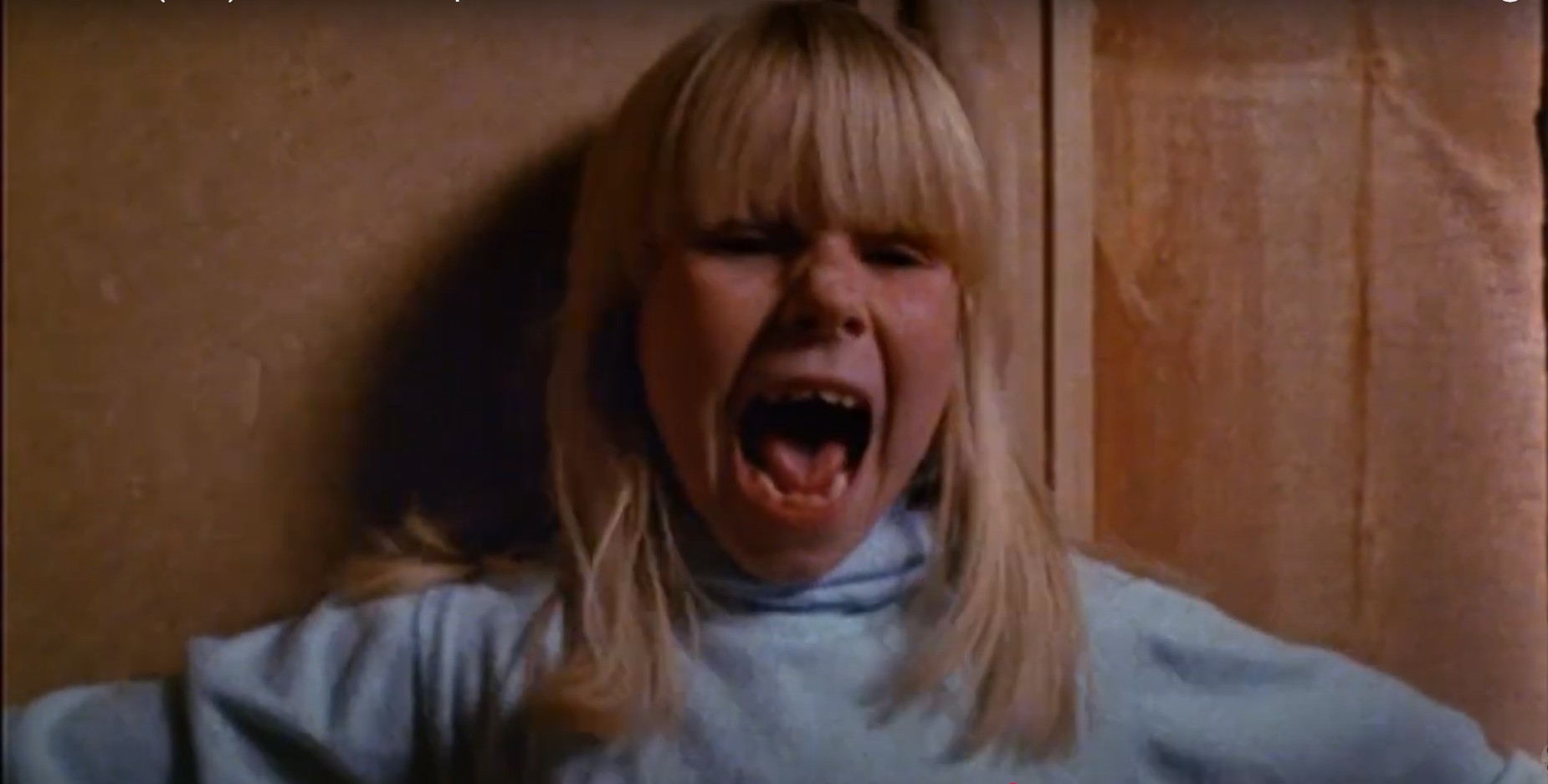
Art Hindle is in the role of Frank Carveth, a father initially skeptical and frustrated with his wife’s supervised treatment and care.  The “Black Christmas” and “Invasion of the Body Snatchers” actor Hindle plays the role of a hinged investigative husband-parent involved into something far more unbelievable than initially imagined.  Next to his on screen dazed and mentally tarnished wife by Samantha Eggar, of “The Exterminator” and “Demonoid,” Hindle enacts normal responses that carry over into extreme situations when those around him – his mother-in-law (Nuala Fitzgerald, “Obsession”), his father-in-law (Henry Beckman, “Side Roads”), and his daughter’s teacher (Susan Hogan, “Phobia”) who might have had a little something-something with while on the rocks with the misses – dies a violent death at the hands of kid-sized mutants that resemble, partially, his own daughter Candace (Cindy Hinds, “The Dead Zone”).  As Nola Carveth, Eggars is only present in a few scenes alongside Dr. Raglan, played by the formidable British actor Oliver Reed (“Paranoiac,” “Gladiator”), as a staring into space, emotionally compromised woman struggling to cope with her past that makes her angry and upset and, in turn, makes her inexplicably conjure do-bidders in the birthing means of advanced evolution or in a parallelism to eusocial insects, like bees or ants.  Reed is the monkey in the middle of all of this between fending off Frank Carveth who challenges the results of his unorthodox psychological methods while also using those methods to unearth the root cause of Nola Carveth’s strange and unusual behavior and, eventual, psychic abilities.  Reeds delivers his typical stoic indifference which makes him ideal for a confident character of the scientific community eager for results rather than feeding his motivations with emotional fodder by empathizing with Carveth’s concerns.  Gary McKeehan (“Rabid”) and Robert A. Silverman (“Naked Lunch”) costar.

In his 50-year plus career, David Cronenberg has evolved in style, substance, and story that dip into more of alternate universes and deliver new ways to blend the future into an organic composite with commercial and social sub context.  While technology and personal and professional growth have developed the director into what he has accomplished and known for today, especially on the verge of his latest release with the living and dead connection theme in “The Shrouds,”  the core of what David Cronenberg does best and still does today has an etiology leading back to his earlier work and “The Brood” is definitely an archetype of his niche.  Cronenberg works the narrative up to his reveal of body horror, and “The Brood” is dangerously on the edge of being atypical, subjecting audiences to more of a buildup in the story and the delimitation of character  disclosure without a steady course of the maladjusted, mutated or modified human body as the villain or the escape, only for that theme to be quasi hinted and then unveiled at the end in a shocking reveal.  “The Brood” plays more of the slasher tones, using the children, dwarfs, or however you want to describe the little, mutant minions to be unknown villain tropes, even when one is laid up on a morgue slab for examination of its biology, or lack thereof.  Cronenberg’s directed ambiguity tees up one of the best endings of his career and, perhaps, even horror cinema as “The Brood” is queen sized stomach-churner, literally.

David Cronenberg’s “The Brood” arrives in 4K on a Ultra HD Blu-ray from UK boutique label Second Sight Films.  The BD100 is HEVC encoded with a 4K resolution or a pixel count of 2160 with Dolby Vision HDR10 and presented in a widescreen 1.85:1 aspect ratio.  On the back cover, the 4K restoration is approved by David Cronenberg.  There’s definitively a more positive treatment of the restored transfer that brightens with a slightly tweaked color grading compared to other DVD or Blu-ray releases, improving delineation as well as rectifying intended details to burst through what’s been long frustrating by a darkened wall of low-resolution definition.  Retaining and sustaining cinema coarse grain, the picture looks and feels incredibly natural without the presence of compromising touchups and smoothing overs that do more harm than good in the plastic-like approach to restoration.  The UHD reinforces the coloring with vibrant richness and range, boosting the once little Canadian film that could into an expensive-appearing optical overhaul that puts to shame previously shelved videos.  Audio fidelity is too retained with a LPCM 1.0 mono that although funnels through a single output is more than an adequate mix all in thanks to the competent sound engineering of Peter Burgess and team to amalgamate recorded sound and post-production ADR into a brawny singular unit that meshes nicely.  Dialogue foots the bill as a clean and clear presentation, the ambient sound design renders distinctly over without ambiguity, and longtime David Cronenberg collaborator and friend Howard Shore conducts an orchestra score that breaks through and keeps the course with an unforgettable amount of tension build.  English subtitles are available.  Special features are aplenty with a new audio commentary by film critics and historians Martyn Conterio and Kat Ellinger, a second commentary with film academic William Beard, interviews with actors Art Hindle and Cindy Hinds moderated by Fangoria’s editor Chris Alexander Meet the Carveths, an interview with executive producer Pierre David Producing the Brood, interview with cinematographer Mark Irwin The Look of Rage, interview with composer Howard Shore Scoring the Brood, an interview with actor Robert A Silverman Character for Cronenberg, a new video essay by film journalist Leigh Singer Anger Management: Cronenberg’s Brood and Shapes of Cinematic Rage, and an archived David Cronenberg interview The Early Years.  The standard Second Sight release comes in the traditional 4K UHD black Amaray case with new unnamed, unsigned illustrated cover art.  The UK certified 18 film is presented region free in this release and has a runtime of 92 minutes. 

Last Rites:  Cronenberg’s play on the word Brood is next level genius with litter rage as a result of mental health and a broken home.  The director’s filmic roots have proved time-and-time again his mastery of moviemaking as his body horror and thought-inducing stories, intermixed with social commentary, are complex visual and narrative devices braised an organic edge. 

“The Brood” Available Now from Second Sight!

Second Sight Delivers the EVIL Goods Yet Again! “You’re Next” reviewed! (Second Sight Films / Blu-ray)

Limited Edition and Standard Edition Sets of “You’re Next” Available At Amazon!

Celebrating 35 years of marriage, Paul and Aubrey Davison invite their four children – Drake, Crispian, Aimee, and Felix – to their rural weekend manor along with their respective spouses for the occasion.  Tensions amongst strained family ties begin to boil over as siblings quarrel before they even share the first meal all together.  Yet, that’s the least of the family’s problems when animal masked intruders shoot crossbow arrows through the windows and are found hiding, waiting under the bed with machetes.  The surprising attack sends a surge of shock through them but not Crispian’s girlfriend Erin who intends on fighting back and defending herself with survival knowhow.  As the night carries on, the family is being brutally executed one-by-one in what is seemingly random acts of violence.  Unsure how many assailants are outside and the cell service not working, Erin and the rest of survivors attempt to survive the night until help arrives. 

Before being the directorial face behind the recent string of mega blockbusters, literally, in the “Godzilla vs. Kong” films, Adam Wingard had more humbling beginnings as an original horror storyteller.  From working with “Texas Chainsaw Massacre: Part II’s” Bill Moseley as a demented door-to-door salesman in “Home Sick,” to interlacing themes of drug addiction and haunting visions in “Pop Skull,” to thrill with an abusive pursuit of an escaped convict tracking down his ex-girlfriend in “A Horrible Way to Die,” Adam Wingard had a knack for extracting small time horror in a big way.  Although all three of those examples saw success at some level, the glass ceiling never really broke until a juncture point just after the turn of the decade in 2010 with “You’re Next.”  Screenwriter Simon Barret, who also before writing “Godzilla x Kong:  The New Empire,” wrote the U.S. home invasion and slasheresque horror-comedy as the fourth film under Wingard’s direction, following “A Horrible Way to Die,” “Autoerotic,” and “What Fun We Are Having;” however, Barrett has found moderate success of his own with “Frankenfish” and, one of my personal favorites, “Dead Birds,” with an early performance from Michael Shannon.  Barrett, alongside Jess Wu and Keith Calder of Snoot Entertainment, Chris Harding, Kim Sherman, and Brock Williams produce the Snoot Entertainment in association with HanWay Films production.

“You’re Next” reunites a cast of Wingard regulars, interchanged with good friend and fellow horror filmmaker Ti West (“The House of the Devil”) that has all but nearly faded the higher the filmmaker climbs the Hollywood latter.  The entourage includes “Hatchet II” and “The House of the Devil’s” A.J. Bowen as the pacifist academic Crispian, “Alien:  Covenant” and “Pet Semetary’s” Amy Seimetz as Crispian’s starving filmic sister Aimie, “The Sacrament” and Autoerotic’s” Joe Swanberg as the pompous older brother Drake, and “Pop Skull,” and “V/H/S’s” Lane Hughes as the Fox masked killer all of whom were in Wingard’s “A Horrible Way to Die” a year earlier.  Plus “Home Sick” and “Pop Skull’s” L.C. Holt dons a killer’s mask and director and friend Ti West of the highly popular X film series also has a brief role that plays into their whole dark nature of storytelling.  The inner circle of friends and usual casting smooths out to fills voids by adding a couple of marketable and genre renowned names to add a solidifying agent to “You’re Next’s” magnetism with “Habit” and “The Last Winter” actor-director Larry Fessenden as well as un-retiring one of the genre’s more respected and timeless scream queens and final girls in Barbara Crampton (“Re-Animator,” “Frome Beyond”) to be playing matriarch and host of the family being invaded upon.  Though marking her return back to horror, Crampton relinquishes her reins on the final girl trope, swallows her stardom by moving aside, and letting have that particular subcategory role to Australian actress Sharni Vinson (“Bait”) in one of her first handful of roles in a feature film.  Vinson will send shockwaves through audiences on her quick turn of character from a lovely, liberal oblique woman to a complete cutthroat badass that not only turns the tables on the attackers but also shepherds in a new fear or thrill – a worriment encompasses over the sociopathic bad guys.  “You’re Next” puts up a high body count with the rest of the cast body including the late Nicholas Tucci (“Choose”), Wendy Glenn (“11-11-11”), Margaret Laney (“Absence”), Rob Moran (“There’s Something About Mary”), and Kate Lyn Sheil (“She Dies Tomorrow”).

Before the film’s release in 2011, the home invasion genre saw an explosion of examples from class that wasn’t exceeding in quantity but rather rocketing skyward in quality.  The French had a good handle on concept with a bleak, ultra-violent coating that completely engrossed viewers as well as rocked their core with how nihilistic and cynical characters could become without a heroic, saves-the-day, or survival outcome, such as is the cast with 2007’s “Inside” and 2008’s “Martyrs.”  The American industry also attempts to capitalize on the niche market with “Funny Games” released in 2007 but that too is based off a European script from Austrian filmmaker Michael Haneke’s original film a decade earlier of the same title.  In all fairness, Haneke also helmed the remake starring Tim Roth and Naomi Watts.  Yet, American audiences adored their own success with Bryan Bertino’s “The Strangers” in 2008 and a remake of Wes Craven’s “The Last House on the Left” by director Dennis Iliadis in 2009 that conveyed that sort of callous violence and anarchial analogies.   Then in steps Adam Wingard and Simon Barrett’s entry of “You’re Next” of shared sadism and pessimism but sprinkles it gallows humor through the dialogue exchanges and impressions of character attitudes to make a hybrid that pulls inspiration from the likes of “Funny Games,” “The Strangers,” and “The Last House on the Left” and still finding individuality amongst the like without suffering from an identity crisis.   Protagonists and antagonists swerve through an interchangeable junction, flipping the script just when you think you’ve plotted the course of the storyline, and yet, a found sense of cold cock shock lands squarely when all is said and done and bits and pieces of the royale rumble characters are strewn about the battled ground mansion. 

“You’re Next” arrives at the UK label and friend to physical media Second Sight Films.  Second Sight’s single disc Blu-ray comes AVC encoded with 1080p hi-def resolution and dual layered with a BD50, projecting a consistent 24FPS.  There’s not much to terribly note about Second Sight’s quality release of Adam Wingard’s over 20-year-old, 4K shot film as digital stock hasn’t necessarily changed significantly for the better over the last two decades.  Presented in a widescreen 2.39: aspect ratio, Wingard and cinematographer Andrew Droz Palermo (“The Green Knight”) choose a warmer color pallet of mustard yellows and burgundies, accentuated by enveloping three-point lighting and the tweed dinner jackets and turtlenecks, to give it a retro 70s or 80s veneer in a modern time.  No banding issues or digital compression anomalies with the ample disc space.  Range is fine but limited to mostly the aforementioned color scheme.  Depth is almost limited in what is mostly a series of medium to closeup shots in an interior setting, but we’re treated to a mixed melee of close-up violence that sees splatter scatter the dark syrupy blood.  A DTS-HD 5.1 Master Audio mix layers a lossless fidelity consistency.  Dialogue has no issues with obstructions, favoring a clean and clear presentation of exchanges without losing inflection, tone, and vitality during the chaos, calmer moments, and tensioned exchanges.  A fugitive depth doesn’t sustain any kind of depth; again, with the close quarters action, we tend to forget Larry Fessenden’s blaring music left on repeat and noted to have at least three layers of depth from within the stereo’s room, between rooms, and outside the house.  Organic and inorganic ambience and action have seamlessly admixed without a sense of artificial notice.   A compilation of artist soundtrack isn’t invasive or intrusive with the assailants and that kind of dampens the effect but it’s an overall workable mix from Mads Heldtberg, Jasper Justice Lee, Kyle McKinnon, and Wingard himself.  Optional English subtitles are available.  Second Sight Films reliability to earn the right to re-release another modern production stands through again another special features laden release that includes a brand-new audio commentary with director Adam Wingard and writer Simon Barrett as well as archive audio commentary with Wingard, Barrett, and actresses Sharni Vinson and Barbara Crampton.   Another new feature is an approx. hour long interview Children of the 80s with Wingard and Barrett recollecting and going through the details for the genesis of the story and film.  Other new interviews include producers Keith and Jess Wu Calder the Most of Us, actor AJ Bowen Script is a Blueprint, actor Joe Swanberg Down in the Basement, actor Amy Seimetz Be Funny or Die, and production designer Tom Hammock Falling into Place.  Animated storyboards, an archival making of What’s Next?, and a video essay from Tim Coleman Slashers Don’t Die fill out the immensely packed second layer.  House in the standard Second Sight green Blu-ray Amaray for their standard lot, the front cover is gruesomely beautiful with a blood illustration of Sarni Vinson in character that’s also very telling of the film’s tone.  Like all their standard releases, this one comes with no inserts inside or other tangible bonus content.  The disc is pressed with another illustration of one of the masked killers.  The UK certified 18 release contains strong bloody violence, as well as language and brief nudity for those of us Americans wondering at home, in a 95-minute duration to which is encoded with a region B playback. 

Last Rites:  “You’re Next” denounces the helpless and the defensive character topes aimed to be slaughter like cattle in an abattoir.  Instead, this final girl and ferocious slasher and home invasion thriller goes against the grain and has gruesomely fun with its kills and thrills.   

Limited Edition and Standard Edition Sets of “You’re Next” Available At Amazon!

One Out of 7 Most Freaky, if not EVIL, Places on the Planet! “Gonjiam: Haunted Asylum” reviewed! (Second Sight / Limited Edition Blu-ray)

Become Engulfed by the “Gonjiam: Haunted Asylum” on Second Sight’s LE Blu-ray!

Horror Times, a web series dedicated to horror and hits, travels to the Gwangju providence for their next big event, a special episode aimed to rake in 1 million views worldwide as they explore the supposedly haunted, deserted, and derelict Gonjiam psychiatric asylum after midnight on its anniversary date of its closing.  Already buzzing with historical disappearances of those curious and brave enough to investigate the dilapidated corridors and rooms, Horror Times brings in four guests to join his three-man crew to record every second of what CNN labels one of the seven freakiest places on the planet.  Setup with wall-mounted motion activated cameras, harnessed with individual GoPros, and given a multi-layered script to follow on each of Gonjiam’s four floors, all is going as planned broadcasting live the strange atmospherics that slowly see climbing views from the director’s camped base outside the structure, pulling some fabricated strings to not only heighten his viewer pool but also get genuine frightened reactions from his guest team, but when the team and the cameras unexplainable paranormal occurrences, how far will a director go to reach his milestone goal.

Based off the actual CNN listicle of the top 7 freakiest places on the planet, “Gonjiam:  Haunted Asylum” was a real brick-and-mortar edifice committed to the committedly insane and one of the most suspected haunted places in South Korea until it’s demolishment shortly after the 2018 film’s release.  “Epitaph” writer-director Jung Bum-shik joins the ranks of the South Korean supernatural spookies, accompanying notable entries such as “The Tale of Two Sisters,” “Phone,” and “Cinderella.”  Cowritten by Sang-min Park, Gonjiam:  Haunted Asylum” refreshens the ramshackle mental institutionalized horror subgenre with a dash of social media influence and found footage that entangles grudging ghosts with cyber terror.  Historical thriller and drama producer Won-guk Kim spearheads the project under Hive Media productions and distributed globally by Showbox Films. 

Like a cable-aired, modern-day version of “Ghost Hunters” or “Kindred Spirits,” the vessel Horror Times exploits people’s spirituality beliefs by mingling the exploration of urban legends with gimmicky ploys to keep eyes glued to the show, run up viewership, and earn the root of all evil, money.  The Mystery Incorporated meddling kids might not have a talking Great Dane, but the Gonjiam ghost hunters are a dynamically doomed blend of greed and curiosity, helmed by their captain Ha-joon (Wi Ha-joon, Squid Game) and his on-the-ground, string-pulling marionettes Seung-wook (Lee Seung-wook) and Je-yoon (Yoo Je-Yoon) to conjure up not spirits but pranks under the guise of Gonjiam ghosts.  The unsuspecting portion of the team react as expected, believing the unexplainable as genuine articles of a haunted asylum, until the jokes bleed into the reality of the structure’s incensed force.  Other than Charlotte (Mun Ye-won), a Korean American who travels to Gonjiam to add the location to her lists of CNN’s freakiest places on the planet, there isn’t another mise-en-place character.  Perhaps the others’ backstories are lost in translation but Sung-hoon (Park Sung-hoon, “Hail to Hell”), Ji-hyun (Park Ji-hyun, “The Divine Fury”), and Ah-yeon (Oh Ah-yeon) lose sympathy points for just being there for the sake of being there.  If you haven’t caught on already, the characters and actors name match to add to the faux realism of found footage. 

Veritably surrounded by the actual notoriety of the former Gonjiam psychiatric hospital, the story adds to the established frightening folklore of the rundown building and though the filmmakers were not allowed to shoot inside or on the grounds of the restricted abandoned building, Gonjiam blueprints were used to reconstruction the grimy, trash-laden hallways and various rooms inside a high school.  The effect works like charm used to teleport audiences, along with the help of social media GoPros, selfie sticks, and the like, right into the crumbling ruins; you can almost smell the mold and stank of beyond putrid chemicals and filth.  Yoon Byung-Ho’s cinematography plays with the signal disruption touch, often deploying randomized and intentional interference to convey signal disruptions or, perhaps even, the foreshadowing with the wraithy wrath of spirits; yet “Gonjiam” never truly feels like a found footage film due to its radical differences in video media being implemented and there’s often the unexplainable, no camera-in-use angle that dilutes the subgenre medium.  “Gonjiam” falls into this unquantifiable realm of storytelling that’s hard to digest.  The chaos that ensures in the third act is more palpable, geared toward developing a heavily reliant, hard and fast tension and trembling fear without needing bloodshed for the crowd-pleasing shock factor.

Second Sight sees through the dense barrage of found footage films and spots the pearl amongst the muck with “Gonjiam:  Haunted Asylum,” curating a limited edition, big box, Blu-ray release.  The AVC encoded, 1080p high-definition, BD50, presented in a widescreen 1.85:1 aspect ratio, nears 24 FPS and has flawless technical recording in its digital capturing.  Blacks are dense and rich to create that unknown void apprehension, the neglected belongings of a forlorn hospital have palpable consistency that’s grimy and rusty, and skin textures appropriate lose definition but maintain quality to the extent of equipment limits with GoPros, cell phones, and camcorders in low and hazy key lighting, onboard camera lighting, and some night vision for authentic found footage grip.  There’s not much in the way of diverse color for what is a graded tone of tenebrous obscurity throughout.  I’ve already touched upon Byung-Ho’s purposeful transmissive trouble that impresses more of an annoyance than an integrated factor of fear.  The Korean DTS-HD Master Audio 5.1 delivers on the need-to-hear atmospherics that shudders in echoes and the frantic churn of survival.  What there is not a ton of, and gratefully kept to a minimum, was the eerie wails of the dead as their moments are kept mostly visual in a virtually scoreless runtime that focuses on the surrounding milieu rather than building tension artificially through minor key notes.  Dialogue comes through clearly and clean, especially when muzzled by video camera audio band transmissions.  English subtitles are translated well and synch fine enough with the rapid procession.  Special features include an feature-length audio commentary by Mary Beth McAndrews (Dread Central editor-in-chief) and Terry Mesnard (Gayly Dreadful editor-in-chief), UK’s Zoë Rose Smith’s Fear the Unknown visual-essay on the Gonjiam’s origin, history, and what makes the Korean film scary, and archived featurettes with interviews, including with director Jung Bum-shik amongst various crew, that explore the rumored beginnings of Gonjiam’s notoriety that fuels the production into recreating Gonjiam nearly identically, live recordings of the film’s sheer eeriness told through the images captured by the camera harnesses and phone footage, the new faces of fear that circles around the cast and behind-the-scenes table reads, The Sanctum of Horror that aims to explore the connection between the actual freaky locations and their cinematized yarn to create a legacy of folklore for the now demolished Gonjiam hospital, The Truth of the Ghostlore explores Gonjiam’s history and urban myth and how that forms the ghosts in the film, Korean press conference film launch, and the film’s trailers.  As much as we love Second Sight’s authored special features, which from films of the East are rarely produce, there also plenty to be excited about with the physical attributes of the limited edition set, including a rigid and thick sleeve box with a Luke Headland designed Gonjiam building in red and black.  The inside contents include a 6 collector’s art cards in the same red and black color scheme, a 70-page book with new essays from Sarah Appleton (“The J-Horror Virus”), James Marsh (“Wisconsin Death Trip”), film critic Meagan Navarro, and horror content creator Amber T, and finished off with the film itself, encased in a green-colored Amaray with the same front cover artwork as the rigid slip box.  There are no inserts, and the disc is pressed simply with the title, English and Korean, splashed in red on a black background.  The LE set is hardcoded with a region B playback, has a runtime of 94 minutes, and is UK certified 15 for Strong Supernatural Threat and Language.

Last Rites: “Gonjiam: Haunted Asylum” is not just another shaky cam of paranormal activity. The film incorporates a component of reality, embellishing more on top an already suspected haunted building by giving the story teeth, and released with cultural purpose that binds fact and fiction with a terrorizing outcome of some really pissed off spirits.

Become Engulfed by the “Gonjiam: Haunted Asylum” on Second Sight’s LE Blu-ray!

EVIL Wants to Cut Out Your Unborn Child. “Inside” reviewed! (Second Sight / Blu-ray)

Order The Limited Edition Copy of “Inside” From Second Sight!

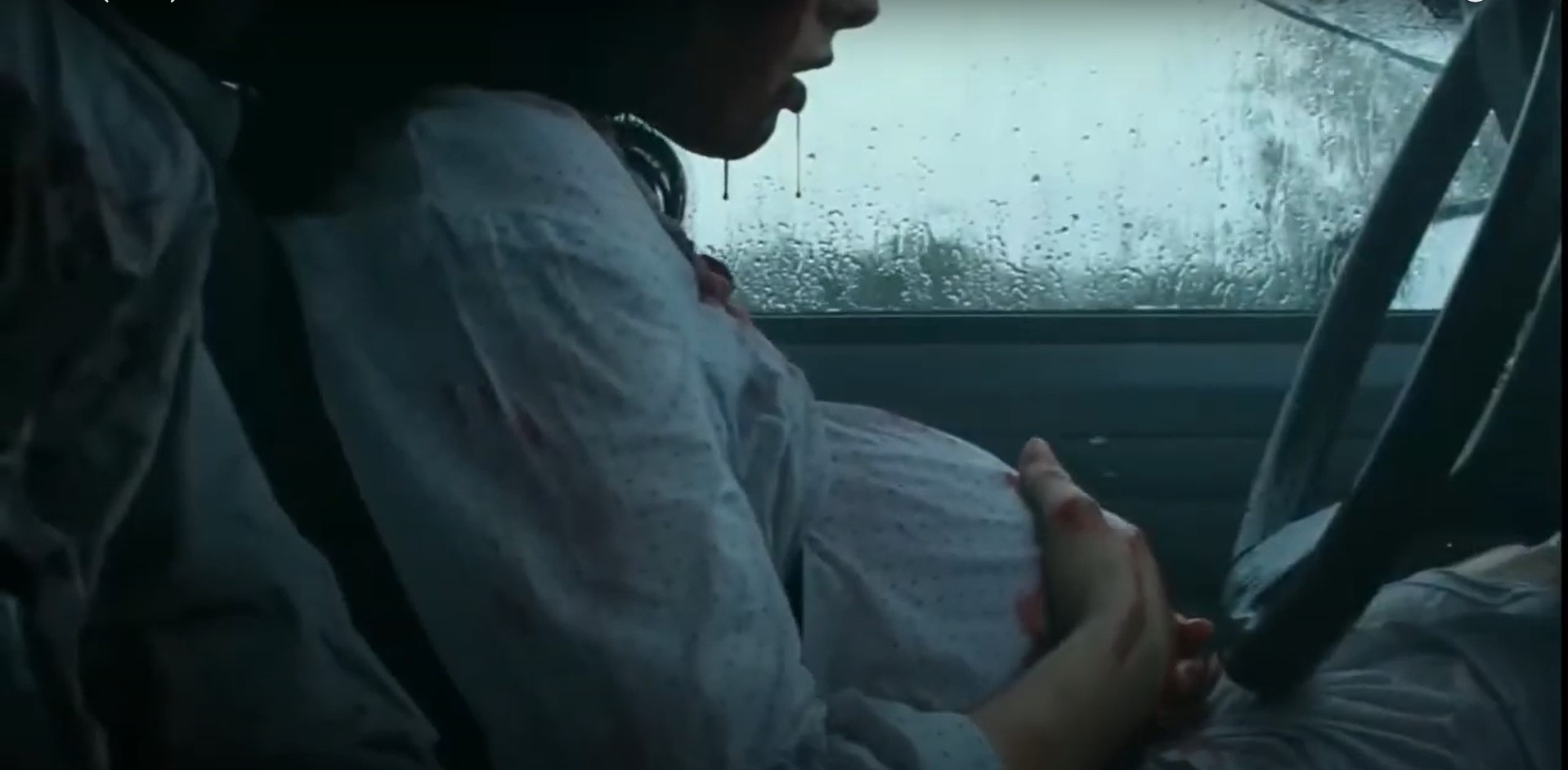
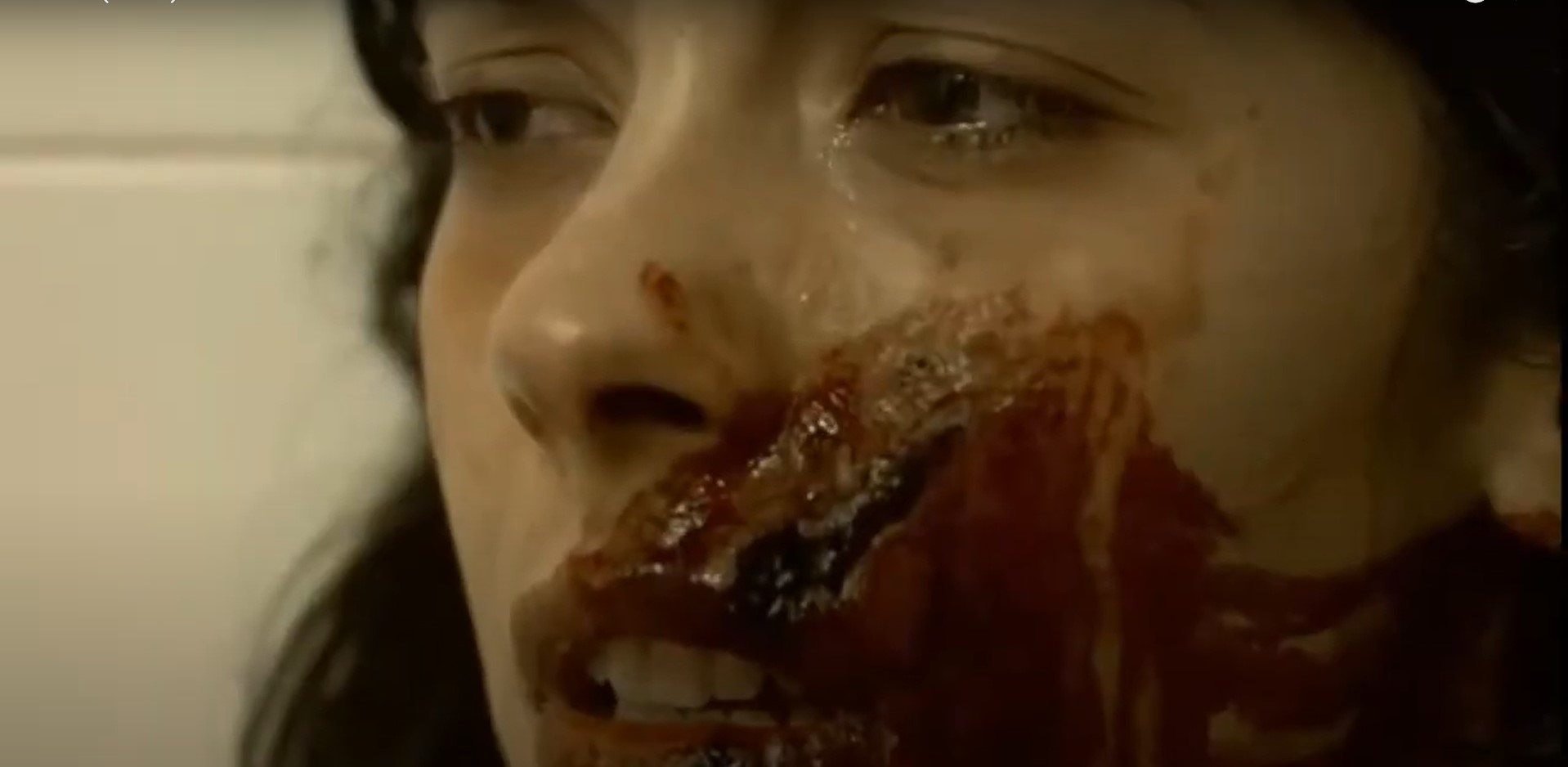
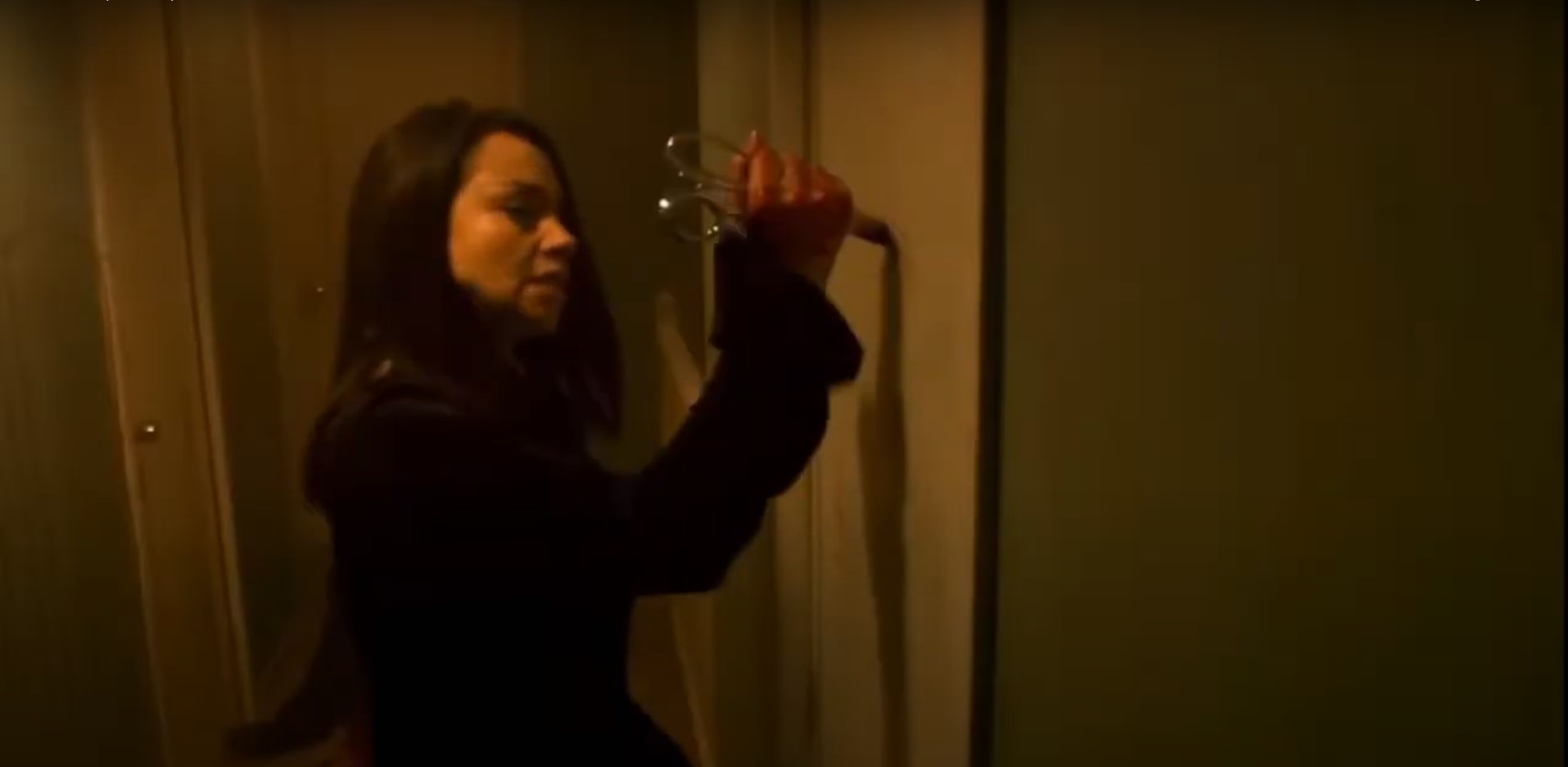
Four months after deadly car crash that claimed the life of her husband, a disheartened and depressed Sarah is 24 hours away from being induced into labor on Christmas day.  Just wanting to be left alone, Sarah is eager to lower her head into her work as a photojournalist of capturing horrifying images that bear a resemblance to her own accident and inviting her editor over later to discuss the work ahead.  As the even lingers into night, an unexpected woman knocks at the door and menacingly tries to break into her house.  As the police arrive to investigate the incident, the woman is nowhere to be found and brush off the incident with little concern, but the woman returns, finds herself inside Sarah’s home, and is determined to cut the baby directly from Sarah’s womb to be her own child.  The tormenting violence becomes a cat-and-mouse game between the two women with an unborn child hanging in the balance. 

Extremely violent and soul biting, “Inside” is one of the more corrosively dehumanizing and destructive films under the French New Extremism, French New Wave Horror, flag.  The 2007 French feature cowritten-and-directed by Alexandre Bustillo and Julien Maury broke the duo into the industry as formidable and fearless filmmakers, reaching global heights having helmed later in their careers a segment of the popular anthology “ABCs of Death 2” and tackling one of America’s more renowned and bred-and-buttered horror franchises with the chainsaw-wielding cannibal in “Leatherface.”  “Inside” comes after the tremendous success of Alexandre Aja’s “Haute Tension,” opening the flood gates to other extreme French horror films in early 2000s with also “Martyrs” and “Frontier(s).”  La Fabrique de Films and BR Films in association with Canal+ server as production companies with later “Frontier(s)’s” Teddy Percherancier, Frederic Ovcaric, Rodolphe Guglielmi, and “Witching and Bitching’s” Franck Ribière and Vérane Frédiani producing the film known as “À l’intérieur” in France.

Not your typical home invasion ultraviolence, Sarah and who we know as labeled only as The Woman are two vipers circling each other, ready to strike when the guards are let down.  Of course, both have distinct personalities and strategies in the measured way of attack and survival that will impress on viewers preconceived notions about them.  As Sarah, Alysson Paradis, younger sister of Johnny Depp’s wife Vanessa Paradis, is bathed in exposed light, literally and figuratively, as the pinpointed principal woman from the start, battered and bloodied in the opening two car accident, to the end, in the final harrowing moments with the relentless Woman but though Paradis performance reeks greatly of depression and perhaps hopelessness with the death of her husband with a baby soon to be brought into this world without a companion by her side, the momentum shifts towards proposed surface villain of the story, The Woman, in a frightening portrayal of stony guile and grim severity by the established, character provocateur French actress Béatrice Dalle (“The Witches’ Sabbath”) in comparison to Paradis relatively filmic beginnings.  Dalle’s role expresses more physically than vocally with motivation coursing through her eyes, facial expressions, and body language that strikes a transfixing chord, turning Dalle’s the Woman into not only an unpredictable killer but an on-screen killer with a lighted purpose without confounding arbitrary slaughter as the yearning for The Woman’s reason never breaks silence until the shocking end.  François-Régis Marchasson, Nathalie Roussel, Ludovic Berthillot, Nicolas Duvauchelle, Aymen Saïdi, Emmanuel Lanzi, and Dominique Frot (“Among the Living”) fill out “Inside’s” cast.

Most will plainly see and interpret “Inside” as a regular home invasion thriller of a pregnant woman defending herself to survive a mad woman’s unborn baby obsession, and maybe that’s how Alexandre Bustillo and Julien Maury mostly intends the narrative to be as an overly graphic portrayal of hate and envy that makes us uncontrollable sinners at heart.  However, there’s something inside me to dig deeper below the face value of terrorizing prenatal torment of a young, expecting mother-to-be in what could be construed as a double-edged explanation.  The Woman doesn’t hold a name as she symbolizes all the worst qualities of a mother, such as anger, deceit, and she even smokes, in Sarah that could be considered a split persona or an archetype of duality.  Sarah is cladded in a bright white nightgown while The Woman is dressed all in black from head-to-toe, contrasting a good versus evil, and both want the same child.  The climax does rebuff the split duality theory to an extent but the way the script is written and how the film is shot very much suggest these two women are cleaved from the same whole with a patriarch-less presence and, to add as an interesting note to further examine and contemplate, all the male characters in the story are slain by the same women while the only other female character is brought down by the other in what is a powerful suggestion of split gender and how gender plays a role in their individual lives.

In what can be said to be the most definitive edition of one of the most brutal films ever produced, Second Sight Films’ Limited-Edition boxset of “Inside” is amply packed with goodies, in application and in a tangible sense. Presented in a widescreen 1.78:1 aspect ratio, the AVC encoded, 1080p high-definition, double-layered BD50 from the UK label holds tremendous value with not only new special features and neat and attractive corporeal contents but also valued by retaining image fidelity with a gritty 35mm print. Natural grain and low-fi celluloid present the seedy grindhouse overlay that’ll take audiences from the comfy, cozy reality into a dark, anomalous atmosphere with warm muted coloring, lambency, and an overall light general haze suffused into the setting. The cinematography has been purposefully constructed with analog building blocks for a rough look for a rough story. Not technically applicable here but “Inside” is set around Christmas, Christmas eve into Christmas day to be exact, but the choice production dressing exhibits little holiday spirit with a far less ostentation presentation and in how the characters dress the season feels more fall like than winter. The lossless French 5.1 DTS-HD master audio offers plenty of spatial awareness during intense pocket skirmishes inside the quaint two-story home, which is the primary setting of the story. The range provides laceration slits and surgical squishes of blades and scissors while gunfire shocks with an innate immediacy. Even with a mostly prominent inconversable back-and-forth, the dialogue that does come up carries through with robust confidence without overbearing the action or feeling out of synch. Speaking of being in synch, English subtitles are available with the French audio track and are error-free and pace well. Special features include a new audio commentary by The Final Girls’ and film critic Anna Bogutskaya, new audio commentary by editor Elena Lazic of the online magazine outlet Animus, a newly produced interview with writer-directors Alexandre Bustillo and Julien Maury First Born as well as newly produced interviews with principal actress Alysson Paradis Labour Pains, producer Franck Ribière A New Extreme, cinematographer Laurent Barès Womb Raider, and stunt coordinator Emmanuel Lanzi Reel Action, with The Birth of a Mother, a Jenn Adams analytical essay focusing on a denied mother’s perspective and the opposite. The limited-edition physical elements of the release add additional magic to the whole package with a rigid, cardboard sleeve case with new artwork by Second Sight retainer artist James Neal. Inside the “Inside” sleeve is a 70-page book with color pictures and thematic essays from film historians and critics Chad Collins, Kat Ellinger, Annie Rose Mahamet, and Hannah Strong. There are also 6-5×7 collector art cards adjacent. The green Blu-ray Amary case houses the same Neal front cover from the rigid sleeve, likely will be the face of the standard release, with the interior disc art having a simple yet effective image of a blade open pair of scissors and psycho-split or -sliced title in red and while. UK certified 18 for strong bloody violence and very strong language, this Second Sight release is B region locked and has a runtime of 83-minutes.

Last Rites: Second Sight invests in “Inside” and its first-time French directors nearly two decades after initial release with a comprehensive package that not only elevates beyond what many labels sought to get out of the gore-laden entropy, quick cash, but this premier release also has depth and range into the film’s applied style and dives into demystifying the breadth of thought preluding random terror.

Order The Limited Edition Copy of “Inside” From Second Sight!