
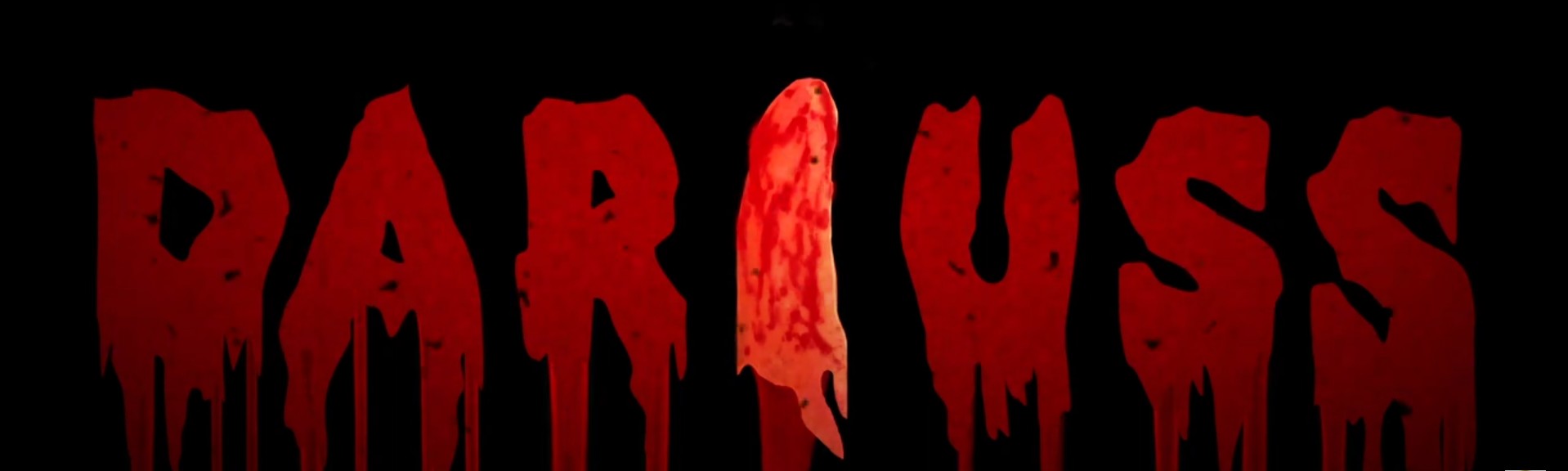
Who is This EVIL Named “Dariuss” reviewed! (SRS Cinema / DVD – Extreme and Unrated)

Find Out Who “Dariuss” Is With this SRS Release!

An experimental vision quest of loss, grief, and death takes refuge in a small English town, inside an old and quaint English house.  A mother grieves for the loss of her child, sobbing uncontrollably and mindlessly wanders with distant stares as the heart pains for her child.  The grandmother, doing what she can, comforts her daughter’s newfangled distraught nature while the husband, grieving in his own isolated way, stays out late at night to drink himself into a stupor.  When madness lurks about their home and intrudes upon their privacy, a vile and heinous loss of life bathes a depraved lunatic in their fluids.  Neither mother, father, nor grandmother is safe from terrific travesty in corporeal form.  A sickness has arrived to cure the inconsolable, eradicating them slowly of the pain in the most painful of ways imaginable, and doing it all with a bloodstained maniacal grin stretching from ear-to-ear.

A hellish loop of defeating pessimism, “Dariuss” fringes the black void areas around reality and escapism that evoke the uncomfortable nature of people and the unpredictable tides that turn for the worst when already at rock bottom.  “Dariuss’s” brackish, brainsick narrative is the brainchild of Guerrilla Metropolitana, an Italian artist crafting his underground and dark cinemaverse of misanthropic mayhem and esoteric eroticism.  The writer-director Metropolitana lives and creates out of London, UK and “Dariuss” is his 2023, debut feature-length film behind an oeuvre of distressing shorts of human imperfection and immortality encroached by a constant line of madness.  Metropolitana not only self-funds and produces his film, where he achieves total control to push back against not only major studio norms but also conventional independent stratagem, but provides the avant-garde cinematography, unorthodox editing, an experimental score and sound design, and even costars the trench coat covered naked body of the antagonistic killer. 

One element to not forget to mention before going through the cast is that “Dariuss” is completely without dialogue.  Metropolitana’s sound design manipulates and repeats many sound clips, such as the plops of water droplets or the high-pitch lip trilling, to fashion an uncomfortable audio sensation sporadically strung throughout that parallel’s the coupled low tumbling score and baby laughter, the later more so when referring to child loss or the abhorrent reincarnation of the child.  Ila Argento holds the majority screen time, especially since the pregnant woman credited as Sarah Isabèl is also Argento as well in some sort of meta crafting or illusion, and she plays the grieving, depressed wife wailing, screaming, and just distantly starring in vast quantities and in a daze of mirrored or painted inversions about the English home.  “Dariuss” is more than just extreme performance art as it embodies interval wretchedness associated with trauma, or in this case more specifically, loss through a reverse world looking glass.  As the wife is tended to by the grandmother, played with apneic conditions and posturing concern is Marie Antoinette de Robespierre, Archibald Kane’s the husband role is scantily around for a father who just lost a child and when the father is in frame, he’s idling in his car drinking, or rather gulping, from a bottle.  Both the grandmother and father roles are a part of Metropolitana’s message of a shattered family structure of insincerity and disconnect. Feeding on that dysfunction is the childlike maniac, played by Metropolitana himself, with rapacious amusement off the back of the household’s suffering.  Almost as if the maniac is a reincarnation of the lost child, perceived by play like antics in a nearly naked and hairless state and audible by the babylike, post-introduced laughter, returning home to exact horrific horseplay on his family involving rape and murder and cannibalism alongside the frolicking and breast milk chugging.  

Let’s preface with an important fact that “Dariuss” will not be everybody’s cup of tea; in fact, Metropolitana’s film is more like bitter black coffee with a pungent, sour smell as a narrative series of images, like a splayed, taped together string of polaroids, giving godawful glimpses of grief and gore.  Sounds and images repeat that beg for madness to emerge out of the nouvelle vague filming style, experimenting with various inverted images, mirrored and angled shots, different types of aged filters and strange lighting, various camera speeds, and oddly framed shots will subject audiences to pricklier sensory sensations than the depicted violence and gore, which is graphically ghastly and extreme with necrophilia and cannibalism.  Story structure also veers into non-linear territory but the gist of the acts is present, if not loose and equivocal for open interpretation and choice cinema characteristics that stray from normal convention, to mold a beginning, middle, and end in only a way Metropolitana can construct by contrasting melancholic grief with stagnating indifference, with a maniacal pleasure of a sandbox of sinew, and, in way, comical by way of the insanity with disturbing imagery mixed with playful mischievousness. 

Just who is Dariuss?  That’s the obstruse person perhaps at the centermost of this ghastly, grisly story that’s now on DVD from SRS Cinema as a part of their Extreme and Uncut label.  The DVD comes MPEG2 encoded, 480p standard definition, 5-gigabyte DVDR that showcases a wide-range of filters, inversions, lighting designs, grading, and you name it, “Dariuss” likely did it of cinematography techniques that stay in the rough patches of eccentricity rather than being comfortable in the fairways.  Picture quality fluctuates and varies depending on the aesthetic chaos methods being deployed, leaving behind not the sharpest looking picture with noticeable pixelation on anything above a 32″ television but not enough of an eyesore to be an imperceptibly deterrent.  Depth has fair spatial qualities but range and saturation is pretty limited to an anemic neutral palette to only when the monochrome or higher contrasts are not in play. The LPCM 2.0 stereo contains no organic matter, meaning that none of the sound is captured within the scenes, as Metropolitana modulates, manipulates, and modifies singular notes and tones for creepy and ear-splicing effect. This also pertains to the soundtrack being completely devoid of dialogue to give the auteur complete authority of how his film she be heard and every bit of that sound design is front loaded and high-powered but to an intended unrefined audio art. English captioning for the deaf and hard of hearing is available. Special features encoded are a behind-the-scenes still gallery and SRS trailers while the standard Amaray comes with an SRS illustration of the film’s original one-sheet, transposed to the disc pressing. There are no inserts included nor slipcover. SRS Cinema’s release is region free and has a runtime of 62, ideal, or even a tad bit too long, for this type of experimentation.

Last Rites: Not to be confused as a nail-biting, popcorn thriller, “Dariuss” will only speak to a select few able to bend the mind to impressionistic, dark eroticism and savagery, both qualities of which Guerrilla Metropolitana has and depicts in droves.

Find Out Who “Dariuss” Is With this SRS Release!

EVIL Manga to EVIL Movie! “Liverleaf” reviewed! (SRS Cinema / DVD)

“LIverleaf” Pushes Through the Bleak to Shine. On DVD Now!

The move from Tokyo to a dwindling rural town hasn’t been easy for middle schooler Haruka.  Most of her classmates have grown up with each other and formed vicious cliques that bully her relentless during and after school.  Mitsuru Abu, a photography enthusiast and Haruka’s classmate is also an outsider but has family ties to the area, is about her only friend and whom she finds attractive.  Upon returning home after spending the day together, Haruka finds her family home engulfed in flames, her mother and father dead, and her little sister severely burned over her entire body.  The loss of her family, her only emotional support, mentally compromises Haruka’s self-control and sends her spiraling into a revenge fueled murdering spree, targeting her bullying classmates who had a hand in the inferno of her family home.  The root of malevolence is not as it appears on the surface, and it will be up to Haruka to kill her way in finding the truth and reveal the secrets.

Adapted from the popular manga series, “Misu Misō,” written by Oshikiri Rensuke, the film version incorporates the indelicate dramas of being a school age teen in while reproducing faithfully the graphic gore, violence, and disturbing nature of character of the series in great detail.  Titled “Liverleaf,” as in the resilient, mountainous found three-lobe leafed flower that resembles the human liver and can withstand harsh winter conditions, is helmed by “Let’s Make the Teacher Have a Miscarriage Club” director Eisuke Naitô and penned by Miako Tadano of “The World of Kanako,” another manga-based film adaptation.  The 2018 film, which can be described as a revenge-drama with particle elements of horror, is shot in one of the snow-covered foothills of Japan’s mountain regions and is produced by Shigeto Arai (“We Are Little Zombies”) under the production banners of the Nikkatsu Corp. and the L’espace Film Co.

Anna Yamada is in the lead role that’s very familiar and culturally significant to Japanese cinema.  A scorn-born femme fatale that’s merciless and personnel, the kind of role that Quentin Tarantino exacted in his tribute to Asian revenge narrative with “Kill Bill,” starring Uma Thurman, hunting down the offending party and dispatching the scum from the Earth in a one-by-one fashion.  The “Suicide Forest Village” actress Yamada headlined “Liverleaf” as mid-to-late teen portraying the manga series’ preteen or early teenage girl Haruka Nozaki.  She isn’t the only nearly adult woman to play a teen in the throes of hormones, peer pressures, and angsty conditions sideswiped by wickedness and a taste for dominance as the whole student body pretends to be a youthful waste in a snowy, mountainside village on the verge of collapse.  Howling Village’s Rinka Ôtani, as Taeko Oguro, stands out with her bright orange hair and a sense of indifferent authority being the supposed head of the gaggle of bullying girls.  “Liverleaf” is Ôtani debut picture and Ôtani would eventually reteam with Yamada on “Suicide Forest Village,” but their first dichotomized performance as protagonist and antagonists brings a palpable tension to the screen.  Throw a boy both girls stoically can’t admit with a lot of expression and that pressure pot grows into an ugly shape of jealousy spurred love triangle.  Mitsuru Aibe is tall, handsome, kind, and a photography buff always looking for the raw and beautiful moment to capture on film.  Played by Hiroya Shimizu, “The World of Kanako” and “Sadako” actor instills that hope for the future and a glance of stability amongst the opposing craziness that has ensued between the rebirthed revenger Nozaki and the horrible highschoolers now fearing for their lives because of their responsible part for the monster they’ve created but does he really provide a safer, greener pasture Nozaki needs to return to once her retribution is complete?  Kenshin Endô, Masato Endô, Reiko Kataoka, Seina Nakata, Arisa Sakura, Aki Moita, Minoir Terada, Kazuki Ôtomo, and ReRena Ôtsuka are cast in one messed up and depressive high school student body that ends in a blizzard of bloodshed.

One thing about “Liverleaf,” if looking at and considering all the components of the feature as a whole, to take away from the adaptation is how Eisuke Naitô facsimiles the plot points of a manga series or, in more general terms, Naitô” has plucked the rudimentary concepts straight from any regular extreme manga series, not just from Oshikiri Rensuke’s Misu Misō.  Yet, “Misu Misō” is very faithfully extracted from the illustrated pages for live action execution down to many of the details with very few changes to the story’s original design. Gore has an extreme graphic nature juxtaposed against the snow, contrasting in homage to those historical revenge genre films set in the same harsh, white blanket, and like all the heroines, or anti-heroines, Haruka Nozaki speaks her soul in her outfit, dressed in a continuously deepening red after each gruesome dispatch of her classmates.  This saturation into crimson extends into this belief that Nozaki is bordering being supernatural, like most condemned women done wrong, who somehow find the superhuman strength, endurance, know-how, and resilience in their own disdain for blood and violence to slay beyond their normal means without batting an eyelash.  “Liverleaf” is not the chippiest of narratives with a coursing core of grim doom and gloom through a quickly dilapidating little town with an austere school, junk pits, and modest structures that inhabit indifferent teachers, brooding teens, and a mental illness that ranges from inherent sociopathy to social sociopathy of peer pressures and bullying. 

SRS Cinema brings manga pen and paper to the big screen with their unrated DVD release of the film adaptation titled “Liverleaf.”  The MPEG2 encoded, upscaled 1080p, DVD9 release is presented in a 1.78:1 aspect ratio.  “Liverleaf” stands out unusual from the other SRS releases, a company that prides itself on standard definition 480 and 720 resolutions and compressing features and their special features onto a packed DVD5 that creates eye artefacts on already low budget, commercial grade, inexperienced film.  Instead, “Liverleaf” has punchier colors and distinction on that segregates the austere from the vibrancy and the extra space helps allow for this decoding to be as smooth as possible on what some may now consider an antiquated format.  Decoding at a higher range of 7-9Mbps, compression imprudence doesn’t show itself here with a clean picture that retians inky voids, charted snow mounds and footprints in a white sheet of snow, and the colors and details on objects that natural enlarge themselves when in contrast, such as Nozaki’s red jacket or the red, orange, and yellow glow of house flames against the night sky.  The Japanese LPCM 2.0 stereo renders a clean mix of dialogue, ambience, and soundtrack.  Dialogue’s clean, crisp, and clearly upfront of a subdued diegetic sound mixed from the boom mic or from post and a Hisashi Arita soundtrack that scores Japanese revenge in non-traditional Japanese notes.  Post mix and action does create some separation that uncouples the visual onomatopoeia of the activity but remains negligible throughout.  The burned-in English subtitles synch well and are error-free.  Extras include a featurette from Manga to Movie that goes into the history of manga and the adaptation concept which most thought the film couldn’t be adapted, Elijah Thomas supplements with his own thoughts and opinions on “Liverleaf” as well as another featurette titled Liverleaf’s Obsession that looks at the character’s dangerous obsessive qualities, the trailer, a Oshikiri Rensuke, biography The Comically Twisted Mind of Oshikiri Rensuke with narrator voiceover going into the writer’s family history and “Misu Misō” genesis, the trailer, and talent files on Anna Yamada, Eisuke Naito, Hiroya Shimizu, Miako Tadano, and Rinka Otani.  These features house behind a static menu, that only has a play option alongside the extras, with a neat art illustration of a murderously ominous Naruka Nozaki.  The cover art hints at the film’s stark contrast aesthetics with a Naruka Nozaki wrapped her red coat and jetblack hair sprawled out on the white snow.  The Amaray does not come with a reversible cover nor any tangible extras inside.  DVD has region A only playback and has a runtime of 114 minutes. 

Last Rites: “Liverleaf” is a surprising, better-than-no budget teen revenge thriller that deals with obsession, depression, and a consternation that Haruka’s tragic journey through the pits of a lowly high school hierarchy will only get worse before it gets better.

“LIverleaf” Pushes Through the Bleak to Shine. On DVD Now!

This EVIL Thanksgiving Bird Has Been Overcooked. “Amityville Turkey Day” reviewed! (SRS Cinema / DVD)

“Amityville Turkey Day” – That’s No Cranberry Sauce! Check Out the DVD Here!

Rocco, a sleazy indie film director, is given one last project to director with the stipulation of not to squander the funds and to make a competent hit movie without completely making principal photography a nightmare for the cast and crew.  Having landed a large estate to shoot his film, the house comes with a manservant named Bram to take care of their needs and see to the estate grounds.  When a man-eating Turkey from Hell, embodied by the evil soul of once infamous doctor, comes home for Thanksgiving dinner, Bram aims to curate a fine feast for the abrasive, wicked bird from the indie film production.  As cast and crew begin to dwindle down and disappear, the show-running producer takes charge to motivate and take care of the slipping through the cracks mess of, yet again, another Rocco botched production.  Yet, the turkey still hungers and when all the excess meat is consumed, he will then find a human mate to reincarnate himself for human form. 

After promising myself, swearing up and down, that I would never, ever watch and review another Amityville titled infused film again, “Amityville Turkey Day” had sucked me right back in, like a moth to the flame into another mindless and pointless, could I even call it this, money-grabbing exploitation of the Amityville title letdown of a holiday-comedy horror film.  The 2024, microbudget Thanksgiving themed sequel to “Amityville Thanksgiving” brings back the writing-and-directing duo of Will Collazo Jr. (“Amityville Shark House,” “Amityville Apocalypse”) and Julie Anne Prescott (indie film scream-queen of “The Amityville Harvest” and “Amityville Thanksgiving”) to add a little more sanguine stuffing in their continuation of a terrorizing wild Turkey.  Alternatively known as “Amityville Thanksgiving 2,” the feature is an indiegogo crowdfunded campaign that raised the $10,000 goal and became a Will Collazo Jr.’s Cult Cinema production.

The sequel doesn’t return most of the cast from the film.  Most sequels don’t, right?  Instead, a whole new batch of rough puff principals are basted over the story to try and moisten the flavor of a rather rough-and-ready follow-up.  Amongst the medley filled in with B-movie talent, there doesn’t seem to be a one standout lead role to take charge in what is more of convergence of counterproductive parts that overlap and overstep each other’s storyline.  Characters also disappear and reappear without context to about where they were and where they go, for example the sleazy director Rocco (Michael Ruggiere) vanishes for most of the story’s midriff and then just reappears in the third act without a sense of where he’s been.  Erica Dyer (“The Town Without Halloween,” “Attack of the Corn Zombies”) plays one of the few characters with an actual intact arc as the pissed off producer Ivy who storms in and takes charge of Rocco’s quickly deteriorating production, proving to be a competent leader to quickly organize the film crew into action, but as cast and crew begin to drop like flies and vanishing from the estate set within the Thanksgiving week, Ivy’s honed in focus doesn’t register the killer Turkey, voiced by Steven Kiseleski (“Amityville Karen,” “Amityville Bigfoot”), and it’s righthand caretaker Bram (Dino Castelli, “Screamwalkers”) slowly filleting the filmmakers for feasting.  A large portion of the character pie is throwaway fodder for the Turkey with only a couple of others to stand out with pointed out substance, that also point back to “Amityville Thanksgiving, with Kevin (Tim Hatch, “Amityville in Space, and the other actor to return from “Amityville Thanksgiving) on a mission to find out what happened to his sister from “Amityville Thanksgiving,” and his planted actress friend Jessica (Jen Elyse Feldy, “The Elder Hunters,” “Camp Blood 666 Part 2”), but their roles do get lost in the fray of the frenzied packed, plot hole-riddled storyline that crams in too much too hastily inside a jerry-built and unnecessary tale.  David Perry, Clint Beaver, Amanda Flowers, Shannon Hall, Jeff Webb, Thomas J. O’Brien, Ralph Rey, James Janso, Stephen Bloodworth, and the late Mark C. Fullhardt, to which this film is dedicated to, fill out as the at will Turkey fodder. And I hope all my listings of “Amityville” named films has brought awareness to this exploitative issue!

“Amityville Turkey Day” is no “Thankskilling.”  Jordan Downey has mastered the smack-talking, rude-with-tude, killer Turkey in style, substance, and outrageous kills.  Will Collazo Jr.’s film feels more like a cheap knockoff to the likes of the Italian unauthorized remakes, sequels, and spinoffs of American films of the 1980s, attaching the Amityville name to draw attention and sponge off the legitimate franchise that has now become a disgusting and disheartening running joke and parody of unoriginality. “Amityville Turkey Day” mirrors every ounce of that last sentiment with a shoddy, low rent feature that not only drags the Amityville title deeper into the overkill mud but also hurts the exposure of Jordan Downey’s “Thankskilling” to those viewers who do get their unsuspecting hands onto Collazo’s film first and leaves a residual bad taste toward more competent Turkey trot terrorizers.  That bitterness is contributed by the lack of story structure and coherency, a lost sense of unique personality and entertainment, and a brutal monotone flow that stagnates upon just one setting over the course of a few days, which is a major gap considering the film crew disappearing here and there during that time and no one happens to care or even hardly notice.  Comedy elements fall flat, reduced to fart and sexual gags and missing-the-mark cheap insults surrounded by dull kills, especially for a Turkey that goes for the juggler.  Very few moments of levity and intrigue can be pulled from “Amityville Turkey Day” with the puppeteered evil Turkey lobbing an occasional humorous one liner – “Look at all that blood!  She’s a squirter!” – and the manifested closet gimp is too strange of a guilty-allure to ignore, and these few and far in between bright spots add a layer of color to what is dull overall. 

The crowdfunded clucker had arrived just in time for this year’s Thanksgiving courtesy of indie film friendly distributor SRS Cinema.  “Amityville Turkey Day” is housed on an MPEG2 encoded, 480p resolution, 5 gigabyte DVD-R.  According to the crowdfunding page, Collazo offered an all-around bigger and better experience from the bareboned, nearly no-budget, precursor, yet the sequel didn’t live up to expectations and appeared to be more of the same slapdash as the first and this translates to a writeable DVD disc with a fuzzy picture, smoothed edges, and plenty of posterization and banding that digs the grave deeper for this overdone bird.  The ungraded picture produces unnatural lighting from a series of gelled flood lights, more so with deep red, aimed upward to evoke thicker upper shadow positions.  What the result constitutes with the unhelpful lower resolution camera is an overly hot and overly diffused image in what would be Turkey and Bram basement scheming scenes that renders any leftover details washed away from the effect.  The English LPCM 2.0 mono track is a flat fixture via the onboard microphone on the digital camera that creates an anemic dialogue presence with subtle distortion.  Range consists of post-production sound effects and the close quartered rooms of the “estate” has depth pretty much nonexistent.  I will say dialogue is prominent and clear though higher decibels overtake and clip the microphone’s volume intake.  English subtitles are optionally available. The release’s special features include a director’s commentary, a making-of behind-the-scenes, the original trailer, and other SRS Cinema prevuews. Aside from an enticing illustrated cover art, the DVD has no other supplemental cover art, inserts, and etc. “Amityville Turkey Day” has a runtime of 93 minutes, is region free, and comes not rated.

Last Rites: “Amityville Turkey Day” is difficult to gobble up. In fact, “Amityville Turkey Day” is much like having to go to your great Aunt’s house for a third Thanksgiving dinner of the day, the one that is the family’s black sheep, wears a muumuu, and her house smells like cheap cigarettes and cat dandruff, it’s a hard no thank you.

“Amityville Turkey Day” – That’s No Cranberry Sauce! Check Out the DVD Here!

Dump Buckets and Buckets of Water Back into this Dry EVIL Well. “Ring Shark” reviewed! (SRS Cinema / DVD)

“Ring Shark” Now Curses the DVD Market! Own It Here!

For the subscribers of her Youtube show, vlogging social media influence Kanamasa and her co-host search for a stone well rumored to be in a haunted forest surrounded by unfriendly villagers who aggressively ward off unwelcomed visitors.  Upon discovering the well, a shark-like creature emerges suddenly and bites Kanamasa, scaring them off.  A few days later, another pair of Youtube investigators of the Psychic Investigations Big Summer learn of Khana’s disappearance after her last video surfaces of what looks to be a shark fin and then a ghastly body surfaces from within her bathtub, attacking her bikini-garbed body.  Seeking the truth and eager to find Khana, the investigators conduct interviews with “shark” experts and attempt to visit the same well only to be shooed off by the villagers until, finally, they’re able to reach the same spot and experience the same sharp-teethed horror lurking within it.  Unknowingly, that same supernatural terror of the well had follow them home. 

Sharksploitation has admittedly gotten out of hand.  The beloved horror subgenre that began with Steven Spielberg and Bruce the mechanical monstrous shark who terrorized the beaches of Amity Island have since drowned in its own watery subcategory of the ocean’s maneater predators with microbudget ineptitude that takes the shark from its natural ecosystem and rehomes it in a miscellany of nonsense locations, such as on land, in the weather, and even circling in toilets.  Well, today is the day we’ve come across a movie been assimilated into that same fatuous collective with “Ring Shark,” aka “Well Shark,” aka “Ido Shark.”  The Japanese, found-footage comedy-horror is the first of a trio of incongruous shark films released between 2023 and 2024 by Taichiro Natsume with “Love Shark” and “Last Shark” to follow, connected by the Big Summer team of Psychic Investigators.  Natsume also wrote and produced the feature.

Unfamiliar with the Psychic Investigator Big Summer series, which there’s uncertainty if Big Summer is a Japanese comedic troupe, equivalent to the Broken Lizard of America, what “Ring Shark, or “Ido Shark” begins is a series of various haunted case probes by the Big Summer team, which in this film in particular include actors using modifications of or using their actual names as characters in the story, such as director Taichiro Natsume being the single male lead in the group under character name Daiichiro Natsume.  Daiichiro Natsume can be a bumbling, yet persistent fool when it comes to the mysterious case of Kana-san with his steady motif of exclaiming his love for big boobs and determination to resolve the mystery.  He’s joined by colleagues on-and-off screen in Momoka Asahi and Chihiro Nishikawa, the latter not to be confused with Chihiro Nishikawa of JVA.  While Nishikawa and Natsume continue the running gag conversating about big breasts, Momoka Asahi enters the picture much later as the third investigating team member when Natsume goes down with a well shark bite infection that haunts him from the inside out and puts him in the hospital.  From there, Nishikawa and Momoka take the reigns on investigation by not only tending to Natsume’s dwindling health but also interviewing internet paranormal sleuths Hiroshima Freddy, a Japanese horror influence in real life, as well as Black Story Kuro, who I imagine is another influencer but couldn’t confirm it.  Typically, the Japanese language has a ton of fluid inflections and tones that dictates situations and mood, but “Ring Shark” avoids much of the vocal ups-and-downs with a consistently level tone of flat and dry humor peppered with fear, arbitrary bickering, and a pinch of kawaii to sustain a semi-serious documentary style investigation.  Maya Mineo, Issei Kunisawa, Yacch Chara, Daiki Mizuno, Honey Trap, Umeki, and the wrestler known as The Shark fills out the cast.

“Ring Shark” is “Blair Witch Project” meets “The Ring.”  The latter having the most prominent appearance as the at home media, that was once titled, or probably is likely titled in Japan, as “Ido Shark,” is marketed for U.S. consumption because every moviegoer is either well versed or knows of Hideo Nakata’s “The Ring” series and its heebie-jeebies Samara spirit.  Instead of a cursed tape that summons Samara out of the depths of her murdered resting spot, a well, to kill anyone after a week of viewing said tape, “Ring Shark” only real connective tissue to “The Ring” is that there is a well in the story and a murdered girl’s body was dumped inside.  That’s it.  From there, the structure is more to the tune of “Blair Witch Project” with a pseudo-found footage of one social media’s disappearance igniting the Psychic Investigator Big Summer team to check it out after the tape is brought to their attention form Kanasama’s co-host.  The docu-style incorporates dry wit of interviewing shark experts, creature academics, urban legend connoisseurs, and thorough analysts and researchers, as well as themselves as angry villagers and a supernatural hand puppet shark head subverts their stratospheric sublayer with soul-chumming results.  Yet, none of everything just said really clicks in a flimsy and slapdashedly put together microbudget story derived for effect for true and absurd exploitation of sharks gone wild. 

“Ring Shark” swims right into SRS Cinema’s well-house with a brand-new DVD from the microbudget cult film distributor.  Upscaled to 1080p, the MPEG2 encoded, single layer DVD5 presents the Big Summer production ion a widescreen 1.85:1 aspect ratio.  Though upscaled to 1080p, the cell phone footage renders stretched limitations under the light of low-budget constraints.  Night vision and poor lighting coupled with closeups-to-extreme closeups, and shaky camera work dematerializes story-important images.  Natural lit and stationary camera work provide cleaner visuals in what is mostly a deluge of exposition and regular camera angles without atmospheric makeup.  The Japanese language Dolby Digital 2.0 stereo provides lean composition with ample inherent surrounding ambience, picking up the natural wildlife chirping in the background, the vocal amplification of someone talking through a microphone, the hustle and bustle of a restaurant, etc. Dialogue isn’t impeded by the commercial phone camera recording that creates a rather good reproduction and diffusion of sound amongst the space.  Added audio effects, such as the shark’s growling or snarling, does feel unnaturally alienated from the rest of the audio but works to the film’s advantage despite the obvious hand puppetry.  English subtitles are burned in but do synch well and appear error free. There’s also what looks to be double English subtitles along with Japanese title cards or subtitles that are a part of the Youtube investigation and often coincide with the main English subtitles in a distracting, screen space absorbing real estate. The Japanese electro-rap graced static menu, which samples Lil Jon’s Yeeeah, contains no bonus feature selection; instead, the bonus content is right on the main menu with short film “Shark of the Dead” (8.26 minutes) and the “Ring Shark” trailer.  I love bad movie cover art and SRS Cinema’s “Ring Shark” is no exception with smokey-eyed, electrically charged, and monstrously toothy shark breaching from a little stone well underneath “The Ring”-font film title.  The disc is pressed with the same image and there are no inserts included.  The barely hour-long film, clocking in at 63-minutes, comes not rated and has a region free playback.

Last Rites: “Ring Shark” is a monumental prosaic mockumentary aimed to swell Sharksploitation into further ill-repute and disrepair with an unfunny and uninteresting undertaking of underwhelming pastiche.

“Ring Shark” Now Curses the DVD Market! Own It Here!

Awesome Boy and Bludgeon Man Fight EVIL at “Slaughter Beach” reviewed! (SRS Cinema / DVD)

July 4th Is Here! Time to hit “Slaughter Beach” on DVD!

Ralph and Barry are best buds.  They’re best buds freeloading off Barry’s father’s shore house during the height of Slaughter Beach’s Summer season.  When Barry’s father becomes annoyed by his adult son and friend’s loafing, his ultimatum to them is to get a job or get out, but the touristy destination of Slaughter Beach has nearly become all but a ghost town as businesses and tourism shut down or come to a slow crawl after a string of mysterious disappearances along the beaches and boardwalk.  Barry’s idea to become vigilante crime fighters, under the hero names of Awesome Boy and Bludgeon Man of the duo’s moniker The FenderBenders and hoping to resurrect the once booming vacationing hotspot back to its full former glory, reels in a boatload of trouble when a salty, horseshoe crab fisherman behind the disappearances casts his deadly fishhook line toward the wannabe crime fighters to make chum out of them and anyone else who crosses his path. 

“Slaughter Beach” is the buddy horror-comedy and slasher set on the American Eastern shorelines of not the actual Slaughter Beach of Sussex County Delaware but actually shot 25 miles north in the more populated Rehoboth beach.  The 2022 released, Daniel C. Davis written-and-director feature is “The Scarecrow’s Curse” and “X Knight Escape from Warp Hell” actor’s third film in a decade span.  The Delaware-born, Wilmington University graduate continues his grow his independent filmmaking career in his home state and the surrounding metropolitan, tri-state area.  His latest directorial lands him on the Eastern beaches of Delaware with filming done mostly at night during the tourism offseason, allowing more wiggle room for shooting, less hassle from onlookers, and a better chance at snagging shooting locations that would be, perhaps, heavily trafficked during peak months.  “Slaughter Beach” runs under Davis and Brett Taylor’s production company, Clockout Films, and is produced by the two filmmakers alongside Jim Cannatelli (“Yester-Years”).

“Slaughter Beach” is amazingly well dialogued in the comedy context for a low-budget, independent feature and without the principal leads, the hapless and hero-lite buddies, of Jon McKoy, who I still recall his similar performance in “Easter Sunday,” and Ethan Han, in his debut feature film role, “Slaughter Beach” would have flop hard like a fish out of water, gasping for a watery breath.  Between McKoy and Han, Ralph and Barry’s antics are contrived out of dunce energy with good intentions that slow churns infectious wit to character likeability.  Their crude innocence faces impossible trials when against a foe that tests their trying not-very-hard heroic vigilantism on the shore’s boardwalk.  Jim Cannatelli, yes, producer Jim Cannatelli, dons the Sou’Wester hat and chest waders for the crazed Fish Man Sam’s crusade on hooking Lilith, the mythical and monstrous horseshoe crab, with his special human bait from wielding a weaponized line and lure and fishhook to gut and chum his victims.  In an appearance very similar to The Fisherman in “I Know What You Did Last Summer,” Cannatelli’s twist hits the old seadog stereotype complete with nautical vernacular and is a fine comic book antagonist to the campy, counterpart sideshow that is Ralph and Barry.  However, the standoff between good versus evil is held to the very end with Fish Man Sam angling boardwalk and beach patrons to their deaths, that’s closer to shooting fish in a barrel with support bit parts performances from mostly Davis casting regulars, such as Amy Lynn Patton, Michelle Qenzel, Keith Crosby, Shawn Shillingford, Heather Street, Kiyneeanay Dykes, and Ethan Han’s actual father, Oscar Aguilar, playing Barry’s dad.

There’s no shortage of zaniness, slapstick, or waggishness in Davis’s “Slaughter Beach.”  Same goes with the horror façade that’s well framed around the comedic core.  “Slaughter Beach’s” terror won’t be a trepidant of tension or knock off your tacklebox with fright, but Davis shows obvious signs of paying attention to the what-works in horror motifs with the crafting of looming angles, danger-building and coherent editing and score, and a villain that might be a caricaturable and an exaggeration vocally but appears damn right creepy in the background as the obscured and shadowing lurking fisherman.  A gory practical effects décor by Trauma Queen FX special makeup and effects artist, Isabelle Isel, elevates the feature’s victim pool to an anticipation level amongst the audience to see what Fish Man Sam has in store next for his ice chest full of horrors.  While visually alarming and usually frightening in nature, the villainous veneer and gore-soaked effects are not excluded from the comedy tone with the fishing themed gallows humor that’s about as ridiculously funny as it sounds.  What isn’t as fleshed out as hoped was Fish Man Sam’s obsessive and radical pursuit of bagging the giant horseshoe crab he’s bestowed as Lilith.  Its an important motivation factor that drives the deranged angler left to swim upstream and doesn’t elaborate and relay Ralph and Barry’s foe sympathetically as a man on a mission.

The Clockout Films production has been picked up by the longstanding zero-budget genre label, SRS Cinema, for the at home DVD release.  “Slaughter Beach” is MPEG-2 encoded onto a single-layer DVD5 with a 720p resolution and is ungraded.  With nearly zip on the hue saturation and stick with a lower resolution, “Slaughter Beach” is able to compress adequately, suppressing any major artefact issues to lesser posterization, and keeping a soft, yet relatively clean image that doesn’t focus on stylistic highlights but rather draws all the attention onto the buddy heroes and the gore.  Lighting is retained by the array of brightly lit Boardwalk bulbs, some specialized muted-colored uplighting for a slightly retro feel, and natural lighting, reducing much of the beachy backdrop to a black void that centers the characters without much depth to delineate within the widescreen 1.85:1 aspect ratio.  The English LPCM 2.0 stereo track musters enough strength from the blemish-free boom recording.  No crackling, hissing, or any other kind of distortions on the dialogue or LFE layers, suggesting that care was put into the audio, and it rightfully shows a coherent and competent mix with alternative-punk-ska tracks from The Jasons, Station, and Skatune Network.  Dialogue clear, clean, and prominent.  There are no optional subtitles available.  Special features include a feature length commentary with a roundtable, ride along discussions with director Daniel C. Davis, stars Ethan Han and Jon McKoy, producer and principal Jim Cannatelli, and director of photography Brett Taylor.  Also included is a raw footage gag reel and SRS trailers, one of which is for “Slaughter Beach.”  The extremely detailed and aesthetically illustrated cover art gives the physical DVD a lucrative eyeful but the release do not credit the artist, nor do I see a signature hidden inside the tonal shades. The region free SRS DVD has a runtime of 80 minutes and is not rated.

Last Rites: “Slaughter Beach” is more than a head in the sand thriller; the Daniel C. Davis horror-comedy paces to deliver timely laughs as well as casting flesh-ripping, barbed lures that easily hooks us for more giggles and gore.

July 4th Is Here! Time to hit “Slaughter Beach” on DVD!