A Parents’ Love Never Dies. It Just Becomes EVIL Against Threats! “The Sweet House of Horrors” reviewed! (Cauldron Films / Blu-ray)

“The Sweet House of Horrors” on Blu-ray by Cauldron Films!

A house robbery gone wrong results in the brutal murder of twin siblings’, Marco and Sarah’s, parents Roberto and Mary Valdi when they stumble upon the masked thief, catching him in the act in their beautiful villa home.  The twins bawling at the funeral gives way to impish innocence as the children cope in jokes amongst each other and to their now legal guardians, Uncle Carlo and Aunt Marcia.  Looking to sell the now sullied house, Carlo and Marcia invite a pompous realtor to examine and price the home only to have strange occurrences begin a series of unexplained phenomena the children are certain to be their parent’s lingering and love presence to keep the house within the family.  The parental entities also seek revenge on their attacker whose has been close to the family for years.  As the spirits continue their course of playful and perturbed poltergeist toward their children and unwanted visitors, an unaware Carlo and Marcia hire an exorcist to rid the house of what they suspect to be an evil spirit. 

The third made-for-TV film in the Massimo Manasse and Marco Grillo Spina doomed The Houses of Doom series, in which none of the films aired due to their too gruesome violence, “The Sweet House of Horrors” is the second Lucio Fulci production under the defunct 1989 series, coinciding with “The House of Clocks.”  Just like that film, Fulci also invented the concept of murdered parents being guardian angels over their children while thwarting murderers, realtors, and exorcists from taking what they hold most precious, their children and their home.  The shooting script comes from “Devil Fish” and “Phantom of Death” duo Vincenzo Mannino and Gigliola Battaglini.  The fantasy-ghost house horror is another production of Reteitalia and Dania Film and filmed in peaceful Italian municipal of Ponte Pattoli.

“The Sweet House of Horrors” has an alternating appointed cast of main characters that turns focus between the children, Marco (Giuliano Gensini, “The Fishmen and Their Queen”) and Sarah (Ilary Blasi), the inheriting guardians of Carlo (Jean-Christophe Brétignière, “Rats:  Night of Terror”) and Marcia (Cinzia Monreale, “The Beyond”), and the dead parents turned ambivalent malicious poltergeists with Mary (Lubka Lenzi, “Massacre”) and Roberto (Pascal Persiano “Demons 2”) Valdi.  Giuliano Gensini and Ilary Blasi are well matched bratty children with mischievous dispositions who let their parents setoff hurricane force winds in the house and unleash topsy-turvy fog to combat the selling of the house and the unwanted removal of the children by the new guardians.   The children are also the only ones who know what’s actually going on while Carlo and Marcia chalk it up to either Marcia overactive imagination or, eventually, boiling the explanation down to malevolent ghosts unaware that it’s actually the deceased Mary and Roberto being impish apparitions.  This allows to comical characters to enter the fold in an overweight and pompous realtor lovingly nicknamed Sausage (Franco Diogene, “A Policewoman on a Porno Squad”) and gravely natured exorcist (Vernon Dobtcheff, “Horsehead”) to give levity and breeziness for a television market to a point where it feels almost a like a kids movie, but then we get to Guido (Lino Salemme, “Demons”) whose a guilt-ridden soul is splashed with past transgressions and the blood of his victims that haunt him from beyond the grave, literally, and in these flashes of Lucio Fulci’s ferocity for a visceral showing of range that definitely turns what could very well be a family friendly film into a smaller scale fright and violent feature.  Dante Fioretti (“The Wild Team”) rounds out the cast as the graveside servicing Father O’Toole who is the butt of the joke from not only the children but also the audience as a priest overbooked in his ceremonial duties. 

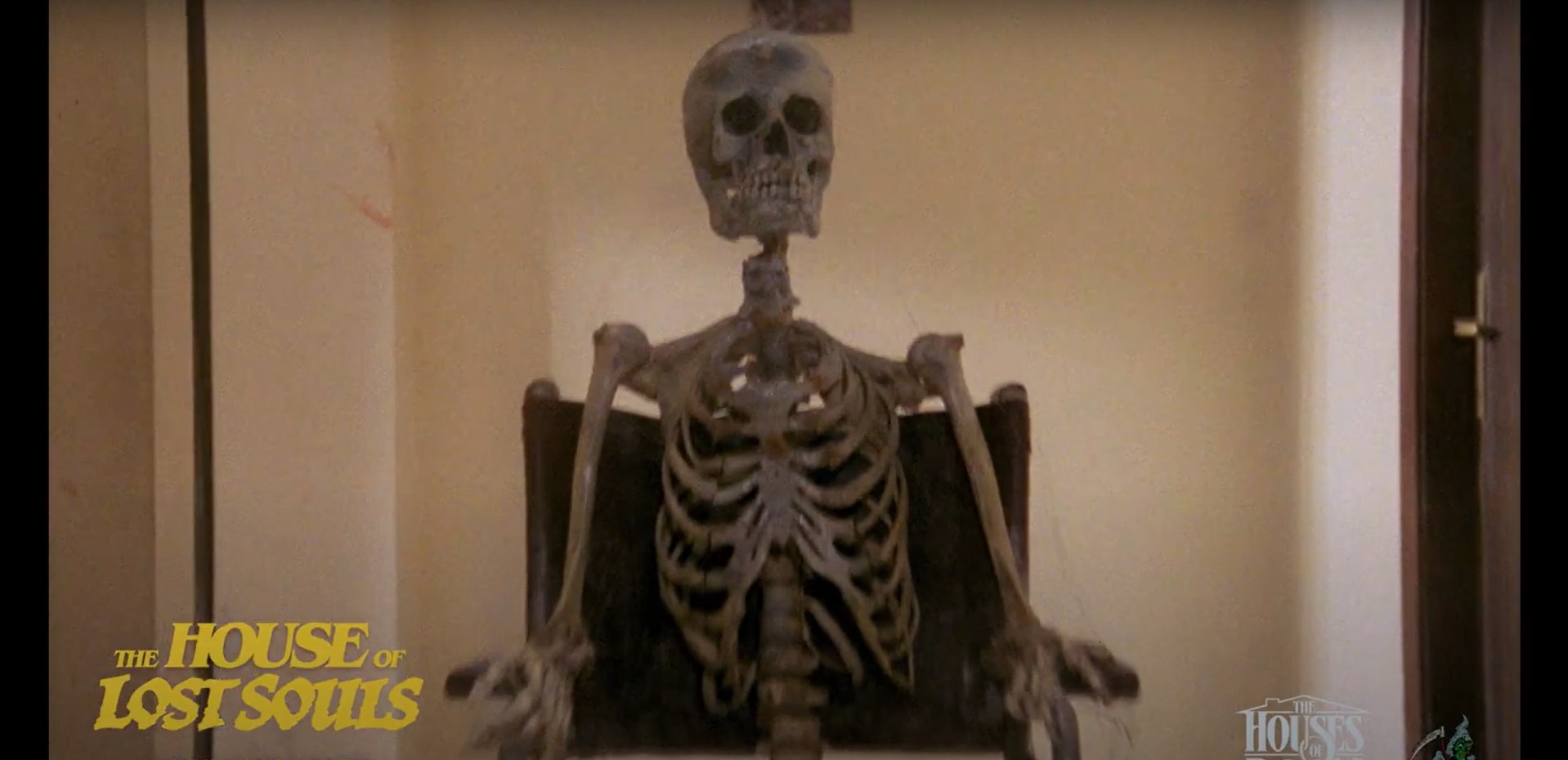
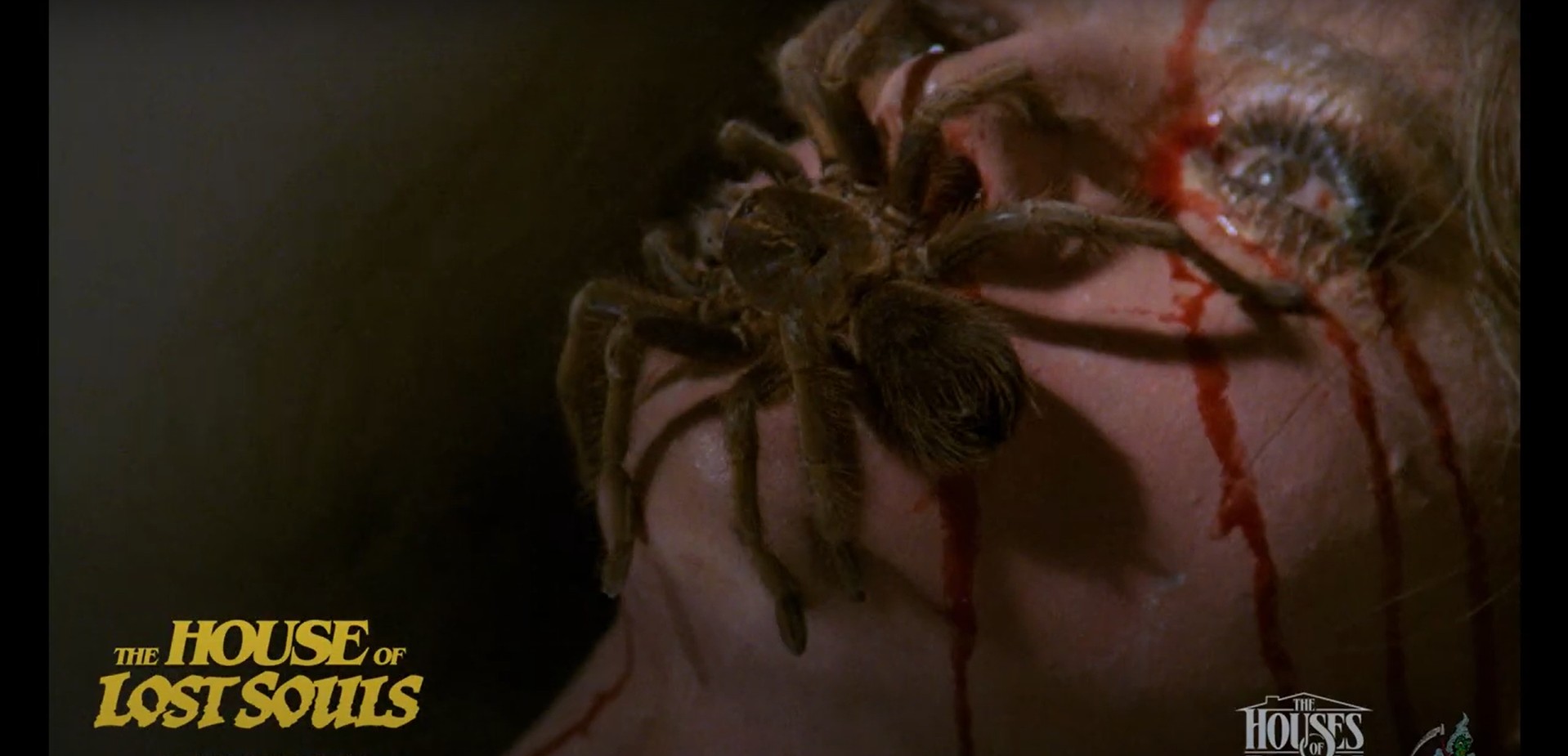
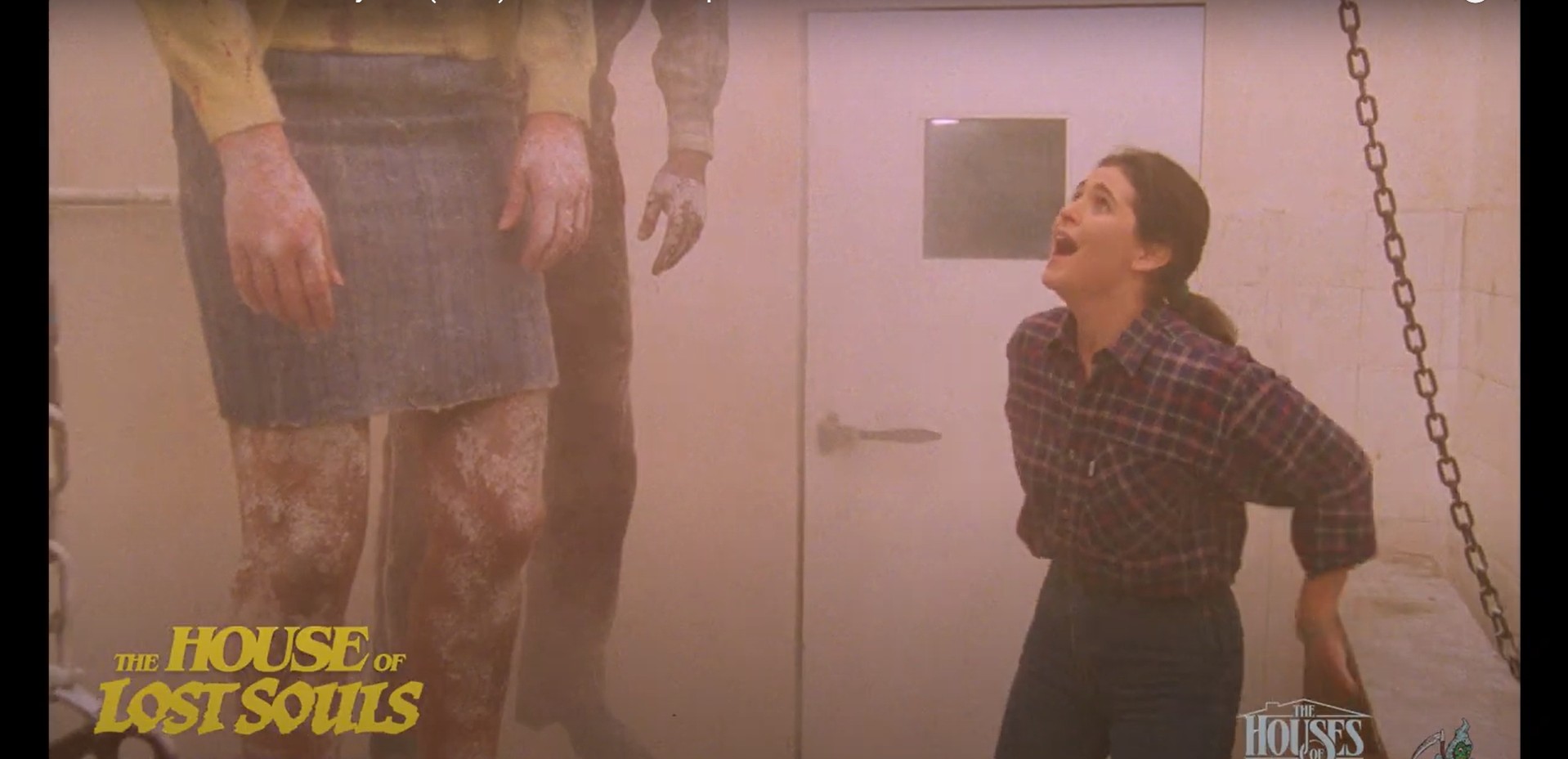
Finally – we’ve always suspected in The Houses of Doom installments a good old fashion haunting would make an inevitable appearance, but this particular Godfather of Gore entry is no ordinary ghost house narrative.  As read above, “The Sweet House of Horrors” has plenty of light-hearted comedy and fantastical elements to make a great televised production with dancing and floating candle flames, slapstick punching bags with the Sausage character, and two children who laugh and belittle at those in the path of the spirit-induced misfortune, spirits who are just loving parents taken too soon from their children and want to protect them at all cost.  As these scenes playout, feeling breezy, light, and full of supernatural fantasy, one hardcore horror fan could potentially forget their tuned into a Lucio Fulci film if it wasn’t for the opening double murder of the parents, the subsequent revenge killing of the murderer, and the shocking last frames of a hand melting away to the bone.  Granulized bits of body injury and stark severity and gruesomeness slingshot audiences out of the kiddie dreamland into the grisly nightmare of Fulci’s eye for details.  Hair and blood matted together, run over and eviscerated by a large truck, and, of course, “The Sweet House of Horrors” wouldn’t be a Fulci film without a gruesome dislodged eyeball from the socket.  There’s nothing quite like this House of Doom picture, or even in the generalization of haunted house tropes, as “The Sweet House of Horrors” splinters a fractured tale of holding onto dear life a happy nuclear family with the external forces that try to violently rip them apart.  

Cauldron Films proudly presents an uncut and restored Blu-ray release, scanned in 2K from the film negative and encoded onto AVC BD50 with 1080p, high-definition resolution.  The 1989 Fulci film now looks remarkably crisp in its European widescreen 1.66:1 aspect ratio.  A counterargument against the defined image could be the color timing that does have a bit of a wash layer overtop, reducing hues down to a pause in the image pop.  The reserved grading primarily hits the internal scenes, perhaps a result of the transparent animation layer for dancing candle flames, the ethereally delineated parents, or the blue orb/blob that circles the kids, but there are live shot instances that too are stifled to radiate better.  Textures are definitely not washed away as we receive an in-depth look at the wardrobe design that distinctly set characters apart, such as Sausage’s prim-and-proper suit, Guido’s paint-speckled denim overalls, and the Exorcist’s dark cloak getup, courtesy competent compression.  The ADR English and Italian 2.0 mono tracks offer a more than adequate A-to-Z dialogue with instances of crackling, more so the beginning.  The hit tracks and other targeted ambient sounds land with depth and range incorporated into the action with the character.  As with a mono track, distinction can be lost but with many Cauldron releases, there’s a pseudo-tier balancing of separating sounds through the 2.0 channels.  English subtitles are available on both releases and are well transcribed with excellent pacing.  Special features includes new Cauldron Films’ produced content, such as interviews with actress Cinzia Monreale Sweet Muse of Horrors in Italian with Englis subtitles, production designer Massimo Antonello Fulci House of Horrors in Italian with English subtitles, editor Alberto Moriani Editing for the Masters in Italian with English subtitles, and an audio commentary track with film historian regulars Eugenio Ercolani and Troy Howarth.  The release also includes archival interviews previously seen on Mediablasters DVD release with interviews from actors Cinzia Monreale, Jean-Christophe Brétigniere, Pascal Persiano, Lino Salemme, and screenplay writer Gigliola Battaglini, all of which are either in Italian or English with English subtitles on the Italian interviews.  Matthew Therrien and Eric Lee provide, yet again, another compositional illustration of the more harrowing sides of “The Sweet House of Horrors” and its logo design inside a clear Scanova Blu-ray case.  The reverse cover also pulls a fiery still from the story.  There are no additional supplements inside or out with a cropped pressed image of the front cover on the disc that has a runtime 83-minutes and has region free playback.

Last Rites: “The Sweet House of Horrors” is a paradoxical made-for-TV special that never saw the light of public broadcast day but lands safely in the distributive hands of Cauldron Films with a new Blu-ray, Hi-Def release too good to pass up.

“The Sweet House of Horrors” on Blu-ray by Cauldron Films!

Scarf Michael and the Fiddler’s Power that Draws Upon EVIL! “The Outcasts” reviewed! (Deaf Crocodile / Blu-ray)

“The Outcasts” on Blu-ray Now Available Here!

Ireland 1810 – a small farming village sustains a livelihood off their crops, marital successors, and superstitious belief.  Widower Hugh O’Donnell and his three teenage-adult daughters find themselves in the midst of all three mechanisms with his eldest daughter forced to live with him into widowed spinsterhood, a middle daughter’s secretive betrothal to a neighboring farmer boy despite Hugh’s disdain for the family, and Maura, the youngest daughter, who acts strange and fearful making her an easy target for ridicule.  When the village crop faces blight, bad luck ensues many of the surrounding farmers, and a sudden, expected snow fall threatens harvests and income, Maura is accused of conspiring with witchcraft of a wraith fiddler known as Scarf Michael whose music invokes visions and creates mischief.  Nearly crucified by the fearful villagers, most of whom derided for her aberrating strangeness, Maura is saved by Scarf Michael to be taught his outlier ways that could lead the young woman to never return home again.

Through themes of folkloric belief, societal class structures, family, marriages, mental illness and how it’s ostracized in an early 1800s setting, “The Outcasts” is a cold, hard, and solemn look at daily affairs of a 19th century, poor Irish seaside village, fenced in with the unusual conducts of Maura whose mind is more curious and vastly hungry for knowledge than her peers’ and that creates an escapism component to try and be equal, or perhaps get even with, those that look down upon her.   English writer-director Robert Wynne-Simmons tackles his debut feature-length film with great understanding of tradition and human fear, elemental human nature bred from the uneducated and localized myth seen in his original devilish script from 1971’s “The Blood on Satan’s Claw” by director Piers Haggard.  “The Blood on Satan’s Claw” was certainly far better suited for success with Haggard’s additional scenes of brackish deviltry aesthetics, plenty of full-frontal nudity, and visible vibrant and rich blood.  “The Outcast” is a return to the slow born of an eventual decline and degradation of not just Maura but her family and her village.   “The Outcast” is part of an Irish production conglomerate of companies, including Arts Council of Ireland, The Irish Film Board, and the Toymyax Company with Tony Dollard producing.

Mary Ryan is the centerpiece of the fantastical and fraught tale because of her teenage character’s childlike innocence that’s deemed unusual, weird, and, eventually, in bed with a spiteful spirit, labelling her character, Maura, as a cursing occultist.  Ryan, who would go on to have minor roles in “Rawhead Rex” and “The Courier,” brings a balance of beauty and blamelessness to Maura’s undesired disposition, one that allows her no friends and is even on the edge of displeasure from her older sister Breda (Brenda Scallon) and father Hugh (Don Foley) whom both found love and lost them over a rough course of untimely death.  There’s still obvious love between them, but Maura likely reminds them of mother, especially from Hugh, and sees a same early grave fate for the youngest and adrift daughter.  Middle Daughter Janey resides on the opposite side of the spectrum with unconditional love and support for Maura only to be intertwined with her own serendipitous affairs with local farm boy Eanon (Máirtín Jaimsie), finding themselves rushed into proper marriage when Janey comes home expecting.  And while Maura made faultless inconsequential ripples through the family and the village, she was initially not on the forefront of everybody’s concern as Janey and Eanon became a jovial celebration that sought the joining of two well-known families and farms until Scarf Michael reappeared to play his fiddle.  Mick Lally fiddles as the musical wraith casting his violin strokes against those essentially bullying Maura with trickery that led to subsequent fears and accusations of agricultural assassination and magical maligned mischief that turn the rural villagers away from Janey and Eanon’s blessed marriage to an acute decline of rationality that put Maura in the crosshairs of suspected supernatural conjuring.  Scarf Michael’s intentions are not to whisk Maura away into what she sees and believes is as blissful freedom from those nasty looks and mocking that surround her as well as Michael’s tenderness to which she falls in love for the first time, like a child growing into adulthood.  “The Outcasts” round out with Tom Jordan, Cyril Cusack, Gillian Hackett, Brendan Ellis, Hilary Reynolds, Donal O’Kelly, James Shanahan, and Paul Bennett.

Not ever story about the loss of innocence from growing up is portrayed in a good light.  Maura wants to hurry grow up and be free of her childish qualities without realizing the consequences.  Falling in love with Scarf Michael proves to be perhaps folly of Maura who gives into the dream, or fantasy, of a man who quickly enters her life and charms her with the mystical fiddle.  By the end, indications of Scarf Michael nothing more than a rake leaves a sour and sad aftertaste that shutters Maura from the rest of her family as she willing joins him on the other side, practically begging him to free her from an unforgiving reality.  Perhaps Maura was also led to believe in no other choice, condemned to a watery grave, the same fate that befell Scarf Michael, by her fearful village peers and elders.  Robert Wynne-Simmons is often playing devil’s advocate by building up Scarf Michael as a savior and a romantic, but Maura drinks the Celtic Kool-Aid because, frankly, she knows no better and received no beneficial direction from those who surround her, leaving the alluring fiddler to warn her of the choices she desires.  Wynne-Simmons and Seamus Corcoran’s soft-and-dreamy fairytale indulges a bit of surrealism through soft-lighting, soft focus, and crude yet effective editing tricks to create a specter’s intermittent visibility amongst other slight of sight practical effects. 

If ever a time to be totally physical media inclusive toward all the obscure outliers, now is the time with “The Outcasts” arriving onto a newly restored 2K transfer for the first ever Blu-ray in the U.S. courtesy of Deaf Crocodile.  Presented in an European widescreen 1.66:1 aspect ratio, the AVC encoded, 1080p high definition, BD50, plus the restoration efforts conducted by the Irish Film Institute – Film Archive, retains that airy softness of a daydream inlaid to suggest a surrealism surrogation but the story is rooted in reality, the reality of early 1800s Ireland to be exact, and so this impoverish, austere, and salt of the Earth land and it’s people are often absorbed by superstition belief that’s awfully real for them but to the audiences, it’s bordering the illogical.  Details are generally soft but the upgrade increases the contours and create a nice layer of depth between foreground and background, bathed in the muted and ascetic green, brown, and tan color scheme of a traditional period piece wardrobe and materials, leaving behind any ounce of hue pop to not spoil the intended grading that lives and dies by somewhere between the RGB and the average grayscale, but there are times of an eerie dressed lighting of added backlit blues and bright whites to secure a fantasy, or spooky, flare.  The fidelity reproduction on the Irish-English DTS-HD mono track diffuses distinct aspects through the single channel without any vague overtaking.  The brogue English did, at least for me, require the optional English subtitles to be turned on for my untrained ear to decipher certain antiquated period terminology and the strong Irish accents that would drown out an entire sentence; this is not an issue concerning the quality of the audio track as it’s nicely achieved without any damage to note or crackling, hissing, or other obstructions to interfere.  The dialogue is also fairly robust and prominent.  Steve Conney’s lyrical and guitar score enchants with traditional Irish folk and is ascertains the mix of commonplace and otherworldly mood Wynne-Simmons seeks to create.  Bonus content includes a new video interview with writer-director Robert Wynne-Simmons, a new video interview with composer Steve Conney, producer and film professor Rod Stoneman, former head of The Irish Film Board, and physical media expert Ryan Verrill provide a video essay, and concludes with five Robert Wynne-Simmons’ short films:  “L’Eredita di Diavolo,” “The Greatest All-Star Advertial of All Time,” “Bomb Disposal,” “The Scrolls,” and “The Judgement of Albion – Prophesies of William Blake”  These shorts include appearances/cameos by Charlton Heston, Sammy Davis Jr. and Peter O’Toole to name a few.  The clear Blu-ray Amaray has an appearance that’s about a stark as the film’s aesthetic with a gray coverart composition of celebration fiddlers in their straw masks overtop an isolated Maura.  An insert advert with a QR code offers to access transcribed bonus content.  The disc is pressed with the same front cover image and the reverse side of the primary cover has a still from the film.  The unrated release has a runtime of 105 minutes and is hard-locked with region A encoding.

Last Rites: An obscure gem of Irish cinema, a folklore and social explication of “The Outcasts” outlives antiquation with a new Blu-ray release from obscure aficionados Deaf Crocodile!

“The Outcasts” on Blu-ray Now Available Here!

A Young Man Has to Become Someone Else to Exact Revenge on EVIL! “The Adventurers” (Eureka Entertainment / Special Limited-Edition Blu-ray)

Limited Edition “The Adventurers” Now on Blu-ray from Eureka Entertainment!

A Cambodian boy’s family is brutally murdered by the family friend and covert colleague Ray Lui, in front of him.  Alone and distraught, Wai Lok-yan is taken under the wing of his Uncle Shang, a CIA operative living in Thailand, and grows up to be a military fighter pilot still haunted by the violent death of his family.  When a newspaper headline names the now wealthy-by-gun-smuggling Ray Lui is to attend a public event, Wai Lok-yan is hellbent to kill Ray Lui at any cost, despite his career and his life, but a horribly failed assassination attempt puts his life in danger.  Uncle Shang strikes a deal with the CIA, who also want Ray Liu dead, to allow Wai Lok-yan in the United Staes in exchange to be an undercover operative named Mandy Chan, a gang boss seeking to kidnap Liu’s estranged daughter Crystal to get closer to the murderous arms smuggler.  However, what Wai Lok-yan didn’t expect in his mission was to fall in love.

The 1995 Ringo Lam gun action-thriller “The Adventurers” starring Andy Lau is in no way related to the 2017 Stephen Fung gun action-thriller “The Adventurers” also starring Andy Lau.  I just wanted to get that out there and over with.  Moving on.  Ringo Lam, director of the Jean-Claude Van Damme films “Maximum Risk,” “Replicant,” and “In Hell,” cowrites what is known in Hong Kong as a heroic bloodshed feature with “Supercop 2’s” Sandy Shaw and Kwong-Yam Yip.  Heroic bloodshed is a popular subgenre stemmed and coined from the 1980s that surrounded themes of duty, honor, and violent gunplay while embroiled in a web of drama and plot complexities that make it seem almost impossible for the hero to come out alive.  The internationally filmed production, spearheaded between China Star Entertainment and Win’s Entertainment Ltd., is produced by “Black Mask’s” Tiffany Chan and Charles Heung.

As stated earlier, Andy Lau stars as the protagonist lead playing a dueled dual life as the orphaned Woai Lok-yan seeking vengeance through the pseudonym of Mandy Chan, criminal boss infiltrating as a spy and assassin against his family’s murderer Ray Lui, played by the longstanding actor Paul Chun (“In the Line of Duty III,” “Hong Kong 1941”).  The “Internal Affairs,” Hong Kong action star Lau seizes and harbors his character’s plotted difficult choice:  to do whatever it takes to get within arm’s length trust of the man who killed his family versus falling gradually in love with that same murderer’s innocent daughter.  There’s plenty of back and forth for Lau to engage in both footsteps that teeter a line between duty, responsibility, and the heart but one side does swallow the other and in a negative way as the romance with love interest Crystal (Chien-Lien Wu, “Beyond Hypothermia”) is sorely underplayed against the Ray Lui mission and a competing love interest in Lui’s arm candy flavor of the month Mona, played by Rosamund Kwan (“The Head Hunter”).  Mona’s desperation to leave or kill Ray Lui, and subsequently be with Wai Lok-yan, is to the point of letting the mission and the love between Mandy and Crystal burn to the ground and that greatly built up and infringes upon the lack of genuine connection provided to give Mandy and Crystal a sympathetic understanding, especially when Ringo Lam’s storytelling isn’t scene successive and time is basically nonexistent.  Less detrimental to story, Mona’s subplot also does take a bite out of the whole operative mission itself, as it creates more complexities for Mandy when a gun smuggler’s woman wants out and will reluctantly do anything to achieve that goal, even backstab the Mandy who she wants to be with.  As the zippy story hits all the highlights, one downside aspect is also zipping through interesting supporting roles from David Chiang (“Murder Plot”), Ben Ngai-Cheung Ng (“The Eternal Evil of Asia”), Victor Wong (“Big Trouble in Little China,” “Tremors”), George Cheung (“Robocop 2”), Van Darkholme, Ron Yuan (“Godzilla 2000”), Phillip Ko (“Cannibal Curse”) and Andy Tse (“Naked Ambition”).

A powerfully engaging opening, heighted for full empathetic effect and visceral distress, of little Wai Lok-yan’s family being mercilessly slaughtered right before his eyes immediately has audiences on his side, especially when the boy, whose no more than 6-8 years old, bawls and collapses right into the arms of Uncle Shang shortly after the bloody aftermath.  What ensues is a flash forward to years later with Wai Lok-yan, now a grown man and a Thai fighter pilot, haunted by his past when his family’s killer Ray Lui surfaces in the paper.  At this point is where the story begins to snowball downhill, gaining speed at an inconceivable rate and growing bigger and bigger by the scene.  The action is pleasingly palatable with excellent gunplay and hand-to-hand fight choreographies that’s squib-tastically bloody and hard-hitting.  Where the story struggles typically reside, perhaps on a more subjective level, is the pacing that’s aimed to fly through the Wai Lok-yan/Mandy Chan timeline at a breakneck speed in order to capture the loops and hoops the hero has to jump through to reach Ray Lui but the way he infiltrates the public ceremony to assassinate Ray Lui, being integrated into the San Francisco Asian street gang, and even his sudden marriage to Crystal without the imprinting buildup of romance shocks the critical thinking system, tricking the brain into a stagnant state by time lapsing forward not in days or in weeks but in months or in years of time passed without the ease of a better transition to work into the time and space in-between.  Also, “The Adventurers” severe lack the motorized mayhem in the land, air, and sea, and despite the film’s select advert one sheets of Wai Lok-yan in full fighter pilot gear and his soaring adult introduction, hurts the image the film portrays that’s more grounded in melee combat or in a barrage of bullets with only bookend combat jet and helicopter sequences and a brief car chase in the middle that impress just above the par bar. 

UK label Eureka Entertainment brings to North American shelves, and audiences, a special, limited-edition Blu-ray edition of “The Adventurers,” stored onto an AVC encoded, high-resolution, 1080p, BD50.  Visual aspects on the Eureka’s brand new 2k restoration release is impeccable with a clear delineation, a sharp detail-driven style, and a clean, desaturated color scheme that’s hard, gritty, and muted, catering extensively to the intense violence and fast-paced action themes of the heroic bloodshed subgenre film.  Lam’s Dutch angles are dramatically harnessed in the Hi-Def scan with additional pixels emphasizing every element in the frame that makes the scene that more dramatic and a concentrated actioner in the anamorphic widescreen 1.85:1 aspect ratio.  Even the jetfighters are clearer and distinct with the camera and object movements that render the plane as a fighter plane rather than the vague blur that maybe is a plane or could be bird.  There are three Cantonese audio tracks, including a restored LPCM stereo, a restored DTS-HD MA 5.1, and the original unrestored stereo.  The unrestored stereo is quite indelicate with plenty of flawed rudiments that have a hard time sustaining with “The Adventurer’s” range.  The restored stereo is an efficient, effective, and adequate exaltation of the original audio track but A/V enthusiast will definitely be pleased with the surround sound DTS-HD 5.1 that completely is immersive where it counts, such as the bookend aerials and channel diffused gunplay that brings the action’ to your ears rather than your ears trying to capture the action.  The 5.1 absolutely feels more robust without being artificially broached.  Newly translated English subtitles are optionally available for an inhouse dialogue that’s clear and present at all times throughout the story.  Special features include a new audio commentary by film critic David West, a new interview with Asian Journal’s editor-in-chief Gary Bettinson Two Adventurers, unearthed archive interview with writer and producer Sandy Shaw, and the theatrical trailer.  What’ makes Eureka Entertainment’s release a limited edition is the cardboard O-card slipcase overtop the clear Blu-ray Amaray case with new artwork by Time Tomorrow, which is a composition of stills bathed in yellow and shadowed in black.  The Amaray has the more egregiously misleading original poster art of the protagonist in jetfighter attire and the New York City’s twin towers in the background for the pre 9/11 film; however, Andy Lau is only briefly in the gear during his adult character’s introduction and his character does not end up in New York City, but rather San Francisco.  A collector’s 19-page booklet resides in the insert section with color photos, more misleading promotional stills, an essay by Hong Kong cinema scholar Aaron Han Joon Magnan-Park from the University of Hong Kong, film credits list, Blu-ray credits list, and tips and tricks for viewing the film properly according to your cinema setup settings.  The release is not rated, has a runtime of 110 minutes, and is encoded with a region A and B playback.

Last Rites: Eureka Entertainment brings Andy Lau back into the spotlight with a slick new transfer for “The Adventurers,” action-packed revenge bottled to be less romantic and more fervid in nature.

Limited Edition “The Adventurers” Now on Blu-ray from Eureka Entertainment!

Babysitter Wanted….by EVIL! “The House of the Devil” reviewed! (Second Sight Films / Blu-ray)

University student Samantha is strapped for cash when trying to express her independence from an invasive and inconsiderate college roommate by renting a house.  In need of quick money to put down the first month’s rent by upcoming Monday, Samatha answers a babysitting billboard ad that leads her to an isolated house outside city limits on a night when the moon is going to be fully eclipsed.  Misled by her employers, the Ulmans, that the care job is not for a child, but rather Mrs. Ulman’s elderly mother and in her desperation, Samantha accepts the odd job for the money needed to secure her new home.  Alone in a dark old house, Samantha’s nerves quickly tingle and recoil at every sound and strange occurrence, quickly coming to realize the Ulmans may be lying to her more than she knows, especially behind the locked rooms where satanic secrets reside and she’s the key to their black practices during the occultation. 

Perhaps one of the hottest directors in the horror genre today with his “X” trilogy, within the trilogy is also “Pearl” and “MaXXXine,” Ti West has been a consistent genre filmmaker since his first feature “The Roost” two decades ago.  Yet, before the “X” trilogy, the year was 2009 when West caught the attention of horror fans with his 198’s inspired and veneered satanic panic film, “The House of the Devil.”  Shot in Connecticut, primarily in an older woman’s gothic Victorian style home, West wanted to bring back the alone babysitter and old dark house theme from decade the story is set, shooting entirely on 16mm that, too, provides that grainy image and darker aesthetic through each frame of the stock.  Initially called just “The House” in initial script treatments, Ti West’s completed film is a production of Larry Fessenden’s Glass Eye Pix (“The Last Winter”) in association with RingTheJing Entertainment and Construtovision with MPI Media Group (“Henry:  Portrait of a Serial Killer” presenting and is produced by Fessenden, Josh Braun (“Creep”), Derek Curl (“Stake Land”), Roger Kass (“A History of Violence”), and Peter Phok (“X”).

In her western, button-up plaid shirt and high-rise mom jeans, Jocelin Donahue (“Doctor Sleep,” “The Burrowers”) epitomized the look of young college girl of the 1980s and with her dialogue and her eclectic 2-minute dance session through the Ulman house proved she has the speech and movements that resemble the timeframe as well.  Donahue is extremely good of taking her character, Samantha Hughes, from a panic scale of one straight up to panic scale of ten in this slow burn, tension-building thriller that isn’t a rollercoaster ride of the next attention deficient disorder event but rather a steady increase of anxiety and anticipation that nags in the back of one’s mind.  Donahue has good reason to be as frightened as she appears on screen with the towering presence of the ever something’s-terribly-off-about-this-character portrayal by “Manhunter’s” Tom Noonan and the malicious grim of a steely wolf under a pearly sheep’s wool from “Night of the Comet’s” Mary Woronov as a pair of satanists.  Noonan and Woronov don’t have immense screentime and are behaviorally underused in the interactions with their babysitter Samantha as West intended target is for Samantha to dynamically degrade within the shadows and creaks of a creepy old house rather have characters be the foremost formidable, focused fear.  In the peripherals is Samatha’s wealthy and vocally blunt friend Megan (Greta Gerwig and, yes, the same Greta Gerwig who wrong and directed that “Barbie” movie) who provides that calling of rationality toward a strange situation only to find herself too wrapped up in her friend’s choices rather than seeing the danger that’s in front of her and there’s also fellow Satan cultist Victor (AJ Bowen, “You’re Next”) who is more or less the son in this Ulman trio of terror.  The cast rounds out with Heather Robb (“The Roost”) as Samantha’s inconsiderate roommate and the genre actor Dee Wallace (“Cujo”) in a small cameo role of the Landlady who, refreshingly, isn’t part of the core plot to burden the actress as an accelerant to pulse the heart of the story faster.

Ti West really did harness and recreate the dark, solemn energy of the alone babysitter and/or the old dark house subgenres that propelled films such as “When a Stranger Calls,” “Black Christmas,” and even “Halloween” into the cult favorite cosmos.  These particular horror categories are obviously nothing new to diehard fans but they have unfortunately been, for a lack of a better term, forgotten, conjured up only in stored memory banks of those old enough, like me, to have lived consciously through the 70s and 80s and, maybe because of West, audiences starting to see a revival of sorts with modern day retrograding to relive the golden age of the slasher renaissance, popularized by hardcore and gory scares with films like “All Hallows Eve” and the “Terrifier” trilogy,.  Yet, “The House of the Devil” is not an overly gory and squirmy disgusting feature as West meticulously structures the narrative to be evidently tense in an uncomfortable, unfamiliar environmental setting of an antiquated house owned by equally antiquated, and frankly weird, bunch in Tom Noonan and Mary Woronov and West guides audiences step-by-step very slowly up to craggy edge before pushing us violently into the infernal grips of satanists and the demons that seek a female vessel for, whom we presume will be, their unholy lord and destructor.  The third act rips ferociously in contrast to earlier acts in a spiral fit of rite and sacrifice that incorporates more characters, more blood, and a cynical ending that requires no more exposition, no more scenes, and no further explanation in its wayward wake. 

Second Sight Films delivers Satan to us with a new UK Blu-ray release.  The AVC encoded, 1080p high-definition, BD50 is jam-packed with bonus content and a more than satisfactory A/V package.  Presented in a widescreen aspect ratio of 1.78:1, the colorist reproduction leans into that of an 80s horror with a diffused, mid-level saturation of frame cells on 16mm stock, bestowing the image quality with more noticeable grain elements because of its smaller size blown up.  The seemingly white fleck-riddled darker areas or clustering grain experience may discourage audiences of a broad digital generation but for those who know, know how great “The House of the Devil” aesthetically looks as a whole, complete with era appropriate wardrobe and set dressings.  Textures and details do come through despite the stock naturalities but they’re not terribly overpowering or as substantially present an a mostly tan or brown color scheme in a lower contrast.  The English language DTS-HD 5.1 Master Audio offers superb audio reproduction and spatial dissemination, especially through the wood-laden house to where the strain creaks of wood floors and doors offer a side and back-channel chill.  There’s plenty of front loaded, two channel action between the dialogue and the rest of the meium-to-close range shots with a range of diegetic effects – i.e. gunshots, telephone rings, and other actionable movements within the frame – and non-diegetic effects that include demonic whisper through moveless lips and, of course, those creaky noises amongst the empty house.  Dialogue is clean, clear, and prominent throughout.  There are English subtitles optionally available for selection.  Second Sight films did a ton of legwork here for special features, conducting and encoding new interviews with director Ti West The Right Vibe, actress Jocelin Donahue Satanic Panic, actor AJ Bowen Slowing Down is Death, producer Peter Phok A Level of Ambition, producer Larry Fessenden An Enduring Title, director of photography Eliot Rockett It All Feels Appropriate, and composer Jeff Grace Hiding the Seams, sound designer Graham Reznick Writing Through Sound.  There are also a pair of audio commentaries with 1) writer-director Ti West and actress Jocelin Donahue and 2) West with producers Larry Fessenden and Peter Phok along with sound designer Graham Reznick and the rounds out with a making-of featurette, deleted scenes, and original trailer.  Since we’re reviewing the standard Blu-ray release from Second Sights, this version does not call with all the physical bells and whistles associated with the limited, rigid slipbox releases that contain lobby cards and booklet, usually.  Instead, the standard release is a streamlined, green-hued Blu-ray Amaray with uncredited illustrated artwork of Donahue’s character overtop of the titular house with the dark and spooky moon in the background.  Instead, is just the disc pressed with the same front cover image of the house sans Donahue and the moon.  The UK certified 18 release contains strong violence and gore, is hard encoded B for regional playback, and has a runtime of 95 minutes.

Last Rites: The 80’s knock back with Ti West’s satanic panic inspired alone babysitter thriller with a sleek new Blu-ray, overflowing with new retrospective interviews, from Second Sight Films!

Milan Has All the Best Short Film EVIL! “Drag Me To Fest” reviewed! (Rustblade / DVD)

Hurry! Grab the Limited Edition Copy of “Drag Me to Fest” Before Its Gone!

An outpatient nurse is requested by an old woman leaving by her lonesome.  Always forgetting and troubling eccentric, the humble nurse finds he’s in way over his head with a clearly unstable, possibly delusion woman, until the truth of her hidden secret unveils a web of horror.  A young couple looking to help a lonely farmer find themselves erecting a sheep fence as well as maintaining the upkeep of a strange rock formation known as a Tursemorkel that emits ooze out of black orifices and soon find the psychological and physiological energy from the Tursemorkel is more than they can withstand.  An elderly couple, tucked away inside their roadside camper trailer, whips up a finger-licking meaty stew made from all natural, locally sourced ingredients as they watch the nightly news’ top story of a missing person.  A man answers the doorbell and finds a package on his step, scratching and crawling out is a festering corpse eager to play with him.  A priest with an obsessive bug collection has him turnaround when a recently caught rare beetle toys with his mind.  Dafne, a young woman lost in another state of mind, is in the presence and in the arms of her own, personal demon. 

These bloodcurdling tales are the latest batch of horror shorts from the annual Milan, Italy hosted Drag Me to Fest.  The festival brings together Italy and international filmmakers to submit their unique brand of terror.  The 2024 lineup were submitted to the Milan collection in 2023, hit the festival the following year, and has now been compiled onto a home video release for North American audiences to enjoy and cower in teeth chattering fear under its namesake title, “Drag Me to Fest,” from Italian distributor Rustblade Records in association with MVD Visual, a subsidiary of MVD Entertainment Group.  Norway’s “Vevkjerring,” or “The Weaving” by Øyvind Willumsen and “Tistlebu” by Matthew Valentine kick off the anthology followed by Italian filmmaker’s Riccardo Suriano’s “Long Pig”, Julie Gun’s “Dafne is Gone,” and Jacopo Vismara’s “Il Coleottero” and finally rounding out with Japanese director Nori Uchida’s “For What the Doorbell Tolls,” all of which are self-produced.

Three countries, six distinct films, and all packed into the unusual side of ambiguously horrifying elements contained inside six short films.  Each character is curated to fit inside the narrative design, no matter how outrageous or avant grade the message is.  Willumsen’s “The Weaver” is a more straight forward, common structured horror of building up tension in an already uncomfortable situation of a friendly, living assisted male nurse Henrik (Fredrik Hovdegård) knocking on the doorstep of a haggard and kooky old croon named Gudrun, played devilishly and disgustingly by Isa Belle.  The next four episodes become a bit vaguer in their intentions of madness, purgatory, survival, and obsession that intends to either harm or transfigure into something beyond the dimensional standard.  “Tistlebu” aims to transfigure as a young city couple (Sascha Slengesol Balgobin and Sjur Vatne Brean) look to connect with nature and their curiosity, coupled by intrusive misuse and sexuality, toward an earthy pillar of energy inside a widow’s (Oda Schjoll) barn enraptures them into something more primordial, literally connecting them to an omnipresent natural world that’s much bigger than their insignificant need.  Uchida provides his own one-of-a-kind performance based immensely off Sam Raimi’s “Evil Dead” by playing not only the hero but also the decaying plaything that arrives at the hero’s doorstep in one’s mirrored rotting of loneliness.  “Il Coleottero’s” Don Antonio (Mimmo Chianese) has a crisis of faith that become sidetracked by his diligent hobby of entomology when his prized find, a rare beetle, suddenly disappears from his collection.  Chianese finds the balance between being a disenchanted priest and an anxious man hunting for the beetle that got away and that will eventually destroy him.  Julie Gun’s “Dafne is Gone” is more operatically finessed with interpretive dance between Dafne (Giulia Gonella) and a demon (Jason Marek Isleib) that’s completely absent of dialogue, stagecraft visualized, and characteristically naked to showcase Dafne’s descent into the Demon’s spellbinding movements.

The collected and presented works are not the highest dollar productions but do encase a prosthetic practicality as seen in Willumsen’s “The Weaver” with a shedding of an exterior layer into a more grotesque freak of nature while Uchida takes the tribute route using filleted flesh and milky contacts, along with LFE tones and grading, modulated vocals, to accomplish his own version of “Evil Dead” without the presence of Ashley Williams.  The others are not as cut and dry with their infinite interpretational insights that likely will speak more on a personal level than a glossy buttered popcorn one that requires little effort to absorb.  “Tistlebu” and “Dafne is Gone” entrench themselves in their respective unknown and modern art by providing very little in the one thing they both have in common, a shared sense of unsettlement.  There’s also an undertone of sexualism as if it equates to the very beast that entrances, which in these shorts is the Tursemorkel, which is a large surface growth that emits an allurement of safety and gratification, and, in comparison, to the demon, perhaps her own visceral demon, that frolics to breach Dafne’s temptation, drawing her closer to his own colorfully neon netherworld in a production of warmly dark euphemism.  “Il Coleottero” is perhaps the best understated undercurrent between the skepticism that plagues man and his faith.  Shot mostly naturally, tension is built on Father Antonio continuous deviations from his religious duties, distracted in his homilies and divine surroundings, by the mere fact of a lost beetle, a beetle, similar to the appearance of a Stag Beetle, that toys with him.  One could assume the beetle represents a test from God to challenge the priest’s diversification balancing his faith between realism against spirituality, to quote biologist J.B.S. Haldane, and I paraphrase, if the creator had made life, it must have been inordinate fondness for beetles because of their profound species diversity.

“Drag Me to Fest” has now hit DVD home video for the first time in its 3rd annual run with a limited edition to 500 copies courtesy of Rustblade Records, routed through the North American distribution channels of MVD Entertainment Group under their MVDVisual label.  The region free release, presented in a widescreen 1.78:1 aspect ratio, is encoded onto a MPEG2, upscaled 1080p, DVD5 with palatable average of image quality in its varying degrees of filming equipment, lighting, and technical know-how to get the intended look without suffering cinematography faux pas.  Compression wise can be a different story but, generally, “Drag Me to Fest” has an adequate presentation albeit a less-than-desirable color saturation, especially Gun’s “Dafne is Gone” that implements warm neon primary coloring in a high contrast, hard light emulsion.  Skin and pattern textures vary from short-to-short, but the delineation is there to not blend depth nor create solid, smoothed out surfaces.  Valentine’s “Tislebu” relies heavily on the rolling hills and greenery farmscape to enact its character qualities for an Earthy or terrestrial mystery important to the sentient and engrossing formation.  The Italian, Japanese, and Norwegian language Dolby Digital 2.0 Stereo offers a passable mix that doesn’t elevate the atmospherics or construct tension to the max but neither does it flounder or lay waste to the support of the shorts.  There’s not a profound amount of leveled depth or creative sound design to fabricate space as much of the dialogue and environment resides in the foreground, and the dialogue does render over clean and clearly with forced errorfree English subtitles, but the focus is primarily on moving the story in a matter of minutes for some of the shorts, leaving narrative devices, such as characters and the effects, to drive the story and its tension.  The DVD is a barebones released that does not come with any encoded extra content, but the slim, trifold jewel case does depict a grouping of cherry-picked ideas from the shorts in a green bath illustration from graphic artist Gonz and has individual taglines and color stills for each short.  The 92-minute anthology is unrated. 

Last Rites: Abroad anthology with a goal to highlight and amplify short filmmaker voices, “Drag Me to Fest” finishes up from the main screen and extends to home video for the first time! Rustblade and MVDVisual illuminate the cinema obscure for the general public and we’re all the richer for it!

Hurry! Grab the Limited Edition Copy of “Drag Me to Fest” Before Its Gone!