Eating Disorder? More Like EVIL Disorder! “Binge and Purge” reviewed! (SRS Cinema / DVD)

“Binge and Purge” on SRS DVD Home Video!  This One Is Hard to Keep Down!

Three former police officers now private sector detectives find themselves embroiled in a cannibalistic frame up by the police state in a near dystopian future.  Their no choice, self-preservation investigation leads them to a group of models who consume people in order to stay vibrant and young as if frozen in time.  The mastermind behind the models’ ravenous new diet is a former Nazi science experiment-turned-fashion designer who has not only spread his indelicacies throughout the fashion world but also into a corrupt authoritarian police department helmed by a sordid chief.   As more and more people succumb to the ghastly craving of human beings, the rebellious detectives embark on an ambitious plan to cut off the head of the snake by working up the fashion designer’s human-hungry hierarchy but are they too late to stop the meat-eating madness?  Has the world been forever infected by the touch of pure evil? 

The first Christmas horror film review of 2023!  Brought to you by the Canadian-born, “Meat Market” trilogy director Brian Clement, the filmmaker’s written-and-directed third feature, “Binge and Purge,” is the 2002 genre melting pot of action, horror, and comedy set in an undisclosed urban jungle of North America where a person’s legal rights no longer exist, beauty and fashion insidiously influence, and normalcy becomes rebel factions’ reason to fight tooth and nail to hang on to it despite the coursing corruption and taking refuge from repressive authorities on their tail.  While sounding glum and despondent, Clement’s addition of black humor adds a loose layer of lurid levity to the bizarro-world society mirroring our own that teeters toward a path of culture and humanity deterioration with radical political and influential figures.  Once considered being the third film in the “Meat Market” series and alternatively known as “Catwalk Cannibals” in other countries, “Binge and Purge” is produced by Clement under Frontline Films. 

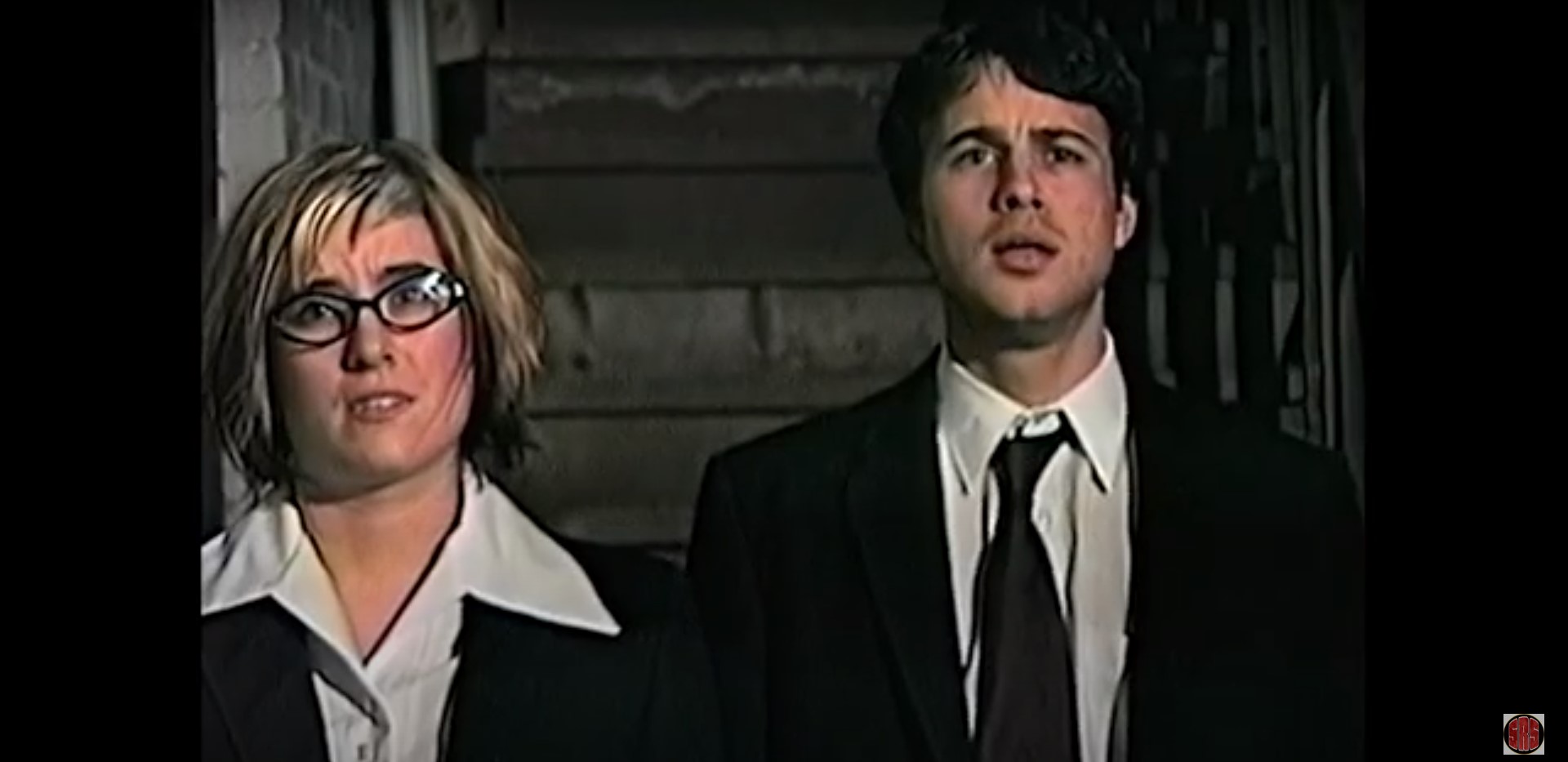
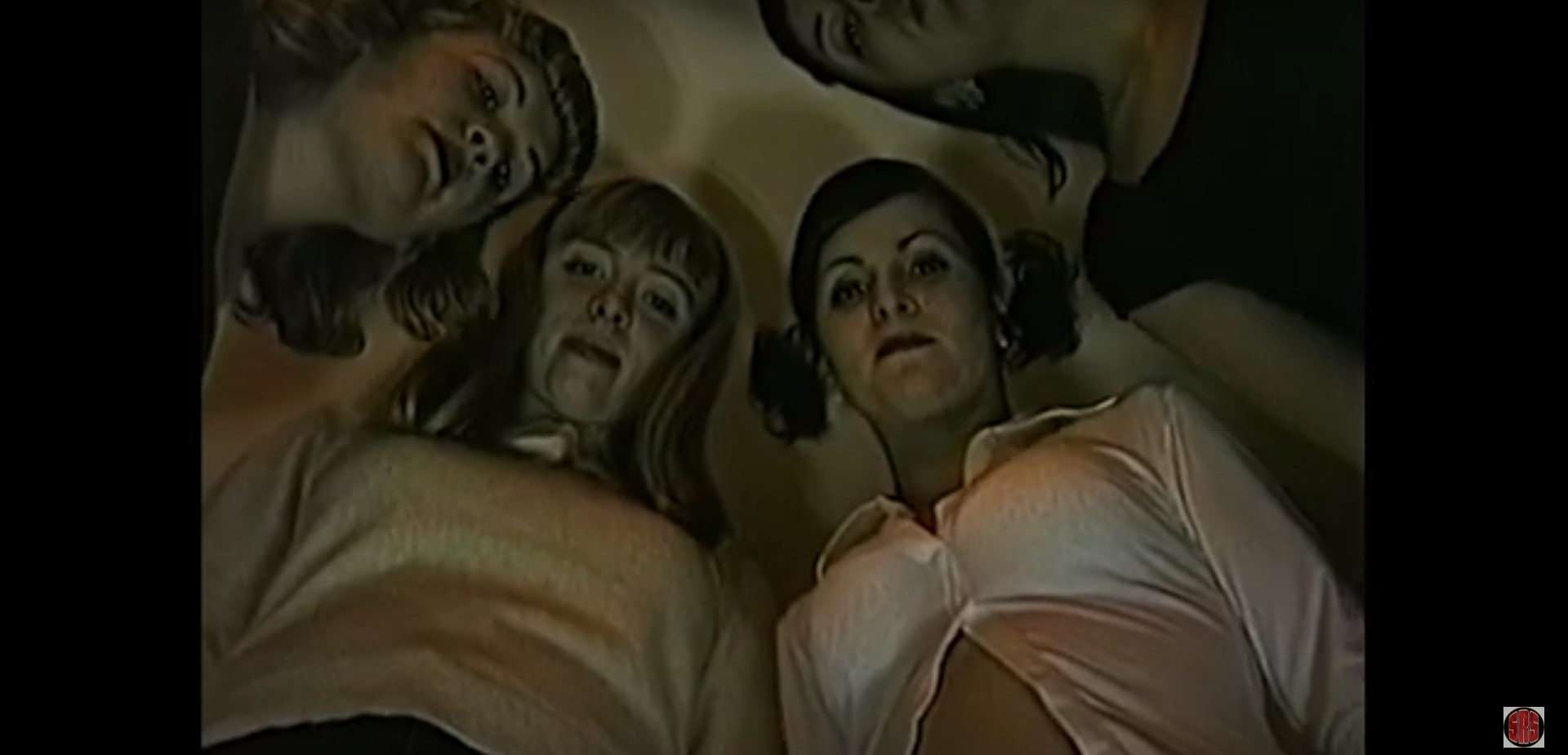
One thing to note about SOV independent production is the impressive number of cast involved.  The large cast helps manifest Clement’s ambitious dystopia and chaos-riddled world.  Without it, “Binge & Purge” would have been too anorexic to sustain selling grandiose on the cheap.  Typical formula for flesh-eater films persists with secluding a handful of principal roles, majority only speaking roles, fleshed out with an epic apocalypse contextualization of little-to-no dialogue, story arc, or any other sort of prominent screen time stock or background characters in a horde of the undead in crude bloodstained suits.  Clement establishes good guys and bad guys clearly but doesn’t necessarily the focal characters with an ebb and flow pattern between the three detectives May (Tamara Barnard), Vanzetti (Stephan Bourke, “Exhumed”), and Number 11 (Fiona Eden-Walker), who we gather was a former highly trained operative so engrained into the training and operations that her name was lost or forgotten, reduced to a number and the troupe of man-eating models under the eternal fashion designer Karl Helfringer (Gareth Gaudin). The models consist of not your slender-hip vixens with shaved down noses and hungry-looking figures but rather the curvy, pin-up types to wet a seemingly heathy appetite. Moira Thomas, Samara Zotzman, Amy Emel, Becky Julseth, Terra Thomsen and Melissa Evans lavish in so much delight over the sticky glop and spilling intestinal scenes of shoulder-to-shoulder cannibal chow downs that there isn’t an ounce of hesitation or disgust before enamel stabs into the fresh viscera but where the enthusiasm mostly falters is with the monotone dialogue deliveries with hardly any swing in inflection, tone fluctuations, or any kind of gesturing during the more emotive occurrences. “Binge and Purge” rounds out with Robert C. Nesbitt and Chuck Depape respectively as a fashion magazine reporter turned human hungry minion and the coke-snorting corrupt police captain.

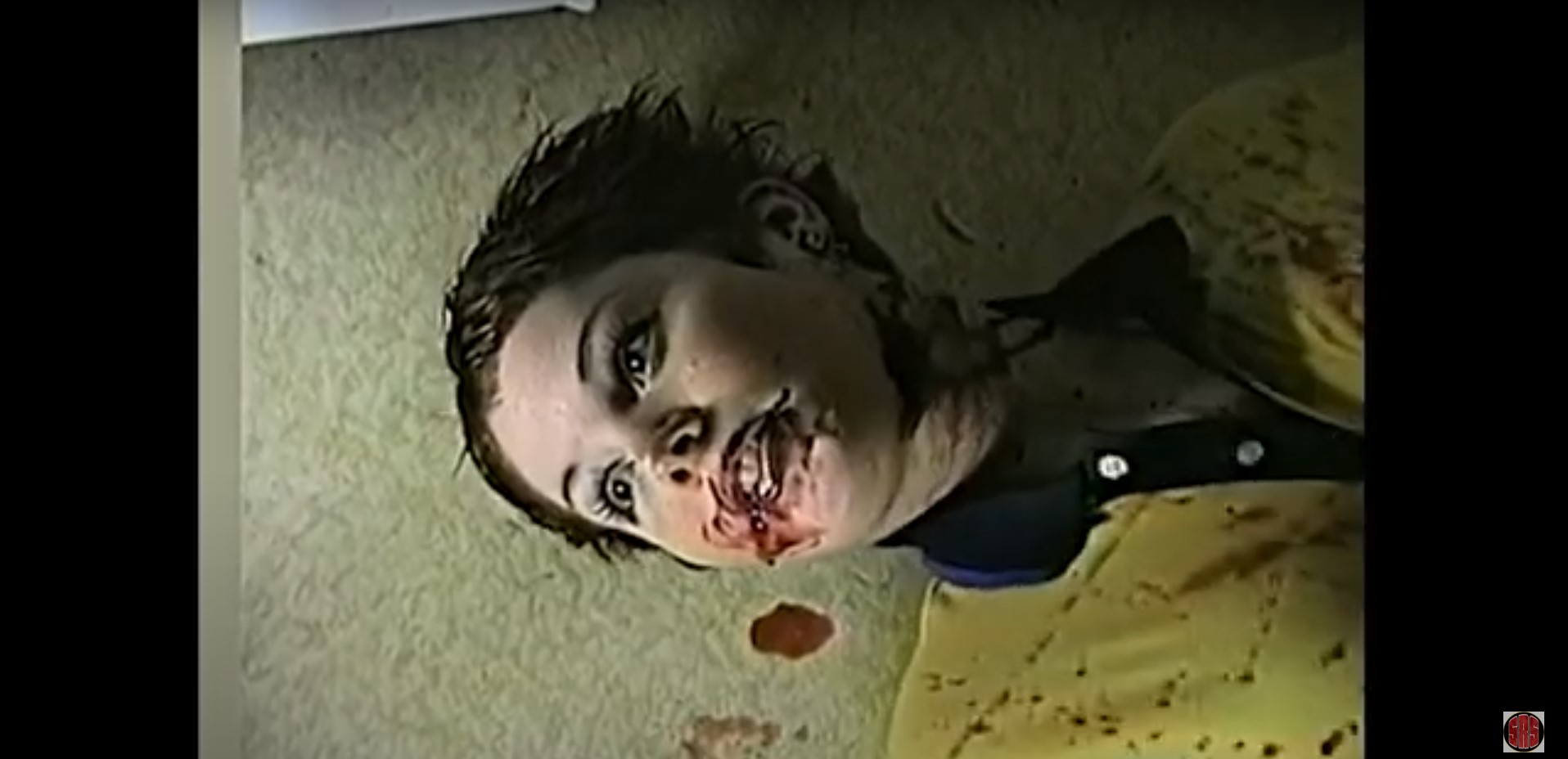
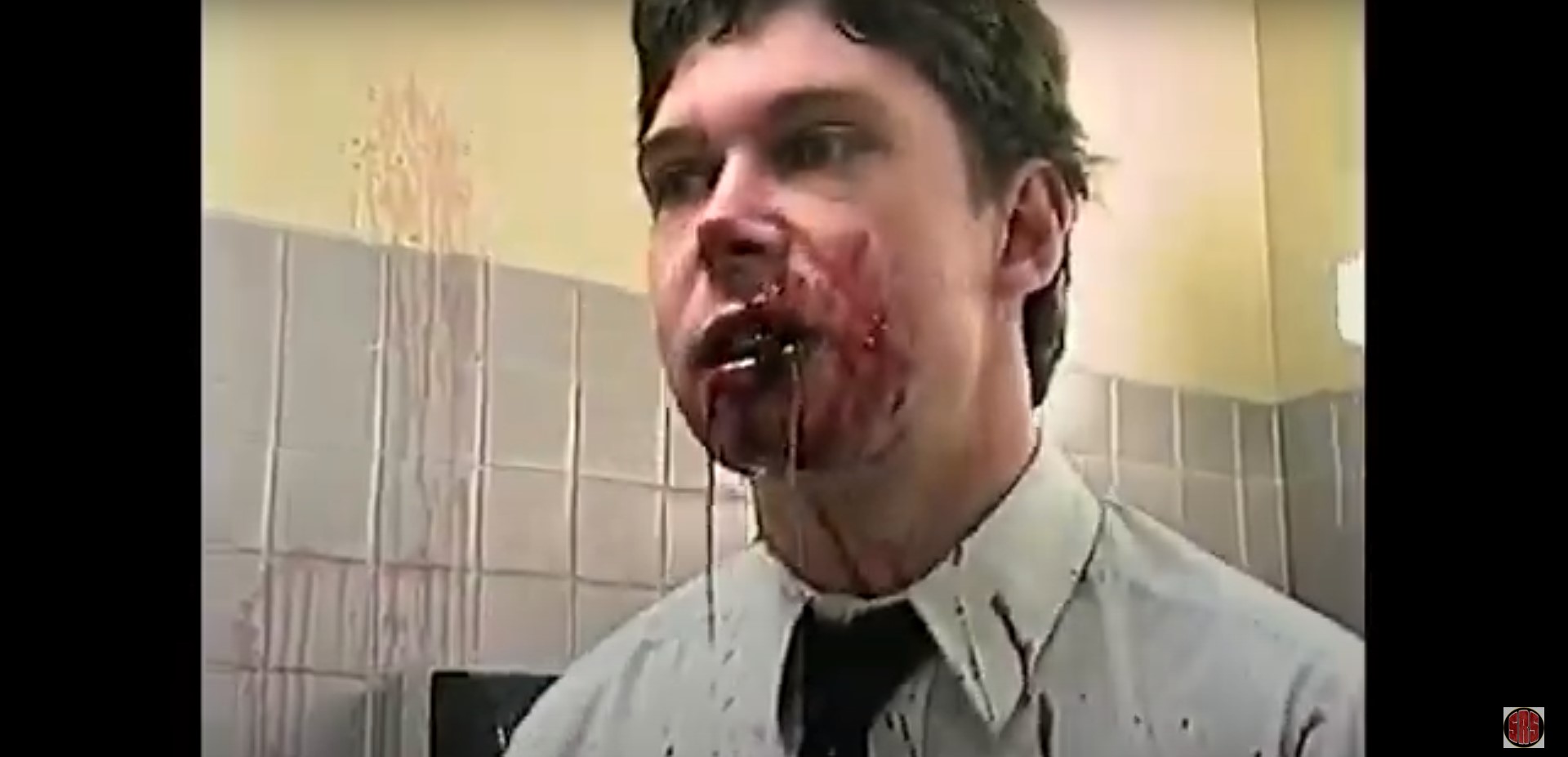
“Binge and Purge” is more than just a Christmas horror.  Amidst the meandering storyline of touching points in time and space with numerous characters and flashbacks skating on thinly laid context ice, such as the Spanish Civil War of the 1930s, Nazi experiments of the 1940s, and how America became a police state, the girth of “Binge and Purge’s” main coarse actually spans across the end of the holiday season in that week between Christmas and New Year’s, approximating a Y2K scare vibe of total chaos and confusion by way of cannibalism contagion instead of a feared computer bug, but that’s one area lacking in Brian Clement’s production laced with insatiable consumerism and consumption with in regard to really hyping up the cheerful holiday atmosphere to become besmirched by the corrupted filth of dirty cops, a plague of death, and a conspiratorial coup by high fashion.  The occasional Santa hat makes an appearance in a model shoot and the end of the year countdown denotes the pinnacle of a MP5 massacring finale, and though I can’t be certain, even the soundtrack sound to be distorted versions of the perennial Christmas classics, but that’s the extent of Clement’s holiday backdrop that would have easily fissure a chasm between “Binge and Purge” and the next low-budget cannibal shocker.  If you’re going to set the film during Christmas, deck the freaking halls, man!  Where Clement bedecks the film is with blood and gore that sees stringy sinew and a high body count’s insides become outsides over an encircling of edible entrails and on literally finger food trays.  Another shining highlight area is the action with agreeable submachine gunfire and the creative pyrotechnic-flares for explosion special effects that does rich up production value, inching the film more toward a magnetic, practical effect-laden, SOV spectacle worth the viewing calories. 

Shot on S-VHS, SRS Cinema gets their hands on the best master print director Brian Clement could carve out of his body of work. The MPEG2 encoded DVD presents the feature in 1.33:1 pillarbox aspect ratio in a 480p resolution. S-VHS master looks pretty darn good despite the caliginous reflection that produces more shadows and illumination on the tape, even if S-VHS offered better illumination as a format, and a lower, poor resolution than S-VHS’s Betamax predecessor. Still, this print has enough delimiting factors to produce a well-oiled image suitable for public distribution with a mix of neon warm and soft color capturing and crude lighting for maximum gritty-palpable product. The English LPCM mono track also has admirable lossless fidelity with a bitrate decoding of 192kbs, that has come typically standard, and greatly appreciated for audiophiles, on SRS releases. Some scenes are better than others, but the dialogue does retain some tail-end hissing and can be soft in spot. Otherwise, dialogue renders clearly enough. The release offers no subtitles. Bonus features include an archived audio commentary and a new SRS cinema produce audio commentary both of which include a self-deprecating Brian Clement going through his “least favorite” work’s production wishful do-overs, where the cast are nowadays, and his favorite gags and setups, a handful of deleted scenes, a slideshow, a new SRS cut trailer, and other previews for other SRS distributions. SRS Home Video release is mocked up with a retro VHS box-impression Amaray DVD case complete with graphically printed-in Please Be Kind, Rewind and Horror stickers. The not rated film has a runtime of 83 minutes and is region free. Nowhere near being a bulimic gorge for expulsion to empty one’s cinematic capacity, “Binge and Purge” is fully digestible grubby grub of horror, action, and comedy. 

“Binge and Purge” on SRS DVD Home Video!  This One Is Hard to Keep Down!

When There is EVIL in the Seoul! “Gangnam Zombie” reviewed! (Well Go USA Entertainment / Blu-ray)

Well Go USA’s “Gangnam Zombie” on Blu-ray Hi-Def!

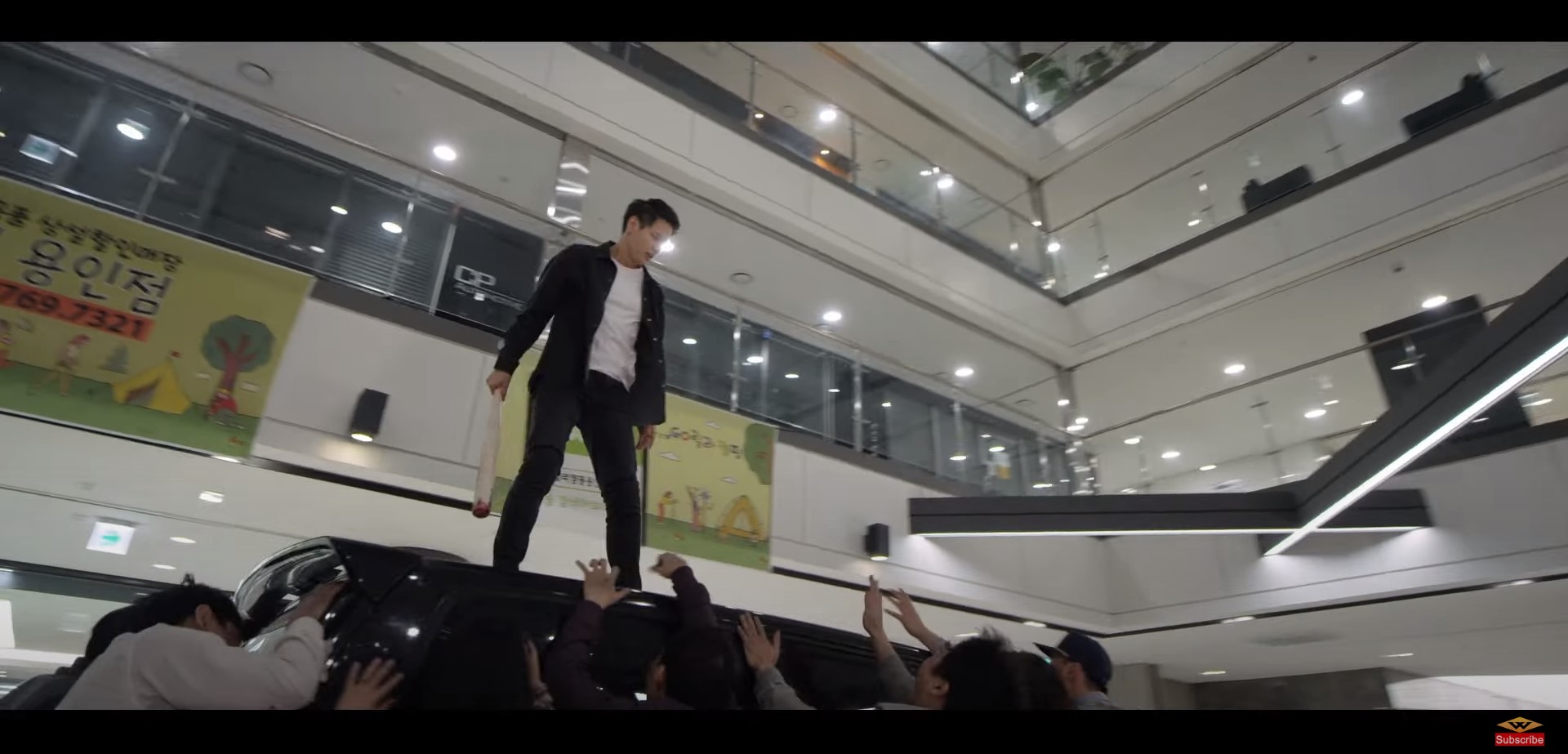
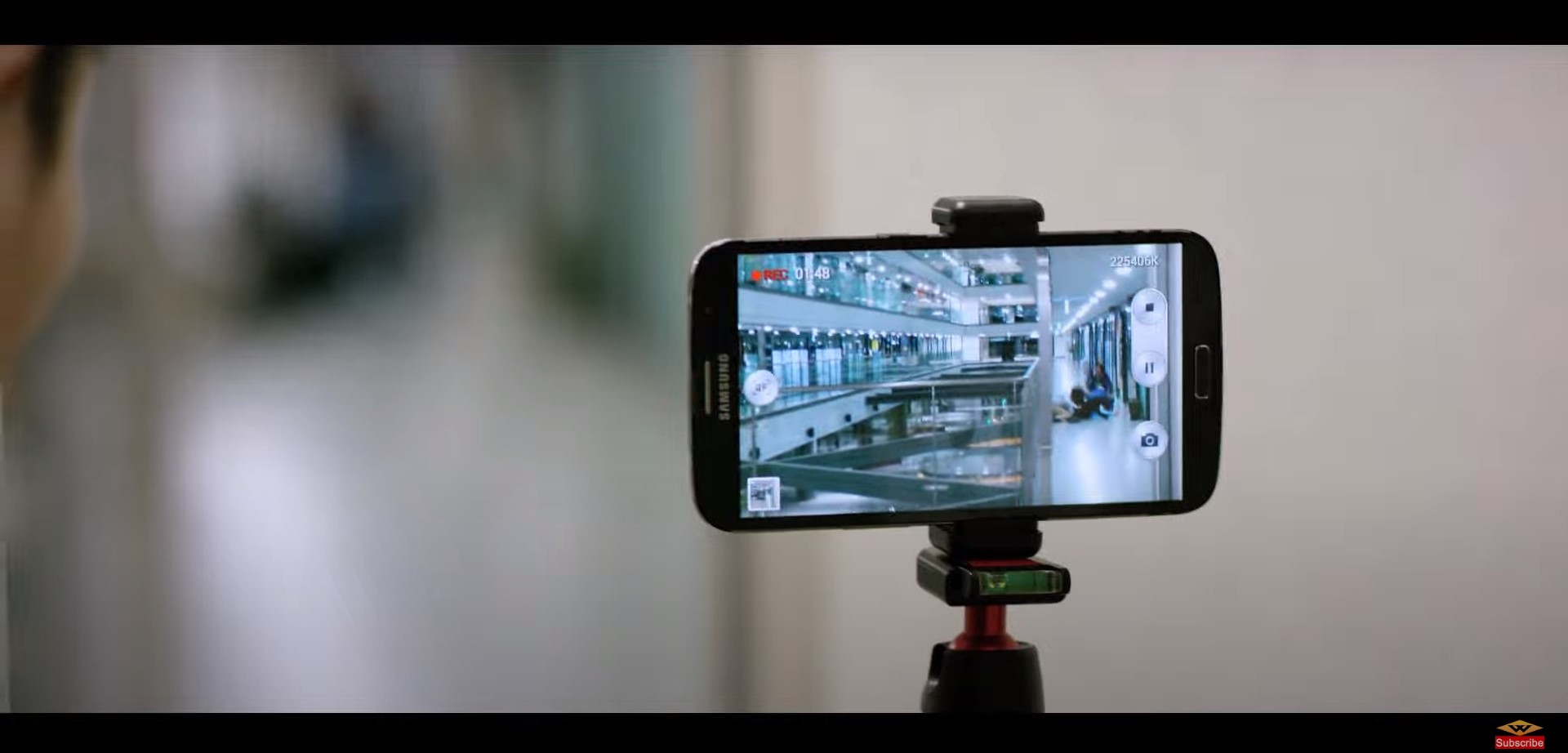
In the Gangnam district of Seoul, South Korea, former backup to the national taekwondo team Hyeon-seok works underpaid and unhappily for a smalltime viral video streaming company.  His colleague and crush, Min-jeong, is a content editor constantly being hit on by the knavish company owner.  Unhappy at their jobs, the two miserably plug away while avoiding the elephants in the room until an infected, flesh-eating man walks into their office rental building, biting and infected the surrounding professionals that turn the place of business into a place of horror and survival.  With the doors chained shut and no way to call for help, Hyeon-seok, Min-jeong, their small band of coworkers, and the building’s landlady react antagonistically against the quickly devolving situation that seeks to sink its teeth into them.  The upstanding Hyeon-seok does the only thing he knows how, to fight his way out while protecting Min-jeong from a mass army of blood-stained teeth.

In the wake of the popular successful running and rampaging outbreak spread of zombie-madness in “Train to Busan,” the 2016 all-aboard the zombie train thriller not only blazed the rails with a hyper-intense, body-over-body, dog-eat-dog infected film confined to the cramped aisles of linked train cars but it also set the tone for years to come with imitators to rake in the cash of the outbreak breakout success.  Though the concept is nothing new, South Korea has adopted the fast-running infected flesh-eater and shaped it with mass affect with newer entries being submitted every year since the release of “Train to Busan.”  “Rodeukil” director Soon Sung Lee has helmed one of those new entries with “Gangnam Zombie,” a far more contained zombie burst confined to a mall-like office building set in the heart of the Gangnam district, hence the title.  “Gangnam Zombie” is a self-produced production of Soon Sung Lee in association with JNC Media Group and Joy N Cinema with co-producer Choe Gwang-rae.

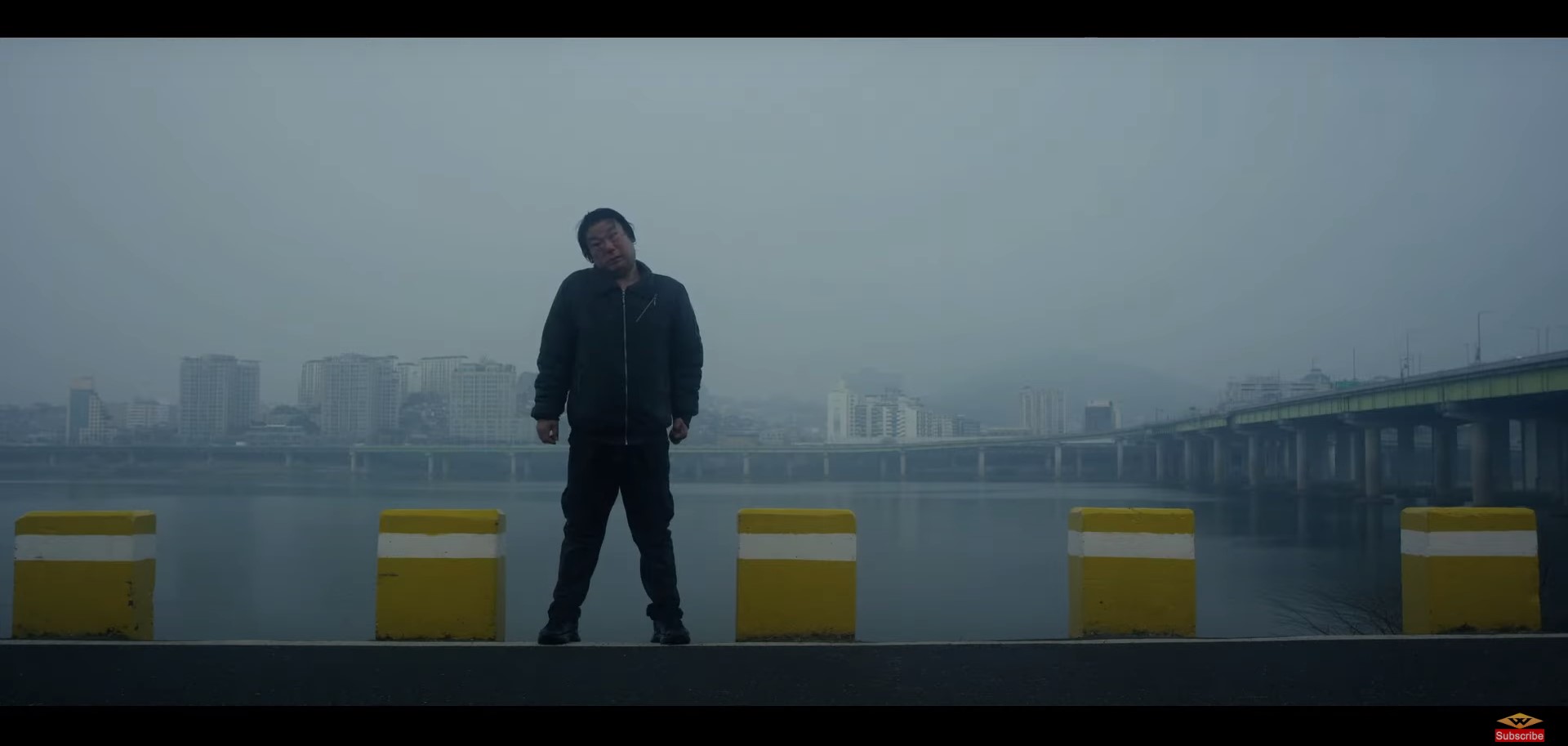
The aphorism less is more can be applied to many things and many situations, often generally true, much like overthinking a simple problem.  For the cast buildup of Soon Sung Lee’s “Gangnam Zombie,” the saying torpedoes any kind of chance connecting with the chaos-engrossed characters.  Opening to Cho Kyoung-hoon and his partner’s breaking and entering of a shipping container full of boxes of I-don’t-know-what, objectively were lost to the here and why this crime becomes not only ground zero for the epidemic, Cho Kyoung-hoon’s Wang-I is attacked by a container-hitching infected cat of all things, but also the motivation for their transgressions of thievery.  I honestly could not tell you what was being hijacked from the container boxes; to me, the contents appeared to be COVID-19 test kits which would make sense since “Gangnam Zombie” forces the paralleling global epidemic done our visual esophagus with a cat instead of a bat.  After dispatching his partner with a bite to the neck, in what is a very vampiric method I might add, Wang-I wanders his dazed self into the city of Seoul, especially the Gangnam district, where he steals red meat from a grocer and stumbles with a self-image conflict into Hyeon-seok and Min-jeong’s office building.  Indiscriminately unhappy with their jobs with a mild sense of attraction between them, the characters are played by Ji Il-ju and Park Ji-yeon who can’t really get into the tumultuously thrown together chemistry needed to make their emotionally pulling tug work with viewers.  The supposed coupling actors’ scenes feel one-sided with Park Ji-yeon in a defensively scared and uncertain shoes but very much guarded against Ji Il-ju who can wear his heart on his sleeve as he roundhouses zombie extras left and right.  Cho Kyoung-hoon feels more enthused in his black-eyed, rabid-smile zombie mode while still able to grasp his humanity with close-quarters hand-to-hand, an enthusiasm not really shared by the others when faced with ground zero apocalypse that doesn’t quiver under one-liners and vapid, vacuous vernacular and vigor.  Min Choi, Tu-in Tak, and Yi-joo Jung round out the cast.

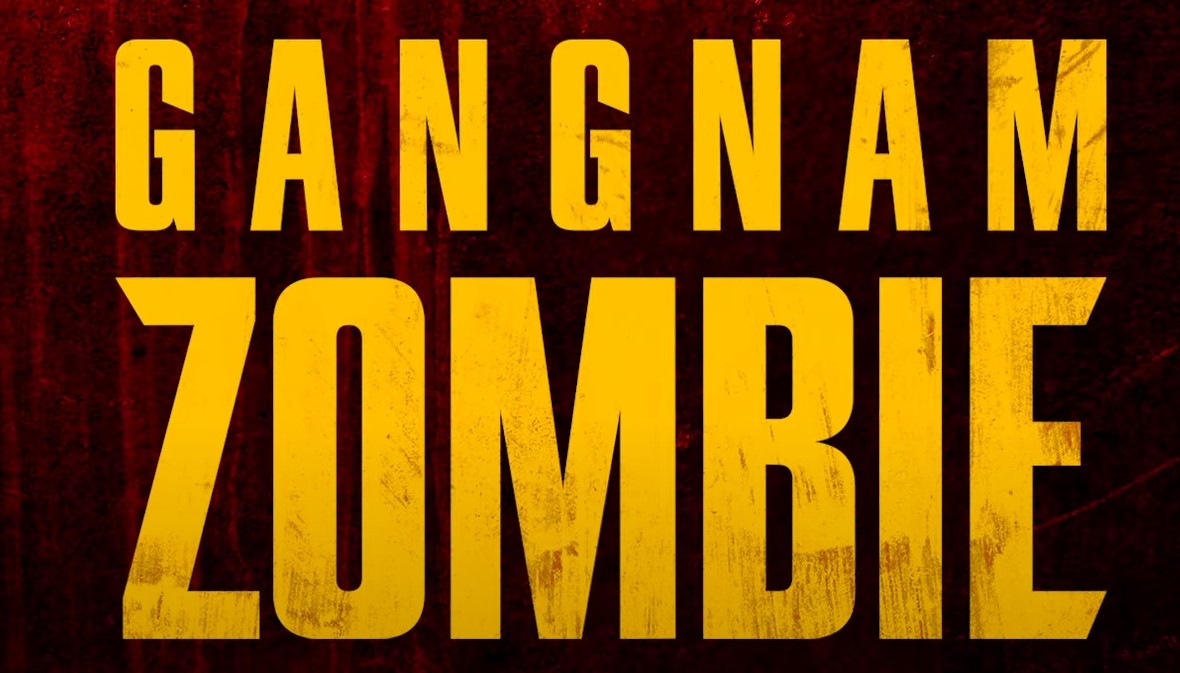
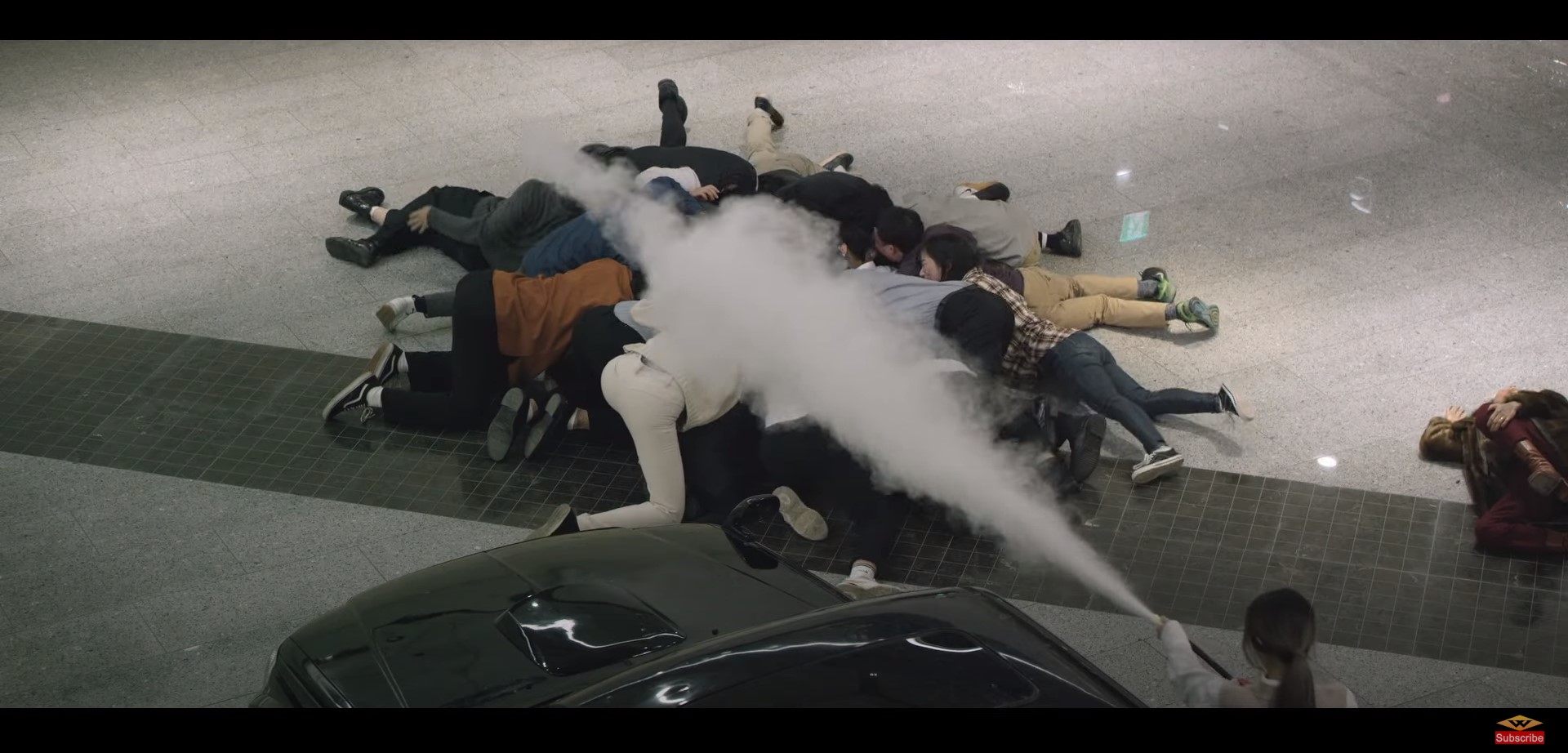
“Gangnam Zombie” falls into the cheap-thrills trap of comparing itself the deadly strain of COVID-19 not because of the cat and bat reference above but because the opening title sequence hammers in a quick recap of the epidemic era in massive overload of visuals with the occasional infected person flashing into frame.  Though not mentioned once of COVID into the dialogue, a tumbling of slowly progressing confusion settles itself inside the narrative of what director Soon Sung Lee is trying to convey comparing COVID to chaotic cannibalism.  The exploit is egregiously akin to Full Moon’s capitalizing indecorous “Corona Zombies.”  The two not only share germs but also share essentially the same title and are both more comedic and lighter, shadowing over and taking away any intensity it intended in this more comedy-horror than horror-comedy.  Zombie carnage is laid waste to bad continuity editing as we see some of the same zombies looking down one hallway and then in the next scene and in a different hallway there is the same infected head, zombies inexplicably rolling on the floor into frame, zombies sneaking up behind people only to hesitate an attack with more of an intent to scare them when the chased turns around, and the infected are not brainlessly dulled and have the ability, or at least only one of them has the ability, to fight back with blocks and other defensive and offensive moves.  “Gangnam Zombie” milks the stouter predecessors with a haphazardly duck taped lesser vessel to slog forward what other South Korean filmmakers have previously perpetuated so well in the subgenre.

On Blu-ray now from Well Go USA Entertainment is “Gangnam Zombie” with an AVC encoded, 1080 hi-def, BD25, presented in a listed widescreen 1.78:1 aspect ratio that works well in the compressed environment of the office building. Exterior scenes of the city, overall general landscape, suggest a wider aspect ratio, perhaps a 2.35:1 to capture more the of the urban landscape. Speaking of the office building, the well-lit environment provides less complexities on the digital image with the same gray, steel, and translucent facing in most of the scenes. Varying saturations of red diverse the blood shading around the body and face with darker tints often looking like motor oil to match the midnight irises. Details in the digital age rarely see a loss of face with natural skin tones, to the minute details of reflective surfaces, and a properly sterile office space. The only audio track built into the release is a Korean DTS-HD 5.1 master audio that’s balanced appropriately with forefront dialogue and a backseat generic soundtrack mix of heavy metal and crescendo builds. The zombie grunts, groans, and roars tear into the channels, nicely through the backend channels, but with cacophonous irritation at times. There’s decent secondary sound design with the baseball bat being hit across infected faces and the floor, despite revealing its rubbery bounce, and Ji Il-joo kick and punch melodies. Sometimes a hit-or-miss with bonus features on the international releases, this particular Well Go USA release comes bare bones with no special features on the software. The hardware, aka physical features, is also not terribly spectacular with a standard Blu-ray casing with a sketch and paint cover that’s slightly misleading where our protagonist will be when the outbreak breaks. Unlatching the case reveals an advert insert for three Well Go USA distributed films, likely rotational with different features, with a unique fascination disc press art of rope tied radio with outstand hands and fingers appearing to grab the bottom of it. It’s a Blu-ray opening enigma viewers will have watch the feature to understand. Clocking in at 82 minutes, “Gangnam Zombie” is region A locked and is not rated. The bite marks of “Gangnam Zombie” are a familiar pang and now nearly a decade after a formidable Korean zombie subgenre began, we’ve become too desensitized for hackneyed carbon copies.

Well Go USA’s “Gangnam Zombie” on Blu-ray Hi-Def!

EVIL Has the Right to Remain Dead! “Magic Cop” reviewed! (88 Films / Blu-ray)

No Two-Bit Magician In ‘Magic Cop” on Blu-ray!  

Hong Kong cops are confounded by a chaotic drug bust when learning that their female suspect, who had managed to overpower an entire unit of male officers and even take a bullet ambling deadpan into the streets, had died 7 days prior.  An outlying officer, and practicing Taoist, Uncle Feng is called to Hong Kong to not only quickly solve the narcotic crime but also investigate the unnatural properties of the case.  Feng is accompanied by his city eager niece Lin and two Hong Kong cops, a Taoist devotee and skeptic of Ancient Chinese spiritual mythologies.  Together, they track the drug trail to The Sorceress, a Japanese witch with powers that rival Feng and that can resurrect the dead into zombies and vampires to do her bidding, such as trafficking narcotics.  When the investigation closes in her business, The Sorceress and her right arm, skilled fighter plan to remove the only man worthy of stopping her.

Fans of Ricky Lau’s “Mr. Vampire” will once again be amazed and entertained by the fantastical and mystical action of Stephen Tung Wai’s “Magic Cop.”  Tung, a fellow martial artist and stunt man who had roles in “The Fatal Flying Guillotine” and John Woo’s “Hard Boiled,” helms his debut directorial penned by Chi-Leung Shum (“Vampire vs Vampire”) and the longtime Stephen Chow script writer Kan-Cheung Tsang (“Shaolin Soccer,” “Kung-Fu Hustle”).  The screenwriting duo brought lighting quick comedy to the mostly fictionally invented yet sprinkled with slivers of hard-pressed veracity and definitive entertaining occultism and what resulted resurrected “Mr. Vampire” semblance out of the being a period piece and into the modern day, backdropped in the year of 1990 when the film was released.  Long rumored to be the fifth sequel of the “Mr. Vampire” franchise, “Magic Cop” is a coproduction between Movie Impact Limited, Millifame Productions Limited, and Media Asia Film with star Ching-Ying Lam producing.

“Magic Cop,” and even “Mr. Vampire,” wouldn’t have such a cult following if it wasn’t for the Vulcan eyebrows and thin mustache of Ching-Ying Lam in costume.  The short-statured, Shanghai-born Lam delivers the same vigorous choreography and tranquil demeanor to this particularly stoic character of Uncle Feng, a Taoist practitioner to essentially wrangle unruly entities and please the spirits in the in-between our world.  Feng is old world and finds himself in surrounded by modernism when in Hong Kong, goaded by the young lead sergeant attached the case.  Practical as well as disrespectful, Sgt. Lam (Wilson Lam, “Ghost for Sale”) epitomizes today’s, or rather back then the 1990’s, modern man who has forgotten tradition and deference to those who came before.  Though padded with a fair amount of comedy coursing throughout, balanced against the impeccably edited tango fight sequences, Sgt’ Lam’s partner, known only as Sgt. 2237 played by “Centipede Horror’s” Kiu-Wai Miu, risibly wants to understudy Uncle Feng’s powers while Feng’s niece Lin, played by Mei-Wah Wong of “The Chinese Ghostbusters,” provides the subtle and quirky opposite sex that catches of the philandering eyes of Sgt. Lam.  The ragtag quartet of influx mindsets and personalities become challenged by their single common goal, to stop whoever is behind breathing life into the formidable dead and stop the unorthodox method of drug smuggling.  Former Japanese bodybuilder Michiko Nishwaki (“City Cops”) embodied that very dark magic antagonist.  Nishiwaki handles The Sorceress character with ease despite not having a surfeit army under her thumb; instead, this forces Nishiwaki to become the entire villain body with the slight, full-contact support for her right-hand bodyguard (Billy Chow, “Future Cops”) and a couple of undead lackeys, including Frankie Chi-Leung Chan of “Riki-Oh.”  “Magic Cop’s” cast rounds out completely with well-versed and seasoned, late actor Wu Ma (“Mr. Vampire,” “Return of the Demon”) as the chief inspector polarized in a complicated history with Uncle Feng.

What director Stephen Tung Wai boils down in essence is another variation of good executants of spirit humbled caretakers versus the wicked necromancers existing inside the fabric of the highly praised and cult-following “Mr. Vampire” universe.  Frankly, there’s nothing wrong with that derivativity since Ching-Ying Lam, Mr. Vampire himself, produces and stars as the titular hero.  Lam can conjure whatever-the-hell he wants in order to battle Hell itself.   “Magic Cop” is also a well-made, entertaining story, balanced between the contest wizardry, slapstick comedy, and the character dynamics, and stacked with improbable yet gratifying step-intensive fight orchestration that has gawked early martial arts films a wonder to behold and continues to do so to today but now trickles with pizzazz more-after-more due to put in place industry safety measures.  “Magic Cop” contains that lost art of potentially hazardous palatable physicality that beguiles more than the movie’s faux magic exhibited on screen.  To add to the authenticity, very little painted composited visual effects were used with makeup and the actors doing much of the heavy lifting with the editing team of Ting-Hung Kuo and Kee Charm Wu in full cut-and-paste fortifying mode to button up each sequence with comprehendible continuity of each punch, kick, and magical chopsocky.  One overtone made well known in “Magic Cop” is the unfillable chasms between old and new, respect and disrespect, and myth and science from whence solves no problems until some unified common ground can be reached in order to succeed, in this case, to stop a bitch of a witch.    

An age-resistance 35mm print scanned onto a buffed 2K Blu-ray that extracts the best print elements to-date. The AVC encoded, 1080p, Blu-ray presents Stephen Tung Wai’s picture in a widescreen 1.85:1 aspect ratio. A fine-tooth comb through the celluloid couldn’t unveil any major issue with the 88 Films release. Colors are richly grafted within the sabulous surfaces that are exceedingly defined with delimited, shadow-creating depth. Decoding speeds average around 35Mbps on a BD50, securing categorical choiceness amongst other releases and formats (that is until the potential 4K release). The release comes packed with four audio options to explore: The original Cantonese DTS-HD master audio 2.0 mix, a Cantonese DTS-HD 2.0 home video mix, an English DTS-HD 5.1 master audio dub, and an English DTS-HD 2.0 dub. Between the variated audio mixes, we preferred the original Cantonese DTS-HD 2.0 due to its cadence with the image and welcoming exactness through the lossless compression process. You can make do with the other three options, but the fidelity is much better with the original mix and only anti-subtitle sectarians would be pleased with an English dub. English subtitles are optional and synch well the dialogue but be prepared to speed read as the pacing is quick much like the dialect. Software special features include an audio commentary with Hong Kong film experts Frank Djeng and Marc Walkow, an alternate, standard definition Taiwanese cut of the film with alternate score, an interview with director Stephen Tung Wai, image gallery, and trailer. Endowed with a limited-edition, cardboard slipcover, the dark green Blu-ray snapper has newly illustrated, front cover artwork by Manchester graphic designer and 88 Films resident artist Sean Longmore, which is also on the cardboard O-slip. The reversible cover art has a reproduction of the original Hong Kong poster art. Stuffed in the insert is a mini-folded poster of Longmore’s front cover and a disc art, a scene moment captured in spherical rotunda, of the opening sequence. Available with a regional playback limited to A and B, the 88 Films release is not rated and has a runtime of 88 minutes. ‘Magic Cop, perhaps, wasn’t the sole proprietor of influence but certainly had a black talisman plying hand in the substrata of more Western favorites like “Big Trouble in Little China” and is a crucial cornerstone in representing the best of the Hong Kong Golden Age of cinema.

No Two-Bit Magician In ‘Magic Cop” on Blu-ray!  

Norwegian EVIL Has Women Issues! “The Thrill of a Kill” reviewed! (Wild Eye Releasing / DVD)

Enjoy the “Kill” on DVD now Available on Amazon.com

Out of work Kimsy and her irritated mother butt heads over Kimsy’s lack of effort in trying to find a job and help out with responsibilities around the house.  After a particularly nasty argument, Kimsy storms out to walk off her frustration in the quiet surrounding woods.  Instead of lowering her blood pressure, Kimsy’s blood runs scarred and runs down her head as she’s knocked out and picked up by a playful serial killer with an irreparable hate for women and takes gratification in degrading them by any means possible.  Sadistically bred by unconditional motherly abuse, the killer treats each of his prized possessions like dogs to submit to his every beckon and call.  Kimsy’s mother and sister, Camilla, grow concern for Kimsy who hasn’t returned home and set off to find her.  When they realize she’s been abducted, they’re able to track her to a remote, vacant cabin used as a kill house and as they set foot inside the cabin to save Kimsy, a killer lies and waits to strike. 

Lars-Erik Lie’s Norwegian torture porn, “The Thrill of a Kill,” resonates with the old and true proverb, what comes around, goes around.  Filmed in and around Norway’s largest ski destination and resort, the Scandinavian mountain town of Trysil becomes the backwoods abattoir for the director to set his exploitation workshop for the bleak Norse horror.  “The Thrill of a Kill” is the first feature length fictional film from the Norway-Born Lie who has digs into the indie underground and gory storytelling, self-funded by his own banner, Violence Productions, and is coproduced by Morten K. Vebjørnsen and Arve Herman Tangen, Morten Storjordet, and Linda Ramona Nattali Eliassen serve as executive producers.

Dichotomizing “The Thrill of a Kill” into two stories set during two different time periods, Lars-Erik Lie’s focal point is not the hapless victims caught in a deadly spider’s web of perversities.  Instead, Lie’s story formulates the theory on how the sociopathic killer was ill-nurtured into a monster with an interweaving plot set in 1968 of a young boy (Carl Arild Heffermehl) neglected and abused, verbally and physically, by an alcoholic and sexually promiscuous about town mother (Sonja Bredesen) who would bring home another town drunk to bed. Missing his (deceased?) father and tired of being bullied by his own mother, the boy mental state snaps like a twig under immense emotional, family-oriented pressure and descends into a murderous madness. Years later and all grown up, the maniac mountain man abducts young women as a direct result of the hate toward his mother and her mistreatments. Arve Herman Tangen becomes the goateed face of the grown man gone haywire. Tangen develops his character with purposeful intent and with a nonaggressive tone to persuade his bound quarry to remain subdued. The role is nothing short of typical that we’ve seen in other films of its genus where a screwed-up child-turned-adult runs a deviancy amok sweatshop of imprisoned flesh and torture devices and Tangen really adds nothing meaningful to derangement. In her debut and only credited role, Kirsten Jakobsen, former Model Mayhem model from Oslo, succumbs to being the unlucky alternative girl, Kimsy, that runs into the big, overwhelming man while strolling through the forest. One would think Kimsy would have suffered brain damage after being struck and knocked unconscious not once, not twice, but three times by the killer who undresses her after each time with the third and final blow putting the final touches on his toying with the girl and bringing her back for a visit to his hen house of brutalized women. After the first blow or two, Jakobsen doesn’t show that much concern for Kimsy’s attentive wellness or concern as Kimsy continues to just wander as if nothing major has happened. Camilla Vestbø Losvik is a much more reliable and realistic rendition of the situation as Kimsy Sister, Camilla. As another alternative and attractive woman, Camilla shares a strong kinship with Kimsy despite their mother’s disciplinary differences toward them, to which eventually their mother (Toril Skansen) comes around as the patron saint of motherly worriment that’s likely a contrasting parallel to the killer’s unaffectionate mother. With an ugly-contented subgenre, “The Thrill of a Kill” has various compromising positions for its cast with rape and genital mutilation that there’s some shade of respect give to those who can mock play the unsettling moments we all are morbidly curious to see. The film rounds out with a lot of half-naked women strung up in bondage or chained to the wall with Linda Ramona Nattali Eliassen, Veronica Karlsmoen, Veronica Karlsmoen, Madicken Kulsrud, and Ann Kristin Lind with Raymond Bless, Niclas Falkman, and Jarl Kjetil Tøraasen as drunk, male suitors.

“The Thrill of a Kill” recreates the simulacrum of SOV horror as Lars-Erik Lie pulls out his handheld video to follow Kimsy’s journey through the jollies of a madman and the mother and sister’s rout out for their lost Kimsy. The beginning starts off with a zombie-laden dream sequences that places Kimsy in a field with a killer and his mutilated corpses that reanimate in a bit of foreshadowing of what’s in store for the spikey haired damsel. By dismissing her vividly horrifying dream of diminutive meaning, just like she does with everything else, Kimsy falls easily into the killer’s hands signifying one of the films’ themes to never take things for granted, especially those things that are important to you as exampled later on in the story. That’s about as much purpose I could pull from out of Lie’s film that floats like a feather on surface level waters. There is one other tangential offshoot Lie attempts to explored but never fleshes out fully is the unbeknownst to Kimsy and Camilla’s perverted hermit of a father who lives on the outskirts of town. Their mother thought he would have insight on Kimsy’s whereabouts but instead he tries to forcibly coerce Kimsy into his shack for involuntary lovemaking and then the exposition ensues after Camilla barely escapes his axe-chopping in (sexual?) frustration clutches. That exposition literally goes into a tunnel leading to nowhere and doesn’t alter the actions of Camilla or her mother to do anything different, expunging any kind of knowledge to utilize for a complete character arc and just comes to show Lie’s written bit parts don’t define the narrative of learned opportunities or gained instinct but rather are just additional sleazy show. The same sleazy show can be said about the rape scenes as they won’t ascertain the intended reaction of squeamish uncomfortableness. Now, while rape is no laughing matter or accustomed at any degree, there’s a level of numbness to these scenes that carry a severe flat affect to doesn’t display the anguish, the terror, or the hurt these women are going through as the killer decides upon himself to violate them. There’s literally no fight in these undrugged, still vigorous, young women who have just been snatched and made into his plaything and while some seasoned BDSM partisans may get aroused, the emotional receptor in me wants to empathize what their strife agony, but maybe that’s why the film is titled “The Thrill of a Kill,” to be an emblem of fun, cheap thrills.

Coming in at number 70 on the spine, the Norway schlocker-shocker, “The Thrill of a Kill” lands appropriately onto the Wild Eye Releasing’s Raw & Extreme banner. The 2011 released film finds a vessel for its North American debut over a decade later after its initial release and presented in a 1.33:1 aspect ratio, with vertical letterboxing on 16×9 televisions, despite the back cover listing a widescreen format and being released in 4:3 is a bit surprising as other countries display in anamorphic widescreen and the lens used in the film is definitely anamorphic as you can tell with flank falloff that distorts the image and makes the picture appear rounded. Color grading is slightly washed and lives in a low contrast. Again, I have to wonder how aesthetically different the transfer is on the outer region product. Soft, SOV-equivalent details don’t necessarily kill the image quality, but you can obviously notice some pixelation in the frame inside the shack and in wider shots of the landscape amongst the low pixelated bitrate. The Norwegian Golby Digital Stereo 2.0 comes out clean, clear, and about as full-bodied as can be with a two-channel system. Some of the Foley is overemphasized production which comes off sillier than the deserving impact of a thrown punch or a meat hook going through the lower mandible. English subtitles are burned/forced into the picture but are synched well without errors though the grasp maybe lost a little in translation. Bonus content is only a trailer selection warehousing select Raw & Extreme titles, such as “Hotel Inferno,” “Acid Bath,” “Morbid,” “Bread and Circus,” “Absolute Zombies,” “Whore,” and “Sadistic Eroticism.” Continuing to achieve maximum controversial covers, Wild Eye Releasing doesn’t hold back for “The Thrill of a Kill” DVD with a crude, yet fitting DEVON illustrated cover art that is a platterful of unclasped splatter while in the inside is a still frame of one of the more tongue biting scenes. No cuts with this unrated release and the film clocks in at 85 minutes with a region free playback. A grating gore gorger with mother issues, “A Thrill for a Kill” redundantly recalls our attention back to the subservience of what makes horror horrifying and while what terrifies us is pushed aside, the free-for-all fiend-at-play treats the death-obsessed to a buffet of blood and defilement.

Enjoy the “Kill” on DVD now Available on Amazon.com

Not All Zombies are EVIL. Some Zombies Save Lives. “The Loneliest Boy in the World” reviewed (Well Go USA Entertainment/ Blu-ray)

“The Loneliest Boy in the World” on Sale Now at Amazon.com!

The unexpected tragic death of Oliver’s mother, involving a pool, a television, and a garden gnome, places the now aged-out and deinstitutionalized Oliver into a difficult position. The sheltered, socially awkward young man, living by himself in his mother’s home and still makes like his mother is still with him, is given a last chance ultimatum from his supportive social worker and a pessimistic psychologist to make friends, to lead a normal life, and to sustain impendence or else he’ll have to return to being institutionalized as an adult. Local contemporaries single out Oliver for being weird, unusual, and a loner to the point that his childlike and naive mind turns him desperate enough for a friend to dig up corpses, those who used to be well-liked in the community, but when one morning the exhumed bodies come to life as a nuclear family that eats, breathes, and is sort of living. Though rotting from the outside, the undead family encourage and advise Oliver through his toughest life challenge yet – to be normal.

Described as a modern fairytale with zombies, “The Loneliest Boy in the World” is a satirical comedy horror about the rite of passage into adulthood from the screenwriting team of John Landis’ “Burke & Hare” writer Piers Ashworth, producer of “Director’s Cut” Brad Wyman, and “Maximum Overdrive” star and “Rated X” director Emilio Estevez. Director Martin Owen (“L.A. Slasher”, “Let’s Be Evil”) helms the late 80’s deco piece with a Halloween backdrop, fitting for any undead family to suddenly animate into an eclectic and eccentric fashion that encircles what it means to understand family values in a very trendy niche specific of the late 80’s style. The feature is produced by Piers Ashworth, Ryan Hamilton (“Possessor”), Matt Williams (“Let’s Be Evil”), Pat Wintersgill (“Amulet”) and a conglomeration of executive producers including Emilio Estevez and is a production of the London, UK-based Lip Sync in association with Future Artists Entertainment and presented by Great Point Media and Well Go Entertainment.

Max Harwood gives a peculiar performance as a soft-spoken, sheltered-to-a-fault mother’s boy, Oliver, with a delusional depiction of reality. Though Harwood’s performance pairs well enough with Martin Owen’s rocky shore small town of equally asymmetrical corporeality, the titular Oliver comes off derivative of done before loners and Harwood provides little range to fully arc with the character’s transition from a naive young adult on the fringe of losing everything to the compendious hero of his own story by unearthing not only dead bodies that come to life but learning from their advice, truth, and experience to flesh out his own path of courage and confidence. A part of the LGBTQ community, Harwood is joined by fellow community comrade Tallulah Haddon in a strange turn of casting as Oliver’s love interest, Chloe. Queers play straight in the innate course of acting that, as of late, has often been called out for its hypocrisy of an actor portraying something their actually not. The “Black Mirror: Bandersnatch” Haddon is an outsider to Oliver’s surroundings as isn’t influenced by those who have labeled Oliver weird or strange. Instead, Oliver and Chloe spark interest out of hate for being different, a relatable scenario for someone in the gay community. Oliver’s undead family is undoubtedly the best lot with a wide range of happy homemaker personalities and a decaying best friend that supports Oliver’s wings to fly from the next. Susan Wokoma is the stay-at-home mother with a knack for reading the room while her skin peels off and falls to the floor. Ben Miller is the red-blooded Frank that displays glimpses of being a renaissance man at times and Miller plays the beer drinking, jack-of-all-trades father figure aptly. “Harry Potter and the Half Blood Prince’s” Hero Fiennes Tiffin comes on the scene cool and suave in a skin that’s literally drooping off his bones and his eyes have disintegrated from his sockets; Tiffin’s charming, lively, and a source of verbal wit that would be missing from the film. Lastly, Zenobia Williams rounds out the family as Mel, the little sister who is frankly underused and is quiet and subservient to being nice to her living older brother. “The Loneliest Boy in the World’s” cast rounds out with Jacob Sartorious, Hammed Animashaun, Alex Murphy, Sam Coleman, Mitchell Zhangazha, and “The Curse of Buckout Road’s” Evan Ross and “Alone at Night’s” Ashley Benson as the two sole American actors in a contending professionals betting on Oliver’s outcome in friend making.

The casting is interesting as a melting pot of nationalities and cultures intertwined into an alternate reality where the dead can be willed alive. Again, “The Loneliest Boy in the World” is marketed as a modern fairytale and it’s comparable to the likes of if Andrew Currie’s 2006 “Fido,” where in a managed post-apocalyptic world the zombies are kept on as servants for the living in a 1950’s backdrop, was under the Peter Jackson landscape lens of hilltops, seasides, and graveyards. The obvious farce in the late 1980’s pattern aims to set the bar for a number of themes, including growing up into adulthood, to bring back traditional family values in order to push out and correct absent parent trauma, and to embrace the family as nurturing guidance. Oliver’s struggles are frugally displayed but that doesn’t mean the first act misses the mark on plotting the dots of his lonesomeness with being the target of bully teasing, the subject of an insensitive bet of established adults, and being in a position of having no living family or friends to slake his dependence. The one thing to note about Oliver’s sudden lifeline cut is that he doesn’t appear to bothered or frantic about the death of his mother or the prospect of being alone and possibly end up institutionalized. Instead, the unsocialized introvert falls into a semi-chimera state where he’s still tethered to his mother as he watches her favorite television shows and recalls their play-by-play during his graveside visits with mom. The whole concept of death is seemingly foreign to Oliver as he never calls the demise of his mother her death but rather an accident and he finds exhuming recently dead corpses to be his friends normal though he obviously knows it’s illegal and unacceptable normal behavior as he quickly hides or disguises the pre-animated bodies when visitors show up at his doorstep. There’s never an explanation why the dead come to life, but one thing is for sure is that the expired exhumed did a Frosty the Snowman just for the sake of Oliver’s desperation for companionship and, perhaps, that’s the entire reason why. The need for family was granted to the nice, dissociated boy in a lightning bolt of unexplainable supernatural serendipity to right all the bad things that are happening and will happen to him. Zombies are typically resurrected to take life and eat away at the living while Oliver’s zombies are atypical, restoring life and providing hope in an optimistic paradoxical universe.

Dark and quirky, “The Loneliness Boy in the World” is heartwarming with cold bodies. Well Go USA Entertainment releases the AVC Encoded, 1080p high-definition Blu-ray with a widescreen 1.78:1 aspect ratio. The presentation is quite colorful with a vast palette of foundational primary colors sprinkled with retro-vision, such as tape camcorder view, that splits the difference in extracting the vivid pink-laden house interior as well as the spot colors on the characters with stark contrast against the lush greenery background or the rocky, wave crashing shoreline. Night sequences are often blue tinted but not overly saturating. I didn’t note any issues with compression as blacks are generally deep without splotchiness or banding. Details are mostly fine with intricacies more expressive on the decomposing bodies that give off great muscle, skin, and organ decay. The Blu-ray comes with a single audio option, an English DTS-HD 5.1 Master Audio track. Dialogue never has to outbattle the ambient tracks or The Invisible Men pop score. The ambient range really comes through the auxiliary channels well with the central element focusing on the dialogue. English subtitles are optional. Bonus features include a short behind-the-scenes with more fluff from the cast who seemingly can’t get enough of this project and the theatrical trailer is also included. The physical release comes in a standard Blu-ray snapper with an illustrated mesh artwork of essentially every character in the film, even the dead Dachshund. “The Loneliest Boy in the World” has a runtime of 90 minutes, is regionally hard coded A, and is rated R for language and violent content. Enjoyable yet explainable, “The Loneliest Boy in the World” is more defined by its cadaverous twist of fate than the theme it attempts to convey; nonetheless, the Martin Owen film has heart, soul, and the living dead.

“The Loneliest Boy in the World” on Sale Now at Amazon.com!