Yeoh, Rothrock Beat the EVIL to a Pulp! “Yes, Madam!” reviewed! (88 Films / Blu-ray)

“Yes, Madam!” on Blu-ray from 88 Films!

Hong Kong’s Inspector Ng and Scotland Yard’s Inspector Carrie Morris reluctantly join forces to solve the murder of an undercover British national on the verge of exposing a fraudulent real estate contract helmed by crooked businessman Mr. Tin.  When a small piece of key case evidence, a microfilm, winds up in the bumbling hands of three low-level thieves after coincidently robbing the undercover British agent’s hotel room, they find themselves at a crossroads; do they give up the kill-for microfilm to the police in the name of self-preservation or ransom it against Mr. Tin’s syndicate for a big payday?  The elusive Mr. Tin becomes enemy number one in Ng and Morris’s crosshairs despite his circumventing the law.  Not deterred by the failed arrest, the tough as nails inspectors track down the microfilm thieves to make their case and take down by force one of Hong Kong’s most powerful criminal organizations.  

An accelerating knockaround action-comedy from Corey Yuen (“Ninja in the Dragon’s Den,” “The Transporter”), “Yes, Madam!” is a fight-heavy, female-driven super cop emprise with martial arts daggers drawn and slicked in a vigorously lubed burlesque dark comedy.  The 1985 Hong Kong production, penned by Barry Wong (“Hard Boiled”) and James Clouse, as his sole credit, teams an unlikely and highly skilled, international partnership between a twosome of type A personalities who not only initially combat each other and then the unscrupulous bad guys and their mischievous plans but also against the historically prejudiced gender role reversals outside the borders of the story.  Action-packed choreography mixed with slapstick comedy, “Yes, Madam!” is entertainingly fun to watch and hard-hitting, produced by stuntman Sammo Hung (“Long Arm of the Law”) and film’s costar John Sham (“Royal Warriors”) and along with Sammo Hung, executive producer Sir Dickson Poon develops “Yes, Madam!” under their cofounded martial arts and action feature producing D&B Films.

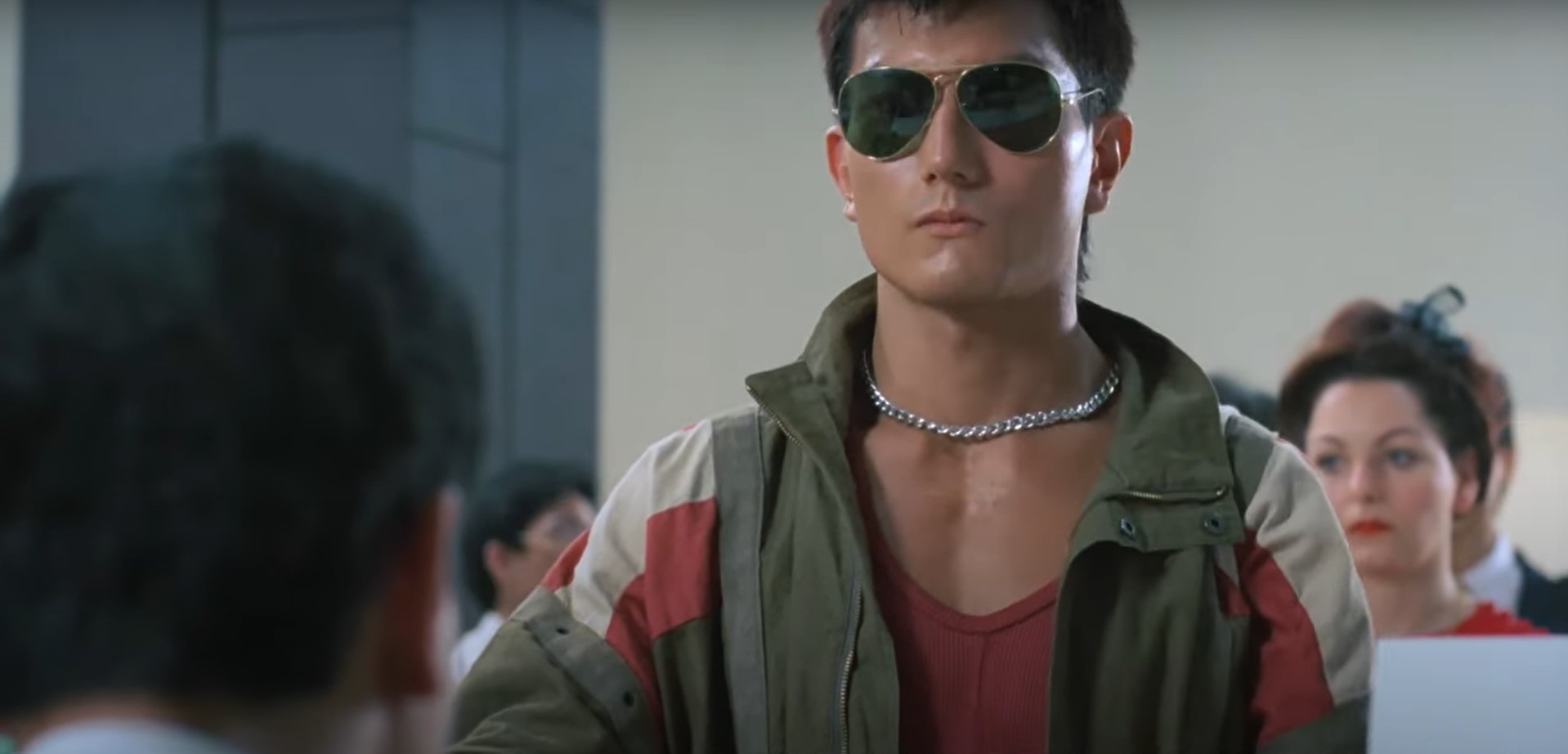
If you’re ever looking for a celebrity roots film, a launching pad feature of success, “Yes, Madam!” has that inner circle, star-studded power and deliverance that not only showcases the beginnings of two presently well-known action and martial art film women but also joins the East with the West in a singular chop-socky fracas.  Oscar winner Michelle Yeoh (“Crouching Tiger, Hidden Dragon,” “Everything Everywhere All at Once”), credited as Michelle Khan, and black belt martial arts competitor and World Champion Cynthia Rothrock (“China O’Brien,” “Tiger Claws”) explode to the thousandth degree on screen as apex inspectors forced to work together to take down crime boss Mr. Tin (James Tien, “Fist of Fury”).  They’re fast, they’re ferocious, they’re incredibly talented in what could be considered their debut principal performances, especially Rothrock in her first feature film in which she doesn’t speak an ounce of either of the native Hong Kong’s Cantonese or Mandarin dialects.  Yeoh and Rothrock are top dog heroines in a yard full of marginal, blundering thieves caught in the middle of a grander operation.  Under incognito with pain reliever aliases are actor-producer John Sham (“Winners & Sinners”) as Strepsil, Hoi Mang (“Zu:  Warriors from the Magic Mountain”) as Aspirin, and Hark Tsui (“Working Class”) as Panadol and though they act like, and sort of resemble, the Three Stooges, the three thieves and counterfeiters embody a mutual brotherhood with background history and a all-for-one, one-for-all attitude as their minor caper turns into a full collapse of their con game.  Characters and performances are all over the board between the various groupings in the melee but does weirdly gel together in an artificial way toward a poignant culmination collision of what’s just and unjust that destroys, and unites, friendships and bonds.  “Yes, Madam” rounds out the cast with Melvin Wong, Wai Shum, Eddie Maher, Michael Harry, and Dick Wei (“Five Deadly Venoms”) and Fat Chung (“To Hell with the Devil”) as Mr. Tin’s nonpareil sub-bosses. 

Barreling along from the very beginning of an armored car hijacking turned into a bloody shootout to the grand finale that pageants the marvelous, born-for-this skill of Michelle Yeoh and Cynthia Rothrock as they plow down foes with acrobatic fists and kicks galore, “Yes, Madam” doesn’t dwindle as a debut disappointment but rather is a tour de force of destruction, drollery, and delictum prevention.  Outlandish at times, of course, with a story slightly straying off course here and there but that feverishly, cyclonic filmmaking condenses to being nothing new or novel for the reputably fast-paced, churn-them-out style of Hong Kong cinema and palpable fighting is taken to a whole new level of ouch and woah.  Multiple takes from various angles equates to the stunts being depressed continuously onto the repeat button, solidifying prolific editor Peter Cheung (“Ready to Rumble,” “Mr. Vampire”) as one of the best in the business, globally, to manage the multiple strands of film and make a coherent and entertaining yarn out of the celluloid chaos.  The crux of the kerfuffle isn’t delineated well enough to justify and muster this kind of police force and exaggerated villainy but the theme majority inside the broadly cartoonish veneer is mostly about respecting the girl boss and grasping friendship that has been taken for granted, dipped in a furiously candy-coated rouse of visually exciting stimulation. 

88 Films adds “Yes, Madam!” into their U.S. distribution cache with a new, well-curated Blu-ray release.  The AVC encoded, 1080p high-definition, BD50 presented 2K scanned and restored feature has the original aspect ratio of 1.85:1 in the Hong Kong cut. Beautifully diffused and vibrant color, there’s no hue deficiency under this well-lit production, restored to nicely detail skin tones and textures in every aspect of the lighting. No issues with compression during the rapid-fired sequence cells, such as aliasing or ghosting, and black levels are solid albeit there’s not a ton, if any, negative space to experience as even the night shots are illuminated in a “moon” diffusion. Delineation reflects a deepened background contrasted against foreground objects, creating ideal space between objects in what is mostly a close quartered, hand-to-hand combat with only a handful of medium, medium-long shots to make the scenes more realistic than choreographed on a wider frame. Two audio options encoded are the original Cantonese DTS-HD 2.0 mono and an English DTS-HD 5.1, both use ADR dialogue which incurs only minor negative separation and synch between actor and script. Cantonese track fairs slightly better with the native tongue but much like the story’s brisk pace, vocals are also quick as a whip and often times outpace the lips. What’s interesting about “Yes, Madam!’ is the score which is credited to Romeo Díaz (“A Chinese Ghost Story”) but samples much of John Carpenter’s “Halloween” in tense moments. “Halloween” comes through so prominently that it shadows and hurts Díaz’s own work, if any of it exists. Ambience tracks work with the grain with some of the fighting emphasized for chop-socky effect. English subtitles synch fine and have scribed errorfree. Product special features an audio commentary by Frank Djeng on the Hong Kong cut, a new interview with star Cynthia Rothrock, Rothrock and Djeng also provide select scene commentary, a new interview with Mang Hoi who played Aspirin, archive interview with Michelle Yeoh, an archive Battling Babes featurette, and with the Hong Kong trailer rounding things out. New action-packed compositional artwork from graphic designer Sean Langmore graces the primary cover art with original artwork on the reverse side. The disc art is pressed to promenade the two female actresses and there is nothing across the way in the insert clips. The region A playback release has a runtime of 93 minutes and is listed as not rated.

Last Rites: There’s nothing more to say other than “Yes, Madam!” A top-notch, assertive action film starring two worldclass women in the fighting subgenre who stir in the cool and the kickass with silky, smooth ease.

“Yes, Madam!” on Blu-ray from 88 Films!

Happy, EVIL Halloween, Halloween, Halloween. Happy, EVIL Halloween, Silver Shamrock! “Halloween III: Season of the Witch” reviewed! (Via Vision / Limited Edition Blu-ray)

“Halloween III: Season of the Witch” Available on Limited Edition Blu-ray from Via Vision!

Just days before Halloween, a man stumbles hurt and delusional rantings into the hospital of Dr. Daniel Challis.  Clutching a Halloween mask to his chest, Challis figures the man to be crazy before stabilizing his vitals for rest but when the man is heinously murdered in his hospital room and the murderer burns himself alive in the hospital parking lot, Dr. Challis doesn’t know now what to make of the man’s rantings about something or someone is going to kill us all.  In walks Ellie Grimbridge, the man’s daughter, who has been investigating her father’s mysterious death.  Intrigued not only by the case, but also by the lovely Ellie, Dr. Challis and Ellie’s investigative work leads them to the Silver Shamrock mask factory in Santa Mira, the same mask factory that created the mask Ellie’s father was clutching before he died.  What they uncover is a plot of sacrifice on Halloween night, spearheaded by an Irish toy maker in Conal Cochran.

With a novel concept in the hands of one of horror’s most promising filmmakers, John Carpenter, a script penned by an uncredited yet famed British science fiction writer in Nigel Kneale and touched up by Carpenter, and a young Carpenter protégé, Tommy Lee Wallace, at the helm, “Halloween III” attempted to be an off-the-beaten path of success new story for what would have an annual Halloween-themed anthology going forward.  Unfortunately, and regrettable, “Halloween III:  Season of the Witch” failed to connect with an audiences and Michael Myer fanboys too stubborn to let go of The Shape.  It wasn’t until years later that the 1982 feature, released on the coattails of 1981’s part II of the original Michael Myers saga, found footing with fans who now appreciate the unique story, its practical effects, and the bold, yet defunct, vision Carpenter and crew once envisioned.  Carpenter and Debra Hill returned to produce, alongside Joseph Wolf, Irwin Yablans, and Barry Bernadi, with Universal Pictures as the backing studio. 

Now, “Season of the Witch” just didn’t star a bunch of nobodies in this offshoot of a newly branded “Halloween” concept.  Before playing the quasi-alcoholic, deadbeat father Dr. Challis, Tom Atkins was already a rising star in the land of John Carpenter films with “The Fog” and “Escape from New York” In 1980 and 1981.  Atkins’s usual confident and charming qualities underneath the rugged good looks and trimmed mustache serve him the better part of man doing his bit part in a not-his-business investigation of a man’s death to please a good-looking woman that happens to be the dead man’s daughter.  That good-looking woman is Ellie Grimbridge, embodied by the Mad Magazine Production’s “Up the Academy’s” Stacey Nelkin, and if you blink, you might miss Atkin’s Dr. Challis being perhaps the worst father ever to his two children and ex-wife.  The subplot is so subtle and overshadowed by the Silver Shamrock Halloween plot that being invested in the crumbling family dynamics doesn’t even hold substantial weight and it truly works to subvert the subconscious and plant a destructive pipe bomb smartly into your moral compass because if you think Dr. Challis is the hero of the story, which in many perspectives he is, he’s also doesn’t keep up with his own children interests or current events, numerously bails on their planned care, runs off and sleeps with a much younger woman he hardly knows, is an active alcoholic, and is quite the handsy philanderer at that when he grabs his much older nurse’s bottom in a playful moment.  No, Dr. Challis is every ounce an antihero hidden in plain sight and in the guise of a potential savior of the children, the world, as he takes on Silver Shamrock and its founder, an Irish toymaker named Conal Cochran with tremendous evil genius and mastermind appeal by Dan O’Herlihy (“The Last Starfighter”).  “Halloween III:  Season of the Witch” rounds out the cast with Ralph Strait, Jadeen Barbor, Al Berry, Michael Currie, Garn Stephens and Essex Smith in key support roles.

Lots of previous opinionated chatter surrounding “Halloween III” collectively concludes to if the filmmakers decided to title the film anything else, maybe just the tagline of “Season of the Witch,” then the film would have won over audiences with a fresh take of science fictional horror and would not have been wrongfully panned by critics and moviegoers.  I call BS on this take.  The original intention was to deliver a new, Halloween-themed horror film year-after-year with John Carpenter attached in some way, shape, or form of bringing novelty terror to our eyeballs and brain.  Instead, public persuasion and studio submissiveness rendered the concept powerless and as a result, and no disrespect to any Michael Myers films that followed, was the departure of John Carpenter and Debra Hill and a string of mediocre and wacky Michael Myer sequels that went deep off the far end.  “Season of Witch” is not a teeny bit at all slasheresque, separating itself far from Michael Myers as much as possible by unconfining itself from location concentration by expanding the threat domestically, if not globally, with a parlor trick plot that involves special, laser-shooting masks that make kids’ heads melt into glop of crickets, snakes, and other creepy-crawly sui generis of the animal kingdom.  While strange in the cause and effect, the practical effects and superimposed visuals work to convey some taught gore and prosthetic knots that can be unraveled, even retrospectively critiquing them by today’s standards.  Wallace masters the film while, at the same time, hitting the ground running on his debut feature that has a look and feel of a graduate from the film of the John Carpenter. 

Halloween season may be months away, but Christmas comes early with Via Vision’s limited-edition Blu-ray set of “Halloween III: Season of the Witch.” The AVC encoded, high-definition 1080p, BD50 presents the film in a widescreen aspect ratio 2.35:1. Much like the Via Vision’s companion release with “Halloween II,” “Season of the Witch” mirrors the same resolution picture quality and stellar package presentation. Dean Cundey’s delivers another smoky noir realism that definably hard-edged and hard-lit that while isn’t the most colorful contrast it does create an abundance of inky shadow to lost in and sink into. A cleaner picture does bring with a reveal of how obsolete some of the composite matte effects but, simultaneously, revives what once was, nostalgia and a more tactile truth in movie magic. Details come through within contour delineation and textural elements. The English language DTS-HD Master Audio 2.0 has dual channel balance and strength with lossless fidelity. Dialogue retains saliency throughout from a rather middle-of-the-road strength ambience albeit a wide range of effects from explosions to laser beam bursts and its constructed, catchy Silver Shamrock jingle, often muted through the television programming, and John Carpenter’s and Alan Howath’s synth collaboration that’s tonally reminiscent of previous “Halloween” films but stands by itself in distinct measure to garner new-sound tension. English subtitles are optionally available. Also, like Via Vision’s “Halloween II” Blu-ray release, a 2024 commentary is recorded and encoded with film critic/historian Lee Gambin and a special appearance by “The Howling” director Joe Dante. Archival commentaries from Tommy Lee Wallace and Tom Atkins are also on the disc with all three commentaries in the setup menu. Special features content includes 2012 Scream Factory-Red Shirt productions with Stand Alone: The Making of Halloween III: Season of the Witch documentary surrounding a Micheal Myers-less picture, it’s critical shockwave, and its ultimate cult following and Horror’s Hallowed Grounds: Revisiting the Original Shooting Locations hosted by Sean Clark visiting a few of the locations used for the film. A still gallery, theatrical trailer, and television spots round out the rest. Of course, my favorite part is the lenticular cover on the limited-edition and numbered cardboard sleeve case of the three, silhouetted little trick-or-treaters with a crone-ish face coming down from above the fire red dusk sky. The slightly thicker Blu-ray Amaray case cover art is stark still image from the movie with another, different image on the reverse side. The black background disc has the skull mask and title across from each other in nice compositional juxtaposition. Next to the Amary case is an envelope with 6 art (picture) cards taken from the film. The Via Vision release is rated M for Mature for moderate violence and moderate coarse language, has a runtime of 109 minutes, and has region B playback only.

Last Rites: Who knew being the outcast looked so damn good. “Halloween III: Season of the Witch” deserved better and received the best on this Australian, limited-edition, lenticular Blu-ray set that’ll leave you whistling the Silver Shamrock jingle and fearing Halloween masks more than ever.

“Halloween III: Season of the Witch” Available on Limited Edition Blu-ray from Via Vision!

Classic Sequel Gets a Lenticularly EVIL! “Halloween II” reviewed! (Via Vision / Limited Edition Blu-ray)

“Halloween II” Limited Edition Blu-ray + 6 Photo Lobby Cards! Order here!

The horrific Halloween night massacre in Haddonfield where a masked escaped mental patient named Michael Myers murdered the close friends of Laurie Strode has not yet ended.  Hurt and in shock after narrowly escape Michael’s relentless pursuit, Laurie is rushed to Haddonfield Memorial Hospital to receive treatment from a skeleton shift while Dr. Loomis, who shot Michael six times, continues his hunt for the hard-to-catch, hard-to-kill killer.  Frantic about the evil inside his former patient, Dr. Loomis will not stop at nothing to track him down with police assistant and try to puzzle together just why Michael had returned to his hometown in the first place.  As Laurie recovers from her injuries and copes with her friends’ deaths, The Shape arrives at the hospital, continuing his emotionless killing spree of hospital staff in order to get to Laurie, and with nowhere to run, Laurie’s only hope is in the hands of a determined Dr. Loomis. 

Picking up where the highly successful independent horror, John Carpenter’s “Halloween,” that changed the slasher genre to what we know it as today, “Halloween II” provides more illumination on The Shape, Laurie, and shuts the door on the significant open-ended and fear-inducing mystery at the finale of Carpenter’s masterpiece.   The 1981 sequel, released three years after the first film, was not helmed by Carpenter whose success skyrocketed post-“Halloween.”  Instead, Carpenter and creative producer Debra Hill agreed to the executive producer title with some creative control in penning the script that would be a what-happens-immediately-next continuation with newcomer Rick Rosenthal sitting in the director’s chair.  The director who would helm later the follow year’s “Bad Boys” with Sean Penn had a goal to retain the same Carpenter stylistic choices to make the sequel seemingly seamless.  Alongside Carpenter and Hill in the melting pot of producers, the more narratively opinionated Moustapha Akkad and Dino De Laurentiis served as executive producers along with Joseph Wolf (“A Nightmare on Elm Street”) and Irwin Yablans (“Tourist Trap”) in what became a coproduction between Universal Studios and Dino De Laurentiis’s production company.

“Halloween” converted the then unknown Jamie Lee Curtis into a couple of things.  She instantly became a household name that at the same time also made Laurie Strode a household icon.  Curtis also became what was a relatively new coined term at the time of a scream queen, propelling her career in the horror genre with “Halloween” subsequent films such as “The Fog,” “Prom Night,” “Terror Train” and, of course, the more recent titular television series “Scream Queens” and the contemporary “Halloween” sequels.  What also emerged post Lee’s performance is the actress was eager for the role and effortless to work with making the 23-year-old daughter of Janet Leigh and Tony Curtis a treat to work with, malleable toward her role, and enthusiastic about returning as Laurie Strode for the sequel.  Curtis falls right back into the role as if filming didn’t stop rolling with Strode in a confounding state of shock and injury from her the relatively short scuffle with Michael Myers until Dr. Loomis intervenes with six gunshots into The Shape at the key and climatic moment, saving Strode from being strangled.  The difference in the sequel is Curtis’s instilled knowledge for her frightened character.  It’s that kind of touch that doesn’t hesitate to react to a force of evil.  Returning as Dr. Loomis, and again as if he never stopped performing as the paranoid and fervent good psychiatric doctor, is the iconic and late Donald Pleasence tracking down his former patient with trench coat sagacity, an understanding that no one else shares except for maybe Myers’ ultimate prey, Laurie Strode.  A new cast of relegated kill fodder magnifies part two’s grislier death count with Lance Guest (“Jaws: The Revenge”), Pamela Susan Shoop (“The One Man Jury”), Leo Rossi (“Maniac Cop 2”), Tawny Moyer (“Looker”), Ana Alicia (“Romero”), Gloria Gifford (“Virgin Paradise’), Hunter Von Leer (“Trancers III”), Cliff Emmich (“Hellhole”), Ford Rainey (“The Cellar”), and Dick Warlock putting on the mask as The Shape with Charles Cyphers and Nancy Stephens returning in their respective roles as Sheriff Brackett and Marion Chambers.

What new can be said about “Halloween II” that hasn’t been already said?  Dichotomously, “Halloween” and its sequel share a single narrative that emanates the same stylistic tone; however, both films couldn’t be more different in their surface level and underlying intentions and that gnaws raggedly on the connective tissue that binds them.  Carpenter’s original embraces the mystery enshrouding Michael Myers motivations with a merciless, yet nearly bloodless, killing spree of horny hopped-up teenagers who wiggle themselves out of responsibility for a little trick-or-treat fun under the sheets or for just being alone in their house.  Myers unneeded and unheeded explanation formed The Shape as evil personified, an incarnate force compelled to return home where the light switch was flipped to an expressionless compassion for human life.  Rosenthal’s part two subverted the unknown by providing Michael reason and that reason being Laurie Strode, anyone else who gets in his way, could foil his plans, or are just in the vicinity of the hunt are eliminated with extreme prejudice, and that leads into the ramped-up gore with large pools of blood and other gratuitous displays of damage to unsuspecting soon-to-be stiffs.  Despite the different strokes, the sequel is not bad by a longshot.  In fact, “Halloween II” is just an extension spiraling in intensity and terror, a product of its time when everyone and their brother had directed gore-ladened slashers during the steep beginnings of the slasher renaissance. 

Though a many number of “Halloween II” video media exists between the current formats, the collaboration of Via Vision and Lionsgate release from Australia is beyond reproach for any kind of transfer print woes, lackluster bonus features, and drab packaging.  The limited edition and numbered 2-Dsic Blu-ray set is a physical media thing of beauty with an AVC encoded, full high-definition 1080p, BD50 on both discs.  Disc one houses the theatrical cut of film, presented in a widescreen 2.35:1 aspect ratio, from pristine print, likely the original negative licensed through Universal Pictures for this very release, with the Via Vision caveat of every effort has been made to produce the highest quality on the back cover.  Not a single reason comes to mind on that statement being false as the Dean Cundey’s cinematography retains an undiluted facsimile of the original “Halloween,” represented here with phenomenally suitable contrast that can presumably hide Micheal Myers in every shadow and create the apprehension in every darkly lit scene with minimal key lighting in various, sometimes neon, shades of red, yellow, and white.  The 35mm film grain has a pleasant consistency of a low-to-medium low visual viscosity that never reaches levels of blotting out picture quality, presenting no issues with zoomed in images or any other touchup enhancements to note for that matter.  Perceptible details sanction The Shape’s tactile and weathered look of a rough night in Haddonfield.  Colorfully warranted scenes, such as the Nurse Alves on a gurney in the middle of a pool of her blood, are robust to display the carnage whereas other, more minimalistic approaches detail just enough for the imagination to take over.  Disc two contains the standard-definition, upscaled to 1080p, television cut of the film, presented in a made-for-TV 1.33:1 aspect ratio, that omits some of the gorier moments, suitable for broadcast viewers.  Audio options include two lossless English language selections with a DTS-HD Master Audio 5.1 and a DTS-HD Master Audio 2.0.  The audio codec distributes punchier ambiences of Myers’s rhythmic breathing through the mask, the jarring alert of a hospital room buzzer, and the impactful moments of Myers slamming his fist-loaded weapon into the skull, back, and….a pillow with the cringe-worthy associated crunch and thud.  No impediments on the dialogue track that’s free of crackling, hissing, and popping and is consistently prominent and mixed well within more chaotic, milieu-mania scenes, such as with the finale with hissing air tanks and scalpel swoops.  Optional English subtitles are available.  Special features are consolidated to the theatrical cut disc only with Shout Factory’s inaugurated 2012 documentaries – The Nightmare Isn’t Over:  The Making of Halloween II and Horror’s Hallowed Grounds:  The Locations of Halloween II – featuring cast and crew interviews with director Dean Cundey, Tommy Lee Wallace, Dick warlock, Leo Rossi, and more as well as visiting locations in a modern time with host Sean Clark, and two commentaries featuring director Rick Rosenthal and Leo Rossi in one and stunt man/The Shape Dick Warlock in the other.  There’s a brand new 2024 commentary with author Dustin McNeill, co-author of Taking Shape:  Developing Halloween from Script to Scream.  The encoded features round out with the alternate ending with more explanation on the fate of a certain left ambiguous character, deleted scenes, a theatrical trailer, TV and radio spots, and a still gallery.  What makes the Via Vision a limited, numbered set is the neat package and physical goodies inside.  The rigid lenticular cardboard sleeve of the skull pumpkin has eyes that follow you at every angle.  Inside is a slightly thicker Blu-ray Amaray casing with reversible cover art displaying notable stills from the feature.  The extra disc, disc 1 likely, is in a clear push-lock, page-turner disc holder.  Six photo lobby cards featuring stills from the movie come alongside the Blu-ray.  Via Vision’s release has a region B playback encoding, a runtime of 93 minutes on both cuts, and rated R.

Last Rites: Michael Myers has been slashing away in the cinema for nearly half a century and “Halloween II” has been a staple entry that, to this day, is a memorable fan-favorite in the grand scheme of most of the franchise’s sequels. Via Vision’s limited edition, lenticular Blu-ray packaging just sweetens the deal with a crystal clear and top-tier quality release worthy in any physical media collection.

“Halloween II” Limited Edition Blu-ray + 6 Photo Lobby Cards! Order here!

Prudish EVIL Takes on the Arcade in “Joysticks!” reviewed! (MVD Visual Rewind Collection / Blu-ray)

Get Your Herky-Jerkey Hands on “Joysticks’ on MVD Blu-ray!

Arcade manager Jefferson Bailey runs his grandfather’s business like a nonstop party lined with token-operated video game machines, stocked with a complete concession counter, and welcoming beautiful women to enjoy not only the endless entertainment of the arcade machines at all hours but also to gush over his handsome, easygoing demeanor. With an expert gamer and a newly hired dweeb helping to run the arcade, Bailey has a lot of free time to enjoy the perks of popularity until a wealthy businessman, Joseph Rutter, continues to have a hard time keeping his entitled daughter away from the arcade and Bailey which he considers both to be corrupting the town’s youth. Rutter, his two bumbling nephews, and a peevish gamer try everything in their power to shut down the arcade but Bailey, the employees, and the lucrative patronages won’t subside without a fight, even if that means settling everything on a single video game battle.

An obscure and forgotten teen sex comedy from the early 1980s, “Joysticks” is a celebration of the coin-operated video game at the height of the arcade’s heyday. Director Greydon Clark (“Satan’s Cheerleaders,” “Without Warning”) helms the Al Gomez, Mickey Epps, and Curtis Burch screenplay with ton of sex appeal, a display of 8-bit gaming graphics, and a cheesy, chunky storyline of big, bad entitlement versus the small, teen-run business of fun, sex, and videogames. The 1983 film was shot in Los Angeles and had introduced to the big screen not only a few of the more popular game titles – Pac-Man, Millipede, Pole Position, Naughty Boy, and Defender 2 – of the period but also introduced a new game with Midway’s Satan’s Hollow. “Joysticks” is a Greydon Park Production with associate producers in Curtis Burch, Daryl Kass (“Darkman”), and George Perkins (“Teen Wolf”) with also Clair Farley and Raylan D. Jensen serving as executive producers.

Headlining “Joysticks” is legendary, recognizable actor of “Walking Tall” and “The Shadow of Chikara,” Joe Don Baker, as the gruffly, arrogant suit Joseph Rutter going up against the then arcading-entrenched youth, represented primarily by actor-turned-director Scott McGinnis (“Last Gasp”) as the fun-loving arcade manager Jefferson Bailey. Baker fits into that stereotypical group of the out of touch older generation who doesn’t understand new and fascinating entertainment technology that attracts young people and, as he would understand it, these arcades are nothing more than the exterminating flame that attracts the unsuspecting moth. Bailey makes for a good fun while upholding certain convictions that doesn’t entail him being the villain of the story; those attributes fall not only into Baker’s lap but also Jonathan Gries as the eccentric gothic gang-leader King Vidiot. The “Fright Night 2” and “TerrorVision” actor, who outside the horror realm is well known for being Uncle Rico to the titular “Napolean Dynamite,” sports blue-red hair, cladded in leather, and has a hold over four equally garbed and dyed-colored women as his subjects to his peculiar behavior around the arcade. Initially Gries felt like an integrated part of the clientry until miffed by the arcade’s resident joystick and buttons master of gameplay, Dorfus (Jim Greenleaf, “Evil Speak”) in a one-on-one challenge. If “Joysticks” is a film about the joys of an arcade hall that’s precious to protect from overly concerned parents, the Dorfus character is pretty much the antithesis of that theme having once been the high school thin valedictorian now a sloppy, flatulating, and overweight gamer. Another character that doesn’t quite fit into the equation is the nerdy Eugene (Leif Green) whose character predates “Revenge of the Nerds” that released a year later but didn’t quite absorb into the fold of the only other companioning misfit in Dorfus. Where Eugene succeeds, with the help of Green’s performance, is the bumbling dumb-smart guy whose innocence instills more trouble for himself than anything else, especially with the braless women around him with Kym Malin (“Weird Science”), Kim G. Michel, Becky LeBleau (“School Spirit”), Lynda Wiesmeier (“Avenging Angel”), Morgan Lofting, and Corinne Bohrer (“Zapped!”). The supporting cast fills out with John Diehl (“Stargate”), John Voldstad (“Leprechaun”), and Logan Ramsey (“Doctor Hackenstein”).

As far as in the canon of 80’s teen sex comedies, “Joysticks” fits the bill as a nonpolitically correct cinematic lark with all the goofy and raunchy bells and whistles that come standard with these types of movies but there’s something missing from the ’83 feature that doesn’t quite put the categorical entry at the same quintessential high level as “Revenge of the Nerds,” “Private School,” or “Porky’s.” The narrative trajectory often stays in stagnant territory, or in more detailed terms a lopsidedness, instead of a back-and-forth, tit-for-tat jostling contest that hardly challenges the opposition to face dire straits. Also, too often does “Joysticks’s” jokes fall flat, perhaps the lost in flavor is due in part to the film’s 40-year-old comedic gags, that mostly reoccurs with Dorfus passing horrible gas or Eugene stumbling into an unlikely sexpot to his disadvantage. There is substance in a deeply rooted character arc with the once pro-level Jefferson Bailey unable to play his beloved coin-operated machines because of a traumatic event involving a past love of his life that results in him trembling, sweating, and getting into his own headspace but that, too, is obstructed by the warmed-over objective that generally has a loveless love-interest in a mostly male dominated principal cast, a short-fused motivation reasoning for most characters, and a rough patch polish, such as with that ear-throbbing main theme song, that tries to compensate with wacky situational and sexual archetypes which are not unpalatable to say the least but can’t keep “Joysticks” from respawning after all its lives have been used up.

Catalogued as number 58th on the MVD Rewind Collection banner, in conjunction with the Multicom Entertainment Group, “Joysticks” receives special package design that will surely please fans of older video game consoles and cartridges, but the packaging keeps with the Rewind Collection overall theme that is a testament to its label.  The AVC encoded, single-layer BD25 presents the fill in full 1080p HD and in an anamorphic widescreen aspect ratio of 1.78:1, based off a 2015 2K scan and restoration of the 25mm film elements.  This 2015 transfer is likely from the Scorpion Releasing limited number release from nearly a decade ago, licensed to MVD for broader and more easily accessible distribution.  Though an older transfer, the color saturation still pops albeit some heftier grainy frames that stumbles the overall consistency from time-to-time.  This ultimately also affects the details to an extent, especially on medium shots where the action is pulled away from the camera to get a wider view.  Closeups and extreme closeups look better with tighter detail and better contrast.  The English LPCM 2.0 mono is the only available audio track.  The lossless format provides ample volume and is a real pedigree of the original audio recording.  Dialogue has most a firm grasp on the layer design with no inaudible inadequacies but can often be anemic in more noisy settings, such as the arcade where bleeps, bloops, and other video game noises invade the audio field and dilute distinction and depth.  Legion’s “Joysticks” theme track also renders palely in his cheesy metaphorical lyrics that mix sex with video game playing, even if as appropriate as it may be to the context.  English subtitles are available for selection.  Special features include an archival feature length commentary and interview with director Greydon Clark but also has a brand-new roundtable commentary with MVD’s director of acquisition Eric D. Wilkinson, Cereal at Midnight host Heath Holland, and Diabolik DVD’s Jesse Nelson.  There’s a short film “Coin Slots” which is a faux “Joysticks” trailer that costars Eric D. Wilkinson and directed by Youtuber and producer Newt Wallen.  MVD’s physical presence of “Joysticks” is where the fun is at with an Atari themed orange slipcover with boxed in picture of sex-comedy appeal poster art, a more slimdown version design that’s more attuned to the MVD Rewind Collection look for the cover art in the clear Blu-ray Amaray case, and a Blu-ray disc pressed with the coloring and markings of an Atari game cartridge.  A more complete version of the cartridge look is on the reverse side of the reverse cover art, preferably for this reviewer to mix up the designs between slipcover and cover art.  A folded, back-and-front illustrated mini-poster of both cover arts is housed in the inside the case insert.  The region free release has a runtime of 88 minutes and is rated R. 

Last Rites: The packaging alone is worth the cost of this inexplicably obscure and quaintly waxen teen sex-comedy that now breathes new life on a more accessible high-definition Blu-ray release from MVD Visual!

Get Your Herky-Jerkey Hands on “Joysticks’ on MVD Blu-ray!

Psychological and Psychotic EVIL Descend Upon a High School Boy! “Butcher, Baker, Nightmare Maker” reviewed! (Severin Films / 2-Disc 4K UHD and Blu-ray)

The 2-Disc UHD and Blu-ray Available for Pre-Order. Due to Release 5/28!

Orphaned Billy Lynch has raised by his Aunt Cheryl after his parents are tragically killed in a motor vehicle accident.  On the verge of his 17th birthday, Billy is ready to move on from his old life living under the overly caring Aunt to building a relationship with girlfriend Julia and possibly moving to Denver on a basketball scholarship, but the threatened Aunt Cheryl will do anything to keep Billy home, even if that means murder.  A brutal, stabbing incident of a local television repair man in their home leads to Detective Joe Carlson to suspect Billy as the main culprit and begins digging into the young man’s life that, coincidently, unearths the dead repair man had a homosexual relationship with Billy’s basketball coach.  Bigotry and intimidate course through Detective Carlson being as he prejudicially hounds and interrogatingly paints Billy as a gay, jealous lover without an ounce of hesitation.  Between his crazy Aunt and an intolerant cop, Billy’s life spirals dangerously out of his control. 

‘Butcher, Baker, Nightmare Maker,” also known as “Momma’s Boy,” “Night Warning,” or just “Nightmare Maker,” is the 1981 queer awareness and maturing suppression horror-thriller from “Bewitched” TV-series director William Asher.  Trying his hand at an edgier storyline with plenty of graphic violence and subversive themes, Asher helms the picture working off a script by a trio of debuting writers in Steven Breimer, Alan Jay Glueckman (“The Fear Inside”), and Boon Collins (“The Abducted”).  The American-made production brought considered taboo topics to the table when homosexuality was becoming more prominent in American culture in light of the AIDs epidemic and while the sexually transmitted disease has no part in this story, the derogatory fear of same-sex coupling is mercilessly present.  “Butcher, Baker, Nightmare Maker” is a Royal American Pictures production, distributed theatrically under Comworld Pictures, and is produced by screenwriter Steve Breimer and “Class of 1999” producer Eugene Mazzola.

Hardly does any film ever made have the perfect cast.  “Butcher, Baker, Nightmare Maker” does not reside in that genus of imperfection.  Every performance is spot on and fitting for this early 80’s video nasty, each actor playing the singular part ingrained into their act that deciphering if their behavior is actually like that in real life can be tremendously difficult and a completely disorienting.  The story focuses on Jimmy McNichol’s 17-year-old high schooler Billy Lynch who, until recently, has been living moderately comfortable under his Aunt Cheryl’s roof.  That is until school sis nearly over and the prospect of college and girls sows the seeds of springing him from his childhood home.  Though the story is supposed to be centrically Billy Lynch, it’s the quirky and unusuality of Susan Tyrrell as the undefined obsessed Aunt Cheryl with a thick undertone of sexual tension toward her nephew that just makes McNichol and Tyrrell’s scenes enormously uncomfortable.  The late actress, who starred in Richard Elfman’s “Forbidden Zone” and would later have roles in “Flesh+Blood” and “From a Whisper to a Scream,” could charm audiences with perky provocativeness and scare into submission with the ability to pivot to a crazed madwoman.  And while we’re slightly turned on and also frightened by Tyrrell, we’re completely in disgust of “The Delta Force’s” Bo Svenson’s one-train-thought, homophobic detective strongarming high school teens, coaches, and even his sergeant (Britt Leach, “Weird Science”) into being cocksure of his own short-sighted homicide theory driven by hate for homosexuality.  Marcia Lewis (“The Ice Pirates”), Steve Eastin (“Killers of the Flower Moon”), Julia Duffy (“Camp X-Ray”), and before he was a big superstar, a young Bill Paxton (“Aliens,” “Predator 2”) bring up the supporting cast rear.

For an early 80s video nasty, “Butcher, Baker, Nightmare Maker” is without a doubt intense and provocative with timeless themes that nearly table the trenchant violence for corrosive mental issues, systematic homophobia, and pressures of maturity.  The two prong antagonistic sides bear down on Billy Lynch and the one principal who still technically a child and learning all the facets of adulthood has his own good being thwarted by conventional adult role models of family and law enforcement.  Director William Asher, through the script, inlays a pro-queer avenue where the gay basketball coach displays immensely more wit, sense, and compassion than that of Aunt Cheryl and Detective Carlson, awarding the coach with more likeability and favor to come out of this ugly business unscathed.  Asher’s very intent on defining the personalities and the actors deliver tenfold under a surly environment of not only the brusque characters but also Cheryl’s home that is a tomb for one of Aunt Cheryl’s past lovers and is becoming a tomb for Billy who will either bend to Aunt Cheryl’s sexually-toned obsessiveness or die a terrible a death.  “Butcher, Baker, Nightmare Maker” also predates the infamous “Final Destination 2” log truck scene with its own that’s equally hard hitting and macabre, the latter also being expressed thoroughly throughout the entire narrative with a morose overhang that’s simmering to explode. 

Arriving onto a 2-disc UHD and Blu-ray set, “Butcher, Bake, Nightmare” is Severin’s latest title to go ultra-high definition, first for the William Asher film, with an HVEC encoded, 2160p 4K resolution, BD100 and an AVC encoded, 1080p high definition, BD50 for the Blu-ray.  Presented in an anamorphic widescreen 1.85:1 aspect ratio, “Butcher, Baker, Nightmare Maker” favors a stark and naturally vibrant color scheme with low profile compression issues on a pristine transfer, scanned in 4K from the original camera negative.  I could not detect any compression artefacts with the dark spots retaining their inky cohesion and the details retain superior depth in a slightly more saturated contrast of a healthy-looking, grain-appropriate picture quality, even elevated more definitively with the extra pixels.  The English uncompressed PCM mom track has lossless appeal with some foremostly faint dialogue hissing and crackling that’s more of given with age rather than a flaw in the mix.  The mix also doesn’t establish depth all too well with one channel doing all the heavy lifting, but the layers are well-balanced in proportional volume that make the audio composition effective and scary.  English subtitles are available. Encoded special features include 6 hours of content. On the UHD in lies three audio commentaries: one with star Jimmy McNichol, one with cowriters Steve Breimer and Alan Jay Glueckman, moderated by Mondo Digital’s Nathaniel Thompson, and the last one with co-producer and unit production manager Eugene Mazzola. The theatrical trailer cabooses the UHD special features. All of the above are also on the Blu-ray special features with additional content that includes a new interview with Bo Svenson Extreme Prejudice, a new interview with director of photography Robbie Greenberg Point and Shoot, a new interview with editor Ted Nicolaou (“Don’t Let Her In”) Family Dynamics, archival cast and crew interviews with Susan Tyrrell, Jimmy McNichol, Steve Eastin, make-up artist Allan A. Apone and producer Steve Breimer, and a TV spot as the cherry on top of some sweet special features. However plentiful and well-curated the special features are, my favorite attribute of this Severin release is the exterior with a dual-sided cardboard slipcover that has new illustrated compositional art and tactile features. Underneath, a reversable cover art featuring the film’s one-sheet poster art with a more Severin Film’s retro constructed “Nightmare Maker” arrangement that’s more red-blood heated. Inside does not contain any insert goodies or booklets and a disc on either side of the interior featuring the slipcase and black UHD Amaray case cover art. Both formats are region free, have a runtime of 93 minutes, and are not rated.

Last Rites: Seriously messed up on so many levels, if being a teenage boy isn’t pressurized enough right before manhood, becoming an adult can be arrantly deadly in this superbly packaged shocker “Butcher, Baker, Nightmare Maker” now on 4K UHD for the first time ever on May 28th!

The 2-Disc UHD and Blu-ray Available for Pre-Order. Due to Release 5/28!